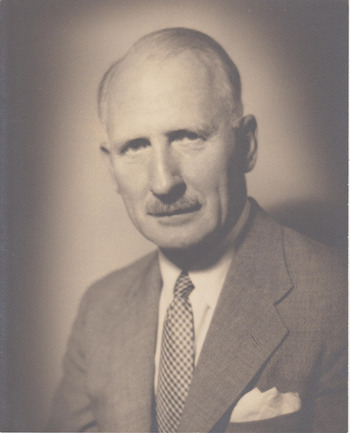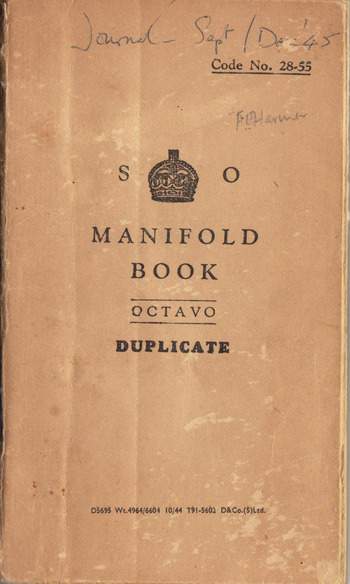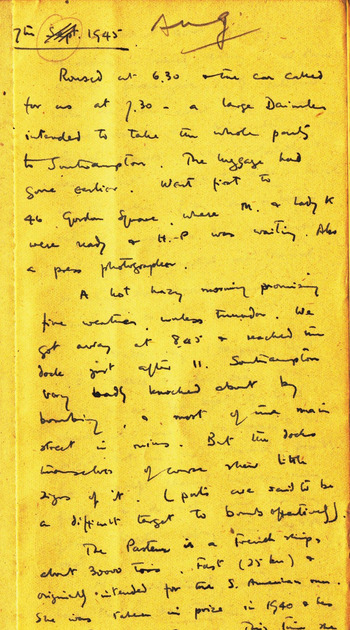


Frederic Harmer in the 1940s. Courtesy of James Harmer.

Provenance
Austin Robinson to Harmer, 15 November 1991
Typescript
From Professor Austin Robinson
Professor Emeritus of Economics
Sidney Sussex College,
Cambridge
My dear Freddie,
Forgive me writing to you after an interval of what IFootnote 1 think must be forty-five years. Let me explain why I am writing.
In the process of tidying up my room in the Marshall library, I found a diary of the Bretton Woods Conference. It was a typescript copy on foolscap paper. It was fascinating. It was obviously written by someone very much more alive and intelligent than the ordinary Treasury civil servant. By a process of elimination, I arrived at you as the almost certain author. I sent it to Donald Moggridge, who has edited the Bretton Woods volume in our Collected Writings of John Maynard Keynes.Footnote 2 He confirmed that it was not among the Keynes papers in the King's College archive.
I have been in touch with the archivist. I am told that they would love to have it in their archive. I am writing to you to ask you whether I am right in thinking that the diary is yours. But in particular I am writing to ask whether you will allow me to give it to King's College.
Of all the archives in Cambridge, I think the one in King's is the best place for it, where it will be seen by people who are working on the Keynes papers.
I very much hope this is agreeable to you. But I do not think it would be right that I should give something of yours to King's without your permission.
Like all the rest of us I am getting older. But I still survive. I have given up trying to understand what the present generation regards as economic.
Yours ever,
Austin Robinson
[holograph]
[Source: in possession of James Harmer.]
Harmer to Robinson, 16 December 1991
Typescript
Tiggins Field,
Kelsale,
Saxmundham,
Suffolk
My dear Austin,
I was pleased to hear from you, but forgive the delay in replying. I don't often have the opportunity to dictate, and in the absence of such help my capacity to write letters is very limited. I have had one or two strokes.
If the document you refer to really is a copy of a diary of the Bretton Woods conference it can't be mine because I wasn't there. I was back in the Treasury having been recently in Washington – that is, if it was in summer ’44. I can't remember, though, which year it occurred – summer ’44 or ’45, but in either case I wasn't there, so I cannot have kept a record of it. It does, though, sound a little bit like a copy of a diary or journal which I kept on one of my visits to Washington – probably the one when I was accompanying Maynard just after VJ-Day for the wind-up negotiations on Lend Lease and all that.
To sum up, if it really is about Bretton Woods it can't be mine, but if it is about Washington with Maynard there it might be, in which case I should not have the slightest objection to it being offered to King's archives if they should care to have it.
It was nice to hear from you, but don't start giving yourself airs about being a bit senior to me. My sister has just celebrated her 97th birthday, having come down from Cambridge in 1915. So if she can do it, so can you, and she beats you by quite a lot of years.
With regards, and Christmas greetings from us both
Freddie
[holograph]
[Source: Archive Centre, King's College, Cambridge, John Maynard Keynes Papers, JMK/MM/7.]
Robinson to Harmer, 20 December 1991
Typescript
From Professor Austin Robinson
Professor Emeritus of Economics
Sidney Sussex College,
Cambridge
My dear Freddie,
I am delighted to have your letter. I had just got to the point of wondering whether I had mis-directed my letter.
I stand reproved. The Americans to whom you were talking during your visit with Maynard were so much the same as those involved in Bretton Woods that I muddled the two occasions.
I am giving your record to King's. Do you have a copy of it yourself? Would you very much like to have a copy? I think we could arrange it.
Your sister has me beat. Knowing what it is to be 94, I can visualise what it must be to be 97.
It will amuse you to know that I still visualise you as you were forty-five years ago. I imagine that you must have changed slightly over the intervening years.
Happy Christmas and New Year to you. Like you, I entirely depend on my secretary for any opportunity of answering letters.
Yours ever,
S. Macdonald
p.p. Austin
[Source: in possession of James Harmer.]
Handwritten note, undated
By a process of elimination it ultimately becomes clear that the author of this fascinating record is Freddy Harmer sometime of Eton and King's and possibly the best economist produced in Cambridge in the period 1925–35.
E.A.G.R.
[Austin Robinson]
[Source: Archive Centre, King's College, Cambridge, John Maynard Keynes Papers, JMK/MM/7.]
Harmer Diary cover. Courtesy of James Harmer.

Harmer Diary, p. 1. Courtesy of James Harmer.

The Diary
27th August 1945
Roused at 6.30 and the car called for us at 7.30 – a large Daimler intended to take the whole party to Southampton. The luggage had gone earlier. Went first to 46 Gordon Square, where M. [John Maynard Keynes] and Lady K. [Lydia Keynes] were ready and H.-P. [Hall-Patch]Footnote 3 was waiting. Also a press photographer.
A hot hazy morning promising fine weather, unless thunder. We got away at 8.45 and reached the dock just after 11. Southampton very badly knocked about by bombing, and most of the main street in ruins. But the docks themselves of course shew little signs of it. (Ports are said to be a difficult target to bomb effectively).
The PASTEUR is a French ship and about 30000 tons. Fast (25 knots) and originally intended for the S. American run. She was taken in prize in 1940 and has been trooping all the war. This time she carries about 4000 returning Canadians – mainly Army– no civilian passengers. B. [Barbara – Harmer's wife] returned with the car about 12.30 and we settled ourselves in. My cabin in the officers’ quarters – very comfortable and roomy, but reputed to leak. Lunch in the cabin (as she is trooping only 2 meals a day are served, but we are supplied with normal, or rather extravagant, meals at the usual times).
Under way at 1.30 p.m. Light S.E. breeze and calm sea. Very hazy and we lose sight of land almost at once. We appear to be right out in mid-Channel – possibly for a swept channel between minefields – and do not even see any of the lights along the English coast.
M. spends the day resting. But we have tea and dine together. Hall-Patch was in China up till the Japanese war began: he arrived in Hong Kong the day before Pearl Harbour and was ultimately flown out in the last plane to leave (for Chungking) before the surrender. Described the utter ineptitude of the defence preparations particularly Singapore (where the GovernorFootnote 4 and C. in C.Footnote 5 were not on speaking terms) and Burma: Hong Kong not quite so bad, but totally unprovided either with armaments or food. Duff CooperFootnote 6 did a good job in getting things co-ordinated in Malaya but arrived too late to accomplish much.
He is entertaining and libellous about Chinese politics and politicians. Chiang Kai ShekFootnote 7 apparently started life as a soldier, but had to leave after opium scandals in Canton. He then went into business (as a broker) in Shanghai, but his firm defaulted after a few years and he absconded. There were warrants for his arrest. Then he became a war lord and finally the leader of the Kuo ministry. Mme Chiang is not his first wife:Footnote 8 he has others, who have borne him children (she has not) and in Chinese eyes she is merely his, say, third concubine. (They were however married by the Presbyterian Church, which conveniently ignored his other establishments, and this formed the basis for putting him across [to] the Western world).
And so on. Not an attractive set-up; but not worth detailing at length.
After dark, we ran into thunderstorms. Heavy rain after about 11 p.m. and a lot of lightning around. Sea still calm but a slight ground swell.
(P.S. Off the Nab Tower we passed a warship, which proved to be H.M.S. ONSLOUGH; a flotilla leader which, I believe, had a terrific achievement in a battle escorting a Russian convoy. She signalled us “Best of luck to you and your distinguished passenger”. M. purred).
28th August
A fine morning with a light S.W. breeze. We had passed Bishop's Rock Light at 1.30 a.m. and were 20 miles off the Irish coast at 8.30. Not visible. We have the run of the bridge and better still the so-called convoy bridge – a small deck space about it, right on top of the ship, but well screened from the wind. Spent most of the day there (we have it to ourselves) and did a little desultory work. But it clouded over in the afternoon and by tea-time we [were] in haze, with the wind veering and rising. By 6 p.m. it was northerly and by midnight fresh. The ship rolls very little and her motion is easy.
After tea some general discussions with M. who has spent the day browsing on his papers. Ditto after dinner. But he is deliberately resting and keeping away from serious work for a bit.
29th August
The northerly wind died away in the small hours and the early morning was calm. Then it freshened from the S.W., veering W., with rain squalls and a slight sea. Rather cold and not attractive on deck.
Spent most of the morning in a prolonged tour of the engine room etc. with the Chief Engineer, who gave us (Hall-Patch and self) pink gins afterwards in his cabin. We must arrange a party for M. to meet them all: they are all desperately eager to shake him by the hand.
Most of the afternoon and evening working in my cabin and chiefly preparing for the talks in Ottawa. We hear on the wireless that the news of our going to Ottawa first is now public, and well received, and that Byrnes has made placating statements in Washington.Footnote 9
A very good dinner (the food is superlative) with a bottle of Clicquot ’28 and of Gevry Chambertin ’21 from the ship's cellar, which the captain has just ransacked for M's benefit. M. in full blast on the iniquities and ineptitudes of the treasury (a pet topic) but not talking shop.
The glass has fallen nearly half an inch since the morning. So far the weather isn't anything terrific but there may be some ahead.
We were about half way across the open sea (Bishop's Rock to Belle Isle) at noon. Subject to weather fog and icebergs (all prevalent off Newfoundland) we should be in the straits by some time on Friday morning [Friday 31 August]. This would put us rather ahead of our schedule.
30th August
The sea was rising and the wind was freshening at midnight, and it looked unpromising. Bitterly cold. But in the small hours we ran into calm weather and by the morning there was only a light S.W breeze, and fog. Occasionally it would lift for a few minutes and a feeble sun come through, but for most of the day visibility was barely ¼ mile.
With radar, this made no difference to our speed. Apart from very small icebergs (which may not shew above the surface) anything can be picked up; and out here there is no traffic.
A quiet day. After tea we had a prolonged discussion with M. about the Canadian question; also discussed his notes for his proposed interview with the press on reaching Washington. Very tentative as we shall need to see what develops during the time we are on the way. M. is enjoying the trip and the rest and as a result is very – probably over-confident. But he has an incredible capacity for quick adaptation. At present he is more than half persuaded that we shall find a pretty good atmosphere in Washington: I doubt it.
About seven the breeze suddenly veered N.W. and cleared up the fog in a few minutes. There followed a lovely clear cold evening and it was pleasant to see a sunset for a change, and the stars. Very cold, but no icebergs about. It seems certain we shall be in the straits in the morning.
31st August
There was a superb aurora last night. I went up on deck at 11.30 and came down below just before 12. Apparently it started soon after 12 and went on for two hours. Oh to have missed it. The captain has promised to rouse me if it recurs tonight.
A lovely morning – clear sky, light breeze, flat calm. We were just entering the strait, between Belle I[s]le and Newfoundland, when I got up. By about lunchtime we were through the strait and out into the more open Gulf of Newfoundland beyond. The Labrador coast to the north is bare granite rocks, rolling country above with scrubby vegetation and trees only in an occasional valley. A very few houses by the coast – and apparently none inland until we got to the further end of the strait when one or two slightly larger settlements appeared. There was an iceberg grounded half way down – the only one seen on the trip, though one was picked up by radar, 17 miles away, during the night. The Newfoundland coast the other side is low-lying, sandy or marshy, with many more trees and relatively numerous houses. But very poor-looking – hardly any visible cultivation.
Ships few and far between – one or two steamers and a single small fishing boat.
Spent the morning on the bridge (and later drinking pink gins with the Chief Engineer – a nice elderly Irishman from Queenstown who knew Major BagnallFootnote 10) and the afternoon working. After tea a long talk with M. about the Washington negotiations. He has re-written his paper, with some improvement.
We should reach Quebec tomorrow evening, about 9. (I have telegraphed Gordon MunroFootnote 11 to ask for transport for Sunday morning, which I hope can be managed. The extra day should be a godsend).
A clear starlit night with the Milky Way shewing up brilliantly. Much warmer after the cold of the last two days, and it should be hot by the time we reach Quebec.
1st September
The fine weather was over by the early morning. Sometimes fog, sometimes torrential rain, and the whole time cloudy and muggy. Much warmer as the day went on. Picked up the pilot at farther Point – about 150 miles from Quebec – at 10 a.m. We gave a party for the ship's Officers etc. at 12 – they are a pleasant lot – thrilled at meeting M. of course.
After lunch a little work – then on the bridge to watch the ship through the Traverses – a shoal area at the bottom of Orleans Island. An interesting operation as there was less water in the Channel than the ship drew when steaming so she scraped over on her tail and her steering – always rather wild – became sensational.
Later we came up to see the approach to Quebec. Heavy rain which fortunately cleared just in time. Q. [Quebec City] lies at the head of Orleans Head and stands well up on its cliffs – Heights of Abraham, etc. As we approached the town salutes were fired from the citadel, ships’ sirens went off all night and the PASTEUR responded by blowing V's (…—) rather ponderously on her own siren. All the troops on board (some of them had been overseas for nearly 6 years) wildly excited and cheering like mad. Berthing was a long process, as there was such a racket that no orders could be heard. One of the hawsers parted twice before we were finally moored.
A young man – SykesFootnote 12 – from the H.C.'s [High Commissioner's] Office came on board and told M. (Hall-Patch and I unfortunately were drinking gin with the Chief Engineer) that there was a plane to take him straight on to Ottawa that night. We had all tried to head him off the idea earlier. Anyway, he insisted on leaving: and we took hurried farewells and armed with sandwiches drove off in a couple of staff cars to the airport. A terrific storm was on, and we got to the airport to learn there had been a mistake; flying was impossible and went back to the Chateau Frontenac for the night. A pity – it would have been so much pleasanter on board the ship.
2nd September
The storm had blown itself out during the night (the glass had dropped nearly 1 inch in 12 hrs!) and it was a grey morning. We reached the airport at 9.30 and took off almost immediately in a Hudson, which accommodated us 5 (including Sykes) and the baggage very comfortably. A quick and quite eventful flight – still weather and we flew just below the clouds at about 2000 ft which was no strain on M's heart. On reaching Ottawa at 11.15 we had to wait a bit for the signal to land and circled the town two or three times. It looks very well from the air, standing on the Ottawa river, with lakes and rivers all round in the distance.
Gordon Munro and Stephen Ho[l]mesFootnote 13 met us on the airfield and we drove to [the] Chateau Laurier [Hotel], where M. and Lydia have a suite and I have very pleasant rooms along the same corridor. Frank LeeFootnote 14 and Ken [Goschen]Footnote 15 arrived by air from Washington about 12.30 and we lunched together in the hotel. After lunch Malcolm MacDonald,Footnote 16 Stephen Holmes and Raymond Ball [should be, and hereafter entered as, Bell]Footnote 17 arrived and we had a talk in M's room, which lasted till 6.Footnote 18 Discussed first the Canadian question – we meet IlsleyFootnote 19 and Canadian officials at 11 tomorrow – and then the U.S. one. Canada looks relatively plain sailing, subject to a lot of technical problems, most of which I shall have to try and settle with Bob Bryce;Footnote 20 Washington looks like being a very stormy passage. Frank's [Frank Lee's] description of the general atmosphere not encouraging, and there has been a major row over 3/c agreements,Footnote 21 with loading of supplies held up by the Americans and a telegram from the P.M. [Clement Attlee]Footnote 22 to Truman,Footnote 23 since we left. (That incidentally seems to be sorting itself out).
Frank [Lee] commenting on Truman's handling of the whole L/L [Lend-Lease] episode said the current cliché was that he shoots from the hip. M. said he preferred to describe it as dropping bricks from the hip.
After the meeting broke up Gordon [Munro] Ken and I went to Earnscliffe [High Commissioner's residence/offices] and I drafted a telegram to London explaining what we proposed to do about interim financial arrangements. This took nearly an hour and we then collected Hall-Patch and went to Gordon's house (out in Rockliffe) for supper. Muriel [Munro] and the children being away Gordon is entirely alone – no help. We had cocktails and got ourselves supper – I did the cooking but only buttered eggs and we talked and drank beer very pleasantly. While we were industriously preparing supper we turned on the radio which told us that intense political activity prevailed in Ottawa on the arrival of Lord Keynes and British officials to discuss etc. etc. It seemed very unreal. Finally Gordon drove us back to the hotel – earlyish as we were all tired – and I went early to bed.
3rd September
Ken [Goschen] and I breakfasted together in the cafeteria. It was a cold night but developed into a very pleasant day – sunny and fine but not too hot. We went along to the Dept. of Finance and met Ilsley (Minister of Finance) and a number of officials – Bill MackintoshFootnote 24 and Bob Bryce (Finance), Graham TowersFootnote 25 and RasminskyFootnote 26 (Bk/Canada), Norman RobertsonFootnote 27 and PierceFootnote 28 (External Affairs), Hector MacKinnonFootnote 29 and Max McKenzieFootnote 30 (Dept. of Commerce). Ilsley was originally a schoolmaster – intelligent but rather donnish in looks, and so desperately tired that he has very little vitality in him. The others were a hand-picked collection, all very good and absolutely straight, and the main subject was to let M. talk off the record and tell them exactly how we stood with Washington. We had some talk first of the Canadian problems, but it tended to stray into technicalities and it was left to me to sort it all out with Bob Bryce. Then M. got going on Stage III, commercial policy etc. It was an admirable audience for M. to try out his ideas on and they were on the whole encouraging in their reactions. One of the main functions of the Canadians is to help us to see how our own ideas and points of view are likely to impinge on the Americans and the great thing about this sort of audience is that one can talk completely freely and yet get a very good idea of how our ideas and American ones are likely to differ.
We finally ended at 1.30. Ilsley was to talk to the other Canadian Ministers on one or two points: M. to talk Commercial Policy with Norman Robertson and MacKinnon: and I to see Bob Bryce. Hall-Patch and I lunched with Gordon at the Rideau Club, and I went back to the Dept. of Finance, with Gordon, for part of the time, and Raymond Bell. A long and rather technical discussion, lasting from 3 to 6, but we got quite a way.
Afterwards Gordon drove us out to the Country Club – a very pleasant, not too sophisticated affair a few miles out up the river – where Ilsley gave us dinner. 16 people there, including all those at the morning's meeting and one or two others. I sat between Mackintosh and Graham Towers.
We broke up at 10.30 and went back to the hotel. Thank goodness they keep early hours in Ottawa. Incidentally Frank [Lee] and Ken [Goschen] left at 11 this morning to return to Washington.
4th September
Hotter and more thundery, though no storm actually developed. Morning at Earnscliffe, mainly dictating in order to sort out all that has been discussed in the last 24 hours. Lunch with Raymond Bell in a pleasant French-Canadian restaurant across the river, in Hull. Afterwards a meeting among ourselves to run over the ground and settle the drafting of a few telegrams to London. Nothing more has developed on the Canadian side
Later Gordon and I went to see Karl Fraser, executive head of [Canadian] Mutual Aid Board. Apart from Adm[iralt]y, who seem as usual to have overreached themselves, the position as regards cancelling contracts looks fairly satisfactory.
The High Commissioner [Malcolm MacDonald] gave a dinner party – list attached but there must have been 19 present as everybody named except Rasminsky was there.Footnote 31 Earnscliffe is a medium sized not too pretentious house – late Victorian or Edwardian presumably – and its chief interest is that it stands on a sort of headland overlooking the Ottawa River (which must be 300 or more yards across there) with a very nice view of the sweep of the river towards Ottawa itself. It is about a mile from the centre of the town. I sat between Claxton,Footnote 32 Minister of National Health & Welfare (a comparative newcomer to the Cabinet, youngish and intelligent) and Arnold Heeney,Footnote 33 the Secretary of the Cabinet, a bright young man, not more than 30 at a guess, who could go a long way. After dinner M. held forth for an hour or two, on everything under the sun, but mainly on the prospective Washington negotiations and on Germany. On the latter he holds strong views; military occupation was a mistake in that there is no practical possibility of Germany becoming a menace for years, and by the time she could become dangerous we shall all be so sick of it that we shall be pulling out: meanwhile the place is in an unthinkable mess and what started as an army of occupation will end up as a glorified Red Cross organisation at our and America's expense. The Russians will no doubt be tougher, but we haven't got it in us. He remarked that the fundamental point in his view, both in the last war and this, should have been to ensure that whoever paid reparations we did not; and we had failed last time, and would probably fail again, though for different reasons.
The rather large body of Canadian Ministers contributed very little to all this; they mostly sat around rather spellbound, while their officials cross-examined him. This inner circle of Canadian civil servants is a rather outstanding collection: mostly young and all first rate.
5th September
Fine and warm but not quite thundery. After breakfast I had a talk with Vesugar,Footnote 34 head of the Indian Supply Mission in Washington and two of his chaps whose names I did not catch. Next we had a meeting in M's room with the heads of the U.K. missions about their supply arrangements, cancellations etc. At 12.15 we went over to Ilsley's room, where he saw us with HoweFootnote 35 and St. Laurent,Footnote 36 and a row of officials. The general upshot was that they would meet us most of the way, on cancellations, recapture of goods in transit, and on putting date of termination back to 2nd September, but wanted some minor concessions in return, to which M. gratefully agreed. St. Laurent made routine objections (speaking as the representative of French Canada) but the impression was that he really agreed but wanted to keep himself right with his party. They were to have a full Cabinet to decide the matter in the afternoon.
After lunch, M. and Gordon and I went to see Mackintosh about the L/L [Lend-Lease] question. Mike Pearson,Footnote 37 (Canadian Ambassador in Washington) also there and one or two others. A good meeting in that at last we came to a positive decision how to handle this very old and troublesome question.
Then we saw Admiral Rawlings and [F.N.] Smith of B.A.T.M.Footnote 38 about their shipbuilding programme. They are in rather a mess through not getting proper instructions from Admiralty but there may be time to sort it out.
Hall-Patch and I dined in the hotel restaurant and I then proceeded to draft telegrams till midnight.
6th September
A day of frantic rush, and to add to everything, very hot and [?steamy] –up to 90°. I forgot to say that late last night Gordon rang up to say the [Canadian] Cabinet had agreed the proposals of our morning meeting with Ilsley.Footnote 39 Spent all the morning working on draft telegrams, press announcements, etc. with M. and M. gave a lunch to wind up the visit. Malcolm M. [MacDonald] and the rest. Then we had a hurried talk with Admiral Rawlings again, followed by one with Mackintosh and Bob Bryce and finally bustled M. off to the train at 3.45. At the last moment I decided to stay the night so as to clear things up with Gordon, and fly in the morning – T.C.A. [Trans-Canada Air Lines] to Montreal and courier plane on. They had put on a special coach for M. as far as Montreal but there he had to change into the ordinary Washington train.
He (with Lydia and Hall-Patch) left at 4. Gordon and I returned to the hotel and then to the office, where we worked till 7. Then we came down town and saw Bob Bryce (about the Admiralty ships) and Gordon went off home. I dined in the hotel and afterwards had an hour with Vesugar about his locos and railway waggons. Finally I took a cab out to Gordon's, spent an hour there, with much-needed whisky, and got the last of our telegrams disposed of, and he drove me back to the hotel at midnight. I have to be up at 7 for the plane.
7th September
Got up at 7, packed and was just dressing when the airline office telephoned that the plane was delayed and we should not leave the hotel till 9.45. This would almost certainly wreck any chance of connecting with the courier plane, due to leave Montreal at 11. I asked them to get on to Montreal and try and hold it back, and put the office (via Gordon) on to doing likewise. I could only get assurance that it would probably be all right, and that the main thing was to get to Montreal and see what could be done. Gordon himself looked in to say goodbye – no further developments.
Drove out to the airport (about 20 minutes – a different one from where we arrived on Sunday [2 September] and finally we took off at 10.30 – a 2-engined T.C.A. plane, rather like a D.C.3 and very comfortable. Fine and very hot, but hazy. We reached Montreal about 11.15 and I made contact with the Transport Command people, who drove me across the field and put me into the plane, which fortunately had waited. Then off to N.Y. Very hazy, sometimes almost foggy. There seemed to be pleasant country – lakes and fairly high hills – about half, I suppose in Vermont, but very little could be distinguished in the haze. Over N.Y. you could hardly see the ground from 2000 ft. and the skyscrapers only loomed out of the haze occasionally as we circled to land: they looked even more fantastic than usual. Down on La Guardia airport at 1.30 and I got a sandwich and a cup of coffee at the PX,Footnote 40 cleared the customs etc. (who were very friendly contrary to reputation) and we took off again at 2.15. It was a Hudson, similar to the one which took us from Quebec, and the same pilot from N.Y. – Norwegian. 5 or 6 passengers, all going to the Missions in Washington. Still very hazy, but as we got beyond Pittsburg[h] it cleared and there was a grand view. Then we came into cumulus and flew on top of it at about 5000 ft. till it started breaking up and we flew through it and finally below it, quite low, for the rest of the way. Reached Washington airport at 4 and Ken [Goschen] met me and drove me to the Willard,Footnote 41 where we found M. just starting a meeting with Brand,Footnote 42 Henry Self Footnote 43 etc. At about 8 Ken, Frank [Lee] and I left the office and drove to Frank's house (his wife is still away in Maine) where we cooked ourselves supper and afterwards, in the intervals (on my part) of trying not to fall asleep, played ping pong. Back to the hotelFootnote 44 about 11, where after some muddle about the rooms I got unpacked and thankfully enough to bed. A comfortable room with gadgets and fully air-conditioned: not too bad on the whole.
I felt extremely tired, though it had been a most comfortable flight. Washington red-hot and rather muggy.
8th September
Morning in the office, without incident, and we all lunched down by the fish market at a rather pleasant small restaurant called Naylor's. After lunch a long meeting with Missions discussing their programmes etc. which lasted till 5.30. Later on Frank and I went to dinner with Roger StevensFootnote 45 (secretary of B.S.C.Footnote 46) at his home in Georgetown. His wife [Constance] and Ronnie MorrisonFootnote 47 also there. Roger is a very pleasant and very entertaining person and it was a good restful evening. It had been even muggier and hotter than ever and a mild storm broke after dinner – not alas enough to clear the air. This made us rather late, as we waited for the rain to stop, and finally Roger drove us home at about midnight. I still haven't caught up on sleep.
9th September
I decided not to be called but to sleep it out, with the result that I woke at 10.15. I had meant to do a morning's work in the office so it wasn't so good. But I got there about 11.30 and read papers etc. till 1 (having just scoured the latest version of M's main paper for the negotiations), when Ken [Goschen] and I and Dorothy EvansFootnote 48 (of the Tey. [Treasury] recently sent out here to UKTDFootnote 49 as a junior) went off for a picnic, in David McCurrach's car,Footnote 50 which Ken has while D. [David] is on leave. We went across the river into Virginia and then up N.W. parallel to the Potomac. Sandwiches en route. It was hot as ever in Washington but just bearable in the car. Undulating, fairly wooded country for the first part of the drive (Ken is a farmer and the standard of farming breaks his heart, apart from the cattle which are good) and then as we approached the Blue Ridge (a line of mountains up to 4000 ft.[,] further away, but no more than hills at this end) it got more open, apart from hills which are thickly wooded, largely oak and maple, and became very pleasant, though not terrific, scenery. We decided to make for Harper's Ferry and our map shewed a bridge over the Shenandoah which joins the Potomac there. But after 4 miles off the main road we got on to a very bad dirt road (so-called – i.e. untarred) which threatened to peter out any minute. We finally reached the Shenandoah opposite Harper's Ferry to find the bridge had been washed way in 1936 and not rebuilt. So we got ferried across by an ancient boatman in an ancient punt, and walked around the place. It is a small town, of historic interest (though I don't know why) which was largely wrecked by the floods of 1936 and has never been rebuilt but a very lovely situation, on the confluence of the two rivers, and superb views of the thickly wooded rocky gorges with rapids below. Characteristically the finest bit of rock face (on the Maryland side – the three states V'a, W.V. and Md [Virginia, West Virginia and Maryland] meet on the river edges) has a large advertisement of somebody's toilet powder painted on it.
Then back across the river and up our bumpy road. (We longed to bathe but had no bathing dresses). The boatman told us lurid stories of the snakes to be found in the banks – rattlesnakes and copper snakes, both highly poisonous, but we saw nothing more formidable than a rabbit or two. The butterflies were lovely and there were a lot of cardinals and other good birds (though unknown by name to us) to be seen. Got back to Washington, having driven about 110 miles, at 8.30. Had a meal in the nearest available eating house and Ken drove me back to the Statler.
10th September
Hot and muggy again, with some rain in the morning. We had a meeting at the Embassy in the morning with the Ambassador [Lord Halifax],Footnote 51 M., Brand and the rest of us. Largely to discuss the opening formalities, as we are to meet the Americans for the first time tomorrow. It is going to be very difficult to keep H.E. [His Excellency, the Ambassador] up to realising what this means and to keep him adequately briefed. He starts off very annoyed at having to cut short his time in England for the purpose, and it isn't exactly his subject.
Apart from this, all the day spent in preparing papers at the Willard.
Frank [Lee] and I were dining with Win Brown,Footnote 52 who is now at the State Dept. and has temporarily Charles Noyes’ house out at Wisconsin [Avenue].Footnote 53 We left the office at 7.45 and after failing to get a taxi, arrived by streetcar at nearly 8.30. Just the three of us – Win very friendly but a bit more remote from real life than he was in London and I found the evening rather depressing because from various hints he dropped it looked as if the Americans were still a very long way from understanding the question and quite unrealistic in their ideas. But he gave a good dinner and it was not a bad evening.
11th September
Cooler – Almost tolerable, though still feels thundery. An uneventful morning in the Willard. Lunch with M., Frank [Lee], Ken [Goschen] and Charles Denby,Footnote 54 who has been on a long holiday since he left F.E.A.Footnote 55 and is now about to return to his law practice in Pittsburg[h]. Pleasant to see him again and he seemed to be in very good form and glad to be out of the racket.
At 4, the opening meeting. Frank, Ken and I drove to the State Dept. with M., closely following CrowleyFootnote 56 and his lot from F.E.A. When we met on the steps of the SD [State Department] M. was almost overwhelmingly genial which was unlike his usual form but means nothing. The opening meeting was in the S.D. [State Department] conference room where we held the oil talks in May last year.Footnote 57 There was the usual business of press photographers etc. and the session was mainly formal. Nominally a meeting of the steering committee (Clayton,Footnote 58 Vinson,Footnote 59 Crowley, Wallace,Footnote 60 Eccles (F.R.B.)Footnote 61 and McCabeFootnote 62 (S.W.P.A.Footnote 63) on the U.S. side, and H.E. [Halifax], M., Brand, Self and Hall-Patch on the U.K. side) but the Americans were as usual surrounded by a vast phalanx of supporters from Tey [Treasury], S.D., F.E.A. etc. Among these Harry WhiteFootnote 64 and one or two others of note whom I was glad to see again. We are setting up a series of Committees on the various subjects, and I shall sit on the Finance, Lend-Lease, Procurement and Surpluses ones: the Finance, Lend-Lease and Commercial Policy (which thank God I escape) are the ones which really matter.Footnote 65
This all lasted an hour or so, after which back to the Willard to go on with the preparatory work. It isn't one quarter finished, but no doubt it'll come out right sooner or later. London are being quite sensible so far and giving us a free hand to do pretty well what we like.
Frank and I dined with Brand. We left the office at 7.15 and were driven in his car to his house – some way out beyond the Md [Maryland] DC crossing. A very good dinner followed by heated argument in which I said I thought the Americans would start by dressing up the whole thing as a matter of accountancy, however well disposed, in order to placate Congress, and they said they couldn't believe it. I think they are over-optimistic: though I don't take it all too tragically.
A letter from B. [Barbara] at last: it had taken 10 days to arrive – written while staying with Jan and Dave. Felt very homesick and anti-Washington (though I can't say I ever really liked the place) all evening.
12th September
A change in the weather, the sticky oppressive heat of these last days has gone entirely and it is fine, sunny, with a bit of a breeze and feels quite cool in comparison, though actually the thermometer is still in the 80's. An eventful morning in the Willand [Willard – consistently misspelled in TS and usually corrected], and after lunch we went up to the Embassy for a Press Conference. The big drawing room on the first floor was used – entirely filled with chairs and there must have been two or three hundred people present. Halifax started off with a short speech about things generally in England, a few purple passages some of which went down well and some were not so good: didn't talk much about the financial questions: on the whole it sounded well and was I think well received. Followed by M. who made a longish statement (carefully prepared and vetted by all of us in the morning) which he delivered brilliantly. He contrived to make it sound both dramatic and spontaneous and though he stuck strictly to his draft, which he knew pretty well by then, it sounded amazingly spontaneous. There were innumerable questions afterwards from the reporters: very few hostile, mostly quite genuine enquiries for explanations etc. though he couldn't answer a lot of them because it had been decided he should not let himself be drawn on the lines of the proposals which might be made in the negotiations. H.E. [Halifax] brought it to an end at 4.45 after 1¼ hours but it looked as if it could have gone on almost indefinitely.Footnote 66 After that drinks were provided (which Ken and I found not unwelcome) and the reporters hung about. We went back to the Willard, ending up with a long and incredibly tiresome discussion about statistics with Roy Allen,Footnote 67 now with C.P.R.B. [Combined Production and Resources Board]Footnote 68 and almost more spinsterish than even a professional statistician has any right to be.
We finally left the office after 8.30 and drove out (still in David's car) to a restaurant by the river, which however was by then closed. So we drove across the river to Hot Shoppe (sic – i.e. a local equivalent of a Lyons Corner House) which was just like home because everything we ordered was found in turn to be off.Footnote 69 Ken then suggested going to the airport, which is about 1 mile along from where we were to watch the planes. A rash suggestion as it turned out, as driving on the Virginia side is a highly skilled operation, particularly by night. There are three or four big arterial roads radiating out, with no side roads off them (the other roads are mostly taken under bridges and don't interconnect) and very badly signposted. Where there is any sort of crossroad, it involves a very complicated clover leaf system of interconnections, not awfully easy to cope with if you don't know it. As a result we drove about 5 miles out along one road without being able to leave it. Then with some difficulty got off it, under it and back along it to another, which we thought was all right. But it proved to be still too far to the right of where we were aiming and we must have driven nearly 10 miles along it, right into Alexandria, before we could get a left turn. Then at last we got on to the proper road and reached the airport. It is an admirably designed modern building, largely glass bricks and plate glass, and for a dime you can go out on a balcony running the whole length of the building and watch planes coming in and taking off – which they seem to do all through the night at intervals of a minute or two. We decided our respective sons would have thought rather highly of it – so we did ourselves. It was a lovely warm night with just enough breeze to be pleasant.
Then back to bed.
13th September
Not quite so good a day as yesterday but fine and unbearably hot. A hectic morning getting papers ready for the afternoon meeting with the Americans, interspersed with meetings with M. etc. and the first meeting of the L/L [Lend-Lease] Committee. A hurried lunch and we finally got all the stuff together just in time to leave at 3.15 for the party, which this time took place in the Board Room of the Federal Reserve Board Building (along Constitution Avenue). A good deal more unnecessarily luxurious than even say the Bank parlours, but really rather well done, and not too overdone. All the same people there as on Tuesday [11 September], except Wallace. M. started off on his statement of the U.K. position which is to take two sessions. He did it well, as he always can when it is a question of straightforward exposition of a complicated subject. He has a bad habit of turning to me on these occasions and asking for statistics out of the blue. I usually have to guess the answer equally out of the blue and we look it up afterwards and correct the record in the Minutes. But it makes a good side show. Nothing much emerged from the Americans, but they were sensible and obviously knew their job.Footnote 70
This lasted from 3.30 to 5.30 and we then went back to the office, leaving at 7 (for a change) for a cocktail party at Roger Stevens! Nobody special there but very pleasant. I slipped away fairly soon, dined by myself downstairs and for a change went to bed early.
14th September
Hot and muggy again. I had sent one tropical suit to be cleaned and felt very sticky in ordinary clothes. A meeting in the morning of the Surpluses Committee with McCabe presiding. An amicable old boy but usually completely at sea. I rather took charge, somewhat to Henry Self's perturbation because I thought he seemed to be far too mild about it all. However, he admitted afterwards it was the right line. McCabe told me Benno [Schmidt]Footnote 71 might be over here again before long.
In the afternoon (no time for lunch but we had sandwiches sent up) another meeting of the Steering Committee and M. continued his dissertation. All about the financial statistics. It went quite well and lasted till nearly 6. Later I dined with Maurice BridgemanFootnote 72 at a good Italian restaurant near the Mayflower (just off Connecticut Avenue) and listened to him talking oil politics most of the evening – always an entertaining pastime.
Then to bed. I had meant to work again after dinner but it was too late. Anyway I succeeded in buying and mailing a box of chocolates to James [Harmer's son] for his birthday.
15th September
A wet rather stuffy day again, not terribly hot. Spent a hectic morning in the Office getting more papers drafted for the next chapter of M's exposition (Monday afternoon [17 September]) and after lunch went back to clearing up other overdue work. Ken [Goschen] and I stayed late at the Office and finally dined together, with a young man called John WyndhamFootnote 73 who has just come out as Brand's secretary. Rather dim. Ken and I went back to the Office after dinner and worked until about 11.
Not an eventful day for myself. But there has been a lot of trouble around our Commercial Policy. Ministers seem to have changed their minds or something, and a very large party including [Sir Percivale] LieschingFootnote 74 is to come out at the end of next week. M. was very angry but took it well. Ditto Halifax.
16th September
Sunday – but I had a lot of work to finish before Monday's meeting so went down to the office at 10. A damp, fairly cool morning, with a definitely autumnal feeling and signs of trees turning colour, etc. Lunch with M., Lydia, Roger [Stevens] and Mrs. Stevens at Harvey's.Footnote 75 Quite a good lunch and M. in terrific form, enjoying a more or less complete day off. But the upshot was a lot more things to get ready for tomorrow so I went back to the Office and aided by Paul BareauFootnote 76 and a statistician called Coase (from C.S.O.Footnote 77) worked till 7.30 when we had pretty well finished. So we had dinner together at O'Donnell's and I went back to the office till 10! I think I have got all set for tomorrow. But somehow we must stop M. promising the Americans papers at five minutes notice which really need a week's research. One has neither the materials nor the experts out here and though the finished products look pretty plausible, I would hate to say how many odd calculations on the backs of envelopes, and odd figures dug out of the files (which may be part of the statistical returns you are looking for, or maybe someone's telephone number) go to make them up. The oddest thing is that while we employ dozens, and the Americans hundreds, of statisticians who grind out masses of detailed information, nobody can ever bother to wade through it when it comes to the point, and one always proceeds precisely as described above. But that's how it always happens. Anyhow the official statistics are usually self inconsistent.
17th September
A streaming wet day. There has been a hurricane over Florida, now moving up the coast and we are on the fringe. Too far away no doubt to get the winds, but the rain has been terrific and practically unceasing.
In the morning a meeting with H.E. [Halifax], M., R.H.B. [Brand], Ken [Goschen] and myself to discuss plans generally H.W. [Harry White] has warned M. that things will be pretty sticky for a bit and he mustn't lose his temper except at right moments. Which rather pleased M. and actually it won't suit us badly not to force the pace for a bit. After lunch a meeting of the Steering Committee and M. completed his statement of the U.K. position. A very fine performance: we had done him pretty well in the way of material as the result of the week-end's efforts, and it made a very impressive story, superbly set out by M. in the morning – all about the general background, not the purely financial angles, which we had covered in earlier meetings.
Ken and I had dinner together – as usual rather late: Ken went back to the Office. I returned to the hotel. Wrote letter (one from B. [Barbara] written after Anthony's weddingFootnote 78) and to bed comparatively early.
18th September
Another streaming morning, but by lunchtime it had stopped and for the rest of the day it was warm, windless and very sticky. Apparently the hurricane blew itself out during the night and there is a promise of better weather.
No meetings with the Americans – a welcome change. Particularly for me, as my antrum, which had shewn signs of trouble over the weekend, had now become absolutely flaming and I could hardly think. I got hold of the name of a doctor, to ring up in the morning if it didn't improve.
Clayton gave a cocktail party at the Blair Lee House, a place just opposite the State Dept. used for official receptions etc. All the normal lot there on the American side, Clayton, Vinson and most of the Treasury, State Dept. and F.E.A. people whom we are meeting: so it wasn't particularly exciting. I went back to the Statler, had a bath and changed, which made me feel better, and met Maurice Bridgeman with whom I had dinner. We went to a place called Salle du Bois,Footnote 79 on Dupont Circle – expensive, but the first definitely good meal I have had here. We wandered around a bit, came and talked in my room after. I was feeling pretty rotten and convinced by then that cocktails didn't go down well with antrum trouble. However, I was wrong.
19th September
Woke up suddenly feeling quite different. Though it hadn't cleared up entirely, it was obviously recovering rapidly. Also it was quite a nice day – not especially hot or sunny, but reasonably fresh.
In the morning, we had the first meeting of the Finance Committee, and really began to get down to business. On the U.S. side, Vinson, presiding, Clayton, Eccles, McCabe and Jim Angell (vice Crowley).Footnote 80 On ours, H.E. [Halifax], M., R.H.B. [Brand], Hall-Patch and myself. M started talking possible arrangements – skating very delicately and cautiously round the whole subject – rather overdoing it perhaps. I didn't feel it went at all well; and it ended prematurely, as some of the Americans had another date – a somewhat frigid atmosphere as it seemed.Footnote 81
Nothing special in afternoon. M. saw H.W. [Harry White] who seems to have cheered him up quite a bit and didn't think it was going too badly. But H.W. is the one American who really understands, appreciates, and I think genuinely likes him, and one wonders how this affects his judgement. Though actually he is a pretty hard boiled character in general. Anyway, M. finished up the afternoon in fairly high spirits.
Ken and I had a late dinner. I went back to the hotel not long after.
20th September
Not a bad day. My antrum still rather troublesome. We had another meeting of the Finance Committee in the afternoon which didn't go nearly so badly as the first. M. came much more into the open, and talked definite figures. I got the impression that the Americans liked his plan, and though they cross-examined him a lot it was all fairly friendly and helpful. Not that that necessarily means anything.
The New York Times has got hold of our paper about comparative losses of the U.K. and U.S. the one that Paul Bareau and I were doing last Sunday.Footnote 82 It was given to the Americans as a secret paper, but as usual someone gave a copy to the press. Actually the Americans had rather disliked it. They don't like being reminded that they didn't win the war unaided and several of them had come up to us privately and urged us not to allow it to be published with the other documents. So this leak was quite funny: and in fact the publicity it got didn't do us much harm; if not positive good.
Otherwise an uneventful day. I worked late, had dinner with Ken and went back to the Office after.
21st September
A nice fresh fine day. In the morning a meeting of the Surplus Disposal Committee, which was quite entertaining, though we are still in the stage of being desperately coy on both sides about the figures. Afterwards I lunched with a man called John Husted, an American who is dealing with U.S. surpluses in London and had come over for the occasion. He had been a partner in Brown Shipley for 12 years before the war, and was a rather anglicised New Englander. But quite sensible about it all and very friendly.
In the afternoon, a meeting at the Treasury with a party of their economists and statisticians, who tried to understand what all the figures meant. Not a very entertaining pastime, as it's incredibly difficult always to persuade them of the facts, especially when they've made up their minds, as happens so often, to something different.
Ken and I dined with David McCurrach and his wife Margaret, pleasant, rather shy, very Scotch. They have two small girls – 4 and 6 – and a house out in Maryland, along Mass. Avenue. We played gin rummy: at least I taught D. and K. how to do so, and lost 37c in the process. David drove me back to the hotel.
22nd September
Another very lovely day. Apart from a press conference of M's with the English correspondents, nothing of note this morning. M. asked me to come with him, and Lydia, to Mount Vernon, which I thankfully accepted. This antrum has been making me sleep badly and I've been working pretty hard, with the result that I really did feel I wanted to get out into the fresh air. We went off at three in his car. A really lovely afternoon, sunny and warm but not at all sticky, and the country looked very pleasant. The trees have hardly begun to turn, and everything is quite green; which is unusual, but it has been a wet summer. We strolled round and sat in the sun and enjoyed it generally for a couple of hours, and they dropped me at the Willard again at 6. I was dining with Al Ogden,Footnote 83 and some other friends of his were to pick me up there at 7, which they duly did: a nice youngish couple called George and May Clark, connected with the Rockefellers and obviously with far more money than is good for them. But Al is very nice (if a bit isolationist minded) and so is his wife Fel. Last time I was over they were in Alexandria (whence we had an exhausting bicycle ride to Mt. Vernon) and now they have moved to Bellhaven, about two miles out of it. A very nice modern house on the side of the hill, with woods all round. There was also another couple whose name I didn't catch, and we had a cold supper and talked till very late. Al drove me back to the hotel at 1.30.
23rd September
I slept late and went down to the Office for an hour, after which I took the bus up to Frank's [Frank Lee's] house (on 36th) for lunch. In the afternoon he took me along to play softball (a milder version of baseball, of which he is an enthusiast) with a scratch collection of Americans, largely from the State and War Depts. It came on to rain and we got soaked, which rather spoilt it, but it was quite fun, and the exercise was most welcome. We went back to Frank's, changed and had tea: played rummy with the children (he has three daughters – 7, 4 and 1½) and I left when they went up to bed. Looked in at the Willard where I met Ken, and we had quite a good dinner at a Chinese restaurant at 9 St. and went to an incredibly bad film.
24th September
A fine day but hot and sticky again, with the temperature near 90°. Nothing in particular, except a long and tedious session with the U.S. Treasury Finance people in the afternoon, which lasted 2 hours and nearly drove us all mad with boredom. In the evening, Ken and I had dinner together and I afterwards went back to the Office till nearly midnight.
My antrum, thank heaven, has at last cleared up, though I felt very stiff after yesterday's exercise.
25th September
Hot and sticky – much too late in the year for this sort of weather. A meeting at F.E.A. in the morning with Jim Angell, Jule HannafordFootnote 84 and Havelock (F.G.L. [Lee], H.K.G. [Goschen] and self [sic – ?Harmer or Henry Self]) to discuss the new Committee set-up to deal with outstanding claims each way (Ken's dead cats).Footnote 85 Then lunch with M. and Lydia and Angell in the Statler Coffee Shop followed by a talk in M's suite, the main purport of which was Angell's efforts to head us off publishing anything on the lines of the paper we did earlier and which leaked into the N.Y. Times on comparative sacrifice – so-called. M. was rather mischievous but in fact will agree not to. I got away rather belatedly for a meeting with McCabe – an off the record heart to heart talk only with McC. [McCabe] and Orchard and Leland on the American side, H. [Henry] Self, F.G.L. [Lee] and I present, when we spent two hours trying to impress McCabe that we didn't particularly want to take over U.S army surpluses in the U.K. and certainly wouldn't pay fancy prices for them. Each time this was said McCabe made a long speech about Anglo-American relations and we nearly blew up. But it may have some impression.
Anyway, having in mind the present rumours about Crowley's negotiations, it is no use our not taking McCabe seriously. But we don't yet know the real facts. McCabe was full of beans which is a pointer no doubt.
Dinner with Ken and we went to an incredibly bad movie – name forgotten.
26th September
Still hot and sticky – most unseasonable. If this goes on I shall be in serious difficulties, having only one tropical suit. No particular meetings or other events – we were to have had an afternoon session with the Treasury, but luckily they postponed it. Frank and I went over late in the afternoon and agreed a programme with Glassor [Glasser]Footnote 86 to get things finally wound up between us. Otherwise no particular events to be recorded.
In the evening Frank and I went up to Dan Fennelly's flat (he is present head of B.R.M.M.Footnote 87) and played bridge with him and James Helmore (of B/T [Board of Trade], at present out for the Commercial Policy talksFootnote 88) which was a very pleasant change. Moderate bridge – I won 65c.
27th September
Still rather too hot. The temperature reached 90° yesterday. Nothing special in the morning, when I was very busy getting things ready for the afternoon session with the Treasury. Lunch with Hart (head of B.M.S.M., WashingtonFootnote 89) and Bill Weston (just arrived from M.W.T. [Ministry of War Transport] for the U.M.A Conference etc.Footnote 90) and discussed shipping policy. Then a long meeting in the Treasury – 2½ hours and endless discussions of quite irrelevant statistics, but I suppose we have to go through with it.
Maurice Bridgeman dropped in about 7 and we had dinner together – at the Salle du Bois – very pleasant. He is good company and we get on well. I remember him originally as one of the great men at school [Eton] when I was a small boy – [in] the eleven etc. – but he has sense, and is the one person in the oil racket one can talk to.
A very hot and rather showery evening. I went to bed early
28th September
A good day – hot though a bit sticky. The news came through that Crowley really has resigned, having apparently quarrelled with Truman. We don't know exactly why, but it seems that he is annoyed at F.E.A. being taken over into the State Dept. It is not particularly concerned with our affairs, though no doubt having quarrelled he will try and get his own back on the S.D. by running down any agreement they may come to with us – if they do. Clayton becomes responsible for the main policy questions, and McCabe – God help us – for current business. He is pure flatulence, though probably well-meaning. But if too he brings in John Orchard with him (as may well happen, as O. [Orchard] was in F.E.A until about May 44) it will be pretty terrible. Orchard is weak and timid and quite incapable of taking a decision and standing up to it. In fact the reason he left F.E.A. (he was succeeded by Charles Denby) was that during his time there, in charge of British Empire affairs, he got everything in such a mess, and everybody at such cross purposes with one another, that an explosion was imminent: which wouldn't have done just before D-day.
Henry Self spent another hour or so with him on surpluses, but let Frank [Lee] and me off coming too. He regards it as part of his job to go through this dreary softening-up process (though it is a case of gilding the lily). Frank is almost in tears about the change as he is allergic to McCabe most. I had to censor a telegram he was sending to London reporting it. M. finds it all very funny and is in high spirits as he likes the idea of Clayton in charge of winding up L/L.
We – R.H.B. [Brand], F.G.L. [Lee], Ken [Goschen] and I – had lunch with Bill Griffin and five other Americans from F.E.A. (Kramer, Paul, Lawrence, Austin and I forget who) to say farewell to Bill Griffin who is resigning at last.Footnote 91 He has been on the point of doing so for over a year. He is no great loss, except as a bad joke – well-meaning, hopelessly muddle-headed and scared stiff of Congress, which makes him do almost any silly thing almost any time with the best of motives. But at any rate, however exasperating, he normally provides entertainment.
After lunch, another session with the U.S Treasury – not so long as last time and a relatively easy passage. They have very nearly got to the end of their cross-examinations about the statistics, etc. I suppose it has been useful, but it is very wearing.
John Magowan gave a cocktail party to which we all went.Footnote 92 Nobody there of special interest, but I met Senator Fulbright (who was responsible for the original resolution in the Senate approving the principle of cooperation for postwar security).Footnote 93 He seemed pleasant: intelligent and youngish. But I didn't get any serious talk with him. Also ran into Garry Tyrrell, who is apparently at the Embassy.Footnote 94 I hadn't seen him for nearly 20 years. Ken and I had dinner after and played gin rummy in my room –which cost him sixty cents. Bed earlyish.
29th September
Hotter again – 91° in the afternoon – and very close. Nothing special in the office and I was able to do a little shopping. At 4 started for a drive with M. and Lydia – up the Potomac this time, to the falls, which are about 15 miles above Washington. Wooded rocky sides, 60 to 100 ft. high and a fairly narrow channel where the water comes down what is really a succession of rather steep rapids. But quite attractive. The threatened thunderstorms broke while we were there and we took refuge in a hot dog kiosk until the rain was over. But it went on raining off and on all the evening. I was to have gone to a cocktail party at the Summerscales (Commercial Secretary in the EmbassyFootnote 95) but got back rather late for it and it was raining a lot anyway. So I didn't. Ken and I had a latish a dinner together.
30th September
A telegram from B. [Barbara] phoned to me to say she was trying for a passage but “not hopeful”. Do hope it can be managed. Wrote a letter to Alec [Grant]Footnote 96 about it.
Much colder – in the 50s – but still a bit steamy. The clocks went back to ordinary time in the night, which gave us an extra hour. Ken and I and Paul Bareau went to breakfast (very late) with Dorothy Evans. We had been complaining of the impossibility of getting breakfast in Washington on Sunday, as previously all the cafeteria[s] and coffee shops closed. She has quite a pleasant apartment in a small house off Connecticut Avenue and provided an admirable breakfast. By the time we finished it was past 12 and we decided to go for a walk. The idea was to walk along Rock Creek to where it comes out of the District and then get a rather late lunch. It was a pleasant walk but much further than we expected and we didn't get to the end of the Creek Meadowbrook, just a mile or so over the border into Maryland) till nearly 3.30 and found we had another 2 miles or so before we could get anywhere to eat – beyond Silver Spring, up at the end of 16th. So we finally lunched at 4.30, having walked a good 10 miles and feeling rather stiff. No one ever takes any exercise in this place. Went back in a bus, had tea rather late. Ken was going out to dinner and Paul retired exhausted (!) to bed. Dorothy and I went to a cinema (On Approval, a medium English filmFootnote 97) and I went to bed early.
1st October
Cool and unsettled. Nothing special happened. We've no news yet of who is going to take over from Crowley, which hangs everything up rather. In fact I don't remember what I did all day, though I seemed to be fairly busy. Ken and I had dinner together.
2nd October
Warmer – back to tropical suits, though it wasn't really hot. A good meeting in the afternoon with M., R.H.B. [Brand], Hurcomb (Secy. [Secretary] of M.W.T. just out for the U.M.A. Conference). Weston (M.W.T.) and Hart (B.M.S.M.) about shipping. There is every prospect of a mess about the bareboat charters and complications with Canada as well. We decided to ask Gordon [Munro of British High Commission, Canada] and rang him up. He will get a plane down on Thursday.
Benno [Schmidt] rang up, having just arrived from Paris. He asked me to dinner and promised to call for me at the Willard. Which he did, nearly half an hour late. He and Martha have a flat in Alexandria. Quite pleasant but barrack-like. Benno has left Europe finally and is leaving his present job (surplus disposals) as soon as he can get out. I suspect Clayton may ask him to do a job on lend-lease, as with Crowley's departure they are very short of someone good. And Benno will do it well.
Altogether a very pleasant friendly sort of evening.
3rd October
A lovely day – sunny but quite cool. We had a long meeting in the morning at the U.S. Treasury, from 9.30 to midday. Otherwise nothing special. Everything is still rather hanging fire but M. is to see Clayton on Friday [5 October] which may start things moving again.
Ken and I had dinner and afterwards went to Frank's house where we played cards. It was a fine night but quite chilly – nearly freezing – and it was nice to have a log fire.
4th October
James’ birthday. I had sent him a telegram last night, which I suppose won't arrive in time. Another nice sunny day. Definitely warmer again. Gordon [Munro] was to arrive at the airport at 11.30 in a R.C.A.F. [Royal Canadian Air Force] plane from Ottawa, which was laid on to bring Adm. CunninghamFootnote 98 down. They were about 20 mins. late. Frank [Lee] and I drove out to meet him and brought him back to the Willard.
In the afternoon a long talk with M. largely about Canadian affairs followed by a meeting with the shipping people. The position looks a bit better than we feared but M. must go into action with Clayton tomorrow about it. I gave Gordon and Ken dinner at the Washington, which is quite a good restaurant, and we talked shop very enjoyably till 10.30 or so. A substitute – but I felt an inadequate one – for James's birthday party.
Tommy Tallents rang up.Footnote 99 He is arriving in Washington for Sat. night and I have got him a room at the Mayflower.Footnote 100
5th October
Having neglected writing this up for some time, I cannot now remember anything about this day. Gordon [Munro] was about, and left in the late afternoon for N.Y. We got a little further, but nothing very concrete, about the ships. And – now it comes back to me – it was Nimitz day – the parade for Adm. N.Footnote 101 which meant that nobody did much work between say 12 and 3.
The high spot of the procession was the aircraft – masses of them going over in formation, including one lot spelling NIMITZ, which was very well done. The procession came up Penna [?Pennsylvania Avenue], and turned down 15th to the open ground by the Washington monument, where stands etc. were erected. There was quite a good view of it to be had from the window of my office in the Willard, and in fact Ken and I went on the fire escape outside the window, which answered very well. Not that the procession was up to much. Americans can't march and their music doesn't seem to fit properly. But it was quite interesting to see a number of Japanese aircraft (including a Baka suicide plane) and other equipment which was towed along in the course of it.
I went out to supper with David and Margaret [McCurrach].
6th October
Rather a slack day, as it turned out, and Ken and I spent part of it searching round the shops for food to put in parcels to send home. It is a lengthy business, what with packing the right sort of containers and getting them not to weigh more than 5lbs. (the limit). Of course there is practically unlimited food to be had but the problem is to find things worth sending and which will stand the journey – i.e. not perishable or in bottles, etc.
I went round to the Mayflower at 7 and met T.F.T. [Thomas Francis Tallents]. We had a drink in the bar and went on to the Salle du Bois where we met Gilbert SimonFootnote 102 and had dinner very enjoyably. It was nice to spend a complete evening talking about things other than finance and Anglo-American relations.
7th October
I went round to join Tommy [Tallents] at 10 having failed to get any breakfast as Maynard wanted to discuss a number of things and asked me to come up to his suite at 9.30 just as I was finishing dressing. He was in his pyjamas, surrounded by papers and we got through a lot. But Lydia afterwards told me he had had a slight heart attack yesterday and she was a bit worried about him.
At the Mayflower we were joined by a man called W.E. Lee, Australian Gvt Shipping Rep. who in private life belongs to Birt & Co. the Federal agents in Australia. He produced a car with which we did a sight-seeing tour of Washington – the Capitol, Lincoln and Jefferson memorials etc. etc. ending up at the Shoreham where Tommy called on McCarthyFootnote 103 of the Australian Dept. of Commerce, who has just come over with Duub [Dunk]Footnote 104 to see what is happening over commercial policy. Then we went back to the Mayflower and met Sir Ronald Garrett, Deputy Chairman of Lloyd's, who is making a trip round the country and took him to lunch at the Washington.Footnote 105 Pleasant but not exciting.
Tommy left for N.Y. at 4. It was grand seeing him and I asked him to take back messages to B. [Harmer's wife Barbara] as he is sailing on Q.E. [the Queen Elizabeth] on 11th.
I did a little work in the Office after that and Ken and Paul [Bareau] looked in at dinner time. We had dinner and played gin rummy at which as usual Ken had the most outrageous luck. But Paul was the chief sufferer.
8 October
Nothing in particular to record, except that we got from London a rather grudging consent to go more or less as far as M. wants to be able to go with the Americans. The grant-in-aid is pretty certainly out as such. The question is how far we can go in undertaking to make repayment terms and escape clauses. From the recent private talks that M. and Halifax have had with V. [Vinson] and C. [Clayton] it looks pretty hopeful that we can find an answer – subject to Commercial Policy snags, and preferences in particular. But even on these they are not being excessively rigid.
There is the possibility that we shall now have to try and force the whole thing to a settlement in a couple of weeks or so. Since Crowley has still not gone nominally, this is very difficult on the L.L. side, where all the complicated detail [?qu[estio]ns] arise. We may have a pretty hectic period ahead, but probably not until next week.
I went to dinner again with Benno and Martha [Schmidt]. Benno is not taking another job in Washington, but is going away for a month or two, possibly to do a bit of writing, but otherwise to have a rest. He doesn't know what he will do after. They asked me to join them for a weekend in N.Y. which I should like to do, but (a) I may have to go to Ottawa with Hurcomb, (b) the final clearing up rush may start by then, so it doesn't look likely. I promised to let him know if I could. Young Ben in bed with flu and rather sorry for himself. There is a lot of it about.
9 October
Roger Stevens and I lunched with Jule Hannaford and discussed L.L. arrangements. But they are still bogged down and nothing is moving yet. Otherwise nothing much.
Dinner at Embassy, with a number of Congressmen, invited to meet M. These were Charles EatonFootnote 106 (an elderly Republican from Maine. Canadian born, but American by origin. A grand old boy, and important as the senior Republican on the House Foreign Affairs Committee); RamspeckFootnote 107 (Dem. [Democratic] Chief Whip, youngish, dry and not easy to talk to. More of a professional politician than most of them); TaberFootnote 108 (Rep. House Finance Cttee. – rather dumb and could be very difficult, I imagine); John McCormackFootnote 109 (Dem. Leader of the House. Youngish, intelligent and enlightened. A good chap); CannonFootnote 110 (Dem. ? Chairman of Finance C[ommi]ttee. Very silent and not easy to make out, but M. who sat next to him at dinner liked him); and one other, from Texas, whose name I forget.Footnote 111 Then there were the Ambassador [Halifax] R.H.B. [Brand], Hall-Patch, a man called Lockhart of the Embassy, and myself. They cross-examined M. energetically after dinner; on whole intelligently and good-humouredly. I think it was a useful party. They were all people of importance when and if this comes to Congress, and one had the impression that they were mostly if not all, anxious to be persuaded that they ought to be helpful, but wanted reasons to give their critics. The pro-British line always needs defending in this country: the anti-British one never. This is psychological, and need not be taken too seriously: but it is a fact which always needs remembering in handling any important issue. It isn't that there is underlying hostility to Britain: on the contrary, there is very great friendliness. But their history starts with the War of Independence and this colours all their thinking. They must always be able to shew they haven't been outsmarted.
10th October
Lunched with Szymczak [handwritten addition: M.S. SZYMCZAK [L.S.P.]], Deputy Governor of the Federal Reserve Board.Footnote 112 Win Brown was to have been there but had to go to N.Y. Also Randolph Burgess, Vice-chairman of the Nat. City Bank, and until recently President of the A.B.A., which was very active over Bretton Woods etc.Footnote 113 As a private banker, he knew nothing about the present negotiations and this made it all a little difficult. But I liked Szymczak who is youngish and intelligent. Maurice [corrected to Marriner in L.S.P.'s handwritten addition] Eccles, Chairman of the Board and a member of our Steering & Finance Committees came in later. I gathered from a talk with Szymczak after lunch that they expected to get moving now at any moment. But he gave very little concrete away.
In the evening I went to Frank's house for supper and played bridge with him, George Archer (of B.M.S.M. now returned from England) and Dan Fennelly, I found myself feeling very shivery and not too good, and by 11 p.m. it was quite clear I was starting something. Frank [Lee] very kindly drove me back in his car and I took aspirins and went to bed.
11th October
Obviously a chill or flu or what not, though not very acute. I woke up still with a slight temp. very achy and rather a headache. Spent most of the day asleep. Lydia was very kind and brought me grapes and oranges etc. and offered all sorts of good if unrealistic advice about not getting up. Frank and Ken looked in in the afternoon, armed with books to read of all kinds. Felt better by the evening and had an omelette for supper. Only a very slight temp. by then, although I had taken no more aspirin since last night. I suppose I may have caught this from Benno's [Benno Schmidt's] household (his boy had much the same complaint) but there is a lot of it around.
12th October
Recovering rapidly, and fever practically gone. Lydia and M. looked in from time to time, with grapes in the one case and papers in the other, and I spent an idle and uneventful day in bed. I read the greater part of The Politicos an account of American political history in the latter part (post civil war) of the 19th century. By Matthew Josephson.Footnote 114 It was the age of political graft on the grand scale (too many Tammany [handwritten correction] bosses etc) and discounting a slight Marxist bias – which its subject rather tends to justify, the book is worth reading. Also two or three detective stories.
M. told me Clayton had arranged for a grand lend-lease meeting on Saturday afternoon [13 October]. I said I would attend.
13th October
Much better, in fact quite recovered but rather limp. M. looked in and told me the meeting was off, so he was going for a drive in the afternoon. I gracefully went too. It was a nice afternoon – sunny but cool – and the leaves are beginning to colour. There are several which turn a brilliant red or scarlet – the red oaks, various maples, blackgum and dogwood. We drove past Mt. Vernon, but didn't go in, and then came back about 4.30 as M. had a meeting with Halifax at 6. I had supper with Ken, we played gin rummy, and early bed.
14th October
Rather cold, but not a bad day. Ken, Paul and I went to breakfast – very late – with Dorothy Evans. Afterwards we went for a bit of a walk in Rock Creek, ending up at the Zoo, which we wandered round for an hour or so. Lunch – very late, about 3.30 – at Harvey's and I went down to the Willard and worked. Not that I had anything special to do, except read telegrams and catch up. I missed dinner, as we had lunched so late, but we all met later and had a sandwich at a café.
15th October
M., Frank [Lee] and I went to see Clayton at the S.D. in the morning. A long talk about lend-lease, which went fairly well. We didn't get a lot settled, but it gave it all a shove, which has been needed since Crowley's resignation and the resultant stagnation. Frank and I are about to meet with ColladoFootnote 115 etc, to carry it on. This we did after lunch – from 3.30 to 6. A dull meeting, about inventories, prices etc. but I suppose useful.
When we got back we saw M. who had had a further talk with Clayton and Vinson. Rather discouraging. We seem to have stuck on the terms of the loan, not so much because of Clayton and Vinson's views as because of what they think Congress will accept. There is to be a further meeting tomorrow at the Embassy to which I am going, as Harry White will be there and we shall be discussing the figures. M. was more down than I have seen him before.
Ken and I had supper rather gloomily together.
16th October
The weather continues to be very pleasant. Cool, and one almost if not quite needs an overcoat in the morning and the evening, but sunny and fresh: and the colouring is becoming lovely.
Nothing special in the morning. Lunch given by R.H.B. [Brand] to the British Empire Div[isio]n of F.E.A. now being broken up. U.K.T.D. [UK Treasury Delegation] plus Bill Griffin, Walter Thayer,Footnote 116 Jule Hannaford, Paul [Bareau], Jim Angell, Havlik,Footnote 117 Scheut, and one other. Most of them are going or have gone, and only Havlik is definitely staying on. Goodness knows how the S.D. will manage the job.Footnote 118
After lunch R.H.B. [Brand] and I went up to the Embassy. There were Halifax, M. and ourselves, Vinson, Harry White, Clayton and Collado. A long and rather irritating discussion about figures, which shewed very little of what had been said earlier to Glasser etc. had penetrated. The fact is probably that they are under instructions to prove that we only need 3 or 4, when we maintain that it must be 5: and there is so much room for doubt on the figures that discussion is pretty fruitless.
In the past, there has been very little dispute of the figure of 5. Now this has suddenly started, presumably because they can't stretch our offer of service to cover a capital sum of 5, and want to persuade us that 4 or less is good enough.Footnote 119 M. was tired and rather irritable. He and Harry [White] get on admirably, but Vinson evidently doesn't like him and one or two remarks went down badly.Footnote 120 It ended rather inconclusively but the next move is with them. M. however is to draft a new telegram to London to try and bring things to a head.
David [McCurrach] took me home to dinner and I had a pleasant quiet evening there with just the two of them. [David and his wife Margaret]
17th October
Another lovely day. Most of the morning occupied with a talk with R.H.B. [Brand] and Frank [Lee], which got heated at times. I felt they were being defeatist and that somehow or other we must persuade London to go ahead with this as best we can. The difference between us is not, in my view, significant: and certainly would not justify our breaking off, with all that would mean to our relations with America and with the rest of the world. However, I think they were both ready to be persuaded. I know M. feels this way very strongly.
Halifax came down in the afternoon and we had a full meeting with RobbinsFootnote 121 and Liesching there as well. M produced a draft telegram. Very long, but a superb work. One of the best pieces of writing he has ever done. If anything can put the case to London, this surely will.Footnote 122 But their present mood and mistrust and almost blind desire to shew they can do without the U.S. (which is quite unrealistic) makes one rather doubtful.
Maurice [Bridgeman], Ken and I had dinner afterwards at the Occidental and I went to bed early.
18th October
Again a lovely day. Gordon Munro was coming down by air, with Graham Towers, and Frank [Lee] and I drove out to the airport to meet them. Gordon returned in the afternoon, but Towers is staying over the week-end, to find out what is happening and talk it over with both sides – for which he is admirably qualified. He had lunch with M. and Halifax.
They (but not of course with Towers) had a further meeting later with Vinson and Clayton. Not very satisfactory. Vinson and Clayton came out with an offer of 4 [billion dollars] at 2% and L/L wind-up on 3c terms.Footnote 123 M. offered to go back home whereupon it became clearer that this “final offer” was not perhaps so final, and that they were still looking for something better. M. tried out his ideas about escape clauses, which were well-received, and finally retired to seek instructions from London. We then proceeded to draft, and a meeting was fixed for this morning.
Ken and I had dinner together.
19th October
Again a lovely day. M. produced an admirable telegram, which after a longish meeting we sent off. In the afternoon a wearisome meeting with the Lend-Lease people, which didn't really get us very far. Otherwise, nothing of interest.
20th October
This looked like being a clear day, and the weather was still perfect. Ken and I decided to try and hire a car and get away to the Blue Ridge or somewhere for the weekend.
Our efforts were not very successful. We couldn't find an adequate car and were trying out various alternative plans. But the distances from Washington are so great that it is difficult to arrange anything. But it didn't matter in the end, because in the course of the morning M. announced he wanted a meeting at 6 in the evening to settle a further telegram. So the party was off. Frank [Lee] and I had a very pleasant and interesting lunch with Graham Towers at the Mayflower. His talks with Clayton and Harry White are not discouraging, though they seem to be set on much too small a figure. He had perhaps rather complicated matters, by suggesting to H.W. [Harry White] that Canada might put up 1 billion “or any other amount needed” – which is more than we have counted on or really want to take from Canada. Obviously he felt a bit guilty about this: but there is probably no great harm done.
I went back to the Willard, and later on we had the meeting in M's room in the Statler. Ken and I took the telegram to get despatched, and afterwards Dorothy [Evans] met us at the Willard and we went to a not bad film – the House on 92nd Street, about the F.B.I.Footnote 124 – and had a late dinner at O'Donnell's.
21st October
Miraculously Roger Stevens invited Ken and me to come with them for a trip to the Blue Ridge – which solved as best could be our problem of yesterday. We had the usual Sunday breakfast with Dorothy and went to the Stevens at 10.30. Apart from R. [Roger] and Constance [Stevens], there was Bill Clark, a rather tiresome but entertaining man in B.I.S.,Footnote 125 and two large poodles. So in a not very large car we were rather a crowd. It was hot and fine again, and we had the car – convertible – open. The drive is uneventful: rolling country all very much alike, with a lot of woods and rather poor farmland in between. A good road, and it only took us about 2 hours to do the 70 miles or so to Washington Va. where we got gas. Then on to Sperryville, 7 miles more, and we began to climb up a valley to a pass about 2200 ft. up in about the middle of the ridge. A few miles on the car died on us, and we found all the tools had been removed. So finally we got turned round and coasted back to Sperryville.
This we found was strictly Sabbatarian and no garage would work on Sunday. But we borrowed tools from them and finally ran the trouble down in the carburettor and got going again. This time we got to the top all right though boiling vigorously. The road is well graded but it is quite a long and steep climb.
The Blue Ridge runs up to about 4000 ft. Thickly wooded hills, mainly oak and not particularly striking scenery. But the air was grand, and after walking up to the top of a nearby hill of 3500 ft. we got good views over Va. and went towards the Alleghanies [Alleghenies].
The autumn colouring was quite superb, particularly on the way: as we got up to the top we rather lost the brilliant reds which are so characteristic round here.
We started back towards sunset, and reached Washington about 8. Roger and Constance [Stevens] gave us a very pleasant supper and we dispersed, very sleepy and in my case rather sunburnt, at 11.
I started a collection of acorns (Blackjack, Chestnut and Red) which I will take back and try and grow at home.
22nd October
Nothing much happened. The weather was sticky and looked like breaking up. No news from London and we shan't get any until the end of the week, as the budget is tomorrow.
23rd October
Again – nothing much. The weather has now broken and there were spasmodic showers. I had a lot of odd things to clear up in the Office, so it seemed a busy, although quite unimportant day
This waiting is trying.
24th October
A rainy day, rather chilly and autumnal. Again nothing in particular to report, and: still no developments of interest. Dinner with Henry Self, with a number of [?mainly] Dominion people. Notably Duul [Dunk] and McCarthy of Australia.
25th October
Still waiting, and another wet and rather cheerless day. But as usual there were a lot of things to catch up with. Gordon [Munro] telephoned to suggest we arrange to go home on the Q.E. [Queen Elizabeth] on 22nd November. There is nothing earlier except the Q.M. [Queen Mary] at the beginning of November which is too early. This should probably fit in quite well, unless things get held up again, and M. decided we should tentatively book passages.
We may get some news by tomorrow, but not very likely till Saturday [27 October].Footnote 126
26th October
Still nothing in particular from London, except one telegram about figures which was slightly depressing as it looked as if they had got it all wrong. But not in itself important. Most of the day spent in clearing up and catching up but we got Maurice B. [Bridgeman]. for a talk with M. about oil, which is to come up on Monday at the Lend-Lease Committee.
The waiter cleared and Ken and I went up the Washington Monument after lunch. A good view, but the country round, as we know too well, is very dull.
I went back to the Office after dinner to draft a telegram, which took rather a long time.
27 October
Called on M. first thing to discuss my draft telegram of last night, so arrived rather late at the Willard, to find that a telegram from London was just coming in. We got it hurriedly copied and Frank [Lee] and I took it up to the Statler. Very depressing. It suggested that London was suspicious, rather at sea about it all: and above all clung to the lunatic idea that we could break with the Americans on everything they really care about and still get enough finance on some terms or other to get us through. M. took it reasonably calmly and we tried to comfort ourselves with the thought that it merely represented the conclusions of an inconclusive and muddled cabinet which had been sent out, more or less without comment, by EadyFootnote 127 knowing they would [be] demolished by the reply M. would send back
But there was another telegram on the way and we had to wait for that. So after a hurried lunch Frank and I returned to the Willard, to find it was just coming in. A long and laboriously worked out justification of what they propose in first one, which at first reading made us feel that it was only a question [of] how soon we should break off or go home.Footnote 128
Anyway, it had to be copied: and M. was to come to the Willard at 4.15. so David [McCurrach] drove us to Haynes Point (where the Potomac, Tidal Basin and Anacostia rivers join) and we had a walk; returning a little late to find M. and R.H.B. [Brand] in the Office reading it through. M. white with rage and talking about resigning. After further discussion we decided we must have a meeting with Halifax as soon as possible. He is in N.Y. for the Navy Dinner, but we got in touch with him and arranged he would be back by lunch time tomorrow. Nothing more to be done for the present except sleep on it. But at Lionel Robbins’ suggestion I undertook to provide a draft setting out just what the effect of London's proposals would be if we really tried to carry them out.
Ken and I went to dinner with the McCurrach's and spent a pleasant evening playing gin rummy. A welcome relief from a depressing day.
28 October
A lovely day, though of course there wasn't much chance of getting the benefit of it. Ken and I had our usual Sunday breakfast with Dorothy, but rather earlier than usual as I wanted to get down to the Office and do this draft. Afterwards I started off, on foot through Rock Creek Park, which seemed as good a way as any other of thinking it out. (And incidentally collected quite a variety of acorns!) This took longer than I intended and I didn't get there till nearly 12. But by then I had it all fairly clear in my mind and I succeeded in getting it down on paper and typed out just in time – though at the cost of foregoing lunch. David [McCurrach] had to be summoned hastily for some research, which turned out fortunate too because in the end he had to drive Ken and me up to the Embassy for the meeting. Even so we were a bit late. We were all there – H.E., R.H.B. [Brand], M., Liesching, Robbins, Hall-Patch, Frank [Lee], Henry Self etc. M. had thought it all out very well and after writing and destroying one or two vitriolic drafts produced a very good one good tempered but merciless in pointing out where London had gone wrong. Some discussion of tactics followed: London had suggested two alternatives. A. which though not silly had little chance of acceptance, and B. which as I said was lunatic and not on the map. M. was anxious to go straight ahead with A. merely pointing out to London that B. wasn't a starter. We talked him out of this, and persuaded him to give London at least a chance of second thoughts. They had taken up so uncompromising a position[,] that we must get either A. or B. or break off[,] that we had to do this.Footnote 129
Finally we went through my draft with Lionel [Robbins], who leaves for London tonight and therefore needed all possible briefing. M., R.H.B. [Brand], Lionel and I stayed to tea with H.E. [Halifax] and Lady H. [Halifax]. And afterwards drove back – M. and Lydia to go for a drive – I to return to the Willard to finish off one or two things that had arisen. I found Ken with great forethought had laid in a couple of sandwiches, which were welcome as I had practically not eaten since breakfast: later Dorothy [Evans] joined us and we went off to a quite good movie, had a late supper and so to bed.
H.E. [Halifax] is to go back to London too – by bomber tomorrow. He looked in and we had a talk: and I gave him a very hurried – and probably quite misleading – letter to B. [Barbara] to take. But it had been a trying day and it was difficult to think straight.
29th October
Another lovely day. A telegram from London first thing which though short was much more realistic and encouraging. They improved their bid for A. and asked M. to put it forward.Footnote 130 We had a Lend-Lease Committee at 11. Clayton, McCabe, Glasser, Havlik etc. and M. (arrived late, from the Embassy) Self, R.H.B. [Brand], Frank [Lee] and me. It went very well. Clayton obviously determined to push ahead and get it all settled and I think we really made progress.
Afterwards M. and R.H.B. [Brand] had a word with him to the effect that we had had news from London, still had one or two points to get clear and would like to put off a further talk for a day or two. Clayton agreed quite readily. Though time is getting short as they want to get everything settled by 10th November.
In the afternoon we had the first meeting of the Dead Cats Committee (so-called [?Ken] the maritime claims and counter claims between the two governments) which likewise went well and rapidly. Ken (whose pet subject this is) had a grand afternoon watching his dead cats romping home one after the other. All except the biggest ones of course: but that was to be expected. The big claims we have against the U.S.G. [US Government] have very little likelihood of ever being met (having in mind that they aren't going to claim for lend-lease) but they may be useful in dressing up a final settlement.
Frank [Lee] and I left in the middle for a further meeting at the Embassy. M. (looking very tired incidentally) produced two draft telegrams, which were finally agreed and sent off. Afterwards we returned to the Willard – Ken and I had dinner – and I went back there again to work.
30th October
The same lovely weather. Another day of suspense and no action of any significance. Bob [?Bryce] gave a lunch to George Archer, who is returning to London. He has done a good job in B.R.M.M. and is liked by everyone. 14 people there – Heads of Missions etc. – at the Metropolitan Club.
Dinner with Charlie Noyes, back from London for a while with statisticians. He expects to return to London after Christmas but probably not for long. His wife, who is shy and rather solemn but seemed very nice – Benno and Martha [Schmidt], and Win Brown. The latter just engaged – very unexpectedly – but his fiancée not there. It was a pleasant evening. I shan't see Benno and Martha again as they are going off to the south till after Christmas, which I shall regret.
31st October
Again a lovely day. Frank [Lee] and I had a private talk with Hubert Havlik about Lend-Lease settlement etc. but we didn't get very far. He is helpful, but seems rather timid in getting anything decided. In the afternoon another meeting of the Dead Cats Committee which went on a long time and was acrimonious in parts. Ken and I had dinner together, and went back to the Statler after.
1st November
The weather continues perfect. They all say it has been a quite exceptional autumn. The trees are getting rather bare but there is still quite lot of colour about. The suspense continues: and in the evening we got two short telegrams from W.E. [Wilfrid Eady] which said very little but seemed to portend no good. M. rather depressed in consequence but is seeing Clayton and Harry White privately and getting on well on other matters. The main question of the loan has still to be kept off. But there is no question of their anxiety to get the thing through, and these delays are beginning to cut badly into their timetable. They must get it all before Congress early this month and try and get it passed by Christmas.
I had dinner with R.H.B. [Brand] at his club and we talked after. Went back to the hotel and to bed earlyish.
2nd November
Another fine day, but signs of a change of weather. I have been very busy these last few days on the military lend-lease settlement, and have had a number of meetings with our own people – Macready is getting old and is not so good as he was a year ago. He has a good Brigadier, de Chassiron. And there is an admirable airman, Air Comm[odo]re Nowell, who really knows his job.Footnote 131 All this has taken up time.
Another Cats Cttee. in the afternoon – this time very amicable and we made good progress. In the evening a telephone message from Lionel Robbins – very cryptic of course because anyone can listen in to the transatlantic phone, but he said “the ice was beginning to break” in London: also a longish telegram to M. from Eady about the sterling area arrangements which gave rather the same indication.Footnote 132 So we ended the day much more cheerful than we had started it. Worked after dinner and wrote to B. [Barbara]. A telegram came from her – tomorrow being my birthday – 40 alas.
3rd November
A very strenuous but not particularly eventful day. Nothing further from London, but we were busy with M. preparing the final version of various papers – on the st[erlin]g area for instance (though that still awaits further London comments). However, I got out after lunch and did some shopping – mainly clothes for J. [James ] and L. [Louisa – Harmer's children] though they aren't easy to get. Further talk with M. later and we didn't leave the office in the end until nearly 8.30. Ken, Dorothy [Evans] and I had dinner at the Salle du Bois and played gin rummy after.
4th November
A very cold rather cloudy day. Ken rang up to say he had succeeded in getting a car and we decided to go off to the Blue Ridge, taking Dorothy and Frank [Lee]. D. [David McCurrach] gave us breakfast and we started about 10.30. Quite a good though ancient Chevrolet and it behaved perfectly. We got up to the hills by about 1.30 and had lunch. The sun had come out and it looked very well – much more open than last time as most of the leaves are now off the trees. Bitterly cold. We drove along the Skyline Drive till we came to the foot of the hills, and walked up to the top – 3800 ft. above where the road ran back and on further along the road to the next, called Stony Ma – over 4000 ft. and a rather long climb. It was really cold at the top of it: all the pools of water in the rocks frozen solid, but no snow about. By the time we started down the sun was about to set and the colour and views were very good. Then we drove another 20 or so miles along the Skyline Drive until we got to a pass and dropped down. Stopped on the way and finished our sandwiches and then drove back to Washington, which we reached about 9.30. Altogether we had done 250 miles (not so exhausting as it would be in a English car on English roads, but quite enough), walked a good many miles, including a good deal of climbing and were pretty tired. Ken in fact was rather ill, but it seemed to be more like food poisoning (possibly oysters he ate yesterday) than anything else.
5th November
Ken obviously suffering from food poisoning and had to be sent off to bed from the office. I felt none the worse for it all. A great deal of miscellaneous work and in the afternoon I went with M. and R.H.B. [Brand] to see Harry White and a number of Treasury people about the sterling area paper. It got quite a good reception except on one unexpected point – arrangements with non-st[erlin]g-area countries which we had rather left outside everything so far.Footnote 133
Nothing from London till latish when telegrams arrived giving us a pretty well completely free hand (subject to final Cabinet approval tonight)Footnote 134 and we did some hurried drafting of papers for M. to present to Vinson and Clayton tomorrow on the main financial proposals.
I had dinner with Bob Bryce, Jim CoyneFootnote 135 (Bank of Canada) and RitchieFootnote 136 of Canadian Embassy at the Shoreham. Bob on a short visit to Ottawa and we discussed various Canadian affairs which we got mixed up in our lend-lease settlement. A very pleasant evening.
6th November
Frank [Lee] and I had a long talk with Hubert Havlik in the morning. We seem to be moving, but very slowly, towards some sort of sense on the outstanding questions. But it is incredible how long the Americans take to make up their minds. Then some final intensive work with M. who sees Vinson and Clayton this afternoon.
Lunch with Bob Bryce and Coyne. Ken turned up apparently recovered. A rather tedious Cats Committee in the afternoon with practically no progress on the U.S. side. We got back to find that M. had returned. The meeting did not go off too well. He only put forward the so-called Alternative A. and V. & C. [Vinson and Clayton] weren't too happy about it. They are to discuss among themselves tomorrow – probably all day.
We did some desperately hurried drafting to get things in to them before their meeting, including one letter on the st[erlin]g area which I scribbled out for M. during a talk with him about other matters and which he signed by the simple expedient of writing his name in different places on a number of sheets of paper leaving us to fit the letter on to whichever suited the length; while he returned rather exhausted to the hotel. As a result of all this we finished very late.
A tram and bus strike in the District and everybody walking or hitchhiking to work. Fortunately I was not affected as I walk from the Statler anyway.
7 November
The Americans were talking among themselves all day and no further meetings with M. Apparently yesterday's meeting came as rather a shock to them. Possibly salutary.
It was a nice fine day, coolish but clear, and we went up the Washington Monument after lunch. Lionel Robbins and Hall-Patch turned up about 5 having left London at 11 a.m. yesterday morning, and consequently very tired. But we had a talk and they gave us all the news.
London seems to have been in a pretty terrible muddle about it all. Most of the difficulties came from the quarter we thought. But the real trouble was obviously the failure of Ministers to understand what it was all about or really try to grasp the issues. Lionel's description of them all spending endless time discussing the theory of nationalisation and doing nothing much about immediate problems was not encouraging. And meanwhile most of the senior officials are working to the verge of collapse. Cripps has apparently been very good and understands it all well and is sensible.Footnote 137 BevinFootnote 138 after starting badly has now caught up, according to Hall-Patch. DaltonFootnote 139 has shewn himself quite unable to read any of the papers and has never even talked to the P.M. about it. (His comment – “When I first knew D. as an undergraduate at King's he was a passionate supporter of Joe Chamberlain and his room was plastered with placards about Imperial Preference etc. Then one night when he was drunk he was converted to Fabianism by Rupert Brooke. Hence all our present troubles.”)
But L. [Liesching]. and Hall-Patch did very good job indeed and now it looks as if things are much more on the rails, and Ministers are handling it properly. We haven't reached agreement with the Americans yet but at least we know where we stand with London, which is a very great improvement.
Ken and I had dinner and I worked afterwards. Feeling rather tired and to bed early.
8 November–19th November
I have got very behind with this record and I can't now write it up strictly as a diary. It has been too strenuous and trying to leave one the energy to keep up to date.Footnote 140 But the story – with as many dates as possible – has gone as follows. The week-end was very busy, mainly working on a draft heads of agreement to be put in to the Americans, and on a paper about the famous aircraft claim,Footnote 141 which we have to revive if there is to be a satisfactory L/L settlement. (There is $250 m. in it and the Americans are thinking in much too high figures of their claims on us). In consequence I only got out for an hour or so on Saturday [10th] and for a couple of hours walking in Rock Creek on Sunday [11th]: otherwise there was merely a lot of meetings and drafting all the time. On Monday and Tuesday (12th and 13th) M. and H. [Halifax] spent a good deal of the time with V. & C. [Vinson and Clayton] without apparently making much headway. A lot of new difficulties were arising – over quantifying the st[erlin]g area arrangements etc: and one entirely new horror about oil on which Maurice B. [Bridgeman] and I spent a lot of time.Footnote 142 M. very nervy and difficult to deal with. He is quite exhausted and the effects are not easy for the rest of us. We had a great deal of trouble particularly over this oil question and only a great deal of firmness and tact (with Lionel R. [Robbins] preeminent) got him to face it properly and not side-step. On Wednesday (14th) we were told that the Americans were working on a counter-draft and were promised it by first thing on Thursday [15th]. Frank and I had some discussion with their Treasury working group on technicalities – waiver clause etc. – which like all such discussions did not get anywhere much. And meanwhile M. was continuing to see V. & C. [Vinson and Clayton] but likewise not getting anywhere; and everything was rather a nightmare.
We hoped that the draft would resolve some of our difficulties, and looked forward to it – not perhaps hopefully (except M. who would not even contemplate the possibility that it could be unsatisfactory) but as at least clarifying the present obscurity. It was arranged that copies would be sent to M. in the Statler at 9, and I could collect some and take them to the Willard with a view to a meeting with H.E. [Halifax] at 10 a.m.
At 9.5 Hall-Patch looked into my room to say that it had arrived and was appalling. I went up and found M. in bed looking very shaken and white: and all he could say was that we had better pack up and go home. I went along to the Willard, distributed copies and we had a look at it. It was characteristic in a sense – their technicians had been at work and every kind of silly and insulting technicalities had been written into the draft; together with general major new points which would have caused an immediate explosion of fury if sent home. These arise partly on the waiver (now a deferment) partly on the st[erlin]g area arrangements.
At 10 we met in H.E's [Halifax] room. He took charge very firmly of the position. It was decided that we should refuse to discuss the draft and merely offer to send it to London for instructions, warning them of the possible consequences. M. very nervy and finding it difficult to control his feelings. (One personal aspect of all this to him is obvious). We returned to the Willard for further discussion. Harry White had offered to see M. in the morning for technical discussion, but it was obviously unsuitable and we hoped we had succeeded in avoiding any contact before the meeting. Unfortunately Harry [White] rang up just before lunch and M. was appallingly rude to him on the telephone – just what we wanted to avoid.
The meeting was fixed for 3 p.m. No longer an informal meeting like all the earlier ones with V. and C. but a full dress meeting of the Finance Cttee in Vinson's room. So we all went along, H.E., M., R.H.B. [Brand], L.C.R. [Robbins], Hall-Patch and myself, with Frank [Lee] as Secretary and Paul [Bareau] (as their press man was also to be present). On the U.S. side were Vinson, Clayton, Marriner Eccles, McCabe and Thomas (Dept. of Commerce) Harry White and Collado and one or two others. H.E. [Halifax] said his piece extremely well – with great dignity and effect but perfect good temper. It caused something of a stir. Vinson and Clayton said at once it was a draft put forward for discussion, not an ultimatum, and urged us to discuss it. So having started by saying we could not do so we proceeded to for some two hours. M. not at all in good form – far too worked up, and the whole atmosphere was very trying. But as a result they decided to have a further meeting immediately, with a view to technical discussion of the less important points in the morning.Footnote 143
On Friday (16th) these technical discussions proceeded. M., R.H.B. [Brand], L.C.R. [Robbins], Frank [Lee] and myself and Harry White, Collado and several other U.S. Treasury and Federal Reserve Bank people. Some very trying discussions ensued with M., almost uncontrollable. Very painful at times and it didn't do any good.
Saturday morning [17 November] was spent by the U.S. side in further meetings and we had another technical meeting in the afternoon. A replica of yesterday's only if anything more trying. Afterwards we met and sketched out the scheme of telegrams to be sent to London – 8 in all – but decided to leave the detailed draftings for Sunday morning.
We were all thoroughly worried by now. M's health cannot stand this strain and the consequent strain and difficulty for all of us is not inconsiderable. One of the first essentials must be to give him somehow or other rest next week and we must hope that after Monday's meeting there will be a lull while we wait to hear from London. Meanwhile we must somehow or other get through Monday without explosions.
Sunday morning was entirely occupied with this bunch of telegrams, which covered most of the points of difficulty fairly satisfactorily. But the drafting of them was not easy in the present state of strain.
On Sunday afternoon the McCurrachs took Ken and me and D.E. [Dorothy Evans] out for a drive into Virginia and we had a good walk across field and wooded country. It was a clear fine day – quite cool but very fresh, and after all this last week to get out into the air was a joy. I personally am feeling pretty exhausted.
Monday (19th) was not perhaps so bad as might have been expected. Frank and I had a long talk with Collado and Hubert Havlik about L/L which though not very conclusive was fairly encouraging in some – not all – respects. But they are pleasant to deal with, and it was a relief to get back to this atmosphere of friendliness (even with all the hard bargaining involved) after all the tensions of the finance discussions.
The finance meeting was fixed for 2 p.m. Again a full committee. Again H.E. [Halifax] took charge and did it well. But it was less dramatic and much more temperate. Not that we got very much closer. Indeed one point – the question of the st[erlin]g area arrangements – looks like wrecking the whole business. The Americans, looking at it too much as a commercial loan, want conditions that we cannot accept, and could not carry out if we did. But from their standpoint they are not being unreasonable. Hence the real problem. This is too important an affair to be wrecked by unreasonableness on either side; the real breaking points come when each side is being reasonable by its own lights and the two viewpoints are irreconcilable.
M. was very good – much more himself and though Eccles was again incredibly trying it all passed off fairly smoothly. We are to send further telegrams to London tomorrow, but they won't add much to what has been said already. There are really four or five main problems:–
(1) Amount – I believe they will meet us – though L/L is going to be difficult.
(2) Waiver – I believe if necessary we ought to go so[m]e [handwritten addition: ?some? L.S.P.] to meet them.
(3) Payments agreements – this is largely doctrinal (Clayton) and I think they will have to meet us in the end.
(4) Treatment of the st[erlin]g balances – this is the real problem.
But he can't go much further till we hear from London.Footnote 144
The Q.E. [Queen Elizabeth] is now off and we have cancelled our passages. But we hope to make the Mary [Queen Mary] on 30th from N.Y. Alas it looks quite certain we shan't get to Ottawa.
I forgot to say there was a cocktail party on the 12th at the Embassy at which Attlee made an appearance and we were duly introduced to him.Footnote 145 H.E [Halifax] and M. had a little discussion at other times with him. But he has been primarily occupied on his atomic bomb talks and has deliberately kept clear of these negotiations. He did however hear about and agree the line we have taken.
20th November–6th December
Again the pressure of events has made it impossible to keep this as a diary, and I will resume this as before.
Our telegrams duly went off and we got replies on the Friday (23rd).Footnote 146 The general line from London was that the Americans were making it all far too complicated seeking to attach all sorts of precise conditions which it would be impossible for us to accept: and to appeal for a new and broader approach. Accordingly H.E. and M. saw V. & C. [Vinson and Clayton] on Sunday (25th) and spoke to this effect, leaving a note setting it all out which we drafted on the day before. This made some impression, and the Americans undertook to think it over further. We sent back the text and a report to London, and awaited results.
The result was rapid and disturbing. London while entirely agreeing with the line taken generally, objected to our having maintained a fixed date for the liberalisation of the st[erlin]g area. This had been a cardinal point hitherto of our whole proposals, and had been as we understood reaffirmed by the most recent instructions. Indeed we had spent some time on the point on the Saturday evening [24 November] and had come to this conclusion only after very careful examination of the papers – though I realised it myself on that occasion, I must confess that I felt quite convinced there was in fact no doubt.
Anyway, London now wanted to go back on this. M. was profoundly upset – not only because he thought it quite wrong on merits, but because he was committed, it was an integral part of the whole plan as he saw it, and he did not see how we could retract. Some very troubled days followed. M. at the point of extreme nervous tension and on the verge of physical collapse; Lydia in floods of tears at almost every occasion; and all of us in a pretty bad state of mental and nervous exhaustion. Telegrams passed to and fro: M's getting more desperate – he was more than once on the point of resignation but was persuaded not to: London is getting more and more curt, and completely uninformative. Finally on the Friday (30th) we saw no option but to put this new situation to the Americans, and we met to decide how to do so. As we were sitting in R.H.B. [Brand]'s room, a telegram arrived, personal from [Sir Edward] BridgesFootnote 147 to L.C.R. [Lionel Robbins] in reply to a like one of Lionel's, saying he was coming over by plane. We decided we should wait for his arrival and H.E. [Halifax] got the P.M's authority for us to do so.
E.E.B. [Bridges] accompanied by Alec Grant, arrived at lunch time on Saturday [1 December] having flown through to Dorval and down from there. We spent the rest of the afternoon and evening in conference, partly at the Willard partly at the Embassy. E.E.B. [Bridges] took very little time to take in the situation and very rapidly adjusted himself.
I will not go into all the details of London's attitude. They were mixing what seemed to us – and still does in retrospect – a great deal of feeble and muddled argumentations with some rather ineffective blackmail about the Bretton Woods timetable. (If we don't pass the bill by the end of the year the whole thing is probably off: but it isn't necessarily a useful argument in a negotiation where so much depends on getting the Americans to deal with us on a basis of mutual trust).
On Sunday morning [2 December] we had a full meeting in Vinson's room; and H.E. [Halifax] presented the new London points. Vinson's reaction was as expected: but we got quite a long way with him on various points, not all unimportant. (Eccles was not there: only Clayton looking very ill, Dean Acheson,Footnote 148 H.W. [Harry White] and officials). It entirely supported our view of what could be done; but it was not an enjoyable meeting.
We reported back. London's reply came, to the effect that they would accept subject to a final appeal on one point – payments agreement and giving up of B.W. [Bretton Woods] transitional rights. We put this to Vinson and Clayton on Monday but without result. A final appeal – very disingenuous – came from London that evening and there was a meeting between H.E. [Halifax], M., E.E.B. [Bridges], and Vinson who was dug out of a dance with some difficulty. This led nowhere. Finally, on the Tuesday morning [4 December] London agreed and the thing was over.
I had spent these last few days working (between the top Cttee meetings) with the Americans on the text of the agreement. This took all day and most of the night and for these last five days I usually got to bed about 3, having started at 8.30. It was exhausting: but interesting. The U.S. technicians are good, and now that they were being helpful and had got rid of all their tiresome technicalities, it was enjoyable to work with them.
Wednesday [5 December] was occupied with final clearance of texts etc. and we signed on Thursday morning – 10.30 a.m., in the S.D. Byrnes and H.E. [Halifax] signed. The usual ceremony with press, etc.
Meanwhile the L/L settlement had been pressing on, largely in Frank's hands, with satisfactory results. But I won't go into details.
On Thursday night (Dec. 6 – Founder's Day – M and I sent a telegram to King's) we had a dinner given by M. in the Statler. All the people mainly concerned in our team. With the clerical, cyphering, typing staff, etc. M. made a brilliant speech, and H.E. [Halifax] and Lionel [Robbins] were also in good form. A pleasant evening. But I am too exhausted to sleep and am feeling the reaction from these last days, and the anti-climax.
[Handwritten insertion by Harmer: N.B. text of WE's [W. Eady's] last signal in the NABOB/BABOON series – “Mox nox una dormienda”.]Footnote 149
7th December–17th [December]
On Friday afternoon R.H.B. [Brand], E.E.B. [Bridges], P.L. [Liesching], [R.J.] Shackle,Footnote 150 A.T.K.G. [Alec Grant] and I left for Ottawa. We had meant to fly but weather impossible. M. went to N.Y. for the weekend.
Arrived there on Saturday. We had an enjoyable yet very strenuous weekend, talking to Ilsley and the rest of them. Exploratory as there was no time to get anywhere.
Monday afternoon we left – reached N.Y. 8 a.m. (11th) and embarked on the Q.E. at noon.
Bitterly cold in Montreal and N.Y. We didn't sail till 10 p.m. and it was a grand sight as we went down the Hudson river. But quite arctic. After that a quite uneventful trip – following winds and she is much steadier than the Q.M. Ken, Peter Young and I shared a cabin on the sundeck but it was large and quite comfortable. No incidents and we reached Southampton at 11 a.m. on Monday 17th.
Farewell to the Treasury
Frederic Harmer (Treasury) to Keynes, 21 December 1945
Handwritten letter
My dear Maynard,
I looked in to say goodbye only to find with great disappointment that you had already left. I am sorry. This is my last day in the Treasury + I shan't reappear in the office unless possibly to collect papers [?at] some time after Christmas.
I am taking a few weeks’ holiday + beginning my new job towards the end of January.
One thing I wanted to take your advice about was this article I have more or less undertaken to produce for the American Economic Review. I forgot all about it on the ship but the commitment came back to mind when I was going through my papers. I had originally thought that it should be purely factual – i.e. a rehash more or less of the statistical white paper with an eye on what might particularly interest Americans – but I am wondering now whether it should not be rather more tendentious + try and throw some light on the London reactions to the agreement. What do you think?
The alternative of forgetting all about it should I suppose be reluctantly dismissed!
It's very difficult to express adequately what I feel about the Washington visit. The way you handled that incredibly complicated + trying situation deserves all the superlatives. But anyway I am very grateful that you brought me in on it: + very glad that it ended up so appropriately with the triumph of your speech in the House of Lords.
My love to Lydia. I hope you both have proper rest.
Freddie
[Source: Archive Centre, King's College, Cambridge, John Maynard Keynes Papers, Letters, chronological, JMK/L/45/79-80.]
Keynes to Harmer, 6 January 1946
Typescript
My dear Freddie,
Sorry we missed on the last day, but all was in hurry and turmoil. Let me know when you are back in London. If you go on lunching at the United University I will join you there and bring you up to date with such news as I know.
How much I am going to attend the Treasury from now remains, however, to be seen. I am writing this from Tilton, where I have been for the last fortnight (having recuperated completely, through absence of worry rather than absence of work), and when I get back to the Treasury I shall have to have a thorough talk with Bridges. I am not prepared for full-time work, and experience shows that half-and-half arrangements seldom last for long, unless indeed they are related to some specific job.
I do not know if you heard about one very satisfactory set of staff promotions which have been arranged in the Treasury as from the New Year, by which, in effect, most people move up one. The under-Secretaries, Waley,Footnote 151 Brittain,Footnote 152 Sheepshanks and Wilson Smith,Footnote 153 become known as Third Secretaries and hold rank equivalent to the deputy head of a first-class department. Rowe-Dutton,Footnote 154 Hale, Proctor,Footnote 155 Blunt and Padmore become Under-Secretaries (acting), and I am glad to say also Frank Lee so long as he remains Brand's deputy in Washington (and I should assume and hope he will not have to go down-hill again when he returns).
On the question of your article, I agree with what you suggest. I think it should certainly be more tendentious than you were originally contemplating and should try to throw some light on the London reaction to the agreement.
Yours ever,
MK.
[Source: Archive Centre, King's College Cambridge, John Maynard Keynes Papers, Letters, chronological, JMK/L/45/81-82.]