INTRODUCTION
Glomus tumours are highly vascular paragangliomas of neural crest origin. Neural crest cell bodies are predominantly distributed throughout the middle ear within the head and neck region and temporal bone location. Head and neck glomus tumours can arbitrarily be divided into glomus tympanicum (neoplasms arising from the hypotympanum, probably from the tympanic branch of the glossopharyngeal nerve) and glomus jugulare (neoplasms which arise in the adventitia of the jugular bulb in the region of the jugular fossa). It is important to follow patients with jugulotympanic glomus tumours (JTGT) for many years after treatment because these neoplasms are slow growing and not frequently encountered. Herein we report the case of a 66-year-old woman whose treatment of the locally extensive JTGT by gamma knife radiosurgery (GKRS) resulted in a complication-free tumour control period extending over 10 years.
CASE REPORT
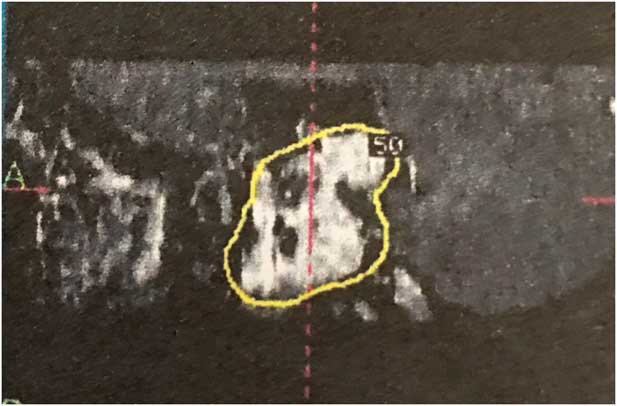
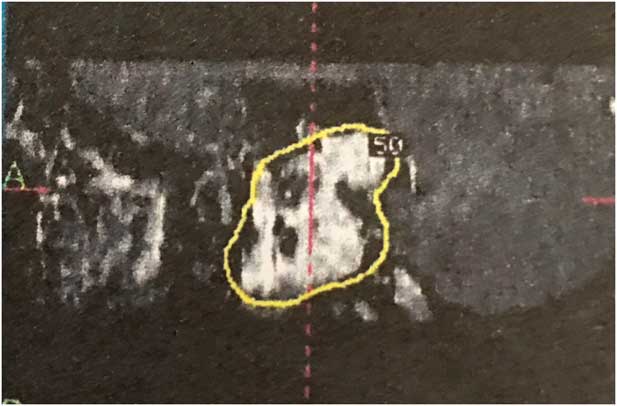
A 66-year-old woman was referred for GKRS of a left JTGT in November 2003. She had experienced symptoms of dizziness, hearing loss, and unsteadiness for 5 years. On physical examination, her blood pressure was normal. Contrast-enhanced magnetic resonance (MR) imaging showed a mass with the characteristic salt-and-pepper appearance in the left jugular foramen area (Figure 1); the GKRS plan was designed to employ eight isocenters (using the 14 mm collimator) in order to encompass the tumour volume of 8·4 cm3 with a marginal dose of 13 Gy. The dose to the ipsilateral cochlea was not estimated during the treatment planning process on account of the existing hearing loss.
Sagittal magnetic resonance image illustrates the margin dose of 13 Gy at the 50% isodose line encompassing the jugulotympanic glomus tumour (Fisch class D and Glasscock-Jackson type IV neoplasm).
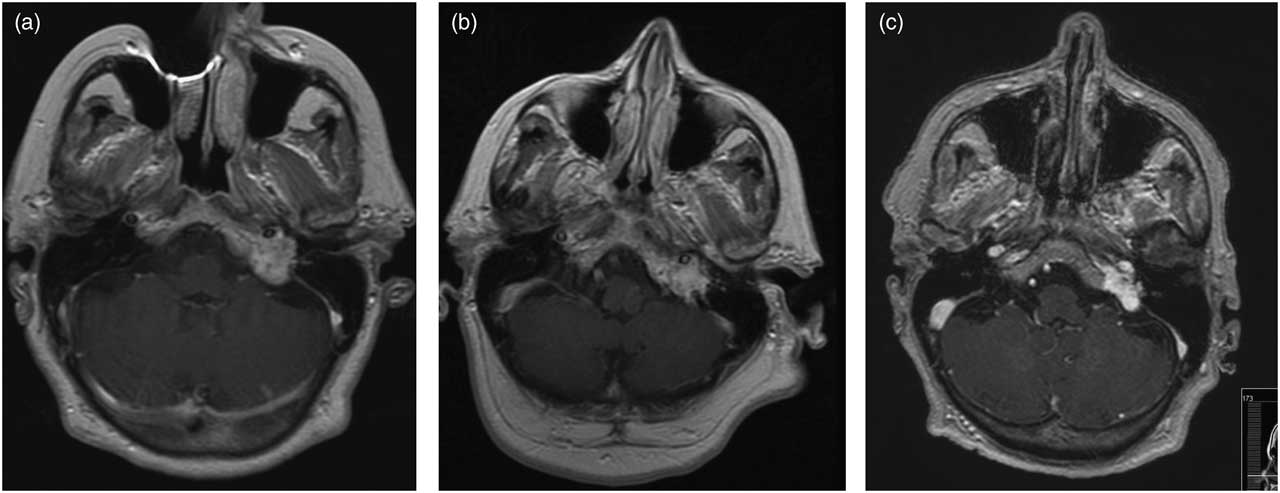
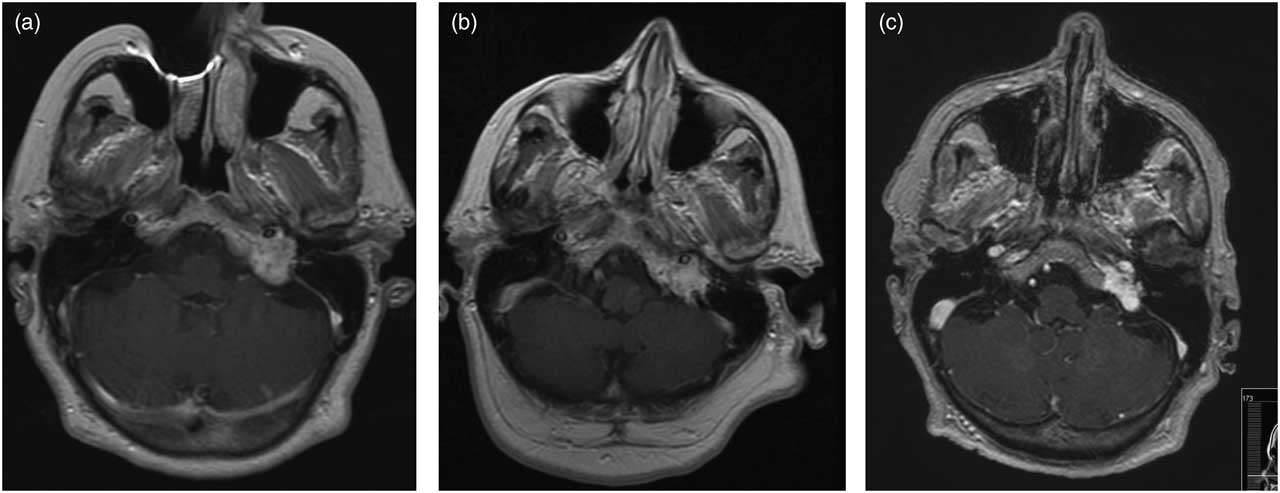
Comparison of MR images from May 2004, July 2007, and January 2016 showed stable disease (Figures 2a–2c, respectively). At last follow-up (147 months after completion of GKRS), the patient still complained of episodic vestibular dysfunction, and the deafness persisted. No other neurological deficits were observed on clinical examination.
Axial magnetic resonance images at 6 months (a), at 41 months (b) and at 147 months (c) after gamma knife radiosurgery indicate stable tumour.
DISCUSSION
Several findings from our case have been described in the literature: First, our patient was a 66-year-old woman, and reports show that JTGTs affect women three times more frequently than men and are most common in individuals who are older than 50 years of age.Reference Gandia-Gonzalez, Kusak, Moreno, Sarraga, Rey and Alvarez 1 , Reference Liscak, Urgosik and Chytka 2 Second, the diagnosis was based on the presented clinical manifestations, the radiographic finding (of ‘salt-and-pepper’ appearance reflecting serpentine flow void pattern within the tumour) and the location of the neoplasm.Reference Gandia-Gonzalez, Kusak, Moreno, Sarraga, Rey and Alvarez 1 , Reference Liscak, Urgosik and Chytka 2 Third, the disease stage was advanced in nature (Fisch class D/tumour with intracranial extension; Glasscock-Jackson type IV/tumour extending beyond the petrous apex into the infratemporal fossa).Reference Chen, Nguyen, Payne, Sheehan and Hashisaki 3 . Fourth, hearing was not regained after GKRSReference Liscak, Urgosik and Chytka 2 and the unchanged size of the neoplasm was long-lasting.Reference Chen, Nguyen, Payne, Sheehan and Hashisaki 3 , Reference Lim, Bower, Nangiana, Adler and Chang 4
Judicious refrain in performing biopsy of the clinically suspected JTGT is worth emphasising because profuse bleeding is a real potential hazard. Surgery and radiotherapy are regarded as the cornerstones of treatment of JTGTs. However, observation has been advocated as another management option if the patient is asymptomatic, has a small to medium-sized neoplasm and can be closely monitored. In support of this watch and wait policy, it can be argued that the estimated median doubling time of untreated JTGTs is 13·8 yearsReference Jansen, van den Bergh, Kuiper, van der Mey, Zwinderman and Cornelisse 5 and that few patients die of residual or recurrent tumours.Reference Frijns, van Dulken and van der Mey 6 In our view, active treatment should not be controversial especially when patients have preserved lower cranial nerve function. We agree with the rationale that radiosurgery provides a non-invasive means of achieving tumour control and assists in preventing the risks associated with surgery while avoiding the potential peril of watchful observation.
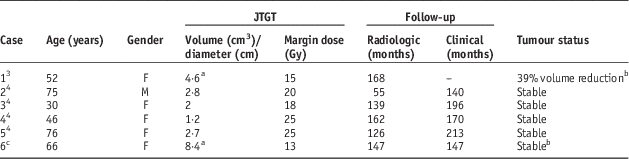
Reviews of the literature included in several reportsReference Liscak, Urgosik and Chytka 2 , Reference Chen, Nguyen, Payne, Sheehan and Hashisaki 3 have shown only short-term results after radiosurgery with mean follow-up periods ranging from 18·5 to 86·4 months. Table 1 Reference Chen, Nguyen, Payne, Sheehan and Hashisaki 3 , Reference Lim, Bower, Nangiana, Adler and Chang 4 summarises described information (i.e., regarding patient, neoplasm and treatment characteristics) about the long-term effect achieved with the application of stereotactic radiosurgery for JTGTs. With respect to transient and permanent side-effects observed after GKRS, none were mentioned pertaining to the five long-term survivors from the other experiences.Reference Chen, Nguyen, Payne, Sheehan and Hashisaki 3 , Reference Lim, Bower, Nangiana, Adler and Chang 4
Reported cases of long-term outcome after gamma knife radiosurgery of jugulotympanic glomus tumours (JTGT)

Notes:
a Volume (cm3).
b JTGT staged as Fisch class D/Glasscock-Jackson type IV.
c This report.
CONCLUSIONS
JTGTs are uncommon neoplasms and therapeutic effects of stereotactic radiosurgery for these benign tumours have invariably been short-term. This case report describing the enduring effect substantiates the utility of GKRS as a treatment option for particularly select cases of locally invasive JTGT.
Acknowledgement
None.