Introduction
The years 2009 to date have seen the introduction of three new oral second-generation antipsychotics, iloperidone (Fanapt, Novartis), asenapine (Saphris, Merck) and lurasidone (Latuda, Sunovion). Not yet commercially available but in Phase III clinical trials are two dopamine D2 receptor partial agonists, cariprazine (Forest) and brexpiprazole (Otsuka). Also in Phase III is bitopertin (Roche/Genentech), a glycine transport inhibitor that may have antipsychotic effects.
Despite the plethora of therapeutic options, schizophrenia remains a complex and difficult disorder to treat. Substantial heterogeneity exists both in an individual's response to treatment and among the different medications themselves.Reference Volavka and Citrome1 Finding the “right medication for the right person” often involves sequential empirical trials of different antipsychotics until one is found that works “well enough,” is tolerated “well enough” and that the patient is willing to adhere to. Because of this, new treatments are often eagerly anticipated.
This narrative review is intended to give a broad overview of iloperidone, asenapine and lurasidone for the treatment if schizophrenia, outlining their basis for FDA approval, dosing, and efficacy/tolerability profiles. Citations are provided for the relevant systematic reviews previously conducted by the author. Where data is available, additional indications are briefly mentioned. An overview of the agents in late stage clinical development for the treatment of schizophrenia is also provided.
New Agents Now Available
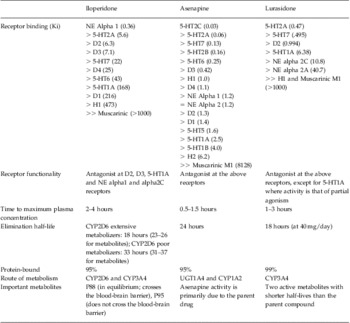
Iloperidone, asenapine and lurasidone are the three new second-generation antipsychotic medications now available. Their pharmacodynamic profiles are outlined in Table 1. Similar to most other second-generation antipsychotics, all three are potent serotonin 5-HT2A and dopamine D2 receptor antagonists. Their other receptor binding characteristics may also be important clinically. For example, both lurasidone and asenapine are antagonists at the serotonin 5-HT7 receptor, with higher binding affinity for the serotonin 5-HT7 receptor than for the dopamine D2 receptor. This may be of potential interest because of pre-clinical findings of a possible pro-cognitive effect mediated by action at the serotonin 5-HT7 receptor.Reference Ballaz, Akil and Watson2 Antagonism at serotonin 5-HT2C receptors, observed with asenapine, can also theoretically be expected to produce desirable clinical effects, including improvements in both cognition and mood.Reference Shayegan and Stahl3 Low affinity to muscarinic receptors, as observed with iloperidone, asenapine and lurasidone, would theoretically predict a low propensity for causing anticholinergic side effects, including cognitive dysfunction and gastrointestinal disturbances, at clinically relevant doses.Reference Shayegan and Stahl3 Proof that this is clinically relevant in the day to day treatment of patients requires clinical trials to test these hypothesized effects.
Pharmacodynamic and pharmacokinetic profile of iloperidone, asenapine, and lurasidone

From US product labeling [11,16,33]. Information regarding iloperidone and NE Alpha 1 from updated information as noted in Novartis promotional materials as Data on file. CSR IPD008. Vanda Pharmaceuticals Inc.
Iloperidone
Approved by the US Food and Drug Administration (FDA) in 2009, iloperidone is indicated for the treatment of schizophrenia in adults. At present iloperidone is only available in the US. The efficacy of iloperidone was assessed in one 4-week and three 6-week randomized, double-blind, placebo- and active comparator-controlled multicenter studies in which two studies were accepted by the FDA as positive.Reference Potkin, Litman, Torres and Wolfgang4–Reference Citrome7 Post hoc analyses of pooled patient data from all four trials demonstrated superiority of iloperidone over placebo on the Positive and Negative Syndrome Scale (PANSS) total, PANSS positive subscale, PANSS negative subscale and Brief Psychiatric Rating Scale-derived (BPRSd) total scores,Reference Citrome, Meng, Hochfeld and Stahl8 and on the PANSS factor scores.Reference Citrome, Meng and Hochfeld9
Data are also available from three long-term (52-week), prospective, randomized, multicenter, double-blind, flexible-dose, parallel group trials that compared the efficacy and safety of iloperidone and haloperidol in patients with schizophrenia, using a non-inferiority design.Reference Kane, Lauriello, Laska, Di Marino and Wolfgang10 Rates of relapse and reasons for relapse were similar between iloperidone and haloperidol.
According to the recommendations in the product label,11 iloperidone must be titrated slowly from a low starting dose (1 mg BID) to a target of 6 mg BID over a 4-day period to avoid orthostatic hypotension. This requirement can be explained by iloperidone's strong alpha adrenergic receptor blocking properties (Table 1). Consequently, control of symptoms may be delayed compared with some other antipsychotic drugs that do not require similar titration.11 BID dosing was used in the clinical trials in order to decrease the likelihood of adverse events; however, the half-life of iloperidone and its active metabolite supports the notion that once daily dosing may be feasible once the patient is stabilized at a therapeutic dose.
Commonly observed adverse reactions in short-term trials (incidence ≥5% and two-fold greater than placebo) were dizziness, dry mouth, fatigue, nasal congestion, orthostatic hypotension, somnolence, tachycardia and weight increase.11 Dizziness and tachycardia were more common with iloperidone 20–24 vs. 10–16 mg/day in the clinical trials however this may not necessarily translate to what can be expected in clinical practice as patients in the clinic would not be routinely force-titrated to a high dose. Increases in QTc were observed with all dose ranges of iloperidone however there were no deaths or serious arrhythmias attributable to QT prolongation in these studies.
Mean weight change from baseline to end-point in the 4–6 week short-term studies was 2.0 kg for patients receiving iloperidone 10–16 mg/day, 2.7 kg with iloperidone 20–24 mg/day, and −0.1 kg with placebo.11 Based on the 4–6 week studies, the proportions of patients having a weight gain of at least 7% from baseline were 4% for placebo, 12% for iloperidone 10–16 mg/day, and 18% for iloperidone 20–24 mg/day.11 However, no medically important differences were observed between iloperidone and placebo in mean change from baseline to end-point in routine hematology, urinalysis or serum chemistry, including glucose, triglycerides and total cholesterol measurements.11 Product labeling notes that in the short-term trials, iloperidone was associated with modest levels of prolactin elevation compared to greater prolactin elevations observed with some other antipsychotic agents.11
In the 52-week trials the most common adverse events were insomnia, anxiety, and aggravated schizophrenia with iloperidone, and insomnia, akathisia, tremor, and muscle rigidity with haloperidol.Reference Kane, Lauriello, Laska, Di Marino and Wolfgang10 Metabolic changes were minimal for both groups. Mean changes in the ECG QTc interval were 10.3 msec (iloperidone) and 9.4 msec (haloperidol) at end point.
Remarkably, there was no significant association with extrapyramidal disorder, akathisia, or tremor noted for iloperidone at any dose and this low potential for extrapyramidal side effects is akin to what is observed with quetiapine.12, 13 It is speculated that iloperidone's low risk for EPS or akathisia may be related to alpha 1 adrenergic blockade; there is preclinical evidence that alpha 1 receptors are localized on the same pyramidal neurons that have 5HT2A receptors.Reference Marek and Aghajanian14, Reference Stahl15
Iloperidone is unique among antipsychotics in terms of being relatively metabolically “friendly” and free of liability for EPS or akathisia. The principal practical obstacle in using iloperidone is the need for initial titration to a therapeutic dose in order to manage the risk for orthostatic hypotension.
Asenapine
Asenapine was approved by the FDA in 2009 and has regulatory approval for the indications of schizophrenia and bipolar mania/mixed episodes, the latter either as a monotherapy or in combination with lithium or valproate.16 Asenapine is also available in other countries. Efficacy in schizophrenia was demonstrated in two of the four 6-week randomized, double-blind, placebo- and active comparator-controlled multicenter studies and in a placebo-controlled, double-blind, multicenter, maintenance treatment trial.Reference Kane, Cohen, Zhao, Alphs and Panagides17–Reference Citrome20 Efficacy in the treatment of manic or mixed episodes of bipolar I disorder is supported by two of two completed phase III randomized, placebo and active-controlled 3-week trialsReference Citrome20–Reference McIntyre, Cohen, Zhao, Alphs, Macek and Panagides22 and in a placebo-controlled trial of asenapine combined with lithium or valproate vs. lithium or valproate monotherapy.Reference Szegedi, Calabrese, Stet, Mackle, Zhao and Panagides23
Long-term data are available from a 1-year double-blind study in patients with schizophrenia or schizoaffective disorder randomized to asenapine or olanzapine.Reference Schoemaker, Naber, Vrijland, Panagides and Emsley24 Rates of discontinuation because of insufficient therapeutic effect were 25.1% for asenapine and 14.5% for olanzapine. Changes from baseline in PANSS total score were similar for asenapine and olanzapine at week 6 but showed a statistically significant difference in favor of olanzapine at endpoint (Last Observation Carried Forward). Among the patients who completed the entire year-long trial, changes in PANSS total score were similar for asenapine and olanzapine at week 6 and also at week 52. Additional long-term data are available from two randomized, double-blind, 26-week studies and their respective 26-week extensions that tested the hypothesis that asenapine is superior to olanzapine for persistent negative symptoms of schizophrenia and that also assessed the comparative long-term efficacy and safety of these agents.Reference Buchanan, Panagides and Zhao25 Asenapine was not superior to olanzapine in change in the Negative Symptom Assessment Scale total score in either core study, but asenapine was superior to olanzapine at week 52 in one of the extension studies. Asenapine's longer-term efficacy in patients with manic or mixed episodes of bipolar disorder was assessed and supported in a 9-week extensionReference McIntyre, Cohen, Zhao, Alphs, Macek and Panagides26 to the 3-week studies,Reference McIntyre, Cohen, Zhao, Alphs, Macek and Panagides21, Reference McIntyre, Cohen, Zhao, Alphs, Macek and Panagides22 followed by an additional 40-week extension.Reference McIntyre, Cohen, Zhao, Alphs, Macek and Panagides27
Because bioavailability is less than 2% if ingested but 35% when taken sublingually, asenapine must be administered in the form of an orally-disintegrating tablet so that the medication is absorbed in the oral mucosa. No initial dose titration is required but the product label recommends specific doses depending on the disease state and other circumstances for treatment: acute schizophrenia 5 mg BID, maintenance 10 mg BID, bipolar mania/mixed as a monotherapy 10 mg BID, bipolar mania/mixed with lithium or valproate 5 mg BID.16 These doses are based on the design of the clinical trials used to obtain regulatory approval. Product labeling further recommends that food or drink should be avoided for 10 minutes after administration of asenapine in order to maximize bioavailability; however, 2 minutes may be sufficient in that only a 19% reduction in bioavailability was observed when this was tested at that time point.Reference Citrome28 Although the product label recommends BID dosing (used in the clinical trials to decrease the likelihood of adverse events), the half-life is about 24 hours, thus once daily dosing may be possible in stabilized patients where tolerability has been established.
Commonly observed adverse reactions in short-term trials (incidence ≥5% and two-fold greater than placebo) were akathisia, oral hypoesthesia and somnolence for patients with schizophrenia, and somnolence, dizziness, extrapyramidal symptoms other than akathisia, and increased weight for patients with bipolar disorder.16 Somnolence is the single most common adverse event associated with asenapine treatment and the product label describes this event as usually transient with the highest incidence reported during the first week of treatment. Somnolence led to discontinuation in only a small proportion (0.6%) of patients treated with asenapine.16 Although rates of spontaneously reported oral hypoesthesia (numbness) and dysgeusia (altered or unpleasant taste) were not particularly alarming in the clinical trials, patients in clinical practice may more readily complain about these potential effects and should be forewarned in order to avoid patients becoming nonadherent. A black cherry flavored formulation is now available as well. The packaging is also different from ordinary tablets or capsules and from what the patient may be used to – asenapine orally disintegrating tablets are easily damaged by moisture or rough handling so they are housed in a hard plastic case that can be challenging for some people to open.
Overall, asenapine treatment had no significant effect on clinical laboratory parameters.16 Asenapine has a mild effect on QTc similar to that seen with quetiapine.16, Reference Citrome28 In addition to a favorable weight gain profile, asenapine has shown limited effects on glucose-related laboratory parameters, such as fasting glucose and fasting insulin.16, Reference Citrome20
The mucosal absorption of asenapine renders it as the only antipsychotic in which in order to “cheek it” you have to swallow it (and swallowing asenapine orally disintegrating tablets is difficult to do since this formulation disintegrates within seconds once placed in the mouth). This is different from other orally disintegrating tablets of antipsychotics such as olanzapine, risperidone and aripiprazole where swallowing is necessary because absorption occurs further down the GI tract. With asenapine administration a rapid rise is plasma levels occurs, with peak plasma levels in as early as 30 minutes (Table 1); this may be helpful in situations where agitation is a presenting problem, and is being tested for this purpose in a clinical trial (see http://clinicaltrials.gov/ct2/show/NCT01400113).
Lurasidone
Lurasidone was approved by the FDA in 2010 for the indication of schizophrenia. Lurasidone is also available in Canada. Initial approval was based on a clinical trial program that included five 6-week randomized, double-blind, placebo- and active comparator-controlled multicenter studies of which four were positive.Reference Nakamura, Ogasa and Guarino29–Reference Citrome32 After the product was launched, results from a fifth positive 6-week study became available and were subsequently integrated into product labeling.33 An analysis of pooled data from the six 6-week pivotal trials demonstrated superiority of lurasidone over placebo on categorical definitions of antipsychotic response.Reference Citrome34
Long-term data have been published and include a 12-month double-blind safety and tolerability study, where clinically stable adult outpatients with schizophrenia were randomized to lurasidone or risperidone.Reference Citrome, Cucchiaro and Sarma35 A higher proportion of patients receiving risperidone had at least a 7% endpoint increase in weight and the median endpoint change in prolactin was significantly higher for risperidone. A comparable improvement in efficacy measures was observed with both agents and the rates of relapse were similar, however all-cause discontinuation rates were higher for lurasidone vs. risperidone. Preliminary findings from 12-month double-blind extension to a short-term study that included quetiapine extended-release as an active control have been presented.Reference Loebel, Cucchiaro, Xu, Sarma, Pikalov and Kane36 Lurasidone was non-inferior to quetiapine in risk for relapse over the 12-month treatment period and moreover, the probability of relapse at 12 months was lower for lurasidone vs. quetiapine.
The recommended starting dose is 40 mg/day administered once daily. No initial dose titration is required. The current maximum recommended dose is 160 mg/day. There is no information available on the potential utility of dosing in excess of 160 mg/day, although a clinical trial is underway of lurasidone doses of up to 240 mg/day in patients with treatment resistant schizophrenia (see http://clinicaltrials.gov/ct2/show/NCT01569659). Similar to ziprasidone, lurasidone should be administered with food and the current recommendation is that lurasidone be given when consuming a meal of at least 350 calories, regardless of fat content.33 In a food effect study, lurasidone maximum plasma concentration and total plasma exposure (i.e. area under the curve) were about 3-times and 2-times, respectively, when administered with food compared to the levels observed under fasting conditions.33 Whether administering 40 mg without food would be equivalent to 20 mg with food is not known, and although the pharmacokinetics of lurasidone is dose-proportional within a total daily dose range of 20 mg to 160 mg,33 it is not known if this would be the case when fasting.
From the short-term registration studies, the commonly observed adverse reactions (incidence ≥5% and at least twice the rate for placebo) included somnolence, akathisia, nausea and parkinsonism.33 A key issue may be time of administration – evening may be preferable.Reference Citrome34, Reference Citrome37 Lurasidone is associated with minimal weight gain and no clinically meaningful alterations in glucose, lipids, prolactin, or the ECG QT interval.
Positive preliminary findings are available from two 6-week placebo-controlled trials in major depressive episodes in patients with bipolar I disorder without psychotic features.Reference Loebel, Cucchiaro and Silva38, Reference Loebel, Cucchiaro and Silva39
Lurasidone differs from iloperidone and asenapine in terms of the recommended dosing frequency (once daily vs. BID). Lurasidone also appears best-in-class in terms of minimizing untoward alterations in body weight and metabolic variables.33, Reference Citrome34, Reference Citrome and Nasrallah40 Potential obstacles to use include sedation, extrapyramidal side effects, akathisia and nausea.
Differentiating features
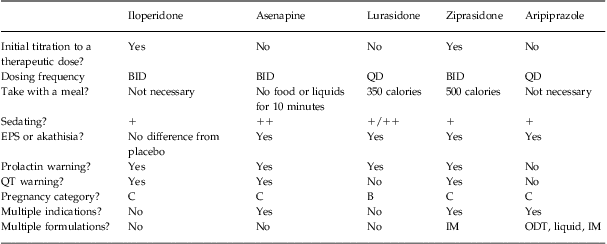
As noted, iloperidone, asenapine and lurasidone have different receptor binding and pharmacokinetic profiles (Table 1) and thus different tolerability “personalities.” However all three are relatively less likely to be associated with metabolic abnormalities than some other first-line second-generation antipsychotics. It would be logical to compare iloperidone, asenapine and lurasidone with ziprasidone and aripiprazole, as these second-generation antipsychotics also have a lower propensity for alterations in body weight, glucose and lipid metabolism than risperidone, olanzapine, or quetiapine. Table 2 illustrates some differences and similarities among these agents. These differences are not always clinically relevant and would depend on the individual patient's history at baseline; for example, key questions include a patient's past experiences with EPS, akathisia or sedation. Prolongation of the ECG QT interval is largely irrelevant in routine practice with reasonably healthy patients; initial concerns regarding the risk for QT prolongation with ziprasidone have not materialized in clinically significant arrhythmias.Reference Citrome41
Highlights of differences and similarities among iloperidone, asenapine, lurasidone, ziprasidone and aripiprazole
From US product labeling [11,16,33] and [40].
IM – intramuscular
ODT – orally disintegrating tablet
Agents in Development
Cariprazine (RGH-188)
Cariprazine is a dopamine D3-preferring D3/D2 receptor partial agonist under development for the treatment of schizophrenia and bipolar disorder. Available are preliminary results from a 6-week randomized controlled study that enrolled acutely ill patients with schizophrenia.Reference Bose, Li and Migliore42 Subjects were randomized to receive cariprazine 1.5, 3.0, or 4.5 mg/day, risperidone 4.0 mg/day, or placebo. Improvement in the PANSS total score at week 6 was greater for cariprazine 1.5, 3.0 and 4.5 mg/day versus placebo as well as for risperidone versus placebo. The most common adverse events in the cariprazine groups were insomnia, extrapyramidal symptoms, akathisia, sedation, nausea, dizziness and constipation. There were no clinically meaningful metabolic parameter changes for cariprazine; no prolactin elevation or QTc prolongation were observed. Results from the 48-week open-label extension study have also been presented;Reference Cutler, Bose and Durgam43 treatment-emergent adverse events reported in at least 10% of patients were akathisia, insomnia, and increased weight.
Randomized controlled trials of cariprazine in acute mania have also been conducted and the results of a Phase IIReference Knesevich, Papadakis and Bose44 and a Phase III studyReference Starace, Bose and Wang45 have been presented. In the Phase III trial, subjects were randomized to cariprazine 3–12 mg/day or placebo for 3-weeks of double-blind treatment. Statistically significant improvement was demonstrated with cariprazine vs. placebo on the Young Mania Rating Scale. The most common adverse events were akathisia, extrapyramidal disorder, tremor, dyspepsia, and vomiting.
Brexpiprazole (OPC-34712)
Brexpiprazole is a dopamine D2 receptor partial agonist currently in clinical trials for schizophrenia. Presented were the preliminary results of a 6-week double-blind, placebo- and aripiprazole-controlled Phase II study that explored the dose-response relationship of brexpiprazole in acutely ill patients with schizophrenia.Reference McQuade, Hobart and Forbes46 Mean improvement in PANSS scores was clinically meaningful for all dose groups, including placebo. Improvements in the brexpiprazole (1.0 mg, 2.5 mg and 5.0 mg) and aripiprazole treatment groups were numerically greater, but not significantly different, compared with placebo. Also available are the preliminary results of a study examining brexpiprazole as an adjunct to antidepressants in the treatment of major depressive disorder.Reference Thase, Fava and Hobart47 Statistically significant improvements in depression rating scores were observed for adjunctive brexpiprazole 1.5 mg/day vs. adjunctive placebo.
Potential “antipsychotics” that act on glutamate receptors
Current FDA-approved pharmacological options for the treatment of schizophrenia involve antagonism (or partial agonism) at the dopamine D2 receptor, and additionally, in the case of second-generation antipsychotics, antagonism at the serotonin 5-HT2A receptor. This may still be insufficient for symptom relief. There is substantial research activity in the area of schizophrenia and the glutamate neurotransmitter system.Reference Kantrowitz and Javitt48 The interplay between glutamate and dopamine may provide a way to identify therapeutic targets that could treat the negative and cognitive symptoms of schizophrenia. One model of schizophrenia is that of hypofunction of the NMDA receptor complex. The NMDA receptor is a glutamate receptor. Under normal circumstances tonic inhibition occurs in the NMDA receptor regulation of the mesolimbic dopamine pathway but in the presence of NMDA receptor hypofunction in cortical brainstem projections of patients with schizophrenia, hyperactivity of the mesolimbic dopamine pathway would take place. Moreover, under normal conditions, NMDA receptor regulation of mesocortical dopamine pathways is that of tonic excitation. With NMDA receptor hypofunction, the direct result would be hypoactivity of mesocortical dopamine pathways, with insufficient dopamine release in the pre-frontal cortex, resulting in the cognitive, negative, and affective symptoms of schizophrenia.
Glycine is needed in addition to glutamate for the NMDA receptor to function. NMDA receptor functioning can thus be enhanced by making available more glycine at the synapse. This can be accomplished by action at the glycine reuptake pumps, the major route of inactivation of synaptic glycine. Glycine transport inhibitors are analogous to the drugs that are used for the treatment of major depressive disorder (ie, serotonin-specific reuptake inhibitors), although instead of inhibiting serotonin reuptake, these agents inhibit glycine transport, increasing the synaptic availability of glycine, and presumably enhancing NMDA-mediated neurotransmission.
Bitopertin
Bitopertin is a glycine transport inhibitor currently in Phase III of drug development. Preliminary results are available for one 8-week double-blind, placebo-controlled trialReference Umbricht, Yoo and Youssef49 where clinically stable schizophrenia patients with predominantly negative symptoms and low severity of positive symptoms were randomized to 10 mg, 30 mg, and 60 mg of bitopertin added to ongoing antipsychotic medication treatment. Measured were negative symptom severity, overall symptom severity and function. Efficacy and safety results were considered promising and several additional clinical trials are currently underway examining patients with sub-optimally controlled symptoms of schizophrenia; persistent, predominant negative symptoms of schizophrenia; biomarker measures of cognitive dysfunction in patients with schizophrenia; and patients with acute exacerbation of schizophrenia (see http://www.clinicaltrials.gov). In most of these efficacy trials bitopertin is administered adjunctively with antipsychotics.
A cautionary note
Metabotropic glutamate receptors have also been identified as a therapeutic target for schizophrenia.Reference Kinon and Gómez50 Because the active symptoms of schizophrenia are hypothesized to be associated with cortical dysregulation in the thalamus, prefrontal cortex, and limbic system, treatment with a metabotropic glutamate receptor agonist may re-establish regulated and balanced cortical activity with a resulting improvement in psychosis. Randomized, placebo-controlled, clinical trials of treatments targeting these receptors in persons with schizophrenia have been published.Reference Patil, Zhang and Martenyi51, Reference Kinon, Zhang and Millen52 In the first report,Reference Patil, Zhang and Martenyi51 monotherapy with pomaglumetad methionil resulted in improvements in both positive and negative symptoms of schizophrenia as measured by the PANSS over 4 weeks. The active control, olanzapine, also resulted in reductions in these symptoms. Unfortunately, a second study of pomaglumetad methionil monotherapyReference Kinon, Zhang and Millen52 failed to replicate the efficacy findings of the first trial.Reference Patil, Zhang and Martenyi51 Additionally, recently disclosed in a press release is a negative study where monotherapy with pomaglumetad methionil did not separate from placebo on the primary efficacy endpoint (based on the PANSS) at the two doses investigated (40 mg and 80 mg BID) but the active control, risperidone, did separate from placebo.Reference Eli53 Moreover, a recently completed Phase II study investigating the adjunctive use of pomaglumetad methionil with second-generation antipsychotics did not meet its primary endpoint.Reference Eli54 In view of these results and that of other analyses, development of this agent has been halted by the manufacturer.Reference Eli54
Conclusions
Choosing among all the different antipsychotics for the individual patient is complex, requiring consideration of the prior history of therapeutic response, prior history of tolerability with other agents, and individual patient values and preferences. Three new second-generation antipsychotics are available: iloperidone, asenapine and lurasidone. Similar to ziprasidone and aripiprazole, these new agents have a lower propensity for weight gain and metabolic abnormalities than older second-generation antipsychotics such as olanzapine. Lurasidone appears to be best-in-class in terms of minimizing untoward alterations in body weight and metabolic variables. However, iloperidone, asenapine and lurasidone differ among themselves in terms of on-label dosing frequency (once daily for lurasidone versus twice daily for iloperidone and asenapine), the need for initial titration to a therapeutic dose for iloperidone, requirement to be taken sublingually for asenapine, requirement for administration with food for lurasidone, lengthening of the ECG QT interval (greater for iloperidone than for asenapine and no effect observed with lurasidone), and adverse effects such as akathisia (seen with lurasidone and asenapine but not with iloperidone) and sedation (most notable with asenapine). On the horizon are 2 additional second-generation antipsychotics, both of them partial agonists at dopamine receptors: cariprazine and brexpiprazole. Also being tested in clinical trials are agents that impact directly on glutamate receptors; although they have no appreciable binding to dopamine D2 receptors, they may nevertheless possess antipsychotic properties.
Acknowledgment
Financial support: This CME supplement is supported by an educational grant from Sunovion Pharmaceuticals Inc.
Disclosures
Leslie Citrome, MD, MPH, is a clinical professor in the department of psychiatry and behavioral sciences at New York Medical College in Valhalla. Dr. Citrome is a consultant to Alexza, Alkermes, AVANIR, Bristol-Myers Squibb, Forest, Genentech, Janssen, Lilly, Lundbeck, Novartis, Noven, Otsuka, Shire, and Sunovion; is on the speakers bureaus of AstraZeneca, Bristol-Myers Squibb, Lilly, Merck, Novartis, Otsuka, Pfizer, and Sunovion; and is a stockholder of Bristol-Myers Squibb, Lilly, Merck, and Pfizer.
No writing assistance was utilized in the production of this article.