Introduction
The study of Palaeolithic art has been the subject of new approaches and avenues of research in recent years (Moro & González Morales Reference Moro and González Morales2008). It has traditionally been studied by focusing mainly on its development and chronology (Breuil Reference Breuil1952; Leroi-Gourhan et al. Reference Leroi-Gourhan, Delluc and Delluc1995; Ochoa & García Diez Reference Ochoa and García-Diez2015; Pettitt & Pike Reference Pettitt and Pike2007) or on its interpretation and social value (Conkey Reference Conkey, Lock and Peters1996; Lewis-Williams Reference Lewis-Williams2002; Lorblanchet Reference Lorblanchet1995), while obviating other aspects. This is partly due to these studies being undertaken mostly by archaeologists and anthropologists. Thus, approaches to Palaeolithic art from the perspective of art history have not been frequent. Nevertheless, some studies have proposed an approach from such a perspective to address aspects regarding interpretation and processes of creation, or with the nature of prehistoric art within the history of humankind (Giedion Reference Giedion1964; Moro Reference Moro2013; Turcios Reference Turcios1995).
The creative process of Palaeolithic art has drawn the attention of scholars in recent years, regarding both cognitive and motor abilities. This line of research has been traditionally carried out by art historians and archaeologists and has also involved the participation of neurologists.
The study of creative processes implies the identification of aspects connected to the mental conceptualization of the representations and their functional purpose (social and/or individual symbolic value). These approaches also involve understanding the materials used, the technical actions and decisions, as well as the artistic skills and abilities required to achieve the desired final product (d'Errico Reference d'Errico1994; Farbstein Reference Farbstein2011; Fritz Reference Fritz1999; Mellet et al. Reference Mellet, Salagnon and Majkić2019; Muzquiz Reference Muzquiz1988; Rivero Reference Rivero2016; Tosello Reference Tosello2003). From the archaeological point of view, different proposals have been put forward regarding training, transfer of knowledge and the social value of the processes. Their consideration provides a glimpse into past societies, by determining how young members were introduced to certain activities and/or their level of skill or degree of knowledge based on variables such as framing, the presence or absence of rectifications, the depth of the incision assessing the type of support, etc.; these approaches have been applied to portable art, as well as to other kinds of archaeological evidence (e.g. Castañeda Reference Castañeda2018; d’Errico Reference d'Errico1994; Fritz et al. Reference Fritz, Tosello and Conkey2016; Janik & Williams Reference Janik and Williams2018; Olive Reference Olive2004; Pigeot Reference Pigeot1988; Rivero Reference Rivero2011; Rivero & Garate Reference Rivero and Garate2020).
The study of portable art is currently allowing archaeologists to comprehend the ‘biography’ of decorated objects. Microscopical studies, frequently supported by experimental research, allow us to understand the complexity of this evidence and propose different stages regarding their use and function, thus identifying a succession of decorative, symbolic and economic uses for these objects (Corchón et al. Reference Corchón, Rivero and Martínez2006; García-Diez & Vaquero Reference García-Diez and Vaquero2006; Idarraga & Berganza Reference Idarraga and Berganza2008; Tosello Reference Tosello2003). Such complex biographies of objects would imply that not necessarily all graphical action might possess decorative or artistic significance, and that their purpose may have varied over time.
In this regard, Palaeolithic art is characterized by some degree of standardization as it corresponds to a series of symbolic codes. Their meaning escapes our interpretation, but they may have had significant implications for the prehistoric communities and therefore needed to be reproduced faithfully (Barandiarán Reference Barandiarán1988; Reference Barandiarán, García-Diez, Ochoa and Rodriguez-Asensio2015). The transmission of knowledge to new generations would be socially relevant as it ensured the continuity of the activity into which they were initiated. It would be used to integrate children gradually into society, granting them a role in relation to their age and gender, endowing them with an identity within the group and supplying them with personal motivation for a collective purpose (Castañeda Reference Castañeda2018).
Taking this into account, the study of a decorated Palaeolithic pebble (dated to about 15,680–14,230 cal. bp) from Coímbre cave provides a glance into the artists’ actions and offers a timeline of the technical gestures and uses of the object carried out by the artist (whether they were experienced artists or apprentices undergoing training), as well as the decision-making process regarding the symbolic and economic uses of the decoration and/or the object.
Coímbre cave: geographic and chronological context of the decorated object
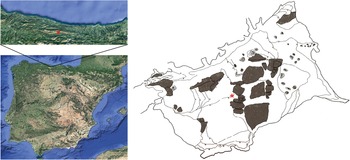
Coímbre cave is located in the middle-lower valley of the River Cares, in the centre-west of northern Spain (Peñamellera Alta, Asturias, north Spain) (Fig. 1). Although it is close to the current coastline, it is situated in an inland valley in the montane surroundings of the eastern and central massifs of the Picos de Europa. The entrance is on the southwest side of Pendendo Hill (529 m) in a small valley formed by the River Besnes, about 800 m before its confluence with the Cares.
The location of Coímbre Cave and the sector inside the cave where the decorated pebble was found.

The site was made known in 1971 (Moure & Gil Reference Moure and Gil1972) and after the first fieldwork (Moure & Gil Reference Moure and Gil1974) it was not studied again until a new research project was started in 2008 (Álvarez-Alonso Reference Álvarez-Alonso, Álvarez-Alonso and Yravedra2017; Álvarez-Alonso et al. Reference Álvarez-Alonso, Yravedra, Arrizabalaga, Jordá Pardo and Heredia2009).
For its study, the interior of the main chamber in the cave was divided into four zones (A, B, C and D). Fieldwork to date has been carried out in Zones A and B. Zone B, the innermost part of the entrance hall, excavated between 2008 and 2012, contains an archaeological sequence with a Gravettian level (29,660–28,560 cal. bp) at its base, overlain by a barren layer and then an intense discontinuous Magdalenian occupation (between 20,730 and 14,230 cal. bp) with levels belonging to the archaic, lower, middle and upper phases of the period (Álvarez-Alonso & Yravedra Reference Álvarez-Alonso, Yravedra, Álvarez-Alonso and Yravedra2017; Álvarez-Alonso et al. Reference Álvarez-Alonso, Yravedra, Arrizabalaga, Jordá and León Gasalla2013; Reference Álvarez-Alonso, Yravedra, Jordá and Arrizabalaga2016; Reference Álvarez-Alonso, Yravedra and Álvarez-Fernández2017; Reference Álvarez-Alonso, Yravedra, De Andrés Herrero, Straus and Langlais2020).
Fieldwork was also carried out in Zone A between 2008 and 2010 (Álvarez-Alonso & Yravedra Reference Álvarez-Alonso, Yravedra, Álvarez-Alonso and Yravedra2017; Álvarez-Alonso et al. Reference Álvarez-Alonso, Yravedra, Arrizabalaga, Jordá Pardo and Heredia2009; Reference Álvarez-Alonso, Yravedra, Arrizabalaga, Jordá and León Gasalla2013), where the decorated pebble studied here was found. Its rich deposit was considerably altered in its upper layers by the extraction of sediment for agricultural purposes. The top clay layer of a 2 sq. m excavation provided a very characteristic assemblage of Middle Magdalenian osseous artefacts. The study of the lithic and osseous remains from the surface layers, where the decorated pebble was found, revealed their similarity with the archaeological evidence in Level 1 in Zone B, attributed to the Upper Magdalenian, and therefore can be dated to between 15,680 and 14,230 cal. bp.
Description and analysis of the technical actions
The study of the engravings of the Coímbre pebble was carried out based on digital photographs and using Adobe Photoshop image treatment software and the DStretch plugin in ImageJ. Furthermore, this work relied on the use of a stereoscopic microscope. The technological study of the engravings was carried out using a stereoscopic microscope and Confocal Laser Microscopy (Olympus LEXT OLS3000).
Description of the object
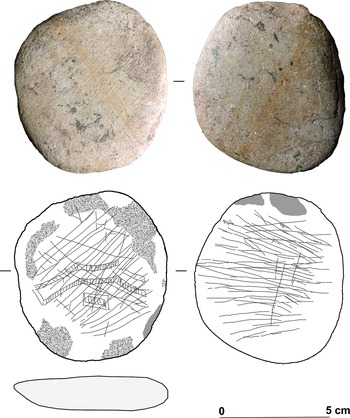
The studied piece is a flat, approximately circular limestone pebble, 6.7 cm wide, 7.8 cm long and 1.5 cm thick (Fig. 2). Both faces are mostly flat and smooth and converge towards the rounded edges. Both faces display impact fractures on the edges (especially on the upper face) caused by striking another surface. The rounded nature of the edges and the inner and outer lines of the fractures can be associated with hydrological processes. Therefore, it is likely that the pebble was originally collected from a riverbed. We have not documented further taphonomic evidence that might be misinterpreted as anthropic actions directed to prepare the object or to engrave the lines (d'Errico & Villa Reference d'Errico and Villa1998).
Photograph and tracing of the decorated pebble from Cueva de Coímbre.

Description of the graphic units
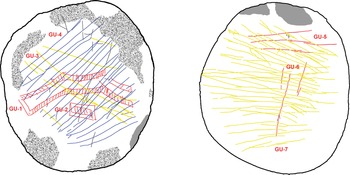
Seven graphic units have been differentiated (Fig. 3), four on the upper face and three on the lower face (the concept of ‘graphic unit’ (GU) is used here for descriptive purposes and does not necessarily imply a decorative or artistic purpose).
Differentiation of graphic units on the decorated pebble from Cueva de Coímbre.

Upper face (A):
• Graphic Unit 1 (GU-1). Located in the centre of the face and in a horizontal position in accordance with the proposed orientation of the pebble. It consists of two double dashed lines approximately parallel, between 0.35 and 0.6 cm apart, which follow a horizontal display. The ends of the lines are connected on the left by two approximately vertical lines, whereas on the right the double lines end individually and are not connected. The angular development (an obtuse angle of about 150°) creates three branches for each double line. In the lower line the three branches are continuous while in the upper line only two of them are (left and middle), and one is isolated (on the right). The continuous branches are 1.5–2.2 cm long and the isolated branch is 1.0 cm long. The interior of the double horizontal lines is filled by small (0.1–0.3 cm long) vertical or oblique lines that tend to be parallel to each other. They sometimes extend beyond the double lines and are less numerous in the upper right isolated arm. In contrast, the double line connecting the horizontal lines on the left does not contain any interior lines. The graphic unit is complex but can be described as an open polygon or roughly an octagon. It covers a maximum surface of 5.1 cm by 2.1 cm.
• Graphic Unit 2 (GU-2). Horizontal rectangle (1.2 cm wide and 0.8 cm high) with another similar rectangle in its centre (1 cm wide and 0.3 cm high). The inner rectangle is open in its upper left corner while its interior is filled with small (0.2–0.3 cm) oblique lines roughly parallel to each other. Some of these lines intersect the corners and/or perimeter of the inner rectangle.
• Graphic Unit 3 (GU-3). Set of sparse lines of variable length in which the middle ones are the longest. They follow an oblique to horizontal, approximately parallel pattern. Distributed unequally all over the engraved surface of the face, they cover a maximum surface of 5.1 cm by 4 cm.
• Graphic Unit 4 (GU-4). Dense set of lines following an oblique to vertical, approximately parallel pattern. These lines are evenly distributed over much of the engraved surface of the face. This unit covers a maximum surface of 5.3 cm by 5.8 cm.
Lower face (B):
• Graphic Unit 5 (GU-5). A set of very sparse and roughly parallel lines following a horizontally oriented pattern, concentrated on the upper part of the face. It covers a maximum area of 4 cm by 1 cm.
• Graphic Unit 6 (GU-6). A set of very sparse lines of variable length that follow an approximately parallel and vertically oriented pattern. This unit is located in the centre-right of the face. It covers an area of 1 cm by 3.3 cm.
• Graphic Unit 7 (GU-7). Dense set of lines that follow a mostly horizontal pattern, especially in the centre, and slightly oblique near the top. They are generally parallel and distributed over much of the surface. They cover an area of 6 cm by 6 cm.
Process of engraving and functionalization of the object
The natural shape of the object determines two approximately circular areas available for decoration; these can be defined as graphic fields according to Barandiarán (Reference Barandiarán1984). They display a mostly flattened surface for both faces. The position of the graphic units (Fig. 3) in relation to these graphic fields shows that GU-1 to GU-4 on Face A were engraved on the central part of the pebble. The most complex form (GU-1) occupies the centre as regards both the vertical and horizontal axes, whereas the rectangular shape (GU-2), located below the previous unit, is only centred as regards the vertical axis. This implies, especially for GU-1, a deliberate intention to centre the graphic units on the surface. The same tendency can be observed in the other graphic units on the upper face, and less noticeably in GU-6 and GU-7 on the lower face.
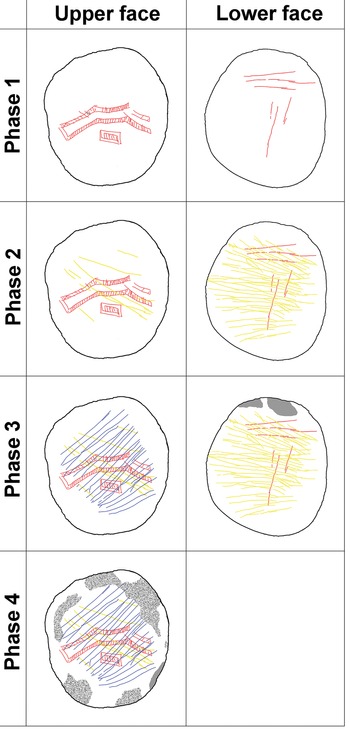
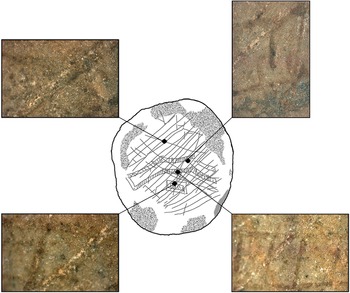
Study of the different lines and dots and the superimpositions between them reveals different stages of human action on the pebble (Figs 4 & 5).
Graphic process in the decoration of the pebble from Cueva de Coímbre.

Photograph of a detail of the lines and superimpositions on the pebble from Cueva de Coímbre using Confocal Laser microscopy (Olympus LEXT OLS3000) (5×).

On the upper face, the first technical action (Phase A-1) was devoted to engraving the lines that make up the complex forms (GU-1 and 2). The analysis of the creative process shows that, in both cases, the definition of the outlines was previous (Phase 1a) to the engraving of the small lines in their interior spaces (Phase 1b). These marks were produced some time before the rest of the lines on the upper face (GU-3 and 4). Stages in their engraving can also be differentiated: the less dense group of lines (GU-3; Phase 2) was engraved earlier than the denser group (GU-4; Phase 3). Finally (Phase 4), the use of the pebble as an active object is documented on the upper face by indirect percussion marks around the periphery of the face; these are more noticeable in its upper part, especially on the right. The ends of some of the lines in GU-4 corresponding to Phase 3 in the graphic process were affected by the percussion. However, in some cases, traces of these lines can still be identified because the percussion was not so intense as to eliminate the engraving completely.
On the lower face, the least dense sets of lines (GU-5 and 6) were engraved first (Phase 1). Subsequently, the larger set of lines (GU-7) was engraved in Phase 2 and finally, some small, isolated impact marks were made (Phase 3).
Discussion
Technical actions resulting in non-figurative engraved or painted lines have normally been endowed with a symbolic significance, whatever their shape, structure and/or composition. This historiographic tendency has determined the interpretation of most simple linear representations as graphic elements with a symbolic intention, as well as a product of cognitive processes that were mentally planned (Aurière Reference Aurière2009; Barandiarán Reference Barandiarán1994; Crémades Reference Crémades1994) and manifested on a surface, that was consequently attributed a symbolic value (Fano et al. Reference Fano, Rivero and Garate2010; Lorblanchet Reference Lorblanchet1981). Thus, there is a generalized assumption that the final graphic production observed today in the archaeological record is necessarily the manifestation of some symbolic intention conceived by the prehistoric artist. The symbolic interpretation of linear forms, for which typological classifications have been proposed (Casado Reference Casado1977; Leroi-Gourhan et al. Reference Leroi-Gourhan, Delluc and Delluc1995; Sauvet et al. Reference Sauvet, Sauvet and Wlodarczyk1977; Vialou Reference Vialou1986), implies neglecting other possible approaches regarding the creative process.
Therefore, we seek to uphold that the possible existence of graphic representations without any symbolic intention should be considered. These would include the accepted existence of sketches in portable art (Barandiarán Reference Barandiarán1984; Reference Barandiarán2006; Koppers Reference Koppers1950; Pericot Reference Pericot1942; Saint-Mathurin Reference Saint-Mathurin1973), understood as models for definitive symbolic depictions, as well as ‘training images’ (Rivero Reference Rivero2011). The latter were defined by Laming-Emperaire (Reference Laming-Emperaire1962) as exercises carried out by learner engravers, and have been found applicable to other activities such as stone knapping (Castañeda Reference Castañeda2018; Olive Reference Olive2004; Pigeot Reference Pigeot1988). Prehistoric art requires a complex system of knowledge, including abstraction, as well as the use of the imagination and a series of technical skills. It is reasonable to believe that some of the results of these formative exercises would not be regarded as discards, but might instead be reused to continue technical or symbolic training, or for other potential later uses. The learner would need to understand the stages of the creative process and recognize the symbolic values implied on particular representations (Rivero Reference Rivero2016). The depictions followed pre-established patterns, learnt and reproduced according to strict models (Barandiarán Reference Barandiarán1988; Rivero Reference Rivero2011). Furthermore, the very practice of engraving requires the acquisition of technical knowledge regarding the raw material and instruments used, as exposed by experimental research (Croidieu Reference Croidieu2012).
Sketches and training images are, a priori and originally, products without any symbolic intentions: attempts for projects, reference models and experiments, which might be individually made and/or supervised through a knowledge transmission and teaching system between individuals.
Historiography has considered the possible existence of artwork attributable to inexpert and unskilled artists, incapable of ‘correctly’ creating the depictions they mentally envisioned (Capitan & Peyrony Reference Capitan and Peyrony1928; Cartailhac & Breuil Reference Cartailhac and Breuil1907), but also to qualified artists who made a mistake in the shape, adaptation or composition of representations. In some cases, following a desire to comply with the mental model initially conceived, the artists decided to rectify and/or correct the representation within so-called sub-phases of the graphic process (Rivero Reference Rivero and Clottes2012). These actions, which imply the acknowledgement of an error and the decision to rectify or correct it, helped to reconcile the final result with the preconceived shape and maintain the original symbolic purpose of both the depiction and the surface. However, it is also possible that some depictions were planned (a surface chosen, a design conceived, and a placement displayed for it across the surface) and produced pursuing a symbolic end but, owing to circumstances occurring during the execution, lost the symbolic purpose for which they had been conceived.
Recognizing the loss of some symbolic value once attributed to representations is not simple. Nevertheless, archaeological evidence has recorded the existence of surfaces displaying actions possibly taken to invalidate a representation by crossing it out, hiding it or rubbing it out, for example in Las Caldas (Corchón & Rivero Reference Corchón and Rivero2017; Corchón et al. Reference Corchón, Rivero and Martínez2006; Rivero Reference Rivero2007; Reference Rivero and Clottes2012); Isturitz (Rivero Reference Rivero2010; Reference Rivero and Clottes2012); Laugerie Basse (Tosello Reference Tosello2003); El Parpalló (Villaverde Reference Villaverde1994); and Limeuil (Tosello Reference Tosello2003). These surfaces displaying abrasions or entangled lines may imply the elimination or removal of symbolic value from the graphic motif. Other invalidating actions, such as the destruction, discard or abandonment of objects, have been identified in several cases of European Palaeolithic portable art (Mons Reference Mons1986; Tosello Reference Tosello2003).
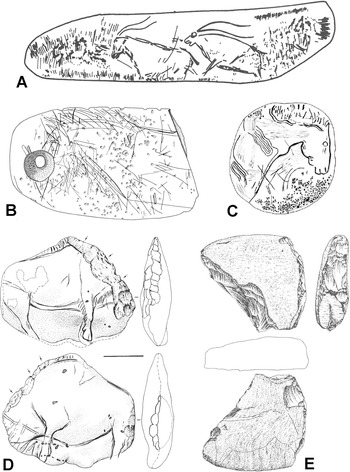
Evidence has also recorded objects that were given a new purpose or a new life, whenever their morphological and/or ergonomic features allowed the raw material to be recycled for a certain use. Decorated objects that were later used as pressure tools or hammerstones are not infrequent (Fig. 6), for example in Las Caldas (Corchón et al. Reference Corchón, Rivero and Martínez2006); Isturitz (Rivero & Garate Reference Rivero and Garate2014); Urtiaga (Idarraga & Berganza Reference Idarraga and Berganza2008); La Colombière (Paillet & Man-Estier Reference Paillet and Man-Estier2010); Beraud (Aulanier et al. Reference Aulanier, Man-Estier, Lafarge, Delvigne, Liabeuf and Raynal2016); Pagès (d'Errico Reference d'Errico1994); Molí del Salt (García-Diez & Vaquero Reference García-Diez and Vaquero2006); La Madeleine, Villepin (Tosello Reference Tosello2003); Gourhan, La Vache (de Beaume Reference de Beaume1997); Enlène (Bégouën & Clottes Reference Bégouën and Clottes2008); and Santimamiñe, Ermitia and Bolinkoba (Barandiarán Reference Barandiarán1972). Their use as anvils or grindstones (Las Caldas: Corchón & Rivero Reference Corchón and Rivero2017) or as sidescraper-type implements (La Madeleine: Tosello Reference Tosello2003) has also been documented. In fact, the study of the European assemblage carried out by Sieveking (Reference Sieveking1987, 40–41) revealed that these situations were relatively common. These uses provide evidence in the form of abrasion or pecking on the surface of the object that tends to be concentrated on the edges or near them (especially in the case of hammerstones), on the internal surfaces (especially when the objects were receptors of impact) and, less frequently, on both areas.
Objects with graphic activity and later functional use: (A) Bolinkoba; (B) Las Caldas; (C) La Colombière; (D) La Madeleine; (E) Molí del Salt.

However, this does not imply that all the decorated objects with use-marks overlaying graphic evidence should be regarded as undeniable cases of symbolic loss or removal. An object with a mechanical use (hammerstone, anvil, etc.) may also have been decorated (Corchón Reference Corchón2008) in order symbolically to complement or even strengthen its functionality (Fano et al. Reference Fano, Rivero and Garate2010). It is not easily recognizable whether the ‘artistic’ and ‘mechanical’ uses were contemporary or differentiated in time and purpose. Nevertheless, there are archaeologically detectable actions that might help to support one hypothesis over the other. When a distinguishable graphic action is performed overlaying the decoration, such as rubbing or crossing out, it is plausible to suggest that there was a will to eliminate the motif. Therefore, these two differentiated stages, separated by the invalidation of the symbolic significance that both the motif and the object once held, provide arguments to differentiate the purposes of the decoration and the mechanical use. The study of the technical actions performed on this pebble from Coímbre Cave supports a comprehensive interpretation of the planning and placement of the engraved lines, the stages followed (shown by superimpositions) and the use-marks that have been documented. The use of the pebble from Coímbre as a percussion tool is a demonstrable fact, due to the presence of percussion marks on the edges (particularly on its upper face). The study of the superimpositions indicates that percussion was the last technical action to be performed, involving the partial elimination of some of the lines in GU-4, and therefore made sometime after GU-1 to 4.
It can also be determined that both the rectangular shape (GU-2) and the roughly octagonal motif (GU-1) were the first to be engraved. In the case of the latter, one of its ends is physically unconnected to the rest of the shape. This has enabled us to propose feasibly that a mistake was made while engraving the motif and that, in consequence, it did not match the mental idea that the artist aimed to materialize. Supported by behavioural and neurological approaches (e.g. Enquist & Arak Reference Enquist and Arak1994; Schultz Reference Schultz2015), archaeology has been able to identify the search for symmetry in the Palaeolithic mind through the manufacture of utilitarian (Hodgson Reference Hodgson2011; White & Foulds Reference White and Foulds2018) and symbolic objects (Corchón Reference Corchón1986; Ramil Soneira & Vázquez Varela Reference Ramil Soneira and Vázquez Varela1983; Tylén et al. Reference Tylén, Fusaroli and Rojo2020). Furthermore, a good part of the complex motifs in Palaeolithic art are based on symmetrical configurations (Martínez-Villa Reference Martínez-Villa2017). The shape and size of the pebble (which are both determining factors in the creation of art on portable objects, as pointed out by Delporte & Mons Reference Delporte and Mons1977 and Barandiarán Reference Barandiarán1984) suggest that a depiction with a roughly octagonal shape was planned to follow a symmetric structure regarding a vertical axis; the fact that such symmetrical image was not achieved might imply an error during the act of engraving.
After the mistake was made, the artist decided not to amend it because it would have implied to link the misoriented branch with the rest of the composition, and consequently break the planned symmetry. Despite the line fitting error, the absence of multiple strokes to execute the longer lines, the smaller strokes rarely exceeding the framing lines of GU-1 and GU-2, the rather deep engravings, and the framing of GU-1 and GU-2 in the centre of the graphic field of the upper face, allow us to propose that the author of the piece was probably not an inexperienced engraver.
In the proposed hypothesis, which implies an unfinished graphic production due to an execution failure, the graphic purpose for GU-3 and GU-4 might be now queried. As they were created after GU-1 and 2 and overlie them to a high degree, it is likely that they were intended to eliminate (rub or cross out, mask or reduce the perception of) those signs. An alternative interpretation may claim that those later graphic units (GU-3 and 4) were perhaps a training exercise in engraving parallel lines, after a discard of the previous failed graphic action (GU-1 and 2). However, a common inference to both hypotheses is that the lines carry no symbolic value within themselves, and did not play a part in the design originally conceived by the artist. Instead, they may be attributed the purpose of removing the symbolic value implied in the production of GU-1 and 2. Similarly, the existence of equivalent graphic units to GU-3 and 4 on the lower face (GU-5 and 6) may correspond to an iteration of technical actions with the same purpose. For the lower face, the target must have been the pebble itself rather than previous graphic motifs (since they do not exist on this face). It is thus feasible to propose that the reason for producing GU-3, 4, 5 and 6 was to desymbolise the pebble as a canvas, panel or surface. This desymbolizing was done before the final use of the pebble as a percussor or hammerstone.
In sum, the study of the pebble from Coímbre Cave, dated between 15,680 and 14,230 cal. bp, is an example of symbolic value annulment, as a consequence of a failure in connecting lines during the engraving of said motifs. This was done by engraving new sets of lines, bearing no symbolic value, to cross out the lines previously performed. Lastly, the object was used as a hammerstone, which resulted in marks that partially affect the graphic units. Similar situations of intentional erasing of some symbolic significance both from decorative motifs and objects themselves have been identified at other sites. Most of the cases recorded equally start with some symbolic graphic activity followed by a desire to erase, mask or cross out the motifs, and a final stage of mechanical re-use of the object.
Conclusion
The execution of mental designs conceived by an artist may involve different degrees of formal variation from the original concept. However, the occurrence of certain errors or mistakes requires a correction in order to achieve the desired outcome. In a similar way, examples have been documented in Palaeolithic art in which errors in the design led neither to corrections, nor to the completion of the art piece.
A graphic failure in executing the mental design would result in disconnecting the motifs and/or the surface from the symbolic value for which they were initially conceived. This can be observed in the existence of graphic units with no symbolic value that aimed to rub out, delete or mask previous motifs and thus nullify the original significance the motifs and the surface originally had. This possibility implies that not all graphic units should be regarded as artistic depictions or planned motifs, and therefore they may lack a symbolic value by themselves.
The removal of the symbolic features from an object might, in some cases, be a necessary step towards a latter reuse as an active element with an economic purpose, although this mechanical reutilization could have been the last stage of the desymbolizing process.
The study of the pebble from Coímbre Cave and its interpretation have thus addressed Palaeolithic art from a new perspective. Study of the engraved lines and the technical actions involved in their creation has enabled a new glimpse into the decisions that the artist made during the creative process.
Acknowledgements
The research project in Coímbre cave was funded by Fundación María Cristina Masaveu Peterson. The Confocal Laser Microscope used for this study is located in the CENIEH (Centro Nacional de Investigación de la Evolución Humana, Burgos). Blanca Ochoa's research is funded by a postdoctoral research fellowship from the University of the Basque Country (UPV/EHU) and she is a member of the Prehistory Research Group of the UPV/EHU funded by the Basque Government (IT-1223-19).