



1 Introduction
The celebrated Fermat’s Last Theorem was proven in [Reference Taylor and Wiles19, Reference Wiles22] by Taylor-Wiles and Wiles. Ever since then, it has been natural to attempt to use the same methods to tackle more general forms of the Fermat equation, particularly the still unresolved Beal conjecture [Reference Mauldin16].
Another direction has been to study the usual Fermat equation over number fields. For instance, Freitas and Siksek considered, in [Reference Freitas and Siksek10, Reference Freitas and Siksek11], Fermat’s Last Theorem over real quadratic fields. In particular, it is currently known that Fermat’s Last Theorem is asymptotically true for
 $K = \mathbb {Q}(\sqrt {d})$
where
 $2 \le d \le 23$
square-free and
 $d \not = 5, 17$
and also on a subset of d which has density
 $5/6$
among square-free
 $d> 0$
. For a given number field K, asymptotically true means that Fermat’s Last Theorem is true for sufficiently large exponents. In a different vein, [Reference Freitas, Kraus and Siksek6–Reference Freitas, Kraus and Siksek8] establish more general criteria for proving the asymptotic Fermat’s Last Theorem and apply these to a number of infinite families of number fields.
In this paper, we study Fermat’s Last Theorem over K for
 $d = 5$
and
 $d = 17$
, the first two notable cases where asymptotic results are not yet proved. These cases present difficulties within the framework of [Reference Freitas and Siksek11] due to a large number of solutions to the S-unit equation over K where S is the set of primes of K above
 $2$
. We circumvent these obstructions by showing that the reciprocity constraints in [Reference Bennett, Chen, Dahmen and Yazdani1, Reference Chen and Siksek4] generalize to a real quadratic base field, allowing a complete resolution in certain congruence classes of prime exponents p. In addition to [Reference Bennett, Chen, Dahmen and Yazdani1, Reference Chen and Siksek4], we also mention [Reference Deconinck5, Reference Ibrahim14] where reciprocity constraints have been used to solve generalized Fermat equations.
Let K be a quadratic field, and let
 $\mathcal {O}_K$
be its ring of integers. Assume that K has class number one. We say that a solution
 $(a,b,c)$
over
 $\mathcal {O}_K$
, i.e., where
 $a,b,c \in \mathcal {O}_K$
, to
 $$ \begin{align} x^p + y^p + z^p = 0 \end{align} $$
is primitive if the ideal
 $(a,b,c) = \mathcal {O}_K$
and nontrivial if
 $abc \not = 0$
.
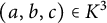
Under the assumption that K has class number one, we note that any nonzero solution
 $(a,b,c) \in K^3$
to (1.1) can be scaled to a primitive solution over
 $\mathcal {O}_K$
, and henceforth, when we refer to solutions over K, we mean that the solutions have been scaled to a primitive solution over
 $\mathcal {O}_K$
. In the more general case that K does not have class number one, we refer the reader to [Reference Freitas and Siksek11].
Theorem 1.2 There are no nontrivial primitive solutions over
 $\mathbb {Q}(\sqrt {5})$
to
 $$ \begin{align*} x^p + y^p + z^p = 0 \end{align*} $$
for prime
 $p \ge 5$
if p satisfies one of the following:
-
(1)
 $p \equiv 5,7 \ \pmod 8$
, or
-
(2)
$p \equiv 19, 41 \ \pmod {48}$
.


The above theorem shows that Fermat’s Last Theorem over
 $\mathbb {Q}(\sqrt {5})$
is true for a set of prime exponents with Dirichlet density
 $5/8$
. In [Reference Kraus15], Theorem 1.2 is proved for
 $5 \le p < 10^7$
, where we note that the small exponents in this range rely on [Reference Hao and Parry13]. The method used in [Reference Kraus15] is to fix a prime exponent
 $p \ge 11$
and use an auxiliary prime
 $q = pk+1$
with
 $k < p-2$
and q split in K, and apply the modular method together with the local condition mod q on solutions to (1.1). In practice, it appears that most primes q of this form succeed in giving a proof for the fixed exponent p, but there is no currently known way to prove results of this type in general.
Theorem 1.3 There are no nontrivial primitive solutions over
 $\mathbb {Q}(\sqrt {17})$
to
 $$ \begin{align*} x^p + y^p + z^p = 0 \end{align*} $$
for prime
 $p \ge 5$
if p satisfies one of the following:
-
(1)
$p \equiv 5, 7 \ \pmod 8$
, or -
(2)
$p \equiv 17 \ \pmod {24}$
.


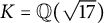
Remark 1.4 In [Reference Freitas and Siksek11], Theorem 1.3 is established for
 $p \equiv 3, 5 \ \pmod 8$
using the symplectic method [Reference Halberstadt and Kraus12]. The above theorem and the result in [Reference Freitas and Siksek11] imply the corollary below, which shows that Fermat’s Last Theorem over
 $K = \mathbb {Q}(\sqrt {17})$
is true for a set of prime exponents with Dirichlet density
 $7/8$
.
Corollary 1.5 There are no nontrivial primitive solutions over
 $\mathbb {Q}(\sqrt {17})$
to
 $$ \begin{align*} x^p + y^p + z^p = 0 \end{align*} $$
for prime
 $p \ge 5$
if
 $p \not \equiv 1 \ \pmod {24}$
.
The proofs of the above theorems are based on the modular method, which attaches a Frey elliptic curve
 $E_0$
defined over K to a putative nontrivial primitive solution. One then considers the representation
 ${\overline {\rho }}_{E_0,p} : G_K \rightarrow \operatorname {GL}_2(\mathbb {F}_p)$
on the p-torsion points of
 $E_0$
, which, by virtue of being a Frey elliptic curve, has Artin conductor bounded independently of the solution and prime exponent p.
Using modularity and level lowering, one deduces that
 ${\overline {\rho }}_{E_0,p} \cong {\overline {\rho }}_{f,p}$
, where
 ${\overline {\rho }}_{f,p} : G_K \rightarrow \operatorname {GL}_2(\mathbb {F}_p)$
is the residual Galois representation attached to a Hilbert newform at the possible Artin conductors. For the cases considered in this paper, f has a coefficient field equal to the field of rational numbers.
Unlike the original Fermat’s Last Theorem, the space of newforms with level equal to the possible Artin conductor is typically not zero. Hence, to achieve a contradiction, one needs additional methods. To accomplish this, we combine information from reciprocity constraints such as in [Reference Chen and Siksek4] to obtain a contradiction for prime exponents in certain congruence classes. This succeeds for
 $\mathbb {Q}(\sqrt {5})$
; however, the reciprocity constraint used in [Reference Chen and Siksek4] is not strong enough to treat
 $\mathbb {Q}(\sqrt {17})$
.
Using the approach in [Reference Bennett, Chen, Dahmen and Yazdani1], valid over
 $\mathbb {Q}$
, we prove a stronger reciprocity constraint, valid over certain real quadratic base fields, in terms of Hilbert symbols. This has an added advantage that the reciprocity law needed is simply the well-known reciprocity law for Hilbert symbols over a number field [Reference Voight21].
The programs and output transcripts for the computations needed in this paper are described and posted at [Reference Chen, Efemwonkieke and Sun3].
2 Proof of Theorem 1.2
Let
 $K = \mathbb {Q}(\sqrt {5})$
and note that
 $\mathcal {O}_K$
has unique factorization. Suppose
 $(a,b,c)$
is a nontrivial primitive solution over
 $\mathcal {O}_K$
to (1.1) for a prime
 $p \ge 5$
. Normalize the solution
 $(a,b,c)$
as in [Reference Kraus15].
Let
 $E_0$
denote the Frey elliptic curve over K:
 $$ \begin{align} E_0: Y^2 = X(X-a^p)(X+b^p). \end{align} $$
Let
 $\mathfrak {P}$
be the unique prime of K above
 $2$
.
Proposition 2.2 Assuming
 $p \ge 5$
, the conductor of
 $E_0$
over K is given by
 $$ \begin{align*} N(E_0) = \mathfrak{P}^t \prod_{\mathfrak{q} \mid abc, \mathfrak{q} \not= \mathfrak{P}} \mathfrak{q}, \end{align*} $$
where
 $t \in \{1,2,3\}$
. Moreover,
 $t = 1$
if
 $2 \mid abc$
and
 $t \in \left \{ 2, 3 \right \}$
if
 $2 \nmid abc$
.
Proof See [Reference Kraus15, Lemme 3].
Proposition 2.3 The representation
 ${\overline {\rho }}_{E_0,p} : G_K \rightarrow \operatorname {GL}_2(\mathbb {F}_p)$
is irreducible if
 $p \ge 11$
.
Proof See [Reference Kraus15, Proposition, p. 7].
Proposition 2.4 There is a Hilbert newform f of trivial character, parallel weight
 $2$
, and level
 $\mathfrak {P}^t$
such that
 ${\overline {\rho }}_{E_0,p} \simeq {\overline {\rho }}_{f,\mathfrak {p}}$
.
Proof The elliptic curve
 $E_0$
over K is modular by [Reference Freitas, LeHung and Siksek9]. Using [Reference Freitas and Siksek10, Theorem 7], we obtain the desired statement.
The space of Hilbert newforms of trivial character, parallel weight
 $2$
, and level
 $\mathfrak {P}, \mathfrak {P}^2$
is zero, so these cases do not occur. In particular, we may now assume that
 $$ \begin{align} 2 \nmid abc \end{align} $$
and
 $t = 3$
.
There is a unique Hilbert newform f of trivial character, parallel weight
 $2$
, and level
 $\mathfrak {P}^3$
which corresponds to an elliptic curve E over K. Hence, we have that
 $$ \begin{align} {\overline{\rho}}_{E_0,p} \simeq {\overline{\rho}}_{E,p} \end{align} $$
by Proposition 2.4.
Lemma 2.7 The elliptic curve E over K is given by
 $$ \begin{align*} E : Y^2 = X (X - (-8 + 4 \sqrt{5})) (X + (9 - 4 \sqrt{5})). \end{align*} $$
Proof The conductor of E over K is
 $\mathfrak {P}^3$
. Since E is modular, it corresponds to the unique Hilbert newform f of trivial character, parallel weight
 $2$
, and level
 $\mathfrak {P}^3$
.
Remark 2.8 In the last section, we explain how to determine the full list of solutions
 $(a,b,c)$
to
 $a + b + c = 0$
, up to multiplication by the square of a unit of
 $\mathcal {O}_K$
, such that
 $$ \begin{align*}E_{a,b,c} : Y^2 = X(X-a)(X+b)\end{align*} $$
gives rise to an elliptic curve in the same isogeny class of E over K. We remark that the
 $2$
-adic conditions on these
 $(a,b,c)$
vary; in particular, there are some triples where
 $2 \nmid abc$
. This implies that inertia arguments at
 $2$
will fail as any solution which is
 $2$
-adically close to one of these triples
 $(a,b,c)$
cannot be ruled out by inertia arguments at
 $2$
.
Let
 $L = K(\zeta _r)$
where
 $\zeta _r$
is a primitive rth root of unity. Using modularity arguments and Theorem 3.5 in the following cases involving values of r, we will prove Theorem 1.2.
-
(1) Case
$r=1$
.Let
$k = \mathcal {O}_K/3 \mathcal {O}_K \cong \mathbb {F}_9$
, noting that
$\# k^\times = 8$
.Let
$\mathfrak {q}_3 = 3 \mathcal {O}_K$
and
$N(\mathfrak {q}_3) = 9$
be the norm of
$\mathfrak {q}_3$
.If
$abc = 0$
in k, then we obtain a bound on p by [Reference Kraus15, p. 9]. In particular, if
$p \not = 3$
, then p divides (2.9)which is nonzero by the Hasse bound
$$ \begin{align} a_{\mathfrak{q}_3}(f) \pm (N(\mathfrak{q}_3) +1) \not= 0, \end{align} $$
(2.10)
$$ \begin{align} | a_{\mathfrak{q}_3}(f)| = |a_{\mathfrak{q}_3}(E)| \le 2 \sqrt{N(\mathfrak{q}_3)}. \end{align} $$
If
$a_{\mathfrak {q}_3}(E_0) \not = a_{\mathfrak {q}_3}(E)$
, then we also obtain a bound on p by [Reference Kraus15, p. 9]. In particular, if
$p \not = 3$
, then p divides (2.11)
$$ \begin{align} a_{\mathfrak{q}_3}(E_0) - a_{\mathfrak{q}_3}(E) \not= 0. \end{align} $$
Thus, either we obtain a bound on p or we have that
$a,b,c \in k^\times $
and
$a_{\mathfrak {q}_3}(E_0) = a_{\mathfrak {q}_3}(E)$
. The bound can be computed to be
$p \in \left \{ 2,3 \right \}$
.Assume now that
$a,b,c \in k^\times $
and
$a_{\mathfrak {q}_3}(E_0) = a_{\mathfrak {q}_3}(E)$
. Now, set (2.12)
$$ \begin{align} \epsilon = a^p b^p c^{-2p} \text{ in } k. \end{align} $$
Since
$p^2 \equiv 1 \ \pmod 8$
, we have that
$\epsilon ^R = ab c^{-2}$
in k where
$R \equiv p \ \pmod 8$
. Hence, the condition (3.6) becomes (2.13)for all permutations of
$$ \begin{align} \left(\frac{\epsilon^R-1}{3}\right)_{K} \not= -1, \end{align} $$
$a,b,c$
as (2.5) holds. Using
$\mathsf{Magma}$
, we can check the set of triples
$(a,b,c) \in (k^\times )^3$
which satisfy and (2.13) for all permutations of
$$ \begin{align*} a_{\mathfrak{q}_3}(E_0) = a_{\mathfrak{q}_3}(E), \end{align*} $$
$a,b,c$
is empty if
$p \equiv 5, 7 \ \pmod {8}$
.
-
(2) Case
$r = 3$
.Let
$k = \mathcal {O}_K/21 \mathcal {O}_K \cong \mathbb {F}_9 \times \mathbb {F}_{49}$
, noting that
$\# k^\times = 384$
. Let
$\mathfrak {q}_3 = 3 \mathcal {O}_K$
and
$\mathfrak {q}_7 = 7 \mathcal {O}_K$
.If
$abc \notin k^\times $
or one of the following two conditions holds, we obtain a bound on p similarly as in (2.9) and (2.11). This bound can be computed to be
$$ \begin{align*} a_{\mathfrak{q}_3}(E_0) & \not= a_{\mathfrak{q}_3}(E), \\ a_{\mathfrak{q}_7}(E_0) & \not= a_{\mathfrak{q}_7}(E), \end{align*} $$
$p \in \left \{ 2,3,5 \right \}$
. The case
$p = 5$
is covered by [Reference Kraus15].
Assume from here on that
$a,b,c \in k^\times $
and both hold. Now set
$$ \begin{align*} a_{\mathfrak{q}_3}(E_0) & = a_{\mathfrak{q}_3}(E) \quad\text{and} \\ a_{\mathfrak{q}_7}(E_0) & = a_{\mathfrak{q}_7}(E) \end{align*} $$
(2.14)
$$ \begin{align} \epsilon = a^p b^p c^{-2p} \text{ in } k. \end{align} $$
Let
$R^{*}$
be the least positive residue such that
$p \equiv R^* \ \pmod {384}$
, and let R be such that
$R R^* \equiv 1 \ \pmod {384}$
. Then we have that
$\epsilon ^R = ab c^{-2}$
in k. Hence, the condition (3.6), taking
$\zeta _r' = \zeta _r^R$
since
$r = 3$
divides
$384$
, becomes (2.15)for all permutations of
$$ \begin{align} \left(\frac{\epsilon^R - \zeta_r'}{1- 4 \zeta_r}\right)_{K} \not= -1, \end{align} $$
$a,b,c$
as (2.5) holds. Using
$\mathsf{Magma}$
, we can check the set of triples
$(a,b,c) \in (k^\times )^3$
which satisfy and (2.15) for all permutations of
$$ \begin{align*} a_{\mathfrak{q}_3}(E_0) & = a_{\mathfrak{q}_3}(E), \\ a_{\mathfrak{q}_7}(E_0) & = a_{\mathfrak{q}_7}(E), \end{align*} $$
$a,b,c$
is empty if
$$ \begin{align*} & p \equiv 7, 19, 29, 41, 55, 67, 77, 89, 103, 115, 125, 137, 151, 163, 173, 185, \\ & 199, 211, 221, 233, 247, 259, 269, 281, 295, 307, 317, 329, 343, 355, 365, 377 \ \pmod{384}. \end{align*} $$
It can be verified that the set of congruence condition above is equivalent to
$p \equiv 7, 19, 29, 41 \ \pmod {48}$
, noting that
$48$
divides
$384$
.



































This concludes the proof of Theorem 1.2.
Remark 2.16 In the proof of Theorem 1.2, we argued on a hypothetical solution
 $(a,b,c)$
to
 $a^p + b^p + c^p = 0$
and applied constraints over the residue class ring k. However, since p is coprime to
 $\# k^\times $
, we can check the modular and reciprocity constraints in terms of new variables
 $(a',b',c') = (a^p,b^p,c^p)$
in
 $k^3$
. This remark also applies to Theorem 1.3.
Remark 2.17 For a given
 $r \ge 1$
, let
 $K = \mathbb {Q}(\sqrt {d})$
and
 $L = \mathbb {Q}(\sqrt {d},\zeta _r)$
. Our method of obtaining results for the Fermat’s Last Theorem over K requires us to check the reciprocity constraints for all
 $3$
-tuples
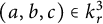 $(a,b,c) \in k_r^3$
where
 $k_r$
is the residue ring given by
 $$ \begin{align*}k_r := \mathcal{O}_K/\mathfrak{N}_r\end{align*} $$
and
 $\mathfrak {N}_r := (1-4\zeta _r)\mathcal {O}_L \cap \mathcal {O}_K$
. As we increase r, the size of the rational prime factors of
 $\text {Norm}(1 - 4\zeta _r)$
grows rapidly, which leads to computational bottlenecks as then
 $k_r$
is too large (implying that the number of
 $R^*$
and triples
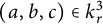 $(a,b,c) \in k_r^3$
to consider are too numerous or the Hecke eigenvalue computation for the modular constraint is infeasible). We therefore restricted our search for results to
 $r \le 10$
.
Remark 2.18 We describe more specifically how Remark 2.17 applies to
 $d = 5$
: if
 $r = 2$
, then
 $(1-4\zeta _2)\mathcal {O}_L = (\sqrt {5} \mathcal {O}_L)^2$
so that
 $$ \begin{align} {\left(\frac{{ab-c^2\zeta_r'}}{5}\right)_{L}} = \left(\frac{ab-c^2\zeta_r'}{\sqrt{5}}\right)_{L}\left(\frac{ab-c^2\zeta_r'}{\sqrt{5}}\right)_{L} = 1 \ne -1 \end{align} $$
for any
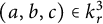 $(a,b,c) \in k_r^3$
; that is, we obtain a trivial reciprocity constraint. For
 $r = 4,5, 6,10$
, every possible choice of
 $R^*$
had a triple
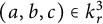 $(a,b,c) \in k_r^3$
which passed all of the imposed constraints, implying negative results for these r’s. For
 $r = 8$
, the Hecke eigenvalue computation for the modular constraint was not feasible. For
 $r = 7,9$
, the size of
 $k_r$
was unfeasible (
 $\# k_r> 17 \times 10^6$
). However, there were choices of
 $R^*$
such that sampling many
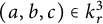 $(a,b,c) \in k_r^3$
at random for that
 $R^*$
did not yield a triple
 $(a,b,c)$
which passed all of the imposed constraints. It thus remains possible that the imposed constraints are in principle sufficient to give a positive result for some
 $R^*$
’s for
 $r = 7, 9$
, but the method is infeasible computationally in its present form because
 $\# k_r$
is too large.
3 Reciprocity constraints
In this section, we will prove the reciprocity constraint, which is used in the proof of Theorem 1.2. For this, we will use the following form of quadratic reciprocity over number fields and a corollary, both of which are taken from [Reference Chen and Siksek4].
Let L be a number field with ring of integers
 $\mathcal {O}_L$
. For an element or ideal of
 $\mathcal {O}_L$
, we say that it is odd if it is coprime to
 $2 \mathcal {O}_L$
.
Theorem 3.1 Suppose
 $ L $
is a number field with r real embeddings. We write
 $\operatorname {\mathrm {sgn}}_{i}(\alpha )$
for the sign of the image of
 $\alpha $
under the ith real embedding. Let
 $\alpha , \lambda \in \mathcal {O}_L$
be integers with
 $\alpha $
odd and
 $\alpha $
and
 $\lambda $
coprime. Decompose
 $\lambda \mathcal {O}_L = \mathfrak {L}\mathfrak {R}$
where
 $\mathfrak {R}$
is an odd ideal in
 $\mathcal {O}_L$
and
 $\mathfrak {L}$
is even. Suppose that
 $\alpha $
is a quadratic residue modulo
 $4\mathfrak {L}$
. Then
 $$\begin{align*}\left(\frac{\lambda}{\alpha}\right)_{L} \left(\frac{\alpha}{\mathfrak{R}}\right)_{L} = {(-1)}^{\sigma}, \end{align*}$$
where
 $\left (\frac {a}{\mathfrak {R}}\right )_{L}$
is the Jacobi symbol in L and
 $$\begin{align*}\sigma = \sum_{i=1}^{r} \frac{\operatorname{\mathrm{sgn}}_{i}(\alpha) - 1}{2}\frac{\operatorname{\mathrm{sgn}}_{i}(\lambda) - 1}{2}. \end{align*}$$
For the definition of Jacobi symbol
 $\left (\frac {\lambda }{\mathfrak {R}}\right )_{L}$
over a number field L, see [Reference Chen and Siksek4] or [Reference Neukirch17, Definition 8.2]. Furthermore, for
 $\alpha \in \mathcal {O}_L$
,
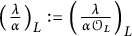 $\left (\frac {\lambda }{\alpha }\right )_{L} := \left (\frac {\lambda }{\alpha \mathcal {O}_L}\right )_{L}$
.
Corollary 3.2 Let
 $\alpha , \lambda $
be algebraic integers in the number field
 $ L $
with
 $\alpha $
odd. Suppose that
 $\alpha \equiv \epsilon ^{2} \ \pmod {4\lambda }$
for some algebraic integer
 $\epsilon $
in L. In addition, suppose that
 $\alpha $
is positive in every real embedding of
 $ L $
. Then
 $$\begin{align*}\left(\frac{\lambda}{\alpha}\right)_{L} \neq -1. \end{align*}$$
Proof If
 $\alpha $
and
 $\lambda $
are not coprime, the above symbol is zero. Otherwise, we are in the case where we can apply Theorem 3.1 in the case where
 $\mathfrak {L} = \lambda \mathcal {O}_{L}$
and
 $\mathfrak {R} = \mathcal {O}_{L}$
. In this case,
 $\sigma = 0$
since
 $\alpha $
is positive in every real embedding, and
 ${\left (\frac {\alpha }{\mathcal {O}_{L}}\right )_L = 1}$
, so that
 ${\left (\frac {\lambda }{\alpha }\right )_L = 1}$
.
We also require the following lemmas.
Lemma 3.3 If
 $x, y \in \mathbb {R}$
satisfy
 $x^n + y^n = 1$
for
 $n \in \mathbb {N}$
, then
 $xy < 1$
.
Proof For all real x, we have that
 $x^{2n} - x^{n} + 1> 0$
. This implies that
 $x^{n}(1 - x^{n}) < 1$
. If
 $xy \ge 1$
, then we would have that
 $x^n y^n = x^n (1-x^n) \ge 1$
, a contradiction. Hence, we conclude
 $xy < 1$
.
Lemma 3.4 If
 $(a, b, c)$
is a primitive nontrivial solution to Fermat’s equation over K for some odd prime
 $p> 2$
, then
 $ab - c^{2}$
is negative in every real embedding of K.
Proof Let
 $\rho $
be any real embedding of K. Since
 $(a, b, c)$
is a primitive solution to the Fermat equation,
 $(\rho (a), \rho (b), \rho (c))$
is also a primitive solution. Thus, if
 $(a, b, c)$
is such a triple, then
 $$\begin{align*}{\bigg(\frac{\rho(a)}{-\rho(c)}\bigg)}^{p} + {\bigg(\frac{\rho(b)}{-\rho(c)}\bigg)}^{p} = 1. \end{align*}$$
Now, we employ Lemma 3.3 to deduce
 $$\begin{align*}\frac{\rho(a)\rho(b)}{\rho(c)^{2}} < 1, \end{align*}$$
which gives
 $\rho (ab - c^{2}) = \rho (a)(b) - \rho (c)^2 < 0$
.
We now state and prove the reciprocity constraint.
Theorem 3.5 Let K be a number field, and let
 $\zeta _{r}$
be a primitive rth root of unity where
 $ (r,p) = 1 $
. If
 $r = 1$
, assume further that K has an even number of real embeddings. Let
 $L = K(\zeta _{r})$
and write
 $\zeta _r = {\zeta ^{\prime }_{r}}^p $
where
 $\zeta ^{\prime }_r$
is a primitive rth root of unity.
If
 $(a,b,c)$
is a primitive solution over
 $\mathcal {O}_K$
to
 $$\begin{align*}a^{p} + b^{p} + c^{p} = 0 \end{align*}$$
and c is coprime to
 $2\mathcal {O}_{K}$
, then
 $$ \begin{align} \left(\frac{ab - c^{2}\zeta^{\prime}_{r}}{1 - 4\zeta_{r}}\right)_{L} \neq -1. \end{align} $$
In particular, if
 $abc$
is coprime to
 $2 \mathcal {O}_K$
, then (3.6) holds for all permutations of
 $a,b,c$
.
Proof By assumption, c is coprime to
 $2\mathcal {O}_{K}$
. We employ the identity
 $$\begin{align*}(a^{p} - b^{p})^{2} = -4{(ab)}^{p} + c^{2p}. \end{align*}$$
Subtracting both sides of this identity by
 $c^{2p}(1 - 4\zeta _{r})$
, we get
 $$ \begin{align} {(a^{p} - b^{p})}^{2} - c^{2p}(1 - 4\zeta_{r}) & = -4 \left( (ab)^p - \zeta_r c^{2p} \right) \\ \notag & = -4(ab -c^{2}\zeta^{\prime}_{r})h, \end{align} $$
where
 $$ \begin{align*} h = {(ab)}^{p-1} + \zeta^{\prime}_{r}c^{2}{(ab)}^{p-2} + \cdots + \zeta_{r}^{\prime(p-1)}c^{2(p - 1)}. \end{align*} $$
Let
 $\alpha = 1 - 4\zeta _{r}$
and
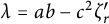 $\lambda = ab - c^{2} \zeta ^{\prime }_{r}$
. We first show that c is invertible modulo
 $4\lambda = 4(ab - c^{2}\zeta ^{\prime }_{r})$
. To this end, let
 $\mathfrak {P}$
be a prime in
 $\mathcal {O}_{L}$
dividing c. We show that
 $\mathfrak {P}$
does not divide
 $4\lambda $
. Indeed, suppose this were the case. Then
 $\mathfrak {P}$
divides
 $4\lambda $
and so either divides
 $4 \mathcal {O}_L$
or divides
 $\lambda $
. Note that
 $\mathfrak {P}$
cannot divide
 $4 \mathcal {O}_L$
, for then
 $\mathfrak {P}$
divides
 $2 \mathcal {O}_L$
and thus
 $c \in \mathfrak {P} \cap \mathcal {O}_{K}$
, contradicting that c is coprime to
 $2 \mathcal {O}_K$
. Hence,
 $\mathfrak {P} \mid \lambda $
. Then we have that
 $$\begin{align*}ab = \lambda + c^{2}\zeta^{\prime}_{r} \in \mathfrak{P} \end{align*}$$
and so either a or b is in
 $\mathfrak {P}$
. However,
 $$\begin{align*}a^{p} + b^{p} + c^{p} = 0, \end{align*}$$
so
 $\mathfrak {P}$
divides
 $a, b$
, and c. We have assumed that
 $a, b, c$
are coprime in
 $\mathcal {O}_{K}$
. Let
 $r_{1}, r_{2}, r_{3}$
be such that
 $$\begin{align*}r_{1}a + r_{2}b + r_{3}c = 1. \end{align*}$$
Then we get the contradiction that
 $1 \in \mathfrak {P}$
.
In light of this, let
 $\epsilon \in \mathcal {O}_{L}$
be such that the image of
 $\epsilon $
in
 $\mathcal {O}_{L}/(4(ab - c^{2}\zeta ^{\prime }_{r}))$
is
 $$\begin{align*}c^{-p}{(a^{p} - b^{p})} \ \pmod{4(ab - c^{2}\zeta^{\prime}_{r})}. \end{align*}$$
We see that
 $\alpha $
is odd, for if
 $\mathfrak {P}$
divides both
 $\alpha $
and
 $2 \mathcal {O}_L$
, then
 $\mathfrak {P}$
divides
 $1$
, a contradiction. Then, from (3.7),
 $$\begin{align*}\alpha \equiv \epsilon^{2} \ \pmod{4\lambda}. \end{align*}$$
Since L has no real embeddings if
 $r> 2$
, Corollary 3.2 gives the result in this case.
If
 $r = 2$
, we have that
 $\alpha = 5$
is positive in every real embedding of
 $L = K$
because
 $\mathbb {Q}$
is fixed. Corollary 3.2 then gives the result in this case.
From Theorem 3.1, we have that
 $$\begin{align*}\left(\frac{ab - c^{2}}{-3}\right)_{K} = {(-1)}^{\sigma}. \end{align*}$$
We are under the assumption that K has an even number of real embeddings
 $2t$
so that
 $$\begin{align*}\sigma = \sum_{i=1}^{2t} \frac{\operatorname{\mathrm{sgn}}_{i}(-3) - 1}{2}\frac{\operatorname{\mathrm{sgn}}_{i}(ab - c^{2}) - 1}{2}. \end{align*}$$
We see that
 $\operatorname {\mathrm {sgn}}_{i}(-3) = -1$
for all i. Lemma 3.4 gives that
 $ ab - c^{2} $
is totally negative and so
 $\operatorname {\mathrm {sgn}}_{i}(ab - c^{2}) = -1$
for all i and hence we conclude
 $\sigma = 2t $
is even. This gives the result for
 $r = 1$
.
4 Proof of Theorem 1.3
Let
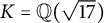 $K = \mathbb {Q}(\sqrt {17})$
, and let
 $\mathcal {O}_K$
be its ring of integer, which has unique factorization. The prime
 $2$
splits in K as
 $2 \mathcal {O}_K = \mathfrak {P}_1 \mathfrak {P}_2$
for prime ideals
 $\mathfrak {P}_1$
and
 $\mathfrak {P}_2$
of K. Suppose
 $(a,b,c)$
is a nontrivial primitive solution over
 $\mathcal {O}_K$
to (1.1), and let
 $E_0$
denote the Frey elliptic curve over K:
 $$ \begin{align} E_0: Y^2 = X(X-a^p)(X+b^p). \end{align} $$
Proposition 4.2 Assume
 $p \ge 5$
. Up to scaling
 $(a,b,c)$
by a unit in
 $\mathcal {O}_K$
, the conductor of
 $E_0$
over K is given by
 $$ \begin{align*} N(E_0) = \mathfrak{P}_1 \mathfrak{P}_2 \prod_{\mathfrak{q} \mid abc, \mathfrak{q} \nmid \mathfrak{P}_1 \mathfrak{P}_2} \mathfrak{q}. \end{align*} $$
Proof See [Reference Freitas and Siksek11, Corollary 5.1]. We note the fact that
 $\mathcal {O}_K$
has unique factorization means that there is no need to consider the extraneous prime
 $\mathfrak {r}$
in [Reference Freitas and Siksek11].
We may assume that
 $$ \begin{align} 2 \mid abc, \end{align} $$
since
 $a^p + b^p + c^p = 0$
implies that one of
 $a^p,b^p,c^p$
is
 $0$
in the residue fields of
 $\mathfrak {P}_1$
and
 $\mathfrak {P}_2$
.
By the arguments in [Reference Freitas and Siksek11, p. 2], we need only prove Theorem 1.3 for
 $p \ge 17$
, which we now assume.
Proposition 4.4 The Galois representation
 ${\overline {\rho }}_{E_0,p} : G_K \rightarrow \operatorname {GL}_2(\mathbb {F}_p)$
is irreducible if
 $p \ge 17$
.
Proof See [Reference Freitas and Siksek11, Lemma 6.1, p. 9].
Proposition 4.5 There is a Hilbert newform f of trivial character, parallel weight
 $2$
, and level
 $\mathfrak {P}_1 \mathfrak {P}_2$
such that
 ${\overline {\rho }}_{E_0,p} \simeq {\overline {\rho }}_{f,\mathfrak {p}}$
.
Proof The elliptic curve
 $E_0$
over K is modular by [Reference Freitas, LeHung and Siksek9]. Using [Reference Freitas and Siksek10, Theorem 7], we obtain the desired statement.
There is a unique Hilbert newform f of trivial character, parallel weight
 $2$
, and level
 $\mathfrak {P}_1\mathfrak {P}_2$
, and this corresponds to an elliptic curve E over K.
Lemma 4.6 The elliptic curve E over K is given by
 $$ \begin{align*} E : Y^2 = X (X - (4 - \sqrt{17})) \left( X + \frac{-13+5 \sqrt{17}}{2} \right). \end{align*} $$
Proof See [Reference Freitas and Siksek11, p. 13]. The conductor of E over K is
 $2 \mathcal {O}_K$
. Since E is modular, it corresponds to the unique Hilbert newform f of trivial character, parallel weight
 $2$
, and level
 $2 \mathcal {O}_K$
.
Hence, we have that
 $$ \begin{align} {\overline{\rho}}_{E_0,p} \simeq {\overline{\rho}}_{E,p} \end{align} $$
by Proposition 4.5.
Proof of Theorem 1.3
Let
 $L = K(\zeta _r)$
where
 $\zeta _r$
is a primitive rth root of unity. We give two proofs in the cases
 $r = 1$
,
 $r = 2$
, and
 $r = 3$
.
-
(1) Case
$r=1$
.Let
$k = \mathcal {O}_K/3 \mathcal {O}_K \cong \mathbb {F}_9$
, noting that
$\# k^\times = 8$
. Let
$\mathfrak {q}_3 = 3 \mathcal {O}_K$
.If
$abc \notin k^\times $
or
$a_{\mathfrak {q}_3}(E_0) \not = a_{\mathfrak {q}_3}(E)$
, then we obtain a bound on p similarly as in (2.9) and (2.11). This bound can be computed to be
$p \in \left \{ 2,3 \right \}$
.Assume from here on that
$a,b,c \in k^\times $
and
$a_{\mathfrak {q}_3}(E_0) = a_{\mathfrak {q}_3}(E)$
holds. For
$a,b, c \in k^\times $
, we set (4.8)
$$ \begin{align} \epsilon = a^p b^p c^{-2p} \text{ in } k. \end{align} $$
Since
$p^2 \equiv 1 \ \pmod 8$
, we have that
$\epsilon ^R = ab c^{-2}$
in k where
$R \equiv p \ \pmod 8$
. Hence, the condition (5.22) becomes (4.9)for all permutations of
$$ \begin{align} \left(\frac{\epsilon^R-1}{3}\right)_{K} \not= -1, \end{align} $$
$a,b,c$
as (4.3) holds. We note that (5.20) holds as if not, by the left-hand side of (5.10), we would have that
$\sqrt {-3} \in K$
.
Using
$\mathsf{Magma}$
, we can check the set of triples
$(a,b,c) \in (k^\times )^3$
which satisfy and (4.11) for all permutations of
$$ \begin{align*} a_{\mathfrak{q}_3}(E_0) = a_{\mathfrak{q}_3}(E), \end{align*} $$
$a,b,c$
is empty if
$p \equiv 5, 7 \ \pmod {8}$
.
-
(2) Case
$r = 2$
.Let
$k = \mathcal {O}_K/5 \mathcal {O}_K \cong \mathbb {F}_{25}$
, noting that
$\# k^\times = 24$
. Let
$\mathfrak {q}_5 = 5 \mathcal {O}_K$
.If
$abc \notin k^\times $
or
$a_{\mathfrak {q}_5}(E_0) \not = a_{\mathfrak {q}_5}(E)$
, then we obtain a bound on p similarly as in (2.9) and (2.11). This bound can be computed to be
$p \in \left \{ 2, 3, 5, 7 \right \}$
.Assume from here on that
$a,b,c \in k^\times $
and
$a_{\mathfrak {q}_5}(E_0) = a_{\mathfrak {q}_5}(E)$
holds. For
$a,b, c \in k^\times $
, we set (4.10)
$$ \begin{align} \epsilon = a^p b^p c^{-2p} \text{ in } k. \end{align} $$
Since
$p^2 \equiv 1 \ \pmod {24}$
, we have that
$\epsilon ^R = ab c^{-2}$
in k where
$R \equiv p \ \pmod {24}$
. Hence, the condition (5.22) becomes (4.11)for all permutations of
$$ \begin{align} \left(\frac{\epsilon^R-1}{5}\right)_{K} \not= -1, \end{align} $$
$a,b,c$
as (4.3) holds. We note that (5.20) holds as if not, by the left-hand side of (5.10), we would have that
$\sqrt {5} \in K$
.
Using
$\mathsf{Magma}$
, we can check the set of triples
$(a,b,c) \in (k^\times )^3$
which satisfy and (4.11) for all permutations of
$$ \begin{align*} a_{\mathfrak{q}_5}(E_0) = a_{\mathfrak{q}_5}(E), \end{align*} $$
$a,b,c$
is empty if
$p \equiv 13, 17, 19, 23 \ \pmod {24}$
.
-
(3) Case
$r = 3$
.Let
$k = \mathcal {O}_K/21 \mathcal {O}_K \cong \mathbb {F}_9 \times \mathbb {F}_{49}$
, noting that
$\# k^\times = 384$
. Let
$\mathfrak {q}_3 = 3 \mathcal {O}_K$
and
$\mathfrak {q}_7 = 7 \mathcal {O}_K$
.If
$abc \notin k^\times $
or one of the following two conditions holds, we obtain a bound on p similarly as in (2.9) and (2.11). This bound can be computed to be
$$ \begin{align*} a_{\mathfrak{q}_3}(E_0) & \not= a_{\mathfrak{q}_3}(E), \\ a_{\mathfrak{q}_7}(E_0) & \not= a_{\mathfrak{q}_7}(E), \end{align*} $$
$p \in \left \{ 2,3,5,7 \right \}$
.
Assume from here on that
$a,b,c \in k^\times $
and both hold. For
$$ \begin{align*} a_{\mathfrak{q}_3}(E_0) & = a_{\mathfrak{q}_3}(E) \quad \text{and} \\ a_{\mathfrak{q}_7}(E_0) & = a_{\mathfrak{q}_7}(E) \end{align*} $$
$a,b,c \in k^\times $
, we set (4.12)
$$ \begin{align} \epsilon = a^p b^p c^{-2p} \text{ in } k. \end{align} $$
Let
$R^*$
be the least positive residue such that
$p \equiv R^* \ \pmod {384}$
, and let R be such that
$R R^* \equiv 1 \ \pmod {384}$
. Then we have that
$\epsilon ^R = ab c^{-2}$
in k. Hence, the condition (5.22), taking
$\zeta _r' = \zeta _r^R$
since
$r = 3$
divides
$384$
, becomes (4.13)for all permutations of
$$ \begin{align} \left(\frac{\epsilon^R - \zeta_r'}{1- 4 \zeta_r}\right)_{K} \not= -1, \end{align} $$
$a,b,c$
as (4.3) holds. We note that the hypothesis (5.20) holds as K is totally real.
Using
$\mathsf{Magma}$
, we can check the set of triples
$(a,b,c) \in (k^\times )^3$
which satisfy and (4.13) for all permutations of
$$ \begin{align*} a_{\mathfrak{q}_3}(E_0) & = a_{\mathfrak{q}_3}(E), \\ a_{\mathfrak{q}_7}(E_0) & = a_{\mathfrak{q}_7}(E), \end{align*} $$
$a,b,c$
is empty if
$$ \begin{align*} & p \equiv 5, 7, 13, 23, 29, 31, 37, 47, 53, 55, 61, 71, 77, 79, 85, 95, 101, 103, \\ & 109, 119, 125, 127, 133, 143, 149, 151, 157, 167, 173, 175, 181, 191, 197, 199, 205, \\ & 215, 221, 223, 229, 239, 245, 247, 253, 263, 269, 271, 277, 287, 293, 295, 301, \\ & 311, 317, 319, 325, 335, 341, 343, 349, 359, 365, 367, 373, 383 \ \pmod{384}. \end{align*} $$
It can be verified that the congruence condition above is equivalent to
$p \equiv 5, 7, 13, 23 \ \pmod {24}$
, noting that
$24$
divides
$384$
. Finally, the congruence
$p \equiv 5, 7, 13, 23 \ \pmod {24}$
is equivalent to
$p \equiv 5, 7 \ \pmod 8$
for prime
$p \ge 5$
.


























































Remark 4.14 We describe more specifically how Remark 2.17 applies to
 $d = 17$
: if
 $r = 4$
, we have that
 $(1-\zeta _4)\mathcal {O}_L = (\sqrt {17} \mathcal {O}_L)^2$
, so in a similar way as in (2.19), we obtain a trivial reciprocity constraint. For
 $r = 6, 8$
, every possible choice of
 $R^*$
had a triple
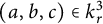 $(a,b,c) \in k_r^3$
which passed all of the imposed constraints, implying a negative result. For
 $r = 5, 7, 9, 10$
, the sizes of the
 $k_r$
’s were too large (
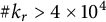 $\# k_r> 4\times 10^4$
). For
 $r = 5, 7, 9, 10$
, there were choices of
 $R^*$
such that sampling many
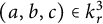 $(a,b,c) \in k_r^3$
at random for that
 $R^*$
did not yield a triple
 $(a,b,c)$
which passed all of the imposed constraints. It thus remains possible that the imposed constraints are in principle sufficient to give a positive result for some
 $R^*$
’s for
 $r = 5, 7, 9, 10$
, but the method is infeasible computationally in its present form because
 $\# k_r$
is too large.
5 Reciprocity constraints using the Hilbert symbol
In this section, we use Hilbert symbols to prove a strengthened reciprocity constraint which does not have a condition on c.
Definition 5.1 For a global field L, we define the Hilbert symbol
 $( \cdot , \cdot )_L:L^{\times }\times L^{\times } \rightarrow \{-1,1\}$
as
 $$ \begin{align} (a,b)_L := \begin{cases}1, &\text{ if }z^2 = ax^2 + by^2\text{ has a nontrivial solution in }L,\\ -1, &\text{ otherwise.}\end{cases} \end{align} $$
Let
 $S_L$
denote the set of normalized places of L and partition them into
 $$ \begin{align*} S_L^\infty & = \left\{ v \in S_L : v \mid \infty \right\}, \\ S_L^{\text{even}} & = \left\{ v \in S_L : v \mid 2 \right\}, \\ S_L^{\text{odd}} & = \left\{ v \in S_L : v \nmid 2 \right\}. \end{align*} $$
For a place
 $v \in S_L$
of L, we denote
 $(\alpha ,\beta )_v := (\alpha , \beta )_{L_v}$
, where
 $L_v$
is the completion of L at v. Let
 $\pi _v$
be a uniformizer for
 $L_v$
, let
 $\mathcal {O}_v$
be the ring of integers of
 $L_v$
, and let
 $\mathbb {F}_v$
be the residue field of
 $L_v$
.
We will state a few useful properties of the Hilbert symbol for later use.
Lemma 5.3 The Hilbert symbol defines a nondegenerate symmetric bimultiplicative pairing.
Proof See [Reference Voight21, Lemma 12.4.6].
Lemma 5.4 Let
 $a, b \in L^\times $
. Then the following hold:
-
(1)
$(a c^2,b d^2)_L = (a,b)_L$
for all
$c, d \in L^\times $
. -
(2)
$(b,a)_L = (a,b)_L$
. -
(3)
$(a,b)_L = (a,-ab)_L = (b,-ab)_L$
. -
(4)
$(1,a)_L = (a,-a)_L = 1$
. -
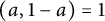
(5) If
$a \not = 1$
, then
$(a, 1-a) = 1$
. -
(6) If
$\sigma \in \mathrm{Aut}(L)$
, then
$(a,b)_L = (\sigma (a),\sigma (b))_L.$








Proof See [Reference Voight21, Lemma 12.4.3].
Lemma 5.5 (Reciprocity law)
Let L be a number field, and let
 $S_L$
be the set of places of L. Then, for any
 $\alpha , \beta \in L^*$
, we have that
 $$ \begin{align} \prod_{v \in S_L} (\alpha, \beta)_v = 1. \end{align} $$
Proof See [Reference Voight21, Corollary 14.6.2].
Lemma 5.7 With notation as above, let
 $q = \# \mathbb {F}_v$
be odd. Write
 $a = a_0 \pi_v ^{v(a)}$
and
 $b = b_0 \pi_v ^{v(b)}$
. Then we have that
 $$ \begin{align} (a,b)_v = (-1)^{v(a) v(b) (q-1)/2} \genfrac(){}{}{a_0}{\pi_v}^{v(b)} \genfrac(){}{}{b_0}{\pi_v}^{v(a)}. \end{align} $$
Proof See [Reference Voight21, equation (12.4.10)].
We now move on to the theorem that enables us to tackle the reciprocity constraint on the primitive solutions over
 $\mathbb {Q}(\sqrt {17})$
. The following is a generalization of [Reference Bennett, Chen, Dahmen and Yazdani1, Proposition 17].
Theorem 5.9 Let L be a number field containing a primitive rth root of unity
 $\zeta _r$
such that
 $(r,n) = 1$
where
 $n \in \mathbb {N}$
. Assume
 $s, t \in \mathcal {O}_L$
,
 $v(t) = 0$
for all
 $v \in S_L$
such that
 $v(n)> 0$
, and
 $v(s)> 0$
only for places
 $v \in \mathrm{S}_\mathrm{L}^{\mathrm {even}}$
. Furthermore, suppose we have the following identity:
 $$ \begin{align} A^2 - t B^{2n} = s (C^n - \zeta_r B^{2n}) \not= 0 \end{align} $$
for coprime
 $A, B, C \in \mathcal {O}_L$
and write
 $\zeta _r = {\zeta _r'}^n$
where
 $\zeta _r'$
is a primitive rth root of unity.
Then we have that
 $$ \begin{align} \prod_{v \in S_L^\infty} (t,s (C - \zeta_r' B^2))_v \prod_{v \in \mathrm{S}_\mathrm{L}^{\mathrm{even}}} (t, s (C - \zeta_r' B^2))_v \prod_{v \in \mathrm{S}_\mathrm{L}^{\mathrm{odd}}, \mathrm{v(t)}\ \mathrm{odd}} (t,s(C - \zeta_r' B^2))_v = 1. \end{align} $$
Proof The hypotheses imply that
 $s, t, (C^n - \zeta _r B^{2n})$
are nonzero, and hence also
 $(C - \zeta _r' B^2) \not = 0$
, so the Hilbert symbols used below are well defined. Note that
 $$ \begin{align*} (t, s(C^{n} - \zeta_{r}B^{2n}))_{v} = 1 \end{align*} $$
for all
 $v \in S_{L}$
because
 $$ \begin{align*} A^{2} = t B^{2n} + s(C^{n} - \zeta_{r} B^{2n})\cdot 1^{2}. \end{align*} $$
Using the fact that
 $\zeta _r = {\zeta _r'}^n$
and the factorization
 $$ \begin{align} C^{n} - \zeta_{r}B^{2n} &= C^n - (\zeta_r' B^2)^n\\ \notag &= (C - \zeta_{r}' B^{2})(C^{n-1} + C^{n-2} \zeta_{r}' B^{2} + \cdots + (\zeta_r' B^2)^{n-1}), \end{align} $$
we see that
 $$ \begin{align} (t, s(C - \zeta^{\prime}_{r}B^{2}))_{v} = (t, C^{n-1} + C^{n-2} \zeta_{r}' B^{2} + \cdots + (\zeta_r' B^2)^{n-1} )_{v}, \end{align} $$
using Lemma 5.3.
Let
 $\beta = s(C - \zeta _{r}'B^{2})$
. By (5.6), we have that
 $$ \begin{align} \prod_{v \in S_{L}^\infty} (t, \beta)_{v}\prod_{v \in S_{L}^{\mathrm{even}}} (t, \beta)_{v}\prod_{v \in S_{L}^{\mathrm{odd}}, v(t) \text{ odd}} (t, \beta)_{v} = \prod_{v \in S_{L}^{\mathrm{odd}}, v(t) \text{ even}} (t, \beta)_{v}. \end{align} $$
Thus, it suffices to show that
 $(t, \beta )_{v} = 1$
when
 $v \in S_{L}^{\mathrm {odd}}$
and
 $v(t)$
is even.
Suppose
 $v \in S_{L}^{\mathrm {odd}}$
and
 $v(t)$
is even. By (5.8),
 $(t, \beta )_{v} = 1$
when
 $v(\beta )$
is even. So suppose that
 $v(\beta )$
is odd.
If
 $v(n)> 0$
, then we have that
 $v(t) = 0$
by assumption. As
 $ v(\beta ) $
is odd, we deduce from (5.10) and (5.12) that
 $$ \begin{align*} v(A^{2} - t B^{2n}) = v(s(C^{n} - \zeta_{r} B^{2n})) \ge v(\beta)> 0, \end{align*} $$
so that
 $$ \begin{align} A^{2} \equiv t B^{2n} \ \pmod {\pi_{v}}. \end{align} $$
Since
 $A, B, C$
are coprime, by (5.10), we deduce that A and B are coprime, as
 $v(A), v(B)> 0$
implies
 $v(s C^n)> 0$
. Since
 $v(s) = 0$
, we see that
 $v(C)> 0$
, contradicting
 $A, B, C$
being coprime. Hence, if
 $v(B)> 0$
, then by (5.15) we obtain that
 $v(A)> 0$
, contradicting
 $A, B $
being coprime. Thus,
 $v(B) = 0$
and B is a v-adic unit. From (5.15), we deduce that
 $$ \begin{align*} (A B^{-n})^2 \equiv t \ \pmod{\pi_v}, \end{align*} $$
and hence
 $$ \begin{align*} {\left(\frac{t}{\pi_v}\right)} = 1, \end{align*} $$
using also that
 $v(t) = 0$
. Using Lemma 5.7, this leads to
 $(t, \beta ) = 1$
.
If
 $v(n) = 0$
, then since
 $v(\beta )$
is odd and
 $v(s) = 0$
, we firstly have that
 $$ \begin{align} v(C - \zeta_r' B^2) = v(\beta)> 0. \end{align} $$
We have that
 $v(C) = 0$
for if
 $v(C)> 0$
, then by (5.16)
 $v(B)> 0$
and hence by (5.10)
 $v(A)> 0$
, contradicting that
 $A, B, C$
are coprime. It follows that
 $$ \begin{align*} C^{n-1} + \cdots + (\zeta_r' B^2)^{n-1} \equiv n C^{n-1} \ \pmod{\pi_v}, \end{align*} $$
which from the conditions
 $v(n) = v(C) = 0$
imply that
 $$ \begin{align*} v(C^{n-1} + \cdots + (\zeta_r' B^2)^{n-1}) = 0. \end{align*} $$
Since
 $v(t)$
is even, using Lemma 5.7, it follows that
 $(t, C^{n-1} + \cdots + (\zeta _r' B^2)^{n-1})_{v} = 1$
. Hence, by (5.13), we obtain
 $$ \begin{align*} (t, \beta)_{v} = (t, C^{n-1} + \cdots + (\zeta_r' B^2)^{n-1} )_{v} = 1, \end{align*} $$
as desired.
Remark 5.17 In our application,
 $L = K(\zeta _r)$
,
 $n = p$
,
 $t = 1 - 4 \zeta _r$
,
 $s = 4$
,
 $C = ab, B = c, A = a^p-b^p$
, and we have the identity (5.10) because of (3.7). Here,
 $v(s)> 0$
only for places
 $v \in S_L^{\text {even}}$
and
 $A,B,C$
are coprime. Finally, we require
 $(p)$
to be coprime to
 $(t) = (1 - 4 \zeta _r)$
to ensure the hypothesis
 $v(t) = 0$
for all
 $v \in S_L$
such that
 $v(n)> 0$
.
We need a few more lemmas to aid the proof of our reciprocity constraint.
Lemma 5.18 Let L be a number field containing a primitive rth root of unity
 $\zeta _r$
, and L is unramified at
 $2$
. Let v be a place of L above
 $2$
. Then
 $(1 - 4 \zeta _r,b)_v = 1$
for any
 $b \in L$
with
 $v(b) = 0$
.
Proof The proof in [Reference Serre18, Theorem 1, Chapter III, Section 1.2] for the case
 $L = \mathbb {Q}$
and
 $\alpha = \beta = 0$
can be adapted to prove this lemma.
If u and b are elements in
 $L_v^{\times }$
with
 $u \equiv 1 \ \pmod {8}$
, then we first show that
 $$ \begin{align*} (u, b)_v = 1, \end{align*} $$
where the Hilbert symbol is taken in
 $L_{v}$
. Indeed, if
 $u \equiv 1 \ \pmod {8}$
, then since
 $$ \begin{align*} v(1^2 - u) \geqslant 3> 2 = 2 v(2(1)), \end{align*} $$
applying Hensel’s lemma to
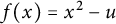 $f(x) = x^{2} - u $
, we see that u is a square in
 $L_v$
, say
 $u = a^{2}$
. Hence,
 $$ \begin{align*} a^{2} = u(1)^2 + b(0)^{2}, \end{align*} $$
so
 $(u, b)_v = 1$
.
Now, let
 $k_v$
be the residue field of
 $L_v$
, and let
 $u = 1 - 4 \zeta _r$
. Since
 $k_v^\times $
is odd, we can solve the equation
 $b x^2 = \zeta _r$
in
 $k_v^\times $
for
 $x \in k_v^\times $
. Then
 $u(1)^2 + b (2x)^2 \equiv 1 \ \pmod 8$
and hence
 $u(1)^2 + b (2x)^2 = a^2$
for some
 $a \in L_v$
by the argument above. It follows then that
 $(u,b)_v = (1 - 4 \zeta _r, b) = 1$
.
The following is a strengthened version of Theorem 3.5, now with no condition on c being coprime to
 $2 \mathcal {O}_K$
.
Theorem 5.19 Let
 $K $
be a number field, and let
 $L = K(\zeta _{r})$
where
 $\zeta _{r}$
be a primitive rth root of unity such that
 $(r,p) = 1$
. If
 $r = 1$
, assume further that K has an even number of real embeddings.
Suppose L is unramified at
 $2$
, K is totally split at
 $2$
,
 $(p)$
is coprime to
 $(1 - 4 \zeta _r)$
, and write
 $\zeta _{r} = \zeta _r^{{\prime }p}$
where
 $\zeta _r'$
is a primitive rth root of unity.
If
 $(a,b,c)$
is a primitive solution over
 $\mathcal {O}_K$
to
 $$ \begin{align*} a^{p} + b^{p} + c^{p} = 0 \end{align*} $$
such that
 $$ \begin{align} (ab)^p - \zeta_r c^{2p} \not= 0, \end{align} $$
then one has
 $$ \begin{align} \left(\frac{ab - c^{2}\zeta^{\prime}_{r}}{1 - 4\zeta_{r}}\right)_{L} \neq -1, \end{align} $$
for all permutations of
 $a,b,c$
.
Proof We may assume that
 $ab-c^2\zeta _r^{\prime }$
and
 $1-4\zeta _r$
are coprime, or else we are already done as we would have
 $$ \begin{align*} \left(\frac{ab - c^{2}\zeta^{\prime}_{r}}{1 - 4\zeta_{r}}\right)_{L} = 0. \end{align*} $$
Since
 $1 - 4 \zeta _r$
is coprime to
 $2 \mathcal {O}_L$
, we have from the definition of Jacobi (see, for instance, [Reference Neukirch17, Definition 8.2]) symbol that
 $$ \begin{align} \left(\frac{ab - c^{2}\zeta^{\prime}_{r}}{1 - 4\zeta_{r}}\right)_{L} = \prod_{v \in S_{L}^{\mathrm{odd}}, v(1 - 4 \zeta_r) \text{ odd}} {\left(\frac{ab-c^2 \zeta_r'}{\pi_v}\right)^{v(1-4\zeta_r)}}. \end{align} $$
We note that the product is by definition over the
 $v \in S_{L}^{\mathrm {odd}}$
, but only the terms with
 $v(1-4\zeta _r)$
odd can be
 $-1$
. Using Lemma 5.7, we see that
 $$ \begin{align*} {\left(\frac{ab-c^2 \zeta_r'}{\pi_v}\right)^{v(1-4\zeta_r)}} = (1 - 4 \zeta_r, ab-c^2 \zeta_r')_v \end{align*} $$
if
 $v \in S_{L}^{\mathrm {odd}}$
,
 $v(1-4\zeta _r)$
is odd, and
 $v(ab-c^2\zeta _r') = 0$
. Hence, we obtain that
 $$ \begin{align} \left(\frac{ab - c^{2}\zeta^{\prime}_{r}}{1 - 4\zeta_{r}}\right)_{L} = \prod_{v \in S_{L}^{\mathrm{odd}}, v(1-4\zeta_r) \text{ odd}} (1 - 4 \zeta_r, ab - c^2 \zeta_r')_v. \end{align} $$
As
 $(a,b,c)$
is primitive, for any
 $v \in S_{L}^{\mathrm {even}}$
, two of the elements
 $a,b,c$
are units in
 $\mathcal {O}_{L,v}$
and the remaining element has positive valuation, since
 $a, b, c \in \mathcal {O}_K$
and K is totally split at
 $2$
. This implies that
 $$ \begin{align*} ab - c^2 \zeta_r' \end{align*} $$
is coprime to
 $2 \mathcal {O}_L$
. By Lemma 5.18, it follows that
 $$ \begin{align*} (1 - 4 \zeta_r, ab - c^2 \zeta_r')_v = 1 \end{align*} $$
for all
 $v \in S_{L}^{\mathrm {even}}$
as we are assuming L is unramified at
 $2$
.
If
 $r \ge 3$
, then L is totally complex and we have that
 $(1-4 \zeta _r, ab - c^2 \zeta _r')_v = 1$
for all
 $v \in S_L^\infty $
.
If
 $r = 2$
, then
 $L = K$
and
 $1 - 4 \zeta _r = 5$
is positive in every real embedding of L. Thus,
 $(1-4 \zeta _r, ab - c^2 \zeta _r')_v = 1$
for all
 $v \in S_L^\infty $
.
If
 $r = 1$
, then
 $L = K$
is a number field with an even number of real embeddings by hypothesis. Thus, using Lemma 3.4, we obtain that
 $$ \begin{align*}\prod_{v \in S_K^\infty} (-3, ab-c^2)_v = 1\end{align*} $$
as the Hilbert symbols which are
 $-1$
occur in total an even number of times in the above product.
Thus, in all cases for r, using Theorem 5.9, we see that the third product in (5.11) is
 $1$
, which implies that
 $$ \begin{align*}\left(\frac{ab - c^{2}\zeta^{\prime}_{r}}{1 - 4\zeta_{r}}\right)_{L} = 1.\end{align*} $$
The hypothesis (5.20) ensures that the quantity in (5.10) is nonzero.
Remark 5.24 The constraint in (5.11) of Theorem 5.9 is an example of a Brauer–Manin obstruction. Let
 $\mathcal {A}$
be the Azumaya algebra given by the Hilbert symbol
 $(t, s (C - \zeta _r' B^2))$
on the variety defined by (5.10), subject to
 $A, B, C$
coprime and
 $C^n - \zeta _r B^{2n} \not = 0$
. Then (5.14), which is used in the proof of (5.11), corresponds to the condition
 $$ \begin{align*} \sum_v \text{inv}_v \mathcal{A}(x_v) = 0 \end{align*} $$
of the first formula in the introduction of [Reference Bright2].
6 Essential obstructive S-unit solutions
Let
 $K = \mathbb {Q}(\sqrt {5})$
or
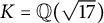 $K = \mathbb {Q}(\sqrt {17})$
, and let S be the set of places of K above
 $2$
.
Suppose
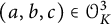 $(a,b,c) \in \mathcal {O}_K^3$
is a nontrivial primitive solution to (1.1) with
 $p = 1$
, that is,
 $$ \begin{align} a + b + c = 0. \end{align} $$
If the Frey curve
 $$ \begin{align*} E_{a,b,c} : y^2 = x(x-a)(x+b) \end{align*} $$
is an elliptic curve over K with conductor
 $N = 8 \mathcal {O}_K$
for
 $K = \mathbb {Q}(\sqrt {5})$
and conductor
 $N = 2 \mathcal {O}_K$
for
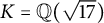 $K = \mathbb {Q}(\sqrt {17})$
, then the triple
 $(a,b,c)$
poses an obstruction to solving (1.1) over K using the modular method. We call such a triple
 $(a,b,c)$
an (essential) obstructive solution to (1.1). Given such a triple
 $(a,b,c)$
, multiplication by the square of a unit in
 $\mathcal {O}_K$
produces another such triple with
 $E_{a,b,c}$
in the same isomorphism class over K, and thus it is natural to consider obstructive solutions
 $(a,b,c)$
up to multiplication by the square of a unit in
 $\mathcal {O}_K$
.
If
 $(a,b,c)$
is an obstructive solution to (1.1), it can be seen that division by any one of
 $-a,-b,-c$
in (6.1) gives a solution to the S-unit equation
 $$ \begin{align} U + V = 1, \end{align} $$
where
 $U, V$
are S-units in K. Conversely, given a solution
 $(U,V)$
to the S-unit equation, we can form a triple from the six orderings of
 $U, V,-1$
and scale by an element of
 $K^*$
to produce a primitive solution
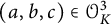 $(a,b,c) \in \mathcal {O}_K^3$
to (6.1). However, the possible triples
 $(a,b,c)$
which arise need not be obstructive solutions, so not all solutions to the S-unit equation (6.2) are relevant as obstructions to the modular method.
In this section, we give methods to list the obstructive solutions
 $(a,b,c)$
to (1.1). This serves two purposes: first, it gives a more detailed description of the obstructions to solving Fermat’s Last Theorem over these quadratic fields, and second it gives a double check on the computations used to prove the main results of this paper.
One method to list the obstructive solutions
 $(a,b,c)$
to (1.1) would be to compute the solutions to the S-unit equation (6.2) for K. This can be done in a few minutes in
 $\mathtt { SageMath}$
. However, a direct computation of solutions to the S-unit equation for
 $\mathbb {Q}(\sqrt {17})$
using
 $\mathsf{SageMath}$
is slow and does not appear to terminate in any reasonable amount of time.
We explain now an alternate method of determining obstructive solutions
 $(a,b,c)$
to (1.1) using known lists of elliptic curves over K with conductor N [20].
First, recall that if we have two elliptic curves
 $E_1$
and
 $E_2$
over K, given in the following form,
 $$ \begin{align*} E_1 : y_1^2 = f_1(x_1), \\ E_2 : y_2^2 = f_2(x_2), \end{align*} $$
where
 $f_i \in \mathcal {O}_K[x]$
are monic of degree
 $3$
, then
 $E_1$
is isomorphic to
 $E_2$
over K if and only if there exist
 $u, \beta \in \mathcal {O}_K$
and a change of variables
 $$ \begin{align} y_2 & = u^3 y_2, \end{align} $$
 $$ \begin{align} x_2 & = u^2 x_1 + \beta, \end{align} $$
 $$ \begin{align} \Delta(E_2) & = u^{12} \Delta(E_1). \end{align} $$
Suppose
 $(a,b,c)$
is an obstructive solution to (1.1). Then the elliptic curve
 $$ \begin{align} E_0 = E_{a,b,c} : y^2 = x(x-a)(x+b) \end{align} $$
satisfies
 $$ \begin{align*} E_0 \cong_K E \end{align*} $$
for some elliptic curve E defined over K of conductor equal to N. Due to primitivity of
 $(a,b,c)$
, (6.6) is semistable at primes
 $\mathfrak {q}$
of K coprime to
 $2 \mathcal {O}_K$
, and hence already a local minimal Weierstrass model at such
 $\mathfrak {q}$
. Since
 $E_0 \cong _K E$
and
 $E_0$
has full
 $2$
-torsion over K, it follows that E also has full
 $2$
-torsion over K.
Put E into global minimal Weierstrass form
 $$ \begin{align} E: y^2 + a_1 xy + a_3 y = x^3 + a_2 x^2 + x_4 x + a_6. \end{align} $$
By completing the square, we may transform to a model for E of the form
 $$ \begin{align} E : y^2 = f(x) = (x - e_1) (x - e_2) (x - e_3), \end{align} $$
where
 $f \in \mathcal {O}_K[x]$
is monic of degree
 $3$
, and this model is a local minimal Weierstrass model at all primes
 $\mathfrak {q}$
of K coprime to
 $2 \mathcal {O}_K$
.
Using (6.5), we deduce that u is an S-unit in
 $\mathcal {O}_K$
by definition of local minimal Weierstrass model (i.e., a Weierstrass model over
 $\mathcal {O}_{K_{\mathfrak {q}}}$
whose discriminant has minimal valuation). Furthermore, by
 $E_0 \cong _K E$
and (6.4), there is some permutation of
 $e_1, e_2, e_3$
such that
 $$ \begin{align*} & u^2 e_1 + \beta = 0, \\[2pt] & u^2 e_2 + \beta = a, \\[2pt] & u^2 e_3 + \beta = -b, \end{align*} $$
or equivalently
 $$ \begin{align} a & = u^2 (e_2 - e_1), \end{align} $$
 $$ \begin{align} b & = -u^2 (e_3 - e_1). \end{align} $$
Conversely, given an elliptic curve E over K of conductor N and full
 $2$
-torsion over K, we can produce an obstructive solution
 $(a,b,c) := (a, b, -a-b)$
if and only if there is an S-unit u of K such that a and b are coprime in (6.9) and (6.10). A triple
 $(a,b,c)$
produced from E is unique up to multiplication by the square of a unit in
 $\mathcal {O}_K$
(and up to a choice of labeling of
 $e_1, e_2, e_3 \in K$
).
We have determined the list of obstructive solutions for both
 $\mathbb {Q}(\sqrt {5})$
and
 $\mathbb {Q}(\sqrt {17})$
, which can be found in the electronic resources for this paper [Reference Chen, Efemwonkieke and Sun3]. For those congruence classes of exponents p where we obtain a result, all obstructive solutions are eliminated by the reciprocity constraints. For those congruence classes of exponents p where we do not obtain a result, there is some obstructive solution that is not eliminated by the reciprocity constraints.
We end by illustrating the two methods for listing the obstructive solutions
 $(a,b,c)$
to (1.1) for
 $K = \mathbb {Q}(\sqrt {5})$
. The first method starts with the solutions
 $(U,V)$
to the S-unit equation (6.2):
 $$ \begin{align} \left(2, -1\right), \left(\frac{-\sqrt{5}+1}{4}, \frac{\sqrt{5}+3}{4} \right), \left(\frac{-\sqrt{5} -1}{2}, \frac{\sqrt{5}+3}{2} \right), \left(\frac{\sqrt{5}+2}{4}, \frac{-\sqrt{5}+2}{4} \right), \\\left(4\sqrt{5} - 8, -4\sqrt{5} + 9\right), \left( \frac{-\sqrt{5}+1}{2}, \frac{\sqrt{5}+1}{2} \right), \left(-4\sqrt{5} - 8, 4\sqrt{5} + 9\right), \nonumber \\\left( \frac{-\sqrt{5} +3}{2}, \frac{\sqrt{5}-1}{2} \right), \left(-\sqrt{5} - 2, \sqrt{5} + 3\right), \left(-\sqrt{5} - 1, \sqrt{5} + 2\right), \left(\frac{\sqrt{5}+1}{4}, \frac{-\sqrt{5}+3}{4} \right), \nonumber\\\left(-\sqrt{5} + 2, \sqrt{5} - 1\right), \left(-\sqrt{5} + 3, \sqrt{5} - 2\right), \left(\frac{1}{2}, \frac{1}{2}\right), \nonumber \end{align} $$
as computed by SageMath and listed up to permutation of
 $U,V$
.
For triples
 $(a,b,c), (u,v,w) \in K^3$
, we write
 $(a,b,c) \sim (u,v,w)$
if
 $(a,b,c)$
is a nonzero scalar multiple of a permutation of
 $(u,v,w)$
. Consider the set
 $$ \begin{align*} \mathfrak{S} &= \left\{ (a,b,c) \in \mathcal{O}_K^3 : (a,b,c) \sim (U, V, -1), (U,V) \text{ is an }S\text{-unit solution,}\right.\\ & \qquad \left. \text{and } (a, b, c) \text{ is primitive} \right\}\hspace{-1pt}. \end{align*} $$
The obstructive solutions to (1.1) are the triples
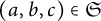 $(a,b,c) \in \mathfrak {S}$
such that the conductor of
 $E_{a,b,c}$
is
 $8 \mathcal {O}_K$
. As we consider obstructive solutions up to equivalence by multiplication by the square of a unit in
 $\mathcal {O}_K$
, the set
 $\mathfrak {S}$
is finite up to this equivalence and representatives can be computed from (11).
In the second method, we consider each of the elliptic curves E over K with conductor
 $8 \mathcal {O}_K$
and produce if possible an obstructive solution
 $(a,b,c)$
from it using the process described in the previous paragraphs.
Both methods give the same list up to equivalence by multiplication by the square of a unit in
 $\mathcal {O}_K$
. In all, there are
 $12$
obstructive solutions to (1.1) over
 $K = \mathbb {Q}(\sqrt {5})$
, up to equivalence by multiplication by the square of a unit in
 $\mathcal {O}_K$
:
 $$ \begin{align} \left(-1, -4\sqrt{5} - 8, 4\sqrt{5} + 9\right), \left(4\sqrt{5} + 8, 1, -4\sqrt{5} - 9\right), \\\left(-1, \frac{\sqrt{5} + 3}{2}, \frac{-\sqrt{5} - 1}{2} \right), \left(1, \frac{-\sqrt{5} + 1}{2}, \frac{\sqrt{5} - 3}{2}\right), \nonumber\\\left( \frac{-3\sqrt{5} - 7}{2}, 2\sqrt{5} + 2, \frac{-\sqrt{5} + 3}{2} \right), \left( \frac{-\sqrt{5} - 1}{2}, -1, \frac{\sqrt{5} + 3}{2}\right), \nonumber\\\left( \frac{\sqrt{5} + 1}{2}, \frac{-\sqrt{5} - 3}{2}, 1 \right), \left( 4\sqrt{5} + 9, -1, -4\sqrt{5} - 8\right), \nonumber\\\left(-4\sqrt{5} + 8, 1, 4\sqrt{5} - 9\right), \left(1, -4\sqrt{5} - 9, 4\sqrt{5} + 8\right), \nonumber\\\left( \frac{-\sqrt{5} + 3}{2}, \frac{\sqrt{5} - 1}{2}, -1\right), \left( \frac{-\sqrt{5} - 3}{2}, 1, \frac{\sqrt{5} + 1}{2}\right). \nonumber \end{align} $$
Acknowledgment
We would like to thank Alain Kraus for helpful comments and improvements on an earlier version of this paper, and Nuno Freitas and Samir Siksek for useful comments about the problems studied in this paper.



