Introduction
Following successive discoveries beginning in the late 18th century, several exploitative industries have operated in the Antarctic regions, notably sealing, whaling and in recent times, fishing. Sealing was characterised by large fluctuations in catches and shifts in sealing grounds as seals were almost exterminated in particular locations, in an era with no regulation. By the mid-19th century the industry had dwindled.
There is a substantial literature on the history of this industry specifically, and also as one aspect of the larger South Seas trades or the larger fur trade (Bonner Reference Bonner1982; Steven Reference Steven1983; Deacon Reference Deacon1984; Busch Reference Busch1985; Laws Reference Laws1989; Jones Reference Jones1992; Dickinson Reference Dickinson2007; Burton Reference Burton and Riffenburgh2006; Headland Reference Headland2009; Richards Reference Richards2010). The literature provides valuable details of many aspects of the economics of the industry. It contains a vast amount of data relating vessels, catches and market information. However, most of it is fragmentary and sporadic, making it difficult to acquire a good picture of long term economic development. Another problem is the incompleteness of the primary sources. Summing up her work on British records, Steven (Reference Steven1983: 100) concluded:
The dispersed nature of the trade, both at its collection and disposal points, helped to obscure activity and now makes regular estimates difficult to compile . . . Even the comparatively formal regularity of the British Customs is interrupted by blank sections in records otherwise kept with some degree of faithfulness.
Her assessment may be followed by Jones (Reference Jones1992: 393), writing in the introduction to his study that:
[t]he comprehensive history of the southern whale and seal fisheries from Britain, from the 1770s to the 1850s still has to be written. When it is done it will be unsatisfactory as the material is so scrappy and scattered.
No analysis has yet succeeded in indicating the aggregate economic value of 19th century Antarctic sealing or the aggregate development throughout the years of operations, combining data on market prices and catches. This paper begins such assessment and aims to contribute to a more accurate appraisal of the significance of the industry, enabling a comparison of sealing with subsequent Antarctic exploitative industries, especially whaling and fisheries. Sugden (Reference Sugden1982: 401) provided one such comparison, but it is a rather general model of the assumed pattern of development and without factual data. Laws (Reference Laws1989: 181) made a comparison of the catches of the main species of the exploitative industries (seals, whales, fish, krill) from 1784 to 1988.Footnote 1 This is instructive in showing how immense was the production of whaling, compared with the other industries. However, a comparison of quantities gives an incomplete concept of the economic significance of the industries. For such purposes, prices must be taken into account.
The geographical area included in the following study will be somewhat wider than what is often understood as the Antarctic. In addition to the coasts of Antarctica and off-lying islands, the main sub- or peri-Antarctic islands are also included. Some of these lie south of the Antarctic Convergence, some are located slightly to the north of it. Such a wider definition (in geographical terms) is necessary when the aim is to analyse the Antarctic as an economic region (Basberg, Reference Basberg2006).Footnote 2 The sealers operated throughout the Southern Ocean to find seals, but did not venture farther south than necessary. A cargo might consist of catches from several islands (Antarctic and elsewhere), without distinguishing between them in the records. This fact also poses problems regarding islands farther to the north such as the Falkland Islands, Tierra del Fuego, southern Australasian islands, and Tristan da Cunha that are obviously not located in the Antarctic. But the sealing there may be difficult to distinguish from the trade farther south.
The main areas included are the following: The South Orkney Islands, South Shetland Islands and the Antarctic Peninsula; South Georgia, South Sandwich Islands and Bouvetøya; Prince Edward Islands, Iles Crozet, Heard Island and Iles Kerguelen; Campbell, Auckland and Macquarie Islands.Footnote 3
19th century Antarctic sealing
We will not review the history of this industry in any detail. That has been done extensively elsewhere. We will, however, emphasise some factors of special relevance to the analysis of its economic importance.
The majority of the sealers were from Britain and the United States and the sealing companies or owners were predominantly located in a few areas. In the US, they were, like the whaling companies, in the northeast, in New England. Although the sealing and whaling trades were closely connected, the sealing industry had its centre in Connecticut rather that in the whaling capital of New Bedford, Massachusetts. In Britain, London was the business centre to which the majority of the companies and vessels belonged.
The sealers hunted two genera; fur seals (Arctocephalus sp.) for pelts, and elephant seals (Mirounga leonina) for oil. The most important markets for pelts were in Britain (London), the US (New York) and China (Canton) where they were used for fur, leather, and felt-making for hats and other clothing. The markets for oil were only the first two. Markets originated from the beginning of the industry in the 1780s and developed due to both supply and demand factors. On the supply side, the discovery of the new southern catching grounds was important. The increased demand was related to improvement in processing techniques that prepared finer furs and could put the pelts to new uses. Such developments took place in China from the mid 18th century and somewhat later in Europe (Steven Reference Steven1983: 86, 95).
The London market was by far the most important during the 1780s, supplied mainly by British sealers. London then supplied the domestic market, but furs were also re-exported to Europe and China. The British Canton trade, in the charge of the East India Company, lasted only until about the start of the 19th century. The European trade, however, declined from the late 1820s.
United States sealers reached the Canton market in the 1790s and soon dominated that trade. Furs from seals also soon outnumbered those from otter and beaver imports that previously also had been dominated by US traders and the Hudson Bay Company. At the start of the 19th century the market there was glutted by fur seals, thus prices and imports declined (Richards Reference Richards2003: 3; Gibson Reference Gibson1992: 202). By the early 1830s the US trade to Canton had ceased. Between the 1840s and the 1880s Antarctic fur sealing was dominated by US vessels, mainly supplying the domestic market and Europe to a lesser extent.
The elephant seal oil market was more stable. It yielded high quality oil used for lighting and lubrication, as well as leather, rope and textile treatment. However, as with whale oil, the market for lighting was supplanted in the latter part of the century by the new mineral oil and coal gas (Ryan Reference Ryan1994: 81). The contemporary observer J.H. Kidder (Reference Kidder1876: 40) wrote:
The increasing scarcity of the sea-elephant, and consequent uncertainty in hunting it, together with the diminished demand for the oil since the introduction of coal-oil into general use, have caused a great falling-off in the business of elephant-hunting.
The sealing industry was part of larger industries and to some extent difficult to distinguish from them. The fur seal industry was part of the fur trades in the sense that the pelts went to the same markets and, to some extent, represented substitutes for those from other species. Elephant sealing or ‘elephanting’ was distinct. Vessels, equipment, skills and grounds were substantially different from those of the fur-sealers (Downes and Downes Reference Downes, Downes, Green and Woehler2006: 186). Elephant sealing was instead closely connected with the whaling trade. The oils were similar and could be processed aboard the vessels using the same apparatus (the try-works). Indeed, many vessels were taking both whales and elephant seals (so called ‘mixed voyages’), and the two industries were very much integrated. But, as Chatwin (Reference Chatwin1997: 3) has pointed out, ‘[m]ore complex technological requirements and higher capital costs of outfitting a whaling ship precluded sealers from going whaling, but not whalers from going sealing’.
Especially in the United States, 19th century whaling was a very significant industry, and the quantities of seal oil were small fractions of the total oil produced by the whaling trade of that country (see later).
Based on earlier studies and contemporary sources, Bush (1985) estimated the total number of fur seals killed in the southern trade as a total of 5.2 million in the period up to 1812. About 1.7 million were killed within what we have defined as the Antarctic region. More than one million fur seals may have been killed at South Georgia according to James Weddell's estimates (Burton Reference Burton and Riffenburgh2006: 875). Busch realised, however, the vast uncertainties of the estimates, stressing that ‘[a]ny figure is but a guess’ (Bush 1985: 36). Detailed studies of primary sources may, however, reduce such uncertainties.Footnote 4 Richards (Reference Richards2003: Table 1, Appendix 1: 3, 9) has most recently compiled new figures for the fur seal markets in London and Canton based on various sources for the period 1788 to 1833. He has also critically reviewed some of the previous published figures of the total extent of fur sealing on the various southern grounds, indicating the imprecise nature of some of those estimates, and also emphasising the severe difficulties in obtaining accurate numbers from an industry that, at the time, was not much concerned with exact reporting. According to Richard's estimates, a minimum of seven million fur seals were killed and sent to the London and Canton markets before 1833; 20% more than previous estimates. This includes the entire southern fur sealing, and he is not making estimates for the Antarctic region as such.Footnote 5
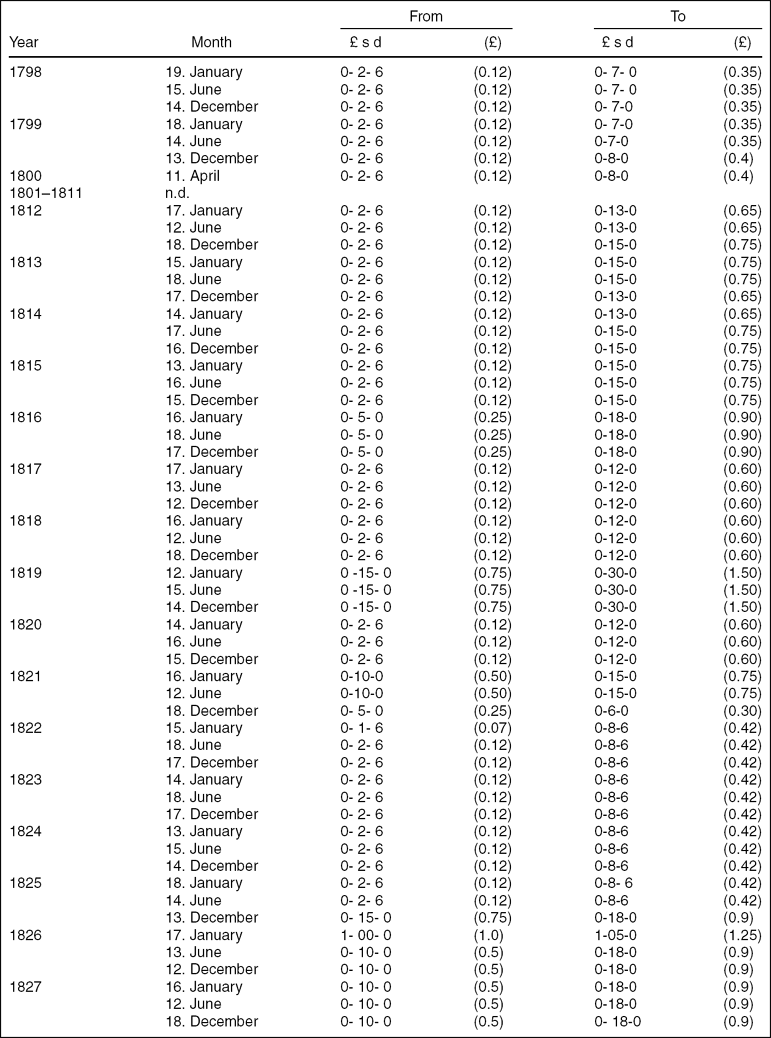
Prices for fur seal skins (‘South seas skins’) in London (£-s-d and £), 1798–1827

Source. Prince's London Price Current and London Mercantile Price Current (1816, 1819, and 1821).
Note: The price currents were published twice a week. We have, when possible, extracted data for three dates per year, as close as possible to 15 January, 15 June and 15 December. The reliability of the data may be questioned. One indication is the significant differences between the price quotes in 1816, 1819 and 1821 and quotes in previous and following years.
From about 1840 the Antarctic fur sealing was very much about US sealers providing the US market. Nothing has been recorded systematically about the aggregate production in this period which lasted throughout the remainder of the century.
The number of elephant seals killed and the production of oil throughout the late 18th and 19th centuries are also rather obscure. The main reasons are that figures often were ‘hidden’, as they were included in whale oil production or in the larger South Seas trade. Busch (Reference Busch1985: 181) has also studied elephant sealing and again emphasising that his figures are estimates, calculated a catch of about 800,000 elephant seals during the 19th century at the main catching grounds of South Georgia, Kerguelen, Heard and Maquarie.Footnote 6
The number of vessels employed in Antarctic sealing is also one important indicator of the extent of the industry. Data are found in logbooks and published sources (Jones Reference Jones1992: 401). A problem with most sources is again the extent to which it is possible to identify specifically the Antarctic sealing. A sealing and whaling voyage may be listed as a whaling voyage. Quite often the only geographical identification is the ‘South Seas’ which of course could be much more than the Antarctic waters (Jones Reference Jones1992: 360). In fact, it could mean anything south of Britain.
Several historians have compiled information on vessels. In an effort to obtain a comprehensive list based on primary as well as secondary sources Headland (Reference Headland2009: 59–64) has recorded about 1200 sealing voyages, distributed across years, on grounds and countries of origin of the expeditions.Footnote 7
The size of the vessels is also of interest in an economic context. They varied considerably, making it difficult to talk of a ‘standard’ type. Based on several sources, Dickinson (Reference Dickinson2007: 11) estimated the average size of United States sealing vessels before 1800 to be about 240 tons. Throughout the 19th century there was a declining trend towards vessels below 200 tons.Footnote 8 The sealing vessels were smaller than the average whaling vessels that typically were 300–350 tons barques and ships (Davis and others Reference Davis, Gallman and Gleiter1997: 220–221).Footnote 9
Jones (Reference Jones1992: 398) revealed that a vast majority of the vessels were employed in only one or two voyages before they entered other trades.Footnote 10 This may demonstrate the cyclical nature of this business. It also indicates that the sealers were not purpose built vessels that could not be used for other trades.
The crew obviously varied according to vessel size. The average 240 ton vessel had a estimated average crew of 17, again much less that the average whaling vessel in which the crew on a typical New Bedford ship was 29, or 26 for a typical barque (Davis and others 1996: 154).
Not much is known about the crew and the sealers’ life and working conditions aboard and ashore. They were no doubt among the most unpleasant in the maritime industries. Jones (Reference Jones1992: 400) put it this way: ‘Socially, the South Sea trade was near the bottom of the hierarchy, and the seal fishery was lower still’. A contemporary observer of the Bass Strait sealers in the 1820s wrote: ‘. . . their general appearance is semi-barbarous, and they are people usually who are fit for no other employment’ (Starke Reference Starke1986: 15). The sealers farther south were doubtless better. Stackpole (Reference Stackpole1953: 181) called the sealers the ‘nomads of the sea’. In a single voyage, they often visited several islands, moving when the beaches in one place had been cleared. However, gangs were also left ashore for extended periods.Footnote 11 As was the case in whaling, sealing was not attractive employment. Especially in the Unites States, hiring became increasingly difficult and both sealing and whaling expeditions had to rely on crew recruited from Azores and Cape Verde Islands.
The total employment in the industry in a single year, or for a longer period, is not known, but it is possible to estimate based on information on vessels and crew size. In the all time high year of 1820, 75 vessels are recorded. The average size of the vessels working in the South Shetlands in the early 1820s was about 195 tons (Dickinson Reference Dickinson2007: 11). Anticipating an average crew of 15, the 75 vessels would altogether carry about 1125 men.Footnote 12 A typical season throughout the century saw fewer than 15 vessels annually (Headland Reference Headland2009: 60). 10 vessels would indicate about 150 men. So, in a comparative perspective (to industries elsewhere, other maritime industries or later Antarctic industries) we are dealing with a very minor industry.
Prices and economic significance
In an analysis of the economic significance of industries, production is only part of the story. It is necessary to compare values and therefore, prices must be taken into account. This has been done to a very limited extent in the literature on Antarctic sealing.
There are several relevant price-series, corresponding to the different main products and main markets:
– Fur seal prices in the UK (London) per pelt (£)
– Fur seal prices in the US (New York) per pelt ($)
– Fur seal prices in Canton per pelt ($)
– Elephant seal oil prices in the UK (London) per ton (or barrel) (£)
– Elephant seal oil prices in the US (New York) per ton (or barrel) ($)
When it comes to such series, the sources and data situation are also difficult and complex, as was the case concerning the quantity aspects of the trade (vessels, catches). There are primary sources reporting on the London, New York and Canton markets. The main problem is associated with the difficulty of identifying prices that pertain to a specific product for a specific period. A measure such as a ‘unit fur seal price’ in one year did not exist and will have to be calculated. There are multiple reasons for this problem: one was that prices differed according to sex and age of the fur seals (wigs, clapmatches, yearlings, pups) because such factors decisively influenced the size and quality of the furs.Footnote 13 Another reason was that the quality of the furs when they reached the market varied substantially according to how they had been prepared and especially how, and for what period, they had been stowed aboard the vessel. There are examples of cargoes that were not saleable. Typically, the furs were auctioned, and prices varied significantly. Dickinson (Reference Dickinson1987: Appendix 3: 264–270) has compiled auction prices in New York for southern fur seals between 1824 and 1846, divided into various categories of skins. They show annual variations from typically $5–10 maximum to $0.50–0.25 minimum. Gibson (Reference Gibson1992: 253) found that fur seals fetched from $3–4 to $0.35 at Canton, generally about $1. This is not far from estimates by Busch (Reference Busch1985: 36) who wrote that the fur seals yielded an average price of about 90c each. It is, however, not obvious how such an average price should be calculated.
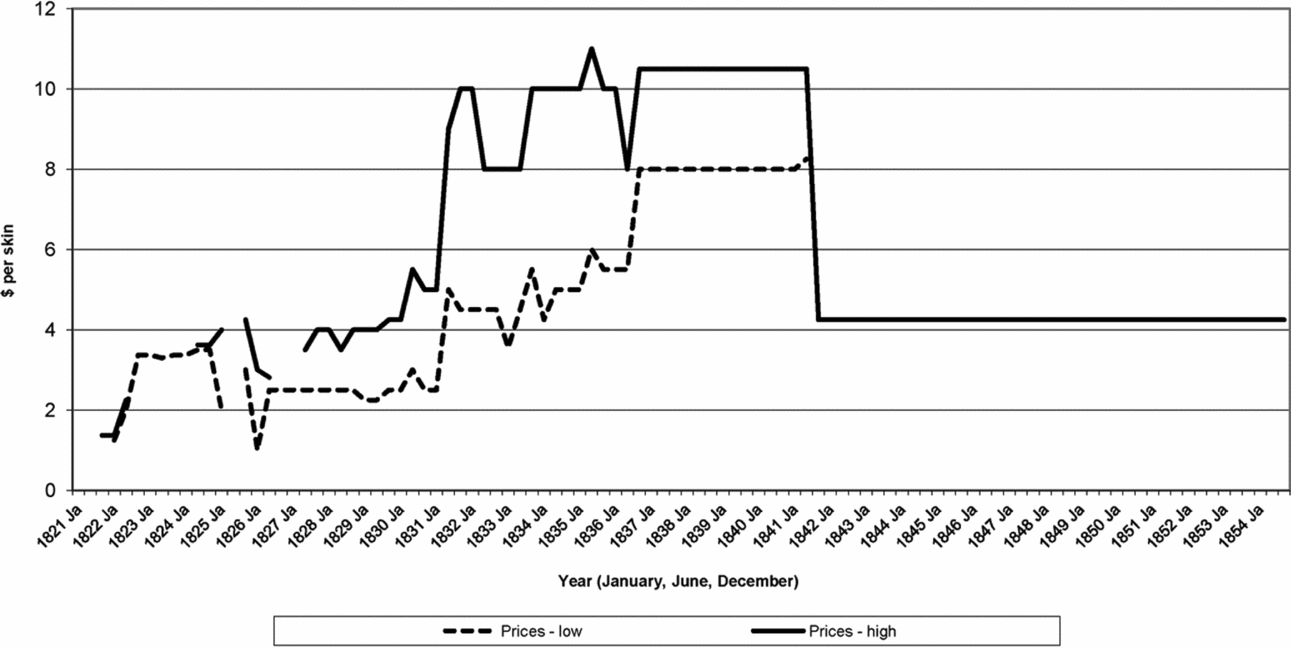
A further illustration may be found in the New York Price Currant (bi-weekly in New York Shipping & Commercial List) that published fur seal prices between 1821 and 1854. Lowest and highest quotes are listed for salted fur seal skins (in most years clapmatches).Footnote 14 In Fig. 1 three high and low quotes per year (about 15 January, 15 June, and 15 December) are plotted for the entire period.
Prices for salted fur seal skins in New York, 1821–1854. Sources: New York Price Currant (New York Shipping & Commercial List). Note: New York Shipping & Commercial List was published twice a week. The data plotted here are from 15 January, 15 June, and 15 December every year or from publication dates as close as possible to these dates (typically 13 to 17).
The overall trend indicates an increase in prices from 1821 and throughout the 1830s, although most of this increase is associated with a sharp increase in prices during 1831. In 1841 the prices dropped severely (from $10.50 to 4.25 as the maximum). At the same time the low quotes were no longer reported and the high quotes remained at $4.25 until the reports ended in 1854. The sharp decline from the early 1840s may indicate a declining demand and worsened market conditions in New York for fur seal pelts (Dickinson Reference Dickinson1987: 77). However, there are also reasons to believe that the quotes in the New York Price Currant for the period from 1842 until the quotes ended in 1854 are not entirely reliable.
Another feature displayed in the figure is the difference between maximum and minimum price quotes. They obviously varied from one year to the next, but were as much as $5.50 at its greatest.
Prices for southern fur seal skins in London reveal the same pattern of large variations from high to low quotes, although it has not been possible to compile consistent series of prices for a very long period. Based on quotes in the Prince's London Price Current, which for the period published prices twice a week, Table 1 lists high and low prices from 1798 until 1827. Wherever possible, we have listed quotes for three selected dates every year (again about 15 January, 15 June and 15 December). Before 1798 fur seal prices are not quoted or they are just indicated as ‘uncertain’ reflecting a non-existent or poorly developed market. From 1798 the low quotes are quite stable at £0.12, but with some annual variation. The high quotes fluctuated much more, starting at £0.35, reaching £0.75 in 1812, declining to £0.42 and finally jumping to £0.9 in late 1825. Prices may at times have been much higher but this is not shown by the samples quoted in Table 1. Scattered observations between 1800 and 1821 from other sources indicate that prices at times may have been exceptionally high; £6–8s-0d (£6.4) in 1816, £3–17s-0d (£3.85) in 1819 and £1–10s-0d (£1.5) in 1821 (Jones Reference Jones1992 294–307).
The price data for fur seal skins in London may be compared with similar data for New York. Using annual exchange rates, it is practicable to compare the differences between prices of the two markets.Footnote 15 In a few instances the prices were identical, but in general there seems to be no clear pattern other than that both price series typically fluctuated lower than £1 per skin. In the first three to four years New York prices were systematically higher than London prices by as much as £0.6 (comparing low quotes). During late 1825 and early 1826 London prices increased dramatically (from £0.12 to 1.0 for low quotes), and in the remaining 1826 and 1827 London prices equalled or were even slightly higher than those of New York. At least from these few observations, it is difficult to identify an integrated market across the Atlantic for this particular commodity.
The market price fluctuations for elephant seal oil were very different from that of the fur seal market. It represented a much more clearly defined product, and the quality did not vary much (although there were, indeed, differences). As has been mentioned, it was a close substitute for whale oil, and consequently it tracked whale oil prices to a large extent. In fact, they were almost identical. Ryan (Reference Ryan1994) extracted prices for seal oil, whale oil and sperm oil quoted on the London market for almost 50 years (1832–1880). As can be seen from his data, whale and seal oil prices both fluctuated the same way. The price of sperm whale oil was an entirely different matter. It fluctuated much more and was also much higher than whale- and seal oil prices, typically almost twice as high and even three times as high in some years.Footnote 16
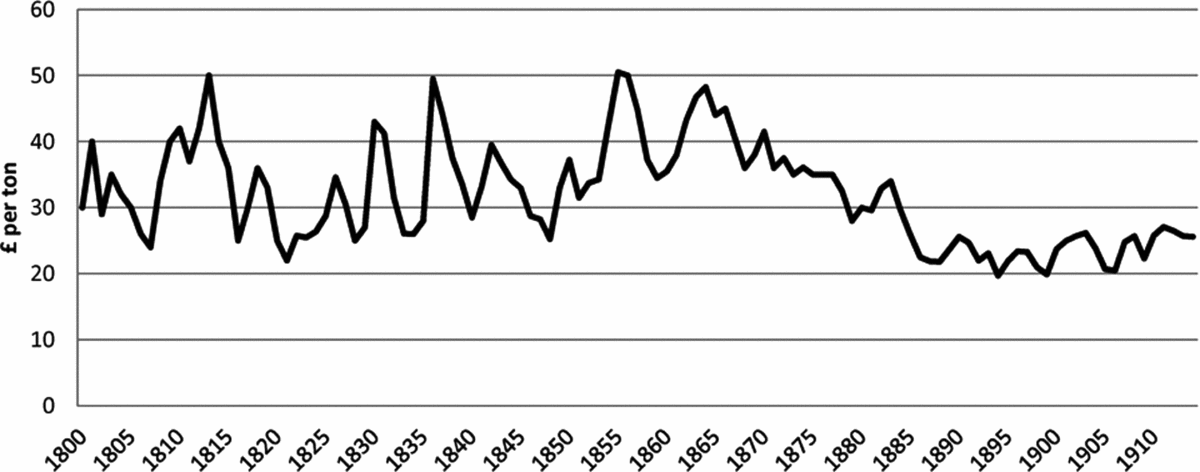
Using several sources (including Ryan's data), London seal oil prices between 1800 and 1914 have been compiled in Fig. 2. The graph shows that prices varied substantially from one year to the next. Throughout the first half of the 19th century there seems to have been no long term trend up- or downwards. However, after about 1865 it was a downward trend until 1890 when prices were fairly stable. The annual variations were also much smaller than in the first half of the century.
Seal oil prices, London, 1800–1914. Sources: 1800–1821, 1828–1830, 1835: McCulloch Reference McCulloch1852. 1822–1827. London Price Current, average January, June and December high and low quotes. 1831–1833. The Merchantile Journal, average January, June and December high and low quotes. 1834–1880. Ryan (Reference Ryan1994), based on Mark Lane Express averages. 1874 and 1881–1914. The Economist, Weekly Price Current, averages from monthly quotes. Note: The data from McCulloch is for whale oil which closely followed the seal oil prices.
Calculations of the economic importance of the Antarctic sealing industry are quite scarce and involve estimates and mere guesses. The reason is, as we have seen, the difficulties involved in obtaining reliable data both for the actual production (the catches) and prices. Busch (Reference Busch1985: 36), for example, calculated values of the US Canton fur seal sales between 1792 and 1812 based on various estimates of total production (about 3 million skins) multiplied by a calculated average price (about $1) totalling about $3 million. The sales figures are about the same as those used by Richards (Reference Richards2003: 3) (about 2.8 million skins for the same period). However, Richards’ data cover the period 1788 to 1833, and he estimates the US sales in Canton as 3.6 million skins. Using the same average price, this gives a value of about $3.5 million. The value of the British Canton trade, based on Richards’ data (257,824 skins between 1788 and 1804) would total about $250,000 or £50,000 (based on an exchange rate of 1/5).
Steven (Reference Steven1983 Appendix III: 131) estimated values of fur seals brought into the London market from the southern fisheries. She relied on data from British Customs ledgers between 1788 and 1820. However, the annual values indicated for the southern seal fisheries have been estimated using the same price per skin for every year; £0.04 (about 10 old pence or a little less than 1 shilling). This again exemplifies the difficulties in relying on some of the primary sources. From what we now know about sealskin prices in London (Table 1), this estimated price is highly unlikely during this period.Footnote 17 The data available show that prices obviously varied and there were large differences between high and low quotes. During the years before 1820 the quotes fluctuated between £0.12 and £0.75. Prices were never as low as £0.04. The calculated average price quote based on our data is £0.35 (1798–1820) and £0.40 (1798–1827). Consequently, Steven's calculated total value of the London fur trade for the period 1788 to 1820 of about £66,000 for about 1.6 million skins is probably much too low. Using a unit price of £0.35 would instead indicate the much higher value of about £575,000.
Richards (Reference Richards2003) has estimated the number of fur seal skins sold in the London market between 1788 and 1833, partly relying on Steven's data, to be about 2.2 million. We do not have systematic price quotes extending to 1827, but relying on the average calculated quote for the period 1798 to 1827 of £0.4 would generate a value of about £880,000.
As indicated earlier Busch estimated, based on various sources, the total number of elephant seals killed throughout the entire century to be 800,000. Using the seal oil prices displayed in Fig. 2, the annual average for the period 1800–1900 is £32.63 per ton. Assuming that one elephant seal yielded an average of one barrel of oil, the total estimated catch was about 800,000 barrels which is about 133,000 tons (based on 6 barrels per ton).Footnote 18 This gives a total estimated value of a century of elephant sealing of £4,339,790 or about $21.7 million. How this was distributed among different markets is not known, but the main one was probably the British.
Busch refers to Stevenson's calculations for South Georgia, where he estimated a production of 242,000 barrels worth $5,420,000 for the entire century. That would equal roughly £1 million, indicating that South Georgia elephant sealing alone produced about 1/5 of the total economic output.
These figures indicate that the economic value of elephant sealing was much higher than fur sealing. However, we do not have fur seal data for the latter part of the century, and we do not have figures for the US import of fur-seal skins. Considering that fur sealing declined severely in the latter part of the century, we may, however, at this point anticipate that elephant sealing may have been more important than fur sealing in economic terms.
This analysis has been focussing on the economic importance of the industry as such, not on the individual owners and companies. To what extent sealing was a profitable business for those involved is obviously also an interesting question. However, it would require an entirely different approach in terms of data and analysis, and this is not the aim here. The evidence from existing literature suggests that sealing in the long run was not a very profitable business. In Britain, for example, few companies became large, and few stayed in business for very long (Jones Reference Jones1992: 403). Even Messrs. Enderby, that indeed was a long lived and comparatively large company, seems to have had its most successful years in early whaling rather than sealing (Jackson Reference Jackson1978: 112, 141). In fact, many sealing companies, especially in Britain were part of the much larger shipping or maritime communities. In Jones’ (Reference Jones1992: 294) words; ‘the fur seal fishery was a drop in the ocean’.
Sealing in context: whale oil and fur trades
Antarctic sealing was, as we have mentioned, yielding products that had alternatives and were thus part of much larger markets where it had to compete. The fur seal skins were just one of a wide variety of furs on the world market.Footnote 19 Oil from the elephant seals competed with whale oil. How important were the seal products in these larger markets?
Gibson (Reference Gibson1992, Table 7: 315) compiled data for the aggregate fur imports to Canton between 1804 and 1837. In most years, fur seal skins were the single most important category, responsible for more than 50% of the total fur import. The other important categories were beaver, fox, land otter and sea otter; land otter and beaver being the most important. From around 1830 they were more important than fur seals, probably owing to scarcity.
How did fur seal prices compare with those of other furs and skins? Prices obviously varied a lot according to availability and size. It also varied over the years and between different markets. In the early 19th century, sea otter was by far the highest priced fur in Canton, followed by beaver. Fur seals were never really high priced there, and from the 1830s they sold for higher prices in the US than in Canton.Footnote 20
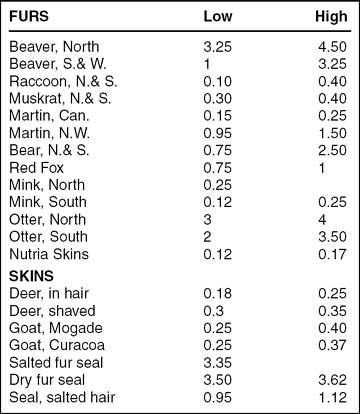
Taking New York prices in the 1820s as an example, we can see from Table 2 that the market for furs and skins (or peltries as they were called) was quite varied at the time.
Prices for Furs and Skins, New York, 1823 ($)
Source. New York Price Currant 17 June 1823.
This example gives a somewhat different impression than do the Canton prices from about the same period; fur seals being among the more expensive ones, together with beaver and otter, again indicating that there was no integrated market.
How important was the sealing industry compared with the whaling industry: the other main southern industry at the time? Again, this is a difficult question to answer because data are unreliable and whaling and sealing data to some extent may be mixed. Steven (Reference Steven1983 Appendix III: 131) also calculated the total value of the import to London (basically the British industry) in the period 1788 to 1820, again based on Customs Ledgers data. This was the period before the huge expansion following the discoveries of the South Shetlands, but the period when the industry was established and expanded at South Georgia. While the value of the whale oil import according to this source was typically between £50,000 and £120,000 annually, the value of the seal pelts were calculated in a range between less than £1000 and about £4000. In the most successful year for both industries in this period, 1793, whale oil generated £136,110 and seal pelts £15,079. Thus the sealing generated 11% of the value of whale oil that year. Taking the entire period together, seal skins generated, according to these data, about 2.5% of those of whale oil (total value of whale oil import in the period; £2.6 million, total value of seal pelts £66,900).Footnote 21 Even the value of whalebone (baleen) imports, itself a fraction of that of the whale oil, for most years was many times higher than the value of sealskin imports. However, these figures have to be re-examined. As Steven emphasised, the prices used in the Custom Ledgers data are estimated. This applies both to the seal prices as well as the whale oil prices.
An alternative source of information is McCulloch's (Reference McCulloch1852: 738) dictionary of commerce, published in several editions from the 1830s, that contains data on the British southern whaling and sealing between 1800 and 1839. They have been used in several later publications, especially Jenkins (Reference Jenkins1921) and Brandt (Reference Brandt1940). The exact origin of McCulloch's data is not known. His only reference is quite amusing: ‘We are indebted for the above valuable table, the only one of its kind that has ever been published, to a gentleman connected with a house that has been largely engaged in the trade since its commencement. The details may, therefore, be safely depended upon’ (McCulloch Reference McCulloch1852: 738, also quoted by Brandt Reference Brandt1940: 210). Bearing this in mind, there is, however, no strong reason to challenge the reliability of his data.
McCulloch explicitly states that the whale fisheries, and the data ‘consists of three distinct branches’; sperm whale, common black whale (that is southern right whale) and elephant seals. Prices and quantities of sperm and common oil are reported separately, sperm oil being a distinct product with much higher prices than other whale oil. Whale oil and seal oil were not separated, because of the similarity between the two.
Based on annual data on quantities and prices as well as for sperm oil and ‘common oil’, the total value of import to Britain between 1800 and 1839 according to McCulloch was about £14.4 million. This is a much higher estimate than Steven's. Her data on quantities for overlapping years correspond well with McCulloch's. However, she (relying on the Customs Ledgers estimates) used an average price per ton of about £17.2 which is much lower than McCulloch's and others observations. While whale oil typically fluctuated between £20 and 50 (as did seal oil; see Fig. 2), sperm oil fluctuated between £60 and 100. In many years sperm oil accounted for half of the total quantity. In fact, from the 1820s onwards, the import was predominantly sperm oil.
Jenkins (Reference Jenkins1921: 208 and Appendix III: 307) reported data on the British southern whale fisheries between 1800 and 1834, based mainly on data from McCulloch, to a value of about £10.9 million.Footnote 22 Jenkins calculations are based on the quantities of sperm oil and baleen whale oil imported and average annual prices per ton separating sperm oil and whale oil. Thus they should give a better indication than the previous estimate.
Jackson (Reference Jackson1978 Table 8: 112), in his work on the British whaling trade, estimated the real value of the import from the southern trade between 1791 and 1800 to about £2.2 million, based on prices and quantities of both whale oil and sperm oil.Footnote 23 Taking these estimates together, a likely total value of the British southern whaling trade from around 1790 to about 1840 could be in the order of £15 million.
How do these estimates on the value of the British whale oil import correspond to the value of the sealing trade? We have estimated the fur seal import to London in approximately the same period to about £880,000. When it comes to elephant sealing, the quantities may well be incorporated in the figures for whaling. The only aggregate data we have so far is Busch's very crude estimate of about 800,000 elephant seals killed throughout the entire century which we estimated would gain about £4.3 million. Sealing obviously represented only a small fraction of the value of the whaling trade.
The value of the US whaling products (including whale oil, sperm oil and whale bone) for the entire 19th century is estimated to about $370 million.Footnote 24 It includes whaling worldwide, and the grounds were primarily outside what we would define as the Southern Ocean and the Antarctic.Footnote 25 However, the figure indicates the supreme dominance of this industry in the period. Converted to British currency, the value would roughly be £75 million.
Conclusions
The aim of this paper has been to analyse the economic significance of the 19th century Antarctic sealing industry. The historical literature on this industry has been reviewed and, more specifically, sources and data especially relating prices have been investigated. Such data enable estimates of the economic value or output of the industry. We have been able to compile some consistent long-run time series, especially relating prices. The analysis is not complete and more studies are needed and encouraged. However, some observations and findings should be emphasised.
A substantial part of the data on most aspects of the industry reported in the existing historical literature is based on incomplete sources of very varying quality. This is also realised by most authors. Consequently, great caution should be applied in interpretations and analyses.
The investigations in this paper indicate that in particular, the calculations of values of the trade (economic importance) need re-examination. Based on revised price information both the values of fur and elephant seal import into the London market have been upgraded.
The analysis reveals that seal oil from elephant seals seems to have been more important economically relatively to furs and whale oil than has been anticipated.
There does not seem to have been an integrated or ‘global’ market for fur seal skins during the 19th century, although the industry had a global character.
Acknowledgements
The initial research was done while Basberg was a Visiting Scholar at Scott Polar Research Institute, University of Cambridge (2007–2008). He is grateful for financial support from The Norwegian Research Council, Norwegian School of Economics (NHH) and Røwdes Foundation. An early version of the paper was presented at the SCAR/IASC IPY Open Science Conference - Polar Research – Arctic and Antarctic Perspectives in the International Polar Year (Session 2.4./5.2., Human Linkages: The History of Non-indigenous Peoples in Polar Regions – Impacts and Interactions), St. Petersburg, 8–11 July 2008, and also circulated as a Norwegian School of Economics Working Paper (WP 21/08). A later version was presented at Oceans past III, Trinity College, Dublin, November 2010. We are thankful for various comments and suggestions from Liam Brunt, Robert Burton, Peter Clarkson, Anthony Dickinson, Jan Tore Klovland and Tim Smith as well as session participants at the two conferences and referees.