Introduction
Sorghum (Sorghum bicolor, L. Moench) (Poaceae) is the fifth most important cereal worldwide and a staple food to over 500 million people in the semi-arid tropics (Wortmann et al., Reference Wortmann, Mamo, Mburu, Letayo, Abebe, Kayuki, Chisi, Mativavarira, Xerinda and Ndacyayisenga2009). Grain output in low-resource farming is about 15 times less than the potential yield of 10 t/ha (Singh et al., Reference Singh, Rao and Sharma2011) mainly because of insect pests, diseases and parasitic weeds (Wortmann et al., Reference Wortmann, Mamo, Mburu, Letayo, Abebe, Kayuki, Chisi, Mativavarira, Xerinda and Ndacyayisenga2009). The major stemborer species that attack sorghum and maize in Kenya include the African stemborer Busseola fusca Fuller (Lepidoptera: Noctuidae) and the spotted stemborer Chilo partellus Swinhoe (Lepidoptera: Crambidae) (Beyene et al., Reference Beyene, Mugo, Mutinda, Tefera, Karaya, Ajanga, Shuma, Tende and Kega2011). Busseola fusca inhabits high-altitude areas and coexists in mid-altitude areas in Kenya with C. partellus, which is a highly invasive and persistent stemborer from Asia (De Groote, Reference De Groote2002; Wale et al., Reference Wale, Schulthess, Kairu and Omwega2006). Stemborers are associated with quality and yield losses ranging between 15 and 80% depending on the crop variety, pest population and phenological stage at the time of attack (Karaya et al., Reference Karaya, Njoroge, Mugo and Nderitu2009). Damages caused to sorghum by the two species include leaf feeding, dead heart, exit holes, stem tunnelling and chaffy grain in case of extensive peduncle damage (Dillon et al., Reference Dillon, Shapter, Henry, Cordeiro, Izquierdo and Slade Lee2007). Sorghum management has mainly been focused on cultural control, predominantly intercropping, fertilizer use and recently genetic engineering (Schmidt and Bothma, Reference Schmidt and Bothma2006; Amsalu et al., Reference Amsalu, Bekele and Melaku2008). Many farmers have not adopted most of these methods, as they are impracticable and not cost effective. Host plant resistance is the major component in integrated pest management, a sustainable approach to the management of stemborers in cereals. It is an effective, economical and environmentally friendly method to manage insect pests and diseases in plants.
Painter (Reference Painter1951) documented three mechanisms of resistance: antibiosis, non-preference (antixenosis) and tolerance. Antibiosis is manifested when plants exert adverse effects on the growth and survival of insect pests. This is expressed in terms of larval mortality, slow growth and delayed development (Kishore Kumar et al., Reference Kishore Kumar, Sharma and Dharma Reddy2006). Non-preference is manifested when plants exert adverse effects on the insect's behaviour. Waxes protect plants against desiccation, insect predation, disease and movements of insects across leaf surfaces. Trichomes provide a barrier that prevents insects from landing, feeding and moving on plants (Afzal et al., Reference Afzal, Nazir, Bashir and Khan2009). Tolerance is the ability of plants to support, without yield or quality losses, a population of pests that would damage a susceptible variety (Reese et al., Reference Reese, Schwenke, Lamont and Zehr1994). Levels of resistance to stemborers in sorghum are low to moderate, suggesting diverse mechanisms of resistance (Singh et al., Reference Singh, Rao and Sharma2011). The identification of new sources is important to diversify the bases of resistance. The objective of this study was to identify sorghum genotypes that are tolerant to both pests.
Materials and methods
Experimental site
Experiments to identify sorghum genotypes resistant to B. fusca were carried out during the long and short rainy seasons in 2010 in the Upper Kabete Campus Field Station of the University of Nairobi (latitude 1°15′S, longitude 36°44′E, altitude 1940 m above sea level (masl)). Long rainy season occurs from March to June; short rainy season occurs from October to December with an annual mean temperature of 20 °C (Beyene et al., Reference Beyene, Mugo, Mutinda, Tefera, Karaya, Ajanga, Shuma, Tende and Kega2011). Experiments to identify sorghum genotypes resistant to C. partellus were conducted at the Kenya Agricultural Research Institute (KARI), Kiboko (latitude 20°15′S, longitude 37°75′E, altitude 975 masl with an annual mean temperature of 24 °C) (Karaya et al., Reference Karaya, Njoroge, Mugo and Nderitu2009). Long rains are received from March to June and short rains between October and January.
Experimental design
The test material was sown in an α-lattice design (Piepho et al., Reference Piepho, Büchse and Truberg2006) of nine plots in three blocks, replicated twice. Rows were 2 m long and 0.75 m apart; spacing between plants within rows was 0.25 m. First-instar neonates of both pests were obtained from the International Centre of Insect Physiology and Ecology (icipe), Nairobi, Kenya. At 30 days after sowing, five plants in each row were tagged, and each was artificially infested with five larvae using a camel hair brush. To prevent larvae from drowning in the water held in leaf whorls, seedling whorls were tapped gently before infestation early in the morning or late in the evening to encourage larval survival.
Experimental material
A total of 27 sorghum genotypes were evaluated in this study: 20 lines were obtained from the International Crops Research Institute for the Semi-Arid Tropics (ICRISAT)-India and seven lines from the ICRISAT-Kenya. Exotic sorghum materials were included to assess whether they were resistant to both pests. Macia, KARI-Mtama 1 and Gadam have good processing qualities for beer making and are used by brewing companies in East Africa. Farmers prefer these varieties along with Seredo; their grain is utilized for food and the stover for feed. Genotypes IS 1044 (resistant R) and Swarna (susceptible S) were used as controls in this study (Sharma, Reference Sharma2006).
Parameters monitored
Leaf feeding damage (De Groote, Reference De Groote2002) was recorded on a plant basis 2 and 4 weeks after artificial infestation. Percentages of plants with leaf feeding damage were computed by expressing the number of damaged plants as a percentage of the total number sampled. Five plants within each row were tagged for infestation, and data were collected systematically from these five marked plants. Dead heart damage was recorded 2 and 4 weeks after infestation (Kishore Kumar et al., Reference Kishore Kumar, Sharma and Dharma Reddy2006); incidence was computed by expressing the number of damaged plants as a percentage of the total number sampled. At harvest, the number of exit holes on the stems was counted in each of the five sampled plants. The main stems of plants infested with the larvae were split open from base to apex and the cumulative tunnel length (cm) was measured.
Susceptibility parameters (damage from leaf feeding, dead heart, stem tunnelling and exit holes) were used to define the reaction of the genotypes to infestation by both pests. Based on this damage, the susceptibility index was computed using the following formula (Tadele et al., Reference Tadele, Mugo, Likhayo and Beyene2011):
 $$\begin{eqnarray} \frac { X - \bar {>X} }{4}, \end{eqnarray}$$
where X is the genotypic value,
 $$\bar {>X} $$
is the grand mean of the trait and 4 is the number of damage parameters considered.
Plant height (cm) was measured from the base of the plant to the tip of the panicle at maturity. Time to flowering was recorded as the number of days from the date of sowing to 50% anthesis of plants in a plot. After harvest, sorghum panicles were sun-dried and hand-threshed. Total grain yield and hundred-grain mass (Sharma et al., Reference Sharma, Dhillon and Pampapathy2006) were recorded for each of the five sampled plants using a weighing balance (Mettler PM 6000, CH-8606 Greifensee-Zurich, Switzerland).
Statistical analysis
Data on percentages were angular transformed; counts were log transformed before analysis of variance (ANOVA) using GenStat statistical software 10th edition (Payne et al., Reference Payne, Murray, Harding, Baird and Soutar2009). Means were separated using Fisher's protected least significant difference (LSD) test at P= 0.05 after ANOVA. Pearson's correlation coefficients were computed to determine the association between agronomic traits evaluated and stemborer damage parameters. The relative contributions of the four damage parameters to grain yield loss were partitioned into direct and indirect relationships by path coefficient analysis with grain yield as the resultant variable (Mitchell, Reference Mitchell, Scheiner and Gurevitch1993). Path analysis is an extension of the regression model used to test the fit of the correlation matrix against two or more causal models being compared.
Results
Tolerance of sorghum genotypes to Busseola fusca
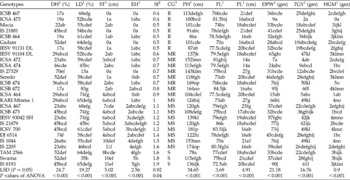
The results of experiments carried out to determine the response of sorghum genotypes to B. fusca are given in Table 1. There were significant (P< 0.01) differences among the genotypes with regard to leaf feeding damage, dead heart formation, stem tunnelling, exit holes, panicle length, total grain yield and hundred-grain mass. Genotypes ICSB 467, ICSB 472 and IESV 91131 DL exhibited the least dead heart damage, which was one-quarter of that in DJ 6514, which exhibited the most damage (74%). Genotype IS 27329 exhibited the least leaf feeding damage, one-quarter of that in the resistant check. Genotypes that exhibited the least stem tunnelling and exit hole damage were ICSB 467 < IS 21881 < Gadam < IS 27329 < ICSA 473 < Seredo < IESV 91131 DL < ICSB 464.
Response of sorghum genotypes to Busseola fusca at Kabete, Kenya, during long and short rainy seasons, 2010

DH (%), percentage of dead heart formation; LD (%), percentage of leaf damage; ST, stem tunnelling; EH, exit holes; PH, plant height; FL, days to 50% flowering; PL, panicle length; DPW, dry panicle weight; TGY, total grain yield; HGM, hundred-grain mass.
1 Means followed by the same letter are not significantly different (P= 0.05).
2 Susceptibility index was calculated based on damage from leaf feeding, dead heart, exit holes and stem tunnelling. Genotypes with susceptibility index values < 1.0 were regarded as resistant and those with a susceptibility index >1.0 as susceptible (adopted from Tadele et al. (Reference Tadele, Mugo, Likhayo and Beyene2011)).
3 CG, category: R, resistant; MR, moderately resistant; MS, moderately susceptible; S, susceptible.
Based on the susceptibility index, seven genotypes were classified as resistant, eight as moderately resistant, 10 as moderately susceptible and two as susceptible. Some genotypes were better than the resistant check and some succumbed to distinctly more damage than the susceptible check. Genotypes ICSB 467 < ICSA 473 < IS 21881 < Gadam < IESV 91131 DL < ICSB 464 < Macia were the most resistant to B. fusca with a susceptibility index ≤ 0.5. Genotype IS 8193 with a susceptibility index of 1.9 and Swarna (susceptible check) with a susceptibility index of 1.8 were categorized as the most susceptible among the genotypes evaluated in this study.
The susceptibility index of the most resistant genotypes ICSB 467 and ICSA 473 (susceptibility index 0.4) was one-fifth of that of the most susceptible genotype (IS 8193). The resistant check IS 1044 had a susceptibility index of 1.5, which was four times greater than that of the most resistant genotypes, ICSB 467 and ICSA 473. Plant height ranged between 78 cm in TAM 2566 and 181 cm in ICSV 700. Days to 50% flowering ranged between 70 in Gadam and 86 in IS 21879. Genotypes IS 27329 and KARI-Mtama 1 produced panicles that were about twice as long as those produced by ICSA 474; the shortest panicles (14 cm) were produced by ICSA 472. The highest yielding and moderately resistant genotype ICSB 472 produced twice as much as the susceptible check. The highest hundred-grain mass recorded in genotype ICSB 474 (moderately resistant) was comparable to that of the resistant check (IS 1044) and twice that of the susceptible check (Swarna).
Tolerance of sorghum genotypes to Chilo partellus
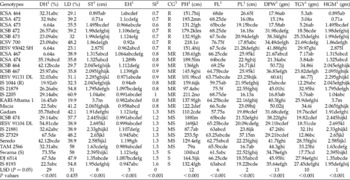
The results of experiments carried out to determine the response of sorghum genotypes to C. partellus are given in Table 2. Genotypes ICSA 473, IESV 93042 SH and ICSA 467 exhibited the least dead heart damage, which was 11 times less than that in the susceptible check (Swarna). KARI-Mtama 1 exhibited the least leaf feeding damage, one-third of that in IS 2205, which exhibited the most damage. Genotypes ICSA 472 < ICSV 700 < ICSA 464 < ICSB 473 < ICSB 472 < IESV 91131 DL < ICSA 473 exhibited the least stem tunnelling damage, which was one-third of that in IS 8193, which exhibited the most damage. Genotypes ICSA 472 < ICSA 464 < ICSV 700 < IESV 91131 DL < IS 21879 had the fewest exit holes, one-fifth of the number in the most susceptible check (Swarna), which had an average of 10 exit holes per plant.
Response of sorghum genotypes to Chilo partellus at Kiboko, Kenya, during long and short rainy seasons, 2010

DH (%), percentage of dead heart formation; LD (%), percentage of leaf damage; ST, stem tunnelling; EH, exit holes; PH, plant height; FL, days to 50 % flowering; PL, panicle length; DPW, dry panicle weight; TGY, total grain yield; HGM, hundred-grain mass.
1 Means followed by the same letter are not significantly different (P= 0.05).
2 Susceptibility index was calculated based on damage from leaf feeding, dead heart, exit holes and stem tunnelling. Genotypes with susceptibility index values < 1.0 were regarded as resistant and those with a susceptibility index >1.0 as susceptible (adopted from Tadele et al., Reference Tadele, Mugo, Likhayo and Beyene2011).
3 CG, category: R, resistant; MR, moderately resistant; MS, moderately susceptible; S, susceptible.
The susceptibility index was computed based on damage from leaf feeding, dead heart, stem tunnelling and exit holes. Based on the susceptibility index, seven genotypes were classified as resistant, 10 as moderately resistant, seven as moderately susceptible and three as susceptible. Several genotypes were better than the resistant check as they exhibited higher levels of resistance; others succumbed to distinctly more damage caused by C. partellus than the susceptible check. The most resistant genotypes (ICSA 473, ICSA 472, ICSA 464, ICSV 700, ICSB 472, ICSB 473 and IESV 93042 SH) exhibited damage levels that were one-third of that in the susceptible check, IS 8193 (susceptibility index 1.6).
The most resistant genotype (ICSA 473) was 20% better than the resistant check (IS 1044). The susceptibility index of IS 8193 (1.6), the most susceptible genotype, was comparable to that of the susceptible check Swarna (1.5). Plant height ranged between 79 cm in TAM 2566 and 254 cm in IS 27329. Days to 50% flowering ranged between 58 days in Gadam and 77 days in ICSV 700. Genotype IS 2205 had the shortest panicles (16 cm); ICSA 464 had the longest panicles (27 cm). Genotype IESV 91131 DL produced the highest total grain yield, which was four times greater than that of the resistant check (IS 1044). KARI-Mtama 1 had the highest hundred-grain mass, which was almost twice as much as that of the resistant check.
Pearson's correlations between resistance traits and the agronomic parameters evaluated
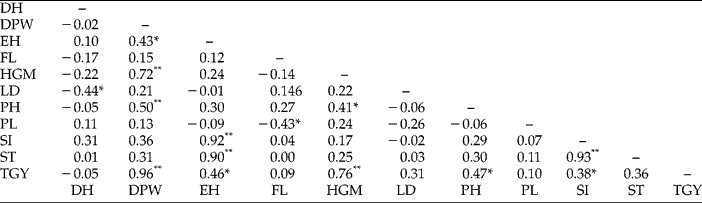
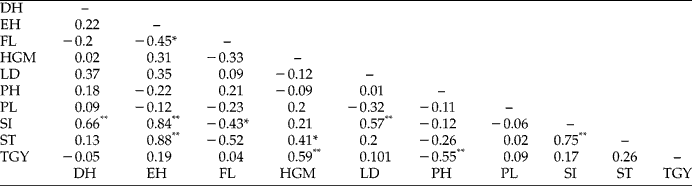
Pearson's correlations between resistance traits and some agronomic parameters evaluated for infestation by B. fusca in Kabete are given in Table 3. Significant positive correlations were observed between the following: exit holes and stem tunnelling; the susceptibility index and stem tunnelling; hundred-grain mass, total grain yield and plant height; plant height and total grain yield; dry panicle weight and total grain weight; and plant height and hundred-grain mass. A significant negative correlation was observed between days to 50% flowering and panicle length. Pearson's correlations between resistance traits and some agronomic parameters evaluated for infestation by C. partellus in Kiboko are given in Table 4. Significant positive correlations were observed between the following: dead heart damage and the susceptibility index; leaf feeding damage and the susceptibility index; the susceptibility index and stem tunnelling; exit holes, stem tunnelling and the susceptibility index; and hundred-grain mass and total grain mass. Significant negative correlations were observed between the following: the number of exit holes and days to 50% flowering; days to 50% flowering and the susceptibility index; and plant height and total grain yield.
Pearson's correlations between Busseola fusca damage parameters and agronomic traits evaluated in Kabete

DH, dead heart damage; DPW, dry panicle weight; EH, exit hole damage; FL, days to 50% flowering; HGM, hundred-grain mass; LD, leaf feeding damage; PH, plant height; PL, panicle length; SI, susceptibility index; ST, stem tunnelling damage; TGY, total grain yield.
* Values significant at the 5% level.
** Values significant at the 1% level.
Pearson's correlations between Chilo partellus damage parameters and agronomic traits evaluated in Kiboko

DH, dead heart damage; DPW, dry panicle weight; EH, exit hole damage; FL, days to 50% flowering; HGM, hundred-grain mass; LD, leaf feeding damage; PH, plant height; PL, panicle length; SI, susceptibility index; ST, stem tunnelling damage; TGY, total grain yield.
* Values significant at the 5% level.
** Values significant at the 1% level.
Direct and indirect relationships of damage parameters by path coefficient analysis
The results of path analysis on the direct and indirect relationships of B. fusca damage parameters with grain yield are given in Table 5. The relative contributions of the damage parameters to grain yield loss were partitioned into direct and indirect relationships by path coefficient analysis with grain yield as the resultant variable. Dead heart damage had a significant positive direct effect on grain yield, supported by negative indirect effects through damage from exit holes and stem tunnelling. Exit hole damage had a positive effect on grain yield, supported by negative indirect effects through damage from leaf feeding and stem tunnelling. Leaf feeding damage had a significant positive direct effect on grain yield, supported by negative indirect effects through damage from exit holes. Stem tunnelling damage had a positive direct effect on grain yield, supported by a negative indirect effect through damage from exit holes.
Results of path analysis on the direct and indirect effects of Busseola fusca damage parameters on sorghum grain yield

DH, dead heart; EH, exit holes; LD, leaf feeding damage; ST, stem tunnelling.
* Values significant at the 5% level.
** Values significant at the 1% level.
The results of path analysis on the direct and indirect relationships of C. partellus damage parameters with grain yield are given in Table 6. The relative contributions of the damage parameters to grain yield loss were partitioned into direct and indirect relationships by path coefficient analysis with grain yield as the resultant variable. Dead heart damage had a significant positive direct effect on grain yield, supported by negative indirect effects through damage from exit holes and stem tunnelling. Dead heart damage had a positive indirect effect through damage from leaf feeding. Exit hole damage had a significant positive direct effect on grain yield, supported by a negative indirect effect through damage from leaf feeding and positive indirect effects through damage from dead heart and stem tunnelling. Leaf feeding damage had a significant positive direct effect on grain yield, supported by a negative indirect effect through damage from stem tunnelling and also positive indirect effects through damage from dead heart and exit holes. Stem tunnelling damage had a significant positive direct effect on grain yield, supported by negative indirect effects through damage from dead heart and leaf feeding and also a positive indirect effect through damage from exit holes. Similar significant path analysis results and Pearson's correlations were observed for all traits evaluated for infestations by both pests.
Results of path analysis on the direct and indirect effects of Chilo partellus damage parameters on sorghum grain yield

DH, dead heart; EH, exit holes; LD, leaf feeding damage; ST, stem tunnelling.
* Values significant at the 5% level.
** Values significant at the 1% level.
Discussion
This study identified sorghum genotypes with dual resistance to both the studied pests. The results revealed a great variation in resistance levels and supported the hypothesis that sorghum genotypes show varied levels of resistance (Sharma, Reference Sharma2006). Genotypes ICSA 473, ICSA 472, ICSB 472, ICSA 464, ICSB 464, ICSB 467, ICSA 474, IESV 91131 DL and Macia exhibited resistance to both insect species. These can be used as sources in breeding for resistance to reduce the yield losses caused by these pests. Host plant resistance is an important component of integrated pest management strategy against stemborers. The highest yielding genotypes with dual resistance were KARI-Mtama 1, IESV 93042 SH and ICSB 474 and should be promoted for adoption by farmers in stemborer-endemic areas as they possess traits such as high yields that farmers prefer.
Sorghum genotypes were categorized into four classes: resistant, moderately resistant, moderately susceptible and susceptible. Genotypes categorized as resistant to both pests were better than the resistant check. Resistance to these insect pests was determined based on reduced damage from leaf feeding, dead heart, stem tunnelling and exit holes following artificial infestation of seedling whorls with stemborer neonates. Several damage parameters were considered because resistance is a quantitative trait and selection based on a single parameter is not efficient (Singh et al., Reference Singh, Rao and Sharma2011). Consequently, these four damage parameters were used to compute a susceptibility index that was used to categorize the genotypes into different resistance groups as reported by Tadele et al. (Reference Tadele, Mugo, Likhayo and Beyene2011). The resistant genotypes exhibited low levels of damage. The mechanism of resistance studied was mainly tolerance as some genotypes produced substantial grain yields after enduring high levels of damage from leaf feeding, dead heart, stem tunnelling and exit holes. Several studies have reported antixenosis and antibiosis to C. partellus in sorghum cultivars IS 2123, IS 13100, IS 1054, IS 18333, IS 18573, ICSV 714, ICSV 705, IS 1044 and IS 2205 under greenhouse conditions (Kishore Kumar et al., Reference Kishore Kumar, Sharma and Dharma Reddy2006; Singh et al., Reference Singh, Rao and Sharma2011). The last two genotypes were also evaluated in this study for tolerance. This indicates that genotypes IS 1044 and IS 2205 can express all the three categories of resistance to stemborers. Genotype IS 2205 has also been reported to be resistant to sorghum shoot fly Atherigona soccata Rondani (Sharma, Reference Sharma2006). Among the genotypes reported as being resistant to C. partellus based on reduced dead heart damage is ICSV 700, which was tested for tolerance in the present study (Sharma et al., Reference Sharma, Dhillon and Pampapathy2006).
Information on the relationship between stemborer damage and grain yield loss is important for developing an efficient improvement programme for resistance. The positive relationship observed between grain yield and plant height indicates that tall genotypes yield significantly more than short genotypes. Tall plants are associated with vigour, and this indicates that more photosynthates are available for grain filling. Odiyi (Reference Odiyi2007) reported a similar observation in maize. Dead heart damage exerted a significant positive direct effect on grain yield, supported by negative indirect effects through damage from exit holes and stem tunnelling. This could be explained by the fact that dead heart damage resulted in the destruction of the apical shoot of the main stem, thus causing the death of the main plant. The significant positive relationship between stem tunnelling and exit holes indicates a close relationship between the two damage parameters, and either can be used to predict the other. The significant positive association between the four damage parameters and the susceptibility index indicates that an increase in damage would make the genotype susceptible to both pests. The susceptibility index based on the four damage parameters was negatively correlated with days to 50% flowering. This indicates poor resistance in early-flowering plants as the borer undergoes many generations, thus causing severe damage. In addition, unlike late-maturing plants, these plants have a relatively short period for growth in the field and thus cannot compensate for damage. This observation is in agreement with reports on other stalk borers such as Eldana saccharina and Sesamia calamistis in maize (Odiyi, Reference Odiyi2007). Schulz et al. (Reference Schulz, Kreps, Klein, Gumber and Melchinger1997) also found that late-maturing maize plants suffer less stem tunnelling owing to antibiosis against the European corn borer.
Conclusion and recommendation
Sorghum genotypes with dual resistance to B. fusca and C. partellus based on reduced damage from leaf feeding, dead heart, exit holes and stem tunnelling were identified in this study and can thus be used as sources in breeding for resistance to improve susceptible local varieties that farmers prefer.
Acknowledgements
The present study received financial support from the Regional Universities Forum for Capacity Building in Agriculture (RUFORUM), the Carnegie Corporation of New York, USA, and the Harnessing Opportunities for Productivity Enhancement (HOPE) of Sorghum and Millets in Sub-Saharan Africa and South Asia Project under the ICRISAT. The University of Nairobi, KARI Kiboko Research Station, and Embu University College hosted the research. The authors appreciate ICRISAT's research technicians Mr Wickliffe Kidima, Mr Patrick Sheunda, Mr Julius Ombaki and Mr Joseph Kibuka for their support.