Significant outcomes
-
∙ For the first time, we assessed the influence of haloperidol on NPS/NPSR mRNA expression in the rat brain.
-
∙ We proved a significant upregulation of NPS mRNA level in the rat brainstem after haloperidol administration.
Limitations
-
∙ We assessed only mRNA expression, protein level was not measured.
-
∙ We did not determine receptor–ligand interactions nor downstream signalling pathways.
Introduction
Neuropeptide S (NPS) is a selective 20-amino acid ligand for the NPS receptor (NPSR), a Gs and Gq – coupled receptor formerly identified as orphan receptor GPR 154 (Reference Pape, Jungling, Seidenbecher, Lesting and Reinscheid1). NPS is an endogenous modulator of a wide spectrum of physiological activities in the brain. It exerts anxiolytic effects, stabilises arousal state, regulates food intake as well as plays a role in the pathomechanism of fear modulation and addiction (Reference Beck, Fernette and Stricker-Krongrad2–Reference Slattery, Naik and Grund8). In the rat brain, expression of NPS is shown almost exclusively within the locus coeruleus, principal trigeminal nucleus and lateral parabrachial nucleus, whereas in mouse NPS expression in the Kölliker-Fuse nucleus has also been reported (Reference Clark, Duangdao and Schulz9). In contrast to the specific expression of NPS, NPSR mRNA is abundant within the brain and has been detected in the olfactory bulb, piriform cortex, amygdala, hypothalamus, thalamus and brainstem (Reference Xu, Gall, Jackson, Civelli and Reinscheid10). Receptor stimulation leads both to a release of Ca2+ reserves to the neuroplasm and to an increase of cAMP levels (Reference Guerrini, Salvadori, Rizzi, Regoli and Calo11,Reference Pape, Jungling, Seidenbecher, Lesting and Reinscheid1). From a neuropsychiatric viewpoint, the most important role of NPS seems to be its activity at the level of neuronal pathways related to the neurobiology of fear (Reference Wegener, Finger and Elfving12). A number of behavioural tests prove that central or even intranasal NPS administration has a strong anxiolytic effect in rats, which may be related to an increase of dopamine release in the medial prefrontal cortex (Reference Lukas and Neumann13,Reference Si, Aluisio and Okamura14). The stimulatory effect of NPS on dopaminergic signalling suggests that this neuropeptide might increase dopamine synthesis and/or its turnover within the synaptic cleft (Reference Si, Aluisio and Okamura14). Moreover, NPS application to organotypic hippocampal slices activated synaptic plasticity in CA1 and CA3 areas, whereas targeted NPS microinjection directly to the ventral CA1 was enough to reduce fear related behaviour in mice (Reference Dine, Ionescu and Stepan15). Furthermore, under in vitro conditions NPS, acting through its receptor, weakens the neural activity stream from the dentate gyrus to the CA1 area (Reference Dine, Ionescu and Stepan15). NPS peptide administration into the mouse amygdala results in conditioned fear elimination, but it has no effect before the conditioning process (Reference Jungling, Seidenbecher and Sosulina16). Recent experiments on healthy individuals also suggest, that NPSR gene T-alleles could be connected with fear, excessive stress reaction and increased HPA axis stimulation (Reference Kumsta, Chen, Pape and Heinrichs5). Moreover, NPSR1 gene variation affects the glutamate/glutamine (Glx) levels in the rat cingulate cortex during induced panic attacks (Reference Ruland, Domschke and Schutte17). Studies by Zhang et al. (Reference Zhang, Jin and You18) prove that NPS expression in the locus coeruleus and a decrease of NPSR internalisation level in the limbic system coexist with chronic pain and anxiety (Reference Gass, Schwarz and Sartorius24). On the other hand, NPS can stimulate inhibitory GABAergic transmission in the rat medial amygdala, reducing fear-related responses (Reference Jungling, Seidenbecher and Sosulina16). The NPS signalling may be also involved in the regulation of HPA axis acting as a part of negative feedback loop in the response to various stress stimuli (Reference Chauveau, Lange, Jungling, Lesting, Seidenbecher and Pape4). Another clinically intriguing report has associated NPSR polymorphisms with neuropsychiatric disorders including schizophrenia (Reference Lennertz, Quednow and Schuhmacher19). Noteworthy, anxiety is considered as an important and relatively frequent symptom of schizophrenia, which is significantly connected with an elevated risk of severe consequences including suicidal behaviour (Reference Garay, Samalin, Hameg and Llorca20). Post-traumatic stress disorder and obsessive compulsive disorder are present in 38.3% of patients suffering from schizophrenia (Reference Braga, Reynolds and Siris21). Interestingly, some recent findings suggest a role of the NPS signalling in the regulation of motor functions at the level of basal ganglia (Reference Didonet, Cavalcante and Souza Lde22,Reference Li, Peng and Jiang23).
Haloperidol, a classical but still widely administered D2 receptor antagonist effectively reduces the psychosis suggesting impaired dopaminergic signalling as a key mechanism of positive schizophrenia symptoms (Reference Gass, Schwarz and Sartorius24). Noteworthy, haloperidol is a non-specific neuroleptic with affinity to numerous receptors, including dopamine D2, serotonin 5-HT2, α-adrenergic and σ-opioid receptors (Reference Cobos, Del Pozo and Baeyens25–Reference Seeman and Tallerico27). Haloperidol shows either potentially beneficial anxiolytic and sedative properties or a wide spectrum of unfavorable side effects including tardive dyskinesia, neuroleptic malignant syndrome, akathisia and QT-interval prolongation (Reference Budden28–Reference Stracina, Slaninova and Polanska30). Nevertheless, the neurochemical mechanism of anxiolytic and dyskinetic actions of neuroleptics, both classical and atypical, is so far poorly understood. Some reports show that atypical antipsychotics, but not haloperidol can upregulate the level of steroid GABAA receptor stimulators in the rat brain (Reference Marx, Shampine and Duncan31). In turn, the blockage of serotonin 5-HT2 receptors with haloperidol may be responsible for its anxiolytic effect (Reference Millan, Brocco, Gobert, Schreiber and Dekeyne32). Hypothetically, the peptidergic signalling systems may play a significant role in the central regulation of anxiety-related events.
Aims of the study
Accumulating but still limited findings suggest that neuroleptics may affect peptidergic regulatory pathways in various brain structures. For example, both chlorpromazine and clozapine affect corticotropin-releasing hormone (CRH) expression probably via activation of the PI3K/Akt signalling cascade, however PKC-related pathway may be also involved (Reference Basta-Kaim, Budziszewska and Jaworska-Feil33). Haloperidol stimulates CRH mRNA expression and also increases the gonadotropin-releasing hormone (GnRH) secretion in the rat hypothalamus (Reference Umathe, Wanjari, Manna and Jain34). In turn, both quetiapine and olanzapine are able to inhibit the release of CRH from isolated rat hypothalami and hippocampi (Reference Tringali, Lisi and De Simone35). Haloperidol upregulates neurotensin levels in the rat striatum, hippocampus and the frontal cortex, but risperidone decreases the peptide expression (Reference Gruber, Nomikos and Mathe36). Conversely, long-term treatment with haloperidol decreases NPY mRNA levels in the rat amygdala and hippocampus, while olanzapine and clozapine show the same effect in the striatum, nucleus accumbens and anterior cingulated cortex (Reference Huang, Deng, Zavitsanou and Neuropeptide37). Long-term treatment with risperidone also downregulates the NPY mRNA expression in the rat hypothalamus (Reference Kursungoz, Ak and Yanik38). In contrast, a stimulatory effect of subchronically administered olanzapine on NPY expression is also suggested (Reference Ferno, Varela and Skrede39). Olanzapine increases calcitonin gene-related peptide immunoreactivity in the rat brain (Reference Angelucci, Gruber, Caltagirone and Mathe40).
Despite these ongoing studies, almost no data exists regarding the interaction of neuroleptics with brain NPS signalling. We therefore examined the effect of administration of haloperidol, a classical butyrophenone type antipsychotic drug, on NPS and NPSR expression in the rat brain and showed a robust significant increase in brainstem NPS mRNA expression as a result of chronic drug administration.
Materials and methods
Animals
The experiments were performed on adult male Sprague-Dawley rats (2–3 months old, 180–210 g). We injected two groups of animals (n=4) with either control vehicle (saline) or haloperidol (2 mg/kg/day) every day for 4 weeks (28 injections per rat). All procedures were conducted in a manner consistent with NIH Guidelines for Care and Use of Laboratory Animals and approved by the Local Bioethical Committee at the Medical University of Silesia (agreement no. 36/2012).
Material collection and reverse transcription
After 24 h of the last drug administration, animals were anaesthetised with isoflurane. Then, the brains were quickly removed and we performed microsurgical excision of samples from hypothalamus, hippocampus, striatum and brainstem. After that, all samples were homogenised with an ultrasound homogeniser (Heildolph DIAX 900, Heidolph Instruments, Schwabach, Germany) in 1 ml of TRIzol® Reagent (Life Technologies, Carlsbad, California, USA) and total mRNA was extracted and dissolved in 50 μl of RNAse-free water. Transcription of mRNA into cDNA was performed by incubation in buffered solution of reverse transcriptase MMLV-RT with RNAsin, oligo-dT and a mix of nucleotides at 42°C for 60 min using a DNA Thermal Cycler 480 (Perkin Elmer Inc., Waltham, MA, USA). Initial mRNA solutions contained 5 µg of RNA per 100 µl.
Quantitative real-time polymerase chain reaction (PCR)
We performed quantitative Real-Time PCR reaction (qPCR) with the use of FastStart SYBR Green Master Mix (Roche Diagnostics Gmbh, Mannheim, Germany) in a Light Cycler® 96 (Roche) for 45 rounds. Expression levels of NPS and NPSR were compared with expression of housekeeping gene glyceraldehyde phosphate dehydrogenase (GAPDH). cDNA amplification was performed using the following primers: for NPS; Forward: 5′-TTGGAGTTATCCGGTCCTCTCTT-3′, Reverse: 5′-TTGGAGTTATCCGGTCCTCTCTT-3′, for NPSR; Forward: 5′-TGCAAGGTGCAAAGATCCCA-3′, Reverse: 5′-AATCTGCATCTCATGCCTCTC-3′, for GAPDH: Forward: 5′-GTGAACGGATTTGGCCGTATCG-3′, Reverse: 5′-ATCACGCCACAGCTTTCCAGAGG-3′.
Statistics
Statistical analysis was done with Statistica (Systat Software). We presented data (on graphs) as mean±SEM. Mean differences between groups of animals were analysed using non-parametric Kruskall–Wallis test. Differences were considered statistically significant at p≤0.05.
Results
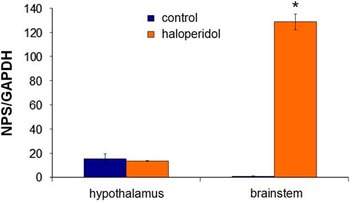
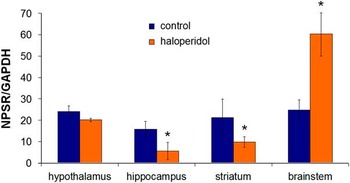
In the current study, rats treated chronically with haloperidol manifested strongly increased relative NPS mRNA expression in the brainstem; 128.75±6.48 versus control: 1.08±0.33 (p=0.000246). Although, there is an unexpectedly massive (about 120-fold) increase of NPS mRNA level in this region we excluded the effect of haloperidol on GAPDH expression, as mean Cq values for this gene are very similar for control animals (15.65) and for haloperidol treated animals (15.48). We have also found a trend for decreased NPS mRNA level in the hypothalamus: 13.79±0.36 versus control: 15.59±4.09, nevertheless this change was not statistically significant (Fig. 1). The NPS mRNA expression in the hippocampus and striatum was undetected. After long-term administration of haloperidol NPSR mRNA expression was downregulated in the hippocampus; 5.6±4.03 versus control: 15.76±3.86 and striatum: 9.78±2.42 versus control: 21.19±8.67, unchanged in the hypothalamus 20.17±0.81 versus control: 24.01±2.65 and highly increased in the brainstem: 60.36±10.48 versus control: 24.86±4.59 (Fig. 2).
Quantitative PCR results of relative neuropeptide S mRNA expression levels in the rat hypothalamus and brainstem (n=4). Data are presented as mean±SEM. Statistical analysis was performed using non-parametric Kruskal–Wallis test. Differences were considered significant at p≤0.05 (asterisk).

Quantitative PCR results of relative NPSR mRNA expression levels in the selected rat brain regions (n=4). Data are presented as mean±SEM. Statistical analysis was performed using non-parametric Kruskal–Wallis test. Differences were considered significant at p≤0.05 (asterisks).

Discussion
At present, there are relatively few reports concerning NPS expression changes related to antipsychotic drug activity. Studies on the influence of this group of pharmaceuticals on peptidergic regulatory pathways could be a source of hypothesis explaining alternative ways of their pharmacological effects. In our analysis we focussed on the expression of the NPS and NPSR mRNA in selected brain structures of rats chronically treated with haloperidol. The results indicate that chronical drug administration may modulate the expression of NPS and NPSR mRNAs in selected rat brain regions.
The statistically significant elevation of the brainstem NPS mRNA level, after long-term haloperidol administration stays in agreement with our recent results showing that short and chronical treatment with the neuroleptics chlorpromazine and olanzapine increased the NPS mRNA expression in the rat hypothalamus (Reference Pałasz and Rojczyk41). In addition, haloperidol stimulates the secretion of GnRH (Reference Umathe, Wanjari, Manna and Jain34) and increases corticotrophin-releasing hormone (CRF) mRNA expression in the rat hypothalamus (Reference Park, Choi and Lee42). On the other hand, haloperidol, but not risperidone, elevates neurotensin levels in the rat striatum, hippocampus and frontal cortex. Conversely, in the occipital cortex, risperidone, but not haloperidol, reduces neurotensin expression (Reference Gruber, Nomikos and Mathe36). In contrast, long-term haloperidol administration decreases NPY mRNA expression in the rat amygdala and hippocampus while olanzapine and clozapine show the same effect in the nucleus accumbens, striatum and anterior cingulated cortex (Reference Zhang, Jin and You18). Similarly, chronically administered risperidone decreases the NPY mRNA level in the rat hypothalamus (Reference Kursungoz, Ak and Yanik38). Only olanzapine significantly decreases the NPY mRNA level in the lateral septal nucleus (Reference Huang, Deng, Zavitsanou and Neuropeptide37). A decrease in the hypothalamic NUCB2 and nesfatin-1 expression after chronical haloperidol administration was also recently reported (Reference Rojczyk, Palasz and Wiaderkiewicz43). In our experiment, the NPS mRNA expression remains unchanged in hypothalamus after drug treatment. This result is in line with the study showing that hypothalamic NPY mRNA level did not change after long-term neuroleptic administration to rats (Reference Rojczyk, Palasz and Wiaderkiewicz43).
Furthermore, it is suggested, that haloperidol can induce disturbances in the oxidative-antioxidative balance. It should be noted that the elevation of NPS expression observed in our study may be a part of neuronal protective mechanism against an extended treatment with this drug. Moreover, it was shown, that NPS can weaken lipid peroxidation processes in the mouse brain cortex, which confirms its neuroprotective activity during the occurrence of oxidative stress (Reference Castro, Moretti and Casagrande44).
Single dose treatment with haloperidol and other typical antipsychotics may increase the number of spontaneously active dopaminergic cells in the rat brainstem (areas A9 and A10) whereas olanzapine and atypical neuroleptics stimulate cell populations in A10, but not A9 (Reference Rasmussen, Hsu and Yang45). The long-term treatment with neuroleptics proved that multiple haloperidol administration can lead to a decrease of the number of spontaneously active cells in A9 and A10 areas of the brainstem (Reference White and Wang46) whereas Stockton and Rasmussen (Reference Stockton and Rasmussen47) showed that chronic exposition to olanzapine results in a decreased number of active neurons in A10, but not in A9 area.
Interestingly, after long-term treatment with haloperidol, the NPSR mRNA levels were downregulated both in the hippocampus and striatum. This result is consistent with our recent finding that NPSR mRNA levels in the same structures were decreased after chronical chlorpromazine and olanzapine administration. Additionally, both short and long-term exposition to chlorpromazine decreased the NPS mRNA level in the hypothalamus (Reference Pałasz and Rojczyk41). Presented phenomena are rather difficult to interpret without specific analysis of potential interactions between NPSR mode of action and dopaminergic signalling. Possibly, haloperidol may modulate the NPS-related synaptic plasticity in the hippocampus mediating any kinds of fear responses (Reference Dine, Ionescu and Stepan15). Probably, the high elevation of NPS mRNA level in brainstem neurons may suggest an increased neuropeptide synthesis and release to the hippocampal formation and striatum. Thus, it should be taken into consideration that a decrease in NPSR mRNA expression could be a compensatory response to increased NPS concentration in these structures. In contrast, the NPSR mRNA level in brainstem was distinctly elevated after chronical haloperidol administration. Theoretically, this neuroleptic could increase the sensitivity and/or activity of NPS signalling in the brainstem and in consequence facilitate anxiolytic mechanisms. Importantly, the brainstem contains a distinct population of aminergic NPSR-expressing neurons (Reference Xu, Gall, Jackson, Civelli and Reinscheid10) that play numerous central roles such as modulation of cortical glutamatergic transmission and maintaining the arousal state. We therefore can hypothesise that haloperidol may affect them indirectly via stimulation of NPS pathway. Chronic administration of haloperidol evokes several considerable side effects including prolonged sedation and tardive dyskinesia besides other motor disabilities.
Recent data suggested the role of NPS in locomotion and related these actions with dopaminergic signalling (Reference Castro, Moretti and Casagrande44). It was shown that intracerebroventricular infusion of NPS to the striatum and substantia nigra increase the locomotor activity in rats. This effect is counteracted both by SHA 68 (a selective antagonist of NSPR) and antalarmin (a CRF-1 receptor blocker) suggesting that CRF plays a significant role in the NPS-related control of locomotion activity (Reference Li, Peng and Jiang23). Similarly, central injection of NPS abolished motor impairments evoked by dopaminergic neurotoxin 6-OHDA (Reference Didonet, Cavalcante and Souza Lde22). Probably, NPS may stimulate dopamine release via selective activation of NPSR receptors in the extrapyramidal system (Reference Mochizuki, Kim and Sasaki48). The observed downregulation of striatal NPSR mRNA expression suggests that pharmacological activity of haloperidol may also manifest at the level of NPS transmission in the basal ganglia, which may be one of the alternative ways of triggering dyskinetic side effects by this medication. Intriguingly, a recent study reports that haloperidol can also decrease the functional connectivity between substantia nigra and cortical motor regions, which may reflect motor disabilities (Reference Gass, Schwarz and Sartorius24).
Taken together, it is possible that dopamine may inhibit the expression of genes encoding some neuropeptides including NPS in certain brain regions. Thus, the blockage of dopamine receptors performed by haloperidol can result in compensational expression increase of the aforementioned proteins. Mechanisms of anxiolytic side effects of antipsychotics are not fully clarified, however it is suggested that the blockage of both dopamine D2 and serotonin 5-HT2 receptors may be responsible for the haloperidol anxiolytic action (Reference Millan, Brocco, Gobert, Schreiber and Dekeyne32). Conversely, some reports show that atypical neuroleptics clozapine and olanzapine, but not haloperidol can increase the level of endogenous allopregnanolone and allotetrahydrodeoxycorticosterone, two positive GABAA receptor modulators in the rat brain (Reference Barbaccia, Affricano, Purdy, Maciocco, SPIGA and Biggio49,Reference Marx, Shampine and Duncan31,Reference Mead, Li and Kapur50).
In conclusion, the fact that haloperidol highly affected the level of NPS and NPSR mRNA expression in the rat brain supports the hypothesis that NPS plays a role in the anxiolytic actions of neuroleptics and possibly also in the pathophysiology of mental disorders; for example in the control of negative schizophrenia. It was also shown recently, that synthetic NPS is a potent anxiolytic agent, even in rodents with an innate predisposition to high anxiety. Thus, it is strongly suggested that NPS may be a promising, potentially beneficial medication in the treatment of anxiety disorders especially in patients with the high-risk variant (Reference Slattery, Naik and Grund8). Our intriguing initial data requires further basic pharmacological and behavioural studies on the wide spectrum of antipsychotic drugs, but nonetheless highlights the complex nature of potential interactions between dopamine receptors and brain peptidergic pathways and opens up an array of future potential clinical applications.
Acknowledgements
The authors thank Marek Krzystanek, PhD, DSc, for providing neuroleptics, and Barbara Rojczyk, MSc, Eng. MA, for her valuable technical assistance.
Authors Contributions
Artur Palasz – article conception and design, drafting the manuscript, analysis and interpretation of data, Ewa Rojczyk, Milosz Golyszny, Lukasz Filipczyk – acquisition of data, analysis and interpretation of results, John J. Worthington – drafting the article and revising it critically for important intellectual content, Ryszard Wiaderkiewicz – final review of the version to be published.
Financial Support
This work was supported by the Medical University of Silesia grant for Department of Histology KNW-132/N/4/0.
Conflicts of Interest
None.
Animal Welfare
Experiments were conducted in a manner consistent with NIH Guidelines for Care and Use of Laboratory Animals.
Ethical Standards
The authors assert that all procedures contributing to this work comply with the ethical standards of the relevant national and institutional guides on the care and use of laboratory animals