Implications
Genetically modified (GM) plants are now under development and rapid commercial use in all over the world. However, we are uncertain whether GM food and feed can exert potential reproductive toxicology on humans or animals. In this review, we focus on the latest (last 3 to 4 years) findings and debates on reproduction of male and female animals after feeding daily diets containing the GM crops, and to present the possible mechanism(s) to explain their influences. The controversy about the potential reproductive toxicology of GM foods is complex, which certainly would require further scientific investigation to answer safety concerns.
Introduction
Genetically modified (GM) crops are identified as crops that use modern techniques of genetic engineering (or biotechnology) to introduce specific genetic material derived from any species of plant, animal, microorganism or even synthetic material into different species of plants by altering genetic material (DNA) coding for herbicide tolerance, insect resistance or a combination of these traits in a way that does not occur naturally. Then, the resulting plants can express the novel and desirable traits, such as enhanced disease resistance, anti-reversion force or secretion of useful proteins during different stages of the plant growth. In these plants, the genetic insert leads to the production of a gene product, which does not interfere with the overall metabolism of the plant cell, and does not alter the composition of the GM plant except for the introduced trait (World health Organization (WHO), 2002; European Food Safety Authority – Genetically Modified Organism (EFSA GMO) Panel, 2008; Magana-Gomez and delaBarca, Reference Magana-Gomez and delaBarca2009; Dhlamini, Reference Dhlamini2009). With many advantages over conventional crops, GM plants are now under development and rapid commercial use since 1996. On the one hand, the global area of GM crops has increased >80-fold, from 1.7 million hectares in six countries in 1996 to 143 million hectares in 23 countries in 2007. The world's top six producers – the United States, Argentina, Brazil, Canada, India and China – account for >90% of global GM production (James, Reference James2007). On the other hand, more and more types of genetic materials and the systems for GM crops have been created, accompanying the improvement in genetic engineering. These include soybean with improved amino acid composition or potato with enhanced calcium content and other functional foods (Krishnan, Reference Krishnan2005; Park et al., Reference Park, Kang, Kim, Han, Kim and Smith2005; Hirschi, Reference Hirschi2009). Owing to the development of GM crops, they are today distributed all over the world, frequently becoming part of human and animal diets (Sanvido et al., Reference Sanvido, Romeis and Bigler2007). As diet is considered one of the most important environmental factors affecting life span, GM crop genomes into which new genes have been inserted by using modern techniques of genetic engineering are very different from conventional crops at the aspect of plant improvement to raise and stabilize yields, to improve resistance to pests and diseases (Dhlamini, Reference Dhlamini2009). Many discussion forums, studies and publications have been devoted to the safety assessment of GM food and feed. Of importance, reproductive toxicology of GM crops is studied in order to detect whether they will interfere in some way in normal reproduction and induce adverse effects on sexual function and fertility in male and female animals, as well as developmental toxicity in the offspring. Therefore, many studies have been carried out to ensure the safety of GM food via number of methods and species of common animals by feeding a diet containing the novel materials such as a new protein or secondary metabolite. However, it remains debatable whether GM food and feed exert potentially adverse effects on humans or animals. The aims of this review are to focus on the latest (last 3 to 4 years) findings and debates on reproduction of male and female animals after feeding daily diets containing the GM crops, and to present the possible mechanism(s) to explain their influences.
The effect of GM crops on female animal reproduction
Background
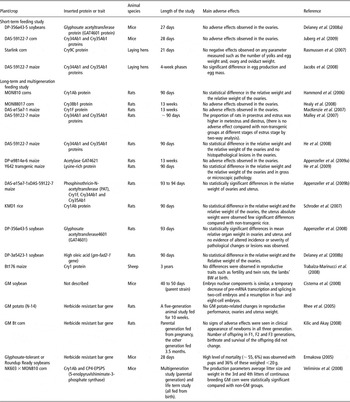
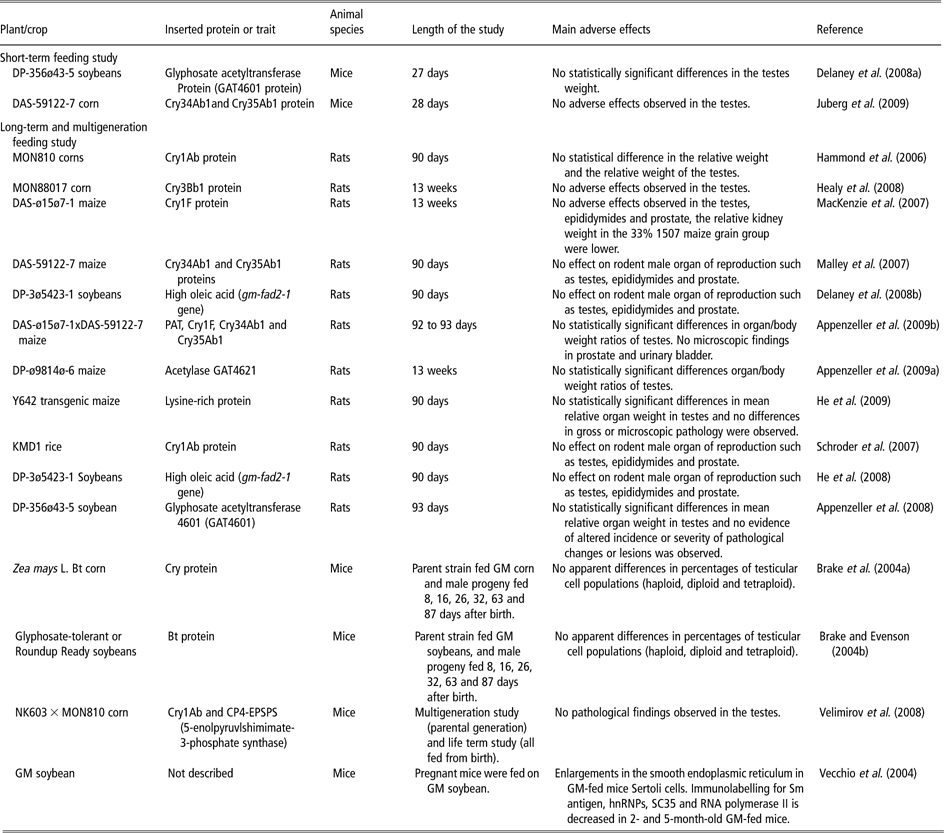
In the toxicological investigation of GM crops, various international guidelines have been designed by international organizations like Food and Agriculture Organization (FAO) of The United Nations, World Health Organization (WHO), Organisation for Economic Co-operation and Development (OECD) and the Codex Alimentarius Commission (CAC) to assess the safety of GM foods on the basis of risk analysis concepts and principles. Current approaches are based on internationally approved acute or chronic tests in laboratory animals (rat or mouse) and fast-growing domesticated species such as chicken (FAO/WHO, 2000; OECD, 2007; CAC, 2003a and 2003b; Craig et al., Reference Craig, Tepfer, Degrassi and Ripandelli2008; Sesikeran and Vasanthi, Reference Sesikeran and Vasanthi2008). Especially, the ability of the 90-day rat feeding study to detect the biological/toxicological effects of the new gene product in the GM food (Knudsen and Poulsen, Reference Knudsen and Poulsen2007). The effects of GM crops on female animal reproduction are shown in Table 1.
The effect of GM crops on female animal reproduction

GM = genetically modified.
Short-term feeding studies
Using animal feeding models, many studies indicated that administration of a large single dose had no acute toxicity on animals as evaluated over a short period of observation. At present, many groups used a short-term (not >1 month) feeding animal model to evaluate safety of GM crops. When feeding different GM crops to mice, no adverse effects were observed in the ovaries fed for 27 days by a GM crop 356043 soybeans contained glyphosate acetyltransferase protein, GAT4601 protein; Delaney et al., Reference Delaney, Zhang, Carlson, Schmidt, Stagg, Comstock, Babb, Finlay, Cressman, Ladics, Cogburn, Siehl, Bardina, Sampson and Han2008a). Moreover, no microscopic pathology was observed in vagina of animals treated with Cry34Ab1 or Cry35Ab1 proteins for 28 days, even at repeated high dose (1000-fold greater than the highest estimate of human exposure based on the concentrations of these proteins expressed in 59 122 maize grain; Juberg et al., Reference Juberg, Herman, Thomas, Brooks and Delaney2009). In livestock, no negative effects were observed for laying hens fed for 21 days or 4 weeks on any parameter measured, including the number of yolks and egg and ovary weight, follicle number, oviductal weight, egg production, egg mass and feed efficiency (Rasmussen et al., Reference Rasmussen, Sarra, Wilhelms and Scanes2007; Jacobs et al., Reference Jacobs, Utterback, Parsons, Rice, Smith, Hinds, Liebergesell and Sauber2008).
Long-term and multigenerational feeding studies
Long-term feeding studies
Compared with the short-term feeding study, the long-term feeding study contained sub-chronic toxicity (a reduction in the tested animal's life span by ∼10%) and chronic toxicity, and allowed the investigator to ascertain the variation in responses. At present, many research groups have started to evaluate the safety of GM food and feed in the long-term feeding study.
In the 90-day or 13-week feeding studies in rats, no statistical difference was uncovered in either the relative body and ovary weight of rats fed transgenic corns (Hammond et al., Reference Hammond, Dudek, Lemen and Nemeth2006; Healy et al., Reference Healy, Hammond and Kirkpatrick2008), maize (MacKenzie et al., Reference MacKenzie, Lamb, Schmidt, Deege, Morrisey, Harper, Layton, Prochaska, Sanders, Locke, Mattsson, Fuentes and Delaney2007; He et al., Reference He, Tang, Luo, Li, Cao, Yu, Delaney and Huang2009; Appenzeller et al., Reference Appenzeller, Munley, Hoban, Sykes, Malley and Delaney2009a and Reference Appenzeller, Malley, Mackenzie, Hoban and Delaney2009b), rice (Schroder et al., Reference Schroder, Poulsen, Wilcks, Kroghsbo, Miller, Frenzel, Danier, Rychlik, Emami, Gatehouse, Shu, Engel, Altosaar and Knudsen2007) or soybeans (Appenzeller et al., Reference Appenzeller, Munley, Hoban, Sykes, Malley and Delaney2008; Delaney et al., Reference Delaney, Appenzeller, Munley, Hoban, Sykes, Malley and Sanders2008b); and there were no histopathologic lesions in ovaries from rats fed DAS-59122-7 maize (Cry34Ab1 and Cry35Ab1 proteins; He et al., Reference He, Huang, Li, Qin, Delaney and Luo2008). Furthermore, Malley et al. (Reference Malley, Everds, Reynolds, Mann, Lamb, Rood, Schmidt, Layton, Prochaska, Hinds, Locke, Chui, Claussen, Mattsson and Delaney2007) reported higher mean uterus weight during the estrous stage of rats fed maize DAS-59122-7 (Cry34Ab1 and Cry35Ab1 proteins) or 5002B (commercial rodent diets) v. the 33R77 group (non-transgenic reference maize grain), 091 group (non-transgenic near-isogenic maize grain) or 5002A (commercial rodent diets); however, this might be due to the fact that the proportion of rats in proestrus and estrus in the 59122 and 5002B groups was greater than that in the 5002A, 091 and 33R77 maize grain groups, in which a greater proportion of rats were in metestrus and diestrus. The longest long-term feeding study was a 3-year longitudinal study of feeding sheep a diet containing Bt176 (Bacillus thuringiensis) maize. This study indicated that there were no differences in reproductive traits such as fertility and twinning rate, body weight at birth, mortality or daily weight gain up to weaning (90 days of age) in lambs (Trabalza-Marinucci et al., Reference Trabalza-Marinucci, Brandi, Rondini, Avellini, Giammarini, Costarelli, Acuti, Orlandi, Filippini, Chiaradia, Malatesta, Crotti, Antoninia, Amagliani, Manuali, Mastrogiacomo, Moscati, Naceur Haouet, Gaiti and Magnani2008).
As described above for long-term feeding study, their greatest concerns are on ovulation of a normal oocyte, fertilization, uterine status, implantation and prenatal development. However, the female reproductive system is also at risk during fetal development in utero, postnatally during puberty and during the female's reproductive lifetime. Given the safety assessment of GM food and feed, Cisterna et al. (Reference Cisterna, Flach, Vecchio, Barabino, Battistelli, Martin, Malatesta and Biggiogera2008) investigated the ultrastructural and immunocytochemical features of pre-implantation embryos from 10 two-month-old Swiss mice fed a standard diet containing 14% GM soybean or non-GM soybean until weaning (i.e. for 40 to 50 days). Morphological observations revealed that the general aspects of embryo nuclear components were similar in the two experimental groups. However, immunocytochemical and in-situ hybridization results suggested a temporary decrease in pre-mRNA transcription and splicing in two-cell embryos and a resumption in four- and eight-cell embryos from mice fed the GM soybean. In addition, pre-mRNA maturation seemed to be less efficient in both two-, four- and eight-cell embryos from GM-fed mice than in controls (Cisterna et al., Reference Cisterna, Flach, Vecchio, Barabino, Battistelli, Martin, Malatesta and Biggiogera2008). However, these studies did not provide any information on the source, nutritional composition or any kind of processing of the soybeans used, and the sample size was small for female mice (n = 5), and there was a lack of description of the embryo. The evidence is still far from certain as to whether the long-term consumption of GM foods possesses a possible danger for human or animal health. Therefore, further studies on the effects of GM food components on embryo development are needed.
Multigenerational feeding studies
The limitation of a one-generation test is that the reproductive capacity of chemically exposed rats both prenatally and postnatally is not assessable. However, in a multigeneration test, the postweaning maturation and reproductive capacity of the pups can be evaluated (Francis and Kimmel, Reference Francis and Kimmel1988). Therefore, more and more reports are being designed to clarify and enlighten the possible effects on animal health of GM crops through multigenerational feeding studies.
One group examined the potential reproductive and developmental toxic effects of rats by using five generation of animals fed a solid pellet containing 5% GM potato and non-GM potato for 10 weeks before mating. They uncovered no GM potato-related changes in reproductive performance, histopathological observations of the reproductive tissues and organ weight was not different. The litter-related indices did not show any GM organism (GMO)-related changes (Rhee et al., Reference Rhee, Cho, Won, Seok, Kim, Kwack, Lee, Chae, Kim, Lee, Park and Choi2005). Kilic evaluated the effects of GM Bt corn on the rats that were fed through three generations with either GM corn or its conventional counterpart. No signs of adverse effects were seen in clinical appearance of newborns in all three generations. The dams gave fertile progeny and successfully continued their strips. Number of offspring in F1, F2 and F3 generations, birthrate and survival of the offspring were not changed among groups suggesting their successful reproduction (Kilic and Akay, Reference Kilic and Akay2008). Conversely, high levels of mortality (55.6%) and decreases in birth weight of offspring were reported in a GM soybean feeding study in which female rats were fed before mating, during mating and during pregnancy (Ermakova, Reference Ermakova2005). However, the study of Ermakova (Reference Ermakova2007) was in debate and there were certainly no conclusions for their results (Marshall, Reference Marshall2007). In 2008, Velimirov carried out a series of experiments involved in almost every aspect of a multigenerational feeding study. The test diets differed only as to the inclusion of 33% NK603 × MON810 GM corn v. non-GM corn of a near-isogenic line. They found that the production parameters such as average litter size and weight in the 3rd and 4th litters of continuous breeding GM corn were statistically significant compared with non-GM groups. In addition, analyses of metabolic pathways by microarrays indicated that the groups differed with regard to some important biochemical pathways, including interleukin (IL) signaling, cholesterol biosynthesis and protein metabolism (Velimirov et al., Reference Velimirov, Binter and Zentek2008). Their studies are by far the most meticulous and comprehensive feeding trials to date, and confirm deleterious reproductive and health impacts obtained by scientists independent of the biotech industry and farmer observations in the field. However, the researchers at Monsanto Company think that Dr Velimirov's report lacks sufficient experimental details to fully interpret the results and contains a number of errors that make it unsuitable for risk assessment and/or regulatory purposes (Monsanto Company, 2008).
The effect of GM crops on male animal reproduction
Background
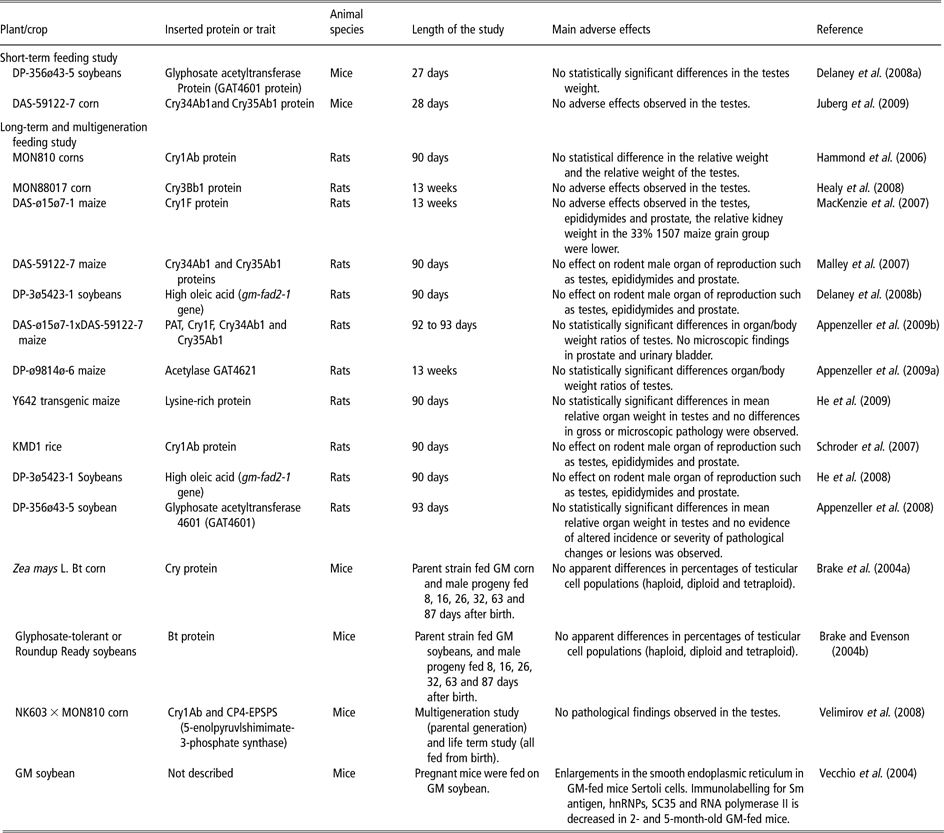
The male reproductive system is at risk during fetal development in utero, postnatally during puberty and even over the entire life span with targets including testes and accessory organs. In addition, the high rate of cellular proliferation and the unique cellular differentiation within the mammalian testis make it a very sensitive organ that can detect cellular and molecular changes that occur when exposed to a toxicant (Evenson et al., Reference Evenson, Darzynkiewicz and Melamed1980). Therefore, many research groups are concerned about whether the GM food exert negative effects on the male reproductive system in order to ensure the safety of GM food by a number of methods over many species of animals. The effects of GM crops on male animal reproduction are shown in Table 2.
The effect of GM crops on male reproduction
GM = genetically modified.
Short-term feeding studies
Bt proteins have been shown to be rapidly degraded in vitro using simulated gastric fluids (Betz et al., Reference Betz, Hammond and Fuchs2000; Momma et al., Reference Momma, Hashimoto, Yoon, Ozawa, Fukuda, Kawai, Takaiwa, Utsumi and Murata2000). Therefore, in a short-term feeding study, there were no statistically significant differences in the testis weight compared with rats fed non-GM soybeans (Delaney et al., Reference Delaney, Zhang, Carlson, Schmidt, Stagg, Comstock, Babb, Finlay, Cressman, Ladics, Cogburn, Siehl, Bardina, Sampson and Han2008a). Moreover, no microscopic pathology was observed in testes of Cry34Ab1 or Cry35Ab1 protein-treatment groups for 28 days, even at a repeated high dose 1000-fold > the highest estimate of human exposure based on the concentrations of these proteins expressed in 59 122 maize grains (Juberg et al., Reference Juberg, Herman, Thomas, Brooks and Delaney2009).
Long-term and multigenerational feeding studies
Long-term feeding studies
In a 90-day or 13-weeks feeding studies on rats, several groups have reported that there were no effects on male reproductive organs such as testes, epididymides and prostate in rodents compared with rats receiving non-GM food in long-term study when the diet was treated with different GM foods (Hammond et al., Reference Hammond, Dudek, Lemen and Nemeth2006; MacKenzie et al., Reference MacKenzie, Lamb, Schmidt, Deege, Morrisey, Harper, Layton, Prochaska, Sanders, Locke, Mattsson, Fuentes and Delaney2007; Schroder et al., Reference Schroder, Poulsen, Wilcks, Kroghsbo, Miller, Frenzel, Danier, Rychlik, Emami, Gatehouse, Shu, Engel, Altosaar and Knudsen2007; Appenzeller et al., Reference Appenzeller, Munley, Hoban, Sykes, Malley and Delaney2008, Reference Appenzeller, Munley, Hoban, Sykes, Malley and Delaney2009a and Reference Appenzeller, Malley, Mackenzie, Hoban and Delaney2009b; Delaney et al., Reference Delaney, Appenzeller, Munley, Hoban, Sykes, Malley and Sanders2008b; Healy et al., Reference Healy, Hammond and Kirkpatrick2008; He et al., Reference He, Huang, Li, Qin, Delaney and Luo2008 and Reference He, Tang, Luo, Li, Cao, Yu, Delaney and Huang2009). However, in MacKenzie et al. (Reference MacKenzie, Lamb, Schmidt, Deege, Morrisey, Harper, Layton, Prochaska, Sanders, Locke, Mattsson, Fuentes and Delaney2007 study, there was no statistical difference in the relative weight of the testes, epididymides or prostate. Specifically, the relative kidney weight from male rats receiving the 33% 1507 maize grain (Cry1F protein) were lower than those rats fed diets containing non-GM maize grains. However, the author did not discuss these results (MacKenzie et al., Reference MacKenzie, Lamb, Schmidt, Deege, Morrisey, Harper, Layton, Prochaska, Sanders, Locke, Mattsson, Fuentes and Delaney2007).
Multigenerational feeding studies
Brake designed short-term mouse study in which pregnant female mice were fed Bt or conventional corn diets; the authors then detected the fetal, postnatal, pubertal or adult testicular development of first generational male mice by dual parameter flow cytometry at time points 8, 16, 26, 32, 63 or 87 days after birth. In addition, they also designed multigenerational mouse study to detect the same endpoints in the 4th generational male mice at the same time points as in the short-term mouse study described above. In this study, no apparent differences in percentages of testicular cell populations (haploid, diploid and tetraploid) were observed between the mice fed the Bt corn diet and those fed the conventional diet (Brake et al., Reference Brake, Thaler and Evenson2004a). The same research group also studied the effect of transgenic soybeans using the same methods. The results showed that the transgenic soybean diet had no negative effect on fetal, postnatal, pubertal or adult testicular development (Brake and Evenson, Reference Brake and Evenson2004b).
However, in the Vecchio study (Vecchio et al., Reference Vecchio, Cisterna, Malatesta, Martin and Biggiogera2004), the authors fed pregnant Swiss mice and male litters on a standard laboratory chow containing 14% GM soybean. Then, they evaluated Sertoli cells, spermatogonia and spermatocytes by means of electron microscopy at 2, 5 or 8 months of age Their results indicated that immunolabelling for Sm antigen, hnRNPs, SC35 and RNA polymerase II was decreased in 2- and 5-month-old GM-fed mice, and restored to normal at 8 months. In GM-fed mice of all ages considered, the number of perichromatin granules was higher and the nuclear pore density lower. Moreover, the authors found in GM-fed mice enlargements in the smooth endoplasmic reticulum of Sertoli cells. In an opposing critique, Batista (Batista and Oliveira, Reference Batista and Oliveira2009) thought that the Vecchio study was flawed. For instance, these authors did not provide any information on the source, nutritional composition or type of soybean processing used, nor did they discuss the appropriateness of the control used, such as whether it was a near-isogenic line that was grown in the same field and under the same environmental conditions. One piece of crucial information would be the isoflavone content of the GM soybean v. the control, because the estrogenic effect of isoflavones per se could be responsible for changes in cell nuclear trafficking (Zhu and Conney, Reference Zhu and Conney1998). In addition, we thought Vecchio's study lacks some cell biology experiments such as assessing motility of sperm analyses and sperm count. However, a possible role played by GM crops on the development of male sperm needed more discussions.
Possible mechanisms for GM effects on animals
Although possessing many advantages compared with conventional crops, there are still doubts as to the safety of GM crops with respect to possible long-term adverse effects on the environment and human health, as DNA and protein representing the novel constituents in GM crops can be degraded by animals. As it is well known, alterations in dietary agents during the pre-mating period will affect oocyte maturity, blastocyst yield, prenatal survival and the number of offspring born alive (Trosko, Reference Trosko2008; Ashworth et al., Reference Ashworth, Toma and Hunter2009). Therefore, given the characteristics of GM crops, DNA and proteins are broken down rapidly into small fragments by digestive enzymes: DNA into fragments and nucleotides within the digestive tract; proteins into polypeptides, peptides and amino acids (Faust and Glenn, Reference Faust and Glenn2002). However, now this view faces a challenge, and there are numerous debates about whether exogenous DNA fragments or protein can be absorbed by the gastrointestinal tract and then exist in tissues, resulting in adverse effects. However, there is no direct evidence to support a particular mechanism for an effect of GM crops on reproduction in male and female animals. Therefore, we must focus on some possible factors impacting animal reproduction as follows.
Exogenous protein and effects on gastrointestinal tract
To date, many novel proteins expressed in GM crops were evaluated by a rigorous safety-assessment process before the crop is commercialized: assessment of the potential for the protein to be an allergen or toxin or assessment of potential toxicity and allergenicity of introduced proteins (Kier and Petrick, Reference Kier and Petrick2008). Importantly, Cry1Ab and 5-enolpyruvlshimimate-3-phosphate synthase (CP4 EPSPS) were mainly resistance proteins expressed in GM crops. The amount of transgenic protein ingested by animals (mouse, rat, livestock, etc.) depends on the concentration of the protein in the feed, the amount of feed intake and the duration of daily diet feeding (Alexander et al., Reference Alexander, Reuter, Aulrich, Sharma, Okine, Dixon and Mcallister2007).
After feeding GM crops, the digestive fate of new proteins introduced into transgenic crops have been evaluated by examining their in-vivo or in-vitro digestibility in simulated gastric and intestinal fluids by testing for the occurrence of these proteins (or their fragments; Bertrand et al., Reference Bertrand, Sudduth, Condon, Jenkins and Calhoun2005). Evidence of absorption of Cry1Ab proteins was not obtained from assays of calf tissue extracts including liver, spleen, kidney, mesenteric lymph node and muscle (Chowdhury et al., Reference Chowdhury, Shimada, Murata, Mikami, Sultana, Miyazaki, Yoshioka, Yamanaka, Hirai and Nakajima2003a). The plasma sample from cows fed non-transgenic maize or transgenic maize (collected before or after 1 or 2 months of feeding) showed no effects of the Cry1Ab protein degraded during digestion in the bovine gastrointestinal tract (Lutz et al., Reference Lutz, Wiedemann, Einspanier, Mayer and Albrecht2005; Paul et al., Reference Paul, Steinke and Meyer2008 and Reference Paul, Guertler, Wiedemann and Meyer2010). No toxicity of Cry1Ab at non-physiological high concentrations (100 ng/ml) was observed in short- as well as in long-term experiments as to the viability of rumen epithelial cells (Bondzio et al., Reference Bondzio, Stumpff, Schon, Martens and Einspanier2008). The Powell et al. (Reference Powell, Wheatley, Omoruyi, Asemota, Williams and Tennant2010) study indicated that long-term (3 months) exposure to diets formulated with transgenic papaya did not result in biologically important unintended effects for the gastrointestinal tract.
In contrast, when compared with control maize, MON810 maize induced alterations in the percentage of T and B cells and in sub-populations of CD4+, CD8+, γδT and αβT cells in the gut and peripheral sites at weaning and in adult mice fed for 30 or 90 days, respectively, An increase in serum IL-6, IL-13, IL-12p70 and MIP-1β after MON810 feeding was also found. These results suggested the importance of the gut and peripheral immune response to GM crop ingestion as well as the age of the consumer in the GMO safety evaluation (Finamore et al., Reference Finamore, Roselli, Britti, Monastra, Ambra, Turrini and Mengheri2008). Another group also found that GM crops had a histological influence in the distal intestine and significant effects in intestinal Na+-dependent D-glucose uptake and SGLT1 protein levels in the region of the pyloric caeca of soy-fed Atlantic salmons (Bakke-McKellep et al., Reference Bakke-McKellep, Koppang, Gunnes, Sanden, Hemre, Landsverk and Krogdahl2007 and Reference Bakke-McKellep, Sanden, Danieli, Acierno, Hemre, Maffia and Krogdahl2008). Therefore, considering the adverse effects on gastrointestinal tract, it is easy to think that those effects would influence absorption of nutrition and subsequently affect animal reproduction.
On the other hand, the percentage of proteins in foods is relatively small. However, current risk assessment practices recommend evaluating the safety of transgenic proteins, confirming that no potentially toxic proteins are engineered into crops (Parrott et al., Reference Parrott, Chassy, Ligon, Meyer, Petrick, Zhou, Herman, Delaney and Levine2010). Factors such as pH and pepsin-to-substrate ratio greatly influence the digestion of Cry1Ab proteins suggesting that an in-vitro digestibility test that is new and more physiologically relevant should be involved such that the resistance of a protein to digestion can be studied (Guimaraes et al., Reference Guimaraes, Drumare, Lereclus, Gohar, Lamourette, Nevers, Vaisanen-Tunkelrott, Bernard, Guillon, Creminon, Wal and Adel-Patient2010). For example, a research group found that significant modifications of some nuclear features in hepatocyte nuclei (Malatesta et al., Reference Malatesta, Caporaloni, Gavaudan, Rocchi, Serafini, Tiberi and Gazzanelli2002a) and influence zymogen synthesis and processing in mouse pancreatic acinar cells after mice were fed GM soybean (Malatesta et al., Reference Malatesta, Caporaloni, Rossi, Battistelli, Rocchi, Tonucci and Gazzanelli2002b). Moreover, they reported a significant lowering of nucleoplasmic and nucleolar splicing factors as well as accumulation of perichromatin granules in GM-fed mice (Malatesta et al., Reference Malatesta, Biggiogera, Manuali, Rocchi, Baldelli and Gazzanelli2003). To our knowledge, protein synthesis is dependent upon DNA transcription and mRNA translation in cells. Each specific protein is encoded by an individual gene. Therefore, these findings provide a hypothesis that animals fed a GM crop may exhibit exacerbated effects of some unknown proteins when nuclear modifying or nucleolar splicing factors are lowered.
Albo et al. (Reference Albo, Mila, Digilio, Motto, Aime and Corpillo2007) studied GM maize flour compared with wild type (WT) and some unpredictable differences were detected: (i) glucose and ribitol dehydrogenase spot by 2-D protein gel was unique to Bt maize; (ii) endochitinase A spot was unique to WT maize and (iii) triosephosphate isomerase 1 and one spot of globulin-1 S were overexpressed, whereas cytosolic 3-phosphoglycerate kinase and one spot of aldose reductase were downregulated in Bt maize with respect to WT. In short, some proteins expressed in GM crops are not present in significant quantities in conventional (or non-GM) food and might lack a clear history of safe use. It makes crucial sense that each transgenic food is treated as whole food and not as a single protein, and should be tested directly for toxicity in animals (Dona and Arvanitoyannis, Reference Dona and Arvanitoyannis2009).
Exogenous DNA and horizontal gene transfer (HGT)
HGT is the non-sexual or parasexual transfer of genetic material between organisms belonging to the same or different species. Of particular concern are putative recipient microorganisms in the digestive tracts of the human and animals, which are especially relevant to the above discussion of antibiotic-resistance genes (Craig et al., 2008). Some DNAs in food are degraded during cooking and processing, but others remain intact. Consumed DNA was largely hydrolyzed during digestion (Heritage, Reference Heritage2004). Several studies documented the survival of DNA in food/feed throughout the gastrointestinal tract in pigs (cry1Ab and cry9C gene; Chowdhury et al., Reference Chowdhury, Kuribara, Hino, Sultana, Mikami, Shimada, Guruge, Saito and Nakajima2003b and Reference Chowdhury, Mikami, Nakajima, Hino, Kuribara, Suga, Hanazumi and Yomemochi2003c), piglets (cry1Ab gene; Chowdhury et al., Reference Chowdhury, Kuribara, Hino, Sultana, Mikami, Shimada, Guruge, Saito and Nakajima2003b) and human intestinal microflora with low levels of the epsps gene (Netherwood et al., Reference Netherwood, Martin-Orue, O'Donnell, Gockling, Graham, Mathers and Gilbert2004; van den Eede et al., Reference van den Eede, Aarts, Buhk, Corthier, Flint, Hammes, Jacobsen, Midtvedt, van der Vossen, von Wright, Wackernagel and Wilcks2004). Furthermore, a small fragment of the cry1Ab transgene was detected in liver, spleen, kidney and blood but not in muscle of piglets after feeding GM (MON810) for 35 days (Mazza et al., Reference Mazza, Soave, Morlacchini, Piva and Marocco2005). Meanwhile, several research groups found that transgenic maize in the presence of ampicillin modified the metabolic profile and microbial population structure of bovine rumen fluid (Koch et al., Reference Koch, Strobel, Tebbe, Heritage, Breves and Huber2006; Wiedemann et al., Reference Wiedemann, Gurtler and Albrecht2007). Therefore, it clearly suggests that exogenous DNA fragments or proteins may be absorbed by intestinal tracts or intestinal tract microorganism and made some unknown factors changing and then influenced on the reproductive system.
In contrast, other research groups found that no transgenic DNA was detected in tissues of sheep, pig or fallow deer (Sharma et al., Reference Sharma, Damgaard, Alexander, Dugan, Aalhus, Stanford and McAllister2006; Guertler et al., Reference Guertler, Lutz, Kuehn, Meyer, Einspanier, Killerman and Albrecht2008). Moreover, no transgenic DNA was detected in blood, ruminal fluid or ruminal bacteria of sheep in a 3-year longitudinal study. However, they found higher expression of Ki-67, a marker of proliferative activation of basal ruminal cells, cell nuclear modifications in the pancreatic acinar cells and hepatocytes and functional modifications in the basal cells (Massimo et al., 2007). Interestingly, recombinant or maize-specific DNA was not detectable in tissue samples of pigs. However, plant DNA fragments were detectable in the investigated pig tissues (Reuter and Aulrich, Reference Reuter and Aulrich2003). The study by Singh et al. (Reference Singh, Praveen, Singh, Varma and Arora2009) indicated that GM crops may not injure digestive tract and result in affecting other systems by the novel protein and tDNA. Furthermore, Onose et al. (Reference Onose, Imai, Hasumura, Ueda, Ozeki and Hirose2008) detected the sub-chronic toxicity of chemically-induced gastrointestinal impairment in F344 male rat models with dietarily administered Cry1Ab protein from B. thuringiensis, and there were no significant differences in absolute testis and adrenal weight. These results suggested that Bt protein Cry1Ab was degraded and absorbed in the alimentary canal despite gastrointestinal impairment.
Although the frequencies at which viruses infect a GM plant and recombine with a viral transgene is dependent on a wide range of factors (Keese, Reference Keese2008), the DNA and protein introduced into biotechnology-derived crops are not different from other sources of DNA in the diet (Animal agriculture's future through biotechnology, 2006). However, there is presently no obvious evidence that mammalian or human cells show altered biological properties due to foreign DNA uptake (Royal Society, 2002), we must nevertheless pay close attention to exogenous DNA and HGT in GM plants as they may pose a risk to human and animal health.
Anti-nutrient compounds in GM crops
Nutrition and nutritional value of food and feed are major determinants of human and animal well-being. Thus, ensuring the nutritional quality and equivalence of GM food and feed is of critical importance to man and livestock. In addition, the potential for anti-nutrients (trypsin inhibitor, phytic acid and raffinose) adversely affecting health either directly or indirectly is well known (EFSA GMO Panel, Reference Dona and Arvanitoyannis2008). In the study by Ermakova (Reference Ermakova2005), high levels of mortality (55.6%) and decreases in weight of offspring were reported in female rats fed GM soybean before mating, during mating and throughout pregnancy. These authors believed that the health of newborns might be affected by toxins, allergens or anti-nutrients in the mother's diet. However, Shepherd et al. (2006) point out that there is no construct specifically induced unintended effects and no consistent differences by targeted compositional analysis. In addition, statistically significant differences between WT controls and eight specific types of fructokinase transgenic potatoes appeared to be random and not associated with any specific construct. However, it is possible that GM varieties could change expression levels of those compounds. A purely speculative possibility is that silent pathways for toxicant and anti-nutrient production could be reactivated by insertion or expression of the new genes (Kaeppler, Reference Kaeppler2000).
Conclusions
Reproductive toxicity testing is an important assessment for safety of GM food and feed. Its primary objective is to detect any effects of GM crops or their metabolites on animal reproductive function, especially on the embryo and fetus, embryonic and fetal implantation and loss, fetal weight and development, and reproductive capacity of offspring (EFSA GMO Panel Working Group, Reference Dona and Arvanitoyannis2008). In recent years, many controversial studies have been published with regard to the effects of GM crops on the reproductive system. As shown in this review, it appears that there is no adverse effect of GM crops observed for many species of animal in acute or short-term feeding studies, but serious debate still surrounds long-term and multigenerational feeding studies (Tables 1 and 2). Therefore, long-term and multigenerational feeding studies are clearly necessary to further investigate on this important issue.
As the definition of GM crops, concerns have been raised with regard to any dietary effects on human or animal health at the aspects of protein coded by the transgene, gene flow, HGT, non-target effects, etc (Craig et al., Reference Craig, Tepfer, Degrassi and Ripandelli2008). When considering the serious debate of long-term and multigenerational feed toxicology studies, one can postulate that an increase in the amount of newly expressed protein or could lead to a toxic effect on reproductive function or stacked after long-term and multigenerational feeding if the protein is potentially toxic. At the same time, transgene expression may change when a transgene is placed in a different genetic background through breeding. Unpredictable alterations and changes in the expression levels of hundreds of genes may occur when specific genes are inserted into different species of plants (Schrijver et al., Reference Schrijver, Devos, Van den Bulcke, Cadot, De Loose, Reheul and Sneyers2007). However, these possible factors are not yet thoroughly analyzed and may result in the public's suspicion of GM food and feed safety. It is worth noting that the majority of reports suggest that exogenous DNA fragment or protein may be absorbed by the gastrointestinal tract and exerts some effects on it and the microbial population structure within bovine rumen fluid. In addition, sex differences and phenomena of non-linear dose- or time-related effects of pesticides or drugs may reveal hormone-dependent diseases and the first signs of toxicity (Séralini et al., Reference Séralini, de Vendomois, Cellier, Sultan, Buiatti, Gallagher, Antoniou and Dronamraju2009). In a report of the Soil Association of UK and in several other reviews, it has been shown that GM crops may manifest adverse effects on humans and animals (Azeez and Nunan, Reference Azeez and Nunan2008; Dona and Arvanitoyannis, Reference Dona and Arvanitoyannis2009; Rickard, Reference Rickard2010). At present, between 20% and 30% of the US public has a negative attitude toward products that contain GM crops, even though farmers in the US have raised crops for more than a decade (International Food Information Council (IFIC) Report, 2008). Kwieciński (Reference Kwieciński2009) point out that application of GM technology in agriculture has caused better political and ideological controversy. Moreover, the Chinese government is expected to begin a $3.5 billion research and development initiative on GM plants (Stone, Reference Stone2008). In addition, others contend that not pushing ahead with GM varieties could be more detrimental than any theoretical hazard. The relative safety of the insect- and herbicide-resistant crops that dominate our food today says little about the safety of more complex traits the industry has promised in the future (Mellon, Reference Mellon2010). In short, the controversy about the health safety of GM foods is complex. Good science and its communication are required in order to find solutions (Magana-Gomez and delaBarca, Reference Magana-Gomez and delaBarca2009). If combining and analyzing recent findings on reproduction of male and female animals fed daily diets containing GM crops show significance; this may indicate unintended effects, which then certainly would require further scientific investigation to answer safety concerns.
Acknowledgement
This study was supported by National Nature Science Foundation of China (No. 30771553) and Basic Research Foundation for Science and Technology of Nanjing Agricultural University, China. We express our gratitude to Dr Reinhold J. Hutz of the Department of Biological Sciences, University of Wisconsin-Milwaukee, Wisconsin 53201, USA, for reading the original manuscript and offering valuable suggestions.