Introduction
One of the fundamental principles in biology is that each individual organism, from its creation to its demise, is the product of both genetic and environmental influences. The proportional contribution of each component is readily apparent in extreme examples of genetic mutations or lethal environments, but otherwise those interactions, which dictate an individual’s phenotype, are often less well understood. In the late 1980s, as the genomic revolution began to evolve, so did interest in the concept of Developmental Origins of Health and Disease (DOHaD). The DOHaD concept is focused primarily on the earliest stages of human development and provides a novel venue for promoting lifelong prevention of common chronic health problems. A poignant example of the DOHaD concept can be found in the work of Dr David Barker, who began publishing reports on the association between an adverse intrauterine environment (as assessed primarily by low birth weight) and an increased risk of coronary heart disease later in life.Reference Barker 1 Upon further investigations into this relationship, the correlation between low birth weight and heart disease was extended to an association between low birth weight and type 2 diabetes (T2D), which later highlighted the relationship between impaired glucose tolerance and insulin resistance.Reference Hales, Barker and Clark 2 Following those reports, many animal studies confirmed and extended the epidemiologic DOHaD observations, which then lead to elucidation of many pathophysiologic mechanisms that underlie DOHaD.Reference Lillycrop and Burdge 3 Through more recent efforts, it was determined that in certain situations some developmental cues are not programmed in a deterministic way and may be reversible, thus offering exciting new opportunities for therapeutic interventions.Reference Attig, Djiane and Gertler 4 , Reference Attig, Brisard and Larcher 5 The DOHaD concept is constantly evolving and now global research in this field includes all aspects of environmental impact, including early life exposure to toxicants.
It is well established that in utero exposure to certain chemical toxicants can have detrimental effects on pregnancy and birth outcomes. Higher levels of exposure can be associated with increased risk of spontaneous abortions, stillbirths, fetal growth restriction, increased infant mortality, low birth weight or preterm birth.Reference Mayhoub, Berton and Bach 6 , Reference Landrigan 7 Moreover, exposure to toxicants in utero or postnatally may exacerbate risk of chronic disease and should be carefully considered. In order to address this potential relationship, and with regards to the dramatic increase in T2D, our review aims to bring new insight emerging from recent DOHaD data on developmental disruption by food contaminants and their subsequent effects on the epidemic of T2D.
Perinatal life is a critical window of susceptibility to chemicals in the food matrix
Perinatal life is a critical window of susceptibility to chemicals from nutritional sources. Many substances, defined as contaminants by the Codex Alimentarius are introduced to the food as the result of environmental pollutions, agricultural practices, industrial processing, treatments, packaging, transport, storage of foodstuffs. Thus, food provides humans a very complex and heterogeneous mixture of natural substances, food additives, industrial pollutants, residues of veterinary drugs, pesticides and other compounds generated during the storage and food heat treatment. Drinking water and food chemicals with low molecular weight or lipophilic properties can cross digestive and placental barriers and transfer to fetuses when ingested by pregnant women. Moreover, fetal exposure to dietary chemicals may continue into neonatal life through the consumption of breast milk or milk formulations. Neonates consume greater proportions of food per kilogram of body weight than adults and thus may exceed acceptable daily intake levels set by food safety agencies for many chemical substances.Reference Lozowicka 8 Consequently, neonates may begin to accumulate toxicants as a result of the increased nutritional needs or reduced ability to clear toxicants.Reference Landrigan, Sonawane, Mattison, McCally and Garg 9 , Reference LaKind, Amina Wilkins and Berlin 10
Fetuses and infants, especially those born with a low birth weight, are likely to be the most sensitive to the effects of toxic chemicals.Reference Zhang, Ma and Wang 11 – Reference Elmhiri, Mahmood and Niquet-Leridon 13 In these populations, occurrence of food chemical exposures coincides also with developing organs and systems such as those involved in the control of chemical detoxification and energy metabolism. Although fetal liver and kidney tissues may not be as metabolically or functionally active during pregnancy and early life as in adults, the cellular impact that may occur during maturation and remodeling of the endocrine pancreas by exposure to food contaminants may be lasting. Chemical contaminants can exhibit adverse health effects at low levels doses corresponding to relevant dietary exposure, some of which have been reported to target tissues involved in metabolic regulation, impair the functionality and the viability of β cells of the endocrine pancreas leading to the progression of diabetes in pregnant women.Reference Mostafalou and Abdollahi 14 , Reference Shapiro, Dodds and Arbuckle 15 The pancreatic toxicity of food chemicals has also been investigated at molecular and cellular levelsReference Lasram, Dhouib, Annabi, El Fazaa and Gharbi 16 , Reference Schug, Janesick, Blumberg and Heindel 17 suggesting that the developmental vulnerability dramatically exacerbates the deleterious consequences of chemical exposures.Reference Scheuplein, Charnley and Dourson 18 Despite growing literature describing damage to β cells in the adults by many substances commonly detected in food and perinatal environment, no precise information exists on their influence on the developing endocrine pancreas.
Susceptibility of developing pancreas during perinatal life to food contaminants: potential implication on T2D
Pancreas organogenesis and maturation
Organogenesis of the endocrine pancreas in most mammalian species begins with budding of the embryonic endoderm and the maturation of the pancreatic islets continues into the postnatal life.Reference Jensen 19 During this prolonged developmental process, transformation of the pancreas is accompanied by massive proliferation of β cells. The β cell doubling reaches maximal intensity at the end of the early infancy with the establishment of a critical mass sufficient to regulate the glucose energy supply of growing individuals. In adult humans, the β cell mass responds to the insulin demand by modulating volume and number of β cells. Therefore, formation and maintenance of an appropriate β cell population at birth is indispensable to maintain long-term β cell mass functionality, stabilize sufficient levels of glucose in the blood, and monitor a protective action in the adult against insulin resistance.Reference Gregg, Moore and Demozay 20 , Reference Ackermann and Gannon 21
The decline in β cell mass is one of the most important etiological factors involved in the pathogenesis of T2D. Progressive metabolic abnormalities occurring at early and late stage of T2D coincide with diminished proliferation or increased necrosis or apoptosis that reduce β cell population within the Langerhans islets.Reference Meier and Bonadonna 22 The dynamics of the β cell mass is a regulated process controlled by specific stimuli during pregnancy and early infancy. Various hormonal and physiologic signals such as prolactin, glucocorticoids, hypoxia or glycemia have been identified to regulate the balance of replication of the existing β cells/neogenesis from stem cells, differentiation or cell death, and thus determine the initial population of β cells.Reference Fernandez-Twinn and Ozanne 23 – Reference Reusens and Remacle 25 Numerous environmental stress factors that interfere with these intrauterine signals can trigger an adaptive response leading to the adjustment of the β cell pool responsible for a reduction of β cells number at the end of the perinatal period. This developmental plasticity or programming of the β cell mass has long-term consequences on the health of individuals. The initial number of β cells can be viewed as a ‘good heath repository’ that depreciates with aging. A decrease in β cells during the perinatal life cannot be significantly compensated by a generation of new β cells, thus leading to persistent lowered β cell numbers and weaker remodeling capacity of the β cell mass occurring with adaptation to the demand on insulin production over adult life. Individuals suffering from a deficit of β cells are more prone to develop abnormal metabolism such as hyperglycemia and hyperinsulinemia later in life associated with peripheral insulin resistance contributing to the increase in diabetes or the ‘programming of type 2 diabetes’.Reference Portha, Chavey and Movassat 26
Potential implication of food contaminants on programming of T2D
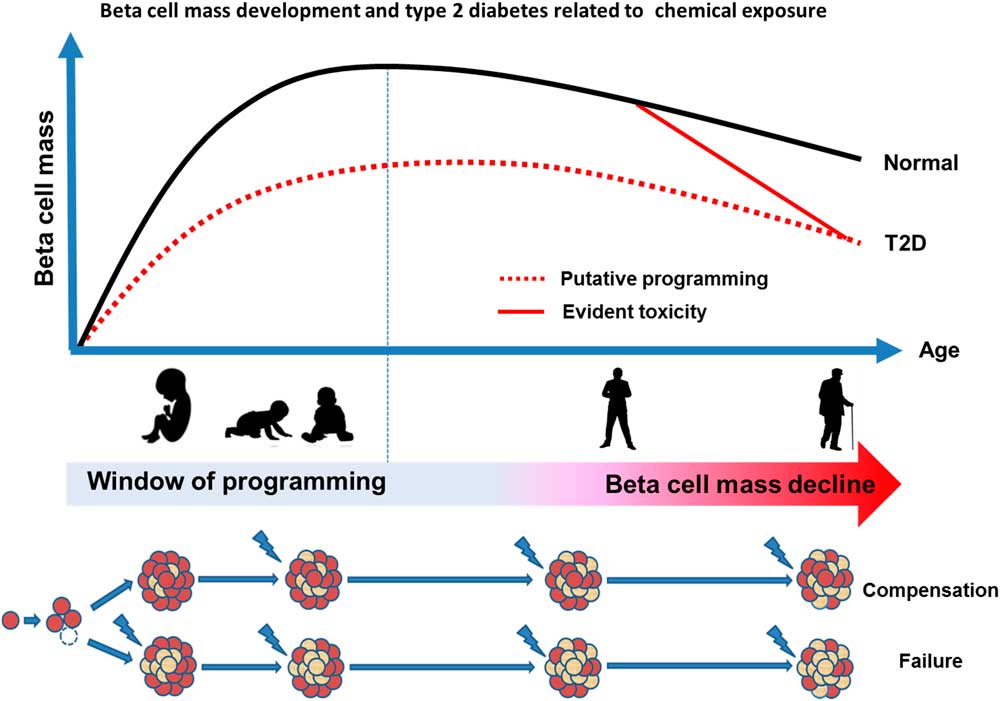
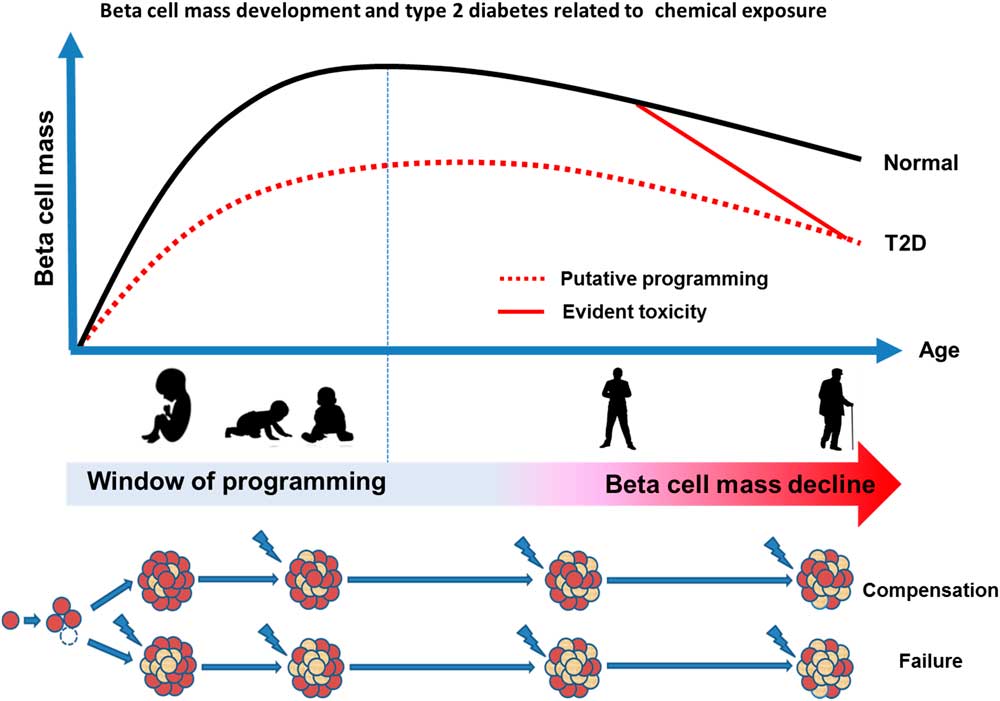
As the individual develops, not only is it more vulnerable to toxicants due to mass organ changes, but also the complexity of the organizational processes associated with the timing of the insults and its impact on the developmental programming of T2D. This paradigm infers that loss of insulin-secreting β cells observed in diabetic patients may be the consequence of several cumulative events occurring in β cells of Langerhans islets at all stages of the life including those initiated in utero with gestational insults affecting the fetal development of the endocrine pancreas. According to this definition, an exposure to food contaminants may interfere with division, differentiation or apoptotic processes controlling the β cell mass trajectory during developmental period (Fig. 1). Observations from β cell cultures systems and adult animal models developed to explore effects of chemicals at doses and time relevant of a perinatal exposureReference Lim, Ahn and Song 27 – Reference Hectors, Vanparys, Pereira-Fernandes, Martens and Blust 29 suggest disruption in number and function of Langerhans islets, as a result of exposure to low doses of several chemical food contaminants during early life. The target of toxic insults to the endocrine pancreas in these toxicological studies involve disruption and/or alteration of insulin/glucose signaling pathways and/or transcription factor expression and regulation that are implicated in orchestrating processes of both development and maintenance of the β cell mass.
The developmental origin of type 2 diabetes (T2D): the loss of functional endocrine pancreas is the result of cumulative insults targeting the β cell mass during development (window of programming) and over adult life with adaptation to aging associated body size changes (β cell mass decline) (figure redrawn from Ackermann and GannonReference Ackermann and Gannon 21 ).
For instance, it may be speculated whether toxicological properties of the contaminants of the food matrix plays a role in the programming of the T2D. Hard evidences demonstrating the impact of chemical food contaminants during early life on the pathophysiology of T2D are scarce. Exhaustive documentation is available on adult cohort studies referencing positive correlation between diabetes and chemicals such as persistent organic pollutants (POP), pesticides exposureReference Taylor, Novak and Anderson 30 – Reference Magliano, Loh, Harding, Botton and Shaw 33 but none of the epidemiological studies conducted with infants cohorts have been performed to assess the relation between chemical impregnation over the perinatal life and risk T2D at childhood or adulthood. Reproductive studies have correlated chemical exposure of pregnant women with pregnancy outcomes such as low birth weight and macrosomia. Birth weight abnormalities are clearly associated with glucose intolerance, insulin resistance, increased incidence of T2D in adulthoodReference Fernandez-Twinn and Ozanne 23 suggesting that early life exposure to food chemicals may alter the endocrine pancreas and promote T2D. Information comes from available experimental data centered on the developmental-mediated disruption of glucose and insulin metabolism in juvenile and adult progeny following pre and early postnatal exposure.Reference Vaiserman 34 These include largely the contaminants migrating from plastic packaging, additives (emulsifiers, preservatives and antioxidants), POP and pesticides. Further, undesirable compounds like advanced glycation end products may be generated during heat treatment and storage though little is known about their direct involvement in programming of T2D.
With regards to the recent findings in the literature evoking the involvement of contaminants in the progression of chronic diseasesReference Barouki, Gluckman, Grandjean, Hanson and Heindel 35 and due to the fact that a large part of them pollute our foods, we intended to put lights specifically to those migrating from plastic packaging, additives (emulsifiers, preservatives and antioxidants), POP and pesticides. As ubiquitously present in the environment and widely used throughout the world, they have been the subject of several epidemiological and experimental referenced studies and thus can be considered as ‘major’ potential contributors to the programming of T2D. Highlighting their involvement in such ‘programming process’ is according to us a challenging problem that needs urgently to be addressed to sensitize public health regarding their potential harmful effects on health across generations.
Food packaging chemicals
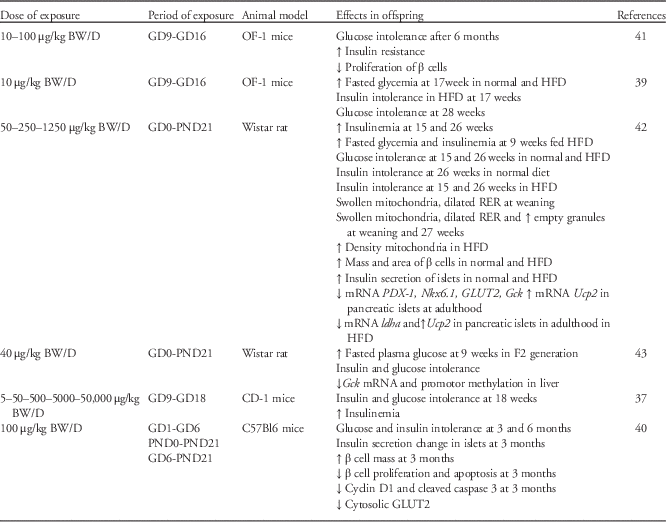
Bisphenol A (BPA) is the one of most commonly used plasticizer in can coatings and polycarbonate and resin products. Heating and storage processes can release contaminants into food and drinks. For example, BPA has been shown by many studies to disturb the β cell mass, energy metabolism and predisposition to T2D (Table 1). Many experimental studies support the potential for BPA to affect offspring birth weightReference Somm, Schwitzgebel and Toulotte 36 and induce a durable glucose and insulin metabolism disruption in rodent models when exposure occurs during endocrine pancreatic development.Reference Angle, Do and Ponzi 37 – Reference García-Arevalo, Alonso-Magdalena and Rebelo Dos Santos 39 Fetal stage is highly correlated with critical period of susceptibility to BPA exposure. Adult offspring exposed to BPA during gestational periods showed glucose homeostasis imbalance in relation with increased β cell mass and reduced turnover.Reference Liu, Yu and Qian 40 Male offspring mice exposed to BPA from gestational days GD9 to GD16 showed lowered proliferation rate of pancreatic β cells, abnormal insulin circulating levels and glucose intolerance at 6 months of age.Reference Alonso-Magdalena, Vieira and Soriano 41 Perinatal exposure to BPA leads to disruption of Pdx-1 and NKx6.1 expression, which are two genes involved in pancreatic cell division and function as well as endoplasmic reticulum and mitochondrial damage in β cells of weaned offspring rats.Reference Wei, Lin and Li 42 In this study, adverse effects of BPA exposure on the endocrine pancreas was aggravated as offspring increase in age. BPA-treated offspring exhibit hyperglycemia, hyperinsulinemia and glucose intolerance in adulthood. Wei et al. also reported that the effects were accentuated when animals received high-fat diets, which promotes the development of insulin resistance and obesity. Moreover, the glucose metabolism disrupting effects of maternal exposure to BPA can also affect subsequent generations.Reference Li, Chang and Xia 43 These transgenerational effects appear to be mediated by a reduced Gck messenger RNA (mRNA), a key enzyme of the glucose-sensing system of liver cells and a methylation process of the Gck promotor in rat offspring that were not exposed to BPA in subsequent two generations.
Experimental studies showing in vivo evidences of the relation between perinatal exposure to bisphenol A and pathophysiology in adulthood

BW/D, body weight per day; GD, gestational day; PND, postnatal day; HFD, high-fat diet; mRNA, messenger RNA; RER, rough endoplasmic reticulum.
Other important studies on substances migrating from food packaging have been realized for phtalates esters, mainly Di(2-ethylhexyl) phtalate (DEHP), which is a plasticizer commonly found in consumer products of the polyvinyl chloride type. Glucose homeostasis abnormalities were reported in offspring exposed to DEHP during developmental stage of the endocrine pancreas covering period of gestation and lactation. In rats, increased circulating glucose and insulin levels were revealed as the result of impaired Langerhans islet functionality in the pancreas.Reference Lin, Wei and Li 44 In this study, damaged endoplasmic reticulum and mitochondria were observed in pancreatic cells of weaned rats as well as a decrease of β cells mass, lower pancreatic insulin contents in older animals. In accordance with these observations, reduced levels of insulin, glucose sensors mRNA Glut2 and Gck as well as an increased expression of genes encoding for endoplasmic reticulum stress (Atf4, Atf6, Bip) in pancreatic islets of DEHP-exposed pups was found.Reference Rajesh and Balasubramanian 45 Glucose homeostasis effects of perinatal DEHP exposure were evidenced as the consequence of changes in imprinting of DNA, micro RNA or phosphorylation of insulin signaling pathways proteins and transcription factors (MafA, Pdx-1, Foxo1 Pax4, Pax6, Hnf4a) involved in the control of the development and function of pancreatic β cells and regulation of the energy metabolism in insulin-sensitive tissue such as skeletal and cardiac muscle.Reference Mangala Priya, Mayilvanan, Akilavalli, Rajesh and Balasubramanian 46 , Reference Rajesh and Balasubramanian 47
Environmental chemical contaminants
Chemical industries have produced and used a large quantity of chemicals to answer to societal needs including compounds with low degradable, lipophilic or volatiles characteristics. These substances can move from the source of emission and spread in soils, sediments and ground water causing persistent ecosystem pollution and food chain contamination. Many environmental pollutants are resistant to metabolic degradation and concentrate in higher trophic levels organisms and animals products consumed by humans. They accumulate in food and constitutes the dominant source of exposure for several highly persistent and bioaccumulative pollutants of human concern.Reference Bro-Rasmussen 48 – Reference Dórea 51 Among chemical classes frequently detected in perinatal foodstuffs such as milk or dairy products, trace elements,Reference Arnich, Sirot and Rivière 52 chlorinated organic pollutants,Reference Nougadère, Sirot and Kadar 53 brominated flame retardants and certain perfluorinated chemicals (PFC)Reference Rivière, Sirot and Tard 54 have been implicated in the programming effects of glucose metabolism homeostasis. An increased mitotic activity was observed in the pancreas of 6-week-old male offspring born to dams exposed to cadmium during pregnancy.Reference Konecki, Błazejowski, Słowiński and Helewski 55 It appeared in this experiment that the vulnerability of the fetuses to cadmium exposure was related to the proliferative activity of developing organs. In another experiment, exposure to lead during gestation and lactation resulted in irreversible changes in glucose tolerance and insulin response of male adult offspring.Reference Faulk, Barks and Sánchez 56 Metabolic changes were also observed in murine offspring born from dam exposed daily to PFC during pregnancy. Mice receiving perfluorooctanoic acid during gestation gave birth to male offspring who presented higher serum levels of insulin than controls pups at adulthood.Reference Hines, White and Stanko 57 Gestational and lactational exposure to perfluorooctanesulfonate (PFOS) lead to elevated insulin secretion and impaired glucose tolerance in adult rats.Reference Lv, Li and Li 58 Male offspring exposed to PFOS presented abnormal serum insulin levels at weaning and the phenotype of insulin resistance and glucose intolerance for animals fed standard and high-fat diets in adulthood.Reference Wan, Zhao, Leung and Wong 59 Glucose intolerance in adult offspring was also evidenced in another research work studying the effects of perinatal exposure to polybrominated diphenyl ethers.Reference Suvorov, Battista and Takser 60
Pesticides
Numerous substances have been used for agricultural applications because of their broad spectrum of biological activity, effectiveness in plant health protection and benefits on crop production. Although residues of authorized and banned pesticides from fields are frequently detected in food products, blood or urine of pregnant women and their progeny, only a few of experiments have been performed in order to link perinatal exposure to T2D by pesticides. Conversely, several studies on rodent models recently demonstrated that glucose and insulin metabolism disruptions may be caused by developmental exposure to pesticides. In the study of Slotkin et al.,Reference Slotkin, Brown and Seidler 61 male rats neonates exposed to chlorpyrifos (CPF), an organophosphorus pesticide belonging to the group of cholinesterase-inhibiting insecticides, suffered from hyperinsulinemia in adulthood. These recent findings raise concern about the potential influence of exposures on T2D in agricultural populations considering the widespread use of CPF and the increased T2D risk in farmer families.Reference Starling, Umbach and Kamel 62 In our recent study, hyperinsulinemia was revealed when pregnant and lactating rats were exposed to a dose of 1 mg of CPF/kg body weight, whereas a marked hypoinsulinemia with an increased glucose levels were seen at a higher dose of 3.5 mg/kg body weight. The dose-related effects on glucose metabolism and insulinemia were reversed by inulin (submitted data), a modulator of intestinal microbiota and its fermentative activity. In another study by La merill et al.,Reference La Merrill, Karey and Moshier 63 the phenotype of glucose intolerance was evidenced with organochlorine pesticides. Adult offspring treated with dichlorodiphenyltrichloroethane (DDT) during pregnancy exhibited higher blood glucose during oral glucose challenge and reduced Glut4 expression in adipose tissue. Transcriptional down-regulation of genes encoding for this glucose transporter was also reported in white fat tissue of adult mice after perinatal exposure to the pyrethroid insecticide deltamethrin.Reference Armstrong, Driscoll and More 64
Food additives
Chemical additives are commonly used for technological applications in food industry. Their incorporation in processed foods and beverages constitutes a relevant source of dietary exposure for pregnant women and children. For most food additives, there is no published data on glucose and insulin metabolism programming effects by their ingestion during perinatal life. However, recent findings reviewed by Arujo et al.,Reference Araújo, Martel and Keating 65 show that perinatal exposure to non-nutritive sweetener aspartame or saccharin predispose the offspring to develop impaired function of the endocrine pancreas at adulthood.Reference Araújo, Martel and Keating 65 , Reference Von Poser Toigo, Huffell and Mota 66
Conclusions and perspectives
Food contains many chemical substances that have the capacity to induce a range of cellular effects contributing to the alteration of the β cell mass and induce glucose metabolism defect over lifespan. Moreover, as detailed in this review, several substances, including common compounds defined as highly toxic or inert by classical toxicological approaches, have the capacity to mediate permanent effects in adulthood when introduced in the perinatal environment at low concentrations representative of the food intake or regulatory levels doses. Such findings support that exposure to chemical food contaminants during pregnancy and early infancy may program the offspring endocrine pancreas pathophysiology later in life.
Molecular mechanisms of environmental chemical-induced T2D, especially resulting from perinatal exposure, remain unclear assuming that the processes by which these substances induce insults during the perinatal period are not systematically transposed to those occurring with toxicity on endocrine pancreas in adult organism. Although, epigenetic modifications, endocrine disrupting effects or pro-oxidative properties may be one of the mechanisms driving the early installation of the T2D by food contaminants.Reference Hectors, Vanparys and van der Ven 67 – Reference Portha, Fournier, Kioon, Mezger and Movassat 69 Moreover, there exist many substances entering in early environment that have not been assessed individually or as chemical mixtures. Evidences of pancreatic islets function alterations in animals suggest that neoformed contaminants generated from food and milk heat processing may play an important role in the early life development of T2D.Reference Elmhiri, Mahmood and Niquet-Leridon 13 , Reference Elmhiri, Hamoudi and Dou 70 , Reference Elmhiri, Barella and Vieau 71
Systemic biology approaches including the β cell mass dynamic modeling based on developmentally regulated gene expression analysis should be useful for the identification of contaminants that influence the developing endocrine pancreas and predict putative T2D programming by the chemical cocktail of the food matrix. Highlighting the role of food chemicals in the β cell mass regulation during the developmental period and mechanisms behind these alterations is of primordial importance for assessing the T2D risk in exposed population. Further research may help to prioritize hazardous compounds, clarify whether the chemical composition of the diet has to be considered as early determinants of the T2D and may guide preventive strategies to break the progression of diabetes in next generations.
Acknowledgment
The authors thank Dr Mina Desai, David Geffen School of Medicine, for improving the document by English corrections and comments.
Financial Support
This research received no specific grant from any funding agency, commercial or not-for-profit sectors.
Conflicts of Interest
None.