Language-minority (LM) students comprise approximately 21% of all students in the United States and face unique academic challenges (National Center for Education Statistics [NCES], 2010). Because instruction is conducted only in English in most US schools, LM children need to learn enough English to comprehend their teachers’ instructions, engage with classroom content, and participate in classroom discussions before they can begin learning academic skills such as literacy. Moreover, many LM children live in poverty, which has been linked with their diminished academic performance (August & Hakuta, Reference August and Hakuta1997; Kieffer, Reference Kieffer2008). Consequently, low-income LM children are doubly disadvantaged in school. This is evident in that many LM students, most of whom are Spanish-speaking (71%; NCES, 2010), perform far below their English-speaking peers in English reading comprehension tests during fourth and eighth grades, and their limited English proficiency is a critical underlying factor (August, Carlo, Dressler, & Snow, Reference August, Carlo, Dressler and Snow2005; NCES, 2009). Because vocabulary skills foster reading comprehension (Dickinson & Porche, Reference Dickinson and Porche2011; NICHD Early Care Research Network, 2005; Storch & Whitehurst, Reference Storch and Whitehurst2002), it is important to identify the factors that contribute to LM children's English vocabulary skills prior to formal school entry.
LM children's early linguistic environments (e.g., home and school) provide language exposure, feedback, and practice opportunities that foster fundamental English skills, including vocabulary (Chesterfield, Hayes-Latimer, Chesterfield, & Chávez, Reference Chesterfield, Hayes-Latimer, Chesterfield and Chávez1983; De Houwer, Reference De Houwer, Fletcher and MacWhinney1995; Duursma et al., Reference Duursma, Romero-Contreras, Szuber, Proctor, Snow and August2007; Patterson, Reference Patterson2002). Given that exposure to language is required for language acquisition, English exposure is particularly important for LM children. Studies with English-speaking children highlight the critical role that language exposure from parents (Pan, Rowe, Singer, & Snow, Reference Pan, Rowe, Singer and Snow2005), teachers (Dickinson, Reference Dickinson, Dickinson and Tabors2001), and peers (Mashburn, Justice, Downer, & Pianta, Reference Mashburn, Justice, Downer and Pianta2009) plays in fostering early vocabulary. De Houwer (Reference De Houwer, Fletcher and MacWhinney1995) stressed the importance of studying patterns of linguistic input based on children's social environments. However, because most studies in this area have focused on monolingual English-speaking children, less is known about how English exposure levels from family members in the home and from teachers and peers in the classroom are associated with LM children's English vocabulary. It is also unclear whether LM children's English acquisition is fostered from the combined amounts of English exposure from family members, teachers, and peers or whether each of those language sources contributes differently. For example, does exposure from some of those sources contribute more to expressive vocabulary than receptive vocabulary, or vice versa? The present study explored these questions by examining the combined and unique contributions of English exposure levels from both the home and the classroom on Spanish-speaking preschoolers’ English receptive and expressive vocabularies.
SOCIAL INTERACTIONS AND CHILDREN'S VOCABULARY DEVELOPMENT
Children learn to understand and speak a language (whether first or second) by engaging in social interactions that provide them with opportunities to hear and use language (De Houwer, Reference De Houwer2009; Tomasello, Kruger, & Ratner, Reference Tomasello, Kruger and Ratner1993). In the early stages of language development, children acquire basic receptive and expressive vocabulary skills primarily from their social interactions with parents, with greater and diverse parental speech patterns generally enhancing monolingual children's vocabulary development (Dodici, Draper, & Peterson, Reference Dodici, Draper and Peterson2003; Hart & Risley, Reference Hart and Risley1995; Hoff, Reference Hoff2003; Huttenlocher, Haight, Bryk, Seltzer, & Lyons, Reference Huttenlocher, Haight, Bryk, Seltzer and Lyons1991; Pan et al., Reference Pan, Rowe, Singer and Snow2005). Although parental speech can play an important role in the English language development of LM children, the linguistic input that such families provide varies based on the extent to which English is used relative to the home language, which makes the amount of English exposure an important variable to consider (De Houwer, Reference De Houwer, Fletcher and MacWhinney1995, Reference De Houwer2009).
Research suggests that variations in the amounts of English that LM children hear from family members are likely to be associated with children's English vocabulary skills. For example, Duursma et al. (Reference Duursma, Romero-Contreras, Szuber, Proctor, Snow and August2007) found that parents’ self-reported preference for speaking English in the home correlated positively with Spanish-speaking children's English expressive vocabulary skills in the fifth grade. In addition, Patterson (Reference Patterson2002) found a positive relation between the time Spanish-speaking parents spent reading books in English to their children and children's English expressive vocabulary skills. In addition, changes in household English use by parents over time corresponded with changes in Spanish-speaking children's English proficiency between 8 and 30 months of age, with greater English exposure levels enhancing children's English expressive vocabulary (Pearson & Fernandez, Reference Pearson and Fernandez1994; Pearson, Fernandez, Lewedeg, & Oller, Reference Pearson, Fernández, Lewedeg and Oller1997). A similar finding has been reported for Spanish-speaking children who attended Head Start (HS) for 2 years. Those whose parents did not use English at home exhibited lower English receptive vocabularies than those who were spoken to in both English and Spanish (Hammer, Lawrence, & Miccio, 2008). Finally, Mancilla-Martinez and Lesaux (Reference Mancilla-Martinez and Lesaux2011) found that Spanish-speaking children whose parents reported speaking mostly English at home exhibited greater English expressive vocabulary at 4.5 years of age and through age 12 than children whose parents reported speaking mostly Spanish or both languages equally at home. Together, these findings support the notion that patterns of English use in the home are likely to shape Spanish-speaking children's English vocabulary, an idea that is also supported by studies with monolingual English-speaking children (e.g., Dodici et al., Reference Dodici, Draper and Peterson2003; Pancsofar & Vernon-Feagans, Reference Pancsofar and Vernon-Feagans2006).
Few studies have examined the contribution of English exposure from family members other than parents. Research with English-speaking families has shown that sibling–child interactions contributed to children's subsequent language use about their own feelings (Brown & Dunn, Reference Brown and Dunn1992). With regard to LM children, interactions with other family members, such as older siblings, are important because they also can provide children with English exposure that may enhance their English vocabulary skills (Hakuta, Reference Hakuta, Lamberty and Coll1994; Zentella, Reference Zentella1997). Therefore, it is important to consider the contributions that siblings and other close family members may make to children's English vocabulary. In the present study, we considered English exposure from all sources in the home, including mothers, fathers, siblings, and other family members.
The research reviewed above highlights how Spanish-speaking children's parents and other close family members are likely to play a critical role in shaping their English vocabulary skills, in part by providing English exposure and opportunities for interaction. Family members are important interlocutors for children in the home, but children also spend significant amounts of time away from home (De Houwer, Reference De Houwer2009). For many children, time away from home increases when they enter preschool, where teachers and peers become integral members of children's social environments and additional important sources of English exposure. Recommended practices for educators of dual language learners emphasize the importance of frequent exposure to new words in various contexts to facilitate children's English vocabulary development (US Department of Education, n.d.), and preschool teachers and peers are able to play an early role in this exposure.
The classroom setting not only offers children additional interlocutors but also exposes them to academic registers of English: in comparison to conversations in the home, interactions between teachers and students rely less upon shared contexts and more closely resemble literate discourse (Cazden, Reference Cazden1988; Michaels, Reference Michaels1983). Moreover, conversations between teachers and students tend to follow the IRE pattern of a teacher initiating a question, a student replying, and the teacher evaluating what the student has said (Mehan, Reference Mehan1979). This pattern is perhaps most salient in large-group interactions and has been shown to occur in preschool (Smith, Reference Smith1996). Teachers play an important role in the acquisition of academic registers of language because their questions and feedback can guide children's responses (Cazden, Reference Cazden1988; Michaels, Reference Michaels1983). In addition to fostering children's development of English academic registers, classroom exposure to English is linked with language outcomes: monolingual children's vocabulary skills are likely to grow more during the school months than over summer break (Huttenlocher, Levine, & Vevea, Reference Huttenlocher, Levine and Vevea1998), and school exposure to English has been shown to be a better predictor of word definition skills than home exposure among elementary school children from various home language backgrounds (Snow, Reference Snow1990).
Although classroom experiences may play a role in children's language development, little is known about the association between teachers’ and peers’ English use and Spanish-speaking children's English vocabulary skills in preschool. Spanish-speaking children exhibited growth in English receptive vocabulary over 2 years of participation in a HS program regardless of home language use (Spanish only or Spanish and English), but the extent to which teachers’ and peers’ English use contributed to children's English vocabulary skills was not examined (Hammer et al., Reference Hammer, Lawrence and Miccio2008). Bowers and Vasilyeva (Reference Bowers and Vasilyeva2011) reported a positive association between teachers’ amount of English use in the classroom (as measured by the total number of words produced during a 90-min observation) and the English receptive vocabulary skills of 29 LM preschoolers from diverse linguistic backgrounds, including Spanish speakers. Finally, Chesterfield et al.'s (Reference Chesterfield, Hayes-Latimer, Chesterfield and Chávez1983) study of bilingual (Spanish/English) preschool classrooms found that the more time the Spanish-speaking children spent socializing with teachers in English, the more proficient in English they were likely to become as the preschool year progressed, as measured by changes in children's English mean level utterance values from late fall to early summer. Thus, English exposure from both parents in the home and teachers in the classroom has the potential to influence Spanish-speaking children's early English vocabulary skills. However, the relative degree to which linguistic experiences in English at home and with teachers in the classroom are equally predictive of Spanish-speaking children's English vocabulary is unclear.
There is also a gap in our understanding of the association between peers’ English use and Spanish-speaking children's English vocabulary skills. Filling this gap is important because during day-to-day classroom routines, it is likely that preschoolers interact with one another more regularly than with teachers, and these interactions can benefit preschoolers’ vocabulary skills in a second language. For example, Aukrust (Reference Aukrust2004) found a positive association between the total number of Norwegian utterances produced by classroom peers and Turkish-speaking preschoolers’ Norwegian receptive vocabulary skills. In addition, Chesterfield, Chesterfield, and Chávez (Reference Chesterfield, Chesterfield and Chávez1982) observed the naturally occurring peer interactions and language use of six Spanish-speaking preschoolers in mixed-language (Spanish/English) classrooms at the beginning, middle, and end of the academic year. They found that the children who interacted mostly with English-speaking peers throughout preschool were likely to exhibit the greatest gains in their English oral proficiency, as measured by changes in children's mean level of utterance values.
Taken together, extant research suggests that the combined effects of English exposure from the home and the classroom are likely to foster Spanish-speaking preschoolers’ English receptive and expressive vocabulary skills, but these have not been examined simultaneously in a single study. Moreover, because children are exposed to varying language varieties or registers when they interact with multiple individuals in different contexts, English exposure from family members in the home and from teachers and peers in the classroom may influence Spanish-speaking preschoolers’ English vocabulary skills differently. For example, parents generally use more informal language registers when communicating with children in the home, whereas teachers may rely more on formal language registers, especially for instructional purposes (Cazden, Reference Cazden1988; Michaels, Reference Michaels1983). Preschool peer interactions most often take place in the context of play and involve partners who are equals. Thus, peer-oriented language is likely to be simpler, more playful, and more reciprocal than adult-oriented communication and perhaps even more demanding because there is no adult involved who can interpret and correct language errors or misunderstandings. As such, family, teacher, and peer contexts for language development vary on a variety of dimensions.
Although studies have independently linked home, teacher, and peer English exposure levels to Spanish-speaking children's English vocabulary development, studies have not examined data from these different learning environments and interlocutors simultaneously. This idea of differential effects is highlighted by calls for studies to examine the unique contributions of language exposure from multiple social ecologies and social partners on children's language development (e.g., De Houwer, Reference De Houwer2009). Moreover, although previous research has considered the effects of different sources of English input on Spanish-speaking children's grammatical performance (Gathercole, Reference Gathercole2007; Gutierrez-Clellen & Kreiter, Reference Gutierrez-Clellen and Kreiter2003), less is known about their effect on Spanish-speaking children's English vocabulary.
THE PRESENT STUDY
In the present study, we explored how varying levels of English exposure from family members in the home and teachers and peers in the classroom during the fall of preschool contributed to spring English receptive and expressive vocabulary skills in a sample of low-income, mainly Mexican-origin Spanish-speaking children. We expected that the combined levels of English exposure would be positively associated with children's English vocabulary. We also expected that the amounts of English exposure from family members, teachers, and peers would differ and that these differences likely would play a unique role in shaping children's English vocabulary skills. Given that parents and close relatives, such as older siblings, typically engage in verbal interactions with children from birth, and parent interactions have been linked with children's receptive and expressive vocabularies (e.g., Dodici et al., Reference Dodici, Draper and Peterson2003; Hart & Risley, Reference Hart and Risley1995; Hoff, Reference Hoff2003; Huttenlocher et al., Reference Huttenlocher, Haight, Bryk, Seltzer and Lyons1991), it is likely that English exposure levels in the home foster children's English receptive and expressive vocabulary skills. With respect to the classroom environment, because teachers are likely to rely on formal registers of English for instructional purposes and much of their English use is likely to be directed at large groups of children (Neuman & Roskos, Reference Neuman and Roskos1993), teachers’ English use may contribute to children's English receptive vocabulary skills during preschool. In contrast, peers are likely to rely on informal registers of English during play activities involving a handful of peers at most, which can provide multiple opportunities for children to practice their language skills. Therefore, peers’ English use might contribute mostly to English expressive vocabulary skills.
METHOD
Participants
The participants included low-income Spanish-speaking preschoolers drawn from 10 HS classrooms in a metropolitan southwest area. Two cohorts were recruited, with each cohort representing a year of data collection. All classrooms were half-day programs, where children attended 5 days a week for 3.5 hr/day and teachers and students used both English and Spanish. Classroom sizes ranged from 15 to 20 students, with the proportion of Spanish-speakers per classroom ranging from 70% to 100%. In 6 of the classrooms, either the lead teacher or the teacher aide spoke Spanish fluently. In the other 4 classrooms, both teachers were bilingual.
Parental consent was obtained from 143 Spanish-speaking children (out of a possible 161; permission rate = 89%). For the 9 children who attended a participating classroom more than 1 year, only their first year of data was used. There was 1 classroom in which both the lead teacher and the teacher aide were bilingual whose fall observations were excluded because a project staffing shortage resulted in very few observations, which produced low reliabilities (n = 19). Thus, data from 9 HS classrooms were used in the present study. Children from these 9 classrooms who had no observations in the fall or had missing data on all the study variables (because they enrolled later in the year or were chronically absent) were also excluded from the study (n = 17). In addition, children who had fewer than 10 total observations in the fall had their observational data (i.e., teachers’ and peers’ English use) excluded due to insufficient data (n = 27). Similar to the children with missing data on all the study variables, the children who had fewer than 10 fall observations were those who were frequently absent, enrolled midyear, or left a participating classroom. However, these children were not excluded from the study. Instead, their available data on the other study variables (e.g., home English exposure levels, family income levels, children's English receptive and expressive vocabulary skills, or general cognitive abilities) were used in maximum likelihood methods to derive more accurate estimates (Allison, Reference Allison2001). This approach allowed us to retain the power that would have been lost by excluding them entirely.
The final sample of 107 children were mainly of Mexican descent (96%) and born in the United States (90%). Their ages ranged from 44 to 60 months (M = 53 months, SD = 4 months), with age calculated at the start of preschool. Slightly more than half were boys (56%). The children were exposed to varying levels of English and Spanish in the home, with 41% of parents only using Spanish, 52% using “more Spanish than English,” and 7% using “more English than Spanish.” The majority of children lived in two-parent households (70%) with most mothers (87%) and fathers (92%) born outside the United States and earning less than $30,000 annually (83%).
Procedures
The data were collected using a multimethod, multireporter approach (i.e., naturalistic observations, standardized assessments, and parent questionnaires), as part of a longitudinal study of Spanish-speaking HS children's school readiness. Naturalistic observations were gathered indoors and outdoors during each observation day (except during meal times) for about 8–10 hr/week throughout the fall of preschool (September to December). Eighteen bilingual (English/Spanish; 94% female) observers were trained by faculty and experienced graduate students. They engaged in extensive training (lasting about 4 weeks), which included sessions where they observed and coded children's behavior alongside the trainer at a university-sponsored preschool, compared codes, and discussed discrepant cases. Once the observer reached 90% agreement with the trainer, the observer practiced coding alongside an experienced observer at the HS classroom(s) where s/he was assigned for data collection to learn children's names and gain more experience. Observers did not begin collecting data until they could successfully name the children in their assigned classroom(s).
The observers were given a randomly ordered list of participating children in a classroom and observed each child for 15 s at a time, following the order on the list. When the observers reached the bottom of the list, they repeated the observations again starting from the top. For each observation, the observers noted the behavior in which the target child was engaged for the majority of the time. The observers coded whether the target child was engaged in social play (rule-based play with peers, interactive play, or conversation), parallel play (engaging in the same activity alongside peers), solitary play (playing alone), teacher-oriented behavior (engaged with teachers), onlooking behavior (watching other children play but not involved), or unoccupied behavior (characterized by a lack of focus). The observers also noted whether the target child, teacher, or peers were speaking English or Spanish. If the target child, teacher, or peer started speaking Spanish and used one or more words in English or vice versa during the 15-s observation period, that person's language was categorized as “both.” When more than one peer was speaking (i.e., when several children were engaged in an activity), the language use of the peer who spoke for the majority of the time was coded. These observational procedures have been successfully used in prior studies of preschoolers’ behavior and peer interactions (Hanish, Martin, Fabes, Leonard, & Herzog, Reference Hanish, Martin, Fabes, Leonard and Herzog2005; Martin & Fabes, Reference Martin and Fabes2001).
Across the 2 years of data collection, a total of 2,092 observations were gathered during the fall semesters (M = 21.61 per child, SD = 10.67, range = 10–45). The observations relevant to the present study were those in which target children were engaged in social play, parallel play, or teacher-oriented behavior (because they involved interactions with others); thus, 793 observations involving solitary play, onlooking behavior, or unoccupied behavior were excluded. Of the remaining 1,299 observations, 622 involved teachers using language with children (417 for English, 96 for Spanish, and 109 for both languages) and 512 involved peers using language with children (175 for English, 293 for Spanish, and 40 for both languages). Because this study was focused on the role of English exposure, the observations involving teachers’ and peers’ use of Spanish or both languages were excluded. The remaining 165 observations were those in which teachers or peers were interacting with target children but not using language during the 15-s observation period. Thus, the present analyses were conducted with 417 observations of teacher English and 175 observations of peer English. Individual differences in the number of observations across children were due to several factors, including the number of students per classroom and student absences. To account for these individual differences in our analyses, we controlled for teachers’ and peers’ total language use (i.e., the sum of teachers’ or peers’ frequency counts of English use, Spanish use, or use of both languages) with each child during the fall semester.
During the fall semester, parents (mostly mothers) reported the English exposure levels that children received in the home. Parents completed the questionnaires in Spanish. Finally, standardized assessments were used to gauge children's general cognitive abilities at the start of preschool and their English receptive and expressive vocabulary skills in the spring.
Measures
Home English exposure
To gauge children's English exposure levels in the home, parents completed five items from the PAVEd for Success home literacy inventory, which was written in Spanish (Hamilton, Restrepo, Neuharth-Pritchett, & Schwanenflugel, n.d.). Each item asked parents to rate how often their child heard English during interactions with the mother, father, siblings, and other family members, as well as with friends and other people outside of home and school. Responses ranged from never (1) to all of the time (4). The responses were averaged to create a home English exposure score for each child (α = 0.78).
Teachers’ and peers’ English use
The raw frequency counts of teachers’ and peers’ English use during social interactions with children (i.e., social play, parallel play, and teacher-oriented behavior) from the naturalistic observations in the fall of preschool were used to gauge each child's amount of English exposure from teachers and peers. Separate scores denoted the raw frequency of teachers’ and peers’ English use during interactions with each child.
To gauge interrater reliability for teachers’ and peers’ English use, approximately 402 observations (about 16% of the total fall observations) were gathered simultaneously during the fall and coded independently by two observers. The reliabilities for teachers’ English use (κ = 0.71) and peers’ English use (κ = 0.64) in the fall indicated adequate levels of agreement between observers. In addition, for observations that involved peers, observers agreed on the number, identity, and English use of peers 95%, 94%, and 99% of the time, respectively.
Children's English vocabulary skills
Children's English receptive vocabulary skills in the spring were measured using the Peabody Picture Vocabulary Test, Fourth Edition (PPVT-4; Dunn & Dunn, Reference Dunn and Dunn2007). The PPVT-4 gauges children's receptive vocabulary skills by presenting them with an oral stimulus and a set of four pictures. Children select the picture that best represents the meaning of the word (i.e., the oral stimulus), with each successive item increasing in difficulty. Children's English expressive vocabulary skills were assessed with the picture vocabulary subscale of the Woodcock–Johnson, Third Edition (WJ-3; Woodcock, McGrew, & Mather, Reference Woodcock, McGrew and Mather2000). Children were presented with the picture of an item and asked to say the name of the item in the picture. Both the PPVT-4 (α = 0.97) and the picture vocabulary subscale of the WJ-3 (α = 0.81) have been widely used and shown to be reliable markers of children's vocabulary skills.
It is important to note that children's English receptive and expressive vocabulary skills were also gathered in the fall. However, we excluded these data from the present study because children's PPVT-4 and WJ-3 test scores were highly correlated across semesters (rs > .7). Thus, controlling for the fall scores in the analyses made it difficult to detect the influence of parents’, teachers’, and peers’ English use on children's spring English vocabulary. This may be because the PPVT-4 and WJ-3 picture vocabulary task capture children's broad English vocabulary skills and are not specific enough to capture gains across short time spans. Small changes in Spanish-speaking children's English vocabulary skills have been documented in prior studies that have used these measures across similar time spans (e.g., Mancilla-Martinez & Lesaux, Reference Mancilla-Martinez and Lesaux2011). Given the importance of accounting for children's own abilities, we controlled for children's general cognitive abilities at the start of preschool.
Control variables
In addition to controlling for teachers’ and peers’ total language use, several variables linked with children's vocabulary development were considered as potential covariates, including children's age, gender, and general cognitive abilities, as well as parent reports of the family's income levels. Children's general cognitive abilities at the start of preschool were measured by the individual version of the Naglieri Nonverbal Ability Test (NNAT-I; Naglieri, Reference Naglieri2003). The NNAT-I uses matrix items involving shapes and geometric designs interrelated via spatial or logical organization to gauge children's general cognitive abilities in a culturally neutral manner, regardless of English proficiency levels (because it can be administered in English or Spanish) or socioeconomic background (Naglieri, Booth, & Winsler, Reference Naglieri, Booth and Winsler2004). The NNAT-I is a reliable (α = 0.89) and valid measure that correlates (r > .50) with tests of intelligence and achievement, such as the Wechsler Intelligence Scale for Children, Fourth Edition and the Stanford Achievement Test, Ninth Edition (Naglieri, Reference Naglieri2003; Naglieri et al., Reference Naglieri, Booth and Winsler2004). The NNAT-I was used because it has been shown to work well with Spanish-speaking children with varying levels of English proficiency (Naglieri et al., Reference Naglieri, Booth and Winsler2004).
Neither the PPVT-4 (Dunn & Dunn, Reference Dunn and Dunn2007) nor the WJ-3 (Woodcock et al., Reference Woodcock, McGrew and Mather2000) provides normative information for Spanish-speaking children, which can lead to bias when interpreting test results (Peña & Halle, Reference Peña and Halle2011; Valdés & Figueroa, Reference Valdés and Figueroa1996). Thus, the raw scores for the PPVT-4 and the W scores for the WJ-3 (i.e., equal-interval scale scores based on children's actual performance, not their ordinal position relative to peers as with normed scores; Mather & Woodcock, Reference Mather and Woodcock2001) were used as markers of children's English vocabulary skills. The NNAT-I was normed for use starting with kindergarten-aged children, not preschoolers. Thus, the raw scores were used to gauge children's general cognitive abilities.
RESULTS
The goal of this study was to examine the extent to which varying levels of English exposure from family members in the home and from teachers and peers in the classroom contributed to Spanish-speaking preschoolers’ English vocabulary development. Preliminary analyses were conducted to (a) assess the normality of the study variables, (b) describe children's English exposure levels from family members in the home and from teachers and peers in the classroom, (c) gauge the role of teachers’ bilingual status on children's English vocabulary, and (d) examine the bivariate correlations. Next we tested a structural equation model examining the combined contribution of home, teacher, and peer English exposure levels (as a latent factor) on children's English receptive and expressive vocabulary skills, followed by a path model examining the differential contributions of home, teacher, and peer English exposure levels.
Preliminary and descriptive analyses
We examined the normality of all study variables and found that they were reasonably well distributed, with skewness values ranging from –0.614 to 1.93. Skewness values ranging from +2 to –2 are indicative of a normal distribution (Bachman, Reference Bachman2004). We also examined whether children's English receptive and expressive vocabulary skills varied based on the bilingual status of the lead teachers and teacher aides. The children were divided into three categories based on the type of classroom: those where only the lead teacher spoke Spanish (n = 12, two classrooms), those where only the aide spoke Spanish (n = 36, two classrooms), and those where both the lead teacher and the teacher aide spoke Spanish (n = 37, four classrooms). Two classrooms were excluded from these analyses because teacher staffing changes midyear changed from having only the teacher aide speak Spanish to having only the lead teacher speak Spanish in one classroom and vice versa in the other classroom. Mean level comparisons revealed no differences in children's English receptive vocabulary, F (2, 74) = 0.02, p = .985, and expressive vocabulary, F (2, 74) = 0.58, p = .563, across the three types of classrooms. Next children's were divided into two categories based on classroom type: those where the lead teacher and the teacher aide spoke Spanish (n = 37, four classrooms) and those where only the one of them did (n = 70, 6 classrooms), which allowed for the inclusion of the children in the classrooms that underwent the aforementioned staffing changes. Again, children's English receptive and expressive vocabulary skills did not vary between classrooms ts (96) = 0.06 and –0.79, ps = .949 and .432, respectively. Thus, we did not control for teachers’ bilingual status in subsequent analyses. Finally, maximum likelihood was used for handling cases with missing data. The proportion of missing data among the study variables ranged from 6% to 25%, with the data patterns missing completely at random (MCAR) according to Little's (Reference Little1988) test, χ2 (59) = 57.75, p = .522. Finally, Cook's (Reference Cook1977) distance scores indicated no multivariate outliers.
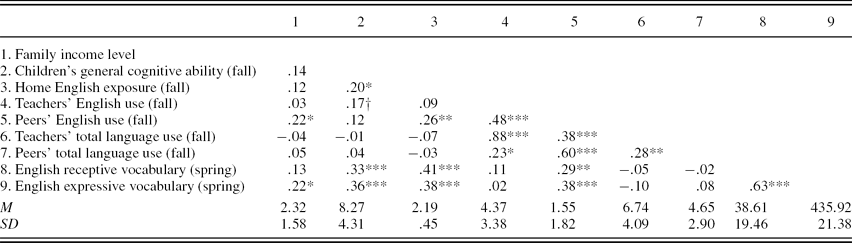
Table 1 contains the means, standard deviations, and bivariate correlations among the study variables. The means and standard deviations suggest that, on average, children received moderate levels of English exposure from mothers, fathers, siblings, other family members at home, and friends outside of school. A one-sample t test revealed that compared with mothers (M = 2.03, SD = 0.73), children received lower levels of English exposure from fathers (M = 1.77, SD = 0.72), t (84) = 3.15, p = .002, but higher levels from siblings and other family members at home (M = 2.44, SD = 0.80), t (84) = 4.86, p < .001, friends (M = 2.39, SD = 0.67), t (84) = 4.96, p < .001, and others outside of school (M = 2.39, SD = 0.67), t (84) = 5.10, p < .001.
Bivariate correlations, means, and standard deviations of study variables (N = 107)

Note: Maximum likelihood was used for handling cases with missing data. Family income levels ranged from 1 (less than $10,000 annually) to 4 (more than $30,000 annually). Children's general cognitive abilities were their raw scores on the Naglieri Nonverbal Ability Test. Home English exposure levels ranged from 1 (never) to 4 (all of the time). Teachers’ and peers’ English use was measured using frequency counts.
†p < .10. *p < .05. **p < .01. ***p < .001.
Furthermore, to provide perspective on teachers’ and peers’ amount of English use with children in the classroom, we calculated a per-hour rate estimate of English exposure levels based on the mean total observations per child of 21.61 and the mean frequency counts for teachers’ and peers’ English use in the fall. Several successive steps were followed. Given that each observation lasted 15 s, we calculated that each child was observed for an average of 5.4 min throughout the fall (21.61 × 15 = 324.15 s/60). This extrapolates to 11.11 observation periods per hour (60/5.4). Based on the mean of 4.37 for teachers’ English use, we calculated that teachers used English with children at an average rate of 48.55 events per hour (4.37 × 11.11). The mean of 1.55 for peers’ English use suggested that peers used English with children at an average rate of 17.22 events per hour (1.55 × 11.11). Thus, children received close to three times more English exposure from teachers than from peers. A paired-samples t test revealed that this mean level difference was statistically significant, t (79) = 8.46, p > .001. Finally, in comparison to the mean scores of the monolingual norming samples of the PPVT-4 and the WJ-3 (M = 83.25, SD = 22.80 for the raw scores on the PPVT-4; M = 468.24, SD = 16.65 for the W scores on the WJ-3), the Spanish-speaking children in the present study performed about two standard deviations below the norms on the English receptive and expressive vocabulary tests in the spring of preschool.
With regard to the bivariate correlations, home and peer English exposure levels in the fall were positively correlated with children's English receptive and expressive vocabularies in the spring, but teachers’ English use was not correlated with children's English vocabulary. It is also noteworthy that peers’ English use in the classroom was positively correlated with home English exposure levels and teachers’ English use. Moreover, family income level was positively correlated with children's English expressive vocabulary, indicating that children from higher income levels exhibited greater English expressive vocabulary than those from lower income levels. In addition, children's cognitive abilities at the start of preschool were positively correlated with both English receptive and expressive vocabularies. Thus, we controlled for these effects by including these two variables as predictors in the structural equation and path models. Children's age at the start of preschool was uncorrelated with their English receptive and expressive vocabularies, rs (105) = .14 and .11, ps = .19 and .28, respectively. Children's English receptive, F (1, 96) = 0.087, p = .77, and expressive, F (1, 96) = 0.483, p = .49, vocabulary skills did not vary by gender.
Combined English exposure effects
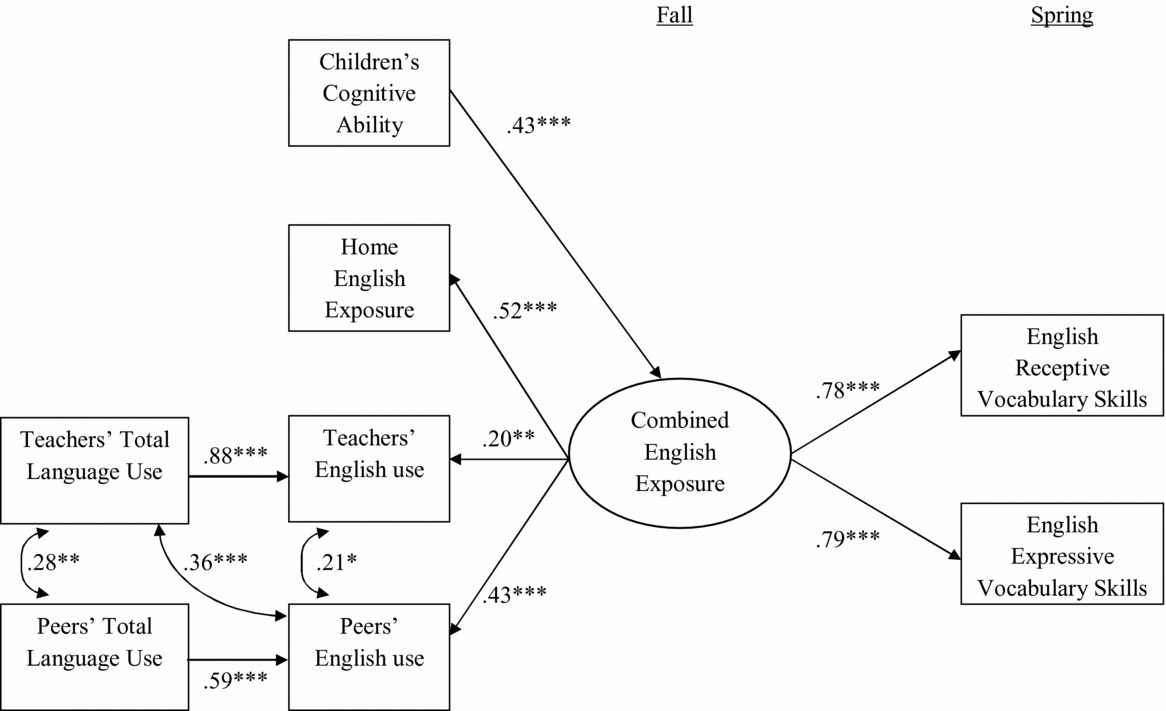
The combined-effects model examined the additive contributions of home, teacher, and peer English exposure on children's English receptive and expressive vocabulary skills. A structural equation model was tested in which a latent factor denoting the combined English exposure in the fall of preschool (indicated by standardized values of home, teacher, and peer English use) predicted children's English receptive and expressive vocabularies in the spring. Maximum likelihood with robust standard errors was used to calculate the standard errors of the model parameter estimates. To assess model fit, multiple fit indices were considered, including the chi-square statistic, root mean square error of approximation (RMSEA), and the comparative fit index (CFI). Chi-square values that are nonsignificant (p > .05) are indicative of good model fit, as well as RMSEA values less than 0.06 and CFI values above .90 (Hu & Bentler, Reference Hu and Bentler1999).
The results of our initial model fit the data well, χ2 (24) = 25.74, p = .37; CFI = 0.99, RMSEA = 0.03. However, after accounting for children's general cognitive abilities, the results yielded a nonsignificant path coefficient for the effect of family income levels on children's English expressive vocabulary skills. As part of the specification search to identify the simplest and best fitting model (see MacCallum, Reference MacCallum1986), we excluded family income from the structural model and retested it controlling solely for children's general cognitive abilities. The resulting structural equation model fit the data well, χ2 (25) = 24.63, p = .48; CFI = 1.00, RMSEA = 0.00, with home, teacher, and peer English use loading significantly on the latent factor measuring children's combined English exposure levels. Figure 1 shows the resulting standardized path coefficients. The results suggested that the combined English exposure levels from the home and classroom settings during the fall of preschool fostered children's English receptive and expressive vocabulary skills in the spring (controlling for teachers’ and peers’ total language use in the fall). The next step was to examine whether the varying levels of English exposure from family members, teachers, and peers differentially contributed to children's English receptive and expressive vocabulary skills.
Standardized effects of combined English exposure levels from the home and classroom on Spanish-speaking preschoolers’ English vocabulary skills. *p < .05, **p < .01, and ***p < .001.
Differential English exposure effects
Path analysis was used to assess the unique contributions of home, teacher, and peer English exposure levels on Spanish-speaking children's English receptive and expressive vocabulary skills. As with the combined-effects model, maximum likelihood with robust standard errors was used to calculate the standard errors of the model parameters and the chi-square statistic, RMSEA, and CFI indices were used to gauge model fit.
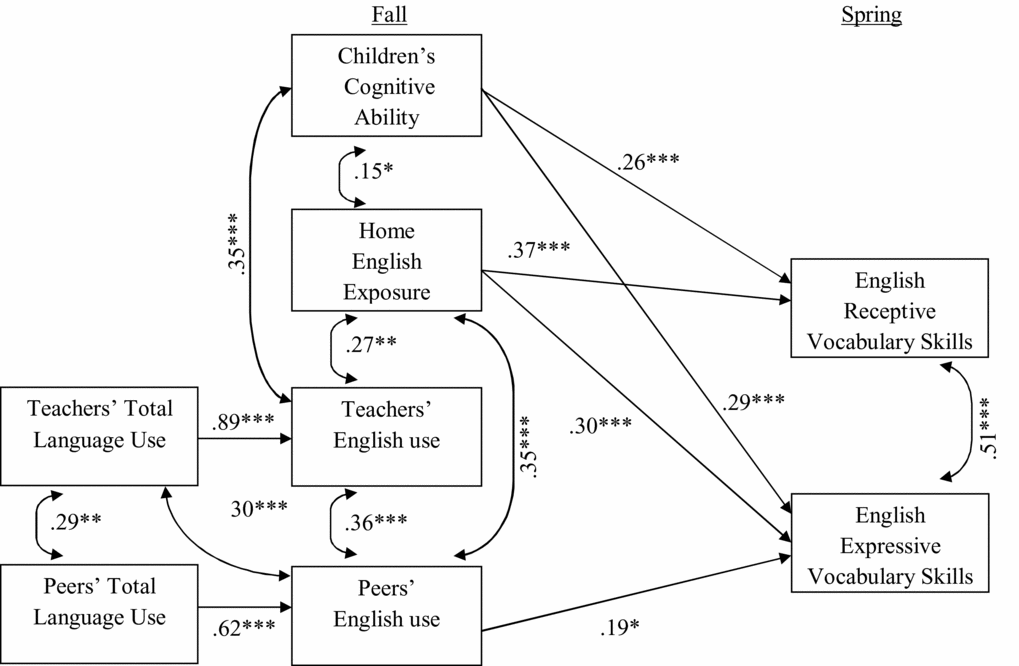
To test for differential effects, the hypothesized path model tested six direct paths from home English exposure, teachers’ English use, and peers’ English use in the fall to children's English receptive and expressive vocabulary skills in the spring. To account for the effects of children's general cognitive abilities at the start of preschool, two direct paths were tested from this variable to children's English receptive and expressive vocabulary skills. To account for the effects of family income levels, we included a direct path from that variable to children's English expressive vocabulary skills. As mentioned earlier, we also controlled for teachers’ and peers’ total language use. Finally, the covariances among the variables that were correlated at the bivariate level were allowed to estimate freely, whereas those that were not were set to zero.
The resulting hypothesized path model provided a moderate fit for the data, χ2 (18) = 26.81, p = .08; CFI = 0.97, RMSEA = 0.07. As with the structural equation model, once the contribution of children's general cognitive abilities was considered, the effect of family income levels on children's English expressive vocabulary became nonsignificant. In addition, the paths from teachers’ English use to children's English receptive and expressive vocabulary skills were nonsignificant, as was the path from peers’ English use to children's English receptive vocabulary. Finally, the modification indices suggested accounting for the covariances of teachers’ English use tendencies with home English exposure levels and children's cognitive abilities. As part of the specification search (see MacCallum, Reference MacCallum1986), we excluded family income levels from the model, deleted the nonsignificant pathways, and freely estimated the covariances among teachers’ English use with home English exposure and children's cognitive abilities.
Figure 2 presents the standardized path coefficients for the revised differential effects model. The model fit the data well, χ2 (21) = 18.50, p = .62; CFI = 1.00, RMSEA = 0.00. The results revealed that general cognitive abilities at the start of preschool were positively associated with children's English receptive and expressive vocabulary skills in the spring. In addition, the English exposure levels that children received in the home during the fall of preschool were positively associated with their English receptive and expressive vocabulary skills in the spring. Peers’ English use in the classroom during the fall was positively associated with children's English expressive vocabulary skills. However, teachers’ English use in the fall did not account for unique variance in children's English receptive or expressive vocabulary skills.
Standardized path coefficients for the differential effects model. *p < .05, **p < .01, and ***p < .001.
DISCUSSION
The main objective of this study was to examine the extent to which varying levels of English exposure from family members in the home and from teachers and peers in the classroom were associated with Spanish-speaking preschoolers’ English receptive and expressive vocabulary skills. By considering English exposure from teachers and from peers simultaneously while accounting for home English exposure, the present study provides insight into the contribution of all three sources of input toward children's English vocabulary. The results suggested that the combined English exposure levels from home and classroom settings were positively associated with children's English vocabulary skills. Moreover, the results suggest that home and peer English exposure each made a unique contribution to children's English vocabulary skills. English exposure from family members in the home during the fall of preschool was positively associated with children's English receptive and expressive vocabulary skills in the spring, even after controlling for children's general cognitive abilities. In the preschool classroom context, exposure to English from peers during the fall was positively associated with children's English expressive vocabulary skills in the spring. However, exposure to English from teachers during the fall was not significantly associated with children's English receptive or expressive vocabulary skills in the spring.
English exposure levels in the home
The findings suggest that English exposure from family members in the home is likely to enhance Spanish-speaking preschoolers’ English receptive and expressive vocabulary skills. This finding is consistent with prior research emphasizing the important role that family members’ language-use patterns in bilingual homes (e.g., mothers, fathers, and siblings) is likely to play in shaping LM children's early English vocabulary development (Duursma et al., Reference Duursma, Romero-Contreras, Szuber, Proctor, Snow and August2007; Hakuta, Reference Hakuta, Lamberty and Coll1994; Mancilla-Martínez & Lesaux, Reference Mancilla-Martinez and Lesaux2011; Patterson, Reference Patterson2002; Pearson & Fernandez, Reference Pearson and Fernandez1994; Pearson et al., Reference Pearson, Fernández, Lewedeg and Oller1997).
It is noteworthy that we relied on a sample of low-income Spanish-speaking children, given that low-income status has been linked with LM children's English acquisition and academic performance (e.g., August & Hakuta, Reference August and Hakuta1997; Kieffer, Reference Kieffer2008). Our findings suggest that English exposure from family members in the home is a potential avenue for fostering low-income young LM children's English acquisition, which is promising because, in comparison to their higher income counterparts, low-income children likely have fewer resources outside the home to promote English acquisition. Moreover, any English skills LM children have will facilitate their transition into kindergarten, where many of them will likely be instructed only in English. Based on the present study, this might be particularly true for Spanish-speaking preschoolers from low-income homes. Future research can also investigate whether the role of home English exposure on children's English vocabulary varies based on family income.
Classroom English exposure levels
Our findings also suggest that interacting with classroom peers in English helps shape Spanish-speaking preschoolers’ English vocabulary skills, although the same was not found in regard to English exposure from teachers. The different findings for teacher and classroom peer English use may stem from differences in the nature of classroom interactions between child and teacher as opposed to between peers, such as the number of participants, the topics of conversation, and the strategies for avoiding or resolving misunderstandings.
Peers’ English use
Unlike adults, peers are not expected to present new concepts to other children, and this is especially true in preschool. Moreover, classroom peers have less experience adjusting their speech so that it is easier for a child to understand an unfamiliar word (Owens, Reference Owens2008). As such, peer interactions may be less conducive to fostering receptive vocabulary. Nevertheless, peer interactions have the advantages of frequency and the possibility of extended verbal interactions, especially in preschool where children are more likely to come in contact with one another for social interaction than with teachers and where much learning occurs during peer play. Interactions between peers typically occur during free-play periods or small-group structured activities, settings where there are few limits on children's interactions. As such, these experiences offer the potential for children to engage in prolonged verbal interactions and thereby allow children to practice their expressive vocabulary skills. Although they are not as skilled interlocutors as their teachers, peers are able to offer simple forms of corrective feedback (e.g., letting a child know that he has used the incorrect word to label an object, telling a child that she does not understand what was said) during extended verbal interactions (Oliver, Reference Oliver1995, Reference Oliver2002; Preece, Reference Preece1992). In sum, peer interactions appear to be promising settings in which Spanish-speaking children can build their English expressive vocabulary.
It is possible that some types of activities with peers are more likely to foster children's English expressive vocabulary skills than others. For example, research with monolingual children suggests that dramatic play may enhance children's vocabulary skills (NICHD Early Child Care Research Network, 2005; Storch & Whitehurst, Reference Storch and Whitehurst2002) or foster literacy skills directly (Bergen & Mauer, Reference Bergen, Mauer, Roskos and Chrisite2000); similar positive effects may exist for Spanish-speaking children. Future research should use naturalistic language samples to examine children's interactions in more depth. Such studies can also compare the nature of English exposure provided by the teachers and the peers and offer insight into how activity and other characteristics of peer interactions might foster English expressive vocabulary development.
The present findings regarding the effects of peer English are inconsistent with Mashburn et al.'s (Reference Mashburn, Justice, Downer and Pianta2009) finding that peers’ expressive vocabulary knowledge was likely to influence both receptive and expressive vocabulary skills in English-speaking prekindergarten students. However, there are important differences between Mashburn et al. (Reference Mashburn, Justice, Downer and Pianta2009) and the present study in regard to (a) how peer English was measured (knowledge versus amount of exposure), (b) program type (a mixture of full and half-day versus half-day only), and (c) the study samples (English-proficient children versus dual language learners with varying levels of proficiency). Future research should consider differences in program type because more time at school allows for more opportunities for English exposure, which may enhance children's English receptive and expressive vocabulary skills. With regard to samples, because Mashburn et al. selected only four focal children in each participating classroom, little is known about the proportion of children in the classroom who spoke languages other than English and the extent to which any non-English languages were used in peer interactions. In contrast, the children in the present study were enrolled in classrooms where the majority of the students (70% or more) were Spanish speakers. The potential for children's English receptive vocabulary development is likely to be influenced by the amount of English exposure provided by their interlocutors. For example, if Spanish-speaking children interact with each other primarily in Spanish (as in the present study), then there are fewer opportunities to develop English receptive vocabulary. Therefore, Mashburn et al.'s findings may not be generalizable to the context of the present study. However, the results of the present study may not be generalizable to Spanish-speaking children enrolled in preschool classrooms where the majority of the students are English monolinguals. More research is needed from a variety of classroom contexts.
Another noteworthy finding was the positive correlation between English exposure levels in the home and peers’ English-use tendencies in the classroom. Although not the focus of the present study, this correlation is consistent with the idea that Spanish-speaking children who prefer to socialize in English during preschool (presumably because they were exposed to it frequently at home) choose to affiliate often with classroom peers who use primarily English (author reference removed). Thus, it might be that children bring their home language-use tendencies into the classroom.
Teachers’ English use
Teachers’ language use with children tends to occur in the context of large-group structured activities, which are characterized by the teacher speaking more than any individual student and often serve as the setting for the presentation of lessons (e.g. Cazden, Reference Cazden1988). When children listen to their teachers in these activities, they may hear unfamiliar English words defined or used in context. Furthermore, when teachers interact with a child on an individual basis, they may adapt their language use so that the child understands them without difficulty. Furthermore, previous research has suggested that teachers’ English is likely to foster LM children's English vocabulary (Bowers & Vasilyeva, Reference Bowers and Vasilyeva2011; Chesterfield et al., Reference Chesterfield, Hayes-Latimer, Chesterfield and Chávez1983). The lack of a unique contribution of teacher exposure in the present study was unexpected. However, there are several possible reasons for the inconsistency between previous and present findings, including differences in measurement. Bowers and Vasilyeva (Reference Bowers and Vasilyeva2011) collected teacher English exposure data on a single day, whereas Chesterfield et al. (Reference Chesterfield, Hayes-Latimer, Chesterfield and Chávez1983) and the present study gathered data multiple times in the fall semester. Measurements of teacher English included the total number of words produced by the teacher (Bowers & Vasilyeva, Reference Bowers and Vasilyeva2011), the relative frequency of teacher utterances that were in English (Chesterfield et al., Reference Chesterfield, Hayes-Latimer, Chesterfield and Chávez1983), and, in the present study, the number of observations in which teachers were observed speaking English with each child. Moreover, in contrast to Bowers and Vasilyeva (Reference Bowers and Vasilyeva2011) and the present study, Chesterfield et al. (Reference Chesterfield, Hayes-Latimer, Chesterfield and Chávez1983) measured children's mean length of utterance rather than their English vocabulary. Future research should investigate the quality of teacher English (e.g., lexical richness) and examine quantity in terms of number of English words as well as number of English interactions.
There are also important differences between the present study and previous research with regard to the samples and classroom contexts. In Chesterfield et al.'s (Reference Chesterfield, Hayes-Latimer, Chesterfield and Chávez1983) study, the sample size was comparatively small (n = 11), and the percentage of children who predominantly used Spanish in each classroom ranged from 29% to 56%: It is unclear how many of the remaining students in the classrooms were bilinguals who primarily used English or if any students were English monolinguals. In the Bowers and Vasilyeva's (Reference Bowers and Vasilyeva2011) study, the proportion of LM students in each classroom ranged from 5% to 50%, and several home language backgrounds were represented among the participants (n = 29). In contrast, the relatively larger sample (N = 107) of the present study focused on Spanish-speaking children, regardless of their individual language preferences, and these children comprised at least 70% of the students in each classroom. If classroom composition affects teacher English use, as Chesterfield et al. suggest, this is a factor that must be considered when comparing findings across studies. This is particularly important given that Bowers and Vasilyeva make no mention of teachers using any language other than English in the classroom, but teachers in the present study and Chesterfield et al. used both Spanish and English. Finally, all children in the present study were enrolled in half-day programs, but it is unclear whether the classrooms observed by Chesterfield et al. and Bowers and Vasilyeva were half-day or full-day programs. Length of school day is an important consideration because teachers have limited time for extended one-on-one conversation in English with students in a classroom of 15–20 children (Chesterfield et al., Reference Chesterfield, Hayes-Latimer, Chesterfield and Chávez1983; Neuman & Roskos, Reference Neuman and Roskos1993), especially when students attend a half-day rather than a full-day program.
The findings for teacher English exposure in the present study stand in contrast to the association between home English exposure and children's receptive and expressive English vocabulary skills. Although differences in how English exposure was measured across settings may contribute to some of the differences between the home and the classroom teachers, it is also important to consider the nature of informal conversations at home. In comparison to classroom talk, home conversations tend to be more contextualized and have fewer restrictions on when a child can initiate or participate in an interaction (Cazden, Reference Cazden1988; Romaine, Reference Romaine1984). This may provide an environment conducive to both learning and using new words, thus developing receptive and expressive English skills. Families with siblings have additional people with whom a child can converse. This is important because language exposure from siblings may also enhance children's vocabulary development (Hakuta, Reference Hakuta, Lamberty and Coll1994; Zentella, Reference Zentella1997), and conversations between siblings are likely to be more playful and reciprocal than adult–child conversations (Brown & Dunn, Reference Brown and Dunn1992). Another possibility is that the extended time spent at home is likely to allow more opportunities for English exposure in comparison to half-day preschool programs.
Limitations and implications
Although the present findings highlight that home exposure to English can play an important role in a Spanish-speaking child's acquisition of English vocabulary, it is important to note that home language use was measured only in the fall. Language use in bilingual homes can change as household members spend time in environments that require proficiency in one language and begin to use more of that language at home (De Houwer, Reference De Houwer2009; Pearson et al., Reference Pearson, Fernández, Lewedeg and Oller1997). In the case of Spanish-speaking homes in the United States, family members who use English at work or at school may increase their English use at home (e.g., Zentella, Reference Zentella1997). The present study considered different sources of English exposure in the fall of preschool and thus could not examine the extent to which changes in home English exposure influenced children's English vocabulary. In general, research has measured language exposure levels at one time without accounting for changes in home language patterns over time (e.g., Mancilla-Martínez & Lesaux, Reference Mancilla-Martinez and Lesaux2011). Research that measures language use in the home for extended periods of time (before and after the start of a child's formal schooling) is needed to better understand how home English exposure is associated with children's English vocabulary development. Furthermore, not only English but also Spanish use over time should be considered to provide insight into cross-linguistic relationships in vocabulary development.
The present study calculated the quantity of children's exposure to English at home and in the classroom, but the quality of the English input, for example, its richness, complexity, and the nature of any feedback provided to the child, was not considered. These issues must be addressed to further understand the role that home and classroom English exposure play in English language development of Spanish-speaking children (e.g., Paradis, Reference Paradis2011). Furthermore, despite intensive observational data collection, some children had low numbers of observations that involved peer or teacher English use. Because each observation was only 15 s long, there were some observations in which the target child was interacting with a teacher or a peer but there was no teacher or peer language. Therefore, classroom English exposure was determined based on frequency of interactions involving English with teachers or peers. Longer observation periods would increase the number of observed interactions with teacher or peer English and allow further examination of how teachers’ and peers’ English use contributes to Spanish-speaking children's English vocabulary development.
It is also important to consider that this study was conducted in classrooms where at least 70% of the students spoke Spanish and where at least one teacher or aide was fluent in Spanish. Thus, children had the option to use Spanish in many classroom interactions. Therefore, the findings reported may not be generalizable to Spanish-speaking preschoolers enrolled in classrooms where English monolinguals comprise the majority of the students or where none of the classroom personnel speak Spanish. Future research should consider the effects of English exposure on vocabulary in classrooms with varying numbers of Spanish-speaking students and classroom personnel.
Given the relative lack of research on English exposure in Spanish-speaking children, it is difficult to determine what balance of English and Spanish use by family members in the home and by teachers and peers in the classroom is most likely to maximize Spanish-speaking preschoolers’ English vocabulary development. Although engaging in frequent English-language interactions appears to be beneficial for Spanish-speaking preschoolers, the use of English should not come at the expense of children's Spanish-language interactions. Repressing the use of Spanish in the classroom would be counter to HS's guiding principles of respecting home language and culture (US Department of Health and Human Services, 2010) and can have negative consequences for children's self-esteem, family relationships, attitudes toward their heritage, and English acquisition (e.g., Cho & Krashen, Reference Cho, Krashen, Krashen, Tse and McQuillan1998; MacGregor-Mendoza, Reference MacGregor-Mendoza2000). Thus, the question is how interactions in English can be promoted without prescribing English language use at home or in the classroom. Research that investigates language use in LM homes as well as in preschool classrooms can contribute toward establishing best practices for LM children's English language development in the home and classroom.
As De Houwer (Reference De Houwer, Fletcher and MacWhinney1995) has observed, little is known about the exact role that the amount of linguistic input plays in the language development of a bilingual child. The present study added to the existing literature by examining the contribution that English-language interactions at home and with teachers and peers in the classroom in the fall have on Spanish-speaking children's English receptive and expressive vocabularies in the spring. Although combined English exposure levels from family members in the home and from teachers and peers in the classroom were positively associated with children's English receptive and expressive vocabularies, unique contributions were made by different sources of English exposure. Interactions with peers in English during the fall were positively associated with children's English expressive vocabulary skills in the spring, but there was no significant relation between English-language teacher interactions and children's English vocabulary skills in the spring. In the home, fall English exposure levels from family members were positively related to children's spring English receptive and expressive vocabulary skills. Thus, this study highlights the importance of considering different social interaction contexts, including child–child interactions. As this previously overlooked area of research continues to grow, we can gain an improved understanding of how the quantity and quality of English-language input influences LM children's English language development.