
Introduction
Sometimes archaeology can be confusing, and, on closer inspection, can prove even more complicated. The conflicting interpretations of a putative Viking/warrior grave discovered at Prague Castle in 1928 well illustrate the point. The story of grave number IIIN199 and of the man who discovered it, Ivan Borkovský, lies at the crossroads of war-torn, twentieth-century Europe, contested nationalisms and the clash of science and political ideologies (Díaz-Andreu & Champion Reference Díaz-Andreu, Champion, Díaz-Andreu and Champion1996: 3). It reflects the fate of Czechoslovakia and Central Europe, as the burial became entangled with Czech identity, Nazi occupation and the manipulation of archaeology, German ideas of racial purity and the concomitant stigmatisation of Slavic culture, as well as Nazi and Soviet creations of historical memory (Wiwjorra Reference Wiwjorra, Díaz-Andreu and Champion1996: 175–76; Lehmann & Oexle Reference Lehmann and Oexle2004). The saga involves four bodies (one long dead, two who died in the world wars and one more recently deceased), a historically and culturally significant landscape, ambiguous material culture and modern scientific analysis. These combine to demonstrate how all deaths are part of larger historical narratives (Renshaw Reference Renshaw2013: 36), albeit in different ways. Here, we aim to describe and analyse the sequence of historical events that contextualised the changing identification of the Viking/warrior burial; the role of political ideologies underpinning these changes; and how all of these affected the recognition and movement of two Czech Unknown Soldiers.
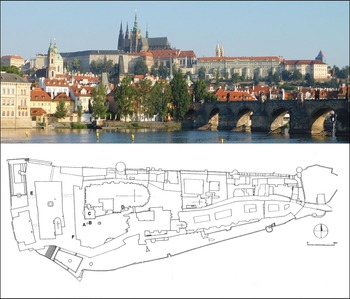
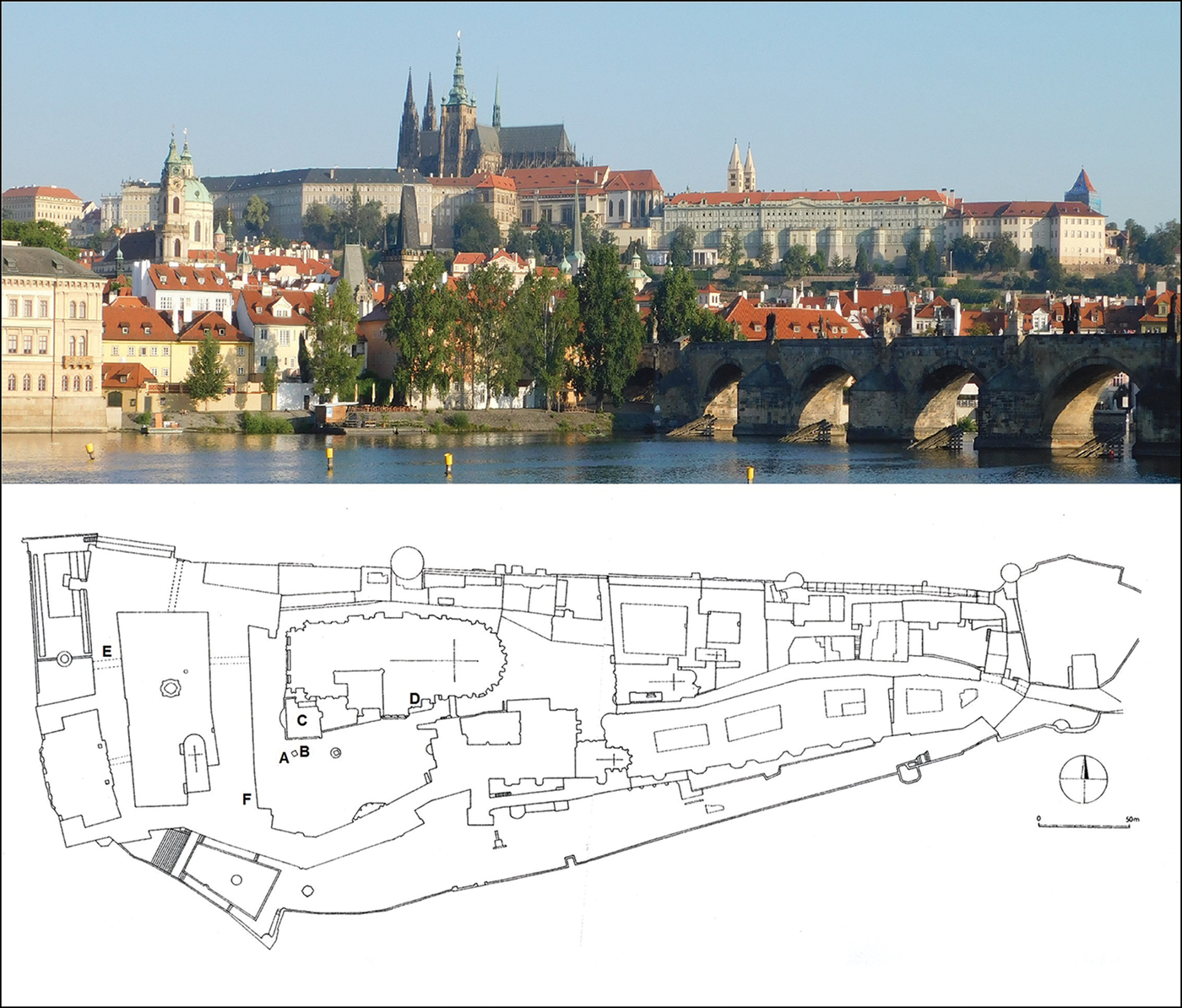
Prague Castle (Figure 1) has been the centre of the Czech state since the end of the ninth century AD and home to the successive dynasties of the Przemyslid, Luxembourgian, Jagiellonian and Habsburgian dukes, kings and emperors. In 1918, it became the presidential seat of the newly established Czechoslovakia, with reconstruction work to facilitate this repurposing starting a year later. In 1925, excavations by Karel Guth, the Head of the Historical Archaeological Department at the National Museum (Figure 2b), set out to identify the earlier phases of the castle, contemporaneous with the life of Duke Wenceslas, the most important Czech saint. The completion of these investigations was planned for September 1929 to coincide with the millennial commemoration of Wenceslas's death. This would serve to draw a legitimising connection between past and present, and to demonstrate the importance of the dead insofar as they can serve and can be utilised by the living (Domanska Reference Domanska2006: 347).
Prague Castle; view from the south (above) and the ground plan (below): A) grave IIIN199; B) obelisk; C) Bishop's Palace; D) St Guy's rotunda; E) Church of the Virgin Mary; F) main gate.
A) Ivan Borkovský, the discoverer and excavator of the Viking/warrior burial at Prague Castle in 1928; B) Karel Guth, Head of the Historical Archaeology Department of the National Museum, Prague, and in charge of the Prague Castle excavations.

Borkovský himself was a conflicted individual—his country of origin divided by competing political and military loyalties, and his fate to be as controversial as that of the unidentified body he would soon discover. Born in 1897 in Ukraine, he joined the Austro-Hungarian army in 1915 to fight the Russians (Figure 2a). He then fought in the 1917–1923 Civil War in Russia for the anti-Communist White Army, later switching sides to the Red Army. In 1920, he escaped to Czechoslovakia; two years later, he began studying archaeology at the Charles University in Prague. By 1926, he was in charge of the Prague Castle excavations as Guth's assistant, although publication was under the control of Guth.
A grave discovered
On 11 July 1928, the partially preserved remains of a well-built male were discovered beneath the third courtyard of Prague Castle (Figure 3). Interred just 0.3m below the surface and laying in an eroded wooden chamber, the body was located on the edge of an old cemetery in the central and highest point of the early medieval castle, probably dating to the Middle Hillfort period, AD 800–950/1000. Originally, the burial was probably covered by a funerary mound (Figure 4). The cemetery had ceased to function prior to the eleventh century, when the hill was partially levelled to build the Bishop's Palace. Nevertheless, construction of the late eleventh-century castle and an associated road respected the integrity of the graveyard area (Borkovský Reference Borkovský1946). The contemporaneous laying of the courtyard's pavement protected the body for 1000 years.
Photograph of grave IIIN199, shortly after excavation in 1928.

Grave IIIN199, ground-plan and equipment: 1) sword; 2) bucket; 3) fire-steel; 4) flint; 5) razor (?); 6–7) knives; 8) axe (after Vlček Reference Vlček1977: 44)

During the excavation, the burial was lifted as a block and placed in the Old Royal Palace (Figure 5), where it was examined and conserved. The individual had been buried with the head oriented to the west in a 3.0 × 1.2m chamber, with sides and base made of oak and the decomposed lid possibly of fir.
Moving the burial block of grave IIIN 199 to the Prague Castle storerooms in 1928.

The grave goods included a set of weapons comprising an axe, two knives and a corroded 0.96m-long sword in a wooden scabbard with a leather covering. By the right foot was a heavily damaged iron axe with a 90mm-long curved blade. A 176mm-long corroded knife also had a wooden scabbard and leather covering. The second knife—also corroded but with traces of gilding—lay by the left pelvis. A poorly preserved leather bag was found placed on the pelvic area and containing a small flint exhibiting use-wear and a richly wrought 97mm-long fire-steel (i.e. fire-striker), with decorative cut-out decoration on one side and trefoil-like elements. There was also a 118mm-long corroded iron tool (possibly a razor). At the right-side corner of the chamber was a bucket featuring three reinforcing iron hoops, three iron handle loops and small traces of the original wood. The bucket was up to 0.15m tall, with a diameter between 0.22 and 0.24m. Borkovský’s analysis and interpretation of this material culture assemblage proved highly contentious and threatened the excavator's future career.
The body acquired
The burial was located some distance from the castle's associated churches, and the material assemblage bore no resemblance to objects discovered in other Christian cemeteries at Prague Castle. These facts, together with Guth's and Borkovský’s reluctance to publish the detailed scientific results of the excavation, left the door open for controversy and a contested identity. Guth tended to publish little and late, and Borkovský required Guth's permission to publish. Into the gap left by Borkovský flowed a stream of publications offering contrasting interpretations. The first was a short newspaper article by Guth (Reference Guth1929a), published on the millennial anniversary of St Wenceslas's death. A second, also by Guth (Reference Guth, Odložilík, Prokeš and Urbánek1929b: 58), was more informative, dating the grave to c. AD 900 and identifying the occupant as an elite member of the castle's society—perhaps even of the princely family. Five years later, in 1934, Guth suggested that the grave could be that of Bořivoj I (died c. AD 890), or perhaps Spytihněv I (died AD 915). These were two early Przemyslid dukes of a Czech royal dynasty that ruled Bohemia and Moravia between the ninth and fourteenth centuries (Guth Reference Guth1934). Helmut Preidel—a Sudetenland German schoolteacher and archaeologist—fuelled the debate by comparing the grave with another burial from Žatec in northern Bohemia. Discovered in 1932, Preidel (Reference Preidel1936–1937) thought that this burial was associated with the Polish King Boleslaw I (‘The Brave’), who ruled in Bohemia between AD 1003 and 1004. Preidel (Reference Preidel1938) later maintained that Viking warriors were part of Boleslaw I's retinue and were buried at Žatec and in Prague Castle. He considered the inventories of both graves to date to the tenth century, or perhaps later.
All of this placed Borkovský on the horns of a personal as well as a professional dilemma. His 1929 doctoral dissertation on Corded Ware Culture in Central Europe had made explicit reference to Eastern European influences in its early stages. Soon afterwards, in 1933, he renounced his Ukrainian nationality and was granted Czechoslovakian citizenship. In 1939, he was appointed to a full-time position at the Institute of Archaeology in Prague. During these crucial years in his career, Viking-related interpretations of grave IIIN199, and others at Žatec, were at their height. Whatever Borkovský thought, his silence on the matter, his inability to publish due to Guth, and the storage rather than public display of the skeletal remains and associated grave goods, undoubtedly if coincidentally, meant that in the years leading up to 1933, he avoided public controversy at a delicate time, during which his new citizenship was under consideration.
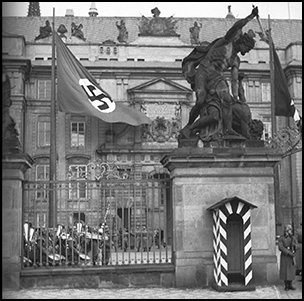
Although Borkovský’s low profile on the matter suited his personal and professional lives, it proved a fateful decision. On 15 March 1939, the Germans occupied the country and forced his hand (Figure 6). Nazi ideology and their manipulation of narratives of the past became entwined with the problematic identification of the buried individual. Archaeological evidence for Slav presence and identity ran counter to Nazi aims, particularly “in Eastern Europe where it was politic to prove previous Germanic habitation on the basis of material culture” (Arnold Reference Arnold1990: 473), thereby affirming the greatness of the German race—a process that “helped to justify Nazi conquests and informed German policies in zones of occupation” (Hare Reference Hare2014: 1–2). The Prague Castle burial was a case in point, and tailor-made for ‘ideological correction’.
Prague Castle during the visit of Heinrich Himmler in 1941 (after Uhlíř & Klimek Reference Uhlíř and Klimek2008: 143).

Almost immediately following the occupation, in 1940, German archaeologists accused Borkovský of suppressing the publication of the burial for nationalistic reasons, as it ‘proved’ the Germanic rather than Slavic origins of Prague Castle; Vikings, after all, were Nordic, as were the Germans. This conflation of Viking/Nordic/Germanic identity spoke to a supposed common racial community, which extended over national borders and reached deep into the past. According to Hans Reinerth, a spokesman for the ‘purification and Germanisation of German prehistory’: “the eternal stream of blood binds us across the ages to those Nordic farmers’ sons, who had to fight for southern German soil twice in the course of four millennia” (Arnold Reference Arnold1990: 468).
Borkovský was an easy target and, in 1940, he exacerbated his predicament by publishing a monograph identifying the oldest Slavic pottery in Central Europe (Borkovský Reference Borkovský1940). While this represented a significant contribution to European archaeology, it was personally dangerous, despite there being no evidence of a personal, pan-Slavic or Czech nationalist agenda at work. German archaeologists quickly dismissed the research, and he was forced to withdraw his work under threat of imprisonment in a concentration camp. The immediate German reaction was the 1940 publication of Ist Böhmen-Mähren die Urheimat der Tschechen (‘Is Bohemia-Moravia the original homeland of the Czechs?’) (Zotz & von Richthofen Reference Zotz and von Richtofen1940), which argued that Germanic peoples had inhabited Bohemia and Moravia continuously since prehistory. With the help of Kurt Willvonseder, the head of Heritage Management in Austria, professor of Archaeology at Innsbruck University, and a Nazi Party member and SS Untersturmführer, Borkovský’s publication was declared unconvincing and worthless (Smetánka Reference Smetánka1997: 705) (Figure 7c).
A) Jiří Malý; B) Lothar Zotz; C) Kurt von Willvonseder (after Anděl Reference Anděl1999: 617; Obermair Reference Obermair2015: 158; www.muzeumprahy.cz/lothar-zotz /downloaded 10/09/2018/).

Borkovský’s first publication of the Prague Castle burial appeared, with Guth's permission, in 1941, some 13 years after its discovery. Once again, German pressure was applied due to his previously published book—most copies of which the Germans had destroyed. Ironically, the same Lothar Zotz, now in charge of Bohemian archaeology (Figure 7b), decided that the article should be published in the first issue of his new journal Altböhmen und Altmähren (Old Bohemia, Old Moravia). Borkovský’s original title for the article was ‘A warrior grave from Prague Castle’, but, without consultation, Zotz changed it to ‘A Viking grave from Prague Castle’ (Borkovský Reference Borkovský1941). Zotz may also have altered some of the text.
The published article was overt in its Nazi-influenced, Nordic interpretation. In addition to the title, it stated explicitly that “the grave of a Viking was discovered” (Borkovský Reference Borkovský1941: 171). The comparison of the ‘fire-steel's’ trefoil decoration to similar designs on axes from Gotland and Öland was emphasised (Paulsen Reference Paulsen1939: 49, figs 8–9). Concerning the sword, Borkovský—or perhaps Zotz—added: “finally, we have to mention that a sword found in neighbouring Silesia, which corresponds to our exemplar, has been interpreted by Zotz (Reference Zotz1934) as German-Viking and dated into the 10th–11th centuries” (Borkovský Reference Borkovský1941: 181–82).
Czechoslovak president Gustav Husák and Soviet leader Leonid Brezhnev at Prague Castle in 1978 (after Klazarová Reference Klazarová2003: 473).

Construction of the underground cave for the ‘Unknown Soldier’ in 1918.

In 1941, in the same climate of Nazi occupation, Jiří Malý (Figure 7a) undertook an anthropological study of the skeletal remains from grave IIIN199. Although the report was never published, a typescript still exists (Malý Reference Malý1942). Examination of only the skull and left femur suggested that the individual possessed a strikingly large skeleton—some 1.75–1.76m tall—with robust bones exhibiting pronounced muscle attachments, and was around 40 years old at death. Malý’s final point was explicit: the skeleton “overall corresponds to a male of Nordic racial type” (Malý Reference Malý1942: 7).
The end of the Second World War brought another change in the body's identity. Following Germany's defeat, Czechoslovakia was occupied by the Soviets and remained under strong Soviet influence after the Red Army's departure at the end of 1945. In 1945, Borkovský narrowly escaped being sent to a Siberian Gulag, possibly due to his anti-Communist activities 20 years previously, and particularly for his role as the Rector of the Ukrainian Free University in Exile (1939–1943). After explaining that he had been forced into the pro-Viking interpretation, he soon published his second article (Borkovský Reference Borkovský1946). In this, he interpreted the burial as that of an important person who was related to the early Western Slav Przemyslid dynasty—in effect, reverting to Guth's 1929 and 1934 views. This interpretation, reinforced retrospectively by his 1940 monograph on Slavic pottery, was in accord with the new Soviet regime.
Aside from the overt politics, the 1946 article dated the burial to the AD 860s—before the foundation of Prague Castle as a state centre and its oldest Church of the Virgin Mary. Thus, the warrior belonged to pre-Christian pagan times. Meanwhile, the identification and dating of the burial as Viking and the notion of a regional Viking presence fell apart. Preidel (Reference Preidel1944) accepted Guth's earlier interpretation and dating of the grave, admitting there were no Vikings buried at Prague Castle or Žatec.
Despite the pro-Slavic tone of Borkovský’s Reference Borkovský1946 publication, the issue of the warrior grave remained toxic during the Cold War. While it was considered a significant early medieval discovery, subsequent research focused more on demonstrating the advanced cultural level of Slavonic society at that time, and the interpretation of the ‘Great Moravian Empire’ as the first common state of the Czechs and Slovaks (Poulík & Chropovský Reference Poulík and Chropovský1985). During this time, Borkovský became director of the newly established Department of Historical Archaeology at the Institute of Archaeology in Prague, which, in 1952, became part of the Academy of Sciences, organised along Soviet lines. During this difficult period, which was punctuated by the Prague Spring of 1968 and a new Soviet occupation (Figure 8), the grave block and its contents were kept mostly out of public view. Although no further investigations on the burial occurred after 1946 (with one exception, see below), Borkovský’s views were accepted by subsequent, influential publications on Prague Castle, early medieval Bohemia and beyond (e.g. Borkovský Reference Borkovský1972; Sláma Reference Sláma1977; Maříková-Kubková et al. Reference Maříková-Kubková, Mašterová, Válová and Vicelja-Matijašić2015).
Anthropologist Emanuel Vlček struck the only discordant note. In the 1970s, his research on the skeleton argued against any Przemyslid connection, offering a date for the burial closer to Guth's (Reference Guth1934), in the second half of the ninth century AD (Vlček Reference Vlček1977: 44–51). The skeletal remains and grave goods were kept in storage for 58 years, before going on permanent public display in 2004, long after Borkovský’s death in 1976 and the dissolution of the Soviet Union in 1991—and fully 76 years after their discovery.
By the late 1940s, the burial had undergone a confused and confusing change of identities based, in part, on the associated grave goods, but mostly in connection with military conflict and the shifting political and ideological conditions that ensued. Simultaneously, Borkovský’s own identity had also been changed by war and, at least in part, by the shifting interpretations of the burial. A connection between the living and the dead in these events is clearly visible. Yet this was not the full story: there was another contested body linked to both world wars, both occupations, Czech identity and war heritage (i.e. commemorative monuments, war cemeteries, sites and the National Monument), and the location of the burial.
Warriors, commemoration and landscape
The history of the warrior burial's excavation, and of its excavator, was inextricably entangled with the early mortuary landscape of Prague Castle and a third body whose identity—like that of the warrior—was also unknown and produced contested memorialisation and political strife. The multi-vocal and polysemic nature of landscapes is revealed by the shifting cultural and ideological imperatives of those who behold them—and wherein memory is constructed and perpetuated. This is well illustrated by these parallel historical events, and situates the analysis of these landscapes between history and anthropology (Sherman Reference Sherman1999: 15, 36–44; Bender & Winer Reference Bender and Winer2001).
In 1918, a memorial to the Czech ‘Unknown Soldier’ of the First World War was planned, a few metres from the spot where the burial IIIN199 would later be found. Part of the memorial was to be a monolithic granite obelisk, the other part, a specially dug subterranean cave (Figure 9), presumably to hold the remains of an unidentified Czech soldier killed at the 1917 Battle of Zborov in Ukraine (Malá Reference Malá, Abdallaova and Martlew1997: 291). Even this was contested, however, as Czechs fought on both sides—volunteers for the Russians fought against their compatriots (including Borkovský) who were fighting in the Austro-Hungarian army. The Russians lost the battle, but their Czech troops fought so effectively that it strengthened the case for an independent state of Czechs and Slovaks after the war. For unknown reasons, the castle courtyard memorial was abandoned, and an alternate Unknown Soldier monument erected instead within Prague's Old Town Hall in 1922.
The obelisk was repurposed, partly as a First World War memorial, but also—and increasingly over time—as a monument marking the tenth anniversary of the creation of Czechoslovakia (Figure 10). Thus, two events were fused into one object and into the collective memory. Meanwhile, on 12 July of that year (1928) Borkovský discovered the warrior burial just a few metres away. The castle's architect, Josep Plečnik, waited until the archaeological excavations were completed before deciding where to erect the obelisk in late 1928 (Malá Reference Malá, Abdallaova and Martlew1997: 294).
Erecting the First World War Memorial obelisk in the courtyard of Prague Castle 1928.

Just over a decade later, the two First World War commemorative monuments were affected by the Nazi occupation. During 1941, the Unknown Soldier memorial in the Town Hall was embroiled in conflict when it became a nationalist flashpoint of Czech demonstrations against Nazi occupation. It was subsequently demolished on the orders of Reich Protector Reinhard Heydrich, leaving the anonymous body in limbo. Determined as Heydrich was both to suppress Czech culture and to Germanise—and, ultimately, to eliminate—the population, this event may have alerted him to the potential of the castle obelisk to become a new Czech rallying point. On 5 December 1941, Heydrich wrote to Emil Hácha the Czech State President, ordering the removal of the obelisk. For unknown reasons, however, Heydrich lost interest. He was assassinated six months later (Malá Reference Malá, Abdallaova and Martlew1997: 294), but the obelisk survived.
After the war, in 1947, and marking the thirty-ninth anniversary of the Battle of Zborov, the Czech army decided to re-establish the tomb of the Unknown Soldier inside the National Monument atop the city's Vítkov Hill. Now, however, a different ideology came into play. The Zborov soldier's remains were again re-politicised, this time by Soviet embassy officials, who intervened and stopped the transfer of the skeletal remains, possibly to avoid stirring memories concerning the role that the battle played in creating the independent Czechoslovak state in 1918. In 1949, during restoration work at a military cemetery near Dukla, the remains of an unknown soldier were exhumed and taken to Prague. On 9 October, these remains were interred in the National Monument during commemorations of the fifth anniversary of the Battle of the Dukla Pass, at which Russian and Czech troops had defeated the Germans. On 8 May 2010, the body of the First World War Unknown Soldier was laid to rest alongside that of his Second World War counterpart. Thus, after 61 years, the original plan for a monument to honour those who fell to liberate the Czech and Czechoslovak states was fulfilled.
The Viking returns?
Stripped of politics and ideology, what is the significance of the burial today? Reassessing the evidence in the light of recent scholarship recalibrates the contribution of the objects to the creation of national identities (Domanska Reference Domanska2006: 338), and clarifies the identification of the individual interred at Prague Castle. One of the most significant objects is the fire-steel. A standard item of Viking personal equipment, the shape of the Prague Castle example is different from others found in Bohemia. Although corrosion complicates identification (the original was lost in the Prague floods of 2002), the surviving drawings show the artefact to be remarkably similar to other Scandinavian examples. Furthermore, as noted above, the trefoil extensions resemble those found on axes from Gotland and Öland (Paulsen Reference Paulsen1939: 49, figs. 8–9).
The sword can also be re-evaluated, albeit equivocally. Its guard and iron pommel appear to correspond to Petersen's type X (Profantová Reference Profantová and Tomková2005; Androshchuk Reference Androshchuk2014), a tenth-century form popular across Europe, from Scandinavia to Poland, Moravia and Rus; Bohemian and Moravian examples are most often associated with burials of local elites. A total of 30 early medieval swords, for example, have been found in Bohemia. From the 12 that can be identified, four are type X (Profantová Reference Profantová and Bendeguz2012: 172–73). Nevertheless, the sword from Prague Castle may well belong to phase 2 of the Middle Viking Age (c. AD 900–975). A style represented on ‘Viking’ coins struck in York between AD 910 and 950, it became widespread in Scandinavia around the mid tenth century (Androshchuk Reference Androshchuk2014)—post-dating Borkovský’s original dating of the Prague Castle burial by two to three generations.
The warrior's axe is unusual in that it belongs typologically to the Eastern European type of broadaxe. Nevertheless, the evidence remains ambiguous: while the warrior's axe originally had lobes, which are common in early medieval Bohemia, a similar shape of axe is found in graves containing Viking equipment on the southern Baltic coast (Gossler Reference Gossler2014: 11). Again, corrosion inhibits comparative studies.
The length of the largest knife suggests a possible weapon of probable Continental provenance—and thus not expected in a burial linked to Denmark (Eisenschmidt Reference Eisenschmidt2004). Buckets are a relatively common component of contemporaneous grave assemblages and have been found in 14 tenth- and eleventh-century graves in and around Prague Castle (Frolík Reference Frolík and Frolík2014: 61–64). Notably, luxury items, such as jewellery and amulet containers, were found in eight of these graves. In Croatia, buckets are found in rich, ninth- and tenth-century graves, along with fire-steels and swords (Petrinec Reference Petrinec2009). Buckets, however, are also common in tenth-century burials in Southern Scandinavia (Pedersen Reference Pedersen2014), highlighting the international context of this custom, including local Slavonic lords and Vikings from Denmark (Androshchuk Reference Androshchuk2014).
The material culture from grave IIIN199 is therefore a mix of foreign (i.e. non-Czech) items, such as the sword, axe and fire-steel, and domestic objects, such as the bucket and the knives. The grave belongs to a well-equipped warrior, and the sword makes it unique—the only one found in approximately 1500 early medieval graves so far found in Prague Castle.
The picture presented by the material culture has become both more detailed and more complex. Even in combination with the presence of ‘Viking-like’ burial customs—the wooden chamber and probable burial mound—the material culture cannot make a renewed case for identifying the burial as ‘Viking’. The application of new scientific techniques, such as ancient DNA, stable- and radioisotope analyses and advanced bio-anthropological methods, such as CT scans, 3D modelling and computer-augmented measurements of skeletal features, might be expected to make a more definitive contribution to our understanding of the individual's origins. Yet, after subjecting the skeletal remains to a battery of such analyses (probably surpassed in range only by those applied to Ötzi the Iceman), conducted by many international laboratories, the results remain inconclusive (see also Kaupová et al. Reference Kaupová, Velemínský, Stranská, Bravermanová, Frolíková, Tomková and Frolík2018)—a complex and interesting comment on Kristiansen's (Reference Kristiansen2014) ‘Third Science Revolution’.
Perhaps brave Borkovský and all the others involved in this epic saga simply set the wrong agenda in emphasising ethnicity over identity. Our warrior may well have regarded himself as a genuine Viking, and there are good reasons for assuming as such. Yet he may actually have been a Slav from a neighbouring region, who had mastered Old Norse as well as Slavonic—a warrior and leader who lived a widely travelled, adventurous and belligerent existence, before being laid to rest beneath what was to become Prague Castle. Does this perhaps more accurately reflect the realities of tenth-century elite individuals than the outdated question of whether he was Germanic or Slavonic?
Conclusions
The case of the ‘warrior burial’ is a potent example of politically contested identity, where ideology has forced multiple interpretative changes, and twentieth-century conflict runs like a multistranded thread throughout. The shifting personal circumstances of Ivan Borkovský, the excavator and interpreter of the burial, are inextricably interwoven with these events. The list of conflicts and political upheavals that contextualise the burial's fate is a roll call of some of the twentieth century's most momentous events: the First World War, the Russian Civil War, Czechoslovak independence, the Second World War and German occupation, the Cold War and Soviet occupation, and the Velvet Revolution. The burial has undergone a dizzying collection of identifications: just an important burial; a Przemyslid duke—if not Bořivoj, the founder of the dynasty; a Nordic Viking; an important Slavonic warrior; an ‘invisible’ person caught in the liminal space of Prague Castle's storerooms; and, today, in the twenty-first century, perhaps an example of an early European leader, whose complex identity was signalled by the diverse collection of material culture that accompanied him to the afterlife.
Acknowledgements
This article is part of project 14-36938G, supported by the Czech Science Foundation. We are grateful to Anne Pedersen (Copenhagen), Lotte Hedeager (Oslo) and Fedir Androshchuk (Stockholm), for discussions on Viking burial customs, equipment and dating, and Tomáš Mařík (Prague) for help with German translations. Unless otherwise stated, all images are courtesy of the Institute of Archaeology of the CAS, Prague Castle Excavations, where Borkovský’s Archive is housed.