

If we leave Iraq there will be chaos.
Chaos is worse, right?
(Anti-Iraq war magnet, 2005)
In 1908, Lord Cromer, a British administrator for Egypt, published a noted essay in what would be called today development economics.Footnote 1 The article praised a philanthropic colonial rule for inspiring decisions that were taken ‘mainly’ with reference to what was, by the ‘light of Western knowledge and experience tempered by local considerations’, ‘conscientiously’ thought to be best for ‘subject races’. While his good faith is not questioned, economists will find it puzzling that anyone should expect the self-interest of the metropolitan government to be aligned with that of a ‘subject nation’ – let alone a ‘subject race’.
The mismatch between colonies’ interest and that of their colonial ruler, albeit an evident feature of colonial empires, has received little attention from economists. For instance, it is not a central concern of research aiming at explaining the variance in colonial performance such as the important articles by Engerman and Sokoloff (Reference Engerman and Sokoloff2000, Reference Engerman and Sokoloff2005a, Reference Engerman and Sokoloff2005b). The popular paper by Acemoglu, Johnson and Robinson (Reference Acemoglu, Johnson and Robinson2002) does not focus on this dimension of colonial retardation.
Yet a significant mileage could be got from taking the political economy of colonial governance into account. Acemoglu et al. argue that the ‘extractive’ institutions that were imposed where local populations predominated sealed the fate of such colonies’ subsequent development, locking them into a ‘bad’ equilibrium. They also suggest that in places where populations of European origin predominated, the superior institutions of the metropolis, providing for greater representation and the rule of law, were transplanted and turned out to provide the ground for subsequent good performance.
What these authors do not explain is why the institutions of the metropolis were transplanted in certain colonies but not in others. Subsequent history suggests that places where natives predominated were just as eager to secure greater representation and the rule of law as places where non-natives were more numerous. Moreover, although we recognize that Acemoglu et al. have an argument about initial conditions and persistence, historical evidence shows that patterns of colonial governance did exhibit a degree of malleability. We also think that they do not pay enough attention to the fact that colonial institutions were intensely bargained over, as illustrated by the American war, when thirteen white-peopled colonies, helped by a foreign power, secured independence from England. Uprisings such as in Canada in the 1830s provided a nineteenth-century reminder that such issues had not just gone away.
What we suggest here, in other words, is that there may be more to the variance of colonial development than a historical accident supported by subsequent lock-in effects. Instead, we argue that it is precisely the fact that there did exist credible exit options in certain parts of the British Empire but not in others that accounts for a significant fraction of the diversity in development outcomes.
Our starting point is an insight from political economy and the economics of fiscal federalism. External control of a province, state, or in the instance, colony, by a centre or metropolis, has the effect of removing default risk from the province, state, or colony, and transferring it to the centre or metropolis. Supporting the analogy between colonial empires and federal states, we report elsewhere evidence that empire subjection made colonial governments’ borrowing costs irresponsive to the ‘fundamentals’ that mattered for sovereign entities (Accominotti et al. Reference Accominotti, Flandreau, Rezzik and Zumer2008). But to the extent that it did so, empire subjection annihilated market discipline. The question becomes: what did substitute for the lack of a market mechanism?
In this article, we argue that the British Empire displayed two radically different solutions to address the moral hazard problem created by this explicit or implicit underwriting of colonial debts. We suggest that the adoption of such solutions depended on the degree of coercion available to British authorities. Finally, we show that these solutions cast a long shadow on the different colonies’ subsequent performance.
On the one hand, the so-called self-governing colonies (Australia, Canada, New Zealand, etc.) were monitored by subjecting their governments to the rule of law, imperial courts and a deepening of democracy. This was because, for such colonies, exit was a credible option, as the American war had demonstrated. The self-governing colonies had to be cajoled, and self-governance was one way to achieve this. But this in turn created an exposure for British finance. Self-government plus a de facto guarantee from London could turn out to be an explosive cocktail. The solution, we claim, was a reinforcement of democracy and property rights that ruled out sovereign default and diffused political conflict.
On the other hand, India and the so-called dependent colonies (Ceylon, Jamaica, etc.) were monitored by transferring decision-making to London. This was because the use of violence and coercion against a native population was perceived in the western world as legitimate. Each country's colonies were treated as a backyard and while there could be ferocious fights among colonial powers over the control of given areas, the gentlemen's agreement was that one ought not to support natives against their European rulers. In other words, racism acted as a coordination device and was responsible for the maintenance of repressive institutions. As a result, direct control and repression removed any residual exposure of the metropolitan government to default risk by making sure that no colonial debt would be issued without London's approval. The outcome of this political repression, we shall see, was financial repression.
To bear out our claims, we provide a theoretical analysis of the incidence of empire on borrowing and report empirical evidence that the surplus from British Empire subjection depended critically on the type of colony one is looking at. Our results suggest that white-peopled ‘self-governing’ colonies derived some gains, while for black ‘dependent’ colonies where natives predominated, the surplus was negative. The British Empire was a black man's burden.
In addition to bringing a fiscal federalism perspective on the economics of empire, this article provides two new insights. First, by focusing on the cost of capital and government loans, we build a bridge between empirical studies of historical bond spreads and research on colonial institutions. These two branches of the literature have ignored one another so far. We believe that they are really related because alternative colonial systems can be mapped into alternative ways to deal with moral hazard. Our insight is that understanding colonial institutions and understanding the pricing of colonial debts are the two sides of the same coin.
Second, we provide a new perspective on the relationship between government and development in white colonies. Our theoretical analysis leads us to predict that the institutions of self-governing colonies were conducive to heavier government involvement in the process of economic growth than was the case under sovereignty. We report empirical evidence that is consistent with this. This finding is at odds with the prejudice recently associated with neoconservative writing, that empire is useful because its repressive nature is conducive to financial orthodoxy.Footnote 2 But it is a result that is consistent with the ‘welfare state free lunch puzzle’ identified by Peter Lindert (Reference Lindert2004). The puzzle is that government spending may not be associated with lower growth performances. Lindert also notes that certain countries such as Australia and New Zealand were pioneers in the development of welfare state institutions. We remark that they belonged to the self-governing empire and suggest that their pioneering of the welfare state was a by-product of the political economy of self-governing colonies, where extensive government involvement in economic development and a deepening of the electoral franchise went hand in hand.
The remainder of the article is organized as follows: Section 1 reviews modern research on the connection between colonial institutions and economic development. Section 2 explains the logic of colonial institutions as an instrument for solving the moral hazard problem. Section 3 provides analytical insights into the incidence of empire subjection on market access and external borrowing. Section 4, finally, builds on these theoretical insights to derive a measure of the incidence of alternative colonial rules.
1. Colonial institutions and economic performance
The varied success of British Empire subjection across time and space is an intriguing matter that has been repeatedly rediscovered. This notion was a central feature of Easterlin (Reference Easterlin1981), who remarked that variance across colonial institutions can help identify the incidence of those institutions on economic performance. He suggests that human capital accumulation, inequality and democracy account for most of individual countries’ development paths. More recently, Engerman and Sokoloff (Reference Engerman and Sokoloff2005b) reasserted this notion and emphasize the importance of inequality in preventing accumulation of human capital and associate this inequality with the disenfranchisement of substantial portions of the population.Footnote 3 Variation within colonial experiences is also a central theme of the article by Acemoglu, Johnson and Robinson (Reference Acemoglu, Johnson and Robinson2002).Footnote 4 They observe that many areas that were rich in 1500 became poor thereafter and explain this reversal of fortune by different initial institutional endowments. ‘Extractive’ institutions were set up to exploit local resources through native or imported slave labour (as was the case in the mines of Peru or in the Caribbean). ‘Good’ institutions were set up where Europeans settled to replicate the European norm of institutions protecting private property. Among the primary examples of this mode of colonization, they single out Australia, Canada, New Zealand and the United States. They argue that settlers in these societies managed to place significant constraints on their elites (although they do not really explain what led local elites to relinquish their power). This sealed the fate of subsequent development. Colonies with extractive institutions produced a powerful class who actively sought to secure rents. When independence was achieved, elites preserved the old order. But colonies with good institutions could prosper and grow and now feature among the richest countries in the world.
One intriguing question is that of determining why extractive or good institutions were introduced. Since extractive institutions underperformed, they should not have been introduced in the first place or removed after a while. Acemoglu et al. argue that European colonists ‘chose’ to transfer the good institutions of the metropolis when it was in their interest to do so, i.e. when they would be the ones living under the umbrella of these institutions. In popular forms of the argument, they also note that in these colonies, the institutions of the metropolis were not only transplanted, but also ‘often improved’ (Acemoglu Reference Acemoglu2003, p. 28). They claim that extractive institutions were adopted where Europeans did not settle and cared little about aggregate output or the welfare of the indigenous population. An assumption that is implicit in this view is that the colonizing power maximized a ‘European settlers’ social welfare function’. This ignores the possibility of violent conflict between colonies and the metropolis – an obvious reflection of different goals and incentives between metropolitan governments and colonies.
Despite a substantial difference in the focus and scope of analysis, the previous discussion uncovers striking parallels between modern views on colonial development and the earlier political economy account by Davis and Huttenback. Unlike more recent scholars, Davis and Huttenback (Reference Davis and Huttenback1986) were concerned with measuring transfers within the British Empire – or what they call the ‘Empire subsidy’. But while they use different language, they nonetheless came across a classification of colonies that can be mapped into the more recent distinction between extractive and good institutions colonies. Self-governing colonies coincide with what subsequent research has identified as good institutions colonies, while dependent colonies and India coincide with extractive institutions colonies.
Davis and Huttenback also remark that self-governing colonies were rich, while dependent colonies were poor, although they do not think of this relation in terms of causation. The split between two types of colonies is a critical aspect of Davis and Huttenback's computation of the empire subsidy. They measure it as the product between the reduction of interest rate associated with empire subjection and the amount of capital received (this provides an upper bound for consumer surplus, as we shall see later on). Since self-governing colonies received much capital and dependent colonies, little, they conclude that self-governing colonies were obvious beneficiaries of the imperial machinery, while India and the dependent empire probably lost.Footnote 5
What is striking in the parallel between Davis and Huttenback's political economy of the British Empire and the subsequent literature on colonial institutions and performance is not only the analogy in the distinction between dependent/extractive and self-governing/good colonies, but the analogy between their assessment in both literatures. Davis and Huttenback find a positive transfer where Acemoglu et al. find evidence of positive achievements, and a loss in places characterized by extractive institutions. That emphasis on borrowing costs and on borrowed amounts uncovers a split that is emphasized in works whose primary focus is the performance of colonial institutions suggests that there are deeper connections between the political economy of imperial finance and the economic achievements of different groups of colonies than may appear at first sight. In other words, one should be able to construct a theory that would jointly account for borrowing costs, borrowed amounts and governance framework. This we do by bringing to centre stage the bargaining relation between colonizers and colonized.
To summarize, we suggest that the political economy of colonial institutions is still in need of elaboration. Institutions are not only the result of initial accident, later supported by lock-in effects. The alternative approach advocated here is to look at colonial institutions as the outcome of a bargain between the mother country and its political satellite. From this vantage point, the costs and benefits of secession, the political and geo-strategic motives of the centre, and the degree of coercion available to it, are critical ingredients that ought to have shaped the outlook of colonial institutions.
2. On moral hazard in the British Empire and its resolution
2.1. Dealing with moral hazard
Sovereignty provides scope for moral hazard. Sovereign debt can be defaulted upon and when this occurs, investors find themselves helpless. However, the colonies of the British Empire were not quite sovereign. Default, as was occasionally practised by sovereign countries, was not an option for British colonies. This is natural since, to the extent that colonies were political subjects of Britain, default there would have reverberated on the credit of the metropolitan government. And thus moral hazard was a problem for the cabinet in London, rather than for governors and governments in Melbourne, Toronto, or Calcutta.
In this article, we argue that the moral hazard problem was dealt with through the emergence of two alternative monitoring regimes that were radically different from one another. The first regime relied on political monitoring by the political-bureaucratic entity that was supposed to provide a bail-out guarantee in case of default. The second relied on a system of legal control. It rested on the development of legal mechanisms that stood in the way of the judicial sovereignty of the colony. By definition, such mechanisms were not available for sovereign countries, and this is what made the position of colonies so special (Accominotti et al. Reference Accominotti, Flandreau, Rezzik and Zumer2008).
Under the political control system, the cabinet in London provided financial guidance either by integrating colonial finances into the general budget, or by subjecting them to its approval. In the crown colonies, such as Ceylon or Jamaica, finances were run by a London-appointed bureaucracy, the ‘crown agents’. The crown agents were London-based private monitors who acted on behalf of the British government. They were responsible for marketing in London the securities of the crown colonies. They kept the finances of the dependent colonies on a tight leash. They could and did veto external loans when ‘prospects for borrowing appeared doubtful’ (Kesner Reference Kesner1981, p. 61; Sunderland Reference Sunderland2004, passim). India was in a similar position. After the Sepoy Mutiny of 1857, India was placed under the authority of a secretary of state who was a member of the British cabinet. Debts could not be contracted without the approval of the India Office.
The legal control regime applied in colonies where direct interference from London was tempered for reasons that shall be discussed later on. Such colonies enjoyed the privilege of self-government and could in effect borrow without asking London for authorization. But then moral hazard could re-emerge with a vengeance, and this was a concern for London. The solution that gradually emerged and consolidated was that the colony would become legally junior. Use of strategic default would have led local governments to face creditors’ intervention following precise legal and constitutional rules. Creditors were made able to sue defaulters in imperial courts, and assets could be seized. Management or liquidation of the railway line would have been transferred to bondholders. Very much like British domestic firms, the governments of self-governing colonies were thus subjected to the imperial judicial system. Had they tried to interfere, that would have created a breach of existing contractual and constitutional arrangements between the colony and the metropolis, providing scope for Britain to intervene. But focus on this last line of defence would be misleading, because before this stage could be reached, local capitalists holding the securities of their local governments would take advantage of the legal frameworks at their disposal and seek the support of British-backed legal mechanisms for protecting property rights. The point therefore is that the rule of law substituted for a British bail out.
It is useful for our purpose to review the emergence of this regime, because economic research has tended to depict colonial systems as more or less stable over time, when we do see time variance. Until the late 1850s, i.e. until colonial borrowing really took off, legal arrangements as to which jurisdiction would be competent in the event of a problem, what would be the respective responsibilities of the cabinet in London and the local government, etc. were not clear. As colonial borrowing expanded during the 1860s, the need for a sounder institutional framework made itself felt. The British government first tried to wave arms, issuing statements reminding investors that London had no formal responsibility in the issue of self-governing colonies’ debts and should thus not be held responsible in the event of default. In December 1873, a dispatch from Lord Kimberley (Secretary of State for the Colonies in the first Gladstone ministry) to Governor Fergusson of New Zealand indicated: ‘Inasmuch as [the British cabinet] exercises no interference or control as to the financial policy of a colony under responsible government, it shares none of the responsibility for the due payment of the principal and interest of loans which it has not specifically guaranteed.’Footnote 6 That the British cabinet had to issue such statements suggests that confusion was likely.
Before 1877, the pivotal institution to deal with moral hazard was known as ‘imperial conditionality’. Debts issued under ‘imperial guarantees’ carried London underwriting that could be rescinded in case of colonial government misbehaviour. However, in the 1870s, the English Treasury became increasingly nervous that this was not a credible solution. There had been a case where money borrowed by Canada had been used for a different purpose than initially stated, yet the guarantee had not been rescinded.Footnote 7 The problem with the system of imperial guarantees is that it forced the British government to take actions against its colony. Moreover, it created a mechanism whereby investors were led to believe that colonial borrowing came with explicit London underwriting. The British government feared that political transaction costs would make it hostage to the dominions, while the rescinding of guarantees would undermine its own credibility.
The solution that was eventually found was to create a legal framework to help the market deal with trouble, so that the authorities would only be involved at arm's length. The Colonial Stock Act of 1877 set the conditions under which colonial debts could enjoy the benefits of ‘registration’:Footnote 8 this required the acceptance that English courts were competent in case of disputes (Colonial Stock Act of 1877, Section 20). The Act also stipulated that the colonial government, having issued that stock, would undertake to recognize the judgment of the court, and furnish its agents in London with funds for the payment of any amount for which they may be declared liable. In sum, the Colonial Stock Act of 1877 put the judicial system in the driver's seat.Footnote 9
When the Colonial Stock Act was adjusted in 1900, the same principle was again restated. The Act was aimed at providing more liquidity to the debts of the self-governing colonies by granting them ‘trustee status’ to encourage investment by the British middle class.Footnote 10 This benefit was secured in exchange for the recognition, by colonies, of the junior nature of their legal system. The Act required colonial governments to place on record a declaration that ‘any future colonial legislation altering current provisions to the injury of stockholders or involving any departure from the original contracts would properly be disallowed by the imperial government’.Footnote 11 As far as debts were concerned, colonial legislation was therefore subordinated to English law and imperial arbitration. Self-governing colonies might have been fiscally sovereign, but they were not judicially sovereign.Footnote 12
2.2. Credibility and enforcement
There is ample anecdotal evidence that markets did not treat colonial debts in the same way as those of sovereign countries. For instance, the prices of Indian as well as some Egyptian securities were listed with ‘British stocks’ as these carried explicit London guarantees. Colonial debts were listed in a special portion of the stock exchange returns and were thus kept formally apart from sovereign debts. Accominotti et al. (Reference Accominotti, Flandreau, Rezzik and Zumer2008) report evidence that contemporaries considered these regimes very credible. We observe that colonial status broke the link between fundamentals (such as the debt burden) and borrowing costs.
The previous discussion suggests, however, that the channel through which this credibility was secured differed according to the type of colony one is looking at. The credibility of the regime that prevailed in dependent colonies and India rested on the perceived degree of political control, as illustrated in contemporary statements such as when The Economist noted that India's debts were safe because England ‘directly governs India’. Britain's commitment to make sure that the debts of dependent colonies would be paid back to bondholders was made particularly tangible through its determination to implement ruthless repression when needed. The Sepoy Mutiny, and the following take-over of India from the hands of the East India Company, was a reminder that Britain ‘owned’ India. This determination must have provided relief to investors’ earlier concerns that the debts of the ‘strange Empire of India’, as Bagehot had it, might not be on the same footing as those of Britain.
While the credibility of dependent colonies’ debts rested on violence and coercion, that of self-governing ones rested on Britain's commitment to protect the rule of law. This credibility (again visible in the bond price regressions in Accominotti et al.) is ascertained in statements such as the following, taken from an article published in January 1874 by The Economist (three years before the Colonial Stock Act transformed the de facto understanding into law). The article claimed that the government's commitment to enforce the rights of creditors through legal procedures sprang naturally from the fact that it had no other alternative. In other words, London had to bail in debtors, since bailing them out was not an option.Footnote 13 This ensured that Britain's government would not escape the ‘legitimate demand of its subjects that the law would be enforced’ and checked moral hazard, explaining why investors ‘could feel sure that . . . none of the colonies commit default’.Footnote 14
2.3. Democracy and the rule of law
An implication of the above is that we should find a correspondence between democratization and governance frameworks. Specifically, we predict that we ought to observe an extension of the franchise in self-governing colonies over and beyond what British elites would tolerate for Britain itself. This is because, lacking the ability to provide political supervision of colonial borrowing, metropolitan powers had an incentive to enfranchise a greater number of interests who could in turn object to colonial government mismanagement and use legal frameworks as a recourse against financial delinquency by their rulers.Footnote 15 Since this would have created a motive for interference from British authorities, it also created an incentive for local politicians to behave well. Moreover, and for a symmetrical reason, we expect to see stagnating levels of enfranchisement in dependent colonies and India.
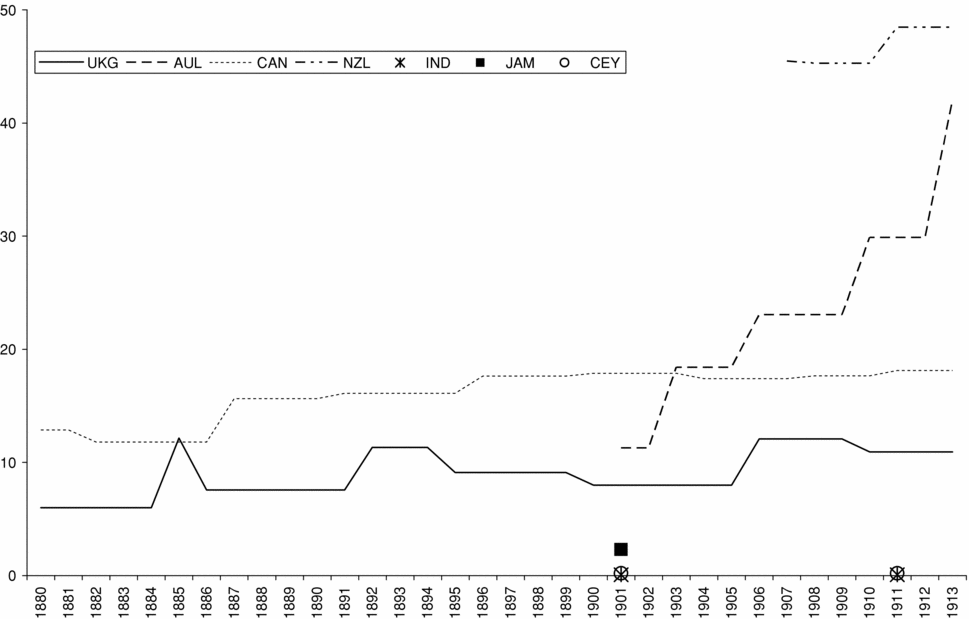
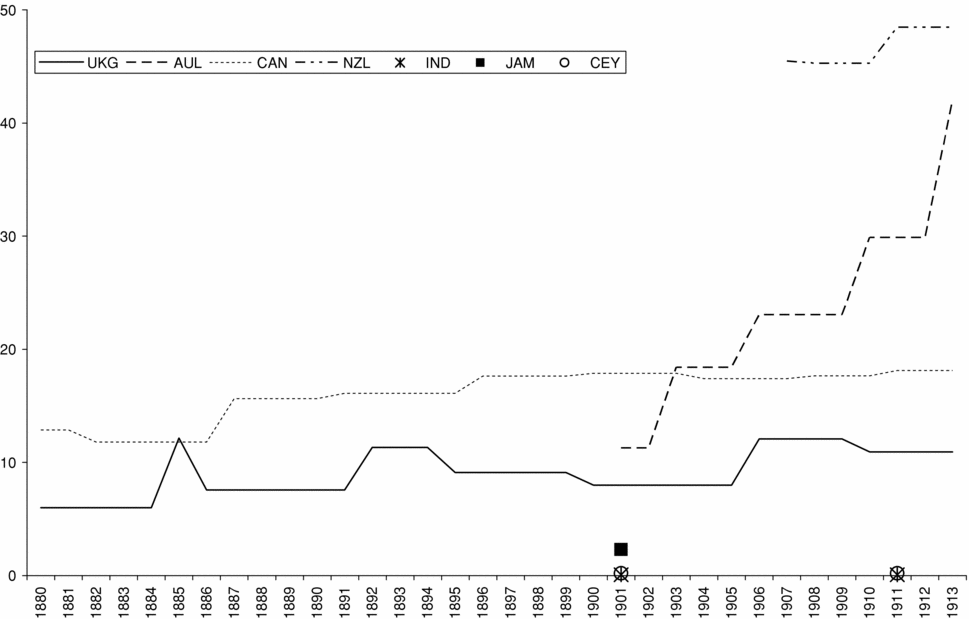
Figure 1 above provides a test. It shows the evolution of the proportion of the enfranchised population in a number of British colonies.Footnote 16 The figure reveals a striking divergence across the two groups of colonies – self-governing on the one hand and dependent on the other. Britain stands in between. As can be seen, our speculation that metropolitan concern over limiting the power of local governments ought to have encouraged the introduction of greater democratic representation is consistent with the data. Thus it is not correct to argue, as has been done before, that the ‘good’ institutions of property rights were merely transplanted from Britain to its offshoots. Democracy was really expanded beyond what existed in the metropolis. We suggest that it resulted not from a mere transplant of superior European principles, but from the rational need to monitor self-governing colonies. Greater degrees of local autonomy were traded against a deepening of judicial control and an extended franchise. This ensured that local governments were checked by local opposition, and local bondholders endowed with secured property rights. In the dependent empire, where coercion was available, the European institutions and ideals were laid to rest.
Political participation in the British colonies
3. Devolution and development
3.1. The simple analytics of empire
We now deepen our foray into the economics of colonial institutions and, to understand the incidence of governance frameworks on development, we construct a counterfactual analysis of the incidence of external control. As the opening quote suggests in a humorous way, this must be a difficult counterfactual.
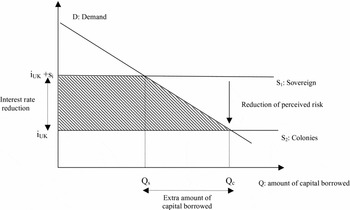
To begin, we discuss the incidence of the two alternative regimes identified above on external borrowing. For simplicity, we consider a small open economy framework, with a standard downward sloping demand curve for capital (Figure 2).Footnote 17 We suppose that sovereign bond spreads determine the cost of borrowing for governments and corporations.Footnote 18 Spreads measure perceived government default risks. This sets the price at which the country can borrow. Risk-neutral investors supply as much capital as needed at this price. Suppose now that the country becomes a colony. The supply schedule shifts downward, to coincide with the risk-free supply schedule (the intercept is the yield on British consols). The country now receives more capital, at a lower interest rate. The surplus from subjection is (Qs + Qc) · si/2.
Default risk and borrowing costs

This analysis applies to the case for self-governing, self-serving colonies only. For dependent ones, the British government had the final say over borrowing decisions. Previous historians have reported evidence of cyclical and structural constraints for both public and private borrowers in the dependent empire. David Sunderland argues that before 1900 British monetary and financial authorities imposed a priority rule on crown colonies. They could not tap the market when the independent area needed funding.Footnote 19 Richard Kesner gives evidence of crown colonies’ dissatisfaction with restrictive market access imposed by crown agents.Footnote 20 Davis and Huttenback also write about the ‘dependent colonies’ hesitancy [to borrow], a hesitancy that reflected at least in part the policy of the Colonial Office to use the London market’.Footnote 21 They add that, while ‘being a British colony, whether self-governing or dependent, provided a privileged entrée to the London capital market . . . dependent colonies were constrained from exercising this privilege too frequently’.Footnote 22
We suggest that rent-seeking behaviour may have helped sustain such a regime.Footnote 23 To see why, suppose that the authorities in London limit a given colony's capital imports. This maintains a wedge between rates of return (equal to the interest rates entrepreneurs would be prepared to pay given profitability of investment) and actual borrowing rates (equal to the risk-free rate at which entrepreneurs borrow from London). Agents who have access to both external capital and local investment opportunities (British firms operating in India controlled by British elites) can capture this rent and have an interest in the status quo. These agents would cajole the Colonial Office, India Office or the Exchequer into maintaining a high degree of financial repression since this amounts to protecting their rents. Similar phenomena are well documented in today's developing economies. In other words, rent seeking and the repression of democracy is clearly both a cause and a consequence of the regime of political control.
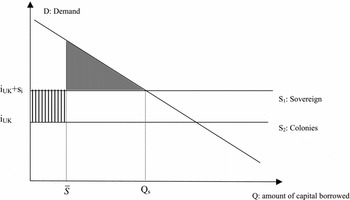
Suppose therefore that we revise the previous analysis and assume that London sets a cap ( ) on the total amount borrowed by the colony.Footnote 24 The country's surplus when sovereign is measured as before, but its surplus as a colony, given constraint , is a fraction only of what it was in Figure 2. If the cap is low enough, the colony loses from subjection.Footnote 25 When the counterfactual to sovereignty is becoming part of an entity subjected to financial repression, sovereignty is preferred despite the higher interest rates it entails. This is obviously the case in Figure 3.Footnote 26
The Gladstonian regime: India, crown colonies

3.2. Slave nations owing nothing
The previous analysis provides a measure of whether countries benefited from empire subjection. It rests on computing what we call the ‘subjection test statistic’. This test statistic is related to the consumer surplus as it is the product of the amount of external capital received by the colony and of the interest rate reduction from being a colony. The interest rate reduction is itself calculated by simulating the interest rate that would have been paid by the colony, had it had the same fundamentals after being freed, using the pricing model identified in Accominotti et al. (Reference Accominotti, Flandreau, Rezzik and Zumer2008) where borrowing costs for sovereign countries are a function of fundamentals.
The interest reduction thus computed is more adequately called a ‘pseudo-counterfactual’ than a counterfactual proper.Footnote 27 The reason is that, as the previous analysis shows, countries, when they become free, undergo a change of institutional regime and are bound to change their borrowing behaviour as a result. We shall discuss this in detail in the next section. At this stage, we note that in the case of a self-governing colony, sovereignty creates an incentive to borrow less owing to the emergence of default risk (Figure 2). Conversely, a dependent colony, if freed, would probably borrow more since the surplus from receiving more capital offsets the greater cost of capital (Figure 3).
We can readily see that the subjection test statistic is an upper bound for the actual surplus from being a colony. Moreover, as it is the product of two positive numbers it is bound by construction to be positive, while Figure 3 shows that for sufficiently low levels of borrowing, dependent colonies were actually losing from subjection. In general, it can be shown that there is a rank correlation between the subjection test statistic and the true surplus that ought to be computed from Figure 3. A very small measured surplus, arising from low borrowing totals, is a suspicion of colonial diseconomies. This is an important result that will help us interpret our later findings.
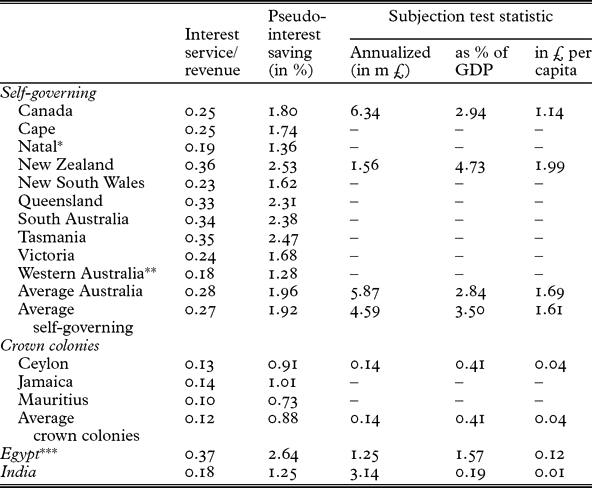
A rigorous interpretation of the subjection test statistic, therefore, is to recognize that, when the benefit from empire is very close to zero and when we are dealing with a dependent colony, the likelihood that colonial status will entail net losses is maximum, although there does not exist a distribution to test for this in a formal fashion. But in light of the previous theoretical discussion, the computation we provide is nonetheless a convenient starting point with heuristic value. In Table 1, therefore, we assess first the pseudo-interest-rate saving computed by comparing the actual price that colonies paid to that which they would have paid had they been priced as sovereigns, assuming that their fundamentals were the same. This saving is then multiplied by the amount of capital received.
The subjection test statistic
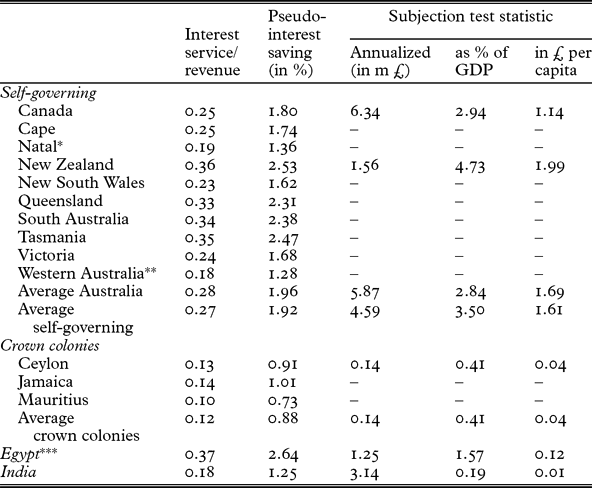
*: Crown colony until 1892 **: Crown colony until 1889 ***: 1886–1913 only.
Sources: Interest service / revenue and pseudo-interest saving: authors’ own dataset (see Accominotti et al. Reference Accominotti, Flandreau, Rezzik and Zumer2008) and computations (see text); capital calls: Stone (Reference Stone1999), except for Ceylon (data communicated by Jeffrey Williamson); GDP: Australia: Vamplew (Reference Vamplew1987); Canada: Urquhart (Reference Urquhart1993); Ceylon: data for GDP per capita kindly provided by Jeffrey Williamson (background data for Clemens and Williamson Reference Clemens and Williamson2004); India, New Zealand: Maddison (Reference Maddison2003); population: Australia, Canada, Ceylon, India, New Zealand: Maddison (Reference Maddison2003), Egypt: Mitchell (2003). Column 1: annual average of interest service / government revenue; column 2: annual average of pseudo-counterfactual interest reduction (see text); column 3: annualized subjection test statistic = Ki*(Ri,s−Ri,c)/Ruk, where Ki is the average amount of capital received by country i, (Ri,s−Ri,c) the average pseudo-interest reduction and Ruk the mean yield on UK's consol; column 4: annualized subjection test statistic as % of average 1880–1913 GDP; column 5: annualized subjection test statistic as % of average 1880–1913 population size.
Table 1 reports various items used for deriving our measure and thus enables one to track down the elements of the computation. The first column provides the annual average (over 1880–1913) of the debt burden (the interest service as a share of government revenue), the relevant element for pricing sovereign nations.Footnote 28 The second column gives the annual average of the pseudo-counterfactual interest reduction (the difference between the interest paid by the colony and the interest it would have paid, if sovereign). The last three columns provide variants of the ‘subjection test statistic’. Column 3 reports the interest rate reduction in column 2 times the average amount of foreign capital received (an indicator of the ‘benefit’ from subjection). This product is then compared to period-average GDP (column 4) and population (column 5).
The first striking conclusion from inspecting Table 1 is the very low results for dependent colonies. This arises because their governments do not display high indebtedness ratios, which is quite natural given the tight fiscal controls from London. When these ratios are factored into the counterfactual sovereign country formula, they yield borrowing terms that are not very much above British consols. In other words, it is difficult to identify a benefit from subjection in the case of dependent colonies, because dependent colonies had very small government debts, and would not have paid high premia had they been free and maintained similar fiscal stances. Moreover, we see that these countries were not very heavy total (government and private) borrowers either. Multiplication of the two items does not produce a very high subsidy and Figure 3 suggests that they were thus really losing out, since the likelihood is that they would have borrowed more had they been free.
By contrast, the governments of self-governing colonies display a much higher statistic. This arises from both terms. First, they had larger government debt ratios, which may be seen as a reflection of their not facing any fiscal constraint from London. When applied to the sovereign bond spread equation, these high debt burdens yield mechanically higher counterfactual borrowing costs. Their economies also borrowed a lot more and a combination of the two effects yields a non-trivial ‘benefit’ from subjection.
An intermediary case is Egypt. There, external control and de facto colonial status arose out of a fiscal crisis in the 1880s. Britain's takeover of Egyptian finances and government ensured that previous debts, once restructured, would be repaid. This caused Egypt's debt service to remain high, while control from London ensured that default risk would be non-existent. The subjection test statistic is thus higher than for dependent colonies, but on the other hand, the credibility transfer from British control was mostly used to service older unproductive debts rather than to issue new productive ones.
We end this section by saying that the simplest lesson from British colonial experience is that, as suggested in a quote from J. McDonald's book, ‘it is better to be a free nation deep in debt than a slave nation owing nothing’.Footnote 29 India, Ceylon, Jamaica and the other dependent colonies were slave nations, owed nothing and did not grow. Australia, New Zealand and Canada were heavy borrowers, governed themselves and developed.
4. Government borrowing and colonial regimes: a Lucas’ critique
We now conclude by taking a closer look at the problem of endogeneity. As already stated, colonial regimes had an impact on the supervision of public finance and must therefore have determined actual borrowing strategies. In this section, we derive a testable implication of this intuition.
To begin, consider the Egyptian experience. As indicated, its persistently high debt burden after 1880 was endogenous to its becoming a British colony at a time when its debts were already high. Had Egypt not been a colony, it might have considered a complete default on its external debts, as other sovereign countries did during that period (Hansen Reference Hansen1983). This is the essence of Lucas’ critique: reaction functions are regime dependent. A country's fiscal behaviour being determined by its institutional arrangements, it may not be reasonable to use the colonial regime's government debt burden as representative of what would happen in a counterfactual sovereignty regime.
In what follows, we go into greater detail and study the fiscal implications of colonial rule, focusing on the situation of self-governing colonies. One may think of colonial subjection as a way to reduce borrowing costs, the alternative being, for sovereign countries, fiscal consolidation (Flandreau and Zumer Reference Flandreau and Zumer2004). Therefore, in accordance with the previous analysis, the governments of self-governing colonies should be expected to accumulate public debt to an extent that is not seen in sovereign countries. This logic is illustrated by New Zealand's Premier Julius Vogel's policy of ‘Great Public Works’ during the 1870s, which took advantage of low borrowing rates to launch that colony on a ‘public-works spree’.Footnote 30 Similarly, Carlos and Lewis (Reference Carlos and Lewis1995) have emphasized the importance of government guarantees in the financing of Canadian infrastructures. An implication of this, therefore, is that, other things being equal, self-governing colonies should make greater use of government loans than sovereign countries. This is because colonial governments emerged as instruments that were particularly adapted for channelling external money, owing to institutional frameworks that made their debts credible.
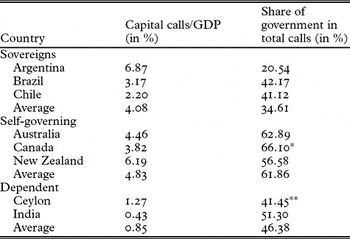
To test for this, we assembled statistics on the incidence of institutional arrangements in place in different groups of colonies and in sovereign countries as well. We provide evidence for the total amount of capital received in London between 1880 and 1913, and document the public/private breakdown. Self-governing colonies are represented by Australia, New Zealand, and Canada. Dependent entities are represented by India and Ceylon. Sovereign countries are represented by Argentina, Brazil, and Chile. We focus on these sovereigns because they used London as their principal conduit of foreign funding. Moreover, Argentina was a rich area, and in this respect provides a meaningful comparison with the rich colonies of the British Empire.
Table 2 describes London capital calls (1880-1913). The first column gives the average annual London call (as a share of GDP); the second gives the government share. Our predictions are borne out. We see that self-governing colonies are among the nations that received the highest amounts of capital (as a share of GDP), but sovereign countries could also receive a lot of external capital, as illustrated by Argentina. The real contrast between sovereigns and self-governing colonies is the composition of foreign capital received. In self-governing colonies a larger fraction of the capital was collected in the shape of government borrowing.
Financial repression and the composition of external borrowing, 1880-1913

Notes: *This is the sum of government calls and government guaranteed railway loans. **1878–1913.
Sources: Stone (Reference Stone1999), except for Ceylon (data communicated by Jeffrey Williamson). GDP numbers: Argentina: derived from Flandreau and Zumer (Reference Flandreau and Zumer2004) and Paolera and Taylor (Reference Paolera and Taylor2003), Australia: Vamplew (Reference Vamplew1987); Brazil: Flandreau and Zumer (Reference Flandreau and Zumer2004); Canada: Urquhart (Reference Urquhart1993); Ceylon: Data for GDP per capita provided by Jeffrey Williamson, data for population from Maddison (Reference Maddison2003); Chile: Braun et al. (Reference Braun, Braun, Briones, Diaz, Lüders and Wagner2000); India, New Zealand: Maddison (Reference Maddison2003).
For all that has been said about the fiscal ‘profligacy’ of Argentina, its government was a small borrower and could not become a conduit for foreign investments, unlike the ‘better-behaved’ countries in the self-governing group. The conclusion is that mollification of the market discipline constraint (compared to what sovereign countries experienced) may be taken as a crucial qualitative benefit of being part of the empire. Such is the essence of what we suggest to call ‘Vogelian economics’ – that empire encouraged less rather than more fiscal orthodoxy.
Finally, we note that, contrary to what some might have expected, the tight fiscal constraints upon dependent colonies did not crowd in private investment. This is obvious from the data on aggregate external capital and from the decomposition between private and public capital in Table 2. Had the fiscal orthodoxy imposed from London been a good thing, we ought to have observed a much smaller share of government borrowing in total capital calls for dependent colonies than for, say, Latin American countries, because restrained public borrowing would have crowded in private capital. But this is not what we observe. This finding, which is fully in line with our earlier theoretical considerations, is inconsistent with the motivation for externally imposed fiscal discipline that is occasionally found in the literature, namely that fiscal virtue, imposed by the white man on the black man, would crowd in private investment.
Of course, for those who doubt that government intervention can be fruitful, the previous evidence that empire encouraged debt accumulation can raise concerns. Longley (Reference Longley1981) shows the high degree of politicization of infrastructure spending in Canada. Carlos and Lewis (Reference Carlos and Lewis1995) provide evidence that suggests that the social returns on railway projects that enjoyed government backing were not very high. On the other hand, there also exists a benign view on the rise of government spending, as articulated by Lindert's (Reference Lindert2004) discussion of the rise of the welfare state, or Sachs’ (Reference Sachs2005) reappraisal of development policies. A full discussion of the extent to which enlarged government borrowing in British colonies was favourable to growth is beyond this article's reach. It would have to discuss subtle issues that relate to crowding in and complementarity. We note in passing the parallel between the implications of our findings and Lindert's welfare state free lunch puzzle. In both cases, public spending appears to have been associated with economic growth. We leave these interesting issues to future research.
5. Conclusions
This article has provided new theoretical and empirical insights into the economic incidence of colonial status in the British Empire. We found that countries that were politically managed and controlled from London (such as the crown colonies and India) displayed particularly modest public indebtedness ratios and borrowed little in aggregate. We constructed a test statistic that suggests that these entities lost from British subjection in terms of foreign capital exports originated in London. We also argued that the regime in place in dependent colonies and India was conducive to rent seeking, because it combined cheap access to capital for an elite, high rates of returns and caps on external borrowing. The subsequent poor economic performance these areas displayed may be viewed in relation with this finding.
Results were different for the white, self-governing, self-serving provinces, where external borrowing and government indebtedness were highest, and where the degree of autonomy was maximum. We found that the main effect of empire subjection, in these areas, was to encourage a growth strategy that involved massive government borrowing and spending. This happened because empire subjection provided investors with a hedge against default, for colonies were junior within the legal system available to both their British and local creditors. Had such a hedge not existed, these colonies would have had to make greater fiscal efforts, or else they would have faced substantially higher borrowing costs.
We conclude that the available variance within the British Empire suggests that the closest a country was to a regime resting on government of the people, by the people, for the people, the better it turned out to be. In effect, one possible interpretation of the success of public spending in self-governing territories is that it went along with a substantial measure of political participation and enfranchisement, which made local decision-makers accountable to their constituencies. This pretty straightforward conclusion (our American friends must have known it since the Boston Tea Party!) is obviously opposite to any suggestion that loss of sovereignty and the outsourcing of economic policy to gentlemen in London (or in Washington) could be good for a country's development.
Last but not least, we found that racism was instrumental in determining development outcomes within the British colonial Empire, through the impact it had on institutional frameworks. The widely accepted view, in the developed world of the time, that violence against native people was a legitimate policy played a crucial role in endowing dependent colonies with bad institutions. Had the white people of the time (British, French, or Americans) believed that the life of black people was worth as much as theirs, the growth prospects of the world would have been very different.
We started with a quote from Lord Cromer. We now conclude with an anecdote taken from Carl Jung's collection of essays Man and His Symbols. Jung recalls the case of a tribe from eastern Africa, whose members were said not to be dreaming at all. Upon closer inspection, however, it was found that every single member did dream, but the tribe believed that only dreams dreamt by the chief and the shaman were worthy of attention. The chief and the shaman reported a complication. They had stopped dreaming meaningful dreams a while ago. The event followed the arrival of British colonizers. Since that time, the tribe felt that the ‘district chief’ (the British colonial civil servant in charge of the tribe) was responsible for dreaming those privileged dreams that were destined to have a powerful influence on the tribe's everyday life and decision-making.
Acknowledgements
We are grateful to Gopalan Balachandran, Sara Bertin, Larry Neal, Cormac O'Grada, Albrecht Ritschl and Joachim Voth for comments on an earlier draft. We also thank participants to the First EuroClio conference in Paris, April 2008, and to the Oxford Seminar on International Financial Markets, Institutions, and Asset Prices during the First Era of Globalization, June 2008, for their comments and insights. Special suggestions and directions from Ann Carlos and Benoit Mario Papillon were extremely useful in revising the draft. Over the course of years, conversations with Jorge Braga de Macedo over the institutions of development and with Jérôme Sgard, over the historical evolution of bankruptcy procedures proved decisive in shaping our thinking. Vincent Bignon made us see what was missing in the previous draft. Extensive funding from the Chaire de Finances Internationales, Sciences Po, is gratefully acknowledged. Remaining misinterpretations remain ours.
Periodicals
The Economist
London Stock Exchange Official Intelligence