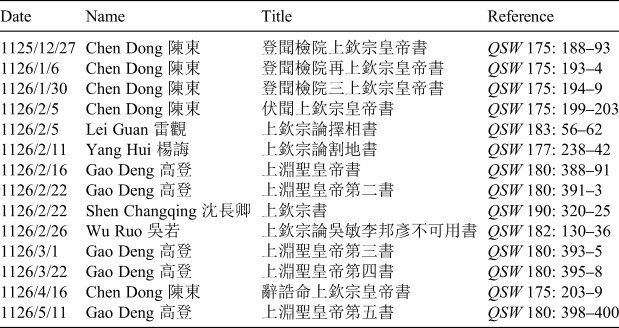
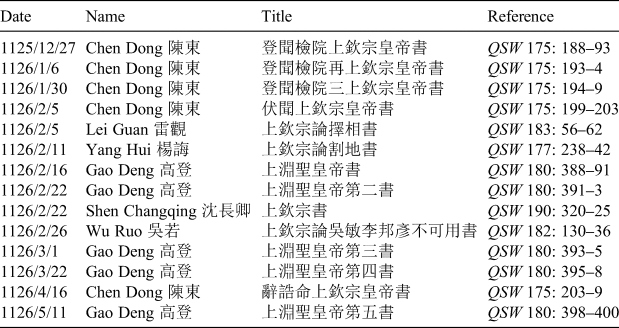
Students in China have actively participated in political movements in the past century, the most prominent of which include the May 4 movement in 1919, the June 4 movement in 1989, and more recently the Sunflower movement in Taiwan and the Umbrella movement in Hong Kong in 2014.Footnote 1 Student activism had been celebrated even earlier in the Chinese past. “Pure discussion” (qingyi 清議) was in vogue at the Imperial University (taixue 太學) in Eastern Han times (25–220), when students lavished praise on officials like Li Ying 李膺 (?–168) and Chen Fan 陳蕃 (90–168) (Zizhi tongjian 55: 1788; Sima Reference Sima1956). Between the years 150 and 165, university students even demonstrated at least twice over slanders against upright officials by influential eunuchs (Hou Hanshu 47: 3408 and 55: 3540, Fan Reference Fan1965). Political activism among students reached another climax in the Song period, burgeoning at the university since the reign of Renzong (r. 1022–1063), as a consequence of the rising power of remonstrators and policy review advisers (taijian 臺諫).Footnote 2 Later, the reformist administrations led by Wang Anshi 王安石 (1021–1086) and Cai Jing 蔡京 (1047–1126) did their best to silence students and minimize opposition to their policies.Footnote 3 Nevertheless, this spirit of defiance was never fully eliminated from the metropolitan schools, as students occasionally memorialized the throne individually, expressing contrary views on government policies or criticizing the misdeeds of repressive officials.Footnote 4 The Jurchen invasion further ignited the courage of university students to put forward proposals to save the country. As Thomas Lee (Reference Lee1985: 187) once noted, “the heightened sense of national urgency in the wake of incessant foreign encroachments no doubt served as another important incentive to the University students to demand a more responsive or aggressive government”. Six students or junior staff members at the Imperial University, namely Chen Dong 陳東 (1086–1127), Gao Deng 高登 (?–1148), Lei Guan 雷觀, Shen Changqing 沈長卿, Yang Hui 楊誨, and Wu Ruo 吳若, submitted a total of 14 memorials to Emperor Qinzong (1100–1161, r. 1125–1127) between 1125/12/27 and 1126/5/11 (see Table 1). Student endeavours climaxed on 1126/2/5, when Chen Dong and his fellow schoolmates prostrated themselves before the palace in remonstrance, a radical move that attracted tens of thousands of civilian supporters in Kaifeng, creating a mass demonstration that culminated in a massacre of eunuchs by the participants.Footnote 5
A list of memorials submitted by university personnel between 1125/12/27 and 1126/05/11
The precedent of collective action under Chen Dong prompted many Southern Song students to follow suit, gaining the attention of later scholars in the process. Existing scholarship on student activism in the late Northern Song focuses on Chen Dong and the mass demonstrations associated with him. The majority of these works attribute Chen's motivation to his righteousness, patriotism, loyalty, and political idealism.Footnote 6 Such a positive assessment owes much to a historiographical bias in connection with a “developing hagiography of Chen Dong” from the thirteenth century onward, as Hartman and Li (Reference Hartman and Cho-ying2015: 106) have thoroughly discussed in a recent article. Soon after Chen Dong's radical prostration in 1126/2, his reputation began to grow. What further boosted Chen's fame was his decapitation in 1127/8 subsequent to his fierce critiques of chief councillors Huang Qianshan 黃潛善 (?–1129) and Wang Boyan 汪伯彥 (1069–1141), an execution which was widely perceived as unjust. Since then Chen has been celebrated increasingly as a martyr to loyalty, to a degree that compilers of the official History of the Song Dynasty (Songshi 宋史) in the fourteenth century appended Chen's biography to the section “the loyal and the righteous” (zhongyi 忠義), while characterizing the officials that Chen denounced like Cai Jing, Huang Qianshan and Wang Boyan as “nefarious ministers” (jianchen 姦臣) (SS, 455: 13359–61 and 472: 13721–28 and 13743–47). Yet such a depiction, which generalizes Chen Dong's prostration and the mass protests as a loyal and righteous movement to eliminate treacherous ministers, somehow simplifies the picture of student activism in the late Northern Song. To what extent did other students share Chen Dong's view and demand the execution of Cai Jing? Instead of joining the prostration, some students submitted their petitions through less radical channels, as we will see below. Why did they behave differently from their radical schoolmate? It is interesting to note that students who joined Chen Dong came mostly from the south-east. What explains this intriguing phenomenon? Were there regional dimensions to political activism? These questions prompt us to investigate further the dynamics of student activism in the late Northern Song.
Moreover, a more fundamental question remains about what enabled university students to comment on politics. Instead of investigating the motives of Chen Dong, which can scarcely be discerned, this article aims to address the following questions: How sensitive were students to changing political conditions? In what ways did they gain access to political information? In addition, some of Chen Dong's schoolmates refused to join his radical acts of prostration and resorted to other channels to memorialize the court. How responsive was the Song court to student petitions submitted through the various channels? This paper presents a chronological examination of the 14 memorials of a political nature submitted by university personnel to Qinzong, thereby exploring the responsiveness of students to changing political circumstances as well as the court's treatment of student petitions. Student sensitivity to political incidents, I would argue, owes much to the existence of different communication channels that facilitated the circulation of political information within literati circles.
The endeavours of Chen Dong and his schoolmatesFootnote 7
Upon defeating the Khitan Liao (907–1125), the Jurchen Jin (1123–1234) started to invade the Song in 1125.Footnote 8 In light of the ominous threat posed by the Jurchen, Emperor Huizong (r. 1100–1125) abdicated power. He was succeeded by his eldest son Zhao Huan, known as Emperor Qinzong, on 1125/12/23.Footnote 9 Just four days after Qinzong's accession, university student Chen Dong and some schoolmates fell prostrate before the palace gate, while memorializing the emperor. Chen was a native of Danyang 丹陽 county in modern Jiangsu province. Having been admitted to a county school in 1102, at seventeen sui, Chen was promoted to the Imperial University in the Song capital of Kaifeng 開封, which by 1111 was one of the very top public schools in the country for the recruitment of officials. In Chen's day, the Imperial University, located in the south of the imperial palace within the walled city, received nearly 4,000 students nominated from the prefectures.Footnote 10 According to the biographical sketch (xingzhuang 行狀) of Chen Dong composed by his younger brother Chen Nan 陳南, Chen refrained from fawning on influential officials or courting potential patrons as other students did, despite repeatedly failing promotion examinations for the 15 years of his tenure at the Imperial University (QSW 182: 326–7). Even though the above account from a potentially biased source may have exaggerated the virtues of Chen Dong, it reflects his upright character, as demonstrated through his scorn for powerful officials who exploited their power to pursue self-interest. This sense of uprightness perhaps explains his demand to execute the so-called “six thugs” (liuzei 六賊) formerly associated with the now-deposed Emperor Huizong, led by Grand Councillors Cai Jing and Wang Fu 王黼 (1079–1126), palace eunuchs Tong Guan 童貫 (1054–1126), Liang Shicheng 梁師成 (?–1126), Li Yan 李彥 (?–1126), and finally, the architect behind the costly Flower and Rock Network (huashi gang 花石綱), Zhu Mian 朱勔 (1075–1126).Footnote 11
In this memorial, Chen Dong delineated various misdeeds of the six treacherous ministers, based on what he heard from different channels. According to Chen, “people from border areas” (bianren 邊人) informed him about Tong Guan's failure to enforce military discipline and to dispense reward and punishment fairly (QSW 175: 189). From “rumours picked up on the road” (daolu zhi yan 道路之言), he learned that Cai Jing had aggrandized his merits concerning the installation of Zhao Huan, who later became emperor Qinzong, as heir apparent (QSW 175: 192). Li Yan's illegal confiscation of land and disruption of social order is another transgression that Chen heard from the others, though he did not disclose his source of information in the memorial (QSW 175:190). Irrespective of whether Chen had indeed obtained the information through the means that he claimed, frequent usage of the phrase “your subject heard…” 臣聞… in Chen's memorial, I believe, tends to be a tactic to make his appeal more persuasive. In fact, a similar rhetorical strategy was adopted in other memorials of Chen Dong and his schoolmates, as we will see below.
It was standard practice for memorials to be submitted through the Public Petitioners Review Office (Dengwen jianyuan 登聞檢院), a formal institution established to solicit opinions from the public.Footnote 12 Yet Chen exploited the most direct means possible – prostrating before the palace gate in protest. Chen reportedly once discussed his radical plan with his schoolmate Pan Qi 潘祺, who agreed with the plan, although he refused to join him out of concern for the wellbeing of elderly parents. Chen resolved to proceed with his protest before the palace, as a consequence of his friend's support.Footnote 13
Pan's declining to take part suggests a certain angst about the potential consequences of Chen's plan – perhaps even loss of life. This may explain why other schoolmates hesitated to join him. In their view, Cai Jing and Wang Fu had monopolized court affairs for years and possessed formidable political networks. Such a concentration of powers in the hands of a single minister, according to Charles Hartman, can be traced back to the reign of Zhezong (r. 1085–1100) when the authority of the super-councillor Lü Gongzhu 呂公著 (1018–1089) transcended the checks and balances that Emperor Shenzong (r. 1067–1085) imposed on ministers in the 1082 institutional reforms.Footnote 14 The establishment of the Advisory Office (jiangyi si 講議司) and the Frontier Defence Office (jingfu fang 經撫房) under Cai Jing and Wang Fu respectively further facilitated the chief ministers’ control of different administrative organs.Footnote 15 It is therefore not surprising that Chen Dong's schoolmates, in receiving the radical plan of their fellow student, reasoned that the political influence of Cai and Wang could hardly be shaken. We are told that some students changed their minds and joined the prostration only after reading Chen's memorial in draft form (QSW 182: 330). Gao Deng from Zhangzhou 漳州,Footnote 16 Jiang Zhiyi 江致一 from Shezhou 歙州,Footnote 17 Chen Zhao 陳昭 from Wuzhou 婺州,Footnote 18 Lü Zhen 呂禎 from Qianzhou 虔州,Footnote 19 Feng Ruzhou 馮汝舟 from Mianzhou 綿州,Footnote 20 and Chen Chaolao 陳朝老 from Jianzhou 建州Footnote 21 were among the students who staged this protest in front of the palace gate alongside Chen Dong on 1125/12/27. The majority of these students hailed from prefectures in the south-east. Other students who might have participated include Wei Yu 魏郁 from Nanjianzhou 南劍州,Footnote 22 Huang Ruli 黄汝礪 and Hu Yi 胡沂 (1107–1174) from Yuezhou 越州,Footnote 23 and Huang Jia 黄嘉 from Yuanzhou 袁州.Footnote 24 Unfortunately, surviving sources say little about their lives and activities as students at the Imperial University or the nature of their relationship with Chen Dong.
Neither do the sources show exactly how the court reacted to this ardent appeal from students. Although the Qinzong Veritable Records (Qingzong shilu 欽宗實錄) stipulates that the court subsequently adopted the various recommendations of Chen Dong (CBJSBM 148: 4628), we should be mindful that the court did not immediately remove from power all six of the so-called “thugs”. Emperor Huizong still held residual influence over court affairs, so it took Qinzong a few days or even months to purge the entire group: days after Chen Dong's protest, the court ordered Zhu Mian to return to his hometown, Wang Fu, to be demoted and banished, and Li Yan to be executed on 1126/1/3.Footnote 25 Nine days later on 1126/1/12, Liang Shicheng was demoted and banished to the south (JKYL 1: 142–3). The edict ordering the demotion of Cai Jing and Tong Guan came as late as 1127/2/26.Footnote 26
Subsequent to Chen's dramatic protest, school officials led by Director of Education Xie Kejia 謝克家 (?–1134), Vice-Director Gai Wangzhi 盖望之and university professor Sun Di 孫覿 (1081–1169) interrogated Chen Dong about his motives. We learn that Chen kept his silence and gave no answers, then retreated after bowing respectfully to teachers (QSW 182: 330). Xie and Sun were promoted to censorial positions on 1126/1/2, probably as reward for criticizing the disruptive activities of students, a threat to social stability.Footnote 27 A day later, on 1126/1/3, the punishments for Zhu Mian, Wang Fu and Li Yan were announced.Footnote 28 Likely for fear of a harsher dispensation, Zhu Mian left the capital in the middle of that night by joining Huizong intimates like Cai Jing and Tong Guan to the south-east (JKYL 1: 95). Aware of the removal of several “thugs” that his first memorial brought about, Chen Dong saw justice as still unfulfilled, inasmuch as Zhu, Cai, and Tong managed to elude the death penalty by fleeing to the south-east. He therefore submitted a second memorial on 1126/1/6 through the Public Petitioners Review Office, probably in order to avoid creating trouble for school officials. In Chen's view, the three “thugs” accompanying Huizong to the south were particularly dangerous, as a consequence of their sway over Fujian and Zhejiang and the potential for splitting the Song regime in two. He thus pleaded with Qinzong to invite Huizong and his entourage back to the capital to stand their deserved punishment.Footnote 29 Chen's second memorial, unlike the first, failed to attract the court's attention, because the emperor and his senior statesmen were preoccupied with plans to counter the Jurchen invasion.Footnote 30
On 1126/1/7, the Jurchen armies started attacking Kaifeng, and the Song managed to fend off the invaders after strengthening the city's defence under the direction of Right Executive Assistant of the Department of Ministries (shangshu youcheng 尚書右丞) Li Gang 李綱 (1083–1140), a member in the Council of State.Footnote 31 The two sides remained locked in a stalemate after a few days of skirmishes. This emboldened the Jurchen to demand an unacceptably large indemnity and the cession of Taiyuan 太原, Zhongshan 中山, and Hejian 河間, three northern prefectures of high strategic value, to secure a truce.Footnote 32 The Qinzong administration, then led by Li Bangyan 李邦彥 (?–1130), who was promoted to senior grand councillor (taizai 太宰) on 1126/1/7 (JKYL 1: 109–10), consented to the requests on 1126/1/11 (JKYL 1: 137). For the rest of the first month of 1126, the Song court exhausted every effort to accumulate sufficient resources to meet the Jurchen demand, while paying little attention to punishing Cai Jing and Tong Guan. The court's lack of responsiveness prompted Chen Dong to submit a third memorial on 1126/1/30, again through the Public Petitioners Review Office. Apart from reiterating his demand to execute Cai Jing, Tong Guan and Zhu Mian, Chen cited the crimes of the eunuch Liang Shicheng according to what he heard, demanding his execution as well.Footnote 33 (When the memorial was written, Chen probably did not realize that Liang had died en route to Huazhou 華州, his place of exile, a day earlier on 1126/1/29.Footnote 34) Chen attributed certain underserving nominations for the palace examination in 1124 to Liang Shicheng's corruption, as he heard that Liang recommended candidates who bribed him with seven to eight thousand cash irrespective of their scholarly credentials (QSW 175: 196). Even Liang's illicit deeds in the inner court could not escape Chen's attention, as Chen was informed that Liang fawned on those who enjoyed the emperor's favour and even usurped the sovereign's authority stealthily. In order to support his accusations, Chen emphasized that most of Liang's treacherous behaviour quoted in the memorial came from “words of scholar-officials” (jinshen zhiyan 縉紳之言)(QSW 175: 195). Considering that Chen Dong had a commoner family background,Footnote 35 the scholar-officials he referred to are likely to be officials he came across in the Song capital, or his schoolmates. Being a student who spent nearly two decades at the Imperial University, it is reasonable to surmise that Chen had developed an extensive social network in the city of Kaifeng.Footnote 36 Chen's informants, I suspect, were probably members of his social network with whom had close ties, but this can hardly be verified as Chen did not disclose their identities in the memorial.
Apart from reiterating the misdeeds of Liang Shicheng that he heard from different channels, Chen Dong also shared popular rumours away from the capital regarding Huizong's predicament:
Yesterday your subject heard a rumour from fellow pedestrians that Gao Qiu recently received a letter from elder brother [Gao] Shen and others, which alleges that when the retired emperor arrived at the Southern Capital, he initially did not wish to proceed. Yet several thugs kidnapped him and forced him to proceed… All pedestrians hold their wrists tightly and weep [upon hearing this]. Even though your subject may be extremely stupid, but I do know something about loyalty and filial piety. When I learned of the incident, I cannot help crying profusely, with tears extending down to my chest. I feel indignant for your majesty.Footnote 37
臣昨日聞諸道路之言曰,高俅近收其兄伸等書報,言上皇初至南京,不欲前邁,復爲數賊挾之而前…道路之人莫不扼腕流涕。臣雖至愚,粗知忠孝,傳聞此事,不覺涕淚流臆,爲陛下憤。
Chen then urged Qinzong to issue two edicts, the first encouraging those troops protecting Huizong to exercise due diligence and a second inviting the retired emperor to return to the capital. Again the court took no action.
Meanwhile, the arrival of more relief armies in 1126/1 caused hawkish ministers like Li Gang and Chong Shidao 种師道 (1051–1126) to believe that the Song had gained the upper hand against the invaders. They advocated a repudiation of the peace accord and an aggressive posture with the Jurchen. On 1126/2/2, several Song regiments launched a surprise night time attack on Jurchen encampments, but they did not prevail. The pro-appeasement Grand Councillor Li Bangyan then suggested demoting the hawkish Li Gang in order to appease the Jurchen. The emperor concurred, causing both Li Gang and Chong Shidao to be demoted on 1126/2/3.Footnote 38 After Chen learned of Li Gang's demotion, he drafted another memorial on 1126/2/4 (QSW 175: 203). He implored the court to remove the pacifist Li Bangyan and all members of the state council who supported appeasing the Jurchen and ceding the three prefectures. Chen also acknowledged the popular support enjoyed by the hawkish minister Li Gang and urged the emperor to reinstall Li and Chong Shidao. He urged the emperor to summon to court virtuous officials like Xu Churen 徐處仁 (1062–1127) and Tang Ke 唐恪 (?–1127) in order to benefit from their counsel (QSW 175: 199–203).
Rather than submit his appeals through the Public Petitioners Review Office, in the manner of his second and third memorials, Chen Dong took a more radical approach this time. His schoolmates Gao Deng and Jiang Zhiyi, who joined him in prostrating themselves before the palace earlier, continued to follow him. Other students also soon participated, including Yuan Dacheng 阮大成 from Fuzhou 福州,Footnote 39 Chen Hao from Quanzhou 泉州,Footnote 40 Feng Song 馮宋 from Puzhou 普州,Footnote 41 Xia Yingda 夏穎達 from Raozhou 饒州,Footnote 42 and Liu Quan 劉銓.Footnote 43 At dawn on 1126/2/5, they kept vigil at the palace gate while waiting to pass their memorials personally to the emperor.
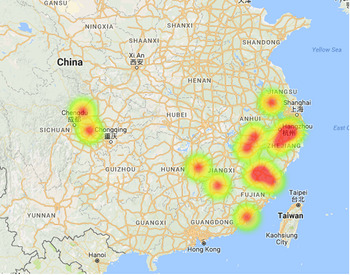
Like those who joined the first acts of prostration as protest, most of the aforementioned students were native to the south-east, and none came from the capital or its immediate environs (see Figure 1). What is different from the first prostration on 1125/12/27 is that almost 100,000 civilians joined the student protesters this time. What explains the much larger scale of the second prostration? The fact that none of the students who joined the first were punished, and that the court subsequently took heed of Chen Dong's petition and penalized the “six thugs” somehow left the protesters with the impression that submitting appeals through prostration could be a relatively safe and effective communication channel. Moreover, some people might worry about the residual influence of the “six thugs” and hence hesitated to join the first prostration to demand their execution. In contrast, the demand in the second prostration to restore the widely acclaimed war hero Li Gang sounds less controversial, which may explain why many civilians joined Chen Dong and his schoolmates. They amassed in front of the palace, murmuring “Unless Li Gang and Chong Shidao are restored, we will refuse to return [to campus].”Footnote 44 非見李右丞、种宣撫復用,毋得歸。 When the court meeting ended and officials prepared to leave via the Donghua 東華 gate, the crowd surrounded and denounced Li Bangyan, throwing tiles and rocks at him. Someone even grabbed Li by the hair, intending to bite him, forcing him to flee to offices for the Bureau of Military Affairs.Footnote 45 When emperor Qinzong learned of the matter, he asked guards at the palace gate to pass along the student memorials. Sometime later, the emperor conveyed the following message to students through an intermediary: “I have already read your memorials, which clearly demonstrate your loyalty and righteous intent. Your suggestions will be implemented, in due course.”Footnote 46 諸生所上書,朕已親覽,備悉忠義,當便施行。
Heat map of the geographical distribution of the native places of students who joined Chen Dong's prostrations on 1125/12/27 and 1126/2/5

As an expediency, the head of the Palace Command's armies (dianqian shi 殿前師), Wang Zongchu 王宗濋, advised emperor Qinzong to embrace the masses by restoring Li Gang and Chong Shidao, since a revolt might break out. The emperor agreed to restore Li Gang as a political expedient and sent a succession of eunuchs to retrieve Li forthwith. But a eunuch named Zhu Hongzhi 朱拱之 (?–1126) somehow delayed transmission of the message, which in turn caused the masses to castigate Zhu as “rebel” and slay him. Mass hysteria ensued and the irate mob slaughtered dozens of eunuchs with rare brutality. Only after witnessing the restoration of Li Gang and Chong Shidao did the murderous throng disperse. Edicts were soon promulgated to restore civil order, but occasional violence against eunuchs continued for several days.Footnote 47 The slaughter of eunuchs is a manifestation of public grievances against their dominance and corrupt practices, which seemed to have worsened since the reign of Huizong.Footnote 48 Interestingly the court seemed to have turned a blind eye to the crowd that killed the eunuchs, as no one was arrested and charged, an unconventional action that suggests a lack of efficacy for the beleaguered court. Hence Qinzong's swift response to Chen Dong's prostration as protest and his immediate concession to protestors should also be considered an exceptional breach of regulations and protocols.
On the same day Chen Dong prostrated in protest before the palace, his schoolmate Lei Guan, a native of Sichuan, also submitted a memorial, probably through the Public Petitioners Review Office. Unlike Chen Dong, who refused to curry favour with influential officials, we are told that Lei, as a University student, often attempted to fawn on Cai Jing through his fellow Sichuan townsman Feng Ji 馮楫 (1075–1152), then a University rector (xuezheng 學正).Footnote 49 Despite behaving differently at school, Chen and Lei both criticized Grand Councillor Li Bangyan in their memorials, though Lei failed to advocate the restoration of Li Gang. In fact Lei's memorial starts by explaining the reasons for his submission, namely, communication channels had been blocked for over two decades under Cai Jing's sway, when the court commonly suppressed critiques of policies and ignored opinions from a wider public. Lei himself had refrained from commenting on politics as a consequence. Only after Qinzong's edict inviting wider input from officials did Lei dare to express his own views.
Lei Guan explained in the memorial the matter the court needed to address first: the appointment of capable Grand Councillors; after this it could take up secondary concerns such as rectifying policies or designing defence strategies. In his view, if capable Grand Councillors were appointed, their subordinates would act with greater circumspection. Yet the Grand Councillorship, Lei argued, had been devoid of able ministers for decades. Even though people across the realm welcomed Qinzong's purge of the mediocre Bai Shizhong 白時中 (?–1127), they were disillusioned by the elevation to Grand Councillor of Li Bangyan and Zhang Bangchang 張邦昌 (1081–1127). Lei set forth the malpractices of Li and Zhang since Qinzong's accession: courting favours from influential officials, forming factions, promoting favouritism, and relinquishing responsibilities. As assistant councillors in the former court of Huizong, they failed to deliberate long-term policies. Li and his cronies had supported the cession of lands for the sake of appeasing the Jurchen, news garnered informally by Lei as “rumours picked up on the road”.Footnote 50 Lei therefore urged Qinzong to remove the pair from office to facilitate court debate while boosting the morale of senior officers in the military. In this way, the Song would no longer need to cede the three prefectures and the Jurchen would retreat.Footnote 51 Although Qinzong did not immediately heed the advice of Lei by removing Li Bangyan, he conferred Lei an official title on 1126/2/6, one day after his forcefully written memorial.Footnote 52
This brief summary of the memorials submitted by Chen Dong and Lei Guan shows that university students were highly sensitive to changes in political context. On the heels of Huizong's abdication, Chen demanded summary executions for the “six thugs”. Three days after Huizong left the capital,Footnote 53 Chen Dong submitted another memorial advising Qinzong to stop his father's trip. After Chen and Lei learned that Li Bangyan had sought the demotion of Li Gang, they prepared their own memorials in two days, requesting the restoration of Li Gang and removal of Li Bangyan. The question should be how did university students obtain information on political events. Chen Dong and Lei Guan recalled in their memorials that they learned about the hardships of the retired emperor and Li Bangyan's ceding of territories through “rumours picked up on the road”.Footnote 54 The following discussion of the memorials submitted by university students and personnel after the prostration protests will provide further hints about how students accessed political information.
The story of Chen Dong shows that he exploited two different channels of communication to address the court: the Public Petitioners’ Review Office, and prostration in protests before the palace. The former was the traditional and legitimate channel for expressing opinion, while the latter was a more radical and even coercive mechanism for addressing the court. Ironically, the court was unresponsive to Chen's appeals submitted through conventional channels, but promptly acted to restore Li Gang, under student pressure (JKYL 2: 231). The court's response to Chen's petitions not only acknowledges the failure of conventional channels of communication to achieve results, but also gave university students and the literati in general the impression that prostration as protest was the most effective way to force the court into action. This may explain why an increasing number of Southern Song university students used prostrations as a political weapon.Footnote 55 Indeed, some Southern Song scholar-officials, led by Neo-Confucian moralist Wei Liaoweng 魏了翁 (1178–1237), chose to sanction such radical activity by the outer court, including the Imperial University (QSW 309: 127).
It is noteworthy that the students who joined Chen Dong in the two celebrated demonstrations came mainly from peripheral areas in the south-east, not from the historical heartland of Henan and Shandong, suggesting that political controls were more efficacious in the capital and its environs. The propensity of southerners to engage in political activism may well reflect perceptions or misperceptions informed by surviving sources, since the records about student activism tend to come from local gazetteers, where the south had greater resources to lavish on gazetteers.Footnote 56 It is also possible that students from the south-east had more grievances against Huizong, whose costly Flower and Rock Transportation Network disproportionately affected the south. Yet not all students from the south-east were inclined towards extreme forms of resistance like demonstrations. Yang Yuan 楊愿 (1101–1152), a student from modern Jiangsu, echoed Chen Dong's praise for Xu Churen's and Li Gang's achievements. Yet he refused to participate in prostrating before the palace, despite residing in the capital at the time of the two demonstrations.Footnote 57
A sizeable number of Chen's schoolmates from the south-west (Sichuan) were less inclined to vociferous demonstrations like kneeling before the palace. Gao Hongfu 高宏甫, a Qiongzhou 邛州 native with close personal ties to Chen Dong, refused to join in public acts of prostration, sources suggest, despite residing in the capital at the time (QSW 311: 90). Another Sichuan native Lei Guan shared Chen Dong's view that Li Bangyan should be removed. He chose to memorialize the palace through regular channels, without joining in the more emotionally evocative prostrations before the palace. Since Chen Dong's schoolmates were few in number, no definitive conclusions can be drawn about the extent to which the geographical background of students influenced their acts of political protest. Clearly, students had individual agendas and faced unique sets of circumstances at home as well as at school, e.g. Pan Qi's overarching concern for elderly parents.
Student responsiveness to political exigencies
On 1126/2/7, two days after the second prostration, two officials, Li Zhuo 李梲 and Cai Mao 蔡楙, memorialized Qinzong, characterizing the mobilization of the masses by university students as subversion (JKYL 2: 359). Remonstrator Sun Di concurred,Footnote 58 agreeing about the need for maximum punishment for student provocateurs. Qinzong shunned immediate action, although Li and Cai proceeded to ask the Director and Vice-Director of Education to expel student leaders like Chen Dong, thus infuriating them. The strict measures proposed by the hardliners at court failed to silence all students, and some continued to submit petitions when deemed appropriate. Six days after the violent protest, on 1126/2/11, university student Yang Hui submitted a memorial, protesting the court's decision to cede the three prefectures in exchange for a truce. Unlike his schoolmates’ fierce denunciation of the Grand Councillor Li Bangyan, Yang focused primarily on Song policies towards the Jurchen:
After the peace accord was first pronounced, the Song relinquished arms and tried to seduce the enemy with material things. When I first learned of the palace pronouncement, I thought Your Majesty acquiesced in the tactics of the barbarians to dominate in order to spare the capital the usual harm of plunder and occupation. … Ten days later, widely spread rumours [about appeasement] have left your subject bewildered.Footnote 59
首發講和之詔,仆械卷銛,以厚利啗之。臣初聞命,以謂陛下此舉特以驕夷虜跋扈之志,紓畿甸攻掠之危…而旬日之際,道路所傳,臣竊惑之。
Having concluded that the cession of territory was a fait accompli based on credible rumours, Yang cited three serious consequences of forfeiting strategic lands. Should the Jurchen control the three prefectures, the Song court would need to relocate its capital for the insecurity of Kaifeng, with its difficult-to-defend topography. In addition, afterwards the Jurchens would probably be corrupted by the materialism of the three prefectures, their greed producing arrogance over the years. The insatiable Jurchen would certainly continue to pillage the Song, Yang predicted, precisely as the defence strategies and topographical conditions of the Song were no longer state secrets. Moreover, Yang believed that the Song could never maintain a lasting peace by ceding its buffer with the north, as the Jurchen were genuine opportunists given to exploiting every opening. Rather than appeasing the Jurchen, Yang called upon the court to adopt an aggressive stance against the invaders. With the loyal support of Li Gang, the deft strategies of Chong Shidao, and the backing of seasoned officials Wu Min 吳敏 (1089–1132) and Geng Nanzhong 耿南仲 (?–1129), Yang believed that the Song might indeed succeed (QSW 177: 238–42). Even though most of Yang's schoolmates respected Li Gang and Chong Shidao in similar fashion, they did not share Yang's positivity towards Wu Min, a man soon to become a target for students.
Senior grand councillor (taizai 太宰) Li Bangyan pleaded to resign on 1126/2/12, probably in response to the public grievances against him, as shown by the mass protest of 1126/2/5.Footnote 60 Two days later, on 1126/2/14, Wu Min was promoted to junior grand councillor (shaozai 少宰),Footnote 61 a move that disappointed many because of Wu's partiality. Two days later on 1126/2/16, university student Gao Deng submitted a memorial through the Public Petitioners Review Office denouncing both Wu Min and Li Bangyan. He was inspired by Wu's support of his notorious colleague Li, as shown on Wu's public notice of which Gao read on 1126/2/12 and noticed that Wu had previously defended Li's innocence and proposed material rewards for Li.Footnote 62 Gao recalled that when the residents in Kaifeng learned about the content of the public notice, they sneered, sighed, or even wept in the first instance, leaving the site disillusioned. According to Gao, the public were even more disappointed after Wu's promotion two days later.
After exposing popular resentment against Li Bangyan and Wu Min, Gao Deng proceeded to argue that the newly acceded Qinzong, who many envisioned as potential sage kings like Yao and Shun, should purge evil ministers in their entirety. Gao then summarized Li's many treacherous deeds: “[Li] promotes petty men by assigning them important duties, while dismissing gentlemen, as if herding them into the deepest abyss. Legal strictures and political order are perverted, in this way, leaving ordinary people anxious and resentful. In addition, [he] deceives the former emperor [i.e. Huizong] with empty promises that produced the crisis of the preceding day.”Footnote 63 引小人而加膝,擠君子於深淵,紀綱紊亂,民庶愁怨,方且以治安之言誘誤上皇,以致昨日之禍. Gao considered Wu Min disloyal in the extreme, since he deceived Qinzong by not alerting him to the widely recognized evils of Li Bangyan. After Wu Min assumed high office, he failed to make meaningful contributions, though people still expected Wu to behave like an upright official. Only until Wu openly supported Li Bangyan did they feel despair, according to Gao.
Towards the end of the memorial, Gao Deng recommended that Qinzong elevate six officials of moral repute. He nominated Huang Cong 黄琮 from Fujian, Feng Xie 馮澥 (1060–1140) from Sichuan, and two former university students, Huang Cishan 黄次山 (?–1139) and Zu Xiushi 祖秀實 (c.1101–c.1170); Xu Churen and Tang Ke had been recommended earlier by Chen Dong, Gao's political ally. Gao invited the court to ascertain the virtues of the four men through administrators in Fujian and Sichuan, their places of origin, along with Imperial University personnel (QSW 180: 388–91). It is noteworthy that three of these four men had superficial ties to Gao, with Huang Cong hailing from Fujian, while Huang Cishan and Zu Xiushi were probably classmates at the university.
Gao Deng's memorial did not originally solicit an imperial response, much like Qinzong's reaction to the two memorials of Chen Dong submitted in 1126/1. Perhaps it was intercepted before reaching the emperor. Wu Min nonetheless remained in office as junior grand councillor, prompting Gao Deng to submit a second memorial on 1126/2/22, six days later, and continue his denunciation of Wu Min. He first reiterated that his opinions had emanated from “a weighing of public sentiment, review of literati opinion, consideration of past incidents, and concern for relevance today”.Footnote 64 審民情,摭士論,稽往古,驗當今. He then rebutted the so-called achievements and capabilities of Wu Min. Wu deserves no personal credit for the enthronement of Qinzong or the retreat of Jurchen armies, Gao Deng insisted, inasmuch as the abdication had been decided by the former monarch, while the Jurchen retreat was a result of paying the enemy off. In addition, Wu Min's unjust denunciation of Li Gang and continued support for Li Bangyan reflects the measure of his ineptitude. Wu offered sanctuary to Li as a payment of political debt, Gao argued, since Wu had been spared under the leadership of Li Bangyan when officials who enjoyed Cai Jing's patronage were expelled. In the closing passages of the memorial, Gao Deng advised Qinzong not to shelter Wu Min for personal reasons, like Li Bangyan.Footnote 65 His emotionally evocative memorial failed to win a positive response from the emperor.
In the meantime, there were frequent changes in the court's attitude towards university students. As noted earlier, many students were considered in violation of the school regulations and expelled, which caused Vice-Director of Education Huang Zhe 黃哲 to blame himself for failing to educate the youth, requesting due punishment on 1126/2/15. In response, Qinzong admitted that students had been motivated by loyalty and righteousness and reassured Huang Zhe that school officials would not be held responsible for the uprising.Footnote 66 Yet Li Zhuo and Cai Mou further persuaded Wang Shiyong 王時雍 (?–1127), then prefect of Kaifeng, to arrest and execute the student leaders and commoners who had joined the mass riot.Footnote 67 We are told that Wang Shiyong had even told students from his hometown to leave the school, warning that armies from the Palace Command would soon arrive.Footnote 68 In the context of heightened tensions, Nie Shan 聶山 (alias Nie Chang 聶昌, 1079–1127), having succeeded Wang Shiyong as the prefect of Kaifeng, submitted a memorial to the emperor on 1126/2/18, reminding him “not to allow loyal and righteous persons to die at the hands of treacherous ministers”.Footnote 69 忠義之人不死奸臣之手 Qinzong heeded Nie's advice and spared the students.
In fact, Qinzong preferred a mix of carrot-and-stick in addressing conditions at the Imperial University. On the one hand, he replaced the existing Director of Education on 1126/2/19 with a veteran scholar widely respected by students, Yang Shi, a disciple of Cheng Yi 程頤 (1033–1107).Footnote 70 On the other hand, Palace Command's armies stationed on the university campus posted the following notice, with imperial seal, threatening execution by the rules of martial law for student offenders:
In the context of the court opening up channels for remonstrance, civilians, military personnel, commoners, along with examination candidates should limit themselves to constructive statements in the spirit of loyal devotion. I will read them personally, determine whether they are relevant, and act accordingly in a gradual manner. As regards students and commoners gathering at the palace gate to submit memorials with the intent of creating disorder, similar deeds in the future will lead to arrest and execution by the Three Capital Guards, as dictated by the rules of martial law.Footnote 71
朝廷方大開言路之時,應文武下士庶秀才等,宜以忠嘉之言讜論建陳,當用納親覽,於其可否,一一施行。然有似此伏闕上書為名者,意在作亂之人,仰三衙立便收捉,當行軍法。
Activities at the Imperial University remained under the close surveillance of Wang Shiyong and Wang Zongchu, Head of the Palace Command's armies. The latter was even authorized to execute offenders before reporting to the emperor.Footnote 72 What explains the court's changing attitude to students? University student Shen Changqing attributed the inconsistencies to the malign influence of ministers like Wu Min and Li Bangyan and petitioned the throne to change its hard line and reward loyal students.Footnote 73 After highlighting contradictory responses occasioning the mass protests, Shen's memorial on 1126/2/22 described how the masses responded to Wu Min's public notice in support of Li Bangyan, probably the same one that Gao Deng viewed on 1126/2/12:
Several days ago, Your Subject observed that Grand Councillor Wu Min had prepared a statement defending the evils and exposing the achievements of Li Bangyan. Written in large characters, the statement was posted as public notices on the streets. All pedestrians reading them could only sneer.Footnote 74
臣又觀前日宰相吳敏有爲李邦彦辯奸慝暴白功狀,大書文榜,揭之通衢。行道之人莫不嗤笑。
Shen affirmed public contempt for Li Bangyan and Wu Min by citing particular acts of evil by the two councillors. Li Bangyan was known for his indecency in actions and words as a youth, securing a speedy promotion by courting powerful officials. According to Shen, Li also failed to alert the emperor of the dangers of collaborating with the Jurchen, an act of gross ineptitude. Ironically, Wu Min had renounced Li Bangyan's treachery and exaggerated his public pronouncements, which in Shen's view merely distorted reality in something of a public spectacle. Shen then described how university students perceived Li Bangyan and Wu Min, both cronies of Cai Jing. Wu defended Li in order to enhance thefaction's power at court, an act of self-interest. By reiterating the consensus among University students about Wu Min, Shen reminded Qinzong of the need for resolve against evil ministers like Wu.Footnote 75At the end of his memorial, Shen cited the following conversation with a schoolmate:
Your parents both reside in a place surrounded by four walls [and few amenities]. Your reason for living frugally as you pursue studies at the Imperial University is to offer your parents the security of an official salary [in the future]. Yet you utilize harsh and even perverted words in admonition of the Son of Heaven above and in repudiation of the Grand Councillor below. This will surely be the cause of your death!Footnote 76
子堂上有二親,家唯四壁,虀鹽大學,苟爲升斗之禄將以養親。而爲狂直之言,上以諫天子,下以忤宰相,吾謂子無死所矣。
The statement above highlights the dilemma students faced about whether to render forcefully written opinions to the court or participate in a wider set of political activities. How to balance loyalty to state and filial devotion to family? Shen Changqing reaffirmed the loyal motivations behind his political stand when addressing the throne. For the time being, Shen's words had yet to draw the ire of the court, much like the memorial of Gao Deng in the past.
Four days later, a rector at the Imperial University, Wu Ruo, submitted a similar memorial, opposing Qinzong's continued use of Li Bangyan and Wu Min. Li Bangyan's response to the Jurchen invasion was both stupid and disloyal, in Wu Ruo's view. Rather than pacify civilians near the capital and defend Song lands until death, Li packed his personal belongings and escorted his family to safety, while convincing the emperor to flee the capital. Wu Ruo also blamed Li for his failure to remonstrate against the northern expedition that ultimately exhausted the country's resources and its will to win; banditry became rampant and government institutions grew corrupt as a result. What made Wu Ruo even more dissatisfied with Wu Min is that the latter exaggerated the merits of the depraved Li Bangyan in a memorial: “Li Bangyan has assisted the former emperor in replacing Grand Councillors and reforming government policies for over a year. The pacification of bandits in Shandong and Hebei owes much to his efforts as well.”Footnote 77 李邦彦輔佐上皇,自前歲以來,罷易宰相,更革政事,定山東、河北之寇,皆出其力.
Wu Min lent assistance to Li Bangyan, as Wu Ruo speculated, because of his favourable standing with Cai Jing and Cai You 蔡攸 (1077–1126). Wu Ruo then cited public opinion to enhance the veracity of his assertions, so-called “literati opinion” (shilun 士論), which regarded Wu Min as closely allied to Cai You. (The two men had collaborated to facilitate the enthronement of Qinzong on the heels of Huizong's abdication.) Wu Min's relationship with Cai You, according to Wu Ruo, is also inferred from the fact that he only exposed the misdeeds of the former Grand Councillor Wang Fu, not Cai You's father, Cai Jing, probably in retribution for Wang's earlier dismissal of Wu. In addition to failing to act impartially to punish Cai Jing and Cai You, Wu Min was also condemned for attempts to block the communication channel between the emperor and his subordinates, while accusing unjustly Li Gang and Chong Shidao, likening them to imperious ministers in the mould of Gao Kuan 高歡 (496–547) of the Northern Wei dynasty (386–534). Wu Ruo thus advised the emperor to recruit talented officials, not the likes of Li Bangyan and Wu Min. In the final section of the memorial, Wu discussed the fiscal problems caused by Huizong's extravagant rewards for subordinates, reminding Qinzong to be more prudent.Footnote 78
Apart from memorializing the throne, Wu Ruo also sent a letter to vice-censor-in-chief (yushi zhongcheng 御史中丞) Xu Han 許翰 (?–1133), a supporter of Li Gang and Chong Shidao, restating the aforementioned criticisms of Wu Min, whose misdeeds should rightfully be reported to the emperor (QSW 182: 137–41). After reading Wu Ruo's memorial, a furious Wu Min reportedly arrested Wu Ruo and expelled him from Kaifeng; he might well have died at the hands of Jurchen troops patrolling the suburbs (JKYL 9: 940). Despite failing to end Wu Min's tenure as Grand Councillor, the impact of Wu Ruo's memorial within literati circles should not be underestimated. After all, printers in Kaifeng had reproduced copies of the memorial that were for sale at many markets in the city (JKYL 9:970), which clearly violated the edict of 1121/4 prohibiting the unauthorized circulation of such materials.Footnote 79
The fact that Wu Min was retained as Grand Councillor provoked Gao Deng to write a third memorial on 1126/3/1. Gao first cited personal anguish at the court's lack of responsiveness to his earlier appeals. If Qinzong respected his opinion, Wu Min would have been demoted long ago; if Qinzong deemed his recommendations ill-advised, then punishment for the petitioner himself should have ensued. Gao then cited historical precedent to illustrate how the quality of Grand Councillors impacted on the fortunes of dynasties. When a capable minister like Yi Yin 伊尹 (1648–1549? bce) assumed power in the Shang dynasty (seventeenth–eleventh centuries bce), the government managed to reverse failures; whereas the evil likes of Li Linfu 李林甫 (683–753) presided over chaos in Tang times (618–907). Gao demanded greater prudence in the selection of Grand Councillors in his own day.
Emperor Qinzong's decision to side with Wu Min ran against the wishes of the masses, Gao argued. The survival of the Song regime so soon after the Fang La 方臘 (?–1121) rebellion and then the Jurchen invasion owes much to expectations that the present emperor would atone for the previous ruler's excesses. By entrusting state affairs to Wu Min, Gao alerted the emperor to the risk of losing the goodwill of the people, the former solidarity of polity dissipating on short order. Gao Deng urged the emperor to remove Wu Min and Zhang Bangchang from the councillorship and expel disloyal officials like Zhao Ye 趙野, Li Zhuo, Wang Xiaodi 王孝迪 and Wang Shiyong, or risk losing the mandate. In addition, he also encouraged Qinzong to promote the six talented officials mentioned in his first memorial.Footnote 80
Two days after Gao Deng's submission of his third memorial, Li Zhuo was removed from the State Council.Footnote 81 A day later, Qinzong chose to demote Zhang Bangchang, while elevating Xu Churen to the Grand Councillorship.Footnote 82 Another official recommended by Gao in his memorial, Tang Ke, was also promoted to executive at the Secretariat (zhongshu shilang 中書侍郎) on 1126/3/3.Footnote 83 Gao was surely glad to know that some of his recommendations had been adopted, although his memorial may not have been a deciding factor. Wu Min and Wang Shiyong nonetheless remained in office, while the other three talented officials previously recommended by Gao Deng had yet to be promoted.
At roughly the same time, a rumour was rife among the masses that Qinzong was planning to invite his father's wife, Empress Zheng (1079–1131), to reside in the Imperial Palace and lend assistance as regent, according to a memorial on 1126/3/11 (JKYL 3: 462–3). Investigating Censor (jiancha yushi 監察御史) Yu Yingqiu 余應求 confirmed the rumour in his memorial of 1126/3/12 (JKYL 3: 472). Empress Zheng did return to the capital on 1126/3/19, where Qinzong held a formal reception (JKYL 4: 531). Gao Deng probably learned of the rumour during the Empress's welcome reception. He initially believed that the gossip was intended to instil frictions between Qinzong and Huizong, the retired emperor. But days later, after reading a memorial of an official, Gong Duan 龔端, he appreciated the increased likelihood of a regency under discussion. He then submitted his fourth memorial to the throne on 1126/3/22, where he advised Qinzong to take sole responsibility for governing the realm, as neither Huizong nor Empress Zheng genuinely wished to intervene (QSW 180: 395–8). He alerted Qinzong to the “nefarious” aims behind the rumours, while reiterating the need to remove from office Wu Min and Wang Shiyong.Footnote 84 Gao Deng's experience reveals much about how university students in the late Northern Song accessed political information, namely by paying attention to gossip and reading official memorials of the recent past.
The determined student campaign against Wu Min failed to lead to his ouster becoming Grand Councillor, although student rhetoric did serve to alert Wu to his notoriety at the university. To redeem his reputation, Wu proposed conferring examination degrees upon Chen Dong on 1126/3/28 in reward for loyal and righteous deeds.Footnote 85 Qinzong agreed, granting Chen the official rank of gentleman of merit (digong lang 迪功郎) while appointing him assistant rector at the Imperial University (taixue lu 太學錄) on 1126/4/9 (JKYL 5: 627). Four days later on 1126/4/13, the edict of appointment from the Department of Ministries (shangshu sheng 尚書省) reached Chen Dong, who declined the offer, his reasoning stipulated in another memorial on 1126/4/16.
Chen acknowledged his desire for official service, so long as he went through ostensibly proper channels such as civil service examinations or school promotion. He did not expect to be rewarded for his memorials expressing points of view in the context of a state of emergency. Chen continued to advise Qinzong that the appointment of a minor figure like himself did not deserve imperial concern, unlike the urgency of “purging petty men, promoting gentlemen, rectifying government affairs and expelling the barbarians”Footnote 86 退小人,進君子,修政事,攘夷狄. Chen attributed the court's failure to address these vital issues to the emperor's lack of resolution and the cronyism of senior officials. Imperial indifference is reflected in the fact that the notorious Councillor Cai Jing had yet to be executed, but instead enjoyed the protection of senior officials. Chen Dong denounced Cai's treachery and urged summary execution for him and his sons (QSW 175: 204–9).
Chen Dong also asserted in his memorial that his earlier palace prostrations emanated from a spirit of loyalty and righteous duty. This likely represents a rebuttal of accusations against Li Gang by others. Such an attack on Li Gang, by his own account originated from discord between him and Geng Nanzhong, the Left Executive Assistant at the Department of Ministries (shangshu zuocheng 尚書左丞). In an imperial audience on 1126/3/27, Geng accused Li of encouraging Chen Dong and his schoolmates to undertake palace prostrations.Footnote 87 This incident was cited in Chen Dong's memorial of 1126/4/16, which shows that students outside the imperial palace somehow had access to information about presumably private imperial audiences. Unfortunately, Chen Dong fails to mention how he obtained this piece of information apart from expressing a sense of being confounded by coming across the accusation in the memorial (QSW 175: 206).
Unlike many schoolmates, Chen Dong refused to censure Wu Min for his support of Cai Jing. Wu Min's earlier recommendation to grant Chen an official title may well have discouraged the student from denouncing the Grand Councillor with greater ferocity. However, Wu's strategy still failed to silence other students, most notably Gao Deng. In his fifth memorial, submitted on 1126/5/11, Gao Deng once again urged the emperor to demote Wu Min. Qinzong's unresponsiveness, in Gao's view, represented a refusal to consider alternative opinions, as evidenced in the emperor's response to his court ministers:
Your subject has heard that when Grand Councillors proffered their advice and policy-critique advisers forwarded their opinions [on an earlier day], Your Majesty's written replies often included words like “We are already resolute in mind” and “We are not fond of this in mind”. This is because Your Majesty hated others discussing you and used such phrases to cover up mistakes and wrongdoings.Footnote 88
臣側聞前日宰相所獻,諫官所論,陛下批答有曰 ‘朕志素定’,有曰‘朕志所不好’,此陛下惡人議己,而自爲遂非文過之詞。
After cross-checking with other contemporary Song sources, the phrase “We are already resolute in mind” 朕志素定 seems to appear for the first time in Qinzong's written reply to Grand Councillor Xu Churen (SZFBNL 13: 845). It is hard to imagine how Gao Deng, an ordinary university student, came to know the exact wording that Qinzong employed in addressing the Grand Councillor.
Concern about the mere appearance of imperial arrogance as a potential inhibitor of candid discourse prompted Gao Deng to conclude that the Song might be on the verge of collapse, much like the Qin dynasty (221–206 bce) succumbed to the arrogant ineptitude of its emperors. To save the country, Gao suggested that Qinzong should rightfully learn from Emperor Taizong of Tang (598–649, r. 626–649), who was humble in receiving remonstrance from his subjects and atoned for past mistakes. But if Qinzong removed Wu Min from office, Gao was willing to present additional initiatives to the emperor, including ten strategies necessary for the dynasty's survival.Footnote 89 The memorial failed to sway the throne, although it managed immediately to offend its target, Wu Min, who encouraged school officials to bring charges against Gao Deng.Footnote 90 The student was forced to return home, although some months later on 1126/8/26, Wu Min was ultimately purged as junior grand councillor.Footnote 91
In sum, the memorials submitted by university students and personnel after the mass protests shared several similarities. Apart from following a common factionalist rhetoric that praised the officials whom they supported as gentlemen while denigrating political enemies as petty men,Footnote 92 writers of these memorials often alluded to some vague “opinions of the people” to give their own opinions more clout. The responses of the masses who learned of Wu Min's support of Li Bangyan, as acknowledged in memorials by Gao Deng and Shen Changqing, or the perception of Wu Min as a crony of Cai You, to which Wu Ruo alludes, both represent examples arguably of “public opinions”. Through the incorporation of “public opinions”, writers of the memorials skilfully transformed their personal opinions into the collective views of the people – rhetoric more appealing to the emperor.
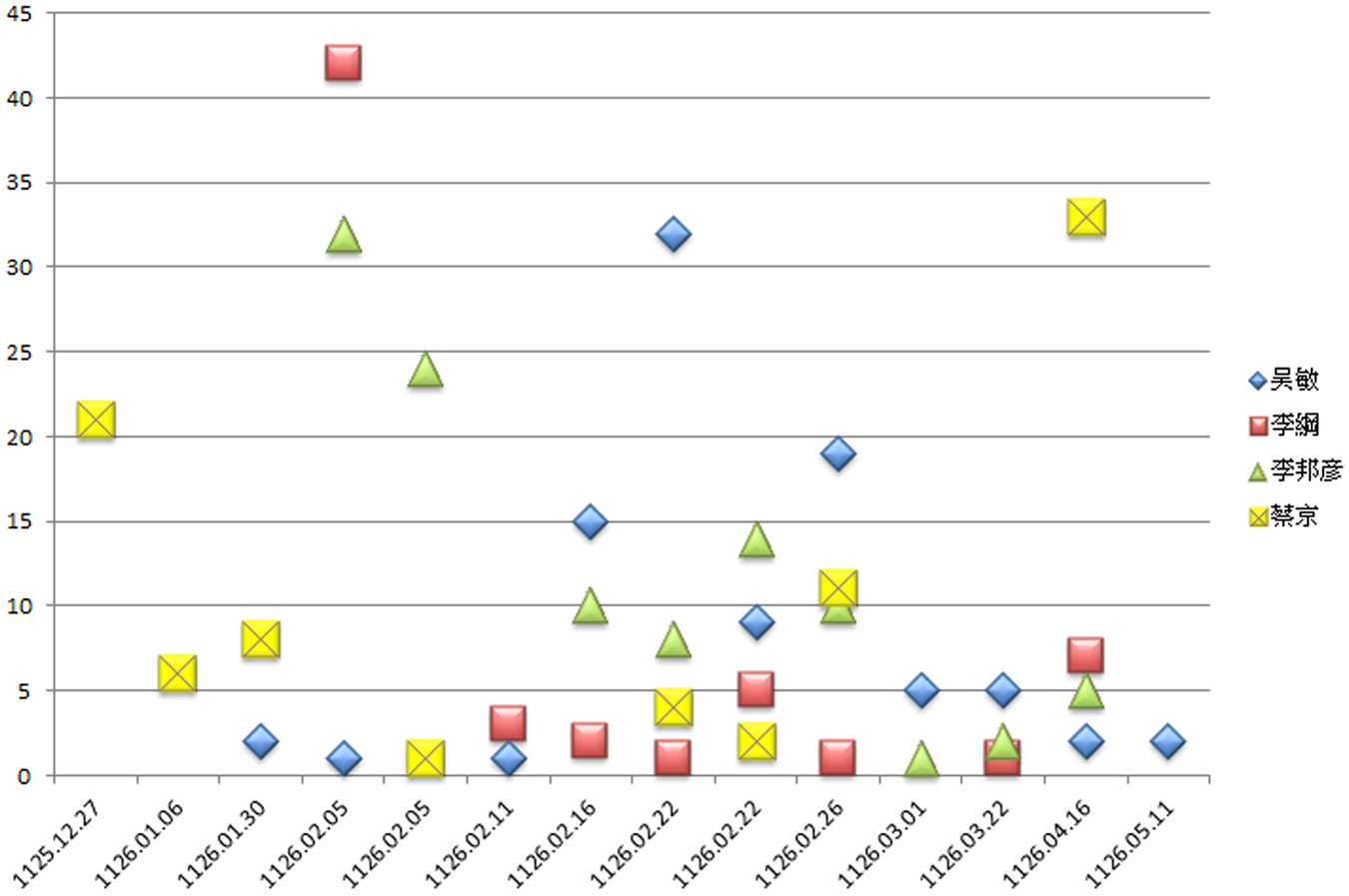
University personnel were highly sensitive to changing political conditions in memorializing the court. Their responsiveness is reflected in perceptions on Wu Min before and after the circulation of statements in support of Li Bangyan. Yang Hui continued to hold Wu Min in high regard, based on his memorial of 1126/2/11. Yet Wu's image underwent a drastic change within five days. In response to Wu's statement that appeared as public notice, which likely caught students’ attention on 1126/2/12, and Wu's subsequent promotion to junior grand councillor on 1126/2/14, Gao Deng, Shen Changqing, and Wu Ruo submitted four memorials between 1126/2/16 and 1126/2/26 that fiercely criticized Wu Min and urged his removal from office. Even though students perceived that Li Bangyan far surpassed Wu Min in evil deeds, Li was not yet the primary target in the four memorials, it would appear, as his name appears far less frequently than Wu (see Figure 2). This is due partly to the writers’ awareness that Li had already been removed from office on 1126/2/14,Footnote 93 a sign of political sensitivity within the university community.
A count of prominent political figures mentioned in students’ memorials submitted between 1125/12/27 and 1126/05/11
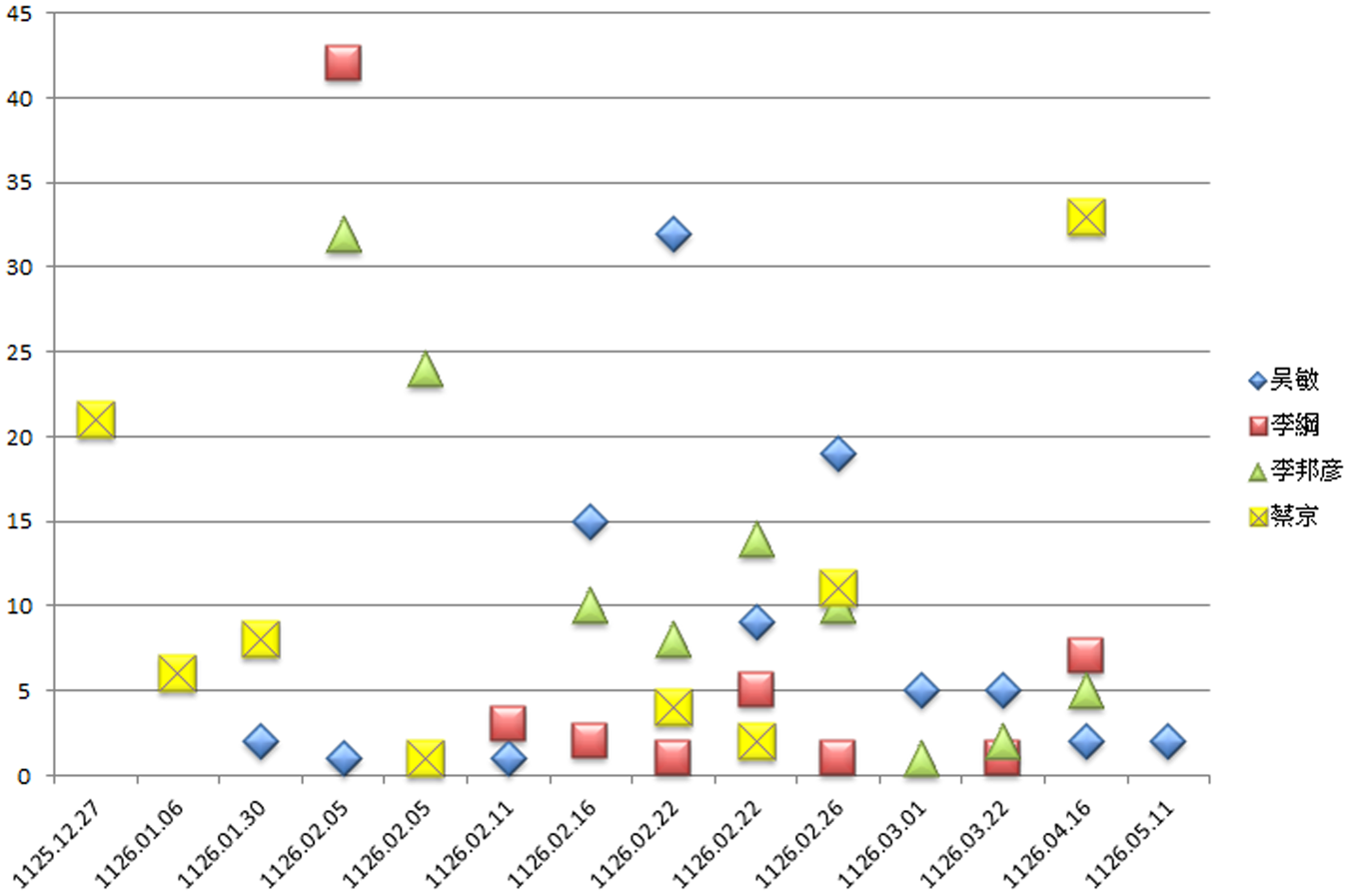
Student sensitivity to political incidents appears to correlate to their access to recent political currents, which include the promotion and demotion of officials, policy deliberations at court, and even the details of debates among senior officials during imperial audience. This owes much to the prevalence of different communication channels that facilitated the circulation of political information within literati circles in the late Northern Song. Public notices showing Wu Min's support of Li Bangyan, which many students alluded to; gossip that Gao Deng and Chen Dong heard about Qinzong's plan to co-govern with Empress Zheng, and Geng Nanzhong's accusation against Li Gang; and printed copies of Wu Ruo's memorial available for sale in the market all represent some of the many channels revealed by student memorials. The physical proximity of the university campus to the Chief Memorials Office (du jinzou yuan 都進奏院) and the residences of influential court officials, all of which were located in the south of the imperial palace,Footnote 94 suggests that students could easily come across political dignitaries and might hear gossip from their well-informed “neighbours”. Gao Deng's reference to Gong Duan's memorial, and Qinzong's response to Xu Churen, also suggest that government documents circulated widely within the literati circle in the late Northern Song likely benefitted from what Hilde De Weerdt calls “the commercialization of state documents”Footnote 95 and a flourishing print culture.Footnote 96
Partly in response to the ever-increasing demand for political information within the literati circle, some commercial printers collaborated with staff members working in the Chief Memorials Office to spread such information through the printing of inauthentic court gazettes and “short reports” (xiaobao 小報). The court's prohibition of the compilation and circulation of the former in 1110/10 attests to how widespread they were in the late Northern Song.Footnote 97 Zhou Linzhi's 周麟之 (1145 jinshi) memorial of 1156 mentions that clerks in the Chief Memorials Office divulged political information in “short reports” composed by them, which circulated within literati circles across the realm.Footnote 98 I suspect printed materials like inauthentic court gazettes and “short reports”, which likely included personnel movements in the civil and military services as well as memorials of officials to the emperor, were also channels for university students to access the most current political information.
Moreover, it should be noted that students in some cases used the phrase “Your subject heard that…” 臣聞… in their memorials to avoid stating where they obtained the information. In effect, this was a means by which students protected their sources, most often friends and relatives then serving in government offices. Since such highly sensitive information was supposed to be confidential, people leaking it to students faced certain punishment. Even though students’ memorials often lacked verifiable proof of the leaked source, we can speculate based on notebooks (biji) compiled by Song contemporaries, such as Sima Guang's 司馬光 (1019–1086) Sushui jiwen 涑水記聞 (A record of hearsay from Su River) and Wang Mingqing's 王明淸 (1127–a.1214) Huizhu lu 揮麈錄 (Waving the duster). Comprehensive studies of the identity of the author's informants revealed in these notebooks suggest that it was common for Song literati to share political information with their relatives, colleagues and friends.Footnote 99 The various channels allowed students to exhaust every avenue to access sensitive news through relatives and friends, public notices, and everyday rumours. The networks of political communication in the early twelfth century,Footnote 100 I believe, laid the foundation for student activism.
Concluding observations
This paper employs a chronological sequence in discussing the 14 memorials submitted by university personnel between 1125/12/27 and 1126/5/11 in response to the political crisis of the Song court. The court's lack of responsiveness to Chen Dong's memorials submitted through the Public Petitioners Review Office in 1126/1 led him to believe that the proper communication channel had been blocked. For fear of failing to reach the emperor with important input, Chen adopted a more radical means on 1126/2/5 – prostrating himself before the palace. Tens of thousands of civilians in Kaifeng joined Chen and his schoolmates in protest, and the crowd slaughtered dozens of eunuchs perceived to be thwarting communications. Chen Dong was condemned as a result, since his prostrations and the massacre of eunuchs were seen by some officials as an unacceptably coercive tactic.
Interestingly, another university student, Lei Guan, was rewarded for offering “loyal advice” on the same day as Chen Dong's prostration. Lei similarly advocated for the purge of Li Bangyan, but he did not join in the palace prostrations and presumably communicated through the Public Petitioners Review Office. The contrast between the fates of Chen Dong and Lei Guan suggests that the court in the late Northern Song was still sceptical towards students expressing their opinions through palace protests. Yet the court's swift response to Chen Dong's prostrations through the restoration of Li Gang clearly encouraged other students to imitate Chen in applying extra political pressure to the court. Frequent prostrations before the palace increased the legitimacy of such practices over a century later, in the late Southern Song.
A brief analysis of the geographical background of students who joined Chen Dong in prostrating themselves before the palace shows that students from the south-east tended to be more radical than their counterparts from Sichuan and the Central Plain. Yet no definitive conclusions can be drawn for the correlation between geographical background and political behaviour due to the small sample in the analysis. Besides, how students expressed their opinion depended on individual needs and the circumstances facing them. As shown in Pan Qi's conversation with Chen Dong and the succinct remarks of Shen Changqing's schoolmate, some students refrained from participating in radical activities for fear of bringing trouble to their families, especially those from more humble circumstances.
A close examination of all 14 memorials reveals certain commonalities between the students and their appeals. In their memorials, they employed a highly moralistic tone, praising officials they supported and denouncing their enemies. They also frequently used vague allusions to “public opinion” to make their appeals more persuasive. Lastly, they were very sensitive to changing political currents. Once the target of their memorials had been demoted, they targetted other “treacherous” ministers still in power. Within five months in late 1125 and early 1126, their target shifted from Cai Jing, to Li Bangyan, and finally to Wu Min. Such sensitivity suggests that students could utilize different channels to access political information. Everyday rumour, public notices, political documents sold at markets, and relatives and friends currently in office allowed students to learn of personnel movements in the civil and military services, policy deliberations at court, and even events at an imperial audience. Such a vibrant network of political communication enabled students to remain politically active, despite prohibitions under the preceding reformist administration.
Lastly, this analysis of 14 memorials by university students in 1126 changes our cursory understanding of student activism in the late Northern Song. First, few students were as radical as Chen Dong in his confrontational approach to matters. The majority were more like Lei Guan, Yang Hui, and Wu Ruo, who expressed their views through traditional channels. Even Chen Dong submitted three out of five memorials through regular channels. Moreover, students had a diverse set of motives for taking political action: the label “patriotic” employed in the past is something of an oversimplification. Furthermore, the targets of student criticism were not solely the “six thugs”, as they subsequently denounced other senior officials like Li Bangyan and Wu Min.
Abbreviations
- CBJSBM
Yang Zhongliang 楊仲良. 1988. Huang Song tongjian changbian jishi benmo 皇宋通鑒長編紀事本末. Nanjing: Jiangsu guji chubanshe.
- CBSB
Huang Yizhou 黃以周. 2004. Xu zizhi tongjian changbian shibu 續資治通鑑長編拾補. Beijing: Zhonghua shuju.
- GMBY
Chen Jun 陳均. 2006. Huangchao biannian gangmu beiyao 皇朝編年綱目備要. Beijing: Zhonghua shuju.
- JKYL
Wang Zao 汪藻. Reference Wang2008. Jingkang yaolu jianzhu 靖康要錄箋注. Chengdu: Sichuan daxue chubanshe.
- QSW
Zeng Zaozhuang 曾棗莊 and Liu Lin 劉琳. 2006. Quan Song wen 全宋文. Shanghai: Shanghai cishu chubanshe; Hefei: Anhui jiaoyu chubanshe.
- SCBMHB
Xu Mengxin 徐夢莘. 1987. Sanchao beimeng huibian 三朝北盟會編. Shanghai: Shanghai guji chubanshe.
- SCGY
Li Zhi 李埴. 2013. Huangsong shichao gangyao jiaozheng 皇宋十朝綱要校正. Beijing: Zhonghua shuju.
- SHY
Xu Song 徐松. 1936. Song huiyao jigao 宋會要輯稿. Peking: Guoli Beiping tushuguan.
- SS
Tuotuo 脫脫 et al. 1977. Song shi 宋史. Beijing: Zhonghua shuju.
- SZFBNL
Xu Ziming 徐自明. 1986. Song zaifu biannianlu jiaobu 宋宰輔編年錄校補. Beijing: Zhonghua shuju.