Introduction
The majority of cancers occur in the elderly population, and more than 60% of new cases are diagnosed in older individuals (Aapro et al., Reference Aapro, Kohne, Cohen and Extermann2005). Colorectal cancer (CRC) is one of the most common cancers in older people, with a median age of presentation in the seventh decade of life and more than two-thirds of patients aged 65 or older (Folprecht et al., Reference Folprecht2004). The prevalence of CRC and the high proportion of cases in the elderly population is expected to increase with anticipated demographic changes. Depression and anxiety, which occur in approximately 30%–40% of all CRC patients (Tsunoda et al., Reference Tsunoda, Nakao, Hiratsuka, Yasuda, Shibusawa and Kusano2005), are the most prevalent psychological disorders in patients with CRC, especially in those with advanced-stage diseases (Rabkin et al., Reference Rabkin, McElhiney, Moran, Acree and Folkman2009; Medeiros et al., Reference Medeiros, Oshima and Forones2010). Several researchers have presented reasonable evidence that CRC patients who had psychiatric morbidity, such as depression or anxiety symptoms, appeared to have poor survival and a lower quality of life (Aarstad et al., Reference Aarstad, Aarstad, Heimdal and Olofsson2005; Gripp et al., Reference Gripp2007; Chan et al., Reference Chan, Wan Ahmad, Md Yusof, Ho and Krupat2015). Moreover, it is abundantly clear that depression and anxiety in older people, alone or in combination, affect physical illness in a reciprocal relationship that deteriorates mental and physical health (Stommel et al., Reference Stommel, Kurtz, Kurtz, Given and Given2004; Bryant et al., Reference Bryant, Jackson and Ames2009). It is important to explore the link between cancer and psychological disorders in older people with metastatic colorectal cancer (mCRC).
Older mCRC patients usually experience depression and anxiety because of repeated chemotherapy, limited knowledge of disease condition, economic problems, and even the side effects of treatment. In addition to being influenced by CRC, depression, and anxiety states are influenced by genetic background, and genetic factors contribute to approximately 40% of cases in patients (Thapar et al., Reference Thapar and McGuffin1996; Kendler et al., Reference Kendler and Prescott1999). Although previous studies have associated cancer-related symptoms, including psychological disorders, with certain genetic polymorphisms (Reyes-Gibby et al., Reference Reyes-Gibby2008; Pirl et al., Reference Pirl2011), the relationships between psychiatric morbidity and the genetics of mCRC have not yet been explored.
K-ras oncogene (KRAS) is one of the most important oncogenes in CRC and has a mutation rate as high as 45% (Allegra et al., Reference Allegra2009). KRAS mutation was reported to be an independent prognostic factor in mCRC patients (Esteller et al., Reference Esteller2001; Van Cutsem et al., Reference VanCutsem2011). KRAS mutations on 12, 13, or 61 codons are common in colorectal tumors and induce a constitutively active ras protein, which leads to EGFR-independent activation of the MAPK pathway. This process prevents the activating KRAS mutation from responding to anti-EGFR mAb therapy and prognosis. After receiving adjuvant chemotherapy, CRC patients with mutated KRAS had a 2-year disease-free survival rate of 37%; the survival rate was 67% in patients with wild-type KRAS (Esteller et al., Reference Esteller2001). Patients with KRAS mutations treated with cetuximab plus chemotherapy had a poorer median disease progression-free survival (7.4 months vs. 9.9 months in patients with wild-type KRAS) and a poorer median overall survival (16.2 months vs. 23.5 months in patients with wild-type KRAS) (Van Cutsem et al., Reference VanCutsem2011). In our clinical experience, we noted that older mCRC patients with KRAS mutations usually manifest worse psychological states than those with wild-type KRAS. As a matter of fact, RAS/RAF/MEK signaling is involved in various critical nervous system processes. In particular, the activation of the RAS/RAF/MEK signaling cascade is critically involved in cognitive and emotional processes, including anxiety and depression (Blume et al., Reference Blume, Bosch, Miklos, Torner and Wales2008; Tronson et al., Reference Tronson, Schrick, Fischer, Sananbenesi, Pages and Pouyssegur2008; Todorovic et al., Reference Todorovic, Sherrin, Pitts, Hippel, Rayner and Spiess2009; Qi et al., Reference Qi2009; Kuo et al., Reference Kuo, Cheng, Chen and Chio2013; Martins-de-Souza Reference Martins-de-Souza, Maccarrone, Ising, Kloiber, Lucae and Maccarrone2014). We hypothesized that the KRAS mutations might explain the association between psychiatric morbidity and survival in older patients with advanced CRC. If KRAS mutation status is associated with psychiatric morbidity, it may be a good indicator for early detection and prevention of psychiatric issues and may improve older mCRC patient survival by facilitating psychiatric morbidity treatment. Thus, in this study, we use the Hospital Anxiety and Depression Scale (HADS), a well-known emotional distress self-report measure frequently used in oncological settings, to assess depression and anxiety in older mCRC patients. The screening results are then used to investigate the possible association between anxiety and depression and KRAS genotype in older mCRC patients.
Methods
Study population
We invited newly diagnosed mCRC patients from the Oncology Department of West China Hospital of Sichuan University and Sichuan Cancer Hospital to participate in our study. The research protocol and questionnaire were approved by the local institutional review board. The eligibility criteria for the current study were as follows: (a) 65 years or older; (b) newly diagnosed with metastatic colorectal adenocarcinoma without any chemotherapy; (c) not disclosure of metastatic colorectal adenocarcinoma diagnosis until the day of the study; (d) willing to undergo a KRAS genotyping test; (e) no history of other cancers; (f) did not know their KRAS mutation status; and (g) physically fit enough to fill out the forms. The exclusion criteria were as follows: (h) cognitive impairment; (i) excessive physical illness; (j) mCRC with brain metastases; (k) visual analog pain score higher than 2; or (l) under current treatment for any psychological disorder or having a history of any psychological disorder treatments at the time of initial consultation. Each participant signed a consent form. The patients were asked to complete the self-report questionnaires, which included demographic and clinical data and questions from the HADS.
Assessment with the hospital anxiety and depression scale
The HADS was originally developed by Zigmond and Snaith and is commonly used to determine the levels of the mood disorders, such as anxiety and depression, that a patient is experiencing. The HADS is a fourteen-item, self-report questionnaire with seven questions for anxiety (HADS-A) and an additional seven questions for depression (HADS-D). Patients rate how they felt during the previous week on a 4-point Likert scale to generate ordinal clinical data for the assessment of mood level. The total score of the HADS ranges from 0 to 42. A higher HADS-A score indicates greater anxiety, and a higher HADS-D score indicates greater depression. Previous studies that have used the HADS to examine the prevalence and short-term course of depression and anxiety in older adults have confirmed the scale's good sensitivity and specificity (Bryant et al., Reference Bryant, Jackson and Ames2009). A score from 0 to 7 is considered in the normal range, and scores higher than 11 are regarded as differentiating cases from normal-cases. Moderate to severe anxiety or moderate to severe depression are indicated by scores of 11–21 (Snaith and Zigmond, Reference Snaith and Zigmond1986; Bryant et al., Reference Bryant, Jackson and Ames2009). The total score (HADS-T) can also be used as a measurement of significant distress, and the cut-off is 14/15. In Asian patients, the optimal cut-off point for screening for adjustment disorders and major depression was 10/11, with good screening performance (sensitivity, 0.92; specificity, 0.65) (Akizuki et al., Reference Akizuki, Yamawaki, Akechi, Nakano and Uchitomi2005). For the HADS-T, the cut-off point is 15 (Akizuki et al., Reference Akizuki, Yamawaki, Akechi, Nakano and Uchitomi2005). A Chinese version of the HADS has been used widely in psychological evaluations, and the instrument was found to have comparable linguistic, structural, and scale equivalences to the original English version (Leung et al., Reference Leung, Ho, Kan, Hung and Chen1993). Because the patients in our study were mainly Chinese and the HADS was originally developed in English for use in western populations, we used the cut-off score of 10 for the HADS-D and HADS-A and 15 for the HADS-T, as recommended in a previous study (Akizuki et al., Reference Akizuki, Yamawaki, Akechi, Nakano and Uchitomi2005).
Demographic, clinical, and behavioral characteristics
All demographic and clinical variables used as baseline data were collected when patients were admitted to our hospitals. Because of the sample size, we restricted the panel of control variables to marital status, gender, and performance status score, these factors given their associations with KRAS mutation and depression in patients with cancer, as suggested in previous studies (Mitchell, Reference Mitchell2007; Pirl et al., Reference Pirl2011). Demographic factors, such as age, gender and marital status, were obtained from the initial clinic consultation. The performance status score represented the level of functional impairment, with the lowest level 0 representing full activity without restriction and the highest level 4 representing complete disability. Performance status score and depression status were obtained from the initial clinical consultation. KRAS mutation status was extracted from the patients’ medical records. We further confirmed this information when the patients enrolled in our study.
Genotype of KRAS gene mutations
The status of the patients’ KRAS mutation in the foremost codons (12 and 13) was clinically tested with multiplexed polymerase chain reaction (PCR). A KRAS mutation analysis was performed with a direct DNA sequencing technique described previously (Pirl et al., Reference Pirl2011). In brief, a Qiagen DNA Kit (Qiagen, Chatsworth, CA) was used to extract genomic DNA from colorectal tissue blocks according to the manufacturer's instructions. PCR amplification was performed using 100 ng of genomic DNA according to a standard PCR protocol and previously described primers and conditions (Pirl et al., Reference Pirl2011). Samples were then subjected to direct DNA sequencing using ABI Prism 377 (Applied Biosystems, Foster City, CA) and then evaluated using Sequence Navigator software (Applied Biosystems).
Statistical analyses
Standard statistical software SPSS version 13 (SPSS, Chicago, IL, USA) was used for all statistical analyses. The patients’ characteristics were analyzed using descriptive statistics. Demographic characteristics, genotype, performance status scores (ECOG) and other clinical characteristics were summarized as the frequency (percentage) of endorsed responses. Continuous variables, such as depression severity (measured by HADS) and age, are shown as the mean (SD). Student's t-test (for continuous variables) and the χ2 test or Fisher's exact test (for categorical variables) were used to assess group behavioral characteristics; differences in demographic, clinical and genotype characteristics; and the association between the rate of probable depression cases and clinicopathological data. The multiple linear regression modeling technique was used to assess if any difference persisted after controlling for performance status score and gender. A p < 0.05 was considered statistically significant.
Results
Characteristics of the study population and the HADS score
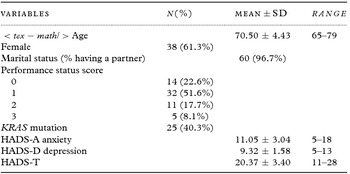
In this study, we first collected data from 65 older patients with mCRC who underwent psychosocial assessment and provided tissue specimens for KRAS mutation analyses. After excluding the patients who failed the genotype test because of insufficient tumor specimen for testing (n = 2) or had invalid scale data (n = 1), 62 patients were included in analyses. A final sample of 62 cases was included in the current analysis, consistent with the sample sizes of prior studies that focused on biological correlates of depression in cancer (Mitchell, Reference Mitchell2007; Pirl et al., Reference Pirl2011). There were 24 males and 38 females. Sixty patients were Han Chinese living in Sichuan Province, China (Table 1), and 62 patients were married. Our data showed that 14 patients (22.6%) had a performance status score of 0, suggesting no active restrictions. the mean HADS-D score was 9.32 (SD, 1.58; range, 5–13), with 28 participants (45.2%) screening positive for probable depression. The mean anxiety (HADS-A) score was 11.05 (SD, 3.04; range, 5–18), with 45 of the 62 participants (72.6%) screening positive for anxiety. The mean HADS-T score was 20.37 (SD, 3.40; range, 11–28).
Clinicopathological characteristics of the 62 mCRC patients

Note. HASD, Hospital Anxiety and Depression scale; SD, standard deviation.
Depression and anxiety among patients of different KRAS genotypes
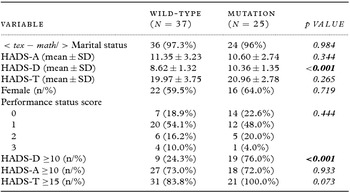
As shown in Table 2, the rate of probable depression cases was 76.0% (19 of 25) in the mutated KRAS cases, whereas only 24.3% (9 of 37) of patients with wild-type KRAS screened positive for probable depression (χ2 test, p < 0.001).
Association of demographic, clinical, and behavioral factors with KRAS mutations

Independent sample t-tests, Mann–Whitney U, χ2 tests and Fisher's exact tests were used to evaluate group differences by KRAS genotype.
Note. HADS, Hospital Anxiety and Depression scale; SD, standard deviation.
Based on the HADS-A score, approximately 72.6% (45 of 62) of the patients met the screening criteria for anxiety symptoms. Patients with a mutated KRAS gene had a mean HADS-A score of 10.60, and patients with wild-type KRAS had a mean score of 11.35 (mutated KRAS SD = 2.74; wild-type KRAS SD = 3.23; p = 0.344) (Table 2). Of the 37 wild-type KRAS patients, 27 were considered to have probable anxiety (73.0%); 18 of the 25 mutated KRAS patients were considered to have probable anxiety (p = 0.933) (Table 2). Based on the HADS-T score, the general psychosocial morbidity (HADS-T ≥15) rate was 90.3% (56 of 62). Patients with a mutated KRAS gene had a mean HADS-A score of 20.96, and those with wild-type KRAS had a mean score of 19.97 (p = 0.265). The rate of probable psychosocial morbidity was 83.8% in wild-type KRAS patients and 100.0% in mutated KRAS patients (p = 0.073). KRAS mutation status (i.e. mutation versus wild-type) did not differ significantly between HADS-A or HADS-T scores in the rate of probable cases, and the score represented severity.
We also evaluated the differences in depression and anxiety scores for participants from different demographic backgrounds. We found that 96.4% of the wild-type KRAS patients and 97% of the mutated KRAS patients were married (p = 0.924). Females constituted 64.3% of wild-type KRAS patients, whereas females constituted 58.8% of mutated KRAS patients (p = 0.660). In all, 75.0% of wild-type KRAS patients showed good activity without restriction (performance status score 0–1) compared to 73.5% of mutated KRAS patients (p = 0.609). Patients with KRAS mutations were not significantly different from those with wild-type KRAS in terms of gender, marital status, or performance status (Table 2).
Patients with a mutated KRAS gene had a mean HADS-D score of 10.36 compared to 8.62 for those with wild-type KRAS (mutated KRAS SD = 1.32; wild-type KRAS SD = 1.35; t = 3.59, p < 0.001) (Table 2). Probably depression was detected in 9 of the 37 wild-type KRAS patients (24.3%), and 19 of the 25 mutated KRAS patients had probable depression (p < 0.001) (Table 2). The KRAS mutation status (i.e. mutation vs. wild-type) was significantly associated with HADS-D scores in the rate of probable cases, and the score represented severity.
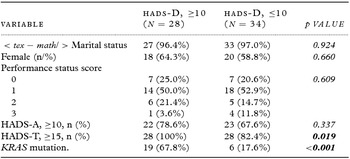
To evaluate the association between probable depression and clinicopathological data, we created Table 3 and found that the rate of probable depressive disorder was not associated with marital status, gender, or performance status but was associated with KRAS mutation status (χ2 test, p < 0.001).
Association of demographic, clinical, and behavioral factors with depression

Independent sample t-tests, χ2 tests and Fisher's exact tests were used to evaluate group differences by KRAS genotype.
Note. HASD, Hospital Anxiety and Depression scale; SD, standard deviation.
Independent association of KRAS mutation status with depression severity
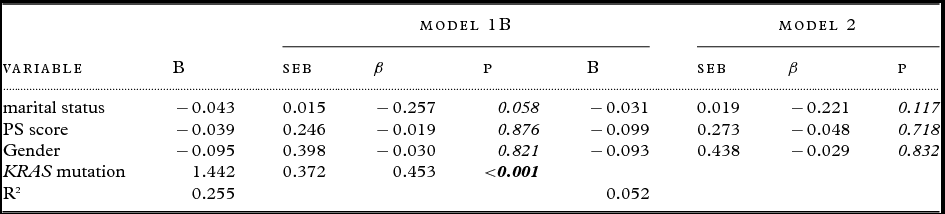
The association between the selected variables and depression severity was further evaluated using multivariate linear regression analysis. In the analysis, we adjusted for gender, performance status, and KRAS mutation. We found that only KRAS mutation was a significant predictor of high depression severity and rate (standardized β = 0.453; p < 0.001; t = 3.877). In contrast, gender and performance status were not associated. Gender and marital status have been reported to be the only factors significantly associated with KRAS mutations in various cancer patient samples (Breivik et al., Reference Breivik, Meling, Spurkland, Rognum and Gaudernack1994) and are reported to be independent factors affecting cancer patients with depression (Freidrich et al., Reference Freidrich, Smith, Harrison, Colwell, Davis and Fefer1987; Pettingale et al., Reference Pettingale, Burgess and Greer1987). They were included as control variables in model 1, which explained the degree to which the five variables contributed to depression severity. We included all the above variables except KRAS mutation status in model 2. As is shown in Table 4, the overall model was significant (F (4, 55) = 4.713; p = 0.000), and the results suggested that 25.5% of the variance in depression severity was accounted for by all the elements, of which the KRAS mutation contributed 20.3%.
Multiple regression model of KRAS mutation for the prediction of depression severity

The final model explained 25.3% of the variance in depression severity. Only variables significant associated with depression severity were shown.
Model 1: All the four control variables were included in the overall model to explain the percentage of those variables contribute to depression severity.
Model 2: The other three variables were included in this model to explain the percentage of those variables, except KRAS mutation, contribute to depression severity.
Discussion
In this study, we assessed older mCRC patients for anxiety, depression, and overall hospital anxiety using HADS to determine the association of these factors with their KRAS mutation status. Our data showed that older patients with mutated KRAS had higher rates of depressive symptoms and higher depression severity than patients with wild-type KRAS, while the KRAS mutation status did not differ significantly between HADS-A or HADS-T in the rate of probable cases. Additionally, marital status, gender, and performance status score were not associated with the rate of probable depression. The multivariate linear regression analysis showed a linkage between depression and KRAS mutations in older mCRC patients. This result partly explained the association between depressive mood and poor prognosis in mCRC patients in the genetic field.
Depression and anxiety are the most common psychological disorders in elderly patients and in patients with late-stage cancer. Although we assessed the psychosocial or psychiatric data 1 week before obtaining the KRAS genotype data to prevent potential psychological distress from disclosure of the KRAS mutation status, our data showed that approximately three quarters of the older mCRC patients had positive screens for anxiety according to the HADS-A, and nearly all of the older mCRC patients had psychosocial morbidity according to the HADS-T. The results indicate that anxiety and psychosocial distress are common in older mCRC patients, independent of KRAS gene status. Older patients usually have additional chronic physical illnesses and exhibit poor tolerance of cancer treatment. Psychological distress can be exacerbated in patients by physical illnesses or cancer complications (Stewart et al., Reference Stewart1989; Yancik, Reference Yancik1997). In turn, psychological distress exacerbated other physical illnesses and side effects of cancer treatment in older mCRC patients (Astrom, Reference Astrom1996; Kvaal et al., Reference Kvaal, Laake and Engedal2001). Mental and physical problems have reciprocal effects on each other, and many older mCRC persons may die with cancer rather than from cancer. Oncologists usually emphasize physical problems, whereas psychological distress remains underreported and undertreated. Our results indicate the need to pay more attention to psychologic distress in older mCRC patients. Systematic routine screening for psychosocial morbidity should be implemented by oncologists in cancer settings. Early interventions for distress are also necessary, especially in KRAS mutation patients, so that the interaction between mental and physical illness can be prevented and survival rates can be improved.
Our study found that KRAS mutation was associated with higher HADS depression scores in older mCRC patients. Depression is commonly encountered in medical populations, and it is frequently misdiagnosed or overlooked in cancer patients (McDaniel et al., Reference McDaniel, Musselman, Porter, Reed and Nemeroff1995). This misdiagnosis is especially prevalent when cancer patients are more than 65 years old because older depression patients usually have atypical manifestations of depression that may escape a non-experienced interviewer (Goodwin et al., Reference Goodwin, Zhang and Ostir2004). This linkage between depression and gene mutation can guide professionals to groups at high risk for depression.
Although previous research has shown depression to be associated with worse survival in cancer patients (Satin et al., Reference Satin, Linden and Phillips2009; Pinquart and Duberstein, Reference Pinquart and Duberstein2010), it remains unclear whether improvements in depression improve survival. For older cancer patients, the effects of depression may be distinct. On the one hand, the relation between symptoms of depression and poor outcomes in seriously ill persons has been found in older patients (Blazer, Reference Blazer1989). Anti-depression treatment did show benefits for individuals with medical illnesses (Gill and Hatcher, Reference Gill and Hatcher2000). On the other hand, depression in cancer patients can reduce patients’ quality of life and decrease their adherence to medical treatments (Vardy et al., Reference Vardy2014). As a treatable illness, depression may represent a target to improve both quality of life and survival in older individuals with late-stage cancer. Fortunately, pharmacological treatment for depression is efficacious and does not interfere with cancer therapy in the majority of cases. The KRAS/depression linkage allows professionals to begin treatment of depression enough to minimize the effects of baseline depression and thereby improve the survival of older mCRC patients.
The current data coincide with previously published epidemiological data showing that patients diagnosed with cancers with highly expressed RAS oncogenes were more susceptible to depression (Massie, Reference Massie2004; Fukushima and Fukayama, Reference Fukushima and Fukayama2007). Previous study showed that 33%–50% of pancreatic cancer patients had depression (up to 90% KRAS mutation rate) and 13%–25% of colon cancer patients (up to 60% KRAS mutation rate). Similarly, metastatic non-small cell lung cancer patients with wild-type epidermal growth factor receptor (EGFR) were found to have lower depression severity and lower rates of probable major depressive disorder. These findings indicate that altered gene expression did play a role in the development of psychiatric disorders in cancer patients. However, the contribution of gene mutation or altered gene expression to psychiatric disorders in cancer patients remains unknown. Previous studies demonstrated that the RAS gene family could play a major role in insulin and glucose utilization in the human body and, therefore, the synthesis of serotonin and dopamine, which plays an important role in the regulation of mood. Again, the H-RAS oncogene-transcribed p21 protein can influence phosphorylation of tryptophan hydroxylase, a rate-limiting enzyme for serotonin synthesis (Ressler and Nemeroff, Reference Ressler and Nemeroff2000; Zhang et al., Reference Zhang, Beaulieu, Sotnikova, Gainetdinov and Caron2004). These findings could support the role of KRAS in the regulation of depression. However, further studies are needed to investigate the serum levels of serotonin and dopamine in cancer patients and their association with depression.
Although these studies are provocative, there are still some limitations. For example, the small sample size precluded a more extensive panel of control variables, although the results support the conclusion that KRAS mutation status is associated with greater depression severity independent of three key risk factors. Considering that KRAS mutation accounts for only part of the variance in the depression score, larger samples are needed to confirm multiple risk factors that likely account for the development of depression in patients with mCRC, some of which may have much greater importance. Moreover, we chose the HADS, which is an easily implemented screening tool for depression and anxiety, instead of the Geriatric Depression Scale, which is more accurate for the screening of depression in older people (Rhondali et al., Reference Rhondali2015). Future studies should use diagnostic criteria for elderly patients. Moreover, future studies should conduct structured psychiatric interviews with patients to verify major depression or another depressive disorders as defined by standard diagnostic criteria. Another limitation is that all the threshold scores used for this study were not specific to older Chinese mCRC patients, and their sensitivity and specificity are not known. We depended on cut-off points, which might different by patient population (Ibbotson et al., Reference Ibbotson, Maguire, Selby, Priestman and Wallace1994). In addition, we did not collect past histories of depression or depression under treatment, which may have helped clarify the directionality of the KRAS/depression association. In addition, other gene alterations, such as EGFR, PTEN, and BRAF, which were reported to be predictors of mCRC, were not included in this study partially due to the lower mutation (amplification) rate (e.g., 10% of mutated BRAF in mCRC) (Guanti et al., Reference Guanti2000; Shin et al., Reference Shin, Park and Park2001). Based on KRAS, the Raf kinase B-Raf was also an upstream activator of the extracellular signal-regulated kinase (ERK)-signaling pathway and therefore participates in many physiological functions. In fact, it has been observed that the catalytic activity of B-Raf is significantly reduced in the PFC and hippocampus of suicidal subjects and in individuals with psychiatric disorders, including depressive disorders (Dwivedi et al., Reference Dwivedi, Rizavi, Conley and Pandey2006; Yuan et al., Reference Yuan, Zhou, Wang, Li, Li and Chen2010). B-Raf is a potential predictor of depression in mCRC. The EGFR is a tyrosine kinase receptor that activates the ERK-signaling pathway. A previous study showed that EGFR mutations were associated with lower rates of probable major depressive disorder and depression severity in patients with metastatic NSCLC, whereas the relationship between depression and EGFR mutation in mCRC have not yet been explored. Further work with larger samples is needed to replicate these findings using diagnostic interviews for past and present major depressive disorder that can examine more potential confounders.
Although some evidence shows that cancer-related symptoms are associated with certain genetic polymorphisms, our research is the first to report the relationship between psychiatric disorders and the genetics of the tumor itself in mCRC patients. Our study indicated the need for further investigation of the relationship between psychiatric disorders and mCRC. Clarifying the underlying relationship between psychiatric disorders and tumor genotypes in mCRC would be undeniably valuable in developing effective interventions for psychiatric disorders and greatly reducing cancer-related suffering. Our results suggest that the KRAS mutation is an important marker for symptoms of depression in older mCRC patients. Older mCRC patients with KRAS mutations should be screened for depressive disorders, whose presence in the elderly has typically been underestimated by oncologists. Elderly mCRC patients should be assessed and treated as early as possible to minimize the effects of baseline depression. The results warrant investigation of the role KRAS proto-oncogene plays in the etiology of depression in older cancer patients and offer initial evidence of the relationship between genotype and cancer-related symptoms. Further studies should focus on verifying the specific relationship between depression and KRAS status in a larger patient cohort and on clarifying the biological mechanism of the association between depression and KRAS genotype.
Conflict of interest
None.
Description of authors’ roles
Yi Zhou, Feng Wen and Xiaohui Gu designed the study, carried out the study and wrote the paper. Jing Chen, Xiaohui Gu, Wen Wei, and Zhi-Hui Zhang formulated the research question and assisted with the drafting of the article. Feng Wen was responsible for the statistical design of the study and for carrying out the statistical analysis.
Acknowledgments
Authors Yi Zhou, Xiaohui Gu, Feng Wen, Jing Chen, Wen Wei, Zhi-Hui Zhangand, and Yanting He contributed equally to this work. This work was also supported in part by a Project of the National Natural Science Foundation of China (NO: 81071862), and the equipment of the State Key Laboratory of Biotherapy in West China Hospital was used.