1. Introduction
It is well known that when a capillary tube is brought in contact with a wetting fluid, the fluid rises in the tube and eventually reaches the Jurin height (de Gennes, Brochard-Wyart & Quéré Reference de Gennes, Brochard-Wyart and Quéré2004). A related set-up is when a cornered geometry consisting of two intersecting plates is brought in contact with the fluid. In this case, a finger-like fluid quickly forms at the corner, and the tip of the finger keeps rising indefinitely (since the equilibrium position of the tip is infinitely high). The earliest study of the capillary rising in corners can be dated back to the 18th century: Taylor conducted experiments on the fluid rising in a small-angle corner formed by two nearly parallel plates. He identified that the equilibrium shape of the meniscus is a hyperbola (Taylor Reference Taylor1710). In the paper straight after Taylor's, Hauksbee (Reference Hauksbee1710) confirmed and quantified Taylor's observation. Other reports on the equilibrium meniscus can be found in works of Langbein (Reference Langbein1990) and Finn (Reference Finn1999, Reference Finn2002).
Even though the equilibrium theory of the meniscus in a cornered geometry is well-established, the understanding of the dynamics was quite recent. The time evolution of the meniscus is governed by several factors. The driving force is the capillary force which tends to minimize the interfacial energy, and the wetting fluid tends to maximize its coverage on the solid surfaces. The rising of the fluid is hindered by the viscous friction and the gravity. In situations when the gravity can be ignored, the propagation of the meniscus front obeys the classical Lucas–Washburn  $t^{1/2}$ scaling (Lucas Reference Lucas1918; Washburn Reference Washburn1921; Dong & Chatzis Reference Dong and Chatzis1995; Weislogel & Lichter Reference Weislogel and Lichter1998). When gravity is considered, the tip of the meniscus rises with a different
 $t^{1/3}$ scaling. This result was first derived by Tang & Tang (Reference Tang and Tang1994). Higuera, Medina & Liñán (Reference Higuera, Medina and Liñán2008) developed a more complete theory for the case of two flat plates forming a small angle. They derived a partial differential equation for the time evolution of the meniscus shape based on the lubrication approximation, and derived the
 $t^{1/3}$ scaling law from this equation. Ponomarenko, Quéré & Clanet (Reference Ponomarenko, Quéré and Clanet2011) conducted experiments of capillary rising in corners of different geometries where walls are curved and are described by functions
 $y=c x^n$ with
 $n \ge 1$. They found that the meniscus front obeys the same
 $t^{1/3}$ scaling as the flat wall. Corroborated with an accompanying scale analysis, they have established that the position of the meniscus front
 $Z_m$ obeys the following equation:
 \begin{equation} \frac{Z_m}{a_c} = C \left( \frac{\gamma t}{\eta a_c} \right)^{1/3} . \end{equation}
In (1.1), the length and time are scaled, respectively, by the capillary length  $a_c=\sqrt {\gamma / \rho g}$ and
 $\eta a_c/ \gamma$ (
 $\gamma$,
 $\eta$,
 $\rho$ are surface tension, viscosity and density of the liquid and
 $g$ is the gravitational constant) and
 $C$ is a numerical factor. The experimental results of Ponomarenko et al. (Reference Ponomarenko, Quéré and Clanet2011) were in good agreement with (1.1). Quite surprisingly, they also found the experimental data collapse to a universal curve, having the same numerical factor independent of
 $n$. This means that the dynamics of the meniscus rise is quite universal, independent of the shape of the corner.
In this paper, we study the dynamics of viscous capillary rising at a general corner. Using the Onsager principle (Onsager Reference Onsager1931a,Reference Onsagerb; Doi Reference Doi2013), we derive a partial differential equation that describes the time evolution of the meniscus profile, and solve it both numerically and analytically. We show that (1) the advance of the meniscus front follows the time-scaling of  $t^{1/3}$, and (2) the front factor
 $C$ changes only 10 % when
 $n$ changes from 1 to 5. This explains the universality found by Ponomarenko et al. (Reference Ponomarenko, Quéré and Clanet2011).
2. Capillary rising in a corner
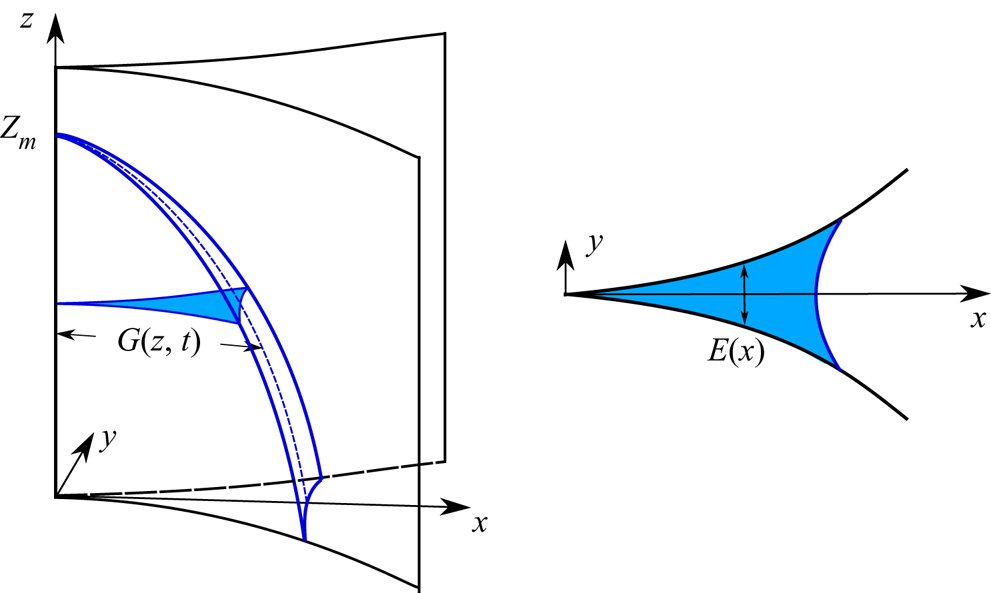
We consider the capillary rising in a corner formed by two surfaces as shown in figure 1. We take the coordinate system with  $z$-axis along the intersection of the surfaces and
 $x$-axis bisecting the surfaces. The two surfaces forming the corner are described by a function
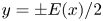 $y= {\pm }E(x)/2$. The meniscus is described by the profile in the
 $x$–
 $z$ plane, given by the function
 $x=G(z,t)$. The bottom of the meniscus is located at
 $z=0$ and is in contact with the fluid reservoir. The tip of the meniscus is denoted by
 $z=Z_m$.
Schematic of the capillary rising in a power-law corner.

2.1. Onsager principle
To derive the time-evolution equation for the meniscus profile  $G(z,t)$, we use the Onsager principle, the variational principle proposed by Onsager (Reference Onsager1931a,Reference Onsagerb) for general irreversible processes. In the present context, this principle can be regarded as a variational formulation of Stokesian hydrodynamics for problems that have moving boundaries. In Stokesian hydrodynamics, the velocity field is determined by the minimum energy dissipation principle if the velocity at the boundary is known. The Onsager principle here can be viewed as an extension of this principle to determine the motion of the boundary.
Our objective is to determine the time evolution of  $G(z,t)$. For this purpose, we construct a functional called Rayleighian, which is a functional of
 $\dot {G}(z,t)$, the time derivative of
 $G(z,t)$. The Rayleighian
 $\mathscr{R}[\dot {G}(z,t)]$ is a sum of two terms
 \begin{equation} \mathscr{R}[\dot{G}(z,t)] = \dot{F} [\dot{G}(z,t)] + \varPhi [\dot{G}(z,t)] , \end{equation}
both being a functional of  $\dot {G}(z,t)$. The first term
 $\dot {F} [\dot {G}(z,t)]$ represents the change rate of the free energy when the boundary is moving at rate
 $\dot {G}(z,t)$. The dissipation function
 $\varPhi [\dot {G}(z,t)]$ represents half of the energy dissipation rate (or the entropy production rate) taking place in the system when the boundary is changing at rate
 $\dot {G}(z,t)$. The Onsager principle states that
 $\dot {G}(z,t)$ is obtained by minimizing the functional
 $\mathscr {R}[\dot {G}(z;t)]$.
In the following calculation, we do not consider  $\dot {G}(z,t)$ explicitly. Rather, we take the volume flux
 $Q(z,t)$ of fluid flowing across the plane at
 $z$ as an independent variable and express the Rayleighian as a functional of
 $Q(z,t)$. Here
 $\dot {G}(z,t)$ and
 $Q(z,t)$ are related to each other by the conservation equation. Let
 $A(G)$ be the area of the region
 $\{(x,y) \, | \, 0<x<G, |y|<E(x)/2 \}$, i.e.
 \begin{equation} A(G)= \int_0^G E(x) \, \mathrm{d} x . \end{equation}
Then the conservation equation for the fluid volume is written as
 \begin{equation} \frac{\partial A}{\partial t} = A' \dot{G} ={-} \frac{\partial Q}{\partial z}, \end{equation}
where the prime denotes the derivative with respect to  $G$,
 $A'=\partial A / \partial G$.
In the following we shall first calculate  $\dot {F}$ and
 $\varPhi$ expressed as a functional of
 $Q(z,t)$ and determine the flux
 $Q(z,t)$ by minimizing the Rayleighian. The time evolution equation for
 $G(z,t)$ is given by the conservation equation (2.3).
2.2. Free energy
The free energy of the system is given by
 \begin{equation} F[G(z,t)] = \int_0^{Z_m} \left( \rho g A(G(z,t)) z - 2 L(G(z,t)) \gamma \cos\theta \right) \, \mathrm{d} z . \end{equation}
The first term is the gravitational energy and the second term is the interfacial energy. In (2.4),  $L(G)$ is the contour length of the curve
 $y=E(x)/2$ for
 $0<x<G$,
 \begin{equation} L(G) = \int_0^G \sqrt{1+ \frac{1}{4} \left( \frac{\mathrm{d} E}{\mathrm{d} x} \right)^2} \, \mathrm{d} x , \end{equation}
where  $\theta$ is the equilibrium contact angle of the fluid on the solid surfaces. We focus on the fluid that wets the surface, i.e. the contact angle
 $\theta$ is close to zero. In writing the free energy in the form of (2.4), we have neglected the surface energy of the free surface. In general, this contribution is of the order of
 $E(G)\gamma$. When the two surfaces are close to each other and for the fully wetting fluid, we have
 $L(G) \sim G \gg E(G)$, thus the free surface contribution can be ignored.
The change rate of the free energy is
 \begin{equation} \dot{F} = \int_0^{Z_m} \left( \rho g A' z - 2 L' \gamma \cos\theta \right) \dot{G} \, \mathrm{d} z = \int_0^{Z_m} \left( \rho g - 2 \frac{\partial (L'/A')}{\partial z} \gamma \cos\theta \right) Q \, \mathrm{d} z \, , \end{equation}
where we have used the conservation equation (2.3) and integration by parts.
The equilibrium profile of the meniscus is determined by setting the integrand in (2.6) to be zero:
 \begin{equation} \frac{ \partial (L'/A') }{\partial z} = \frac{\rho g}{ 2\gamma \cos\theta} . \end{equation}
2.3. Dissipation function
The dissipation function is calculated by the lubrication approximation. In this approximation, the pressure  $p$ is assumed to be constant in
 $x$–
 $y$ plane (i.e.
 $p$ depends on
 $z$ only), and the velocity has the
 $z$ component
 $v_z$ only. This requires the characteristic length scales in the
 $x$- and
 $y$-directions are much smaller than that in the
 $z$-direction (see § 4.4 for more detailed discussion). The velocity
 $v_z$ is determined by the Stokes equation
 \begin{equation} \eta \left( \frac{\partial^2}{\partial x^2} + \frac{\partial^2}{\partial y^2} \right ) v_z ={-} \frac{\partial p}{\partial z} - \rho g , \end{equation}
with the boundary condition  $v_z=0$ at the boundary
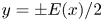 $y= {\pm }E(x)/2$. The equation can be solved analytically by utilizing the fact that the length scale in the
 $y$-direction,
 $E(x)$, is much smaller than the length scale in the
 $x$-direction,
 $G(z)$. Hence the flow profile is essentially parabolic, and
 $v_z$ can be written as
 \begin{equation} v_z(x,y,z,t)= \frac{3}{2} \, \bar{v}_z(x,z,t) \left[ 1 - \left( \frac{2y}{E(x)} \right)^2 \right] , \end{equation}
where  $\bar {v}_z(x,z,t)$ is the
 $y$-averaged velocity. In channel flow,
 $\bar {v}_z(x,z,t)$ is proportional to
 $E^2(x)$, and therefore it can be written as
 \begin{equation} \bar{v}_z (x,z,t) = C(z,t) E^2(x). \end{equation}
The flux is an area integration of the local velocity
 \begin{equation} Q(z) = \int_0^{G(z)} E(x) \bar{v}_z(x,z,t) \, \mathrm{d} x = \int_0^{G(z)} E^3(x) C(z,t) \, \mathrm{d} x = B(G) C(z,t) , \end{equation}
where the function  $B(G)$ is given by
 \begin{equation} B(G) = \int_0^G E^3(x) \, \mathrm{d} x . \end{equation}
The velocity is then given by (2.10) and (2.11)
 \begin{equation} \bar{v}_z(x,z,t) = \frac{Q(z)}{B} E^2(x). \end{equation}
The dissipation function is
 \begin{equation} \varPhi = \frac{1}{2} \int_0^{Z_m} \int_0^{G(z)} \frac{12 \eta}{E(x)} \bar{v}_z^2(x,z,t) \, \mathrm{d} z\, \mathrm{d} x = \frac{1}{2} \int_0^{Z_m} \frac{12 \eta }{B} Q^2(z) \, \mathrm{d} z . \end{equation}
2.4. Time evolution equation
Given the change rate of the free energy (2.6) and the dissipation function (2.14), the Rayleighian is obtained as
 \begin{equation} \mathscr{R} = \dot{F} + \varPhi = \int_0^{Z_m} \left( \rho g - 2 \frac{\partial (L'/A')}{\partial z} \gamma \cos\theta \right) Q \, \mathrm{d} z + \frac{1}{2} \int_0^{Z_m} \frac{12 \eta}{B} Q^2 \, \mathrm{d} z . \end{equation}
The time evolution equation is derived from the Onsager variational principle,  $\delta \mathscr {R} / \delta Q=0$,
 \begin{equation} Q = \frac{B}{12 \eta} \left( - \rho g + 2 \gamma \cos\theta \frac{ \partial (L'/A')}{\partial z} \right). \end{equation}
Combined with the conservation equation (2.3), we obtain the time evolution of the meniscus
 \begin{equation} \frac{\partial G}{\partial t} = \frac{1}{A'} \frac{\partial}{\partial z} \left[ \frac{B}{12 \eta} \left( \rho g - 2 \gamma \cos\theta \frac{ \partial (L'/A')}{\partial z} \right) \right]. \end{equation}
3. Power-law corner
We consider a general corner formed by two surfaces which are a power  $n$ of
 $x$:
 \begin{equation} E(x) = c x^n, \quad n \ge 1. \end{equation}
Note here the parameter  $c$ has a dimension of [LENGTH]
 $^{-n+1}$. To derive the time evolution equation, we need the following:
 \begin{gather} B(G) = \frac{c^3}{3n+1} G^{3n+1} , \end{gather}
 \begin{gather} A'(G) = c G^{n} , \end{gather}
 \begin{gather} \frac{\partial (L'/A')}{\partial z} \simeq{-} \frac{n}{c G^{n+1}} \frac{\partial G}{\partial z} . \end{gather}
We have kept only the terms of lowest order in  $G$.
The flux (2.16) becomes
 \begin{equation} Q = \frac{c^3}{12 \eta (3n+1)} G^{3n+1} \left( - \rho g - \frac{ 2 n \gamma \cos\theta}{c} \frac{1}{G^{n+1}} \frac{\partial G}{\partial z} \right) . \end{equation}
The time evolution equation (2.17) becomes
 \begin{equation} \frac{\partial G}{\partial t} = \frac{c^2}{12 \eta (3n+1) G^n} \frac{\partial}{\partial z} \left[ G^{3n+1} \left( \rho g + \frac{ 2 n \gamma \cos\theta}{c} \frac{1}{G^{n+1}} \frac{\partial G}{\partial z} \right) \right] . \end{equation}
Scaling the length and the time with the following constants:
 \begin{equation} H_c = \left( \frac{ 2 n \gamma \cos\theta }{ c \rho g} \right)^{1/(n+1)} , \quad t_c = \frac{ 12 \eta}{ c^2 \rho g H_c^{2n-1} } , \end{equation}
we convert the equation into a dimensionless form
 \begin{align} \frac{\partial \tilde{G} }{\partial \tilde{t}} &= \frac{1}{(3n+1) \tilde{G}^n} \frac{\partial}{\partial \tilde{z}} \left[ \tilde{G}^{3n+1} \left(1 + \frac{1}{\tilde{G}^{n+1}} \frac{\partial \tilde{G}}{\partial \tilde{z}} \right) \right] \end{align}
 \begin{align} &= \tilde{G}^{2n} \frac{\partial \tilde{G}}{\partial \tilde{z}} + \frac{2n}{3n+1} \tilde{G}^{n-1} \left( \frac{\partial \tilde{G}}{\partial \tilde{z}} \right)^2 + \frac{1}{3n+1} \tilde{G}^n \frac{\partial^2 \tilde{G}}{\partial \tilde{z}^2} , \end{align}
where the tildes denote the corresponding dimensionless variables. This is the generalization of the equation which Higuera et al. (Reference Higuera, Medina and Liñán2008) derived for the capillary rising in the corner made of flat planes.
The equilibrium profile of the meniscus is then given by
 \begin{equation} 1 + \frac{1}{\tilde{G}^{n+1}} \frac{\partial \tilde{G}}{\partial \tilde{z}} = 0 \quad \Rightarrow \quad \tilde{G} = (n \tilde{z})^{{-}1/n} . \end{equation}
Note that the equilibrium profile is unbounded at the edge ( $\tilde {z} \rightarrow \infty$ as
 $\tilde {G} \rightarrow 0$).
The time evolution equation (3.9) admits a self-similar solution of the form
 \begin{equation} \tilde{G}( \tilde{z}, \tilde{t}) = F(\chi) \tilde{t}^{\alpha}, \quad \chi = \tilde{z} \tilde{t}^{\beta} , \end{equation}
where  $\alpha$ and
 $\beta$ are parameters to be determined. Using the above expressions, we rewrite (3.9) as
 \begin{equation} ( \beta \chi F' + \alpha F) \, \tilde{t}^{\alpha -1} = F^{2n} F' \, \tilde{t}^{(2n+1)\alpha + \beta} + \left( \frac{2n}{3n+1} F^{n-1} (F')^2 + \frac{1}{3n+1} F^n F'' \right) \tilde{t}^{(n+1)\alpha + 2\beta} . \end{equation}
The above equation becomes time-independent if
 \begin{equation} \alpha - 1 = (2n+1) \alpha + \beta = (n+1) \alpha + 2 \beta , \end{equation}
which leads to
 \begin{equation} \alpha ={-} \frac{1}{3n} , \quad \beta ={-} \frac{1}{3}. \end{equation}
Equation (3.12) then becomes an ordinary differential equation:
 \begin{equation} F^{2n} F' + \frac{2n}{3n+1} F^{n-1} (F')^2 + \frac{1}{3n+1} F^n F'' + \frac{1}{3} \left(\chi F' + \frac{1}{n} F\right) = 0 . \end{equation}
The meniscus profile should converge to the equilibrium form  $(n\tilde {z})^{-1/n}$ in the limit
 $\tilde {t} \rightarrow \infty$. This leads to the first boundary condition:
 \begin{equation} \chi \rightarrow 0, \quad F(\chi) \rightarrow (n \chi)^{{-}1/n} . \end{equation}
The second boundary condition is that the profile  $F(\chi )$ approaches zero at a certain value
 $\chi =\chi _0$. Assuming
 $F(\chi )$ behaves like
 $(\chi _0 - \chi )^{\gamma }$ as
 $\chi \rightarrow \chi _{0-}$, each term in (3.15) behaves like
 \begin{gather} F^{2n} F' \sim (\chi_0 - \chi)^{(2n+1)\gamma-1} , \end{gather}
 \begin{gather} F^{n-1} (F')^2 \sim (\chi_0 - \chi)^{(n+1)\gamma-2} , \end{gather}
 \begin{gather} F^n F'' \sim (\chi_0 - \chi)^{(n+1)\gamma-2} , \end{gather}
 \begin{gather} \chi F' \sim \chi_0 (\chi_0 - \chi)^{\gamma-1} , \end{gather}
 \begin{gather} F \sim (\chi_0 - \chi)^{\gamma} . \end{gather}
Anticipating  $\gamma \le 1$, the dominating terms are
 $F^{n-1} (F')^2$,
 $F^n F''$ and
 $\chi F$. Upon ignoring other terms, (3.15) becomes
 \begin{equation} \frac{2n}{3n+1} F^{n-1} (F')^2 + \frac{1}{3n+1} F^n F'' + \frac{1}{3} \chi_0 F' = 0 . \end{equation}
The solution to the above equation leads to the second boundary condition
 \begin{equation} \chi \rightarrow \chi_0, \quad F(\chi) \rightarrow \left[ \frac{n(3n+1)}{3(3n-1)} \chi_0 (\chi_0 - \chi) \right]^{1/n} . \end{equation}
Once the solution of (3.15) with the two boundary conditions (3.16) and (3.23) is obtained, we get the asymptotic solution of the tip position
 \begin{equation} \tilde{Z}_m = \chi_0 \tilde{t}^{1/3}. \end{equation}
We can rewrite the above equation using the capillary length  $a_c=\sqrt {\gamma /\rho g}$ as the length scale and
 $\eta a_c/\gamma$ as the time scale (Ponomarenko et al. Reference Ponomarenko, Quéré and Clanet2011). This leads to
 \begin{equation} \frac{Z_m}{a_c} = \chi_0 \left( \frac{ n^2 \cos^2\theta }{3} \right)^{1/3} \left( \frac{ \gamma t}{\eta a_c} \right)^{1/3} . \end{equation}
This result confirms the  $t^{1/3}$ scaling proposed by Ponomarenko et al. (Reference Ponomarenko, Quéré and Clanet2011). Our theory also gives a prediction of the front factor
 \begin{equation} C = \chi_0 \left( \frac{n^2 \cos^2 \theta}{3} \right)^{1/3} , \end{equation}
which is in general dependent on the power of the corner (here  $\chi _0$ is a function of
 $n$) and the contact angle
 $\theta$. One interesting observation is that the
 $c$ parameter from (3.1) does not appear in (3.25), thus the detail of the corner does not affect the tip dynamics.
In the following, we shall study the numerical solutions for special cases of  $n=1$ and 2, which will be called linear corner and quadratic corner, respectively.
4. Examples and discussion
4.1. Linear corner
As a first example, we study the classical case of a corner formed by two flat planes. For this case, the  $E(x)$ function is given by
 \begin{equation} E(x) = a x, \quad a \ll 1. \end{equation}
The dimensionless form of the time evolution equation (3.9) is
 \begin{equation} \frac{\partial \tilde{G}}{\partial \tilde{t}} = \frac{1}{4 \tilde{G}} \frac{\partial}{\partial \tilde{z}} \left[ \tilde{G}^4 \left(1 + \frac{1}{\tilde{G}^2} \frac{\partial \tilde{G}}{\partial \tilde{z}} \right) \right] = \tilde{G}^2 \frac{\partial \tilde{G}}{\partial \tilde{z}} + \frac{1}{2} \left( \frac{\partial \tilde{G}}{\partial \tilde{z}} \right)^2 + \frac{1}{4} \tilde{G} \frac{\partial^2 \tilde{G}}{\partial \tilde{z}^2}. \end{equation}
This is consistent with Higuera et al. (Reference Higuera, Medina and Liñán2008) and our previous work (Yu et al. Reference Yu, Jiang, Zhou and Doi2019).
The equilibrium profile is given by
 \begin{equation} 1 + \frac{1}{\tilde{G}^2} \frac{\partial \tilde{G}}{\partial \tilde{z}} = 0 \quad \Rightarrow \quad \tilde{G} = \frac{1}{\tilde{z}} . \end{equation}
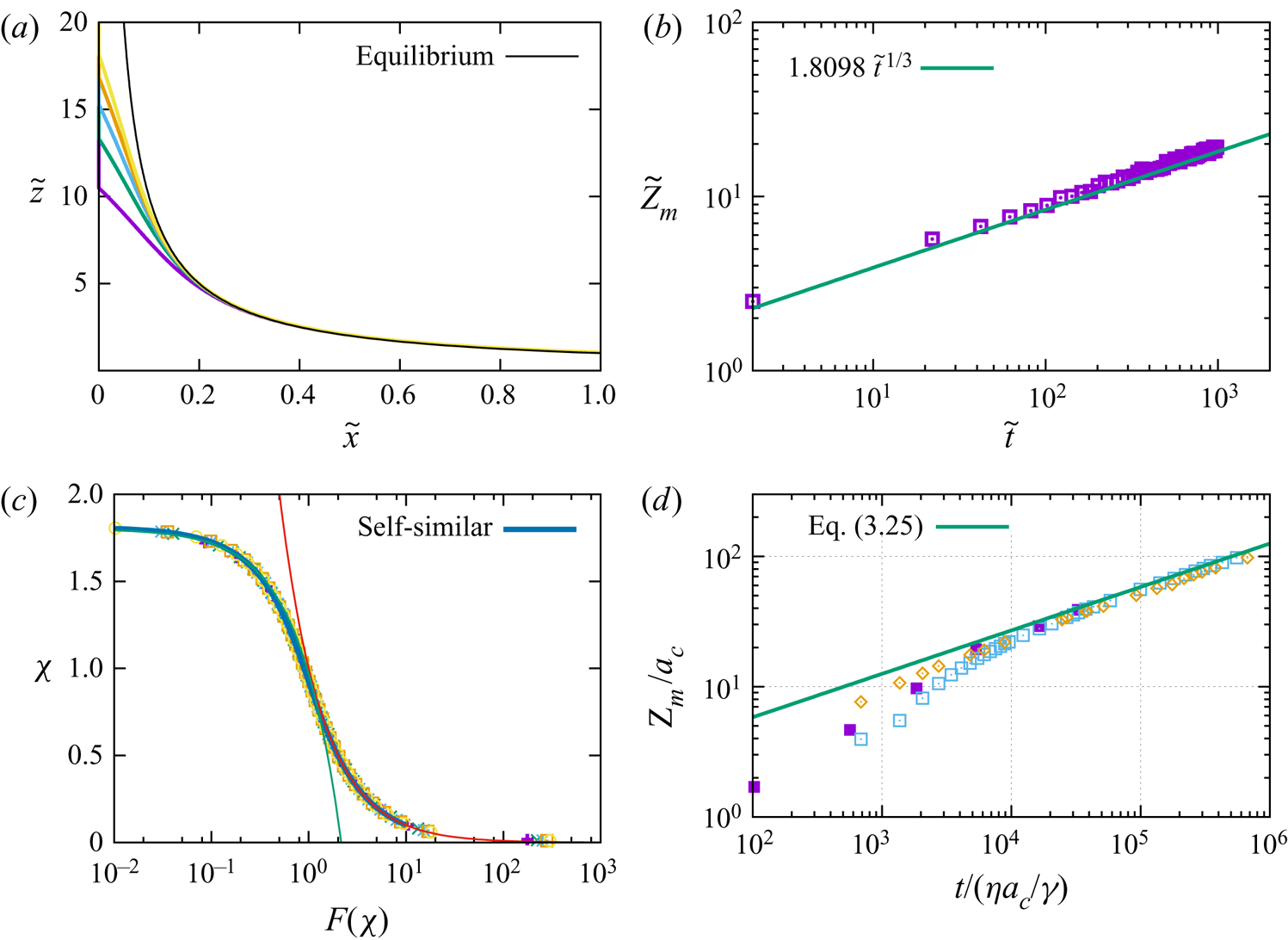
The time evolution equation (4.2) can be solved numerically (see appendix A for details). The meniscus profiles at different times are shown in figure 2( $a$). The tip position as a function of time is shown in figure 2(
 $b$), which follows a
 $\tilde {t}^{1/3}$ scaling.
Linear corner:  $(a)$ meniscus shape at different times (
 $\tilde {t}=200$, 400, 600, 800, 1000 from bottom to top). The solutions are obtained by solving the time evolution equation (4.2).
 $(b)$ The position of the tip as a function of time.
 $(c)$ Self-similar solution of (4.5). Also shown are the meniscus shapes at different times (shown as symbols) and boundary conditions (red, (4.6); green, (4.7)).
 $(d)$ Comparison with experiments. Here the tip position is scaled by the capillary length
 $a_c$ and the time by
 $\eta a_c/\gamma$. Symbols:
 $\blacksquare$, data from Higuera et al. (Reference Higuera, Medina and Liñán2008) (
 $a=2\tan 0.75^{\circ } \simeq 0.026$ and silicon oil V460);
 $\square$, data from Ponomarenko et al. (Reference Ponomarenko, Quéré and Clanet2011) (
 $a=2\tan 2.5^{\circ } \simeq 0.087$ and silicon oil V20);
 $\Diamond$, data from Ponomarenko et al. (Reference Ponomarenko, Quéré and Clanet2011) (
 $a=2\tan 6.5^{\circ } \simeq 0.228$ and silicon oil V20).

The self-similar solution has the form
 \begin{equation} \tilde{G}(\tilde{z}, \tilde{t}) = F(\chi) \tilde{t}^{{-}1/3}, \quad \chi = \tilde{z} \tilde{t}^{{-}1/3} . \end{equation}
The self-similar solution satisfies (3.15) with  $n=1$,
 \begin{equation} F^2 F' + \frac{1}{2} (F')^2 + \frac{1}{4} F F'' + \frac{1}{3} (\chi F)' = 0 , \end{equation}
and the following boundary conditions:
 \begin{gather} \chi \rightarrow 0, \quad F(\chi) \rightarrow 1/\chi , \end{gather}
 \begin{gather} \chi \rightarrow \chi_0, \quad F(\chi) \rightarrow \frac{2}{3} \chi_0 ( \chi_0 - \chi). \end{gather}
The numerical result of the self-similar solution is shown in figure 2 $(c)$, which gives
 \begin{equation} \chi_0 \simeq 1.8098. \end{equation}
In figure 2 $(d)$, we also compare the prediction of (3.25) to experimental data reported in Higuera et al. (Reference Higuera, Medina and Liñán2008) and Ponomarenko et al. (Reference Ponomarenko, Quéré and Clanet2011), and good agreement is found at late times.
4.2. Quadratic corner
We next examine the corner formed by two surfaces which are quadratic functions:
 \begin{equation} E(x) = b x^2. \end{equation}
Note here the parameter  $b$ has a dimension of [LENGTH]
 $^{-1}$. The dimensionless form of the time evolution equations is
 \begin{equation} \frac{\partial \tilde{G}}{\partial \tilde{t}} = \frac{1}{7 \tilde{G}^2} \frac{\partial}{\partial \tilde{z}} \left[ \tilde{G}^7 \left(1 + \frac{1}{\tilde{G}^3} \frac{\partial \tilde{G}}{\partial \tilde{z}} \right) \right] = \tilde{G}^4 \frac{\partial \tilde{G}}{\partial \tilde{z}} + \frac{4}{7} \tilde{G} \left( \frac{\partial \tilde{G}}{\partial \tilde{z}} \right)^2 + \frac{1}{7} \tilde{G}^2 \frac{\partial^2 \tilde{G}}{\partial \tilde{z}^2}. \end{equation}
The equilibrium profile is given by
 \begin{equation} 1 + \frac{1}{\tilde{G}^3} \frac{\partial \tilde{G}}{\partial \tilde{z}} = 0 \quad \Rightarrow \quad \tilde{G} = (2 \tilde{z})^{{-}1/2} . \end{equation}
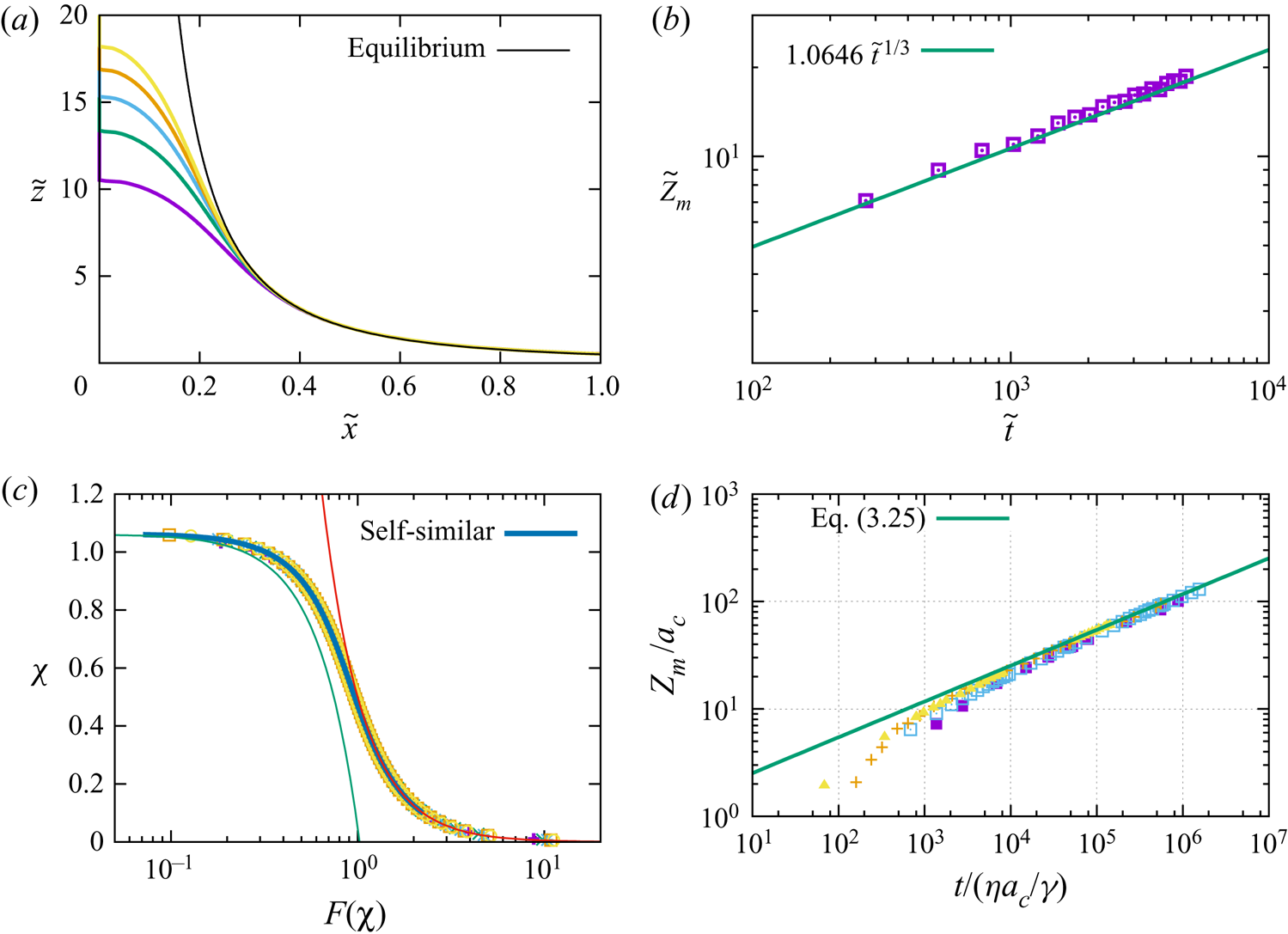
The time evolution of the profile is shown in figure 3 $(a)$. Near the tip, the shape of the meniscus for the quadratic corner is convex away from the corner edge, which is different to that for the linear corner. The tip position as a function of time is shown in figure 3
 $(b)$, which also follows a
 $\tilde {t}^{1/3}$ scaling.
Quadratic corner:  $(a)$ meniscus shape at different times (
 $\tilde {t}=1000$, 2000, 3000, 4000, 50 000 from bottom to top). The solution are obtained by solving the time evolution equation (4.10).
 $(b)$ The position of the tip as a function of time.
 $(c)$ Self-similar solution of (4.13). Also shown are the meniscus shapes at different times (shown as symbols) and boundary conditions (red, (4.14); green, (4.15)).
 $(d)$ Comparison with experiments from Ponomarenko et al. (Reference Ponomarenko, Quéré and Clanet2011). Here the tip position is scaled by the capillary length
 $a_c$ and the time by
 $\eta a_c/\gamma$. The corner is given by
 $b=15\ \textrm {mm}^{-1}$. Symbols:
 $\blacksquare$, silicon oil V10;
 $\square$, silicon oil V20;
 $+$, silicon oil V170;
 $\triangle$, silicon oil V1000.

The time evolution equation (4.10) admits a self-similar solution of the form
 \begin{equation} G(z,t) = F(\chi) t^{{-}1/6}, \quad \chi = z t^{{-}1/3} . \end{equation}
The solution satisfies the equation
 \begin{equation} F^4 F' + \frac{4}{7} F (F')^2 + \frac{1}{7} F^2 F'' + \frac{1}{3} \left(\chi F' + \frac{1}{2} F \right) = 0 . \end{equation}
The boundary conditions are
 \begin{gather} \chi \rightarrow 0, \quad F(\chi) \rightarrow (2 \chi)^{{-}1/2}, \end{gather}
 \begin{gather} \chi \rightarrow \chi_0, \quad F(\chi) \rightarrow \left[ \frac{14}{15} \chi_0 (\chi_0 - \chi) \right]^{1/2} . \end{gather}
The self-similar solution is shown in figure 3 $(c)$, which gives
 \begin{equation} \chi_0 \simeq 1.0646. \end{equation}
In figure 3 $(d)$, we compare the prediction (3.25) to experimental data reported in Ponomarenko et al. (Reference Ponomarenko, Quéré and Clanet2011), and again good agreement is found at late times.
4.3. Power-law corners
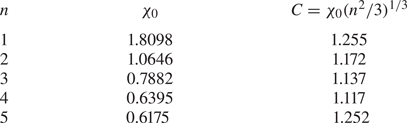
Power-law corners with  $n>2$ show similar results as the quadratic corner. In table 1, we list numerical values of
 $\chi _0$ for power-law corners up to
 $n=5$.
Values of  $\chi _0$ and
 $C=\chi _0(n^2/3)^{1/3}$ for power-law corners up to
 $n=5$.

Ponomarenko et al. (Reference Ponomarenko, Quéré and Clanet2011) suggested that the evolution of the meniscus front for different corners would collapse if one scales the height with the capillary length  $a_c$ and the time with
 $\eta a_c/\gamma$. In our formulation, this corresponds to the front factor
 $C$ of (3.26) being independent of
 $n$. This is a strong prediction. In table 1, we also list the front factor
 $C$ for fully wetting liquid (
 $\theta =0$). One interesting observation is that even the values of
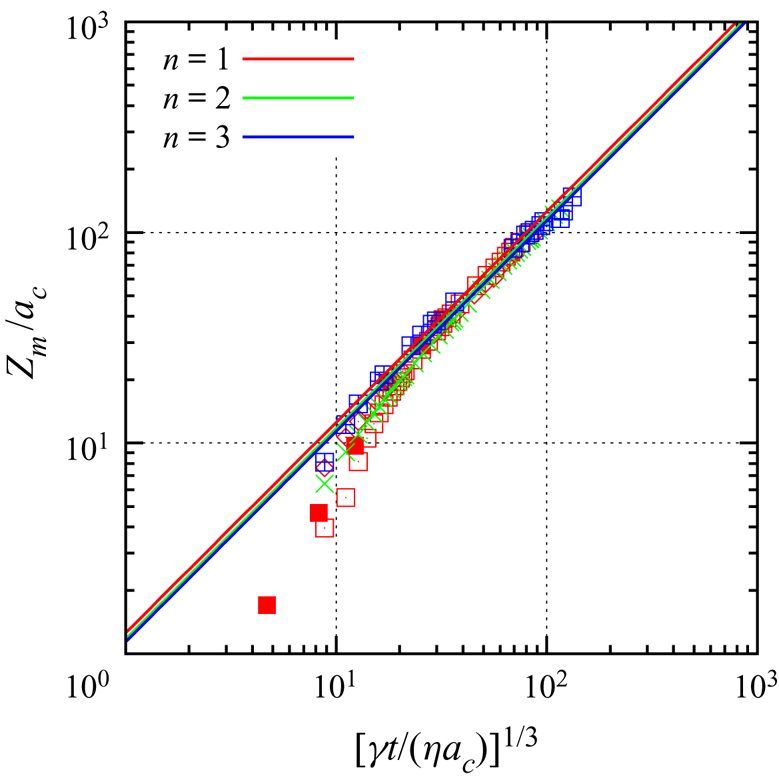
 $\chi _0$ are different, but the front factors are similar with a numerical value around 1.2. Thus our numerical results support the proposition of Ponomarenko et al. (Reference Ponomarenko, Quéré and Clanet2011). Figure 4 shows the numerical results for linear, quadratic and cubic corners, together with the experimental results from Higuera et al. (Reference Higuera, Medina and Liñán2008) and Ponomarenko et al. (Reference Ponomarenko, Quéré and Clanet2011).
Comparison of numerical calculation and experimental results for different corners. Here the tip position is scaled by the capillary length  $a_c$ and the
 $x$-axis is the scaled time to the power of
 $1/3$,
 $[\gamma t/(\eta a_c)]^{1/3}$. Experimental data are from Higuera et al. (Reference Higuera, Medina and Liñán2008) and Ponomarenko et al. (Reference Ponomarenko, Quéré and Clanet2011). (i) Linear corners (
 $E=ax$):
 $\blacksquare$,
 $a=2\tan 0.75^{\circ } \simeq 0.026$ and silicon oil V460;
 $\square$,
 $a=2\tan 2.5^{\circ } \simeq 0.087$ and silicon oil V20;
 $\Diamond$,
 $a=2\tan 6.5^{\circ } \simeq 0.228$ and silicon oil V20. (ii) Quadratic corner (
 $E=bx^2$):
 $\times$,
 $b=15\ \text {mm}^{-1}$ and silicon oil V20. (iii) Cubic corner (
 $E=cx^3$):
 $\boxplus$,
 $c=18\ \text {cm}^{-2}$ and silicon oil V20.

4.4. Discussion
Here we discuss the limitation of our model and various assumptions used in our calculation. From the equilibrium profile (3.10), one sees that the meniscus is unbounded at the edge. This is not always the case (the circular tube is a typical counterexample) and depends on the corner geometry and the wettability of the fluid. If the height of the equilibrium meniscus is finite, then our theory does not apply. For linear corners, the unbounded condition is given by Concus & Finn (Reference Concus and Finn1969),  $\alpha + \theta < {\rm \pi}/2$, where
 $\alpha$ is the open angle of the corner and
 $\theta$ is the equilibrium contact angle. Since we consider the wetting fluid with an equilibrium contact angle
 $\theta$ close to zero, the above condition is satisfied for the linear corner with a small open angle. For power-law corners, the open angle is zero as
 $\tilde {x} \rightarrow 0$ , so the condition is again satisfied.
Our analysis focused on to the long-time dynamics of the meniscus. The early stage of the capillary rising is complicated and various factors come into play. At early times when the meniscus height is less than the capillary length  $a_c$, the effect of the gravity can be neglected. Quéré (Reference Quéré1997) had shown the initial rising follows a
 $t^1$ scaling when the inertial effect is important. Another complication arises during the onset of the meniscus. When the corner first touches the liquid, the assumption of an equilibrium contact angle is not fulfilled and it takes approximately
 $10^2$–
 $10^3\ \eta a_c/\gamma$ to establish the equilibrium contact angle (Clanet & Quéré Reference Clanet and Quéré2002). In our study, the inertial effect is neglected and we are working in the viscous-dominating region where the Reynolds number is close to zero.
When the inertial effect is neglected, the balance of capillary and viscous forces at early times leads to the classical Lucas–Washburn  $t^{1/2}$ scaling. For linear corners, Higuera et al. (Reference Higuera, Medina and Liñán2008) had showed that the height of the meniscus at distance
 $\tilde {x}$ away from the edge evolves like
 $\tilde {H}(\tilde {x}) \sim \tilde {x}^{1/2} \, \tilde {t}^{1/2}$. For power-law corners, one can show that
 $\tilde {H}(\tilde {x}) \sim \tilde {x}^{n/2} \, \tilde {t}^{1/2}$. The equilibrium height profile is
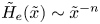 $\tilde {H}_{e}(\tilde {x}) \sim \tilde {x}^{-n}$, which can be obtained by inverting equation (3.10). Equating these two heights leads to a characteristic time for the meniscus at
 $\tilde {x}$ to reach its equilibrium height,
 $\tilde {t}_{e} \sim \tilde {x}^{-3n}$. Thus, the meniscus with larger
 $\tilde {x}$ equilibrates faster. In this study, we focus on the asymptotic dynamics when the meniscus far from the edge is nearly at equilibrium while close to the edge the meniscus is still rising.
In writing the Rayleighian in terms of (2.15), we have made two assumptions regarding the shape of the meniscus. In the free energy part, we have neglected the energy contribution from the free surface. This corresponds to corners with small openings,  $E(G) \ll L(G) \sim G$, i.e. the separation between two planes is much smaller than the distance to the edge. For linear corners, this requires that
 $a \ll 1$ in (4.1). For power-law corners, this condition leads to
 $c G^{n-1} \ll 1$ and becomes progressively better satisfied when the tip is approached,
 $G \rightarrow 1$.
In the dissipation function we have used the lubrication approximation and assume the flow is one-dimensional. This requires that the slenderness parameter, the ratio between the length scale in the  $x$-direction to that in the
 $z$-direction (Weislogel & Lichter Reference Weislogel and Lichter1998; Weislogel Reference Weislogel2001; Weislogel, Baker & Jenson Reference Weislogel, Baker and Jenson2011), is small. For the meniscus at position
 $\tilde {x}$, it takes approximately
 $\tilde {t}_{e} \sim \tilde {x}^{-3n}$ to reach equilibrium. At this time, the tip position is at
 $\tilde {Z}_m \sim \tilde {t}_{e}^{1/3} \sim \tilde {x}^{-n}$. The slenderness parameter
 $\sim \tilde {x}/\tilde {Z}_m \sim \tilde {x}^{n+1}$, which is small when
 $\tilde {x}<1$ and becomes smaller when the rise proceeds.
5. Conclusion
We have studied the capillary rising of wetting fluid in small interior corners. For the general power-law corners with small opening angle, we used the Onsager variational principle to derive a time evolution equation for the meniscus profile. The time evolution equation has a self-similar solution, and we have showed that the advance of the meniscus front follows a universal  $t^{1/3}$ law. The universality of the
 $t^{1/3}$ scaling was previously demonstrated in experiments (Ponomarenko et al. Reference Ponomarenko, Quéré and Clanet2011). Here we have shown that the
 $t^{1/3}$ scaling is indeed satisfied for general power-law corners. Furthermore, we have computed explicitly the prefactor, which only depends on the power
 $n$ and the equilibrium contact angle
 $\theta$.
Acknowledgements
This work was supported by the National Natural Science Foundation of China (NSFC) through the grant no. 21774004. M.D. acknowledges the financial support of the Chinese Central Government in the Thousand Talents Program. We thank A. Ponomarenko, D. Quéré and C. Clanet for providing the experimental data in their paper (Ponomarenko et al. Reference Ponomarenko, Quéré and Clanet2011). We also would like to acknowledge the anonymous referee who raised the point regarding the prefactor.
Declaration of interests
The authors report no conflict of interest.
Appendix A. Numerical solution to (3.9)
The time evolution equation of the meniscus profile is given by (3.9). For  $n=1$ and
 $n=2$, this equation takes the form of (4.2) and (4.10), respectively. These partial differential equations can be solved numerically using Matlab.
The range of  $\tilde {z}$ is
 $[0.1\!:\!20]$. The lower boundary condition is given by the equilibrium profile
 \begin{equation} \tilde{G}(\tilde{z}=0.1)=(n \times 0.1)^{{-}1/n}, \end{equation}
and we assume the part of the meniscus far away from the edge ( $\tilde {z}<0.1$) has already reached the equilibrium. The upper boundary is chosen to be large enough so the tip position does not exceed the upper boundary at the end of calculation. In this study, we used
 \begin{equation} \tilde{G}(\tilde{z}=20)=0. \end{equation}
The initial condition is a straight line connecting the lower boundary and the meniscus tip  $\tilde {Z}_{m0}$, where
 $\tilde {Z}_{m0}$ is the initial tip position and takes a small value. Different choices of
 $\tilde {Z}_{m0}$ do not affect the long-time dynamics. The results shown in figures 2 and 3 are obtained by setting
 $\tilde {Z}_{m0}=1.0$.