INTRODUCTION
We observe in the real world a system of trade-facilitating intermediaries, such as middlemen, dealers, and banks. As intermediaries coordinate transactions, they may issue tradable objects to facilitate exchange, which sometimes circulate as media of exchange in diverse locations and among third parties. Privately issued media of exchange have been common throughout history. Murphy (1978) described an episode in Ireland in which banks closed between 1966 and 1976 and personal checks started circulating as a medium of exchange. Also, bills of exchange were commonly used in transactions in north England during the late 18th and early 19th centuries, as described in Ashton (1945). One modern example is stored-value cards, that can be used for a single type of purchase or more widely at any merchant that has electronic equipment to read the cards. Although these examples involve different institutions, they share many properties of inside money in the model presented later: they are private liabilities that permit transactions at dispersed locations, and some may circulate.
The goal of this paper is to study whether private liabilities may circulate as a general medium of exchange, and how the existence and extent of coordinated transactions (“markets”) affect the level of specialization. To this end, we need a model with an endogenous role of a medium of exchange and with an explicit role for intermediaries. Following Camera (2000), we consider an economy in which agents choose between two alternative trading arrangements: an “unorganized sector” in which agents meet bilaterally at random, and “organized markets” set up by merchants, in which there is no double coincidence of wants problem. The model uses random matching to generate a role for a medium of exchange. In addition, we assume a record-keeping technology in the organized markets so that issuance and redemption of private liabilities by merchants is possible.
Merchants make profits from reselling goods at a higher price than the original purchase price, but they do not produce. When deciding in which sector to trade, agents take into account the trade-off between the saving in waiting time and the higher commodity price in the organized markets. Merchants issue bills of exchange to buy commodities from producers. Under a no-defection condition, all merchants in the organized markets honor the bills issued by other merchants. An agent, once acquiring a bill of exchange, can spend it in the organized markets or in the unorganized sector, where agents' trading histories are private information.
Pareto-ranked multiple equilibria exist with the extent of the organized markets endogenously determined, as in Camera (2000); moreover, the circulation of private liabilities is endogenously determined. As long as the time discount rate is small, all transactions take place in the organized markets, regardless of the degree of trade frictions. This case resembles one in which trade occurs in a Walrasian market. When trade frictions are moderate, both trading sectors are active and bills of exchange circulate as a general medium of exchange. The reason is as follows. If trade frictions are low, conducting trade in the unorganized sector is so attractive that it may not generate sufficient profits for the intermediation business. If trade difficulties are high, it would be too time-consuming for bill holders to encounter trade partners in the unorganized sector, and the use of bills would be confined in the organized markets.
We model specialization as in Camera et al. (2003), a paper in which people choose the set of goods to produce, and producing a smaller set of goods involves a lower production cost but reduces the probability of matching with a trade partner. When all transactions take place in the organized markets, then the market reaches its greatest extent, and the economy achieves complete specialization. If both sectors are active and the use of bills is limited in the organized markets, the level of specialization is identical to that in the pure barter economy. The mere existence of organized markets does not necessarily induce a higher level of specialization relative to barter. The key factor lies in whether the extent of the market and circulation of a medium of exchange reduces the consumption risk as a result of random matching. Indeed, we find that if bills circulate in both sectors, the level of specialization is higher relative to barter. Money, by allowing trade in single coincidence matches, reduces individual's consumption risk and, therefore, induces more specialization. A distinctive feature is that the object that plays the role of medium of exchange here is inside money—private liabilities that accompany the rise of markets. It is also found that lower trade frictions induce higher inside liquidity and more specialization.
In terms of the endogenously determined extent of market and inside money, this paper complements Camera and Li (2003), who study the relationship between endogenous default risk, coexistence of credit and fiat money, and their circulating values. On the contrary, our model focuses on how trade frictions affect the extent of the market and inside liquidity, and their effects on specialization. Previous studies using search models to examine specialization include, for example, Kiyotaki and Wright (1993), Shi (1997, 2005), and Camera et al. (2003). With the exception of Shi (2005), who uses the society's ability to update agents' transaction records to represent the extent of the market, none of these explicitly study the relationship between specialization and market. Other related search papers include Cavalcanti and Wallace (1999), in which notes issued by agents with public transaction records may circulate as a general medium of exchange, and Shevchenko (2004), in which endogenously emerged middlemen hold a variety of inventories to satisfy customers with heterogenous tastes. The difference is that we study the links between agents' choice of competing trading arrangements and merchants' incentives to enter the intermediation business, and explicitly show how endogenously arising intermediation (money and market) ameliorates trading risk and affects the level of specialization.1
There are papers considering trade frictions to study market structure. For example, Howitt and Clower (2000) consider transactions coordinated by specialist traders and use a numerical simulation to show a fully developed market emerges in a learning environment. In Kultti (2003), incompleteness of markets arise endogenously as sellers optimally choose separate locations.
This paper does not depict a particular real-world institution; however, one may find that a close counterpart is the stored-value cards issued by nonbank business firms, most of which are used for a single type of purchase. In the future, joint ventures between banks and business firms may arise to issue stored-value cards that are widely accepted. The present model is explicit about the costs and benefits of conducting a certain type of transaction and use of a medium of exchange. It characterizes the relative advantages underlying various transaction patterns, and allows us to predict the rise and functioning of an intermediary based on the extent to which it ameliorates the costs of exchange. These results should help us to understand the recent development of privately issued money and the possible emergence of new ways to conduct transactions that make use of it.
The rest of the paper is organized as follows. Section 2 introduces the basic model. Section 3 characterizes stationary equilibria. In Section 4, we consider specialization. Section 5 concludes.
The basic model
Time is discrete and continues forever. The economy is populated by a [0,1] continuum of infinitely-lived agents. Let T be the set of goods. These goods are divisible but not storable once divided. Goods come in units of size one. Each agent i consumes goods in a subset Ti ⊂ T and cannot consume goods not in Ti. Let u > 0 be the instantaneous utility from consuming an agent's consumption good and r his time discount rate. When agent i consumes q units of his consumption goods, he enjoys utility qu. He can produce just one good at a time, which is not in Ti, at a cost in terms of disutility c, where 0 < c < u.
The set of agents is symmetric in the sense that the same number of agents consume each good and the same number of agents produce each good. This leads to the following: whenever you meet someone, there is a probability x that he consumes what you produce. The probability that the randomly encountered partner also produces what you consume is x. Thus, the probability of a “double coincidence of wants” is x2, which also measures the difficulty of direct barter.
In this economy, agents meet bilaterally and at random. The potential trade partner's type and inventory are observable. Agents are unable to commit to future actions, proposed transfers cannot be enforced, and trade history is private information to the agent (except a subset of agents; see later). Transactions thus take the form of barter or may be facilitated by some tangible asset. Because goods are not storable once divided, barter trade is a one-for-one swap.
Every agent is endowed with a production opportunity. A fraction K ∈ (0,1) of the agents are randomly chosen to be endowed with the ability to organize a market of consumption goods. Those agents are potential merchants. A potential merchant will enter the intermediation business as long as the expected profits are at least as large as the expected returns to a producer. Once a potential merchant enters, he must give up the production technology. Thus, merchants buy and sell goods but they do not produce. Each merchant sets up a store of the commodities that he wishes to consume. That is, merchant i sets up a store that buys and sells commodities in Ti. Given the assumptions on preference and symmetry, there are many merchants in the market of a particular commodity, and we consider merchants run business under competition. Once the organized markets exist, an agent can always locate the market of the commodity that he wishes to buy or sell without search.
Merchants issue bills of exchange to buy commodities from producers.2
Our results do not depend on the assumed exclusive privilege for merchants to print bills of exchange. If we assume that everyone has the technology to print bills, as agents in the unorganized sector cannot be monitored and cannot commit to future actions, in a symmetric equilibrium no one will produce goods for a bill issued by nonmerchants.
The timing within a period is as follows. Producers and bill holders who decide to trade in the unorganized sector encounter pairwise meetings, and trade occurs in a double coincidence meeting of producers or a single coincidence meeting where the consumer has an asset. Agents who wish to trade in the organized markets arrive at a store in the markets and contact the merchant sequentially. After all arrivals, each producer produces a good, gets a unit of bill in return, and leaves the markets. Consumers and the merchant consume their shares of the goods, q and 1 − q units of the goods, respectively, and bills of exchange received by the merchants are destroyed.
We assume that, once the organized markets exist, there is a technology that keeps merchant's record of transaction, and punishment on defecting merchants is feasible. In particular, defection by a merchant is punished by having the defecting merchant get the payoff from autarky, which is zero. We will show later that this monitoring and enforcement technology ensures that all merchants in the organized markets honor the bills issued by other merchants. We also assume that this technology keeps record of bills issued by merchants and, therefore, a merchant can neither issue more than one unit of bills to a producer to compete for customers, nor can he redeem bills with newly issued bills. Note that this technology keeps only the merchant's transaction record; an ordinary producer-consumer's trading history remains private information. This precludes the possibility that merchants keep track of who produced and who consumed and communicate that to each other. Thus, credit arrangements are infeasible and a tangible asset is necessary for transactions in the organized markets. As argued in Ostroy (1973) and Kocherlakota and Wallace (1998), incomplete record-keeping technology gives a role to a medium of exchange.
Symmetric stationary equilibrium
We focus on symmetric equilibria where strategies and distributions are time-invariant, and agents in identical states (regardless of their consumption types) choose identical actions.
Strategies
Let P denote the proportion of agents who can produce goods (called producers) and B the proportion of agents who hold bills of exchange (called consumers). An agent is in one of the following states: being a producer, a consumer, or a merchant. Producers need to decide where to sell their products; consumers decide where to spend the bills for consumption goods. Let Sp and Sb be the equilibrium probability that a producer and a consumer, respectively, chooses to trade in the unorganized sector. Thus, at a point of time, PSp and BSb are measures of producers and bill holders, respectively, who trade in the unorganized sector; P(1 − Sp) and B(1 − Sb) are measures of producers and bill holders, respectively, who trade in the organized markets. Agents resume the decision process after production and consumption are completed.
In the unorganized sector, a producer may encounter another producer and, if there is a double coincidence of wants, a barter trade takes place. A producer also may encounter a bill holder, and in that situation he must decide whether to accept the bill as payment for his production. Let Σ denote the probability that a random producer accepts a bill in the unorganized sector.
Value Functions
Let (sp,sb, σ) denote the representative individual's best responses when he takes as given others' strategies (Sp, Sb, Σ). Let Vj, j = p, b and f, denote the end-of-period expected life-time utility to a producer, bill holder, and merchant, respectively. Let wp and wb denote the expected payoff to a producer and a bill holder, respectively, trading in the unorganized sector:

A producer encounters a double-coincidence trade opportunity with probability PSpx2. He meets a consumer who wants his good with probability BSbx, and in that situation he receives the gains from accepting a bill of exchange.
The value functions satisfy:


Equations (1) and (2) set the flow return to a producer and a bill holder, respectively. Because merchants compete for customers, in a symmetric equilibrium they earn identical expected profits. Equation (3) shows that each merchant gets an equal share of business, P(1 − Sp)/K units of goods, each of which brings in profits (1 − q)u.
Best Response and Steady-State Conditions
An agent chooses his strategies taking as given those of others, value functions, and the expected terms of trade. A producer's decision as whether or not to trade in the unorganized sector is described by:

A bill holder's decision as whether to trade in the unorganized sector is:

A similar best response condition holds for producer's strategy σ as whether to accept a bill offered in the unorganized sector. From equation (1), we see that the organized markets would not exist if Vb − Vp − c < 0, because producers' expected payoff from search is bounded by the gains of barter. If the organized markets are inactive, no bills would be issued, and so the strategy σ is irrelevant. Thus, in equilibrium if bills of exchange ever exist, they will be accepted in the unorganized sector (Σ = 1). Circulation of bills outside the organized markets thus is determined by bill holder's strategy.
Competition among merchants results in no-surplus condition; that is, the expected profits equal to the expected payoff to a producer. Thus, q is determined by:

We now check whether a merchant has an incentive to defect by not honoring bills of exchange issued by other merchants. By defection, we mean that a merchant consumes all the goods in inventory and does not redeem bills presented to him. If a merchant defects, he consumes all the goods in inventory to get utility P(1−Sp)u/K, and is punished to stay in autarky, of which the payoff is zero. If a merchant chooses to stay in business, he enjoys utility P(1−Sp)(1−q)u/K and the continuation value Vf. The no-defection condition thus implies:

The steady state requires the outstanding bills of exchange be constant; that is, the amount of bills issued equals the amount of bills redeemed every period:

Because the creation and redemption of bills involve the exchange of goods, (8) can be interpreted as a market-clearing condition, as it equates goods supply and demand in the markets. Finally,

DEFINITION 1. A symmetric stationary equilibrium with active organized markets is a list of value functions V = (Vp, Vb, Vf), strategies S = (sp, sb, σ), price q, and stead-state distribution p = (P,B) such that (i) given S, q, and p, value functions V satisfy (1)–(3); (ii) given V, S, and p, price q satisfies (6); (iii) given V, q, and (sp, sb)=(Sp, Sb), σ = Σ = 1, strategies S satisfy (4) and (5) (iv) no-defection condition (7) is satisfied; (v) P and B satisfy (8) and (9).
Existence of Equilibria
First, a stationary equilibrium without organized markets always exists. If it is believed that no potential merchants would set up the markets, then Sp=1 is the unique best response. If all producers sell products in the unorganized sector, no potential merchants would enter the intermediation business, and no bills of exchange would be issued. Hence, Vp>0 and Vf=0 sustain the equilibrium strategies. Only barter takes place in this economy.
There are three types of equilibria with organized markets. When all producers trade in the organized markets, so do consumers, Sp=Sb=0. If producers find it equally profitable to trade in the organized and unorganized sectors, Sp ∈ (0,1), the use of bills may be limited in the organized markets, Sb=0, or also may circulate in the unorganized sector as a medium of exchange, Sb∈ (0,1). Note that Sb=1 is not consistent with the existence of organized markets, because in steady state, bills of exchange must be created and redeemed. We characterize the existence and properties of various equilibria as follows.
The fully organized markets equilibrium (Sp=Sb=0).
In this equilibrium, all trades take place in the organized markets.
PROPOSITION 1. For sufficiently small r, there exists a fully organized markets equilibrium.
The time discount rate must be small for merchant's no-defection condition to hold. This equilibrium resembles a Walrasian equilibrium, underlying which the mechanism that is interpreted as follows. Specialized traders organize markets for various commodities. Each producer sells product in the market of his production good, receives a bill of exchange, and redeems it next period for his consumption good. A distinction from Walrasian equilibrium is that here it involves the use of a medium of exchange. The reason is that in the present model, although there is public knowledge regarding merchants' trading histories, an ordinary producer-consumer's trading history remains private information. Credit arrangements are thus infeasible and a tangible asset is necessary for transactions in the organized markets.
The mixed equilibrium (Sp ∈ (0,1), Sb=0).
Both sectors are active and the use of bills is limited in the organized markets; only barter takes place in the unorganized sector.
PROPOSITION 2. If trade frictions are very low or very high and the time discount rate is small, there exists a mixed equilibrium.
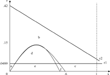
Figure 1 illustrates existence of equilibria.3
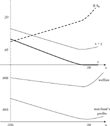
Parameter values in the examples of Figure 1 are u=1, K=.1, c=.5. The no-defection conditions in the fully organized markets equilibrium and the mixed equilibrium satisfy r<r1 and r<r2, respectively. Also, in Figure 2, r=.05.

Existence of equilibria. The pure barter equilibrium exists for all x and r. The fully organized markets equilibrium: areas a, e, f, c. The mixed equilibrium: areas a, b, c. The pure inside money equilibrium: areas d, e.

Effects of trade frictions in the mixed equilibrium with specialization choice.
In this equilibrium, the value of bills and merchants' profits increase as trade becomes easier in the unorganized sector. One perhaps surprising result is that the extent of the organized markets [i.e., the measure of producers who trade in the organized markets, P(1−Sp)] increases as trade frictions in the competing sector fall. The intuitive reason is as follows. When trade frictions fall, agents' expected returns from trading in the unorganized sector rise, and so merchants need to offer a higher q to attract customers. Merchant's profits would be sustained only if there is more business, to compensate the lower profit margin. This is possible only if more producers supply goods to the organized markets; that is, more transactions take place in the organized markets.
Note that, in the model considered here, the extent of the organized markets does not affect the trading efficiency of the organized transactions, but it affects trade difficulties in the unorganized sector. As more transactions take place in the organized markets, it is more difficult to conduct trade in the unorganized sector, because the probability of meeting a trade partner depends on the number of traders. Thus, an agent's decision to conduct the organized transactions creates a negative externality to the trading in the unorganized sector.4
Propositions 1 and 2 show that, the trade efficiency in the unorganized trading sector does not affect the existence of the fully organized markets equilibrium, though it matters for both trading sectors to be active. However, in Camera and Li (2003), all trade takes place in the intermediated sector when the efficiency of the intermediary (e.g., monitoring technology) is high enough.
The pure inside money equilibrium (Sp∈(0,1), Sb∈ (0,1)).
In this equilibrium bills circulate in both sectors as a general medium of exchange. Because it is not amenable to closed-form solutions, in the interest of illustration we discuss this equilibrium with observations from numerical experiments. Given other parameters, the best response conditions for sp and sb hold if x is not too low or too high (see Figure 1). When trade frictions are low, conducting trade in the unorganized sector is so attractive that it may not generate sufficient profits for the intermediation business. If trade difficulties are high, it would be too time-consuming for bill holders to encounter trade opportunities in the unorganized sector. There is a trade-off between the discounting effect and trade difficulties and so when the time discount rate falls, the existence region in terms of x is enlarged. If the trade frictions are moderate, merchant's profits and the extent of the organized markets increases as trade becomes easier.
Competition between different transaction patterns and how it responds to changes in trade frictions are crucial elements underlying the existence of the pure inside money equilibrium. Unlike fiat money, which is more likely to be valued as trade frictions are more severe, circulation of inside money here requires that trade difficulties are not sufficiently high. The reason is that there is an alternative usage of bills of exchange—redeeming them in the organized markets. The existence of organized markets, however, requires that trade frictions are not too low because the organized markets have advantages over the unorganized sector only if barter is not too efficient.
In summary, as long as the time discount rate is small, merchants arise to set up markets, honor the bills issued by other merchants, and privately issued trade credit is used as a medium of exchange in the organized markets. If trade frictions are moderate, bills of exchange circulate in the unorganized sector, where people's trading histories are private information.
Welfare
We have demonstrated that multiple equilibria exist, with the extent of the organized markets and circulation of inside money endogenously determined. Let the weighted average flow returns W denote welfare, where:

We now show that when multiple equilibria coexist they can be Pareto ranked.
PROPOSITION 3. Given parameter K, (i) equilibria with active organized markets dominate the pure barter equilibrium if x is small; (ii) the fully organized markets equilibrium dominates the mixed equilibrium and the pure inside money equilibrium.
In a pure barter equilibrium all agents are identical and W=rVp=x2(u−c). Given K, an equilibrium with active organized markets dominates the pure barter equilibrium as long as the trade frictions are high.5
The fully organized markets equilibrium dominates the pure barter equilibrium if
.
Notice that in the present model, merchants do not produce; they are trade agencies only. That is, merchants' intermediation activity crowds out their productive activity. When measuring the welfare effects of intermediation, one must weigh the benefits of the organized markets in facilitating trade against the costs due to the loss in resources used for providing intermediation services. We have assumed that a predetermined subset of individuals are potential merchants, and the number of merchants does not affect the trading efficiency in the organized markets. An immediate implication is that welfare is decreased by K because the intermediation business takes up resources. Thus, an interesting analysis would be to determine endogenously the size of merchants and study its welfare implications.
Specialization
Following Camera et al. (2003), we model specialization as producing a smaller set of goods and doing it more proficiently, which implies a lower probability to meet suitable trade partners in a decentralized trading environment. The trade-off between the saving of cost and difficulties in conducting trade is taken into account by agents when deciding the level of specialization.
Specifically, specialization is modeled as follows. If agent i chooses to expand his production set to s(yi) then the probability that a randomly encountered agent wants to consume agent i's output is p(yi)=x+yi≤1, where p′(yi)=1 if yi≤1−x, and p′(yi)=0, otherwise. A larger yi thus implies a broader production set and agent i specializes less. The cost in terms of disutility to producing one unit of goods is c(yi)=c+eyi, with e>0.
We study symmetric and stationary equilibria. Let s(Y) denote all other agents' production set. Given s(Y), the probability that a randomly encountered agent can produce for agent i is p(Y)=x+Y≤1. Given that the type of agents is randomly and independently determined, and the set of agents is symmetric, the probability of double coincidence of wants in a match is p(Y)p(yi). In a symmetric stationary equilibrium, y=Y.
Symmetric Stationary Equilibria
We maintain the assumption that a fraction K ∈ (0,1) of agents are potential merchants, and agents who trade in the organized markets can always locate the markets of their production and consumption goods without search; that is, the degree of specialization does not affect trade efficiency in the organized markets. When agents choose the extent of specialization, they take into account whether there are organized markets and whether bills of exchange circulate as a general medium of exchange. Agents' beliefs must be sustained in equilibrium. Once the specialization level is chosen, it cannot be changed.
First, a pure barter equilibrium always exists. We determine the specialization level in a pure barter economy as the benchmark. The value function satisfies:

An agent, taking as given the expected degree of specialization of other agents, chooses y to maximize his expected return from trade. Let
. Differentiate
with respect to y one gets:

because p(y)=x+y and p′(y)=1. The second derivative
. Hence,
yields the individual optimal choice:

When
i.e., yb=0 when x is large. Notice that
and
If trade difficulties are less severe, or the “fixed cost” of production is larger, agents tend to specialize more to improve production proficiency.
We now check the degree of specialization in the fully organized markets equilibrium. A producer-consumer, taking as given Y and q(Y), chooses y to maximize his expected flow return,6
The price q(Y) is determined by a competitive condition similar to (6) and is independent of individuals' choice of specialization.

where

One can show that
and we have corner solution y*=0.
PROPOSITION 4. The economy achieves complete specialization in a fully organized markets equilibrium.
Because agents can always locate the relevant markets of their production and consumption goods without search, they will fully exploit the benefit of specialization to achieve the greatest production efficiency. Proposition 4 is related to the findings in Camera et al. (2003), that the monetary economy is more specialized than the barter economy. Fiat money, by allowing trade in single coincidence matches, reduces individual's consumption risk due to random matching and, therefore, induces more specialization. In this model, if all trade occurs in the organized markets, consumption risk vanishes and agents fully specialize.
The following proposition establishes the specialization level in the equilibrium in which both sectors are active and the use of bills of exchange is limited in the organized markets.
PROPOSITION 5. In a mixed equilibrium, the extent of specialization is identical to that in a pure barter equilibrium.
This result may sound somewhat surprising because people may expect that the degree of specialization would be higher relative to barter because of the existence of organized markets. The intuitive reason lies in the fact that bills are spent only in the organized markets, where there is no double-coincidence problem and the price q(Y) is not affected by an individual's choice of y. Bill holders, after spending bills in the organized market, become producers, who may trade in the unorganized sector where only barter takes place.
We now turn to the pure inside money equilibrium, in which bills of exchange circulate as a general medium of exchange. Producers and bill holders are indifferent between trading in both sectors:

Note that the inventory distribution (P,B) and the endogenous variables (Sp, Sb) all depend on Y, and are taken as given when an individual chooses the optimal level of specialization.
Because of the analytical complexity of this equilibrium, we are not able to prove its existence, although from a large number of numerical examples we find y*<yb. The existence of organized markets and general acceptance of a medium of exchange reduces consumption risk so that people choose a higher level of specialization relative to barter. This result confirms the notion that the existence of markets and money induces specialization. A notable feature is that the object that plays the role of medium of exchange here is inside money—private liabilities that accompany the rise of the organized markets. In this equilibrium, the presence of inside money expands the set of trading opportunities and thereby, increases the level of specialization.
Figure 2 illustrates the effect of changes in trade frictions on the specialization level, welfare, and liquidity.7
Parameter values in the examples of Figure 2 are u=1, K=0.1, e= 1.5, r=0.05, c=0.5. When x→0.78, the specialization level y→0, and the economy performs as in the basic model with no specialization choice when x>0.78. This equilibrium does not exist when x<0.036.
. That is, when trade becomes easier, agents specialize more to such an extent that the reduction in y offsets the increase in x so that p(Y) is smaller. Note that in the basic model with no specialization choice (or, when y=0 in this model), a decrease in trade frictions unambiguously improves welfare.
Moreover, the number of bills circulating in the unorganized sector (BSb) is higher when x is larger. That is, higher inside liquidity is accompanied by a higher degree of specialization. A similar result is also found in Camera et al. (2003), in which a larger stock of outside money increases the extent of specialization when liquidity is scarce. The distinctive feature of the present model is that it is inside liquidity and is responsive to changes in the characteristics of environment such as trade frictions and production cost.
The three equilibria with active organized markets can be ranked in terms of the level of specialization. In the fully organized markets equilibrium y*=0, in the mixed equilibrium y*=yb, and in the pure inside money equilibrium 0<y*<yb. The ranking of the levels of specialization in distinct equilibria is related to the extent of consumption risk. When all trade occurs in the organized markets, consumption risk vanishes and agents fully specialized. If the extent of consumption risk facing agents is identical to barter economy, so is the equilibrium level of specialization. When the consumption risk is reduced by the presence of inside money, the level of specialization is higher relative to barter.
CONCLUSION
An important issue in monetary economics is how private liabilities become a generally accepted medium of exchange. This is not only of historical interest but also of considerable practical relevance, as recent development of technology and removal of legal restrictions have made it easier to create close currency substitutes. We have developed a model in which merchants may arise to set up markets and associated with the emergence of markets privately issued trade credit may be used as a general medium of exchange. The trade credit issued by merchants is a kind of inside money; it is used in the organized markets and also may circulate in the unorganized sector, where people's trading histories are private information. Moreover, we have shown how the endogenously determined extent of market and circulation of inside money affects the consumption risk and the equilibrium specialization level.
For tractability, we use a simple divisible goods setup that allows us to model merchant's profits while every trade in the unorganized sector is one-for-one swap. Relaxing this assumption and using bilateral bargaining to determine prices in the unorganized sector, there still exist three types of equilibria with organized markets. Moreover, from the results in Trejos and Wright (1995), we expect two pure inside money equilibria, with distinct circulating values of bills in the unorganized sector.
We do not consider outside money in the present model, but one can study how fiat money as an alternative means of payment affects the performance of inside money in this framework.8
For a discussion on the competition between inside and outside money in this framework, see the working paper version available on the Web site http://ccms.ntu.edu.tw/~yitingli/.
APPENDIX
Proof of Proposition 1. Given (Sp, Sb)=(0,0), P=B=(1−K)/2 by (8) and (9). The strategy sp=0 is the best response if and only if Vb−Vp−c>0, which is satisfied iff r<(u−c)/c. The strategy sb=0 is the best response iff qu+Vp−Vb>0, which holds given r<(u−c)/c. This implies Vp>0 and Vb>0. Equation (6) thus can be solved for

One can show that for any K∈(0,1), q∈(0,1) iff r<(u−c)/c. Thus, Vf>0. Also, the no-defection condition (7) is satisfied iff q≤1/(1+r), which requires

Proof of Proposition 2. Given sb=0, The value functions V=(Vp, Vb, Vf) are strictly positive and inventory distribution p=(P,B)∈ (0,1) if sp∈ (0,1). We show it is the case when x is close to 0 or close to 1. From wp=Vb−Vp−c one can solve for sp. When K is big, as x→0, sp→1 and ∂ sp/∂x|x→0<0; as x→1,
and ∂sp/∂x|x→1<0. Next, we check q∈(0,1). When K is big, as x→0, q→1 and ∂q/∂x|x→0<0; as x→1,
since ∂sp/∂x|x→1<0. We also need to check whether the best response condition (5) for sb=0 is satisfied. When K is big, as
as x→1,
since ∂sp/∂x|x→1<0. When K is big, q→c/u, and 1/(1+r)→1, as r→0. That is, as r is sufficiently small, q≤1/(1+r) and so the no-defection condition is satisfied.
Proof of Proposition 5. In the equilibrium with Sp∈(0,1),Sb=0, the value functions satisfy:

. One can solve for
. Hence,
yields
.
I thank two anonymous referees for valuable suggestions and comments. I also thank Gabriele Camera, Wan-Hsiang Pan, Shouyong Shi, Randy Wright, and participants at the meetings of the Society of Economic Dynamics and S.C. Tsiang Memorial Conference for helpful comments and conversations. Financial support from the National Science Council is acknowledged.