INTRODUCTION
Nematodes in the trichostrongyloid genus Nematodirus Ransom, 1907 cause significant disease in domestic ruminants and are common components of the gastrointestinal parasite fauna of their free-ranging relatives. Most attention has been paid to N. battus in sheep, since it causes devastating outbreaks of spring disease in temperate areas and appears to have spread following its sudden emergence in the UK some 50 years ago (van Dijk and Morgan, Reference van Dijk and Morgan2008). However, other members of the genus also cause economically significant disease in many parts of the world, most often as part of mixed nematode burdens associated with parasitic gastroenteritis in sheep and cattle. Given its importance as a cause of animal disease, the epidemiology of Nematodirus spp. has received surprisingly little scientific attention. Although the general life cycle is similar among species within the genus, which is purportedly arctic in origin (Hoberg, Reference Hoberg2005), N. battus is mostly restricted to temperate areas and causes disease predominantly in spring, whereas other species such as N. spathiger, N. filicollis and N. helvetianus are more widespread in both their geographical distribution and their seasonality, and have colonised more extreme environments (e.g. Al-Dulaimi et al. Reference Al-Dulaimi, Jassim and Molan1986; El Wahed and Mohammad, Reference El-Wahed and Mohammad2005; Morgan et al. Reference Morgan, Shaikenov, Torgerson, Medley and Milner-Gulland2005). Spatial and temporal abundance patterns of these trichostrongyloids in particular are, to a large extent, determined by temperature thresholds for development and hatching (Christie, Reference Christie1962; van Dijk and Morgan, Reference van Dijk and Morgan2008), and perhaps temperature-driven vital rates. More detailed understanding of the ecology of the free-living stages of Nematodirus species would improve our ability to predict and mitigate the occurrence of disease. Study of its sister species might also help to explain which characteristics of N. battus lead it to cause such damaging outbreaks of disease, why it tends to dominate other members of the genus following its introduction (Crofton, Reference Crofton1957; Thomas, Reference Thomas1959; Helle, Reference Helle1969), and how this species might adapt to remove constraints to further southward spread.
Like other members of the genus, N. filicollis develops to the infective L3 in the egg, with hatching delayed until specific climatic conditions are met (Thomas, Reference Thomas1959; Christie, Reference Christie1962). Temperature thresholds and vital rates have not been described for this species, and the role that chilling experience plays in hatching has not been researched explicitly. Described patterns of abundance at pasture strongly suggest that large numbers of eggs hatch without the need for chilling (Gibson, Reference Gibson1959, Reference Gibson1963; Boag and Thomas, Reference Boag and Thomas1975). Within-genotype variation in hatching behaviour may be an important determinant of the epidemiology of N. battus (see van Dijk and Morgan, Reference van Dijk and Morgan2008), and its role in N. filicollis might indicate likely targets for adaptive selection in Nematodirus spp. particularly in the context of global climate change and geographical spread of disease. Here, we also attempt to put adaptation in hatching behaviour within the genus Nematodirus in the less often considered context of co-infection with parasites competing for the same hosts.
MATERIALS AND METHODS
In February 2006, young lambs grazing on a commercial farm near Bristol, UK, showed patent N. filicollis infections. Year-round intensive monitoring of egg outputs of groups of lambs and ewes had clearly shown that Nematodirus battus was the dominating Nematodirus species on this farm (van Dijk, unpublished data). However, initially only N. filicollis eggs were detected in these December-born lambs. Their faeces were subsequently harvested from pasture and the eggs freed and transferred to a watery suspension as described by van Dijk and Morgan (Reference van Dijk and Morgan2008). Even without measuring them, N. filicollis eggs can easily be distinguished from those of N. battus on obvious differences in egg-shell colour, shape and size (Thomas, Reference Thomas1959). Similarly, even at low magnifications, L3s of Nematodirus spp. are readily distinguished by differences in size and characteristic tail shape. Since a few N. battus eggs were identified in the harvested N. filicollis isolate, 4 aliquots of 500 eggs were counted and the number of N. battus eggs recorded. During the hatching experiment the purity of the field isolates was assessed by larval morphology, and numbers of N. battus eggs and larvae subtracted before analysis. Eggs were stored at 9°C for up to 2 weeks until the start of the experiments.
In parallel with the experiments on N. battus described by van Dijk and Morgan (Reference van Dijk and Morgan2008), a somewhat reduced set of experiments was carried out on N. filicollis eggs and larvae, in the same cooled incubators (Sanyo-Gallenkamp, UK), and data analysed in the same manner. For a detailed description of these experiments we refer to the cited paper. Briefly, to analyse N. filicollis development rates, 3 replicates of approximately 4000 fresh eggs were incubated in filtered tap water at continuous temperatures of 11, 11·5, 12, 13, 15, 20, 25 and 30°C and their development scored weekly up to the point at which the first L3 was detected, and every 3 days thereafter. The temperature settings were chosen to identify the lower and upper thresholds for egg development as well as development rates within the temperature range experienced during spring and summer in temperate regions.
N. filicollis temperature thresholds for hatching were determined. Eggs were incubated at 20°C for 6 weeks, by which time all developing eggs had reached the L3 stage. The suspension was thoroughly mixed and split into 2 equal aliquots, one remaining at 20°C and the other chilled at a constant 4°C. Previous experiments with N. battus had shown that within-egg chilling processes are normally completed within 4 weeks (van Dijk and Morgan, Reference van Dijk and Morgan2008). After 33 days, eggs of both chilled and non-chilled treatments were pipetted into wells of a 96-well microtitre plate. For both treatments, 3 replicas of approximately 500 eggs were placed at continuous temperatures of 4, 6, 9, 11, 13, 15, 17 and 20°C, as well as 12-hourly fluctuating temperatures of 7–13, and 14–20°C, and any resulting hatching followed. The fluctuating treatments, reflecting realistic diurnal temperature ranges at pasture during early and late spring, were added to investigate the likelihood that hatching behaviour under fluctuating conditions is well approximated by observations made under constant temperature regimes. In all treatments, larvae were counted daily for 8 days and then again on days 12 and 20.
Experiments with the species N. battus had suggested that biochemical processes taking place during ‘chilling’ only commence at temperatures up to 11°C (van Dijk and Morgan, Reference van Dijk and Morgan2008). In order to estimate the upper temperature threshold for chilling experience of N. fillicollis, 3 replicas of non-chilled eggs were kept at 6, 8 and 11°C for 56 days before they were allowed to hatch at 13°C. The number of hatched larvae was subsequently counted on day 8.
Assuming that death rates of embryonated Nematodirus eggs at 4°C are negligible (Ash and Atkinson, Reference Ash and Atkinson1986; van Dijk and Morgan, Reference van Dijk and Morgan2008), the influence of prolonged exposure of fully embryonated eggs to 20°C on hatching rates was also tested. Three replicates of approximately 500 embryonated eggs were stored at 20°C for 12 weeks, then transferred to a chilling temperature of 4°C for 10 weeks, before being allowed to hatch at 15°C. The number of hatched larvae was counted on days 4, 6, 8 and 10.
Finally, survival rates of N. filicollis L3s were determined. Batches of larvae that had hatched at 13°C were placed in filtered tap water at temperatures of 9, 11, 13, 15, 17, 20, 25 and 30°C, as well as 12-hourly 14–20°C fluctuation, and the proportion of live larvae counted every 10 days for 140 days.
Differences in the proportion of eggs and larvae reaching a particular stage of development, or surviving a time interval, were analysed using analysis of variance (ANOVA), with treatment and time as factors. The relationship between temperature and development rate, as determined by the time at which 50% of eggs contained L3s, was evaluated by correlation, followed by linear regression where appropriate. The developmental threshold temperature was calculated by extrapolating the regression line of daily developmental rate against temperature to the point at which no development was predicted to occur. The number of ‘Degree Days’ required for 50% of the population to develop was subsequently calculated by deducting the predicted minimum development threshold from the measured temperatures and multiplying by the number of days taken to reach 50% development (e.g. Williams and Richardson, Reference Williams and Richardson1984; Samson and Holmes, Reference Samson and Holmes1985). The observed time between the discovery of the first L3 and the point at which all eggs that were to produce L3s had done so (tmin–max) was determined at each temperature. The rate at which hatching took place is of interest because chilling experience is considered to accelerate hatching in Nematodirus spp. It was assessed as the time at which 50% of the eggs had hatched (t50). The parameters tmin–max and t50 were compared between treatments using ANOVA.
Mortality rates of hatched infective larvae were estimated as the slope of the linear regression of log10-transformed proportions of larvae alive against time. Differences between treatments were considered significant when the 95% confidence intervals of the slope parameters did not overlap.
RESULTS
Scoring of batches of eggs revealed the culture to consist of 95% (range 93–97) N. filicollis eggs and 5% N. battus eggs. Results shown are for N. filicollis only, after subtraction of N. battus observed at each stage of development.
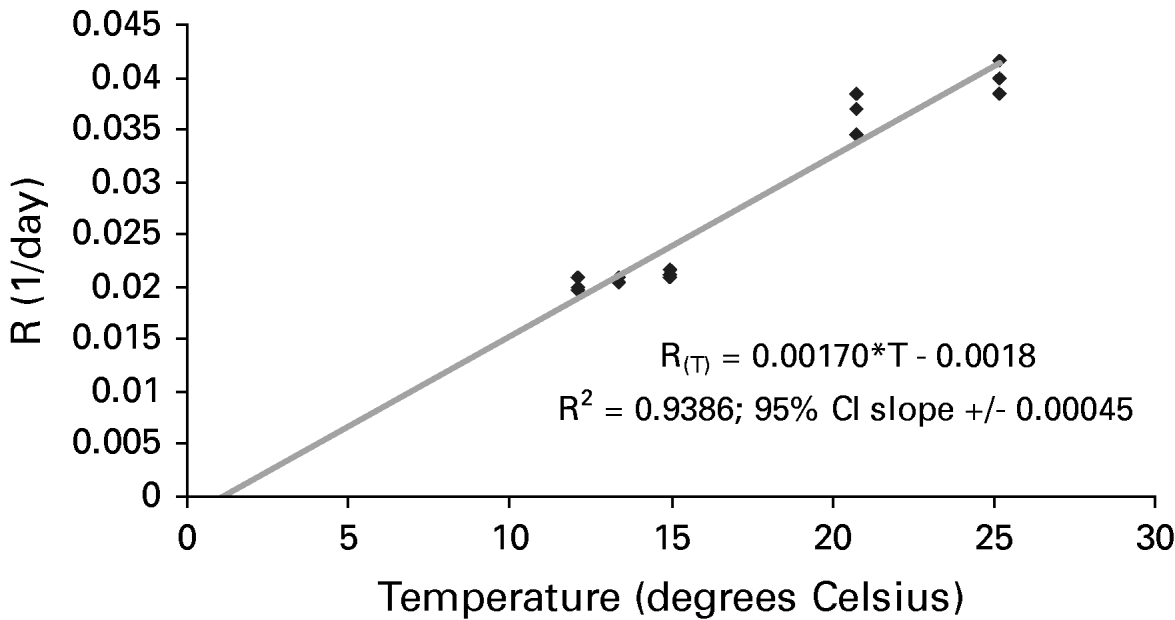
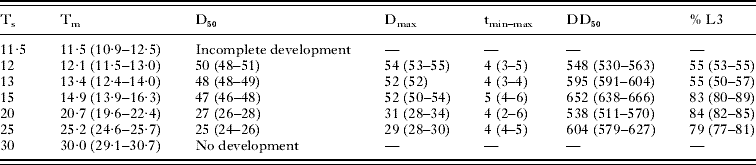
Egg development results are shown in Table 1. At 11·5°C, very few eggs reached the L3 stage, but at 12°C over half of the eggs developed successfully. At 30°C, no development was observed. Arcsine transformed proportions of eggs developing to the L3 stage in the temperature range 12–25°C differed significantly between treatments (F 4,14=48·53, P<0·001). In the 12 and 13°C treatments, significantly fewer (P<0·001) eggs developed than in the 15, 20 and 25°C treatments, while there were no differences between the latter 3 treatments (P⩾0·211). There were no significant differences in the time taken between the onset and completion of development (tmin–max) between treatments (F 4,14=0·575, P=0·687), and therefore development temperature does not appear to influence the degree of synchronizaton of egg development in this species. The temperature range where the largest part of the egg population profits from the highest development rates appears to be 20–25°C. Indeed, the daily development rate to 50% egg development increased significantly with temperature (Pearson r p=0·97, P<0·001) as shown in Fig. 1. Extrapolation of the regression line predicted the minimum development threshold to be 1·06°C (but see Discussion section). Across all temperatures, N. filicollis completed its development more rapidly than N. battus.
Regression of daily development rate (R=1/D50) of Nematodirus filicollis on temperature. As the result of overlap not all 15 data points are visible.

Nematodirus filicollis egg development at various temperatures
(Ts=temperature setting; Tm=mean measured temperature; D50=average day 50% of the eggs had completed their development; Dmax=average day development of all eggs was completed; tmin–max=time between the detection of the first L3 and the completion of development (in days; for most treatments, at least 50% of the eggs had already developed L3 at the time of their first discovery); DD50=average number of Degree Days to 50% development; % L3=percentage of the eggs present at the start of the experiment completing development. Presented percentages and days all rounded up to the nearest integer. The ranges are given in parentheses.)

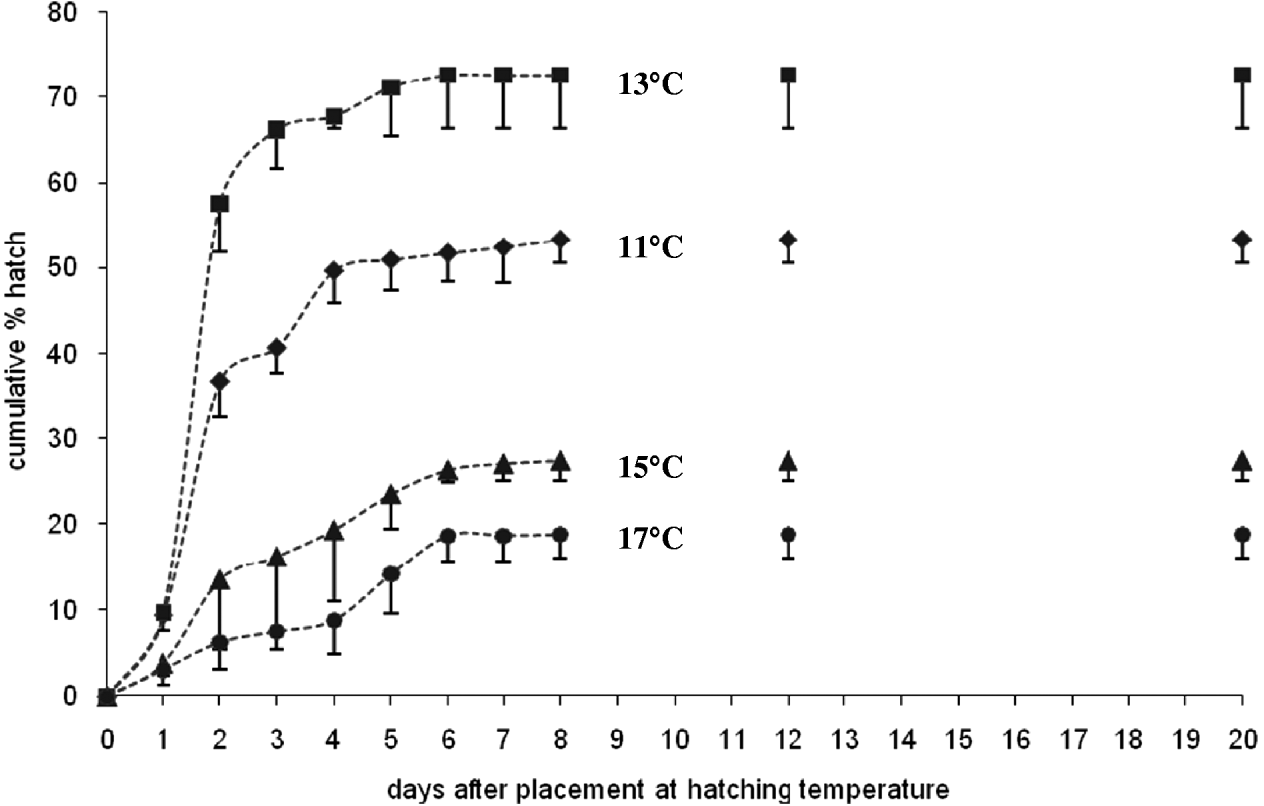
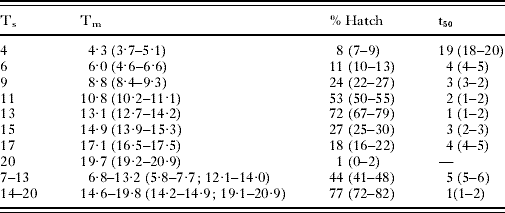
In fully developed non-chilled eggs, virtually no hatching was observed at any of the hatching temperatures. Even after 29 days, the highest percentage hatch in any of the 30 replicates of the 10 non-chilled treatments, at a temperature of 13°C, was 3·5%. The hatching characteristics of the chilled treatments are summarized in Table 2. As virtually no eggs hatched at 20°C, this treatment was omitted from further analyses. Hatching percentages were significantly different between treatments (F 8,26=119·82, P<0·001). At constant temperatures, more eggs hatched at 9°C than at 4 and 6°C (P⩽0·036), while more eggs hatched at each further temperature increment up to 13°C, (P<0·001), before again declining with each 2°C increment (P<0·001). Percentages of eggs hatching in the fluctuating 7–13°C versus constant 11°C treatments (P=0·192), and fluctuating 14–20°C versus 13°C treatments (P=0·655), could not be statistically separated. Hatching behaviour at constant temperatures between 11 and 17°C is illustrated in Fig. 2. At 11 and 13°C, large proportions of eggs hatched in the first 3 days; At all temperatures where hatching occurred the process was completed within 1 week. The t50 of the 4°C treatment (Table 2) was significantly longer than that of all other treatments (F 8,26=215·06, P<0·001) but otherwise no clear patterns could be established in the time taken to 50% hatch as there was variation between homogeneous subsets of treatments.
The hatching of ‘chilled’ Nematodirus filicollis eggs, incubated to the L3 stage at 20°C before being placed at 4°C for 33 days, at 11, 13, 15 and 17°C. Error bars represent standard deviations.

Hatching characteristics of Nematodirus filicollis eggs, incubated to the L3 stage at 20°C before being kept at 4°C for 33 days, then kept at the temperatures given in the table for 20 days
(Ts=temperature setting; Tm=mean measured temperature; % hatch=mean cumulative percentage hatching in the chilling treatments; t50=mean time (in days) to 50% hatch. All measurements are rounded up to the nearest integer. Ranges are given in parentheses.)

Of ‘non-chilled’ eggs kept at 6°C for a prolonged period of time, placement at 13°C (the optimal hatching temperature) resulted in a 52% hatch (49–56) on day 8. The corresponding figure for storage at 8°C was 38% (36–45), and for 11°C only 3% (1–4), suggesting that chilling only occurs below 10°C, and then more strongly towards 4°C. In order to further investigate whether, at 11°C, ‘chilling’ processes do take place, albeit at a reduced rate, this treatment was subsequently kept at 11°C for a further 6 weeks and the hatching process repeated. No further hatching was observed.
Prolonged exposure to 20°C, followed by chilling, did not influence hatching rates negatively. At a hatching temperature of 15°C, 98% (range 96–100) of the eggs hatched and hatching was completed on day 6.
The instantaneous daily mortality rates of L3 at various temperatures are given in Table 3. Mortality rates were significantly lower at 9 and 11°C than at all other temperatures. Within the hatching range, larvae survived significantly longer at 13 than at 17°C. Mortality rates increased very rapidly above 20°C. At fluctuating 14–20°C, survival was similar to that at 20 and 25°C.
Survival of chilled Nematodirus filicollis larvae
(μ=the slope of the log linear regression line and equals the instantaneous daily mortality rate; 95% confidence intervals (plus or minus) are given in parentheses.)

DISCUSSION
The field isolate was not monospecific, with 95% of eggs identified as N. filicollis and the rest as N. battus. However, since hatching of N. filicollis eggs is completed far more rapidly, the presence of N. battus eggs did not interfere with the results of the hatching experiments. N. battus larvae, which can easily be distinguished from N. filicollis larvae, were, as expected, only seen towards the end of the experiments, and were excluded from the counts.
The presence of an upper temperature threshold for hatching, at around 17–20°C, was confirmed for N. filicollis (Table 2). This follows a similar observation for N. battus (van Dijk and Morgan, Reference van Dijk and Morgan2008), and could be a general feature of the genus. However, it is likely that this upper threshold plays a far more important limiting role in the epidemiology of N. battus than for N. filicollis. Firstly, while the lower temperature threshold for hatching of N. battus eggs is approximately 11°C, N. filicollis eggs begin to hatch at a lower temperature and therefore over a larger temperature range. Under UK climatic conditions in spring, when daily temperatures start to exceed the lower temperature threshold of around 6°C, the maximum daily temperature is unlikely to be above 17°C, so interruption of hatching will not normally occur. Secondly, hatching of N. filicollis is completed very quickly: in as little as two days, very large proportions of the population have already hatched, and the rest do so by day 6. As a result, ambient temperature only has to remain within the hatching range for a few days, as opposed to 16–20 days for N. battus. In the UK, and especially in warmer climates, the probability of an egg hatching in a given spring is predicted to be much greater for N. filicollis than for N. battus.
The lower temperature threshold for hatching of N. filicollis, in combination with a gradual release of more larvae as the temperature increases up to 13°C, can explain between-year differences in hatching patterns observed at pasture as well as apparently lower pathogenicity of this species in the UK when compared with N. battus. If daily temperatures rise rapidly in spring, a mass hatch may occur (as observed by Thomas, Reference Thomas1959; Gibson, Reference Gibson1963; Boag and Thomas, Reference Boag and Thomas1975), but more frequently temperatures in winter or early spring rise above the lower threshold for a couple of days, then fall below it once again. For N. battus, no hatching would result, but for N. filicollis this is likely to trigger a gradual hatch of the depot of eggs and thus moderate rates of exposure in sheep, possibly accompanied by gradual build-up of immunity with little overt disease.
As for N. battus, the predicted N. filicollis development threshold (1·06°C) bears little resemblance to reality, casting doubt on the validity of extrapolating temperature-development regressions to estimate minimum development thresholds of arctic parasites (Kutz et al. Reference Kutz, Hoberg, Polley and Jenkins2005; van Dijk and Morgan, Reference van Dijk and Morgan2008). N. filicollis egg development starts at a temperature similar to that of N. battus, but development is quicker, while, in contrast to N. battus, more eggs develop towards the higher end of the development range. Also unlike N. battus, development at the high end of the temperature range still takes place in the characteristic highly synchronized manner. Thus, the developmental phase of N. filicollis appears to be better adapted to warmer climates. However, as the hatching of these eggs, like those of N. battus, is bound by temperature thresholds, this advantage does not necessarily translate to higher larval availability in the UK or in warmer climates. Mortality rates of the two species at high temperatures are also similar. It appears that the main things setting the free-living stages of two species apart is the difference in lower threshold temperature for hatching and the faster hatch within the temperature threshold, i.e. the probability of hatching given a short period of within-threshold temperatures.
The finding that N. filicollis hatches only after chilling is inconsistent with a number of field observations made in the UK. Thus, the autumn peaks in N. filicollis larval emergence described by Boag and Thomas (Reference Boag and Thomas1975) can only be explained by the hatching of non-chilled eggs. Gibson (Reference Gibson1959) described mass hatching in spring, similar to that of N. battus, but also hatching 8 weeks after the deposition of unembryonated eggs at pasture. Gibson and Everett (Reference Gibson and Everett1976) even recorded mass larval emergence any time between June and November, depending on when, in the same calendar year, unembryonated eggs had been put at pasture. This shows that virtually all eggs hatched on completion of development, without any chilling experience. On commercial farms, hatching of N. filicollis eggs in autumn has been shown to contribute significantly to disease outbreaks in sheep (Hollands, Reference Hollands1984). Furthermore, like N. spathiger and N. helvetianus, N. filicollis can be found all over the world and is prominent in ruminants in countries with hot climates. Its hatching strategy would therefore be expected to bear closer resemblance to those of N. spathiger and N. helvetianus, species readily hatching immediately on completion of L3 development (Herlich, Reference Herlich1954; Kates and Turner, Reference Kates and Turner1955; Marquardt et al. Reference Marquardt, Fritts, Senger and Seghetti1959), than that of N. battus. In genetic studies, N. spathiger and N. helvetianus were repeatedly identified as the most closely related sister species, and form a clade with N. filicollis, while N. battus is by far the most distinct species (Newton et al. Reference Newton, Chilton, Beveridge and Gasser1998; Audebert et al. Reference Audebert, Durette-Desset and Chilton2000; Nadler et al. Reference Nadler, Hoberg, Hudspeth and Rickard2000). Although these genetic differences are not necessarily reflected in hatching behaviour, they further fuel the expectation that N. filicollis should more closely resemble N. spathiger and N. helvetianus than N. battus. The hatching of N. filicollis eggs only after chilling was therefore highly unexpected. In agreement with laboratory-based predictions of post-chill spring hatch and no autumn hatch of non-chilled eggs, increased faecal egg counts of this species in autumn were not observed in groups of lambs sampled biweekly, over 2 successive years, on the study farm (van Dijk, unpublished data). It is possible that the proportion of eggs hatching without chilling varies widely between isolates, in which case the extent to which this proportion is open to selection could be of crucial importance to the ability of Nematodirus species to adapt to climate change.
The co-occurrence of N. battus and N. filicollis on the study farm is interesting given the tendency of N. battus to dominate other members of the genus following its introduction (Helle, Reference Helle1969). It is possible that the requirement for egg chilling in this isolate of N. filicollis enables it to concentrate infection of lambs in early spring, before peak infection with N. battus, and hence avoid competition (both direct and mediated by the host immune response) (Keymer, Reference Keymer1982; Boag et al. Reference Boag, Lello, Fenton, Tompkins and Hudson2001). Larvae hatching in autumn would normally encounter immunocompetent hosts with prior experience of N. battus infection, as well as concurrent intake of N. battus larvae, and would be less well placed. Temporal aggregation of infection in N. filicollis could also increase mating probability, which is more likely to be limiting for rare than for common (i.e. dominant) species.
Nematodirus species appear to be well adapted to extreme environments but, in warmer climates, the key to their transmission success lies in the probability of the completion of the hatching process, which is determined by temperature thresholds. As a result of the upper threshold for hatching in both N. filicollis and N. battus, variability in hatching behaviour is likely to play an important part in the ecology of their free-living stages. However, factors other than climatic influences are likely to co-determine the hatching characteristics of these parasites. Crossan et al. (Reference Crossan, Paterson and Fenton2007) showed that infection strategies of nematodes, faced with periods of host absence, may rapidly adapt towards maximizing the probability of infecting hosts. In a farming situation, host availability may be translated into terms like management of pastures and timing of lambing or calving. Interspecific within-host interaction, likely to be mediated by host immunity, may be another important co-determinant. Therefore, the proportion of egg populations hatching without chilling, if open to natural selection, might vary considerably both between regions and at much smaller spatial scales. This makes Nematodirus an interesting model for the study of parasite adaptation to climate change.
J.vD. gratefully acknowledges the support of the BBSRC (UK) through a Veterinary Research Fellowship Studentship. The authors very much wish to thank the Amos family of Lower Failand Farm, near Bristol, for their assistance and support.