The Gant decision changes the landscape dramatically with regard to an officer’s authority to conduct a warrantless search of a vehicle incident to arrest as a matter of routine.
—Lisa A. Judge, Police Chief magazine, June 2009Introduction
In 2009, the US Supreme Court handed down a decision that directly influenced vehicle search practices police had relied upon for almost 30 years. The decision in New York v. Belton (453 U.S. 454 [1981]) was used by police as a bright-line rule that allowed them to conduct warrantless automobile searches of a vehicle’s passenger compartment after arresting one of the vehicle’s occupants—regardless of the offense, the reasonableness of the expectation of finding evidence, or the legitimacy of officer safety considerations. Arizona v. Gant (556 U.S. 332 [2009]) substantially modified the Belton rule by holding that passenger compartment searches can be conducted when it is reasonable to believe that further evidence of the crime of arrest will be found or when the arrestee remains unsecured and may access the vehicle. Within the span of a day, officers around the country went from being able to conduct vehicle searches after any arrest to having to justify their decision within the parameters of the new ruling.
Gant, like many Supreme Court cases, requires implementation by street-level professionals who are compelled to change their day-to-day practices. Numerous studies have focused on how lower court judges respond to rulings by the Supreme Court. By contrast, less is known about what Canon and Johnson (Reference Canon1984) term the “implementing population,” those nonjudicial actors who are responsible for carrying out court policies. Examples include school district officials tasked with integrating schools or county clerks who must distribute marriage licenses to same-sex couples (e.g., Bullock and Rodgers Reference Bullock1976; Hall Reference Hall2010).
This study seeks to gain further insight into how policy gets translated into practice for these actors. Gant provides a unique opportunity to assess whether the police, who were responsible for implementing the new policy, systematically changed their behavior because of this decision. Relying on comprehensive traffic-stop data containing millions of interactions between the police and citizens, rates of police searches before and after the ruling are examined to test the impact of the decision using time series intervention analysis. These rich data allow for an assessment of how quickly, if at all, these implementers responded to the Court’s decision. Further, they provide a meaningful window into the ability of these actors to find alternative ways to achieve their goals or possibly defy Court rulings.
Overall, the findings show that implementer responses to changes in Supreme Court policy can be rapid and dramatic. Police reacted quickly to the Supreme Court’s new policy in Gant, greatly curtailing the number of searches incident to arrest they performed. Yet, despite striking evidence of compliance with the decision, some alternative searches increased greatly during the same period, suggesting that the police found other means to conduct searches as a way to “work around” the ruling.
The Interpretation and Implementation of Supreme Court Decisions
Research on the impact and implementation of judicial policies spans more than a half-century (Peltason Reference Peltason1971; Baum Reference Baum1976; Canon and Johnson Reference Canon1984; Hall Reference Hall2010). Canon and Johnson (Reference Canon1984) provide a useful framework that conceptualizes the implementation of legal policies, offering four distinct “populations” that respond to judicial decisions, two of which are relevant to this study. The interpreting population consists of lower courts whose decisions broaden or restrict the application of the Court’s precedent. The implementing population, by contrast, consists of those government actors who have a responsibility to carry out policies and “apply the system’s rules to persons subject to their authority” (19). They frequently include prosecutors, bureaucrats, and public school officials, among others.
While a burgeoning literature exists on interpreting population responses to Supreme Court policies, research on the implementing population is limited by comparison. The examinations of the US Courts of Appeals (Songer, Segal, and Cameron Reference Songer1994; Brent Reference Brent1999, Reference Brent2003; Benesh and Reddick Reference Benesh2002; Haire, Lindquist, and Songer Reference Haire2003; Luse et al. Reference Luse2009; Westerland et al. Reference Westerland2010; Gizzi, Curtis, and Boldt Reference Gizzi2014) and state supreme courts (Martinek Reference Martinek2000; Benesh and Martinek Reference Benesh2002; Hoekstra Reference Hoekstra2005) have shown broad compliance and responsiveness regarding Supreme Court decisions with a context-dependent ability to resist change.
Most studies that are focused on the implementation of court decisions have evaluated controversial Warren Court cases involving such issues as school district desegregation, school prayer, and police interrogations; they have generally found that Court-issued reforms required significant actions by others (executives, activists, and bureaucracies) to have them implemented in a meaningful way (Dolbeare and Hammond Reference Dolbeare1971; Milner Reference Milner1971; Bullock and Rodgers Reference Bullock1976; Rosenberg Reference Rosenberg2008). The scope of these foundational studies may be constrained by the context of the decisions being analyzed, where resistance to their implementation was especially prominent. Other research has shown greater responsiveness and compliance by the implementing population. Spriggs (Reference Spriggs1996, Reference Spriggs1997) conducted examinations of the impact of the Supreme Court’s decisions on federal administrative agencies, finding no evidence of defiance or evasion in reaction to the Supreme Court.
Among the most far-reaching and generalizable analyses of judicial impact on the implementing population is Hall (Reference Hall2010). He asserts that two conditions explain the outcome of Supreme Court policies, whether the issues being handled are “vertical” or “lateral” in nature. Vertical issues like abortion or the right to counsel are those that need only the support of lower courts to carry out a shift in policy. Lateral issues, meanwhile, such as reapportionment or affirmative action, necessitate the actions of those outside the judicial branch to be successful. Hall finds that decisions in vertical areas of the law are often implemented effectively. Those in lateral areas rely more heavily on public opinion, requiring the citizenry to keep pressure on key implementers to conduct change.
Why Gant and Police Searches?
This study supplements the foundational qualitative judicial implementation work from the 1960s and 1970s that examined a few jurisdictions in great depth (e.g., Dolbeare and Hammond Reference Dolbeare1971; Milner Reference Milner1971) and the more recent innovative cross-sectional studies that test the influence of numerous court decisions on a variety of implementers (e.g., Spriggs Reference Spriggs1996; Hall Reference Hall2010). It focuses on a single court decision but, unlike the earlier research, uses large data sets that include approximately 34 million police-citizen interactions across thousands of state, county, and local law enforcement agencies in two large states. And, unlike the recent large-n studies, the nature of the data allows for extremely fine-grained analysis considering the impact of the Supreme Court in the time immediately following its decision.
Police organizational responses to changes in judicial policy by the Supreme Court present a unique context to view the power of the Court. Contrary to its hierarchical relationship with lower courts, the Supreme Court has no direct ability to supervise the decisions of law enforcement. The Court must rely instead on intermediaries and the rule of law to ensure its will is carried out. Many police searches occur outside the supervision of the judicial branch altogether unless their actions are contested as part of a criminal prosecution or suit involving police liability.
Prior research on the police and Supreme Court decisions suggests that the relationship is sometimes fraught with tensions. Skogan and Meares (Reference Skogan2004) reviewed the body of work on police compliance with criminal procedure. They explained that this literature shows that while law enforcement tends to obey the law, “they sometimes skirt constitutional standards because they want to deter crime by incarcerating the truly guilty” (73). Studies have provided evidence for major shifts in police practice following court opinions and patterns of resistance by police to limits on their authority.
Several studies argued that Miranda v. Arizona (384 U.S. 486 [1966]) substantially reduced rates of questioning, confessions, and case clearances, indicative of widespread implementation of the Court’s opinion (Cassell and Hayman Reference Cassell1996; Leo Reference Leo1996; Cassell and Fowles Reference Cassell1998). Yet, the results of other studies suggest that law enforcement did not always alter their behavior when questioning suspects. Reiss and Black (Reference Reiss1967) and Milner (Reference Milner1971) asserted that many officers observed during their studies did not issue required Miranda warnings.
In the area of search and seizure, several studies have examined whether police have followed precedents established by the Supreme Court. Following the application of the exclusionary rule to the states in Mapp v. Ohio (367 U.S. 643 [1961]), increases were found in the number of search warrant applications and motions to suppress in major cities, suggestive of the ruling’s implementation (Spiotto Reference Spiotto1973). Canon (Reference Canon1973) found declines in arrest rates in several major cities, implying that Mapp limited the ability of the police to gather incriminating evidence. However, one study conducted by Columbia University law students found that the proportion of narcotics cases in which officers claimed to have found evidence in plain view rose dramatically after the decision. This finding led the researchers to argue that law enforcement was “fabricating the grounds of arrest in narcotics cases in order to circumvent the requirements of Mapp” (Hoffman and Seltzer Reference Hoffman1968, 95). Fagan and Davies (Reference Fagan2000) and Gould and Mastrofski (Reference Gould2004) also found that large numbers of police searches in their studies were performed unconstitutionally.
The presence of noncompliance across a variety of prior studies suggests that this project could represent a hard test of the Supreme Court’s reach. Gant upended nearly 30 years of police search and seizure practices. The degree to which local police comply with a ruling that limits their discretion to obtain evidence and conduct criminal enforcement speaks directly to the ability of the Court to lead policy change. Further, the capacity of law enforcement to shirk, evade, or find alternative means to conduct searches may shed light on the ability of other government organizations to pursue their own interests after the Court has spoken.
The Development of Arizona v. Gant
The Fourth Amendment doctrine regarding warrantless searches incident to legal arrest has been a crucial tool used by law enforcement to conduct searches of automobiles for decades (see, e.g., Judge Reference Judge2009; Schott Reference Schott2009; Gizzi and Curtis Reference Gizzi2016). The Court has long permitted police to search the person of an arrestee and the area within their immediate control for officer safety and to prevent the destruction of evidence (Chimel v. California, 395 U.S. 752 [1969]; United States v. Robinson, 414 U.S. 218 [1973]). The subjectivity of the reaching-distance rule created questions for law enforcement about the scope of a search incident to arrest when the person arrested was in a vehicle. For police, these questions were resolved when the Court decided Belton. Police interpreted the decision as a per se rule that permitted the search of a vehicle’s entire passenger compartment incident to arrest.
As applied, the Belton rule eliminated the subjectivity of the Chimel reaching-distance test by permitting the search of a vehicle’s passenger compartment after every arrest regardless of the seriousness of the offense or how reasonable it was to expect to find evidence. It created a lower threshold to search for contraband than was permitted by the automobile exception, which allowed a warrantless search of a vehicle only when the officer had probable cause that the vehicle contained evidence of criminal activity (Carroll v. United States, 267 U.S. 132 [1925]; United States v. Ross, 456 U.S. 798 [1982]).
The true value of the Belton search came in waging the war on drugs. Police used the pretext of a minor traffic violation to conduct criminal investigations. If the officer suspected that the suspect’s vehicle contained contraband but lacked probable cause, an arrest for a minor offense permitted a vehicle search. The Drug Enforcement Agency trained more than 30,000 officers in how to make extensive use of the tools the Court provided (Gizzi and Curtis Reference Gizzi2016). Vehicle searches became a primary means by which the war on drugs was fought.
The Belton search became a central part of police training (Remsberg Reference Remsberg1995; Epp, Maynard-Moody, and Haider-Markel Reference Epp2014) and netted significant victories for law enforcement, but over time, some of the justices began to assert that its application was disconnected from the original rationale that was used to justify search incident to arrest: officer safety and the preservation of evidence.Footnote 1 The majority in Gant found that most vehicle searches incident to arrest involved no officer safety concern after the arrestee was secured and removed from the vehicle, and for many types of offenses, there was no evidence to preserve.
The Supreme Court’s decision to grant certiorari in Gant ran counter to years of police practice (Judge Reference Judge2009). The case included a search that was a prototypical Belton search after an arrest for driving on a suspended license. Rodney Gant challenged the search, claiming there were no officer safety concerns or any need to search for evidence, given what he was arrested for (Arizona v. Gant, 556 U.S. 332 [Reference Judge2009], 335–38). In a 5–4 decision, the Supreme Court agreed with Gant, and Justice Stevens modified the Belton rule, replacing it with a two-pronged standard. Under the first prong, the Court held that incident to arrest, a warrantless search of the arrestee’s person was always permissible, but a vehicle search was allowed only under the rare circumstance in which the arrestee was unsecured and could gain access to the vehicle. Meanwhile, the decision’s second prong permitted a search of the passenger compartment only if it was reasonable to believe that further evidence of the crime of the arrest would be found. This meant that arrests for minor offenses like driving under a suspended license or driving without proof of insurance could no longer be used as the pretext to conduct a passenger compartment search.
The decision sent shockwaves throughout the law enforcement community. Police publications were vocal about the restrictions imposed by the ruling and about finding ways to adapt to those limitations to continue to conduct vehicle searches. The May 2009 issue of the Federal Law Enforcement Training Center’s Federal Law Enforcement Informer devoted 10 pages to the Gant ruling. In the article, an instructor at the center examined how Gant affected the doctrine of search incident to arrest and also discussed, in detail, ways in which officers may conduct searches by relying on other established exceptions to the warrant requirement. The author wrote, “Gant will have an immediate impact on the day-to-day operations of law enforcement officers in the field… . If an officer cannot justify a search of a vehicle incident to arrest under Gant, or is uncertain whether an SIA is warranted, other established exceptions to the search warrant requirement remain available to safeguard evidence and protect the safety of officers” (Solari Reference Solari2009, 4, 8). Despite noting the substantial limitations to conducting vehicle searches, the author indicated that many other warrant exceptions remained available to officers. Specifically, she said that officers might use protective frisks (Michigan v. Long, 463 U.S. 1032 [1983]), probable cause or the “automobile exception” (Carroll), consent of the driver to the search (Schneckloth v. Bustamonte, 412 U.S. 218 [1973]), or inventory searches (South Dakota v. Opperman, 428 U.S. 364 [1976]).
Similarly, the June 2009 issue of Police Chief, the official publication of the International Association of Chiefs of Police, featured a column on Gant by Lisa A. Judge (Reference Judge2009), who wrote, “To many state and federal courts and most of the law enforcement community, the decision marked a significant change to long-standing practices regarding the nature and scope of warrantless vehicle searches conducted incident to lawful arrest… . The Gant decision moves away from the easy-to-understand, bright-line rule of New York v. Belton, which was widely interpreted to authorize the routine warrantless search of a vehicle pursuant to the arrest of an occupant of that vehicle.” Judge continued by detailing a bullet-point list of exceptions to the warrant requirement police organizations may still pursue in addition to search incident to arrest. Included in the list were protective frisks, inventory searches, consent searches, and the automobile exception.
Research Design and Hypotheses
To examine the impact of Gant on law enforcement behavior, this study takes advantage of comprehensive traffic-stop data from two states. Statewide data sets from Illinois and North Carolina allow for a test of whether Gant actually limited searches incident to arrest and can shed light on whether alternative rationales were relied upon in order to conduct searches after the decision.
Several aspects of the case’s impact are of interest. The first is whether the Supreme Court actually changed officers’ reliance upon the search-incident-to-arrest exception to the warrant requirement when searching automobiles. To test this, the rates of search incident to arrest are subjected to time series intervention analyses to see whether the decision had a statistically significant effect. Gant allows for a search incident to arrest of a vehicle only when there is a reasonable expectation of finding further evidence of the crime of the arrest or when the arrestee is unrestrained and within reaching distance of the vehicle. While not eliminating the search-incident-to-arrest exception, this was a substantial shift from allowing a search after any arrest. It is expected that police largely complied with the restriction, thus reducing the rates of these searches. This expectation is stated in hypothesis 1. The strong reaction by law enforcement publications to the decision implies that police took its new limits seriously. While these articles were often critical of Gant, they instructed officers on how to follow the letter of the ruling. Further, the role of law enforcement organization supervisors and trial courts in monitoring police behavior seems likely to constrain officers from conducting illegal searches under the invalidated Belton rule. Not following the new search-incident-to-arrest standards could result in professional sanction or having evidence excluded by trial judges.
Hypothesis 1. Gant reduced the number of police searches incident to arrest, all else equal.
While it is anticipated that Gant reduced vehicle searches incident to arrest, it should not prevent the warrant exception from being used when the circumstances permit it. Officers routinely make arrests in circumstances in which it may be reasonable to find further evidence of the offense in the vehicle (e.g., drug possession, driving under the influence, illegal weapons possession).
Following searches incident to arrest, this study then considers a second aspect of Gant’s judicial impact. Police publications following the decision were vocal about finding other legal means to conduct vehicle searches. Accordingly, rates of alternative search types are examined and tested to see whether police sought other ways to continue doing searches in the new policy environment. Officers have several avenues available for conducting warrantless vehicle searches other than search incident to arrest. For example, if an officer knows that an arrest for driving without proof of insurance will not allow him to search the vehicle, he might ask for the consent of the driver (Schneckcloth) or call a police dog to sniff the exterior (Place). The officer could also elect to impound the vehicle to conduct an inventory search (Opperman). It is likely that even after their discretion has been limited, police officers are still motivated to conduct searches so that they may arrest suspected criminals and gather evidence for successful prosecutions. Thus, it is expected that alternative search rationales were increasingly relied upon after the holding. This expectation is stated in hypothesis 2.
Hypothesis 2. Gant increased the number of police searches that rely on rationales other than search incident to lawful arrest, all else equal.
If a reaction to Gant is found in any kind of police search, then several other questions need to be answered. First, how large of a change did Gant cause relative to before? Quantifying the effect of the decision will provide insight into how the language of the ruling translated into a substantive impact and, perhaps, to what degree officers are complying with the law. Second, how long does it take for officers to change their behavior in the face of a legal policy change? Whether any delay exists between the announcement of a policy and the adaptation of the policy provides valuable information about the process by which police learn about court decisions.
Data
The direct impact of any given court policy on the behavior of actors responsible for implementing it is rarely empirically observable. There are few data sources available that track the behavior of relevant actors within federal, state, or private organizations in response to judicial decisions. This study takes advantage of an exception: a number of states have passed legislation that requires the collection of comprehensive data on traffic stops to detect racial biases in policing. Large data sets from Illinois and North Carolina allow for a rigorous test of the judicial impact of Gant because they include information about vehicle searches and the date of each stop that resulted in the search. This provides an uncommon and informative look into what reaction a discretion-limiting judicial decision provokes from those officials who are bound by it. While several other states have also published traffic-stop data, the data sets from Illinois and North Carolina are the only available ones known to the authors that provide enough information for a rigorous examination of the effect of Gant.Footnote 2
These two data sets report information on nearly the full population of routine police stops in their states. The Illinois Traffic Stop Statistical Study Act mandates the reporting of traffic-stop data of “every law enforcement agency” to the state. North Carolina requires that all state and county law enforcement agencies furnish traffic-stop data. Further, in North Carolina, the Traffic Enforcement Statistics Act mandates that all local police departments with a local population of more than 10,000 or those agencies with at least five full-time officers per 1,000 local residents report information to the state. Year to year, some agencies fail to participate in these traffic-stop studies despite state mandates. However, the nonreporting agencies are a relatively small proportion of the state’s police agencies and are typically small in size.Footnote 3 For this study’s purposes, the Illinois data are also limited because the Chicago Police Department did not report every type of search, including search incident to arrest, and must be excluded from the analysis for this reason.Footnote 4 While the loss of some data due to reporting is unfortunate, the most likely consequence of this is that the failure to report stops or searches will result in a more conservative estimate of the effect of Gant. All law enforcement agencies that conduct traffic stops are, in a legal sense, equally bound by the Court’s ruling. Thus, it is most likely that this study will empirically understate any effects that are found.
Police officers in both states gather data on individual stops in similar ways. After a traffic stop occurs, the officer involved fills out a short form that supplies certain information to a state agency, which then aggregates it and reports it to the public. Both states’ forms include a “type of search” checklist to be completed if any searches were performed, which includes a number of prespecified search types. Both data sets provide searches incident to arrest in addition to other categories. The traffic-stop forms separate vehicle searches from those conducted of a passenger’s person. This study uses only the data on vehicle searches.
The Illinois data provide six search types other than incident to arrest: consent, custodial arrest, dog searches, other, probable cause, and reasonable suspicion. Since a search after a custodial arrest is conceptually indistinguishable from a search incident to arrest, these categories were combined for this analysis.Footnote 5 The “other” search type is not a category until 2007, resulting in a shorter series for that variable. North Carolina’s data offer four alternative search types: consent, probable cause, protective frisks, and search warrants.
Table 1 displays legally established search rationales alternative to search incident to arrest, their corresponding category within the two state data sets, brief explanations about what criteria must be met to satisfy those rationales, and relevant controlling precedents. As one can see, while the categories within the data sets may not perfectly capture the wide array of search criteria available to officers, they do provide some ability to assess whether the use of unrelated search rationales increased in the wake of the decision. With the exception of “other” searches, these categories include a variety of well-recognized search justifications. Still, some speculation can be provided about the kinds of searches the “other” category might include based on the information provided by the state of Illinois. On the form used by officers, the check box for “other” was simply listed alongside the named search types. This strongly implies that “other” is any search other than consent, custodial arrest, dog searches, probable cause, search incident to arrest, or reasonable suspicion.
Alternative Vehicle Search Rationales

*. While using a dog to search a vehicle is an independent means to obtain the ability to search, when a dog alerts the officer, it provides probable cause. Thus, in North Carolina, where K-9 is not listed as a separate search category in the traffic-stop data, there is reason to suspect that it would likely fall under probable cause.
† These classifications are more speculative. “Other” is simply listed as a search category on the Illinois traffic-stop form with no accompanying definition. However, the limited scope of search warrant exceptions gives the ability to determine which rationales most likely fall under it.
There are several search types this catchall may include. One possibility is inventory searches, which are searches performed after a vehicle is impounded to itemize and record the contents of the car (see Opperman). That kind of search would be a useful alternative, since it does not require any suspicion of criminal wrongdoing, just the impoundment of the vehicle and a department policy regarding inventories. This category might also include other search rationales such as those based on active search warrants or searches of suspects currently under correctional supervision.
For this study, each search type is aggregated into a weekly time series so that intervention analysis may be used.Footnote 6 Thus, the dependent variables are the number of searches of a specific type (e.g., incident to arrest) conducted by the police in that state during that week. The dependent variables include vehicle searches only (not searches of an occupant’s person). The weekly level of aggregation was selected because certain series had low daily counts, with many observations recorded as zeros. For ease of comparison, the same level of aggregation was chosen for all models. Regardless, the findings reported in this study are robust to specification at the daily level.
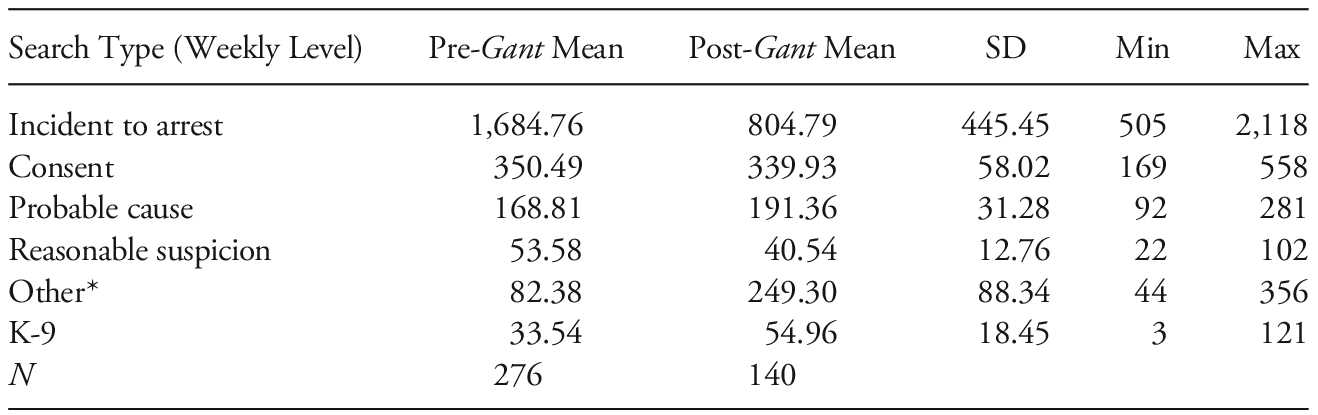
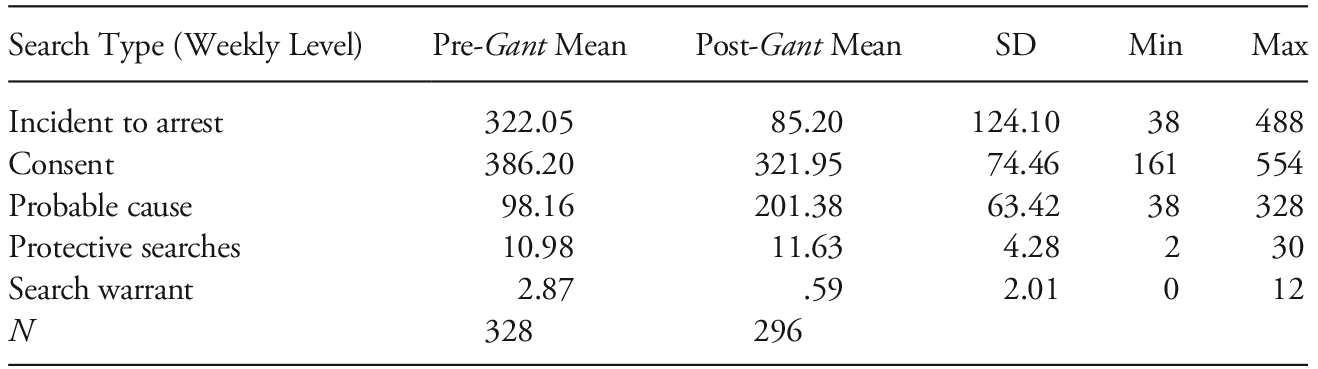
The Illinois sample data contain over 17.9 million traffic stops and 865,638 vehicle searches conducted between 2004 and 2011. Meanwhile, the North Carolina sample data span 2003–14 and report nearly 16.3 million traffic stops and 452,783 vehicle searches. Tables 2 and 3 display the summary statistics for each series. Illinois’s weekly series has 416 observations (from 2004 to 2011), while North Carolina’s series contains 624 (from 2003 to 2014).
Summary Statistics for Illinois Search Series

*. The series begins in 2007. Thus, there are 120 observations before Gant in the series.
Summary Statistics for North Carolina Search Series

Method and Operationalization
To examine the quantitative impact of the Gant decision and subject it to an appropriate significance test, this project uses intervention analyses. Also known as interrupted time series, this approach uses the autoregressive integrated moving average (ARIMA) model to assess the impact of a hypothesized event on a dependent variable examined across time (Box and Tiao Reference Box1975). This is often described as a quasi-experimental method (see, e.g., Thyer Reference Thyer2012; McDowall and McCleary Reference McDowall2014) because the “world” (in this case, the Supreme Court) applies some treatment (the intervention) to a dependent variable that is observed over time, and the effect of that treatment is assessed relative to the time before the treatment, which operates as a control.
A properly applied intervention analysis captures the functional form of the intervention, giving an accurate measurement of its impact. Further, intervention analysis allows the analyst to subject that theoretical intervention to an appropriate significance test since ARIMA modeling purges the data of serial correlation, which biases the standard errors (Box-Steffensmeier et al. Reference Box-Steffensmeier2014). Also incorporated into this study’s ARIMA models are autoregressive conditional heteroskedasticity (ARCH) and generalized autoregressive conditional heteroskedasticity (GARCH) terms. These terms account for the changing variance of the series over time and allow for the inclusion of the intervention to see whether it increased or decreased the variance of the series.
The main independent variable in these models is “Gant intervention,” which is coded as a simple dummy variable, taking the value of 0 up to the week of the decision (April 21, 2009) and 1 after that week. This represents an abrupt and permanent change in the form of the series.Footnote 7 The coefficient value for this variable reports the average change in the number of weekly searches after Gant, relative to the time before the decision. The Gant intervention dummy variable is also included to predict the variance and is labeled “conditional variance of Gant.” A positive coefficient will indicate that the decision decreased the uniformity in the number of searches week to week, while a negative coefficient indicates that the decision increased the uniformity in searches over time. Finally, fixed effects capturing annual seasonality are included. These fixed effects are coded for groups of 4 weeks within a calendar year, with 13 groups in all.
The Impact of Gant on Searches Incident to Arrest
Descriptive Results
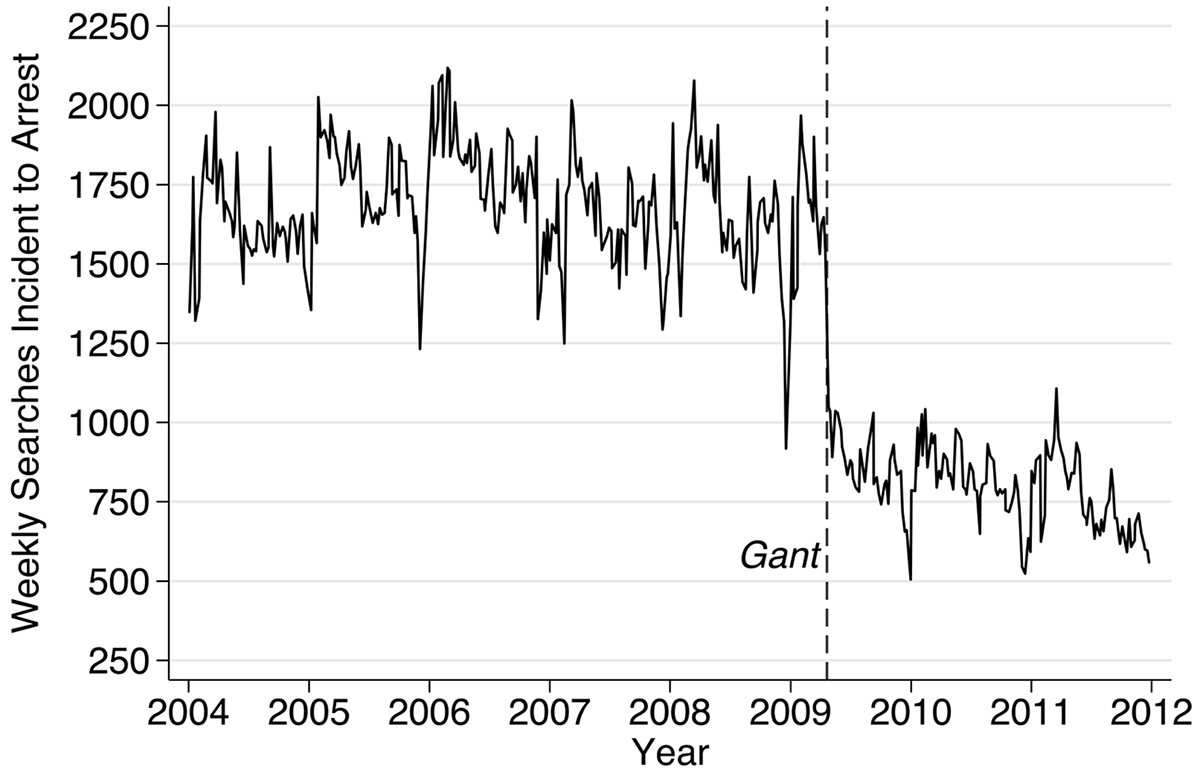
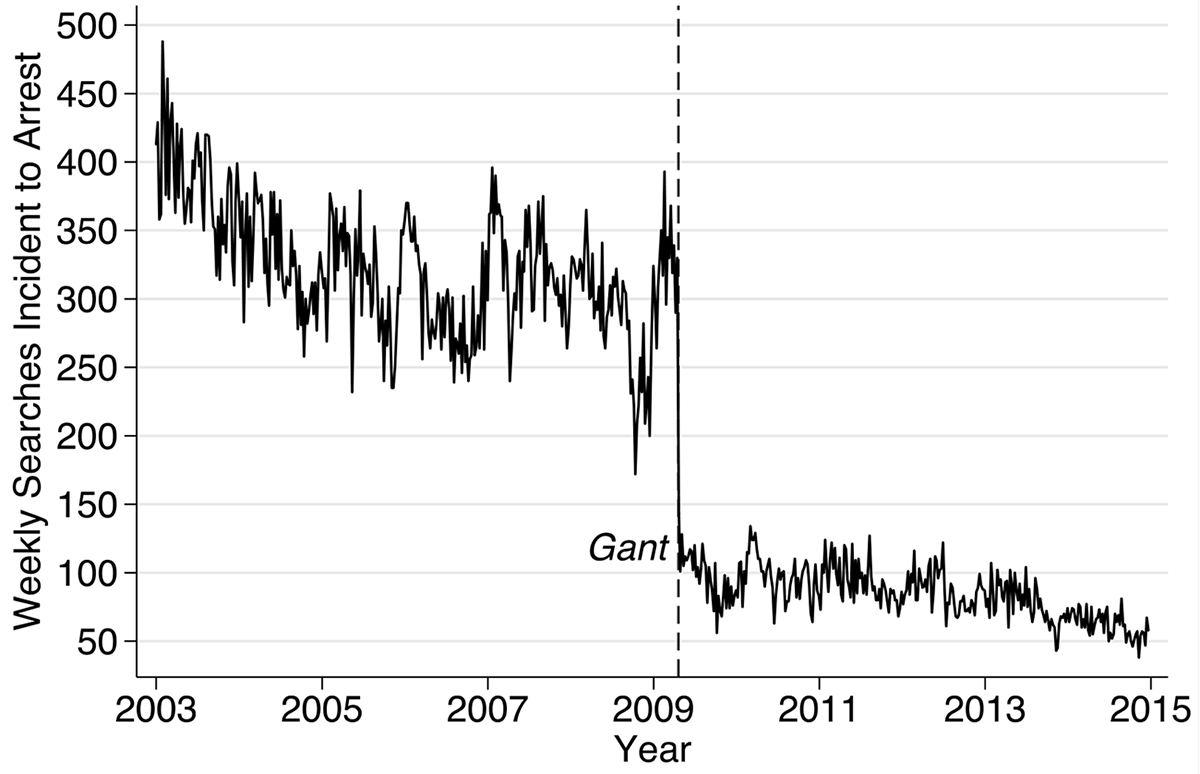
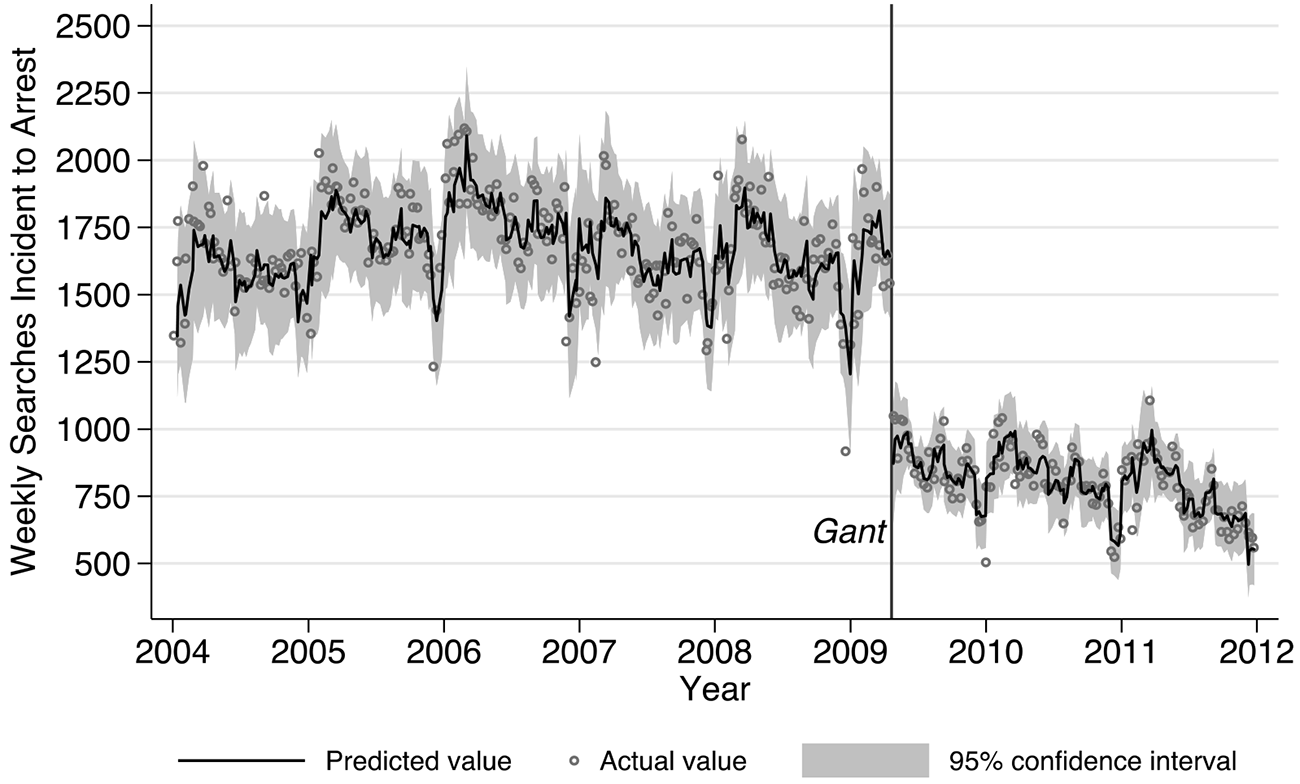
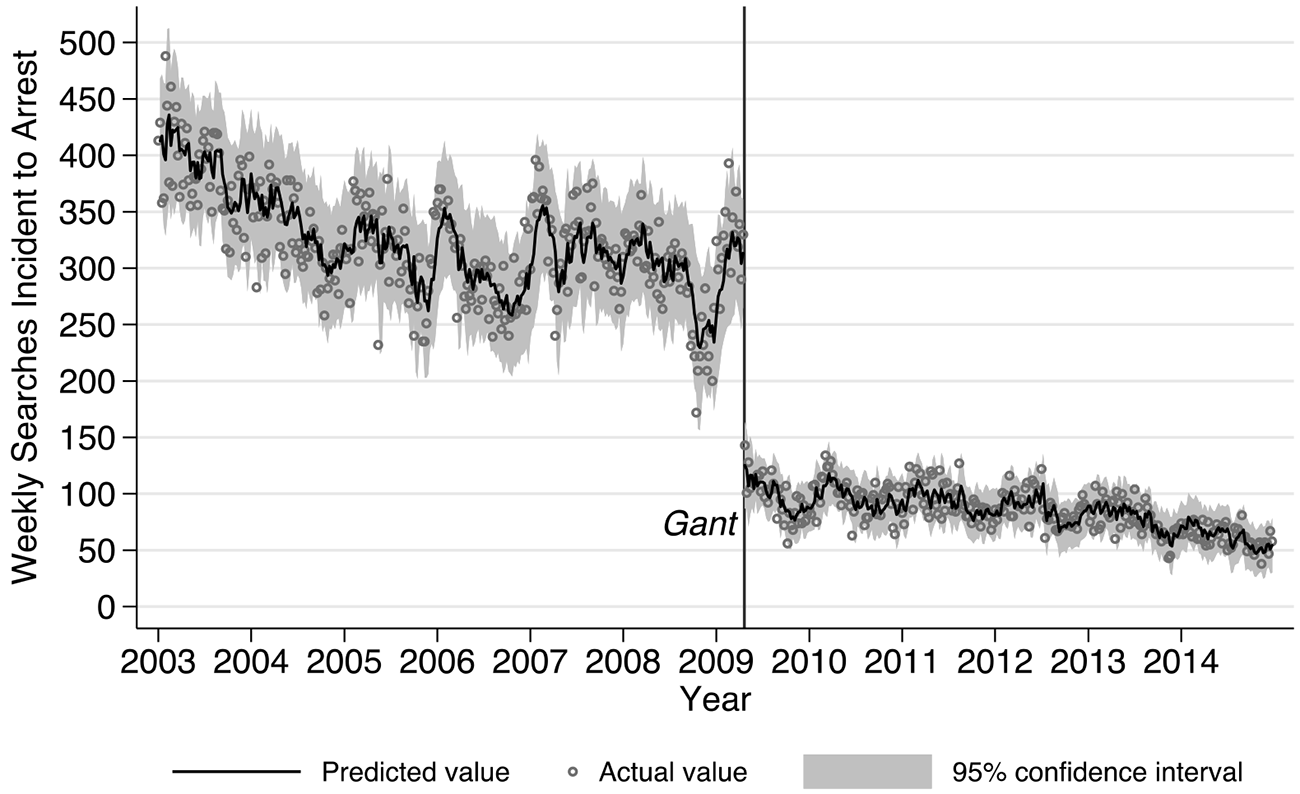
Basic times series plots are displayed first to help demonstrate the purely descriptive evidence for the impact of Gant. The weekly series of searches incident to arrest for Illinois and North Carolina are displayed in figures 1 and 2. A dashed vertical line is placed the week following April 21, 2009, when Gant was decided. Purely upon visual inspection, it would be difficult to argue that Gant did not influence the rate of searches incident to arrest in traffic stops. Both series show a sudden and stable decline in the number of these searches the week of the decision.
Illinois search-incident-to-arrest series

North Carolina search-incident-to-arrest series

Statistical Time Series Results
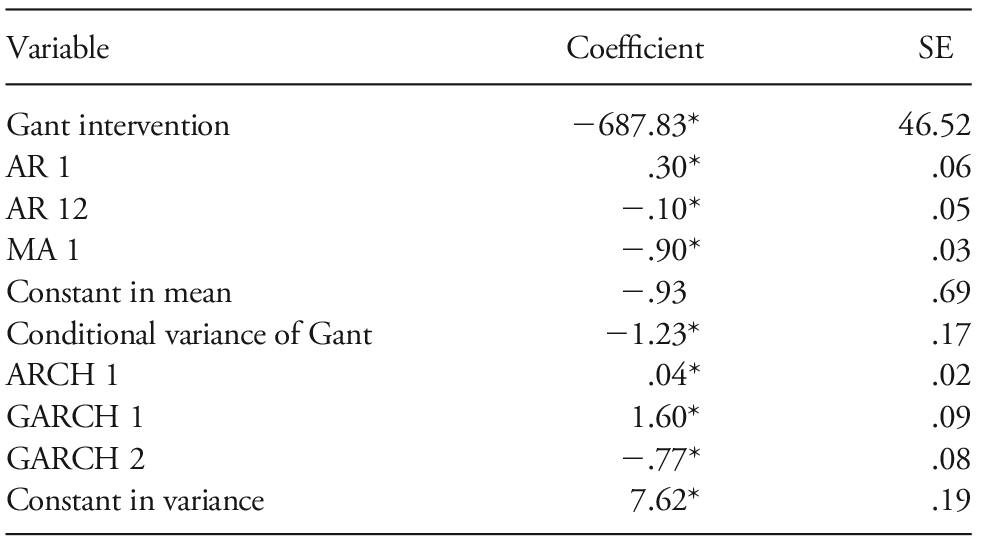
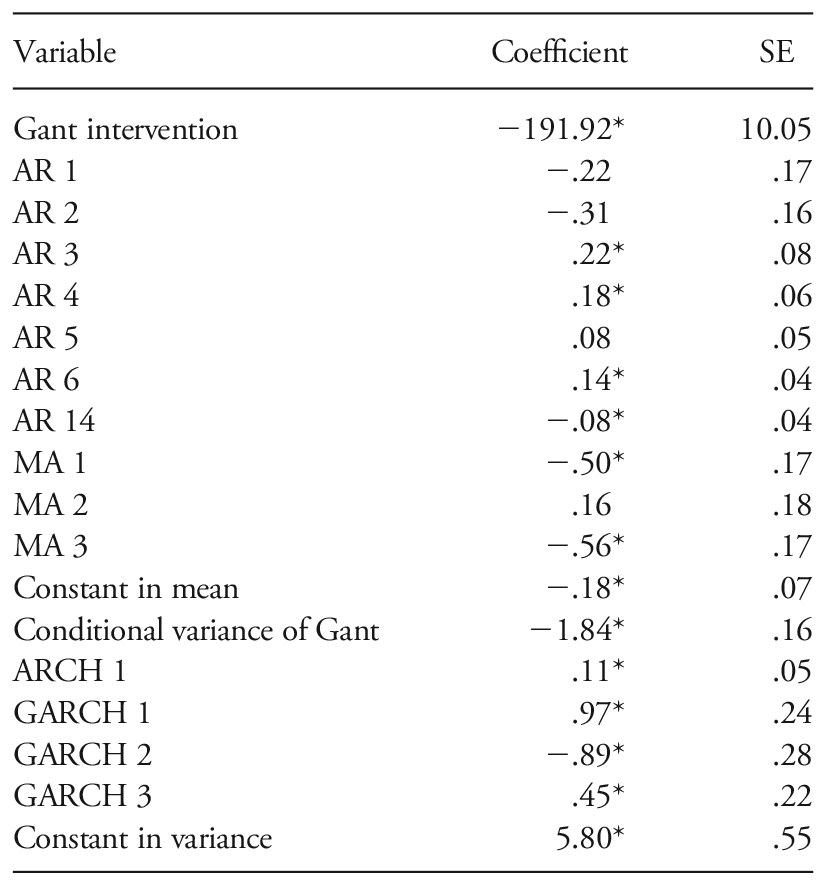
Figures 1 and 2 provide preliminary evidence that Gant limited searches incident to arrest in these two states. To assess whether that effect is statistically meaningful, ARIMA/ARCH time series analysis models were fit to the weekly search-incident-to-arrest series in Illinois and North Carolina. Series were analyzed in first differences to account for nonstationarity, a common issue with time series.Footnote 8 The results of the time series intervention analysis model for the weekly search-incident-to-arrest series in Illinois is contained in table 4 and figure 3, while the corresponding model for North Carolina is in table 5 and figure 4.
ARIMA/ARCH Model, Illinois Search-Incident-to-Arrest Series

Note.—N = 415. Dependent variable is the first differenced weekly number of vehicle searches incident to arrest as reported by the Illinois Department of Transportation (http://www.idot.illinois.gov/transportation-system/local-transportation-partners/law-enforcement/illinois-traffic-stop-study). This model produces white noise residuals with a Ljung-Box Q test p-value of .26 at 53 lags. Seasonality fixed effects included. AR = autoregressive term. MA = moving average term.
*. p < .05.
Predicted values from ARIMA/ARCH model, Illinois search-incident-to-arrest series.

ARIMA/ARCH Model, North Carolina Search-Incident-to-Arrest Series

Note.—N = 623. Dependent variable is the first differenced weekly number of vehicle searches incident to arrest as reported by the North Carolina State Bureau of Investigation (http://trafficstops.ncsbi.gov). This model produces white noise residuals with a Ljung-Box Q test p-value of .20 at 53 lags. Seasonality fixed effects included. AR = autoregressive term. MA = moving average term.
*. p < .05.
Predicted values from ARIMA/ARCH model, North Carolina search-incident-to-arrest series.

Searches incident to arrest in Illinois decreased by approximately 688 per week as a result of the Gant decision, all else equal. This coefficient is significant, with a z-score of −14.78 and a p-value approaching 0. The average number of weekly searches prior to Gant in Illinois was approximately 1,685. Thus, Gant decreased the weekly rate of search incident to arrest in Illinois by nearly 41%.
These results demonstrate that in Illinois the decision imposed substantial limitations on police officers’ ability to perform searches incident to arrest after traffic stops. Interestingly, the estimate of the effect of Gant on the conditional variance indicates that the decision significantly decreased the volatility of the series. There is less variation in the number of weekly searches incident to arrest after Gant than before it. It may be that by narrowing the discretion with which officers could use the search-incident-to-arrest exception, the Supreme Court’s holding induced more uniformity in the number of these searches week to week.
The results from North Carolina are substantively similar to those from Illinois. The effect of Gant on searches incident to arrest in North Carolina is a decrease of approximately 192 per week, all else equal. This coefficient is significant, with a z-score of −19.11 and a p-value approaching 0. The average number of weekly searches prior to Gant in North Carolina was 322. Gant decreased the weekly rate of search incident to arrest in North Carolina by nearly 60%. Much like in Illinois, Gant substantially reduced the rate of searches incident to arrest as a result of traffic stops. The estimate of the effect of Gant on the conditional variance is similar to that of the Illinois model. Again, Gant appears to have decreased the variation in search incident to arrest in these data.
Overall, these results provide clear evidence of judicial impact on this implementing population. The Court’s modification to search-incident-to-arrest doctrine in Gant resulted in a strong and immediate (within 1 week) effect on the behavior of law enforcement. Police officers adapted to the new legal environment, quickly altering their search practices. This suggests that police organizations pay attention to and abide by changes to Supreme Court precedent. However, since the Gant ruling allows for searches incident to arrest when there is a reasonable expectation of finding further evidence of the crime of the arrest in the vehicle or when the arrestee may gain access to the vehicle, it does not eliminate the use of this search rationale in either state. The diminished presence of search incident to arrest after the ruling implies that officers are still conducting these searches in situations in which the Supreme Court has permitted them to do so.
While the immediacy of the effect is surprising, and one might expect at least a small lag in time for police to familiarize themselves with the new law, the sudden shift in behavior does make some intuitive sense. From the date the Supreme Court changed the Fourth Amendment doctrine, officers who do not learn and apply the new standard risk having evidence excluded in court. That could potentially result in accused criminals who may otherwise have been convicted having their cases dropped or their charges dismissed or being found not guilty. In addition to draining limited resources, such occurrences may hurt an officer’s professional standing or public reputation.
These results also shed light on how police learn about court rulings. In learning to abide by a new precedent, law enforcement can be proactive by applying the rule of their own accord, or they can be reactive by changing their behavior only after trial courts have sanctioned them for not following the decision. The immediate timing of the reaction to Gant strongly suggests the former, with law enforcement independently reacting to the changes to search-incident-to-arrest requirements. The consistency of the results across the two states, with large and permanent changes to search rates, also implies organizational systems for police to become educated about relevant changes to the law. If officers were expected to learn about the Gant decision individually, then one would expect a period of delay during which increasing numbers of police were becoming aware of the opinion. Instead, the decrease in searches incident to arrest is sharp.
The Impact of Gant on Alternative Searches
Descriptive Results
Law enforcement appears to have largely complied with the limitations expressed in Gant, as evidenced by the substantial decrease in searches incident to arrest. However, this does not exclude the possibility that officers looked for alternative ways to conduct searches using other established exceptions to the warrant requirement. Law enforcement publications written after Gant detailed several ways for police to circumvent the limitations it expressed and find alternative justifications for searches without relying on search incident to arrest (Judge Reference Judge2009; Solari Reference Solari2009). Thus, it seems reasonable to expect that many officers found ways to adapt to the new legal policy.
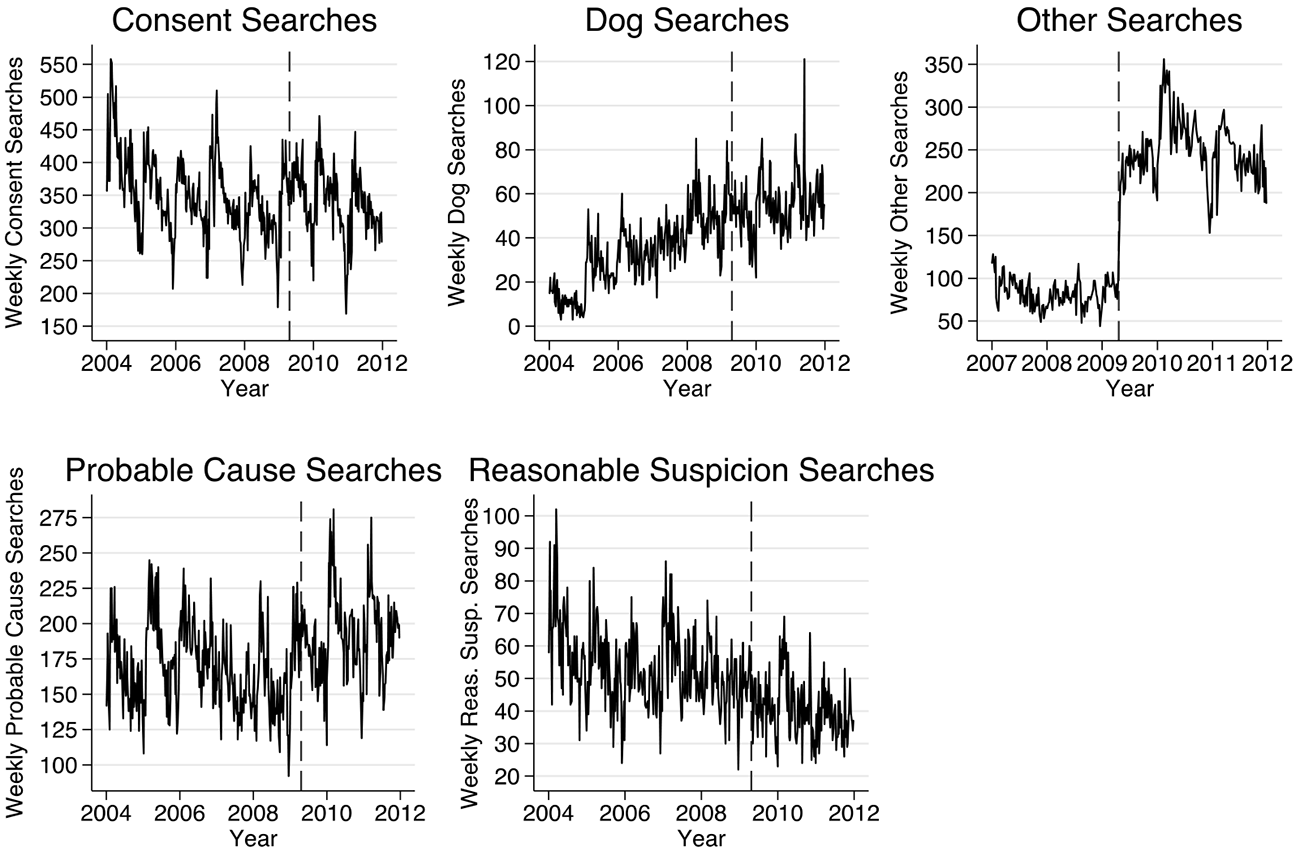
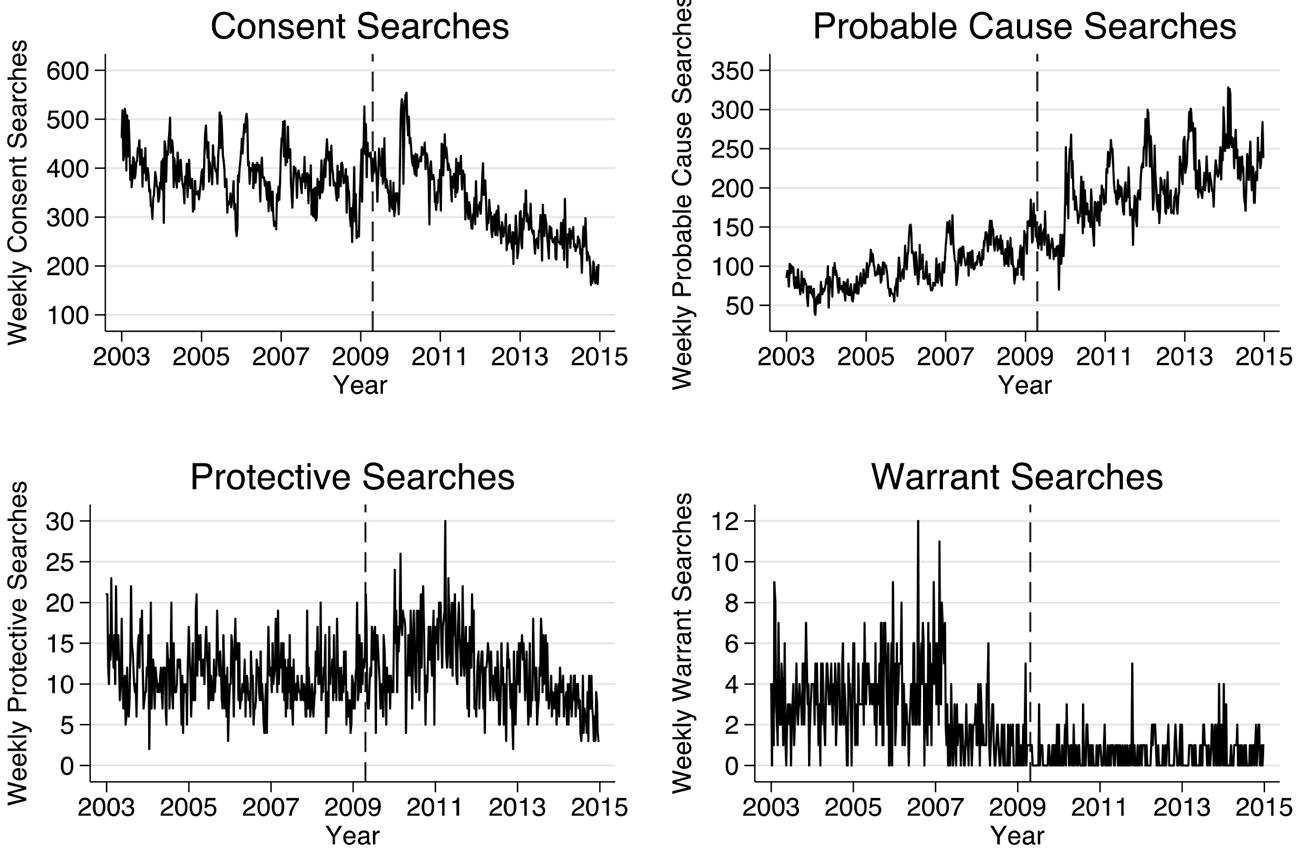
To determine whether police turned to other search rationales in the wake of Gant, rates of alternative searches are examined. The Illinois data include several alternative search categories: consent, K-9, other, probable cause, and reasonable suspicion. North Carolina officers record data on consent, probable cause, protective frisks, and search warrants. The plots of Illinois’s alternative search series are displayed in figure 5. In Illinois, the “other” search was not included as a category in the traffic-stop data until 2007, resulting in a shorter series. The plots of North Carolina’s alternative search series are contained in figure 6. Several of the series display visually striking changes after the week of April 21, 2009. In Illinois, the rate of the “other” category of searches increases the week of the decision and stays elevated until 2012.
Illinois alternative search series

North Carolina alternative search series

In North Carolina, probable cause searches and protective frisks have a sudden increase that occurs at the beginning of 2010. Consent searches appear to decline starting in 2011, roughly 2 years after Gant. Upon first encountering the changes in these three series, it might lead one to conclude that Gant had an impact on these kinds of searches in North Carolina. However, the notion that Gant caused these shifts can be discounted owing to their timing and functional form. It is much more likely that these changes are the result of some other unknown factor. Supreme Court rulings are binding from the date they are decided (in this case, April 21, 2009). Accordingly, the timing of any change to police behavior should begin at or very near that date. Instead, these changes occur 36 weeks after the decision in the probable cause and protective search series. The consent search series does not experience a structural change until 148 weeks later. Each of these shifts also occurs abruptly, with the seasonal pattern noticeably altered at a particular week. It is implausible that officers rapidly changed their search practices as a result of Gant months after the ruling. Time series models will provide further evidence of whether any of these changes is a result of the ruling.
Statistical Time Series Results
To determine whether Gant increased rates of alternative searches, time series models were fit to all but one of the remaining categories in the Illinois and North Carolina traffic-stop data. A model was constructed for each weekly series of searches, with the exception of search warrants in North Carolina, which were too rare to merit inclusion. Because the 2010 increase in North Carolina’s probable cause series and protective search move in the same direction as the hypothesized impact of Gant, they are accounted for through a distinct intervention variable to be more conservative.
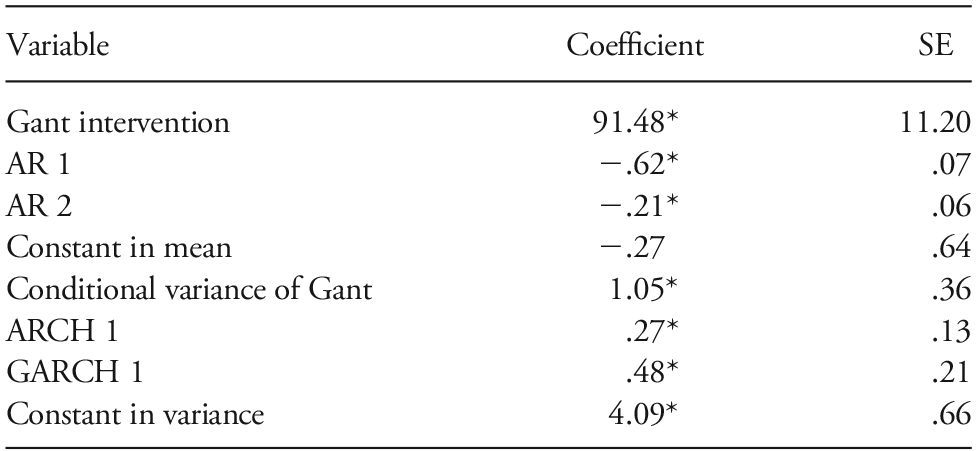
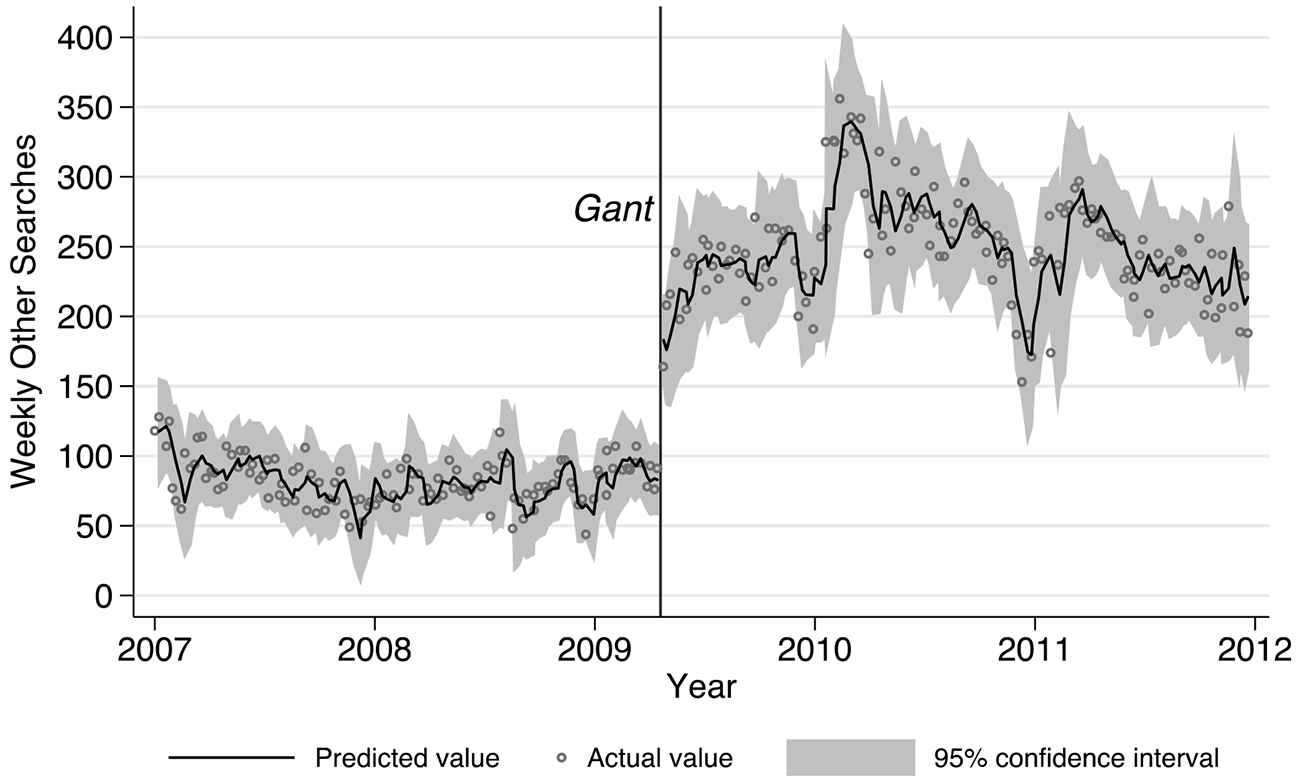
Only the “other” search series in Illinois obtained significant results. The results of the intervention model on the “other” type of search from Illinois are reported in table 6, and the predictions from the model are displayed in figure 7.Footnote 9 For all remaining search types, the result of the Gant intervention variable was not significantly different from 0 (p > .05). The tables for these nonsignificant models are reported in the appendix.
ARIMA/ARCH Model, Illinois Other Search Series

Note.—N = 259. Dependent variable is the first differenced weekly number of vehicle searches incident to arrest as reported by the Illinois Department of Transportation (http://www.idot.illinois.gov/transportation-system/local-transportation-partners/law-enforcement/illinois-traffic-stop-study). This model produces white noise residuals with a Ljung-Box Q test p-value of .18 at 53 lags. Seasonality fixed effects included. AR = autoregressive term.
*. p < .05.
Predicted values from ARIMA/ARCH model, Illinois other search series

The results from the Illinois “other” search intervention model also demonstrate an immediate adaptation to Gant. This suggests that officers “think on their feet” after a limiting court precedent, using their knowledge of search warrant exceptions to justify some searches by using alternative means. Since the “other” search is a catchall category for any search not included on the Illinois traffic-stop form, it may incorporate inventory searches, searches of persons under correctional supervision, or searches based on warrants. Whatever specific search criteria might fall under this category, when the opinion in Gant was announced, the rate of “other” searches increased by nearly 91 per week. The mean of this category of searches prior to the intervention was 82 per week. Thus, the rate of “other” searches increased as a result of Gant by approximately 111%. Interestingly, even though the rise of these searches is dramatic, the increase only partially counters the loss of searches incident to arrest in Illinois (about a 13% makeup effect).
This alternative search justification was used more heavily as a result of Gant in a way that is both visually striking and statistically significant. No significant change is found in any of the remaining alternative search series, yet it may be reasonable to expect increases that are idiosyncratic. Police using alternative rationales to conduct searches must justify their actions in a way that will satisfy others (e.g., supervisors, prosecutors, and judges) that they have met existing legal requirements. Simply because an alternative exists does not mean an officer can rely on it in every circumstance. Despite some evidence of police turning to alternative rationales, the finite number of search categories reported in these data sets, the lack of thorough information on what they specifically mean, and the fact that the two data sets do not contain the same search categories make it difficult to ascertain whether this result is truly reflective of police behavior. As such, this study offers what should be considered preliminary evidence on the question of whether police look for alternative justifications to conduct searches after the Supreme Court limits their discretion.
Conclusion
This study shows that when the US Supreme Court changes the law surrounding search and seizure, the police are paying attention and change their behavior to comply with the shift in policy. The rates of search incident to arrest in Illinois and North Carolina display clear evidence of a strong, immediate, negative impact of Gant on searches incident to arrest. Because of the substantial modifications to the Belton rule imposed by the Gant decision, within 1 week searches incident to arrest in Illinois declined by nearly 41%, while they declined by approximately 60% in North Carolina. This finding is somewhat counterintuitive, as it might be expected that police would require a substantial period of time to receive communication about changes to the law and then learn how to appropriately incorporate them into everyday practice. Instead, these comprehensive traffic-stop data imply rapid organizational communication and adaptation on the part of law enforcement.
One plausible explanation of the police’s quick response to Gant is that those responsible for advising them about the law were able to anticipate, or at least prepare for the possibility of, changes to the standards underlying search incident to arrest and ensured its rapid implementation. Prior research suggests that in-house legal advisors, prosecutors’ offices, city attorneys, and professional police organizations play an important role in spreading information about relevant court decisions to police on the street (Wasby Reference Wasby1976; Eterno Reference Eterno2003; Archbold Reference Archbold2006). An informed observer of the Court’s activity that is relevant to law enforcement would likely have been aware that the Supreme Court was reviewing Gant and thus had a clear signal that the current application of the search-incident-to-arrest exception was potentially in jeopardy. While the observational traffic-stop data used for these analyses prevent any firm conclusions from being drawn about how police learn about important court decisions, the immediate change is consistent with police being proactive to avoid having evidence excluded at trial. This underscores the interconnectedness of the institutions of courts and law enforcement by which alterations to long-standing rules can inspire change before sanctions may even be applied.
The analyses of other kinds of vehicle searches after Gant provide preliminary evidence that police look to alternative means to achieve their goals in the face of a limiting court precedent. The increase in the “other” category of search in Illinois, while idiosyncratic, is stark. Those searches increased by 111% in the wake of the Court’s ruling, indicative of police using other established exceptions to the warrant requirement to conduct searches and obtain incriminating evidence.
The data provided by Illinois and North Carolina allowed for a rigorous examination of implementing-population responses to a court decision, something that is typically not empirically observable. Yet, while these intervention analyses have high internal validity, providing strong evidence of the Court’s impact on these actors, the external validity is bounded by the specific context being examined. Whether the same effect can be found in the aftermath of other decisions or whether other policy implementers react to court decisions in a similar way is a potential avenue for future study.
Scholars should consider whether the finding of strong and quick compliance with court opinions extends to other members of the implementing population, time periods, or areas of law. Since law enforcement is a special type of policy implementer tasked with carrying out court-created rules in a wide variety of contexts, the different relationship shared between other actors and the courts is likely to produce different results, as Hall (Reference Hall2010) finds. While the decisions made by police are subject to scrutiny in the judicial system during the criminal proceedings that stem from their arrests, other implementers of court policy, for example, might be held accountable only when a plaintiff files a lawsuit. Additionally, the modern context of Gant seems likely to have had an impact on its implementation. Technology now allows for the instant dissemination of court rulings and directives responding to them. Had the decision occurred in an earlier period, it is possible that the response would have been slowed simply by the means of communicating the decision (see, e.g., Wasby Reference Wasby1976). Finally, the structured nature of search and seizure case law might make the influence of the courts stronger. Decisions that specify concrete places or circumstances under which a search is permissible are far more explicit than some other legal standards or directives. It may be that changes to different areas of the law provoke slower responses from those responsible for carrying the policy out. Whatever difference in reaction a separate context might bring, this study demonstrates that, at least in some circumstances, the Supreme Court can cause sharp changes in practice among those street-level actors it attempts to control.