Introduction
Extending the working life has been at the top of the agenda among European policy makers for more than two decades. Many European countries have rolled back welfare policies that enabled early retirement and have introduced policies that raise retirement ages and incentivise extending the working life (Hofäcker and Unt, Reference Hofäcker and Unt2013). In Denmark, the parliament has passed a law that has limited the possibility of receiving early retirement benefits and will increase the statutory pension age gradually from 65 to 67 years in the 2019–2022 period. After the 2019–2022 period, the statutory pension age is expected to increase further following the general life expectancy (Andersen and Jensen, Reference Andersen, Jensen, Møller and Larsen2016).
These reforms have been motivated by concerns about the sustainability of the welfare state in the light of the ageing Danish population and with the expectation that everyone can respond to them. However, it can be argued that they are socially imbalanced because the opportunity to respond to these increased incentives to extend the working life are unequally distributed between sub-populations. In particular, previous literature suggests that retirement timing is unequally distributed across social classes with members of the working class retiring significantly earlier and less voluntarily than members from higher social classes (Blossfeld et al., Reference Blossfeld, Buchholz and Hofäcker2006, Reference Blossfeld, Buchholz and Kurz2011; Leinonen et al., Reference Leinonen, Chandola, Laaksonen and Martikainen2020; Radl, Reference Radl2013).
In the literature, individual decisions about retirement timing are often explained with an analytical distinction between push and pull factors. Push factors emphasise the role of factors that ‘push’ people into early retirement including labour market constraints such as poor health, unemployment and low job quality, whereas pull factors emphasise the role of factors that ‘pull’ people out of the labour market such as financial incentives and preferences for family life or leisure (Shultz et al., Reference Shultz, Morton and Weckerle1998; De Preter et al., Reference De Preter, Van Looy and Mortelmans2013). This paper focuses on push factors because the aim is to explain why men and women belonging to the working class, despite increased incentives to extend the working life, retire much earlier than members of the higher social classes. Earlier studies have argued that push factors such as poor health, previous spells of unemployment and job quality are particularly unequally distributed across social classes, with the working class being most disadvantaged (Shultz et al., Reference Shultz, Morton and Weckerle1998; Radl, Reference Radl2014; Visser et al., Reference Visser, Gesthuizen, Kraaykamp and Wolbers2016). Even though financial considerations and preferences for family life or leisure are also unequally distributed across social classes, they are expected to be relatively more homogenous across the population compared to push factors (Radl, Reference Radl2014). Push factors are also important in a social stratification perspective because people who feel pushed out of the labour market are more likely to experience economic hardship and social exclusion than people who choose themselves to retire early (Jensen et al., Reference Jensen, Kongshøj and De Tavernier2018).
Despite the fact that a number of studies have discovered various factors that push members of the working class into early retirement (Mein et al., Reference Mein, Martikainen, Stansfeld, Brunner, Fuhrer and Marmot2000; Blekesaune and Solem, Reference Blekesaune and Solem2005; Lund and Villadsen, Reference Lund and Villadsen2005; Oakman and Wells, Reference Oakman and Wells2013; De Preter et al., Reference De Preter, Van Looy and Mortelmans2013; Thorsen et al., Reference Thorsen, Jensen and Bjørner2016), the relative impact of different push factors on early retirement have rarely been examined systematically across social classes. Additionally, there is a need for more evidence on how different push factors explain social class effects in different pathways into regular retirement. Different pathways into regular retirement refer to arrangements used to bridge the temporary period from work exit to entry into the regular old-age pension (Kohli and Rein, Reference Kohli, Rein, Kohli, Rein, Guillemard and Van Gunsteren1991). While few previous studies have examined the impact of health and work-related factors in explaining social class effects in solely involuntary pathways, such as disability pension and social security (Haukenes et al., Reference Haukenes, Mykletun, Knudsen, Hansen and Mæland2011; Polvinen et al., Reference Polvinen, Gould, Lahelma and Martikainen2013; Sterud and Johannessen, Reference Sterud and Johannessen2014), there is no such evidence linking the impact of push factors on social class effects in more voluntary pathways. Against this backdrop, this paper contributes to the literature by first examining the extent to which different push factors explain why men and women belonging to the working class retire much earlier than members of higher social classes. Second, the paper examines whether the push factors have different explanatory power in terms of explaining social class effects in early retirement, depending on the specific pathway into the regular old-age pension.
To this end, this study uses high-quality longitudinal survey data from Denmark merged with highly reliable administrative register data on older workers. The analysis is based on Karlson–Holm–Breen (KHB) corrected discrete-time logistic models (Karlson et al., Reference Karlson, Holm and Breen2012). These models allow the total effect of social class, measured by the Erikson, Goldthorpe and Portocarero (EGP) class scheme (Erikson and Goldthorpe, Reference Erikson and Goldthorpe1992), on retirement timing to be decomposed into indirect effects through different push factors including health, partner's health, previous spells of unemployment, job quality and a direct effect. The direct effect here refers to the part of the total effect of social class on retirement timing that remains when the push factors are controlled for. An important strength of this approach is that it allows for the examination of the relative impact of push factors across social classes. In other words, it is possible to access which push factors that are most important in terms of explaining social class effects in early retirement. Moreover, because of the longitudinal nature of the data, the push variables are allowed to be time-varying for each individual, which is important because people's health, employment status and job quality can change over time.
Early retirement in Denmark
When reaching the statutory pension age, which is gradually increasing from 65 to 67 years in the 2019–2022 period, all citizens in Denmark can claim a universal state pension. If retirement takes place before the statutory retirement age, there are two primary pathways: disability pension and the early retirement scheme. Disability pension is an early retirement benefit that can be granted to individuals whose ability to work is permanently obstructed due to a disability. Until 2003, it was, however, also in rare occasions possible to be granted disability pension solely due to reasons other than health, such as little prospect of getting a job. After a reform in 2013, individuals may only be entitled to disability pension from the time they turn 40 years old and until they reach the statutory retirement age (Jensen, Reference Jensen, Maltby, De Vroom, Mirabile and Øverbye2004; Bengtsson et al., Reference Bengtsson, Bengtsson, Kjær, Damgaard and Kolding2014). The early retirement scheme gives workers in Denmark the opportunity to retire from the age of 60 and until the statutory pension age if they are a member of an unemployment insurance fund and have paid early retirement contributions. When the early retirement scheme was introduced in 1978, it was supposed to facilitate a pathway for mainly manual and unskilled workers who were worn down by high-strain jobs and to reduce the labour force in periods of high unemployment. However, since its implementation, the early retirement scheme has been used by all groups in society (Kvist, Reference Kvist2003), although it is most prevalent among members of the working class (Lund and Villadsen, Reference Lund and Villadsen2005). Thus, as compared to disability pension, the early retirement scheme is a self-selected possibility to enter into early retirement. Besides the two primary pathways, receiving social security benefits until the statutory pension age can also act as a pathway into retirement. Social security includes various benefits, such as unemployment insurance benefits and sickness benefits, which are available to individuals who temporarily cannot carry out a job. Finally, other pathways include private and occupational pension savings. The recipients of the different early retirement programmes differ quite a lot from each other. Whereas disability pensioners and other social security recipients usually retire due to poor health and low employability, the recipients of early retirement benefits are more voluntary retirees who retire early due to various reasons (Andersen and Jensen, Reference Andersen, Jensen, Møller and Larsen2016). Even though the retirement benefits in Denmark are relatively generous, the pathways in the Danish pension system are strongly linked to the perception of economic hardship after retirement. Individuals who opt for early retirement through private or occupational pension savings are usually the most socio-economically advantaged, compared to recipients of disability pension and the early retirement scheme. The average replacement rate for disability pension and the early retirement scheme is around 70–80 per cent but the exact income depends on a variety of factors, such as the timing of retirement, previous career and household circumstances. Because disability pensioners can retire before the age of 60 and are over-represented by the most disadvantaged part of the working population, economic hardship after retirement is more prevalent among disability pensioners compared to recipients of the early retirement scheme (Clement and Jensen, Reference Clement, Jensen, Jensen and Øverbye2013).
Theoretical background: the working class and early retirement
Comparative research across European countries has documented social class inequalities in the risk of early retirement. Based on cross-national analyses, studies find that highly qualified employees and the self-employed exit the labour force later than members of the working class who tend to withdraw earlier (Blossfeld et al., Reference Blossfeld, Buchholz and Hofäcker2006, Reference Blossfeld, Buchholz and Kurz2011; Radl, Reference Radl2013). Other studies that examine social stratification in early retirement according to education or income have found that both actual and intended early retirement are influenced by these factors. Thus, workers with higher levels of education and high income are less likely to retire earlier than workers with lower levels of education and low income, respectively (Blekesaune and Solem, Reference Blekesaune and Solem2005; Siegrist et al., Reference Siegrist, Wahrendorf, von dem Knesebeck, Jurges and Börsch-Supan2007). On these grounds, my first hypothesis and point of departure is:
• Hypothesis 1: The total effect of belonging to the working class on early retirement is positive because members of the working class have a higher risk of early retirement compared to professionals.
In the following, I will discuss the role of relevant push factors, which are expected to explain why members of the working class retire earlier compared to professionals, namely health, partner's health, previous spells of unemployment and job quality. I focus on these push factors because studies show that these factors are unequally distributed across social classes with the working class being most disadvantaged (Haukenes et al., Reference Haukenes, Mykletun, Knudsen, Hansen and Mæland2011; Radl, Reference Radl2013; Visser et al., Reference Visser, Gesthuizen, Kraaykamp and Wolbers2016; Riekhoff, Reference Riekhoff2018) and they are important predictors of older workers’ ability to perform their work (Ilmarinen et al., Reference Ilmarinen, Tuomi and Seitsamo2005).
Health
A major risk factor in terms of pushing workers into early retirement is poor health (Mein et al., Reference Mein, Martikainen, Stansfeld, Brunner, Fuhrer and Marmot2000; Oksanen and Virtanen, Reference Oksanen and Virtanen2012; Edge et al., Reference Edge, Cooper and Coffey2017). Moreover, it is well known that for a number of reasons, the risk of poor health varies significantly between social classes. First, members of the working class are more frequently exposed to physical strains, noise and other harsh working conditions that have an adverse effect on their health and in turn their working capacity (Blekesaune and Solem, Reference Blekesaune and Solem2005; Hansen and Ingebrigtsen, Reference Hansen and Ingebrigtsen2008; Haukenes et al., Reference Haukenes, Mykletun, Knudsen, Hansen and Mæland2011). These working exposures are also related to early retirement because workers in manual jobs, on average, enter the labour market earlier in life because they spend less time in education than professionals. Second, social class is related to health through other mechanisms. For example, the literature suggests that members of the working class share a culture that promotes unhealthy behaviours (Bartley, Reference Bartley2004), and they have less access to information about healthy behaviour and health care as well as the financial resources to act upon this information compared to their higher-class counterparts (Link and Phelan, Reference Link and Phelan1995). This line of reasoning is supported by research that shows that people with fewer resources face a shorter life expectancy and spend a larger part of their lives in poor health compared to people with many resources (Brønnum-Hansen, Reference Brønnum-Hansen2017). In sum, this suggests that members of higher social classes are better able to retain control over their health situation, which allows them to postpone or avoid early retirement, compared to members of the working class. Hence, my second hypothesis is:
• Hypothesis 2: The total effect of belonging to the working class on early retirement is mediated by an indirect effect via poor health.
Health of the partner
Because the family often constitutes the most dominant life sphere after retirement, previous research has pointed out that retirement cannot only be considered an individual decision but also to a great extent a household decision (Henkens and van Solinge, Reference Henkens and van Solinge2002; Szinovacz and Davey, Reference Szinovacz and Davey2005; Kubicek et al., Reference Kubicek, Korunka, Hoonakker and Raymo2010). One important household push factor for early retirement is the health of one's partner. More specifically, studies show that having a partner in poor health increases the risk of early retirement, although it varies by gender, as women tend to be more influenced by the health of the partner compared to men (Pienta and Hayward, Reference Pienta and Hayward2002; Ho and Raymo, Reference Ho and Raymo2009). Due to social inequalities in health, the likelihood of having a partner in poor health is also higher among members of the working class compared to their higher-class counterparts. Thus, because of a higher prevalence of disability among the working class, studies have shown that they are more likely to be caring for a partner compared to members of higher social classes. Moreover, working-class elderly have fewer resources to purchase assistance for a disabled partner and therefore will provide it themselves (Glaser and Grundy, Reference Glaser and Grundy2002). These factors increase the risk of early retirement and therefore I expect that:
• Hypothesis 3: The total effect of belonging to the working class on early retirement is mediated by an indirect effect via the partner's poor health.
Previous spells of unemployment
Previous research shows that members of the working class, particularly unskilled manual workers, are more likely to have experienced longer spells of unemployment throughout their working life. They are also more exposed to increasing job insecurity and cyclical unemployment due to de-industrialisation compared to members of higher social classes (Ostry et al., Reference Ostry, Hershler, Kelly, Demers, Teschke and Hertzman2001; Visser et al., Reference Visser, Gesthuizen, Kraaykamp and Wolbers2016). There is strong evidence that such working lives have ‘scarring effects’, as they are related to negative labour market constraints in later life (Gangl, Reference Gangl2006; Nilsen and Reiso, Reference Nilsen and Reiso2011; Pettinicchi and Börsch-Supan, Reference Pettinicchi, Börsch-Supan, Börsch-Supan, Bristle, Andersen-Ranberg, Brugiavini, Jusot, Litwin and Weber2019). In particular, previous spells of unemployment ‘reduces a worker's human capital, reduces a worker's psychological readiness for work, and makes a person less attractive to prospective employers’ (DiPrete and Eirich, Reference DiPrete and Eirich2006: 287–288). Under these circumstances, members of the working class are more hard-pressed to obtain and maintain job skills in a technologically changing world and from the employers’ point of view the willingness to invest in these skills may decrease. As a result, studies have shown that volatile employment careers are associated with early retirement, primarily through disability and social security (Visser et al., Reference Visser, Gesthuizen, Kraaykamp and Wolbers2016). Thus, my fourth hypothesis is:
• Hypothesis 4: The total effect of belonging to the working class on early retirement is mediated by an indirect effect via previous spells of unemployment.
Job quality
A third push factor that is frequently found to be linked with early retirement is poor job quality. Previous literature suggests that hard physical working demands and uncomfortable working positions are associated with early retirement (Krause et al., Reference Krause, Lynch, Kaplan, Cohen, Goldberg and Salonen1997; Blekesaune and Solem, Reference Blekesaune and Solem2005; Lund and Villadsen, Reference Lund and Villadsen2005). Moreover, poor psycho-social working conditions, such as low autonomy or low influence and imbalance between effort and reward, are also associated with early retirement (Elovainio et al., Reference Elovainio, Forma, Kivimäki, Sinervo, Sutinen and Laine2005; Siegrist et al., Reference Siegrist, Wahrendorf, von dem Knesebeck, Jurges and Börsch-Supan2007; Thorsen et al., Reference Thorsen, Jensen and Bjørner2016).
The above-mentioned findings are consistent after controlling for health status, which indicates that poor job quality also acts as a push factor for early retirement, independent of health. Based on previous literature, poor job quality is a heavy obstacle to finding satisfaction with one's job (Berg, Reference Berg1999; Raziq and Maulabakhsh, Reference Raziq and Maulabakhsh2015), which demonstrates that job tasks have to be at an appropriate level for the worker in terms of strains and difficulty (Radl, Reference Radl2014). Since physical and psycho-social working conditions differ fundamentally between social classes, there are good reasons to believe that these conditions also mediate the relationship between social class and early retirement. Members of the working class are exposed to physical work strains, due to the physical aspect of their work. They also have poor psycho-social working conditions, such as lower decision latitude, i.e. their work requires a lesser degree of autonomy and skill discretion to carry out their working tasks compared to members of higher social classes (Kristensen et al., Reference Kristensen, Borg and Hannerz2002). Thus, because members of the working class have a higher risk of their job being poor quality due to overly physical demands and due to lower decision latitude, this increases their risk of early retirement compared to members of higher social classes. Hence, I expect that:
• Hypothesis 5a: The total effect of belonging to the working class on early retirement is mediated by an indirect effect via overly physical demands.
• Hypothesis 5b: The total effect of belonging to the working class on early retirement is mediated by an indirect effect via low decision latitude.
Push factors in different pathways
Thus far, the role of the hypothesised push factors has been discussed without distinguishing between specific pathways into the regular old-age pension. Yet, access to different pathways into the regular old-age pension vary in terms of opportunity, timing and control (Kohli and Rein, Reference Kohli, Rein, Kohli, Rein, Guillemard and Van Gunsteren1991; Radl, Reference Radl2013; Riekhoff, Reference Riekhoff2018), which suggests that the hypothesised push factors discussed may have different explanatory power in terms of explaining the total effect of belonging to the working class on early retirement through different pathways. Previous studies conducted among retirees in Denmark show that members of the working class retire earlier through disability pension, social security and the early retirement scheme (Lund and Villadsen, Reference Lund and Villadsen2005; Albertsen et al., Reference Albertsen, Lund, Christensen, Kristensen and Villadsen2007).
Retirement through disability pension or social security is characterised by a low degree of control because people who are disabled or have been long-term unemployed may have no other options than to retire early. Push factors like health and previous spells of unemployment are, besides being two major risk factors in terms of entering into disability pension or social security, also more difficult to exert control over compared to push factors like job quality and partner's health. Thus, I expect that:
• Hypothesis 6a: The indirect effects of health on early retirement through the disability pension and social security pathway are larger in magnitude compared to the indirect effect of low job quality and partner's health.
• Hypothesis 6b: The indirect effects of previous spells of unemployment on early retirement through the disability pension and social security pathway are larger in magnitude compared to the indirect effect of low job quality and partner's health.
A survey conducted in 2006–2007 among retirees in the early retirement scheme found that approximately 80 per cent of retirees in the early retirement scheme characterise their retirement as voluntary (Andersen and Jensen, Reference Andersen and Jensen2008). Additionally, research shows that retirement through the early retirement scheme is more prevalent among workers with high physical job strains and with low job satisfaction (Lund and Villadsen, Reference Lund and Villadsen2005; Thorsen et al., Reference Thorsen, Jensen and Bjørner2016). Thus, based on these findings, entering into the early retirement scheme is likely to be an outcome of poor job quality rather than push factors such as declining health or the scarring effects of earlier unemployment that forces early retirement. Moreover, since partner's health is a push factor within the household it is expected to have an impact only to the extent that members of the working class can exert some control over their retirement timing, which is largely more possible with the early retirement scheme than disability pension and social security. Together, this suggests that poor job quality and partner's health contribute more in explaining the social class effects in the early retirement scheme, compared to the other push factors. Hence, I expect that:
• Hypothesis 7a: The indirect effect of low job quality on early retirement through the early retirement scheme pathway is larger in magnitude compared to indirect effects of health and previous spells of unemployment.
• Hypothesis 7b: The indirect effect of partner's health on early retirement through the early retirement scheme pathway is larger in magnitude compared to indirect effects of health and previous spells of unemployment.
Data and methods
Data and sample
The study uses the Danish Longitudinal Survey of Ageing (DLSA) merged at the individual level with high-quality administrative register data. DLSA is a longitudinal panel survey of people aged 52 and above in Denmark. The survey consists of four waves of data collected on the same individuals with five-year intervals between 1997 and 2012. In 1997, all interviews were carried out as home visits. In the following waves, the interviews were carried out by telephone, but when telephone interviews were not possible, home visits were completed. The response rates for the four waves are relatively high, ranging from 70 to 83 per cent (Lauritzen, Reference Lauritzen2014).
The sample for the analysis consists of 17,519 years of observations, which represents the later working life of 2,111 individuals who were born in 1945 or 1950. The respondents have participated in at least one wave starting from the age of 52, which was in 1997 and 2002, respectively. The survey information from the respondents was merged with administrative register data. It was possible to merge the survey with information from administrative registers because each citizen in Denmark is required to hold a unique individual identification number. In constructing the sample, respondents without a valid measure for social class were excluded (6%).
Defining the risk set and dependent variables
The respondents enter the risk set when they are 52 years and if they are employed. Age 52 is the lower age limit because it is the age where the respondents participate in the survey for the first time. Subsequently, they are followed every year in the registers until they enter into early retirement, or they are treated as right-censored if they drop out of the survey, die, migrate or reach the age of 65, which is the statutory pension age in Denmark for the included birth cohorts. All respondents have participated in the survey at baseline, which is at the age of 52. The next follow-up is conducted when they are 57 and the third follow-up is at age 62. The fourth follow-up is conducted at age 67 but is not used in the study, because the end of follow-up time is 65. Around 70 per cent of the respondents have participated in all waves up to or beyond the age of 62, 13 per cent have participated up until age 57 and, finally, 18 per cent have participated only at baseline, which is at age 52. Those who are censored due to drop-out in the survey are censored in between the last available wave and the next wave. For example, a respondent whose last available wave was at age 57 is then followed to the age of 60 in the registers (which is the middle time between the respondent's last available and next possible wave). If that respondent has not retired at the age of 60, he or she is treated as right-censored. Information on employment and retirement is derived from the National Labour Force Register, which contains information on a yearly basis about the individual's primary labour market status. The timing of early retirement is defined as the first year an individual is out of employment and remains so until the respondent reaches the age of 65. Thus, if an individual starts working again after having exited the workforce and not reached the age of 65 yet, that individual is not considered as early retired until the last year that he or she is observed as working.Footnote 1
Pathways into retirement
To do the separate models for pathways into retirement, I distinguish between entry into disability pension and social security, and the early retirement scheme. The first possible pathway to retirement is disability pension and other social security schemes. I merge these two pathways, because a great number of disability pensioners have, prior to being granted disability pension, received social security benefits (Bengtsson et al., Reference Bengtsson, Bengtsson, Kjær, Damgaard and Kolding2014). When conducting the separate analysis for entry into the early retirement scheme, I exclude those respondents who are not eligible for the early retirement scheme, i.e. they were not paying early retirement contributions at the age of 52, which corresponds to 17 per cent of the sample in the study. Moreover, in this pathway, I only follow the respondents from the age of 60 and above, because it is not possible to enter the early retirement scheme before the age of 60. Therefore, this specific analysis only includes respondents who pay early retirement contributions and who have not retired before the age of 60. This includes a sample of 1,411 respondents with a total of 3,971 years of observations.
Independent variable: social class
Information on social class is based on the EGP class scheme and created with highly reliable administrative register data and coded according to the four-digit unit groups in the International Standard Classification of Occupations (ISCO-88) developed by Ganzeboom and Treiman (Reference Ganzeboom and Treiman1996). To separate different occupational classes, the EGP class scheme combines occupational information with information about employment relations, industry and skills (Erikson and Goldthorpe, Reference Erikson and Goldthorpe1992). In conducting the occupational class scheme, I distinguish between professionals, routine non-manual workers, skilled manual workers and unskilled manual workers. Skilled and unskilled manual workers constitute the working class. The self-employed and small employees are excluded because some of the questions that the variables in the study are based on were not asked to this group. Moreover, farmworkers are also excluded due to limited numbers. Social class is measured at baseline, which is at age 52.
Mediator variables
Health is a self-rated measure. Self-rated health measures are generally considered to be good predictors for health status and of mortality from various diseases (Wu et al., Reference Wu, Wang, Zhao, Ma, Wu, Yan and He2013). Self-rated health is measured in the questionnaire with the question ‘How is your health in general?’ with a five-point scale ranging from ‘very good’ to ‘very poor’.
As there was no information available on the health of the partner in the survey, this information is derived from the administrative registers, where it is possible to link the respondent to his or her partner. The health of the partner is measured according to the International Classification of Diseases-10 (ICD-10) and was obtained from the National Patient Register. This register includes diagnoses of outpatients, inpatients and patients visiting emergency wards. Poor health of the partner is measured as the prevalence of one of the following serious diseases: diabetes, cancer, heart diseases, dementia, depression or the prevalence of musculoskeletal diseases.Footnote 2 The selected musculoskeletal diseases are in many cases related to work environment and working conditions (The Danish Society of Occupational and Environmental Medicine, 2019). The variable is equal to 0 if the respondent does not have a partner or have a partner in good health, equal to 1 if the respondent has a retired (including unemployed) partner in poor health and equal to 2 if the respondent has an employed partner in poor health. I distinguish between whether the partner in poor health is retired or working because a partner in poor health who is employed is less of a burden to the individual than a partner in poor health who is retired.
Previous spells of unemployment are measured as the sum of unemployment rates during early mid-life and until early retirement takes place. In the administrative registers, every individual has an unemployment rate calculated for each year. The unemployment rate is calculated as the ratio between the number of unemployed hours and the number of (possible) working hours. The unemployment rate corresponds to the proportion of the year in which a respondent has been unemployed. An unemployment rate of 1,000 indicates that the respondent has been unemployed throughout a whole year, whereas an unemployment rate of zero indicates that the respondent has been employed for a whole year. For the respondents included in the study, information on their unemployment rates is available from the age of 36 in the administrative registers. Thus, at baseline age 52, the variable equals the sum of the previous unemployment rates between age 36 and 51 and for each subsequent year the variable adds the unemployment rate from the previous year.
Overly physical demands is a variable constructed as an additive index of four items and ranging from 0 to 4. The respondents are asked whether they think their job requires too much work using the body; too much lifting and carrying; too many monotonous and repetitive tasks; and too many uncomfortable or dislocated positions.
Low decision latitude is a variable constructed as an additive index of three items and ranging from 0 to 6. The index contains one item measuring job control: ‘organise one's own work’ and two items measuring skill discretion: ‘use one's qualification’ and ‘use one's experience’.
Since the survey is conducted with a five-year interval between each wave, the mediating variables that are derived from the survey (health, physical work demands and low decision latitude) are time-varying with a five-year interval between. The cut-off point between two waves is made in between two waves. The mediating variables from the administrative registers (partner's health and respondent's previous spells of unemployment) are time-varying for each year.
Method of analysis
Because the retirement status of the respondent is only known on a yearly basis, I use a discrete-time logistic model to estimate the effect of social class on early retirement. As control variables, the analysis includes year of birth to take into account cohort-effects between the two cohorts. The baseline hazard function is fitted with age as a categorical variable (Allison, Reference Allison2010). In order to decompose the social class effects on early retirement, I use the KHB method instead of ordinary logistic regression, because mediation analysis involves comparison of reduced and full models, and non-linear models such as logistic regressions are not directly comparable across models due to scaling bias (Mood, Reference Mood2010; Breen et al., Reference Breen, Karlson and Holm2013).
The analysis is conducted in two steps. First, I investigate the extent to which the different push factors mediate the effect of social class on retirement timing through indirect effects of the different push factors. Next, I examine whether the sizes of the indirect effects of the different push factors depend on the specific pathway to retirement, which includes disability pension, social security and the early retirement scheme. In line with other retirement studies, I run the multivariate analysis separately for men and women. Social class positions differ markedly between men and women, e.g. men are over-represented in hard manual physical work as well as at the top of the occupational ladder compared to women, which suggests that social class differences are more pronounced among men than women (Bihagen, Reference Bihagen2008). Moreover, women more frequently adapt their retirement timing to their partner's health than men do (Pienta and Hayward, Reference Pienta and Hayward2002; Ho and Raymo, Reference Ho and Raymo2009). Together this suggests that the sizes of the indirect effects through the included push factors are likely to be different for men and women. Full results are available in the online supplementary material.
Results
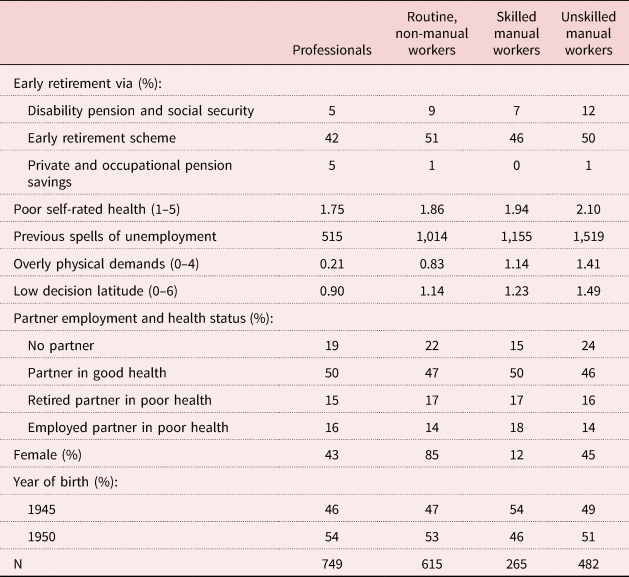
The descriptive statistics in Table 1 show that 7 and 12 per cent of skilled and unskilled manual workers retire via disability pension or social security; the corresponding figure for professionals is 5 per cent. Moreover, the table shows that 46 and 50 per cent of skilled and unskilled manual workers retire via the early retirement scheme compared to 42 per cent of professionals. The table also shows that 5 per cent of professionals enter early retirement via private and occupational pension savings, whereas almost no skilled and unskilled manual workers enter early retirement via pathways other than disability pension or social security or the early retirement scheme.
Descriptive statistics of the sample (measured the last year before exit/censoring)

Table 1 also shows that skilled and unskilled manual workers on average rate their health lower compared to professionals and have experienced longer spells of unemployment than professionals have. Skilled and unskilled manual workers also on average score lower on job quality indicators such as overly physical demanding work and lower decision latitude. There are not marked differences between social class and partner's health. However, this is to some extent also because a larger share of the unskilled manual workers do not have a partner. Finally, Table 1 shows that 85 per cent of the routine, non-manual workers are women compared to 12 per cent among skilled manual workers and 45 per cent among unskilled manual workers. Thus, some of the social classes are highly gendered.
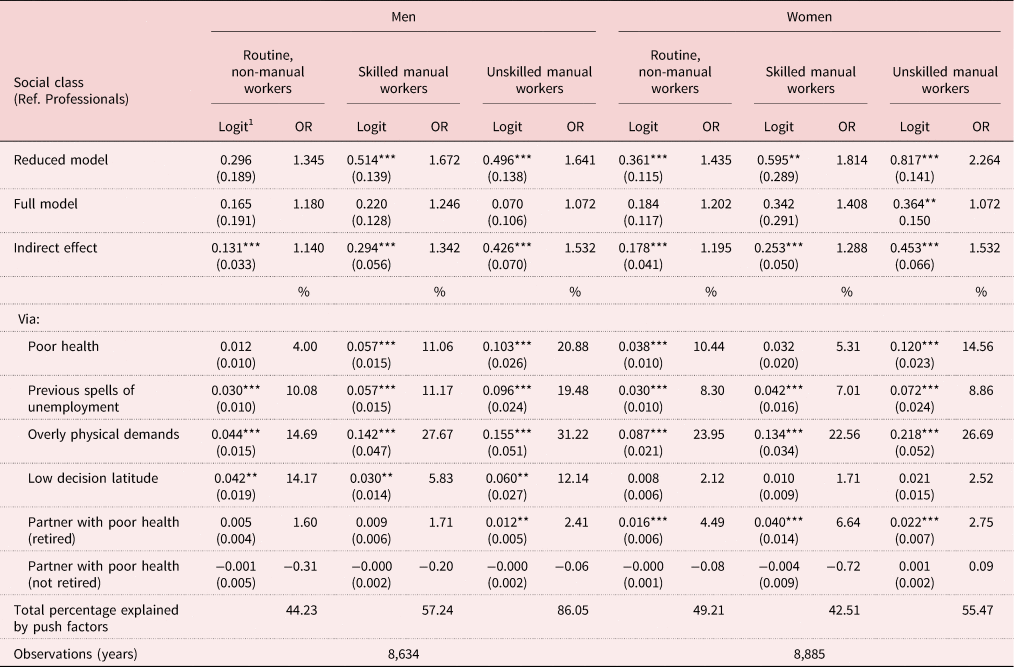
Table 2 presents the results of the KHB corrected discrete-time logistic regression model run separately for men and women.
Discrete-time logistic models: decomposition of the effect of social class on early retirement timing, all pathways for men and women

Notes: Control variables are included in all models. 1. Logit coefficients with robust standard errors in parentheses. OR: odds ratio. Ref.: reference category.
Significance levels: ** p < 0.05, *** p < 0.01.
The reduced models include social class and the control variables include age and indicators for birth cohort, but importantly not the proposed mediator variables. When the proposed mediator variables are not included in the model, we observe significant total effects of belonging to the working class on the risk of early retirement for both men and women, supporting Hypothesis 1. Accordingly, among men, the odds of early retirement for skilled and unskilled manual workers are 1.672 and 1.641 times higher compared to professionals. Among women, the corresponding odds ratios for skilled and unskilled workers are 1.814 and 2.264, compared to professionals.
However, when the proposed mediators are included in the full models, we learn that all of the total indirect effects are positive and significant, which suggests that the mediators partly explain the total social class effects on early retirement. For male unskilled manual workers, the total effect is reduced by 86 per cent, suggesting that the proposed mediators explain approximately 86 per cent of the total effect for this group. For male skilled manual workers, the total effect is reduced by approximately 57 per cent. For both skilled and unskilled male manual workers, Table 2 suggests that overly physical job demands is the most important push factor; this factor alone explains approximately 27 per cent of the total effect on early retirement of being a skilled manual worker and 31 per cent of being an unskilled manual worker, supporting Hypothesis 5a. The table also suggests that poor health, previous spells of unemployment and low decision latitude significantly mediate part of the association between social class and early retirement, supporting Hypotheses 2, 4 and 5b. However, having a retired partner in poor health only significantly mediates part (2%) of the total effect on early retirement for male unskilled manual workers, not for male skilled manual workers. Hence, Hypothesis 3 only receives partial support.
For women, Table 2 suggests that when the proposed mediators are included in the full models, the total effect of being an unskilled manual worker is significantly reduced by 55 per cent for unskilled manual workers and by 43 per cent for skilled manual workers. Thus, among women, the proposed mediators explain a lower proportion of the total effect of belonging to the working class on the risk of early retirement than for men. However, overly physical job demands are also the relatively strongest push factor among female skilled and unskilled manual workers. Accordingly, overly physical job demands explain approximately 23 per cent of the total effect of being a skilled manual worker on early retirement and 27 per cent for unskilled manual workers, supporting Hypothesis 5a. Other significant mediators for female skilled and unskilled manual workers are poor health, previous spells of unemployment and partner's health, supporting Hypotheses 2, 3 and 4. However, for female skilled manual workers, poor health is not a significant mediator. Hence, Hypothesis 2 only receives partial support among working-class women. Moreover, it can be observed that unlike working-class men, low decision latitude does not act as a push factor for working-class women, suggesting that Hypothesis 5b is not supported for women.
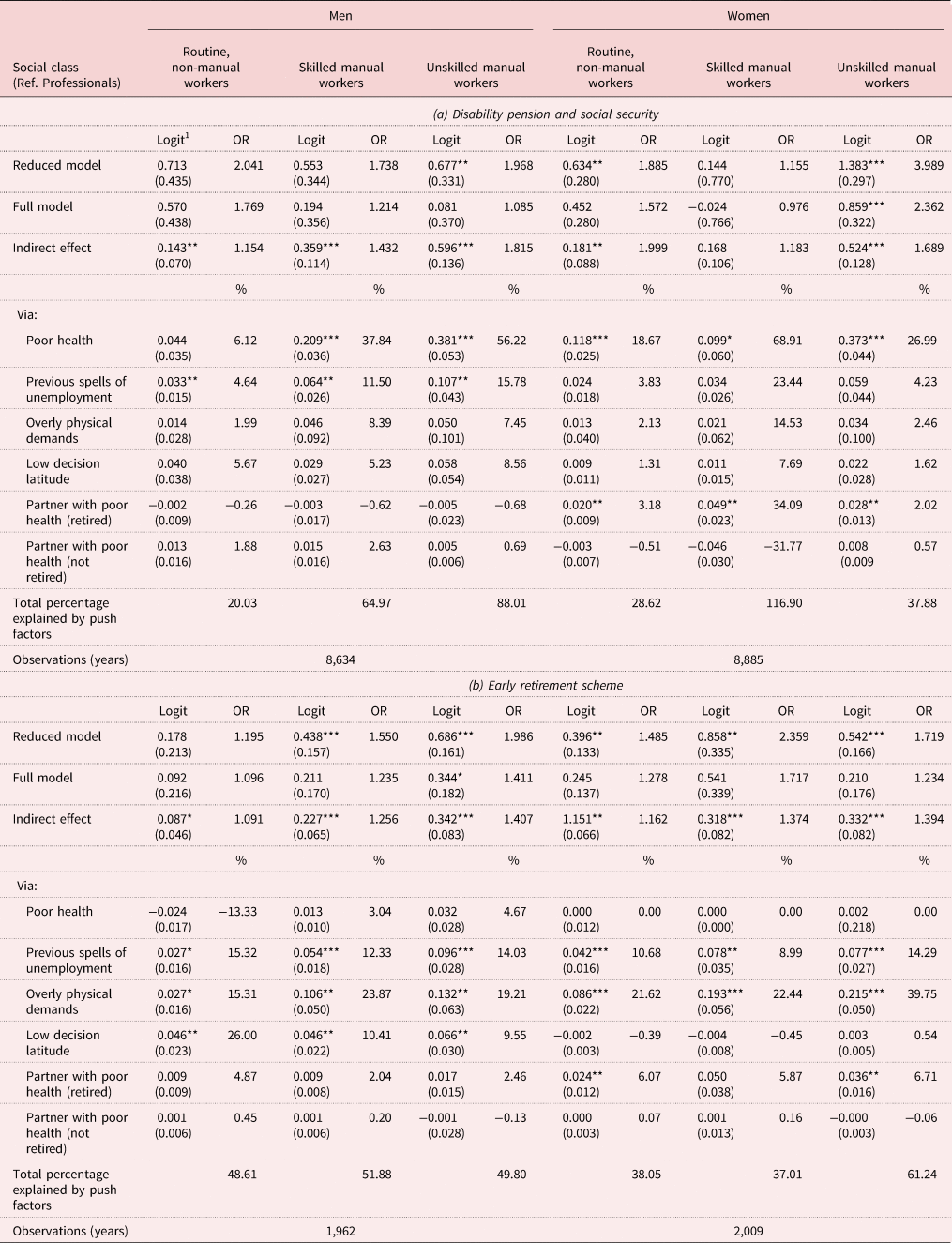
In the following, I break the analysis down into the two major pathways to early retirement in Denmark: (a) disability pension and social security and (b) the early retirement scheme. The results of this analysis are presented in Table 3.
Discrete-time logistic models: decomposition of the effect of social class on early retirement timing, separate pathways for men and women

Notes: Control variables are included in all models. 1. Logit coefficients with robust standard errors in parentheses. OR: odds ratio. Ref.: reference category.
Significance levels: * p < 0.10, ** p < 0.05, *** p < 0.01.
The results from Table 3 suggest that within the disability pension and social security pathway the total effect of being an unskilled manual worker on the risk of early retirement is significant for both men and women. The odds of early retirement for male unskilled manual workers are 1.968 times higher compared to male professionals and 3.989 times higher for female unskilled manual workers compared to female professionals. We also observe a positive, yet insignificant association between being a skilled manual worker and early retirement for both men and women. However, these associations are probably not significant because the proportion entering into disability pension and social security is relatively low in the sample and women represent a relatively small part of the group of skilled manual workers. When the proposed mediators are included in the full models, the total effects are reduced by 88 per cent for male unskilled manual workers and by 38 per cent for female unskilled manual workers. Within the disability pension and social security pathway, poor health is the most important push factor for both groups, explaining approximately 56 per cent of the total effect of being a male unskilled manual worker and 27 per cent of the total effect of being a female unskilled worker, supporting Hypothesis 6a. Among male unskilled manual workers, previous spells of unemployment is also a significant push factor for entering early retirement through the disability pension and social security pathway. However, previous spells of unemployment is not a significant push factor for female unskilled manual workers who enter early retirement through the disability pension and social security pathway. Thus, Hypothesis 6b only receives partial support. Moreover, having a partner in poor health appears to be a significant push factor for female unskilled manual workers, but not for male unskilled manual workers.
Within the early retirement scheme pathway, we learn from Table 3 that the total effects of belonging to the working class on the risk of early retirement are significant for both men and women. Among men, the odds of entering into the early retirement scheme pathway for skilled and unskilled manual workers are 1.550 and 1.986 timers higher compared to professionals. Among women, the corresponding odds ratios for skilled and unskilled manual workers are 2.359 and 1.719 compared to professionals. When the proposed mediators are included in the full models, the total effect for male skilled manual workers is reduced by 52 per cent and by 50 per cent for unskilled manual workers. Significant mediating push factors are in order: overly physical demands, previous spells of unemployment and low decision latitude. Among women, the proposed mediators explain approximately 37 per cent of the total effect for skilled manual workers and 61 per cent for unskilled manual workers. The push factors explaining these associations are in order: overly physical demands, previous spells of unemployment and health of a retired partner. Notably, the indirect effects of health are not significant among men and women belonging to the working class.
Low job quality is the strongest push factor explaining social class effects in the early retirement scheme, which gives support to Hypothesis 7a, although having low decision latitude only explains social class effects among men and not women. Moreover, having a retired partner in poor health is only significant among female unskilled manual workers, where it only explains 7 per cent of the social class effects in the early retirement scheme. Thus, Hypothesis 7b cannot be confirmed.
Conclusion and discussion
The potential social consequences of pension policies on extending working lives accentuate the need for knowledge about the extent to which push factors explain social class differences in early retirement. This study extends previous literature by providing a systematic assessment of the relative extent to which the effect of social class on early retirement, for men and women respectively, is explained by different push factors.
The results of this analysis suggest that members of the working class have an increased risk of early retirement compared to professionals. Among men, 57–86 per cent of the gap in the risk of early retirement between members of the working class and professionals is explained by indirect effects through poor health, previous spells of unemployment, overly physical demands and low decision latitude. Partner's poor health only had a significant contribution in explaining the gap in early retirement between male unskilled manual workers and male professionals. Among women, 43–55 per cent of the gap in the risk of early retirement between members of the working class and professionals is explained by indirect effects through poor health, previous spells of unemployment, overly physical demands and partner's health. However, health only had a significant contribution in explaining the gap in early retirement between female unskilled manual workers and female professionals. For the disability pension and social security pathway, the indirect effects through health were larger in magnitude compared to the indirect effects through the other included push factors. For the early retirement scheme, the indirect effects through low job quality were larger in magnitude compared to the indirect effects through the other included push factors.
The analysis reveals that having overly physical work demands is the most important push factor in explaining social class effects in early retirement. This variable alone explains between 19 and 40 per cent of the gap in early retirement through the early retirement scheme between members of the working class and professionals. This finding strongly indicates that having overly physical work demands induces a dislike of one's job among members of the working class. Additionally, it can indicate that the early retirement scheme is used before overly physical work demands develop into severe disabilities.
The presented empirical evidence also suggests that health of the partner does not contribute substantially in explaining the social class effects in early retirement, and if it contributes, it is mainly among women. Thus, in line with previous research, women's retirement timing is more influenced by their partner's health compared to men (Pienta and Hayward, Reference Pienta and Hayward2002; Ho and Raymo, Reference Ho and Raymo2009). Possible explanations for why the health of the partner does not contribute substantially to explain social class effects in early retirement can be that Denmark has a well-developed and universal health-care system, where most services are provided free of charge (Ministry of Health, 2017). Another explanation can be that health of the partner is measured with ICD-10 health measures. Notably, the diagnoses capture only diseases if the individual received the diagnosis at a hospital. Accordingly, the diagnoses do not capture individuals with undiscovered diseases or individuals who visited a general practitioner for the symptoms of these diseases but have not been diagnosed at a hospital.
Even though the analysis included several relevant push factors, there is still some of the gap between the working class and professionals in early retirement that cannot be explained by the push factors that are included in the analysis. As a result, I can only speculate about factors that might explain the remainder of the gap. However, possible explanations could arguably be the so-called pull factors, such as financial incentives and preferences for family and leisure. Previous literature finds that the generosity of publicly provided pensions affect the retirement behaviour of workers of different socio-economic status (Bingley et al., Reference Bingley, Gupta, Pedersen, Gruber and Wise2004; Schils, Reference Schils2008) and that social class has a strong impact on retirement age norms, i.e. professionals also generally support later retirement than members of the working class (Radl, Reference Radl2012). Even though the social class effects in early retirement do not seem to be more pronounced among men than women, generally the included push factors together explain more of the social class effects among men than among women. Thus, working-class men are more affected by the included push factors than working-class women are, which may be because men are over-represented in manual jobs with low levels of job control. Moreover, previous research shows that women are more likely than men to be ‘pulled’ into retirement because they want to spend time with their family (Friis, Reference Friis, Andersen and Jensen2011), which can also explain why the included push factors explain less of the gap in early retirement between working-class women and professionals compared to working-class men and professionals. However, one exception regarding the early retirement scheme is having overly physical work demands. For women compared to men, overly physical work demands explain twice as much of the gap between unskilled manual workers and professionals. This finding may indicate that women are more aware of their health and therefore overly physical work demands push women in unskilled manual jobs into early retirement to a greater extent than men in similar jobs.
Notwithstanding the contribution of this article, it is not without limitations. First, some of the mediator variables are based on self-evaluations of the respondents. This may create a bias, as such consideration may be related to the choice of the pathway, e.g. workers who enter the disability pension and social security may be more likely to classify themselves as unhealthy. To test this assumption further, I have run a supplemental analysis replacing self-rated health with the same objective health measure used for partner's health. Tables S2 and S3 in the online supplementary material indeed show that the size of the indirect effect through health becomes smaller. This may rather be because ICD-10 diagnoses data only measure severe diseases that have been diagnosed at a hospital, and therefore it is problematic to compare with self-rated health. However, when self-rated health is replaced with an objective health measure, the percentage explained of the total effect does not change substantially. This is mainly because the indirect effect of physical work demands becomes larger, which indicates that health and physical work demands are closely linked.
Another potential limitation of the present study is related to a potential healthy-worker selection effect (Li and Sung, Reference Li and Sung1999) because the respondents in the study are 52 years old at baseline and they have to be in paid work. This implies that the very early retirees and the most disabled unemployed persons are not included in the analysis. Thus, if the most disadvantaged workers have already left the labour market at a very early age, this would lead to an underestimated social class effect, which implies that the estimates provided in the article are conservative estimates of the social class effect. A study of the representativeness and non-response of the DLSA found a sound quality of the study. However, as in other survey studies, the most disadvantaged groups were over-represented among non-participants, which may further increase the risk of the healthy-worker selection effect (Kjær et al., Reference Kjær, Poulsen and Siren2016).
Regardless of these potential limitations, the study highlights the importance of social class inequalities in early retirement. The rationale behind pension reforms to extend the working life is to incentivise the worker economically to keep working longer. However, this analysis contributes to the debate about the potential social consequences of extending the working life by showing that members of the working class might not be able to respond to economic incentives, because a number of factors, including health, previous spells of unemployment and job quality, push them out of the labour market. This might lead to an increase in social inequality in later life because being pushed out of the labour market is associated with severe personal costs for the individual such as loss of income and social exclusion. The analysis thus suggests that the gap in the risk of early retirement between members of the working class and professionals would be reduced by 57–86 per cent among men and 43–55 per cent among women had the working class been equally privileged in terms of health, partner's health, previous spells of unemployment and job quality as professionals. Consequently, the study demonstrates that these push factors need to be improved upon before members of the working class are able to extend their working life.
Supplementary material
The supplementary material for this article can be found at https://doi.org/10.1017/S0144686X20000203
Acknowledgements
The author wishes to thank Per H. Jensen, Rasmus J. Møberg, Claus D. Hansen, Hans-Peter Y. Qvist, members of the research group Centre for Comparative Welfare Studies and two anonymous reviewers for useful comments on earlier drafts of this paper.
Financial support
The research was conducted within the project ‘EXTEND (Social Inequalities in Extending Working Lives of an Ageing Workforce)’ which is funded by the Innovation Fund Denmark (grant number 5194-00003B) in the frame of the Joint Programming Initiative (JPI) ‘More Years, Better Lives – The Potential and Challenges of Demographic Change’.