Introduction
The genus Paravelia Breddin (Hemiptera: Heteroptera: Gerromorpha: Veliidae: Veliinae) was divided by Hungerford (Reference Hungerford1929) into four species groups (P. basalis, P. brachialis, P. inveruglas, and P. stagnalis), when all the species of the genus were still included within the genus Velia Latreille. However, the author did not mention any character to define them. The species of the P. brachialis and P. stagnalis groups are now considered as distinct genera, Platyvelia Polhemus and Polhemus and Steinovelia Polhemus and Polhemus, respectively.
Some species currently placed in Paravelia are divided into the P. basalis and P. inveruglas groups, and only the latter was considered in the literature by subsequent authors (e.g., Hungerford Reference Hungerford1930, Reference Hungerford1931; Drake and Harris Reference Drake and Harris1940). Polhemus (Reference Polhemus2014) recognised eight species for this group: P. albotrimaculata (Kirkaldy), P. amoena (Drake), P. boliviana Breddin, P. columbiensis (Hungerford), P. daza Padilla-Gil and Moreira, P. flavomarginata (Hungerford), P. inveruglas (Kirkaldy), and P. willei (Drake and Harris). The group is characterised by the following features: (1) total body length from 6.40–9.80 mm; (2) ratio of length/width of body ranging from 3.06 to 4.44; (3) absence of basal and apical maculae on the forewings of the macropterous form; and (4) male proctiger with lateral projections or setal tufts. In addition, all species appear to be restricted to regions of high elevations (above 2000 m) (Polhemus Reference Polhemus2014).
Currently, Paravelia comprises 57 valid species, all of them recorded in the Neotropical Region, except P. taipiensis (Chessman), described from the eastern Pacific (Rodrigues et al. Reference Rodrigues, Moreira, Nieser, Chen, Melo, Dias-Silva and Giehl2014; Aristizábal-García et al. Reference Aristizábal-García, Floriano, Moreira and Bispo2015). Despite recent taxonomic studies describing new species of the genus (e.g., Polhemus Reference Polhemus2014; Rodrigues et al. Reference Rodrigues, Moreira, Nieser, Chen, Melo, Dias-Silva and Giehl2014), four additional new species have been discovered and are herein described, illustrated, and compared with their morphologically similar congeners. Also, based on type material, P. amoena, P. kahli (Drake and Harris), P. nexa (Drake and Harris), and P. parilis (Drake and Harris) are re-described and their dorsal habitus illustrated for the first time. Finally, notes concerning another 12 described species, including the description of the previously unknown brachypterous form of P. splendoris (Drake and Harris), are presented.
Material and methods
This study is based upon dry mounted or alcohol preserved specimens deposited in the following collections:
INPA – Instituto Nacional de Pesquisas da Amazônia, Manaus, Brazil.
LES/UFSCar – Laboratório de Estudos Subterrâneos, Universidade Federal de São Carlos, São Carlos, Brazil.
MMLS – Museo Municipal de Ciencias Naturales Lorenzo Scaglia, Mar del Plata, Argentina.
MZUSP – Museu de Zoologia da Universidade de São Paulo, São Paulo, Brazil.
NMNH – National Museum of Natural History, Smithsonian Institution, Washington, District of Columbia, United States of America.
Dissected genitalia were stored in microvials containing glycerin. Morphological terminology is based on Rodrigues et al. (Reference Rodrigues, Moreira, Nieser, Chen, Melo, Dias-Silva and Giehl2014). All measurements are given in millimetres and were always taken in their maximum dimensions; lengths were measured at the midline. The label data of the material examined were transcribed verbatim. All cited elevations in the text are above sea level. Abbreviations used for measurements are as follows: body length (BL), head length (HL), head width through eyes (HW), length of antennomeres I–IV (without interarticular pieces) (ANT I, ANT II, ANT III, ANT IV), maximum eye width (EYE), pronotum length (PL), pronotum width (PW), length of prothoracic leg (FORELEG), length of mesothoracic leg (MIDLEG), length of metathoracic leg (HINDLEG), femoral length (FEM), tibial length (TIB), length of tarsomeres I–III (TAR I, TAR II, TAR III).
Results
Paravelia bachmanni Rodrigues and Moreira, new species
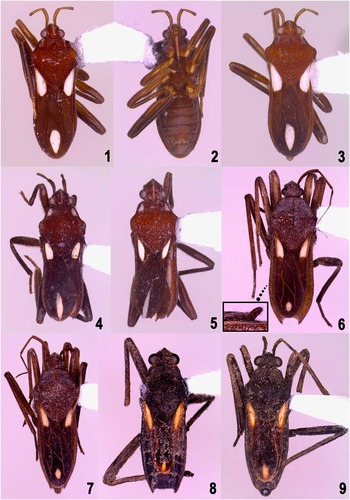
Habitus of Paravelia species. 1–3. Paravelia bachmanni new species. 1. Dorsal view of male holotype. 2. Ventral view of holotype (genitalia removed). 3. Dorsal view of female paratype. 4–5. Paravelia bromelicola new species. 4. Dorsal view of male holotype. 5. Dorsal view of male paratype. 6–7. Paravelia digitata new species. 6. Dorsal view of male holotype (genitalia removed, with detail of posterior process of pronotum in lateral view). 7. Dorsal view of female paratype. 8–9. Paravelia luederwaldti new species. 8. Dorsal view of male holotype. 9. Dorsal view of female paratype.

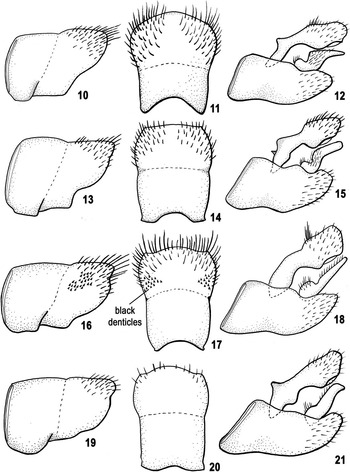
Abdominal segment VIII and genital capsule of males of the new species of Paravelia, 10–12. Paravelia bachmanni new species. 13–15. Paravelia bromelicola new species. 16–18. Paravelia digitata new species. 19–21. Paravelia luederwaldti new species. 10, 13, 16, 19. Lateral view of the abdominal segment VIII. 11, 14, 17, 20. Dorsal view of the abdominal segment VIII. 12, 15, 18, 21. Lateral view of the genital capsule.

Type material. All specimens macropterous. Holotype: ♂ (MZUSP), BRAZIL, São Paulo: Salesópolis, Estação Biológica de Boracéia, 11.viii.1961, in Bromeliaceae, R. A. Rocha col. Paratypes: 2 ♀♀ (MZUSP), same data as holotype. Santa Catarina: 1 ♂, 1 ♀ (MZUSP), 82 [Santo Amaro da Imperatriz], Hotel Plaza, in Canistrum lindenii, 21.v.2003, J. Steiner & A. Zillikens col. 1 ♂, 1 ♀ (MZUSP), 228 [Florianópolis], Unidade de Conservação Ambiental Desterro - UCAD, 28.xi.2003, J. Steiner & A. Zillikens col. 1 ♂, 1 ♀ (MZUSP), 402, Santo Amaro da Imperatriz, in Nidularium innocentii, 25.i.2005, J. Steiner & A. Zillikens col. 1 ♀ (MZUSP), same data, except 414, 12.v.2005. 2 ♂♂, 1 ♀ (MZUSP), same data, except 415. 1 ♂ (MZUSP), same data, except 421, 05.vii.2005. 1 ♂, 1 ♀ (MZUSP), same data, except 422.
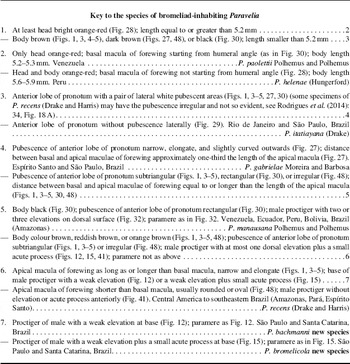
Diagnosis. This species is recorded from water accumulated inside bromeliads. At the moment, this life style is known for six other species of the genus (see key below) and yet another new species described below, P. bromelicola new species. Among the species recorded from bromeliads, P. bachmanni new species is morphologically more similar to P. bromelicola. Both species share the general colouration and the shape of pubescence on anterior lobe of pronotum and maculae on forewing, however, males of P. bachmanni have the posterior margin of abdominal segment VIII convex (Fig. 11), and proctiger with a weak elevation at base (Fig. 12); whereas in P. bromelicola the posterior margin of abdominal segment VIII is slightly convex to straight (Fig. 14), and proctiger has a weak elevation plus a small acute process at base (Fig. 15).
Description. Dimensions: Macropterous male (n=2). Holotype/paratype, BL 3.70/4.00; HL 0.50/0.45; HW 0.67/0.68; ANT I 0.52/0.54, ANT II 0.37, ANT III lost/0.42, ANT IV lost/0.54; EYE 0.17; PL 1.37/1.45; PW 1.38/1.55; FORELEG: FEM 1.02/0.97, TIB 0.87, TAR I 0.07/0.06, TAR II 0.12/0.10, TAR III lost/0.19; MIDLEG: FEM 1.17/1.16, TIB 1.18, TAR I 0.07, TAR II 0.14/0.16, TAR III 0.25/0.20; HINDLEG: FEM 1.32/1.33, TIB 1.63/1.67, TAR I 0.10/0.09, TAR II 0.17/0.18, TAR III 0.27/0.26.
Colour: Head, sides and venter of body, and genital segments brown to reddish brown. Apex of antennomere I and apical third of II brown, remaining articles yellow. Eyes dark red. Articles I and II of rostrum brown, III yellow, IV black. Forewings dark brown, with lighter veins; at base with pair of elongate white maculae, starting from humeri and surpassing posterior margin of pronotum; apex with elongate fusiform white macula, not reaching tip of wing (Fig. 1, 3). Coxae, trochanters, and basal half of femora yellow; posterior half of femora and tibiae brown; tarsomeres yellow (Fig. 2).
Head: Covered by golden pubescence, with white pubescence along longitudinal midline and inner margin of eye; pair of rounded punctures adjacent to posterior margin; without black denticles. Antenna covered by golden pubescence, with a few longer setae interspersed on antennomeres III and IV; antennomere I stoutest, slightly curved outward; antennomere II shortest; III and IV slender. Ocular setae present. Rostrum reaching mesoacetabula.
Thorax: Covered by golden pubescence, without black denticles. Pronotum with pair of small subtriangular pubescent areas, white, arranged laterally; longitudinal median carina present, more evident between anterior and posterior lobes. Humeri slightly elevated. Propleura with two rows of rounded punctures on posterior portion; mesopleura with row of similar punctures on anterior portion; both slightly pruinose. Intersegmental area between mesosternum and metasternum centrally with two pairs of small tubercles. Profemora and mesofemora without spines or spine-like setae; mesofemora and metafemora slightly thicker at middle; metafemur with row of 14–15 teeth on inner margin, slightly increasing in size towards apex. Metatibia slightly clavate.
Abdomen: Connexiva, tergites, and sternites without black denticles. Abdominal segments II–III with small pruinosity laterally. Intersegmental area between abdominal sternites II–III centrally with small tubercle. Sternite VII without projections or nodules, with posterior margin concave. Abdominal segment VIII without black denticles, with anterior margin notched ventrally, dorsum covered by long, dark, brown setae on posterior half, and posterior margin convex dorsally (Fig. 10–11). Proctiger with weak acute process near pygophore (Fig. 12). Paramere elongate, with dorsal surface notched basally, slightly tapering towards apex; with setae on basal half (Fig. 12).
Dimensions. Macropterous female (n=2). BL 3.40–3.60; HL 0.47–0.50; HW 0.65; ANT I 0.48–0.51, ANT II 0.35–0.37, ANT III lost, ANT IV lost; EYE 0.15–0.17; PL 1.25–1.33; PW 1.25–1.32; FORELEG: FEM 0.87–0.90, TIB 0.83–0.85, TAR I 0.07, TAR II 0.10, TAR III 0.20; MIDLEG: FEM 1.02–1.10, TIB 1.05–1.12, TAR I 0.07–0.08, TAR II 0.14, TAR III 0.22; HINDLEG: FEM 1.17–1.25, TIB 1.40–1.50, TAR I 0.09, TAR II 0.17, TAR III 0.25.
Similar to male in colour and morphology (Fig. 3), except: protibia with small grasping comb on apex; metafemur without spines; metatibia not clavate; posterior angle of last connexival segment poorly developed, almost rounded; first gonocoxa platelike; proctiger globose, slightly directed upwards.
Intraspecific variation. Part of the paratypes collected in the state of Santa Catarina have the body distinctly lighter, almost yellow, probably due to the sunlight to which preserved specimens were exposed.
Etymology. The species is named in honour of Dr. Axel O. Bachmann (Museo Argentino de Ciencias Naturales, Buenos Aires, Argentina), in recognition of his valuable contributions to the taxonomy of aquatic Heteroptera from South America.
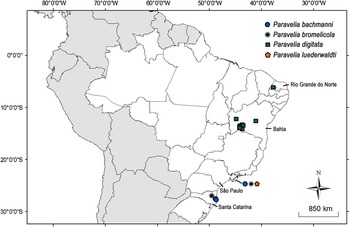
Distribution and habitat. Known from the states of São Paulo and Santa Catarina, southeastern and southern Brazil, respectively (Fig. 51). This new species was collected in two species of bromeliads: Canistrum lindenii (Regel) Mez and Nidularium innocentii Lemaire (Bromeliaceae). Both occupy epiphytic, terrestrial, and rupicolous habitats; however, the specimens from the state of Santa Catarina were collected only in plants from terrestrial and rupicolous habitats.
Paravelia bromelicola Rodrigues and Moreira, new species
Type material. All specimens macropterous. Holotype: ♂ (MZUSP), BRAZIL, Santa Catarina: Hammonia [currently Ibirama], 15.550/70.965, vii.1910, H. Lüderwaldt col. Paratype: 1 ♂ (MZUSP), São Paulo, Cubatão, Estação Raiz da Serra, in bromeliad, 9.968/70.318, 30.ix.1907, H. Lüderwaldt col.
Diagnosis. This species is also recorded from water accumulated inside bromeliads, like P. bachmanni, P. gabrielae Moreira and Barbosa, P. helenae (Hungerford), P. itatiayana (Drake), P. manausana Polhemus and Polhemus, P. paolettii Polhemus and Polhemus, and P. recens (Drake and Harris). Among these species, P. bromelicola is morphologically more similar to P. bachmanni. For a comparison between the two species, see Diagnosis under P. bachmanni.
Description. Dimensions: Macropterous male (n=2). Holotype/paratype, BL 4.38/3.83; HL 0.62/0.65; HW 0.85/0.75; ANT I 0.69/lost, ANT II 0.45/lost, ANT III lost, ANT IV lost; EYE 0.19/0.18; PL 1.68/1.43; PW 1.60/1.35; FORELEG: FEM 1.24/1.00, TIB 1.03/0.90, TAR I 0.07/0.07, TAR II 0.17/0.13, TAR III 0.24/0.25; MIDLEG: FEM 1.37/1.23, TIB 1.39/1.23, TAR I 0.07/0.07, TAR II 0.25/0.22, TAR III 0.27/lost; HINDLEG: FEM 1.68/1.50, TIB 2.16/1.73, TAR I 0.11/0.08, TAR II 0.32/0.25, TAR III 0.30/0.29.
Colour: General body colour brown to dark reddish brown. Antennomeres I and II brown, except lighter apex of II; antennomeres III and IV lost. Rostral articles I and II brown; III yellowish brown, with midline brown; IV dark brown to black. Forewings brown to dark brown; at base with pair of elongate white maculae, starting close to humeral angle and ending near posterior margin of pronotum; apex with other elongate white macula, reaching posterior margin of wing (Figs. 4–5). Acetabula brown, remainder of legs brown to dark brown.
Head: Covered by golden to brown pubescence, with white pubescence along longitudinal midline, inner margin of eye, and faintly on antenniferous tubercles; pair of rounded punctures on posterior portion; without black denticles. Antenna covered by golden pubescence; antennomere I stoutest, slightly curved outwards; antennomere II shortest, thicker. Ocular setae present.
Thorax: Covered by golden pubescence, without black denticles. Pronotum with a pair of white subtriangular pubescent areas arranged laterally; longitudinal median carina weak; posterior angle ending in small process (Fig. 4). Row of rounded punctures on posterior portion of propleura, other on anterior portion of mesopleura. White pubescence on propleura, mesopleura, and metapleura. Mesoacetabulum with punctation on inner margin. Intersegmental area between mesosternum and metasternum centrally with two pairs of small tubercles. Profemur and mesofemur without spines or spine-like setae; metafemur with row of 15–17 teeth on inner margin, increasing in size towards apex, apically with two more prominent and somewhat offset spines. Metatibiae clavate.
Abdomen: Connexiva, tergites, and sternites without black denticles. Abdominal segments II–III laterally with pruinose areas. Intersegmental area between abdominal sternites II–III centrally with small tubercle. Sternite VII without projections or nodules, with posterior margin concave. Abdominal segment VIII without black denticles, with posterior margin slightly convex to straight dorsally, covered by dark brown setae dorsolaterally (Figs. 13–14). Proctiger with small acute projection plus weak process anteriorly near pygophore (Fig. 15). Paramere elongate, with small notch on dorsal surface, slightly curved at middle, apex rounded (Fig. 15).
Intraspecific variation. Substantial variation was observed only in the shape of the basal macula of forewing. In the holotype, the basal macula ends near the posterior margin of pronotum, with truncate distal margin (Fig. 4); whereas in the paratype the basal macula surpasses the posterior margin of pronotum, tapering distally (Fig. 5).
Etymology. bromeli- bromeliad; and suffix -cola (Latin), which denotes inhabiting; referring to the life style of this species.
Distribution and habitat. Known from the states of Santa Catarina and São Paulo, in southern and southeastern Brazil, respectively (Fig. 51). Only “bromeliads” is mentioned on locality labels, thus it is not possible to know in which species of bromeliad this new species was collected.
Paravelia digitata Rodrigues and Moreira, new species
Type material. All specimens macropterous. Holotype: ♂ (MZUSP), BRAZIL, Bahia: Santa Maria da Vitória, Gruta da Bananeira, without date, F. Chaimowicz col. Paratypes: 1 ♀ (MZUSP), same data as holotype. Bahia: 3 ♂♂, 1 ♀ (MZUSP), Serra do Ramalho, Gruna do Google, 13°37'42.0'S/43°48'49.0'W, 13.ix.2008, M.E. Bichuette & B. Rantin col. 2 ♂♂, 1 ♀ (MZUSP), same data except Gruna Vila Nova/ZE, 13°33'14.3'S/43°52'40.7'W, 11.ix.2008, M.E. Bichuette & B. Rantin col. 2 ♀♀ (MZUSP), same data except 26.vii.2012, M.E. Bichuette & J.E. Gallão col. 1 ♀ (MZUSP), same data except Caverna Vila Nova/ZA, 13°33'14.3'S/43°52'40.7'W, 27.vii.2012. 1 ♂, 1 ♀ (MZUSP), Carinhanha, Caverna Domingão, 13°44'40.7'S/43°49'59.7'W, 27.vii.2012, M.E. Bichuette & J.E. Gallão col. 7 ♀♀ (MZUSP), Iuiú, Lapa do Baixão-Epígeo, 14°23'08.11'S/43°37'35.0'W, 06.xii.2012, M.E. Bichuette & J.E. Gallão col. 11 ♂♂, 4 ♀♀ (MZUSP), Coribe, Gruta do Enfurnado, 13°38'41.8'S/44°12'34.7'W, vii.2007, E. Trajano & D. Sansone col. 1 ♀ (MZUSP), Feira da Mata, Caverna Chico Pernambuco, 13°49'09.0'S/44°04'14.9'W, 28.vii.2012, M.E. Bichuette & J.E. Gallão col. 1 ♀ (MZUSP), São Desidério, Gruta Baixa Fria, 12°22'55.2'S/44°56'14.4'W, 04.xi.2008, M.E. Bichuette, T.L.C. Scatolini & D.R. Pedroso col. 1 ♂, 1 ♀ (MZUSP), Andaraí, Gruna dos Torras, 12°51'41.6'S/41°18'52.6'W, 14.vii.2008, M.E. Bichuette, T.L.C. Scatolini & D.R. Pedroso col. Rio Grande do Norte: 1 ♀ (MZUSP), Martins, Gruta Labirinto, 06°03'23'S/37°53'46'W, 10.i.2013, M. Kramer col.
Diagnosis. This new species differs from its congeners mainly by having a distinct upward directed process at the apex of the pronotum (Fig. 6). In addition to this character, the new species also has small black denticles on the ventral region of the head, prosternum, abdominal sternites III–IV, and male abdominal segment VIII (Figs. 16–17). The male has a row of spines on metafemur and a pair of nodules on the posterior region of sternite VII (Fig. 31); female has no spines or teeth on the metafemur.
Paravelia biae Spangler also has a process at the apex of pronotum. Despite this shared character, the new species is easily distinguished from P. biae by the body brown to reddish brown, body 5.12–5.42 mm long, small apical macula of the forewing, and male with a pair of small nodules on sternite VII; whereas in P. biae, body is dark brown to black, 6.20–6.90 mm long, apical macula of forewing is distinctly longer and almost touches the posterior tip of wing, and male has a gibbosity on each side of sternite VII.
Description. Dimensions: Macropterous male (n=5). BL 5.15–5.42; HL 0.72–0.75; HW 0.80–0.85; ANT I 0.95–1.06, ANT II 0.77–0.95, ANT III 0.70–0.76, ANT IV 0.75–0.79; EYE 0.19–0.20; PL 1.85–2.23; PW 1.65–1.75; FORELEG: FEM 1.38–1.50, TIB 1.32–1.45, TAR I 0.07–0.09, TAR II 0.17–0.25, TAR III 0.37; MIDLEG: FEM 1.69–1.87, TIB 1.75–2.00, TAR I 0.09–0.10, TAR II 0.52–0.55, TAR III 0.45–0.50; HINDLEG: FEM 2.00–2.15, TIB 2.35–2.57, TAR I 0.09–0.10, TAR II 0.50–0.52, TAR III 0.46–0.50.
Colour: Head, pronotum, and pleura brown to reddish brown. Antennae brown. Eyes dark brown. Forewing dark brown, with lighter veins; white basal macula starting from humeral angle (slightly brown at base), ending at posterior margin of pronotum; at apex another oval white macula centrally, not touching apex of wing (Fig. 6). Rostrum with articles I–III yellowish brown; IV black. Legs brown to yellowish brown. Abdomen brown, with dark brown stripe on region of spiracles.
Head: Covered by golden pubescence, with longitudinal midline impressed and a pair of rounded punctures at posterior region, near inner margin of eye. Antennae covered by golden pubescence, with long setae scattered on antennomeres III–IV; antennomere I stoutest, curved outward; II slightly thicker than III–IV; III–IV with subequal width. Ventral region of head with several small black denticles. Ocular setae present.
Thorax: Covered by golden pubescence. Pronotum with humeral angles elevated, forming weak callus; posterior angle ending in robust, finger-like upward projected process (Fig. 6). Propleura and mesopleura with row of rounded punctures each. Prosternum with small black denticles, from pronotal collar to posterior portion. Intersegmental area between mesosternum and metasternum centrally with two pairs of small tubercles; inner margin of mesoacetabulum with rounded puncture. Protibia with grasping comb approximately on apical fourth. Prothoracic and mesothoracic legs without spines or spine-like setae. Metatrochanter with small black denticles and three small teeth on dorsolateral margin. Metafemur with 21–24 small spines, occupying almost entire length and slightly increasing towards apex, plus three spines arranged slightly more internally.
Abdomen: Connexiva and tergites without small black denticles. Sternite III and anterior margin of IV with some small black denticles (best viewed in moist specimen). Sternite VII with pair of small nodules arranged medially, with posterior margin concave (Fig. 31); inner margin near abdominal segment VIII with some black denticles. Posterior angle of last connexival segment developed, acute. Abdominal segment VIII with small black denticles and long, brown setae dorsolaterally on apical half; posterior margin slightly convex medially (Figs. 16–17). Proctiger without black denticles or expansions, with weak depression on dorsal surface (Fig. 18). Paramere elongate, with small notch on dorsal surface near base, slightly tapering to apex; with setae near base and on inner surface (Fig. 18).
Dimensions: Macropterous female (n=5). BL 5.12–5.40; HL 0.73–0.80; HW 0.79–0.85; ANT I 0.90–1.05, ANT II 0.72–0.80, ANT III 0.65–0.75, ANT IV 0.72–0.85; EYE 0.18–0.20; PL 2.05–2.11; PW 1.70–1.75; FORELEG: FEM 1.33–1.55, TIB 1.31–1.50, TAR I 0.07–0.08, TAR II 0.20–0.25, TAR III 0.33–0.40; MIDLEG: FEM 1.60–1.90, TIB 1.81–2.00, TAR I 0.08–0.12, TAR II 0.42–0.50, TAR III 0.43–0.46; HINDLEG: FEM 1.90–2.15, TIB 2.33–2.55, TAR I 0.09–0.10, TAR II 0.47–0.52, TAR III 0.45–0.47.
Similar to male in colour and morphology (Fig. 7), except: small grasping comb on apex of protibia; metatrochanter with only few small black denticles, without inner lateral teeth; metafemur without spines; small black denticles on abdominal sternites III–IV more scarce; abdominal sternite VII without nodules; posterior angle of last connexival segment not developed, slightly rounded. Posterolateral margins of abdominal segment VII and upper portion of gonocoxae with small black denticles.
Intraspecific variation. This species has variations in the following characters: black denticles on the abdominal sternites can be scarce or absent; the process of the posterior angle of pronotum may be smaller than illustrated in Fig. 6, and in a single specimen it is almost absent; the basal spot of the forewing can finish before the posterior margin of the pronotum; the forewing can be shorter, reaching the posterior margin of tergite V, or longer, covering the genital segments. The females from Iuiú have the pronotum and acetabulae orange, with body dark brown with black areas.
Species of Veliidae that have some kind of expansion of the tegument (e.g., spines on humeral angles, projections of disc or posterior angle of pronotum) exhibit intraspecific variations, and the low-development or non-development of such structures can possibly lead to misidentifications. Therefore, these variations should always be taken into account, even when they are unknown to occur in a given species.
Etymology. Digit- (Latin), finger; and suffix -ata (Latin), characterised by having; referring to the finger-like process on the posterior angle of pronotum.
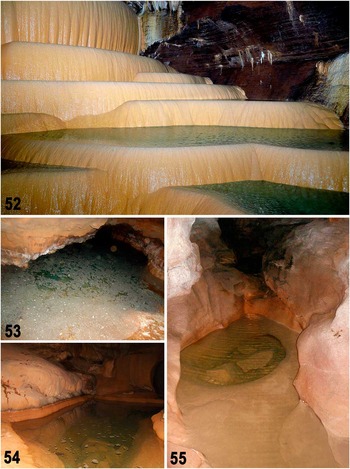
Distribution and habitat. This species has been found in caves in the states of Rio Grande do Norte and Bahia, northeastern Brazil (Figs. 51, 52–55), and represents an interesting and hitherto unknown habitat for the genus. These caves are formed by carbonatic (limestone) rocks, except the “Gruna dos Torras”, which is a sandstone cave; the subterranean waters may or may not have contact with the surface drainage. The specimens were collected in small pools or in backwaters of small rivers, with depth ranging from 10 cm to more than 5 m, in many cases in the aphotic zone. The substrate of these environments is usually formed by clay, silt and limestone pieces, and may contain sand, leaves and/or branches brought by the current. This wide distribution suggests a troglophilic habit for the species (facultative cave organisms).
Paravelia luederwaldti Rodrigues and Moreira, new species
Type material. Holotype: brachypterous ♂ (MZUSP), BRAZIL, São Paulo: Alto da Serra, Paranapiacaba, 19.334/70.307, 1909, H. Lüderwaldt col. Paratypes: 4 macropterous ♀♀, same data as holotype, except collection number: 70.459, 70.460, 70.461, 70.462.
Diagnosis. This new species differs from others of the genus mainly by the body length (5.59–6.10 mm); dark brown colouration of body; anterior lobe of pronotum without pruinosity or pubescence; posterior angle of pronotum rounded; basal and apical maculae of the forewing yellow; absence of spines or teeth on the legs; absence of rounded punctures on abdominal sternites; absence of small black denticles on the body; and male without lobes or projections on abdominal sternite VII.
Among the species of the genus, especially those occurring in southeastern Brazil, P. basalis (Spinola) is more similar morphologically to P. luederwaldti. Both species have dark colouration, lack small black denticles on body surface, and display basal macula of forewing yellow. However, they are differentiated in both sexes by the colouration of the apical macula, yellow in the new species (Figs. 8–9), whereas it is white in P. basalis (Fig. 22). In addition, male abdominal sternite VII does not have projections in P. luederwaldti, which are present in P. basalis.
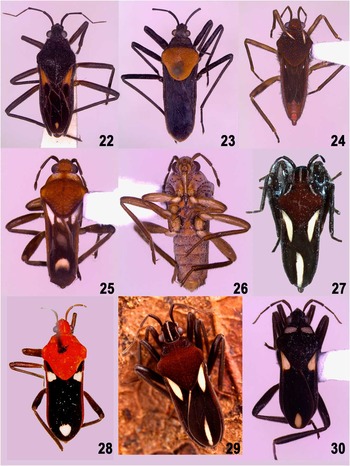
Habitus of Paravelia species. 22. Paravelia basalis, dorsal view of male. 23. Paravelia boliviana, dorsal view of male. 24. Paravelia dilatata, dorsal view of female. 25–26. Paravelia foveata. 25. Dorsal view of male. 26. Ventral view of male. 27. Paravelia gabrielae, dorsal view of female paratype. 28. Paravelia helenae, dorsal view of female holotype. 29. Paravelia itatiayana, dorsal view of female (living specimen), photograph F.F. Albertoni. 30. Paravelia manausana, dorsal view of male.

The brachypterous holotype of P. luederwaldti has the shape of forewing maculae similar to the brachypterous form of P. platensis (Berg). However, in the new species the maculae are yellow and posterior margin of sternite VII of male does not have projections or lobes, whereas in P. platensis the maculae are white (Fig. 49) and sternite VII of male has a pair of central lobes on the posterior margin.
Description. Dimensions: Brachypterous male (n=1). BL 5.59; HL 0.85; HW 1.20; ANT I 1.25, ANT II 1.06, ANT III 0.93, ANT IV 0.89; EYE 0.36; PL 2.12; PW 1.77; FORELEG: lost; MIDLEG: FEM 2.09, TIB 2.32, TAR I 0.12, TAR II 0.52, TAR III 0.48; HINDLEG: FEM 2.54, TIB 3.38, TAR I 0.12, TAR II lost, TAR III lost.
Colour: Head, antenna, pronotum, venter of body, legs, and genital segments dark brown to black. Eyes shiny dark red. Forewings dark brown; at base with pair of elongate yellow maculae, starting from humeri and surpassing posterior margin of pronotum; apex with small oval yellow macula, almost reaching posterior margin of wing (Fig. 8).
Head: Velvety, with short golden pubescence, longitudinal midline impressed, and pair of rounded punctures on posterior portion near inner margins of eyes; black denticles absent. Antennomere I stoutest, curved outwards; segment II shorter; segments III and IV thicker than II and subequal in length; IV fusiform. Ocular setae present. Antenniferous tubercles shiny and swollen. Rostrum reaching base of mesocoxae.
Thorax: Velvety, with small golden pubescence, without black denticles. Pronotum with longitudinal median carina, humeral angles slightly elevated, and posterior angle rounded. Forewing brachypterous, reaching posterior margin of tergite VI. Row of circular punctures on posterior portion of propleura and another on anterior portion of mesopleura. Intersegmental area between mesosternum and metasternum centrally with two pairs of small tubercles. Legs without spines or spine-like setae. Prothoracic legs lost.
Abdomen: Covered by small golden pubescence, without black denticles. Connexiva slightly elevated, partially exposed on segment III, and almost fully exposed on segments IV–VII. Tergite VII fully exposed, with pair of small rounded shiny areas near lateral margins. Sternite VII without projections or lobes, with posterior margin concave. Abdominal segment VIII without black denticles; posterior region dorsolaterally with some brown setae; posterior margin convex medially (Figs. 19–20). Proctiger with conical process at base (Fig. 21). Paramere elongate, with ventral surface slightly curved, and apex truncate; a few setae at base and on inner surface (Fig. 21).
Dimensions: Macropterous female (n=3). BL 5.88–6.10; HL 0.84–0.96; HW 1.19–1.20; ANT I 1.01–1.08, ANT II 0.93–1.02, ANT III lost, ANT IV lost; EYE 0.32–0.35; PL 2.28–2.32; PW 1.89–1.93; FORELEG: FEM 1.55–1.66, TIB 1.68–1.72, TAR I 0.07–0.08, TAR II 0.29, TAR III 0.46; MIDLEG: FEM 1.90–1.98, TIB 2.11–2.20, TAR I 0.09–0.13, TAR II 0.42, TAR III 0.53; HINDLEG: FEM 2.30–2.40, TIB 2.95–3.03, TAR I 0.14–0.15, TAR II 0.65–0.69, TAR III 0.62.
Similar to brachypterous male in colour and morphology (Fig. 9), except: abdominal connexiva slightly more elevated; prothoracic leg not lost, with a small grasping comb on apex of tibia; forewings macropterous, reaching anterior margin of tergite VIII; first gonocoxa platelike; proctiger globose, directed upward, without black denticles.
Etymology. The species is named in honour of Hermann Lüderwaldt (1865–1934), naturalist of Germanic origin, who lived in Brazil, collected the type material of this species, and contributed with various botanical and zoological studies.
Distribution and habitat. Known from the state of São Paulo, southeastern Brazil (Fig. 51). This species was collected in a region of the Atlantic forest, however, without specific data on the label. Paranapiacaba is a district of the municipality of Santo André, which partially belongs to the Serra do Mar, a mountain range that covers part of the southeastern and southern coasts of Brazil.
Re-descriptions
Paravelia amoena (Drake, Reference Drake1957 )
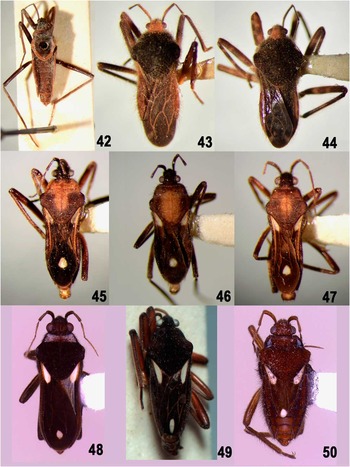
(Fig. 42)
Velia amoena Drake, Reference Drake1957: 138.
Paravelia amoena: Polhemus Reference Polhemus1976: 512.
Type material examined. Holotype: apterous ♂ (NMNH), VENEZUELA, no precise locality, no date, no collector.
Re-description. Dimensions: Apterous male (n=1). BL 7.40; HL 0.95; HW 1.38; ANT I 1.49, ANT II 1.25, ANT III lost, ANT IV lost; EYE 0.43; PL 2.40; PW 2.00; FORELEG: FEM 2.03, TIB 2.23, TAR I 0.10, TAR II 0.30, TAR III 0.50; MIDLEG: FEM 2.55, TIB 2.65, TAR I 0.10, TAR II 0.50, TAR III 0.60; HINDLEG: FEM 2.83, TIB 3.90, TAR I 0.15, TAR II 0.93, TAR III 0.69.
Colour: Head dark brown, with impressed longitudinal median line and two oblique indentations at base darker and shiny. Antenniferous tubercles and bucculae orange brown. Antennae brown. Eyes dark red. Rostrum with articles I–III orange brown; IV dark brown. Pronotum dark brown, with anterior margin and lateral margins starting anteriorly to humeri widely orange brown. Sides of thorax dark reddish brown; venter glued, not visible. Acetabula broadly margined with orange brown. Coxae dark brown; trochanters, femora, tibiae and tarsi brown to dark brown. Dorsum of abdomen, including genital segments, brown. Abdominal sternites dark reddish brown.
Head: Moderately elongate, velvety, without black denticles. Antenniferous tubercle swollen. Antennomere I widest at apex, curved outside; II cylindrical, thinner than I; remaining of antennae missing. Ocular setae present. Buccula without circular punctures. Rostrum reaching mesosternum.
Thorax: Without black denticles. Pronotum covered by short setae on margins, with low, wide longitudinal median carina, transversal row of punctures adjacent to anterior margin, another between anterior and posterior lobes, and several punctures on posterior lobe, much larger closer to apex; humeri broad, elevated; posterior margin widely rounded. Centre of pronotum severely damaged, probably due to pinning. Propleura with row of circular punctures close to posterior margin; mesopleura with two punctures close to posterior margin. Legs unarmed, covered by short light setae; longer, thicker setae on tibiae. Profemur wider on base; protibia slightly clavate, with grasping comb very long, occupying approximately 3/4 of its length.
Abdomen: Without black denticles. Dorsum covered by golden setae, longer on connexiva (except outer margins) and genital segments. Abdominal tergites transversely rectangular; last tergite much longer than others, with thickened posterior margin. Connexiva elevated, almost vertical on last segment, developed into thick long spines on apex, not reaching middle of genital segment I. Venter of abdomen without circular punctures, covered by thin light setae, longer on lateral portions. Last abdominal sternite without carinae, projections or denticles. Genital segment I large, dorsally subquadrate, with slightly rounded posterior margin, ventrally impressed, without projections. Dorsum of proctiger with pair of curved, elevated, flat, lateral projections. Paramere wide, flat, curved inside, with thinner, curved apex.
Comments. Paravelia amoena is part of the P. inveruglas group sensu Polhemus (Reference Polhemus2014), containing large-sized species found in western South America, with paired dorsal projections on male proctiger and long parameres. This group includes, for example: P. boliviana, P. columbiensis, P. flavomarginata, P. inveruglas, and P. osborniana (Kirkaldy). Paravelia amoena can be separated from similar species mainly by the combination of orange marked margins of pronotum (Fig. 42), unarmed legs, and shape of proctiger projections and parameres.
Paravelia kahli (Drake and Harris, Reference Drake and Harris1933 )
(Fig. 45)
Velia kahli Drake and Harris, Reference Drake and Harris1933: 46.
Paravelia kahli: Polhemus Reference Polhemus1976: 512.
Type material examined. All specimens macropterous. Paratypes: 1 ♂, 1 ♀ (NMNH), BRAZIL [Mato Grosso]: Chapada [dos Guimarães], no date, no collector.
Re-description. Dimensions: Macropterous male (n=1). BL 4.10; HL 0.44; HW 0.56; ANT I 0.60, ANT II 0.38, ANT III 0.66, ANT IV 0.78; EYE 0.15; PL 1.31; PW 1.33; FORELEG: FEM 1.08, TIB 1.08, TAR I 0.10, TAR II 0.15, TAR III 0.28; MIDLEG: FEM 1.25, TIB 1.10, TAR I 0.08, TAR II 0.25, TAR III 0.31; HINDLEG: FEM 1.45, TIB 1.78, TAR I 0.08, TAR II 0.50, TAR III 0.40.
Colour: Head dorsally black, with impressed longitudinal median line and two oblique indentations on base shiny. Antenna brown, lighter on interarticular pieces and antennomere IV. Eyes shiny black. Venter of head, buccula, and articles I–III of rostrum brown to dark brown; IV shiny black. Anterior lobe of pronotum brown behind head and on median carina; rest orange brown, colour expanding centrally up to middle of posterior lobe; remaining of posterior lobe brown to dark brown. Orange brown colour of anterior lobe of pronotum continuing over propleura. Mesopleura, metapleura, outer surface of acetabula, and venter of thorax brown; inner surface of acetabula yellowish brown. Forewings dark brown, darker distally, with lighter veins, especially costa; when closed, with pair of white maculae extending from humeral angle almost to apex of pronotum and central macula at apex of veins (Fig. 45). Coxae yellowish brown. Trochanters and small area at base of femora dark yellow. Remaining of legs brown, darker on anterior surface of femora, on tibiae, and mesotarsi and metatarsi. Dorsal exposed portion of abdominal connexiva dark brown; ventral side dark brown with small red marks on outer posterior angles. Abdominal sternites and genital segments yellowish brown.
Vestiture: Surface of body covered by black denticles on dorsum and sides of head, buccula, jugum, pronotum, proepisternum, thoracic pleura, prosternum and mesosternum, inner surface of procoxa, anterior surface of femora, tibiae, connexiva both dorsally and ventrally, central portion of abdominal sternites, posterior margin of last abdominal sternite, and posterior portion of dorsal genital segment I. Long, thick, black setae present laterally on dorsum of head, pronotum, outer portion of forewings, and connexiva.
Head: Moderately elongate, with swollen antenniferous tubercles. Ocular setae present. Antenna covered by short thick setae; antennomeres III–IV also with long trichobotria-like setae. Antennomere I thickest, wider at apex, curved outside; II–III cylindrical; II wider than III; IV fusiform, as broad as III. Buccula with central punctation. Rostrum reaching middle of mesosternum.
Thorax: Pronotum not touching eyes, subpentagonal, with well-developed anterolateral region, humeri obtuse and elevated, and longitudinal median carina starting on posterior region of anterior lobe. Anterior lobe of pronotum with row of circular punctures and two more posterior pairs on sides of midline; another row between anterior and posterior lobes; posterior lobe with several punctures, larger towards posterior margin; margins of posterior lobe thickened; posterior angle rounded. Lateral region of thorax and abdomen with several curved setae. Propleura with three rows of circular punctures; mesopleura with one anterior row; metapleura covered by glue. Inner surface of proacetabulum with deep punctation, other on mesosternum beneath procoxa; inner surface of mesoacetabulum not visible. Mesosternum longitudinally impressed on centre. Mesosternum and metasternum connected centrally by two pairs of tubercles. Metasternum mainly covered by glue. Legs covered by decumbent short setae; anterior surface of femora also with few longer curved setae; tibia with rows of stiff, long setae. Apex of protibia flattened on anterior surface, with ventral concavity and short grasping comb restricted to this area. Metafemur distinctly bent; metatibia slightly curved apically.
Abdomen: Venter of abdomen with shiny depressions on area between connexiva and sternites of all segments. First visible abdominal sternite strongly compressed laterally, especially on anterior portion, presenting subtriangular shape. Remaining segments slightly flattened centrally up to middle of last sternite. Abdominal segment VIII ventrally with pair of flat, elevated, roughly triangular projections; posterior margin with pair of lateral notches, widely concave on venter. Paramere sinuous, curved inward, preapically constricted, with rounded flat apex.
Comments. The descriptions provided by Drake and Harris (Reference Drake and Harris1933) make the distinction between P. kahli, P. nexa, and P. parilis difficult. This was one of the main factors that led Rodrigues et al. (Reference Rodrigues, Moreira, Nieser, Chen, Melo, Dias-Silva and Giehl2014) to consider their key to the Paravelia recorded from Brazil as preliminary. With the photographs and comparisons herein presented, it will soon be possible to present a new and improved key.
Paravelia nexa (Drake and Harris, Reference Drake and Harris1933 )
(Fig. 46)
Velia nexa Drake and Harris, Reference Drake and Harris1933: 47.
Paravelia nexa: Polhemus Reference Polhemus1976: 512.
Type material examined. Holotype: macropterous ♂ (NMNH), BRAZIL, Maranhão: no precise locality, no date, no collector.
Re-description. Dimensions: Macropterous male (n=1). BL 3.55; HL 0.48; HW 0.60; ANT I 0.60, ANT II 0.35, ANT III lost, ANT IV lost; EYE 0.15; PL 1.15; PW 1.19; FORELEG: FEM 0.93, TIB 0.88, TAR I 0.08, TAR II 0.13, TAR III 0.21; MIDLEG: FEM 1.08, TIB 1.11, TAR I 0.08, TAR II 0.21, TAR III 0.25; HINDLEG: FEM 1.28, TIB 1.50, TAR I 0.08, TAR II 0.40, TAR III 0.33.
Colour: Head dorsally dark brown. Antenna brown up to base of antennomere III, then light brown towards apex. Eyes dark red. Venter of head, buccula, and articles I–III of rostrum brown; article IV shiny dark brown. Pronotum light brown on sides of anterior lobe, brown on centre, except small portion of posterior area; humeri and adjacent portion of posterior lobe dark brown; remaining of posterior lobe orange brown, except brown margins. Sides of thorax brown, yellow on outer posterior margins of proacetabula and mesoacetabula. Venter of thorax yellowish brown to brown. Forewings opaque brown, darker towards apex and on most veins; when closed, with pair of short pearly white maculae starting on humeral angle and almost reaching apex of pronotum, and central subcircular macula at apex of veins. Coxae yellowish brown. Trochanters yellow. Femora brown, lighter at base. Tibiae and tarsi brown to dark brown. Dorsally exposed portion of abdominal connexiva dark brown. Genital segments yellowish brown, with brown apex. Ventral side of abdominal connexiva reddish brown. Abdominal sternites dark yellow to yellowish brown.
Vestiture: Surface of body covered by black denticles on dorsum and venter of head, pronotum, pleural region of thorax, proepisternum, anterior portion of prosternum, densely on dorsal margin of abdominal connexiva, and scarcely on ventral side of connexiva, posterolateral margins of last abdominal segment surrounding genital cavity, and anterior surface of femora; denticles absent from genital segments.
Head: Moderately elongate, with few long setae on vertex and adjacent to inner eye margin. Antenna covered by short recumbent setae and rows of longer setae on antennomeres II–IV. Antennomere I thickest, wider on apex, curved outside; II–III cylindrical; II thicker than III; III as thick as IV on centre; IV fusiform. Eyes with ocular setae broken at base. Buccula with two tiny punctures. Rostrum reaching middle of mesosternum.
Thorax: Pronotum not touching eyes, subpentagonal, covered by long, thick, black setae more numerous on posterior angle, with well-developed anterolateral region, humeri obtuse and elevated, and longitudinal median carina starting on posterior region of anterior lobe. Anterior lobe of pronotum with row of circular punctures adjacent to anterior margin and two more posterior pairs on sides of midline; another row between anterior and posterior lobes; posterior lobe with several larger punctures, deeper towards posterior margin; margins of posterior lobe thickened; posterior angle rounded. Sides of thorax, proepisternum and most of ventral abdomen covered by thin light setae. Circular puncture on dorsal outer surface of propleura; two rows on posterior region of mesopleura; three more on anterior portion of metapleura. Mesosternum longitudinally impressed on centre. Mesosternum and metasternum connected centrally by two pairs of tubercles. Mesoacetabulum with circular puncture on anterior portion of inner surface, not extended centrally. Forewings covering most of connexiva, reaching base of genital segments, with thick black setae on outer portions. Legs covered by short decumbent setae; tibiae also with rows of thick straight longer setae. Posterior surfaces of femora and tibiae without spines. Profemur slightly broader than mesofemur. Protibia with well-developed, grasping comb occupying distal third.
Abdomen: Abdominal sternites with long curved brown setae laterally; first visible sternite slightly laterally compressed; last sternite without projections or carina, with posterior margin concave. Venter of abdominal segment VIII compressed laterally, with wide, flat central elevation. Proctiger without dorsal projections. Pygophore partially crushed on venter. Paramere sinuous, curved inwards, yellowish brown on base, becoming dark brown towards thinner apex, with dorsal patch of long setae in this region.
Comments. As mentioned by Drake and Harris (Reference Drake and Harris1933), P. nexa is similar to P. kahli in general appearance. The two can be separated by body size (P. nexa 3.55 mm, P. kahli 4.10 mm); the more widespread black denticles on surface of body of P. kahli (compare vestiture on re-descriptions); distinctly longer tibial grasping comb of P. nexa; curved metafemur of P. kahli; the oddly shaped genital segment I of P. kahli, with a pair of ventral triangular projections and a pair of lateral notches on posterior margin, whereas it is more simple in P. nexa, being laterally compressed with a wide, flat, central elevation; and by shape of the parameres.
Paravelia parilis (Drake and Harris, Reference Drake and Harris1933 )
(Fig. 47)
Velia parilis Drake and Harris, Reference Drake and Harris1933: 46.
Paravelia parilis: Polhemus Reference Polhemus1976: 512.
Type material examined. All specimens macropterous. Paratypes: 1 ♂, 1 ♀ (NMNH), BRAZIL [Mato Grosso]: Chapada [dos Guimarães], no date, no collector.
Re-description. Dimensions: Macropterous male (n=1). BL 3.70; HL 0.50; HW 0.63; ANT I 0.58, ANT II 0.30, ANT III 0.50, ANT IV 0.64; EYE 0.15; PL 1.05; PW 1.05; FORELEG: FEM 0.98, TIB 0.81, TAR I 0.08, TAR II 0.13, TAR III 0.19; MIDLEG: FEM 1.05, TIB 1.10, TAR I 0.08, TAR II 0.18, TAR III 0.24; HINDLEG: FEM 1.25, TIB 1.40, TAR I 0.08, TAR II 0.38, TAR III 0.33.
Practically identical in colour and structure to P. kahli, except for: eyes shiny dark red; venter of head, buccula, and article I of rostrum brown; II–III yellowish brown; IV shiny dark brown; pronotum mainly brown, faintly orange on sides of anterior lobe and on sides of longitudinal carina on anterior part of posterior lobe; acetabula yellowish brown on outer and inner surfaces; ventral side of abdominal connectives brown to dark brown. Body slender, especially abdomen; surface with fewer denticles ventrally, absent from genital segment I; inner surface of mesoacetabulum visible, showing large, deep punctation, with posterior margin thickened centrally, not forming tubercle; metatibia not curved apically; flat projections of genital segment I smaller; apex of paramere curved and acute, not rounded.
Comments. Out of the differences listed above, the absence of black denticles on genital segment I and the curved and acute apex of the paramere seem to be the only reliable features for separation of P. kahli and P. nexa. No reliable characteristics have been found to separate the females, as previously indicated by Drake and Harris (Reference Drake and Harris1933). The main differences used to distinguish P. nexa from P. kahli can also be used in relation to P. parilis and P. kahli, including the distribution of black denticles on surface of the body, length of tibial grasping comb, and shape of the metafemur and genital segment I.
Taxonomic and distributional notes
Paravelia basalis Spinola, Reference Spinola1837
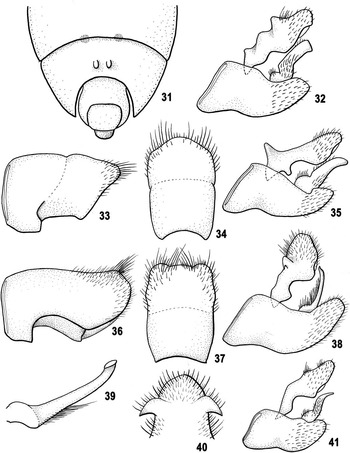
Abdominal and genital segments of Paravelia species. 31. Paravelia digitata new species ventral view of male abdomen apex. 32. Paravelia manausana, genital capsule of male in lateral view. 33–35. Paravelia basalis. 33. Lateral view of abdominal segment VIII of male. 34. Dorsal view of abdominal segment VIII of male. 35. Lateral view of the genital capsule of male. 36–40. Paravelia boliviana. 36. Lateral view of abdominal segment VIII of male. 37. Dorsal view of abdominal segment VIII of male. 38. Lateral view of the genital capsule of male. 39. Inner view of paramere. 40. Posterior view of dorsal surface of male proctiger. 41. Paravelia recens, genital capsule of male in lateral view.

Velia basalis Spinola, Reference Spinola1837: 66.
Velia bicolor Blanchard, Reference Blanchard1843: 218.
Velia brasiliensis Herrich-Schäffer, Reference Herrich-Schäffer1850: 76.
Paravelia basalis: Breddin Reference Breddin1898: 160; Polhemus Reference Polhemus1976: 512.
Velia basalis: Hungerford Reference Hungerford1929: 761.
Material examined. All specimens macropterous. BRAZIL, Rio de Janeiro: 1 ♂, 3 ♀♀ (MZUSP), Angra dos Reis, 30 km N BR-101, 27.xii.1974, H. & B. Reichardt col.
Comments. This is the type species of the genus, which is currently known only from southeastern Brazil. Illustrations of the male genitalia are herein presented for the first time. The abdominal segment VIII is without black denticles, with the posterior region covered by brown setae dorsolaterally, and posterior margin convex dorsally (Figs. 33–34). The proctiger near the base with a conical elevation on the dorsal surface and another smaller lateral expansion (Fig. 35). The paramere is elongate, with a small notch on the dorsal surface near the base and apex rounded (Fig. 35).
Paravelia boliviana Breddin, Reference Breddin1898
Paravelia boliviana Breddin, Reference Breddin1898: 160.
Velia boliviana: Hungerford Reference Hungerford1930: 120.
Paravelia boliviana: Polhemus Reference Polhemus1976: 512.
Material examined. BOLIVIA, Cochabamba: 1 macropterous ♂ (MZUSP), Chapare region, 400 m, x.1956, Dirings col. 1 macropterous ♂, 2 apterous ♀♀, 1 macropterous ♀ (MZUSP), Chapare, Incachaca, 2100 m, viii.1956, Dirings col.
Dimensions. Macropterous male (n=2). BL 8.55–8.80; HL 1.20–1.30; HW 1.40–1.45; ANT I 1.60–1.67, ANT II 1.25–1.30, ANT III 0.97, ANT IV 1.07; EYE 0.35–0.40; PL 3.10–3.15; PW 2.75–2.80; FORELEG: FEM 2.60–2.65, TIB 2.50, TAR I 0.17–0.20, TAR II 0.35, TAR III 0.55; MIDLEG: FEM 3.20–3.25, TIB 3.40–3.50, TAR I 0.20–0.22, TAR II 0.50–0.55, TAR III 0.65; HINDLEG: FEM 3.35–3.50, TIB 4.90–5.00, TAR I 0.18–0.25, TAR II 0.90–1.00, TAR III 0.75. Macropterous female (n=1). BL 8.90; HL 1.20; HW 1.35; ANT I 1.65, ANT II 1.30, ANT III 0.90, ANT IV 1.03; EYE 0.35; PL 3.17; PW 2.90; FORELEG: FEM 2.65, TIB 2.50, TAR I 0.20, TAR II 0.35, TAR III lost; MIDLEG: FEM 3.15, TIB 3.25, TAR I 0.20, TAR II 0.55, TAR III 0.62; HINDLEG: FEM 3.60, TIB 4.90, TAR I 0.25, TAR II 0.87, TAR III 0.75.
Diagnosis. Paravelia boliviana can be diagnosed by the bright orange colour of the posterior lobe of the pronotum, in contrast with the black body (Fig. 23); male without projections on abdominal sternite VII, but with a gibosity on each side of the posterior margin of this segment; abdominal segment VIII without black denticles, with posterior region covered by brown setae dorsolaterally and posterior margin slightly convex medially, with the lateral sides slightly produced (Figs. 36–37); proctiger with a pair of black projections on the posterior half of dorsal surface (Figs. 38, 40); paramere elongate, narrow, and curved, especially near the apex, the inner surface with a set of elongate golden setae (Figs. 38–39).
Comments. This species has been recorded from Bolivia and Peru, and is known from apterous and macropterous forms. In the re-description of the species, Drake and Harris (Reference Drake and Harris1938) illustrated only the pronotum of the macropterous form and more recently, Rodrigues et al. (Reference Rodrigues, Moreira, Nieser, Chen, Melo, Dias-Silva and Giehl2014) presented a photograph of the dorsal habitus of an apterous female. In the present study, macropterous specimens with no maculae on the forewing were examined (Fig. 23), which is uncommon within the genus.
Paravelia capillata (Drake and Harris, Reference Drake and Harris1933 )
(Fig. 43)
Dorsal view of Paravelia species. 42. Paravelia amoena, male holotype. 43. Paravelia capillata, male paratype. 44. Paravelia cognata, male holotype. 45. Paravelia kahli, male paratype. 46. Paravelia nexa, male holotype. 47. Paravelia parilis, male paratype. 48. Paravelia recens, male. 49. Paravelia platensis, male. 50. Paravelia splendoris, female.

Geographic distribution map for the new species of Paravelia. The white area of the map represents Brazil.

Caves where Paravelia species were collected in Brazil. 52. Caverna Chico Pernambuco, Coribe, Bahia, photograph by A.L. Camargo. 53. Gruta Baixa Fria, São Desidério, Bahia, photograph by J.E. Gallão. 54. Caverna Chico Pernambuco, Coribe, Bahia, photograph by P.P. Rizzato. 55. Gruna dos Torras, Andaraí, Bahia, photograph by M.E. Bichuette.

Velia capillata Drake and Harris, Reference Drake and Harris1933: 45.
Paravelia capillata: Polhemus Reference Polhemus1976: 512.
Type material examined. All specimens macropterous. Paratypes: 5 ♂♂, 1 ♀, slide-mounted paramere (NMNH), BRAZIL [Mato Grosso]: Chapada [dos Guimarães], no date, no collector.
Comments. See below under P. cognata (Drake and Harris).
Paravelia cognata (Drake and Harris, Reference Drake and Harris1933 )
(Fig. 44)
Velia capillata cognata Drake and Harris, Reference Drake and Harris1933: 45.
Velia cognata: Drake Reference Drake1957: 138.
Paravelia cognata: Polhemus Reference Polhemus1976: 512.
Paravelia capillata: Rodrigues et al. Reference Rodrigues, Moreira, Nieser, Chen, Melo, Dias-Silva and Giehl2014: 24 (misidentification).
Type material examined. Holotype: macropterous ♂ (NMHN), BRAZIL, Maranhão: no precise locality, no date, no collector.
Additional material examined. BRAZIL, Mato Grosso: 1 macropterous ♂, 1 macropterous ♀ (MZUSP), Nova Xavantina, Rio Antártico basin, Córrego Bacaba, 14°43'10.5'S/52°21'35.07'W, 04.vii.2011, N.F.S. Giehl & P.V.B. Fonseca col.
Comments. The specimens identified by Rodrigues et al. (Reference Rodrigues, Moreira, Nieser, Chen, Melo, Dias-Silva and Giehl2014) as Paravelia capillata were compared to the types of P. capillata (Fig. 43) and P. cognata (Fig. 44), and they actually correspond to the latter species. Both can be distinguished by the body length of 3.60–4.20 mm in P. capillata and 4.55–4.95 mm in P. cognata; the unarmed legs of P. capillata are brown, lighter towards base, whereas they are annulate with black spinules on inner surface of femora and tibiae in P. cognata; and the basal white maculae long and starting on the humeral angle in P. capillata, but short and starting posterior to the apex of the pronotum in P. cognata.
The body length cited by Drake and Harris (Reference Drake and Harris1933: 5.61 mm) and Drake (Reference Drake1957: 5.50 mm) for P. cognata is inaccurate. The holotype actually measures 4.95 mm, the same found by Rodrigues et al. (Reference Rodrigues, Moreira, Nieser, Chen, Melo, Dias-Silva and Giehl2014) for their male specimen. Parameres of the two species are similar, with an expanded apex, which is more acutely projected ventrally in P. cognata. Both species also share with P. capixaba Moreira, Nessimian, and Rúdio and P. bipunctata Rodrigues, Moreira, Nieser, Chen, and Melo the presence of a deep pit on the inner portion of the mesoacetabulum and the legs densely covered by long setae.
Paravelia dilatata Polhemus and Polhemus, 1984
(Fig. 24)
Paravelia dilatata Polhemus and Polhemus, Reference Polhemus and Polhemus1984b: 498.
Material examined. BRAZIL, Amazonas: 1 brachypterous ♀ (MZUSP), Manaus, Reserva Florestal Adolpho Ducke, temporary pool in trail of Igarapé Barro Branco, 02°53'S/59°58'W, 27.xi.2012, U.G. Neiss col. [same specimen examined by Rodrigues et al. Reference Rodrigues, Moreira, Nieser, Chen, Melo, Dias-Silva and Giehl2014].
Dimensions. Brachypterous female (n=1). BL 5.30; HL 0.70; HW 1.00; ANT I 1.00, ANT II 0.75, ANT III 0.67, ANT IV 0.65; EYE 0.25; PL 1.85; PW 1.85; FORELEG: FEM 1.37, TIB 1.30, TAR I 0.10, TAR II 0.25, TAR III 0.35; MIDLEG: FEM 1.80, TIB 1.80, TAR I 0.15, TAR II 0.45, TAR III 0.40; HINDLEG: FEM 2.00, TIB 2.35, TAR I 0.20, TAR II 0.45, TAR III 0.40.
Comments. This species has been recorded from Suriname and Brazil (Amazonas). It has a distinct sexual dimorphism, where the male has the anterior portion of the pronotum expanded, a characteristic absent from the female. Rodrigues et al. (Reference Rodrigues, Moreira, Nieser, Chen, Melo, Dias-Silva and Giehl2014) described the macropterous form and photographed the male; however, they did not illustrate the brachypterous specimen, which has the pattern of maculae on the forewings different from the macropterous form. The brachypterous form has a pair of small white macula at the base, parallel to the apex of pronotum, and another faint white macula at the apex, smaller and almost reaching the apex of the wing (Fig. 24). In the original description, the authors did not mention a pair of white pubescent areas arranged laterally on the anterior lobe of pronotum, which was also omitted by Rodrigues et al. (Reference Rodrigues, Moreira, Nieser, Chen, Melo, Dias-Silva and Giehl2014) in the description of the macropterous form.
Like in P. dilatata, P. amapaensis Rodrigues, Moreira, Nieser, Chen, and Melo and P. bilobata Rodrigues, Moreira, Nieser, Chen, and Melo also have a pair of pubescent areas on the anterior lobe of the pronotum, which were not mentioned in the original descriptions (the pubescence is more inconspicuous in the latter two species). Besides this character, the three species also share colouration and pilosity of the body and appendages, the shape of the apical macula of forewing (macropterous form only; elongate with a medial constriction), and the rounded punctures on the ventral region of the thorax and abdominal sternites (absent from sternite VII). Paravelia anta Mazzucconi and P. hungerfordi (Drake and Harris) also have the same rounded punctures on the ventral region of the thorax and abdominal sternites, and similar shape of the apical macula of forewing. However, it is necessary to examine specimens of the two latter species to know if other characters such as pilosity, body colour, and pubescence on pronotum are also similar.
Paravelia foveata Polhemus and Polhemus, 1984
Paravelia foveata Polhemus and Polhemus, Reference Polhemus and Polhemus1984b: 499.
Material examined. All specimens macropterous. BRAZIL, Roraima: 8 ♂♂, 6 ♀♀ (INPA), 6 ♂♂, 6 ♀♀ (MZUSP), Área Indígena Yanomami, Serra de Surucucu, 02°49'53.78‘N/63°38'19.78'W, unnamed stream, 1354, 26.xi.1991, V. Py-Daniel & U. Barbosa col. 4 ♂♂, 5 ♀♀ (MZUSP), 2029, Serra de Surucucu, igarapé ponte quebrada, 24.xi.1991, V. Py-Daniel & U. Barbosa col.
Comments. Rodrigues et al. (Reference Rodrigues, Moreira, Nieser, Chen, Melo, Dias-Silva and Giehl2014) examined three males and one female from the state of Roraima, northern Brazil. After reviewing the Heteroptera collection of Dr. Victor Py-Daniel, more specimens of P. foveata collected in the same locality, and another new locality near the previous were found.
Paravelia foveata has the ventral region of body covered by small rounded punctures, as in P. amapaensis, P. anta, P. bilobata, P. dilatata, and P. hungerfordi. However, it is the only species in which these punctures are present on abdominal sternite VII of the male and female (Fig. 26), whereas in the other species they are absent from this segment in both sexes.
Paravelia itatiayana Drake, Reference Drake1951
(Fig. 29)
Velia itatiayana Drake, Reference Drake1951: 374.
Paravelia itatiayana: Polhemus Reference Polhemus1976: 512.
Type material examined. Holotype: macropterous ♂ (NMNH), BRAZIL [Rio de Janeiro]: [Itatiaia], Mt. Itatiaya, viii.1940, no collector.
Additional material examined. All specimens macropterous, with the apical macula. BRAZIL, São Paulo: 1 ♀ (MZUSP), Estação Biológica de Boracéia, 29.I.1969, Rodento col. 4 ♂♂, 4 ♀♀ (MZUSP), Salesópolis, Estação Biológica de Boracéia, 23°39'15'S/45°53'22'W, 850 m, in Vriesea sp. (Bromeliaceae), 19–20.vi.2013, F.F. Albertoni & M.A. Ulysséa col. 1 ♀ (MZUSP), same data, except, 23°39'13.9'S/45°53'21.7'W, 847 m, in Bromeliaceae, 21.iii.2015, H. Rodrigues col.
Dimensions. Macropterous male (n=2). BL 4.60–4.70; HL 0.70–0.80; HW 0.90; ANT I 0.65, ANT II 0.48–0.50, ANT III 0.45–0.48, ANT IV 0.55; EYE 0.20; PL 1.75; PW 1.65; FORELEG: FEM 1.25, TIB 1.05, TAR I 0.08–0.09, TAR II 0.15–0.18, TAR III 0.25; MIDLEG: FEM 1.45–1.50, TIB 1.45–1.50, TAR I 0.10, TAR II 0.25–0.27, TAR III 0.25–0.26; HINDLEG: FEM 1.75–1.80, TIB 2.10–2.15, TAR I 0.10–0.11, TAR II 0.30–0.32, TAR III 0.30–0.32. Macropterous female (n=2). BL 4.30–4.60; HL 0.70–0.80; HW 0.90; ANT I 0.65–0.67, ANT II 0.43–0.45, ANT III 0.45, ANT IV 0.50; EYE 0.20; PL 1.70–1.75; PW 1.60–1.65; FORELEG: FEM 1.10–1.20, TIB 1.00–1.07, TAR I 0.07–0.08, TAR II 0.15, TAR III 0.25; MIDLEG: FEM 1.33–1.40, TIB 1.35–1.45, TAR I 0.09–0.10, TAR II 0.25, TAR III 0.25–0.27; HINDLEG: FEM 1.55–1.60, TIB 1.80–1.85, TAR I 0.10, TAR II 0.30, TAR III 0.30–0.32.
Comments. After 60 years of oblivion, Moreira and Barbosa (Reference Moreira and Barbosa2011) suspected that specimens collected in bromeliads and held in different Brazilian museums corresponded to this species described by Drake (Reference Drake1951). Despite the poor description without illustrations, some characteristics matched the material on hand, which led those authors to associate it with P. itatiayana. The examination of the holotype deposited at the NMNH confirms this decision, as well as the records from two states in southeastern Brazil presented by Moreira and Barbosa (Reference Moreira and Barbosa2011), Moreira et al. (Reference Moreira, Barbosa and Ribeiro2012), and Rodrigues et al. (Reference Rodrigues, Moreira, Nieser, Chen, Melo, Dias-Silva and Giehl2014). Besides somatic characteristics, the shape of the paramere matches that drawn by Moreira and Barbosa (Reference Moreira and Barbosa2011).
This bromeliadicolus species is so far known only from southeastern Brazil (São Paulo and Rio de Janeiro), and is morphologically similar to the two new species described above, P. bachmanni and P. bromelicola. It differs from these two species mainly by the absence of lateral pubescence on the anterior lobe of pronotum. A photograph of a live specimen on a leaf, showing dark brown to black colouration of antennae, forewings, and legs, is herein presented (Fig. 29). Specimens of P. itatyaiana have a narrow and elongate, white macula along the inner margin of the forewing, and a tiny process on the posterior angle of pronotum.
Paravelia manausana Polhemus and Polhemus, 1984
Paravelia manausana Polhemus and Polhemus, Reference Polhemus and Polhemus1984a: 341.
Material examined. BRAZIL, Amazonas: 1 macropterous ♂ (MZUSP), Manaus, Aldolpho Ducke Forest Reserve, iv.1975, no collector.
Comments. Polhemus and Polhemus (Reference Polhemus and Polhemus1991) mentioned considerable variation in the male proctiger between two populations of this species, but without specifying exactly what varied between them. These authors (Polhemus and Polhemus Reference Polhemus and Polhemus1991: 206, fig. 3) provided an illustration of the male genital capsule. The proctiger has an elevation much more developed than that of the specimen herein examined; however, it is still possible to see the elevations on the dorsal surface in our material (Fig. 32).
Paravelia nieseri Moreira and Barbosa, Reference Moreira and Barbosa2012
Paravelia nieseri Moreira and Barbosa, Reference Moreira and Barbosa2012: 61.
Material examined. BRAZIL, Minas Gerais: 1 macropterous ♂, 1 brachypterous ♀ (LES/UFSCar), Presidente Olegário, Lapa da Fazenda São Bernardo, 18°16'36.83'S/46°06'45.52'W, 30.ix.2013, T. Zepon & L. Resende col. 2 brachypterous ♀♀ (LES/UFSCar), same data, except 13.iv.2014.
Comments. This species is recorded so far only from the state of Minas Gerais, southeastern Brazil, in localities above 1300 m. Here, this species is recorded from about 800 m, in subterranean waters from a limestone cave, in an ~10-cm-deep stream with moderate current and plant material throughout its length. This increases the known elevational range of the species by more than 500 m, and elevation no longer appears to be an important limiting factor for its distribution.
Paravelia platensis (Berg, Reference Berg1883 )
(Fig. 49)
Velia platensis Berg, Reference Berg1883: 117.
Paravelia platensis: Polhemus Reference Polhemus1976: 512.
Material examined. All specimens macropterous. ARGENTINA, Buenos Aires: 2 ♂♂, 4 ♀♀ (MMLS), Partido de Balcarce, Sierra Bachicha, 27–29.i.1993, Abdala & J.L. Farina col. 1 ♀ (MMLS), Partido General Pueyrredón, Arroyo Loberia, 20.ix.1989, J.L. Farina col.
Comments. This species is known from both brachypterous and macropterous forms, and recorded from Argentina, Uruguay, and Brazil. The record from Brazil was based on a brachypterous male, which was recently photographed by Rodrigues et al. (Reference Rodrigues, Moreira, Nieser, Chen, Melo, Dias-Silva and Giehl2014). A photograph of the macropterous form (Fig. 49) is herein presented, along with the southernmost record of this species, from the southeastern region of Buenos Aires Province, Argentina. The shape of the maculae in both wing forms is similar, being slightly longer in the macropterous form.
Paravelia recens (Drake and Harris, 1935)
Velia recens Drake and Harris, 1935: 192.
Paravelia recens: Polhemus Reference Polhemus1976: 512.
Material examined. All specimens macropterous. BRAZIL, Amazonas: 1 ♀ (MZUSP), Manaus, in bromeliad, 2013, no collector. Pará: 1 ♂ (MZUSP), Santa Isabel do Pará, vii.1974, in Bromeliaceae, no collector.
Comments. This species has a wide geographical distribution, occurring from Honduras to southeastern Brazil, and is recorded from at least three different genera of bromeliads. It also has high intraspecific variation, with populations varying, for example, in colour and shape of the maculae of the forewings and paramere shape. However, so far all specimens of P. recens examined have the apical macula of forewings rounded and located centrally on the posterior portion of the wing, and proctiger without any elevation near the base (Fig. 41).
Paravelia splendoris (Drake and Harris, Reference Drake and Harris1933 )
(Fig. 50)
Velia splendoris Drake and Harris, Reference Drake and Harris1933: 47.
Paravelia splendoris: Polhemus Reference Polhemus1976: 513.
Material examined. BRAZIL, Pará: 2 brachypterous ♂♂ (MZUSP), Canaã dos Carajás [sic; Curionópolis], Gruta CRIS 14, 645696 m E/9287190 m N, SAD’69, 29.vii–06.viii.2008, Andrade col. 2 brachypterous ♂♂, 2 brachypterous ♀♀ (MZUSP), same data, except CRIS 25, 642581 m E/9285831 m N. 4 brachypterous ♀♀ (MZUSP), same data, except CRIS 36, 643261 m E/9285873 m N. 3 brachypterous ♂♂ (LES/UFSCar), Altamira [sic; Vitória do Xingu], Caverna do Jacaré, 03°14'12.45'S/52°03'14.29'W, 05.iv.2011, M.E. Bichuette, J.E. Gallão, D.R. Pedroso & D. Monteiro-Neto col. 1 macropterous ♂ (LES/UFSCar), Altamira, Caverna Bat Loca, 03°19'11.34'S/52°19'54.41'W, xii.2010, M.E. Bichuette, J.E. Gallão & D. Monteiro-Neto col. [first record from the state of Pará]. Minas Gerais: 1 micropterous ♂, 2 micropterous ♀♀ (LES/UFSCar), Presidente Olegário, Toca do Charco, 18°11'05.64'S/46°09'39.31'W, 17.iv.2014, T. Zepon & L. Resende col. Espírito Santo: 1 micropterous ♀ (MZUSP), Fundão, Timbuí, Hotel-Fazenda Lua Nova, 19°56'02'S/40°24'45'W, 02.xii.2010, H.D.D. Rodrigues col. [first record from the state of Espírito Santo].
Dimensions. Brachypterous male (n=3). BL 2.70–2.75; HL 0.45–0.50; HW 0.60-0.62; ANT I 0.42–0.45, ANT II 0.35, ANT III 0.40–0.42, ANT IV 0.50–0.52; EYE 0.12–0.15; PL 0.97–0.98; PW 1.15–1.17; FORELEG: FEM 0.73–0.75, TIB 0.68–0.70, TAR I 0.05–0.06, TAR II 0.07, TAR III 0.22–0.25; MIDLEG: FEM 0.85–0.87, TIB 0.85–0.87, TAR I 0.05–0.06, TAR II 0.10–0.12, TAR III 0.25–0.27; HINDLEG: FEM 0.92–1.00, TIB 1.07–1.12, TAR I 0.06–0.07, TAR II 0.12–0.13, TAR III 0.30–0.37. Brachypterous female (n=3). BL 2.87–2.90; HL 0.45–0.50; HW 0.62–0.63; ANT I 0.42–0.45, ANT II 0.32–0.35, ANT III 0.37–0.38, ANT IV 0.50; EYE 0.15; PL 1.02–1.05; PW 1.22–1.25; FORELEG: FEM 0.77–0.78, TIB 0.72–0.73, TAR I 0.05–0.06, TAR II 0.06–0.07, TAR III 0.25–0.26; MIDLEG: FEM 0.87, TIB 0.87, TAR I 0.05–0.07, TAR II 0.10–0.12, TAR III 0.26–0.27; HINDLEG: FEM 0.96–0.97, TIB 1.06–1.12, TAR I 0.06–0.07, TAR II 0.12–0.13, TAR III 0.27.
Comments. The brachypterous form is herein recorded for the first time, with the forewings of intermediate size between the micropterous and macropterous forms. It has a white macula starting from the humeral angle and ending at the posterior margin of the pronotum; at the apex another white, water-drop-shaped macula, which may or may not touch the apex of the wing (Fig. 50). A slight variation of the wings was also observed, where they reach the posterior margin of abdominal tergite V in some specimens, and the middle of tergite VI in others. Despite the differences in wing length, the specimens are morphologically similar to the micropterous and macropterous forms. The species was previously recorded from Argentina and Brazil (Mato Grosso, Goiás, and Minas Gerais states). It is herein recorded for the first time from the Amazonian region, state of Pará, and in the state of Espírito Santo, southeastern region of Brazil.
Like observed for P. digitata and P. nieseri, P. splendoris was also collected in caves in the states of Pará and Minas Gerais. The sandstone caves of Pará may or may not have a totally subterranean drainage. The specimens were collected in backwater areas of 10–35 cm deep streams with weak current and bottom with tufts of roots and plant matter (leaves) or particulate material. In the limestone cave of Minas Gerais, the specimens were collected in 10–30 cm deep puddles, also with tufts of roots and organic matter. This distribution corroborates the idea that the species is troglophilic.
Discussion
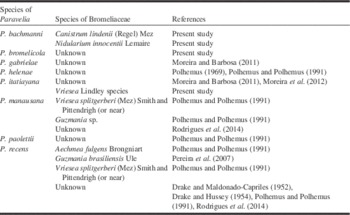
Among the aquatic Heteroptera, the habit of living inside bromeliads is so far known only for some Neotropical species of the genera Microvelia Westwood (Veliidae) and Paravelia, although according to Polhemus and Polhemus (Reference Polhemus and Polhemus1991) some species of Corixidae can occasionally also be found in this environment. These authors reviewed the bromeliadicolus veliids, recording four species of Paravelia: P. helenae, P. manausana, P. paolettii, and P. recens, all of them restricted to northern South America at that time. The authors mentioned that Paravelia species seem to prefer terrestrial bromeliads, while Microvelia colonises both arboreal and terrestrial bromeliads. However, P. recens can be found in both types of bromeliads and apparently without specificity to host plant, being recorded so far from Vriesea splitgerberi (Mez) Smith and Pittendrigh (or near), Aechmea fulgens Brongniart, and Guzmania brasiliensis Ule (Bromeliaceae).
Paravelia manausana is recorded from Vriesea splitgerberi, Guzmania sp. and has been collected in bromeliads growing on cliffs, where P. helenae can also occur (Polhemus and Polhemus Reference Polhemus and Polhemus1991). Subsequently, Moreira and Barbosa (Reference Moreira and Barbosa2011) described P. gabrielae, another bromeliadicolus species, and recorded this habitat for P. itatiayana for the first time. Both species were recorded from southeastern Brazil, but specific data on the inhabited bromeliads were not mentioned (see Table 1). Despite this interesting habitat, few field observations have been made and little is known about the relationships of the Veliidae with species of bromeliads, and Paravelia species appears to have no specificity with the bromeliad species.
Species of Paravelia (Veliidae) associated with species of bromeliads (Bromeliaceae).

The following characters are shared by the species of the genus associated with bromeliads: (1) posterior angle of pronotum forming a small process, indistinct in some specimens; (2) metafemur of male with a row of spines, usually with one or two spines displaced from the main row; (3) metatibia of male clavate; and (4) paramere with a notch on the dorsal surface near the base. Paravelia bahiana Rodrigues, Moreira, Nieser, Chen, and Melo, despite having the ventral region of the head and abdominal sternites covered with black denticles, also shares the other characters mentioned above. Although the habitat of this species is unknown, it is likely that this is also a bromeliadicolus species.
The current partial division of the genus into two species groups, P. basalis and P. inveruglas, does not reflect a natural evolutionary history, since they were proposed based on typological criteria and one or a few characters only. Another important point to be noted is that some species of Paravelia, such as P. conata (Hungerford), P. bipunctata Rodrigues, and P. virtutis (Drake and Harris), share various characters with Platyvelia brachialis (Stål) (type species of Platyvelia Polhemus and Polhemus), creating doubt concerning the monophyly of the latter genus. Some of these characters are: (1) shape of the forewing apical macula; (2) colour of legs; (3) presence of small black denticles on the inner margin of tibiae and femora; (4) silvery pubescence on intersegmental regions of connexiva; (5) anterior margin of abdominal sternites III–VII with transversal areas without setae; and (6) abdominal sternite VII with posterior margin distinctly concave. Consequently, not only the genus Paravelia should be studied in the context of the evolutionary paradigm, but in fact all Neotropical genera of the subfamily Veliinae.
Acknowledgements
Special thanks are due to Maria Elina Bichuette (LES), for her continuous donations of interesting cave-inhabiting Heteroptera, along with valuable data and images. The authors also thank Carlos Campaner, Marcelo Duarte (MZUSP), Juan Farina (MMLS), and Thomas Henry (NMNH) for providing access to their institutions collections; Josefina Steiner and Anne Zillikens (Universidade Federal de Santa Catarina) for donating part of the specimens from the state of Santa Catarina and providing information about the bromeliads; Frederico F. Salles (Universidade Federal do Espírito Santo) for the opportunity to conduct a field collection in the state of Espírito Santo; Michel P. Valim and Carlos R. F. Brandão (MZUSP) for making available the equipment for capturing the images; and Fabiano F. Albertoni (MZUSP) for collecting and photographing specimens of P. itatiayana; A.L. Camargo, J. E. Gallão, M.E. Bichuette, and P.P. Rizzato for cave photographs; and Instituto Chico Mendes de Conservação da Biodiversidade (ICMBio, license 28992) for collecting permits. Financial support was provided by the Fundação de Amparo à Pesquisa do Estado de São Paulo as scholarship for H.D.D.R. (process number 2013/16654–0) and research support for M.E. Bichuette (process number 2010/08459–4); and Conselho Nacional de desenvolvimento Científico e Tecnológico (3037152011–1) as a grant to M.E. Bichuette. Finally, the manuscript benefited from the comments of two anonymous reviewers.