Implications
Inclusion of glycerol in the diet at a level up to 300 ml/day increased milk yield, milk fat percentage and improved feed efficiency and nutrients digestibility. Moreover, energy status of dairy buffalo was improved as indicated by reduced concentrations of non-esterified fatty acids (NEFAs) and β-hydroxybutyrate (BHBA) in the blood.
Introduction
Early lactation is the most critical nutritional phase of the lactation cycle, and is characterized by marked changes in metabolism to support the initiation of milk synthesis, by reduced feed intake, and negative energy balance. Extensive mobilization of body fat is a key factor in meeting energy demands in early lactation of dairy cows, but may also result in the onset of metabolic disorders. Adding concentrates, as an energy source, led to a decrease in fiber content of the diet and negatively affected rumen cellulolytic bacteria. Due to the difficulty in overcoming the reduction in dry matter intake (DMI), producers often use oral drenches and pastes to provide glucose precursors to prevent ketosis and other metabolic disorders. Glycerol, with its high-energy density, is attractive at the low-price level to substitute other energy sources, such as grains, in early lactation (DeFrain et al., Reference DeFrain, Hippen, Kalscheur and Jardon2004; Wang et al., Reference Wang, Liu, Huo, Yang, Dong, Huang and Guo2009b) or in mid-lactation (Donkin et al., Reference Donkin, Koser, White, Doane and Cecava2009) cows. Glycerol can be converted to glucose in the liver of cattle and can provide energy for cellular metabolism (Goff and Horst, Reference Goff and Horst2001). The increase in biodiesel production has reduced the price of glycerol making it economical to include it as an energy supplement for ruminants (Avila-Stagno et al., Reference Avila-Stagno, Chaves, He, Harstad, Beauchemin, McGinn and McAllister2013). Linke et al. (Reference Linke, DeFrain, Hippen and Jardon2004) estimated the energy value of glycerol to be ~20% greater than that of corn grain, yielding a net energy for lactation of about 1.06 Mcal/kg.
Glycerol has been recognized as a safe feed additive for use in animal feed by the FDA (2006). It has been included up to 15% in the diet dry matter (DM) for dairy cows without detrimental effects on feed intake, milk yield or milk composition (Donkin et al., Reference Donkin, Koser, White, Doane and Cecava2009). Supplementation of glycerol during the early postpartum period is a strategy that has been recommended to enhance lactation performance of dairy cows in early lactation. Several studies have focused on feeding of glycerol as a supplement rather than as a major feed ingredient to improve energy balance of dairy cows during the transition period (DeFrain et al., Reference DeFrain, Hippen, Kalscheur and Jardon2004; Clariget et al., Reference Clariget, Román, Karlen, Álvarez-Oxiley, López-Mazz and Pérez-Clariget2016), early lactation (Wang et al., Reference Wang, Liu, Huo, Yang, Dong, Huang and Guo2009b; Kass et al., Reference Kass, Ariko, Samaruetel, Ling, Jaakson, Kaart, Arney, Kaert and Ots2013) or mid-lactation (Kass et al., Reference Kass, Ariko, Kaart, Rihma, Ots, Arney and Kaert2012) to enhance milk production. However, there has been little research conducted on the use of glycerol in dairy buffaloes in early lactation. This study hypothesized that inclusion of glycerol in early lactation of dairy buffalo diets will improve energy balance, and thus could improve lactation performance, nutrients digestibility and production efficiency. The objectives of this study were to investigate the effects of feeding diets supplemented with different levels of glycerol on feed intake, milk production and components, diet digestibility and some blood metabolites of dairy buffaloes in early lactation.
Material and methods
This study was conducted at the dairy farm of the Animal and Poultry Production Department, Faculty of Agriculture, South Valley University, Qena, Egypt, during the months of January through March 2016. Care and handling of the animals and sample collection were approved by the South Valley University Animal Care and Use Committee.
Animals and experimental diets
A total of 24 (n=10 primiparous; n=14 multiparous) early lactation Egyptian buffaloes averaging 8.17±0.31 kg/day milk, 17.50±1.03 days in milk, 2.1±0.2 lactations, 552±11 kg BW and 2.54±0.21 body condition score (BCS) at the initiation of the experiment were used. Animals were housed in individual covered pens with a concrete floor throughout the experiment and had free access to water. Buffaloes were blocked by average daily milk yield, BW and parity, and then randomly assigned to one of the three experimental treatments: control (CON) without supplemental glycerol; low glycerol (LG): control plus glycerol at 150 ml/day per buffalo; and high glycerol (HG): control plus glycerol at 300 ml/day per buffalo. The CON consisted of fresh alfalfa, concentrate mixture and rice straw. Two weeks before the initiation of the experiment, each animal was adapted to the CON. The experimental period lasted for 60 days.
The diet was prepared and fed individually once daily at 0900 h to allow 5% to 10% feed refusals. The experimental diets were formulated to meet or exceed energy requirements according to NRC (2001). Amount of feed intake and orts were recorded daily. Feed intake was calculated from the difference between the amount of offered feed and the amount of refused feed. Each dietary ingredient was weighed individually and fed separately. The amount of concentrate mixture fed was 5.27 kg/day for primiparous and 6.27 kg/day for multiparous buffaloes, whereas alfalfa and rice straw were fed ad libitum intake. The glycerol did not replace any dietary ingredient, but was supplemented to the diet and mixed by hand with the concentrate at the time of feeding. According to the supplier (Al-Gomhuria Company, Al-Gomhuria St, Asyut, Egypt), the glycerol supplement contained 0.5% to 1% water, ⩽0.1% ash and no methanol.
Body weight and body condition score
Body weight and BCS were recorded at the beginning, the middle and the end of the experimental period on 2 consecutive days after the morning milking and before feeding. The BCS was scored by the same evaluator during the entire experimental period, with a five-point scale system proposed by Edmonson et al. (Reference Edmonson, Lean, Weaver, Farver and Webster1989).
Diets samples
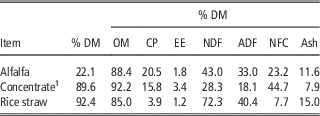
Representative samples of alfalfa, concentrate and straw were collected on a weekly basis and composited by month. Alfalfa samples were stored at −20°C until dried. All samples were ground in a Wiley mill (Thomas Scientific, Swedesboro, NJ, USA) to pass through a 1-mm sieve. Dry matter, ether extract (EE) and ash were determined according to the procedure outlined in AOAC (1990). Total N was determined using the Kjeldahl procedure with an automated, colorimetric quantification of ammonia in digested samples (AOAC, 1990) and multiplied by 6.25 to estimate CP. Neutral detergent fiber and ADF were determined according to Van Soest et al. (Reference Van Soest, Robertson and Lewis1991). Non-fiber carbohydrate (NFC) was calculated according to the equation: NFC=100−(CP+EE+NDF+ash). Chemical analyses of the dietary ingredients are reported in Table 1.
Chemical composition (% on DM) of dietary ingredients

OM=organic matter; EE=ether extract; NFC=non-fiber carbohydrate.
1 Concentrate mixture contains: 40.0% yellow corn, 25.0% wheat bran, 17.0% cottonseed meal, 10.0% soybean meal, 5.0% molasses, 2.0% calcium carbonate, 1.0% sodium chloride.
Digestibility study
At the end of the lactation trial, feces were collected from five buffaloes from each treatment group to conduct a digestion trial. During the digestion trial of 7 days, fecal samples were taken at 12-h intervals directly by hand from the rectum. Samples were weighed and mixed thoroughly by hand. Subsamples of 10% were frozen at −18°C until being composited for the complete collection period. Representative samples of feed, orts and feces were pre-dried in a ventilated oven at 60°C to 70°C for 48 h and ground through a 1-mm mill screen. Digestibility coefficients of DM, organic matter (OM), CP, EE, NDF, ADF and NFC were determined using acid insoluble ash as natural marker according to Van Keulen and Young (Reference Van Keulen and Young1977). Metabolizable energy was calculated as follows: ME (Mcal/kg)=1.011×digestible energy (DE) (Mcal/kg)−0.45 (NRC, 2001).
Milk samples
Each buffalo was milked twice daily at 0500 and 1800 h. Daily milk yield was recorded individually at each milking time during the entire experimental period. Milk samples were obtained individually at the beginning, the middle and the end of the experimental period on 2 consecutive days. Samples were mixed and composited in equal volumes for each buffalo on each sampling day. Composite samples were preserved with sodium azide for analysis of fat, protein, lactose and milk urea nitrogen (MUN) using an infrared spectrometer Milko-Scan (Model 133B®; N. Foss Electric, Hillerød, Denmark). Milk somatic cells were counted using a somatic cell counter (Somacount 150®; Bentley Instrument Inc. Minnesota, MN, USA). Solids-not-fat (SNFs) and total solids (TSs) were also calculated. Fat-corrected milk (FCM) (3.5%) was calculated according to the following equation (Parekh, Reference Parekh1986):
 $${\rm FCM}\left\,( {{\rm kg}/{\rm day}} \right)\,{\equals}\,0.35{\times}{\rm kg}\,{\rm milk}{\plus}18.57{\times}{\rm kg}\,{\rm fat}$$
Blood samples
Blood samples (10 ml) from each buffalo were collected from the jugular vein at the beginning, the middle and the end of the experimental period after the morning milking and before the morning feeding. One sample was collected in tubes with no additives for total protein, albumin, NEFA and BHBA determination, whereas a second sample was collected in tubes containing 5 mg of sodium fluoride and 4 mg of potassium oxalate for glucose determination. Immediately after collection, samples were placed into ice and brought to the laboratory where they were processed on the same day. Samples were centrifuged at 2500× g for 15 min at 4°C to separate serum and plasma, and then frozen at −20°C until further analysis using commercial kits. Serum total protein and albumin were determined according to Kaplan and Szalbo (Reference Kaplan and Szalbo1983) and Doumas et al. (Reference Doumas, Watson and Biggs1971), respectively. Globulin was calculated by difference between total protein and albumin. Plasma glucose was measured using a kit (Cayman Chemical Company, Ann Arbor, MI, USA) according to the procedure outlined by Trinder (Reference Trinder1969), serum BHBA using an enzymatic assay kit (Ranbut D-3-hydroxybutyrate, Randox, Crumlin Co., Antrim, UK) as modified by Williamson et al. (Reference Williamson, Mellanby and Krebs1962) and serum NEFA using (Wako Fine Chemical Industries USA, Inc., Dallas, TX, USA) as modified by Johnson and Peters (Reference Johnson and Peters1993).
Statistical analyses
All data were analyzed as a complete randomized design using the PROC MIXED procedure of SAS (2005). The statistical model was:
 $$Y_{{ijk}} \,{\equals}\,\mu {\plus}T_{i} {\plus}C_{j} {\plus}W_{k} {\plus}E_{{ijk}} $$
where Y ijk is the dependent variable, µ the overall mean, T i the fixed effect of treatments (i=1, 2 and 3), C j the random effect of buffaloes within treatment, W k is the repeated effect of week (k=1, 2, 3, … 9) and E ijk the residual error. Results are presented as least square means±SEM. Differences between treatment means were evaluated using orthogonal contrasts as follows (1) CON v. GLY (LG and HG) and (2) LG v. HG. Differences were considered significant when P⩽0.05 and tendencies are reported when P>0.05 and ⩽0.10.
Results
Dry matter intake, milk yield and milk composition
Dry matter intake was decreased (P<0.0001) in buffaloes fed both levels of GLY compared with the CON (Table 2). The DMI was lower (P=0.00001) with feeding HG v. LG. Mean BW and BCS were not differing across treatments.
Dry matter intake (DMI), BW, milk yield and milk composition of lactating buffaloes fed control diet or diets supplemented with glycerol

BCS=body condition score; FCM=fat-corrected milk; MUN=milk urea nitrogen; SCC=somatic cell count.
1 Treatments: CON=control diet, LG=CON plus glycerol at 150 ml/day and HG=CON plus glycerol at 300 ml/day.
Buffaloes receiving LG and HG produced more (P<0.01) milk and had a greater (P<0.0001) yield of 3.5% FCM compared with the CON. Buffaloes fed HG had a greater yield of 3.5% FCM (P=0.04) compared with those buffaloes fed LG. Feeding LG and HG treatments tended to increase (P=0.09) milk fat percentage and decreased (P⩽0.05) MUN and somatic cells counts (SCCs) compared with the CON. No differences were found in milk components between GLY and CON treatments. There was a tendency for higher (P⩽0.10) concentrations of milk fat, protein, SNF, TS, MUN and SCC with HG v. LG.
Feeding LG and HG increased (P<0.0001) yield of milk fat, protein, lactose, SNF, and TS when compared with the CON. Feed efficiency (FCM/DMI) was greater (P<0.0001) for buffaloes fed GLY compared with CON and greater (P=0.02) for HG than for LG.
Nutrient digestibility
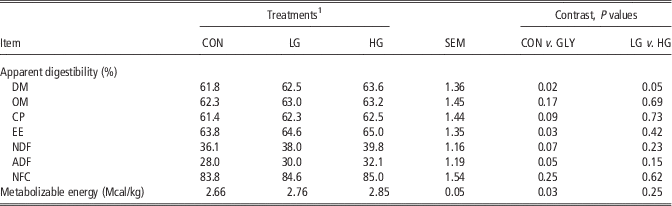
The digestibility and ME of the experimental treatments are presented in Table 3. Feeding LG and HG did not affect (P>0.05) the digestibility of OM and NFC, whereas digestibility of DM (P=0.02), CP (P=0.09), EE (P=0.03), NDF (P=0.07) and ADF (P=0.03) were improved. With the exception of DM digestibility (P=0.05), there were no differences in OM, CP, EE, NDF, ADF and NFC digestibility between both levels of GLY. The ME was greater (P=0.03) for LG and HG treatments compared with CON treatment, but there was no difference between HG and LG.
Effects of glycerol supplementation on nutrient digestibility by lactating dairy buffaloes

OM=organic matter; EE=ether extract; NFC=non-fiber carbohydrate.
1 Treatments: CON=control diet, LG=CON plus glycerol at 150 ml/day and HG=CON plus glycerol at 300 ml/day.
Blood metabolites
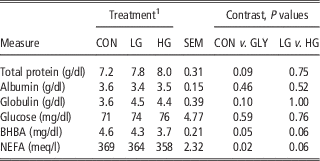
The effect of treatments on blood parameters is presented in Table 4. Serum total protein and globulin concentrations tended to be greater (P⩽0.10) for buffaloes fed LG and HG compared with the CON. Inclusion of GLY did not affect albumin and glucose concentrations when compared with the CON. The glycerol-supplemented buffaloes had reduced (P⩽0.05) concentrations of BHBA and NEFA compared with the CON group. There was a tendency for lower (P=0.06) BHBA and NEFA concentrations with feeding HG v. LG, but there were no differences in the other blood metabolites.
Blood metabolites concentrations of lactating buffaloes fed control diet or diets supplemented with glycerol

BHBA=β-hydroxybutyrate; NEFA=non-esterified fatty acid.
1 Treatments: CON=control diet, LG=CON plus glycerol at 150 ml/day and HG=CON plus glycerol at 300 ml/day.
Discussion
Dry matter intake and body weight changes
The DMI decreased with increasing inclusion of GLY in the diets. According to Orrico Junior et al. (Reference Orrico Junior, Bottini Filho, Vargas Junior, Orrico and Silveira Osório2015) the lower DMI could be related to the chemical satiety due to the increased energy density of the diet or to diet palatability.
In the current study, inclusion of glycerol in the buffalo diets increased energy density of the diet and this could decrease feed intake. Furthermore, Benedeti et al. (Reference Benedeti, Paulino, Marcondes, Maciel, da Silva and Faciola2016) estimated ME of glycerol at 3.64 Mcal/kg, which is 12% greater than the 3.25 Mcal/kg of corn.
Similarly, feeding different amounts of glycerol decreased feed intakes in transition cows (DeFrain et al., Reference DeFrain, Hippen, Kalscheur and Jardon2004; Ogborn, Reference Ogborn2006), in lactating dairy cows (Boyd et al., Reference Boyd, Bernard and West2013), or in finishing steers (Hales et al., Reference Hales, Foote, Brown-Brandl and Freetly2015; Chanjula et al., Reference Chanjula, Raungprim, Yimmongkol, Poonko, Majarune and Maitreejet2016). In contrast, feed intake was not affected when glycerol was included in dairy cow diets (Wang et al., Reference Wang, Liu, Huo, Yang, Dong, Huang and Guo2009b; Omazic et al., Reference Omazic, Traven, Bertilsson and Holtenius2013). On the other hand, feeding glycerol has been reported to increase feed intakes in early lactating cows (Bodarski et al., Reference Bodarski, Wertelecki, Bommer and Gosiewski2005; Kass et al., Reference Kass, Ariko, Samaruetel, Ling, Jaakson, Kaart, Arney, Kaert and Ots2013) and in mid-lactation lactating cow (Kass et al., Reference Kass, Ariko, Kaart, Rihma, Ots, Arney and Kaert2012). The non-consistent effects of feeding glycerol on feed intake can be explained by differences in purity and amount of glycerol added, as well as by the concentrate to roughage ratio in the diet (Chung et al., Reference Chung, Rico, Martinez, Cassidy, Noirot, Ames and Varga2007; Wang et al., Reference Wang, Liu, Huo, Yang, Dong, Huang and Guo2009b; Omazic et al., Reference Omazic, Traven, Bertilsson and Holtenius2013).
Average BW or BCS did not differ between dietary treatments. This finding agrees with previous studies with dairy cows in early lactation (DeFrain et al., Reference DeFrain, Hippen, Kalscheur and Jardon2004; Chung et al., Reference Chung, Rico, Martinez, Cassidy, Noirot, Ames and Varga2007; Kass et al., Reference Kass, Ariko, Samaruetel, Ling, Jaakson, Kaart, Arney, Kaert and Ots2013). Although other studies reported an increase in BW with increasing amount of glycerol in dairy cow diets (Donkin et al., Reference Donkin, Koser, White, Doane and Cecava2009; Wang et al., Reference Wang, Liu, Huo, Yang, Dong, Huang and Guo2009b). Clariget et al. (Reference Clariget, Román, Karlen, Álvarez-Oxiley, López-Mazz and Pérez-Clariget2016) reported that BCS was not affected and BW was increased with glycerol supplementation.
Milk yield, milk composition and feed efficiency
The greater milk yield in glycerol-supplemented buffaloes may be explained by improved nutrients digestibility and greater energy intake (Wang et al., Reference Wang, Liu, Yang, Huo, Dong, Huang, Yang and He2009a; Clariget et al., Reference Clariget, Román, Karlen, Álvarez-Oxiley, López-Mazz and Pérez-Clariget2016). Increased milk yield has been reported in cows receiving oral drenching of 500 ml/day of glycerol for 3 weeks of lactation (Kass et al., Reference Kass, Ariko, Samaruetel, Ling, Jaakson, Kaart, Arney, Kaert and Ots2013), in cows fed 300 and 500 ml/day of glycerol for 10 weeks of lactation (Bodarski et al., Reference Bodarski, Wertelecki, Bommer and Gosiewski2005), in cows fed 450 g/day of glycerol during 3 weeks postpartum (Lomander et al., Reference Lomander, Frossling, Ingvartsen, Gustafsson and Svensson2012), or in cows fed 0.5 kg/day of refined glycerol during the first 4 weeks of lactation (Omazic et al., Reference Omazic, Traven, Bertilsson and Holtenius2013). Similarly, Goff and Horst (Reference Goff and Horst2001) observed that administrating up to 3 l glycerol/day increased milk yield. Clariget et al. (Reference Clariget, Román, Karlen, Álvarez-Oxiley, López-Mazz and Pérez-Clariget2016) reported that milk yield was increased when cows were fed diets supplemented with whole rice bran and glycerol compared with the control. In contrast, other studies have reported no effect of glycerol on milk yield (Ogborn, Reference Ogborn2006; Chung et al., Reference Chung, Rico, Martinez, Cassidy, Noirot, Ames and Varga2007; Wang et al., Reference Wang, Liu, Huo, Yang, Dong, Huang and Guo2009b). DeFrain et al. (Reference DeFrain, Hippen, Kalscheur and Jardon2004) observed a tendency for decreased milk yield with glycerol supplementation. In some of these studies, glycerol replaced concentrate in the diets, whereas in the current study and in the studies of Lomander et al. (Reference Lomander, Frossling, Ingvartsen, Gustafsson and Svensson2012) and Kass et al. (Reference Kass, Ariko, Samaruetel, Ling, Jaakson, Kaart, Arney, Kaert and Ots2013) glycerol was supplemented to the concentrate.
In the present study, the tendency for increased milk fat concentration in glycerol-supplemented buffaloes could be attributed to improved fiber digestibility. However, other studies reported a decrease in milk fat percentage and yield with glycerol supplementation (DeFrain et al., Reference DeFrain, Hippen, Kalscheur and Jardon2004; Wang et al., Reference Wang, Liu, Huo, Yang, Dong, Huang and Guo2009b; Boyd et al., Reference Boyd, Bernard and West2013). Ogborn (Reference Ogborn2006) reported that milk fat concentration and yield and true protein were not affected by feeding glycerol.
Reduced MUN concentrations with GLY supplementation are consistent with other studies (DeFrain et al., Reference DeFrain, Hippen, Kalscheur and Jardon2004; Kass et al., Reference Kass, Ariko, Samaruetel, Ling, Jaakson, Kaart, Arney, Kaert and Ots2013) in which glycerol were fed to early lactation dairy cows. The greater MUN for CON may be due to higher DMI and therefore more dietary protein compared with buffaloes fed LG and HG. It is likely that glycerol supplied more energy to the rumen microorganisms, which resulted in higher microbial protein synthesis and more efficient use of nitrogen in the rumen (Kass et al., Reference Kass, Ariko, Samaruetel, Ling, Jaakson, Kaart, Arney, Kaert and Ots2013).
With the exception of milk fat and MUN concentrations, there was no effect of glycerol on the other milk components. Similarly, several studies have reported no effects of glycerol on milk composition (DeFrain et al., Reference DeFrain, Hippen, Kalscheur and Jardon2004; Ogborn, Reference Ogborn2006; Chung et al., Reference Chung, Rico, Martinez, Cassidy, Noirot, Ames and Varga2007). Moreover, Chung et al. (Reference Chung, Rico, Martinez, Cassidy, Noirot, Ames and Varga2007) found that milk composition was not significantly affected when Holstein dairy cows were fed 250 g/day dry glycerol as a part of total mixed ration from parturition to 21 days in milk. Likely due to increased milk yield, yields of milk fat, protein, lactose, SNF and TS were increased with increasing amount of glycerol in the diet.
The better feed efficiency with both levels of GLY could be attributed to reduced DMI and increased milk yield. Furthermore, glycerol-supplemented buffaloes showed a positive energy balance indicated by reduced concentrations of serum NEFA and BHBA. Similarly, Linke et al. (Reference Linke, DeFrain, Hippen and Jardon2004) observed an improvement in feed efficiency with ratios of 1.46, 1.59 and 1.60 kg milk/kg DMI when mid-lactation Holstein cows were fed diets supplemented with glycerol at levels of 0, 498 and 998 g/day, respectively. Furthermore, Chung et al. (Reference Chung, Rico, Martinez, Cassidy, Noirot, Ames and Varga2007) observed a tendency for better efficiency for converting feed into milk for glycerol-supplemented cows during week 6 of lactation.
Digestibility study
Improvement of the digestibilities of DM, NDF and ADF with glycerol inclusion could be due to improved ruminal degradation (Wang et al., Reference Wang, Liu, Yang, Huo, Dong, Huang, Yang and He2009a). This latter reported that inclusion of glycerol in steer forage diets at levels of 100, 200 and 300 g/day improved (P⩽0.01) DM, OM, CP, ADF, NDF and EE digestibility. Recently, Benedeti et al. (Reference Benedeti, Paulino, Marcondes, Maciel, da Silva and Faciola2016) reported that DM digestibility increased quadratically with increasing of glycerol in the diet of finishing beef bulls. Hales et al. (Reference Hales, Foote, Brown-Brandl and Freetly2015) observed that DM digestibility was increased with glycerol inclusion at 0%, 5%, 10% and 15% (as DM) for finishing beef steers with no change in OM digestibility. Chanjula et al. (Reference Chanjula, Pakdeechanuan and Wattanasit2014) reported that DM, OM, CP and EE digestibility was greater in glycerol fed groups compared with the control group, but the difference was not significant. Donkin et al. (Reference Donkin, Koser, White, Doane and Cecava2009) reported that DM, OM and CP digestibility was improved when mid-lactation Holstein cows were fed diets supplemented with glycerol at levels of 50, 100 and 150 g/kg when compared with control diet. In contrast, Boyd et al. (Reference Boyd, Bernard and West2013) reported no effects on nutrient digestibility of DM and CP when lactating cows were fed diets supplemented with glycerol up to 400 g/day. The varying effect of glycerol in nutrient digestibility may be due to the purity and amount of glycerol included in the diet.
Blood metabolites
A tendency for increased serum total protein and globulin with GLY supplementation was found in the current study, whereas Clariget et al. (Reference Clariget, Román, Karlen, Álvarez-Oxiley, López-Mazz and Pérez-Clariget2016) reported that supplementation of glycerol did not affect plasma concentrations of total protein and albumin compared with control diet. Plasma glucose concentrations were unaffected by inclusion of both levels of GLY in the diets. Similar results were previously reported, where glycerol was top-dressed on the total mixed rations (Chung et al., Reference Chung, Rico, Martinez, Cassidy, Noirot, Ames and Varga2007) or provided by oral drenching (Ogborn, Reference Ogborn2006). Moreover, plasma glucose concentrations were not different with inclusion of glycerol in transition cows (Chung et al., Reference Chung, Rico, Martinez, Cassidy, Noirot, Ames and Varga2007), postpartum dairy cows (DeFrain et al., Reference DeFrain, Hippen, Kalscheur and Jardon2004), or mid-lactating cows diets (Kass et al., Reference Kass, Ariko, Kaart, Rihma, Ots, Arney and Kaert2012).
The energy status of early lactating dairy cows can be monitored indirectly by the concentrations of NEFA, BHBA and glucose in blood (Herdt, Reference Herdt2000), and BCS (Edmonson et al., Reference Edmonson, Lean, Weaver, Farver and Webster1989). It was hypothesized that glycerol supplementation increased energy density in the diet and reduced NEFA in the blood. With increased energy availability, the cows would be at less risk of energy deficiency (Kass et al., Reference Kass, Ariko, Kaart, Rihma, Ots, Arney and Kaert2012). In the present study, concentrations of serum NEFA and BHBA were decreased, while blood glucose concentration and BCS were not changed with increasing amount of glycerol in the diet, indicating that the energy status of dairy buffaloes was improved by GLY inclusion. Similarly, Chung et al. (Reference Chung, Rico, Martinez, Cassidy, Noirot, Ames and Varga2007) reported that glycerol-supplemented cows experienced a more positive energy status indicated by reduced concentrations of plasma BHBA and urine ketones during the second week of lactation. Wang et al. (Reference Wang, Liu, Huo, Yang, Dong, Huang and Guo2009b) reported that increasing glycerol supplementation in the diets improved energy balance of the cows as indicated by increased concentrations of plasma glucose and reduced concentrations of plasma BHBA. The decrease of serum concentration of NEFA with glycerol inclusion was found in early lactation (Bodarski et al., Reference Bodarski, Wertelecki, Bommer and Gosiewski2005; Wang et al., Reference Wang, Liu, Huo, Yang, Dong, Huang and Guo2009b), in mid-lactation (kass et al., Reference Kass, Ariko, Kaart, Rihma, Ots, Arney and Kaert2012) and in transition (Clariget et al., Reference Clariget, Román, Karlen, Álvarez-Oxiley, López-Mazz and Pérez-Clariget2016) cows, indicating decreased body fat mobilization and small reductions in BW (Wang et al., Reference Wang, Liu, Huo, Yang, Dong, Huang and Guo2009b). Similarly, feeding glycerol over a longer period has been found to reduce the blood concentration of BHBA in early lactation (Bodarski et al., Reference Bodarski, Wertelecki, Bommer and Gosiewski2005; Wang et al., Reference Wang, Liu, Huo, Yang, Dong, Huang and Guo2009b) and transition (Chung et al., Reference Chung, Rico, Martinez, Cassidy, Noirot, Ames and Varga2007) cows. In contrast, plasma NEFA and BHBA concentrations were not affected by glycerol supplementation (Ogborn, Reference Ogborn2006; Chung et al., Reference Chung, Rico, Martinez, Cassidy, Noirot, Ames and Varga2007; Kass et al., Reference Kass, Ariko, Samaruetel, Ling, Jaakson, Kaart, Arney, Kaert and Ots2013).
Acknowledgments
The authors would like to express their most sincere gratitude and appreciation to the staff at the Animal and Poultry Production Department, Faculty of Agriculture, South Valley University Dairy Farm Unite, Qena, Egypt for their assistance with animal care and sample collection.