Implications
The use of chemicals to control nematode parasites in sheep production is not sustainable due to parasite resistance to chemical treatment and consumer preference for chemical-free animal products. Breeding sheep to be naturally resistant to parasites is a long-term and sustainable solution. This paper reports the benefits of parasite-resistant sheep in Australia. Infective larvae on pasture are greatly reduced by the presence of resistant ewes during lactation. This should lead to increased growth rates in lambs and less re-infection, affecting the epidemiology of the parasite. These results should encourage farmers to select for parasite resistance and reduce reliance on chemicals.
Introduction
Breeding sheep for resistance to internal parasites appears to be a long-term and sustainable solution to the onset of nematode resistance to anthelmintic treatment (Karlsson and Greeff, Reference Karlsson and Greeff2006). Young lambs from populations with low resistance to parasites are most susceptible to nematode infection as they do not acquire effective immunity before 6 to 12 months of age (Stear et al., Reference Stear, Strain and Bishop1999). Greeff and Karlsson (Reference Greeff and Karlsson2006) have shown that lambs born to resistant ewes are up to 22% heavier at weaning than lambs born to unselected ewes. This suggests that infective nematode larvae on pasture during and after lactation are reduced by the presence of resistant ewes.
Sheep display considerable variation in their ability to mount an effective immune response to nematode parasitism, and it has been established that this variation has a genetic basis (Albers et al., Reference Albers, Gray, Piper, Barker, Le Jambre and Barger1987). Sheep can be bred successfully for worm resistance using faecal worm egg counts (WEC) as an indicator trait (Woolaston et al., Reference Woolaston, Barger and Piper1990; Morris et al., Reference Morris, Bisset, Vlassoff, West and Wheeler1998; Karlsson and Greeff, Reference Karlsson and Greeff2006). Bishop and Stear (Reference Bishop and Stear2003) have modelled the epidemiology of nematode parasites in flocks of both unselected and resistant sheep. They have predicted that selection for low faecal egg counts will decrease pasture contamination and, consequently, reduce the population of the parasite over several years.
Ewes are a major source of pasture contamination during peri-parturition because they have a diminished immune response during this time (Barger, Reference Barger1993). This is probably because the ewes have an imbalance of nutrient supply and demand brought about by increased partitioning to the foetus and mammary gland (Kahn, Reference Kahn2003). This has important consequences because newborn lambs, with no acquired immunity, are exposed to an increased level of infective larvae on pasture, which compromises their growth and development.
Bisset et al. (Reference Bisset, Vlassoff, West and Morrison1997) have demonstrated that there are lower numbers of infective larvae on pastures grazed by sheep selected for worm resistance, compared to unselected sheep, during the post-weaning period. Woolaston (Reference Woolaston1992) and Kahn et al. (Reference Kahn, Knox, Walkden-Brown and Lea2003) have shown that sheep selected for low WEC have a lower WEC compared to unselected sheep during lactation, when faced with a nematode challenge consisting mainly of Haemonchus contortus. The contamination of pastures by resistant sheep following parturition and lactation has been modelled but never quantified.
Our objective was to investigate the pattern of faecal egg counts in worm-resistant and unselected Merino ewes on separate pastures during late pregnancy and lactation when faced with a natural parasite challenge, predominately Trichostrongylus colubriformis and Teladorsagia circumcincta. We also quantified pasture contamination before and after lactation in these two lines. More specifically, we tested the hypotheses that WEC would be lower in resistant sheep at all stages of lactation and there would be lower pasture contamination, after lactation, on those pastures grazed by resistant sheep.
Material and methods
Experimental design
Two lines of mature Merino ewes, one bred for low WEC, and one unselected control line, were run separately in six plots, with three replicates of each line. The plots had been grazed by the same two lines of sheep for three years prior to the current experiment. Faecal samples were taken randomly from 10 to 15 ewes from each plot at three 10-day intervals prior to lambing. After lambing, faecal samples were taken randomly from 10 to 15 ewes from each plot at four 7-day intervals. Worm egg counts were performed on all faecal samples. A representative pasture sample from each plot was taken before lambing and again 7 weeks after lambing. Pasture samples were analysed for numbers of infective strongyle larvae.
Location and animals
The experiment was conducted at the Mt Barker research station owned by the Department of Agriculture and Food Western Australia (Latitude 34°62′ S and longitude 117°63′ E). Mt Barker is characterised by a Mediterranean, winter rainfall climate with mean temperatures ranging from 26.1°C in January to 14.3°C in July, and mean monthly rainfall ranging from 23.2 mm in January to 105.4 mm in July.
The sheep were from the worm-resistant Rylington Merino (RM) line, started by the Department of Agriculture and Food Western Australia in 1987. Sheep are selected for parasite resistance on the basis of BLUP-estimated breeding values for WEC taken at 12 months of age (Karlsson and Greeff, Reference Karlsson and Greeff2006). This trial was started as an economic evaluation flock, to determine economic benefits of worm-resistant sheep when grazed separately from unselected sheep. Ewes were divided into six mobs, three resistant and three unselected, each consisting of 50 ewes and grazed separately for their entire lives. Two rams were mated to each mob in early February. Control rams were selected randomly from the unselected RM control line and mated to control ewes, while resistant rams from the RM selection line were mated to the resistant groups. Lambs were born in July/August, weaned in October and moved to separate plots with their corresponding lambing paddocks. Female sheep from the previous years of lambing were moved from these plots back to the lambing paddocks to act as replacement daughters, with the oldest ewes being culled to maintain an even age structure across all groups and to prevent any cross-contamination between groups. As the same plots were used each year, differences in larval contamination were carried over to the next season. Males not used for breeding were sold after completing all measurements.
Faecal sampling
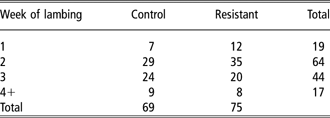
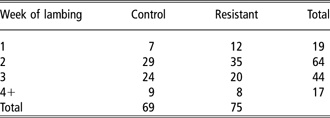
Faecal samples were taken from animals on each plot at three 10-day intervals before lambing commenced. Lambing started on 10 July 2005 and spanned a 5-week period (Table 1). After lambing commenced, faecal samples were collected from animals on each plot at four 7-day intervals, resulting in seven samples in total from each plot. Between 10 and 15 ewes from each plot were sampled each time, depending on time constraints. Due to the ewes being either pregnant or lactating during the experiment, it was not possible to yard ewes and collect faeces directly from the rectum. Therefore sheep were observed from a distance through binoculars and fresh faeces were obtained after defecation onto the pasture. Ewes were identified by using a number sprayed onto their flank, which corresponded to their tag number. Plots were checked daily for newborn lambs. Upon the birth of lambs, the lambs were weighed and the weight, tag number of the ewe and litter size (single, twin or triplet) was recorded. Thus, it was possible to relate all faecal WECs to the stage of pregnancy or lactation of the ewe, and whether it was carrying a single lamb or twins.
Number of ewes sampled for worm egg counts in the control and resistant selection lines during the experiment, and the week that they lambed
Worm egg counts were performed on all faecal samples using the modified McMaster method (Whitlock, Reference Whitlock1948). Bulk cultures of larvae were performed from the second, fifth and seventh batch of faecal samples in order to indicate the diversity of worm species present before, during and after lambing.
Pasture sampling and measurement of larval contamination
Pasture samples were taken from each plot 1 week before lambing started, and again 7 weeks after lambing commenced. Pasture samples were taken by following a ‘W’-shaped transect across each plot. The sampler walked along the transect, stopping approximately 200 times at equal distances from each site. At each stop, a small amount of grass was plucked from behind, in front, to the left and to the right. This was done to mimic the way an animal grazes, that is, did not consist of roots and soil and did not just consist of the top part of the plant. Approximately 500 g of pasture was collected for each plot.
The number of larvae on the pasture was estimated using a method adapted from Martin et al. (Reference Martin, Beveridge, Pullman and Brown1990). Briefly, larvae were washed off the pasture and allowed to settle in large bins. The sediment was collected and concentrated by further sedimentation steps until a mixture of one part sediment to one part liquid was obtained. Fifty millilitres of this suspension was then added to 25 ml saturated potassium iodide solution (KI : water, 1 : 1). The suspension was centrifuged at 960 × g for 2 min, and then poured through a Buchner funnel containing filter paper. The filter paper was rinsed and the washings collected in a glass tube. The glass tube was then centrifuged at 890 × g for 2 min. The supernatant was drawn down to 5 ml and then 3 ml of iodine added to the sediment. The sediment mixture was transferred to a 10 ml cylinder, the tube was washed out with potassium iodide and added to the cylinder to make a volume of 10 ml. The cylinder was mixed well by inverting and 1 ml was removed from the suspension. This was placed in a counting chamber and the number of larvae visible were counted under a microscope and differentiated to species.
The number of larvae in the pasture samples was expressed per kg dry weight of pasture. The dry weight was determined by drying the pasture samples in an oven for several days and weighing until there was no change in weight.
Statistical analysis
All WEC and pasture larvae data were transformed prior to analysis using a square-root transformation to remove skewness and approximate a normal distribution. Analysis of variance was performed using SAS version 9.1. For all analyses, the P-value for significance was <0.05.
WEC and numbers of larvae on pasture were analysed using a mixed model design to account for repeated measures on each paddock. For all analyses, the random factor in the model was the paddock (nested within selection line) to control for the fact that different ewes were sampled each time. To investigate how the pattern of WEC changed over time, the fixed model consisted of selection line (resistant or control), stage of lactation (defined as the number of weeks pre or post partum, ranging from −5 to +3), year of birth of the ewe (1999 to 2003) and all first-order interactions. To account for lamb mortality, pregnancy status (0, 1 or 2 lambs) and lactation status (0, 1 or 2 lambs) were included as separate fixed effects. Factors found not to be significant were dropped from the final model. Two sets of triplets born in the control line were treated as twins in the analysis (Woolaston, Reference Woolaston1992). To further investigate the effect of litter size on WEC during gestation and lactation, the mean WEC for each sheep over the course of the experiment was analysed as a variate with the selection line and number of lambs (0, 1 or 2) as fixed factors.
To determine if selection line had an effect on the relative proportion of larval species, additional analyses were performed on the results of the larval bulk cultures. For each bulk culture, the mean WEC for each nematode species within the control and resistant selection lines was calculated by multiplying the proportion of that species from the bulk culture by the average WEC of ewes from each selection line during that period. A separate analysis of variance was then conducted for T. circumcincta and T. colubriformis egg counts, with selection line and sampling period as fixed factors.
For analysis of the pasture larvae data, the fixed model consisted of the selection line and sampling period (before or after lambing).
Results
Faecal WECs
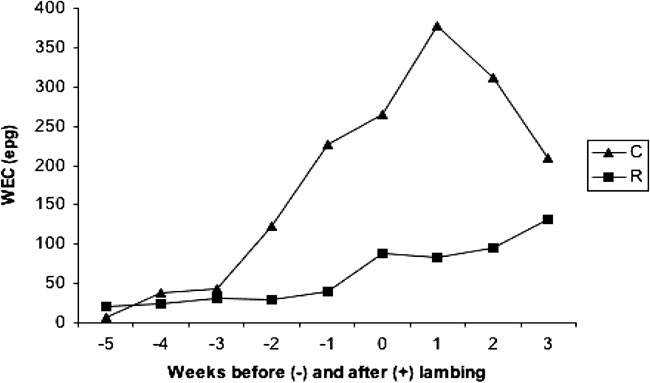
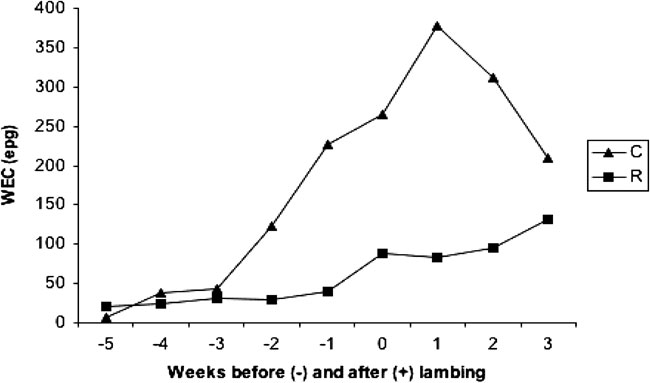
Worm egg counts were significantly lower in the resistant ewes from 1 week pre-partum to 2 weeks post-partum (Figure 1). There was an interaction between line and stage of lactation (P < 0.001), with control ewes displaying a more rapid rise in egg counts during the peri-parturient phase. Between 2 and 3 weeks prior to parturition, there was a sharp increase in the egg counts in the control line. WEC in the resistant ewes did not rise until the week before parturition, and the rise was less pronounced than that of the control ewes.
Mean WEC (worm egg count: eggs per gram of wet faeces) for control (C) and resistant (R) groups during late pregnancy and early lactation. 0 indicates parturition. Mean values are back-transformed.
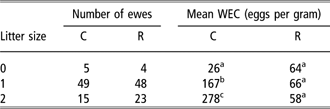
Lamb mortality was low, and had no impact on the effect of litter size on WEC. There was no interaction between pregnancy status and lactation status in the analysis of WECs, which indicates that litter size (0, 1 or 2 lambs) during gestation had the same effects on WECs as did the litter size during lactation. There was an interaction between selection line and litter size on mean faecal WECs (P < 0.05; Table 2). There were no differences in mean WEC over the course of the experiment for resistant ewes with singles, twins or dry. In contrast, control ewes carrying twins had egg counts over 1.5 times higher (P < 0.005) than those carrying singles. Dry control ewes had lower WEC than their pregnant counterparts (P < 0.005). There was no interaction between litter size and stage of lactation on WEC, and year of birth of the ewe did not have a significant effect.
Mean worm egg counts (WEC) (back-transformed means) of ewes throughout experiment classified according to selection line (control (C) or resistant (R)) and litter size (0, 1 or 2)
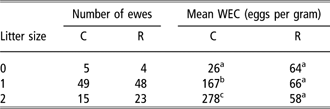
a,b,cValues within WEC columns that have different superscripts are different (P < 0.005).
Larval differentiation
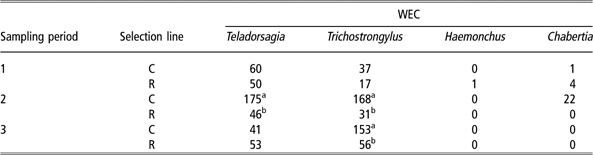
Bulk larval cultures showed that the vast majority of the worms present were T. circumcincta and T. colubriformis (Table 3). In the pre-lambing period, there were no differences between the control and resistant ewes in the numbers of eggs laid by either species. However, during the lambing period resistant ewes had lower (P < 0.05) numbers of both worm species. In the post-lambing period, resistant ewes were still shedding lower numbers of T. colubriformis eggs than control ewes (P < 0.05), but there were no differences in the numbers of T. circumcincta.
Mean worm egg counts (WEC) (back-transformed), of each nematode species in control (C) and resistant (R) ewes, during the pre-lambing period (1), during lambing (2) and in the post-lambing period (3)
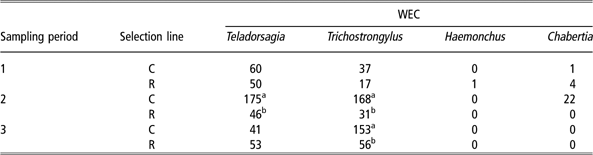
a,bWithin each sampling period, different superscripts between the control and resistant ewes indicate different values (P < 0.05).
WEC for each species were calculated by multiplying the proportion of each species, determined by larval bulk culture, by the mean WEC of ewes from each selection line during that period.
Pasture larvae counts
Total larvae numbers were higher (P < 0.05) in the post-lambing period than the pre-lambing period for both resistant and control ewes, and in both periods there were fewer total larvae on pastures grazed by resistant ewes (P < 0.05; Table 4). There was no difference in the number of T. circumcincta larvae on pastures grazed by either resistant or control ewes in either period. There were no differences in numbers of T. colubriformis larvae on pastures grazed by either resistant or control ewes in the pre-lambing period. In the post-lambing period, there were more than four times as many numbers of T. colubriformis larvae on pastures grazed by control ewes (P < 0.05).
Contribution of different nematode species to total larvae on pasture for control (C) and resistant (R) ewes, at period 1 (pre-lambing) and period 2 (post-lambing)

a,b,c,dValues within columns followed by a different superscript are significantly different (P < 0.05).
Back-transformed means are shown.
Discussion
The patterns of faecal egg counts observed during the experimental period demonstrate clearly that sheep selectively bred for worm resistance have lower WEC during late pregnancy and early lactation, which supports our first hypothesis. Our results are consistent with the findings of Woolaston (Reference Woolaston1992), Morris et al. (Reference Morris, Bisset, Vlassoff, West and Wheeler1998) and Kahn et al. (Reference Kahn, Knox, Walkden-Brown and Lea2003) who also observed a similar divergence in peri-parturient WEC for resistant and unselected sheep. The low egg counts observed in the resistant line indicate that anthelmintic treatment would probably have been unnecessary for these ewes throughout the peri-parturient period. The rise in WEC normally observed in late pregnancy and lactation is reported to be due to a relaxation in immunity (Barger, Reference Barger1993; Kahn, Reference Kahn2003). The low egg counts in resistant ewes observed in this experiment suggest that sheep bred for worm resistance are better able to withstand this relaxation.
The hypothesis that pastures grazed by resistant ewes would have lower infective larvae than pastures grazed by control ewes, following lactation, was also supported. The differences in numbers of infective larvae on pastures grazed by resistant and control ewes provides a quantification of the decrease in parasite numbers that occur on pastures grazed by resistant sheep. The peri-parturient phase is the most significant period of pasture larval contamination (Kahn et al., Reference Kahn, Knox, Walkden-Brown and Lea2003) and we have quantified the effect that resistant sheep can have on reducing this larval output. It is interesting to note that there were significant differences in larval contamination between the two selection lines even before the peri-parturient rise in WEC. This is most likely a remnant of the previous years’ effects and demonstrates clearly the long-term benefits of breeding for increased resistance. This reduced contamination is most likely the major reason for the increased growth rates in lambs born to resistant ewes (Greeff and Karlsson, Reference Greeff and Karlsson2006).
Within the selected line of sheep, both single- and twin-bearing ewes were equally affected by the peri-parturient rise, with their egg counts substantially lower than the control line. This suggests that resistant ewes are able to maintain their effective immune response, even when faced with the increased nutritional demands associated with carrying twins. In contrast, twin-bearing ewes in the control line had higher egg counts than single-bearing ewes, which is consistent with previous data (Woolaston, Reference Woolaston1992).
The larval differentiation data suggest that the resistant ewes were better able to resist infection with T. colubriformis than they were in infection with T. circumcincta. In the second bulk culture, during the peak in WECs, resistant ewes had substantially lower egg counts for both worm species. However, in the final bulk culture, T. circumcincta egg output was similar between the two lines, while T. colubriformis output continued to be much lower in the resistant ewes. Consequently, there were no differences in the numbers of infective T. circumcincta larvae on pastures in the post-lambing period, while numbers of T. colubriformis larvae were greatly reduced on the plots grazed by resistant ewes. This suggests that two independent immune mechanisms may be operating towards T. colubriformis and T. circumcincta, such as inhibition of the development of the fourth larval stage in T. circumcincta (Smith, Reference Smith2007) and rapid expulsion of T. colubriformis larvae (McClure et al., Reference McClure, Emery, Wagland and Jones1992). Alternatively, a difference in the effectiveness of the same immune response may explain the difference in resistance to the two species. This theory is supported by our other work with sheep from this resistant flock, where we have found that increased numbers of T. circumcincta establish and become adults compared to T. colubriformis, suggesting that these sheep are more effective at expelling T. colubriformis (Williams et al., Reference Williams, Karlsson, Palmer, Vercoe, Williams, Greeff and Emery2009). Increased levels of inflammatory mediators were found in the small intestine, compared to the abomasum, supporting the concept that there is an increased immune response towards T. colubriformis (Williams et al., Reference Williams, Karlsson, Palmer, Williams, Vercoe, Greeff and Emery2008)
In conclusion, we found that, during late pregnancy and lactation, worm-resistant ewes had significantly lower WEC than unselected control ewes. This led to a significant reduction in total numbers of infective larvae on pastures grazed by resistant ewes. This advantage was maintained in twin-bearing resistant ewes. Resistant sheep are most effective at reducing pasture contamination with T. colubriformis larvae. These results should encourage farmers to include low WEC in their selection indices as the sheep industry strives to reduce its reliance on anthelmintics.
Acknowledgements
The authors are grateful to Drs R. B. Besier and D. G. Palmer for their advice and discussions on this work. Department of Agriculture and Food Western Australia’s technical and laboratory staff at Mt Barker research station and Animal Health Laboratories are also gratefully acknowledged.