Introduction
Japan is situated at the intersection of four large tectonic plates. The energy released from the movement of these plates is responsible for the frequent and sometimes catastrophic earthquakes it has experienced.1 Japan has been able to respond to these disasters because of its well-developed emergency response system, which proved itself during the aftermaths of the Kobe earthquake and the Sarin gas subway attacks.Reference Okumura, Suzuki and Fukuda2-Reference Tanaka5 Despite this success, the need to continually prepare and allocate limited resources remains critical.Reference Catlett, Jenkins and Millin6, Reference Hick, Hanfling and Cantrill7
On March 11, 2011 at 2:46 pm, an earthquake measuring 9.0 on the Richter Scale struck the Japanese Pacific Coast, followed by a large tsunami. These events resulted in >16,000 immediate deaths and 6,000 injuries, and a subsequent internal refugee crisis.1, 8 The damaged infrastructure included a partial meltdown at a nuclear power plant, resulting in further human displacement along with the possibility of radioactive contamination. The focus for this study was not the local effect of the Great East Japan earthquake, but rather the ripple effect in Tokyo, the closest major metropolis, located approximately 290 km from the epicenter of the earthquake. Previous reports on disaster management have detailed how psychiatric trauma can lead to increased patient presentations to emergency departments (EDs).Reference Adler9, Reference Mecocci, Di Iorio and Pezzuto10 To test this hypothesis, the objective of this study was to characterize the demographics and chief complaints of patients, along with resource utilization, in a Japanese ED not immediately adjacent to the 2011 Great East Japan earthquake and tsunami.
Methods
A retrospective chart review was conducted using the records of patients presenting to a Tokyo tertiary care university-based medical center urban ED before and after the disaster. This academic ED treats approximately 20,000 patients per year. This study was approved by the University of Tokyo's Institutional Review Board.
Charts from all patients who presented during the period from twelve days prior through twelve days after the disaster were included in the study. This was accomplished by reviewing the ED's registry and recording all the names and hospital numbers of the patients who had presented. Charts were then obtained from the Chart Room, and data were collected onto preformed data collection sheets and stored in an Excel computer file (Excel for Mac 2011, Version 14.0.2, Microsoft Corporation, Redmond, Washington USA). Abstracted data included gender, age, and total time spent in the ED from check-in until discharge. Utilization of services such as intravenous fluid administration, oxygen, laboratories (blood or urine), ECGs, radiographs, and ultrasound were recorded along with ED final diagnoses, number of medications prescribed per patient, and the number and types of consultation. All charts were reviewed by one author (MS), and 10% were re-analyzed for accuracy; an error rate was reported. Data were compared using 2-tailed t-tests, Fisher's exact tests or rank sum tests. Bonferroni correction was used to adjust for multiple comparisons.
Results
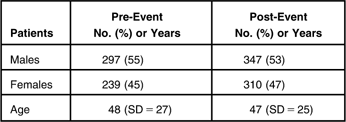
A total of 1,193 patients were evaluated during the period, and all potential study charts were located and reviewed. The error rate for the abstracted data was 3.2% (95% CI, 2.4%-4.1%). Demographics of the patients evaluated before and after the earthquake are presented in Table 1. There was a 23% increase in patient volume following the earthquake that was statistically significant. The total time patients spent in the ED decreased from a mean of 61 minutes to 52 minutes (median decrease from 35 minutes to 32 minutes; P = .005).
Emergency Department Patient Demographics Before and After Event
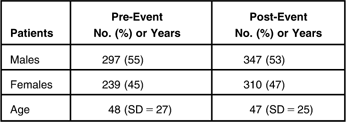
Abbreviations: SD, standard deviation
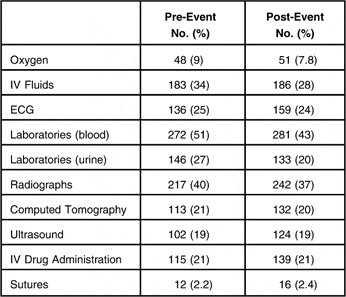
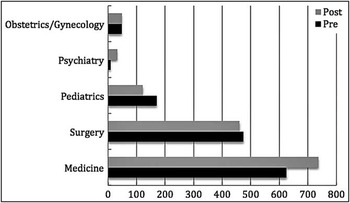
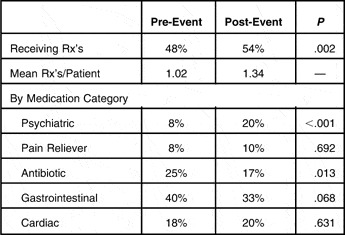
Laboratory utilization for blood or urine specimens decreased from a requirement in 51% of patients to 43% (P = .006). There were no statistically significant changes noted in the number of ECGs, radiographs, or ultrasounds obtained; the use of oxygen; administration of intravenous fluids; administration of intravenous medications; or the placement of sutures (Table 2). According to the ED final diagnosis, there was an increase in the number of patients evaluated for internal medicine and psychiatric complaints (P <.001), but no change was found in the number of patients presenting for surgical, obstetrics or gynecology, or pediatric complaints (Figure 1). The percentage of patients receiving prescriptions while in the ED increased from 48% to 54% (P = .002) (Table 3).
Emergency Department Resource Utilization

Abbreviations: ECG, electrocardiogram; IV, intravenous
Emergency Department evaluation of patient complaints in the period examined before and after the earthquake. Patients could be seen for multiple complaints, so the total number of complaints exceeded the number of patients seen.

Rates of prescriptions (Rx's) written per patient seen in the period examined before and after the earthquake. All data were subject to Fisher's exact test of a contingency table, and Bonferroni adjustment yielded a significance level of P = .01.

Discussion
Given the magnitude of the Great East Japan Earthquake, tsunami and the ensuing internal refugee crisis, Japan's Emergency Medical System was maximally engaged, and most people who were physically affected were treated close to the origin of the disaster.Reference Satomi12-Reference Koyama, Fuse and Hagiwara15 The 9.0 magnitude earthquake was felt throughout the Japanese island of Honshu, but there was relatively little damage, and few deaths were reported in the Tokyo metropolitan area that has an estimated population of 36 million.16 Because of the frequency of earthquakes, most Japanese have participated in earthquake drills while in grade school, but an earthquake of this magnitude could be expected to cause increased anxiety throughout the nation.
Despite the study site being the closest major metropolitan area to the disaster, this study found no change in the number of trauma or acute surgical patients who presented to the ED. It is believed the lack of trauma patients was secondary to a combination of factors, including the distance from the epicenter along with the advanced nature of Japan's EMS system that was able to triage and treat patients closer to the site of injury.Reference Satomi12-Reference Koyama, Fuse and Hagiwara15 Lastly, as a direct result of the tsunami, most of the affected population was killed immediately rather than injured.1, 8
Interestingly, it was found that there was a significant increase in the number of patients seeking ED evaluations, and these were predominantly for medical and psychiatric complaints. It is believed that these patients were of lower acuity in comparison to the time period leading up to the earthquake, and were responsible for the decrease found in the amount of time spent in the ED along with the decrease in laboratory utilization. This concurs with previous reports of emergency services that noted an increase in the need for medical, psychiatric and social services in areas not directly affected by a national disaster.Reference Furukawa, Ootsuki, Kodama and Arai17-Reference Daniels, Chapin and Aspilcueta20 In this case, in addition to the catastrophe associated with the earthquake and tsunami, there was an added stress of possible nuclear contamination that may have led to increased anxiety throughout the Tokyo metropolitan area and the entire island.
Based on this study, it is reasonable to recommend that in preparation for disasters EMS systems need to allocate resources for dealing with the medical, psychological and social needs of the population, in addition to caring for the expected trauma. Further, the study reinforces the fact that the impact of a disaster can be felt in regions geographically remote from the actual disaster site. If not adequately planned for, uncertainty and anxiety can lead to an influx of lower acuity patients, potentially overwhelming the emergency response system.
Limitations
Study limitations included the potential errors associated with retrospective data review. However, recommended strategies to minimize errors were utilized.Reference Gilbert, Lowenstein and Koziol-McLain11 Unavoidable errors were likely introduced, including incomplete medical records and the reliance upon handwritten records. However, all the charts were located, and one author who was taught the basics of abstracting charts abstracted all the charts and then re-reviewed 10% of charts to check for accuracy. The comparison of time periods before and after an event may also offer a skewed view of the data, since there could have been seasonal variation represented in the number of patients seen, although there were no major holidays or events during this period of time.
Conclusions
Immediately following the 2011 Great East Japan Earthquake and tsunami, there was a significant increase in the volume of patients utilizing a Tokyo ED 290 km from the main disaster event. There was an increase in internal medicine and psychiatric evaluations, with decreased laboratory utilization and time spent in the ED. This information may help in the allocation of resources in the planning for natural disasters.
Abbreviations
- ECG:
electrocardiogram
- ED:
emergency department