Six out of 1000 live births have a CHD, making CHD the most common congenital malformation. Reference Hoffman and Kaplan1 Due to significant advances in surgical and intensive care treatment, the survival of children with CHD has increased significantly; therefore, the vast majority reach adulthood nowadays. Reference Hoffman and Kaplan1,Reference Wernovsky2 However, children with CHD who undergo open heart surgery are at increased risk of delayed brain development and brain injury, which can lead to neurodevelopmental impairments Reference Majnemer, Limperopoulos, Shevell, Rohlicek, Rosenblatt and Tchervenkov3–Reference Miller, McQuillen and Hamrick5 such as intellectual impairments, language disorders, behavioural problems, and motor delay. Reference Latal6 The majority of studies reporting motor development and function mainly focused on early infancy and preschool-age. Reference Gaynor, Stopp and Wypij7–Reference Mussatto, Hoffmann and Hoffman9
The literature on motor performance at school-age is limited. Two studies using the Movement Assessment Battery for children reported an increased risk of motor difficulties in 9- and 10-year-old children with CHD. Reference Karl, Hall and Ford10,Reference Holm, Fredriksen, Fosdahl, Olstad and Vøllestad11 A recent systematic review from Bolduc et al Reference Bolduc, Dionne, Gagnon, Rennick, Majnemer and Brossard-Racine12 highlights the increased risk of motor impairments in children and adolescents with CHD. For school-age children, they report a rate of 26.7–46.1% for mild motor impairments (<−1SD) and a rate of 7.5–25.8% for severe motor impairments (<−2SD). For adolescents, these rates were 18.2% and 42.4%, respectively. In addition, motor difficulties are associated with peer relationship and emotional problems in children with CHD. Reference Liamlahi, von Rhein and Bührer13 This emphasised that motor impairments may be linked to behavioural problems, either by causing them or as a comorbidity. However, the findings of the study by Liamlahi et al Reference Liamlahi, von Rhein and Bührer13 were reported for a cohort of children who were born between 1995–1998 and major progress in perioperative care and surgical techniques have since occurred. There is also evidence that school-aged children and adolescents with CHD may have impaired visual–spatial and visual–motor skills, which may correlate with poorer academic achievements. Reference Bellinger, Wypij and duPlessis14,Reference Schaefer, von Rhein and Knirsch15 Different domains of motor performance can be distinguished: timed performance, movement quality, and visuomotor functions. The Zurich Neuromotor Assessment is the only method that quantifies movement quality by assessing contralateral-associated movements, which are defined as involuntary movements in the symmetrical non-active limb that accompany voluntary movements. Reference Jenni, Chaouch and Locatelli16 Associated movements are a marker for neurological and biological maturity in a child Reference Jenni, Caflisch and Latal17 and by that may reflect long-lasting subtle neurological sequelae of neonatal brain injury or altered brain development. So far, only one study demonstrated that in 14-year-old adolescents with CHD, movement quality was significantly impaired. Reference Schaefer, von Rhein and Knirsch15 However, movement quality in younger children has not been reported. Furthermore, little information is available about the correlation of motor performance and visuomotor function in children with CHD.
Therefore, the aim of this study was to quantitatively assess different aspects of motor function (timed performance, movement quality, visuomotor functions) in 10-year-old children with CHD. In addition, we wanted to assess the comorbidity of behavioural problems by using parent-rated questionnaires. Further, neonatal and cardiac risk factors for adverse motor outcome were explored.
Materials and method
Participants
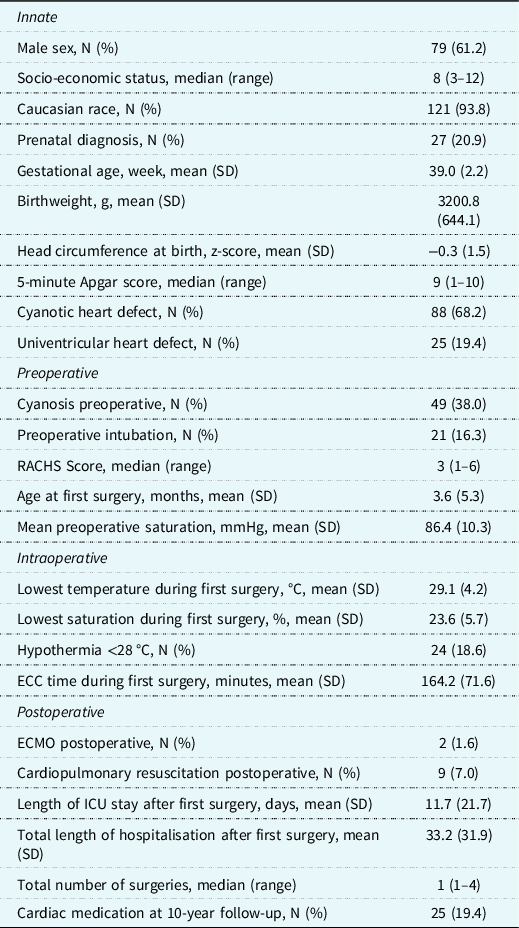
Between July 2004 and July 2009, 300 children with CHD who underwent their first cardiopulmonary bypass surgery at the University Children’s Hospital Zurich were recruited in this cohort study (median age at first surgery 3 months; range <1 month–64 months). Eligible for the study were infants, who were anticipated to undergo their first cardiopulmonary bypass surgery at <6 years of age. Enrolled infants were examined at 1, 4, 6, and 10 years of age. For the 10-year-assessment, children with a genetic or syndromal diagnosis were excluded. Developmental outcomes of this cohort at younger have been reported previously. Reference Gaynor, Stopp and Wypij7,Reference Naef, Wehrle, Rousson and Latal18,Reference Heye, Rousson and Knirsch19 Here, we report the 10-year outcomes of these prospectively enrolled children with various types of CHD. Between the recruitment and the follow-up at 10 years, 27 children died, and 75 children had a diagnosis of a genetic disorder, resulting in a final sample of 198 eligible children for the 10-year follow-up. Of the 198 children, 63 children (32%) were lost to follow-up, therefore 135 children (68%) were assessed of which 129 children completed the neuromotor assessment with the Zurich Neuromotor Assessment. This resulted in a final sample of 129 (65 %) participants (50 females, 79 males) that was included in this analysis. Potential risk factors including birth, intra- and postoperative variables were prospectively extracted from the patients’ records to determine their association with outcomes. Table 1 provides sample characteristics of our cohort of children with CHD. Children who were not examined at ten years or did not complete the neuromotor assessment (n = 69) had a lower prevalence of cyanotic heart diseases (44.9% vs. 68.2%, p = 0.001), compared to those who underwent the assessment (n = 129).
Demographic and cardiac characteristics of children with complex CHD (N = 129)

All pre-, intra- and postoperative variables correspond to the first cardiopulmonary bypass surgery. Data were incomplete for head circumference at birth (missings: N = 19), 5-minute Apgar score (missings: N = 12) and cumulative aortic cross-clamping time (missings: N = 7)
ECC: extracorporeal circulation; ECMO: extracorporeal membrane oxygenation; RACHS Score: Risk adjustment for congenital heart surgery.
The Canton of Zurich Ethics Committee approved the study (KEK-ZH-No.2014-0071). Written informed consent to participation in the study was obtained from all parents.
Outcome assessment
Motor performance was assessed with the Zurich Neuromotor Assessment. This is a standardised test battery developed for the assessment of neuromotor development in children aged 5–18 years. Reference Largo, Fischer and Caflisch20 The Zurich Neuromotor Assessment consists of four timed components (pure motor, adaptive fine motor, adaptive gross motor, and static balance). Reference Largo, Fischer and Caflisch20,Reference Largo, Caflisch and Hug21 For a detailed description of the tasks as well as information on the psychometric properties of the Zurich Neuromotor Assessment, see Supplemental Table S1. Reference Rousson, Gasser, Caflisch and Largo22 Movement quality was scored based on videotape recordings by evaluating the duration (score 0–10) and degree (score 0–3) of contralateral-associated movements. Reference Largo, Fischer and Caflisch20,Reference Largo, Caflisch, Hug, Muggli, Molnar and Molinari23 To ensure interrater reliability, 15 children were examined independently by two trained physicians and comparison of both scorings was used to reach consensus on scoring criteria. Then, a summary component for contralateral-associated movements was created expressing the sum of all contralateral-associated movements for pure and adaptive fine motor tasks. We were able to create a contralateral-associated movements component for 93 children. Reasons for missing overall contralateral-associated movements were unavailability of video recordings (n = 21), insufficient video quality for assessment (n = 2), and incomplete performance of all necessary tasks to create a contralateral-associated movements summary component (n = 13). Timed performance and contralateral-associated movements were expressed as a z-score based on age- and gender-specific normative values. Reference Largo, Fischer and Caflisch20 In order to identify children with motor difficulties, we created a total motor score based on timed performance of each task. We already used a total motor score in a study of 51 children with suspected developmental coordination disorder to describe similarities and dissimilarities between the Movement ABC-2 and the Zurich Neuromotor Assessment. Reference Kakebeeke, Egloff and Caflisch24 We could show that the total motor score could effectively discriminate a group of children with known motor delays from typically developing children. We did not include contralateral-associated movements results in the total motor score because contralateral-associated movements were poor in the majority of the study population and thus did not add a differentiating quality for the formation of two outcome groups. Furthermore, we chose a cut-off below the 10th percentile (z-score of −1.282) for the definition of motor difficulties.
Visuomotor integration, motor coordination, and visuoperceptive skills were assessed with the Beery Test of Visual––Motor Integration, 6th edition. Reference Beery, Beery and Buktenica25 The three sections of the test are visuomotor integration, which consists of 30 drawings that the child has to copy using a pen and a paper, secondly, visual perception, which requires the skill of matching visual shapes in a short time, and thirdly, motor coordination, where the subject has to trace the outline of shapes with a pen without leaving double-lined borders. Reference Beery, Beery and Buktenica25 It is a standardised test where raw scores are converted into age-adjusted standard scores (mean 100, SD 15) with higher scores indicating better performance. Reference Beery, Beery and Buktenica25
To assess child behaviour, the parent-rated Strengths and Difficulties Questionnaire was used (n = 123), which is a valid and reliable screening tool for behavioural problems of children between 3 and 16 years of age. Reference Goodman26 We calculated a total behavioural difficulties score (range, 0–40), an internalising (range, 0–20), and an externalising (range, 0–20) sub-score according to Goodman. Reference Goodman, Lamping and Ploubidis27 The internalising sub-score includes the peer relationship and emotional subscales, and the externalising sub-score includes the hyperactivity and conduct subscales. Reference Goodman26 Higher scores imply more behavioural problems. The scores were then compared against those of a German normative sample. Reference Janitza, Klipker and Hölling28 Further, we created a questionnaire for parents asking them questions on their child’s past and current schooling situation, therapies and educational support, as well as leisure activities and their subjective rating of their child’s motor performance (n = 125). Since there is no validation for the parent-rating of the child’s motor performance in this questionnaire, we only used information on leisure activity and motor therapy at 10 years of age, including physical therapy and occupational therapy.
Prior to cardiac surgery, children underwent a neurologic examination including the assessment of posture, general movements, cranial nerves, tone, muscle reflexes, and reactivity/behaviour. This standardised assessment was modified after Prechtl and Beintema and resulted in a neurological severity score ranging from 0 to 18 with higher scores indicating worse neurologic status. Reference Bertholdt, Latal and Liamlahi29 At 1 year of age, motor function was assessed using the Bayley Scales of Infant Development, 2nd edition, which provides a psychomotor developmental index as the motor component. Reference Bayley30 Socio-economic status was calculated based on both maternal education and paternal occupation (range 2–12, with 12 being the highest socio-economic status). Reference Largo, Pfister, Molinari, Kundu, Lipp and Duc31 Perioperative and demographic data were collected prospectively.
Statistical analysis
All data were analysed using SPSS Statistics Software Version 24 (IBM Corporation, Armonk, NY, USA). Descriptive statistics are presented as the mean (SD), median and ranges, or frequencies. Comparisons with the norm values were made using a one-sample t-test. A chi-square test was used to compare the prevalence of children scoring below the 10th percentile against the expected prevalence of poor motor performance in a normative reference population. Spearman’s rho correlations were carried out to explore associations between all motor-related outcomes, preoperative neurological severity score and the Strengths and Difficulties Questionnaire scores. Group differences were analysed using the independent samples t-test for continuous or chi-square test for dichotomous outcomes. To compare patient characteristics among infants with and without motor difficulties, univariate logistic regression analyses were performed. The association of selected cardiac, neonatal, and potentially risk factors with motor performance was determined by including all risk factors in a multiple linear regression analysis for each specific motor outcome. Potential predictor variables for adverse motor outcome were selected based on the existing literature and availability in our dataset. We excluded predictor variables with low variance and more than 20% missing values. Further, in case of collinearity (r > 0.5), one of the collinear variables was also excluded. Thus, the following factors were included as independent variables: gestational age, birthweight (corrected for gestational age), univentricular CHD, mean preoperative saturation, age at first cardiopulmonary bypass surgery, lowest perioperative temperature, extracorporeal circulation during the first cardiopulmonary bypass surgery, and length of hospitalisation. All statistical tests were two sided and a p-value of ≤0.05 was considered statistically significant.
Results
Detailed demographic and cardiac characteristics are provided in Table 1. Assessment was performed at a median age of 10 years and 2 months (range, 9 years and 6 months–11 years and 3 months). Our study population consisted of 104 (80.6%) children with biventricular CHD and 25 with univentricular CHD (19.4%). Eighty-eight (68.2%) had a cyanotic heart defect of which the majority was a d-transposition of the great arteries (28.7%).
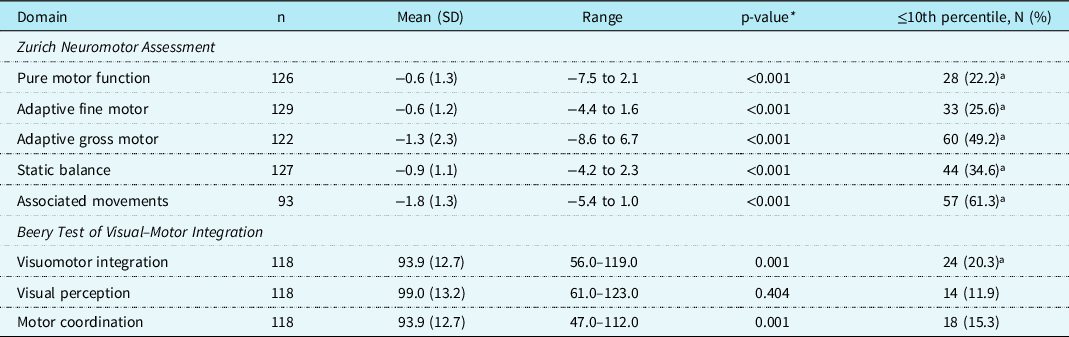
Motor and visuomotor outcomes were significantly lower in children with CHD compared with the reference population in all tested domains except for visual perception (Table 2). The lowest performance was found in the contralateral-associated movements component. Among timed motor components, adaptive gross motor and static balance were most affected. In the Beery Test, visuomotor integration and motor coordination were most impaired. Sixty-one children (51%) had a total motor score below the 10th percentile. The majority had a poor performance (<10th percentile) in one (31.1%) or two (32.8%) timed components and the most frequently affected domain was adaptive gross motor function.
Motor and visuomotor outcome of children with complex CHD

* Compared with norm values. Significance of differences calculated by t-tests.
ª Significant compared with norm of 10%: chi-square test, p-value < 0.001.
To explore the coexistence of impaired motor performance with visuomotor and behavioural problems, multiple correlation analyses were conducted as shown in Supplemental Table S2, all timed motor components of the Zurich Neuromotor Assessment were significantly correlated with each other, while the contralateral-associated movements showed a low to moderate correlation with pure and adaptive fine motor components. All subtests of the Beery Test of Visual–Motor Integration correlated with each other and all timed motor components of the Zurich Neuromotor Assessment. Importantly, both the Zurich Neuromotor Assessment and the Beery Test of Visual–Motor Integration correlated with the Strengths and Difficulties Questionnaire, in particular, the internalising sub-scores of the Strengths and Difficulties Questionnaire showed a strong correlation with all Zurich Neuromotor Assessment components.
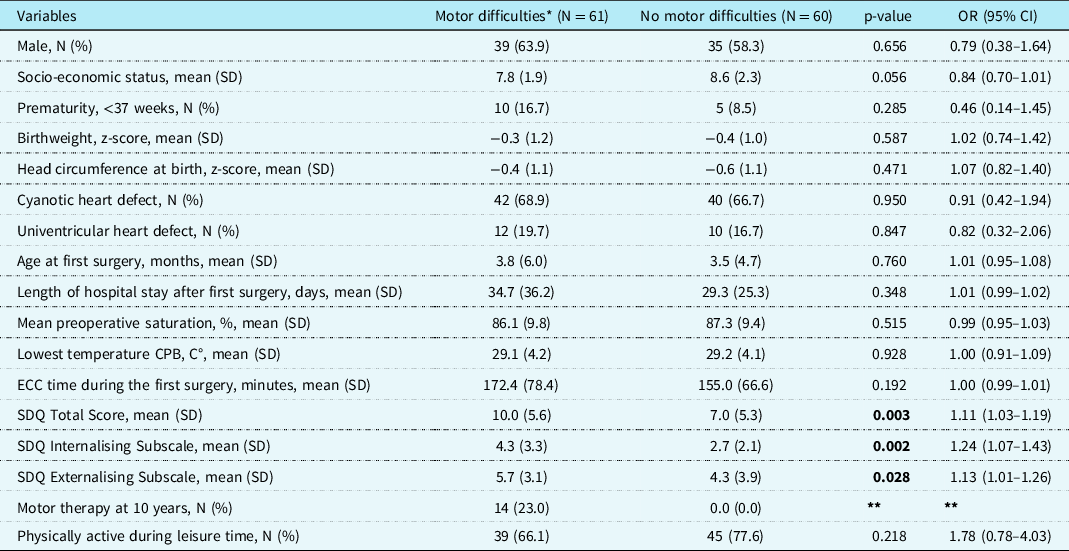
Table 3 presents the characteristics and medical variables for children with and without motor difficulties, defined as total motor score below and or above the 10th percentile respectively. Children with motor difficulties had higher Strengths and Difficulties Questionnaire total score. Of all children, 14% received motor therapy (e.g. physical therapy, occupational therapy) at the 10 years of follow-up. Only children with a total motor score below the 10th percentile received motor therapy. Nevertheless, 62% of the children with a total motor score below the 10th percentile did not have any kind of motor therapy.
Demographic, medical, and parent-reported outcome variables of children with complex CHD in association with motor difficulties (N = 121)

Bold values denote statistical significance.
CPB, cardiopulmonary bypass surgery; SDQ, Strengths and Difficulties Questionnaire.
* Total motor score <10th percentile.
** Due to a n = 0 in the no motor difficulties group, a binary logistic regression could not be calculated.
We also examined neuromotor predictors of motor outcome at 10 years. The Bayley psychomotor developmental index at 1 year correlated with the total motor score at 10 years of age after correcting for gestational age, sex, and univentricular heart defect (ß 0.022, SE 0.010, p = 0.035) while the neurological severity score did not (ß −0.070, SE 0.069, p = 0.308).
We also examined the predictive value of medical risk factors using a multiple linear regression analysis. The model was significant for the pure motor tasks (adjusted R2 = 0.23, p = 0.001) and the adaptive fine motor tasks (adjusted R2 = 0.15, p = 0.040) (see Supplemental Table S3). Gestational age, birthweight, length of hospitalisation, and extracorporeal circulation time were independent predictors of motor tasks.
Discussion
The aim of this study was to quantitatively assess motor performance and visuomotor functions, as well as their association with each other in a cohort of 10-year-old children with CHD. We found that the performance of children with CHD was lower in all motor components compared with the normative reference population. Particular difficulties were detected in adaptive gross motor function, static balance, and movement quality. Pure motor and adaptive fine motor function were less affected. Importantly, also visuomotor integration and motor coordination were affected in children with CHD and impairments in these domains strongly correlated with timed motor performance. The clinical relevance of these findings was evident in a higher rate of motor therapies for children with impaired motor function and a higher rate of mainly internalising but also externalising behavioural problems.
The findings in our cohort are in line with those of Karl et al, Reference Karl, Hall and Ford10 who reported impairments in static balance and in the total motor performance of the Movement Assessment Battery for Children in 9-year-old children with surgically corrected transposition of the great arteries. Nevertheless, and in contrast to our findings, motor performance was still within a normal range. This may be attributed to the fact that Karl et al only included children with a transposition of the great arteries who usually perform better. Also, the Movement Assessment Battery for Children may underestimate motor impairments as shown in Naef et al Reference Naef, Wehrle, Rousson and Latal18 Holm and his group Reference Holm, Fredriksen, Fosdahl, Olstad and Vøllestad11 showed highly significant differences between 10-year-old children with CHD and a control group for the static and dynamic balance assessed with the Movement Assessment Battery for Children. Motor problems were found in 42.5% of children with CHD and in 7.2% of the control group. In adolescents with CHD, gross motor skills and associated movements were the most affected motor domains. Reference Schaefer, von Rhein and Knirsch15
The movement quality determined by contralateral-associated movements was particularly affected in our study population. More than 60% of all children with CHD had contralateral-associated movements below the 10th percentile. Interestingly, a similar result was found in a cohort of 6-year-old children born at very-low-birthweight. In that study, the percentage of children having contralateral-associated movements below the 10th percentile was even higher with 78%. Reference Schmidhauser, Caflisch, Rousson, Bucher, Largo and Latal32 Despite this, the motor profile of very-low-birthweight children differs from that of children with CHD with adaptive fine motor functions being the most impaired component in very-low-birthweight children as opposed to adaptive gross motor function and static balance in our cohort of CHD children. Given the high prevalence of affected contralateral-associated movements in those two at-risk populations, movement quality may be a marker for a more general cerebral dysmaturity, whereas the specific motor difficulties might result from more regional cerebral alterations associated with the underlying disease. In both populations, a combined pattern of white matter dysmaturation and injury has been described. Reference Volpe33 However, a recent study showed that the topology of white matter lesions differ among CHD and preterm born infants with a predilection for anterior and posterior regions in CHD compared to preterm born infants. Reference Guo, Chau and Peyvandi34 It has been suggested that these topological differences are attributable to the specific timing of injury relative to oligodendrocyte lineage maturation in the two at-risk populations. Reference Guo, Chau and Peyvandi34 Thus, the different spatial distribution of neuropathology might underly the distinct nuances in the phenotype of motor impairment in CHD and former preterm born children.
Further, we examined visuomotor functions. The most impaired domain was visuomotor integration with 20.3% of CHD children performing below or equal the 10th percentile. Our findings are in line with those of Schaefer et al, Reference Schaefer, von Rhein and Knirsch15 who reported deficits in visuomotor integration in adolescents with CHD. Interestingly, in contrast to us, they found impairments in visual perception, but they did not find difficulties in motor coordination. This may be due to differences in the tested population and age at assessment.
When looking at the association between motor performance and behaviour, our findings are in line with those of Liamlahi et al, Reference Liamlahi, von Rhein and Bührer13 who reported the coexistence of motor and behavioural impairments being most frequent in the domain of "emotional symptoms" in children born between 1995 and 1998. Our results show that the coexistence between behaviour problems and motor performance remains in a cohort born 10 years later with advanced surgical and intensive care treatment. A possible explanation for this comorbidity may relate to the difficulties in gross motor function such as running or playing soccer, which play an important role for the social interaction with schoolmates and if impaired, can lead to emotional and peer relationship problems. However, a reverse causality is also possible, in that behavioural problems may lead to less physical activity and subsequently to motor impairments. In addition, brain dysmaturity and injury may independently cause difficulties in motor and behavioural functions.
In addition, we aimed to detect risk factors for long-term adverse motor outcomes. Of all analysed medical risk factors, only the duration of extracorporeal circulation time and length of hospitalisation had a small impact on a number of motor components. Lower gestational age was associated with poorer pure motor and adaptive fine motor function. Interestingly, these two domains are the most affected in very-low-birthweight children, Reference Schmidhauser, Caflisch, Rousson, Bucher, Largo and Latal32; therefore, birthweight and gestational age may explain these deficits rather than the heart condition itself.
Limitations
This study has some limitations worth mentioning. First, we included a heterogeneous group of CHD diagnoses, and due to the relatively small sample size for each CHD diagnosis, we could not perform subgroup analyses. Secondly, only children with a complex CHD who underwent cardiopulmonary bypass surgery were included in our study, representing the severe spectrum of CHD. Further, the examiner was not blinded to the child’s medical history; thus, assessment bias cannot be excluded. In addition, we did not obtain pre- or postoperative brain imaging in this cohort, which would have enabled us to investigate the correlation of our findings with alterations in brain architecture and injury.
Conclusion
School-aged children with CHD after cardiopulmonary bypass surgery in infancy may demonstrate impairments in a variety of motor domains, in visuomotor integration, and motor coordination. Importantly, poorer motor function was related to more internalising behavioural symptoms. Our findings emphasise that motor problems described for younger children with CHD can persist into school-age. Therefore, long-term motor assessment and if needed tailored therapeutic interventions are of great importance in all individuals with CHD after cardiopulmonary bypass surgery.
Supplementary material
To view supplementary material for this article, please visit https://doi.org/10.1017/S1047951121004145
Acknowledgements
The authors would like to thank all the participant children and their parents.
Financial support
This study was supported by the Mercator Foundation Switzerland and the Mäxi Foundation.
Conflicts of interest
None.