Introduction
The definition of ‘an older person’ varies internationally but is relatively consistent throughout the European Union (EU) as beginning at the age at which the state first offers a pension. Throughout the EU this is 65 years for both men and women, although Germany has proposed to increase their retirement age to 67 years, from 2012.1 In the UK, at present women can retire at 60 years of age although it is proposed to make the genders equal by extending this to 65 years by 2012, and pension age might rise further.2
Defining nutritional status in older adults
The current WHO categories of body mass index (BMI) apply to all adults across the age range, with undernutrition defined as a BMI < 18.5 kg/m2.3 Screening tools which seek to define ‘undernutrition and estimate the risk of undernutrition’ can be used to identify those individuals at high or medium nutritional risk. These tools use other clinical information in addition to anthropometry, including measures of appetite and mobility, recent weight change and presence of disease with or without BMI. The Mini Nutritional Assessment (MNA) and Malnutrition Universal Screening Tool (MUST) score are commonly used.Reference Guigoz, Lauque and Vellas4, Reference Elia and Ca5 Biochemical measures to indicate micronutrient status may also be used to determine nutritional status of particular elements.
Scale of undernutrition in older people
Unintentional weight loss and undernutrition in older people increases mortality and morbidity and is known to be accompanied by functional decline.Reference Salva, Coll-Planas, Bruce, De Groot, Andrieu, Abellan, Vellas, Andrieu, Bartorelli, Berner, Bruce, Corman, Domingo, Egger, de Groot, Guigoz, Imedio, Planas, Porras, Rovira, Salvà, Serra and Vellas6 A comprehensive cross-sectional survey of nutritional status, health and diet of older people (aged over 65 years) in the UK, divided participants into those living independently i.e. ‘free-living’, and those residing in a care home or ‘institution’.Reference Finch, Doyle and Lowe7 Undernutrition for the purposes of this survey was defined as a BMI < 20 kg/m2. Sixteen per cent of men and 15% of women living in institutions were classified as underweight, while 3% of free-living men and 6% of free-living women had a BMI < 20 kg/m2. It was not reported how many survey participants had a BMI > 18.5 kg/m2 but below 20 kg/m2.
The MNA estimated a prevalence of malnutrition of 2% among community-based older people, rising to 9% in those who were in receipt of some form of home care and support. The prevalence of malnutrition in hospitalized and institutionalized older people has been estimated, using the MNA, at 23%.Reference Guigoz8 This tool has been used in geriatric day hospitals where 53% of patients were found to be at risk of undernutrition, with 3% malnourished.Reference Chevalier, Saoud, Gray-Donald and Morais9 An informal review of studies which examined the nutritional status by MNA in older adults living in an institutional setting found the incidence of malnutrition ranged from 2 to 38% of residents, with risk of malnutrition present in 37–62%.Reference Pauly, Stehle and Volkert10 The 2007 BAPEN survey of undernutrition also reports a high incidence, finding that 30% of the 1210 residents of care homes screened were malnourished, as judged by MUST score.11 A positive relationship was observed between ageing and an increased risk of undernutrition. Residents aged over 90 years were at almost 40% higher risk of being undernourished than those aged below 70 years.
What are the health effects of undernutrition?
The health effects of undernutrition are numerous, and potentially debilitating, affecting almost every aspect of health.Reference Hickson12, Reference Watson, Leslie and Hankey13 Undernutrition influences recovery rates in a broad range of patients and conditions, as well as impairing resistance to health challenges in those whose general health is stable. Well-being is also impaired and this and depression have been associated with the development and maintenance of undernutrition.Reference Ahmed and Haboubi14, Reference Saka, Kayo, Ozturk, Erten and Karan15
Ageing itself has been associated with a gradual decrease in body weight, particularly after the age of 65 years.Reference Newman, Yanez, Harris, Duxbury, Enright and Fried16 This fall in body weight is associated with decreased muscle mass and strength, known as sarcopenia. Prevalence has been reported to increase dramatically from 4% of men and 3% of women aged 70–75 years to 16 and 13%, respectively, in those aged 85 years and older.Reference Castillo, Goodman-Gruen, Kritz-Silverstein, Morton, Wingard and Barrett-Connor17 The development of sarcopenia with ageing has been described as inevitable, is a fundamental cause of frailty, functional decline and disability and is associated with increased risk of falls.Reference Kim, Wilson and Lee18, Reference Kinney19 Individuals with sarcopenia are twice as likely as those without to have fallen in the past year.Reference Castillo, Goodman-Gruen, Kritz-Silverstein, Morton, Wingard and Barrett-Connor17 Undernutrition can contribute to the development of sarcopenia, along with other factors such as inactivity and endocrine disease.Reference Muscaritoli, Anker, Argilés, Aversa, Bauer, Biolo, Boirie, Bosaeus, Cederholm, Costelli, Fearon, Laviano, Maggio, Rossi Fanelli, Schneider, Schols and Sieber20
Hand grip strength has been used as a simple and easy measure of muscle strength, although it does not truly reflect nutritional status. It falls in parallel with loss of muscle strength in men and women with age.Reference Bassey and Harris21 Hand grip strength was measured in the NDNS survey, with findings consistent with a mean decline in grip strength over 4 years.Reference Finch, Doyle and Lowe7 This reduction was 12% in men and 19% in women, with an inverse correlation with age.Reference Bassey and Harris21 Mean grip strength in community-based subjects was 34.8 mm, whereas this value was 19.1 mm for those frailer individuals living in institutions.Reference Finch, Doyle and Lowe7
With ageing, energy requirements fall across all age groups. This can be illustrated by the UK dietary reference values.22 The estimated average requirement for energy in males aged 65–74 years is 2330 kcal, and this falls by 10% to 2100 kcal in those aged 75 years or more. Similar differences are apparent for females aged 65–74 years at 1900 kcal and 75 years or more at 1810 kcal. Basal metabolic rates have been estimated to fall by as much as 15% as a result of sarcopenia between the ages of 30 and 80 years.Reference Evans23
What are older people eating?
Macronutrients and fibre
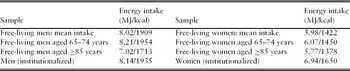
Assessing dietary intakes with any confidence in any population is challenging and the validity of findings impossible to verify. Despite these limitations, estimates of dietary intakes of older people have been, and continue to be, regularly collected. Assessments of the food intake of older people living in care or free-living in the UK were reported in the key NDNS survey (Table 1).Reference Finch, Doyle and Lowe7
Mean energy intake for men and women in the UK NDNS survey

This survey revealed a considerable range of reported energy intakes. Free-living subjects were consuming 84% of the estimated average requirement (EAR), while in institutionalized subjects this was close to 90%. Seventy-six per cent of free-living men aged 65–74 years reported consuming fewer than 2250 kcal per day. Energy consumption for women in this age group was lower, with 95% reporting an intake below 2000 kcal per day. Energy intake in older men and women was lower, with 65% of men and 96% of women aged 75–84 years consuming below 2000 kcal per day.
Macronutrient intakes largely mirrored energy intakes. Protein intakes were perhaps higher than expected, with a daily mean intake of 71.5 and 56.0 g in free-living men and women, respectively. This finding was consistent across age and setting categories, with mean values well in excess of the reference nutrient intake (RNI) of 53.3 g per day for males and 46.5 g per day for females. However, 14 and 25% of free-living men and women consumed at or below their reference RNI. Among those in institutions these proportions were 27 and 23% of men and women, respectively.
Carbohydrate energies were close to 50%, for both free-living and institutionalized older people. Around half of carbohydrate energy was derived from cereal products, with white flour-based products important contributors. Perhaps unsurprisingly, the reported intakes of non-starch polysaccharides (NSP) were lower than the recommended 18 g/day. These were 13.5 g for men, 11 g for women free-living, and 11.0 g for men, 9.5 g for women in institutions. Constipation, a common symptom that impairs the quality of life of older people, would be likely with this intake.Reference Rao and Go24, Reference Sturtzel and Elmadfa25 Dietary fat intakes were not very different from UK dietary reference values (DRV), with an average energy intake of close to 35% of total energy intake.22
A number of studies have examined dietary intakes in free-living older subjects. A study of independently living young-old age (greater than 65 years), old-old age (greater than 75 years) and very-old age (greater than 85 years) in Germany suggested that nutrient intakes were adequate for the 70% of participants who were well enough and able to participate in this nationwide cross-sectional study of over 2000 subjects.Reference Volkert, Kreuel, Heseker and Stehle26 The authors considered the findings encouraging, with the median reported intakes exceeding the recommended amount for most macronutrients, excepting dietary fibre. However, frailer older people either declined, or were unable, to participate in this study, suggesting that these data do not reflect the entire population, or at least reflect the health and dietary intakes of only the fit. Similar findings were observed in an Australian study where older people (mean age 62 years, range 49–89 years) participated in a longitudinal dietary survey collecting data over 10 years.Reference Flood, Burlutsky, Webb, Wang, Smith and Mitchel27 Around 1166 participants provided usable dietary data at all three examinations. Energy and sugar intake significantly increased among women over the 10-year period. Many of the observed changes in diet were consistent with current population dietary recommendations. Some changes, however, appear to have been due to poorer dietary choices, and weight gain (around 4 kg) was apparent rather than the development of undernutrition. It may be that those who were approached but declined to participate were those in whom undernutrition was more frequent, and the results reflected the effects of overnutrition in the fitter participants.
Conversely, the 4-year European longitudinal SENECA study of older adults in their mid-seventies, and living independently in nine European towns, quantified the decline in mean energy intake over time.Reference Moreiras, van Staveren, Amorim Cruz, Carbajal, de Henauw, Grunenberger and Roszkowski28 The diversity of this group was illustrated by highly variable intake data. A mean reduction in intake of close to 1 MJ daily was significant in only four of the towns (P < 0.01). As expected with such a fall in energy intake, a slight decline was reported in intake of macronutrients, with the exception of protein.
Micronutrients
Volkert et al. found shortfalls in micronutrient, calcium, vitamin D and folate intake.Reference Volkert, Kreuel, Heseker and Stehle26 Around 40% of those surveyed did not achieve two-thirds of the recommended daily amounts, with an age-related decline observed. These findings mirror the earlier UK data.Reference Finch, Doyle and Lowe7 In addition to dietary intake, micronutrient status was reported in terms of biochemical measures. Measurements included serum ferritin, water-soluble vitamins, fat-soluble vitamins and carotenoids. Very few minerals were measured. In fewer than 1% of cases plasma zinc concentrations were lower than the reference value of 10 μmol/l below which deficiency has been recognized. There were no concerns about plasma calcium concentrations, which are under tight homeostatic control. Poor iron status was highlighted as an important health issue. Iron status was reported in terms of haemoglobin, clinically important as a measure of iron deficiency, and ferritin, a measure of iron stores. Mean values for haemoglobin were 14.5 and 13.5 g/dl for free-living males and females, respectively. The WHO lower limits for haemoglobin are 13 and 12 g/dl, respectively: 11% of men and 9% of women were below these limits. In institutions, 52% of men and 39% of women were anaemic. Unlike free-living groups, the concentrations of haemoglobin in residents in institutions varied little with age.
Serum ferritin concentrations were also wide ranging, with 7% of men having a serum ferritin below 20 μg/l and 9% below 15 μg/l in the free-living group. In the institutionalized group 11% of men and 10% of women had values below these cut-offs, confirming depleted iron stores. Low iron status has considerable implications for well-being and the maintenance of functional capacity.Reference Bianchetti, Rozzini, Carabellese, Zanetti and Trabucchi29
Plasma vitamin C (abscorbate) levels were also found to be compromised. Plasma concentrations of below 11 μmol/l indicate biochemical depletion. Mean concentrations in free-living subjects were 39.1 μmol/l for men and 48.6 μmol/l for women. Fourteen per cent of women and 13% of men who were free-living were found to have levels below 11 μmol/l. In institutionalized residents considerably more (44% of men and 38% of women) had plasma levels below 11 μmol/l. An age-related decline was evident. Vitamin B12 and folate are both important for the maintenance of well-being and prevention of other forms of anaemia. Mean serum folate concentrations should be between 7 and 46 nmol/l. Fifteen per cent of free-living and 39% of institutional participants had values below these. Six per cent of free-living and 9% of institutional subjects had a B12 below the lower level of normal (118 pmol/l).
Plasma 25-hydroxyvitamin D, the most widely used measure of vitamin D status, was below the lowest value 25 nmol/l in 6% of women and 10% of men, but in institutions this was much higher at 38 and 39%, respectively.
Poor vitamin A status did not cause concern, with fewer than 1% of participants experiencing this.
Quality of life, well-being, nutritional status and body mass index
Malnutrition or low nutrition screening scores have been shown to impair quality of life (QOL) and be positively associated with low QOL scores in those living independently and in supported accommodation.Reference Vetta, Ronzoni, Taglier and Bollea30, Reference Maaravi, Berry, Ginsberg, Cohen and Stessman31 Poor dietary intakes, for example of dietary fibre, are likely to show negative effects on QOL.Reference Rao and Go24 Interventions to address short-falls in fibre intake in older institutionalized people have shown some promise, although QOL and well-being measurements were not made.Reference Hankey, Cullen, Wynne, Death and Kenny32
Well-being and QOL, both difficult subjective measures to make, are of great importance. A recent review which considered the factors that influence subjective well-being suggested that the three most important contributors to this were socioeconomic status, social integration and health, with health found to be the most important contributor for adults of all ages.Reference George33 Older people have reported valuing greatly their health status, functional ability, activities and social relations.Reference Wilhelmson, Andersson, Waern and Allebeck34
Tools to measure well-being are numerous, some measuring subjective well-being whilst some, such as the SF-36, measure objective well-being.Reference Ware, Snow, Kosisnki and Gandek35 QOL in older people has also been assessed by various questionnaires, most often in those living independently in the community.Reference Webb, Blane, McMunn and Netuveli36
Other tools such as the Euro-Qol, which include measures of well-being, are standardized instruments for measuring overall health outcome. EuroQol is applicable to a wide range of health conditions and treatments, and provides a descriptive profile and a single value for health status. In practice, this tool is relatively easy to complete and has been widely used to estimate health status in older people.
Existing research relating health to nutritional status of older people has used a variety of tools to measure QOL, well-being and overall health. Reviews that considered the impact of malnutrition on the QOL in older people have been difficult to find. However, the American Dietetic Association37 summarized the need for appropriate nutritional intervention in those adults living in long-term care to at least maintain QOL. Others have opposed this view, stating that the effectiveness of nutritional interventions cannot be measured by QOL measures as, although the value of food intake as a preventative measure decreases with age, its value within social structure, self esteem and enjoyment with increasing age means its influence becomes disproportionate.Reference Schlettwein-Gsell38
Can nutritional status, quality of life, well-being or general health be improved by nutritional supplementation?
The first and most low-cost intervention to address undernutrition is dietary advice. However, use of this approach alone has shown limited benefit, with very few studies having considered this issue. A systematic review of dietary advice versus supplements included 24 trials with a wide range in the duration of follow-up, between 16 days and 24 months.Reference Baldwin and Parson39 Groups receiving supplements gained significantly more weight (or lost significantly less weight) than those who received only dietary advice, with a weighted mean difference of 1.09 kg (0.29–1.90). It is unclear if these weight changes were of clinical significance. The authors concluded that a lack of evidence exists to support the use of dietary advice alone in the management of illness-related malnutrition, based on few, often poor-quality studies.
A Cochrane review considered the overall effectiveness of dietary supplementation, largely provided in the form of commercial drinks, in addition to usual food intakes.Reference Milne, Potter, Vivanti and Avenell40 Primary outcomes included all-cause mortality, morbidity and functional capacity. Secondary outcomes ranged from development of complication, to changes in weight, QOL and grip strength. Sixty-two randomized controlled trials and ‘quasi’ randomized controlled trials, including 10,187 participants, were included. The maximum duration of study was 18 months. The findings were perhaps made less clear, by some studies not restricting participation only to those who were undernourished.
Within this review, health-related QOL was a secondary outcome. Many studies that evaluated well-being and QOL either did not look at just those who were undernourished,Reference Krondl, Coleman, Bradley, Lau and Ryan41 or focused on specific patient groups, such as those hospitalized with an exacerbation of acute illnessReference Saudny-Unterberger, Martin and Gray-Donald42–Reference Hampson, Martin, Moffat, Vaja, Sankaralingam, Cheung, Blake and Fogelman44 or those who were already free-living and already had high QOL life scores.Reference Barr, McCarron, Heaney, Dawson-Hughes, Berga, Stern and Oparil45 Any effects on well-being were small and in most cases inconclusive. Collins et al.Reference Collins, Kershaw and Brockington46 supplemented older people receiving treatments for wound healing, and reported a relationship between improved well-being and supplementation in an acute setting. In contrast, a study in the community showed no benefits on any aspect of well-being with supplementation.Reference Edington, Barnes, Bryan, Dupree, Frost, Hickson, Lancaster, Mongia, Smith, Torrance, West, Pang and Coles47 This probably reflected the finding that supplementation itself had no effects in the treatment group. There have been no studies that report any beneficial effects on QOL or well-being in those who were not acutely ill but were living in a care setting.
Overall, conclusions from this review were that supplementation did not affect mortality, although a small but consistent positive effect on body weight with supplementation was seen. These findings concur with the NICE review on nutrition support.48
Food-based interventions to improve undernutrition and health-related quality of life
A number of studies have looked at various types of food-based interventions in a bid to improve undernutrition. While these studies did not all follow a randomized design, they provide interest, ideas and pilot data for the design of future interventions.
Home food delivery may offer promise by providing sufficient food which, if eaten, may stall chronic weight loss, and possibly favour continued independent living. This was recently explored in a study with a quasi-experimental design, which compared people in receipt of the meals with a non-randomized group receiving other services.Reference Frongillo and Wolfe49 However, the study included subjects who were both obese and overweight, making the results difficult to interpret. Although dietary intakes improved, there was no report of what, if any, effect the intervention had on body weight, or whether it changed across different BMI categories.
The value of providing home-delivered meals to frail older people was also examined in a cross-sectional study.Reference Gollub and Weddle50 Individuals already in receipt of home-delivered meals were also provided with breakfast and lunch. This had a beneficial effect on mean energy intakes (+350 kcal/day) and improved self-reported depression and food insecurity. However, effects on QOL or other similar well-being-type measures were not reported.
Another study examined whether the provision of an additional evening meal could improve total daily food intake, nutritional status, and health-related quality of life (HRQOL) in frail aged residents of service flats. The study was carried out in two residential complexes with 60 out of 122 residents agreeing to participate. Forty-nine subjects, median age 84 years, completed the 6-month study. Twenty-three residents, the intervention group, in one complex were served 530 kcal in addition to their regular meals, while 26 residents in the other building were controls. At the start, the MNA classified 27% as malnourished and 63% as at risk for malnutrition, with no difference between the groups. After 6 months the median body weight was changed +0.6 kg in intervention subjects and –0.6 kg in controls. There was a wide range in weight change, –13% to +15%. The evening meal improved the protein and carbohydrate intake (P < 0.01), but the energy intake increased by only 180 kcal/day. There was no significant difference in cognitive function or HRQOL between the groups. Although 90% of the frail residents had nutritional problems, the additional meal had no significant effects on energy intake, body weight or HRQOL. Reasons for this lack of effect could be many, but the wide level of variation in outcomes within each study group made detecting statistically significant differences impossible. It may be the case that residents receiving the additional meals compensated in some way by reducing their food intakes at other times of the day and that HRQOL was unchanged as nutritional status was unchanged.
Frail older people are a disparate group, among whom individuals with dementia are increasing, the nutritional intakes of whom can often be compromised.Reference Kaiser, Bauer, Rämsch, Uter, Guigoz, Cederholm, Thomas, Anthony, Charlton, Maggio, Tsai, Vellas and Sieber51 Measures of QOL and estimations of well-being are challenging to make in all older people, and especially so in the frail aged with dementia.
A number of interventions have been designed for this nutritionally at-risk patient group. Those with dementia and resident in a short stay assessment unit were offered three interventions, which aimed to improve nutrition status and influence body weight/BMI. The study followed a single stranded design with four 12-week phases, each with a 5-week ‘break’ to allow time for new patients to be admitted to the unit, and ensure that different patients received each intervention. Phase one was quasi control, where BMI fell by 0.3 kg/m2. The provision of snacks 24 hours per day, providing specific help with undereating and the provision of music with meals were the three intervention phases. Over 12 weeks these interventions prevented weight loss, with a gain in BMI of around 0.3 units for each treatment over 12 weeks.Reference Wong, Burford, Wyles, Mundy and Sainsbury52
The provision of assistance with feeding to all undernourished patients, to address undernutrition or stall chronic weight loss, has been explored in an acute hospital setting.Reference Hickson, Bulpitt, Nunes, Peters, Cooke, Nicholl and Frost53 A brief training period for healthcare assistants covered identification of undernutrition, awareness of the importance of poor nutritional status on health and therefore it promoted responsibility of staff to improve food intake. A 16-day period of study found nutritional status was not affected by the provision/presence of healthcare assistants, but intravenous antibiotic use was reduced. However, this very brief intervention suggested that unskilled staff, whose role is to maximize patient's food intakes, may have potential to show clinical benefits. A similar study may have application to other care settings, with the advantage of having minimal costs, and having the potential to harness help from those from the voluntary sector. Simmons et al.Reference Simmons, Keeler, Zhuo, Hickey, Sato and Schnelle54 used four nursing homes as the setting for a study that examined the effect of providing help with feeding for residents who were at risk of weight loss. The crossover controlled trial included 76 long-term nursing home residents at risk of unintentional weight loss. Residents were given help with meals and snacks by research staff twice daily, over a 6-month period. Significant improvements in dietary intake were seen in the intervention group, resulting in weight maintenance or weight gain, close to 2 kg, and a mean increase in BMI of 0.74 units. In contrast, dietary intake of the control group remained stable and weight loss was observed. The provision of assistance with meals and snacks took 42 and 13 minutes, respectively, compared with usual care of 5 minutes per meal and 1 minute per snack by care staff. This approach has implications for staffing, but it is clearly able to stabilize chronic weight loss by improving intakes. It was not reported whether well-being or QOL in this group were influenced by this intervention.
Food fortification has been widely advocated as an approach to address undernutrition.48 This approach potentially offers considerable advantage in terms of low cost, ease of delivery and acceptability as usual food preferences can be maintained, thus increasing the likelihood of a sustainable intervention. A few studies have attempted food fortification without the use of commercially prepared supplements in frail older people, with only mixed success. A controlled study of 12 weeks duration was recently carried out in frail aged nursing home residents in Germany.Reference Smoliner, Norman, Scheufele, Hartig, Pirlich and Lochs55 The intervention comprised snacks which provided 300 kcal twice daily, and oils and creams to ‘fortify’ meals already offered. The control group received usual care. However, BMI increased significantly in both the intervention and control groups, by 0.8 and 0.5 kg/m2, respectively, with no between-group differences found.Reference Smoliner, Norman, Scheufele, Hartig, Pirlich and Lochs55 The study took place in eighteen wards over three sites, with randomization according to ward. It may have been that contamination of treatment between wards in the home occurred, as staff working across wards, and through any other staff interactions, were likely to have become aware, rather than remain blinded to the intervention. However, the study did show that it was possible to stabilize BMI in frail aged people resident in a care home using a food-based intervention. However, measures of QOL could not be completed in these residents.
A similar study of food fortification was carried out in a Scandinavian nursing home. One ward was allocated to intervention, where undernourished patients received fortified/enriched food, and one ward where patients received usual care. Energy intake was improved in the intervention group and was significantly higher than the control group, again suggesting an effect of food fortification.Reference Odlund Olin, Koochek, Cederholm and Ljungqvist56
It has been suggested that addressing undernutrition and halting weight loss may improve QOL/well-being as well as reducing the incidence of infections.Reference Gollub and Weddle50, Reference Arvanitakis, Coppends, Doughan and Van Gossum57 An ongoing study, the protocol of which has been published, is examining the value of a health-promoting intervention, which focuses on physical activity. The intervention had a focus on activities of daily living, which included measures of weight change, to prevent development of frailty and the associated effects on well-being, and to minimize health care use and be cost effective.Reference Dahlin-Ivanoff, Gosman-Hedström, Edberg, Wilhelmson, Eklund, Duner, Ziden, Welmer and Landahl58 Such a study with nutritional advice as an intervention could be of value in determining whether well-being and QOL could be affected and functional capacity maintained in such a group.
Mineral and vitamin supplementation
Mineral and vitamin supplements appear to be widely used, with no indication of any health or other benefits. The NDNS dataset has highlighted that deficiencies in a number of minerals and vitamins are present in older people, and addressing these shortfalls may offer benefits in terms of well-being. A meta-analysis considered evidence that mineral and vitamin preparations may influence the occurrence of infections in older people living at home but found the available data to be conflicting and inconclusive.Reference El-Kadiki and Sutton59
The MAVIS clinical trial carried out in free-living older individuals in the community examined and followed a randomized controlled design.Reference Avenell, Campbell, Cook, Hannaford, Kilonzo, McNeill, Milne, Ramsay, Seymour, Stephen and Vale60 The study investigated whether mineral and vitamin supplements could have health benefits in an older population. The primary outcomes were: (1) reduced contacts with health professionals for infection-related issues, (2) reduced occurrence of self-reported infection, and (3) improved QOL. Supplementation with multivitamins showed no benefit on any of the outcome measures. This may relate to the initial nutritional status of the participants, which was in the main good, as participants did not have to be undernourished to be eligible to participate. The QOL for the study participants, measured by the overall health score, EuroQol, was as expected for people of the participant's age. Supplementation may have benefit in higher risk populations, such as older people in nursing homes, or living in the community with the help of a carer or, most likely, those who are identified as undernourished.
Conclusion
This review has highlighted shortcomings in the available literature. Few studies have attempted to improve and then measure well-being or QOL in older adults who are undernourished. Addressing undernutrition may improve well-being, QOL and functional capacity. However, Milne et al.Reference Milne, Potter, Vivanti and Avenell40 concluded that QOL and functional capacity were not improved in those given nutritionally complete supplements. There are scant data on whether food fortification or other interventions, which have focused on increasing energy intake from food sources, influenced functional capacity, QOL or well-being. The conclusion of Milne and colleaguesReference Milne, Potter, Vivanti and Avenell40 may therefore reflect both a lack of research trials in this area, or that many studies are not sufficiently focused in their design. An important point of note is that interventions to address undernutrition have often included well-nourished subjects.
There are also few studies that have considered the possible effects of providing practical help such as assistance with feeding to improve nutritional status, although those that have been done showed promise in halting chronic weight loss, with interventions that are inherently low cost. Increasing the energy density of foods, rather than the provision of supplements, appears to have promise but does remain under-researched. Studies which have examined this approach might have had more effect if contamination by staff exposed to both intervention and treatments had been prevented, ideally by each arm of the intervention study taking place in separate units. Furthermore, a greater level of staff training might have increased the effectiveness of the interventions. This could have reinforced the need for recognition and management of undernutrition to carers, who conceivably would then be more willing to implement interventions designed to relieve it.
The provision of energy complete supplements remains of value, as their use remains a relatively easy solution to ongoing chronic undernutrition, though only in the short term. There are few studies that have looked at their use over the long term. The most frequent setting for their use appears to be the acute sector, as Milne et al.Reference Milne, Potter, Vivanti and Avenell40 report, where the majority of studies have taken place and where a small weight gain has been demonstrated. The value of vitamin and mineral supplements in this group is unclear as many studies carried out have included those who are not undernourished and who are unknown micronutrient status.
The cost of managing undernutrition appears to be low, although to date there are few formal reviews, and those that are available are more focused on the acute setting.48 Occasional studies, such as that by Edington et al.,Reference Edington, Barnes, Bryan, Dupree, Frost, Hickson, Lancaster, Mongia, Smith, Torrance, West, Pang and Coles47 have found no cost benefits for low-intensity interventions to address undernutrition, but others such as Simmons et al.Reference Simmons, Keeler, Zhuo, Hickey, Sato and Schnelle54 have shown promising approaches. However, in comparison with many other costly interventions, managing nutritional intakes carefully using a low-intensity approach is likely to be a low cost option. Given the increasing proportion of older people in the population, effectively managing nutritional intakes has considerable potential to improve well-being and QOL, and at the least stall the chronic weight loss associated with hospitalization.
Research recommendations for undernourished older people
In the light of this review the following studies appear justified:
(1) To examine the effectiveness of food fortification/enrichment in independent living undernourished older people resident at home with a carer, in terms of body weight and HRQOL.
(2) To implement a programme of staff training, food fortification and physical activity in community care homes to challenge undernutrition and HRQOL.
(3) To implement a programme of staff training and food fortification delivered within optimal meal environments for those with dementia resident in care homes, to (a) challenge undernutrition and (b) improve HRQOL.
Conflict of interest
The authors received a donation of £5000 from GlaxoSmithKline to write this review. However, the Company did not influence the content of the review.