There is significant debate around the question of how best to support Indigenous Australian doctoral students (Barney, Reference Barney2013; Behrendt, Larkin, Griew & Kelly, Reference Behrendt, Larkin, Griew and Kelly2012; Schofield, O'Brien & Gilroy, Reference Schofield, O'Brien and Gilroy2013; Trudgett Reference Trudgett2009, Reference Trudgett2011, Reference Trudgett, Craven and Mooney2013, Reference Trudgett2014). That debate has been led in recent years by the Review of Higher Education Access and Outcomes for Aboriginal and Torres Strait Islander People (Behrendt et al., Reference Behrendt, Larkin, Griew and Kelly2012). The Review clearly identified the need for universities to be meaningfully engaged in this space and to consider Indigenous higher degree research students in their overall business plans, recommending that:
Universities develop Aboriginal and Torres Strait Islander Research strategies within their business planning processes, for inclusion in their mission-based compacts. Strategies should include increasing the number of Aboriginal and Torres Strait Islander academics with completed HDRs and the use of ethical research practices when undertaking research involving Aboriginal and Torres Strait Islander communities (see recommendation 23 in Behrendt et al., Reference Behrendt, Larkin, Griew and Kelly2012, pp. 23, 130).
Despite growing interest in crosscultural doctoral research (Grant & McKinley, Reference Grant and McKinley2011; Henry, Reference Henry, Denholm and Evans2007; Manathunga, Reference Manathunga2005), studies undertaken to explore how best to grow research capacity by consciously investing in this cohort remains significantly sparse.
This paper serves two main purposes. First, it provides details about our ARC funded project which endeavours to create a model of best practice for the supervision of Indigenous doctoral students. The model of best practice will be presented in a later paper when further analysis has been undertaken. We envisage that our methodology for undertaking research with Indigenous people in the higher education sector can be of benefit to other scholars wishing to pursue a similar inquiry. Second, the paper provides some insight into the demographic representation of Indigenous people who have successfully completed a doctoral qualification. This is critically important as little is known about this cohort and what success looks like for Indigenous doctoral students.
In order to best understand the data pertaining to Indigenous doctoral students, we need to turn our attention to the historical growth pattern of this cohort nationally. Formal records are difficult to locate. This paper therefore draws on a combination of estimates and concrete figures to determine a strong understanding of what the growth pattern of Indigenous doctoral completions in Australia over time looks like. Whilst there is some uncertainty about who was the first Indigenous Australian to be awarded a doctoral qualification, the earliest record that we could find was the PhD awarded to Dr Bill Jonas in 1980 by the University of Papua New Guinea (Bock, Reference Bock2014; New South Wales Board of Studies, nd). Other Indigenous Australian people were also reported to have received a doctoral qualification in the 1980s (for example, Professor Maryann Bin-Sallik who graduated with a Doctor of Education from Harvard University in 1989). We cannot establish a firm number to attribute to the decade from 1980, when Jonas was first awarded his, through to 1990. Based on information pertaining to the following decade and relevant trends in the data, we estimate that approximately 25 Indigenous people were awarded their doctorate during this period. This estimate is based on the fact that this was a new occurrence in higher education and also considering the figures for the following decade. Bock (Reference Bock2014) refers to the Department of Education records, stating that 55 Indigenous Australians were awarded doctoral qualifications in Australia from 1990 to 2000. We therefore estimate that approximately 80 Indigenous Australians were awarded a doctoral qualification before 2000.
We now turn our attention to the pool of Indigenous people graduating with a doctoral qualification post 2000. Table 1 illustrates that the number of Indigenous Australians completing a Doctoral qualification has increased in recent years — from eight completions in 2001, to 27 in 2014, with a noticeable peak in 2011. Despite this growth, the overall percentage of all doctoral completions compared to domestic completions remains well below the target rate of 2.2 per cent (Behrendt et al., Reference Behrendt, Larkin, Griew and Kelly2012, p. 11). In short, we need a multiple factor of at least four on the current number of Indigenous HDR completions to achieve parity with non-Indigenous students.

Analysing the data presented in Table 1, we can see that a total of 292 Indigenous Australians completed doctoral completions in Australia during the 2001–2014 period. Taking into account the pre 2000 data, we estimate that there has been a total of approximately 372 Indigenous Australians who have completed a doctoral qualification in Australian universities at the end of 2014. We are aware that some Indigenous scholars such as Professor Larissa Behrendt and Professor Mary-Anne Bin-Sallik gained their qualification from institutions outside Australia, but we believe such cases are small in number and not likely to significantly impact the above figures.
In 2006, the Indigenous Higher Education Advisory Committee boldly claimed that by 2010 the sector would see 50 Indigenous Australians completing a doctoral qualification each year (IHEAC, 2006, p. 29). The report provided this prediction on the basis of the trends at the time and no policy changes. We can see from Table 1 that the actual number of Indigenous doctoral completions evident in 2010 was 29, only slightly more than half that predicted by IHEAC. In order to reach such targets, which some may label as ambitious, the sector needs to engage with policy discussions and provide for changes that may occur in both the near and long terms futures.
Methods
This paper reports on a study that employed a qualitative approach to understand and improve the supervision provided to Indigenous Australian doctoral students. Drawing on the combined expertise of the three authors, the study used qualitative, social-science derived methods (Denzin & Lincoln, Reference Denzin and Lincoln1994) and a concurrent, mixed methods approach (Creswell, Reference Creswell2013) involving both semi-structured interviews and demographic questionnaires. We also drew on Indigenous methodologies to guide the ethical approach of the research.
Rigney (Reference Rigney1999) and Nakata (Reference Nakata1998) identify the importance of creating an intellectual space that provides Indigenous scholars with an opportunity to articulate their own situated knowledge within a community of practice. This research has been Indigenous led (Trudgett and Page) and along with our non-Indigenous colleague (Harrison) we have developed a collaboration in which Indigenous scholarship has been valued, allowing for robust intellectual exchange. As well as, the voices and experiences of Indigenous doctoral graduates are honoured and respected in this study, as we sought to ensure that they were able to speak, through the open-ended interviews, about their academic journeys in a manner that respects their own ways of knowing, being and doing (Martin, Reference Martin2003).
Our study began by drawing on the findings of a pilot study conducted by Trudgett (Reference Trudgett2011, Reference Trudgett, Craven and Mooney2013, Reference Trudgett2014). The pilot study comprised a questionnaire and semistructured interviews with ten Indigenous Australians who held a doctoral qualification, as well as their supervisors. It proved to be a crucial component of the larger ARC funded study as it provided a valuable methodological foundation to approach research aims, questions, literature and analysis. The current study is described below.
Sampling and Recruitment
There are no publicly accessible lists that identify those Indigenous Australians with a doctoral qualification. In order to successfully recruit for this study, we used purposive sampling (Teddlie & Yu, Reference Teddlie and Yu2007) and began by creating a list of Indigenous academics with doctoral qualifications, based on our own knowledge of the Indigenous Higher Education sector. Those identified were invited to participate in the study. We emailed people in small cluster groups until we reached our required 50 participants for that component of the study, which we refer to as the Phase 1 cohort. Drawing on a modified snowball sampling method (Heckathorn, Reference Heckathorn2011), Phase 1 participants were asked if they would be willing to provide the research team with the names of their supervisors. We assured the participants that should they be willing to consent, nothing that they had shared with us in the data collection process would be communicated to their supervisor, and vice-versa. Five participants did express concern about providing the details of their supervisor as they didn't have a positive experience and did not want the supervisor to know that they had participated in a study of this nature. There was unfortunately little scope to avoid this in instances where the supervisor had supervised only one Indigenous doctoral student to completion. However, in situations where a supervisor had more than one Indigenous doctoral student complete, they would not know which of their students had participated in the study they were simply told ‘a student who you supervised has participated in this study’. A total of 58 supervisors and email details were provided by the remaining 45 Phase 1 participants. Each of these supervisors were contacted and invited to participate in the study. Of these, 33 participated which formed the Phase 2 cohort.
Participants
Of the 50 Indigenous doctors, 49 identified as Aboriginal and 1 as a Torres Strait Islander. This group comprised of more females (n = 31) than males (n = 19). Participants in this cohort received their doctoral qualifications from 25 different institutions across the nation, including Group of Eight universities, metropolitan, and rural universities, and technology universities. Thirty-five participants indicated that they had children. Almost all of the Indigenous doctors were employed in the Higher Education sector. We also interviewed 33 people responsible for providing supervision to this cohort of Indigenous doctors. This comprised of 17 males and 16 females. None of the supervisors were Indigenous.
Data Collection
Participants were asked to complete a questionnaire which contained 17 questions to collect basic demographic information and then participate in a semistructured interview where they were asked an additional 19 questions. Of the 50 interviews conducted with Phase 1 participants, 42 were conducted face-to-face and eight were conducted over the phone. Questions focused on the strategies behind selecting a supervisor and university to undertake doctoral studies; the role and acceptance of Indigenous Knowledges in terms of supervisor and academy; cultural appropriateness of supervision; strategies to improve supervision for future Indigenous doctoral students and necessary components for the best-practice model for the supervision of Indigenous doctoral students. Interviews tended to range from 30 minutes to 2.5 hours, with the average interview taking approximately 1 hour.
Similar to the Phase 1 methods employed, Phase 2 participants were also asked to complete a questionnaire to gather demographic information such as gender, age, employment and education. They were also asked to participate in a semistructured interview to discuss topics such as their academic employment; supervision experience; key areas of difference when supervising Indigenous Australian students compared to supervising non-Indigenous students; Indigenous Knowledges and the academy; strategies to improve the supervision that Indigenous doctoral students receive with a specific focus on the best-practice model of supervision. These interviews tended to range for 30–60 minutes in total.
There were some initial discussions around whether the two Indigenous researchers would undertake all the Phase 1 interviews, leaving the non-Indigenous researcher to concentrate on Phase 2 data collection. In some cases, this may be the preferred method of approach, particularly when there are two experienced Indigenous academics on a team. However, we did not deem it necessary for this investigation for two reasons. First, Harrison is a highly experienced researcher who has over 30 years’ experience in Indigenous Education. Having supervised a number of Indigenous postgraduate students, he is extremely well versed with this type of cohort. Second, we viewed the Indigenous lenses in relation to analysis to be of greater importance than data collection. Though this paper does not present the qualitative data, it is important for methodological purposes to point out that all interviews were analysed by at least two members of the team, ensuring an Indigenous lens was part of the analysis task.
Data Analysis
All interviews were transcribed by a professional transcription service for analysis purposes. The demographic data were analysed according to frequency of responses. The interview data were transcribed, and a manual thematic search of all data on examination was conducted, followed by analysis of content themes using an emic approach to identify the perspectives of participants (Stake, Reference Stake, Denzin and Lincoln2005). For the purposes of this paper, we are reporting on demographic data from the questionnaires.
Findings and Preliminary Analysis
Demographic Information About Indigenous Doctors (Phase 1 Participants)
In the past, it has not been possible to illuminate the current demographic of successful Indigenous doctors in Australia. However, the availability of such data would assist government to formulate policy, universities to implement strategies and academics to deliver programmes that foster success for Indigenous doctoral students. This paper will now describe in detail some of the demographic information collected from the questionnaires completed by the 50 Indigenous Australian doctors who participated in the study. It is important to note that this is provided as a means to capture a snapshot of the cohort, and by no means attempts to provide a holistic picture that captures each and every graduate.
Candidacy Demographics
Year of doctoral completion
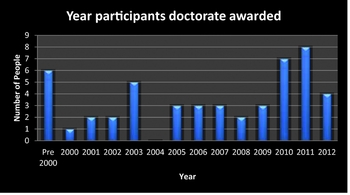
As indicated earlier in Table 1, the number of Indigenous Australians awarded a doctoral qualification has increased in recent years. Figure 1 provides a summary of the year participants from our study were awarded their doctoral qualification. There was representation from across a broad period, including more recent graduates as well as participants who completed their qualifications some years ago.
Year doctorate was awarded.

Figure 1 shows that six participants received their award prior to 2000. As there were few Indigenous Australians who completed their qualification during this era, we have aggregated the data to maintain participant anonymity. Besides 2004, there is some representation in the study of people who were awarded their degree between the period 2000–2012. The years 2010 and 2011 had the highest levels of representation accounting for a total of 15 of the 50 participants. Overall, there were a large number of participants who completed their doctoral qualification in more recent years; which is consistent with the national picture over time.
Age of candidate at completion
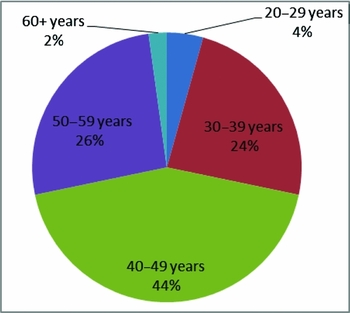
Figure 2 provides an overview of the age of the Indigenous doctors who participated in this study. Slightly less than half (44 per cent) of the participants were aged 40–49 years when awarded their doctoral qualification. Indigenous doctors aged 50–59 years represent 26 per cent of this cohort and the 30–39 year group account for 24 per cent of the cohort. There were relatively small numbers of Indigenous doctors in the 20–29 year old group (4 per cent) and those aged 60 years or older accounted for 2 per cent of the cohort.
Age of participants when awarded their doctoral qualification.

Analysis of the data challenges previous assumptions that Indigenous Australians are usually awarded their doctoral qualification towards the end of their career (Rigney, Reference Rigney2011; Strelein, Reference Strelein2011). Conversely, this study suggests that Indigenous Australians are now most likely to achieve their doctoral qualification at the mid-career stage of their professional lives.
Length of time to complete
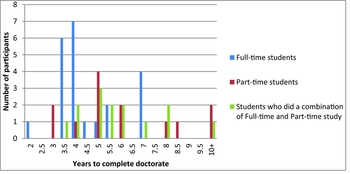
There was observable differences in the length of time it took this cohort of Indigenous Australians to complete their doctoral qualification. Full-time students took an average of 4.5 years to complete, while part-time students took an average of 6.1 years to complete. Students who undertook a combination of full-time and part-time study took an average of 5.9 years to complete. Figure 3 provides data on completion time according to three categories — full-time, part-time and a combination of full-time and part-time studies. It shows that some participants in this group took as little as 2 years whilst others took more than 10 years. Participants without children did not finish particularly quicker than those with children.
Length of time to complete doctoral qualification.

Discipline of enrolment/award
Sixty per cent of this cohort completed their doctorates in the arts and humanities discipline. This has been the case for many years, and is likely to remain somewhat stagnant for many years to come given that is where the majority of Indigenous undergraduate students are currently enrolled (Behrendt et al., Reference Behrendt, Larkin, Griew and Kelly2012). Education students represented the second largest cohort with 22 per cent of this group. Eight per cent of students were enrolled in the sciences, 4 per cent were Public Health students and 6 per cent received their qualification in a STEM discipline (which will not be named specifically for the sake of anonymity). There is a current focus on encouraging Indigenous undergraduate students to undertake studies in STEM disciplines; however, it will be some years before the nation sees such an initiative having a dynamic impact in the postgraduate sector.
Enrolment
Almost half (46 per cent) of the participants indicated that they were enrolled on a full-time basis. Further, roughly one-quarter (26 per cent) of participants studied on a part-time basis and 28 per cent were enrolled as both a full-time and part-time student at different periods of their candidature. These findings highlight the possible pressures that this cohort faced in relation to demands on their time. Most highlighted the competing demands between paid employment, study, family and community obligations while studying.
One aspect of some surprise was the mode of study undertaken by this cohort. We found that 74 per cent of the cohort undertook their studies as internal students, 20 per cent were external students and 6 per cent decided to complete their studies using a mixed mode approach. This suggests that many people in the cohort completed their degrees at an institution close to their homes and workplaces. Of those who were employed in the higher education sector, many had enrolled at the same institution as their employment. Although enrolling at your employing institution may simply be pragmatic, it suggests that proactive institutions could be more systematically working with their Indigenous staff to facilitate enrolment, retention and success. Outcomes from this type of activity would benefit both individuals and their employing organisations. Given that Indigenous graduates remain underrepresented at doctoral level (Behrendt et al., Reference Behrendt, Larkin, Griew and Kelly2012) investment in existing and future human resources seems a relatively low cost institutional investment that could be absorbed by current infrastructure.
Employment and Study
Employment and position seniority (Phase 1)
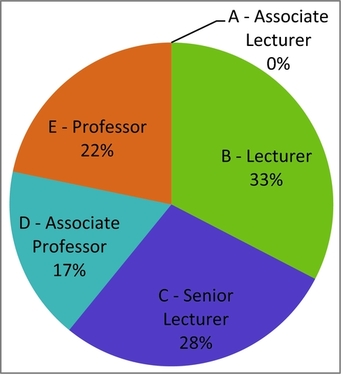
Forty-five participants were employed on a full-time basis, two part-time, two were retired and one was self-employed. All participants who indicated that they were employed worked in the higher education sector, which was a direct result of how we sampled and recruited. Despite the fact that participants had achieved their doctoral qualification at various times throughout the previous two decades, it is interesting to examine the different levels of positions they hold in academia at the time of the interview (as opposed to at the time they completed their qualification). Figure 4 shows that of the 46 people who responded to this particular question, 33 per cent of participants were employed as lecturer; 28 per cent as senior lecturer; 17 per cent as associate professor and 22 per cent as professor.
Positions in higher education participants held at the time of interview.

None of the participants were employed as an Associate Lecturer, indicating that once an Indigenous Australian is awarded a doctoral qualification they are not expected to remain at the most junior level of academia. The majority of the lecturers in our study had recently graduated with their doctoral qualification and were considered by definition to be early career researchers (5 years since they had completed their PhD). This is indicative of the growing pool of Indigenous doctoral qualified academics throughout the sector. There were a few participants who held the position of lecturer but had completed their doctoral qualification prior to 2005. They had worked predominantly in the higher education sector since earning their doctoral award. It was unclear at the time of the data collection why such qualified and experienced Indigenous academics remained in entry level positions for Indigenous doctoral qualified academics. That could be a result of a lack of quality mentorship, a large service work or teaching load and minimal time for research, or lack of motivation and engagement with the academy. A cluster of impediments to Indigenous students’ access and success at undergraduate level is evident in the literature. These barriers include financial hardship (James, Krause & Jennings, Reference James, Krause and Jennings2010), diminished academic preparation, family and community responsibilities and addition burden of ill-health (Andersen, Bunda, & Walter, Reference Andersen, Bunda and Walter2008; Pechenkina & Anderson, Reference Pechenkina and Anderson2011; Wilks and Wilson, Reference Wilks and Wilson2015). While it might be expected that some of these challenges would be ameliorated by educational success, it is possible the barriers faced by Indigenous beginning students are not completely compensated for by success in a doctoral programme.
The effects of ill-health and communities responsibilities are not necessarily immediately remedied by educational progress. In addition, the extra and often invisible burdens for Indigenous academics, such as student support and cultural awareness work, are increasingly documented in the literature (Page & Asmar, Reference Page and Asmar2008; Asmar & Page, Reference Asmar and Page2009) may have contributed to the career stagnation. Alternatively, individual doctoral programme failures may be a factor, despite the trend towards more rounded preparation of doctoral graduates (Kiley, Reference Kiley2011; McCallin & Nayar, Reference McCallin and Nayar2012). Thus, despite the doctorate contributing to career progression for most of our participants, the small group for whom this was not evident suggest that doctoral completion is not a ubiquitous personal panacea.
Figure 4 also speaks back to the myth that most Indigenous Australians who hold a doctoral qualification have senior positions such as Associate Professors or Professors, as only 39 per cent of this cohort fell into this category. Several of the people who held a senior academic position were recently awarded their doctorate, whilst others had held their qualification for some time. In short, the level of academic employment amongst this cohort seems to be associated with how long it had been since they had been awarded their doctoral qualification.
Demographic Information About Supervisors (Phase 2 Participants)
Demographic data about supervisors was an important part of this study as it provides an opportunity to understand the group of people responsible for successfully supervising Indigenous Australian doctoral students to completion. We spoke directly with 33 people responsible for providing supervision to at least one of the 50 Indigenous doctors who took part in the study. This comprised 17 males and 16 females.
Ethnicity
There was some diversity in terms of the ethnic backgrounds of supervisors with some identifying as European or Russian for example, however the vast majority of supervisors were from Anglo Australian backgrounds. There were no Indigenous Australians in this cohort. This was primarily because Indigenous people responsible for providing supervision usually hold a doctoral qualification themselves and would have therefore been included in the master list of people to contact for Phase 1. All participants who took part in Phase 1 were asked about the supervision they provide to their students. It was therefore unreasonable to ask them to participate in Phase 2 of the study should one of their Indigenous doctoral graduates have taken part in Phase 1, as they had already been asked questions pertaining to the supervision they provide.
Age
At the time their Indigenous doctoral student completed their degree, the average age of the supervisors was 55.8 years. Female supervisors were slightly younger on average (54.4 years) than their male counterparts (57.2 years). All supervisors were aged between 43 and 78 years when their student completed their degree.
This led us to undertake further analysis of our data to determine if the supervisor and Indigenous student relationship was likely to be more successful if the supervisor was older or younger than their student. We used the date of birth of supervisor and student to determine their ages at the times of completion, and cross-referenced this information with the year in which the students’ doctorate was awarded. This analysis was possible for 25 (of 33) sets of supervisor and student.
For this particular cohort, there was clear evidence that the supervisors tended to be older than their student, as this was the case in all but one of the 25 cases analysed. The one instance where the supervisor was not older than the student, there was an age difference of only 1 year. Both student and supervisor were males aged in their late 50s when the doctoral qualification was awarded. There was also one case when both supervisor and student shared the same year of birth. There is some suggestion here that there is a greater chance of success when the supervisor is older than Indigenous doctoral students, or that the students are likely to choose supervisors who are older than them.
Employment and Academic Background (Phase 2)
Of the 21 respondents who indicated they worked full-time at the time when the interview was conducted — 12 held Professorial positions, four Associate Professor positions and five were employed as Senior Lecturers. It is interesting to note that all of the Senior Lecturers were female and all but one had their Indigenous doctoral student graduate in the last few years.
As a collective, they share a great deal of experience in supervising doctoral students with the total number of years being 657. This equates to an average of 20 years’ experience each — although there were some notable differences in the group as the least experienced had supervised for 5 years and the most experienced had supervised for 40 years. This suggests that Indigenous doctoral students seek out experienced supervisors, perhaps because the participants in this study were themselves already experienced in academic work.
The discipline backgrounds of supervisors were similar to that of the student cohort. Of all the supervisors who participated in Phase 2 of the study, 51.5 per cent had an academic background in the arts and humanities; 27.3 per cent in education and 21.2 per cent in other discipline areas.
There was a wide range of diversity evident when examining where the supervisors received their own doctoral qualifications. One-third received their testamur from a university outside Australia — countries such as the United States, England and Russia. It was also interesting to note that renowned universities in the world were responsible for awarding some of the supervisors their doctorates.
Discussion
Indigenous Australians are successfully gaining doctoral qualifications at a rate that is slowly increasing with time. Analysis of the demographic data provided by the 50 Indigenous doctors and their 33 supervisors provides some interesting and perhaps unexpected findings which suggest implications for current practice. Notably, this paper has challenged several assumptions often made about the Indigenous doctoral cohort. For example, common assumptions such as Indigenous doctors are older (i.e. Rigney, Reference Rigney2011; Strelein, Reference Strelein2011) and hold senior positions in the academy which was not strongly reflected across our cohort of participants. We discovered that many Indigenous Australians are awarded their doctoral qualification in the middle stages of their career that is aged in their 40s. Institutions would do well then to ensure that they have strategies in place, not only to promote the success of Indigenous academics enrolled in doctoral programmes, but also to foster the career progression of this small but vital group. Career stagnation for this group of academics would be a waste of scarce resources and vital cultural capital for teaching, research and the development of Indigenous students.
This particular mid-career cohort was more likely to be studying in the arts and humanities, employed in higher education, and enrolled on a full-time basis. They took an average of 4.5 years to complete their doctoral degree when studying full-time and 6.1 years when enrolled as a part-time student. Given the additional burden of student support and cultural awareness work, completing a doctorate, while working full-time would suggest that universities are getting considerable value from their Indigenous academic workforce, particularly where the doctoral candidate is working for and enrolled with, the same institution. Universities that fail to recognise this value are highly likely to be on the wrong side of the current Indigenous academic mobility and interinstitutional enticement we are aware of in a higher education sector where demand for qualified Indigenous academics outstrips supply.
The academics providing supervision to this group proved to be highly experienced, with an average of 20 years supervision experience. A compelling finding from the data was that the successful partnerships evident between student and supervisor almost always comprise a team where the supervisor was older than the student. This finding suggests a powerful dynamic that may be a critical factor to consider for future supervision relationships between a non-Indigenous supervisor and an Indigenous student. It is likely that midcareer Indigenous doctoral candidates choose older and more experienced supervisors because, amongst a range of reasons, they themselves already have sector experience. Providing targeted Indigenous research professional development for supervisors with experience and strong reputations in their discipline would be a useful starting point for universities seeking to increase their cohorts of Indigenous doctoral students.
Conclusion
Pointing to the recommendations and findings in the Review of Higher Education Access and Outcomes for Aboriginal and Torres Strait Islander People (Behrendt et al., Reference Behrendt, Larkin, Griew and Kelly2012), this paper has clearly articulated the need for the Australian Higher Education sector to pay specific attention to building the research capacity of Indigenous Australians to the point where we see at least 2.2 per cent of our domestic student doctoral completions comprising Indigenous Australians. The demographic analysis of our study presented here has highlighted the dynamics of a small pool of qualified Indigenous doctoral academics in Australia. This paper does not claim to make a concrete representation that covers the entire Indigenous doctoral cohort. Instead, it provides a strong snapshot that illuminates the various factors that contribute to the academic and professional lives of Indigenous doctors. It is imperative that we gain a strong understanding of this cohort's needs and preferences in order to create the best strategies, policies and practices to support more Indigenous doctoral completions.
Acknowledgements
We would like to thank the Australian Research Council for funding this study under the Discovery Indigenous Scheme. We also wish to thank the 83 participants who shared their knowledge, experiences and stories with us. Without their generosity this project would not have been possible. Finally, it is essential to thank Melissa Collins and Angelique Welsh, our two wonderful research assistants whose professionalism was second to none.
About the Authors
Michelle Trudgett is an Indigenous scholar from the Wiradjuri Nation in New South Wales. In February 2015, she took up the position Professor of Indigenous Education and Director of the Centre for the Advancement of Indigenous Knowledges at the University of Technology, Sydney. Prior to this posting, Michelle was the head of the Department of Indigenous Studies at Macquarie University, Sydney. Michelle has developed an international reputation as a leading Indigenous Australian scholar whose research provides considerable insight into the area of Indigenous participation in higher education, with a specific focus on the postgraduate sector.
Susan Page is a Professor at the Centre for the Advancement of Indigenous Knowledges, University of Technology, Sydney. She is an Aboriginal academic whose research and publication focuses on Aboriginal and Torres Strait Islander peoples’ experience of learning and academic work in higher education. Susan has been awarded a University Teaching Excellence award and has been successful in gaining a number of national competitive grants. She is an elected director, and currently deputy chair of the National Aboriginal and Torres Strait Islander Higher Education Consortium (Aboriginal Corporation).
Neil Harrison is Senior Lecturer in the School of Education, Macquarie University, Sydney, Australia. He has over 30 years of teaching and research experience in Aboriginal education, and his book Teaching and Learning in Aboriginal Education (Oxford) is used widely in Teacher Education Programs across Australia. His recent research centres upon developing research and teaching partnerships with Aboriginal communities, and to this end he is developing an approach to Learning from Country in the city.