Physical function in later life is often conceptualised in terms of frailty (Gillick, Reference Gillick2001). Frailty is a term on which there is much disagreement, and the consensus following multiple attempts at a definition concludes only that it is a multi-factorial state involving vulnerability (Rockwood, Reference Rockwood2005; Morley et al. Reference Morley, Vellas, van Kan, Anker, Bauer, Bernabei, Cesari, Chumlea, Doehner, Evans, Fried, Guralnik, Katz, Malstrom, McCarter, Gutierrez Robledo, Rockwood, von Haehling, Vandenwoude and Walston2013). Definitions of frailty typically focus upon declines in strength, energy levels, immunity, and increases in susceptibility to infection, short-term illness, hospitalisation, and mortality rate (Walston et al. Reference Walston, Hadley, Ferrucci, Guralnik, Newman, Studenski, Erschler, Harris and Fried2006). Fried operationalised frailty as a five-component phenotype comprising exhaustion, weight loss, low levels of physical activity, slow walking speed, and decline in grip strength (Fried et al. Reference Fried, Tangen, Walston, Newman, Hirsch, Gottdiener, Seeman, Tracy, Kop, Burke and McBurnie2001). Fried’s phenotype establishes the multi-factorial nature of the frailty syndrome, and highlights the direct consequences of this syndrome on functioning. This quantitative approach to frailty allows for individuals to be assessed under each of the five domains and then categorised as robust, pre-frail, or frail. The five-component frailty phenotype and subsequent categorisation system facilitates the identification of individuals at risk of the negative health outcomes associated with frailty (Fried et al. Reference Fried, Tangen, Walston, Newman, Hirsch, Gottdiener, Seeman, Tracy, Kop, Burke and McBurnie2001).
It is important to understand the main factors involved in frailty-related decline in later life. Being able to identify those at risk of becoming frail or more frail will be of value for clinicians who wish to modify risk of negative health outcomes at an earlier stage of life. Some studies have begun to focus upon predictors of frailty in an older population, including psychological predictors (Morley et al. Reference Morley, Perry and Miller2002). For instance, depressive symptomatology is associated with frailty status in older adults at a cross-sectional level (Chen et al. Reference Chen, Wu, Chen and Lue2010). It has also been established that depressive symptomatology may be associated with changes in physical functional disability status longitudinally (Yang & George, Reference Yang and George2005). The combination of depressive symptomatology and frailty appears to be a particularly powerful driver of mortality risk among individuals who have a diagnosis of depression in particular, suggesting there is a synergistic relationship between mood and frailty in later life (Brown et al. Reference Brown, Roose, Fieo, Liu, Rantanen, Sneed, Rutherford, Devanand and Avlund2013).
Other aspects of mood such as anxiety symptomatology have also been found to be associated with frailty among older adults at a cross-sectional level, and this relationship was evident even at the pre-frail stage of functioning (Ni Mhaolain et al. Reference Ni Mhaolain, Fan, Romero-Ortuno, Cogan, Cunningham, Kenny and Lawlor2012). It has been suggested that a state of frailty may leave an older adult vulnerable to increased anxiety, specifically anxiety related to health (Bourgault-Fagnou & Hadjustavropoulos, Reference Bourgault-Fagnou and Hadjustavropoulos2009) and that this state of increased vulnerability may explain the association. It has also been suggested that an increase in anxiety may accompany functional decline, rather than being a cause per se (Bernal-Lopez et al. Reference Bernal-Lopez, Potvin and Avila-Funes2012). A similar argument has been made in the depression literature: that depression and frailty share common risk factors and symptoms, rather than being causally related (Mezuk et al. Reference Mezuk, Edwards, Lohman, Choi and Lapane2012). The symptom of exhaustion is common to both depression and frailty and so the two syndromes may overlap conceptually.
As well as distress states, traits related to distress may also determine frailty among older adults. A likely candidate would be neuroticism, defined as a trait tendency to experience psychological distress (Eysenck & Eysenck, 1991). Previous research has found that neuroticism is associated with many undesirable health outcomes, including increased mortality risk (Kreuger et al. Reference Kreuger, Wilson, Liping, Bienias, Mendes de Leon and Evans2005). Little attention has been given to date in the literature to the potential relationship between neuroticism and frailty, although the potential for this relationship to be informative has been described (Jang et al. Reference Jang, Mortimer, Haley and Borenstein Graves2002).
Psychological factors may impact upon frailty levels in older adults. It has been found that positive affect is protective against risk of frailty over time in older adults (Ostir et al. Reference Ostir, Ottenbacher and Markides2004). Depressive symptomatology in women has also been listed as a cause of frailty (Woods et al. Reference Woods, LaCroix, Gray, Aragaki, Cochrane, Brunner, Masaki, Murray and Newman2005), and risk factors for frailty such as poor nutrition and sedentary lifestyle (Bortz, Reference Bortz1982) are often associated with mood and personality factors also (Ruo et al. Reference Ruo, Rumsfeld, Pipkin and Whooley2004; Whooley et al. Reference Whooley, de Jonge, Vittinghoff, Otte, Moos, Carney, Ali, Dowray, Na, Feldman, Schiller and Browner2008).
Objectives
In the current study, we were interested in investigating the potential relationships between mood, personality, and changes in frailty over time, measured as transitions between non-frail and frail states within four frailty components, as well as changes in overall frailty status, both positive and negative. The aim of the study was to ascertain whether psychological factors measured at baseline are predictive of transitions in components of frailty over time.
Method
Participants
We utilised a prospective cohort study design in order to answer our question about frailty transitions over time in an older population. A convenience sample of 624 men and women (mean age=72.75, s.d.=7.21, 68% female) aged 60 years and over underwent a comprehensive baseline biopsychosocial assessment between 2007 and 2009. Participants were contacted by phone by a research nurse explaining the function of the assessment before the baseline assessment. A follow-up assessment was completed by 447 participants 2 years later. The majority of participants were self-referrals (67%) who heard about the project from the study website or articles in the local media; the remainder were referred from health professionals. All participants were community dwelling, able to walk independently, and able to provide written informed consent, which they all provided before involvement in the study. Ethical approval for the study was obtained from the St James’s Hospital (SJH) Research Ethics Committee (2011/04/10) in accordance with guidelines from the Declaration of Helsinki.
Setting
Participants were interviewed at the Technology Research for Independent Living (TRIL) Clinic at SJH, in Dublin, held by physicians, research psychologists, and nurses (for more information, see Romero-Ortuno et al. Reference Romero-Ortuno, Cogan, Fan and Kenny2010). The assessment included a medical and falls history, anthropometry (see below for details), completion of physical assessments to determine frailty status, and a number of self-report measures to determine psychosocial functioning.
Measures
Some variables were measured for the purposes of inclusion in an attrition weight calculation. These variables were the following:
Polypharmacy: measured as a binary variable, indicating whether individuals were taking more than four medications.
Faller status: measured as a categorical variable, defining participants according to whether they reported that they themselves had fallen in the past 6 months, 12 months, or not at all during this period.
Faller frequency: measured among those participants who indicated that they had fallen in the past year, and indicating as a binary variable whether they had fallen once or repeatedly.
Habitation status: measured as a binary variable, indicating whether the individual lived alone or with others.
Frailty
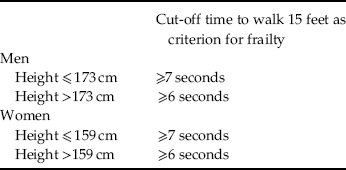
Frailty was measured using a modified Fried biological syndrome model (Fried et al. Reference Fried, Tangen, Walston, Newman, Hirsch, Gottdiener, Seeman, Tracy, Kop, Burke and McBurnie2001). Body mass index (BMI) was measured among participants by measuring standing height in centimetres using a stadiometer, and standing weight in kilograms using a clinical regularly calibrated weighing scales (measured to the nearest 0.1 kg), whereupon for both measurements the participant was instructed to only remove their shoes. The definition of weight loss was assessed objectively in our study as a BMI of <18.5 kg/m2, rather than the original criterion (a subjective report of weight loss of more than 10 pounds). This was reflective of similar adaptations for the weight loss criterion from other large population-based studies validating the biological syndrome model of frailty (Cigolle et al. Reference Cigolle, Ofstedal, Tian and Blaum2009). Subjective exhaustion was determined by asking participants about their energy levels over the past month. Slowness was defined in terms of walking speed using the cut points from the Cardiovascular Health Study (after adjusting for distance) (Fried et al. Reference Fried, Tangen, Walston, Newman, Hirsch, Gottdiener, Seeman, Tracy, Kop, Burke and McBurnie2001). These cut-off points are as follows:
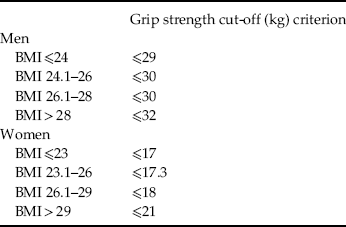
Weakness was defined by assessing grip strength using a Baseline brand hydraulic dynamometer with equivalence to the original Jamar dynamometer (Fabrication Enterprises International), with participants instructed to take two tries using each hand, and the same cut points were used as in the Cardiovascular Health Study (Fried et al. Reference Fried, Tangen, Walston, Newman, Hirsch, Gottdiener, Seeman, Tracy, Kop, Burke and McBurnie2001). These cut-off points are as follows:
In the TRIL follow-up assessment, limited resources meant that the physical activity frailty component was not recorded at follow-up. Thus, we report findings based on four components of frailty, rather than the original five criteria operationalised by Fried. We conducted a correlation analysis on the baseline data and found that there was a high significant correlation between baseline frailty results based on five and four items (r=0.955, p<0.001) suggesting that the omission of the physical activity component is unlikely to significantly affect results. Furthermore, we focus on the individual components more so than an overall frailty score (although the latter is investigated in a preliminary fashion).
Depression
Depressive symptomatology was evaluated using the Centre for Epidemiological Studies Depression (CES-D) 8 (Radloff, Reference Radloff1977), a brief version of the widely used original. Each item asks whether for ‘how much of the time during the past week’ an individual has felt a certain way. A total score between 0 and 8 is then computed with scores of 7 or above indicating case-level depressive symptomatology. The scale has previously been shown to have acceptable reliability (Cronbach’s α=0.78) and validity (test–retest correlation of r>0.5) (Radloff, Reference Radloff1977). In the current sample, the scale had a reliability of α=0.742.
Anxiety
Anxiety was evaluated using the Hospital Anxiety and Depression Anxiety Subscale (Zigmond & Snaith, Reference Zigmond and Snaith1983). Each of the seven items in this scale requires participants to report how often they would be likely to experience various symptoms of anxiety, on a four-point scale. A total score is then computed, which ranges from 0 to 21, where scores of 11 or over are indicative of caseness. The scale has previously been shown to have acceptable reliability (Cronbach’s α=0.85) and validity (test–retest correlation of r=0.4; Zigmond & Snaith, Reference Zigmond and Snaith1983). In the current sample, the scale had a reliability of α=0.787.
Neuroticism
Neuroticism was measured using a subscale of the revised Eysenck Personality Questionnaire (Eysenck & Eysenck, Reference Eysenck and Eysenck1991). This scale contains 23 items assessing neuroticism, with higher scores indicating higher levels of neuroticism. The scale has previously been shown to have acceptable reliability and validity (Alexopoulos & Kalaitzidis, Reference Alexopoulos and Kalaitzidis2003).
Comorbidities
The Charlson Comorbidity Index (Age Adjusted Comorbidity Index - AACI) (Charlson et al. Reference Charlson, Pompei, Ales and MacKenzie1987) is a method of quantifying the mortality risk of comorbid conditions (a total of 22 conditions are listed). Each condition is assigned with a score of 1, 2, 3, or 6, dependent on the risk of mortality associated with the condition. Scores are summed and a total is given, which can be used to predict mortality risk.
BMI
BMI is a widely used proxy for human body fat based on an individual’s weight and height. Measurements are given in kilograms divided by squared metres (kg/m2).
Timed Up and Go (TUG)
The TUG test (Mathias et al. Reference Mathias, Nayak and Isaacs1986) is a measure of mobility that involves the participant standing from a seated position, walking, turning, stopping, and sitting back down; all of which are relevant for independent mobility. The measure has acceptable test–retest validity (r=0.68) (Mathias et al. Reference Mathias, Nayak and Isaacs1986). The TUG test was used to evaluate walking speed, which instructs participants to stand up from a seated position and walk 3 m, turn, and walk back, all of which is timed using a stopwatch to 0.01 of a second.
Maximum grip strength
Grip strength was measured using a dynamometer (described above), which is grasped in each hand in turn by the participant who is then instructed to squeeze as hard as they can. Readings are given as pounds of pressure applied.
Data analysis
All analyses were performed using SPSS v.18.0 (SPSS Inc., USA). As the data were collected at two time points, an attrition weight was calculated using inverse probability weighting. A binary logistic regression, with hypothesised predictors of attrition between time points, was used to create the predicted probability of attrition for each participant. These hypothesised predictors were age, gender, polypharmacy, faller status, habitation status, depressive symptomatology, anxiety symptomatology, loneliness, and neuroticism. The inverse of the predicted probability (i.e. 1/predicted probability) was then applied as a case-by-case weight to each participant in the data set. With this attrition weight set, all data from Wave 1 (n=624) and Wave 2 (n=447) were thus used in the analyses presented below.
Six outcomes were of interest in the current study. Each of the four available frailty components were operationalised in a binary fashion, whereby a value of 1 indicated that the participant had transitioned negatively over time within that component, and a value of 0 indicated that they had not. The BMI change variable for instance took a value of 1 when there was a decrease in BMI moving from baseline to follow-up, and a value of 0 when no such change was observed. The grip strength change variable similarly took a value of 1 when there was a decrease in grip strength between baseline and follow-up, and a value of 0 when no such change was observed. The same rule was applied for the creation of the speed change and exhaustion change variables. A binary overall frailty transition variable was constructed such that 1 indicated that the participant had transitioned negatively over time in overall frailty (i.e. moved from being robust, with a score of 0, to pre-frail with a score of 1 or 2, or to frail, with a score of 3 or 4, or else from pre-frail to frail). Death was assigned a score of 6 in the follow-up frailty index, such that we were also able to capture transitions to death in our sample. Finally, we investigated individuals who improved in their frailty status over time, relative to those who did not, as a binary variable with a score of 1 indicating that the participant had transitioned positively over time in overall frailty, and a score of 0 indicating that they had not.
Logistic regression models were then used for each binary outcome to determine the association between hypothesised predictors and transition status in each of the four frailty components, in overall frailty, and finally in improvements in frailty. Predictors for all regression models were age, gender, comorbidity index, neuroticism, anxiety, and depressive symptomatology. Dependent variables were those listed as above; BMI change (model 2a), grip strength change (model 2b), speed change (model 2c), exhaustion change (model 2d), overall frailty change (model 2e), and improvements in frailty (model 2f).
Results
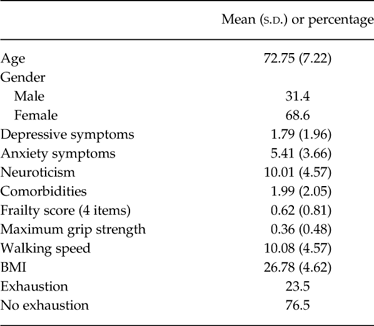
At baseline 280 (44.9%) participants were robust, 283 (45.3%) were pre-frail, and 61 (9.8%) were frail. At follow-up, 223 (49.8%) were robust, 183 (41%) were pre-frail, 5 (1%) were frail, and 19 (4.3%) had deceased (with information on frailty missing for 3.9% of the sample). There was a global attrition rate of 26% (n=159) between waves. In all, 71 could not be contacted by telephone, 27 had deceased, 29 declined to take part, 17 cited medical reasons for their drop-out, and the clinical staff were unable to locate 15 participants. Due to the fact that six analyses were planned, Bonferroni corrections were applied and α was set at 0.008 (see Table 1 for a description of the sample).
Sample characteristics of Technology Research for Independent Living participants at baseline (Wave 1)

BMI, body mass index.
Depressive symptoms (using the Centre for Epidemiological Studies Depression (CES-D) 8 measure), anxiety symptoms (using the hospital anxiety and depression anxiety subscale (HADS)), neuroticism (using the Eysenck Personality Questionnaire), comorbidities (using the non-age-adjusted Charlson Comorbidity Index), Fried frailty score (based on four items), maximum grip strength over two measures of each hand using a dynamometer, walking speed (based on the Timed Up and Go test), BMI (measured using centimetre and kilogram), and exhaustion (measured as a single-item from the CES-D 8 measure).
Of the 447 participants assessed at follow-up, two (0.4%) had transitioned negatively in BMI, 65 (14.6%) transitioned negatively in grip strength, seven (1.5%) had transitioned negatively in their walking speed, 35 (7.9%) had transitioned negatively in exhaustion, and 86 (18.3%) had transitioned negatively in overall frailty (59 went from robust to pre-frail, 13 from pre-frail to frail, and 14 from robust directly to frail). Interestingly, a further 89 individuals improved their frailty score at follow-up by at least one point. Regression analyses were then performed for the change outcome variables.
BMI change
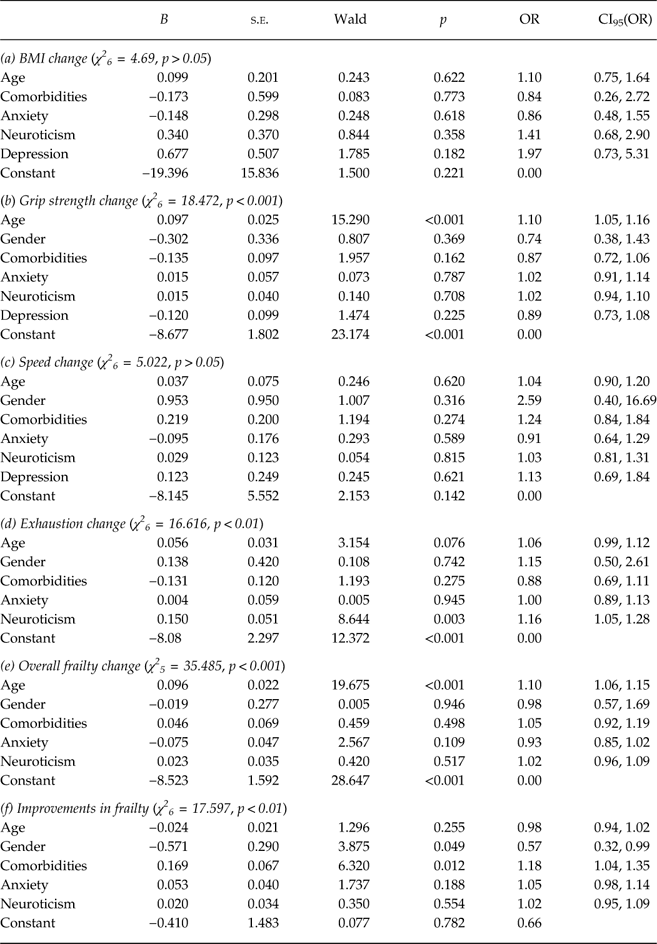
The first analysis (model 2a) was performed to predict BMI change over time. We include details of each regression model in Table 2, divided into subsections relevant to each outcome, with each predictor listed in turn and its associated statistics (see Table 2). Statistical output included the overall goodness of fit of the model, assessed using a χ 2 statistic. The models then go on to describe the Wald’s χ 2 statistic and its related two-tailed p-value relevant to the coefficient for each predictor as a measure of its association with the outcome variable. The tables include odds ratios (OR), which is a relative measure of effect, and can be interpreted as meaning that the outcome increases with increases in the predictor if the OR is >1, but that the outcome decreases with increases in the predictor if the OR is <1. An OR of 1 indicates no relationship between the predictor and the outcome. Confidence intervals were also offered related to the OR, which can help in the interpretation of the OR significance since if the interval contains 1, it cannot be concluded that there is a significant relationship between the predictor and the outcome.
Logistic regression models predicting (a) Body mass index (BMI) change, (b) grip strength change, (c) speed change, (d) exhaustion change, and (e) overall frailty change, between baseline and follow-up conditions, with age, gender, comorbidities, neuroticism, anxiety, and depressive symptomatology at baseline as predictors (with depressive symptomatology removed from models d and e), reporting odds ratios (OR) for all effects
CI, confidence interval.
Comorbidities, measures on the non-age-adjusted Charlson Comorbidity Index (Charlson et al. Reference Charlson, Pompei, Ales and MacKenzie1987); anxiety, scores on the Hospital Anxiety and Depression Anxiety Subscale (Zigmond & Snaith, Reference Zigmond and Snaith1983); neuroticism, scores on the neuroticism scale of the Eysenck Personality Inventory Revised Version (Eysenck & Eysenck, 1991); depression, scores on the Centre for Epidemiological Studies Depression scale (Radloff, Reference Radloff1977).
Due to the fact that numbers were so small in the ‘negative transitions’ cell of BMI change, and a resulting lack of power in relation to gender as a categorical predictor, we omitted gender as a variable from this analysis. The analysis did not produce a significant model (χ 26=4.69, p>0.05; see Table 2a) and none of the predictors were found to be related to the outcome.
Grip strength change
A second analysis was performed to predict grip strength change over time (model 2b), and this analysis did produce a significant model (χ 26=18.472, p<0.001), correctly classifying 86.5% of cases and producing a good fit according to the Hosmer–Lemeshow test (χ 28=9.898, p>0.05).
In this model, age was a significant predictor of grip strength change, with an OR of 1.10, indicating that increased age was associated with an increased likelihood of declines in grip strength (see Table 2b).
Speed change
Speed change was then assessed using a logistic regression and the same predictors as above (see model 2c), but the model was not significant (χ 26=5.022, p>0.05; see Table 2c).
Exhaustion change
Exhaustion change was then analysed, with depression removed from the model as the CES-D scale contains an item about exhaustion (model 2d). The model was significant (χ 26=16.616, p<0.01) and correctly classified 92.5% of cases, presenting a good fit to the data according to the Hosmer–Lemeshow test (χ 28=4.518, p>0.05). Neuroticism was a significant predictor of exhaustion change (see Table 2d), with an OR of 1.16, suggesting that increased scores on the neuroticism scale were associated with an increased likelihood of transitioning in exhaustion at follow-up.
Overall frailty change
A logistic regression model was created to predict overall frailty change (model 2e). Again depression was excluded from the model. The model was significant (χ 25=35.485, p<0.001) and correctly classified 81.1% of cases, also indicating a good fit (Hosmer–Lemeshow test: χ 28=12.868, p>0.05). Only age was a significant predictor in this model, with an OR of 1.10, indicating that increased age was associated with an increased likelihood of transitioning in overall frailty at follow-up (see Table 2e).
Improvements in frailty
We then decided to investigate those individuals who improved in frailty, that is transitioned positively by one or more points on the index, over time. Once more depression was excluded from the model. A similar model as that performed above with overall frailty change was performed with improvements in frailty as an outcome, where 1 indicated that the individual had improved, and 0 indicated that they had stayed the same or gotten worse. The model (model 2f) was statistically significant (χ 26=17.597, p<0.01) and correctly classified 80.9% of cases, indicating a good fit (Hosmer–Lemeshow test: χ 28=5.143, p>0.05). Only gender and comorbidities were significant as predictors, with an OR of 0.57 such that females were more likely to positively transition over time (see Table 2f), and an OR of 1.18 relating to comorbidities, indicating that individuals higher in comorbidities were more likely also to positive transition over time.
Conclusions
The current findings demonstrate that age and neuroticism alone were associated with transitions in frailty status over time, specifically within exhaustion, grip strength, and overall frailty, measured using a modified Fried’s frailty phenotype. The pattern of results is interesting as age is frequently found to be associated with frailty within the literature, other factors known to relate to frailty such as gender and comorbidity were not found to be predictive of transitions in frailty here. Neither were depressive symptomatology and anxiety found to predict transition in frailty components, which is also inconsistent with previous findings which found an association between these factors and frailty status (Alexopoulos et al. Reference Alexopoulos, Vrontou, Kakuma, Meyers, Young, Klausner and Clarkin1996; Harter et al. Reference Harter, Conway and Merikangas2003; Ostir et al. Reference Ostir, Ottenbacher and Markides2004; Yang & George, Reference Yang and George2005; Avlund et al. Reference Avlund, Rantanen and Schroll2006; Chen et al. Reference Chen, Wu, Chen and Lue2010). However, these factors do not relate to changes in frailty over time, which may possibly accord with the observation made by some researchers that anxiety and depression may accompany frailty, rather than representing an antecedent per se (Bernal-Lopez et al. Reference Bernal-Lopez, Potvin and Avila-Funes2012; Mezuk et al. Reference Mezuk, Edwards, Lohman, Choi and Lapane2012). Depression and anxiety as defined in the current study are state variables and therefore relatively transient, whereas neuroticism, which was found to predict change in exhaustion over time, is a trait variable and therefore relatively stable. Therefore it is possible that neuroticism would constitute an antecedental factor in frailty transitions, as it would remain relatively stable over time and could therefore have a long-term, longitudinal impact upon physical health and frailty.
In the current study, neuroticism was found to relate specifically to transitions in exhaustion. The exhaustion component was assessed as a yes/no response to a question about energy levels within the past month. As this was a subjectively reported symptom, it is concordant that neuroticism would be associated, as neuroticism levels are associated with the tendency to endorse negative symptoms (Merkelbach et al. Reference Merkelbach, Konig and Sittinger2003). Furthermore, neuroticism has previously been linked to emotional exhaustion (Tai & Liu, Reference Tai and Liu2007), which may explain our current finding. Alternatively, having high levels of neuroticism and resulting tendency to engage in worry may in itself be exhausting (Calderwood & Ackerman, Reference Calderwood and Ackerman2011).
We investigated improvements in frailty over time, of which there were a small number, and found that while the model was reported as significant, no one variable was a significant predictor of improvement. Gender was approaching significance, suggesting possibly that women are more likely to improve in frailty over time than men. This is interesting as the same finding was recently reported in the English Longitudinal Study of Ageing (Nazroo & Marshall, Reference Nazroo and Marshall2014). Further research on frailty trajectories are required to make more conclusive statements about this finding.
It should be noted that the current results are based on data collected from community-dwelling participants who represent a healthy subset, unrepresentative of the overall older Irish population, and because of this results may not be generalisable. Another point of caution pertains to the use of an incomplete Fried frailty phenotype. Due to resource constraints it was not possible to record the physical activity component at follow-up, which may have produced an under-estimate of the negative transitions in overall frailty. It is possible to hypothesise that within the 2-year interim period between baseline and follow-up, physical activity would likely have overall decreased with increasing age as has previously been suggested (Schutzer & Graves, Reference Schutzer and Graves2004). In calculating an overall frailty status score, this issue may have repercussions. First, there were a number of participants who would have had a maximum score (of 5) on the Fried frailty index at baseline, and had they remained the same at follow-up, it would not have been noted as only four of the criteria were recorded at follow-up. However, positive transitions and no transitions were pooled as a single level, so the potential occlusion of these highly frail individuals making a positive transition of 1 down the index would not have been specifically of interest at any rate. The same cannot be said, however, for participants who scored 4 on their baseline frailty index, and who would have negatively transitioned in the physical activity component to arrive at a score of 5 in the follow-up, had this component been recorded. These participants would be erroneously classified as having maintained frailty over time, instead of having transitioned negatively by a score of 1. However, again scores of 3, 4, and 5 were pooled to create the category ‘frail’, so those participants who would have hypothetically moved from a score of 4 to a score of 5 would have instead been classified as remaining in the same category over time, and the increased score would not have been of interest.
Second, as the Fried phenotype is a five-component structure, removing one component may have implications for the overall reliability of the index. It could be said that the overall frailty status here assessed, while highly correlated with the four-item version at baseline, is not a valid measure. Despite this, the interpretation of the individual components is nevertheless a valid approach to investigating transitions in frailty over time among older adults, and these results are likely more interpretable than those related to the overall frailty status transition variable, which should be thus interpreted with caution. Another note of caution should be made concerning the analyses of transitions in BMI over time as only two individuals transitioned negatively over time (i.e. lost weight). This fact may account for our failure to find a meaningful model of change in BMI over time, but any interpretation of this failure to find significance must take into consideration the low numbers in this transitional group.
The current findings have significant clinical implications for older adults. As age and neuroticism both appear to have a causal influence on frailty transitions in older adults, at a clinical level, these risk factors should be considered when assessing mortality risk. Neuroticism has frequently been defined as a trait tendency to experience psychological distress and physical distress (Stone & Costa, Reference Stone and Costa1990; Eysenck & Eysenck, 1991) and therefore is suitable as a screening tool or a factor when attempting to identify those at increased risk of frailty and mortality risk. Further research could help elucidate whether indeed frailty may partially mediate the relationship between neuroticism and mortality risk.
Acknowledgements
The authors thank the participants of the TRIL study and staff who helped collect the research data. This research was conducted as part of the TRIL research project. The authors thank the participants, clinical staff, and researchers who were involved in data collection, and especially to Tim Foran and Lisa Crosby for their assistance in gathering clinical data.
Financial Support
This work was conducted in the TRIL Centre, which was funded by the IDA, Intel Ireland, and GE Healthcare.
Conflicts of Interest
None.
Ethical Standards
The authors assert that all procedures contributing to this work comply with the ethical standards of the relevant national and institutional committee on human experimentation with the Helsinki Declaration of 1975, as revised in 2008. The study protocol was approved by the institutional review board of each participating institution. Written informed consent was obtained from all participating patients.