INTRODUCTION
During an ecological and taxonomic study, focused on the meiobenthos of Patagonian bays (Río Negro and Chubut provinces, Argentina), new free-living marine nematodes were found. This is the fifth paper of the series. From these areas we describe two new species of the genus Epacanthion Wieser, Reference Wieser1953.
The genus Epacanthion belongs to the family Thoracostomopsidae Filipjev, Reference Filipjev1927. This family is composed of three subfamilies: Thoracostomopsinae Filipjev, Reference Filipjev1927, with only one genus (Thoracostomopsis Ditlevsen, Reference Ditlevsen1918); Trileptiinae Gerlach & Riemann, Reference Gerlach and Riemann1974, that has only one genus too (Trileptium Cobb, Reference Cobb1933); and Enoplolaiminae De Coninck, Reference De Coninck and Grasse1965. The subfamily Enoplolaiminae is mainly marine species but has freshwater species. This subfamily has 18 genera and can be distinguished from the other subfamilies by the presence in the buccal cavity of three broad mandibles, formed of two longitudinal rods joined by a thin membrane between, and a cephalic capsule strongly sclerotized with three lips and the cephalic setae above them.
The most complete revision of the genus Epacanthion was made by Greenslade & Nicholas (Reference Greenslade and Nicholas1991). They established 21 species as belonging to it. Afterwards, Gagarin (Reference Gagarin2009) has described one new species (E. macrolaimus) from the Mediterranean Sea and Guilherme et al. (Reference Guilherme, Da Silva and Esteves2009) have described another one (E. agubernaculus) from Brazil. In this last work, a new key for species identification was proposed.
We describe two new species of Epacanthion: E. bicuspidatum sp. nov. and E. ampullatum sp. nov.
MATERIALS AND METHODS
Description of sites studied
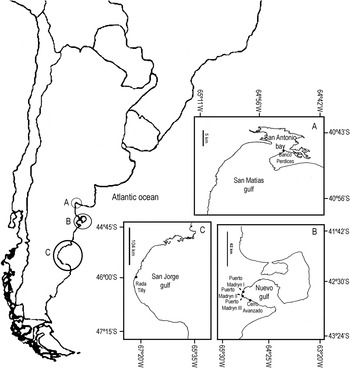
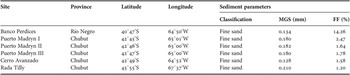
Samples were collected from the Patagonia littoral coastal region in seven separate locations at three different latitudes (Table 1; Figure 1).
Map showing the three sampling areas with the location of samples stations: (A) San Antonio Bay (Río Negro); (B) Nuevo Gulf (Chubut); (C) San Jorge Gulf (Chubut).

List of sampling sites with sediment parameters (classification, mean grain size and fine fraction).

The northernmost site (Banco Perdices) is in San Antonio Bay, Río Negro province. This bay is located in the north-west of San Matías Gulf. This bay is composed of a shallow channel system with small islands and sandbanks, which are completely covered at high tide. The tidal amplitude reaches 9.30 m, with low tides exposing a muddy area of 7 km width.
Four sampling sites are located in Nuevo Gulf, Chubut province. Three of these sites are in the coastal area of Puerto Madryn city (Puerto Madryn I, II and III), and the other is further south (Cerro Avanzado). Nuevo Gulf is situated in the southern part of Península Valdés. This gulf is a semi-enclosed basin of 65 km in length and 46 km in width with 16.5 km in the mouth. Tidal current is the most important movement of water with tidal amplitude of 4 m.
The southernmost site (Rada Tilly) is located at the central coast of the San Jorge Gulf, Chubut province. This gulf is a semicircle with 145 km of radius and 220 km of width of mouth. The tidal amplitude varies between 4 and 6 m.
Sample collection and treatment
On each site, five sediment samples were taken with a cylindrical Plexiglas corer (10 cm high and 2.8 cm in diameter). The samples were preserved in 5% formaldehyde in filtered seawater, and then were sieved through both 500 µm and 50 µm mesh sieves. The nematodes present on the 50 µm sieve were separated by Ludox® TM. Nematodes were fixed following the method described by Ditlevsen (Reference Ditlevsen1911) and preserved in anhydrous glycerin, counted and mounted on slides sealed with Canada X resin. Then they were identified to species level.
Specimen analysis
Morphometrics data were obtained from camera lucida drawings using a Zeiss microscope with differential interference constrast (DIC). The measurements are in microns. Photographs were taken with Olympus BX51 microscopy equipment with DIC equipped with a Nikon D80 digital camera. Sediment analyses were carried out by dry sieving and classified according to the Wentworth scale. The literature has been obtained from NeMys (Deprez, Reference Deprez2006). Type specimens were deposited in the Museo Nacional de Ciencias Naturales ‘Bernardino Rivadavia', and the paratypes were deposited at the Nematodes Patagónicos collection in the Centro Nacional Patagónico, Argentina. De Man's ratios, a, b and c used in this paper were calculated as standard.
Abbreviations used in this paper
bcl, buccal cavity length; bcw, buccal cavity width; cbd, cloacal body diameter; cs ant, anterior cervical setae; cs post, posterior cervical setae; daa, distance from anterior end to anus; daph, pharynx length; dav, distance from anterior end to vulva; mbd, maximum body diameter; hd, head diameter; lcs, length cephalic setae; llsi, length internal labial setae; llse, length external labial setae; Spic, spicular length in microns, along the arc; Spic%, spicule chord as proportion of anal body diameter; c’, tail in anal diameter; Gub, gubernaculum length; Gub%, gubernaculum length as proportion of anal body diameter; L, total body length; Lo ant, length antidromously reflected anterior ovary; Lo post, length antidromously reflected posterior ovary; V%, distance from the anterior end to the vulva opening in percentage of total length; T, tail length; PS, pre-cloacal supplement. Measurements are in µm.
RESULTS AND DISCUSSION
SYSTEMATICS
Order ENOPLIDA Filipjev, Reference Filipjev1929
Suborder ENOPLINA Chitwood & Chitwood, Reference Chitwood and Chitwood1937
Superfamily ENOPLOIDEA Dujardin, Reference Dujardin1845
Family THORACOSTOMOPSIDAE Filipjev, Reference Filipjev1927
Subfamily ENOPLOLAIMINAE De Coninck, Reference De Coninck and Grasse1965
Genus Epacanthion Wieser, Reference Wieser1953
Epacanthion bicuspidatum sp. nov.
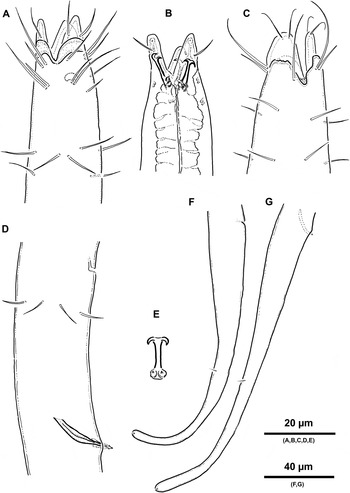
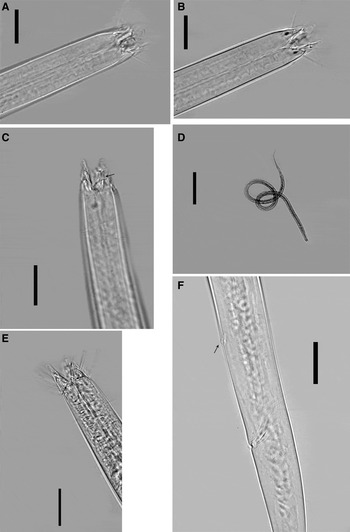
(Figure 2; Plate 1; Table 2)
Epacanthion bicuspidatum sp. nov.: (A) anterior end of male holotype; (B) head and buccal cavity with mandible of male holotype; (C) anterior end of female paratype; (D) copulatory apparatus and pre-cloacal supplement of male holotype; (E) mandible and teeth of male holotype; (F) posterior end of female paratype; (G) posterior end of male holotype. Scale bars: A–E = 20 µm; F, G = 40 µm.

Epacanthion bicuspidatum sp. nov.: (A) mandible and teeth of female paratype; (B) buccal cavity of female paratype; (C) view of teeth on proximal end of mandibles, and body of mandibles of male holotype (arrow); (D) entire male holotype; (E) view of mandibles cusps with tooth laterally of male holotype (arrows); (F) copulatory apparatus and pre-cloacal supplement of male paratype (arrow). Scale bars: A, B, C, E & F = 40 µm; D = 200 µm.

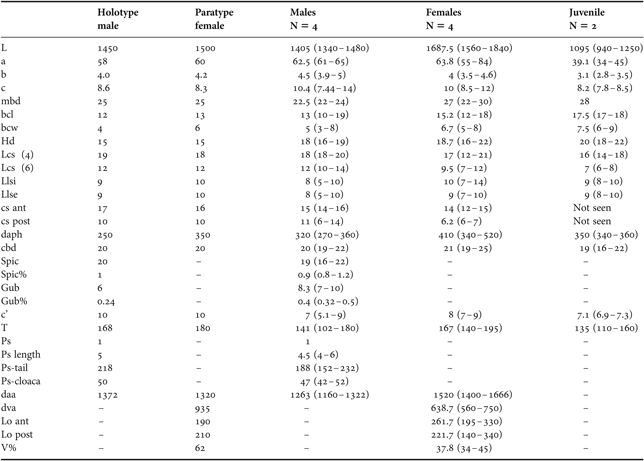
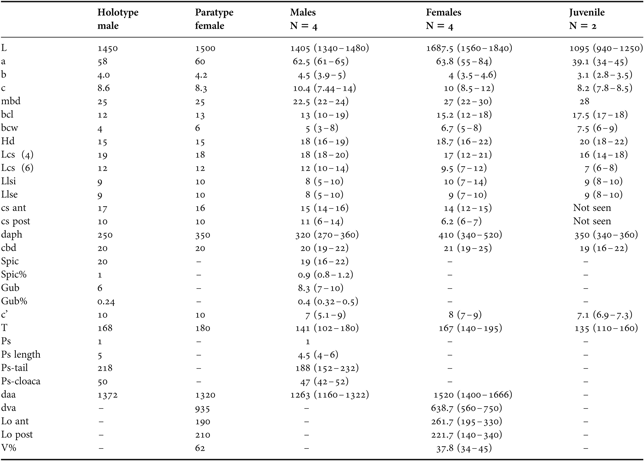
Measurements (μm) of Epacanthion bicuspidatum sp. nov. (range, mean value in parentheses).
TYPE MATERIAL
Holotype: adult male. Registration number MACN-In 39287; type locality: Puerto Madryn I; coordinates: 42°45′S 65°01′W; low littoral. Collected by C.T. Pastor de Ward and V. Lo Russo, 1 March 2006.
Paratype: adult female. Registration number MACN-In 39288; type locality: Puerto Madryn I; coordinates: 42°45′S 65°01′W; low littoral. Collected by C.T. Pastor de Ward and V. Lo Russo, 1 March 2006.
OTHER MATERIAL
– Two males and one female. Registration numbers CNP NEM 1612–1614; type locality: Puerto Madryn II; coordinates: 42°46′S 65°00′W; low littoral. Collected by C. Harguinteguy, 15 June 2003.
– One male. Registration number CNP NEM 1615; type locality: Cerro Avanzado; coordinates: 42°49′S 64°52′W; low littoral. Collected by C. Harguinteguy, 15 June 2003.
– One male and two females. Registration numbers CNP NEM 1616–1618; type locality: Puerto Madryn I; coordinates: 42°45′S 65°01′W; low littoral. Collected by C.T. Pastor de Ward and V. Lo Russo, 1 March 2006.
– One female. Registration number CNP NEM 1619; type locality: Puerto Madryn III; coordinates: 42°47′S 65°00′W; low littoral. Collected by C. Harguinteguy, 15 June 2003.
– Two juveniles. Registration numbers CNP NEM 1620 and 1621; type locality: Banco Perdices; coordinates: 40°47′S 64°50′W; high littoral. Collected by G. Villares and V. Lo Russo, 14 February 2009.
ETYMOLOGY
From Latin word bicuspidatum (adj.) =bicuspid, two cusps on the basis of the mandible.
MATERIAL EXAMINED
Measurements: see Table 2.
DESCRIPTION
Male (holotype): cylindrical body (L = 1450 µm). Smooth cuticle. Sclerotized cephalic capsule. Lips smooth and associated with three strongly sclerotized mandibles (10 µm long) composed each one of two longitudinal solid bars united by a thin membrane. The mandibles are straight with a proximal end expanded laterally ending in two curved teeth on each side. Two cusps with two teeth on the basis of each mandible were observed.
Each lip presents two labial setae (9–10 µm). There are six short (12 µm) and four long (19 µm) cephalic setae inserted at base of lip flats. Six long (17 µm) and six short (10 µm) cervical setae inserted below the position of the amphidial fovea. Eight setae arranged in two circles in the cervical region and below a third circle consisting of four setae. Somatic setae (6–8 µm) on the body follow a pattern standing in crowns, never found scattered.
Amphidial fovea slightly distinct, 4 µm width. Oesophagus cylindrical, long and muscular (250 µm long). Reproductive system diorchic, testes located at the left of the intestine, extending to the anterior region of the body. Two short, equal spicules, 20 µm (1 cbd) in chord length. Gubernaculum present, triangular in shape. One tubular and sclerotized pre-cloacal supplement (5 µm long), 50 µm distant from the cloaca and 218 µm distant from the extreme of the tail. Eight setae (6 µm long) arranged in a circle below the pre-cloacal supplement and located 35 µm distant from the cloaca. Tail cylindrical–conical in shape (168 µm long). Caudal glands not observed.
Female (paratype): females are similar to males in general body shape. Reproductive system diorchic, with two antidromously reflexed ovaries left to the intestine. Vulva 62% of body length, short vagina. Tail 180 µm long, cylindrical–conical in shape.
DIAGNOSIS AND RELATIONSHIPS
Epacanthion bicuspidatum sp. nov. is characterized by having two cusps on distal mandible end, the presence of two rings of eight setae in the cervical region and eight setae crown-shaped along the body, the presence of one supplement distant two cbd from cloacae, gubernaculum and short spicule.
Depending on the length of the spicules, the species of Epacanthion can be classified in two main groups. One with species with long spicules, more than 2 anal diameters, which includes: E. agubernaculus Guilherme et al., Reference Guilherme, Da Silva and Esteves2009; E. brevispiculosum Mawson, Reference Mawson1958; E. bütschlii (Southern, Reference Southern1914); E. durapelle (Kreis, Reference Kreis1929); E. microdentatus Wieser, Reference Wieser1953; E. nadjae Sergeeva, Reference Sergeeva1974; E. polysetosum (Jensen, Reference Jensen1986); E. saveljevi (Filipjev, Reference Filipjev1927); and E. stekhoveni Greenslade & Nicholas, Reference Greenslade and Nicholas1991. And the other with species with short spicules, less than 2 anal diameters, which includes: E. brevispiculum Mawson, Reference Mawson1956; E. enoploidiforme (Gerlach, Reference Gerlach1953); E. exploratoris Greenslade & Nicholas, Reference Greenslade and Nicholas1991; E. galeatum Boucher, Reference Boucher1977; E. georgei Inglis, Reference Inglis1971; E. gorgonocephalum Warwick, Reference Warwick1970; E. macrolaimus Gagarin, Reference Gagarin2009; E. mawsoni Warwick, Reference Warwick1977; E. multipapillatum (Wieser, Reference Wieser1959); E. oliffi Inglis, Reference Inglis1966; E. oweni Keppner, Reference Keppner1986; and E. pellucidum (Saveljev, Reference Saveljev1912). Into the second group there are species with several (E. multipapillatum and E. oweni) or no precloacal organs (E. enoploidiforme, E. georgei, E. gorgonocephalum and E. oliffi). The rest of the species with short spicules has one precloacal organ. Our species, E. bicuspidatum sp. nov., belongs to this group.
Epacanthion bicuspidatum sp. nov. has a distance of 2.5 anal diameters between the precloacal organ and the cloaca, and a long tail of about 8 anal diameters. Hence, it can be disthinguished from E. brevispiculum, E. macrolaimus and E. pellucidum because all of them have a shorter distance precloacal organ—cloaca (1.8, 2 and 2 anal diameter, respectively) and a shorter tail (5, 2.5 and 5.5 anal diameter). Our species has the somatic setae arranged in crows along the body and can be distinguished from E. galeatum that has long somatic setae scattered throughout the body. Epacanthion exploratoris has a gubernaculum with rounded posterior apophysis whereas E. bicuspidatum has not. The spicules are rather straight in the new species and arcuate in E. mawsoni.
Genus Epacanthion Wieser, Reference Wieser1953
Epacanthion ampullatum sp. nov.
(Figure 3; Plate 2; Table 3)
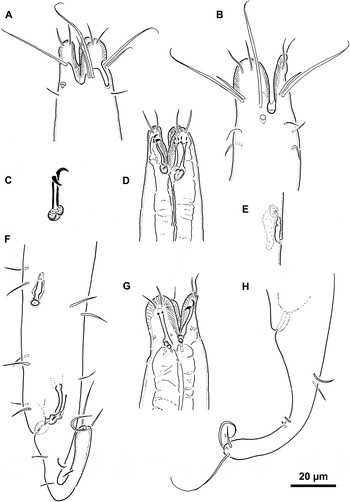
Epacanthion ampullatum sp. nov.: (A) anterior end of male holotype; (B) anterior end of female paratype; (C) mandible of male holotype; (D) head and buccal cavity with mandible of male holotype; (E) detail of the precloacal supplement; (F) copulatory apparatus and pre-cloacal suplement; (G) head and buccal cavity with mandible of female paratype; (H) posterior end of female paratype. Scale bars: A–H = 20 µm.

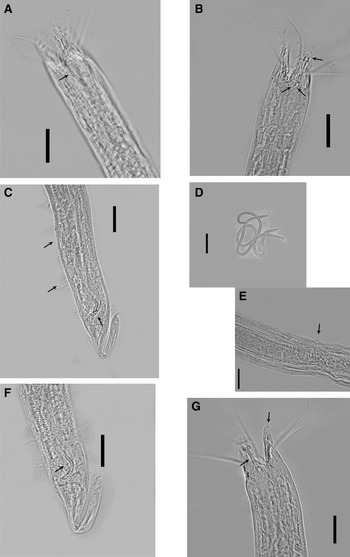
Epacanthion ampullatum sp. nov.: (A) amphidial fovea on head of female paratype (arrow); (B) bifid proximal end of the mandible with two lateral teeth (arrow) and view of two teeth on distal end of mandibles (arrows) of male holotype; (C) pre-cloacal supplement, pre-cloacal setae and gubernaculum of male holotype (arrows); (D) entire male holotype (M 1) and male paratype (M 2); (E) vulva (arrow); (F) posterior end and spicule of male holotype (arrow); (G) lip and body of mandibles of female paratype (arrows). Scale bars: A–C, E–G = 40 µm; D = 200 µm.

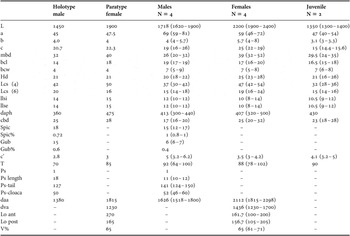
Measurements (μm) of Epacanthion bicuspidatum sp. nov. (range, mean value in parentheses).

TYPE MATERIAL
Holotype: adult male. Registration number MACN-In 39289; type locality: Rada Tilly; coordinates: 45°55′S 67°35′W; mid-littoral. Collected by C.T. Pastor de Ward, 1 April 2006.
Paratype: adult female. Registration number MACN-In 39290; type locality: Rada Tilly; coordinates: 45°55′S 67°35′W; mid-littoral. Collected by C.T. Pastor de Ward, 1 April 2006.
OTHER MATERIAL
– Four males, four females and one juvenile. Registration numbers CNP NEM 1622–1630; type locality: Rada Tilly; coordinates: 45°55′S 67°35′W; mid-littoral. Collected by C.T. Pastor de Ward, 1 April 2006.
ETYMOLOGY
From Latin word ampullatum (adj.) = blister, refers to presence of ampulla.
MATERIAL EXAMINED
Measurements: see Table 3.
DESCRIPTION
Male (holotype): cylindrical body (L = 1450 µm). Smooth cuticle. Sclerotized cephalic capsule. Lips striated and composed of three sclerotized mandibles (18 µm long) of two longitudinal solid bars united by a thin membrane, mandibles expanded laterally in the proximal end with one tooth on each side. Two cusps with one small tooth on each were observed on their distal end.
Two labial (14 µm) setae were observed in each lip. Six short (20 µm) and six long (42 µm) cephalic setae inserted at base of lip flats. Somatic setae are present (8 µm) on the body, with no distinct pattern. Amphidial fovea very small, slightly distinct 2 µm width. Oesophagus cylindrical, long and muscular (360 µm long). Reproductive system diorchic, testes located at the left of the intestine, extending to the anterior region of the body. Two short, equal spicules, 18 µm (0.72 cbd) in chord length. Gubernaculum present, triangular in shape. One long tubular precloacal supplement, sclerotized (15 µm long), 50 µm in front of the cloaca and 127 µm distant from the extreme of the tail. Tail 70 µm long, (2.8 cbd), approximately 1/2 cylindrical in shape. In the tip of the tail are seen two long setae (20 µm) and one short setae (9 µm). Caudal glands not observed.
Female (paratype): females are similar to males in general body shape. Reproductive system diorchic, with two antidromously reflexed ovaries left to the intestine. Vulva 65% of body length, short vagina. Tail 85 µm long, (3 cbd) approximately 1/2 cylindrical in shape. Two long setae (33 µm) and one short setae (8 µm) on the tip of the tail. Caudal glands not observed.
DIAGNOSIS AND RELATIONSHIPS
Epacanthion ampullatum sp. nov. is characterized by having a tubular and long pre-cloacal supplement distant three cbd from cloacae, short spicule, presence of gubernaculum, presence of three long setae on the tip of the tail, the presence of one supplement and the presence of two small cusps on the distal end of the mandible.
Epacanthion ampullatum as Epacanthion bicuspidatum, also belongs to the group characterized by short spicules and one precloacal supplement, but differs from all of them by having the largest distance between the precloacal supplement and the cloaca (3 anal diameters in the new species versus 2 to 2.5 in the others). Epacanthion galeatum, E. mawsoni and E. pellucidum have a long tail (more than 5 anal diameters) and no setae on its tip whereas E. ampullatum has a short tail (less than 3 anal diameters) and three long setae on the tip of the tail. From E. macrolaimus and E. brevispiculum our species can be distinguished by the length of the spicules that is about 1.5 anal diameters in them instead of less than 1 anal diameter in E. ampullatum. As E. ampullatum, E. galeatum has long terminal setae, but differs in the number of them (3 versus 2). The other difference between these two species is the shape of the gubernaculum that has apophysis in E. galeatum but not in E. ampullatum.
ADDITIONAL CONSIDERATIONS
As Epacanthion murmanicum Saveljev, Reference Saveljev1912 was described without figures and appears to be similar to E. georgei, it was considered as species inquerendae by Greenslade & Nicholas (Reference Greenslade and Nicholas1991). For that reason it was not considered in the previous comparisons. Epacanthion flagellicauda Gerlach, Reference Gerlach1956 also was not considered because it is only known from one juvenile.
The last key for Epacanthion is from Guilherme et al. (Reference Guilherme, Da Silva and Esteves2009), that is a modified version of that present in Greenslade & Nicholas (Reference Greenslade and Nicholas1991). We modified here a part of that key to add our two new species and E. macrolaimus Gagarin, Reference Gagarin2009.
10. Spicules 2.5 anal diameters, gubernaculum present, lips not striated……………E. microdentatus
– Spicules less than 2.5 anal diameters, lip flaps striated……………10’
10’. Spicules about 2 anal diameters……………E. macrolaimus
– Spicules about 1 anal diameter……………11
11. Small species (1.5–2.0 mm long), posterior rim of cephalic capsule crenelated……………11’
– Large species (2.2–2.9 mm long), posterior rim of cephalic capsule not crenelated……………E. exploratoris
11’. Tail with caudal setae……………E. ampullatum sp. nov.
– Tail without caudal setae……………11’’
11’’. Somatic setae following a pattern standing in crowns.………………E. bicuspidatum sp. nov.
– Somatic setae sparse without a pattern……………E. galeatum.
ACKNOWLEDGEMENTS
This work was supported by PNUD-GEF-Secretaría de Medio Ambiente de Nación-CONICET, Argentina. We acknowledge two anonymous referees for improving this manuscript with their comments.