Introduction
The genus Tinospora Miers (Menispermaceae) has about 32 species distributed in tropical Africa, Madagascar, Asia to Australia and the Pacific Islands (Forman, Reference Forman1981; Kubitzki et al., Reference Kubitzki, Rohwer and Bittrich1993; Mabberley, Reference Mabberley2005). In India, the genus is represented by four species. Of these, two species, Tinospora cordifolia (Willd.) Hook.f. & Thomson and T. sinensis (Lour.) Merr., are known to occur in South India. The other two, Tinospora crispa (L.) Hook.f. & Thomson and T. glabra (Burm.f.) Merr., are reported from Northeast India and the Andaman Islands (Pramanik & Gangopadhyay, Reference Pramanik, Gangopadhyay, Sharma, Balakrishnan, Rao and Hajra1993). During intensive botanical studies along the Western Ghats of Kerala state in South India, the authors collected an interesting species from Vellanimala forest in Thrissur district. This turned out to be a new species of Tinospora and is described and illustrated here.
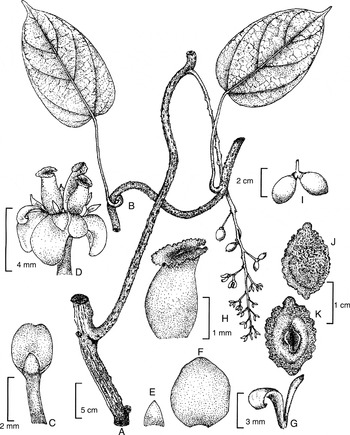
Tinospora formanii Udayan & Pradeep, sp. nov.Fig. 1.
Tinosporae smilacinae Benth. affinis floribus numerosis pseudoracemosis 5–18 cm longis, sepalis exterioribus et interioribus similis, petalis quam sepalis majoribus, eglandulosis, carpophoro 2-ramoso, drupis magnis (2–2.5 cm diam.) ellipsoideis et verrucosis differt. – Type: India, Kerala, Thrissur District, Vellanimala, in semi-evergreen forest, 550–600 m, 24 ii 2005, Udayan 03374 (holo CMPRFootnote a; iso K, MH).
Tinospora formanii Udayan & Pradeep. A, a twig with female inflorescence; B, a twig showing leaves; C, female flower bud; D, female flower; E, sepal; F, petal; G, outer and inner staminodes; H, carpophore; I, fruits; J, endocarp, dorsal view; K, endocarp, ventral view (A, I–K from Udayan 03374; B from Udayan 03374 C; C–H from Udayan 03374 B).

Woody dioecious climber, with pale yellowish watery sap when cut; bark smooth, shining, papery, peeling off into scales, with prominent leaf-scars. Stems up to 4 cm thick, with several prominent concentric rings, lenticellate. Leaves alternate, ovate to elliptic-lanceolate, 6–14 × 4–8 cm, coriaceous, glabrous, acuminate at apex, cordate at base, entire; basally 3-nerved, lateral nerves intra-marginal, running to tip of lamina, distinctly looping along margin; lateral nerves 3–4 pairs, reticulation more prominent on lower surface, glandular patches present in basal nerve axils; petioles slender, slightly swollen and geniculate at base, 5–12 cm long, often drying blackish at least at the swollen base and near the lamina. Male inflorescences and flowers unknown. Female inflorescence: a compound elongated pseudoraceme, 5–18 cm long; peduncle c.20 cm long; pedicels 0.5–1.5 cm long; sepals 6, triangular ovate, 2 mm long, greenish-yellow, glabrous, stout; petals 6, ovate, 2 mm long, greenish-yellow, glabrous, stout; staminodes 6, subulate, c.1.3 mm long, stout; stigma sessile, flat, 3-cleft; carpels 3, ellipsoid c.2 mm long; gynophore c.1 mm long. Infructescences up to 25 cm long. Drupes globose, 2 together, 2–3 cm across, red when mature; carpophores 2–3 cm long on 2 cm long peduncles with terminal stylar scar; pericarp thin; endocarp broadly elliptic to subrotund in outline, 2–2.5 × 2–2.5 cm, hard, rigid, tuberculate; aperture small, c.2 mm long on ventral face; condyle intrusive. Seeds oblong, subellipsoid, dorsally convex, ventrally narrow-grooved lengthwise, reniform in cross-section; endosperm abundant, horny. Fl. Jan–Mar; fr. Feb–May.
Distribution. Known only from Vellanimala forest, Thrissur district of Kerala.
Habitat and ecology. Semi-evergreen forest at an altitude of 500–550 m.
Additional specimens examined. India. Kerala, Thrissur District, Vellanimala, in semi-evergreen forest, 550–600 m, 28 x 2004, Udayan et al. 03374 A (CALI, CMPR); same plant, 21 i 2006, Udayan et al. 03374 B (CAL, CALI, FRLH, MH); same plant, 26 vi 2006, Udayan 03374 C (CMPR).
This species is similar to Tinospora smilacina Benth. but the latter differs in being a slender climber growing in sandy beach areas up to 50 m altitude in Australia, in its many-flowered 5–18 cm long pseudoracemes, the outer and inner sepals being similar, the petals being eglandular and larger than the sepals, the carpophore being 2-branched, and the larger (2–2.5 cm), ellipsoid and warty drupes. Tinospora formanii is also related to T. crispa and T. baenzigeri Forman. It differs from Tinospora crispa by the absence of tuberculate stems and the glandular patches in the basal nerve axils of the leaves, and in having six petals as opposed to the three of T. crispa. It can be distinguished from Tinospora baenzigeri by the absence of a pair of hollow domatia in the basal nerve axils on the lower surface of the leaves and in the 20–25 mm long endocarp as opposed to the 7–9 mm long endocarp of T. baenzigeri.
This species is restricted to semi-evergreen forest at an altitude of 500–550 m in Vellanimala forest, Thrissur district of Kerala. It is rare and sparsely distributed in the area along with Tinospora sinensis. A sufficient number of female flowers and fruits could be collected only after two years of continuous field observation. We only ever located three female plants in the study area and, despite frequent searches, we were unable to find any male plants. This liana reaches the top of the canopy of host trees such as Diospyros crumenata Thwaites (Ebenaceae), Drypetes oblongifolia (Bedd.) Airy Shaw (Euphorbiaceae) and Bambusa bambos (L.) Voss (Poaceae). It is usually devoid of leaves when flowering and fruiting (January–May). Leaves are produced in the early monsoon (June).
Acknowledgements
The authors are grateful to Dr S. K. Srivastava, IBLO & Scientist ‘C’, Royal Botanic Gardens, Kew, for his help and opinion on the identity of the species; Dr M. Sanjappa, Director, Botanical Survey of India (BSI), Kolkatta, Dr A. Pramanik, Deputy Director, Botanical Survey of India (BSI), Kolkatta, and Dr N. Sasidharan, Scientist, Kerala Forest Research Institute (KFRI), Peechi, Thrissur for their help and opinions; TATA trust, Mumbai for financial support; the authorities of Arya Vaidya Sala, Kottakkal for providing facilities; the authorities of Kerala State Forest Department for granting permission and their generous help during field visits; and to Mr Satheesh George and Mr K. V. Tushar, Scientists, CMPR, Mr N. K. Janardhanan, Herbal Garden staff, and Arya Vaidya Sala for assistance in the field.