Introduction
Hospice services have been shown to increase the likelihood that terminally ill individuals will die in the setting of their choice that, for many people, is their home (Tang & McCorkle, Reference Tang and McCorkle2003). Although patients and families cite positive aspects of giving and receiving end-of-life care in the home environment, these experiences can also be exceptionally stressful (Carlander et al., Reference Carlander, Ternestedt and Sahlberg-Blom2011). As dying individuals experience physical decline and increasing dependence, their family members face the physical, emotional, and financial demands of caring for someone while also anticipating their death (Wilder et al., Reference Wilder, Parker Oliver and Demiris2008).
As members of the hospice interdisciplinary team, nurses are responsible for supporting home patients and their family members in coping with stressors, which requires communicating about the emotional aspects of care in addition to the physical realities of advanced illness (Milone-Nuzzo et al., Reference Milone-Nuzzo, Ercolano, McCorkle, Ferrell, Coyle and Paice2015). Although communication training is highly variable in formal nursing education, numerous opportunities exist for specialized training in specific fields. For hospice and palliative care nurses, communication training is available through initiatives such as the End-of-Life Nursing Education Consortium (Wittenberg-Lyles et al., Reference Wittenberg-Lyles, Goldsmith and Richardson2013) and the interdisciplinary Serious Illness Care Program (Bernacki et al., Reference Bernacki, Hutchings and Vick2015). Both of these trainings recommend the use of validation communication techniques, which acknowledge patients and families’ emotions and send the message that those emotions are real and understandable. By recognizing and validating patients and families’ feelings, providers build trust and establish a solid foundation for subsequent care (Feil, Reference Feil1993).
Although validation communication techniques are often discussed in a more general sense in physical healthcare settings, they tend to be regarded in considerable depth among mental health practitioners, who routinely care for individuals coping with emotionally destabilizing experiences. For example, psychologist Marsha Linehan (Reference Linehan2015), who developed an intervention called Dialectical Behavior Therapy, describes validation as occurring on six different levels of increasing complexity. Level 1 validation involves simply being present and giving one's undivided attention, whereas level 6 validation requires interacting with another person in radically genuine manner, regarding him or her as a competent equal.
Study aim and research question
Although validation communication techniques have not been formally incorporated into supportive interventions in end-of-life care, the strong emotional context in which dying occurs suggests that they may be useful in the provision of hospice services to terminally ill individuals and their families. Although prior research has shown that hospice nurses engage in emotional talk during home hospice visits (Ellington et al., Reference Ellington, Reblin and Clayton2012), the extent to which they use validation as part of that talk remains unknown. To address this gap in the literature, research sought to examine the use of validation communication techniques by hospice nurses during home visits to patients and their family caregivers, asking the following research question: In what ways do hospice nurses validate the emotional experiences of patients and family caregivers during routine home visits?
Methods
Researchers conducted a directed content analysis (Hsieh & Shannon, Reference Hsieh and Shannon2005) of secondary data that were originally collected as part of a larger parent study (P01CA138317) conducted from 2011 through 2014. The original study was approved by the University of Utah institutional review board. Data were shared with collaborators at the University of Missouri pursuant to a Data Use Agreement executed in April 2015. A full description of data collection strategies is available elsewhere (Reblin et al., Reference Reblin, Clayton and John2016); however, in brief, hospice nurses from four different geographic regions of the United States audiorecorded their routine home visits. All participants (i.e., nurses, patients, family caregivers, and others) provided informed consent to be audiorecorded in accordable with the institutional review board-approved study protocol.
The dataset analyzed in the present study consisted of transcripts from audiorecordings of 65 hospice nurse visits, which were purposively selected to ensure maximum variation in terms of nurses’ years of experience, race, and gender. No two visits were conducted by the same nurse. The original audiorecordings totaled 18 hours and 21 minutes in duration, with a mean visit time of 38 minutes.
The transcripts were analyzed by two medical students using directed content analysis procedures (Hsieh & Shannon, Reference Hsieh and Shannon2005). Linehan's (Reference Linehan2015) six levels of validation, described in detail in the Results section, served as the coding frame. First, the students worked with a licensed clinical social worker (J.T.) with extensive experience in dialectical behavior therapy to code seven transcripts, representing approximately 10% of the dataset. Then, after they had gained familiarity with the level/code definitions, they separately coded seven additional transcripts and afterward reconvened to calculate interrater reliability (Lombard et al., Reference Lombard, Snyder-Duch and Bracket2002). After confirming an acceptable level of agreement in coding decisions (i.e., >90%; Neuendorf, Reference Neuendorf2002), they divided the remaining transcripts and coded them independently. As an extra step to assure rigor, all final coding was reviewed by the licensed clinical social worker who originally trained the students in applying the coding frame.
Results
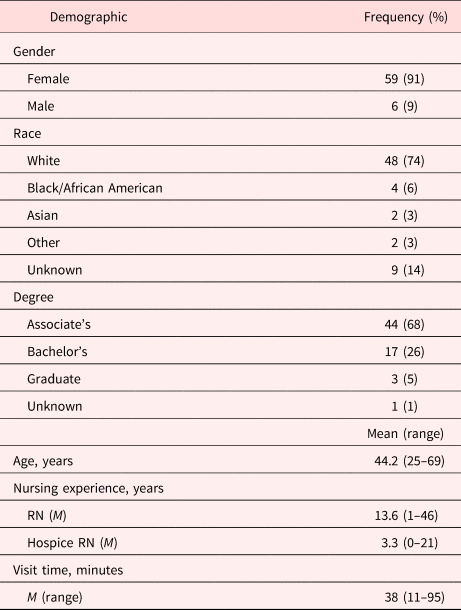
Table 1 provides the demographic and practice characteristics of the 65 nurses whose visits were analyzed in the present study. Nurses on average had slightly more than three years of hospice experience with a range of 0–21 years. The majority identified as female (91%) and white (74%). Patient and caregiver data were not included in the institutional Data Use Agreement and thus were unavailable for inclusion in analysis.
Summary of nurse demographics (n = 65)

M, mean; RN, registered nurse.
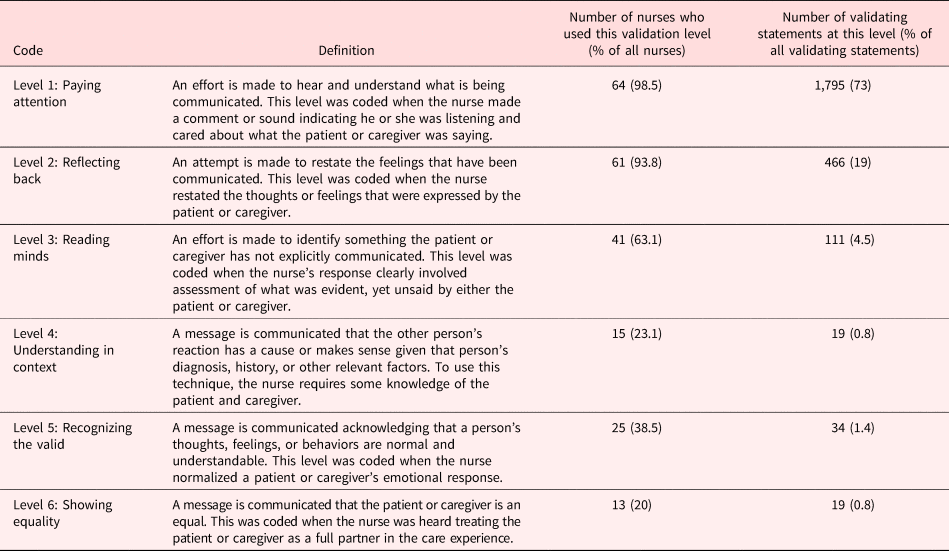
At least one use of a validation communication technique was identified in each of the 65 nurse encounters; however, the number and level of complexity of uses varied considerably across the dataset. Two nurses used all six levels of validation in their visit. In contrast, four nurses used only one level of validation. Table 2 summarizes the use and operational definition of each level.
Summary of codes by level of validation
Level 1: Paying attention
The most basic form of validation involves making an effort to hear and understand what is being communicated (Linehan, Reference Linehan2015). In short, level 1 validation is paying attention. This level was coded when the nurse made a comment or sound indicating she was listening and cared about what the patient or caregiver was saying. The overwhelming majority (73%) of validating comments were of this level, and nearly every nurse (98.5%) used this technique. The most frequent examples were one-word responses to a patient or caregiver such as “yeah,” “uh huh,” “mmm,” or “okay.” Although often minimal, these responses acknowledged that either the patient or caregiver had spoken and had been heard.
Level 2: Reflecting back
The second level of validation goes one step further to restate the feelings that have been communicated. Validation communication techniques were coded as level 2 when the nurse reflected back the thoughts or feelings that were expressed by the patient or caregiver. These techniques accounted for 19% of all validating statements and were used by approximately 94% of the nurses. An example of reflecting back is provided in the following exchange:
Nurse: Do you have many of your men friends that come around to see you?
Patient: Nope, none.
Nurse: No, none.
Level 3: Reading minds
The third level of validation entails giving voice to what the patient or caregiver has not specifically said. This level was identified when the nurse's response clearly involved assessment of what was evident, yet unsaid by either the patient or caregiver. Requiring additional skill and listening, level 3 validation was provided in 4.5% of the identified validation statements and was used by approximately 63% of the nurses. This technique was often used in visits during which the nurse had also used levels 1 and 2 validation. In the following exchange, the nurse used level 3 validation:
Patient: The last time we saw [the physician], she just, you know, said obviously things are headed downhill.
Nurse: It was a hard visit.
Level 4: Understanding in context
Level 4 validation encompasses communicating that the other person's point of view has a cause or makes sense given that person's diagnosis, history, or other relevant factors. To use this technique, the nurse requires some knowledge of the patient or caregiver. Less than 1% of the validating statements identified in the dataset were coded as level 4; this validation technique was used by approximately 23% of the nurses. An example of this technique is provided in the following discussion between a nurse and family caregiver regarding the caregiver's decision to not attend an appointment at her daughter's school:
Caregiver: So did I overreact? I should have gone?
Nurse: I don't think you overreacted. You wouldn't have been able to focus. I think you did the right thing. You would have been no good down there.
Level 5: Recognizing the valid
Level 5 validation normalizes a person's emotional reaction. Nurses using this level of validation acknowledged to patients or caregivers that people in circumstances similar to theirs might experiences thoughts, feelings, or behaviors like theirs. Some of the level 5 validating comments featured self-disclosure. That is, the nurse shared that she had experienced something similar to what the patient or caregiver was going through. Other times, the nurse communicated that many people would react similarly in the patient's or caregiver's situation, or the nurse explained that she had seen other patients or caregivers experience the same thing. Codes for level 5 validation were applied to 1.4% of the validating statements in the dataset and in visits conducted by approximately 38% of nurses. The nurse in the following example provided level 5 validation:
Caregiver: We have the most crying in this family.
Nurse: That's good.
Caregiver: We cry when we're happy, we cry when we're sad.
Nurse: It's a stress relief, it's a stress relief. It's okay.
Nurse: Honestly when the people don't cry that's when I get concerned about them.
Caregiver: Mm-hmm.
Nurse: It really is.
Level 6: Showing equality
This highest level of validation was coded when the nurse was heard treating the patient or caregiver as an equal partner in the care experience. By being “real” with the patient or caregiver rather than treating him or her as fragile, the nurse communicated respect. This was an infrequently used technique (<1% of the validating statements) and was used by 20% of nurses. One example of level 6 validation was when the hospice nurse responded that the patient should decide whether or not to stay in bed:
Caregiver: Should I let her [or] make her stay in bed today?
Nurse: I think we should let her decide what she wants to do.
Discussion
Findings suggest that nurses regularly use validation techniques in their communication with home hospice patients and their family caregivers, although their use of basic techniques far outweighs their use of more complex forms of validation. We cannot conclude from the data presented here that this imbalance is necessarily problematic, however. A recent study found that, on average, hospice nurses are confronted with four unique problems during per home visits (Parker Oliver et al., Reference Parker Oliver, Washington and Demiris2018). They are called upon to support patients and family caregivers facing often difficult-to-manage physical symptoms such as pain and shortness of breath and, given that physician home visits are uncommon in routine hospice care (Shoemaker et al., Reference Shoemaker, Aktas and Walsh2012), nurses may be the best equipped members of the hospice team to address physical care issues. Although providing emotional support is part of their professional role, it is by no means their sole responsibility. In addition, it is a reality of human communication that shallow exchanges are more common than intimate ones, particularly in newly formed or time-limited relationships (Altman & Taylor, Reference Altman and Taylor1973).
At the same time, these study findings introduce the possibility that home hospice nursing would be enhanced by greater use of higher level validation techniques, which are vital ingredients in evidence-based interventions such as dialectical behavior therapy (Linehan, Reference Linehan2015) that have been developed specifically to support people experiencing intense emotional distress, as many hospice patients and family caregivers are (Wittenberg-Lyles et al., Reference Wittenberg-Lyles, Demiris and Parker Oliver2012). In addition to building trust and rapport, more complex validation communication techniques may create a useful foundation for activities such as shared decision making that require recognition of patients and family caregivers as expert members of the healthcare team (Makoul & Clayman, Reference Makoul and Clayman2006; Washington et al., Reference Washington, Oliver and Gage2016). True partnership with patients and families is, in essence, level 6 validation. Future research examining the effect of the full range of validation communication techniques on patient and family caregiver outcomes would provide useful data to inform professional education and workplace training opportunities for hospice nurses.
Study limitations
Several study limitations should be considered. First, the transcripts analyzed in this study did not include information on nonverbal communication, which would likely have provided useful in context. For example, although researchers determined that one-word utterances such as “uh huh” or “okay” reflected level 1 validation, they were not able to determine if these utterances were made with corresponding eye contact and the nurse's full attention of if they were made somewhat automatically with little engagement. Videorecordings of home visits and/or interviews with patients and caregivers would have better allowed researchers to examine body language and facial expressions to assess both the nurse's level of interest and the caregiver's reaction. Second, because this analysis involved only one home visit by each nurse, researchers were not aware of any relationship that may have been built in previous visits or how use of validation communication techniques may change over time. It was therefore difficult to determine whether content coded as level 6 validation was indeed validating in the context of an established nurse-patient/caregiver relationship or if at times nurses’ use of direct communication may have been experienced as invalidating because of a lack of rapport or trust. Finally, this analysis focused on the presence of validation communication techniques but did not explore invalidating communication, which has been found to increase emotional reactivity during stressful situations (Shenk & Fruzzetti, Reference Shenk and Fruzzetti2011). Attention to this important concern is recommended for future research.
Author ORCIDs
Karla T. Washington 0000-0002-1100-9524
Acknowledgments
The authors thank the study participants who made this research possible. Research reported in this article was supported the National Cancer Institute under award number P01CA138317.
Conflicts of interest
The content is solely the responsibility of the authors and does not necessarily represent the official views of the National Cancer Institute.