INTRODUCTION
The rough-toothed dolphin, Steno bredanensis (Lesson, 1828), is a tropical to subtropical species and generally inhabits deep oceanic waters between 40°N and 35°S (Perrin, Reference Perrin2009). However, in certain areas (e.g. Brazil (Lodi & Hetzel, Reference Lodi and Hetzel1998 and references therein; Lodi & Hetzel, Reference Lodi and Hetzel1999), Honduras (Kuczaj & Yeater, Reference Kuczaj and Yeater2007) and Mauritania (Addink & Smeenk, Reference Addink and Smeenk2001)) the species occurs in shallower coastal waters.
Rough-toothed dolphins are widely distributed in all three major oceans, but the literature on S. bredanensis includes many comments indicating that little is known about their distribution and ecology (e.g. Jefferson, Reference Jefferson, Perrin, Würsig and Thewissen2002; Baird et al., Reference Baird, Webster, Mahaffy, McSweenet, Schorr and Ligon2008).
In Brazil, the northern and southern limits of the species are reported as Pará State (geographical coordinates unknown) (Siciliano et al., Reference Siciliano, Emim-Lima, Costa, Rodrigues, Magalhães, Tosi, Garri, Silva and Silva2008) and 60 km south of the Tramandaí River mouth, Rio Grande do Sul State (30°29′S–50°20′W) (Ott & Danilewicz, Reference Ott and Danilewicz1996), respectively. This information may indicate that S. bredanensis is widely distributed in coastal waters. However, few records of the species in oceanic waters in depths between 1500 and 2500 m are also available (Ramos et al., Reference Ramos, Poletto, Moreira, Erber, Dafferner, Freitas, Figna, Miranda, Alencastro, Carneiro, Fortes, Rinaldi, Demari e Silva, Barbosa, Ramos, Siciliano and Ribeiro2010).
The available information on this species remains scarce and is limited to opportunistic and occasional records of sightings (e.g. Ramos et al., Reference Ramos, Poletto, Moreira, Erber, Dafferner, Freitas, Figna, Miranda, Alencastro, Carneiro, Fortes, Rinaldi, Demari e Silva, Barbosa, Ramos, Siciliano and Ribeiro2010), strandings (e.g. Meirelles et al., Reference Meirelles, Monteiro-Neto, Martins, Costa, Barros and Alves2009), biological data on the diet (e.g. Di Beneditto et al., Reference Di Beneditto, Ramos, Siciliano, Santos, Bastos and Fagundes-Neto2001), age and growth (Siciliano et al., Reference Siciliano, Ramos, Di Beneditto, Santos, Fragoso, Brito, Azevedo, Vicente, Zampirolli, Alvarenga, Barbosa and Lima2007) and parasitic fauna (e.g. Carvalho et al., Reference Carvalho, Bevilaqua, Mayo, Iñiguez, Mathews-Cascon, Ribeiro, Pessoa, Meirelles, Borges, Marigo, Soares and Silva2010). Records of feeding (Lodi & Hetzel, Reference Lodi and Hetzel1999), epimeletic (Lodi, Reference Lodi1992) and interspecific behaviours (Wedekin et al., Reference Wedekin, Freitas, Engel and Sazima2004), fisheries interaction (e.g. Lodi & Capistrano, Reference Lodi and Capistrano1990), plastic debris ingestion (Meirelles & Barros, Reference Meirelles and Barros2007) and persistent organic pollutants (e.g. Yogui et al., Reference Yogui, Santos, Bertozzi and Montone2010) are available as well.
The aim of this study is to describe the movements of S. bredanensis in the coastal waters of Rio de Janeiro State by reporting the results of photo-identification comparisons between the catalogued individuals of the Cabo Frio and the Rio de Janeiro City regions.
MATERIALS AND METHODS
Study area
The Cabo Frio coast (22°57′58″S–42°01′40″W) is marked by a change in the shoreline from north–south to a south-west–north-east orientation and exhibits a steep slope (De Leo & Pires-Vanin, Reference De Leo and Pires-Vanin2006). The occurrence of two water masses is strongly influenced by the wind regime. The Brazil Current (BC) is a warm, resource-depleted surface water mass. The South Atlantic Central Water (SACW) is a deeper, relatively cold and nutrient-rich water mass influenced by the prevailing dominant east–north-east winds. This combination of features produces upwelling conditions (Carbonel, Reference Carbonel1998). The area that we sampled in this study included the inner region of Forte Beach (22°53′59″S–42°01′01″W), which includes water depths of approximately 5–30 m (Nautical Chart No. 150501: Diretoria de Hidrografia e Navegação da Marinha do Brasil). In general, the Rio de Janeiro City coast (22°54′10″S–43°12′27″W) is influenced by the heavily polluted waters of Guanabara Bay and by the hydrological dynamics of the BC and the SACW. The SACW occurring in this region is derived from the Cabo Frio upwelling (Carbonel & Galeão, Reference Carbonel and Galeão2007). The area sampled by this study included the coastline of Rio de Janeiro between the entrance of Guanabara Bay (22°58′16″S–43°09′25″W) and Ipanema Beach (22°59′50″S–43°12′27″W). This coastline exhibits depths varying from 5–40 m (Nautical Chart No. 1620: Diretoria de Hidrografia e Navegação da Marinha do Brasil).
Field procedures
Sightings of S. bredanensis on the Rio de Janeiro coast were made opportunistically during the common bottlenose dolphin (Tursiops truncatus) population dynamics research project. The photographs taken on the Rio de Janeiro coast were obtained from a 9.3 m vessel with an outboard engine. Data on sightings on the Cabo Frio coast were gathered through the long-beaked common dolphin (Delphinus capensis) bioacoustics and social organization project. Photographs were taken from a 6.5 m vessel with an outboard engine. The height from which the photographs were taken was approximately 1.5 m.
The photographs were taken with Canon EOS 40D digital cameras, both equipped with 70–300 mm lenses (Rio de Janeiro and Cabo Frio). Photographs were taken in 2011 during four sightings (two in Rio de Janeiro and two in Cabo Frio).
Data analysis
Rough-toothed dolphins exhibited distinct features suitable for individual identification, such as notch patterns on the dorsal fin and distinct scratches (Mayr & Ritter, Reference Mayr and Ritter2005). Only well-focused images with sufficient light and little blurring were considered for the analysis and creation of a photo-id catalogue for each locality. The procedures in Espécie et al. (Reference Espécie, Tardin and Simão2010) were followed. In the laboratory, the photographs from both catalogues were compared using Darwin software (Digital Analysis and Recognition of Whale Images on a Network: http://darwin.eckerd.edu/).
RESULTS AND DISCUSSION
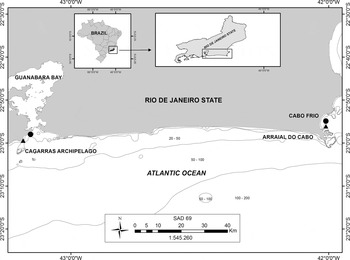
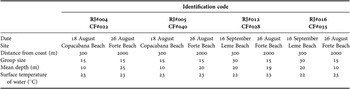
Photographs were obtained for 30 and 41 individuals identified at Rio de Janeiro and Cabo Frio, respectively. Two photo-identified individuals sighted on the Rio de Janeiro coast (RJ#004 and #005) on 18 August 2011 were resighted at Cabo Frio (CF#022 and #040, respectively) on 26 August 2011 at a linear distance of approximately 119.7 km east of the initial sighting. Two other photo-identified individuals sighted on the Cabo Frio coast (CF#028 and #035) on 26 August 2011 were resighted at Rio de Janeiro (RJ#012 and #016, respectively) on 16 September 2011 at a linear distance of approximately 117.0 km west of the initial sighting (Figure 1; Table 1).
Resightings of rough-toothed dolphins (Steno bredanensis) along the Rio de Janeiro State coast, Brazil. ▴, RJ#004/CF #022 and RJ#005/CF#040; ●, RJ#012/CF #028 and RJ#016/CF#035.

Sightings and resightings of Steno bredanensis off Rio de Janeiro State between August and September 2011.

Although the Cabo Frio coast is influenced by upwelling phenomena, the process is not homogeneously distributed. The influence of upwelling at the site where we have observed S. bredanensis (Forte Beach) is relatively less prominent (Carbonel, Reference Carbonel1998). The site shares physiographical and oceanographical similarities with Rio de Janeiro. Our data showed that dolphins were sighted in similar depths and at similar temperatures (Table 1) in both areas.
On 26 August 2011 at Cabo Frio and on 19 September 2011 at Rio de Janeiro, we could observe rough-toothed dolphins feeding on mullet (Mugil curema) and cutlass fish (Trichiurus lepturus), respectively. These species of fishes have been previously described in the diet of the rough-toothed dolphins (Lodi & Hetzel, Reference Lodi and Hetzel1999; Di Beneditto et al., Reference Di Beneditto, Ramos, Siciliano, Santos, Bastos and Fagundes-Neto2001). They are widely distributed along the Brazilian coast (Carvalho Filho, Reference Carvalho Filho1999). This may suggest that the dolphins travel between the two areas because they offer similar food resources.
Our data on the group sizes in both areas (Table 1) were consistent with the known patterning of social groupings of S. bredanensis in other regions, e.g. Mauritania (10–12: Addink & Smeenk, Reference Addink and Smeenk2001), the Canary Islands (10–>50: Ritter, Reference Ritter2002), French Polynesia (1–35: Gannier & West, Reference Gannier and West2005), Honduras (5–30: Kuczaj & Yeater, Reference Kuczaj and Yeater2007), Hawaiian Archipelago (2–90: Baird et al., Reference Baird, Webster, Mahaffy, McSweenet, Schorr and Ligon2008), and Brazil (1–>50: Lodi & Hetzel, Reference Lodi and Hetzel1998; Ramos et al., Reference Ramos, Poletto, Moreira, Erber, Dafferner, Freitas, Figna, Miranda, Alencastro, Carneiro, Fortes, Rinaldi, Demari e Silva, Barbosa, Ramos, Siciliano and Ribeiro2010).
The ongoing project in the Cabo Frio region resighted three of the 41 photo-identified individuals. CF#003, 012 and 014 were sighted for the first time on 19 March 2011 and resighted on 26 August 2011. These observations suggest a possible instance of site fidelity. The three individuals resighted in the Cabo Frio region were not observed in the Rio de Janeiro region. Resightings of photo-identified dolphins in the Canary Islands (Mayr & Ritter, Reference Mayr and Ritter2005), Honduras (Kuczaj & Yeater, Reference Kuczaj and Yeater2007) and the Hawaiian Archipelago (Baird et al., Reference Baird, Webster, Mahaffy, McSweenet, Schorr and Ligon2008) indicated that individual rough-toothed dolphins are residents in these areas and exhibit site fidelity.
In the main Hawaiian waters, the distances between the resighting locations of individuals off Kaua‘i/Ni‘ihau were not statistically greater than the straight-line distances between the resighting locations off Hawaii. Individuals were found to move from Kaua‘i to Hawai‘i after an interval of 309 days. The straight-line distance of 480 km between sighting locations is the greatest travel distance reported for the species (Baird et al., Reference Baird, Webster, Mahaffy, McSweenet, Schorr and Ligon2008).
In view of these findings, the distance between the two clusters of sightings in our study appears to fall well within the range reported for individual rough-toothed dolphins. This note reports the first information about the movements of the species in Brazilian coastal areas. Clearly, additional survey effort in the areas between Rio de Janeiro City and the Arraial do Cabo regions is needed to better understand the site fidelity and home range of this species in the coastal waters of Rio de Janeiro State.
ACKNOWLEDGEMENTS
We thank Marco Aurelio Crespo and students (Israel S. Maciel, Elaine C.S. Oliveira and Carine C.G. Galvão) of the Laboratório de Bioacústica e Ecologia de Cetáceos (LBEC/DCA/IF/UFRRJ) for their valuable support in the field. We express our gratitude to Sérgio C. Moreira for providing Figure 1. The authors gratefully acknowledge research grants from Conselho Nacional de Desenvolvimento Científico e Tecnológico—CNPq (Grant#479348/2010-3) (Cabo Frio). The results of this study are part of Projeto Ilhas do Rio (Ilhas do Rio Project), performed by Mar Adentro Instituto (Mar Adentro) and sponsored by Petrobras (Brazilian Petroleum Corporation) through the Petrobras Environmental Program (Rio de Janeiro).