Between 1999 and 2015, 183,000 Americans died from drug overdoses related to prescription opioids.1 While the opioid crisis has multiple causes, the role of the medical profession in the emergence and response to the crisis has attracted significant regulatory attention. As it is, however, the regulatory framework governing physicians' prescription of opioids markedly departs from otherwise applicable regulatory approaches to regulating the professional practice of medicine. Federal and state laws, both preceding the epidemic and responding to it, already curtail physician autonomy to a greater degree than in almost any other area of medical practice. To make matters worse, the variety of legislative interventions in this area, both before and now during the crisis, have created a patchwork of incoherent regulation.
Take a hypothetical general practitioner in rural western Massachusetts — Dr. Joan Smith — as an example. Dr. Smith's first patient, Mary, is a young woman she had seen on a handful of occasions five years earlier. Mary confides that she has been struggling with opioid addiction for 18 months and expresses an interest in opioid replacement therapy. Dr. Smith agrees that medication-assisted treatment with methadone or buprenorphine is the most appropriate course.Reference Connery2 However, federal law prohibits her from prescribing methadone for addiction in an office setting, and there is no methadone clinic in the area. Dr. Smith recently completed the federally-mandated training necessary to obtain a waiver to prescribe buprenorphine for addiction, but she is the only physician in the area who has done so. Under federal law, physicians may only prescribe buprenorphine to 30 patients at a time in the first year of their waiver, and Dr. Smith has reached that limit.3 Thus, she is unable to provide the care that Mary needs, and refers Mary to an addiction clinic two towns over.
Dr. Smith's second patient of the day is James, an elderly man with severe chronic pain. James has been her patient for several years. Dr. Smith has previously prescribed long-acting opioids alongside nonpharmacological interventions in the course treating his pain. After struggling on alternative medications, James reports that methadone provides him with the greatest pain relief and the fewest side effects. Dr. Smith prescribes him a new course of the drug. She is confident the treatment she provides meets the stan dard of care and is permissible under the law.Reference Rastogi and Meek4
Finally, Dr. Smith sees Steven, a middle-aged man complaining of knee pain following a car accident two days before. Dr. Smith believes a short course of oxycodone is appropriate, so she checks the Prescription Monitoring Program database as required by state law.5 She notes that Steven was prescribed a one-week course of oxycodone in each of the prior three months by other physicians. Although she continues to believe that oxycodone could be safe and effective under the circumstances, she feels uncomfortable writing the prescription given the attention the opioid crisis has drawn. Massachusetts, for example, has passed a law limiting opioid prescriptions to seven days for patients who have not taken opioids in the past. While that law does not apply in Steven's case, it nevertheless makes Dr. Smith more reluctant to prescribe. Steven already has an appointment to see an orthopedic specialist in two weeks and says his pain is severe but tolerable. Instead of prescribing oxycodone, Dr. Smith ultimately advises him to obtain over-the-counter ibuprofen.
This article first describes limitations on physician autonomy related to opioids, both at the federal level and in the five states with the highest overdose rates. It next compares those measures with limitations on physician decision-making in other areas of medicine. Measures limiting the autonomy of physician decision-making in these other areas help shed light on the significance and implications of opioid-specific regulations. We also consider the extent to which these legislative intrusions into the patient-physician relationship may be primarily driven by ideological or political values rather than concern for public health, as in the case of abortion, or laws, described below, mandating that physicians not discuss gun safety with their patients. The history of opioid regulations suggests these moral judgments may likewise be in play in the opioid context.
These examples provide a limited snapshot of the ways that federal and state opioid laws can affect a physician's daily practice and interfere with what otherwise would be professional judgments about appropriate medical care. This degree of federal and state regulation of the practice of medicine is unusual in two respects: it departs from the case-by-case standard of care that typically applies to physician conduct, and it is one of the few areas in which legislatures have interfered with physician self-regulation.
Under the continuing scrutiny of state medical conduct and licensure authorities, treatments offered by physicians must meet the standard of care.Reference Carlson and Thompson6 However, given the wide variance among patients even with the same condition, standards of care are determined for licensing oversight purposes on a case-by-case basis by peer physicians with adequate experience to evaluate the treatment in context.Reference Ruger7 For opioids, however, laws and regulations are extremely specific and proscriptive. For example, the federal government heavily regulates prescription practices for methadone and buprenorphine, even relative to other potentially addictive drugs.8 Some states have established specific limits, without exceptions, on the quantity of opioids that may be prescribed in a single prescription to opioid-naïve patients.
Further, whereas in most other contexts state legislatures have traditionally deferred to the expertise of medical boards in establishing and enforcing such practice and prescribing standards, when it comes to opioids state legislatures increasingly have abandoned the historical norm of physician self-regulation.9 Many states have legislated prescribing guidelines for opioids, with specific requirements regarding their appropriate use for pain management and medication-assisted addiction treatment.10 The resulting laws often fall outside the standard medical regulatory regime, limiting physician discretion to treat individual patients.
There are some other areas of medical practice that are likewise deemed to have special public health or public policy significance, and in which regulation of medical practice is thought to be a prudent mechanism for achieving specific policy or public health goals. For example, physicians are required to report suspected childReference Vulliamy and Sullivan11 and elder abuseReference Daniels, Baumhover and Clark-Daniels12 and are under mandates to report the names and other identifying information of their patients who have been diagnosed with specific illnesses, especially infectious conditions.Reference Chorba, Berkelman, Safford, Gibbs and Hull13 There are also some areas in which physician autonomy has been curtailed as part of larger religious and political battles, such as abortion. State legislatures have passed laws forcing physicians to provide specific warnings about abortions, limiting off-label prescribing of some abortifacient drugs, and prohibiting referrals for certain abortion services.
Physician groups, both historically and recently, have decried legislatures and agencies “overstep-ping the proper limits of their role in the health care of Americans to dictate the nature and content of patients' interactions with their physicians.”Reference Weinbertg14 All of these measures have generated litigation and scholarly interest and have important lessons for opioid regulations. This article first describes limitations on physician autonomy related to opioids, both at the federal level and in the five states with the highest overdose rates. It next compares those measures with limitations on physician decision-making in other areas of medicine. Measures limiting the autonomy of physician decision-making in these other areas help shed light on the significance and implications of opioid-specific regulations. We also consider the extent to which these legislative intrusions into the patient-physician relationship may be primarily driven by ideological or political values rather than concern for public health, as in the case of abortion, or laws, described below, mandating that physicians not discuss gun safety with their patients. The history of opioid regulations suggests these moral judgments may likewise be in play in the opioid context.
It is possible that the scope and severity of the opioid epidemic may justify these medical practice limitations. First, it is undisputed that some members of the medical profession played a significant role in creating the crisis. The epidemic of serious overprescribing (even if much of it was in good faith) may explain state legislatures' willingness to intervene. Second, the unique public health context of the opioid epidemic may justify restrictions on physician autonomy with opioids. While physicians are primarily concerned with their individual patients, opioids present risks to others outside of the patient-physician relationship. But it is still important both to recognize how regulation of the use of opioids in medical practice is exceptional, and to try to understand whether the public health and public policy rationales offered for this regulation are persuasive reasons to depart from the norm. It may be, for example, that the regulations as enacted are not as narrowly or wisely tailored as they might be to fulfill the articulated policy and public health goals. Regulation might ultimately be designed in such a way as to maintain the important values served by physician autonomy within the patient-physician relationship while still protecting individual patient and public health. Further, regulation might more appropriately be considered by and issued in the course of the general oversight of quality of physician care, instead of decreed by legislatures.
I. Opioid Laws and Physician Autonomy
A. Standard Regulation of Physicians
In most areas of medical practice, physicians are regulated at the state level with limited federal dictates. The state regulatory regimes that have arisen leave most medical decision-making authority to individual physicians in collaboration with their patients.Reference Ruger15 The underlying goal is to preserve physicians' professional choices to serve patients' needs, in accordance with professional insights. This value is reinforced by the fiduciary relationship that exists between physician and patient.
1. state regulations
All 50 states and the District of Columbia have delegated authority to define the qualifications for practicing medicine, the scope of acceptable practice, and the duty to monitor individual physician's practices, to medical boards comprised predominantly of physicians.16 The profession itself thus largely oversees its own licensure, professional practice, and discipline, with the goal of guaranteeing that physicians have adequate training and treat patients in accordance with current medical knowledge.Reference Curess and Cruess17 State medical boards require applicants for licensure to obtain a professional degree from an accredited medical school, pass a set of licensure exams, and complete a residency program.18
Once physicians meet a medical board's requirements and obtain a license, the board regulates practice by ensuring physicians provide treatment in accordance with the prevailing professional standards. Medical boards may issue advisory opinions or guidelines that inform the standard of care, but guidelines tend to be general and not proscriptive. Medical board rules and regulations rarely dictate the precise manner in which physicians must provide treatment. For example, the Ohio Medical Board became concerned about overutilization of a particular vascular screening procedure and released a position statement to discourage its use. Rather than setting specific rules about the procedure or prohibiting it under certain circumstances, the position statement was worded broadly. The Board explained that the screening should only be used by physicians with “sufficient training and expertise to enable them to practice in compliance with minimal standards of care.”19 In short, the Board left the final decision about the appropriateness of the test to individual physicians.
If a board receives a complaint or has reason to believe a physician violated the standard of care, it will investigate, and in many state practice regulatory regimes, the case will be reviewed by other physicians with comparable expertise.20 As a result, the standard of care is assessed on a case-by-case basis by a physician's peers who have adequate training and experience to evaluate the physician's treatment in context.
2. federal regulations
The federal government plays a comparatively minor role in regulating the practice of medicine. Physicians may only prescribe drugs and devices that have been approved by the Food and Drug Administration (FDA) for manufacture and shipment in interstate commerce. Once a drug or device has been approved, though, the FDA does not generally regulate its use. Indeed, “off-label” prescribing is an accepted and important aspect of medical practice and a key example of the deference that government long has afforded physicians in their sphere of expertise. It is estimated that about 20 percent of all prescriptions are written for uses that are not consistent with labeling indications contained in FDA approvals.Reference Radley, Finkelstein and Stafford21 In some specialties, off-label use is even more common. For example, as many as 55 percent of drugs to treat breast cancer are prescribed off label.Reference Hamel, McNair, Birkett, Mattison, Krantis and Krewski22 Pediatricians often have no choice but to prescribe off-label because “an overwhelming number of drugs still have no information in the labelling for use in” children.Reference Neville, Frattarelli, Galinkin, Green, Johnson, Paul and Van Den Anker23
For most controlled substances, the Federal Drug Enforcement Agency (DEA) requires that physicians register with the agency and maintain active DEA registration. After registration, though, the DEA itself does not impose significant limits on physician prescribing of controlled substances.
B. Federal Opioid Laws and Regulations
In contrast to the relative lack of federal oversight of physicians in most areas of medicine, the federal government has taken an active role in regulating certain opioid prescriptions, particularly opioid agonists like methadone and buprenorphine that are used in medication assisted treatment.
In the early twentieth century, medical professionals tended to view addiction as a medical problem, and physicians were free to prescribe opiates for maintenance therapy.Reference Weber24 As rates of opium use rose, though, some policymakers began to blame the medical profession for facilitating addiction. United States Opium Commissioner Hamilton Wright argued that physicians “continually prescribe opium for insufficient causes or without any real excuse.”Reference Marshall25 Wright further claimed that many physicians were addicted to opium. He described medical professionals as “arrant knaves,” who were “themselves victims of the drug and robbed by it of all sense of their responsibility to their patients and society.”26 Against this backdrop of anger and suspicion, Congress passed the Harrison Narcotics Act of 1914, regulating, for the first time, physician prescribing of narcotics.27 On its face, the Act applied to all opiates; however, in a series of cases beginning in 1919, the Supreme Court interpreted the Harrison Act specifically to prohibit doctors from prescribing opiates as treatment for addiction.28 By 1920, under enforcement pressure generated by the Harrison Act and subsequent judicial interpretations, ambulatory maintenance clinics that had developed over the previous 20 years began to close.29 In this way, federal policy in the early twentieth century prohibited the development of medication-assisted treatment for opiate addiction. As addiction treatment moved out of doctors' offices, addiction came to be viewed as a moral failing rather than a medical problem.
Modern federal laws regulating opioids reflect this history. Passed in 1970, the Controlled Substances Act (CSA) superseded the Harrison Act and maintained the unique limitations on opioids prescribed for addiction treatment. The CSA established the requirement that any physician who will manufacture, distribute, or dispense a controlled substance must register with the DEA.30 The CSA generally applies to all controlled substances — both opioid and non-opioid. However, DEA regulations under the CSA singled out certain opioids for special restrictions. Physicians may not prescribe methadone, a Schedule II drug, for detoxification or maintenance therapy.31 As a result, methadone may only be “administered” or “dispensed” — not prescribed — for maintenance treatment, and only at a federally-registered narcotics treatment program — not in an office setting.32 A physician may prescribe methadone for pain management in the office, though, without any additional federal requirements beyond registration with the DEA. The regime was later adopted by statute as well.33
In 2000, Congress sought to expand access to medication-assisted treatment through the Drug Abuse Treatment Act (DATA), which authorized physicians to prescribe Schedule III drugs like buprenorphine (a partial opioid agonist) for addiction treatment in an office setting. One of the law's sponsors emphasized that its intent was to increase physician autonomy, noting that “decisions by qualified physicians about the appropriate means to treat their patients and to prescribe and dispense medications are not a proper matter for government regulation.”34 Still, DATA left greater restrictions on buprenorphine than on almost any other drug. It required physicians to obtain waivers from the Attorney General and demonstrate their qualifications for providing medication-assisted treatment. Even after obtaining a DATA waiver, a physician may only see 30 patients for maintenance therapy in the first year and must officially request an increase to 100 in the second year and 250 in the third.35
C. State Opioid Laws and Regulations
Given that states are primarily responsible for regulating the practice of medicine, they have been the largest source of opioid-specific laws.36 Unlike the federal regulations, these laws are relative newcomers to the landscape — most have been enacted during the current crisis. In this part, we collect and analyze laws limiting physician autonomy in the five states with the highest opioid overdose rates in 2015, the most recently available data.
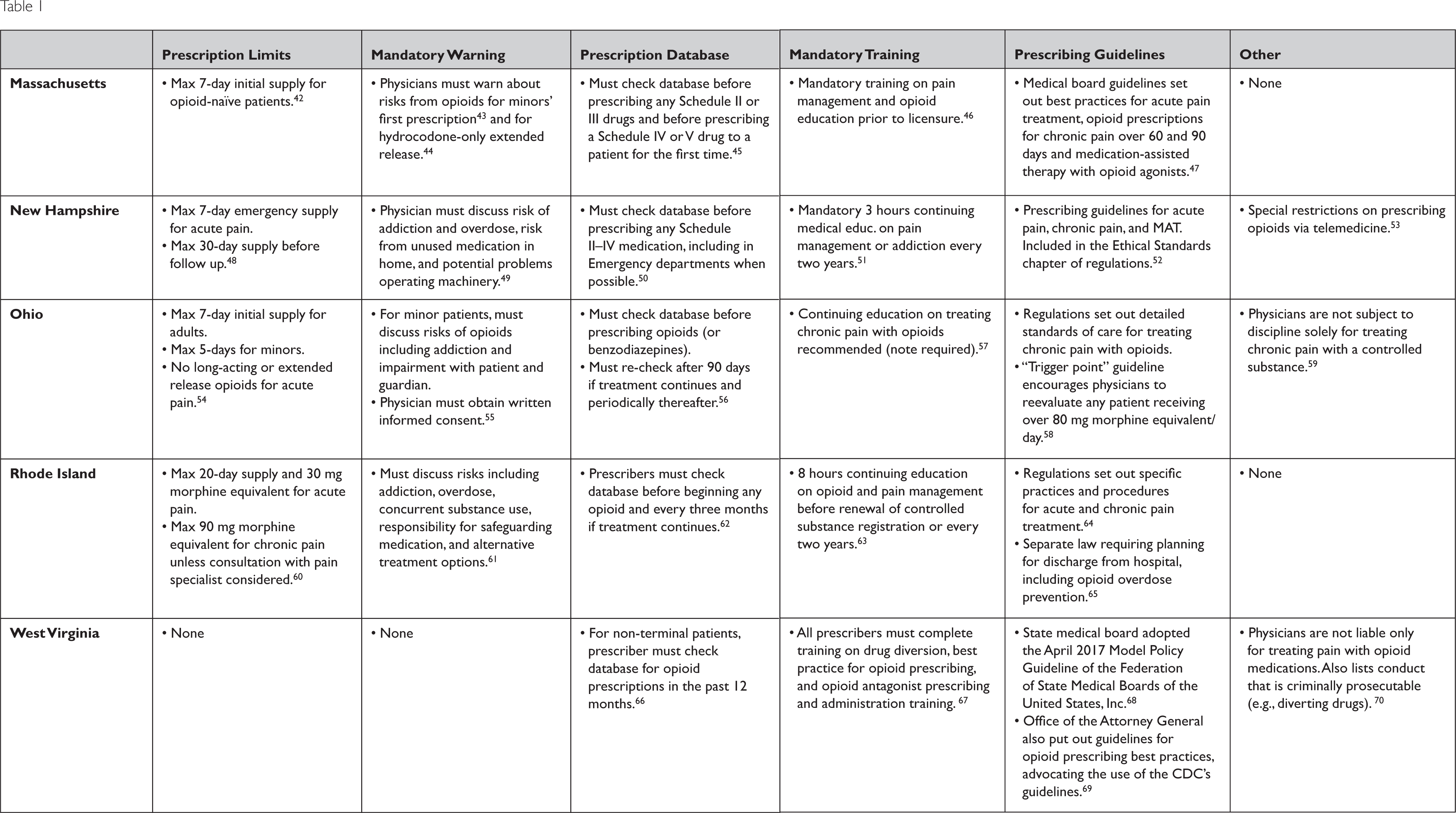
The analysis includes West Virginia, New Hampshire, Ohio, Rhode Island, and Massachusetts.37 (We do not include other opioid-related laws that do not directly implicate physician autonomy, such as “Good Samaritan” laws exempting bystanders from some criminal liability for drug possession when they call for emergency assistance following an overdose.38) These five states with the highest overdose rates presumably have great incentive to address opioid prescribing aggressively. Overdose rates vary significantly by state. In 2015, the opioid overdose rate in West Virginia (36.0 deaths from opioids per 100,000 people) was more than three times higher than the national rate (10.1) and more than ten times higher than the states with the two lowest overdose rates (South Dakota at 3.5 and Nebraska at 3.1). The five states analyzed have thus experienced the opioid epidemic the most acutely and have the greatest need to respond. These five states also are politically diverse. Three of the states (OH, WV, NH) currently have Republican governors and majority-Republican legislatures.39 Massachusetts currently has a majority-Democratic legislature, but a Republican governor,40 and Rhode Island a majority-Democratic legislature and a Democratic governor.41 These states' relevant laws are summarized in Table 1.

1. initial prescription limits
Four of the states (all but WV) have adopted rules limiting the duration of initial opioid prescriptions for acute pain. These measures were passed in direct response to the opioid epidemic; Massachusetts was the first state to impose a prescription limit in March 2016.Reference Townley71 Three of the states (OH, RI, NH) adopted their measures in a manner typical of medical regulation — either by regulation of the medical board or through notice-and-comment rulemaking by an executive agency. The Massachusetts legislature adopted its limit by statute.
The prescription limits are unusual in that they are binding and specific, contrasting with typical practice guidelines, which tend to be general and advisory. Rhode Island's regulations do not allow for any physician discretion — they indicate that an initial prescription “shall not exceed” the stated amount. The Massachusetts, New Hampshire, and Ohio limits allow some discretion: physicians may prescribe beyond the statutory limit if the practitioner determines the additional doses are necessary and notes the justification for the variance in the patient's medical chart. All four states make exceptions for non-acute pain, including palliative care and cancer treatment.
Nationally, at least 24 states have adopted some prescription limitation.72 Two-thirds of those states adopted the limit by statute. Two U.S. Senators recently introduced a bipartisan bill to impose a nationwide limit on initial opioid prescriptions to seven days.Reference Zezima73 Some physicians have argued that such “hard limits” prevent them from adequately addressing individual patients' needs.74 Moreover, some physicians perceive the laws as a general condemnation of opioid prescriptions, and “are now leery of treating pain patients.”75
2. mandatory warning
Four of the states (all but WV) require physicians prescribing opioid analgesics to provide a warning to their patients about risks from the drugs, including addiction and overdose. Ohio and Massachusetts only mandate these warnings for minor patients; New Hampshire and Rhode Island require warnings for all patients prescribed opioids.
While the warning provisions have been implemented by states, they may trace back to a federal source. In 2016, the Centers for Disease Control and Prevention (CDC) released guidelines on the use of opioids for chronic pain.Reference Dowell, Haegerich and Chou76 A major theme of the CDC guidelines is effectively communicating the risks and benefits of opioids to patients. Many of the risks that the CDC emphasizes are reflected in the state's mandatory warning regulations. For example, the CDC recommends warning patients about the risks to family members from keeping unused medication in the home. The Rhode Island and New Hampshire regulations make that warning mandatory.
3. prescribing guidelines
All five states maintain prescribing guidelines specific to opioids. Massachusetts' and West Virginia's guidelines were published by their state medical boards. Three of the states (RI, OH, NH) formally adopted prescribing guidelines by regulation. In each case, the guidelines are unusually detailed and specific. For example, Part I of the Massachusetts Board of Registration in Medicine prescription guidelines is sixteen pages long, covering broad topics such as “Legitimate Medical Purpose” and “Prescribing to Family Members.”77 That section devotes more than four pages to opioid prescriptions for chronic pain and addiction. No other class of drug is discussed in similar detail. Prescribing guidelines in states that have adopted standards by regulation are equally specific.
In West Virginia, the Board of Medicine formally adopted the opioid prescribing guidelines developed by the Federation of State Medical Boards, while the Office of the Attorney General separately published Best Practices for Prescribing Opioids, recommending standards similar to those developed by the CDC. Although the two sets of standards are compatible, the double guidelines send physicians an important message: opioid prescribing is treated differently in West Virginia, and those who prescribe improperly face not only professional discipline, but civil and criminal liability.
4. prescription drug monitoring database
All five of the states maintain a prescription drug monitoring database. The states vary in how often physicians are required to check the databases, and for which drugs. Massachusetts and New Hampshire adopted their rules by statute, but explicitly delegated authority for determining when physicians should check the database to, respectively, the state department of public health and board of medicine. They tie the requirement that physicians check the database to the DEA's drug classifications, so the database requirements apply equally for opioids and non-opioids. Three of the states (OH, RI, WV) implemented drug monitoring by statute, with the legislature setting specific requirements for physicians to check the database. In these states, physicians must check the databases only for opioids (or opioids and benzodiazepines). As a result, physicians can prescribe nonopioid drugs without first checking the database.
Prescription drug monitoring databases developed well before the current opioid epidemic.Reference Finklea, Sacco and Bagalman78 However, physician registration with the programs was generally voluntary,79 and providers were not required to check the databases before prescribing controlled substances.Reference Arditi80 In response to the opioid crisis, states have moved toward mandatory registration and rigid rules for checking the database before prescribing opioid medications.Reference Haffajee, Jena and Weiner81 Forty-nine states have prescription drug monitoring databases.82 In thirty-six states, physicians are legally required to query the database under certain circumstances,83 up from sixteen in 2013.84
Limitations on physician autonomy related to opioids are extremely unusual. For the most part, other examples of intrusions into professional judgment and the patient-physician relationship that have generated both scholarship and litigation have dealt with highly politicized topics. For example, states have passed laws barring doctors from discussing firearms with their patients, requiring specific warnings related to abortion procedures, and prohibiting off-label prescribing of certain abortifacient medication. These statutes have fallen to constitutional challenges.
Although the federal government does not operate a nationwide prescription database, it has played an active role in spreading databases across the states. The earliest state prescription monitoring programs85 developed more than two decades before Congress conferred authority on the FDA to evaluate the efficacy of prescription medications.86 Rather than develop a single nationwide prescription monitoring database, the federal government has supported state efforts to develop databases and share data amongst themselves. In 2002, the Department of Justice established a grant program to support state efforts to plan, implement, or enhance prescription monitoring.87 Three years later, Congress amended the Public Health Service Act to require the Department of Health and Human Services to award additional grants to states seeking to develop or improve their programs,88 and in 2011, the Obama administration released a four-prong “action plan” for responding to the opioid epidemic. One prong of the plan was to support states implementing monitoring programs and to promote data-sharing across states.89 Thus the federal government has encouraged the use of prescription drug monitoring programs, but has not required it.
5. other restrictions
Three of the states surveyed have other laws specific to opioids that significantly affect physician autonomy. First, New Hampshire adopted a statute imposing special restrictions on physicians' ability to prescribe opioids via telemedicine. Second, Ohio and West Virginia have adopted statutes emphasizing that physicians are not subject to discipline or liability solely for treating chronic pain with opioids or other controlled substances. Although these Ohio and West Virginia provisions ostensibly preserve physician autonomy, their adoption demonstrates legislative acknowledgment of the heavily regulated environment surrounding opioid prescribing.
II. Legislative Limitations on Physician Autonomy in Other Contexts
Limitations on physician autonomy related to opioids are extremely unusual. For the most part, other examples of intrusions into professional judgment and the patient-physician relationship that have generated both scholarship and litigation have dealt with highly politicized topics. For example, states have passed laws barring doctors from discussing firearms with their patients, requiring specific warnings related to abortion procedures, and prohibiting off-label prescribing of certain abortifacient medication. These statutes have fallen to constitutional challenges.
At first blush, opioid-related laws seem distinguishable from these restrictions; the other restrictions aim to protect values that were not exclusively medical, such as the right to life or the right to gun ownership. But considering opioid restrictions in light of the history of federal policies like the Harrison Act, the distinctions are less clear. While the modern trend among academic medicine and public health is toward viewing addiction primarily as a medical issue, earlier views of addiction and addiction treatment were meaningfully shaped by moral judgments and normative preferences from outside the medical and public health communities.
A. Legal Challenges to Regulations Restricting Physician Autonomy
States' and the federal government's efforts to limit both the advice and services that physicians may provide have generated legal challenges producing a significant body of case law. Cases related to abortion and physician speech may have important implications for the opioid regulations described: most importantly, as illustrated below, state laws regulating abortion have been subject to constitutional challenge, and many such laws have been struck down under theories that they impermissibly restricted either physician autonomy or patient privacy, or both. These cases illustrate that measures adopted under the police power to promote patient and community health are nevertheless subject to significant restraints when constitutional rights of physicians and patients are implicated.
1. regulating abortion through physician speech
The Supreme Court first recognized a woman's constitutionally-protected right to choose to have an abortion in Roe v. Wade.90 In striking down the Texas law making it illegal for a woman to seek, and for a doctor to provide, any abortion except those performed in a medical emergency or in the case of rape or incest,91 the Court repeatedly emphasized that its decision depended not only on the woman's right to choose, but “the right of the physician to administer medical treatment according to his professional judgment.”92 Subsequent attempts at limiting abortions have thus been couched as limitations on physician speech and regulating the practice of medicine.
The Court has not always upheld these claims. In Rust v. Sullivan,93 the Court considered a group of physicians' claims that HHS regulations prohibiting providers who received federal funding for family planning services from providing any advice on or referrals to abortion services violated their First Amendment rights as well as women's Fifth Amendment rights to have an abortion.94 With respect to the physicians' claims, the Court majority held that the government is free to favor one viewpoint over another through funding without violating the First Amendment.
The next watershed case, Planned Parenthood v. Casey, reaffirmed the “essential holding” of Roe, but focused entirely on the woman's right to choose without discussing the physician's right to exercise independent professional judgment.95 After Casey, several states passed statutes aimed at curtailing abortions through statutes ostensibly regulating the practice of medicine. In some instances, though, these statutes contradicted prevailing medical standards.Reference Haupt96 These cases had mixed results. For example, one South Dakota statute required physicians to disclose all “known medical risks” of abortion, but explicitly included “[i]ncreased risk of suicide ideation and suicide” among the “known” risks.97 The Eighth Circuit divided, but eventually upheld the statute.
Recently both Texas and North Carolina passed laws requiring physicians to perform sonograms and describe the results to women seeking abortions.Reference Keighley98 The sonogram and description served no medical purpose, but were meant to dissuade women from having abortions. The Fifth Circuit upheld Texas's law as a permissible medical regulation, noting that it only required physicians to convey “truthful, non-misleading” information.99 In contrast, the Fourth Circuit struck down North Carolina's law.100 While the court acknowledged that the requirement was a medical regulation, it explained that the law went far beyond typical informed consent requirements.101 The key difference between the reasoning of the two courts of appeals was that the Fifth Circuit viewed the regulation as strictly medical, and thus within the power of the state; the Fourth Circuit viewed the coerced speech as political rather than professional given that it imposed uniquely strict requirements for abortions without medical justification.102 According to the Fourth Circuit, medical professionals are best equipped to decide what information is necessary for patients to make informed medical decisions, and forcing physicians to disclose irrelevant information for ideological reasons encroached on their professional autonomy and First Amendment rights.103
In addition to requiring physicians to convey specific information or withhold specific advice in regard to induced termination of pregnancy, some states have attempted to limit abortion by directly regulating the treatments that physicians provide, medications they may prescribe, and other details of medical practice. In 2000, the FDA approved the drug mifepristone to induce non-surgical abortions up to 49 days of gestation.104 Although physicians were free to utilize the new procedure by prescribing the approved drug, six states passed statutes restricting physicians' ability to prescribe abortion-inducing drugs off label.Reference Lyons105 Nineteen states passed laws requiring that a physician be present to provide mifepristone, thus limiting the drug's availability via telephone consultation or even via telemedicine. Abortion providers in some states with restrictive laws sued seeking injunctions against enforcement. While the cases were pending in late 2016, the FDA approved an updated label for mifepristone, incorporating the less cumbersome protocol, mooting the suits.Reference Green and Drazen106
In a ruling before the FDA label change, the Oklahoma Supreme Court held that the state's law went far beyond typical medical regulations.107 Ordinarily, prescribing decisions were left to physicians. Off-label prescribing was permissible as long as it was consistent with “good medical practice” in the judgment of the physician.108 In contrast, this law required “dogmatic adherence to FDA labeling.”109 The statute stood “[i]n contrast to the deference physicians receive regarding treatment decisions in almost all other areas of medicine.”110 The court pointed to this exceptional imposition on physician autonomy as evidence that the statute was specifically targeted to prevent abortions, and therefore placed an undue and impermissible burden on women seeking to terminate their pregnancies.
2. special requirements for physicians providing abortions
Twenty-three states also have passed laws imposing strict requirements specific to abortion providers.111 Many of these regulations are extremely detailed, including setting minimum corridor width, exam room size, and the minimum distance to a hospital.112 Several states required otherwise qualified physicians to obtain hospital admitting privileges or a comparable arrangement at a local hospital before providing abortions.
The Supreme Court recently struck down one such set of regulations. In Whole Women's Health, the Supreme Court found that Texas' regulations, which required that physicians performing or inducing abortions have admitting privileges at a hospital within 30 miles of the location where the abortion procedure would be performed, placed an undue burden on a woman's access to abortion under the guise of regulating the practice of medicine.
B. Limitations on Physician Autonomy Outside the Abortion Context
States have occasionally enacted comparably restrictive laws in other contexts. Other than abortion, gun regulation is the most prominent example. Laws on informed consent for the treatment of breast cancer provide another illustration.
1. firearm safety and the patient-physician relationship
Like abortion, gun ownership is an area in which politics has led to issue-specific regulation of physician practice. In response to national physician groups taking on gun safety as a public health issue, Florida passed the Firearm Owners' Privacy Act (FOPA),113 prohibiting health care practitioners from inquiring, keeping records, or harassing patients about firearm ownership. The law also prohibited practitioners from discriminating against patients on the basis of the patients' firearm ownership. The Eleventh Circuit struck the law down, concluding that “the record-keeping, inquiry, and anti-harassment provisions of FOPA constitute speaker-focused and content-based restrictions on speech,” and the state had offered no sufficiently compelling interest to justify the imposition.114 Emphasizing the importance of physician advice, the court noted that in medical practice, “information can save lives. Doctors, therefore, must be able to speak frankly and openly to patients.”115
2. breast cancer
Breast cancer provides a final, perhaps less widely known example. Before the 1970s, the standard treatment for most breast cancers was radical mastectomy, an extremely invasive, disfiguring procedure with potential for lasting complications.Reference Anderson-Watts116 Over time, Breast Conserving Surgeries (BCS) developed that were significantly less invasive. Some women who nevertheless underwent radical mastectomy reported feeling that they had not been fully informed about the options available to them.117 Breast cancer advocates thus began campaigns for statutes requiring physicians to better inform women of their options. From the late 1970s through the 1990s, sixteen state legislatures passed laws that dictated the specific information that physicians were required to disclose to women being treated for breast cancer.118 While these laws have remained on the books, the statutes appear to have had little effect. States that adopted informed consent measures saw a small, shorted lived increase in the proportion of women choosing BCS over mastectomy.Reference Nattinger, Hoffman, Shapiro, Gottleib and Goodwin119 Subsequent research demonstrated that women who were more involved in the decision-making process were actually more likely to choose to have mastectomies than those who are less involved.Reference Lantz, Janz, Fagerlin, Schwartz, Liu, Lakhani, Salem and Katz120 Some have argued that the informed consent regimes imposed by statute were not designed to increase women's participation in the process, but to encourage women to choose BCS.121
In light of the government's strong interest in addressing the opioid epidemic, and considering the profession's role in the proliferation of opioid supplies and consequent addictions, the recent state interest in regulating physician autonomy is not surprising. Although federal opioid agonist restrictions generally preceded the opioid epidemic and targeted opioids used for addiction treatment, while state prescription restrictions were passed largely in response to the epidemic and deal with opioids prescribed for pain, the federal and state laws now operate together and form a patchwork of regulations that significantly limit physician autonomy.
III. Evaluating Opioid Laws in Context
In light of the government's strong interest in addressing the opioid epidemic, and considering the profession's role in the proliferation of opioid supplies and consequent addictions, the recent state interest in regulating physician autonomy is not surprising. Although federal opioid agonist restrictions generally preceded the opioid epidemic and targeted opioids used for addiction treatment, while state prescription restrictions were passed largely in response to the epidemic and deal with opioids prescribed for pain, the federal and state laws now operate together and form a patchwork of regulations that significantly limit physician autonomy.
However, physician autonomy continues to serve an important purpose in this area of treatment, as in others. The patient-physician relationship is a social relationship based on knowledge asymmetries, in which the patient relies on access to professional knowledge the physician holds. The fiduciary duties that obtain within the patient-physician relationship ultimately exist to ensure that the patient receives the knowledge necessary to make important decisions concerning his or her health. Physician autonomy allows physicians to meet that fiduciary obligation, putting first the needs of the individual patient.
In some tension, there are public health concerns that are exogenous to the individual physician-patient relationship. For example, diminishing the supply of opioids may have significant benefits on the population level, but may come at the expense of individual patients. Consequently, regulation must strike a balance that accounts for both the interests of the individual and the broader public.
A. Political Preferences as Medical Regulations
In most other situations in which legislators have imposed specific limits or requirements on the practice of medicine, such as in the case of guns and abortion, they have sought to further a value other than the immediate health of the patient. Even regulations that might serve a public health purpose in some contexts may be misused to insert political preferences into the patient-physician relationship. For example, breast cancer informed consent statutes were designed to influence women's treatment decisions.122 These laws contrast with more neutral informed consent requirements like those for HIV or genetic testing, which are designed to provide information and facilitate discussion rather than influence patients' decisions.123
Most opioid laws are facially medical; however, history suggests that they have significant political and ideological underpinnings as well. In the early 1900s, opioid addiction was morally condemned, and physicians who provided or prescribed opioids were described as “arrant knaves” and little more than glorified drug dealers. Under the Harrison Act, physicians could be criminally prosecuted for prescribing opioids for maintenance treatment because maintaining a patient's addiction was not a “cure.”124 This assumption still reverberates through opioid regulations and related enforcement actions today. Physicians are permitted under federal law, for example, to prescribe methadone for pain without serious limitation, but are significantly more constrained when treating addiction.Reference Schottenfeld, Waldman, Gluck and Tobin125 Similarly, much of the rhetoric around state opioid prescription limitations casts physicians as drug dealers profiting from their patients' addictions.Reference Llorente126
One important way to limit the influence of non-medical, non-public health considerations in opioid policy is to maintain an open dialogue between state policymakers, medical boards, and physician groups. For example, in 2016 New Hampshire's Governor Maggie Hassan wrote a letter to the state medical board strongly suggesting an update to the board's “outdated” narcotics prescribing guidelines. The Governor and State Attorney General's Office developed their own proposal, which many physicians viewed as unduly restrictive and harsh. As one provider noted, “It makes me think the State Police's drug task force will come off the streets and start trolling physician offices.”Reference Nilsen127 The state medical board took both the Governor's proposal and physician concerns into consideration in developing its final rule.
States also might consider delegating responsibility for enforcing rules to state medical boards, which are accustomed — unlike prosecutors — to examining the appropriateness of individual physician treatment decisions and practices. Medical boards may be attuned to the needs of individual patients and to assuring that treatment rendered by licensed physicians meets prevailing standards of care. Physicians who treat patients outside of accepted standards (for example, by seriatim renewals of opioid prescriptions without seeing or evaluating a patient, or “selling” opioid prescriptions) are disciplined, or even lose their licenses to practice medicine.
Medical boards would have two advantages over prosecutors.Reference Chaudhry, Gifford and Hengerer128 First, they have significantly more experience and expertise in assessing the appropriateness of medical decision making in the context of specific patients. Second, they have flexibility to apply a broad range of sanctions depending on the offending conduct. It is unlikely that medical boards would be a panacea for the opioid epidemic, but legislators should carefully weigh the benefits of leveraging these existing regulatory and enforcement structures to address the crisis. Indeed, as reflected by an increased frequency of license proceedings against physicians who have inappropriately prescribed opioids, state medical boards have mounted aggressive responses to the opioid crisis by identifying and pursuing disciplinary actions, including license revocations, against offending prescribers. According to a December 2017 investigative report, over 1000 medical board disciplinary proceedings were initiated nationwide during 2016 and 2017 based on allegations of inappropriate physician prescribing of opioids.Reference Teegardin129 The physician disciplinary process has been used to address other public health crises arguably of importance equal or greater than that of the opioid epidemic, with legislative solutions adopted to compel physicians to reform their professional behavior: in 1992, for example, in the midst of fear of transmission of HIV and other infectious diseases from physicians to patients, the New York State legislature amended the physician disciplinary code so that failure to use appropriate infection control practices would represent sanctionable professional misconduct.130 That change was coupled with issuance of recommended infection control guidance from the state health department and CDC.
B. Opioid Exceptionalism and Physician Regulation
To be sure, much of the modern regulation about opioids and physicians stemmed from medical reasons, not moral ones. When Congress adopted metha-done restrictions by statute in 1974, it was responding in part to evidence of methadone diversion and abuse.Reference Rettig and Yarmolinsky131 Nevertheless the fact that Congress then — like the states today — sought to address a legitimate medical concern cannot fully explain the exceptional treatment of opioids compared to other prescription medications. For instance, there are dozens of other Schedule II substances that present serious risks of diversion but are not subjected to the regulatory rigidity related to prescribing opioids in general and methadone or buprenorphine in particular. Surveys suggest that between 5 percent and 35 percent of undergraduates have used prescription stimulants illicitly; 54 percent of those with legitimate stimulant prescriptions report having been approached to sell their medication.Reference McCabe, Teter and Boyd132 However, stimulants have not been widely singled out for prescription limitations.
Two potential justifications for this opioid exceptionalism emerge. First, physicians overprescribing opioids bear some of the blame for causing the current crisis, weakening the justification for the profession's self-regulation. Second, opioids present a unique public health concern because they pose greater risks to third parties who are not patients.
1. physicians' role in creating the opioid epidemic
Unlike other areas where legislators have curtailed physician autonomy, in the opioid context, medical professionals played a role in creating the crisis to which legislators have responded. In the 1990s, physicians began prescribing opioids at increasingly high rates in a response to a larger national push to treat patients' pain more aggressivelyReference Kliff133 This pressure was, moreover, abetted by heavily promoted advocacy for opioid use by pharmaceutical manufacturers, as well as an influential campaign by the Joint Commission on Accreditation of Healthcare Organizations (a private organization whose standards and accreditation decisions are adopted by reference by federal agencies and state governments) — itself funded in part by manufacturers — to treat pain as a “fifth vital sign” that should be considered in every patient encounter and treated.
The medical profession has a long history of self-correcting — without outside regulation — in response to new information. Some may argue that the profession moves too slowly. But in the opioid context, medical professionals have already changed practices significantly.134 Imposing rigid restrictions on opioid prescriptions only “locks in” current knowledge and prevents physicians and even medical licensing boards from flexibly adapting to meet patients' needs, as medical knowledge advances about effective and ineffective, appropriate and inappropriate treatment use of opioids.
The sum result of these very specific legal requirements is — as illustrated in the hypothetical case introducing this article — that physicians may be constrained in their ability treat patients in accordance with the best medical practices. While there may be legitimate risks from diverted buprenorphine, for example, evidence now suggests that those risks are minimal relative to the damage caused by untreated addiction.Reference Yokell, Zaller, Green and Rich135 Enshrining proscriptive opioid limitations in statutes may thus prove counterproductive over time.
2. protecting third parties and the public health
Two key public health concerns may set opioid laws apart from comparable laws in other domains. First, there are several groups of patient stakeholders to any opioid law. An individual seeking treatment for pain may have a legitimate need for opioid analgesics, yet opioid prescription laws also affect treatment use for individuals who are already struggling with addiction. Moreover, opioids present potential risks through diversion to individuals other than the patient receiving the prescription. These additional complications may justify additional intrusions into the patient-physician relationship.
For example, when Ohio passed limits on initial opioid prescriptions, Gov. John Kasich's office celebrated the new rule because it would “lead to 109 million fewer doses of opiates getting into the hands of addicts each year.”136 The limit was not intended to reduce the chance that opioid-naïve patients would become addicted if given a longer course, but rather to reduce the street supply of opioids. While a physician may be best positioned to protect individual patients, states may be better able to prevent harm to the public. State mandatory warning provisions also address public health concerns. While physicians would likely discuss the risks of opioid medication with patients, they might not otherwise discuss risks to family members from keeping unused medication in the home, as the statutes require. Physicians' primary obligations are to their individual patients, not to the collective public health and safety, and the state may reasonably impose additional requirements on that relationship to protect others beyond the patients themselves.
C. Striking a Balance: Physician Autonomy and the Public Health
The law imposes on physicians a fiduciary duty to put the needs of their individual patients first.Reference Boyd137 The numerous restrictions on opioid prescribing may help to restrict opioid supplies and thus achieve a public good, but they do so at the expense of physician autonomy, whose goal, ultimately, is to allow the physician to assure the best treatment of the individual patient. Although the public may benefit from curtailment of opioid supplies, such regulations harm patients seeking easy access to addiction treatment or those with pain conditions who need more opioid analgesic than a government-imposed limit allows. At the margins, due to the effect of these regulations in impeding access to medical appropriate treatment, some patients may be unable to access treatment at all.
Constitutional and statutory challenges may be available for sweeping restrictions prescriptions that obstruct physicians' ability to provide adequate treatment and block patient access to needed medications. Laws requiring physician speech in this context may find close analogues in similar laws in the abortion context and raise First Amendment concerns. Other potential sources of law may be state and/or federal constitutional privacy doctrines or the Americans with Disabilities Act and analogous state disability rights statutes. In some cases, the new state laws are not only outside the standard regime but also contrary to it. For example, limiting opioids to a seven-day initial supply or restricting the number of patients to whom physicians can prescribe buprenorphine actually prevents responsible physicians from doing what is in the best interest of their patients, and pre-empts the professional disciplinary process entirely. These overlapping state and federal measures create a web of regulations that set opioids entirely apart from any other medical regulation. State laws may limit physicians' ability to effectively treat pain patients; federal regulations may leave them unable to treat their patients' addiction. Together, they create an environment in which physicians are limited in their ability to meet their fiduciary duties to their patients.
Regulatory responses that work within the normal disciplinary processes could better preserve physician autonomy, protecting the needs of the individual patient while accomplishing the same public health goal. For instance, initial opioid prescription limits are intended to stem diversion of unused medication, but lawmakers could instead implement narrower and possibly more effective measures to achieve the same result: establishing accessible drug disposal programs, requiring pharmacists to dispense a larger prescription in smaller chunks, and improving prescription monitoring databases to minimize “doctor shopping.” Federally, restrictive methadone and buprenorphine regulations are ostensibly justified by a fear of diversion of drug supplies to support addiction. However, the regulation is limited to opioid agonists prescribed for medication assisted treatment. The law thus protects individuals at risk from diversion at the expense of patients seeking treatment for addiction.
While the existing physician disciplinary system alone will not resolve the crisis, it provides a ready framework for stronger enforcement and oversight to reduce overprescribing and diversion within a context that respects the tradition of physician autonomy. To the extent that prescribing restrictions are justified, executive, public health agencies may be more expert than legislatures in considering and adopting preventive limitations on the prescribing of opioids in medical practice.
Conclusion
Federal and state governments have adopted what are, in many cases, exceedingly detailed and unusual restrictions on how physicians may use and prescribe opioids and on how physicians must interact with patients when prescribing them. The focus on the physician as the “pressure point” for efforts to restrict the supply of opioids is understandable as public policy because physicians, with opioids as with other prescription drugs, are the “gatekeepers,” without whose actions opioids would not be legally available to patients.
At the same time, these efforts could be more narrowly tailored, impose less on the autonomy of physician decision-making, and do less damage to those patients for whom opioid prescriptions are medically indicated. Just as in other areas in which physicians have been regulated more heavily than usual, such as abortion, the greatest losers may be patients whose access to indicated pain medication or addiction treatment is made more difficult.
This is not to say that controlling physician prescribing of opioids as a public health measure may not be entirely appropriate. But what is striking about opioid-related restrictions on medical practice is both their extreme specificity and their enforcement approach that bypasses the established mechanisms for assuring physician adherence to appropriate standards of care and appropriate prescribing practices. The legislative debates do not seem to even have taken into account the customary professional self-regulatory model of the profession, or considered using medical boards and their investigative and disciplinary processes. Boards by nature are better suited to consider, on an individualized basis, whether a physician has departed from appropriate standards in prescribing opioids for a patient. That kind of regulation, focusing on the individual doctor-patient relationship, would be more consistent with our longstanding norms of physician autonomy.