INTRODUCTION
Many species of the Gobiidae, the most speciose fish family in the Mediterranean Sea (Quignard & Tomasini, Reference Quignard and Tomasini2000), are small-sized and commercially not important. For such fish it is often difficult to decide whether a species is rare or if it has been previously overlooked. Recent studies on the gobiid fauna of the Mediterranean Sea have been distinctly intensified and resulted in descriptions of new species (Kovacic & Miller, Reference Kovacic and Miller2000), records of rare species (Scsepka & Ahnelt, Reference Scsepka and Ahnelt1999; Ahnelt & Dorda, Reference Ahnelt and Dorda2004; Kovacic & Golani, Reference Kovacic and Golani2007), and the discovering of unusual behaviour like obligatory cave dwelling (Herler et al., Reference Herler, Patzner, Ahnelt and Hilgers1999) or facultative hiding beneath sea urchins (Ahnelt & Patzner, Reference Ahnelt and Patzner1996).
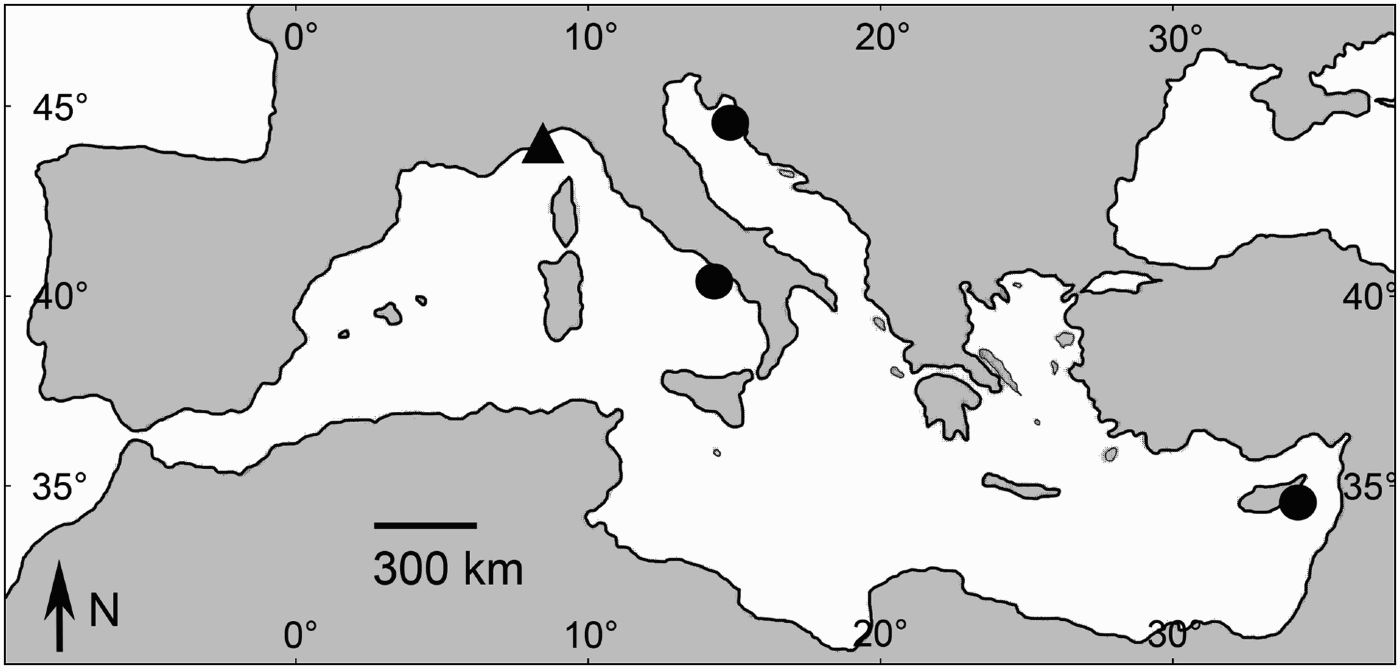
Gobius couchi Miller & El-Tawil, Reference Miller and El-Tawil1974 (Figure 1) is such a rare species. This goby is known from two sites in the eastern Mediterranean Sea and from one in its western basin (Kovacic & Golani, Reference Kovacic and Golani2007). The specimens from the Gulf of Genova represent the second record in the western Mediterranean Sea (Figure 2).
Lateral view of a male of Gobius couchi (Registered no. NMW 95211) from the Gulf of Genova, Ligurian Sea. Scale bar: 10 mm.

Map of the Mediterranean Sea showing previous records (full circles) and the new record (triangle) of Gobius couchi.

MATERIAL
On 7 February 1993 four males 52.2–56.7 mm standard length (SL) and three females 47.5–53.5 mm SL were collected by hook and line on a prelevant sandy bottom in a depth between 60 and 100 cm in the Gulf of Genova, Finale Ligure (44°10′30.74″N 8°22′08.13″E) by one of us (G.A.C.B.). Specimens are deposited at the Natural History Museum of Vienna (Registered no. NMW 95211), and in the collections of G.B.D. and G.A.C.B.
DESCRIPTION
Anterior nostril short, tubular and with small triangular process from rim; pectoral fin with the tips of the two dorsal most rays free from fin membrane; pelvic disc truncate or slightly emarginate respectively (fourth ray of same length or slightly longer as fifth ray), anterior membrane height in midline about one-third of spinous ray; middle rays of first dorsal fin longest; rear tips of second dorsal fin and anal fin reaching to or close to the dorsal and ventral origins of caudal fin respectively; branchiostegal membrane attached to side of isthmus; hyomandibular row of free neuromasts not continuous.
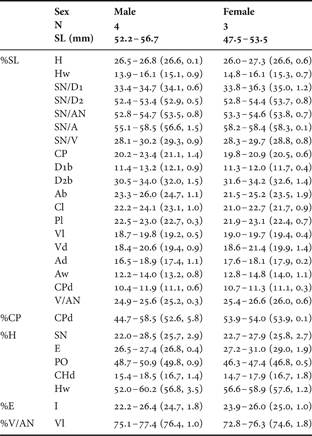
Body proportions are given in Table 1. Kovacic (Reference Kovacic2001) mentions differences in several body proportions between populations of the Adriatic Sea and the north-eastern Atlantic. Our values are generally in accordance with those of Kovacic (Reference Kovacic2001). Some differences may be based on our small sample size and on the large size-range of the Adriatic population.
Body proportions of Gobius couchi. Values are range, and in parentheses, mean and standard deviation.

Ab, length of anal fin base; Ad & Aw, body depth and width at anal fin origin; Cl, caudal fin length; CHd, cheek depth from lower border of eye to level of angle of jaws; CP & CPd, caudal peduncle length and depth; D1b and D2b, length of first and second dorsal fin bases; E, eye diameter; H & Hw, head length and width; I, interorbital width; Pl, pectoral fin length; PO, postorbital length; SL, standard length; SN, snout length; SN/A & SN/AN, distance from snout to vertical of anal fin origin and anus; SN/D1 & SN/D2, distance from snout to origin of first and second dorsal fins; SN/V, distance from snout to vertical of pelvic spinous ray (V I) origin; V/AN, distance from origin of V I to anus; Vd, body depth at origin of V I; Vl, pelvic fin length.
Number of spinous (roman numerals) and soft (arabic numerals) fin rays: first dorsal fin VI, second dorsal fin I/13–14 (13: 3, 14: 4), anal fin I/12, pectoral fin 16, pelvic disc I/5 + 5/I, caudal fin 14 branched rays. Rays of first dorsal fin not distinctly elongate; longest rays reaching, when depressed, to first ray of second dorsal fin. Body predominantly covered with ctenoid scales but breast, ventral side of abdomen, nape and predorsal area, base of pectoral fin and from dorsal origin of pectoral fin rearwards to about middle of first dorsal fin covered by scales without ctenii; opercle naked, except for one specimen with a few scales on dorsal edge; scales in longitudinal series 35–40 (35: 1, 37: 1, 39: 4, 40: 1), scales in transversal series 11.
The pattern of the lateral-line system is within the range for the north-eastern Atlantic (Miller & El-Tawil, Reference Miller and El-Tawil1974) and for the northern Adriatic (Kovacic, Reference Kovacic2001) populations.
Coloration: preserved specimens fawn with 8–9 dark spots along lateral midline; head with 3–4 indistinct geniohyoid spots, cheek with two dark spots; pectoral fin hyaline with dark spot at dorsal origin, somewhat longer than deep; head with series of dark dots on first, second dorsal and caudal fins; anal fin and pelvic disc of males dusky.
DISCUSSION
Originally described from the English Channel, Gobius couchi was first documented for the Mediterranean Sea from the island of Ischia (Stefanni & Mazoldi, Reference Stefanni and Mazzoldi1999). This goby is still to date rarely documented in the Mediterranean Sea and was only known from three areas, the northern Adriatic Sea and from the islands of Ischia (Tyrrhenian Sea) and Cyprus (Levant) (Kovacic & Golani, Reference Kovacic and Golani2007) (Figure 2). The new record of G. couchi represents the first for the Ligurian Sea and for the Italian mainland. Interestingly, the most recent records of G. couchi (Kovacic & Golani, Reference Kovacic and Golani2007; present data) are based on samples from museum collections. This indicates that this small goby was possibly overlooked or misidentified in previous studies and may occur in the Mediterranean Sea more frequently than estimated.