

INTRODUCTION
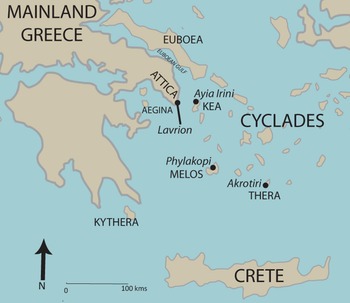
A major problem in the archaeology of the Bronze Age Cycladic islands (Fig. 1) is the issue of Minoanisation, a phenomenon in which Cycladic communities adopted and adapted many aspects of Cretan material culture and practice during the later Middle Bronze Age (MBA) and earlier Late Bronze Age (LBA).Footnote 1 Debate over the primary causes underlying the changes in material culture associated with the Minoanisation phenomenon has been ongoing for over 30 years, since the publication of Hägg and Marinatos's edited volume, The Minoan Thalassocracy, in Reference Hägg and Marinatos1984 (recently, see Broodbank Reference Broodbank2004; Davis and Gorogianni Reference Davis, Gorogianni, Brodie, Gavalas and Doole2008; Macdonald, Hallager and Niemeier Reference Macdonald, Hallager and Niemeier2009; Wiener Reference Wiener and Koehl2013). Yet few studies focus specifically on the later MBA phase of the phenomenon, with some notable exceptions (Papagiannopoulou Reference Papagiannopoulou1991; Davis Reference Davis1984; Reference Davis1986; Whitelaw Reference Whitelaw, Dakouri-Hild and Sherratt2005; Knappett and Nikolakopoulou Reference Knappett, Nikolakopoulou, Laffineur and Greco2005; Reference Knappett and Nikolakopoulou2008; Hilditch Reference Hilditch2008; Gorogianni Reference Gorogianni2008; Abell and Hilditch Reference Abell, Hilditch, Gorogianni, Pavúk and Girella2016; Gorogianni, Abell and Hilditch Reference Gorogianni, Abell and Hilditch2016). The later MBA is, nevertheless, a crucial period for evaluating the degree to which different Cycladic communities participated in the earliest stages of the phenomenon, as well as for elucidating the initial processes that spurred the massive changes evident in LBA Cycladic material culture and society.
Map of the Aegean showing sites referenced in the text.

This paper considers the earliest phase of Minoanisation at the settlement of Ayia Irini on Kea (Fig. 2), one of the three major Cycladic sites of the MBA–LBA, which include also Akrotiri on Thera and Phylakopi on Melos. The full publication of archaeological remains of Period V (Table 1) by Davis (Reference Davis1986) provides an opportunity to examine patterns of ceramic importation and local production and to consider the relationships between Minoan (i.e. Cretan), Minoanising (i.e. Cretan-style) and non-Minoanising ceramics in the Keian assemblage. Detailed assessment of both Minoanising and non-Minoanising features of the Period V ceramic assemblage demonstrates that a substantial proportion of pottery was imported not from Crete, but from other Cycladic islands, especially Melos and/or Thera.Footnote 2 Although some of these Cycladic imports were Minoanising, many of the most common imported eating and drinking shapes were non-Minoanising shapes. The quantity of Cycladic imports and increased popularity of both imported and locally produced non-Minoanising vessels alongside new Minoanising ones suggests that the process of culture change at Ayia Irini in the later MBA was multifaceted and was dictated by changing patterns of interaction and shifting values within the Cyclades as much as between the Cyclades and Crete.
Plan of Ayia Irini (after Schofield Reference Schofield2011, pl. 2; courtesy of the Department of Classics, University of Cincinnati).

Summary of Aegean relative chronology, after Abell Reference Abell2014b, fig. 5. Keian phasing based on Caskey Reference Caskey1972; Overbeck Reference Overbeck, MacGillivray and Barber1984, Reference Overbeck1989a; Cummer and Schofield Reference Davis1984; Davis Reference Davis1986; Schofield Reference Schofield2011; Abell Reference Abell2014b. For the Theran phasing, see Marthari Reference Marthari, MacGillivray and Barber1984, Reference Marthari, Hardy, Doumas, Sakellarikis and Warren1990; Nikolakopoulou et al. Reference Nikolakopoulou, Georma, Moschou, Sophianou, Brodie, Gavalas, Doole and Renfrew2008. For Knossos, recently, see Hatzaki Reference Hatzaki and Momigliano2007; Macdonald and Knappett Reference Macdonald and Knappett2007; MacGillivray Reference MacGillivray and Momigliano2007.

MINOANISATION DEBATES: OVERVIEW AND RECENT RESEARCH
The most prominent debate in Minoanisation studies is concerned with the agency of Cycladic islanders in promoting the local adoption of Cretan and Cretan-style objects and practices. On one side of the debate are those who consider changes in Cycladic society to have resulted from direct Cretan action in the Cyclades, in the form of colonies and the military or political takeover of some or all of the islands (Branigan Reference Branigan1981; Reference Branigan1984; Barber Reference Barber1987, 194–200; Wiener Reference Wiener, Hardy, Doumas, Sakellarakis and Warren1990; Reference Wiener and Gale1991). Most recent studies, however, have emphasised the difficulties in demonstrating political or military control over an area on the basis of archaeological evidence alone and have focused instead on elucidating the exchange networks that linked Crete to the islands and the choices made by Cycladic people in adopting socially significant or economically beneficial objects, technologies and practices from Crete (e.g. Davis Reference Davis, J.L. and J.F1979; Schofield Reference Schofield1982; Davis Reference Davis1984; Davis and Lewis Reference Davis, Lewis, Knapp and Stech1985; Davis Reference Davis1986; Davis and Cherry Reference Davis, Cherry, Hardy, Doumas, Sakellarakis and Warren1990; Whitelaw Reference Whitelaw, Dakouri-Hild and Sherratt2005; Berg Reference Berg2007b; Knappett and Nikolakopoulou Reference Knappett, Nikolakopoulou, Laffineur and Greco2005; Reference Knappett and Nikolakopoulou2008; Cutler Reference Cutler, M.-L. and Laffineur2012).
In a recent critique, Broodbank (Reference Broodbank2004) raised a number of issues that he argued had impeded the development of complex explanatory frameworks capable of dealing fully with the archaeological evidence for Minoanisation. Among the most significant ongoing problems is a tendency to conflate all periods of Minoanisation (later MBA–mid-LBA), so that the phenomenon is conceived of as a static thing, rather than a fluid process (see also Knappett and Nikolakopoulou Reference Knappett and Nikolakopoulou2008). In addition, attempts to address the significance of Minoan and Minoanising objects in the Cyclades regularly overlook how Minoanising objects relate to non-Minoanising ones, or fail to acknowledge the potential economic or social importance of Minoanising imports from places other than Crete. Such Creto-centric perspectives have obscured variability in how Cycladic communities engaged with the Minoanisation phenomenon, although some recent studies have clarified areas where such variability exists, particularly with respect to settlement patterns, architecture, ceramic and weaving technologies and the use of Linear A and Minoanising seals in the islands (e.g. Davis and Cherry Reference Davis, Cherry, Hardy, Doumas, Sakellarakis and Warren1990; Schofield Reference Schofield, Hardy, Doumas, Sakellarakis and Warren1990; Whitelaw Reference Whitelaw, Dakouri-Hild and Sherratt2005; Knappett and Nikolakopoulou Reference Knappett, Nikolakopoulou, Laffineur and Greco2005; Reference Knappett and Nikolakopoulou2008; Berg Reference Berg2007b; Karnava Reference Karnava, Brodie, Doole, Gavalas and Renfrew2008; Cutler Reference Cutler, M.-L. and Laffineur2012; Abell and Hilditch Reference Abell, Hilditch, Gorogianni, Pavúk and Girella2016; Gorogianni, Abell and Hilditch Reference Gorogianni, Abell and Hilditch2016).
Minoanisation in its earliest phase
Analysis of variability in how Cycladic communities adopted and adapted Cretan and Minoanising forms of material culture is particularly important for the earliest stages of the phenomenon. The beginning of the Minoanisation phenomenon has typically been dated to the later MBA, when Cretan imports were relatively common at Cycladic sites, and local pottery styles were influenced by Cretan ones (Scholes Reference Scholes1956, 38–9; Davis Reference Davis1984; Barber Reference Barber1981; Reference Barber1984; Davis Reference Davis1986; Papagiannopoulou Reference Papagiannopoulou1991; Broodbank Reference Broodbank2004; Knappett and Nikolakopoulou Reference Knappett, Nikolakopoulou, Laffineur and Greco2005; Reference Knappett and Nikolakopoulou2008; Nikolakopoulou Reference Nikolakopoulou2009; Reference Nikolakopoulou2013). Cretan technologies and practices were adopted at all three major Cycladic settlements in the later MBA, particularly in the realm of weaving (Cutler Reference Cutler, M.-L. and Laffineur2012) and pottery production and consumption patterns (Knappett and Nikolakopoulou Reference Knappett, Nikolakopoulou, Laffineur and Greco2005; Reference Knappett and Nikolakopoulou2008; Berg Reference Berg2007a; Reference Berg2007b; Hilditch Reference Hilditch2008; Gorogianni, Abell and Hilditch Reference Gorogianni, Abell and Hilditch2016). In addition, the use of Cretan Linear A on locally produced objects (Caskey Reference Caskey1970; Karnava Reference Karnava, Brodie, Doole, Gavalas and Renfrew2008) and, perhaps, a lead weight based on Cretan metrological standards (Davis Reference Davis1986, no. Q-1) first appeared at Ayia Irini in the later MBA.
The later MBA was a period that witnessed major changes on Crete as well, with the breakdown of the cultural regionalism of MM II and emergence of more unified cultural, economic and perhaps political power at Knossos, although the latter continues to be an area of much debate (recently, e.g. Knappett and Schoep Reference Knappett2000; Schoep Reference Schoep, Driessen, Schoep and Laffineur2002; Adams Reference Adams2006; Bevan Reference Bevan2010; Carinci and La Rosa Reference Carinci and La Rosa2013; Rethemiotakis and Christakis Reference Rethemiotakis and Christakis2013). Major social, economic and perhaps political changes in MM III Crete probably resulted in new Cretan strategies of exchange and interaction with the Cyclades, a possibility that has been discussed in detail by Wiener (Reference Wiener and Gale1991; Reference Wiener and Koehl2013), as well as Knappett and Nikolakopoulou (Reference Knappett, Nikolakopoulou, Laffineur and Greco2005; Reference Knappett and Nikolakopoulou2008). Imported Melian/Theran jars and jugs in MM III deposits at Knossos have been cited as evidence for changing relationships between the Cyclades and Knossos in particular, since Cycladic imports from other parts of Crete in the same period are rare (Evans Reference Evans1921, 557–61; MacGillivray Reference MacGillivray1984; Knappett Reference Knappett, Tampakaki and Kaloutsakis2006). The concentration of Cycladic imports at MM III Knossos also marks a shift from the previous period, when Cycladic imports were rare throughout Crete (MacGillivray Reference MacGillivray1984, 153; Sotirakopoulou Reference Sotirakopoulou, Philippa-Touchais, Touchais, Voutsaki and Wright2010, 834–5; Van de Moortel Reference Van de Moortel, Philippa-Touchais, Touchais, Voutsaki and Wright2010, 880). The later MC imports at Knossos have been interpreted as evidence either of tribute (Evans Reference Evans1921, 561; Scholes Reference Scholes1956, 38; MacGillivray Reference MacGillivray1984, 156) or of the intensification and increased valuation of contacts between Knossos and the Cyclades (Knappett Reference Knappett, Tampakaki and Kaloutsakis2006; Knappett and Nikolakopoulou Reference Knappett and Nikolakopoulou2008, 36–7). The presence of not only Cycladic, but also Dodecanesian and Milesian imported pottery at MM IIIA Knossos suggests that palatial elites there were actively cultivating new exchange relationships with the wider Aegean in that period (Knappett, Mathioudaki and Macdonald Reference Knappett, Mathioudaki and Macdonald2013, 16).
As Wiener (Reference Wiener and Gale1991; Reference Wiener and Koehl2013) argued, the development of new Knossian strategies for engaging with the Cyclades in MM III perhaps should be expected, since the Cyclades provided access to not only island resources and products, but also mainland ones, via the Western String trade route (Davis Reference Davis, J.L. and J.F1979; Cherry and Davis Reference Cherry and Davis1982); among these, significantly, were the ore deposits of Lavrion, which seem to have been a major resource in the MBA–LBA Aegean (Stos-Gale and Macdonald Reference Stos-Gale, Macdonald and Gale1991). Knappett (Reference Knappett, Tampakaki and Kaloutsakis2006) and Knappett and Nikolakopoulou (Reference Knappett, Nikolakopoulou, Laffineur and Greco2005; Reference Knappett and Nikolakopoulou2008) have also argued, however, for Cycladic agency in promoting new relationships with Knossos and enabling increased interaction between the Cyclades and Crete.
The degree of Cycladic agency in the development and intensification of Minoanisation during the later MBA was addressed in Davis's (Reference Davis1986) study of Period V at Ayia Irini. In the conclusions to the volume, Davis (Reference Davis1986, 105–7) laid out a case for the continuity of settlement and culture at Ayia Irini. He argued that there was no evidence for a military takeover or for the presence of a Cretan colony or enclave within the Period V settlement, given the continuity of material culture and technologies from Period IV into Period V, the remarkable heterogeneity of material culture from Period V deposits, the lack of some features of Cretan assemblages and the immediate rebuilding and expansion of the Period V fortification wall in the early phases of Period VI. He argued instead that the adoption of Minoanising technologies and material culture at Ayia Irini was driven primarily by economic motivations, as Aegean trade intensified and Keians tried to compete in island markets dominated by Cretan products and craft specialists (Davis Reference Davis1984; Davis and Lewis Reference Davis, Lewis, Knapp and Stech1985; Davis Reference Davis1986, 105–7). Certainly, the local production of Minoanising objects in the islands is a major factor in the archaeological visibility of the Minoanisation phenomenon in later MC assemblages (Davis Reference Davis1984; Papagiannopoulou Reference Papagiannopoulou1991).
Although Davis emphasised economic reasons for the adoption of Cretan technologies to make Cretan products, the problem of why such products became appealing to Cycladic islanders in the first place remains obscure. Davis and Gorogianni (Reference Davis, Gorogianni, Brodie, Gavalas and Doole2008) argued that the desire for Minoanising objects in Cycladic communities was driven by increased social stratification and competition between Cycladic elites, who adopted Minoanising material culture and practices in order to demonstrate connections with Cretan ways of doing things, which came to represent some measure of elite status. But, if Davis and Gorogianni (Reference Davis, Gorogianni, Brodie, Gavalas and Doole2008) are correct that Cretan ways of doing things become enmeshed with elite ones, why did this process escalate so significantly in the later MC?
Trade and interaction between Crete and the Cyclades in the MBA
One argument is that trade between Crete and the Cyclades intensified during the later MBA and that the increasing interaction and availability of Cretan objects drove changes in social values in the Cyclades (Knappett and Nikolakopoulou Reference Knappett and Nikolakopoulou2008; Nikolakopoulou Reference Nikolakopoulou2009). Knappett and Nikolakopoulou (Reference Knappett and Nikolakopoulou2008, 37–8) reported an increase in Cretan imports in Phase C deposits at Akrotiri and argued that such objects themselves acted as a colonial force, reshaping values and the social context of consumption as they were used.
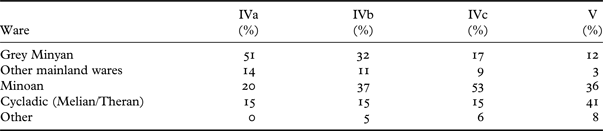
While their argument that Cretan objects played an important role in ‘colonising’ the Cyclades is compelling, it may not apply equally to all island communities. A recent assessment of Cretan imports at Ayia Irini suggests that MM imports made up a slightly smaller proportion of the assemblage in Period V than in the previous period (Gorogianni and Abell Reference Gorogianni, Abell, Hilditch, Beestman-Kruijshaar, Revello Lami, Rückl and Ximeriforthcoming). Of the approximately 25% of the Period IV assemblage which seems to have been imported (Overbeck Reference Overbeck1982, 40; Abell Reference Abell2014b, 353–4), Crego calculated that ‘Minoanising’ ware was nearly twice as common as the next most common imported ware, Grey Minyan, from the mainland, in all but the earliest phase of the period (Table 2; Crego Reference Crego, Felten, Gauss and Smetana2007, 337 fig. 4). Although Overbeck (Reference Overbeck1982; Reference Overbeck1989a) and Crego (Reference Crego, Felten, Gauss and Smetana2007) did not distinguish between Minoan imports from Crete and Minoanising imports from elsewhere, macroscopic fabric analysis in Area B suggests that much of their ‘Minoanising’ ware category is made up of Cretan products, the vast majority of which are reported to be miscellaneous jars, jugs and medium–large closed vessels, both painted and plain (Overbeck Reference Overbeck1989a; Abell Reference Abell2014b, 356–9, 364–5). In Period IV, that is, it seems that local interest in Cretan pottery was focused primarily on products transported in ceramic containers, rather than on the ceramics themselves. Nevertheless, the importation of Cretan ceramics and other products was not, at least at Ayia Irini, a new feature of the later MC period.
Relative percentages of imported wares in Period IV subphases and Period V, after Crego Reference Crego, Felten, Gauss and Smetana2007, 337, fig. 4 and calculations based on count of vessels reported in Davis Reference Davis1986.

An additional aspect of interaction between Keians and Cretans in Period IV is relevant for considering the changes in material culture that occurred in Period V. The adoption of Cretan technologies like the potter's wheel and warp-weighted loom by Cycladic communities has been interpreted as a fundamental component of the Minoanisation phenomenon in the later MBA, since these techniques first appeared at Phylakopi and Akrotiri in that period, and they came into common use at Ayia Irini (Davis Reference Davis1984; Davis and Lewis Reference Davis, Lewis, Knapp and Stech1985; Knappett and Nikolakopoulou Reference Knappett, Nikolakopoulou, Laffineur and Greco2005; Berg Reference Berg2007a; Reference Berg2007b; Knappett and Nikolakopoulou Reference Knappett and Nikolakopoulou2008).Footnote 3 Unlike Akrotiri and Phylakopi, however, these technologies were used at Ayia Irini already in the earliest phases of Period IV, well before the traditional start of the Minoanisation phenomenon in the Cyclades. The adoption of these technologies, which require a lengthy period of apprenticeship to master, strongly suggests that long-lasting and direct contact took place between Keian and Cretan craftspeople in Period IV, probably enabled through the mobility of some Cretan craftspeople (Abell Reference Abell2014a).
Locally produced, wheel-fashioned ceramics, Cretan-style loomweights and Minoanising cooking vessels were rare in Period IV deposits (Overbeck Reference Overbeck1989a). Most local ceramic and textile production employed non-Minoanising techniques and, at least in the case of pottery, resulted primarily in non-Minoanising objects. There is no obvious Cretan influence in Period IV burial practices, architecture or other aspects of local society. Thus, despite good evidence for exchange and the mobility of at least a few craftspeople between Kea and Crete in Period IV, the community as a whole cannot be considered as ‘Minoanised’, at least in the sense that this term is generally used to describe the later MBA–LBA Cyclades.
The earlier MBA relationship between Kea and Crete seems to have been rather different from other contemporary Creto-Cycladic relations. At Akrotiri and Phylakopi, Cretan technologies were not in use (Knappett and Nikolakopoulou Reference Knappett, Nikolakopoulou, Laffineur and Greco2005; Reference Knappett and Nikolakopoulou2008; Berg Reference Berg2007a; Reference Berg2007b; Cutler Reference Cutler, M.-L. and Laffineur2012). At Akrotiri, Cretan imports from Phase A contexts were relatively rare, increased in Phase B and reached a peak in Phase C (Nikolakopoulou Reference Nikolakopoulou2009, 33; pers. comm.). The situation is somewhat less clear at Phylakopi, where Papagiannopoulou (Reference Papagiannopoulou1991, 119) reported a decrease in Cretan imports from earlier to later MC, based on rarer MM IIIA than MM II imports. However, as Hood (Reference Hood, Renfrew, Brodie, Morris and Scarre2007, 250) noted in his study of Minoan imports at Phylakopi, MM IIIA is difficult to date closely based on stylistic analysis alone, which may have resulted in an over-representation of datable MM II in comparison with MM IIIA imports at that site. On the other hand, Hood (Reference Hood, Renfrew, Brodie, Morris and Scarre2007, 248, 253) also argues that MM imports in general are more common at Ayia Irini than at Phylakopi, and Berg (Reference Berg2007b, 111 fig. 33), although she does not discuss the earlier MC period, reports that imports were consistently less than 5% of the assemblage from later MC–LC II at Phylakopi. Similarly, imports were very rare at earlier MC Paroikia on Paros, while Minoan or Minoanising imports in particular were almost non-existent (Overbeck Reference Overbeck1989b, 14–15, 18–19, 21–4). In sum, of the major Cycladic sites of the earlier MC period, the material culture of Ayia Irini differs in the presence of more imported ceramics generally, more Cretan and/or Minoanising imports in particular and good evidence for direct interaction and apprenticeship between Keian and Cretan craftspeople.
It seems likely that these differences are related to the role of Ayia Irini in processing and providing access to Lavrion metals in Aegean exchange networks (Davis Reference Davis, J.L. and J.F1979; Gale Reference Gale, Mendoni and Mazarakis Ainian1998). Over the course of the MBA–LBA, the economic base of Ayia Irini seems to have been rooted in the role of the town as an exchange hub linking culturally diverse regional networks of central and southern mainland Greece, Aegina and the Cyclades, as well as Crete. It is likely that people were drawn to the area in order to access resources from Lavrion, which was a prominent source of metals for the wider Aegean throughout the Bronze Age (Davis Reference Davis, J.L. and J.F1979; Stos-Gale and Macdonald Reference Stos-Gale, Macdonald and Gale1991). The presence of metals and metallurgical debris in deposits of all phases at Ayia Irini attests to the role of the community not only as a stopover for people on their way to Lavrion, but also as a location where metals were processed and probably exchanged (Cummer and Schofield Reference Cummer and Schofield1984; Davis Reference Davis1986; Overbeck Reference Overbeck1989a; Wilson Reference Wilson1999; Schofield Reference Schofield2011). Accordingly, residents of Ayia Irini seem to have had better access to wide-ranging exchange networks in the earlier MBA than did residents of Phylakopi or Akrotiri.
As with these other Cycladic communities, however, the later MBA marked a significant change in the material culture of the community, despite little change in the proportion of Cretan imports in the assemblage. Given the evidence discussed above for Keian–Cretan trade and interaction already in the earlier MC period, however, it is unlikely that an intensification of trade with Crete and the concomitant availability of more abundant Cretan products was the primary impetus for shifting values at Ayia Irini during the later MC period, although it may well have impacted residents of Akrotiri as suggested by Knappett and Nikolakopoulou (Reference Knappett and Nikolakopoulou2008).
PERIOD V AT AYIA IRINI
The full presentation of Period V by Davis (Reference Davis1986) provides a good starting point for comparing how patterns of production and consumption at Ayia Irini compare with those summarised by Knappett and Nikolakopoulou (Reference Knappett, Nikolakopoulou, Laffineur and Greco2005; Reference Knappett and Nikolakopoulou2008) for Phase C at Akrotiri, and for considering other factors in the promotion of the changes in the material culture of the later MC settlement apart from changing trade patterns with Crete.
The beginning of Period V at Ayia Irini was marked by the construction of a massive fortification wall (Fig. 2), which enlarged the size of the previous settlement (Davis Reference Davis1986, 1). The greater area encompassed by the fortification wall in comparison with the previous phase suggests that the population had grown substantially by the beginning of the period (Davis Reference Davis1986, 102). Period V ended with an earthquake that damaged the fortification wall, which was repaired and expanded almost immediately in Period VI. The only major architectural remains dated to Period V are the fortification walls. The lack of other architecture that can be associated with Period V probably resulted from ongoing clean-up and major construction activities after the earthquake (Davis Reference Davis1986, 1). In addition to metallurgical activities, other industries attested in Period V are weaving; working of bone, antler and perhaps boar's tusk; lithic production using imported Melian obsidian; perhaps stone vessel manufacture and, of course, pottery production (Davis Reference Davis1986, 89–100).
Sample and methodology
Since ceramics make up the most abundant dataset in Period V, the discussion below focuses on the pottery catalogued in Davis's (Reference Davis1986) publication. Nearly all sherds of Period V are presented by Davis (Reference Davis1986, 4), which ensures that analysis of his volume is not biased substantially by selection of particular kinds of ceramics for publication. On the other hand, some pottery was discarded prior to publication as part of the typical post-excavation processing procedure at Ayia Irini (Gorogianni Reference Gorogianni2008, 102–5; Gorogianni Reference Gorogianni2013). In Period V, nearly 60% of the assemblage (roughly, by volume) seems to have been discarded (Gorogianni and Abell Reference Gorogianni, Abell, Hilditch, Beestman-Kruijshaar, Revello Lami, Rückl and Ximeriforthcoming, table 2; for specific deposits, see also Gorogianni Reference Gorogianni2008). Analysis of excavation records and the remaining ceramic lots in the Northern Sector and in Area B have demonstrated that coarse, plain wares made up the majority of discarded pottery, regardless of chronological period (Gorogianni Reference Gorogianni2008, 351; Abell Reference Abell2014b, 10–12). Given the relatively coarse nature of local Keian fabrics, this pattern of discard probably affected primarily local plain wares, especially larger – and, correspondingly – coarser vessels, particularly when chronologically or typologically diagnostic features like rims or bases were not preserved (Gorogianni Reference Gorogianni2008, 351; Abell Reference Abell2014b, 10–12). The preserved dataset, which is made up primarily of feature and/or decorated sherds in imported and local ceramic wares, should, nevertheless, be reasonably well suited to a discussion of Minoanisation in the ceramic assemblage, since the major category of missing evidence – plain and coarse local sherds with few distinctive shape or decorative characteristics – is a ceramic category that is unlikely to be especially sensitive to changes in ceramic fashions.
Davis's (Reference Davis1986) catalogue is grouped by ware, which he assigned to a broad region of production based on typo-stylistic parallels and macro- and microscopic fabric analyses (Davis and Williams Reference Davis and Williams1981). Red-brown, moderately fine to coarse, schist-rich Keian fabrics are easily distinguishable from most non-local fabrics on the basis of colour, texture and inclusions. Ongoing fabric analysis of Period V deposits in the Northern Sector, a collaboration of Jill Hilditch with Evi Gorogianni and Rodney Fitzsimons, suggests that ceramics arrived from more regions than Davis hypothesised, but, in large part, Davis's assignation of provenance remains useful, with imports from Crete, Melos and/or Thera and mainland Greece being the most common in Period V deposits. This basic pattern has been confirmed in the most recent macroscopic fabric studies (Gorogianni Reference Gorogianni2008; Gorogianni and Abell Reference Gorogianni, Abell, Hilditch, Beestman-Kruijshaar, Revello Lami, Rückl and Ximeriforthcoming; Hilditch pers. comm.).Footnote 4
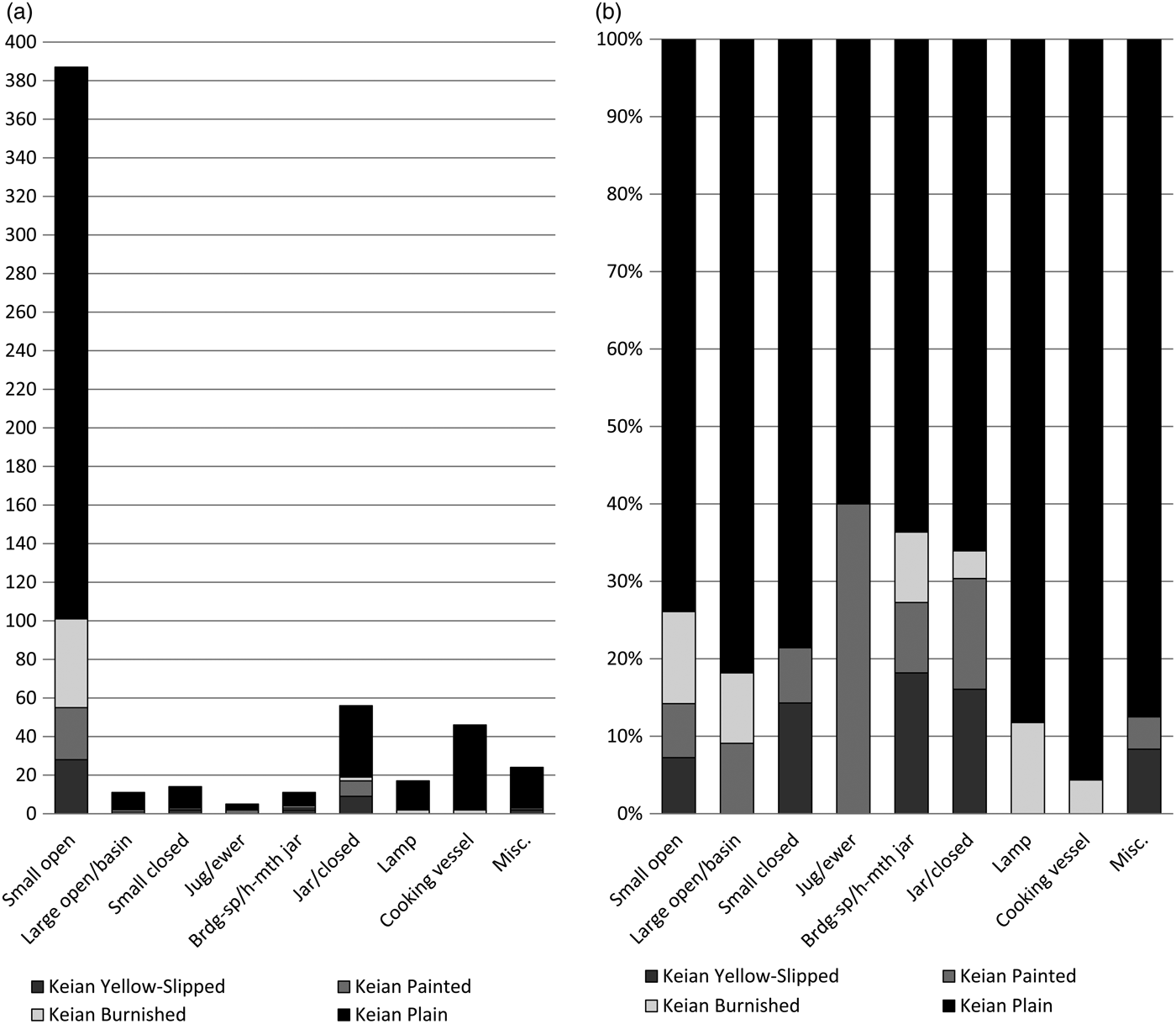
The goal of this paper is not to provide a detailed assessment of the precise trade partners to whom residents of Ayia Irini had access. Rather, it considers broadly what kinds of functions and shapes were represented in imported wares, as well as the proportions of Minoanising and non-Minoanising elements in the assemblage overall. In particular, I am interested not just in the make-up of the Minoanising assemblage, which Davis has already established, but in how non-Cretan imports and local products fit into that assemblage, as well as what kinds of different practices or interaction patterns are represented by the non-Minoanising component of the assemblage. To accomplish this goal, I counted the number of vessels reported by Davis for each Period V deposit according to shape and ware; entries that included multiple vessels without specific quantification were counted according to the lowest number of vessels possible. So, for example, ‘several’ jars were counted as two jars; five tripod legs were counted as two tripod vessels and so on. The results of the quantification are presented in Figs. 3, 4, and 5. This quantification serves to highlight similarities and differences in the kinds of ceramics imported from different regions, as well as in the popularity of particular shapes, regardless of ware.
(a) Number and (b) relative percentage of vessels by ware and shape based on count of catalogued pottery in Davis Reference Davis1986. * = Minoanising shapes. Bridge-spouted/hole-mouthed (Brdg-sp/h-mth) jars are considered as Minoanising, despite the fact that some (a minority) are Cycladic variants that are not clear imitations of the Cretan version of this shape. (*) = categories of bowl, cup, jar and jug that include both Minoanising and non-Minoanising versions; vessels that can be classed only as open or closed are not well enough preserved to be tied to specific shapes (Minoanising or otherwise). Hdl-less = handleless; Oval-mth = oval-mouthed; S&B = slipped and burnished.

(a) Number and (b) relative percentage of local vessels by ware and general shape category based on count of catalogued pottery in Davis Reference Davis1986. Brdg-sp/h-mth = bridge-spouted/hole-mouthed.

(a) Number and (b) relative percentages of imported vessels by ware and general shape category based on count of catalogued pottery in Davis Reference Davis1986. Brdg-sp/h-mth = bridge-spouted/hole-mouthed; S&B = slipped and burnished.

Analysis of published Period V deposits: Local wares
The Minoanisation of the Period V ceramic assemblage is apparent especially in the many local versions of Cretan shapes, whereas the local Period IV assemblage had been dominated by a variety of bowl, goblet and jar shapes that are paralleled elsewhere in the Cyclades, Aegina and mainland Greece (Overbeck Reference Overbeck1989a). Although Minoanising shapes and decorative styles were common in Period V, they were not the only ones made by local potters (Figs. 3, 4, 6).
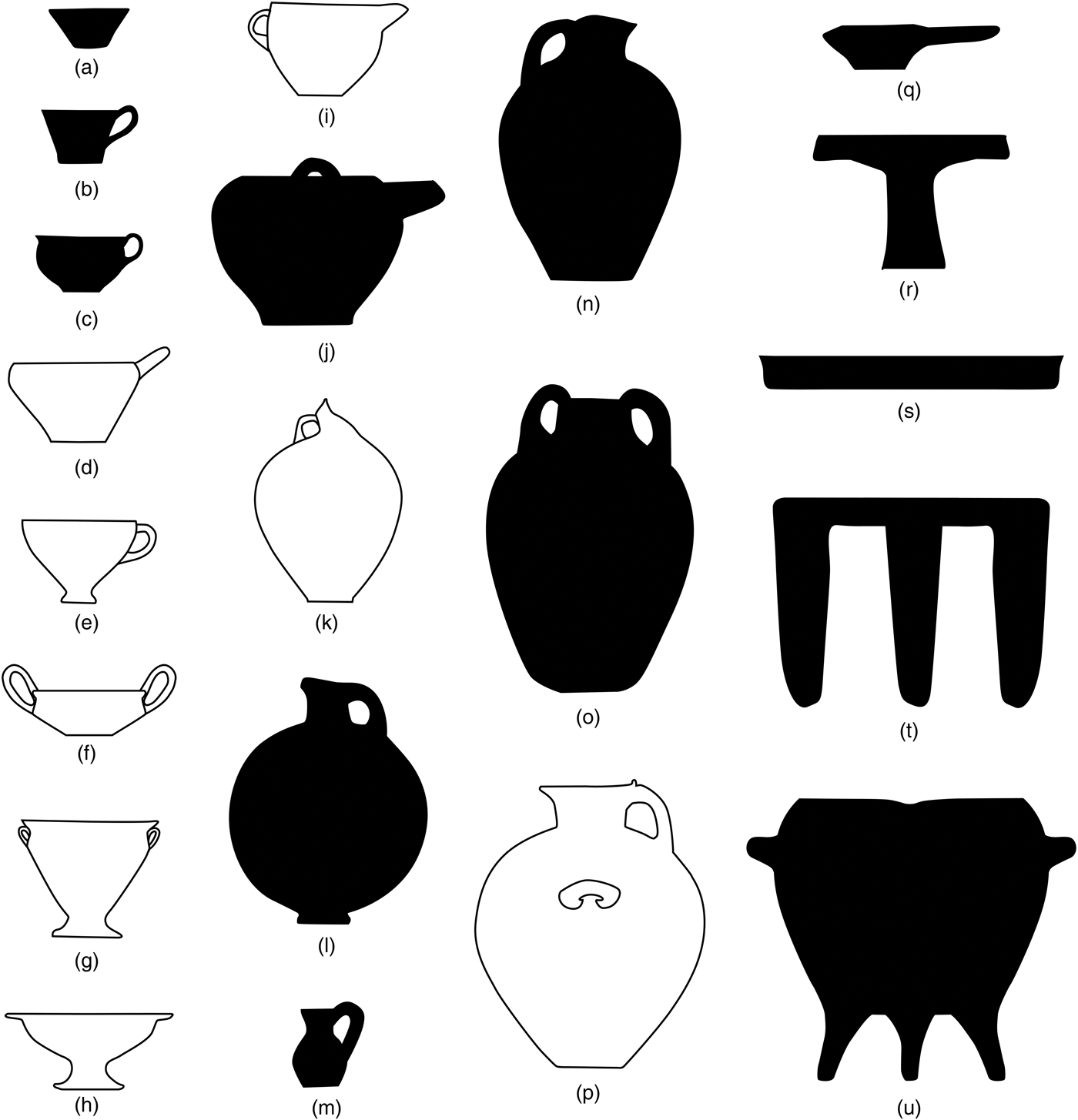
When all local wares are taken into consideration, the most common shape in Period V deposits, by far, was the Minoanising handleless cup (Figs. 3, 6a ). Proportionally, however, the shape did not form as substantial a part of the drinking assemblage as it did in Periods VI and VII; although Davis reported 179 handleless cups from deposits throughout the site, thousands of such vessels were deposited in House A and the Western Sector alone in Periods VI and VII (Cummer and Schofield Reference Cummer and Schofield1984; Schofield Reference Schofield2011). The two most common open shapes apart from handleless cups were KeftiuFootnote 5 cups (Figs. 3, 6b ) and Cycladic cups (Figs. 3, 6d ). Other relatively popular shapes were rounded cups, goblets, baking pans or trays and tripods, of which all but goblets are Minoanising shapes (Figs. 3, 6c, g, s–u ). Tripod jars and trays are perhaps under-represented in Davis's (Reference Davis1986) publication, since tripod fragments were common at the site and, thus, regularly discarded by the excavators.
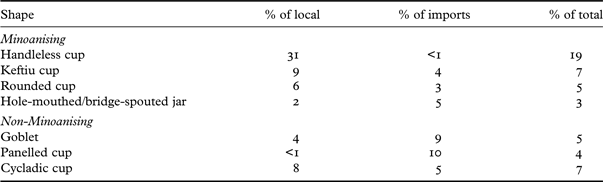
Nearly all common imported shapes were also manufactured locally (Table 3; Figs. 3, 6). A few shapes were more common among the imported than the local wares: panelled cups, common in Melian/Theran wares; hole-mouthed or bridge-spouted jars, most common in Melian/Theran and Minoan wares; beaked jugs, most common in Melian/Theran wares; lentoid jugs and oval-mouthed amphorae, present only in Minoan wares; and hydriae and kantharoi, present in mainland or unknown wares (Figs. 3, 6d, f, j–l, o, p ). Other shapes common among imports but less well represented in local wares in Davis's (Reference Davis1986) catalogue include both large and small closed vessels and miscellaneous open vessels for which a clear profile was not identifiable. This pattern in the current data, especially with respect to large closed vessels, probably reflects post-excavation discard patterns that privileged decorated ceramics, as well as fabrics and wares that appeared to be imported over coarse local ones (compare the proportion of closed to small open vessels preserved in local versus imported wares in Figs. 4a , 5a ).
Common tableware shapes in Period V (after Davis Reference Davis1986).

Local wares in Period V deposits were classified according to surface treatment. In addition to plain and burnished wares, two painted wares existed: Yellow-Slipped Ware, in which the surface of the vessel was coated in yellow slip and painted with designs in dark paints (sometimes bichrome), and Painted Ware, in which dark or light paint was used for designs either on the untreated surface of the clay or, more rarely, over a dark slip. Although similar kinds of surface treatment are attested in Period IV, burnished ware was much more common than painted wares (especially among tablewares), whereas burnished ware became significantly less popular in Period V.
In Period V, Cycladic cups were common in local burnished ware, as were goblets (Figs. 3, 6d, g ); both shapes are derived from popular open shapes of the previous period. The most common shapes in Painted Ware were Minoanising rounded cups and miscellaneous closed vessels with unidentifiable profiles (Figs. 3, 6c ). Keftiu cups, rounded cups and miscellaneous closed vessels were the most common in Yellow-Slipped Ware (Figs. 3, 6b, c ). In general, burnished ware included primarily non-Minoanising shapes, while painted wares included primarily Minoanising ones. Thus, the increase in the popularity of painted wares in comparison to burnished ware in Period V seems to be tied to the increased popularity of Minoanising shapes (Davis Reference Davis1986, 85).
Schematic of selected Period V shapes based on illustrations in Davis Reference Davis1986. Non-Minoanising shapes are outlined, Minoanising ones are filled. (a) handleless cup; (b) Keftiu cup; (c) rounded cup; (d) Cycladic cup; (e) panelled cup; (f) kantharos; (g) goblet; (h) pedestalled bowl; (i) Cycladic spouted jar; (j) bridge-spouted/hole-mouthed jar; (k) beaked jug; (l) lentoid jug; (m) juglet; (n) trefoil-mouthed jug; (o) oval-mouthed amphora; (p) hydria; (q) stick-handled lamp; (r) pedestalled lamp; (s) baking tray; (t) tripod tray; (u) tripod jar.

Most published Minoanising vessels, however, were not painted in imitation of Cretan light-on-dark (LoD), polychrome, or dark-on-light (DoL) styles and were, instead, left undecorated. Plain ware was by far the most common local ware in Davis's (Reference Davis1986) publication (Figs. 3, 4). Nearly all Minoanising and non-Minoanising shapes are represented, with the exception of a few, like pedestalled bowls and panelled cups (Fig. 6e, h ). The most popular Minoanising shapes, including Keftiu cups, were usually plain (Fig. 6b ). Only rounded cups were more commonly decorated than plain (Fig. 6c ). Among non-Minoanising shapes, Cycladic cups were also common in plain ware (Fig. 6d ). It is likely that this pattern reflects actual production patterns, rather than being an effect of post-excavation discard practices, since decorated sherds were more likely to be kept than plain ones.
The increased preference for plain tablewares in Period V compared to Period IV is noteworthy. In Period IV, tablewares were more common in burnished ware than plain ware, which was used primarily for larger closed, cooking or utilitarian shapes, although a few plain tablewares are reported from Period IV deposits of all phases (Overbeck Reference Overbeck1989a; Abell Reference Abell2014b, fig. 177). The shift in local ceramic production in Period V was not, therefore, limited to merely replacing traditional burnished shapes with direct imitations of Minoan vessels as a marker of elite status, since high-quality imported Minoan ceramics in the Cyclades were typically painted, especially in the LoD or polychrome styles (Davis Reference Davis1986; Hood Reference Hood, Renfrew, Brodie, Morris and Scarre2007; Knappett and Nikolakopoulou Reference Knappett and Nikolakopoulou2008). Plain and less highly burnished tablewares became more common in the latest phase of Period IV (IVc), which suggests that the change in production in Period V was a relatively gradual one (Overbeck Reference Overbeck1989a).Footnote 6 Finally, since some local products of Period IV incorporated the use of white or polychrome paint on a dark ground, it must have been possible for local potters in Period V to manufacture more direct imitations of LoD or polychrome painted Cretan ceramics, if they wished. The fact that they did not do so suggests that factors other than increased accessibility to or desirability of Cretan dark-ground pottery impacted local ceramic production choices in this period.
Analysis of Period V deposits: Imports
In addition to changes in local production, Period V also witnessed a shift in import patterns. The most common imported wares in Period V were Cretan and Melian/Theran wares, while mainland wares were rarer (Table 2, Fig. 5) (Davis Reference Davis1986; Gorogianni and Abell Reference Gorogianni, Abell, Hilditch, Beestman-Kruijshaar, Revello Lami, Rückl and Ximeriforthcoming). In contrast, in Period IV, mainland wares were only somewhat less common than Minoan wares, with Melian/Theran (i.e. Cycladic) wares being comparatively rare (Table 2). The major change in import patterns from Period IV to V at Ayia Irini, therefore, was not a shift in the proportion of imported Cretan pottery, but rather, a sharp decrease in mainland imports alongside an increase in Melian/Theran imports (Gorogianni and Abell Reference Gorogianni, Abell, Hilditch, Beestman-Kruijshaar, Revello Lami, Rückl and Ximeriforthcoming). A decrease in mainland imports – at least in the form of Grey Minyan ware – between the earlier and later MC periods has also been noted at Phylakopi and Akrotiri (Nikolakopoulou Reference Nikolakopoulou, Felten, Gauss and Smetana2007, 355–6).
Different functional categories of pottery were imported from different regions. Nearly all Grey Minyan imports were open vessels, especially goblets (Fig. 6 g); among rarer mainland painted wares, both larger closed and fine open vessels were reported (Fig. 5). Although the proportion of mainland wares was smaller in Period V than in Period IV, the functional range of shapes was similar between the two periods: in Period IV, most mainland imports also were fine drinking vessels, with very few closed vessels imported (Overbeck Reference Overbeck1989a; Abell Reference Abell2014b, 372–5).
Similar functional categories were imported in Melian/Theran and Minoan wares, although small, open vessels were more common in Melian/Theran than Minoan wares (Figs. 3, 5). Some shapes – especially jugs, bridge-spouted or hole-mouthed jars, small closed vessels, cooking vessels and lamps – were imported almost exclusively in Melian/Theran and Minoan wares. In other words, in Period V the general patterns of importation of Minoan and Melian/Theran wares are more similar to each other, in terms of the functional categories represented, than they are to mainland wares. The pattern of importation of Cretan wares also seems to have changed to include more tablewares between Periods IV and V, while Melian/Theran wares seem to have had a similar pattern of distribution across functional categories throughout Periods IV and V (Abell Reference Abell2014b, 372–5, 383–7). As mentioned above, however, while the proportion of Cretan imports overall did not change significantly from Period IV to Period V, Melian/Theran imports became much more common (Table 2).
According to Davis's (Reference Davis1986) catalogue, large closed vessels were the most common imports among Cretan wares in Period V (Fig. 5). Keftiu cups, rounded cups, bowls, hole-mouthed or bridge-spouted jars and lentoid jugs were relatively common as well, while various small closed and pouring shapes, lids, lamps and a tripod were also reported (Figs. 3, 5, 6b, c, j, l, q, r, u ). In Melian/Theran wares, the most common shapes in Period V were panelled cups, Cycladic cups, hole-mouthed or bridge-spouted jars and miscellaneous closed vessels (Figs. 3, 5, 6d, e, j ). Cycladic cups (termed ‘carinated bowls’ in Period IV) and bridge-spouted or hole-mouthed jars were popular shapes in Period IV. Panelled cups, rare in earlier Period IV deposits and usually in Melian/Theran Cycladic White Ware, did not become popular until the end of Period IV (phase IVc), when importation and local production of Minoanising pottery also increased (Overbeck Reference Overbeck, MacGillivray and Barber1984; Reference Overbeck1989a). Some Minoanising rounded cups, Keftiu cups, bowls, a jug and even a baking tray were also imported in Melian/Theran wares in Period V (Fig. 7).
Imported Melian/Theran Minoanising vessels (after Davis Reference Davis1986; courtesy of the Department of Classics, University of Cincinnati). Drawings are not to scale. Bridge-spouted and hole-mouthed jars (AG-3, E-21, AA-70) have a variety of profiles and decorative schemes, not all of which are strictly Minoanising (e.g. AG-3).

In general, the most common shapes in imported wares were non-Minoanising (Table 3; Fig. 3). Imported panelled cups and goblets were each about twice as common as imported Minoanising shapes like Keftiu and rounded cups, as well as hole-mouthed or bridge-spouted jars, the most common pouring vessels (Table 3). Traditional Cycladic cups, meanwhile, were equally as common as those Minoanising shapes. The fact that panelled cups were one of the most popular drinking shapes of Period V and were the most popular imported drinking shape overall suggests that such vessels were accorded new value in eating and drinking practices at Ayia Irini during Period IVc–V. Finally, although several tableware shapes were imported in Melian/Theran plain ware (Figs. 3, 5), only three plain tableware vessels were reported among Minoan imports (Davis Reference Davis1986, 25, 48, 65, nos. E-28, V-13, AG-11), and none were reported in mainland wares. Therefore, it seems that local consumption patterns began to incorporate not only plain local tablewares, but also imported Cycladic ones, which, like local wares, included both Minoanising and non-Minoanising shapes (Fig. 3).
IMPLICATIONS FOR THINKING ABOUT MATERIAL CULTURE CHANGE IN PERIOD V
Despite the fact that Period V may be viewed as the beginning of Minoanisation at Ayia Irini, the variety in the local ceramic assemblage demonstrates that members of the community produced, imported and used ceramic shapes that simultaneously linked and differentiated local practices from Cretan ones. When imports and local products are considered together, it is clear that Minoanising drinking shapes were most common in the assemblage – especially handleless cups (Table 3; Fig. 3a ). Although handleless cups were mostly locally made, some imported ‘Minoan’ shapes were not made on Crete, but were instead Minoanising imports from Melos and/or Thera. There is no reason to assume that Melian/Theran imports, including Minoanising and non-Minoanising shapes, were considered less valuable or desirable than Cretan ones, at least at Ayia Irini, since they were imported in nearly equal proportions and covered the same range of functional categories as Minoan ceramics; their presence in the assemblage may have played as important a role in ‘colonising’ local tastes and values at Ayia Irini as did Minoan imports at Akrotiri.
Tablewares at Ayia Irini were diverse. The four most common drinking shapes across the assemblage were handleless cups, Cycladic cups, Keftiu cups and mainland-style goblets (Table 3; Fig. 3a). The most common pouring vessel was the hole-mouthed or bridge-spouted jar, which was also a common Cycladic shape in the previous period, albeit with a tubular instead of a bridge-spout and lugs rather than arched handles (Figs. 6j; 7). The continued popularity of this shape and adjustments in its profile are probably related to increased interest in Minoan and Minoanising material culture (probably including stone as well as ceramic vessels; Bevan Reference Bevan2007, 125–30). Nevertheless, the fact that similar shapes had been used in the earlier MC period suggests that their use need not have required a dramatic shift in practice.
The most popular imported drinking vessels were panelled cups in Melian/Theran wares, not Minoan or Minoanising vessels. The use of the panelled cup (Davis Reference Davis1978, 218) is probably related to somewhat different drinking practices than those associated with the traditional Minoanising assemblage. The shape is larger than Minoanising cups, while its decoration – where the major motif probably was meant to face away from the drinkerFootnote 7 – also differs from Cretan decorative habits, where decoration on tablewares either utilises the entire surface of the vessel or is organised in horizontal rather than vertical zones. Drinkers using panelled cups probably interacted with vessels in a different way than drinkers using smaller Minoanising cups, whether through drinking different types or quantities of liquids or in the ways vessels were handled and viewed. The use of such vessels implies new local interest in a specifically Cycladic drinking practice, which is not paralleled in contemporary Crete. Moreover, since the shape was not common at Ayia Irini until Periods IVc–V, when it also became popular at Akrotiri (Nikolakopoulou pers. comm.), it seems that changes in local drinking practices in the later MC cannot be viewed as a straightforward replacement of mainland or Cycladic forms with Cretan ones. Rather, there was a shift in drinking practice, probably associated with new drinking behaviours that incorporated Minoan and Minoanising shapes, but which also placed new emphasis on this particular Cycladic shape.
Despite the fact that most imported Minoan ceramics at Ayia Irini and throughout the Cyclades were painted, on Crete itself plain tablewares – particularly handleless cups – became much more common in MM IIIA and seem to have formed an important part of new kinds of drinking or toasting activities, perhaps used as a means of strengthening relationships and solidifying hierarchical divisions between Cretan communities or social groups (Girella Reference Girella2007; Knappett, Mathioudaki and Macdonald Reference Knappett, Mathioudaki and Macdonald2013; Knappett and Hilditch Reference Knappett, Hilditch and Glatz2015). Accordingly, the increased local production at Ayia Irini of plain Minoanising vessels, often manufactured using the Cretan technology of the potter's wheel, suggests that new value was probably placed on Cretan practices that incorporated the use of such vessels during the later MC. The use of the potter's wheel to produce such vessels has been argued to be an important factor underlying the adoption of wheel technology throughout the Cyclades in this period, as Cycladic islanders attempted to modify production practice to manufacture the ‘ideal’ version of a Minoan handleless cup, which was defined not only by its shape and lack of decoration, but also by the wheel technique used to create it (Knappett and Hilditch Reference Knappett, Hilditch and Glatz2015).
On the other hand, however, consumer demand for vessels to use in such Minoanising practices does not fully explain why non-Minoanising shapes like Cycladic cups began to be produced in plain ware more regularly than in Period IV, especially since locally manufactured goblets continued to be regularly burnished. Likewise, plain tablewares were also imported in Cycladic wares more frequently than they had been in Period IV (Overbeck Reference Overbeck1989a; Abell Reference Abell2014b, 359–60). This new emphasis on the use of plain tablewares – local and imported – marks a shift in Cycladic production and consumption habits that may have been influenced by new forms of eating and drinking on Crete, but, given that the trend affected the production and use of both Minoanising and non-Minoanising ceramics, might also have been driven by other factors, such as participation in eating and drinking events by new social groups, or a more rigid association between specific equipment (including perhaps both ceramic and metal vessels) and certain social groups as a means of reinforcing status or group membership.
HOW DOES KEA COMPARE?
The ceramic assemblage of Period V Ayia Irini is, in some ways, rather different from those of contemporary Phylakopi and Akrotiri. A recent assessment of imports and Minoanising local products at Phylakopi suggested not only that imports were a much smaller proportion of the assemblage there (less than 5%; Berg Reference Berg2007b, 111, fig. 33), but also that imports from the Cyclades (including Kea) were unrecognisable in the later MC period (although there are stratigraphic difficulties in isolating later MC deposits; see Whitelaw Reference Whitelaw, Dakouri-Hild and Sherratt2005).
At Akrotiri, Hilditch's (Reference Hilditch2008, 189) petrographic and chemical analysis identified few probable Keian imports in Phase C deposits from the Pillar Pits, although she argued that imports from other Cycladic islands increased from Phase B to C. Knappett and Nikolakopoulou (Reference Knappett and Nikolakopoulou2008, 10, no. 15) presented a non-local (perhaps Koan) Minoanising jug in a Phase C deposit, which they noted as unusual, since non-local Minoanising ceramics were rare in comparison to Cretan imports. In contrast, at Ayia Irini, Minoanising and non-Minoanising objects in imported Melian/Theran wares were common, suggesting quite different patterns of exchange and, indeed, production, since Keian pottery does not seem to have been manufactured for export. The increase in the proportion of imported Melian/Theran ceramics at Ayia Irini suggests not only an intensification of exchange with those islands, but also an intensification of production for exchange on the part of Melian and/or Theran potters, who manufactured both Minoanising vessels and traditional Cycladic shapes like beaked jugs, panelled cups and Cycladic cups.
At Ayia Irini, local potters used the Cretan technology of the potter's wheel to manufacture many vessels across a range of shapes, unlike at Akrotiri and Phylakopi. A recent re-evaluation of wheel technology at Ayia Irini suggested that about half of Period V pottery was produced using a wheel (Gorogianni, Abell and Hilditch Reference Abell, Hilditch, Gorogianni, Pavúk and Girella2016), while very small percentages of wheel-fashioned pottery are reported from Akrotiri and Phylakopi (Berg Reference Berg2007b; Knappett and Nikolakopoulou Reference Knappett and Nikolakopoulou2008). This pattern suggests a different degree of engagement with Cretan people and practice at Ayia Irini from that at other Cycladic settlements in this period, a difference that is also evident in the earlier appearance of both Linear A and Minoanising weights at Ayia Irini in comparison with Akrotiri or Phylakopi (Davis Reference Davis1986; Karnava Reference Karnava, Brodie, Doole, Gavalas and Renfrew2008).
Ayia Irini differed from Akrotiri in terms of the popularity of certain shapes among local wares. At Akrotiri, Knappett and Nikolakopoulou emphasised that local imitations of Cretan ceramics were rare and selective (Knappett and Nikolakopoulou Reference Knappett and Nikolakopoulou2008, 38); likewise at Phylakopi, Minoanising shapes seem to have been relatively rare within the later MC repertoire (Barber Reference Barber1974; Berg Reference Berg2007b, 105 fig. 31). On the other hand, nearly every common shape at Ayia Irini catalogued by Davis (Reference Davis1986) had a Cretan precedent, with the exception of Cycladic cups, goblets, panelled cups and pedestalled bowls. Knappett and Nikolakopoulou (Reference Knappett and Nikolakopoulou2008, 10) reported that the most common drinking shapes in Phase C at Akrotiri were Minoanising rounded (hemispherical) cups and straight-sided cups, as well as non-Minoanising piriform cups and panelled cups. The only shapes described as common in plain ware at Akrotiri were ledge-rim bowls and conical cups (Knappett and Nikolakopoulou Reference Knappett and Nikolakopoulou2008, 10), whereas at Ayia Irini, nearly all tableware shapes were produced in plain as well as decorated wares.
Although most Cretan imports at Akrotiri were decorated in the LoD or polychrome styles, most Theran Minoanising vessels were painted in either the DoL or bichrome styles (Knappett and Nikolakopoulou Reference Knappett and Nikolakopoulou2008, 9). In addition, Theran potters only adopted selected Cretan motifs, namely white dots on a dark ground and DoL ripple pattern (Knappett and Nikolakopoulou Reference Knappett and Nikolakopoulou2008, 9). The preference for DoL-style decoration at Akrotiri has been linked to local traditions of light-ground pottery styles that continued to be valued by local potters and consumers during the earliest phase of Minoanisation (Knappett and Nikolakopoulou Reference Knappett and Nikolakopoulou2008, 36).
Although potters at Ayia Irini did not produce vessels decorated with ripple pattern until Period VI (Davis Reference Davis1986, 82, 86–8; Abell Reference Abell2014b, 393), a wider variety of simple Minoanising motifs appeared in Period V compared with those reported for Phase C Akrotiri. These include bands, wavy lines, foliate bands, scallops and filled circles (Davis Reference Davis1986, 86–8). As at Akrotiri, most Cretan imports at Ayia Irini were painted in the LoD or polychrome styles, but local Keian potters employed DoL decoration about as much as LoD decorative schemes. At Ayia Irini, an increased interest in producing DoL tablewares in Period V is not clearly linked to a long-lasting local tradition of light-ground pottery styles, since, although Yellow-Slipped Ware was manufactured in the previous period, it was used primarily for barrel jars and basins, not tablewares (Overbeck Reference Overbeck1989a; Abell Reference Abell2014b, 366–9, figs 176–7). It is possible that the Keian preference in Period V for adapting a significant proportion of Minoanising decoration to a DoL rather than an LoD idiom might have been impacted by increased importation of and exposure to not only DoL Cretan pottery, but also Melian/Theran DoL painted wares, which were such common imports at Ayia Irini.
Although the proportions differed, the functional range of Cretan imports in Period V at Ayia Irini is similar to that reported for Phase C at Akrotiri, where fine MM tablewares were common, but coarser closed vessels like amphorae, pithoid jars, ewers and a lentoid jug also were found (Knappett and Nikolakopoulou Reference Knappett and Nikolakopoulou2008, 35; Hilditch Reference Hilditch2008, 210–18); likewise, both tablewares and large jars are reported among MM IIIA imports from Phylakopi (Hood Reference Hood, Renfrew, Brodie, Morris and Scarre2007).
Knappett and Nikolakopoulou (Reference Knappett and Nikolakopoulou2008, 36) suggested that the metallicising features of dark-ground Cretan ceramics might have enhanced their desirability in later MC Akrotiri and ‘filled a gap in the consumption of actual metal vessels’, thereby contributing to the increased importation of Cretan pottery in Phase C. This idea, however, does not seem to work in quite the same way at Ayia Irini. In addition to the fact that Cretan imports had already been relatively common in the previous period (although not all were dark-ground), Period IV production and import patterns privileged metallicising shapes and burnished surfaces across ware categories. What is noteworthy in the Period V ceramic assemblage seems rather to be a decline in the metallicising element in the local repertoire, as well as a decline in metallicising Minyan imports, with increased preference for Minoanising and non-Minoanising tablewares that were plain or painted rather than burnished.
It is tempting to hypothesise a change in the production or trade in metal vessels corresponding to this shift away from the production of decorated high-quality ceramics at Ayia Irini; a similar argument has been made for the decline in the production of fine decorated tableware on MM III Crete (Hood Reference Hood1978, 154–5). The archaeological evidence for metal vessels, however, is very limited at Ayia Irini, as at Akrotiri (Knappett and Nikolakopoulou Reference Knappett and Nikolakopoulou2008, 36). Overbeck (Reference Overbeck1989a) reported no fragments of metal vessels from Period IV deposits, even from relatively wealthy graves that included precious metal objects of other kinds. The earliest possible fragment of a metal vessel appears in a Period VI rather than Period V context (Davis Reference Davis1986, 89; Cummer and Schofield Reference Cummer and Schofield1984, 136 no. 1709a). On the other hand, the possibility of the increased availability of bronze objects in Period V has been raised by Torrence (in Davis Reference Davis1986) in relation to the Period V obsidian assemblage; she argued that the paucity of retouched obsidian tools in Period V deposits probably was tied to the increasing availability of metal tools that could be used for heavy-duty chopping and scraping tasks (in Davis Reference Davis1986, 92). The evidence from these two artefact categories, then, could suggest changes not only in patterns of exchange in Aegean ceramics, but also perhaps in the production and exchange of metal objects as well. If so, it is possible that metal vessels became a more prominent part of Keian eating or drinking activities in Period V, prompting potters to produce fewer metallicising ceramic pots. Along similar lines, if Minoan or Minoanising metal vessels were more readily available in the later MC period, those vessels, rather than ceramic ones, could have played an important role in driving the shift toward Minoanising drinking and eating practices at Ayia Irini and elsewhere in the Cyclades, especially if, as Knappett and Nikolakopoulou (Reference Knappett and Nikolakopoulou2008, 38) suggest, ‘the conspicuous consumption of valuable metal vessels was gaining broad regional currency as a means of displaying status’.
CONCLUSIONS
Patterns of local production, consumption and exchange of ceramics at MC Ayia Irini suggest that the processes of culture change in the later MBA were more complicated than might be suggested by the rather one-sided term ‘Minoanisation’. The presence of common Cretan imports and the local use of Cretan technologies at Ayia Irini already in the earlier MC suggests that the shift in Cycladic consumption patterns in the later MC must have been driven by more than just new trade routes or the development of new exchange relationships between the Cyclades (as a group) and Knossos or other Cretan polities. Rather than more importation of Cretan pottery, the later MC period witnessed increased importation of Melian/Theran wares at Ayia Irini, which parallel the functional range of imported Cretan ceramics, if varying somewhat in form (e.g. panelled vs Keftiu cups); at the same time, the period witnessed a decline in the importation of mainland wares. The increase in importation of Melian/Theran ceramics may suggest an intensification of production for exchange on the part of Melian and/or Theran potters, as well as a growing interconnectivity between Cycladic settlements. The evidence of local and imported ceramics suggests that the later MC period at Ayia Irini witnessed new forms of Cycladic material culture and practice, both Minoanising and non-Minoanising.
Ultimately, it seems probable that the cultural ‘buy-in’ of Cycladic communities into Cretan ways of doing things in the later MC was accompanied by a variety of shifting economic and social strategies that were based in the Cyclades, rather than being driven directly or unilaterally by Knossos or other Cretan polities, regardless of whether or not Cretan agents developed new alliances or other politico-economic relationships with Cycladic islanders. It is probably not coincidental that the same period witnessed a growth of population in the Cyclades (Whitelaw Reference Whitelaw, Cherry, Scarre and Shennan2004); increased prosperity in certain Cretan settlements and parts of the mainland (Macdonald and Knappett Reference Macdonald and Knappett2013; Voutsaki Reference Voutsaki and Pullen2010); emergence of regional exchange networks connecting more distant parts of the Aegean (Graziadio Reference Graziadio1998; Knappett and Nikolakopoulou Reference Knappett, Nikolakopoulou, Laffineur and Greco2005; Reference Knappett and Nikolakopoulou2008; Knappett, Mathioudaki and Macdonald Reference Knappett, Mathioudaki and Macdonald2013); and technology transfers enabled through the mobility and interaction of craftspeople (Knappett Reference Knappett2011; Cutler Reference Cutler, M.-L. and Laffineur2012; Gorogianni, Abell and Hilditch Reference Gorogianni, Abell and Hilditch2016).
In the Cyclades, increased prosperity in some quarters probably encouraged competition between elites; indeed, Knappett and Nikolakopoulou (Reference Knappett, Nikolakopoulou, Laffineur and Greco2005; Reference Knappett and Nikolakopoulou2008, 37) hypothesised that elites at Akrotiri took advantage of new patterns of Cretan off-island trade and actively pursued affiliation networks with Knossos in the later MBA as a means of becoming more engaged with southern Aegean exchange and acquiring exotica that could be conspicuously consumed. Although participation in Minoanising eating, drinking or toasting events could have provided one avenue for competitive social behaviours, new interest in traditional Cycladic shapes at Ayia Irini and an intensification of production of those shapes for exchange by Melian and/or Theran potters suggest that participation in consumption events that involved using panelled cups and Cycladic cups had also become an important element of later MC society. Accordingly, it is possible that non-Minoanising forms of high-status drinking activities formed part of the social manoeuvrings of some Cycladic islanders in this period.
At Ayia Irini, it is notable that mainland-style goblets (local and imported) continued to be a major part of the drinking assemblage during the earliest phase of Minoanisation in Period V, unlike other Cycladic sites, as well as Cretan ones. The continued participation in mainland-style drinking practices suggests continuing local engagement with mainland communities, despite a decrease in mainland imports proper. Likewise, the prevalence of both LoD and DoL styles in the ceramic repertoire at Ayia Irini in the later MBA further distinguishes this community from its Cycladic and Cretan contemporaries. In other words, despite broad similarities in ceramic assemblages at the major Cycladic sites of the MBA, differences in production, exchange and consumption patterns also exist and may provide a means of unpacking the varied ways in which Cycladic communities adopted and adapted new ways of doing things (see also Whitelaw Reference Whitelaw, Dakouri-Hild and Sherratt2005; Nikolakopoulou Reference Nikolakopoulou, Felten, Gauss and Smetana2007; Abell and Hilditch Reference Abell, Hilditch, Gorogianni, Pavúk and Girella2016).
While Minoan and Minoanising pottery might have acted as a conspicuous consumable at Akrotiri, its prevalence in the Keian assemblage and ubiquity in deposits across the site suggests that much or all of the Period V population at Ayia Irini would have had access to such objects. From a ceramic perspective, this pattern suggests that if participation in eating, drinking and toasting events using Minoan or Minoanising equipment provided an avenue for competitive social behaviours, most or all of the community must have been involved. Eating, drinking and feasting events, however, not only serve as fora for reinforcing status relationships and providing opportunities for social competition; they also can provide opportunities to emphasise solidarity between social groups and reinforce community membership (Hayden Reference Hayden1990; Reference Hayden, Dietler and Hayden2001; Dietler Reference Dietler, Dietler and Hayden2001; Spielman Reference Spielmann2002; Joyce and Henderson Reference Joyce and Henderson2007). In this respect, because the Keian community at large seems to have been involved in using Minoanising vessels and participating in Minoanising practices, the changes in ceramic production and consumption of Period V may have played an important role in redefining how local people conceptualised their own community identity, beyond merely elite efforts to advance their own status. Moreover, the fact that non-Minoanising objects and practices gained new popularity in this period suggests that this process was not one-sided: novel and non-Minoanising developments in Cycladic production and consumption habits strongly suggest that the process of culture change in the later MBA Cyclades – at Ayia Irini and beyond – was multifaceted and driven by new social, economic and political strategies of Cycladic islanders in the increasingly interconnected world of the later MBA Aegean. The production, circulation and consumption patterns of ceramic objects in the later MC period demonstrates that Cycladic islanders – whether impacted directly by new political power from Crete or not – created a context for production, circulation and consumption that was identical neither to Crete, nor to earlier or later periods in the Cyclades.
ACKNOWLEDGEMENTS
The majority of the research for this article was completed as part of my PhD thesis at the University of Cincinnati; it was funded by fellowships and grants from the University of Cincinnati, Archaeological Institute of America, International Institute of Education (Fulbright Fellowship–Greece) and American School of Classical Studies at Athens. The paper was written while a Visiting Scholar at the University of California–Berkeley, and I am grateful especially to Kim Shelton for enabling my research there. I thank Jack Davis, Evi Gorogianni, Jill Hilditch, Carl Knappett, Irene Nikolakopoulou and John Cherry for reading and offering comments on previous drafts of this paper; the comments of the two anonymous reviewers also improved the final product. All errors and omissions are my own.