1. Introduction
The coalescence of droplets on liquid surfaces has garnered significant attention due to its importance in a wide range of applications, including atomisation and spray processes, oil–water separation in enhanced oil recovery, coatings, microfluidics, combustion and inkjet printing (Stone, Stroock & Ajdari Reference Stone, Stroock and Ajdari2004; Thoroddsen, Etoh & Takehara Reference Thoroddsen, Etoh and Takehara2008; Kavehpour Reference Kavehpour2015). It also plays a crucial role in natural phenomena such as the impact of raindrops on water bodies, the ejection of marine microplastics by rainfall, soil erosion (Low & List Reference Low and List1982; Veron Reference Veron2015; Liu Reference Liu2018) and gas exchange driven by air capture at the air–water interface (Thomson & Newall Reference Thomson and Newall1886; Pumphrey, Crum & Bjo/Rno/ Reference Pumphrey, Crum and Bjo/Rno/1989). Beyond its practical relevance, droplet coalescence is of fundamental interest (Bouwhuis et al. Reference Bouwhuis, van der Veen, Tran, Keij, Winkels, Peters, van der Meer, Sun, Snoeijer and Lohse2012; Wang, Kuan & Tsai Reference Wang, Kuan and Tsai2013; Kirar, Kolhe & Sahu Reference Kirar, Kolhe and Sahu2022) as it involves rich multiscale interfacial dynamics and air-film drainage processes (Tran et al. Reference Tran, de Maleprade, Sun and Lohse2013; Hendrix et al. Reference Hendrix, Bouwhuis, van der Meer, Lohse and Snoeijer2016; Deka et al. Reference Deka, Biswas, Sahu, Kulkarni and Dalal2019a).
When a liquid drop impacts a liquid pool, the resulting dynamics is governed by a complex interplay of inertia, capillarity, viscosity, gravity and thin-film effects. Depending on the relative importance of these forces, impact outcomes are commonly classified into floating (Couder et al. Reference Couder, Fort, Gautier and Boudaoud2005), bouncing (Alventosa, Cimpeanu & Harris Reference Alventosa, Cimpeanu and Harris2023), coalescence (Thoroddsen & Takehara Reference Thoroddsen and Takehara2000; Blanchette & Bigioni Reference Blanchette and Bigioni2006) and splashing (Worthington Reference Worthington1908; Ray, Biswas & Sharma Reference Ray, Biswas and Sharma2015; Dandekar et al. Reference Dandekar, Shen, Naar and Bourouiba2025) regimes. These regimes encompass a wide range of phenomena, including regular bubble entrapment (Oguz & Prosperetti Reference Oguz and Prosperetti1990), vortex-ring formation (Behera, Dasgupta & Chakraborty Reference Behera, Dasgupta and Chakraborty2021), vortex shedding (Thoraval et al. Reference Thoraval, Takehara, Etoh, Popinet, Ray, Josserand, Zaleski and Thoroddsen2012, Reference Thoraval, Takehara, Etoh and Thoroddsen2013), ejecta sheet formation (Agbaglah et al. Reference Agbaglah, Thoraval, Thoroddsen, Zhang, Fezzaa and Deegan2015; Fudge et al. Reference Fudge, Cimpeanu, Antkowiak, Castrejón-Pita and Castrejón-Pita2023), crown splashing (Paul et al. Reference Paul, Pal, Wang and Biswas2024), jetting (Das et al. Reference Das, Dalal, Breuer and Biswas2022) and large-bubble entrapment (Thoraval, Li & Thoroddsen Reference Thoraval, Li and Thoroddsen2016; Deka et al. Reference Deka, Ray, Biswas, Dalal, Tsai and Wang2017). More recent investigations have focused on resolving the transition dynamics between these regimes (Behera et al. Reference Behera, Rao, Dasgupta and Chakraborty2023; Sprittles Reference Sprittles2024). The present work focuses on the coalescence regime, with particular emphasis on its underlying mechanisms and the transitions that emerge across a broad range of controlling parameters.
Coalescence dynamics involves the merging of two identical liquid bodies following the drainage and rupture of the thin fluid film trapped between the impacting drop and the liquid pool. Depending on the interfacial morphology during this process, two distinct outcomes may occur: partial coalescence, in which the drop pinches off to form a secondary daughter droplet, and complete coalescence, in which the drop merges entirely into the pool. The mechanisms underlying partial coalescence, as well as the conditions governing the transition from partial to complete coalescence, have attracted sustained scientific attention. Charles & Mason (Reference Charles and Mason1960a
, Reference Charles and Mason
b
) were among the first to report partial coalescence in emulsion studies and delineated the boundary between partial and complete coalescence using the viscosity ratio,
 $\mu ^* = \mu _l / \mu _a$
, where
 $\mu _l$
is the viscosity of the drop/pool liquid and
 $\mu _a$
that of the surrounding fluid. They observed partial coalescence to occur predominantly within the range
 $0.02 \lt \mu ^* \lt 11$
. Subsequently, Fedorchenko & Wang (Reference Fedorchenko and Wang2004) introduced the Ohnesorge number,
 $\textit{Oh} = \mu _l / \sqrt {\rho _l \sigma D_{\textit{eq}}}$
, to characterise drop coalescence behaviour, capturing the balance among viscous, inertial and capillary forces. Here,
 $\rho _l$
denotes the liquid density,
 $D_{\textit{eq}}$
the equivalent spherical diameter of the drop, and
 $\sigma$
the interfacial tension between the drop and the surrounding medium. Considerable effort in the literature has focused on determining the critical Ohnesorge number
 $(\textit{Oh}_c)$
that marks the transition from partial to complete coalescence. However, reported thresholds vary widely due to differences in the definitions of
 $\textit{Oh}$
and the fact that most experiments were performed in the low-inertia regime. In particular, Gilet et al. (Reference Gilet, Mulleners, Lecomte, Vandewalle and Dorbolo2007) and Ray, Biswas & Sharma (Reference Ray, Biswas and Sharma2010) distinguished between two Ohnesorge numbers:
 $\textit{Oh}_1$
, based on the viscosity of the drop/pool liquid, and
 $\textit{Oh}_2$
, based on the viscosity of the surrounding fluid, and consequently reported two critical values,
 $\textit{Oh}_{1c}$
and
 $\textit{Oh}_{2c}$
. Aryafar & Kavehpour (Reference Aryafar and Kavehpour2006) combined data from air–liquid and liquid–liquid systems and defined a single critical Ohnesorge number based on the viscosity of the more viscous phase. While this unified representation facilitates comparison across diverse systems, it does not explicitly distinguish whether the transition from partial to complete coalescence is governed by the viscosity of the surrounding fluid or that of the drop/pool liquid. When results are presented in such a unified framework, as in Aryafar & Kavehpour (Reference Aryafar and Kavehpour2006) and Kavehpour (Reference Kavehpour2015), a generalised criterion of
 $\textit{Oh}_c \gtrsim 1$
emerges as a sufficient condition for complete coalescence across a wide range of systems. The present study, however, focuses on air–liquid interfaces, for which
 $\textit{Oh}_2 \ll 1$
. This enables isolation of the role of the liquid-phase viscosity, determination of
 $\textit{Oh}_{1c}$
, and a systematic investigation of the
 $\textit{Oh}_1$
-controlled transition from partial to complete coalescence. Although the Ohnesorge number determines whether viscous or inertia–capillary effects control the pinch-off process, gravitational forces also play an important role (Blanchette & Bigioni Reference Blanchette and Bigioni2006; Chen et al. Reference Chen, Mandre and Feng2006b
; Gilet et al. Reference Gilet, Mulleners, Lecomte, Vandewalle and Dorbolo2007; Ray et al. Reference Ray, Biswas and Sharma2010; Behera, Dasgupta & Chakraborty Reference Behera, Dasgupta and Chakraborty2022). The influence of gravity is quantified by the Bond number,
 $\textit{Bo} = \rho _l g D_{\textit{eq}}^2/\sigma$
, where
 $g$
denotes the gravitational acceleration; it measures the relative importance of gravitational to capillary forces. Chen et al. (Reference Chen, Mandre and Feng2006a
) reported that partial coalescence occurs primarily in the inertia–capillary regime, corresponding to intermediate values of
 $\textit{Bo}$
and
 $\textit{Oh}$
. At high
 $\textit{Bo}$
, gravitational drainage becomes dominant, thereby suppressing partial coalescence.
As discussed, most previous studies have focused on the roles of capillarity, viscosity and gravity in determining whether a drop undergoes partial or complete coalescence, typically under conditions where inertial effects are negligible. Consequently, the explicit and systematic influence of inertia has received comparatively little attention. Inertial effects can be quantified by the Weber number,
 $\textit{We} = \rho _l V^2 D_{\textit{eq}} / \sigma$
, which represents the ratio of inertial to capillary forces. The impact velocity
 $(V)$
is expected to influence the drainage of liquid from the drop into the pool and thereby affect the onset of partial coalescence, an aspect that warrants further investigation.
Although regime maps based on
 $\textit{Oh}$
and
 $\textit{Bo}$
provide valuable criteria for predicting the transition from partial to complete coalescence, the underlying physical mechanisms governing pinch-off and daughter-droplet formation remain actively debated. Early work by Charles & Mason (Reference Charles and Mason1960b
) attributed the pinch-off process to a Rayleigh–Plateau instability of the liquid column. In contrast, Blanchette & Bigioni (Reference Blanchette and Bigioni2006) demonstrated that partial coalescence is governed by the competition between the vertical and horizontal collapse rates of the primary drop, both driven by surface tension. This interpretation was subsequently supported by Ray et al. (Reference Ray, Biswas and Sharma2010), Ding et al. (Reference Ding, Li, Zhang, Sui, Spelt and Thoroddsen2012), Zhang et al. (Reference Zhang, Thoraval, Thoroddsen and Taborek2015). Other studies (Chen et al. Reference Chen, Mandre and Feng2006a
,
Reference Chen, Mandre and Fengb
; Honey & Kavehpour Reference Honey and Kavehpour2006) have also emphasised the role of capillary instabilities in partial coalescence. More recently, Dong & Angeli (Reference Dong and Angeli2023) revisited the problem and argued that Rayleigh–Plateau instability plays a crucial role in partial coalescence, with capillary waves facilitating the formation of the liquid column. These differing interpretations motivate the present study, which revisits the intricate dynamics of partial coalescence of an impacting drop, with particular emphasis on the role of inertia.
Another intriguing aspect is the post-coalescence behaviour of the liquid column formed after impact. In some situations, this column does not pinch off immediately but instead undergoes neck oscillations, resulting in the formation of multiple secondary structures. Although this behaviour has been noted in prior studies (Zhang, Li & Thoroddsen Reference Zhang, Li and Thoroddsen2009; Ray et al. Reference Ray, Biswas and Sharma2010; Alhareth & Thoroddsen Reference Alhareth and Thoroddsen2020), the underlying mechanisms, especially the influence of impact velocity and drop shape, remain elusive. Furthermore, a falling droplet undergoing oblate–spherical–prolate shape oscillations (Thoraval et al. Reference Thoraval, Li and Thoroddsen2016; Balla, Tripathi & Sahu Reference Balla, Tripathi and Sahu2019; Deka et al. Reference Deka, Tsai, Biswas, Dalal, Ray and Wang2019b
; Agrawal et al. Reference Agrawal, Katiyar, Karri and Sahu2020) can also affect the coalescence process during its interaction with a liquid pool, presenting another intriguing area for exploration (Deka et al. Reference Deka, Tsai, Biswas, Dalal, Ray and Wang2019b
; Zhang et al. Reference Zhang, Ling, Tsai, Wang, Popinet and Zaleski2019; Anirudh, Behera & Sahu Reference Anirudh, Behera and Sahu2024). Thoraval et al. (Reference Thoraval, Takehara, Etoh and Thoroddsen2013) recognised that shape oscillations in water droplets with diameters exceeding the capillary length scale,
 $\sqrt {\sigma /(\rho _l g)}$
, can affect both the coalescence and impact dynamics on a liquid layer. This phenomenon has also been investigated experimentally by Dighe et al. (Reference Dighe, Maity, Fonnesbeck, Dutta and Truscott2024), who found that such larger drops tend to flatten during descent, resulting in shallower cavity formation upon impact. The cavity formation becomes more pronounced at higher velocities. Additionally, oblate drops with large aspect ratios exhibit asymmetric coalescence (Anirudh et al. Reference Anirudh, Behera and Sahu2024) and display intriguing splashing dynamics (Anirudh, Behera & Sahu Reference Anirudh, Behera and Sahu2026). Upon contacting the free surface over a broad area, the parent drop displaces air, forming an annular region that traps a ring-shaped bubble. This trapped air leads to fragmentation into smaller bubbles that rise asymmetrically. A capillary wave then generates a deep crater, triggering intense whipping action in the later stages of coalescence. The rapid ascent of the liquid column, driven by strong upward momentum, forms a tall structure that pinches off to produce one daughter droplet, while the remaining fluid in the column forms a second, non-spherical blob. In the context of drop impact on a solid substrate, Yun (Reference Yun2022) demonstrated that ellipsoidal drops influence impact dynamics by inducing symmetry breaking in mass and momentum distribution, with oscillation phase and ellipticity playing crucial roles in modifying hydrodynamics and suppressing rebound. While considerable research has focused on spherical droplets, natural and engineered systems often involve non-spherical drops that undergo shape oscillations during free fall. These oscillations, manifesting as oblate–spherical–prolate deformations, can profoundly influence impact dynamics by altering the initial contact geometry, symmetry of coalescence, and the pathways of energy redistribution upon impact. Furthermore, the associated air entrapment, crater asymmetry and fragmentation behaviour introduce additional complexity, which remains inadequately understood (Thoraval et al. Reference Thoraval, Takehara, Etoh and Thoroddsen2013; Anirudh et al. Reference Anirudh, Behera and Sahu2024; Dighe et al. Reference Dighe, Maity, Fonnesbeck, Dutta and Truscott2024).
Motivated by these gaps, the present study systematically investigates the coalescence dynamics of both spherical and non-spherical droplets impacting a deep liquid pool with varying liquid properties, across a wide range of impact velocities and drop diameters, using axisymmetric numerical simulations. The primary objective is to unravel the underlying mechanisms governing partial coalescence and to identify the dominant forces driving the process. Special attention is given to the dynamics of neck oscillations, which are analysed to gain deeper insights into the pinch-off phenomenon and the formation of secondary droplets. Overall, this study aims to develop a comprehensive understanding of the factors influencing droplet coalescence.
The remainder of this paper is organised as follows: the problem formulation, numerical methodology and validation are described in § 2; the results and their discussion are presented in § 3; and concluding remarks are provided in § 4.
2. Formulation
We investigate the coalescence dynamics of a liquid droplet in a liquid pool using Gerris (Popinet Reference Popinet2003, Reference Popinet2009), an open-source flow solver developed within the finite-volume framework. The flow dynamics is modelled using a cylindrical coordinate system
 $(r, z)$
, with
 $z = 0$
denoting the bottom of the domain and
 $r=0$
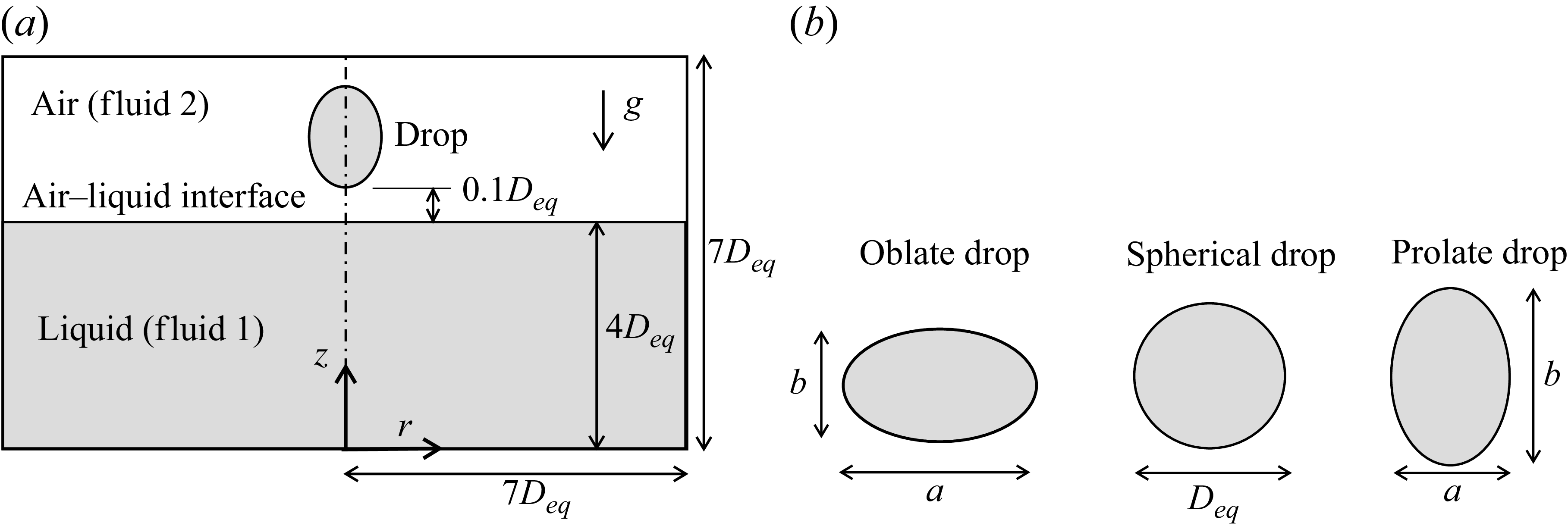
representing the axis of symmetry. Figure 1(a) illustrates a schematic diagram of the initial configuration of a drop that impacts a liquid pool. The initial shape of the drop is characterised by its aspect ratio,
 $\textit{AR}=b/a$
, where
 $a$
and
 $b$
denote the horizontal and vertical diameters of the drop, respectively. Consequently,
 $\textit{AR}\lt 1$
,
 $\textit{AR}=1$
and
 $\textit{AR}\gt 1$
signify oblate, spherical and prolate shapes, respectively (see figure 1
b). In the present study, we vary the initial aspect ratio
 $(\textit{AR})$
while maintaining a constant volume, such that
 $D_{\textit{eq}}^3=a^2b$
, where
 $D_{\textit{eq}}$
represents the volume-equivalent spherical diameter of the droplet. The liquids constituting the drop and the pool are denoted as ‘fluid 1’, while the surrounding medium (air) is designated as ‘fluid 2’. While presenting the simulation results, red, green and blue colours are employed to represent the drop liquid, pool liquid and air, respectively. Both fluids are assumed to be Newtonian and incompressible. The dynamic viscosities and densities of fluid 1 and fluid 2 are
 $(\mu _l, \rho _l)$
and
 $(\mu _a, \rho _a)$
, respectively. Gravity
 $(g)$
acts in the negative
 $z$
direction. The size of the axisymmetric computational domain is
 $7D_{\textit{eq}} \times 7D_{\textit{eq}}$
, with the initial height of the liquid pool set at
 $4D_{\textit{eq}}$
. We confirm that the computational domain size is big enough to ensure negligible boundary effects. At
 $t = 0$
, a small gap of
 $0.1D_{\textit{eq}}$
is maintained between the south pole of the drop and the free surface of the liquid pool, as shown in figure 1(a), with the drop having a prescribed initial velocity.
(a) Schematic diagram illustrating the initial configuration of a drop impacting a liquid pool. (b) Depiction of various shapes of drops. The aspect ratios,
 $\textit{AR}=b/a\lt 1$
,
 $\textit{AR}=1$
and
 $\textit{AR}\gt 1$
, correspond to oblate, spherical and prolate shapes, respectively.

2.1. Governing equations
The governing equations, describing the dynamics of a liquid drop falling on a liquid pool with air as the surrounding medium, consist of the equations of mass and momentum conservation. The dimensional form of these governing equations is given by
 \begin{equation} \rho \left [ \frac {\partial \boldsymbol {u}}{\partial t} + \boldsymbol {u} \boldsymbol{\cdot }\boldsymbol{\nabla }\boldsymbol {u} \right ] = -\boldsymbol{\nabla }\!p + \boldsymbol{\nabla }\boldsymbol{\cdot }\left [\mu (\boldsymbol{\nabla }\boldsymbol {u} + \boldsymbol{\nabla }\boldsymbol {u}^{\rm T})\right ] + \sigma \kappa \delta _s \hat {n} - \rho g \boldsymbol {j}, \end{equation}
 \begin{equation} \boldsymbol{\nabla }\boldsymbol{\cdot }\boldsymbol {u}= 0. \end{equation}
Here,
 ${\boldsymbol u} = (u,v)$
represents the velocity field, where
 $u$
and
 $v$
denote the velocity components in the
 $r$
and
 $z$
directions, respectively. The pressure field is denoted by
 $p$
,
 $t$
represents time,
 $\boldsymbol {j}$
stands for the unit vector in the
 $z$
direction,
 $\delta _s$
signifies the Dirac-delta function utilised to model a localised surface force at the interface,
 $\kappa$
denotes the curvature, and
 $\hat n$
represents the outward-pointing (away from the liquid) unit normal to the interface.
The interface separating the air and liquid phases is tracked by solving an advection equation for the volume fraction of the liquid phase, denoted as
 $c$
, where
 $c = 0$
and
 $1$
represent the air and liquid phases, respectively. This advection equation is expressed as
 \begin{equation} \frac {\partial c}{\partial t} + \boldsymbol {u} \boldsymbol{\cdot }\boldsymbol{\nabla }c = 0. \end{equation}
Thus, the density
 $(\rho )$
and the viscosity
 $(\mu )$
appearing in (2.1) depend on
 $c$
as
 \begin{align} \rho &= c \rho _l + (1 - c) \rho _a, \\[-12pt]\nonumber \end{align}
 \begin{align} \mu &= c \mu _l + (1 - c) \mu _a. \end{align}
The governing equations ((2.1)–(2.3)) are solved with the following boundary conditions. At
 $r = 0$
, a symmetry boundary condition is applied, while at the side boundary
 $(r = 7D_{\textit{eq}})$
, a free-slip boundary condition is employed. No-slip and no-penetration boundary conditions are utilised at the bottom wall
 $(z = 0)$
. At the top of the computational domain (
 $z = 7D_{\textit{eq}}$
), a Neumann boundary condition is applied to velocity, ensuring a zero normal gradient for velocity (
 ${\partial u/\partial z} = 0$
), which represents a free-slip boundary. Additionally, a Dirichlet condition is imposed on pressure, with
 $P = 0$
.
2.2. Numerical method and validation
The open-source flow solver Gerris (Popinet Reference Popinet2003, Reference Popinet2009), employed in this study, uses a volume-of-fluid (VoF) method coupled with dynamic adaptive mesh refinement based on vorticity magnitude and proximity to the interface. The flow solver has been deployed earlier by Thoraval (Reference Thoraval2013) to investigate drop impact, splashing and air entrapment, entailing a stellar contribution pertaining to understanding of gas-layer and interfacial dynamics. Gerris implements a numerical scheme that is second-order accurate in both space and time and incorporates a height-function-based balanced force formulation to include surface tension in the Navier–Stokes equations (2.1). The two-dimensional computational domain is discretised into
 $(2^n)^2$
cells, where
 $n$
denotes the refinement level, allowing for adaptive adjustment of cell sizes between the minimum and maximum refinement limits. The adaptive refinement strategy employed in this study incorporates several features to accurately capture interfacial dynamics while maintaining computational efficiency accurately: (i) interface tracking using gradient thresholds of the VoF function
 $c$
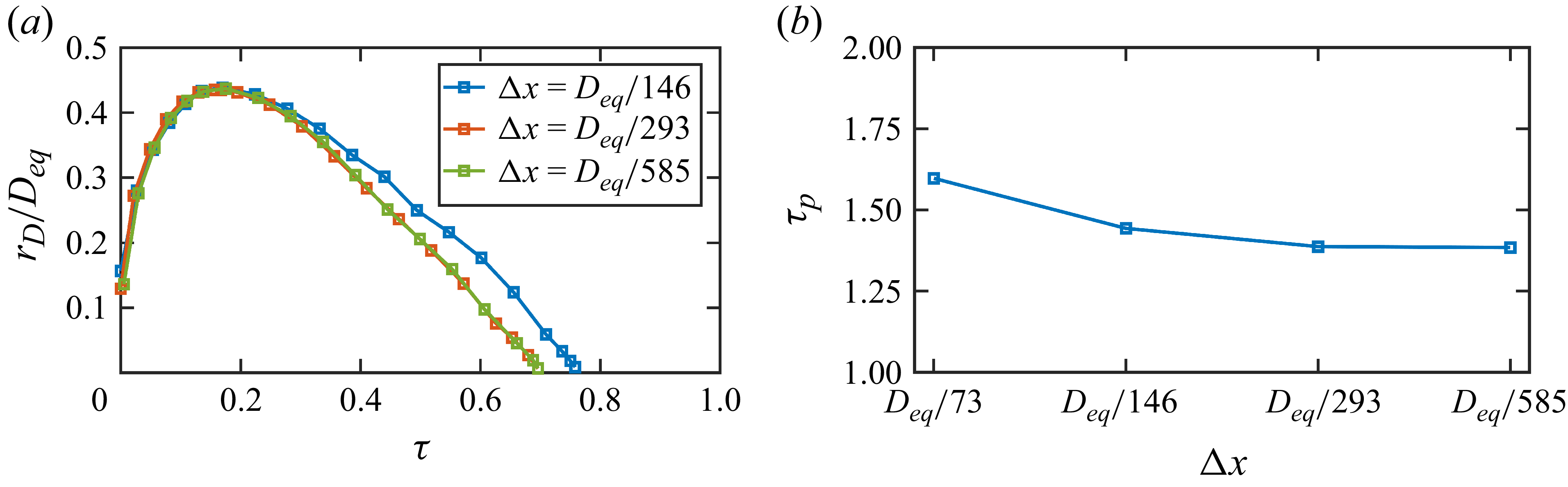
to resolve phase boundaries, (ii) vorticity-based refinement to capture rotational flow features and (iii) region-specific geometric criteria to refine areas with high-velocity gradients or thin-film behaviour. This approach effectively resolves key interfacial phenomena such as air-film rupture, neck formation and the propagation of capillary waves along the drop surface. To validate the numerical approach, we performed a grid convergence study for a representative parameter set. Figure 2(a) shows the evolution of the normalised neck radius,
 $(r_D / D_{\textit{eq}})$
, as a function of the normalised time,
 $\tau = t / \sqrt {\rho _l D_{\textit{eq}}^3 / 8\sigma }$
, for different mesh sizes (
 $\Delta x = D_{\textit{eq}}/146$
to
 $D_{\textit{eq}}/585$
). Notably, the results obtained with
 $\Delta x = D_{\textit{eq}}/293$
and
 $\Delta x = D_{\textit{eq}}/585$
are qualitatively indistinguishable. To enable a quantitative assessment, figure 2(b) presents the normalised pinch-off time (
 $\tau _{p}$
) as a function of mesh size, revealing percentage differences of 9.6 % (between
 $\Delta x = D_{\textit{eq}}/73$
and
 $D_{\textit{eq}}/146$
), 3.9 % (between
 $\Delta x = D_{\textit{eq}}/146$
and
 $D_{\textit{eq}}/293$
) and only 0.2 % (between
 $\Delta x = D_{\textit{eq}}/293$
and
 $D_{\textit{eq}}/585$
). In comparison with the larger deviations observed at coarser resolutions, the negligible difference between mesh sizes
 $\Delta x = D_{\textit{eq}}/293$
and
 $D_{\textit{eq}}/585$
confirms grid convergence. Accordingly, a mesh size of
 $\Delta x = D_{\textit{eq}}/293$
is adopted for all simulations in this study, ensuring an optimal balance between numerical accuracy and computational cost.
(a) Variation of the normalised neck radius
 $(r_D/D_{\textit{eq}})$
with normalised time
 $(\tau = t/\sqrt {\rho _l D_{\textit{eq}}^3/8\sigma })$
for different mesh sizes
 $\Delta x$
, with
 $\textit{AR} = 1.4$
,
 $\textit{We} = 40$
,
 $\textit{Bo} = 0.5$
and
 $\textit{Oh} = 0.003$
. (b) Variation of normalised pinch-off time
 $(\tau _{p} = t_{p}/\sqrt {\rho _l D_{\textit{eq}}^3/8\sigma })$
with mesh size
 $\Delta x$
for
 $\textit{AR} = 1$
,
 $\textit{We} = 0$
,
 $\textit{Bo} = 0.5$
, and
 $\textit{Oh} = 0.014$
.

The numerical solver used in the present study is available in the following GitHub repository: https://github.com/manas27526/Impact-dynamics-of-liquid-drops. Several researchers have also extensively utilised Gerris to explore interfacial flows, and it has been validated for various configurations (Thoraval et al. Reference Thoraval, Li and Thoroddsen2016; Agrawal et al. Reference Agrawal, Premlata, Tripathi, Karri and Sahu2017; Deka et al. Reference Deka, Biswas, Sahu, Kulkarni and Dalal2019a
; Behera et al. Reference Behera, Rao, Dasgupta and Chakraborty2023). Additionally, in figure 3, we compare the coalescence dynamics of an ethanol drop (of radius 0.535 mm) obtained from our present numerical simulation with the experiment conducted by Blanchette & Bigioni (Reference Blanchette and Bigioni2006). Here,
 $t = 0$
represents the instant at the onset of the coalescence process. As time progresses (
 $t \gt 0$
), the drop begins to drain into the pool, as observed at
 $t = 0.53$
, 1.15 and 1.4 ms. This drainage leads to the formation of a cylindrical column with a height exceeding that of the initial drop at
 $t = 2.62$
ms. Subsequently, the neck of this column narrows due to the inward pull of surface tension, resulting in the pinching off of a secondary drop at
 $t = 3.57$
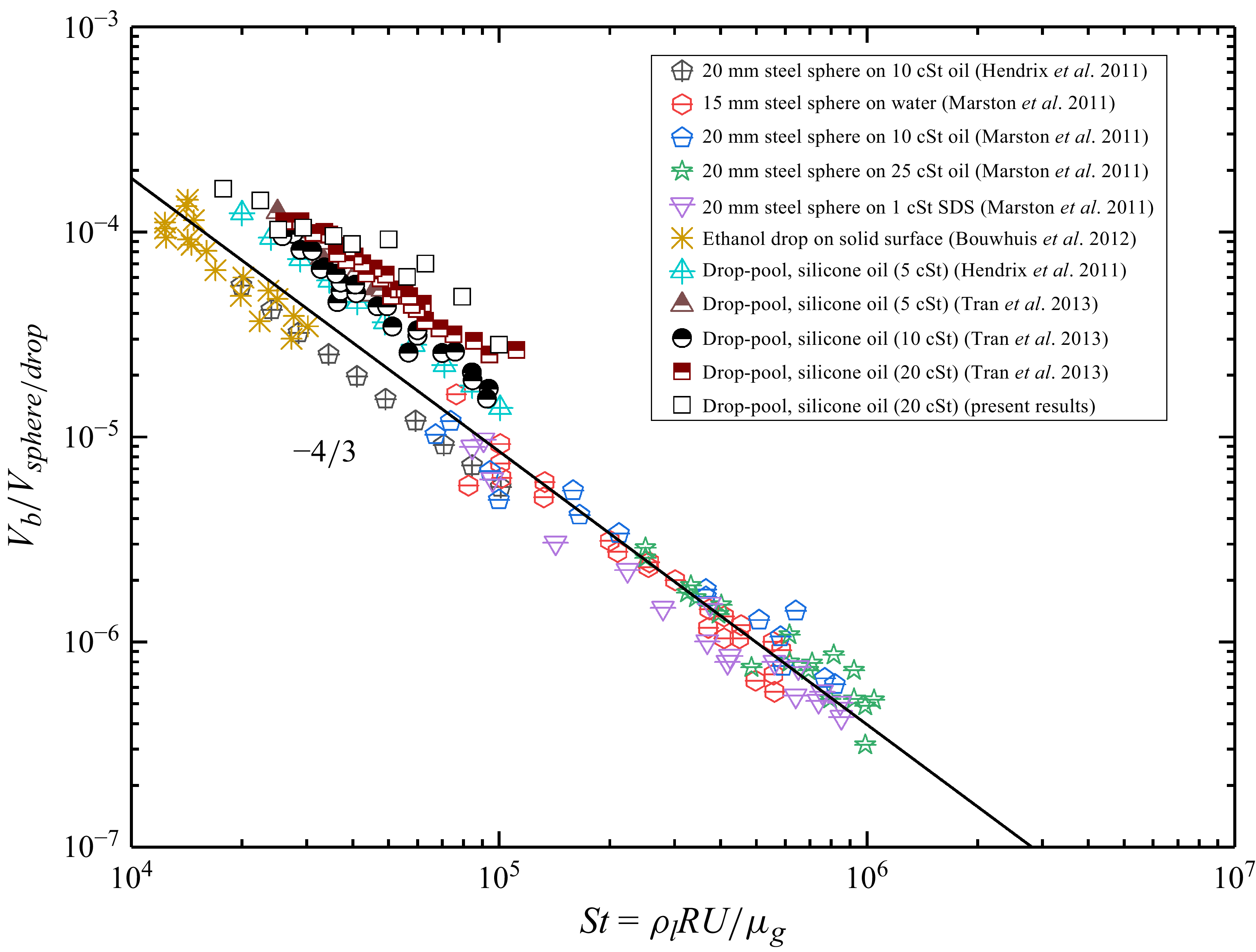
ms. The comparison reveals that the dynamics captured by our numerical simulation at various times agrees well with the experimental observations of Blanchette & Bigioni (Reference Blanchette and Bigioni2006). Furthermore, figure 4 compares the entrapped-bubble volumes from the present numerical simulations of drop impact on a liquid pool with available experimental (Tran et al. Reference Tran, de Maleprade, Sun and Lohse2013) and numerical (Hendrix et al. Reference Hendrix, Bouwhuis, van der Meer, Lohse and Snoeijer2016) results. It can be observed that the simulated bubble volumes are in quantitative agreement with the reported experimental measurements over a range of impact conditions. Moreover, the present results are consistent with the earlier experimental and numerical studies (Duchemin, Eggers & Josserand Reference Duchemin, Eggers and Josserand2003; Marston et al. Reference Marston, Vakarelski and Thoroddsen2011; Bouwhuis et al. Reference Bouwhuis, van der Veen, Tran, Keij, Winkels, Peters, van der Meer, Sun, Snoeijer and Lohse2012; Tran et al. Reference Tran, de Maleprade, Sun and Lohse2013; Hendrix et al. Reference Hendrix, Bouwhuis, van der Meer, Lohse and Snoeijer2016).
The comparison between the results obtained using the current numerical solver and those of Blanchette & Bigioni (Reference Blanchette and Bigioni2006). Experimental results from Blanchette & Bigioni (Reference Blanchette and Bigioni2006) are depicted in (a), while the results obtained in this study are displayed in (b). These panels illustrate the partial coalescence phenomenon of an ethanol drop of radius 0.535 mm in an ethanol pool with air as the surrounding medium. The times (in ms) are indicated on each image for reference.

Figure adapted from Hendrix et al. (Reference Hendrix, Bouwhuis, van der Meer, Lohse and Snoeijer2016). Log–log plot of the normalised bubble volume
 $(V_b / V_{\textit{sphere/drop}})$
as a function of the Stokes number
 $(St)$
. Here,
 $V_b$
and
 $V_{\textit{sphere/drop}}$
are the volumes of the bubble and the impacting drop/sphere, respectively;
 $R$
denotes the drop radius,
 $U$
represents the impact velocity, and
 $\mu_g$
corresponds to the viscosity of the surrounding air phase. The figure shows boundary-integral simulation results from Hendrix et al. (Reference Hendrix, Bouwhuis, van der Meer, Lohse and Snoeijer2016), together with previously published experimental data from Marston, Vakarelski & Thoroddsen (Reference Marston, Vakarelski and Thoroddsen2011), Tran et al. (Reference Tran, de Maleprade, Sun and Lohse2013) and Bouwhuis et al. (Reference Bouwhuis, van der Veen, Tran, Keij, Winkels, Peters, van der Meer, Sun, Snoeijer and Lohse2012). Results from the present study are superimposed as open squares. The solid line denotes the
 $-4/3$
scaling law originally reported by Tran et al. (Reference Tran, de Maleprade, Sun and Lohse2013).

3. Results and discussion
As discussed in the introduction, at low impact velocities, a droplet floats on the free surface, supported by an air cushion between the droplet and the pool, before merging into the pool (Charles & Mason Reference Charles and Mason1960b ; Thoroddsen & Takehara Reference Thoroddsen and Takehara2000; Blanchette & Bigioni Reference Blanchette and Bigioni2006; Honey & Kavehpour Reference Honey and Kavehpour2006). Subsequently, the air film moves out, and the droplet makes contact with the free surface of the pool. This results in the formation of an opening at the contact point as the droplet merges with the liquid pool. The resultant high capillary pressure around this opening, caused by the large curvature, triggers rapid expansion of the neck, generating capillary waves that propagate along the droplet surface and the free surface of the pool. As the neck reaches its maximum radius, it begins to retract toward the axis of symmetry in an effort to minimise surface energy, thereby generating inward-directed horizontal momentum (negative horizontal momentum). Concurrently, the generated capillary waves converge at the tip of the droplet, exerting a vertical pull. The vertical pull and retraction of the neck result in the formation of a liquid column. Over time, the height of the column decreases as the droplet liquid continuously drains into the pool. The coalescence outcomes are determined primarily by the competition between vertical downward momentum and horizontal inward momentum (Blanchette & Bigioni Reference Blanchette and Bigioni2006; Ray et al. Reference Ray, Biswas and Sharma2010; Ding et al. Reference Ding, Li, Zhang, Sui, Spelt and Thoroddsen2012). However, a recent study by Dong & Angeli (Reference Dong and Angeli2023) revealed that the Rayleigh–Plateau instability plays a crucial role in partial coalescence, with capillary waves only facilitating the formation of the liquid column.
Previous studies have characterised the transition between coalescence outcomes using the Ohnesorge number (
 $\textit{Oh}$
) and the Bond number (
 $\textit{Bo}$
), reporting different critical Ohnesorge numbers,
 $\textit{Oh}_c$
, associated with the transition between partial and complete coalescence (Charles & Mason Reference Charles and Mason1960b
; Aryafar & Kavehpour Reference Aryafar and Kavehpour2006; Blanchette & Bigioni Reference Blanchette and Bigioni2006, Reference Blanchette and Bigioni2009; Gilet et al. Reference Gilet, Mulleners, Lecomte, Vandewalle and Dorbolo2007; Ray et al. Reference Ray, Biswas and Sharma2010; Behera et al. Reference Behera, Dasgupta and Chakraborty2022). As clarified in the introduction, this variability in the reported critical values arises primarily from differences in how
 $\textit{Oh}_c$
is defined and interpreted across studies. For instance, Blanchette & Bigioni (Reference Blanchette and Bigioni2006) reported a critical value of
 $\textit{Oh}_c = 0.018 \pm 0.002$
based on a combination of experiments and numerical simulations, whereas Aryafar & Kavehpour (Reference Aryafar and Kavehpour2006) observed partial coalescence even for
 $\textit{Oh}_c \gt 1$
, reflecting a unified definition based on the viscosity of the more viscous phase. Importantly, none of these values have been derived from theoretical foundations, underscoring the need for comprehensive investigations to establish more accurate values for
 $\textit{Oh}_c$
. Additionally, these values were determined under conditions of negligible inertial forces. Recently, Behera et al. (Reference Behera, Rao, Dasgupta and Chakraborty2023) examined the role of inertial forces in coalescence dynamics and presented a phase diagram of the critical Weber number (
 $\textit{We}_c$
) as a function of
 $\textit{Oh}$
for a given
 $\textit{Bo}$
. Similarly, Anirudh et al. (Reference Anirudh, Behera and Sahu2024) investigated the impact of
 $\textit{We}$
and drop shape on coalescence dynamics. However, we propose that the transitions between partial and complete coalescence regimes are governed by the interplay of all three non-dimensional parameters, namely Weber number (
 $\textit{We}$
), Ohnesorge number (
 $\textit{Oh}$
) and Bond number (
 $\textit{Bo}$
). Furthermore, some researchers (Ray et al. Reference Ray, Biswas and Sharma2010; Alhareth & Thoroddsen Reference Alhareth and Thoroddsen2020; Behera et al. Reference Behera, Dasgupta and Chakraborty2022) have observed oscillations of the neck of the liquid column during the drainage of the liquid into the pool. However, the exact mechanism behind this phenomenon remains to be fully understood. Therefore, the present study aims to (i) investigate the effect of competitive effects of different governing forces, characterised by
 $\textit{We}$
,
 $\textit{Bo}$
and
 $\textit{Oh}$
, as a function of the shape of the drop on the coalescence dynamics, (ii) elucidate the mechanism behind the neck oscillations at the transition regime, which significantly influence the hydrodynamics of the coalescence process and (iii) generalise partial coalescence mechanisms.
A comprehensive investigation into coalescence dynamics has been conducted by systematically varying the fluid properties, impingement velocity and drop diameter over a broad range of
 $\textit{We}$
,
 $\textit{Oh}$
and
 $\textit{Bo}$
. These dimensionless numbers quantify the relative contributions of inertial, viscous, capillary and gravitational forces governing the coalescence process (figure 5). Since all simulations in the present study correspond to an air–liquid interface with negligible surrounding-fluid viscosity (
 $\textit{Oh}_2 \ll 1$
), the Ohnesorge number reported here corresponds to
 $\textit{Oh}_1$
, defined using the viscosity of the drop–pool liquid. Figure 5(a) identifies the transition to complete coalescence by showing contours of the critical Weber number (
 $\textit{We}_c$
) as a function of
 $\textit{Oh}$
and
 $\textit{Bo}$
for a spherical drop
 $(\textit{AR}=1)$
. To better interpret this complex three-dimensional
 $\textit{We}$
–
 $\textit{Oh}$
–
 $\textit{Bo}$
regime map, it is useful to examine the pairwise interactions between these dimensionless parameters by holding one constant, as illustrated in figure 5(b–d). Figure 6(a–f) demonstrates the effects of the individual parameters, namely
 $\textit{We}$
,
 $\textit{Oh}$
and
 $\textit{Bo}$
, on the coalescence dynamics by varying one dimensionless parameter at a time while keeping the other two fixed. Figure 5(b) presents the critical Ohnesorge number (
 $\textit{Oh}_c$
) as a function of
 $\textit{Bo}$
in the limit of negligible inertia (
 $\textit{We} \approx 0$
). The results show that increasing both
 $\textit{Oh}$
and
 $\textit{Bo}$
promotes complete coalescence. The specific effects of
 $\textit{Oh}$
, illustrated in figure 6(a,b), indicate that viscous forces increasingly suppress capillary waves at higher values of
 $\textit{Oh}$
. Capillary forces are essential for the formation and elongation of the rising liquid column. At a lower Ohnesorge number (
 $\textit{Oh} = 0.0026$
), weaker viscous diffusion allows capillary-wave–induced perturbations to grow, resulting in an apex height that exceeds the initial drop diameter (figure 6
a). In contrast, at a higher Ohnesorge number (
 $\textit{Oh} = 0.033$
), enhanced viscous diffusion suppresses these perturbations, and the apex height remains below the initial drop diameter (figure 6
b). Such suppression accelerates vertical collapse relative to horizontal collapse, thereby favouring complete coalescence. At sufficiently high
 $\textit{Oh}$
, this mechanism enhances the drainage of liquid from the droplet, leading to complete coalescence. As evident from figure 5(b), the variation of the critical Ohnesorge number,
 $\textit{Oh}_c$
, with the Bond number,
 $\textit{Bo}$
, is weak at low
 $\textit{Bo}$
, indicating a negligible influence of gravitational forces. As
 $\textit{Bo}$
increases, this threshold
 $\textit{Oh}$
decreases, indicating a shift in dominance from capillarity to gravity. This trend is consistent with the observations of Blanchette & Bigioni (Reference Blanchette and Bigioni2006), although minor discrepancies in the critical values may arise due to differences in drop initialisation or air property modelling (figure 5
b). As illustrated in figure 6(c,d), the drainage of liquid from the drop into the pool increases with increasing
 $\textit{Bo}$
, as gravitational forces increasingly dominate over capillary forces, leading to accelerated vertical collapse relative to horizontal collapse.
(a) Regime map showing the variation of the critical Weber number (
 $\textit{We}_c$
) across the
 $\textit{We}{-}\textit{Oh}{-}\textit{Bo}$
parameter space, with the colour bar representing the magnitude of
 $\textit{We}_c$
. Cross-sectional phase diagrams highlight the boundaries between partial and complete coalescence regimes in (b)
 $\textit{Oh}{-}\textit{Bo}$
space at
 $\textit{We} = 0$
, (c)
 $\textit{We}{-}{Bo}$
space for
 $\textit{Oh} = 0.01$
and (d) space at
 $\textit{Oh}{-}\textit{We}$
space at
 ${Bo} = 0.1$
. Panel (b) also includes a comparison of our findings with the results reported by Blanchette & Bigioni (Reference Blanchette and Bigioni2006).

Effect of (a,b) Ohnesorge number (
 $\textit{Oh}$
) with
 $\textit{AR} = 1.0$
,
 $\textit{We} = 0$
and
 ${Bo} = 0.5$
; (c,d) Bond number (
 $\textit{Bo}$
) with
 $\textit{AR} = 1.0$
,
 $\textit{We} = 0$
and
 $\textit{Oh} = 0.014$
; and (e, f) Weber number (
 $\textit{We}$
) with
 $\textit{AR} = 1.0$
,
 $\textit{Bo} = 0.5$
and
 $\textit{Oh} = 0.0026$
on the coalescence dynamics of a liquid drop on a liquid pool. In each panel, time progression is indicated by a colour change from red to blue, albeit with differing time scales across the panels.

Figure 5(c) depicts the variation of the critical Weber number,
 $\textit{We}_c$
, with
 $\textit{Bo}$
at a fixed
 $\textit{Oh} = 0.01$
. It is observed that
 $\textit{We}_c$
decreases as
 $\textit{Bo}$
increases. Focusing on the effect of
 $\textit{We}$
, figure 6(e, f) illustrates that increasing
 $\textit{We}$
enhances inertial effects relative to capillarity, accelerating the drainage of the drop liquid into the pool and leading to a significant reduction in the apex height at a given time. This behaviour favours the transition from partial to complete coalescence. As seen in figure 6(f), complete coalescence can occur even while upward-propagating capillary waves continue to distort the drop apex. This observation aligns with the conclusions of Gilet et al. (Reference Gilet, Mulleners, Lecomte, Vandewalle and Dorbolo2007), who reported that capillary wave convergence alone cannot explain partial coalescence. Since the vertical collapse rate increases relative to the horizontal collapse rate with increasing
 $\textit{We}$
and
 $\textit{Bo}$
, the critical Weber number
 $\textit{We}_c$
decreases as
 $\textit{Bo}$
increases. Figure 5(d) shows the variation of
 $\textit{We}_c$
with
 $\textit{Oh}$
at a fixed
 ${Bo} = 0.1$
. Since both
 $\textit{We}$
and
 $\textit{Oh}$
promote complete coalescence,
 $\textit{We}_c$
decreases as
 $\textit{Oh}$
increases. These two-dimensional regime maps (figure 5
b–d) offer insights into the interplay of inertia, viscosity and gravity in determining coalescence behaviour. Figure 5(a) synthesises these insights by presenting a unified three-dimensional surface separating the regimes of partial and complete coalescence across the
 $\textit{We}$
–
 $\textit{Oh}$
–
 $\textit{Bo}$
space. For each pair of
 $\textit{Oh}$
and
 $\textit{Bo}$
, a corresponding
 $\textit{We}_c$
marks the transition boundary. In the low-
 $\textit{Oh}$
, low-
 $\textit{Bo}$
region, capillarity dominates, and
 $\textit{We}_c$
increases sharply. As
 $\textit{Bo}$
increases in this regime,
 $\textit{We}_c$
decreases due to enhanced gravitational drainage. With increasing
 $\textit{Oh}$
, the system enters a viscous-dominated regime where the transition becomes largely independent of
 $\textit{We}$
and
 $\textit{Bo}$
, as indicated by the plateau in the blue region of figure 5(a). Beyond a threshold value of
 $\textit{Oh}$
, the system predominantly exhibits complete coalescence. The present simulations estimate this critical Ohnesorge number to be
 $\textit{Oh}_c = 0.021$
, above which complete coalescence occurs regardless of
 $\textit{We}$
and
 $\textit{Bo}$
. This critical Ohnesorge number agrees with the threshold values reported by Blanchette & Bigioni (Reference Blanchette and Bigioni2006) and Gilet et al. (Reference Gilet, Mulleners, Lecomte, Vandewalle and Dorbolo2007) under low-
 $\textit{We}$
conditions and negligible viscous effects of the surrounding fluid (
 $\textit{Oh}_2 \ll 1$
). Previous studies have shown that low values of
 $\textit{Bo}$
and
 $\textit{Oh}$
generally lead to partial coalescence of the drop (Aryafar & Kavehpour Reference Aryafar and Kavehpour2006; Blanchette & Bigioni Reference Blanchette and Bigioni2006; Gilet et al. Reference Gilet, Mulleners, Lecomte, Vandewalle and Dorbolo2007). However, the present study demonstrates that complete coalescence can still occur at low
 $\textit{Bo}$
and
 $\textit{Oh}$
provided that
 $\textit{We}_c \geqslant 40$
for
 $\textit{AR} = 1$
.
The shape of a drop is another critical factor influencing the formation of secondary droplets. Figures 7 and 8 illustrate how drop shape affects the coalescence outcome on a liquid bath. Figure 7 shows a regime map in the
 $\textit{Oh}$
–
 $\textit{We}$
space, delineating the boundary between partial and complete coalescence for drops with different aspect ratios (
 $\textit{AR}$
) at a fixed Bond number (
 $\textit{Bo} = 0.10$
). It can be seen that, for a given
 $\textit{Oh}$
, the critical Weber number (
 $\textit{We}_c$
) decreases with decreasing aspect ratio, indicating that prolate-shaped drops (
 $\textit{AR} \gt 1$
) are more prone to partial coalescence than spherical (
 $\textit{AR} = 1$
) or oblate-shaped drops (
 $\textit{AR} \lt 1$
). While the dependence of
 $\textit{We}_c$
on
 $\textit{Oh}$
was discussed earlier (see figure 5), figure 7 highlights the additional influence of drop shape, showing that drops with higher
 $\textit{AR}$
require lower
 $\textit{We}$
to undergo partial coalescence. The temporal evolution of the coalescence process for oblate (
 $\textit{AR} = 0.7$
), spherical (
 $\textit{AR} = 1$
) and prolate-shaped drops (
 $\textit{AR} = 1.4$
) with
 $\textit{We} = 18$
,
 $\textit{Bo} = 0.5$
and
 $\textit{Oh} = 0.0026$
is shown in figure 8(a–c), respectively. For drops with the same equivalent diameter (
 $D_{\textit{eq}}$
), the tendency to form secondary droplets is highest for prolate-shaped drops, followed by spherical, and lowest for oblate-shaped drops. This trend arises from the higher drainage rate of oblate-shaped drops due to their flatter base, which produces a larger neck opening (observed at
 $t = 0.47$
ms in figure 8
a). This larger neck enhances vertical downward momentum relative to horizontal inward momentum, promoting complete coalescence. In contrast, prolate-shaped drops have a narrower neck (observed at
 $t = 0.25$
ms in figure 8
c), which restricts drainage and delays vertical collapse, facilitating rapid pinch-off of a secondary droplet.
Regime map illustrating the variation of the critical Weber number (
 $\textit{We}_c$
), defined as the threshold Weber number separating partial and complete coalescence, across the
 $\textit{We}$
–
 $\textit{Oh}$
–
 $\textit{AR}$
parameter space. The colour bar indicates the magnitude of
 $\textit{We}_c$
. The regions below and above the surface of
 $\textit{We}_c$
denote partial coalescence and complete coalescence, respectively.

Temporal evolution of coalescence dynamics for (a) an oblate drop (
 $\textit{AR} = 0.7$
), (b) a spherical drop (
 $\textit{AR} = 1$
) and (c) a prolate drop (
 $\textit{AR} = 1.4$
). The rest of the parameters are
 $\textit{We} = 18$
,
 $\textit{Bo} = 0.5$
and
 $\textit{Oh} = 0.0026$
.

Figure 9(a–d) illustrates the coalescence dynamics of a spherical primary drop with
 $\textit{Bo} = 0.5$
and
 $\textit{Oh} = 0.0026$
at varying Weber numbers selected to highlight distinct coalescence outcomes governed by neck oscillation behaviour. While the partial and complete coalescence regimes have been studied extensively, the transitional dynamics between them has received comparatively less attention. Our investigation reveals that the transition from partial to complete coalescence is not abrupt; rather, it is mediated by neck oscillations, which can occur multiple times during the coalescence process. In figure 9(b,c), two distinct neck oscillation cycles are observed. Based on the number and outcome of these oscillations, we classify the coalescence process into four distinct regimes: (i) first-stage partial coalescence, where pinch-off occurs during the first oscillation; (ii) second-stage partial coalescence, where pinch-off occurs during the second oscillation; (iii) second-stage complete coalescence, where full merging occurs during the second oscillation; and (iv) first-stage complete coalescence, where complete merging happens during the first oscillation. The coalescence dynamics (i–iv) are shown in figure 9(a–d), respectively. We observe that as the Weber number increases, the drop sequentially transitions through these regimes: from first-stage partial to second-stage partial, followed by second-stage complete, and eventually first-stage complete coalescence. While neck oscillations during coalescence on a liquid pool have been reported in previous studies (Ray et al. Reference Ray, Biswas and Sharma2010; Alhareth & Thoroddsen Reference Alhareth and Thoroddsen2020; Behera et al. Reference Behera, Dasgupta and Chakraborty2022), the systematic identification and classification of all four coalescence regimes, as demonstrated in figure 9(a–d), provide a distinctive contribution of the present study.
Temporal evolution of the shape of the drop during coalescence in different regimes, categorised by the oscillations of the neck of the liquid column, for a primary drop with
 $\textit{Bo} = 0.5$
,
 $\textit{Oh} = 0.0026$
and
 $\textit{AR} = 1.0$
. (a) First-stage partial coalescence for
 $\textit{We} = 0$
, (b) second-stage partial coalescence for
 $\textit{We} = 28$
, (c) second-stage complete coalescence for
 $\textit{We} = 47$
and (d) first-stage complete coalescence for
 $\textit{We} = 90$
.

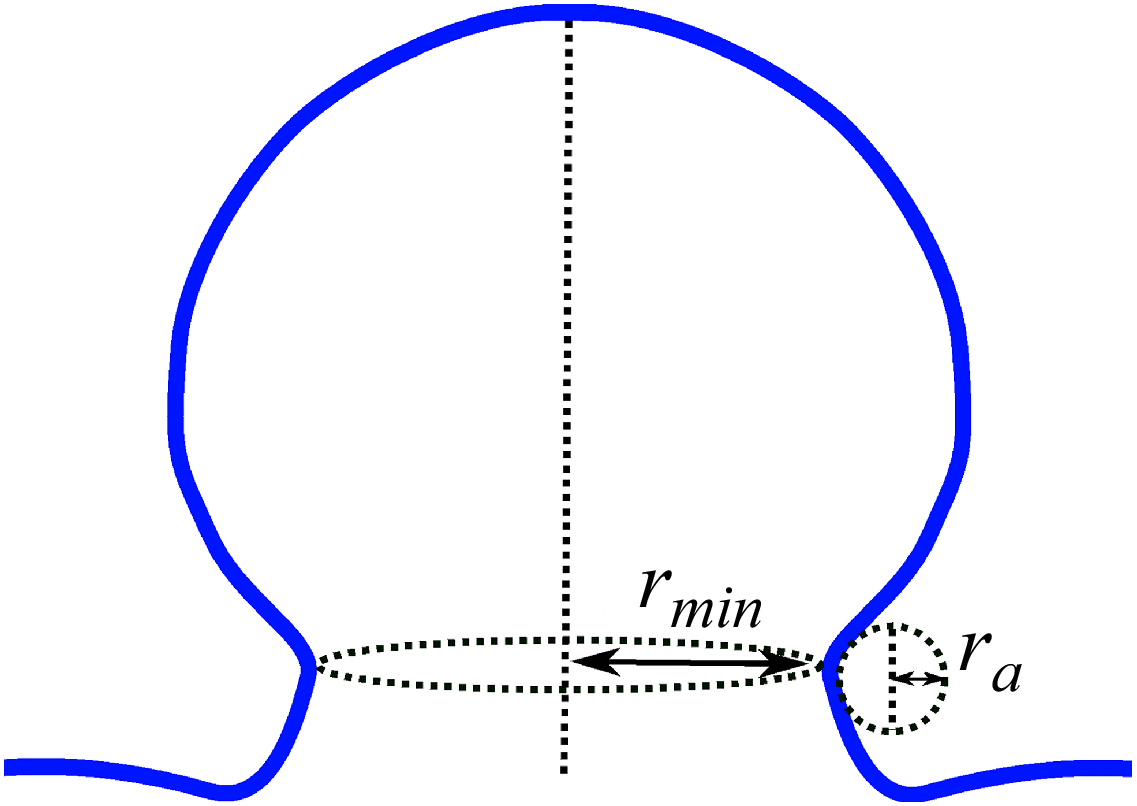
To further understand the neck oscillation dynamics, it is essential to consider the roles of both azimuthal and axial curvatures at the neck, as schematically illustrated in figure 10. In the transitional regime, the rates of horizontal and vertical collapse become comparable. As the cylindrical liquid column diminishes into a smaller droplet during the final stage of coalescence, the azimuthal and axial curvatures in the neck region play a critical role (Zhang et al. Reference Zhang, Li and Thoroddsen2009; Alhareth & Thoroddsen Reference Alhareth and Thoroddsen2020). Specifically, the radius of curvature in the axial direction (
 $r_a$
) becomes smaller than that in the azimuthal direction (
 $r_{\textit{min}}$
). When
 $r_{\textit{min}} \gt r_a$
, the capillary pressure, given by
 $\Delta {p} = \sigma (1/r_{\textit{min}} - 1/r_a)$
, becomes negative, leading to an outward expansion of the neck. This expansion continues until
 $r_a$
exceeds
 $r_{\textit{min}}$
, at which point the capillary pressure changes sign once again. During this retraction phase, the neck collapses inward and downward, forming a cylindrical liquid column. The final outcome, whether second-stage partial or second-stage complete coalescence, depends on the competition between the horizontal and vertical collapse rates.
Schematic diagram illustrating the azimuthal (
 $r_{\textit{min}}$
) and axial (
 $r_{a}$
) curvatures at the neck during the coalescence.

The temporal evolution of the retracting neck and the apex height of the drop, which are associated with the horizontal and vertical collapse rates, respectively, governs the outcome of the coalescence process. To characterise this hydrodynamic behaviour, we measured the time-dependent variations of the neck radius and the apex height. The transition phase between partial and complete coalescence is characterised by oscillations in the neck dynamics, which serve as a clear indicator of this intermediate regime. Figure 11(a–d) show the normalised neck radius (
 $r_D/D_{\textit{eq}}$
) plotted against the normalised time (
 $\tau$
), highlighting the effects of the Weber number (
 $\textit{We}$
), Ohnesorge number (
 $\textit{Oh}$
), Bond number (
 $\textit{Bo}$
) and aspect ratio of the primary drop (
 $\textit{AR}$
). In each case, one dimensionless parameter is varied while the others are held constant. Across all cases, the neck radius initially increases due to the excess capillary pressure within the drop. Once it reaches a maximum, the radius subsequently decreases as the system evolves to minimise its surface energy. Figure 11(a) depicts the effect of
 $\textit{We}$
on the temporal evolution of the neck radius at fixed
 $\textit{Bo}$
and
 $\textit{Oh}$
. It can be seen that as
 $\textit{We}$
increases, the neck velocity during both expansion and retraction increases, indicating a growing dominance of inertial forces over capillary forces. Although a larger
 $\textit{We}$
leads to a greater maximum neck radius, which might intuitively slow retraction, this trend instead reflects a complex interplay between inertia and surface tension. Figure 11(b) displays the downward motion of the drop via the evolution of the apex height for different
 $\textit{We}$
. Initially, the apex height decreases approximately linearly. Subsequently, a distinct mound forms due to upward-travelling capillary waves generated during coalescence. As
 $\textit{We}$
increases, the height of this mound decreases, and the initial linear stage shortens, indicating that inertial forces increasingly suppress capillary effects. The resulting enhancement in vertical collapse rate plays a key role in driving the transition from partial to complete coalescence. This is evident from figure 11(a), where the neck exhibits a single oscillation for both first-stage partial (
 $\textit{We} = 0$
, 10) and first-stage complete coalescence (
 $\textit{We} = 54$
, 90), while it oscillates twice during second-stage partial (
 $\textit{We} = 28$
) and second-stage complete coalescence (
 $\textit{We} = 47$
).
Variations of the (a–d) normalised neck radius
 $(r_D/D_{\textit{eq}})$
and (e–h) normalised apex height
 $(h_D/D_{\textit{eq}})$
of the drop with normalised time
 $(\tau )$
. (a,e) Effect of Weber number (
 $\textit{We}$
), with fixed
 $\textit{AR}=1.0$
,
 $\textit{Bo} = 0.5$
and
 $\textit{Oh} = 0.0026$
; (b, f) effect of Ohnesorge number (
 $\textit{Oh}$
), with
 $\textit{AR}=1.0$
,
 $\textit{We} = 0$
and
 $\textit{Bo} = 0.5$
; (c,g) effect of Bond number (
 $\textit{Bo}$
), with
 $\textit{AR}=1.0$
,
 $\textit{We} = 0$
and
 $\textit{Oh} = 0.014$
; (d,h) effect of drop aspect ratio (
 $\textit{AR}$
), with
 $\textit{Bo} = 0.5$
,
 $\textit{Oh} = 0.0026$
and
 $\textit{We} = 23$
.

The effect of viscosity of the drop characterised by the Ohnesorge number (
 $\textit{Oh}$
) is examined in figure 11(b, f). As
 $\textit{Oh}$
increases, viscous damping becomes more prominent, suppressing capillary waves. Interestingly, the neck retraction velocity and the maximum neck radius increase with increasing
 $\textit{Oh}$
. This behaviour is evident in the apex height evolution (figure 11
b), where increasing viscosity diminishes the height of the capillary-induced mound, facilitating a faster vertical collapse and promoting the transition from partial to complete coalescence. A single neck oscillation is observed for both first-stage partial (
 $\textit{Oh} = 0.002$
, 0.010) and first-stage complete coalescence (
 $\textit{Oh} = 0.020$
), while two oscillations occur in the case of second-stage complete coalescence (
 $\textit{Oh} = 0.017$
).
The influence of gravity, represented by the Bond number (
 $\textit{Bo}$
), is shown in figure 11(c, f). As
 $\textit{Bo}$
increases, gravitational forces become stronger than surface tension, accelerating neck retraction and increasing the maximum neck radius. A higher
 $\textit{Bo}$
also enhances liquid drainage from the drop, reducing both the stagnation period and mound height, as evident in figure 11(f). This results in a faster vertical collapse and facilitates the transition from first-stage partial (
 $\textit{Bo} = 0.005$
, 0.05, 0.1, 0.5) to first-stage complete coalescence (
 $\textit{Bo} = 5$
), via second-stage complete coalescence (
 $\textit{Bo} = 1$
). Figure 11(d,h) examines the effect of drop shape, characterised by the aspect ratio (
 $\textit{AR}$
). The neck opens more widely for prolate drops (
 $\textit{AR} \gt 1$
), resulting in a larger neck radius at any given time compared with spherical or oblate drops. A lower
 $\textit{AR}$
corresponds to reduced neck velocity and a delayed horizontal collapse. Additionally, drop shape influences apex height due to geometric constraints: oblate drops exhibit lower apex heights, promoting faster vertical collapse. As the horizontal collapse rate decreases and the vertical collapse rate increases when transitioning from prolate to oblate shapes via spherical drops, the coalescence behaviour shifts from first-stage partial (
 $\textit{AR} = 1.4$
) to first-stage complete coalescence (
 $\textit{AR} = 0.7$
, 0.85), passing through the transition phase with double neck oscillations (
 $\textit{AR} = 1$
, 1.2), characteristic of second-stage partial coalescence.
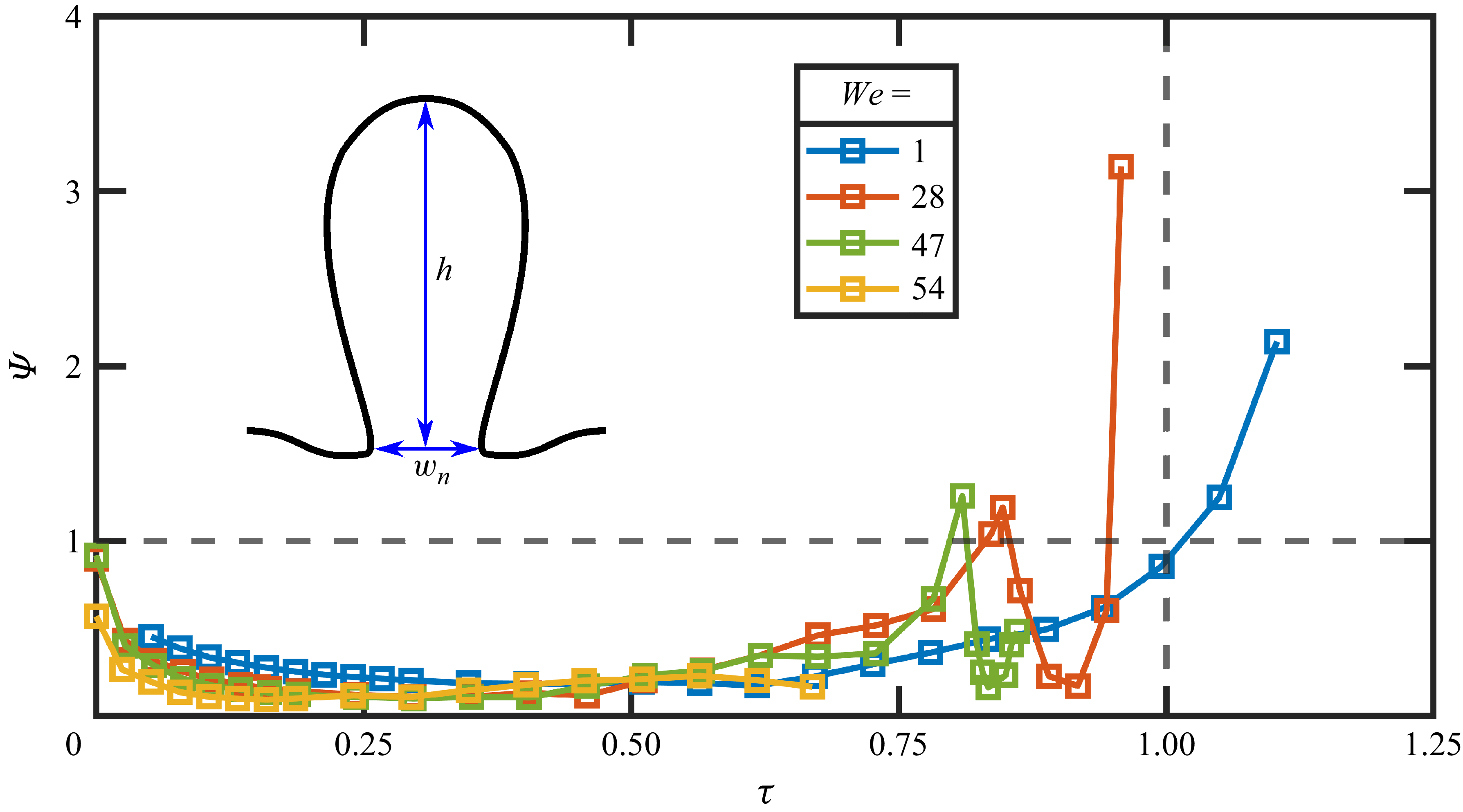
To examine the potential role of Rayleigh–Plateau instability in the pinch-off process, figure 12 shows the temporal evolution of the column height-to-neck ratio,
 $\psi = h/\pi w_n$
, for various Weber numbers (
 $\textit{We}$
). The rest of the parameters are
 $\textit{Bo} = 0.5$
,
 $\textit{Oh} = 0.0026$
and
 $\textit{AR} = 1$
. Here,
 $h$
represents the height of the liquid column, and
 $w_n$
is the neck diameter, both measured following the methodology of Dong & Angeli (Reference Dong and Angeli2023). In figure 12, the selected cases,
 $\textit{We} = 1$
, 28, 47 and 54, correspond to first-stage partial coalescence, second-stage partial coalescence, second-stage complete coalescence and first-stage complete coalescence, respectively. For the complete coalescence case (
 $\textit{We} = 54$
),
 $\psi$
remains consistently below one throughout the pinch-off process. In contrast, for first-stage partial coalescence (
 $\textit{We} = 1$
),
 $\psi$
exceeds one just prior to the pinch-off of the secondary droplet. This indicates that if the Rayleigh–Plateau instability were responsible for the pinch-off, the instability would have been expected to manifest much earlier in the pinch-off process. Similarly, in second-stage coalescence cases (
 $\textit{We} = 28$
and 47),
 $\psi$
temporarily exceeds one during the neck retraction phase but decreases without leading to a pinch-off. These findings indicate that Rayleigh–Plateau instability alone cannot fully explain the coalescence dynamics observed for the parameters considered in the present study.
Temporal variation of
 $\psi =h/\pi w_n$
for different Weber numbers. Here,
 $\textit{We} =$
1, 28, 47 and 54 correspond to the first-stage partial coalescence, second-stage partial coalescence, second-stage complete coalescence and first-stage complete coalescence scenarios. The rest of the parameters are
 $\textit{Bo} = 0.5$
,
 $\textit{Oh} = 0.0026$
and
 $\textit{AR} = 1$
.

Finally, we explore the dynamics underlying the formation of multiple secondary drops, as shown in figure 13. This phenomenon was initially reported by Charles & Mason (Reference Charles and Mason1960b
) for the coalescence of larger water drops (
 $D_{\textit{eq}} \gt 6$
mm) at a benzene–water interface, attributed to the Rayleigh capillary instability. Dong & Angeli (Reference Dong and Angeli2023) characterised the probability of the formation of multiple droplets by measuring the height-to-circumference ratio (
 $\psi$
) of the deformed drop in the column formation stage due to capillary pull. Recently, through three-dimensional numerical simulations, Anirudh et al. (Reference Anirudh, Behera and Sahu2024) also observed the formation of multiple secondary drops during the coalescence of an oblate drop with a large aspect ratio. In contrast, in the present work, we observe that the generation of multiple secondary droplets occurs when the shape of the drop at the time of contact is prolate (figure 13). As depicted in the figure, the pinching off of secondary droplets occurs first, followed by their fragmentation into multiple droplets. This suggests that when the primary drop is pinched off because of negative horizontal momentum, the varicose capillary waves generated during the pinching-off process tend to break this secondary droplet because of the Rayleigh–Plateau instability. When a prolate drop comes into contact with a pool, a secondary drop forms as an extended liquid column, compared with an oblate or spherical droplet shape. This extended column assists the Rayleigh–Plateau instability in breaking into multiple droplets. It is worth emphasising that the Rayleigh–Plateau instability typically contributes to interfaces that are locally cylindrical, a condition not always satisfied during partial coalescence. When the falling drop contacts the liquid pool, capillary waves travel from the point of contact toward the apex, generating an upward pull. During the same time, part of the liquid in the drop drains downward due to vertical momentum, while strong horizontal momentum inward at the neck initiates pinching, resulting in the formation of a secondary droplet. If capillary-induced upward motion creates a columnar structure (
 $\psi \gt 1$
) with a short cylindrical region of nearly constant radius, the Rayleigh–Plateau instability can be activated. Additionally, following the formation of the secondary droplet, varicose perturbations on its elongated, prolate shape can give rise to this instability, potentially leading to its further breakup. Our findings reveal that increases in the Weber, Ohnesorge and Bond numbers enhance liquid drainage into the pool, yielding smaller secondary droplets and only slightly elongating the liquid column. As a result, the likelihood of droplet breakup due to Rayleigh–Plateau instability diminishes.
Formation of multiple secondary droplets for a prolate-shape primary drop with
 $\textit{Bo} = 0.5$
,
 $\textit{Oh} = 0.0026$
and
 $\textit{AR} = 1.4$
impacting a liquid pool with different Weber numbers: (a)
 $\textit{We} = 28$
(three secondary droplets), (b)
 $\textit{We} = 33$
(two secondary droplets) and (c)
 $\textit{We} = 40$
(one secondary droplet).

4. Concluding remarks
We investigate the dynamics of liquid drop coalescence in a deep liquid pool through axisymmetric numerical simulations using Gerris (Popinet Reference Popinet2003, Reference Popinet2009), an open-source finite-volume flow solver. This study aims to generalise the mechanisms of partial coalescence for a range of droplet sizes, shapes, impact velocities and liquid properties, and elucidate the role of neck oscillations, which significantly influence the subsequent coalescence process and the formation of secondary droplets. The effects of relevant dimensionless parameters, such as Weber
 $(\textit{We})$
, Ohnesorge
 $(\textit{Oh})$
, Bond
 $(\textit{Bo})$
numbers and the aspect ratio
 $(\textit{AR})$
of the drop are also examined. By performing extensive simulations, we construct a three-dimensional regime map in the
 $\textit{We}{-}\textit{Oh}{-}\textit{Bo}$
space that delineates the transition boundaries between partial and complete coalescence. Our results reveal four distinct coalescence regimes based on the oscillatory behaviour of the neck of the liquid column, namely (i) first-stage partial coalescence, where pinch-off occurs during the initial neck oscillation; (ii) second-stage partial coalescence, with pinch-off occurring during the second oscillation; (iii) first-stage complete coalescence, characterised by full merging during the first oscillation; and (iv) second-stage complete coalescence, in which complete merging occurs during the second oscillation. The temporal evolution of the neck radius and apex height shows that the transition between the two regimes of coalescence, namely the partial and complete coalescence is driven by the competition between horizontal and vertical collapse dynamics, which is further influenced by inertia, viscosity, gravity and the morphology of the primary droplet. Neck oscillations emerge as a robust indicator of the coalescence regime, with the number of oscillation cycles strongly correlating with the stage of coalescence across a wide range of
 $\textit{We}$
,
 $\textit{Oh}$
,
 $\textit{Bo}$
and
 $\textit{AR}$
values. Furthermore, our analysis of the height-to-neck ratio of the liquid column suggests that the Rayleigh–Plateau instability does not adequately explain the partial coalescence behaviour observed under the investigated conditions. Overall, this study offers a comprehensive understanding of the hydrodynamic mechanisms governing distinct coalescence dynamics over a wide range of parameters.
Funding
G.B. acknowledges his gratitude to J. C. Bose National Fellowship of SERB, Government of India (grant JBR/2020/000042). K.C.S. thanks IIT Hyderabad for the financial support through grant IITH/CHE/F011/SOCH1. M.R.B. acknowledges financial support from BITS-Pilani, K. K. Birla Goa Campus through grant no. NFSG/GOA/2024/G0978 and support from IIT Kanpur under the Institute PDF.
Declaration of interests
The authors report no conflict of interest.