Implication
In order to optimise the efficiency of muscle growth in cattle (and hence to ensure enough meat production to feed the increasing human population), efforts will have to start very early in life and continue throughout postnatal life. Indeed, undernutrition during foetal life impedes muscle differentiation and changes energy metabolism in a way that is detrimental to postnatal growth. Just after birth, overfeeding of veal calves induces dysregulation of glucose metabolism. In growing cattle, feeding level, compensatory growth and grass feeding on pasture also induce a plasticity of muscle characteristics. Changes in hormonal status explain these nutritional effects at least in part. In addition to genetic factors, all these observations provide tools for breeders to better control muscle growth and, hence, body composition of meat-producing cattle.
Introduction
In the near future, we will have to meet the difficulties associated with very considerable population growth (6 to 9 billion in 2050), which implies not only a food production challenge but also an environmental challenge (Gill et al., Reference Gill, Smith and Wilkinson2010). Livestock will have to satisfy not only the predicted high demand for meat with the increasing human population, but also the demand by consumers for safe, high-quality products in the context of sustainable agriculture and animal husbandry (especially in developed countries that are well aware of environmental issues). Projections indicate that by 2050, global meat and milk production will have more than doubled (Steinfeld et al., Reference Steinfeld, Gerber, Wassenaar, Castel, Rosales and de Haan2006).
Among the livestock species, large herbivores provide multiple products including meat. In the context of increased globalisation and competitiveness, increasing production performances of farm animals is an economic challenge, especially that of meat animals, in order to produce more beef with the same number of cattle. Skeletal muscle is thus a tissue of major economic importance for meat production. Therefore, in some countries, especially in Europe, genetic selection in beef breeds has been directed in favour of muscle development in order to produce lean carcasses with the ultimate objective of increasing the production of muscle quantitatively at the expense of fat. Selective breeding in cattle has effectively addressed increasing muscle growth rates in beef cattle and this may have modified muscle characteristics involved in meat quality (Sudre et al., Reference Sudre, Cassar-Malek, Listrat, Ueda, Leroux, Jurie, Auffray, Renand, Martin and Hocquette2005; Bernard et al., Reference Bernard, Cassar-Malek, Renand and Hocquette2009). In other countries, such as Australia, USA and especially Japan, the production of fat animals is favoured to ensure the production of marbled beef (which is beef rich in intramuscular fat), which has a high economic value. Bovine muscle also has a differentiation pattern similar to that in humans (for a review, see Picard et al., Reference Picard, Lefaucheur, Berri and Duclos2002) with consequent potential applications in medical science: indeed, muscle energy metabolism (in interaction with the other organs and tissues, including adipose tissue Hocquette et al., Reference Hocquette, Ortigues-Marty and Vermorel2001b), plays an important role in human subjects for the appearance of metabolic disorders (Cortright et al., Reference Cortright, Muoio and Dohm1997).
Muscle biology is complex due to the different biological functions of muscles. First, skeletal muscle plays an important role in maintaining the skeleton and in allowing movements such as changing posture or engaging in various physical activities. Second, muscle is involved in the deposition of proteins, especially in growing individuals. Third, it has a role in the protection of individuals against any drop in body temperature via shivering or non-shivering thermogenesis (for a review, see Hocquette et al., Reference Hocquette, Ortigues-Marty, Pethick, Herpin and Fernandez1998). Over the last few decades, a vast amount of research has been conducted to understand the metabolic and hormonal regulation of muscle growth and body composition (Etherton, Reference Etherton2009). This review aims to summarise the progress in knowledge in this specific area with a focus on the recent contribution of genomics (Hocquette et al., Reference Hocquette, Lehnert, Barendse, Cassar-Malek and Picard2007a and Reference Hocquette, Cassar-Malek, Scalbert and Guillou2009) to decipher these biological processes and as a complement to a previous review describing the responses to nutrients in farm animals in all organs and tissues (Hocquette et al., Reference Hocquette, Tesseraud, Cassar-Malek, Chilliard and Ortigues-Marty2007c).
This paper is divided into two sections that deal with the metabolic and hormonal regulation of muscle growth before birth and after parturition, which are two different periods in terms of muscle growth. The review will focus on research on bovine muscle because bovine muscle is of high importance for beef quality, has been well described in terms of differentiation during the foetal life, has been deeply studied in terms of cell precursors (myoblasts, satellite cells and pre-adipocytes), has been studied in different models of muscle hypertrophy and fat hypotrophy (myostatin mutation) and has been (and will be in the future) studied by a wide variety of powerful techniques including genomics, thanks to the bovine genome sequencing. Special attention will be paid to double-muscled (DM) cattle, which display considerable muscle hypertrophy (about 20%) and lower fat deposition (−50%) in their carcass. Compared with other breeds with normal musculature, their muscles contain twice the number of fibres (Wegner et al., Reference Wegner, Albrecht, Fiedler, Teuscher, Papstein and Ender2000). Their meat is very tender due to a lower collagen content than normal animals (for a review, see Bailey et al., Reference Bailey, Enser, Dransfield, Restall and Avery1982), but their meat is less tasty due to the lower intramuscular fat content.
Endocrine and metabolic regulation of muscle physiology before birth
The concept of nutritional programming
During the last two decades, a considerable body of evidence has emerged showing that hormonal context, metabolic environment and nutrition during the foetal period and childhood may have lifelong programming effects on different body functions including growth with a considerable impact on disease susceptibility in humans and body composition in all mammals. This is the ‘Barker early origins hypothesis’ (Figure 1), which is well known in medical science and is founded on the concept that foetal growth restriction is an important cause of some of the most common, costly and disabling medical disorders of adult life in humans. In fact, both foetal undernutrition (which implies a low birth weight) and overnutrition (the child of a diabetic mother) increase the risk of future diabetes in humans. In both cases, babies are characterised by high adiposity. The term ‘programming’ means that the physiological options of the child have been restricted by his environmental conditions during foetal life. In other words, if the environment in later life does not match the options for which the foetus has been programmed, the risk of disease or excess of fat deposition increases (Yajnik and Deshmukh, Reference Yajnik and Deshmukh2008). It has also been stated that environmental or nutritional changes during critical periods of early stages of growth can reset the developmental path when tissues still have some plasticity. The relative importance of ‘nutritional programming’ may be important and, why not, greater than that of genetics. A great number of examples of the long-term effects of underfeeding or overfeeding during foetal life or during the suckling period have been described in ewes, pigs, rats and/or human beings (for a review, see Guilloteau et al., Reference Guilloteau, Zabielski, Hammon and Metges2009). In cattle, Greenwood and Cafe (Reference Greenwood and Cafe2007) indicated that severe nutritional restriction is usually required to reduce bovine foetal growth. It was, however, observed that heifers give birth to smaller calves on average than cows, because of the partitioning of available nutrients between the foetus and the heifer, which is still growing. In case of twin calves and multiples (which are rare in cattle), individuals of a litter have reduced foetal growth compared with singletons because of the partitioning of available nutrients. Generally, severe growth retardation of bovines early in life induces reduced the growth potential, resulting in smaller animals at any given age (for a review, see Greenwood and Cafe, Reference Greenwood and Cafe2007).
Current concept of the ‘Barker early origins hypothesis’. This figure shows the influence of early life nutritional factors on postnatal life and body composition (adapted from Yajnik and Deshmukh, Reference Yajnik and Deshmukh2008).

Foetal programming may be achieved through a great number of mechanisms. Many of them imply modifications in metabolism-controlling hormones. One of these involves insulin action, which leads to the concept of the ‘foetal insulin hypothesis’. Any dysfunction in pancreatic β-cells can induce defects in glucose-stimulated insulin secretion and, consequently, reduced insulin-mediated foetal growth as well as low birth weight (Jones and Ozanne, Reference Jones and Ozanne2009). Leptin secretion is also regulated by nutritional factors and is therefore a signalling factor of nutritional and environmental conditions. The nervous system could also be implicated in nutritional programming. The growth hormone–insulin growth factor (GH–IGF) axis may also have important roles in mediating nutritional effects during foetal growth. (for a review, see Guilloteau et al., Reference Guilloteau, Zabielski, Hammon and Metges2009). In fact, in the foetus, GH plays little or no role in regulating foetal growth while the important action of IGFs is independent of that of foetal GH secretion. It mainly depends on placental GH. The GH/IGF axis, as well as placental GH secretion, are affected by intrauterine growth retardation. Therefore, alterations in IGF biology may contribute to inducing insulin resistance (Setia and Sridhar, Reference Setia and Sridhar2009). In addition to these mechanisms, it was also shown that concentrations of glucocorticoids can be elevated by nutritional perturbations and that foetal glucocorticoid excess disturbs adult glucose/fatty acid transport and metabolism (Wyrwoll et al., Reference Wyrwoll, Mark, Mori and Waddell2008).
After birth during the suckling period, deregulation and over-stimulation of pancreatic insulin secretion may be associated with insulin resistance, diabetes and/or overweight. Protein nutrition may also alter the GH–IGF axis and, therefore, glucose metabolism. Alternatively, over-circulation of GH in mice induces not only a higher muscle mass but also a shift of muscle fibres towards a more glycolytic metabolism, whereas dwarfism due to the disruption of the GH receptor had no significant effect on muscle fibre type (Schuenke et al., Reference Schuenke, Kopchick, Hikida, Kraemer and Staron2008). As insulin and leptin are associated with energy intake and expenditure, they also very likely play an important role together or in interaction with thyroid hormones. The nervous system and many neuropeptides also play an important role in the regulation of food intake, body weight, energy balance and, hence, body composition (reviewed by Guilloteau et al., Reference Guilloteau, Zabielski, Hammon and Metges2009).
In addition to hormonal and neuronal regulation, epigenetic mechanisms have been suggested to account for foetal programming. These mechanisms typically involve changes in the DNA methylation pattern and/or modifications of the chromatin packaging, thereby modifying gene expression with consequences on phenotypes without any changes in the DNA sequence (for a review, see Guilloteau et al., Reference Guilloteau, Zabielski, Hammon and Metges2009). Depending on the nature and intensity of the nutritional insult, which occurs during foetal life, and depending on the critical spatio-temporal windows when it occurs, these epigenetic alterations can lead to reversible changes or to permanent changes in tissue and organ structure and function (Gallou-Kabani et al., Reference Gallou-Kabani, Vigé, Gross and Junien2007).
Current knowledge of bovine muscle differentiation
Skeletal muscle is composed of different compartments (connective tissue, adipocytes and myofibres) and thus contains different cell populations. The major compartment is made of myofibres, which are themselves characterised by different functional properties optimised for different tasks. Quantitatively, the potential for muscle growth depends on the number of muscle fibres. Qualitatively, meat properties are related, on the one hand, to muscle characteristics and, on the other, to conversion of muscle into meat during post-mortem ageing.
Many studies have been conducted on bovine foetuses to describe the chronology of the contractile and metabolic differentiation of muscle fibres (for a review, see Picard et al., Reference Picard, Lefaucheur, Berri and Duclos2002). As in other species, bovine myogenesis involves different generations of cells, probably three as in large animals, which appear at around 60, 90 and 110 days of foetal life (post-conception) in bovines. These generations are distinguishable by their size and their metabolic and contractile properties. Myoblasts from the primary and secondary generations proliferate during the first two-thirds of foetal life until 180 days post-conception (p.c.) on average. The total number of fibres is fixed from this stage on. The contractile and metabolic differentiation of these fibres occurs after this stage through the final trimester of gestation. The first generation of myoblasts corresponds to slow fibres that will be converted mainly into type I fibres after birth. The second generation achieves its differentiation at the end of foetal life and will give rise mainly to fast fibres after birth but also to slow fibres depending on the muscle type.
In terms of metabolism, the activities of the various enzymes involved in the glycolytic or oxidative metabolism increase during the last third of gestation (Gagnière et al., Reference Gagnière, Picard, Jurie and Geay1999), which indicates that the metabolic differentiation of bovine muscle mainly occurs during the last third of gestation. More precisely, the capacity of the bovine rectus abdominis and masseter muscles to oxidise oleate gradually increases from 3 to 5 μmol/min per g tissue in 110-day-old foetuses to 18 to 26 μmol/min per g tissue at 260 days of gestation and after birth. These changes are parallel to the increase in cytochrome-c oxidase (COX) activity, a key enzyme of the respiratory chain (Hocquette et al., Reference Hocquette, Piot and Picard2000).
In the heart, which is a model of extreme oxidative muscles, the induction of enzyme activity occurs at various stages of cardiac development, indicating different steps in the differentiation process. More precisely, the activities of glucose metabolism enzymes (namely phosphofructokinase (PFK) and lactate dehydrogenase (LDH)) increase throughout gestation and reach a plateau at 6 and 8.5 months of age for PFK and LDH, respectively. Activities of Krebs cycle enzymes (citrate synthase (CS) and isocitrate dehydrogenase) are low during foetal life, but dramatically increase during the perinatal period. In contrast, COX activity, which is a representative enzyme of the mitochondrial respiratory chain, is almost constant during foetal life. Lipoprotein lipase (LPL) activity, the rate-limiting step in the hydrolysis of triglycerides from circulating lipoproteins, is maximum between 180 and 230 days of foetal life, but tends to decrease before birth and increases thereafter. These changes suggest a switch in energy substrate preference from glucose to fatty acids from the early and late stages of gestation to parturition (Hocquette et al., Reference Hocquette, Sauerwein, Higashiyama, Picard and Abe2006).
The ontogenesis of collagen, the major component of intramuscular connective tissue, has been studied during foetal life. The most important changes in collagen content occur during the two first trimesters of gestation: the amounts of types I and III increase up to a maximum reached at 180 to 230 days p.c. and then decrease up to 260 days p.c. Although the total collagen content is higher at 260 days p.c. than during post-natal life, the differences between muscle types are the same as those observed in adult muscles. To summarise, at the end of foetal life, skeletal muscle has already acquired its postnatal structure in terms of connective tissue structure (Listrat et al., Reference Listrat, Lethias, Hocquette, Renand, Ménissier, Geay and Picard2000).
The ontogenesis of intramuscular adipocytes has been poorly studied compared to the differentiation of carcass adipose tissue. Samples of perirenal adipose tissue of foetuses were taken just after slaughter of the mother at various stages of foetal life. Expression of glucose transporters 1 and 4 (GLUT1 and GLUT4) as well as activities of PFK, LPL, malic enzyme (ME), glucose-6-phosphate (G6PDH) and glycerol-3-phosphate (G3PDH) dehydrogenases, fatty acid synthase (FAS) and CS markedly increased during gestation and all of them declined thereafter except that of PFK. However, the period of maximum activity or expression varied between 180 and 210 days p.c. for LPL, 180 and 230 days for G6PDH, G3PDH and FAS, 210 to 230 days for ME, 230 days for GLUT4, 210 to 280 days for GLUT1 to 260 days for CS (Jadhao et al., Reference Jadhao, Chilliard, Faulconnier, Picard and Hocquette2001; Hocquette et al., Reference Hocquette, Sauerwein, Higashiyama, Picard and Abe2006). Thus, high mitochondrial activity (indicated by CS), which is a characteristic of brown adipose tissue, was detected before birth. Other studies indicated that FABP4 (the adipocyte fatty acid-binding protein) is a strong candidate gene for intramuscular fat deposition (Jurie et al., Reference Jurie, Cassar-Malek, Bonnet, Leroux, Bauchart, Boulesteix, Pethick and Hocquette2007) among adipose-specific genes. Recent studies have identified differentiation regulatory elements, hormone regulatory elements and fat-specific regulatory elements in the 5′-flanking promoter regions of FABP4. Among them, conserved cis-acting elements (especially for two key adipogenic transcription factors C/EBP and PPAR) may contribute greatly to adipogenic regulation and FABP4 expression (Shin et al., Reference Shin, Li, Davis, Suh and Lee2009).
These results about ontogenesis of myofibres, collagen and adipocytes suggest the existence of close relationships between the differentiation of the different muscle compartments and that of the adipose tissue of the carcass.
Potential control of bovine muscle growth and hence of body composition during foetal life
Several mechanisms can be imagined during foetal life to enhance muscle growth at the expense of carcass adipose tissue in order to optimise body composition and muscle characteristics associated with meat quality at the time of slaughter.
The first mechanism relates to stem cells that are the source of cells that will develop subsequently in different cell populations in muscle tissue. However, the mechanisms involved in deriving different lineages from stem cells to obtain adipose, muscle, myoblasts and fibroblastic cells remain largely elusive. Interaction between fibroblasts, adipocytes and myoblasts in the very early stages of growth is likely to occur and influence the respective differentiation of the different muscle cellular types. As an example, impairment of insulin signalling has been demonstrated in muscle cells by in vitro co-culture with human adipocytes (Dietze et al., Reference Dietze, Koenen, Rohrig, Horikoshi, Hauner and Eckel2002). In fact, it is quite likely that both skeletal muscle and brown fat cells, but not white fat cells, are derived from Myf5 expressing progenitors (Seale et al., Reference Seale, Bjork, Yang, Kajimura, Chin, Kuang, Scimè, Devarakonda, Conroe, Erdjument-Bromage, Tempst, Rudnicki, Beier and Spiegelman2008). Furthermore, brown-fat pre-adipocytes and muscle progenitors share similar expression of myogenic regulatory factors (Timmons et al., Reference Timmons, Wennmalm, Larsson, Walden, Lassmann, Petrovic, Hamilton, Gimeno, Wahlestedt, Baar, Nedergaard and Cannon2007). Brown-fat pre-adipocytes can indeed differentiate into muscle cells upon inhibition of PRDM16, a translational factor that controls the brown fat/muscle cells switch (Seale et al., Reference Seale, Bjork, Yang, Kajimura, Chin, Kuang, Scimè, Devarakonda, Conroe, Erdjument-Bromage, Tempst, Rudnicki, Beier and Spiegelman2008). In addition, forced expression of PRDM16 and C/EBP is sufficient to induce a fully functional brown fat programme in naive fibroblastic cells, including skin fibroblasts from mice and humans. These fibroblasts can further generate brown fat cells (Kajimura et al., Reference Kajimura, Seale, Kubota, Lunsford, Frangioni, Gygi and Spiegelman2009). Other in vivo studies have shown excessive adipogenesis when myogenesis is impaired: adult Myf5 null mice exhibit perturbed muscle regeneration with a significant increase in muscle fibre hypertrophy, delayed differentiation and adipocyte accumulation (Gayraud-Morel et al., Reference Gayraud-Morel, Chretien, Flamant, Gomes, Zammit and Tajbakhsh2007). Furthermore, an inhibition of adipogenesis was reported when growth of type IIx/IIb muscle fibres is enhanced (Izumiya et al., Reference Izumiya, Hopkins, Morris, Sato, Zeng, Viereck, Hamilton, Ouchi, LeBrasseur and Walsh2008). Nutrients are also likely to be involved in deriving cell precursors to obtain adipocytes or myoblasts. Indeed, primary cell cultures derived from adipose tissue or skeletal muscle differentiate into adipocytes when cultured in high glucose media. In other words, a specific differentiation route triggered by high glucose may drive not only resident stem cells of the adipose tissue but also uncommitted precursors present in muscle cells to form adipose depots (Aguiari et al., Reference Aguiari, Leo, Zavan, Vindigni, Rimessi, Bianchi, Franzin, Cortivo, Rossato, Vettor, Abatangelo, Pozzan, Pinton and Rizzuto2008).
The second mechanism to control muscle growth is through the hormonal status including the cross-talk between muscle cells and adipose tissue cells (Ukropec et al., Reference Ukropec, Ukropcova, Kurdiova, Gasperikova and Klimes2008b) throughout life. In cattle, the IGF-I, IGF-II and insulin receptor concentrations were shown to decrease throughout foetal development from 3 to 5 months of age onwards in both the skeletal muscle (Boge et al., Reference Boge, Sauerwein and Meyer1995; Listrat et al., Reference Listrat, Jammes, Djiane, Geay and Robelin1999b) and the heart (Hocquette et al., Reference Hocquette, Sauerwein, Higashiyama, Picard and Abe2006 for IGF-I and insulin receptors only). In various mammals, increase in IGF-I (Jensen et al., Reference Jensen, Chellakooty, Vielwerth, Vaag, Larsen, Greisen, Skakkebaek, Scheike and Juul2003 for humans) and IGF-II plasma levels (Listrat et al., Reference Listrat, Belair, Picard, Boulle, Geay, Djiane and Jammes1999a for cattle) were observed throughout gestation. Therefore, the IGF-I, IGF-II and insulin receptor levels are the lowest at the end of gestation when the IGF-I levels in foetuses are the highest, when foetal glucose level is the lowest and when foetal GLUT4 expression increases (Hocquette et al., Reference Hocquette, Sauerwein, Higashiyama, Picard and Abe2006). Furthermore, the balance between intracellular growth factors (basic fibroblast growth factor and transforming growth factor-β1, for instance) and also the activity of some antioxidant enzymes may participate in the regulation of the transition of muscle cells from proliferation to differentiation (Orzechowski et al., Reference Orzechowski, Gajkowska, Wojewódzka, Cassar-Malek, Picard and Hocquette2002a). In addition, reactive oxygen/nitrogen species inhibit insulin-induced DNA synthesis in cultured muscle cells. Insulin, however, markedly improves mitogenicity in the muscle cells treated with increased concentrations of reactive oxygen/nitrogen species. Therefore, insulin appears to be a highly efficient survival factor for myoblasts under oxidative/nitrosative stress, presumably due to the stimulation of cellular antioxidant defences (Orzechowski et al., Reference Orzechowski, ̡okociejewska, Muras and Hocquette2002b). Lastly, it was also shown that elevation of plasma T3 concentrations in the last gestational trimester could be involved in the differentiation of oxidative skeletal muscles (Cassar-Malek et al., Reference Cassar-Malek, Picard, Kahl and Hocquette2007b). All these results may help on the one hand to identify critical windows of hormonal sensitivity of tissues during the foetal life, and on the other to find the best hormonal actors according to the developmental stages and these critical windows.
In addition, the activity of adipocytes in secreting adipokines (such as leptin; Kokta et al., Reference Kokta, Dodson, Gertler and Hill2004) as well as that of muscle fibres secreting myokines (such as myostatin, Artaza et al., Reference Artaza, Bhasin, Magee, Reisz-Porszasz, Shen, Groome, Fareez and Gonzalez-Cadavid2005; Hirai et al., Reference Hirai, Matsumoto, Hino, Kawachi, Matsui and Yano2007) is among the key putative mechanisms of this interaction between adipose and muscular cells. All these hormonal factors themselves act in interaction: for instance, GH deficiency modulates adipokine and cytokine protein expression pattern, which might influence adipose tissue growth and differentiation and predispose to a defect in the whole-body insulin action (Ukropec et al., Reference Ukropec, Penesová, Skopková, Pura, Vlcek, Rádiková, Imrich, Ukropcová, Tajtáková, Koska, Zórad, Belan, Vanuga, Payer, Eckel, Klimes and Gasperíková2008a). While it was originally thought that adiponectin expression was limited to adipocytes, it is also expressed in mouse skeletal muscles and within differentiated L6 myotubes. Its intramyocellular localisation is associated with elevated intramyocellular lipids (Krause et al., Reference Krause, Liu, Vu, Chan, Xu, Riddell, Sweeney and Hawke2008). In the case of DM cattle, mutations in the myostatin gene increase the muscle mass and lead to smaller adipocytes and fewer fat islands in muscle (Wegner et al., Reference Wegner, Albrecht and Ender1998), but the exact mechanism by which myostatin regulates muscle differentiation and overall metabolism is still partly unknown despite some recent progress (Steelman et al., Reference Steelman, Recknor, Nettleton and Reecy2006; Chelh et al., Reference Chelh, Meunier, Picard, Reecy, Chevalier, Hocquette and Cassar-Malek2009).
The third mechanism to control muscle growth and characteristics as well as body composition is to act on the relative proportions of primary and secondary fibres by different genetic or nutritional factors. For instance, it was shown that at 100 days p.c. the semitendinosus muscle from Holstein foetuses contains a higher proportion of primary fibres than that from Belgian Blue foetuses (Deveaux et al., Reference Deveaux, Cassar-Malek and Picard2001). This suggests a genetic control for this characteristic. On the other hand, secondary fibres are susceptible to maternal nutritional manipulations at least in some species. For instance, pregnant sows that are undernourished produce offspring with fewer secondary myofibres in their muscles with no significant changes in primary myofibre number (Dwyer and Stickland Reference Dwyer and Stickland1991). From studies in pigs and sheep, nutrition during the first half of gestation is critical with regard to the determination of fibre number. In nutritionally advantaged foetuses, the total nuclear content of muscles is increased with consequences for postnatal muscle fibre hypertrophy (Stickland et al., Reference Stickland, Demirtas, Clelland and Ashton2000). Critical windows of foetal life were also identified in sheep (Symonds et al., Reference Symonds, Mostyn, Pearce, Budge and Stephenson2003 and Reference Symonds, Pearce, Bispham, Gardner and Stephenson2004). In addition, it was shown by Stickland’s group that maternal nutrition can have a significant influence on muscle characteristics (Karunaratne et al., Reference Karunaratne, Ashton and Stickland2005). Increased maternal nutrition also induces a shift in muscle oxidative metabolism at the expense of glycolytic metabolism within the porcine offspring’s muscles (Markham et al., Reference Markham, Latorre, Lawlor, Ashton, McNamara, Natter, Rowlerson and Stickland2009). These effects correlate with postnatal consequences for muscle growth and adiposity.
All these mechanisms are likely to play an important role, which supposes a true potential to manipulate growth, body composition and muscle characteristics by acting during foetal life. This has been clearly observed in specific models. For instance, a delay in muscle differentiation and maturation in cloned heifers was observed at 8 months of age postnatally because the young cloned heifers had slower muscle types associated with a more oxidative muscular metabolism than control heifers. It has been hypothesised that this delay probably originates from foetal myogenesis (Jurie et al., Reference Jurie, Picard, Heyman, Cassar-Malek, Chavatte-Palmer, Richard and Hocquette2009).
It was also observed that the performances of cattle (birth weight, retail yield) severely nutritionally restricted during foetal life are reduced at the same age later in life compared with cattle well nourished early in life. However, performances are similar when animals are compared at the same carcass weight (Greenwood and Cafe, Reference Greenwood and Cafe2007). In addition, within the limits of normal beef production systems with non-extreme genotypes, Greenwood and Cafe (Reference Greenwood and Cafe2007) concluded that severely restricted growth in utero does not influence significantly the efficiency of nutrient utilisation later in life. Similarly, in case of foetal growth retardation, bovine muscle type is little affected later in life.
Greenwood and Cafe (Reference Greenwood and Cafe2007) speculated that the plasticity of tissues, especially that of muscles, allows animals that are nutritionally and hormonally perturbed during their foetal growth to compensate and hence to attain normal weight and body composition. They also indicated from the literature that birth characteristics are highly regulated via the dam by the placenta and that placental growth may be less sensitive to nutritional deficiencies in cattle than in sheep. However, the quality of nutrition (probably quantitatively and qualitatively) appears to be essential during the phase of recovery after severe undernutrition, since animals may have the same body composition or may be fatter than their well-grown counterparts depending on the availability and quality of nutrition after severe restriction. This justifies further research to better understand the effects of malnutrition and to better match the postnatal nutrition to the animals’ potential. The effects of malnutrition on the reproductive capacity of animals also need to be better studied (Greenwood and Cafe, Reference Greenwood and Cafe2007). In addition, there are true economic benefits for the producers to optimise foetal growth to obtain advantages in terms of carcass weight and retail beef yield at a given age, to reduce feed costs per animal and to reach a given market weight on time (Alford et al., Reference Alford, Cafe, Greenwood and Griffith2007).
Endocrine and metabolic regulation of muscle physiology after birth
Regulation of metabolism by nutrition in veal calves
In pre-ruminants, the balance between dietary carbohydrates and fats affects a number of processes in nutrient absorption and metabolism. The coagulation of milk caseins in the abomasums of the calf results in the retention of dietary proteins and triglycerides in an insoluble clot for several hours. This delays the absorption of amino acids and fatty acids and alters the postprandial hormonal status (i.e. insulin plasma concentration), thereby affecting protein metabolism (for a review, see Hocquette et al., Reference Hocquette, Ortigues-Marty and Vermorel2001b). Studies in humans also indicate that a slow rate of dietary protein digestion as with casein may promote postprandial protein deposition, which is not the case with a rapid rate of dietary protein absorption, such as with whey (Boirie et al., Reference Boirie, Dangin, Gachon, Vasson, Maubois and Beaufrere1997). This remains to be further studied in calves (for a review, see Hocquette et al., Reference Hocquette, Ortigues-Marty and Vermorel2001b).
Another process relates to the dysregulation of glucose metabolism in insulin-sensitive tissues (such as muscles) from intensively milk-fed calves during fattening. Indeed, an age-dependent reduction in the ability of veal calves to handle high amounts of absorbed nutrients, especially glucose, was observed due to over-feeding of the calves. Consequently, they develop insulin resistance, especially in the postprandial state (for a review, see Blum and Hammon, Reference Blum and Hammon1999).
Another important regulation of energy metabolism occurs in case of changes in the nature of dietary nutrients, the best example being at weaning. This regulation may occur through hormonal factors, such as insulin, or nutritional factors such as dietary fats or dietary carbohydrates. For instance, activation of peroxisome proliferator–activated gamma (PPARγ) receptors by fatty acids during the suckling period may increase the transcription of some genes before weaning but not after weaning. Unlike in the rat and in the pig, in the calf weaning is indeed characterised by a decreased dietary supply of carbohydrates and fats due to fermentation of food in the rumen. This induces a small decrease in the expression of glucose transporters in adipose tissues (Hocquette et al., Reference Hocquette, Castiglia-Delavaud, Graulet, Ferré, Picard and Vermorel1997; for more details related to glucose transporter regulation in livestock species, the reader may refer to the review of Hocquette and Abe, Reference Hocquette and Abe2000). Weaning also induces a specific regulation of LPL, an enzyme that plays a key role in muscle metabolism, allowing triglyceride-rich lipoprotein catabolism to provide fatty acids to muscles for energy production and to adipose tissue for storage. Indeed, LPL activity and expression are reduced in adipose tissue after weaning. Based on data available in other species, it has been speculated that the decrease in the absorbed fat may be responsible for the decrease in LPL expression in adipose tissue. By contrast, we observed increased LPL activity in the masseter muscle (a muscle of the cheek) after weaning due to the development of solid food chewing, but not in other muscles of the carcass (Hocquette et al., Reference Hocquette, Graulet, Vermorel and Bauchart2001a). This is associated with the higher muscular activity for chewing of the masseter after weaning, thanks to the development of rumination.
In addition, weaning causes a temporary stress, whose main consequences are to decrease overall muscle fibre area and the percentage of glycolytic fibres in weaned animals. These effects may be due, at least in part, to the nutritional and behavioural disturbances associated with weaning, because 42 days after the end of weaning there is no longer any difference in the size of muscle fibres (Picard et al., Reference Picard, Gagniere, Geay, Hocquette and Robelin1995).
Regulation of hormonal and metabolic muscle traits by genetic factors
It is generally accepted that a high muscle growth potential is associated with low fat deposition in the carcass. However, when different bovine breeds that differ in their ability to deposit fat are compared, no clear relationships between muscle growth potential and fat deposition are observed (Albertí et al., Reference Albertí, Panea, Sañudo, Olleta, Ripoll, Ertbjerg, Christensen, Gigli, Failla, Concetti, Hocquette, Jailler, Rudel, Renand, Nute, Richardson and Williams2008). Differences in muscle characteristics across bovine breeds can be associated not only with their fatness score but also with their biological type (rustic, beef or dairy) or with their geographical origin (Hocquette et al., Reference Hocquette, Jurie, Picard, Albertí, Panea, Christensen, Failla, Gigli, Levéziel, Olleta, Sañudo, Ertbjerg, Nute and Williams2007b).
The relationship between growth, body composition and hormonal status is more pronounced in DM bovines that are characterised by a loss of function of myostatin due to mutations in its gene. Muscles of DM animals are bigger and more glycolytic since they contain a higher proportion of fast glycolytic fibres than bovines with normal muscle mass. DM cattle are also characterised by low fat deposition in the carcass, enhanced muscle sensitivity to insulin (for a review, see Hocquette et al., Reference Hocquette, Ortigues-Marty, Pethick, Herpin and Fernandez1998), and lower levels of triiodothyronine, insulin and glucose plasma concentrations (Hocquette et al., Reference Hocquette, Bas, Bauchart, Vermorel and Geay1999), underlining the importance of the metabolic and hormonal status in the control of carcass composition and muscle characteristics. Comparison of the muscle transcriptome in animals with or without mutations in the myostatin gene confirmed that the muscles of DM animals are shifted towards a more glycolytic metabolism, and showed altered extracellular matrix composition and decreased adipocyte differentiation (with downregulation of the C1QTNF3 gene, which is mainly associated with adipose tissue development). The genes upregulated in DM foetuses are mainly involved in the regulation of transcription, cell cycle/apoptosis, translation or DNA metabolism (Cassar-Malek et al., Reference Cassar-Malek, Passelaigue, Bernard, Léger and Hocquette2007a). Knockout of the myostatin gene is associated with the upregulation of proteins involved in the glycolytic shift of the muscles and downregulation of proteins involved in oxidative energy metabolism. In addition, increased abundance of survival/anti-apoptotic factors was observed, which is in favour of a role of myostatin as a modulator of cell survival in vivo (Chelh et al., Reference Chelh, Meunier, Picard, Reecy, Chevalier, Hocquette and Cassar-Malek2009). It was also shown that the decrease in myostatin expression is developmentally regulated and that GH increased myostatin mRNA and decreased the abundance of the mature myostatin protein in hypophysectomised mice by two different molecular mechanisms (Oldham et al., Reference Oldham, Osepchook, Jeanplong, Falconer, Matthews, Conaglen, Gerrard, Smith, Wilkins, Bass and McMahon2009).
Taken all together, these results offer new insight into genes that may interact with myostatin to regulate skeletal muscle growth. However, we must keep in mind that biological effects will be significant only if a large proportion of myostatin is removed or inactivated (Welle et al., Reference Welle, Burgess, Thornton and Tawil2009).
Until now, genetic selection in beef breeds at least in European countries has been directed in favour of higher muscle development in order to increase meat production per animal. As a general rule, as observed in DM cattle, this type of selection induces an increase in glycolytic muscle energy metabolism despite no mutation in myostatin following this type of genetic selection (for a review, see Hocquette et al., Reference Hocquette, Ortigues-Marty, Pethick, Herpin and Fernandez1998). Indeed, the comparison of two lines of Charolais young bulls obtained by divergent selection on growth rate and feed efficiency demonstrated that an increased lean-to-fat ratio was associated with greater muscle glycolytic metabolism, lower intramuscular fat content (Renand et al., Reference Renand, Berge, Picard, Robelin, Geay, Krauss and Ménissier1994), a greater number of fibres, a higher proportion of fast glycolytic fibres and a lower proportion of slow fibres (Duris et al., Reference Duris, Renand and Picard1999). Both biochemical and transcriptomic results indicate that selection on muscle growth potential is associated with reduced slow-oxidative muscle characteristics (Sudre et al., Reference Sudre, Cassar-Malek, Listrat, Ueda, Leroux, Jurie, Auffray, Renand, Martin and Hocquette2005). Furthermore, the Blonde d’Aquitaine breed, in which neither deletion nor mutation in the myostatin gene has yet been identified (Grobet et al., Reference Grobet, Poncelet, Royo, Brouwers, Pirottin, Michaux, Ménissier, Zanotti, Dunner and Georges1998), shows similar muscle characteristics to those of DM cattle (Listrat et al., Reference Listrat, Picard, Jailler, Collignon, Peccatte, Micol, Geay and Dozias2001).
Generally speaking, it has also been observed that the different muscles or tissues react differently to hormonal and genetic factors alone or in combination. For example, the pattern of androgen receptor expression differs for each muscle with increasing age, suggesting that regulation of the expression of this receptor may be linked to allometric muscle growth patterns in cattle (Brandstetter et al., Reference Brandstetter, Pfaffl, Hocquette, Gerrard, Picard, Geay and Sauerwein2000). In the DM model in which animals are much leaner, it is the subcutaneous adipose tissue that is mainly affected (−80%) compared to other fat tissues of the carcass (−49% on average) (Hocquette et al., Reference Hocquette, Bas, Bauchart, Vermorel and Geay1999). Nevertheless, whatever the genotype (breeds with or without mutation in the myostatin gene, genetic selection on growth parameters within a breed), muscle hypertrophy is generally associated with a higher glycolytic muscle metabolism and lower fat content in the carcass and in the muscles.
Control of intramuscular fat level
Intramuscular fat is lower in bulls than in steers, resulting in a less tasty meat, particularly because these animals are slaughtered at a younger physiological age than other meat-producing cattle. In addition, bulls have higher energy expenditure and protein retention than steers, which contribute to a lower availability of nutrients for fat deposition. The livestock industry in Europe worries nowadays about the low level of intramuscular fat in young bulls reducing the acceptability of their meat in terms of taste, flavour or juiciness, especially in the extremely lean DM Belgian Blue type cattle. Selection of animals for increased protein retention has also induced a reduction in intramuscular fat content. French breeders or beef producers are thus at a serious disadvantage for the export of beef meat to other markets. Meanwhile, producers of beef in Asian and American countries are still working to further increase the marbling score of beef while reducing the fatness of the carcass.
Therefore, current research aims to understand the biological mechanisms that may improve intramuscular fat content (for a review, see Hocquette et al., Reference Hocquette, Gondret, Baéza, Médale, Jurie and Pethick2010). The de novo synthesis of fat in intramuscular adipocytes seems to occur mainly from glucose and less from acetate, as in bovine adipocytes from other fatty tissues (reviewed by Smith et al., Reference Smith, Kawachi, Choi, Choi, Wu and Sawyer2009). Indeed, a higher level of GLUT4 expression and higher activities of metabolic enzymes involved in the conversion of glucose into long chain fatty acids (namely PFK and ATP-citrate lyase) were detected in intramuscular adipose tissue compared to subcutaneous fat in these species (Hocquette et al., Reference Hocquette, Jurie, Bonnet and Pethick2005).
In practice, it has been postulated that diets that promote glucose supply to the muscle might increase intramuscular fat deposition. This can be achieved by maximising fermentation in the rumen to produce gluconeogenic precursors (propionate) or by increasing starch digestion in the small intestine, for instance, through a high level of processing in order to maximise the accessibility of dietary starch (Rowe et al., Reference Rowe, Choct and Pethick1999). The rationale behind this hypothesis was that such diets would promote, on the one hand, increased levels of anabolic hormones (insulin), which are known to stimulate lipogenesis, and, on the other, higher glucose delivery to intramuscular adipocytes, which is supposed to be easily used for lipogenesis in these cells. Such diets will also deliver increased levels of net energy for lipogenesis. This explains why grain feeding promotes more intramuscular fat development compared with grass finishing (Pethick et al., Reference Pethick, Harper and Oddy2004).
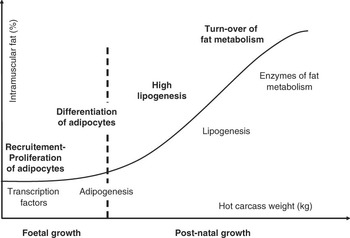
Meanwhile, molecular biology techniques, especially genomics, continue to further expand our knowledge of the adipocyte and to evidence specificities of the different carcass fat depots (Hishikawa et al., Reference Hishikawa, Hong, Roh, Miyahara, Nishimura, Tomimatsu, Tsuzuki, Gotoh, Kuno, Choi, Lee, Cho, Hidari and Sasaki2005). New genetic markers, transcription factors or genes are continuously discovered. Furthermore, adipocyte cell culture systems are also useful tools to identify potential hormonal or pharmacological agents that may modify adipocyte metabolism. The current market for marbling still justifies research in this area (for a review, see Dodson et al., Reference Dodson, Jiang, Chen, Hausman, Guan, Novakofski, Thompson, Lorenzen, Fernyhough, Mir and Reecy2010). The different key mechanisms that can act to improve intramuscular fat level are summarised in Figure 2.
Current concept of the key biological mechanisms that contribute to the accumulation of intramuscular fat in cattle during foetal life and postnatal life (adapted from Hocquette et al., Reference Hocquette, Gondret, Baéza, Médale, Jurie and Pethick2010).

Regulation of muscle and adipose tissue metabolism by nutrition
Steers and heifers often receive a restricted food supply in winter when feed availability is low, and then they are fed on pasture ad libitum in spring when the grass grows again. In this situation the animals first exhibit a low growth rate during the restriction period and then increase growth at a higher rate than that shown by previously unrestricted cattle. This is called ‘compensatory growth’. The importance of restriction during the first period is closely associated with the environmental conditions: restriction is severe in countries such as Australia, with moderate differences across seasons in some European regions. Muscle fibres are able to adapt their characteristics in order to optimise protein turnover. The changes in fibre size and types are commonly explained as a consequence of the mild hypothyroidism that occurs during a period of undernutrition (Cassar-Malek et al., Reference Cassar-Malek, Kahl, Jurie and Picard2001).
Refeeding after a restriction period results in a superior growth rate, and also in modification of muscle characteristics. In vitro data indicate that the restoration of insulin and T3 levels during refeeding could contribute to fibre hypertrophy by increasing satellite cell fusion with existing fibres during compensatory growth (Cassar-Malek et al., Reference Cassar-Malek, Langlois, Picard and Geay1999). Among muscle characteristics, metabolic enzyme capacity is primarily affected after compensation. Interestingly, muscles respond in different directions to refeeding after a restriction period in terms of metabolic activity, without any modification of their lipid content (Cassar-Malek et al., Reference Cassar-Malek, Hocquette, Jurie, Listrat, Jailler, Bauchart, Briand and Picard2004). This was coincidental with an elevation in circulating thyroid hormone levels and in the potential to produce triiodothyronine (T3) as shown by increased 5′deiodinase activity in the liver (Cassar-Malek et al., Reference Cassar-Malek, Kahl, Jurie and Picard2001). More precisely, while glycolytic metabolism (assessed by LDH activity) is restored in all muscle types, muscles that are already oxidative (e.g. triceps brachii) become even more oxidative on the basis of COX activity with no change in this mitochondrial activity in other muscle types (Cassar-Malek et al., Reference Cassar-Malek, Hocquette, Jurie, Listrat, Jailler, Bauchart, Briand and Picard2004).
LPL (activity and/or mRNA level), which is an enzyme that controls, with others, fat delivery to muscles, is decreased by underfeeding and sharply increased by refeeding in the oxidative cardiac muscle and to a lesser extent in the oxido-glycolytic longissimus thoracis in sheep (Bonnet et al., Reference Bonnet, Leroux, Faulconnier, Hocquette, Bocquier, Martin and Chilliard2000) and cows (Bonnet et al., Reference Bonnet, Faulconnier, Hocquette, Bocquier, Leroux, Martin and Chilliard2004). This downregulation may be specific to ruminants, thanks to their digestion particularities and low liver lipogenic capacity (Bonnet et al., Reference Bonnet, Leroux, Faulconnier, Hocquette, Bocquier, Martin and Chilliard2000 and Reference Bonnet, Faulconnier, Hocquette, Bocquier, Leroux, Martin and Chilliard2004). Generally, to a great extent, underfeeding affects lipogenic activities in adipose tissue and refeeding restores those activities. However, nutritional factors regulate sharply the expression and activities of LPL and FAS, moderately the activities of other lipogenic enzymes (glucose-6 phosphate dehydrogenase, malic enzyme and glycerol-3-phosphate dehydrogenase) and to a lower extent the lipolytic activity of the hormone-sensitive lipase (Bonnet et al., Reference Bonnet, Faulconnier, Fléchet, Hocquette, Leroux, Langin, Martin and Chilliard1998).
Using new genomic approaches, Byrne et al. (Reference Byrne, Wang, Lehnert, Harper, McWilliam, Bruce and Reverter2005) studied the short-term effects of dietary restriction induced by a low-quality grass-based hay diet in the longissimus muscle of Brahman steers. They detected 29 unique genes up- and 28 unique genes downregulated in response to nutritional restriction. Some of the changes in gene expression could be attributed to relative changes in cell metabolic activity in the different compartments of muscle tissue. A marked decrease in extracellular matrix transcription, and an increase in structural protein transcription and modulation protein turnover were detected, with some processes being upregulated and others downregulated, probably reflecting specific remodelling events.
In another study, Lehnert et al. (Reference Lehnert, Byrne, Reverter, Nattrass, Greenwood, Wang, Hudson and Harper2006) showed that a dietary restriction induces in longissimus muscle a major underexpression for genes encoding the muscle structural proteins, extracellular matrix and muscle metabolic enzymes, especially those belonging to the metabolic glycolytic pathway. This orientation of metabolism towards a lower glycolytic metabolism previously observed probably reflects an adaptation to better cope with nutritional deprivation. The expression of most of the genes was restored after refeeding. In addition, a small group of genes potentially involved in myogenic differentiation, maintenance of mesenchymal stem cells, modulation of membrane function, prevention of oxidative damage and regulation of muscle protein degradation was shown to be upregulated (Lehnert et al., Reference Lehnert, Byrne, Reverter, Nattrass, Greenwood, Wang, Hudson and Harper2006). However, these results might only be valid for the studied muscle, namely longissimus, since muscle types respond differently to changes in the feeding level (Cassar-Malek et al., Reference Cassar-Malek, Hocquette, Jurie, Listrat, Jailler, Bauchart, Briand and Picard2004).
Regulation of muscle metabolism by the nature of the diet
Among the factors affecting muscle characteristics, the effect of diet has often been described (for a review, see Geay et al., Reference Geay, Bauchart, Hocquette and Culioli2001), but its effect has seldom been studied independently of the energy level or independently of other factors that may affect muscle physiology (ambient temperature, housing, etc). In an experiment with Salers bulls (Listrat et al., Reference Listrat, Rakadjiyski, Jurie, Picard, Touraille and Geay1999c), animals fed hay had a lower average daily weight gain (−11%) and carcass weight (−7%), and they were leaner (17% less fatty tissue) than bulls fed grass silage at the same level of energy intake. The semitendinosus muscle of hay-fed animals had a lower oxidative metabolism but the metabolic properties of longissimus thoracis muscle were not modified, indicating again that muscle types respond differently to nutritional factors. Semitendinosus muscle from animals fed hay also contained similar amounts of total and type I collagen and greater contents of soluble collagen and of type III collagen than those of animals fed grass silage (Listrat et al., Reference Listrat, Rakadjiyski, Jurie, Picard, Touraille and Geay1999c). These results are difficult to explain, but some in vitro results show that vitamins and minerals (which are present in different amounts in hay compared to grass silage) may play a key role in the metabolism of collagen (Berg, Reference Berg1992).
In another experiment, the influence of two production systems (pasture v. maize silage indoors) on muscle metabolism and gene expression was studied in 30-month-old Charolais steers (Cassar-Malek et al., Reference Cassar-Malek, Jurie, Bernard, Barnola, Micol and Hocquette2009). Whereas carcass weight and composition did not differ between the two groups, muscles from animals at pasture were clearly more oxidative. The experimental design was completed by two other groups of animals fed a cut grass diet without mobility or maize silage with forced mobility. The cut grass diet increased two mitochondrial activities (β-hydroxyacyl-CoA dehydrogenase and isocitrate dehydrogenase) and mobility induced by walking increased β-hydroxyacyl-CoA dehydrogenase only. Consequently, the more oxidative metabolic orientation of muscles of grazing steers originates from a combination of two effects: the increased mobility at pasture and a grass (v. maize silage)-based diet (Jurie et al., Reference Jurie, Ortigues-Marty, Picard, Micol and Hocquette2006). Another experiment with young Salers suckled bulls confirmed that a pasture-based diet induces a higher oxidative muscle metabolism than a hay-based diet (Serrano et al., Reference Serrano, Pradel, Jailler, Dubroeuq, Bauchart, Hocquette, Listrat, Agabriel and Micol2007). Proteomic approaches also confirmed that muscles from grazed cattle are more slow oxidative compared to grain-fed animals (Shibata et al., Reference Shibata, Matsumoto, Oe, Ohnishi-Kameyama, Ojima, Nakajima, Muroya and Chikuni2009).
Transcriptomic analyses using a multi-tissue bovine cDNA macroarray were performed to compare gene expression profiles in two muscles between two production groups (pasture v. a maize silage diet indoors) previously studied. The selenoprotein W (SeWP) gene was found to be downregulated in the muscles of steers grazing on pasture. Although its metabolic function is not yet known, SeWP is likely to play a role in oxidant defence and its abundance in tissues is regulated by dietary selenium. Consequently, the differential expression of SeWP in grazing animals may be related to the selenium content or bioavailability in their diet (grass v. maize silage), but this remains to be clarified. Thus, muscle SeWP expression may be a putative indicator of a pasture-based system (Cassar-Malek et al., Reference Cassar-Malek, Jurie, Bernard, Barnola, Micol and Hocquette2009).
Muscle energy metabolism is also regulated by the interactions between carbohydrate and fatty acid metabolisms. In biochemical terms, catabolism of fatty acids (especially long-chain fatty acids) increases the intracellular levels of NADH, ATP and acetyl-CoA, all of which decrease glucose catabolism, mainly by inhibiting the activity of pyruvate dehydrogenase, an enzyme that controls catabolism of glucose-derived pyruvate in mitochondria. In addition to this, citrate, which comes from fatty acid oxidation, leaves mitochondria in order to inhibit PFK, which is a key enzyme of glycolysis. This biological mechanism is known as ‘the Randle cycle’. However, this competitive interaction between nutrients might not be as marked in the case of increased energy requirements resulting from higher rates of protein synthesis and deposition. Conversely, stimulation of carbohydrate catabolism, for instance by insulin, may inhibit long-chain fatty acid oxidation (reviewed by Hocquette et al., Reference Hocquette, Tesseraud, Cassar-Malek, Chilliard and Ortigues-Marty2007c). We observed that a high supply of sunflower oil or linseed oil directly infused into the proximal duodenum modified the metabolic activity of muscles. Infused oil corresponds to a protected form of dietary fats since fatty acids escape biohydrogenation or any other metabolic transformation, which occurs in the rumen of the herbivores due to the activity of micro-organisms. Therefore, oil infusion directly increased fatty acid supply to muscles. In that case, we observed an increase in the potential of muscle β-oxidation (namely a higher β-Hydroxyacyl CoA dehydrogenase activity) and also a decrease in the potential for glucose use. The latter was evidenced by a lower PFK activity. This difference was observed in the rectus abdominis muscle, which is oxidative, and not in the longissimus thoracis, which is more glycolytic (Bouhraoua et al., Reference Bouhraoua, Barnola, Jadhao, Durand, Bauchart and Hocquette2001). This experiment clearly demonstrates the existence of the Randle Cycle in the bovine muscle.
To summarise, although less marked than the effects of the nutritional level, the nature of nutrients may indeed regulate muscle metabolism (and hence growth and body composition) in association with the characteristics of the production system and also in interaction with the amount of dietary energy supply. Again, muscle-specific responses were observed, with changes in oxidative muscles being more pronounced.
Conclusions
The specific effects of nutrition on growth and development in livestock are at the forefront of scientific research for several reasons: (i) the cost of animal feeding is high, and therefore economic benefits at the farm level results from both adequate nutrition throughout life and high animal performances (in terms of carcass weight and retail beef yield); (ii) in addition, beef quality (in terms of marbling, tenderness, flavour, juiciness, etc.) may be enhanced or alternatively altered by nutritional factors and this may be of importance for consumers even if this does not affect incomes for the producers directly or to a great extent. Hormonal factors are highly dependent on nutritional factors and may explain to a great extent the biological effects of nutrients on muscle growth and beef quality.
Foetal life is very important for muscle growth because it is the period during which major biological events take place with high potential impacts later in life on the ability of muscle to grow and to be converted into beef of high quality. Among the important factors that act during foetal life, growth factors control cell lineage and cell proliferation and therefore the balance between myoblasts, adipocytes and fibroblasts in the muscle tissue. Therefore, muscle differentiation is controlled by a complex metabolic and hormonal regulation especially after 6 months of foetal growth. In this context, myostatin plays a major role with important consequences on body composition, muscle growth and characteristics in case of loss of function. Myostatin acts in interaction with hormonal factors and the target genes of myostatin are currently being discovered, thanks to the development of genomics.
Since foetal life is highly important for postnatal life, considerable research has been developed to study this critical period and it was shown that the hormonal and metabolic environment as well as nutrition during the foetal period may have lifelong programming effects on different body functions including growth and body composition in all mammals. However, although very attractive, data obtained so far do not completely support the idea of significant effects of nutritional programming within the normal limits of beef production systems. In addition, it appears from the literature that the plasticity of tissues, especially that of muscles, as well as placental growth, allows bovines that are nutritionally and hormonally perturbed during their foetal growth to compensate at least in part and hence to often attain normal weight and body composition, but at higher ages making cattle probably less sensitive than other models to growth retardation due to moderate undernutrition early in life.
Therefore, research on nutrition in livestock is still needed in order to increase metabolic efficiency and to optimise body composition, thereby reducing production costs. The efficiency of nutrient utilisation is the consequence of very small, but cumulative, changes in biology that often fall within the variance of the current biochemical methodology when metabolic pathways are studied separately. An integrated approach to nutrition and its hormonal regulation is thus recommended to further optimise nutrition of livestock, especially before birth.
During postnatal life, muscle-specific responses have been observed in many different models of growth path in cattle. Generally speaking, the plasticity of oxidative muscles is often high in order to adapt to different nutrient supplies that vary quantitatively and qualitatively. In many examples, mitochondria indeed play major roles in mediating the action of nutrients: the more nutrients are catabolised for whatever reason associated with nutrition, the leaner the individuals are. The interaction between nutrients (especially between fat and glucose) is also an important muscle metabolism regulation factor. In addition, the wealth of information arising from genomics experiments offers considerable promise for characterising the complex interaction between all nutrients, which is often muscle-specific depending on muscle type. Similarly, like the different muscle tissues, adipocytes from different depots have specific metabolic features, especially intramuscular adipocytes, which seem to use a greater proportion of carbohydrates for lipogenesis.
All this knowledge opens the door for potential mechanisms to increase muscle growth and marbling score (to ensure beef quality) independently of carcass fatness by combining genetic and nutritional factors, both of which act through hormonal regulation. However, these interventions will require intense efforts to unravel the complexity of these genetic, hormonal and nutritional interactions and to evaluate their potential applications with minimal side effects and with low costs and benefits for both beef producers and consumers.
Acknowledgements
The contributions of Drs D Bauchart, M Bonnet, I Cassar-Malek, Y Geay, C Jurie, A Listrat, D Micol, I Ortigues-Marty, B Picard and M Vermorel in the conduct of research on consequences of nutrition on muscle growth and body composition are most gratefully acknowledged. I also acknowledge the considerable efforts of the research, technical and/or farm staff and the slaughterhouse staff of INRA in the conduct of some of the research described in this review.