One of the big questions in the historical evolution of the public corporation is this: When did ownership separate from control? The received view among business historians until recently was that when incorporation laws were liberalized in the nineteenth century, the ownership of corporations was dominated by founding families, but as public corporations grew in scale in the twentieth century, ownership became more dispersed.Footnote 1 This view has recently been challenged and has subsequently generated substantial debate among scholars.Footnote 2 In this article, we contribute to this debate by analyzing large shareholders in Victorian public companies formed after the liberalization of British incorporation law in 1856.Footnote 3 In related work, we find that the broad structure of corporate ownership was surprisingly diffuse in the Victorian era.Footnote 4 In this article, however, we examine in detail the largest shareholders in all of our sample firms to establish whether they played an active governance role in companies or were wealthy rentiers who simply provided finance to companies.
The acts that liberalized incorporation legislation in the United Kingdom required companies to report a detailed list of shareholders and their ownership to the Registrar of Companies on an annual basis.Footnote 5 After a comprehensive archival search, we found ownership records for 488 unique companies and 890 company-years for the second half of the nineteenth century. We define large shareholders as the largest owner in the company plus all others who own more than 10 percent of the company's voting or cash-flow rights. In total, across the 890 company-years, we have identified 1,158 unique large shareholders. In order to assess whether these large owners played a governance role or were simply wealthy rentiers, we use our ownership data to measure how much voting control large shareholders had. We then examine the socio-occupational background of these large shareholders and where they lived, to see if they had a background consistent with being a rentier rather than an active large owner. Finally, we attempt to establish the wealth of large shareholders using probate records. We do so for two reasons. First, if a large shareholder's ownership in a company is a substantial proportion of his or her wealth, this would imply that he or she exercised more control over the company because a large proportion of family wealth was at stake. Second, if a shareholder was a rentier, we want to see if he or she was from the superrich elite or from the moderately wealthy middle class.
A study of large shareholders in Victorian Britain is of interest for at least one additional reason. The rapid expansion of both the U.K. equity market and the investing public during the latter part of the nineteenth century may have been facilitated by the control exercised by large owners acting to assure smaller shareholders that managers would act in the shareholders' interests.Footnote 6
Taking our evidence as a whole, our main finding is that large owners in general do not appear to have exercised much control over the companies in which they were large shareholders. Rather, our evidence suggests that large shareholders in many Victorian companies were merely wealthy investors. This finding—that the average large shareholder did not appear to exercise much control—is consistent with Colin Mayer's view that by giving up control, large owners are credibly committing to other parties who contract with the firm, particularly other investors, that they will not abuse their power to expropriate other stakeholders.Footnote 7 Notably, Eric Hilt and Aldo Musacchio argue that something similar occurred in the early development of the U.S. and Brazilian equity markets.Footnote 8
This article contributes to a strand of business history literature that has criticized the control of British companies in the Victorian and Edwardian eras. Following Alfred Chandler, the commonly accepted view is that British firms, when they were established in the nineteenth century, were family controlled and that this persisted into the twentieth century, with the result that they did not develop the managerial sophistication of their U.S. counterparts.Footnote 9 This state of affairs may ultimately have played a role in the relative decline of the British economy in the twentieth century.Footnote 10 However, our findings suggest that this view needs some revision because the degree to which large shareholders or families controlled the vast majority of companies in our sample is debatable.
Also this article builds on the growing literature on investors in the Victorian era. To date, this literature has focused on sociocultural references and public perception of investors; investors in banks, gas companies, and railways; and the relationship between gender and investment.Footnote 11 We augment this literature by looking solely at large shareholders across a wide variety of industries in the second half of the nineteenth century.Footnote 12
Finally, this article contributes to the debate regarding the role of London's capital markets in channeling capital to colonial or overseas companies to the detriment of indigenous British firms.Footnote 13 Our study enables us to add several nuances to this debate because 155 of the 488 companies in our sample are overseas companies, enabling us to see the differences (if they exist) in control by, and identity of, large shareholders.
Data on Large Shareholders
The Companies Acts of 1856 and 1862 liberalized U.K. incorporation law by permitting entrepreneurs to incorporate with limited liability simply by registering with the Registrar of Companies.Footnote 14 Companies registered under these acts were required annually to return a list of their ordinary and, where applicable, preference shareholders to the Registrar of Companies using a standardized return form known as Form E. These returns always contained the shareholder's name and the number of shares owned, and, in the majority of cases, they also contained the shareholder's address and occupation. The returns of companies that were dissolved before 1970 were placed within the Companies Registration Office files at the National Archives at Kew (BT31 series) and the National Archives of Scotland (BT2 series).
We searched the catalogs of the BT2 and BT31 series for public companies that had issued common stock quoted either in the Course of the Exchange between 1825 and 1870 or in the Investor's Monthly Manual in 1870, 1885, and 1899.Footnote 15 Our final sample consists of 890 firm-years, representing 488 unique companies.Footnote 16 Of these companies, 333 were domestic companies and 155 can be defined as overseas companies, since their operations were based outside of the British Isles. Information on the location of a company's main operations was obtained from memoranda of association contained with the files in the BT31 and BT2 series, Burdett's Official Intelligence, Stock Exchange Official Intelligence, and Stock Exchange Year-book.
Because the ownership archives consist of companies that became defunct at some stage before 1970, none of our sample companies are still in existence today as separate entities. Using the Register of Defunct Companies, we were able to trace the ultimate fate of most of our sample companies. About 55 percent became defunct because they reconstructed or merged with another firm, while approximately a further 28 percent of sample companies were liquidated. Most of the banks and insurance companies in our sample merged with the banks that dominate these sectors today. Notably, the Clydesdale Bank is in our sample and, although it merged with the Midland Bank in 1920, it has continued to operate under its original name. Other companies in our sample merged to form industrial giants. For example, one of our sample companies, the Runcorn Soap and Alkali Company, merged with a group of other chemical companies to form United Alkali Company, which later merged with three other companies in 1926 to form Imperial Chemical Industries. Notably, the brand names associated with several sample companies that merged with other companies still exist today (e.g., Bovril and Schweppes).
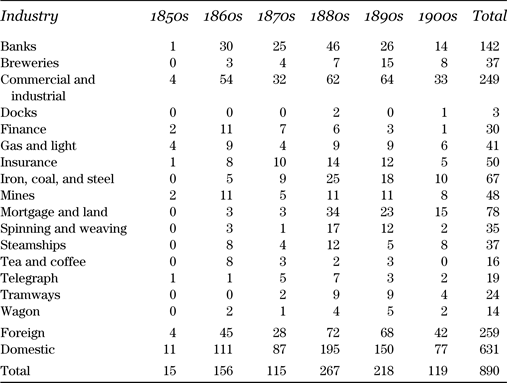
In Table 1, we see that our sample contains a range of companies from different industries. Based on Richard Grossman's data on the industrial composition of the British capital market in this era, the one industry that is underrepresented is mining.Footnote 17 We found that the ownership records for mining companies were more likely to be missing or incomplete, possibly because of their short-lived and speculative nature. The commercial and industrial sector is the largest, which is unsurprising since this was a growth sector in the stock market between 1860 and 1900.Footnote 18 This sector consisted mainly of manufacturing and processing companies (e.g., oil, petroleum, nitrate chemicals, fertilizer, soap and alkali, railway carriages and rolling stock, bicycles, paper mills, plate glass, dairies, wagons), but also contained some large retailers, publishers, and hotels. As can be seen in Table 1, our sample is spread across time, with just over half of our sample firm-years concentrated in the 1880s and 1890s.
Industry Breakdown of Sample

Source: Companies Registration Office files, BT31 series, at the National Archives at Kew, Richmond, U.K., and BT2 series at the National Archives of Scotland, Edinburgh, U.K.
Note: The industry classification used above is that used by contemporary stock exchange manuals such as the Stock Exchange Official Intelligence.
A question arises as to the representativeness of our sample and whether our sample composition is likely to bias our findings in one direction or another. As ownership data was not collected by the Registrar of Companies on statutory companies set up prior to 1862 (e.g., railways and other utilities), nor on banks and insurance companies (unless they registered under the 1862 Companies Act), our sample does not contain the largest companies in the Victorian era. Indeed, none of our companies would have made it into the top one hundred largest public companies in the year for which we have their ownership records; only 8.8 percent of our companies were in the top two deciles of nonrailway companies in terms of their size and 63.3 percent of our companies were in the bottom half of nonrailway companies in terms of their size. Thus, the vast majority of our sample consists of small and medium-sized public companies, which immediately biases our findings as such companies were more likely to have had large owners who exercised a substantial degree of control over their firms.
In terms of stock exchanges, we have information from the Investor's Monthly Manual on where the majority of our company's securities were traded. The percentages of sample companies traded on particular stock markets were as follows: Aberdeen (4.5), Birmingham (5.5), Bristol (2.4), Cardiff (0.8), Dublin (1.0), Dundee (4.6), Edinburgh (10.3), Glasgow (9.8), Leeds (3.5), Liverpool (8.0), London (33.8), Manchester (7.7), Newcastle (2.4) and Sheffield (5.5).Footnote 19 Therefore, it is apparent that our sample does not have an exclusive focus on London and there is a wide geographic distribution in terms of where securities were traded.Footnote 20
As we are interested in the voting rights as well as cash-flow rights of large owners, we collected data on each company's voting scales for each year for which they are in our sample from their articles of association (contained within the files in the BT31 and BT2 series), Burdett's Official Intelligence, and Stock Exchange Official Intelligence. These data were then used to calculate each shareholder's voting rights. We found the voting structures for 729 of the 890 firm-years of ownership returns.
Because we are also interested in whether large shareholders were directors and whether they lived in close proximity to the companies in which they were large shareholders, we collected the names of directors and company headquarters for the relevant years from a combination of articles of association, Burdett's Official Intelligence, Stock Exchange Official Intelligence, and Stock Exchange Year-book. In total, we located director names and company headquarters for 575 of the 890 firm-years in our sample.
As stated above, we define a large shareholder as the largest shareholder in the company plus anyone who owned more than 10 percent of voting or cash-flow rights. We chose 10 percent to define large shareholders following the usual convention in the extant literature.Footnote 21 If two or more individuals are joint owners of the largest stake or 10 percent of voting or cash-flow rights, then we consider each of those individuals as significant owners. After using our digitized ownership returns to identify major shareholders, we then went to the original photographs to transcribe their names, addresses, and occupations. In total, we have 1,158 large shareholders in our sample, with 111 of those being joint owners. Of the 111 joint owners, twenty-nine share a common surname with their co-owners, implying a familial relationship.
Control Exercised by Large Shareholders
Companies in Victorian Britain raised capital by issuing ordinary and preference shares as well as debentures.Footnote 22 The voting rights attached to preference shares were sometimes the same as for ordinary shares, but the usual practice was to assign preference shareholders voting rights under certain conditions, such as on reduction or increase of capital, on winding up of the company, or if the dividend on preference shares was in arrears. Debenture holders only exercised control whenever the company failed to make its coupon payments.
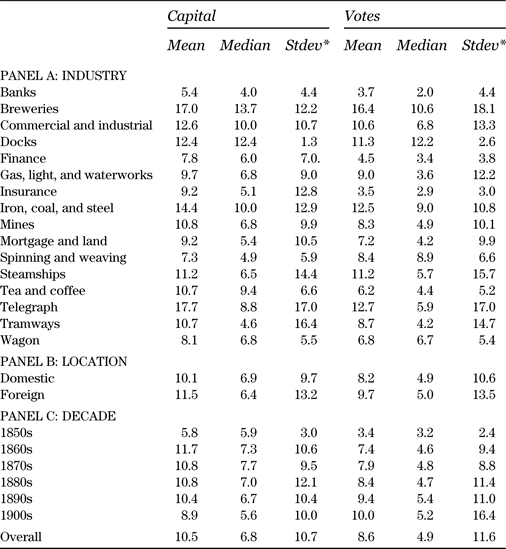
Table 2 contains statistics on the percentage of capital and voting rights owned by the largest shareholder in each firm-year. These figures contain ordinary and, if the company issued them, preference shares. In addition, the voting rights take account of whether or not preference shares had unconditional voting rights attached to them. In terms of the statistics for the overall sample, we see that the median largest shareholder owned 6.8 percent of capital and 4.9 percent of voting rights. To give some perspective on these figures, Rafael La Porta, Florencio Lopez-de-Silanes, and Andrei Shleifer suggest that a company has an ultimate owner (i.e., concentrated ownership) if the largest owner controls more than 20 percent of voting rights.Footnote 23 They also have a weaker definition, where an ultimate owner is defined as having more than 10 percent of voting rights. Thus, no matter which definition of theirs we use, we can see that the median company in our sample did not have an ultimate owner.
Percentage of Capital / Votes Owned by Largest Shareholder
Source: See Table 1.
*Stdev = standard deviation.
Notes: The industry classification used above is that used by contemporary stock exchange manuals such as the Stock Exchange Official Intelligence and Stock Exchange Yearbook. We follow the categorization of these yearbooks and work backwards so that although breweries may have originally been in the industrial and commercial category in the yearbooks, they are always in a separate category in our sample.
As can be seen in Table 2, unlike in later eras, the voting rights of large shareholders in Victorian companies were generally lower than their cash-flow rights. This was due to the popularity of voting scales, which penalized large investors and empowered smaller investors. For example, many companies had voting scales that placed an upper limit on the maximum number of votes that any one investor could have and/or a nonlinear voting scale skewed against large owners.Footnote 24
In Panel A of Table 2, which contains statistics on the largest owners by industry, there are few industries in which the median largest owner has close to or over 10 percent of voting rights. In three major industries, the median largest owner had the highest capital and voting rights: breweries; spinning and weaving; and iron, coal, and steel. One of the key differences between these three industries and others in Table 2 is that the former were established firms, with a partnership organizational form in place before they became public companies. In each of these industries, partnerships converted to limited companies in order to raise capital from the public to finance their growth in firm scale.Footnote 25 The increased capital needs of breweries arose from (a) technological changes that increased their optimal size and (b) their need to secure public houses following regulatory changes in licensing.Footnote 26 In terms of iron, coal, and steel, changes in technical processes and the increased scale of steel production led these firms to seek capital on public markets.Footnote 27 Similarly, the capital needs of the spinning and weaving sector arose from an increase in the scale of efficient production.Footnote 28
Panel A of Table 2 also reveals that low percentages of voting rights were held by the median largest owner in banks, finance, insurance, and gas, light, and waterworks. The latter were public utilities, which typically had large capital needs. Banks, finance, and insurance companies normally structured their articles of association to ensure diffuse ownership, by restricting the amount of shares any one investor could own and/or by skewing their voting scales in favor of small investors.Footnote 29 One reason for doing so was that such companies usually had uncalled capital or extended liability, and depositors and policyholders with these companies may have preferred to see the company's shares dispersed among many wealthy investors instead of sold to one large wealthy owner.Footnote 30
Panel B of Table 2 reveals that there is very little difference, in terms of the percentage of shares owned by the largest shareholder, between British companies operating in the domestic market and those operating in foreign markets. Meanwhile, Panel C shows that as the mean and median percentage of capital owned by the largest shareholder fell during our sample period, the mean and median percentage of voting rights increased. The contrasting movements over time are simply the result of the increased usage of nonvoting preference shares, which enabled large shareholders to have a share of voting rights that exceeded their share of capital.
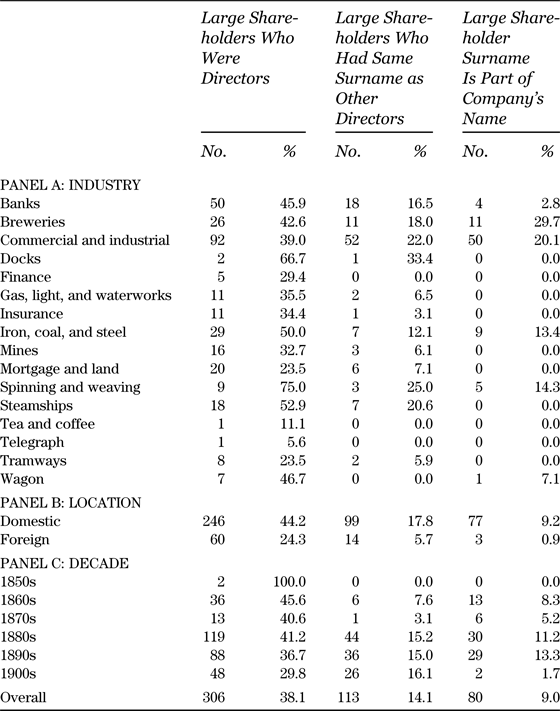
Although the largest shareholders held relatively small amounts of the voting rights in their companies, they may have been able to exercise de facto control of the company through being directors. As can be seen in Table 3—which shows the proportion of large shareholders who were also directors—there are 803 large shareholders of companies for which we have details on who the directors were; only 306 of these shareholders were directors. In other words, 61.8 percent of large shareholders in our sample period were not directly involved in their firm's governance. Given their large stakes, one would expect more large shareholders to play a governance role. One possible explanation for this finding is that the company was a family firm that had been established by the largest shareholder, who managed it on a day-to-day basis; that shareholder could have exercised control without being a director if he or she had superior knowledge of the business and his or her own men on the board. In order to determine whether a company was a family company, we examine whether the large shareholder's surname was part of the company's name. In Table 3, we see that in only eighty instances out of 1,158 did the company's name contain a large shareholder's surname. Another way of assessing whether a company is a family firm is to ask whether other directors shared a surname with the major shareholders.Footnote 31 As can be seen in Table 3, there were 113 cases (constituting 153 directors) where at least one director had the same surname as a large investor. However, in the 496 cases where the large shareholder was not a director, it was in only fifty-four instances that a director shared a surname with the major shareholder.
Large Shareholders and Control
Source: See Table 1 for ownership sources. Directors were obtained from Burdett's Official Intelligence, Stock Exchange Official Intelligence, and Stock Exchange Year-book.
Note: The industry classification used above is that used by contemporary stock exchange manuals such as the Stock Exchange Official Intelligence.
Table 3 reveals interesting differences between sectors. In particular, companies where directors share the same surname as the significant investor, and those where the company name contains the family name, are mainly in two sectors: breweries and commercial and industrial. Notably, companies in these two sectors mainly came to market in the 1880s and 1890s, which explains the patterns we see in Panel C.
Industries that were more likely to be located overseas had a lower propensity for large shareholders to be directors. Panel B verifies this, as it reveals that there are marked differences between domestic and foreign companies in terms of large shareholders being directors or having family members as directors. This may indicate that large shareholders in foreign-based companies were simply wealthy passive investors.
If large shareholders were founding entrepreneurs or part of the founding family, we would expect them to remain as major owners for a lengthy period of time. We exploit the fact that our dataset contains some multiple-firm-year observations to see whether or not there is much in the way of turnover of large shareholders. With an average of slightly over ten years between ownership censuses, we find that in 60.4 percent of cases there are changes in the identity of the large shareholder. Only in 11.3 percent of these cases does the new shareholder have the same surname as the previous incumbent, and in 24.3 percent of these cases does the previous owner remain as a shareholder. This implies significant turnover of large shareholders within our period and a very small proportion of these shareholders being replaced by family members.
Notably, the turnover of large shareholders was greater in foreign companies than in domestic companies (74.5 percent change in identity of large shareholder versus 55.5 percent), which is further evidence that major investors in foreign companies were passive investors. The four industries with the lowest turnover are breweries (46.2 percent); commercial and industrial (54.3 percent); iron, coal, and steel (52.5 percent); and spinning and weaving (50.0 percent). Each of these industries was more likely to be founder or family controlled, so the lower turnover rate is unsurprising.
The overall picture that emerges from the analysis above is that the average large owner in the Victorian era had little in the way of control rights and did not play a governance role. However, towards the end of the nineteenth century the average shareholder had more in the way of control rights, and it appears that a greater governance role was played by large shareholders or their family members. These findings raise several questions. First, who founded companies in this era? Second, why was there a change in the degree of separation between ownership and control towards the end of the century? Third, given the absence of control by large shareholders, who managed companies?
Unlike most modern public firms, many companies in the Victorian era were floated from scratch. In other words, many stock market flotations were not conversions of previously established businesses, but new ventures that raised capital from the stock market at their inception.Footnote 32 The founders, as such, were the promoters behind the business, but they did not necessarily invest heavily in the business or run it once it was established. However, from the 1880s onwards, and particularly in the 1890s, business concerns were much less likely to launch from scratch and more likely to be conversions of existing partnerships and private companies.Footnote 33 Whenever these companies were floated on the stock market, their founders typically tried to maintain control by issuing preference shares and debentures.Footnote 34 This explains why there is less separation of ownership from control towards the end of our sample period.
In terms of who managed Victorian companies whenever large shareholders did not play a hands-on managerial role, general managers or managing directors under the oversight of a board of a directors did, which is contrary to Chandler's critique of late-nineteenth-century British capitalism. This, in turn, raises questions about how shareholders ensured that managers and directors ran the firm in their interests in an era when shareholder protection laws were weak. Gareth Campbell and John Turner suggest that capital-market discipline, the expectation that nearly all earnings would be paid out as dividends, local stock exchanges, and boards of directors may all have played a role in ameliorating the agency problem in this era.Footnote 35
The Socio-occupational Background of Large Shareholders
Having established that a majority of large shareholders owned a small proportion of voting rights and did not play a governance role, in this section we examine who these shareholders were. We do so primarily because we want to ascertain whether large shareholders had a background consistent with being a rentier rather than an active owner.
Since the shareholder returns report socio-occupational status and the addresses of shareholders, we can get some idea of the backgrounds and geographical distribution of large investors.Footnote 36 However, a caveat needs to be placed on using what was reported in the shareholder returns. A large number of males were recorded as “gentleman” or “esquire.” Men described as such could easily have been active businessmen, financiers, or professionals, or retired from active business or professional life.Footnote 37 Alternatively, they could have been members of the landed gentry or simply signaling their social status. However, several pieces of evidence suggest that the majority of cases where someone is described as a gentleman or esquire are either men retired from active life or landed gentry. The first piece of evidence is that gentlemen are much less likely than men of other socio-occupational groups to be directors; specifically, 32 percent of gentlemen are directors, whereas comparable figures for other groupings range from 48 to 64 percent. The second piece of evidence is that 46 percent of gentlemen lived outside large towns or a metropolitan area, which gives some indication about the extent to which they were members of the landed gentry.Footnote 38
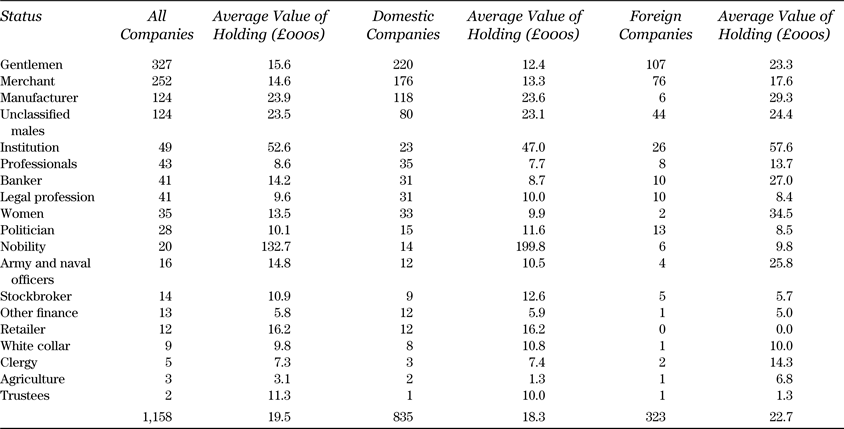
Gentlemen are by far the largest socio-occupational category in Table 4. Most of these individuals were not large shareholders in family firms; only 4.0 percent shared their surname with the company's name, and only 12.7 percent shared their name with a director. In addition, only 32.2 percent of gentlemen large shareholders were directors, which is a substantially lower percentage than that of the two other major occupation categories in Table 4—merchants (54.1 percent) and manufacturers (64.7 percent). All of this evidence would suggest that many gentlemen large shareholders were wealthy passive investors simply seeking a return on their investment. The high proportion of gentlemen among major investors in foreign companies adds further support to this contention.
Large Shareholders' Socio-occupational Status
Source: See Table 1.
Note: Average value of holding is based on the par value of shares.
In terms of other classic rentier groups, a small proportion of large shareholders were from the nobility (Table 4).Footnote 39 However, the average value of their holdings in domestic companies was much greater than that of large shareholders from other socio-occupational categories. The only instance of members of nobility being closely involved with the companies in which they were large shareholders is the case of the Wigan Coal and Iron Company, which was established by James Lindsay (Earl of Crawford and Balcarres) in 1865 to acquire collieries on the Wigan coalfield. When his son, Alexander Lindsay, succeeded to the earldoms in 1869, he devoted a lot of his time to the running of the company.Footnote 40
Recent scholarship has uncovered the extent to which women invested in the stock market in the nineteenth century.Footnote 41 Interestingly, thirty-five large shareholders in our sample were women.Footnote 42 One explanation for this may be that they held investments in family firms or invested jointly with a family member; however, only three women each invested jointly with a family member, a further three were large shareholders in firms where a director shared their surnames, and only one was a large shareholder in a firm that contained her surname in its appellation. Thus, it appears that the vast majority of female large shareholders were wealthy investors, with no family interest in the companies in which they invested. Female major owners also notably invested predominantly in domestic companies, which may reflect an aversion to risk or a local bias.Footnote 43
Professionals (mainly doctors, engineers, and surgeons) and members of the legal field were large shareholders in a wide variety of industries. In many instances, our evidence points to the fact that these investors had a significant stake without necessarily having a family or managerial interest in the company.
Financiers and bankers have been criticized for failing British industry and entrepreneurs by not providing sufficient capital.Footnote 44 However, sixty-eight of the large shareholders in our sample were from the finance sector—bankers, stockbrokers, and others (e.g., actuaries, accountants)—and, as can be seen in Table 4, financiers were predominately large shareholders in domestic companies. Of the forty-one bankers, nineteen were major shareholders in banks, which is unsurprising. The other twenty-two, who were large shareholders in a range of companies (including iron, coal, and steel; breweries; and commercial and industrial companies), include the names of several notable bankers and banking dynasties: Grenfell, Glyn, Gurney, Hambro, Lloyd, Schroder, Stern, and Tiarks. In other words, even though City banks may have been conservative or risk averse when it came to lending to British industry, individual bankers within the City were not and were willing to provide large amounts of capital to British companies.
In Table 4, we see that on twenty-eight occasions, members of Parliament were large shareholders.Footnote 45 Although these individuals are recorded as politicians in the shareholder returns, using the Dictionary of National Biography and other genealogical tools, we found occupations in twenty-two cases, with the most common occupations being manufacturer, banker, and barrister. At least nine were, or had formerly been, manufacturers, with the most notable being Joseph Chamberlain. Five were from banking, with Henry S. King, John Lubbock, and Alexander Matheson (of Jardine Matheson) being the most notable. William Quilter, who was a stockbroker and a founding director of the National Telephone Company, was a large shareholder in the Lion Fire Insurance Company.Footnote 46
Manufacturers differ from other categories in Table 4 in that they make up an extremely small proportion of large shareholders in foreign companies. One explanation is that manufacturers were much more likely to be large shareholders in family firms or in firms where they played a governance role. Notably, in thirty-eight out of 124 instances, major owners who were manufacturers had their surname in the company name. Furthermore, manufacturers were much more likely to be directors than were any other category in Table 4—64.0 percent of large shareholders who were manufacturers were also directors. A further piece of evidence that suggests manufacturers were intimately involved with the companies in which they were large shareholders is that they rarely heavily invested in nonmanufacturing firms; in fact, only nineteen of them did, and most of those firms were financial companies.Footnote 47 In some cases, a manufacturer may have had a large shareholding in a company because he had an interest in the industry. For example, Henry Bessemer, of Bessemer converter fame, was a significant investor in Thames Plate Glass Company in 1865, which may have arisen from his innovations in the production of plate glass.Footnote 48
When compared with manufacturers, merchants were much more likely to invest in foreign companies and less likely to play a governance role within their companies. They were also much more likely to be large shareholders in nonmanufacturing companies, with ninety-five of them being so. Merchants were mainly classified as such in the shareholder returns, but we also assigned others, such as contractors, to this category. One notable example is Thomas Brassey, the well-known civil engineering contractor, who was a large shareholder in the Central Argentine Land Company in 1870.Footnote 49
As can be seen in Table 4, forty-nine of our large owners are institutions. In nine of these cases, it is the company owning its own shares—particularly among banks and insurance companies, which sought to make markets in their own shares.Footnote 50 Eleven of the institutional large owners were banks; however, this does not provide partial absolution from the charge that banks failed British industry, since they were all large shareholders in foreign companies. A further eleven of the institutional sizable shareholders were investment trusts. Notably, in ten of the eleven instances where an investment trust was a large shareholder, the shareholding was in a foreign company, and no investment trust was a major owner prior to 1891.Footnote 51 In seventeen cases, another company was the large shareholder and that company usually operated in the same industry.
The overall finding from our analysis of the socio-occupational backgrounds of large shareholders is that many were rentiers or passive investors who were not involved in governance. Notably, manufacturers and merchants who were large shareholders appear to have played a more active role in firm governance than did other socio-occupational groups, and many of them appear to have been large shareholders in family firms.
The Geographic Spread of Large Shareholders
Having established the socio-occupational background of large shareholders, we now move on to another question: where were these shareholders from? We perform this analysis for two reasons. First, we want to see if major London capitalists, who were more likely to be rentiers than other shareholders, invested in foreign or domestic companies. Second, given that many large investors did not play a governance role, we want to see how close they lived to the companies in which they placed their money.
Five geographic areas dominate: London (34.6 percent of large shareholders), Lancashire (12.2 percent), Yorkshire (7.0 percent), Scotland (13.6 percent), and overseas (5.1 percent). Notably, the first three areas were those that had provided the bulk of capital during the development of the railways in the 1840s.Footnote 52 London provided the largest pool of major shareholders, but its share of large investors (34.6 percent) was somewhat below its percentage of companies headquartered there (45.6 percent). Lancashire provided the second largest pool of substantial shareholders, which mirrored the percentage of companies headquartered there. Notably, while London provided 51.6 percent of all large shareholders in foreign companies, Lancashire and Yorkshire provided only 5.9 percent. This suggests that it was London wealth rather than Lancashire or Yorkshire money that financed foreign companies.Footnote 53
The importance of Scotland as a source of significant shareholders arises purely because we have Scottish companies in our sample.Footnote 54 Only fifteen of the 157 major investors from Scotland were large shareholders in non-Scottish companies, and only twenty-six large shareholders in 162 Scottish-registered companies were from outside Scotland, with ten of the twenty-six being from overseas and sixteen from England. This suggests both that capital markets were geographically segmented in the Victorian era and that large shareholders lived close to the companies they invested in. Notably, nearly 12 percent of all sizable shareholders in foreign companies came from Scotland. This can mostly be attributed to the notable number of freestanding companies that were incorporated in Scotland.Footnote 55 In a similar vein, many overseas firms registered in London, which may explain the high share of London addresses among large shareholders in overseas companies.
Major investors from overseas constituted 5.1 percent of our sample of large shareholders but contributed 10.9 percent of the capital provided. These foreign large shareholders were usually investing in British-registered companies that had operations in the countries where they were domiciled and not in companies with operations in the United Kingdom. In total, 16.1 percent of substantial shareholders in foreign companies were from overseas.
Having established that the geographic spread of large investors more or less mirrored the geographic spread of company headquarters, we now move on to this question: How close to their company's headquarters did major shareholders live? In the Victorian era, a large shareholder's ability to influence the firm or monitor its directors may have been determined for the most part by how close he or she lived to the company's headquarters. Notably, even companies we describe as foreign had their headquarters in the United Kingdom. We have head office details for 771 large shareholders, and we find that 520 of them lived in the same county as the company in which they were the large shareholder. This proximity may have been partially driven by the provincial nature of the British capital market at the time. Such a capital market gave large investors access to information as well as possible influence over the company.
The Wealth of Large Shareholders
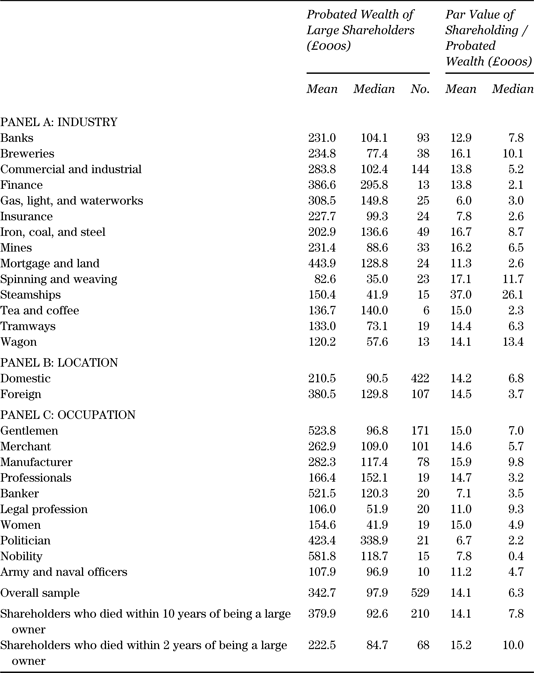
In this section, we examine the wealth of our sample of large shareholders. We do so for several reasons. First, it may tell us whether the companies they invested in were family companies to which they had committed significant proportions of their wealth. Second, it will help us to understand whether major investors in this era were members of the superrich or from the moderately wealthy middle class.
To estimate the wealth of a large shareholder, we use his or her assets as recorded in probate documents. Several caveats must be borne in mind when using probate as an estimate of a person's wealth. Firstly, probate records may underestimate a decedent's true wealth.Footnote 56 Second, these records may not be representative of a person's wealth when he or she was a large shareholder—someone could have made and lost a fortune between the time he or she was a large shareholder and the time of death. We therefore run a set of robustness checks on our probated wealth data by looking at the subsample of individuals who died within two and ten years of an ownership census in which they were identified as large shareholders.
We use Ancestry.com to trace the probated effects of large investors as reported in will calendars. Unfortunately, most Scottish wills were sealed, with the result that no effects are reported. In order to ensure that the probate records were actually those of the large shareholders studied here, we required that the address, occupation, and name (plus initials, if any) as recorded in probate records matched those in the ownership returns. This rigorous methodology and the absence of effects in the Scottish probate records means that we have probated wealth for only one-half of our large shareholders.
Fifty-two of our major investors had probated wealth that was substantially below the paid-up value of their shareholding; all had low wealth and died a median of nineteen and a half years after the ownership census date in which they are recorded as large shareholders. These shareholders obviously had lost a lot of money before they died.Footnote 57 Since these fifty-two individuals overly influence the ratio of the value of a shareholding to probated wealth, we omit them from our analysis in Table 5. As a result, we have 529 large shareholders in our sample. For the sake of comparison, all probate values in Table 5 are converted into 1900 values using Jim O'Donoghue, Louise Goulding, and Grahame Allen's composite price index.Footnote 58
Wealth of Large Shareholders
Sources: See Table 1 for ownership sources. Probated wealth data are from the Will Calendars in Ancestry.com.
Note: This table excludes fifty-two shareholders whose probated wealth was less than the paid-up value of their shareholding. Jim O'Donoghue, Louise Goulding, and Grahame Allen, “Composite Price Index, 1750–2003,” Economic Trends 604 (2004): 38–46, is used to convert probate values into 1900 values. The industry and occupations panels do not add up to 529 as not all industries or occupations are included.
As can be seen in Table 5, the large shareholders in our sample of Victorian companies had a mean wealth of £342,700 (and a median of £97,900). To provide some context, Peter Lindert estimates that in 1875, the average estate of merchants was £11,804, that of gentlemen and the nobility was £9,855, and that of professionals only £1,201.Footnote 59 To put this into further perspective, W. D. Rubinstein, in his study of probate records, finds that there were only 158 millionaires and 383 half-millionaires in the United Kingdom in the period from 1880 to 1914.Footnote 60 Tom Nicholas, in his study of the 790 British businessmen listed in the Dictionary of Business Biography, finds that the median probate of prominent businessmen was £154,471 for those born between 1800 and 1840 and £134,275 for those born between 1840 and 1880.Footnote 61
The bottom two rows of Table 5 reveal that the median wealth of those who died within ten and two years of being recorded as a shareholder in an ownership return is only slightly lower than that of the overall sample. This suggests that large shareholders were typically very wealthy when they were large owners and did not necessarily become wealthy as a result of their stock ownership.
Across the overall sample, we see in Table 5 that the mean and median ratio of the par value of a large investor's holding to his or her probated wealth was 14.1 and 6.3 percent, respectively. These figures increase slightly for those shareholders who died within ten and two years of being recorded as a large shareholder. In other words, the average major shareholder invested a considerable proportion of income in the chosen companies. Taken with the findings above, the significant fraction of overall wealth invested is surprising given the low probability that large shareholders were directors or exercised control. Notably, the correlation coefficient between the proportion of wealth invested in a company and being a director is only 0.07.
In terms of industry, the least wealthy sizable shareholders were in the spinning and weaving, steamship, and wagon industries (Table 5). However, large investors in these industries usually had more of their wealth tied up in the company than did those in other industries, which may indicate family ownership or heightened confidence in the firm because it was a conversion and therefore had a track record. Notably, large shareholders in these industries were more likely to be directors than those in other industries (Table 4). The lowest ratios of par value to probated wealth were in finance, insurance, and gas, light, and waterworks. These fields attracted wealthy investors and were much less likely than other industries to be made up of family concerns.
There is no statistical difference between the mean (and median) of the wealth of large owners who invested in foreign companies and that of those who invested in domestic companies. Thus, there is no evidence to indicate that the superwealthy were large shareholders in foreign companies, leaving the moderately wealthy to be large shareholders in domestic companies.
In terms of socio-occupational background, large shareholders who were women and those who were members of the legal profession had the smallest assets, while politicians and the nobility, members of the governing elite, were the wealthiest groups. Notably, manufacturers had the highest ratio of par value to probated wealth among all socio-occupational classes, which is consistent with the results above, suggesting a greater likelihood that manufacturing companies were family controlled (Table 4).
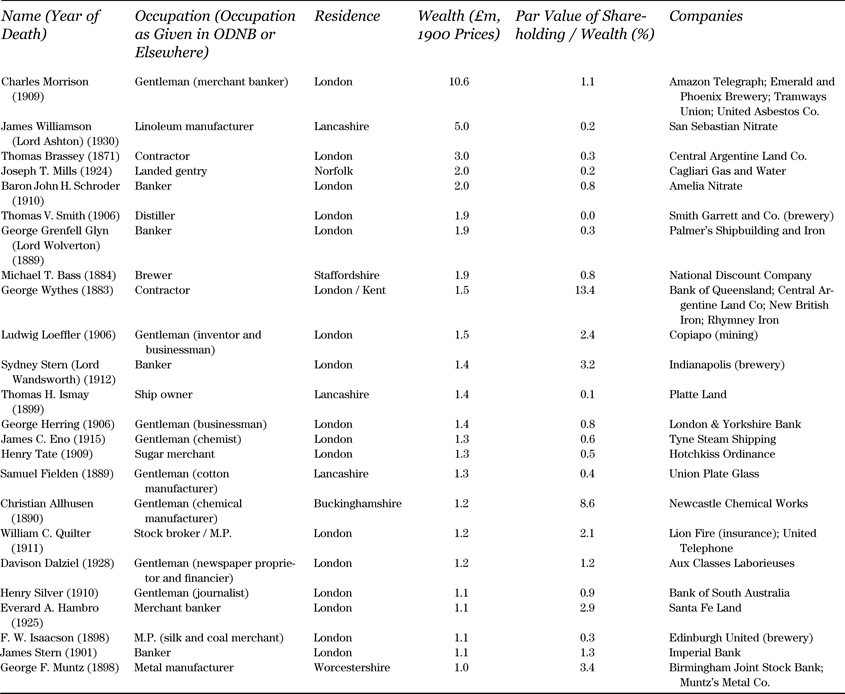
Table 6 contains details of the large shareholders in our sample who were millionaires in terms of 1900 prices. Five things are worth highlighting. First, apart from Christian Allhusen and George Muntz, these millionaires were not large shareholders in companies they had founded nor were they members of the founding family, suggesting that the wealthiest large shareholders were merely investors. Notably, only nine of the twenty-three millionaires were directors in the companies they had invested in. Second, in terms of socio-occupational background, twelve millionaires came from industry and manufacturing, nine from finance, one from the landed gentry, and one was a journalist. This supports Nicholas's analysis, which suggests that even among the superwealthy there was a heterogeneous pattern of wealth holding, while there is little evidence to support Rubinstein's hypothesis that wealth was concentrated in the hands of individuals active in finance and commercial pursuits.Footnote 62 Third, sixteen of these twenty-three millionaires were based in London, which lends some support to Rubinstein's hypothesis that wealth in this era was concentrated in London rather than the provinces.Footnote 63 Fourth, these millionaires did not commit a large proportion of their wealth to these companies, with Christian Allhusen and George Muntz having the highest percentage of their wealth tied up in their firms—but even these are relatively low percentages. Fifth, eleven of these twenty-three millionaires were large shareholders in overseas rather than British companies.
Large Owners Who Were Millionaires (1900 Prices)
Sources: See Table 5.
Note: In the case where someone is a large owner in two or more companies, the value reported in the fifth column is the sum of the par value of shareholding/wealth ratios. ODNB is the Oxford Dictionary of National Biography. Isaacson's occupation outside of Parliament was obtained from Alex Windscheffel, Popular Conservatism in Imperial London, 1868–1906 (London, 2007), 112.
Conclusion
Our findings suggest that the majority of large shareholders in Victorian Britain did not own large portions of the voting rights in the businesses they invested in. Furthermore, the majority of large investors were not directors and neither were their family members. We also observe substantial churn among major shareholders. Taken together, these findings imply that the majority of public companies in the second half of the nineteenth century cannot be characterized as being family companies and that large shareholders are better viewed as wealthy capitalists rather than entrepreneurs. There are some exceptions to these findings: significant investors in breweries, iron and steel companies, spinning and weaving concerns, and manufacturing firms usually had substantial voting rights and were much more likely than those in other industries to be directors. There was also less churn of large shareholders in these sectors. In addition, it was much more likely that companies in these sectors were family firms. We also see that companies established during and after the 1890s were more likely to be family businesses than those set up earlier, with large shareholders playing an important governance role.
In terms of the identity of the capitalists who funded companies in the second half of the nineteenth century, we find that the majority of them can be categorized as gentlemen, merchants, or manufacturers. Thus, the main backers of Victorian public companies were primarily wealthy rentiers or businessmen. About one-third of large shareholders came from London, but a considerable proportion came from the industrial heartland of Lancashire as well as Yorkshire. Large shareholders in overseas firms were more likely to be gentleman capitalists from London, while manufacturers and Lancashire-based individuals were typically large investors in domestic companies.
Many of the large shareholders in our sample were among some of the wealthiest individuals in the nineteenth and early twentieth centuries. Thus, the superwealthy from across the nation played an important part in financing British public concerns during this important phase in the development of the public corporation and capital market, and they did so without necessarily having much control over the companies in which they invested. Furthermore, we find no evidence of a financial dichotomy, in that those who had become very wealthy because of the industrial revolution and those who had become very wealthy through commercial and financial business both contributed to this expansion of British business and the British capital market in the Victorian era.
The main finding of this article revises the prevalent perception that British public companies in the Victorian era had large owners and were dominated by families. Up until recently, the standard view has been that ownership separated from control in the United Kingdom at some stage in the second half of the twentieth century. However, the reality appears to be more nuanced: it seems that in the history of the U.K. corporations over the past two centuries, ownership was initially separated from control; then, around the turn of the twentieth century, ownership began to become more concentrated; and then, at some stage after 1950, ownership began to separate from control once again. These changes in the nature of corporate ownership in the United Kingdom and their long-term impact on the capital market are phenomena that business historians should investigate in future research.