In 1924, Otto Kahn, chairman of the Metropolitan Opera, called for a new kind of American opera with “jazzed music portraying the life and loves of an American flapper.”Footnote 1 Kahn's sentiment was hardly isolated. American self-confidence was on the ascent, and with it, the idea that American music needed to break free from European models and draw instead from the United States’ contributions to the modern world: jazz and the flapper, but also skyscrapers, airplanes, automobiles, and the like. Meanwhile, in 1924, Germany was beginning to stabilize after the upheavals that followed World War I. With stability came modernization and with modernization, a fascination with the United States as the embodiment of all things modern, a phenomenon known as Amerikanismus.Footnote 2 German composers found inspiration in American lifestyles, technology, and jazz, which they poured into a new genre of opera: Zeitoper, or topical opera.
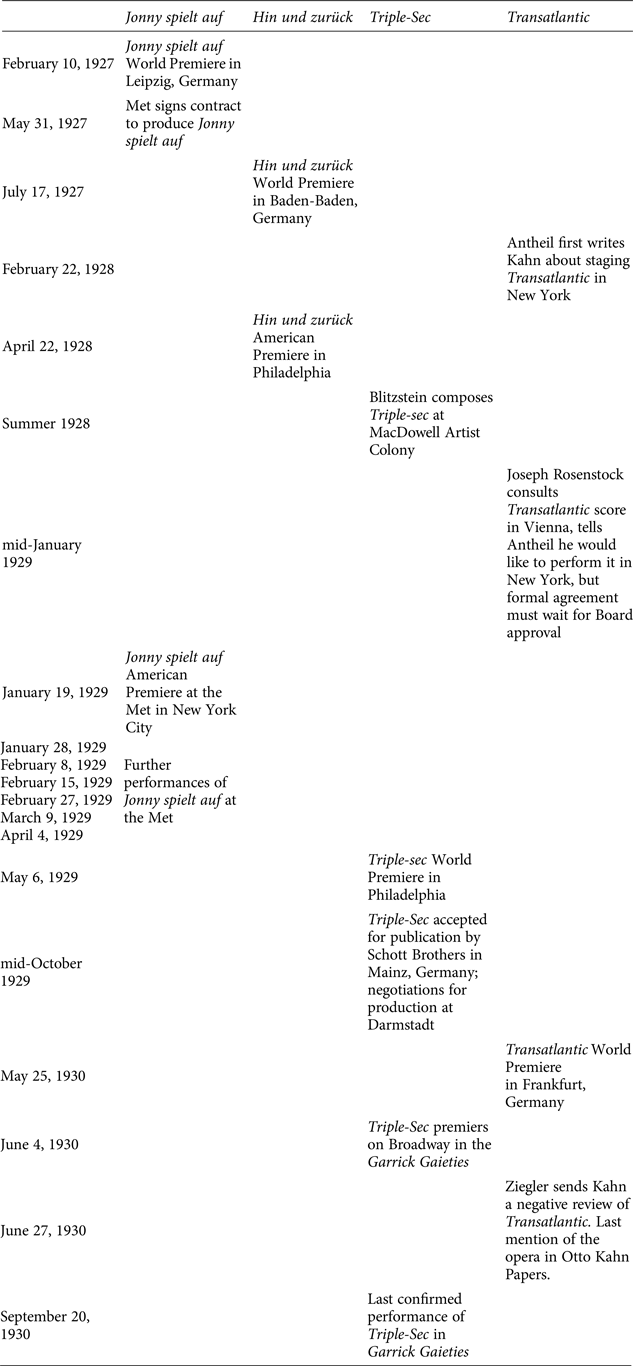
In this essay, I argue that German Zeitoper paradoxically became an essential component of the search for a new, uniquely American style of opera. Whether through German Amerikanismus or Americans’ self-image, composers sought to reflect a specifically American modernity in their operas. Both images of the United States were, of course, based as much on imagination as on reality. Their similarities made it possible for German Zeitoper to influence American opera, but their differences posed challenges to American producers, critics, and audiences, as well as those American composers it inspired. I analyze this dynamic by juxtaposing two German Zeitopern performed in America with two American Zeitopern. Paul Hindemith's Hin und zurück was the first Zeitoper performed in the United States, produced by the Philadelphia Society for New Music on April 22, 1928. Marc Blitzstein attended this performance, and he modeled his opera Triple-Sec after Hindemith's opera. He composed the work in summer 1928, and it was premiered on May 6, 1929, also by the Philadelphia Society for New Music. By this time, Ernst Krenek's Jonny spielt auf had completed its run of seven performances at the Metropolitan Opera. Jonny spielt auf also inspired George Antheil's Transatlantic, which Antheil revised under Krenek's mentorship and then promoted as the answer to Kahn's call for a new kind of American opera. (A timeline is included as Appendix 1.)
Hindemith and Blitzstein's operas in Philadelphia
Hindemith composed Hin und zurück to a libretto by Marcellus Schiffer in 1927 for the Baden-Baden Festival of Contemporary Music. Jazz—the musical marker of Amerikanismus par excellence—plays a subtle role in the opera. In the early 1920s, Hindemith composed several works that made prominent use of jazz, but by mid-decade he began subsuming jazz into his non-tonal contrapuntal musical style. In Hin und zurück, the residual influence of jazz is most audible in the frequent syncopations in the counterpoint.Footnote 3 Rather than jazz, the opera's most obvious engagement with Amerikanismus is the cinematic effect of reverse motion.Footnote 4 In its first half, a man returns home from work, discovers his wife's infidelity, shoots her, and then throws himself out the window in a fit of remorse. The narrative is interrupted by a Philosopher, who ironically comments on his function as a deus ex machina before he sets the action replaying in reverse: the man returns through the window, his wife returns to life, he unlearns of her infidelity, and he leaves for work. Text and music are also reversed, not word-for-word and note-for-note but on the level of sentences and phrases. Sentences retain their individual meaning but no longer make sense together. Thus, “Good morning, dear aunt. How are you? Let me keep you company,” becomes “Let me keep you company. How are you? Good morning, dear aunt.”Footnote 5 Hindemith's music for the opera follows a similar pattern. The musical phrases accompanying lines of text are left mostly intact, but the order in which they are presented is reversed.Footnote 6
Although the brevity and tongue-in-cheek humor of the opera is generally acknowledged to draw on the short slapstick Hollywood films of Charlie Chaplin, Buster Keaton, and others who were popular in Germany at the time, the use of reverse motion is more often linked to French Dada and Surrealist filmmakers.Footnote 7 Reverse motion, however, was also a frequent feature of those Hollywood shorts, as in Behind the Screen (1916), where reverse motion is used to create a scene in which Charlie Chaplin seems to come perilously close to having his toes chopped off by an axe.
Hindemith's use of jazz and cinematic reverse motion were both elements of Amerikanismus in the opera, but reviews of the Philadelphia performance show how this American influence could be lost in translation as it traveled back and forth across the Atlantic. Linton Martin, critic for the Philadelphia Inquirer, recognized the influence of jazz and popular musical theater, which he denigrated with labels like “trivial tunes,” but his colleague, Samuel Lacier, at the Philadelphia Public Ledger did not.Footnote 8 Instead, Lacier focused on similarities between Hindemith's opera and its partner on the program, Stravinsky's L'histoire du soldat, presenting Hindemith's work not as American-inspired but as part of a thoroughly European avant-garde.Footnote 9 Lacier was very interested in the reversal effect, but neither he nor Martin linked it to film. Unlike the local Philadelphia critics, Marc Blitzstein drew out the work's Amerikanismus in his review for Modern Music, demonstrating his familiarity with Zeitoper and the aesthetic agenda surrounding it. Notably, he praised the score as “compact, rich and witty, beautifully proportioned to the trivial nonsense of the libretto” and linked the use of reverse motion to “the movies,” especially the films of Jean Cocteau.Footnote 10
Modeling his opera on Hindemith's, Blitzstein composed Triple-Sec in the summer of 1928 while a resident at the MacDowell Artist Colony.Footnote 11 Blitzstein imitated Hindemith's contrapuntal style but retained a more recognizable jazz influence in both melodic line and harmony. He also based the work on a film effect: doubling.Footnote 12 The work opens with a narrator who instructs the audience to imagine themselves at a cabaret theater, eating and drinking while they watch. The action then begins with aspiring bigamist Lord Silverside at home with his fiancée Lady Betty. His wife arrives unexpectedly, and Lord Silverside and his butler struggle to keep the two women separated. As the plot progresses, the audience's increasing intoxication is represented in a literal portrayal of blurred vision with increasing numbers of actors on stage for each character. Finally, the women confront each other. As the tension reaches climax, the audience becomes so drunk that they “hallucinate” a green dragon jumping out of the stage, and the stage goes black as the audience “passes out.”
Local reception of the premiere paralleled that of Hindemith's opera a year earlier. As with Hin und zurück’s reverse motion, critics discussed the doubling effect without noting its connection to film. Although Blitzstein had been the only critic to notice that Hindemith included a reversing effect in the music of Hin und zurück, critics of Triple-Sec chided him for not including a doubling effect in his opera's music.Footnote 13 As Linton Martin noted, “the parts are not increased musically to match the characters on the stage, which would seem to be the obvious thing to do.”Footnote 14 Blitzstein's more recognizable use of jazz, however, attracted every critic's attention, whether negative, like H. T. Craven's characterization of the work's “xylophonic jazz,” or positive, like Linton Martin's description of the work as a “jazzy jamboree” and the Musical Leader critic's observation of a “streak of commonplace American jazz treated with a highly sophisticated modern technic [sic].”Footnote 15
Blitzstein's Americanized Amerikanismus was more legible to American critics than Hindemith's, but it remains an open question whether it would have read as Amerikanismus to German critics and audiences. The Schott publishing house—which, incidentally, also published Hindemith—thought so. Blitzstein met with them while he was traveling in Germany in the summer of 1929, and they agreed to publish and promote the work. In letters to Blitzstein, Schott described their efforts to promote the opera as a Zeitoper and identified Darmstadt as an ideal location for its German premiere. Blitzstein even met with representatives from the Darmstadt opera, but for unknown reasons, a production never materialized.Footnote 16
Blitzstein and Krenek's operas on and “off” Broadway
While Blitzstein was in Germany, Triple-Sec was added to the program of the Garrick Gaieties variety show on Broadway.Footnote 17 This production reconfigured the encounter of German Amerikanismus and American self-image. Zeitoper was, in part, an attempt to infuse opera with elements of American musical theater, like the revue, with its high-kicking chorus lines, whose popularity in Germany was so memorably analyzed by Siegfried Kracauer.Footnote 18 Meanwhile in the United States, Broadway, rather than the opera house, was the primary stage for experiments in creating “jazz opera.”
Blitzstein's Americanized Amerikanismus was lost in translation on Broadway. Triple-Sec did not feature memorable melodies, sentimental elements, or snappy spoken dialogue, and its jazz influences were blended with dissonant counterpoint. The work was moderately successful, running at least three and a half months before being replaced on the variety program, but its success was as a parody of opera, not as a new kind of jazz opera. Sympathetic New York critics described the work as a “burlesque” or “satire,”Footnote 19 and based on reports he received from friends in New York, Blitzstein concluded, “As I read between the lines half the applause comes from an audience who don't know what it's all about, but accept it as a spoof on grand-opera; and half is from the snobs … who are delighted to go slumming a bit.”Footnote 20
Meanwhile, another Zeitoper, Ernst Krenek's Jonny spielt auf, was produced at the Metropolitan Opera. Whereas Triple-Sec was too much a modernist opera for Broadway, critics largely dismissed Jonny as too much an imitation of Broadway for the opera house, and a poor imitation at that. Some of this can be attributed to Krenek's use of jazz, which, as will be discussed below, was more influenced by ragtime and early twentieth-century Tin Pan Alley than the latest American jazz. Film was also an important factor. One of the opera's great novelties in Europe was the use of a film sequence to portray a car chase, but in New York, critics complained that this was already being done in Broadway theaters, and better.Footnote 21 Additionally, Jonny and other Zeitopern were sometimes called “film opera” in Germany, because they were constructed as a series of short scenes and driven by action and dialogue, as opposed to long, continuously developing acts with arias about characters’ inner thoughts and emotions.Footnote 22 This idea was not picked up by American critics.
Based on its overwhelmingly negative reviews, the Met's production has become a notorious flop.Footnote 23 A closer look at the reception of Jonny spielt auf, however, reveals that it was moderately successful with audiences. Here, Jonny’s relationship to another genre of American musical theater, blackface minstrelsy, played a central role. Krenek drew on the genre while composing the opera, and the Met infamously portrayed the opera's title character as a blackface minstrel performer. Krenek and the Met's different uses of minstrelsy reveal how German Amerikanismus and American self-image differed over the position of African Americans in modern American society.
The history of Jonny at the Met goes back to the opera's first production in Leipzig in 1927, which was attended by Otto Kahn, the chairman of the Met's board of directors, who we encountered at the opening of this article. His interest was piqued by the opera's success, and in a letter to the Met's assistant general manager Edward Ziegler, he described it as “an interesting departure,” likely as a model for the new kind of American opera he envisioned.Footnote 24 Ziegler, however, raised concerns about “whether or not the American public, or rather the Metropolitan Opera House public would be quite reconciled to the love scenes between the Negro and two white women.”Footnote 25 Kahn, Ziegler, and the Met's general director Giulio Gatti-Casazza corresponded about the issue, and Kahn, who was still in Germany, raised it with Gustav Brecher, the music director at the Leipzig Opera, who served as an intermediary to Krenek. With Krenek's blessing, the libretto was altered to support a staging that would either eliminate interracial romance or make it sufficiently ambiguous for the Met audience.Footnote 26
The main change was in the character of Jonny. In the original, Jonny is an African American jazz musician who cohabitates with a white hotel maid and attempts to seduce a white opera singer. At the Met, Jonny was portrayed as a white minstrel performer in blackface. The difference was subtle, yet critical. Every European production of Jonny spielt auf had a white singer in dark makeup portray Jonny, but audiences understood that the character was black, as viewers understand that the title character Verdi's Otello is North African, even if they can see that the singer is white and wearing dark makeup.Footnote 27 At the Met, audiences were supposed to understand the character of Jonny as a white minstrel performer in blackface, inhabiting the “liminal” space of blackface minstrelsy, “neither fully white nor fully black.”Footnote 28
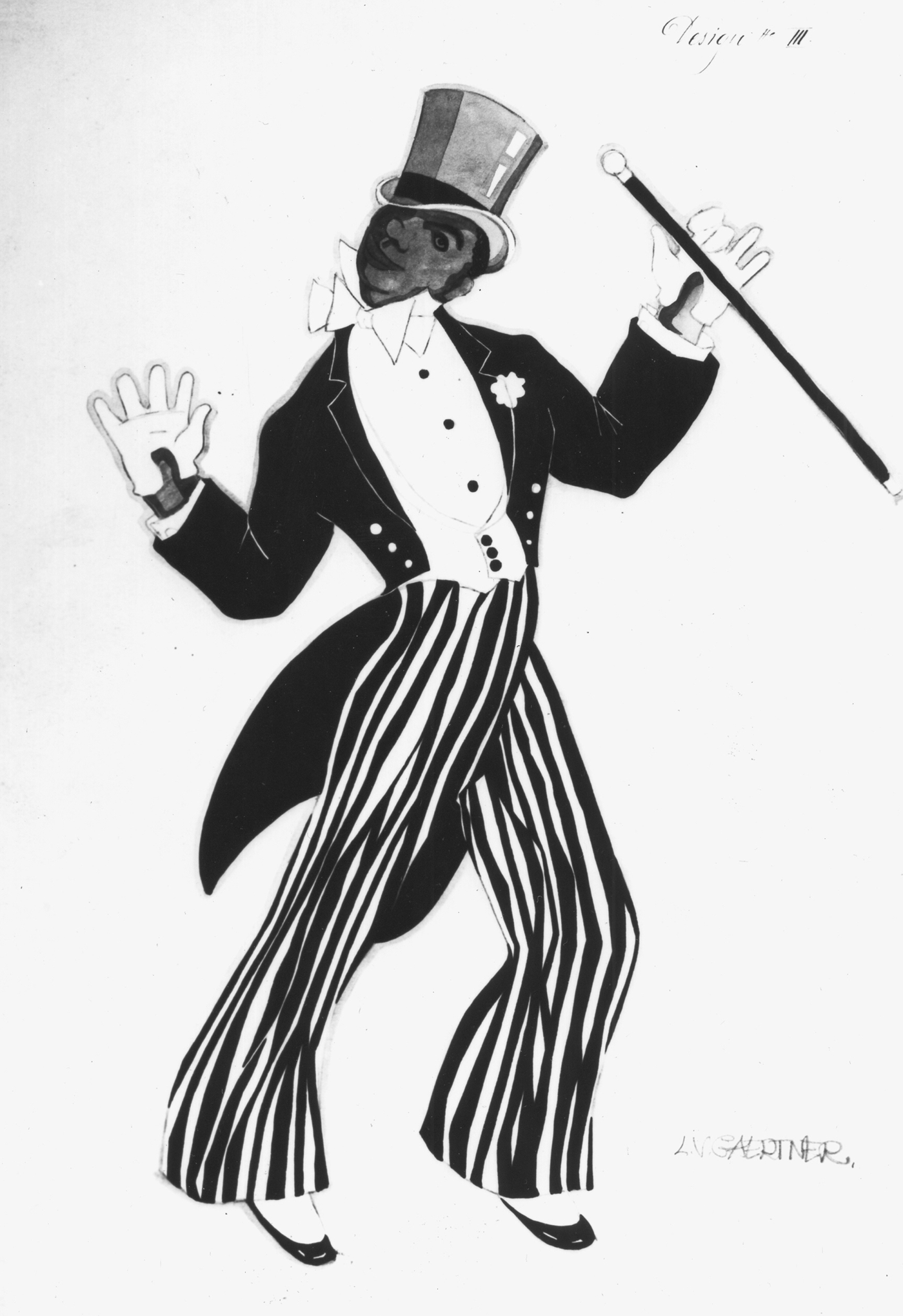
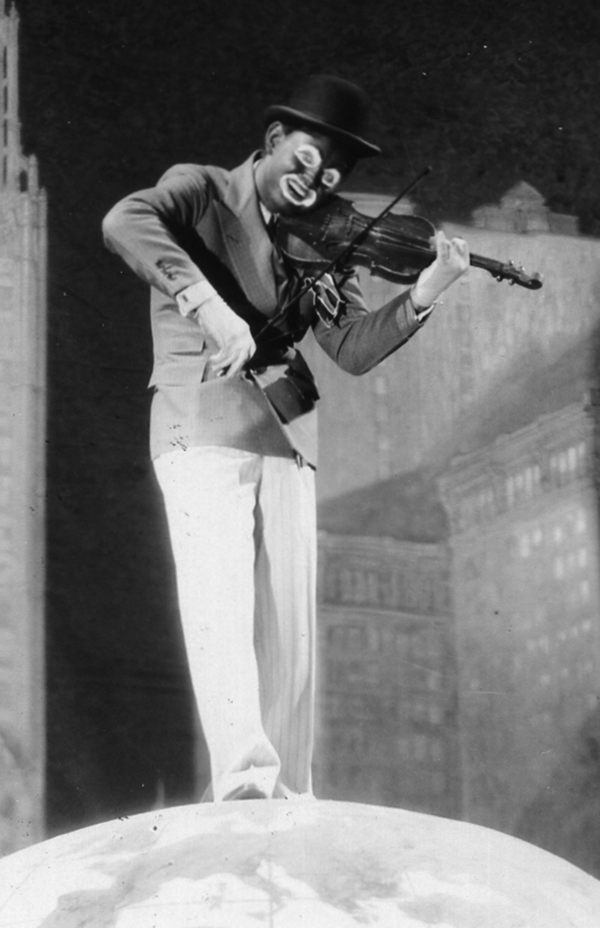
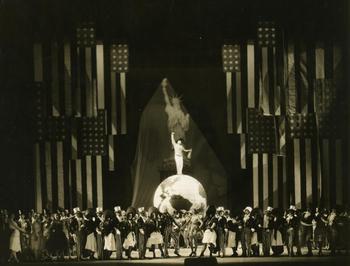
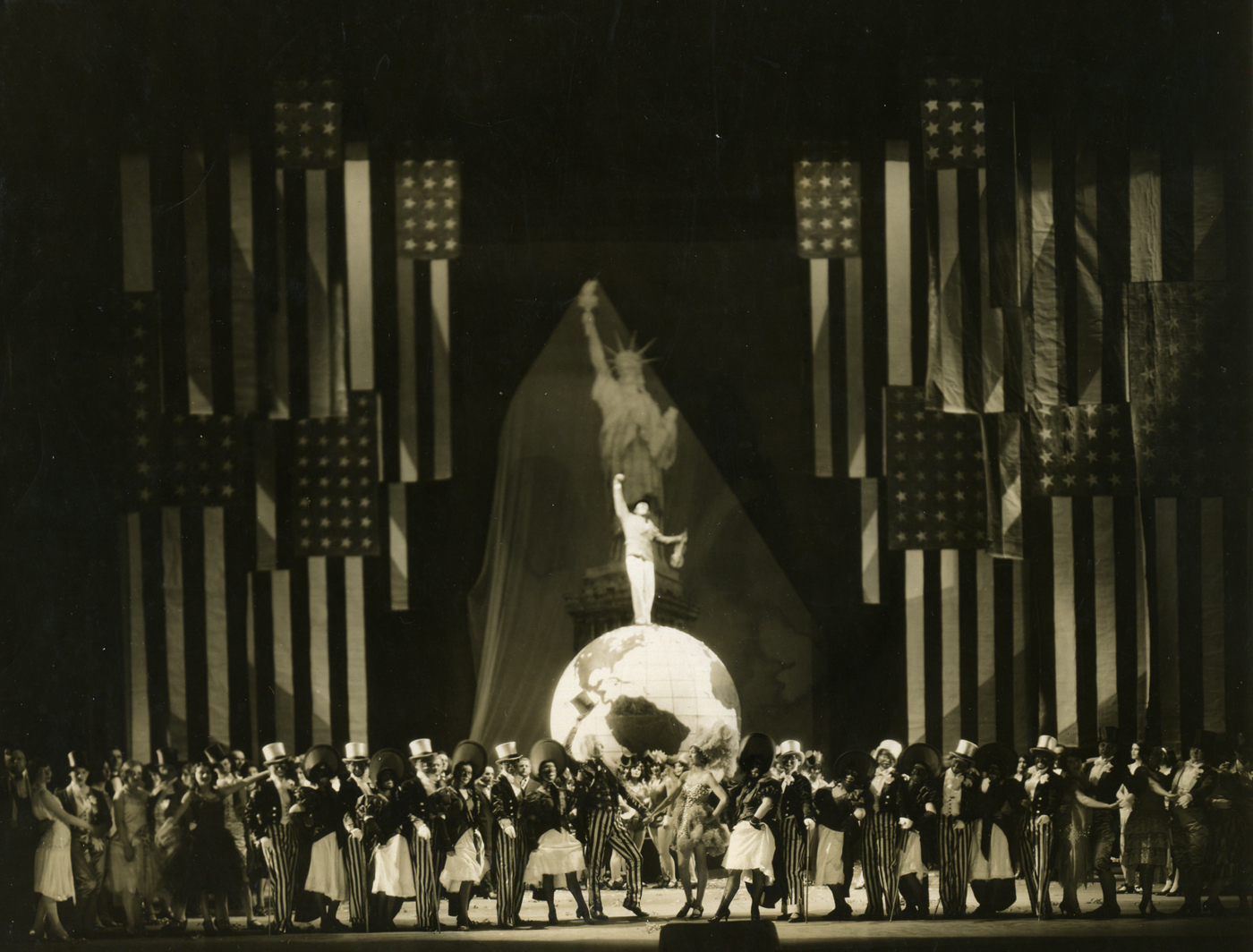
Costume design sketches and publicity photos from the Met archives make clear that this image of Jonny conformed to established tropes of the minstrel show: Jonny's face paint left white rings around his eyes and mouth, and he was costumed in a dandyish suit with striped pants. (See Figures 1 and 2.) Minstrel elements were incorporated into the performance, and Al Jolson was brought in to teach minstrel physical comedy to the singers.Footnote 29 The Met's treatment of the final scene makes clear how their efforts to translate the Amerikanismus in Krenek's portrayal of Jonny intersected with a broader attempt to connect the opera to Americans’ general sense of cultural ascendency. In the original, Jonny stands on a massive globe while all the world dances to his jazz underneath; the Met added a troupe of minstrels dancing in front of the Statue of Liberty and a bevy of American flags. (See Figure 3.)
Costume Design for Jonny Spielt Auf by Lillian Gärtner Palmedo. Metropolitan Opera Archives.

Promotional photo of Lawrence Tibbett as Jonny. Photograph by Carlo Edwards. Metropolitan Opera Archives.

Final scene of Jonny spielt auf from the January 19, 1929 premiere. Photograph by Carlo Edwards. Metropolitan Opera Archives.
Jonathan Wipplinger has argued that “although certainly not a true reflection of Krenek's piece, the Met's minstrelization of Jonny spielt auf is by the same token no bowdlerization: instead, it should be seen as concentrating the minstrel elements already present within the opera.”Footnote 30 Germany's isolation during and after World War I meant that in the 1920s, Germans’ image of African Americans and their understanding of jazz were based on late nineteenth-century touring minstrel shows, Tin Pan Alley rags, and so-called “coon songs.” Tellingly, scholarship on this aspect of German jazz history frequently makes prominent use of Jonny as an example.Footnote 31 By making the minstrel potential in the work explicit, the production team at the Met sought to bring the opera in line with an image of America they believed their audiences wanted to see on stage; that is, one without racial miscegenation. Reviews of the production indicate that they were successful. Numerous critics noted the audiences’ enthusiasm for the work, almost always in connection to descriptions of ways the production brought out minstrel elements. Olin Downes praised Michael Bohnen, the first singer to portray Jonny at the Met, for his unforgettable effect on the audience:
Mr. Bohnen is a comedian … of an uncommonly high order. Apparently he modeled his impersonation after the style of Al Jolson. … No one will forget his strut, impudence and swagger; the black “mug” and the shining saxophone…Footnote 32
The minstrel aspects of Lawrence Tibbett's performance after he took over as Jonny were also described as arousing the particular appreciation of the audience:
He costumed the part in a high-water black coat and checker-board trousers of as loud a hue as possible. In coloring Mr. Tibbett was jet-black with large white circles around the lips and eyes. He emphasized as much as possible the comic element of the role, with steps and gestures popular in American cabarets and vaudeville houses. The audience often laughed at and with him.Footnote 33
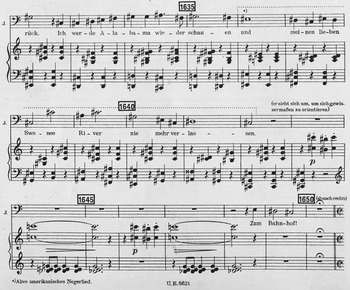
Nevertheless, the overall tone of the reviews was negative. I contend that an important reason for this was a cognitive dissonance created by the production's minstrel elements. Although minstrelsy was still part of American culture in the late 1920s, the Met deliberately exaggerated it to avoid showing interracial romance, and when combined with Krenek's outdated musical influences, like ragtime and early Tin Pan Alley, the effect was more nostalgic than modern. This nostalgia would have been most inescapable in the opera's eighth scene, in which Jonny sings of wishing to return home to America. At this moment, Krenek cites the Stephen Foster tune “Old Folks at Home,” with a note in the score that the melody is “an old American Negro song.” (See Example 1.) This scene is often cited as an example of Krenek's limited understanding of American culture, but audiences at the Met would have connected the song to the nineteenth-century minstrel tradition. Alongside and contradicting this nostalgia, other elements of the production underscored the work's modernity, like the car chase film sequence or guests at a restaurant listening to a radio. Multiple drafts of Joseph Urban's set design indicate that producers rejected initial drafts of interiors in an art nouveau style in favor of up-to-date art deco designs.Footnote 34 Thus, in trying to translate Krenek's Amerikanismus to present-day America, the Met's production team was caught between a nostalgic image of the American past and a modernist image of the American present. This contradiction proved fatal to the reception of a production billed as a new kind of opera that celebrated jazz and modern life.
Ernst Krenek, Jonny spielt auf, piano reduction (Vienna: Universal Edition, 1926), 160. Sung text reads: “… I will see Alabama again and never leave my dear Swanee River.”

The Met's production of Jonny ran for seven performances, making it the most performed novelty that season. Records in the Met archives indicate that it topped every production that season except Aida for ticket sales, and reviews from later performances consistently report mixed to positive audience reactions.Footnote 35 The Met's rationale not to renew the production is unknown. It was too expensive to take on tour, and the fad for Zeitoper was fading in Germany (as will be discussed below). In the face of largely negative critical reception, it is possible the Met felt a revival was too great a financial risk.
If the image of America in the Met's Jonny failed to meet white critics’ image of their country, it inspired observers in the African American press to imagine a nation in which African American singers could take the stage of the Metropolitan Opera and theaters could portray interracial romance. Reports in the Baltimore Afro-American and the Pittsburgh Courier criticized the apparently “sacred rule of the Metropolitan Opera House” which excluded blacks from major singing roles.Footnote 36 A review in the Baltimore Afro-American drew attention to two black vocalists who might have sung the role of Jonny: Paul Robeson and Jules Bledsoe.Footnote 37 The production attracted the interest of African American leaders, including James Weldon Johnson, who was quoted in the same review:
It seems to me that the Metropolitan Opera Company and its public should be willing, at least for art, to face the facts of life or leave them alone. … The opera management not only makes itself ridiculous, but perverts a work of art in deference to snobbery.Footnote 38
Only one African American paper, the New York Amsterdam News, argued the production was a step in the right direction, albeit with reservations:
All accounts of the performance testified that the audience enjoyed the opera, whether or not they admired it. If Americans can enjoy the sight of a white woman sitting in a Negro's lap with her arms around him, even if it is a white man blackened up as a Negro, times have changed.Footnote 39
All of the reviews in the African American press saw Jonny as evidence of greater tolerance in Europe, suggesting the situation in America could be changed. The reviewer of the New York Amsterdam News claimed black singers could play leading operatic roles in Europe, and the reviewer of the Baltimore Afro-American claimed that interracial romance was accepted in Europe.Footnote 40 Just as Krenek's image of America was more romantic than real, so too were these African American critics’ image of Europe. They seem unaware of the racist tirades against the opera in conservative-nationalist German papers or of the Nazi crowd that had gathered to lynch the lead singer in the Munich production of Jonny spielt auf, believing him to be black. The crowd only discovered their mistake at the stage door, and, fortunately, the singer's life was spared.Footnote 41
The Met's final performance of Jonny took place on April 4, a month before the premiere of Blitzstein's Triple-Sec in Philadelphia. Local critics were thus more familiar with Zeitoper than they had been when reviewing Hin und zurück the year before. H. T. Craven, for example, claimed that Triple-Sec’s “origins may be traced to Stravinsky and the Metropolitan's freak opera, Jonny spielt auf.”Footnote 42 The production team in Philadelphia was also familiar with the Met's production, and their staging both criticized the Met's accommodation of racism and presented a relatively more progressive racial politics. The decision-making process cannot be reconstructed, and the only reference to this change comes from Craven's review:
Librettist Ronald Jeans has made Lord Silversides a Negro. He has a love scene, all in fun, mind you, with a white lassie. This is going the Metropolitan one better, since ‘Jonny,’ of ‘Spielt’ fame, is, in the American production, only a Caucasian blacked up like a minstrel.Footnote 43
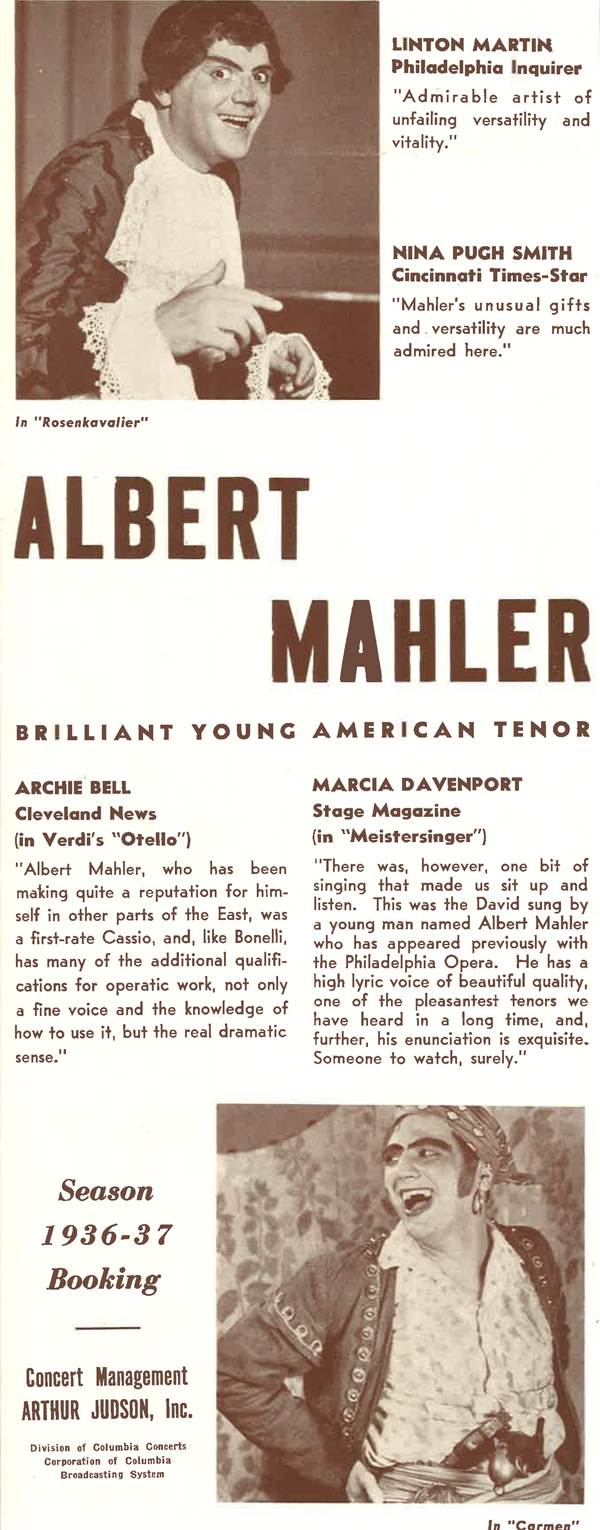
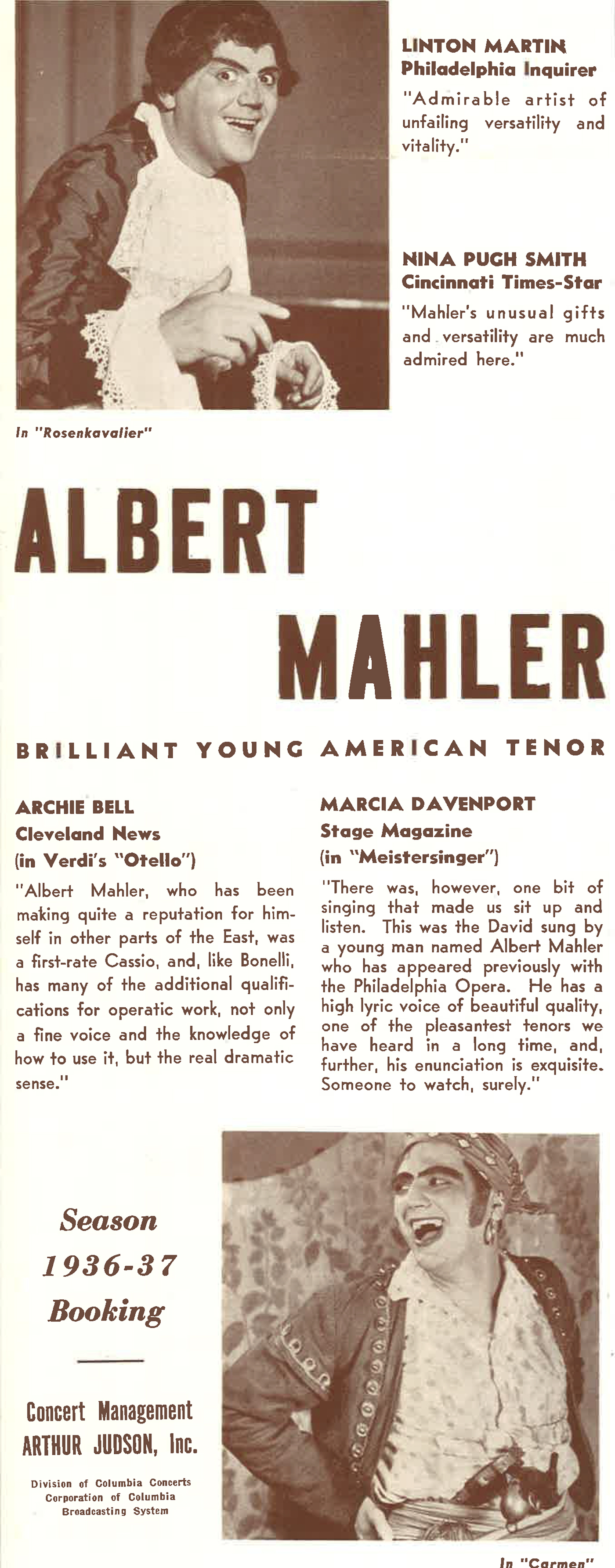
The race of the character is not specified in the libretto, and the tenor who sang the role, Albert Mahler, was white and therefore must have appeared in dark makeup.Footnote 44 (See Figure 4.) Where the Met sought a way out of portraying interracial romance, Blitzstein and the Philadelphia Society for New Music suggested an image of America in which such a relationship was not taboo, albeit without going so far as to cast an African American singer.
Promotional Material for Albert Mahler, ca. 1936. Collection of the Author.
Antheil's Transatlantic in Germany and New York
Meanwhile in 1929, on the other side of the Atlantic, George Antheil was preparing his Zeitoper, Transatlantic, for its premiere in Frankfurt, Germany. Antheil wrote the work for performance in Germany and revised it under the mentorship of Ernst Krenek, who also arranged for his publisher, Universal Edition, to print and promote the work. The opera follows the conventions of German Amerikanismus and Zeitoper. Set in New York City, the plot revolves around the corrupt machinations of an American presidential election. Antheil makes prominent use of jazz, American patriotic songs, and even some machine noises. As in Jonny, a film sequence is shown during the final act, and Antheil took Krenek's filmic dramaturgy to the extreme: scene changes modeled on film cuts were so rapid that realizing them required multiple stages. As action moved from setting to setting, different stages were lit or darkened accordingly.Footnote 45
In Germany, Antheil's American background, despite his years in Europe, disrupted the work's Amerikanismus, as some German critics claimed the work was more authentically American than other Zeitopern while others, like Alfred Einstein, claimed that “we Europeans on our old continent can be proud that we know better what is typically American … than the American George Antheil.”Footnote 46 In reality, both composer and opera fit uncomfortably under any single national label. Although Transatlantic is generally understood today as a German Zeitoper, previous scholarship has not fully explored the extent to which Antheil promoted the opera in the United States as an American work. As Susan Cook has discussed, Antheil described Transatlantic to his American patron Marie Louise Curtis Bok as a new kind of American jazz opera.Footnote 47 He also promoted the work to Otto Kahn as the realization of his call for a new kind of American jazz opera. As in the work's composition, Jonny spielt auf played a decisive role in its American fate.
Antheil began what would become nearly two years of correspondence about the opera in a letter to Kahn on February 22, 1928:
In the press you have often expressed a wish for an American opera dealing with the present day, and in the idiom of our country. This opera is, I believe, the first attempt to completely realize your wish. … It is positively the first to put America in a grand simple melodic line, although it is not the first to utilize jazz, it is certainly the first use a typical American jazz in an American way.
He further promoted himself as “a native-born American, born near New York, and educated there” and as “the first young American composer to have earned a real respect in Europe.”Footnote 48 Antheil faced an uphill battle in New York, as Kahn and Ziegler both had negative memories of Antheil's 1927 Carnegie Hall concert. Nevertheless, Kahn indicated in a letter to his secretary, James Dartt, that it “would be interesting to become acquainted with [Antheil's] new opera inasmuch as … his style of music has changed and has now become reasonably sane.”Footnote 49 Things were looking promising for Transatlantic in January 1929 when Joseph Rosenstock, then musical director at the Met, visited Antheil's publishers, Universal Edition, in Vienna to acquaint himself with the work. Rosenstock was impressed and championed the opera to his colleagues in New York.Footnote 50
After this promising start, things took a turn for the worse. Rosenstock lasted a mere six appearances at the Met before he departed in disgrace. This left Kahn even more susceptible to the input of Ziegler, whose correspondence with Kahn demonstrates his dubiousness not just of Antheil and Krenek (recall Ziegler had objected to Jonny spielt auf) but of any attempt to integrate jazz into art music, including the work of George Gershwin.Footnote 51 Meanwhile, the Met's production of Jonny came and went. Even Kahn's time at the Met was not to last much longer; he left the board in 1931.
The rationale against Transatlantic was part economic: Although I have argued that Jonny was not the flop it is generally considered, it was nevertheless not successful enough to encourage the Met to take on another Zeitoper in such short succession. But the rationale also related to the image of America in the opera. Those like Ziegler opposed an image of modern America grounded in jazz, speakeasies, and political corruption, or that structured itself in ways that drew on the new media of the day. This same complaint was raised by Antheil's patron, Mary Louise Curtis Bok, who wrote that she was “sorry that American opera must be built on lines of such sordid subject matter.”Footnote 52 Kahn's call for modern jazz opera had always been controversial, but as the 1920s drew to a close, economic and cultural forces worked against an image of America grounded in the big city, modern technology, and flappers. At the same time, jazz also began to fade from discourse about how a distinctly American music should sound.Footnote 53
These factors that worked against Transatlantic were themselves transatlantic. The fad for Zeitoper, at least after the model of Jonny spielt auf, had passed in Germany by the end of 1930. The international economic downturn after the American stock market crash in October 1929 left Germany's state subsidized opera houses with fewer funds and audiences disillusioned in the optimistic Amerikanismus and image of modern life that Zeitopern portrayed.Footnote 54
Conclusion
What does it mean, then, for an opera to be American? Kahn's call for a “jazz-opera” with flappers and skyscrapers was one answer to this question. The German creators of Zeitoper sought to answer a similar question: What does it mean for an opera to be “of its times?” Their association of the United States with all things modern led them to create operas infused with Amerikanismus. As we have seen in these operas’ treatment of jazz, film, and race, and in their relationship to popular musical theater, the similarity of these responses facilitated a transatlantic cultural exchange in the final years of the 1920s and enabled German Zeitoper to play a role in the search a new kind of uniquely American opera. Differences between German and American imaginaries, as well as Americans’ own competing images of the United States, complicated this exchange and perhaps prevented it from exerting a more widespread influence. When German Amerikanismus clashed with Americans’ self-image, American critics and audiences responded with confusion or rejection. American producers of German Zeitoper and American composers influenced by it sought to bring their work more in-line with American self-image, but their interventions revealed just how diverse American self-image was. Although they struggled to reconcile all these competing visions, several achieved moderate popular success.
Timeline of Productions, Performances, and Negotiations