1. Framework
An analysis of pension accumulation and retirement planning involves, by its very nature, a broad spectrum of assumptions and projections over very long periods of time. Besides, both deterministic and stochastic factors will play a role. For this purpose, we have set up a comprehensive dynamic model and implemented it into a computer program. This model will provide the foundations for our analyses in this article. The main features of the model will be described both below and in the Appendix.
For purposes of clarity, we will analyse annuity certain pension schemes in this article. This means that we will take a look at pension schemes involving benefit payments for a set period of time. The products analysed are thus pure savings products not involving any biometric risk.
The pension saver is assumed to accumulate his pension funds through periodic contributions – typically monthly – over a given number of years. Pension contributions are adjusted annually by the rate of inflation. During the accumulation phase, the pension saver's account is credited with periodic interest. The rate of interest will depend on the type of savings product chosen, and naturally also on the (stochastic) returns on the underlying investment portfolio. The interplay between investment returns in the financial market and returns on the pension saver's account is what differentiates the three types of savings products analysed in this article. Hence, we can say that this article compares the interest rate mechanisms of three different types of pension schemes. The stochastic financial model is the same “throughout” the analysis. We describe the three types of contract below and will also later describe the assumptions underlying the model for the financial market.
By the end of the accumulation (savings) phase, the pension saver will have built up a certain amount of capital in his account. Based on this account balance (and necessary assumptions of type of payout etc.), a monthly pension benefit can be calculated. As already indicated in the first paragraph above, in this article we can and will continue the dynamic modelling during the payout phase. As the investment portfolio and, therefore, the pension savings account are continuously affected by market returns, the amount of pension benefits will be recalculated at regular intervals – for instance annually. The key objective of this article is to illustrate and compare the calculated pension benefits payable under the three analysed pension products. It is essential to emphasise that most of the analysis is based on Monte Carlo simulated scenarios of a specific financial model. The results will therefore be subject to a certain degree of uncertainty.
2. The three savings products
This section contains a brief outline of the three different types of pension savings products for which we provide results below.
2.1. Traditional with-profits pension savings
Up to the turn of the millennium, the traditional with-profits pension savings contract was the dominant type of pension scheme in Denmark, and because of the massive amounts saved under this scheme, it is naturally still financially significant and therefore also important to analyse. A pension saver with a traditional contract participates in an investment community jointly with the other savers under the scheme. The saver is typically offered a guarantee of benefits based on a certain annual average minimum rate of interest (e.g. 1.5%) on his personal pension account. Added to this, the saver is entitled to receive a share of the pension company's risk, expense and investment surplus (bonus), see Danish Financial Supervisory Authority (2006) and Danish Society of Actuaries (2008).
The policyholders’ investment portfolio is jointly “owned” by the pension savers, and it is therefore not possible to identify the specific investment assets belonging to the individual pension saver. The pension saver has a personal pension account, for which a “balance” is calculated and notified to the saver at least once a year, but there is no one-to-one correspondence between the investment returns actually achieved and the pension saver's annual interest on pension account savings. The individual company determines the annual rate of interest on policyholders’ savings around mid-December by paying due regard to a wide array of factors, such as actual investment returns, the size of the company's free buffers/bonus reserve, the level of guarantees provided, outlook and competition. The underlying principle is often referred to as the average interest rate principle. In the past few years, the problem has served as a basis for comprehensive theoretical studies and model development, see e.g. Grosen & Jørgensen (Reference Grosen and Jørgensen2000), Danish Financial Supervisory Authority (1998), and references in Jørgensen (Reference Jørgensen2004). For the calculations in this article, a new model has been developed which also takes into account the practice of carrying out bonus smoothing between the considered portfolio of annuity certain pension schemes and the portfolio of traditional with-profits insurance products with bonus entitlement. Bonus smoothing is organised in such a way that it is “generation neutral”. This means that when expected returns on the portfolio are continuously credited to the bonus smoothing amounts added and subtracted, the accumulated value of the bonus smoothing amounts added will equal the accumulated value of the bonus smoothing amounts subtracted for the considered generation of annuity certain pension policies. The details of the model are described in a technical memorandum, which is available on request from the authors.
2.2. Unit Link
The simplest of the three analysed contracts is a “pure” Unit Link contract. In a Unit Link scheme, the amount of pension savings is in principle directly observable from time to time as the market value of the securities or funds in which the portfolio is invested. Changes in this market value (market returns) will have an immediate impact on the value of the account. The pension saver can in practice influence the risk of the investment portfolio through his choice of investment assets. Our financial model operates with two principal classes of assets. In the remainder of this article, we will refer to these classes as “shares” and “bonds”, respectively. Here the class of the riskiest investments in practice also comprises other assets treated as shares, see Danish Insurance Association (2008), such as alternative investments etc. The allocation of invested amounts between the two classes of assets is a model parameter. It is basically assumed that shares account for 35% of the assets in the Unit Link scheme (it corresponds to one of the products that are being offered in the market).
2.3. TimePension
The third pension scheme subjected to an analysis below is a formula based smoothed investment-linked annuity scheme referred to as TimePension.Footnote 1 TimePension was originally introduced by a Danish life and pension insurance company in September 2002 in a period when many new Unit Link-inspired products saw the light of day in a move to “revolt” against traditional products. The prime movers behind the development of TimePension found that the step from traditional pension savings to pure Unit Link-based savings was too large, emphasising that TimePension was a result of combining “the best of two worlds”. From the world of Unit Link, they adopted the principle of individuality and full transparency in the relationship between investment returns and interest on policyholders’ savings, whereas they were inspired by the smoothing of returns from the traditional with-profits environment when designing the interest rate mechanism of TimePension. Hence, TimePension operates with two accounts – the customer's account (the pension benefit account) and an individual smoothing account – and an accurately and mathematically well-defined mechanism specifies how the market value of the investment portfolio, for book-keeping purposes, is distributed at all times between the two accounts, of which the former belongs to the customer and the latter, the smoothing account, belongs to both the customer and the company in a specific and predefined ratio.
The fundamental idea behind the development of TimePension is as follows: premiums and returns are (re)invested in a portfolio with a relatively high percentage of shares, e.g. 50%. This implies that expected returns are relatively high, but also involves a higher degree of risk than do portfolios of traditional with-profits pension schemes, for instance, where shares typically account for 15 to 35%.Footnote 2 To dampen the influence of variations in market returns on the saver's pension benefit account, a smoothing account (a “buffer”) is therefore introduced between the pension account and the market value of the investment portfolio. This smoothing account is individual and works analogously to the collective bonus mechanism of a traditional pension savings scheme with the effect that it will offer relatively high rates of interest on savings when the smoothing account/buffer is adequate, whereas more moderate rates will be offered when the buffer is low and maybe even negative. But an important difference compared to traditional with-profits schemes is, in other words, that the smoothing mechanism is accurately and mathematically well-defined. The TimePension mechanism is described in detail and analysed in a wide range of articles, for instance in Nielsen & Jørgensen (Reference Nielsen and Jørgensen2002), Jakobsen (Reference Jakobsen2003), Guillén et al. (Reference Guillén, Jørgensen and Nielsen2006) and Jørgensen (Reference Jørgensen2007).
3. The underlying financial model
To be able to simulate dynamic movements in the underlying pension scheme investments, we need a model of the financial market. As we, as previously mentioned, would like the model to operate with two principal classes of assets – shares and bonds – we need both a model for returns on shares and a dynamic yield curve model. Here the options are nearly endless according to the financial literature. We have chosen a model setup that is reasonably positioned between the much too simple setup (e.g. a purely deterministic model) and the very advanced setup, which might consequently also be difficult to use in practice. As a model for returns on the share portfolio, we have chosen a model with constant (local) return volatility and with the option of mean reversion in expected returns over time. The bond market is modelled according to Vasicek's (Reference Vasicek1977) widespread one-factor model for the dynamics of short interest rates. A correlation between returns in the two sub-markets can be specified. This joint model has previously been suggested, estimated and employed with success in for instance Wachter (Reference Wachter2002) and Munk et al. (Reference Munk, Sørensen and Vinther2004), to which we refer for the finer details of the description. Our choice of the parameter values is partly inspired by the estimates in the above-mentioned articles, partly based on our own estimates. The parameters have also been set in compliance with what is called the common assumptions for pension projections, prepared by the Danish Bankers Association and the Danish Insurance Association, see e.g. Danish Insurance Association (2008). For precise values, reference is made to Appendix A.
4. Parameter specification for numerical work
In the remainder of this article, we would like to present and discuss selected results from the implementation of our model. Due to space constraints, and as the full-scale model has a large two-digit number of parameters, it will be necessary to narrow the focus to some extent and to establish the parameter values for the initial position of the analysis. First of all, we will in all circumstances take a look at schemes that involve savings built up over 35 years through monthly contributions. Pension contributions start at a level of DKK 100 annually and subsequently increase by 2.5% p.a. The amount of savings accumulated after 35 years is then spent down as a 20-year annuity certain scheme, which is paid out in monthly instalments and adjusted once a year. For calculating the size of pension benefits at the time of retirement and for the subsequent adjustments of benefits, we have used an assumed interest rate (AIR) of 3.5% p.a.
The various savings schemes also imply a number of parameter choices.
As far as the traditional pension savings contract (buffer model) is concerned, the following applies: the investment portfolio has a 25% allocation to shares. The remaining portfolio is invested continuously (here as well as in connection with the other schemes) in a generic bond with a duration of five years. Investment expenses are 0.60% p.a. This is slightly lower than in the two other schemes, see below. Moreover, we operate with a bonus strategy offering an annual rate of interest on policyholders’ savings of at least 1.5% as well as a payout rate of 20% p.a. of the surplus buffer as defined in comparison to a relative target buffer of 10% (of the pension savings account). Here, as in the other schemes, tax is calculated at the rate of 15% according to the Danish Taxation of Pension Investment Returns Act. This basic bonus model corresponds to the “Buffer Model” described in Danish Financial Supervisory Authority (1998). As mentioned above, we have expanded this model to include the practice of bonus smoothing.
As far as the Unit Link scheme is concerned, we choose a 35% allocation to shares in the investment portfolio. Investment expenses are set at 0.75% p.a. The specific parameters for the TimePension contract are as follows: shares account for 50% of the portfolio. The rate of interest on policyholders’ savings is determined on the basis of a 5-year zero-coupon rate.Footnote 3 To this is added a monthly smoothing amount, corresponding to 20% p.a. of the smoothing account balance. Investment expenses are 0.75% p.a. as in the case of Unit Link.
The financial model is presented and parameterised in the Appendix A. Appendix B contains a brief algorithmic description of the implementation of our dynamic model.
Now we direct our attention to the first numerical results.
5. Results
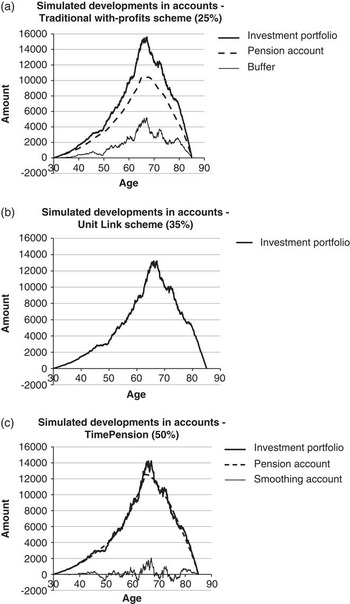
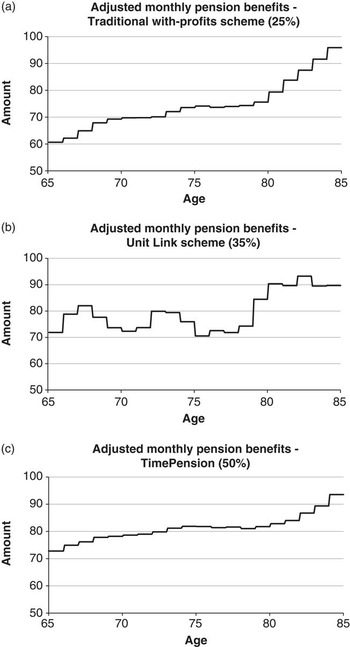
The first illustrations, presented in Figures 1a–1c and Figures 2a–2c, show simulations of one illustrative scenario for each of the three savings products. These merely serve to illustrate some fundamental properties of the three schemes, and – because they only represent a single scenario – great caution should be exercised if using them as a basis for drawing more general conclusions. Figures 1a–1c show movements in the respective central “accounts” of the schemes as a result of the simulated economic scenario, whereas Figures 2a–2c show the corresponding annually adjusted monthly pension benefits. It should be emphasised that the same fundamental economic scenario or “path” has been employed for calculations for all three schemes.
Simulated developments in central accounts for the three schemes

Annually adjusted monthly pension benefits from the three schemes

Figure 1a and Figure 2a relate to the traditional with-profits scheme. Figure 1a shows developments in the market value of the investment portfolio and in the size of the pension account and buffer throughout the 55-year life of the scheme, comprising an accumulation phase and a payout phase, respectively. The volatility of the investment portfolio market value is limited as a result of the relatively low 25% allocation to shares. Movements in the pension account are also very stable as a result of the mechanism of return smoothing and the rate of interest on policyholders’ savings determined by means of this tool. The buffer is positioned between the market value of investments and the balance of the pension account. Through this operation, the absolute size of the buffer builds up during the accumulation phase whereas the buffer in absolute terms is reduced during the payout phase to end in “zero”. Figure 2a shows the annually adjusted monthly pension benefits in the payout phase. These are – again as a result of the smoothing mechanism – relatively stable.
Figure 1b and Figure 2b relate to the Unit Link scheme. This scheme features only one “account” of relevance, i.e. the market value of the investment portfolio. We see that this market value, as expected, generally grows during the contribution period and then decreases towards zero during the payout phase. Figure 2b indicates considerable variation in the annually adjusted pension benefits as these are calculated periodically on the basis of the market value of the investment portfolio, which is relatively volatile, mainly because of a 35% allocation to shares.
Finally, Figure 1c and Figure 2c show movements in the central accounts and in pension benefits for a TimePension scheme, respectively. The account graph shows dynamic movements in the market value of the underlying investment portfolio, in the pension benefit account and in the smoothing account, respectively. We call attention to the fact that the two last mentioned accounts sum up to the portfolio market value. In line with the previous figures, we see that the value of the investment portfolio and the pension account generally grows during the contribution period and subsequently decreases gradually towards zero during the payout phase.
The TimePension scheme structure stabilises and evens out movements in the pension benefit account, and as pension benefits are calculated on the basis of this account, it will offer more stability in benefits compared with the Unit Link scheme. The smoothing account appears, not surprisingly, to be relatively volatile. It can take both positive and negative values during the life of the account. However, the smoothing account will tend to move towards zero at the end of the payout phase.
A cautious comparison of Figures 1a–1c first shows that movements in the investment portfolios underlying the three schemes all “shadow” each other because the same simulated market developments have been used for the three graphs. But the market value of investments is not the same. This is a result of the different allocations to shares under the schemes.Footnote 4
If we take a look at the pension payouts in Figures 2a–2c, pension benefits from the traditional with-profits scheme and from TimePension are much more stable than those provided under the Unit Link scheme. This comparison is in line with expectations as the Unit Link scheme is the only scheme that has no form of mechanism of return smoothing. Finally, the pension benefit graphs indicate that stability in benefits from the TimePension scheme is not achieved at the expense of returns. Benefits from the TimePension scheme are, combined, one level higher than benefits from the traditional with-profits scheme. The gain here comes from the higher allocation to shares under TimePension (and from the fact that the higher expected returns associated with this allocation are actually realised in the given scenario).Footnote 5 But pension benefits are not nearly so uncertain as under the Unit Link scheme, which even features a somewhat lower allocation to shares.
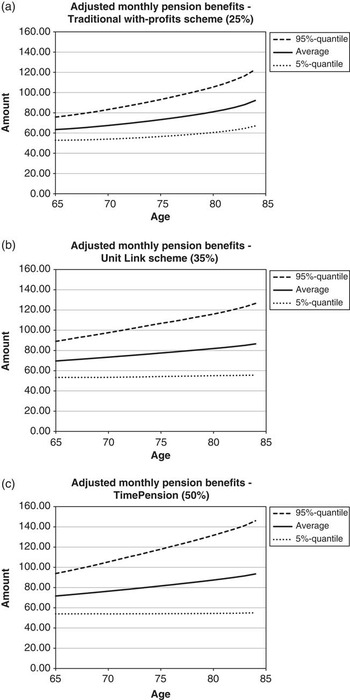
Following these initial indications of the fundamental properties of the three different pension savings products, we are going to present and discuss results that are based on a significantly greater number of simulated scenarios and, therefore, can be interpreted more reliably. As a first example of this, we present in Figures 3a–3c a series of graphs studying pension benefits from the three schemes more closely. For each pension product, we have simulated 50,000 full accumulation/decumulation scenarios, against the background of which we can calculate average (i.e. expected) adjusted (monthly) pension benefits for each year of the payout period. These average scenarios (solid lines) are shown in Figures 3a–3c together with 5% (dotted lines) and 95% quantiles (dashed lines).Footnote 6
Average (expected) annually adjusted monthly pension benefits from the three schemes and related key quantiles

A closer look at the graphs in Figures 3a–3c first reveals that all pension benefits are expected to be adjusted upwards during the payout phase, regardless of product. This is a simple consequence of the relatively conservative assumed interest rate compared with expected returns on investment portfolios.Footnote 7 This strategy implies the calculation of slightly “too low” pension benefits, which provides space for upward adjustments on average as the years pass. It should also be noted that average benefits are highest for TimePension, whereas the traditional scheme pays out lower benefits than does the Unit Link scheme, except for the final stages of the payout period. This ranking of the products is not surprising in the light of their different asset allocations. (Note that the traditional with-profits scheme, in the last years before its termination, may be affected by the way the product is modelled with a relative target buffer of 10% of the pension savings account. All else being equal, this could result in the transfer of bonus funds for subsequent years. This could give the relatively largest effect in the last years before the termination of the pension scheme because the pension savings account is reduced to zero in this period.)
A higher allocation to shares will, all else being equal, be accompanied by higher expected pension benefits, but also greater uncertainty. An impression of this uncertainty is provided by the quantile lines. Pension benefits from the traditional with-profits scheme are within the narrowest “confidence band”, whereas the corresponding confidence band is somewhat broader for the Unit Link scheme and, in particular, the TimePension scheme. It is interesting to note, though, that the smoothing mechanism of TimePension apparently has an essential loss-limiting effect as the 5% quantiles are practically identical for Unit Link and TimePension products in spite of the fact that TimePension has a 15%-point higher allocation to shares. By observing the upper end of the distribution, we notice that a corresponding “limitation” is not applicable in regard to the 95% quantile of TimePension. This is markedly higher than for both of the other products. In other words, TimePension provides more upside potential.
In relation to Figures 3a–3c, it can be added that while the relatively broad confidence band for TimePension benefits seems to harmonise perfectly with the high percentage of shares in the investment portfolio, the broad confidence band offhand appears to be inconsistent with Figure 2c, which conveyed the impression that benefits from the TimePension product were relatively stable. Even so, there is no inconsistency whatsoever, and a concept like “stability” should in this context be used with caution. TimePension is – as Figure 2c indicated – a product providing stable pension benefits, but there will be a degree of uncertainty about the final level of pension benefits, which explains the appearance of Figure 3c. We can therefore conclude that TimePension (in common with the traditional with-profits product) involves a reasonable degree of certainty that pension benefits during the payout phase will not differ much from year to year (contrary to what must be expected from the Unit Link product).
In Table 1, we have attempted to support the above-mentioned observations about the “stability”/“variability” of pension benefits from the three schemes. For each of the 50,000 simulated pension scenarios, we have calculated a series of annual pension benefit adjustments in per cent. There will be 19 of such percentage adjustments with a 20-year payout period, and adjustments can naturally be both positive and negative. A standard deviation is calculated for each of these series, and we also identify the smallest and biggest adjustment. Finally, we calculate the average of these “statistics” over the 50,000 scenarios. The values derived in this manner represent, each in its own way, a measure for the stability of paid-out pension benefits from the respective schemes.
Variability measures for annual pension benefit adjustments in per cent

No matter which of the stability measures we consider, the results shown in Table 1 are unmistakeable. As far as the stability of pension payouts is concerned, the traditional scheme and TimePension belong to one class, whereas the Unit Link scheme belongs to another, much “riskier” class. More specifically, it appears from the table that the percentage standard deviation in pension benefit adjustments for the Unit Link product is more than three times higher than the percentages for the other products. Hence, in the payout phase a pension saver with a Unit Link scheme must expect years when pension benefits are reduced by approximately 8.5%, although – on the positive side – the saver can also expect years with increases in benefits of up to 11.8%. For the traditional with-profits product and for TimePension, on the other hand, only minor reductions in the range between −0.7% and −1.5% are predictable in occasional years, whereas the largest anticipated upward adjustments will be in the order of 5.6% and 4.3%, respectively, for both of these schemes.
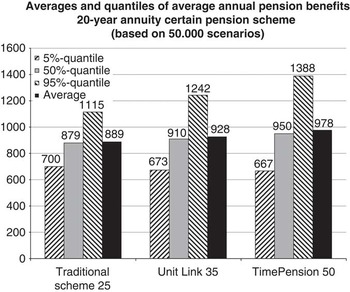
Now that the stability of pension payouts has been thoroughly addressed, we will devote the final analytical section of this article to analysing the size of pension benefits. However, contrary to Figures 3a–3c, which simulated expected pension scenarios over a 20-year period, below we will merely analyse a single summary figure, i.e. the “annual average pension benefit” for each of the three schemes. Calculations are performed as follows: As earlier in the article, for each of the three schemes we have simulated a large number (50,000) of full-scale scenarios comprising a 35-year accumulation phase followed by a 20-year annuity certain decumulation phase. In the payout phase, an annual pension benefit (payable in monthly instalments) is calculated at the beginning of each of the 20 years. The “annual average pension benefit” is defined as a simple average of the 20 adjusted annual benefits”.Footnote 8 This is equivalent to considering the sum total of the 20 annual pension benefits, i.e. aggregate pension payouts. As a result, the number of these annual average pension benefits equals the number of simulated scenarios, enabling us to estimate expected (average) values of associated quantiles. The results are presented in Figure 4.
Averages and quantiles of annual average pension benefits for the three schemes

The figure shows several interesting results. First, if we first look at the 5% quantile, we see that the traditional with-profits product performs best. This is explained partly by the low allocation to shares in the investment portfolio – which is naturally a “good thing” in the poorest market scenarios – and partly by the bonus strategy related to this product, which offers an annual rate of interest on policyholders’ savings of at least 1.5%. TimePension delivers a slightly poorer performance than the Unit Link product in the 5% quantile. The results therefore indicate that highly risk-averse pension savers would consider saving for retirement in a traditional with-profits product. If we take another look at Figure 4, it appears that all the other measures – average, 50% quantiles (medians) and 95% quantiles – rank the products as follows: the traditional with-profits product is “poorest”, Unit Link is “better”, and TimePension is “best”.Footnote 9 Moreover, these results match the conclusions drawn by Nielsen & Jørgensen (Reference Nielsen and Jørgensen2002), which provides a comparison of 30-year capital pension (lump sum) schemes (but with a simpler underlying financial model). It appears from Figure 4 that TimePension on average offers 978−889 = 89 more in annual pension benefits than does the traditional scheme. Seen over a 20-year period – based on some rough mental arithmetic – this corresponds to 20*89/889 = 2.0 annual average pension benefits from the traditional with-profits scheme. We have also done a more correct calculation to illustrate the differences between the two schemes by calculating how long it is possible to “stretch” a TimePension-based annuity certain pension, given that it offers the same average benefit as a 20-year annuity certain pension scheme under the traditional with-profits scheme. Based on unchanged assumptions of calculation, the answer is four years!Footnote 10
6. Conclusion
In this article we have analysed and compared three different pension savings products: the traditional with-profits scheme carrying an average rate of interest and bonus entitlement, the simple market-based Unit Link scheme and the TimePension product. We have particularly focused on the payout phase of the pension schemes, and it has been demonstrated that the pension benefits the pension saver can expect to receive will to a large extent depend on the allocation to shares in the underlying investment portfolio. As we have assumed, in the usual manner, that shares yield higher expected returns than bonds, we find that TimePension, operating with the highest allocation to shares, offers the highest expected pension benefits followed first by the Unit Link product, which has a somewhat lower allocation to shares, and then by the traditional with-profits scheme, where shares account for the lowest percentage of the portfolio. Usually the other side of the coin is that expectations of higher pension benefits are also accompanied by increased uncertainty about the size of the benefits. We have illustrated, however, that the interest rate smoothing mechanism provided by TimePension involves a wide range of properties that can be highly beneficial from the pension saver's point of view. Firstly, our numerical results have shown that the TimePension mechanism offers some form of protection “downwards” as the 5% quantile (i.e. the poorest market return scenarios) is in line with the Unit Link scheme, which has a somewhat lower allocation to shares (and, consequently, lower expected returns). Secondly, we have seen that TimePension has substantially greater “upside” potential – i.e. the possibility of offering gains in the form of high pension benefits – compared with the other products. Finally – and maybe most interestingly of all – we have documented that the TimePension mechanism is capable of ensuring dynamic stability in the adjusted pension benefits fully in line with the traditional with-profits product, which operates with a much lower allocation to shares. TimePension is therefore a pension product combining high expected returns and pension benefits with high stability in the payout phase.
Appendix A: The financial market model
The stochastic financial model we have implemented to be capable of doing the calculations in the article is inspired by Munk et al. (Reference Munk, Sørensen and Vinther2004) and by Wachter (Reference Wachter2002). The central relations of the model are as follows:
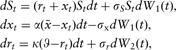
where St is the (time t) value of the share portfolio, xt is the risk premium on shares, and rt is the risk-free short rate. W1 and W2 are standard Wiener processes with correlation coefficient ρ.
For the calculations in the article, we have used a share volatility, σS, of 14%. The equilibrium risk premium,  , is set at 3%. The other parameters in the risk premium process, x 0, α, and σx, are set at 3%, 10% and 0.5%, respectively. The equilibrium interest rate, ϑ, is set at 4.5%. This brings the expected return on shares of 7.5% in equilibrium in compliance with the common assumptions for pension projections (Samfundsforudsætninger) prepared by the Danish Bankers Association and the Danish Insurance Association. The other parameters in the interest rate process, r0, κ and σr, are set at 3.5%, 25% and 1.5%, respectively. We employ a market price of interest rate risk (to determine the price of the bond portfolio) of −25%. The correlation between interest rate changes and return on shares, ρ, is set at 0.
Appendix B: Pseudo code for implementation of the dynamic model (1 scenario)
Specify scheme (traditional, unit linked, or TimePension);
Fix/specify all necessary parameters;
Initialize account(s);
Repeat for each period in accumulation phase
Update account(s) with new contributions;
Simulate stochastic development of financial market;
Compute new account balance(s);
Rebalance investment portfolio;
Until end of accumulation phase;
Repeat for each period in decumulation phase
Recalculate (annually) and pay out pension benefits;
Update account(s);
Simulate stochastic development of financial market;
Compute new account balance(s);
Rebalance investment portfolio;
Until end of decumulation phase;
Appendix C: Supplementary figures in relation to TimePension with a 35% allocation to shares