INTRODUCTION
Housed under the authority of the French Ministry of Higher Education and Research, the Institut Français d’Archéologie Orientale (IFAO) in Cairo is one of the major French research centers abroad. The institute is dedicated to the study of all aspects of the successive cultures of Egypt, from prehistory to the present day, particularly in the fields of history, archaeology, and philology. Some 50 multidisciplinary research programs are currently being conducted in collaboration with French and foreign institutions, including excavations on some 30 archaeological sites in the Nile Valley, the Nile Delta, and most notably in the Eastern and Western Deserts, where the work carried out by the IFAO over the last 30 years has dramatically modified our knowledge of the interactions between the Ancient Egyptian civilization and these arid territories.
The IFAO radiocarbon (14C) laboratory was founded in 2006 to offer the possibility of 14C dating in Egypt; it is exclusively devoted to archaeological issues. It uses the conventional liquid scintillation counting (LSC) method and remains the only operating laboratory in this country where the antiquities law forbids the export of archaeological samples out of the country. It is part of the IFAO archaeometry department, which also houses laboratories in the departments of conservation and materials studies. This research center serves a wide, international, and dynamic community, open not only to the IFAO missions but also to any archaeological project that needs to perform analyses.
THE ARCHAEOMETRY DEPARTMENT
Conservation and Materials Study Laboratories
The IFAO archaeometry department comprises three units of research for performing interdisciplinary studies: a conservation laboratory and a material studies laboratory surround the 14C laboratory. The aim is to initiate an integrated and plural approach of archaeometry. The department aims to answer three main objectives: (1) the development of a shared research platform supported by a strong and international network of experts (not only French, but those coming from all over the world and working on Egyptian archaeological/historical issues); (2) the enhancement and enlargement of its skills and knowledge in various fields of archaeometry; and (3) the coordination of the IFAO scientific research programs. In total, the department is working on more than 20 excavation sites in Egypt and participates in several research programs covering the entire Egyptian territory (the Nile Valley, the desert areas, the oases, the Delta, and the Red Sea coast) and various time periods (from prehistory to the Byzantine and Islamic periods). The strength of the department lies in its ability to connect its three units of research to initiate research programs, making a link between conservation and material studies for developing new protocols, between material studies and 14C dating for various projects in paleoclimatology, sedimentology, and historical chronology, among others. Furthermore, because it is located in an internationally renowned research center of Oriental archaeology established in Egypt since 1880, it benefits from strong competencies in various and diverse research fields, including archaeology, history, philology, epigraphy, the history of art, and more. This all promotes a unique interdisciplinary discussion area in which the IFAO archaeometry department occupies a prominent position.
14C Laboratory Equipment
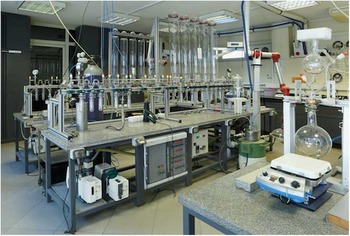
The IFAO 14C laboratory uses the conventional liquid scintillation counting (LSC) method by using benzene (C6H6) as scintillation solvent synthesized from the carbon extracted from the analyzed samples (Figure 1; Povinec et al. Reference Povinec, Litherland and von Reden2009). It is equipped with two parallel and identical conversion lines whose design was developed in 2005 in collaboration with the Centre de Datation par le Radiocarbone in Lyon (France). A specific line dedicated to the combustion of sediments as well as an acid attack line were developed in 2012. A new ventilation system renewing the air every 6 min was set up in the chemical conversion room in 2015. Two Perkins Elmer Tricarb 3100 liquid scintillation counters allow the measurement of more than 100 samples per year. Both counters are working continuously, supplied by two UPS and a generator in case of power failure. The counting room is air-conditioned to maintain a constant temperature of 23°C and humidity of less than 50%. As usual, the analysis process is divided into three steps: (1) pretreatment, (2) benzene synthesis, and (3) measurement by LSC.
The IFAO radiocarbon lab maintains two parallel syntheses lines for chemical conversion. A new line for sediment combustion was set up in 2012. © Gaël Pollin, IFAO.

Pretreatment Step
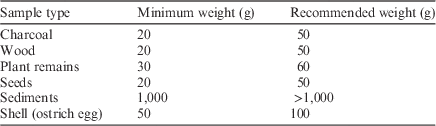
Organic (wood, charcoal, seeds, plant remains, sediments) and non-organic (carbonates) samples are first examined under a microscope and then physically cleaned to avoid any contamination with external carbon (calcium carbonates, magnesium carbonates, organic compounds like roots, humic acids, etc.). An automated ultrapure water system has been developed with a large set of filters (sand, bacteria, UV, resin). The standard pretreatment methods are applied according to the sample type and the sample weight (Table 1): AAA [HCl, 8% (80°C); NaOH, 0.1–0.5N; HCl 8%] or A (HCl, 8%) for sediments; carbonate samples are mechanically cleaned using a Dremel tool, and then rinsed and cleaned using an ultrasound bath and demineralized water. The whole process can take between two and four weeks to complete.
Quantity of materials needed (minimum and recommended) to perform LSC analyses at the IFAO laboratory.

Chemical Conversion
After being dried in an oven at ~70°C, the pretreated samples are converted into carbon dioxide (CO2) using different techniques.
-
∙ For organic material like wood, charcoal, plant remains, and seeds, the combustion method is performed using a combustion bomb. A known weight of sample is placed in a stainless-steel cup inside the bomb, in contact with tungsten filament. After ensuring an accurate vacuum (~10–1 mbar), a stream of around 10 bars oxygen passes into the bomb and an electrical charge is placed across the tungsten filament to complete combustion. The CO2 gas produced is then purified using ethanol traps to remove water (–80°C) and collected in liquid nitrogen cooled traps (–196°C).
-
∙ For sediments, a specific combustion line was set up in 2012. A known weight of sediment sample is placed in a quartz tube inside a tubular furnace heated to 750–800°C, under an oxygen stream (~1 bar, the pressure is adapted according to the sample). The CO gas produced is purified using three sulfochromic acid (H2SO4-K2Cr2O7) bubble traps to remove possible nitrogen and sulphur compounds and one ethanol trap, and passes over a CuO tubular furnace heated at 700–750°C to oxidize CO to CO2. The gas is purified using orthophosphoric acid (H3PO4) and ethanol (–80°C) traps and then collected in two liquid nitrogen cooled traps (–196°C). The combustion is complete as soon as the sediment color changes, which means that all the carbon has been extracted.
-
∙ Carbonate oxidation is performed with acid hydrolysis (HCl). A known weight of carbonate is placed in a 2-L vial containing 100–150 mL demineralized water. Concentrated HCl is added drop by drop and the flask is continuously stirred with a magnetic stirrer in an atmosphere of nitrogen (N2) until the carbonate sample has totally dissolved. The CO2 gas produced is purified and then collected using ethanol (–80°C) and liquid nitrogen cooled traps (–196°C).
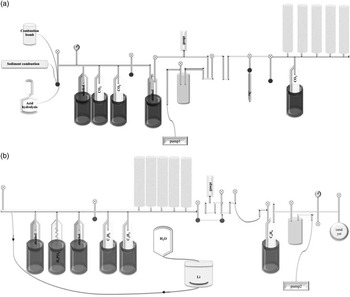
Once the CO2 has been generated it is then transferred into glass columns (1200 mbar maximum by column) after being purified cryogenically using two ethanol (–80°C) traps to remove water and other compounds (nitrogen, sulphur, etc.), and completely condensed using liquid nitrogen cooled traps (–196°C; Figure 2a). A sub-sample of the purified CO2 is taken to measure the δ13C value by mass-spectrometry (these analyses are not carried out within the laboratory). The lithium carbide production is a critical step in the benzene synthesis process (Tamers Reference Tamers1975). Under a vacuum of 4.10–1 mbar, the furnace is heated up to 700°C (for ~1.5 hr to melt the lithium metal). The CO2 is then slowly released into the furnace in presence of molten lithium in stoichiometric quantity with an excess of 1 g to form lithium carbide (Li2C2). Once the lithium carbide is cooled, it is slowly hydrolyzed into acetylene gas (C2H2) using tritium-free water, while the hydrogen evolved is pumped away. The acetylene gas is purified by passing successively through one ethanol trap (–80°C) to remove water, an orthophosphoric acid (H3PO4) bubble trap to eliminate ammonia and halogen compounds, and one last ethanol trap (–80°C). Water contamination in the acetylene gas could lead to low yield of benzene. Acetylene gas is then collected using two liquid nitrogen cooled traps (Barker Reference Barker1953) and released in glass columns after passing through a final ethanol trap (Figure 2b). Finally, the acetylene is trimerized to benzene using an alumina-vanadium-chromium catalyst. Before reaction, the catalyst is activated at 300°C overnight. Once the temperature is kept below 100°C, the acetylene gas is released onto the catalyst under vacuum and the benzene is collected using one liquid nitrogen cooled trap (–196°C). When the reaction is complete, the liquid nitrogen trap is retracted and the liquid benzene comes off at atmospheric pressure. It is stored in a glass vial in a refrigerator prior to being counted. The catalyst is regenerated and cleaned between samples by being heated to 400–450°C under a chemical hood (Noakes Reference Noakes, Isbell, Stipp and Hood1963, Reference Noakes, Kim and Akers1967). During the process, CO2, C2H2, and C6H6 values are recorded to follow the conversation yield of our lines.
Layout of the IFAO benzene synthesis lines. (a) The combustion line is composed of two alcohol cooled traps to purify the CO2, which can be stored in one of the five columns. (b) The acetylene-benzene line is composed with a set of alcohol and orthophosphoric acid traps to purify acetylene and benzene gases. Gases are condensed using liquid nitrogen cooled traps. Turbomolecular pumps provide the vacuum.

Measurement Using the LSC Method
Four mL (equivalent to 3.52 g of benzene) of the synthesized benzene is collected in special 7-mL glass vials for which the background activity has already been measured (see background dispersion). It is necessary to maintain a constant volume to allow measurements to be comparable. Thus, if the synthesized benzene yield is lower than 3.52 g, the solvent is diluted using “dead benzene” to reach the 4-mL volume. Two liquid scintillators—bis-MSB and butyl-PBD—are dissolved in the benzene solvent in equal ratio (0.01 g) and the resulting cocktail is placed in two Perkins Elmer Tricarb 3100 liquid scintillation counters. Each sample is measured around 10 times (run of 1000 min) alternatively on the two counters. We routinely measure sets of 10 samples including a primary standard of Oxalic Acid II (OxII) and a secondary standard [Oxalic Acid I (OxI), ANU or samples from intercomparison programs]. It takes one month to count one batch of samples. Benzene samples sit in a refrigerator for radon to decay from them.
The 14C activity is calculated in percent relative to the activity of an international standard of oxalic acid (OxII), using the Libby half-life (5568 yr) and taking into account the isotopic fractionation normalized to –25‰ (versus VPDB) (Stuiver and Polach Reference Stuiver and Polach1977; Mook and van der Plicht Reference Mook and van der Plicht1999). The final report provides the 14C result (activity in % and age in BP) with a 1σ range and by convention, the 14C age is expressed in years BP (Before Present; the Present is set to 1950 AD). The conversion of the 14C ages to calendar ages is performed using the IntCal13 or Marine13 calibration curve (Reimer et al. Reference Reimer, Bard, Bayliss, Beck, Blackwell, Bronk Ramsey, Buck, Cheng, Edwards, Friedrich, Grootes, Guilderson, Haflidason, Hajdas, Hatté, Heaton, Hoffmann, Hogg, Hughen, Kaiser, Kromer, Manning, Niu, Reimer, Richards, Scott, Southon, Staff, Turney and van der Plicht2013), using the OxCal 4.2 software (Bronk Ramsey Reference Bronk Ramsey2009). The calibrated ages are expressed in years cal BC (calibrated Before Christ) or cal AD (calibrated Anno Domini) and given with a confidence level of 2σ (95.4%).
Performances and Quality Control of the IFAO 14C Laboratory
The control of the quality of the analyses carried out still remains the main concern of the laboratory as a way to ensure an accurate use of 14C dating in archaeological issues. The laboratory routine protocol of analyses aims to check the consistency of our results, to identify possible deviating parameters and to verify that there is no deviated background.
Syntheses Lines
The two synthesis lines are monitored using a standard procedure. Primary vacuums are achieved in the glass vacuum lines using two turbo-pumps. The geometry of both lines is exactly the same but some elements are quite different. For instance, one of the reactors for the lithium capture is manufactured from Inconel, whereas the other is manufactured from stainless steel. Tests for benzene synthesis have been performed to compare the two lines. Using a classical and known charcoal sample divided in two aliquots of exactly the same weight, we have measured the duration of each step of the synthesis for both lines. We got the same result for the combustion step (using the combustion bomb), but not for the lithium capture, which was around 30 min slower on the line with the Inconel reactor compared to the one with the stainless-steel reactor. The yield is thus slightly lower for this same line. When the reactors of the two lines were exchanged, the reaction was slower on the left line, which confirms that the problem is related to the reactor made from Inconel.
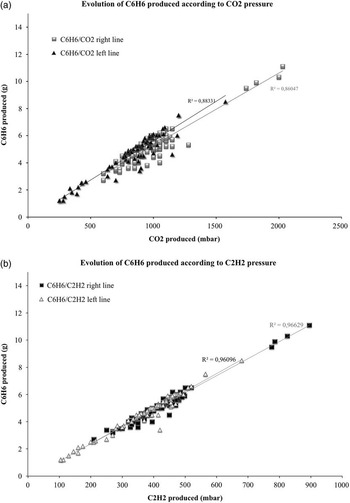
Figure 3 shows for each line the C6H6 (in g) over CO2 (in mbar; Figure 3a) and over C2H2 (in mbar; Figure 3b) ratios. Data report syntheses performed between 2012 and 2015 (more than 190 analyses). For C2H2 yield between 200 and 700 mbar, the two lines have exactly the same linearity with correlation coefficients of ~0.96 (R2). According to the tests we have performed, we prefer using the left line when C2H2 yield is lower than 200 mbar. Generally, we do not measure diluted benzene sample with less than 1 g of syntheses benzene.
Evolution of the quantity of synthesized benzene according to CO2 (a) and C2H2 pressures (b) for the two syntheses lines (right line in square and left line in triangle).

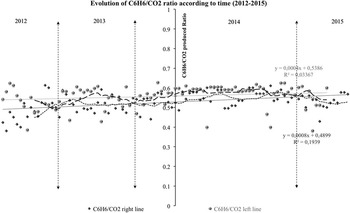
The C6H6/CO2 linearities are also very close for both lines (R2~0.88 and 0.86) even if rather more scattered. This can be explained by the fact that we have gathered different species of samples including lots of sediment samples whose organic material rates are always different. Those results show that both lines provide consistent results. Furthermore, their yields are stable in time as shown in Figure 4, which reports the C6H6/CO2 ratio according to time (from 2012 until mid-2015). Spreads have been slightly reduced in time and their yields are slightly higher. The left line seems to be more consistent, which can be explained by the results we obtained during the tests of chemical step’s duration. It is of vital importance to keep linearity and small spread to be sure that there is no contaminant or (micro)leakages in our lines, and that we get a repeatable yield for a given amount of material.
C6H6/CO2 ratios as a function of time (from 2012 until mid-2015). Linear regressions are in solid lines; moving average regressions done on 10 periods are in dotted lines.

Radiometric Measurements
For radiometric measurements, a specific routine protocol has been developed. A set of 7-mL glass vials was selected according to their weight (only those having very close weights were kept). Each vial background has then been estimated using dead C6H6 prior to being used for measurement. An average of 10 measurements of 1000 min has been performed on each vial and each counter and the average value by counter has been determined after outlier rejection. Those results are integrated in the calculation of ages.
Measurements are performed by series of eight samples to which are added two standard samples: one Oxalic Acid II as primary standard and one ANU, OxI or intercomparison sample (FIRI, TIRI, SIRI…) as secondary standard. All samples are measured until an acceptable standard deviation is reached (around 30 yr BP for Holocene samples corresponding to around 10 runs).
Background Dispersion
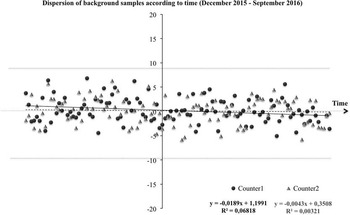
The values of vial backgrounds are regularly checked to avoid a possible background deriving from the counters. We also measure infinite age material samples (>35,000 yr) to test the performance of our equipment. Figure 5 reports the dispersion of background measurements (Ai) to the average value (μΑcount1/2) according to time and for each counter: [(Ai–μΑcount1/2)/Ai×100]. A maximum of less than 10% dispersion can be reached for background samples and we verify that the moving average value using the last 10 measurements is repeatable. The average values and standard deviations are respectively: μcount1=1.672 cpma, σcount1=0.0453 and μcount2=1.927 cpma, σcount2=0.056), confirming the accurate repeatability and stability of both counters at very low-level 14C measurement.
Background dispersion in % relative to the average value as a function of time and counter (December 2015 to September 2016): ([Ai–μΑcount1/2]/Ai×100) with background measurements (Ai) and the average value (μΑcount1/2).

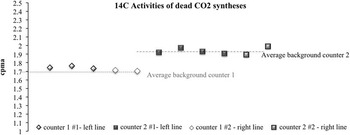
To ensure that the spectrophotometric benzene we have used to evaluate background does not affect the samples’ activity (Hogg Reference Hogg2004), we also measured the 14C activities of dead-CO2 samples synthetized using our two chemical lines. This dead-CO2 gas was delivered by the El-Nasr Company for Intermediate Chemicals (Egyptian Ministry of Defense) in Cairo, and produced from hydrocarbonated raw material (pure kerosene or natural gas). As shown in Figure 6, which reports the cpma of dead-CO2 samples without background correction, there is no difference between background values from photosynthesized benzene samples and from dead-CO2 samples. It demonstrates not only that both chemicals are consistent for the determination of 14C low-level value, but also that there is no added contamination during the benzene synthesis.
14C activities of dead-CO2 synthesized samples. The average values obtained using dead-benzene are reported in dotted lines.

Thus, the specific background value is estimated for each vial and then subtracted from the activity of the analyzed sample. As a control procedure, background values of new vials are continuously measured. As soon as the average value varies more than 1σ, the previous vials are removed.
Primary and Secondary Standards
In the IFAO laboratory we use NBS Oxalic Acid II (OxII) as our primary standard. Once a year, the synthesized benzene is measured more than 10 times on each counter, an average value is then calculated for both counters and any outlier is removed. This average oxalic acid value is then used to calculate 14C ages. In addition, the OxII sample is continuously measured as a control procedure to avoid a possible deviation. If the last value is widely dispersed (more than 1σ range) compared to the average ones, the OxII value is changed.
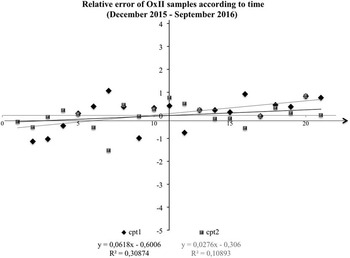
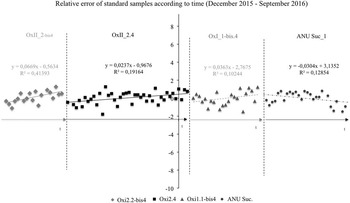
Figure 7 shows that the OxII relative error on the measurement ([AOxII_i1/2–μΑOxII_count1/2]/ AOxII_i1/2×100) has been less than 3% for each counter during the last year. Besides, Figure 8 reports the evolution of the same ratio in time for three different oxalic acid (OxI and OxII) and ANU-sucrose samples (Polach Reference Polach1979). All data were recorded in 2016. They demonstrate the good repeatability of our measurements for high-level 14C measurement.
Relative error of OxII samples according to time (December 2015 to September 2016).

Relative error of standard samples (three oxalic acid samples OxI and OxII, one ANU sucrose sample) according to time (December 2015 to September 2016).

Intercomparison Programs
The IFAO laboratory participates in intercomparison programs lead by the Department of Statistics of Glasgow University. Testing of different 14C reference natural samples used to be performed on samples ranging from infinite age (>40,000 yr) to modern. It allows us to compare our results to the community performance and to avoid potential contamination in our lines and counters.
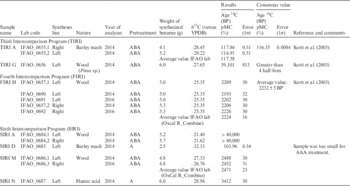
In 2014, 11 measurements from 7 different intercomparison samples were performed [TIRI(2), FIRI(1), and SIRI(4); Table 2]. The same protocol used for all samples has been applied. Each pretreatment has been adapted according to the nature of the sample and the remaining quantity. When possible, the sample was cut into two equal aliquots to be independently synthesized using our two chemical lines. For SIRI D, the sample was too small and fragile to perform a complete AAA treatment. We only undertook an acid bath (8% HCl) and then dried the sample. In 2016, a few of the same samples were remeasured to test the repeatability of our measurements.
Results of intercomparison programs conducted at the IFAO radiocarbon laboratory in 2014 and 2016. Pretreatment column: ABA: [HCl, 8% (80°C); NaOH, 0.1–0.5N; HCl, 8%] A: [HCl8%].

Comparison of our results to the consensus values resulting from previous intercomparison programs (TIRI and FIRI) shows a good agreement. The two synthesis lines provide consistent results. Two very old samples were tested: TIRI G (39,101±813 BP) and SIRI A (2 analyses) providing results older than 40,000 BP. Seven analyses were performed on Holocene samples [FIRI H(5) and SIRI M (2)], which remains the most studied period in the laboratory. Results are perfectly compatible with the consensus value with a 2σ range: for FIRI H, the OxCal combine value is 2224±16 BP over a consensus value of 2232±5 BP; for SIRI M, 2471±23 BP. Moreover, the remeasured samples provide compatible results. Results of those programs confirm the reliability of the applied sample preparation methods, the accurate yields of the chemical conversion and the stability of our facilities. We now use those intercomparison samples as internal standards.
Development and Research Programs
Main Research Programs
The IFAO radiocarbon laboratory occupies a privileged position not only in the IFAO scientific research programs but in particular in those related to archaeology. Currently, at least two-thirds of its activities are dedicated to IFAO studies while the final third is addressed to other institutions currently working in Egypt and elsewhere. As a matter of fact, the laboratory has been working with some excavation sites since its beginning, and has the opportunity to gather substantial sets of data ready to be exploited. Others have been added during the last past years and studies are currently in progress.
In addition, the laboratory is also able to conduct its own research programs and is especially working on issues related to Egyptian chronology. A specific theme—Chronologies—has been integrated into the main scientific research axis of the institute for its 5-yr scientific program (2017–2021). In response to this, a research program about the modeling of a complex chronology for dynastic Egypt using field excavation samples is currently underway. At the interface with the material studies laboratory, we are also developing research projects on archaeological materials that can be dated. The possibility to develop techniques for identifying “accurate samples to be dated” in-situ is one of our priorities. For instance, the identification of well-preserved bone samples by in-situ analyses (Lebon et al. Reference Lebon, Reiche, Gallet, Bellot-Gurlet and Zazzo2016) is a crucial challenge—bone remains (especially human) are always very precious samples—to ensure that sampled species can actually be analyzed once they arrive at the laboratory. The question of paleoclimatology is also a running theme, which requires combining isotopic analyses, archaeobotany, and 14C dating. Close collaborations have been initiated with other laboratories to strengthen our competencies and offer a high-standard research.
The Future of the 14 C Laboratory
Since it was founded, the IFAO radiocarbon laboratory has continually grown by developing new equipment (like the sediment combustion line), improving its facilities (a new air-conditioned system in the chemical conversion room was set up in 2015), and above all by its involvement in the IFAO research programs. Nevertheless, it still remains limited by its rate of production (around 100 analyses a year) due to its measuring equipment (two counters) and by the method used. Despite the very high demand for analyses, we are unable to accept all of them because of the time taken to analyze samples (more than a year) or because of the amount of the sample we need to be able to perform the analyses. That is why the laboratory intends to expand its equipment to set up AMS combustion and graphitization lines to be able to offer the possibility of AMS dating in Egypt. This will require an expansion of the host building and setting up a “white room” for pretreatment. This next step is of vital importance for the future of the IFAO 14C laboratory.
CONCLUSION
The IFAO radiocarbon laboratory was founded in 2006 to offer the possibility of radiocarbon dating in Egypt, using the liquid scintillation counting method. It is part of the French Institute of Oriental Archaeology in Cairo and it is exclusively dedicated to archaeological issues. Being situated in the same building as a material studies laboratory and a conservation laboratory, it occupies a unique position to develop interdisciplinary studies and to offer high-standard analyses to the IFAO scientific research programs. In the near future, we hope to be able to improve its capacities by developing an AMS-graphitization line, which is highly anticipated by the international Egyptological community.
Generally speaking, dating is not an end in itself. The result of an analysis must be part of a global and holistic approach to be adapted to the establishment of a high-resolution chronological model based on crossed data, regardless of where it comes from. The mobilization of physics, applied statistics, as well as archaeology and history simultaneously still remains the best way to acquire the greatest benefit from measurement of archaeological samples taken in a both a culturally and an environmentally precise context. To this day, this is the main philosophy of the IFAO radiocarbon laboratory.
Acknowledgments
The IFAO is funded by the Ministère de l’Enseignement Aupérieur et de la Recherche. We are grateful to the team at the Centre de Datation par le Radiocarbone in Lyon (France), in particular Christine Oberlin and Jean-Claude Lefèvre, for their valuable support and advice during the last few years. We also thank the two reviewers for their relevant comments.