Introduction
With the elderly population growing worldwide, depression in older people is becoming a global health problem. It reduces quality of life and increases healthcare utilization costs in older people. It is the single most important predictor of suicide.
Development of elderly depression could be explained by a multifactorial disease model (Blazer et al., Reference Blazer and Hybels2005), and it is influenced by several bio-psychosocial factors. In developed countries, a number of reports have focused on the difference between urban and rural areas. Evans (Reference Evans2009) examined the differences between urban and rural elderly persons in the level of life satisfaction and depressive symptoms, focusing on the effect of social support in the state of Iowa in the USA. Using structured interviews, urban residents were found to show more depressive symptoms than rural residents. The subjective level of social support was more negatively related to depressive symptoms among rural than urban elderly persons. Mechakra-Tahiri et al. (Reference Mechakura-Tahiri, Zunzunegui, Préville and Dubé2009) reported that the prevalence of elderly depression was higher in rural (17%) and urban areas (15.1%) than in metropolitan Montreal (10.3%). They indicated that social support and the lack of conflict in intimate relationships were associated with a lower prevalence of depression in all areas, although geographical differences in the prevalence of depression existed within the elderly population in the Canadian province of Quebec. In Asian countries, the prevalence of depressive symptoms in the elderly was higher in urban than rural areas, and the level of depressive symptoms was influenced by the variables of level of education, being with or without spouse, ability to pay for living expenses, and sense of satisfaction in daily life in South Korea (Lee et al., Reference Lee, Park, Bae and Cho2008). In Taiwan, Chiu et al. (Reference Chiu, Chen, Huang and Mau2005) demonstrated that urban elderly persons had a relatively higher prevalence of depressive symptoms than rural elderly persons. They also indicated that chronic disease prevalence and activity of daily living (ADL) scores were consistently associated with depressive symptoms in urban and rural samples. In Japan, only one early study reported the difference in elderly depression between urban and rural areas (Sarai, Reference Sarai1983), while a few papers reported that the suicide rate in rural areas was thought to be higher than in urban areas (Watanabe et al., Reference Watanabe, Hasegawa and Yoshinaga1995).
The aim of this study was to investigate the differences in prevalence and risk factors of elderly depression between urban and rural areas in Japan and to contribute to understanding the features of elderly depression.
Methods
Study population
This study was conducted in urban and rural areas in Kumamoto Prefecture. The data collection of the urban area was undertaken in Kumamoto City, which is the prefectural capital of Kumamoto and the biggest city in South Kyushu; its population is about 730,000. The rural area that was studied was in Aso district, with a population of about 70,000, located in a mountainous area of Kumamoto Prefecture. In Aso district, economically active populations are employed within agriculture and forestry, as is characteristic of rural areas in Japan. The rates of people aged 65 years and over in the two areas were 20.5% in Kumamoto City and 31.7% in Aso district in 2009.
Data collection
A multistage, random sampling procedure was used in which the census tracts of Kumamoto City and Aso district between November 2010 and December 2010 were chosen. A total of 2,500 persons was recruited from among the elderly residents aged 65 years and over in each area. Self-administered questionnaires were mailed to individual participants asking about socio-demographic variables including age, sex, living status (living alone or with others), work status, social support, financial strain, suicidal ideation (all the time, often, sometimes, and never), and history of medical disease (heart disease, hypertension, brain infarction, diabetes, cataract, and others). We used the following statements to assess the state of sleep: “good, trouble with sleep, longer than 30 minutes to fall asleep, abrupt awakening, early morning awakening.” We considered the responses other than “good” to indicate sleep disturbances. The questionnaires were returned using an enclosed reply envelope with written, informed consent. All procedures of the present study strictly followed the 2009 Clinical Study Guidelines of the Ethics Committee of Kumamoto University Hospital and were approved by the Internal Review Board.
Measurements
The shortened version of the Geriatric Depression Scale (GDS) was used. The GDS was developed to assess depression in the elderly (Yesavage et al., Reference Yesavage and Blink1983), and it has been used extensively in the fields of psychiatry and public health. Its Japanese version was validated by Muraoka et al. (Reference Muraoka, Ikuchi and Ihara1996). Subjects who scored six points or more were considered “possibly depressed” as in previous studies (Burke et al., Reference Burke, Rocceaforte and Wengel1991; Muraoka et al., Reference Muraoka, Ikuchi and Ihara1996).
In order to assess subjective happiness, the Philadelphia Geriatric Center Morale Scale (PGC-MS) was used. The PGC-MS was developed to assess the self-estimates of happiness and satisfaction with life in elderly persons by Lawton (Reference Lawton1975). The PGC-MS was translated into Japanese, and there were no major cross-cultural differences in the structure of the PGC-MS between the Japanese and American data sets (Liang et al., Reference Liang, Asano, Bollen, Kahana and Maeda1987). The PGC-MS consists of 17 items, most of them in dichotomous response format. The highest score is 17, with high scores indicating low levels of loneliness and dissatisfaction, low agitation, and good attitude toward own aging.
The social support questionnaire (Muraoka, 1996; Koizumi et al., Reference Koizumi2005) consists of five questions about support from the surroundings related to health problems; for example, “Do you have someone who can take care of you when you are ill in bed?” The answer “yes” was given a score of 1 point. The validity and reliability of this question were not evaluated.
Statistical analysis
Valid responses after excluding incomplete responses to each item were scored. The means and standard deviations (SDs) were calculated for the following items: sex, age, sleeping hours, social support, GDS scores, and PGC-MS scores. Statistical differences between Kumamoto City and Aso district were assessed using the χ2 test for work status and the prevalence of depression, and by Student's t-test for sex, age, age groups, family structure, sleeping hours, GDS score, social support, and PGC-MS score. The χ2 test was used to examine sex, living alone, working status, patterns of sleep, suicidal ideation, social support, and financial strain as related to depression in each area. We considered suicidal ideation “all the time, often, or sometimes” as present and “never” as absent. Finally, multivariate analyses were carried out to identify additional factors related to depression and to calculate odds ratios for each factor in each area. Suicidal ideation, because it is not on independent variable, was not used in this analysis. A two-sided P-value of 0.05 or less was defined as significant. All exploratory and formal statistical analyses were performed with SPSS version 18.0 (SPSS Inc., Chicago, IL, USA) software for Windows.
Results
Participants’ characteristics
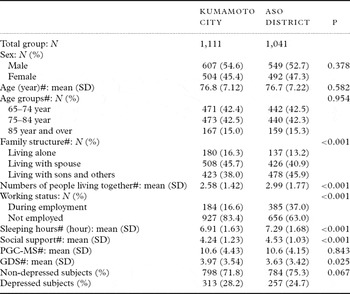
The participants characteristics are presented in Table 1. A total of 2,152 answers were valid after excluding incomplete answers. Men accounted for about 54.6% of the participants in Kumamoto City and 52.7% in Aso district. The mean age of the participants was 76.8 year (SD = 7.12) in Kumamoto City and 76.7 year (SD = 7.22) in Aso district. There were no significant differences in the sex ratio and the mean age between the two areas. Participants from Kumamoto City were more likely to have fewer family members. More participants from Aso district were involved in business. The average sleep time was significantly longer in Aso district. The average social support score was significantly higher in Aso district. There was no significant difference between the areas in the average PGC-MS score. The prevalence of depression was almost the same between the two areas (Kumamoto City, 28.2%; Aso district, 24.7%). The average GDS score was significantly higher in Kumamoto City.
Characteristics of participants in each area

#: Student's t-test, others: χ2-test
GDS-Geriatric Depression Scale; PGC-MS-Philadelphia Geriatric Center Morale Scale
Univariate associations with clinically relevant depressive symptoms
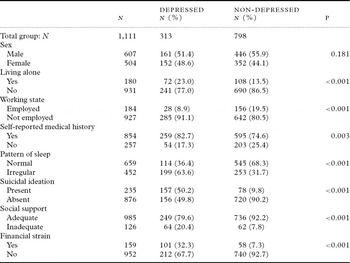
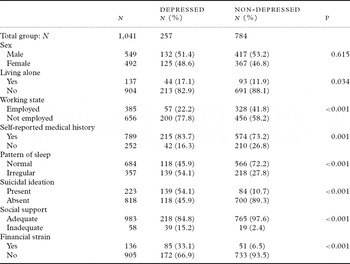
Depressive symptoms in the elderly were significantly associated with living alone, being unemployed, chronic illness, sleep disturbance, suicidal ideation, financial strain, and poor social support in Kumamoto City (Table 2). In Aso district, living alone, being unemployed, chronic illness, sleep disturbance, suicidal ideation, financial strain, and poor social support were associated with elderly depression (Table 3). The factors related to elderly depression were almost the same in the two areas.
Relationships between depression and each factor in Kumamoto City

Chi-square test
Relationships between depression and each factor among participants in Aso district

Logistic regression model
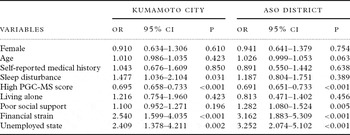
Table 4 shows the variables independently associated with depression on logistic regression analysis in each area. In Kumamoto City, four factors (sleep disturbance, financial strain, being unemployed, and low self-estimation of happiness) were significantly associated with depression. In Aso district, four factors (poor social support, financial strain, being unemployed, and low self-estimation of happiness) were significantly associated with depression. Two variables related to elderly depression were different between the urban and rural areas. Sleep disturbance was a risk factor for depression only in Kumamoto City, while poor social support was a risk factor for depression only in Aso district.
Logistic regression analyses on the relationship between depressive state of participants and multivariate factors in urban and rural areas

OR = odds ratio; CI = confidence interval
Discussion
In this study, the prevalence of elderly depression was investigated, and its risk factors were compared between urban and rural areas in Japan. This study indicates that the prevalence of depression is almost the same among community-dwelling elderly people in both areas. The common risk factors are suicidal ideation, financial strain, and being unemployed. Sleep disturbance is a risk factor only in the urban area, while poor social support is a risk factor only in the rural area.
Before discussing the depressive symptoms and related risk factors, we should discuss socio-demographic differences between urban and rural areas. In Kumamoto City, participants tended to live with few family members, living alone or with their spouse; participants who lived with other generations were more common in Aso district than in Kumamoto City. There were more working people in Aso district than in Kumamoto City. This was thought to be due to the difference in industrial structure. People in Aso district could engage in agriculture well into old age, while many people in Kumamoto City had to retire.
The elderly people in Aso district were found to have a longer sleep time than those in Kumamoto City. In general, urbanization appears to be associated with shortened sleep time in elderly people.
The social support score was higher in Aso district (4.53) than in Kumamoto City (4.24), meaning that rural elderly can get more social support than urban elderly. In urban areas, transportation facilities are very convenient, so that elderly persons can live with poor social support. On the other hand, in rural areas, it is difficult to live without social support due to inadequate facilities, such as transportation. In addition, some young people tend to migrate to urban areas, leaving their parents in their place of origin; consequently sources of family support for these elderly people tend to decrease. Thus, the social networks of those living in rural areas may differ in nature and support from those of urban dwellers (St John et al., Reference St John, Blandford and Strain2006). Differences in these social networks may affect the frequency of depression, as indicated in population studies on depression, which have generally found that the extent and supportive nature of social relationships exert a positive influence on mental health and protect against depression, while strained relationships have been related to poor mental health status (Kawachi and Berkman, Reference Kawachi and Berkman2001). Okwumabua et al. (Reference Okwumabua, Baker, Wong and Pilgram1997) reported that rural area residents tended to have a stronger and more extensive social support network with family, friends, and neighbors, which provided resourceful avenues to cope with loneliness and depression. Social support in rural areas might have a more significant effect on elderly depression than in urban areas.
No marked differences in the prevalence of depression were observed between Kumamoto City (28.2%) and Aso district (24.7%) in this study, whereas many previous studies indicated that urban elderly people had a relatively higher prevalence of depression than rural elderly (Lehtinen et al., Reference Lehtinen, Michalak and Wilkinson2003; Chiu et al., Reference Chiu, Chen, Huang and Mau2005; Evans, Reference Evans2009). On the other hand, the severity of depression was higher among urban elderly people than among rural elderly people, which was consistent with recent reports in other countries.
The factors related to elderly depression were almost the same in both areas. Depression was significantly related in the present study to living alone, being unemployed, chronic illness, sleep disturbance, suicidal ideation, loss of social support, and financial strain. In other, living alone is a potential risk factor for depression in the geriatric population (Pan et al., Reference Pan2008; Barua et al., Reference Barua, Ghosh, Kar and Basilio2010). However, there are only a few studies that have examined the association between depression and living alone in the Japanese elderly. Our group has recently reported such an association in a rural community in Japan (Fukunaga et al., in press). The results of the current study demonstrate that living alone would be associated with depression among the elderly in urban and rural communities in Japan, which was consistent with studies in other countries.
Financial strain and being unemployed were strong common risk factors for elderly depression in both the urban and rural areas. In a previous study, financial strain was strongly associated with concurrent depression among elderly persons (Mendes de Leon et al., Reference Mendes de Leon, Rapp and Kasl1994). Financial strain was associated with depression in both areas, and it was one of the strongest risk factors in the present study. Being unemployed was also significantly related to depression in both areas; unemployed elderly persons showed a high rate of depression. In a previous study, lack of employment was significantly associated with elderly depression (Blay et al., Reference Blay, Andreoli, Fillenbaum and Gastal2007). Working elderly people have many social relationships, and they can feel part of society; these factors are related to decreasing the morbidity of depression. Furthermore, it is natural for elderly persons who are depressed to be unemployed. Being unemployed was also one of the strongest risk factors for depression. Financial strain and unemployment state would be important factors for detecting elderly depression.
The results of the present study demonstrated that there were two different risk factors between the urban and rural areas: poor social support is a risk factor for elderly depression in Aso district but not in Kumamoto City, while sleep disturbance is a risk factor for elderly depression in Kumamoto City but not in Aso district. In a previous study, Koizumi et al. (Reference Koizumi2005) found an increased risk of depressive status in subjects who lacked social support in the Japanese population. Evans (Reference Evans2009) reported that the subjective level of social support was a stronger predictor of life satisfaction and was more negatively related to depressive symptoms among rural than urban elderly. Rural elderly people may have more comfort with and trust in their social networks. Losing social support is a more serious problem in rural than in urban areas. It should be noted that low social support did not affect depression in urban elderly, but it had a significant influence on the rural sample in this study. Therefore, we suggest that this social factor became a more significant predictor of depressive symptoms than physical problems for rural elderly. Depression has a particularly complex relationship with insomnia. Sleep disturbance may be an early symptom of major depression, and thus the treatment of insomnia might preclude the development of depression (Ford et al., Reference Ford and Kamerow1989). In the present study, sleep disturbance had a more significant influence on the urban sample than the rural sample. The average sleep time in Aso district was longer than in Kumamoto City. Urbanization results in urban people sleeping a shorter time, resulting in insomnia. In the depressed elderly in urban areas, risk factors affecting physical condition, such as insomnia, should be considered more than factors associated with social interaction.
The PGC-MS was highly correlated with depression in this study. Several studies have also reported an association between the PGC-MS and elderly depression in Western and Asian populations (Loke et al., Reference Loke, Abdullah, Chai, Hamid and Yahaya2011). If measures increasing subjective happiness improve the depressive state in the elderly, a population approach to increasing subjective happiness may prevent elderly depression, along with decreasing each risk factor.
The results from the present study should be considered within the context of a few limitations. First, cognitive function was not evaluated so that demented persons could not be excluded. However, only persons with very mild dementia would have been able to participate using this mail survey method. Secondly, the definition of “depression” was based only on GDS scores, without corroborating clinical evaluation. However, the GDS is a well-validated instrument for assessing depression, and its use in epidemiological studies is widespread. Furthermore, the return rate using the mail survey method was higher than in previous studies. Thirdly, other risk factors, such as personality and important life events in the past few months before this study were not considered.
Conclusion
Although factors related to depression did not differ between urban and rural elderly people, some risk factors differed between urban and rural people. Based on these results, early intervention programs for elderly depression in rural areas should focus on social support, while in urban areas the focus should be on sleep disturbance. Effective intervention programs for elderly depression should pay more attention to regional differences.
Conflict of interest
None.
Description of authors' roles
Yasuhisa Abe worked on the study implementation, the data analysis, and writing of the paper. Ryuta Fukunaga worked on the study implementation. Yoichi Nakagawa worked on the data analysis. Noboru Fujise and Manabu Ikeda designed the study and helped write the paper.
Acknowledgments
The authors would like to thank all participants and their relatives for their cooperation in this study. This study was supported by a strengthening regional emergency fund against suicide by the Cabinet Office, a grant provided by the Ministry of Education, Culture, Sports, Science and Technology (Grant No. 22591291) for N.F. and M.I.