1. INTRODUCTION
For a long time, historians have recognised that the eighteenth century saw the widespread transformation of much of European rural society. Catalonia, while less known perhaps in the historiography written in English than other regions, underwent changes that were particularly dynamic in the context of Mediterranean Europe. Pierre Vilar dedicated one of the volumes of his extensive work on Catalonia to the agricultural transformations of the eighteenth century, inspiring many researchers who have since confirmed his intuitions. These transformations, along with important demographic growth, happened in a context of increasing commercialisation and regional specialisation, both agricultural and industrial, and involved in large measure the breaking up of barren and wooded lands for bush crops, especially vineyards.Footnote 1 We know that many of these changes were introduced by smallholders, rather than large landowners,Footnote 2 partly due to the significant increase in the number of emphyteutic contracts during the eighteenth and the first half of the nineteenth centuries.Footnote 3 Emphyteutic tenure conferred virtual property rights on the cultivator, who was free to sell, sublet or bequeath the land as he or she saw fit, subject to payment of certain fees to the landlord. Contemporaries and historians have thus seen it as facilitating access to land and creating incentives for the cultivator. Censuses show a relative increase in ‘rural day-labourers’ who, in fact, were smallholders who combined the income from their small exploitations with wage labour. Other sources also indicate an increase in this social group.Footnote 4 But we still know little about the changes – in a context of economic growth – that happened in their family economies or about the development of the incomes they generated.
Was it possible that the new labour opportunities caused by these transformations also produced a relative enrichment of the most humble sectors of society? This question seems particularly relevant given the debate surrounding the industrious revolution, that is, the decision by households to allocate more time to labour in order to increase their expenditure on consumer goods. Jan de Vries assumed that a revolution of this type could not have occurred in Mediterranean Europe, since the predominance of complex family forms and low and stagnant wages did not allow for flexibility in the allocation of labour or the exercise of consumer choice.Footnote 5 His arguments were quite weak, however, since as he himself recognises, wage series are an imperfect guide to the evolution of household incomes, given that they do not include female and child earnings, or changes in the numbers of hours and days worked. He gives no evidence on these issues for southern Europe.Footnote 6 Moreover, de Vries assumes, rather than proves, that consumption did not increase in Mediterranean Europe.Footnote 7 The important role of the ‘humble people’ in the economic transformations of eighteenth-century Catalonia, a Mediterranean society in which the stem family predominated, therefore makes this study a relevant contribution to this debate.
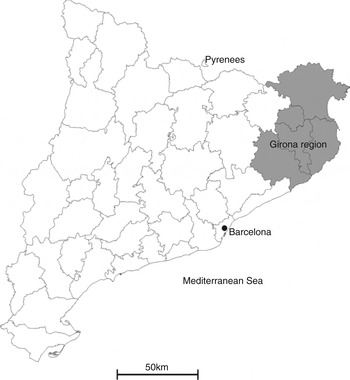
This article proposes an approach to these questions for a specific geographical area and period – the Girona region of north-eastern Catalonia (see Figure 1) during the second half of the eighteenth and the first half of the nineteenth centuries – based on marriage contracts signed before a notary.Footnote 8 In the period under study, these contracts were still in full force, above all in rural areas.Footnote 9 These documents are especially interesting for historical research because they offer information both on the socio-occupational labels by which individuals identified themselves and on their economic status through the value of the dowries bestowed on brides. Precisely one of the contributions of this article is to suggest a method of studying social inequality using dowries as an indicator. Among the different types of transfers related to marriage, many scholars have pointed out that the dowry, unlike the brideprice, is common in societies with a pronounced social stratification, where the dowry becomes a mechanism to maintain or improve status.Footnote 10 Studies of dowry systems in different regions of the world and for different historical periods confirm this idea and coincide in pointing out that there is a close relationship between the value of dowries and the socio-economic status of the families of the grooms and brides.Footnote 11 However, most of the empirical studies on this subject are restricted to certain well-off social groups and only a few offer a quantitative analysis of dowries for an entire society, in part because in many places the only groups that bestowed dowries on their daughters or left written record of doing so were elites or middle classes. By contrast, in the Girona region, as we argue in section 3 of this article, the sources record dowries of women of all social groups. This indicator can therefore contribute to an analysis of social change beyond simply the transformations that affected elites. Registration of dowries right down the social scale also occurred in other regions, especially the Pyrenees and the south of France where inheritance customs and notarial practices were very similar to those in Catalonia. In these cases, we believe that the methodology we present here could encourage comparative analysis.Footnote 12
The Girona region.

The analysis of marriage contracts from the Girona region will show simultaneously significant changes and continuities in the period between 1769 and 1843. On the one hand, there are changes because the evolution of dowries does not always follow that of prices in the expected direction, and because we will see important transformations in the composition of social groups and even the appearance of new social labels. In this sense, especially significant is the appearance of one new label, the menestral, which began to be applied to individuals who ascended from the most humble classes of the rural world. On the other hand, there are continuities, not just the simple persistence of marriage contracts themselves, but also the high degree of stability of social and geographical endogamy during the entire period studied.
2. DOWRIES OF BRIDES AS AN INDICATOR OF SOCIAL CHANGE: THE CASE OF THE GIRONA REGION
In many societies the value of dowries has served historically to situate a family according to its social status, although the difference in dowries between families cannot automatically be assumed to equal the difference in incomes. In the case of Catalonia, there is abundant evidence testifying to the importance that our predecessors gave to dowries as a sign of social success or failure.Footnote 13 This importance is also indicated by the fact that representatives to the Corts (Estates) of 1599 and 1626 tried to establish criteria for dowries for different social groupsFootnote 14 and by the numerous judicial statements as to what should be considered ‘adequate’ dowries given the social status of the family of the bride.Footnote 15
The nature of the Catalan inheritance system, based on male primogeniture, played a role in the relationship between the value of the dowry and the wealth of the family of the bride. According to law, younger sons and daughters had to receive at least the llegítima which consisted of the fourth part of the parental assets, divided equally among all children (including the heir).Footnote 16 For daughters, this share in the inheritance was the dowry: in marriage contracts, women renounced any future claim on the assets of the family upon receiving their dowry and, indeed, in wills, bequests to daughters in addition to the dowry are non-existent or insignificant. If the dowry consisted of a fourth part of the assets shared among all siblings, women from similar levels of wealth or status could receive dowries of different values, depending on the number of brothers and sisters. In fact, the number of daughters could condition the amount in some cases. In general, however, when deciding a dowry for their daughter, parents did not take an inventory of their assets in order to distribute them strictly according to the law. In practice, it seems that the dowry had to guarantee the social and economic status of the family even when this could represent a great effort. For households with several daughters it could even mean compromising the property of the family.
Although the amount of the dowry was not necessarily equivalent to the llegítima, the interrelation between dowry and inheritance nevertheless set limits to the variability of quantities paid by the same family. Sources show that, except in very special cases, sisters usually received the same amount of dowry, almost certainly in order to avoid future claims by less favoured daughters who would have the law on their side.Footnote 17 In the case of the Girona region, then, the amount of the dowry was rarely determined by families using different strategies for the marriage of each daughter (for example, as a reward for a ‘good’ marriage or, in the opposite case, to help daughters who married poorer men) or by the distinct personal attributes of each bride.Footnote 18 The fact that individual factors had little or no importance in the determination of the amount of the dowry re-enforces its value as an indicator of status.
As we have mentioned already, the fact that, in Catalonia, the dowry made up the entire or almost the entire inheritance of daughters means that it can give complete information on how much each woman received from her family. This makes it very useful, compared with other regions where the dowry was only one of several assets that women received from their parents throughout their lives.Footnote 19
In addition to being a good indicator of status, dowries have other advantages for the analysis of inequalities:
1. They provide information on the economic situation of families as such, i.e. as units made up of several members. Dowries are the result of family savings and also include, in some cases, the incomes accumulated by women before marriage.
2. Dowries, at least those paid for the first marriage of a woman, represent a certain homogeneity as far as the life cycle stage of those signing the contract is concerned. In this regard, dowry series are more homogeneous than other sources, especially those that provide information on wealth at the time of death.
3. In most cases, dowries consisted of monetary quantities that are easily quantifiable and comparable. The amount was rarely paid in the same year of the marriage or at the signing of the marriage contract. More commonly the amount of the dowry was divided into a very variable number of annual instalments. The amount assigned in marriage contracts, then, indicated not so much the capacity of the family at that point in time, but an expectation of their future savings. We may not know the sacrifices necessary in order to meet their commitment, but the dowry does express the hopes of the contract signers.
4. In the fourth place, this source allows for a dynamic and flexible analysis of societies. We historians who work on social groups sometimes tend to see these groups, classes, or occupations as stable entities. We often suppose that members of one group or craftsmen of the same occupation evolved in the same way, but we do have to take into account the possibility that different degrees of hardship could be experienced by different groups of individuals within the same social collective.
3. RELIABILITY AND REPRESENTATIVENESS OF THE ANALYSED SAMPLE: WHO SIGNED MARRIAGE CONTRACTS?
Our study is based on the analysis of 4,707 marriage contracts filed at the Registre d'Hipoteques (Register of Property Transfers). The volumes of this register are very useful since here we find centralised in one single source information from notarial records of a fairly large area, which otherwise would be difficult to cover.Footnote 20 The analysed marriage contracts are from three time periods: 1769–1770, 1806–1807 and 1841–1843.Footnote 21 An exhaustive investigation of data from one- or two-year periods gives sufficient information on the distribution of dowries in one generation. Great oscillations from one year to the other are improbable when we take into account that many marriages celebrated in consecutive years involved members of the same families. Therefore we consider three two-year periods, with sufficient intervals of time in between, to be a study of three generations.
As far as the representativeness of our study is concerned, we are confident that, given the size of population and assuming a nuptiality rate of between 8 and 10 per 1,000, the registered marriages we have analysed represent over half of the weddings of the years under consideration.Footnote 22 Although marriage contracts were mostly drawn up only for marriages between heirs and cabaleres (women who were not heiresses), in other words, where the assets to be inherited by the groom were significant, the dowries of these brides were not different from other dowries since, as has been pointed out, sisters from the same family, whether they married heirs or second-born sons, usually received the same amount.
Another question is whether marriage contracts can provide information on all social groups. We can answer this question only by classifying the people involved in the contracts into social categories. Since a greater part of our results will be based on this classification, we should dedicate some space to considering the social ‘labels’ that appear in the sources. A useful comparison here are the dispenses de proclames.Footnote 23Dispenses de proclames exempted the couple from the usual procedure of having the banns read three Sundays before the marriage. In Catalonia, the majority of couples chose this option, thus making the banns dispensations a more representative source of all marriages. The classification of occupations that appears in both sources, which is also that used in all notarial records for the Girona region in this period, distinguishes two groups among those men who worked in agriculture: pagesos (farmers) and treballadors (literal translation: labourers). This dual classification has some advantages and some inconveniences.
The main advantage is that it allows us to differentiate between two social groups related to agricultural work. Unlike in other Catalan regions, in both sources the label pagès refers to the cultivator of a mas (farm). A mas was a family exploitation of medieval origin which guaranteed the subsistence of the family who lived on the farm and dedicated itself exclusively to its exploitation. The majority of treballadors, on the other hand, while they also owned houses and lands, usually owned much smaller exploitations than the masos. Another difference between the two groups was their patterns of residence: while pagesos mostly lived on dispersed farms (although there were also some farms within villages), the majority of treballadors resided in villages and towns. This distinction between pagesos and treballadors can be observed throughout the entire period studied here and allows us to differentiate between the behaviour of two rural groups. As historians of the rural world well know, this is not always the case.
It should be pointed out that the two labels, pagesos and treballadors, did not correspond to different phases of the life cycle of individuals of the same group, as sometimes happens with such classifications, but referred to individuals from different social groups. However, the characteristics of the inheritance system meant that many younger sons of pagès families became treballadors. The label pagès was used only for peasants with a mas and, since the number of these masos did not grow substantially throughout the period studied, we can suppose that most younger sons of pagesos did not secure a farm exploitation and thus mostly appear in the sources as treballadors. The label pagès thus usually indicates the heir of another pagès.Footnote 24
One of the main inconveniences of the classification of the rural population is the ambiguous use of the label pagès: it rarely distinguishes between share-cropping tenants (masovers), who already ran most of the farms by the end of the eighteenth century, and those pagesos who owned their farms. In addition, this last group could be further divided between pagesos who still worked the land themselves and rentiers (hisendats), especially in the eighteenth century.Footnote 25 This requires us to be extremely cautious with the interpretation of the information related to pagesos, especially when it comes to the distribution of dowries.
Moreover, in 1806 there appears another label: menestral. Its use became very common in the first half of the nineteenth century. In Catalan dictionaries, the word menestral is a synonym of artesà (craftsman). In the region of Girona, however, from the end of the eighteenth century on, the word was used for peasants who owned small agricultural exploitations. In 1841–1843, the number of menestrals who signed marriage contracts almost equalled that of treballadors (see Table 1). The origin of this new label is important. The available evidence suggests that this group emerged out of the ranks of the treballadors, not the pagesos. The analysis of the dispensations from banns for 1805–1806 shows that, of the menestral grooms, 18 had fathers who were also menestrals, 1 was a mason, another a merchant and tailor, and 2 were treballadors. Only one was a pagès. Looking at all the fathers of grooms, 35 were menestrals; of the sons of these 35, 17 were also menestrals, 9 were treballadors, 1 was a linen-weaver, 7 had no occupation given and only 1 was a masover.Footnote 26 In the following tables we have opted to include the information related to menestrals in the group of treballadors with the adequate distinctions when necessary. Our hypothesis, discussed below, is that the label menestral indicates a new and improved socio-economic status for some who had previously been treballadors.
Percentage of grooms of different occupational groups among the signatories of marriage contracts and banns dispensations, Girona region, 1769–1843

a We could not compare the occupations of the grooms for 1841 and 1843 since the banns dispensations of that period do not mention this specific information.
Sources: Arxiu Històric de Girona: Registre d'Hipoteques; Arxiu Diocesà de Girona: Dispenses de proclames matrimonials.
Having made these specifications, we can now try to answer our question – who signed marriage contracts – by comparing the marriage contracts with the banns dispensations for the same years, since the latter included almost all couples who married. In Table 1, among those signing marriage contracts groups related to agriculture are over-represented compared with banns dispensations, while artisans and merchants seem to have been less inclined to draw up these documents. It can also be pointed out that, as far as the practice of signing marriage contracts is concerned, there are few differences between the distinct agrarian groups – pagesos, treballadors and menestrals – whose weddings are all well registered in the source. Marriage contracts, then, provide information that is fairly representative of all the population who married during the study period. Unfortunately, the sources do not allow us to determine to what degree marriage contracts are representative of the population as a whole, since we do not know if there were significant differences between the nuptiality rates of different social groups.Footnote 27
4. THE MOVEMENT OF DOWRY VALUES: SOME RESULTS
Studying the evolution of dowries requires some methodological decisions. First, from here on, we only consider marriage contracts in which the dowry of the bride is given in monetary values. Consequently, we have not included heiresses (pubilles) nor those who bring assets to the marriage whose value we cannot know. The cases we analysed represent 82 per cent of the registered marriage contracts.
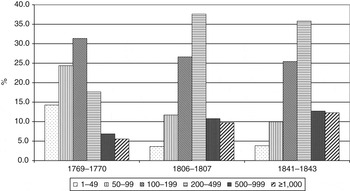
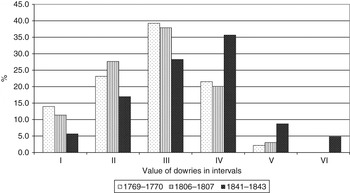
In order to decide how to group dowry payments, we have to take into account the high proportion of cases in which the amount of the dowry is a round figure. There are many dowries of 100 or 1,000 lliures, but few between 80 and 99 lliures or between 800 and 999. We suggest that trying to round up dowry payments represented an effort to situate the family at a higher level compared with those brides who, although the amount of their dowries was not much lower, could not reach the round sum. In Figure 2 we propose the following classification which shows the evolution of dowries, in nominal terms, for all women regardless of their marital status.
Evolution of the value of dowries (in lliures) in the Girona region, 1769–1843. (Source: Arxiu Històric de Girona, Registre d'Hipoteques.)

The similarity between the second and third periods is obvious. Taken at face value, Figure 2 would suggest that important changes occurred between 1769–1770 and 1806–1807, with a clear improvement in the distribution of dowries. However, here we have nominal figures, in a period of substantial change in prices.
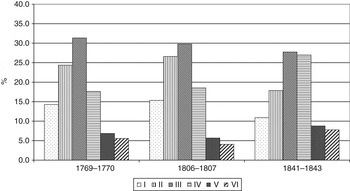
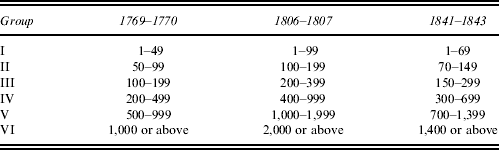
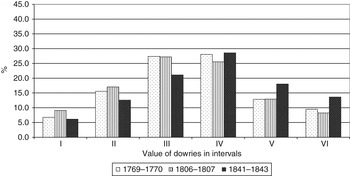
Figure 3 shows the result of dividing the nominal value of dowries by the average wheat price for the nine years prior to the years in question. Taking the average price over several years in this way is consistent with our assumption that dowries reflect the capacity of a family to save income and with the fact that often women contributed with the money they had earned before marriage.Footnote 28 Based on the wheat prices for each period, we have established six levels of approximately equivalent dowries as shown in Table 2, which are then used in Figure 3.
Evolution of dowries in the Girona region, 1769–1843 (with intervals of equivalent values). For dowry payment categories I–VI, see Table 2. (Source: Arxiu Històric de Girona, Registre d'Hipoteques.)

Dowry payments in the Girona region grouped according to equivalent values (in lliures) for the periods 1769–1770, 1806–1807 and 1841–1843
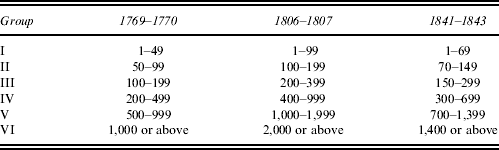
Figure 3 gives a totally different idea of the evolution of dowries than does Figure 2. Here we see that the distribution of dowries in the first and second period are much more alike. Nevertheless, there was still an overall improvement in the timespan between 1806–1807 and 1841–1843: a decrease in marriage contracts with lower payments and a significant increase in the upper groups.
The result illustrates very clearly that the dowry market adapted well to that of the wheat price when it rose. But it also shows that when the wheat price fell, families in the Girona region maintained the previous level of dowries in monetary terms, which means that their real value – measured in wheat – augmented.
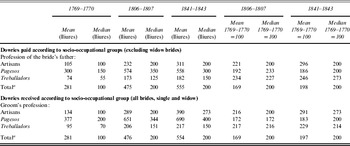
So far we have studied the general movement of dowries. How did the different social groups behave? The analysis of the evolution of mean and median dowries paid and received by the different socio-occupational groups (see Table 3) indicates that the general pattern that we have just mentioned was reproduced in all groups. Pagesos, treballadors and artisans, the three groups that are big enough to allow for individual analysis, increased their dowries significantly in nominal terms during the years of high inflation at the end of the eighteenth and at the beginning of the nineteenth centuries and maintained these values during the years of deflation after the Napoleonic wars. The degree to which the different groups increased their dowries throughout the period was quite similar, but the most humble group, the treballadors, increased their dowries more than the average for all groups and more than the other rural group, the pagesos.
Mean and median dowries paid and received in the Girona region, 1769–1843, according to occupational groups (in lliures at current prices)

a Includes the rest of the socio-occupational groups in addition to the three listed individually.
Source: Arxiu Històric de Girona, Registre d'Hipoteques.
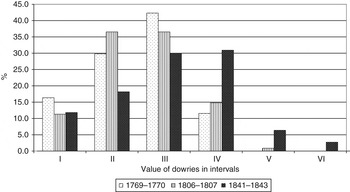
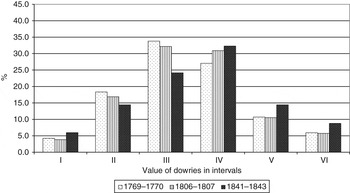
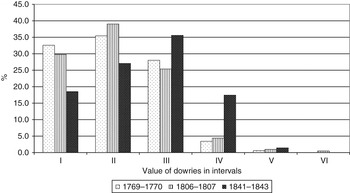
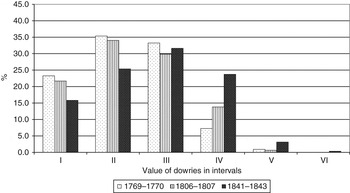
The especially positive evolution of treballador dowries is even stronger when we analyse the distribution of frequencies instead of the synthetic indicators of mean and median. The information in Figures 4, 5 and 6 is based on the real value of dowries of women differentiated by the occupation of their fathers. Here we have not included widows, since many of them brought assets to the marriage obtained from the family of their first husbands, not from their own. We only consider the three social groups for which we have sufficient information: artisans, pagesos and treballadors.
Dowries paid by artisans in the Girona region, 1769–1843. For dowry payment categories I–VI, see Table 2. (Source: Arxiu Històric de Girona, Registre d'Hipoteques.)

Dowries paid by pagesos in the Girona region, 1769–1843. For dowry payment categories I–VI, see Table 2. (Source: Arxiu Històric de Girona, Registre d'Hipoteques.)

Dowries paid by treballadors in the Girona region, 1769–1843. For dowry payment categories I–VI, see Table 2. (Source: Arxiu Històric de Girona, Registre d'Hipoteques.)

For the artisans, Figure 4 shows a substantial improvement between 1806 and 1843: levels II and III diminished significantly (although the first level did not, and, in fact, even increased slightly), while the percentage of dowry payments of the upper values rose considerably. As for pagesos, the first two levels in Figure 5 saw little change throughout all three periods, but the percentage of ‘medium’ dowries (interval III) fell sharply between 1806 and 1843, while that of the upper levels increased. The dowries of the daughters of treballadors manifest the most obvious positive evolution during this time, with changes in all levels of payment. The decrease in the first-level dowries was significant, as was the increase in the number of dowries of the third and fourth level.
The development is a little different when we observe the evolution of dowries in relation to the occupation of the groom. Figures 7, 8 and 9 present the evolution of dowries received by the husbands who appear as artisans, treballadors and pagesos in the marriage contracts. Here we have also included marriages to widows. In all three cases, we observe again that grooms improved their position, especially between 1806 and 1843, and even the poorest group did so.
Dowries received by artisans in the Girona region, 1769–1843. For dowry payment categories I–VI, see Table 2. (Source: Arxiu Històric de Girona, Registre d'Hipoteques.)

Dowries received by pagesos in the Girona region, 1769–1843. For dowry payment categories I–VI, see Table 2. (Source: Arxiu Històric de Girona, Registre d'Hipoteques.)

Dowries received by treballadors in the Girona region, 1769–1843. For dowry payment categories I–VI, see Table 2. (Source: Arxiu Històric de Girona, Registre d'Hipoteques.)

Again, the case of the treballadors stands out, not only because the lowest dowries diminished and the increase in relatively high dowries (interval IV) was especially important during the first half of the nineteenth century. What is most striking here is that the improvement is already clear from the first to the second period (1769–1770 to 1806–1807) when the percentage of dowries of the two lower levels decreased slightly and that of group IV increased. The positive evolution of dowries received by treballadors (theoretically at the lowest social level), together with their demographic growth that is also reflected in our sample, reveals that an important part of the overall movement of dowries was driven by this social group.
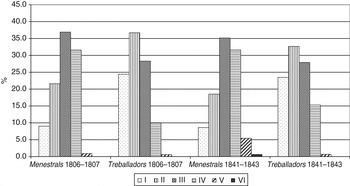
The significant improvement in the dowries received by this last group prompts us to analyse the trends in dowry payments comparing grooms who are identified in the sources as treballadors with those who are described as menestrals after 1806–1807. The comparison is shown in Figure 10 and reveals that, in the years where both occupational labels occur, dowries received by menestral grooms tended to be much higher than those of treballador grooms.Footnote 29 This would seem to confirm the hypothesis mentioned above of the enhancement of their social status by members of this social group.
Dowries received by treballadors and menestrals in the Girona region, 1769–1843 (intervals of equivalent values). For dowry payment categories I–VI, see Table 2. (Source: Arxiu Històric de Girona, Registre d'Hipoteques.)

5. WHO MARRIED WHOM?
As the previous paragraphs show, there are obvious signs of social change to be observed here. First of these is an ‘inflation’ of dowries, especially for the most humble groups in the rural world. In addition, the relative weighting of the different social groups within this society shifted, with a notable increase in the number of treballadors who became, by far, the dominant group. Finally, a new group emerged from the ranks of treballadors, identified with a new label, that of menestral, which came to describe the better off among the treballadors. Were all these changes reflected in marriage patterns, such as trends in patterns of social or geographical endogamy or exogamy? In the next two sections we present information related to these questions. As we will see, surprisingly enough, marriage patterns hardly show any significant variation throughout the period, a fact that allows us to comment on all three periods at once and to underline the specific characteristics of each social group. However, the characterisation of the behaviour of each group is, we insist, as important as the fact that there were hardly any changes between 1769 and 1843.
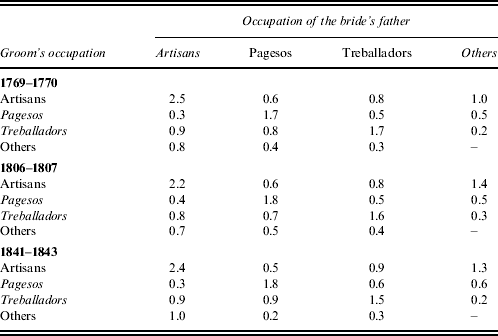
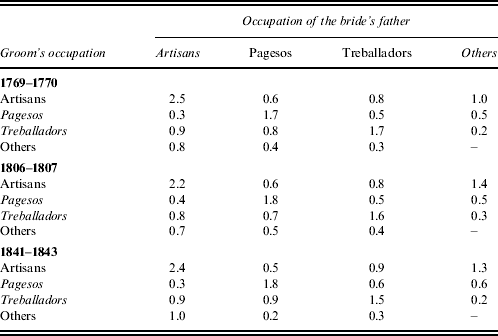
To study occupational endogamy we analysed the number of marriages celebrated between grooms from the three most represented groups (artisans, pagesos and treballadors) and women with fathers in the same occupation. In order to know whether these marriages indicate a tendency for some combinations of occupational backgrounds to be more frequent than others, we calculated the number of marriages that would be expected if the only determining factor were the relative weight of each occupational group within the marrying population. Table 4 shows the ratios between real and expected marriages for the possible combinations considered here.Footnote 30 A ratio of 1 indicates that observed and expected marriages match, less than 1 indicates fewer than expected, more than 1 equals higher.
Occupational endogamy in the Girona region, 1769–1843: the number of observed marriages for each marriage expected given the size of each occupation groupa
a We do not present the numbers for marriages between couples of other occupations (included in the category ‘others’) because the resulting ratios would falsify the real degree of endogamy.
Source: Arxiu Històric de Girona, Registre d'Hipoteques.
The results of Table 4 show endogamous behaviour by all occupational groups considered here, since the number of real marriages between members of families of the same occupation is clearly superior to the expected value. We also detect notable differences in the intensity of endogamy: according to Table 4, artisans represent the most endogamous and treballadors the most exogamous group, while pagesos are situated in between.Footnote 31 Nevertheless, any assessment of the relative importance of endogamy is conditioned by the imbalances in the sample between the numbers of grooms and brides in some occupational categories.Footnote 32 These differences derive from comparing two generations (that is, between grooms and the fathers of the brides), which means that any increase in a particular occupation between generations would increase the number of grooms relative to brides with fathers in that same occupation. Another factor to keep in mind, at least in the case of pagesos, is the inheritance system: as already mentioned, many of the second-born sons of pagesos were treballadors. This explains why our sample registers a much higher number of daughters of pagesos than pagès grooms. These imbalances between men and women imply the existence of a certain degree of ‘forced’ exogamy in some groups. Not all daughters of pagesos could marry a pagès, because there were many more of the first; not all treballador grooms could marry a daughter of a treballador because there were many more of the first. This increases the degree of exogamy in these groups compared with the artisans, where the gender imbalance was less marked.
Table 4 also establishes important differences between the three groups as far as their exogamous marriages are concerned. The main tendencies are the following:
(a) The relative frequency of marriages between artisans and treballadors. Although the number is smaller than expected, it is only slightly so. The tendency of artisans to marry the daughters of treballadors is significantly greater than their inclination towards the daughters of pagesos, the latter being far below the expected value. The relatively high number of marriages between artisans and treballadors could reflect the fact that there were many families in both groups that offered similar dowries (as shown in the previous figures, the distribution of the value of dowries is more alike between artisans and treballadors than between these two groups and the pagesos). Also, both collectives frequently had similar residence patterns (living in villages and towns rather than on farms), which generated closer neighbourly relations.
(b) Pagès grooms who married outside their collective did not choose their bride from one specific group, as we can see from the fact that the number of marriages observed between pagesos and women from the other groups is much lower than expected. The heterogeneity of the pagès group, a label that includes, as mentioned above, both share-croppers and farm owners (the latter category including both farmers who worked the land and rentiers), explains why their exogamous marriages are found at both extremes of the social scale. Next to the daughters of pagesos of a similar status, share-croppers or owners of modest exploitations must have preferred the daughters of treballadors who offered dowries proportional to their own level of wealth and who, in addition, would have certain experience in agricultural work. By contrast, the upper level of the pagès group may have aspired to marry into rentier families (which we have included in the ‘others’ category).Footnote 33
(c) The differences that existed between the marital choices of grooms and brides from the same social group. Thus, the probability of a daughter of a pagès marrying a treballador was much higher than that of a treballador daughter marrying a pagès groom. These differences, in part explained by the gender imbalances within the occupations we described earlier, are also consistent with the effects of the primogeniture-based inheritance system which meant that marriages of younger sons and daughters involved downwards social mobility compared with the position of their parents.Footnote 34 Since the majority of the grooms in our sample were heirs, and thus of the same status as their fathers, most treballador grooms were the sons of treballadors. In the few cases, however, where the daughters of pagesos married treballadors who were not heirs, the latter could in fact be sons of pagesos (since, as has already been noted, younger sons of pagesos often were treballadors). These are thus cases of marriages between individuals born into the same social group. By contrast, marriages of pagesos to the daughters of treballadors implied a marriage between families of different social status, since the label pagès clearly indicated ownership or cultivation of a mas.
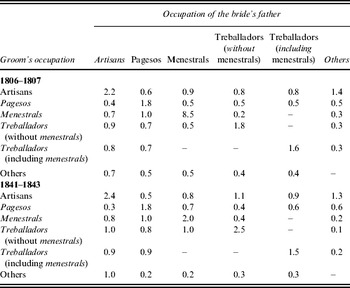
Finally, we have to distinguish between the marriage patterns of treballadors and menestrals after 1806–1807 (see Table 5). Most significant is the high index of endogamy in the menestral group. Menestral grooms rarely married the daughters of treballadors, while menestral daughters did marry treballador grooms in 1841–1843, a pattern consistent with the tendency just described whereby women were more likely to marry below their status than were their eldest brothers. These differences between the marriage choices of treballadors and menestrals serve to reinforce the idea that the appearance of the new label menestral is indicative of actual social change. The relationships of both groups with artisans are very similar, but it seems that pagesos (and daughters of pagesos) preferred to marry menestrals rather than treballadors.
Number of observed marriages for each marriage expected given the size of each occupation group, separating treballadors and menestrals, Girona region, 1806–1843

Source: Arxiu Històric de Girona, Registre d'Hipoteques.
6. GEOGRAPHICAL ENDOGAMY ACCORDING TO OCCUPATION AND VALUE OF THE DOWRY
Marriage contracts also provide information on the spatial range of the marriage market. The Girona region turns out to be particularly suitable for this type of study, since here only a few marriages involved a groom or a bride from outside the region.
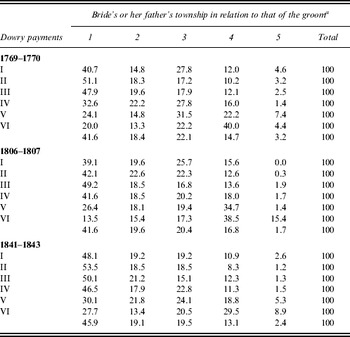
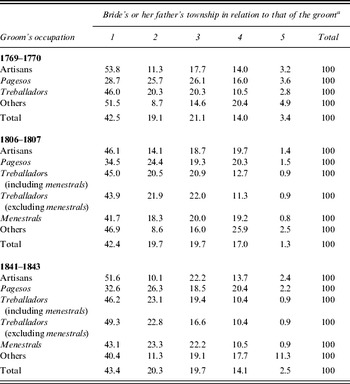
Here there were also few changes over the three generations. Tables 6 and 7 show that there were different tendencies, according to social group or the value of the dowry, to move within the territory at the time of marriage. As we have seen already with social endogamy, however, the most surprising fact is that, despite the variation in the size of each group and of each level of dowry, there were no significant changes over time in the patterns of mobility for reasons of marriage.
Geographical endogamy in the Girona region, 1769–1843, according to the value of the dowry (in percentages)

a 1: Same township (according to the current division of municipalities); 2: neighbouring township; 3: same county (excluding neighbouring townships); 4: neighbouring county (excluding bordering townships); 5: other counties (in the majority of cases, counties or comarques not adjacent to the Girona region or to the province of Barcelona).
Source: Arxiu Històric de Girona, Registre d'Hipoteques.
Geographical endogamy in the Girona region, 1769–1843, according to occupation (in percentages)

a 1: Same township (according to the current division of municipalities); 2: neighbouring township; 3: same county (excluding neighbouring townships); 4: neighbouring county (excluding bordering townships); 5: other counties (in the majority of cases, counties or comarques not adjacent to the Girona region or to the province of Barcelona).
Source: Arxiu Històric de Girona, Registre d'Hipoteques.
The majority of couples married within very close geographical areas. In the three time periods, between 80 per cent and 85 per cent of the marriages were between grooms and brides from the same township, from neighbouring townships or from the same county (comarca). In the first two cases, a move in order to marry was almost always over a distance of under 10 km, and even in the last case the couple rarely moved further than 30 or 40 km from their original residence.
There are, however, differences in the spatial range of the marriage market according to occupational groups and value of dowries. As far as the origin of grooms according to the dowry was concerned (Table 6), those receiving the highest-value dowries showed the smallest degree of geographical endogamy. As might be expected, those social groups with higher incomes, and therefore fewer in number, had to broaden the area of recruitment for spouses, frequently beyond their own county, in order to achieve a marriage with a spouse of similar status. The medium-ranged dowries (groups II, III and IV) recruited spouses from within the most restricted territorial range: high percentages, almost all over 40 per cent, did so within the same township. By contrast, a higher proportion of families with the lowest dowries (group I), searched for spouses in the same county, but not in neighbouring villages. To a large extent, this also reflects the differences in the size of the groups: those groups with more members, i.e. II, III and IV, had more options to marry within a restricted area, compared with the smaller groups. All of this strengthens the hypothesis that the value of the dowry was a relevant factor when it came to deciding who would marry whom, since these patterns suggest that all groups, not only the better-off ones, widened, when necessary, their territorial range to find spouses of a similar level of wealth.
The sample also shows differences in the territorial scope of the marriage market according to the occupation of the groom. Of all the groups we have analysed, pagesos were the ones who most frequently married partners from other counties and least within the same township, whilst also marrying within neighbouring townships more frequently than the other groups. This variation was in part a consequence of the heterogeneity of this occupational group as described above: it was the wealthier pagesos who had to widen their geographical range to find spouses of a similar level of income. Geographical exogamy, however, was also a consequence of their residential patterns: if, as we have seen, pagesos lived on dispersed farms and prioritised marriages to daughters of other pagesos, it would have been difficult for them to marry within the restricted area of their own township.
The marriage market of treballador grooms was more restricted. We have distinguished between those who continued to identify themselves as treballadors after 1806–1807 and the new menestrals. The similarities in the behaviour of both groups are obvious. The only appreciable difference could be the relative high percentage of marriages between menestral grooms and brides from different counties in 1806–1807, which may simply reflect the small number of those labelled as menestrals in this period.
As for artisans, we detect the existence of a double circuit. On the one hand, a strictly local one: artisans married to a significant proportion (always above 45 per cent) within the same township, but very little with neighbouring townships. On the other hand, however, they married within relatively distant areas to a clearly higher degree than treballadors. This is consistent with the high degree of occupational endogamy of artisans. As a collective with a high presence in towns or villages of a certain size, but not so much in smaller places, occupational endogamy required marrying spouses from the same neighbourhood, where size of location permitted or, to a lesser degree, from other, similar places, and made marriage to spouses from the immediate rural hinterland less likely.
7. CONCLUSION AND RESEARCH PERSPECTIVES
The analysis of the evolution of dowries in all sectors of society has allowed us to observe not only the trend in incomes over time, but also the changes in their distribution. In the Girona region, families did not lower the real value of dowries in a period often considered difficult for peasant economies. The median dowry reached 100 lliures in 1769–1770 and 200 lliures in the nineteenth century, approximately equivalent to the annual wage of a construction worker in the first two periods analysed and still more in 1841 and 1843.Footnote 35 In the case of treballadors, the median dowry increased from the equivalent of 11 to 13 months' wages between 1769–1770 and 1841–1843. Reasons for this increase are discussed below.
The continuities over time in social and geographical endogamy seem to suggest that there were no important changes in marriage patterns. Nevertheless, the question remains whether the observed increase in dowries could be related to underlying demographic factors. Some hypotheses can be rejected. For example, that the increase in the value of dowries reflects a significant shortage of men and thus greater ‘competition’ among women. This hypothesis can be rejected on the basis of a lack of evidence for significant emigration during this periodFootnote 36 and, indeed, on the basis that it was relatively easy to gain access to a plot of land through emphyteutic contracts.Footnote 37 Moreover, although the majority of marriage contracts give information only on marriages of heirs, we should remember that one of the most important social changes at this time, the significant increase in the number of treballadors, could be a reflection of an increase in the number of younger sons on the marriage market and, therefore, an increase in the number of marriageable men in general.Footnote 38 Another hypothesis would be a significant fall in the mean number of children per family, but demographic studies situate the decrease of matrimonial fertility in Catalonia in the 1830s and 1840s, and thus it does not affect our samples.Footnote 39
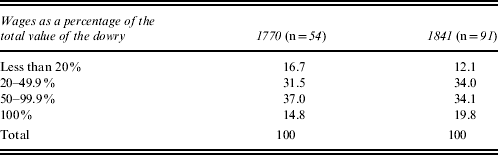
Finally, it is obvious that a delay in the age of women at first marriage could allow a greater capacity for saving, in addition to a reduction in her fertility, which would increase the value of dowries that could be paid to the next generation. In addition, there is also the possibility that the soldada (that is, wages earned by women outside the family household) played an important role in the increase of dowries for the daughters of treballadors. However, the little empirical information available on these issues does not suggest that any were decisive in this regard. First, there seems to have been no substantial change in the average age at marriage, which, according to the census of Floridablanca in 1787, was around 24 years for women. Moreover, some studies suggest that the age at marriage may even have fallen during the first half of the nineteenth century.Footnote 40 Second, information available on the soldades suggests that these contributed only marginally to the rise in dowries over the period under consideration. The analysis of dowries from 1770 and from 1841 does confirm that the women who most often supplemented their dowries with wages were indeed the daughters of treballadors.Footnote 41 Between 15 per cent and 20 per cent of brides from this group added wages earned by working outside the family household, compared with an average for all brides of 10 per cent and much higher than the percentage of daughters of pagesos (5 per cent). Over time, however, the percentage of women who supplemented their dowries with their wages remained very stable at around 10 per cent. Similarly, the median contribution of wages to the dowry doubled in nominal terms, thereby simply keeping up with the increase in the overall value of the dowry, and the percentage of the total dowry contributed by wages only increased slightly between both dates, as shown in Table 8.
Contribution of wages to dowry payments in the Girona region, 1770 and 1841
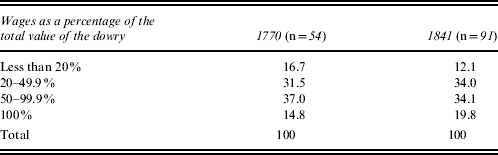
Sources: Arxiu Històric de Girona, Arxiu Comarcal de l'Alt Empordà, Arxiu Comarcal de la Selva, Protocols notarials, 1770 and 1841.
When it comes to explaining the increase not only in the number of treballadors but also in the dowries paid by this social group (in periods of both rising and falling prices), the opportunities and possibilities (agricultural and others, male and female, licit and illicit, within the household and outside) of incrementing the incomes of small family economies have to be taken into account. One hypothesis might be that a rise in land values led to an increase in the value of dowries. Moreover, we should also consider that emphyteutic contracts gave households access to land without the prior necessity of accumulating capital.Footnote 42 Household economies may also have benefited from the introduction of new crops, such as potatoes, and the expansion of vineyards, or the intensification of forest exploitations, especially of cork oaks. On a more negative note, we should not discount the possibility that this increase in dowries might have represented many sacrifices for families, especially in the last years considered here.Footnote 43 There is also the possibility that younger daughters became more aware of their inheritance rights and more insistent in claiming the dowries to which they were entitled according to the llegítima. Such claims could have been the prelude to the erosion of traditional inheritance practices observed among these groups a few decades later.
An investigation of all these hypotheses would fill an important void in the current historiography. In the middle of the nineteenth century, the more prominent landowners of the region took up many initiatives dedicated to the modernisation of agriculture (associations, magazines, contests, farm schools), and thereby became known as leaders of agricultural change. This idea that there were important transformations in the Catalan countryside after the 1840s, and not before, has contributed to a lack of studies on the first half of the nineteenth century. Any attempt to fill this gap should bear in mind the possibility that important social transformations took place among lower social groups. Narcís Fages de Romà, a rentier and one of the main promoters of agricultural associations in the province of Girona, had an aphorism that not only suggests the existence of such transformations but also gives menestrals a leading role in them:Footnote 44
Menestrals have taken a central place in our study. We should ask ourselves, however, why it has taken so long to recognise that agricultural growth could have started with the most humble sectors of the population.
ACKNOWLEDGEMENTS
This study forms part of the project ‘Social dynamics and historical change in rural societies. Analysis of groups and social inequalities’ (HAR 2008-02960/HIST) and ‘Impoverishment and enrichment processes in rural societies: a way of studying social dynamics in history’ (HAR 2011-25077/HIST). A preliminary version was presented at the IX Congress of the Asociación de Demografía Histórica (ADEH) in Sao Miguel (Açores, Portugal) in June 2010. We thank Julie Marfany and the anonymous referees for helpful comments that have substantially improved the first version of this article.