Introduction
Anxiety and fear are normal emotional responses to threatening situations, but these responses are exaggerated or prolonged in patients with anxiety disorders. Such anxiety, fear or avoidance of the perceived threats disturbs social, personal and occupational functioning as well as quality of life in patients with anxiety disorders (Craske et al., Reference Craske, Stein, Eley, Milad, Holmes, Rapee and Wittchen2017). Anxiety disorders, namely, generalized anxiety disorder (GAD), panic disorder (PD) and phobias [social phobia/social anxiety disorder (SAD), agoraphobia and specific phobia], are common psychiatric disorders that have strong lifetime comorbidity with each other. In addition to these disorders, the diagnostic category of anxiety disorders includes obsessive-compulsive disorder (OCD) and posttraumatic stress disorder (PTSD) as of the fourth edition of the Diagnostic and Statistical Manual of Mental Disorders (DSM-IV). The overall lifetime prevalence of anxiety disorders in this broad sense is over 25% (Kessler et al., Reference Kessler, Berglund, Demler, Jin, Merikangas and Walters2005, Reference Kessler, Petukhova, Sampson, Zaslavsky and Wittchen2012). OCD, PTSD and anxiety disorders have distinct causative and neurobiological characteristics; therefore, OCD and PTSD are excluded from the diagnostic category of anxiety disorders and are included in independent categories in the criteria in the fifth edition of the DSM (DSM-5) (Tambs et al., Reference Tambs, Czajkowsky, Roysamb, Neale, Reichborn-Kjennerud, Aggen, Harris, Orstavik and Kendler2009; Monzani et al., Reference Monzani, Rijsdijk, Harris and Mataix-Cols2014; Kupfer, Reference Kupfer2015; Marras et al., Reference Marras, Fineberg and Pallanti2016; Maron et al., Reference Maron, Lan and Nutt2018).
Anxiety disorders, including GAD, PD, SAD, agoraphobia and specific phobia, are complex disorders with a combination of genetic and environmental factors. Family and twin studies across anxiety disorders suggest genetic and environmental factors underlying the etiology of the disorders, with moderate familial aggregation (odds ratio = 3–6) and heritability (h 2 = 0.30–0.50) (Hettema et al., Reference Hettema, Neale and Kendler2001; Van Houtem et al., Reference Van Houtem, Laine, Boomsma, Ligthart, van Wijk and De Jongh2013; Scaini et al., Reference Scaini, Belotti and Ogliari2014; Shimada-Sugimoto et al., Reference Shimada-Sugimoto, Otowa and Hettema2015). Shared genetic risk factors across most anxiety disorders have been indicated (Hettema et al., Reference Hettema, Prescott, Myers, Neale and Kendler2005; Tambs et al., Reference Tambs, Czajkowsky, Roysamb, Neale, Reichborn-Kjennerud, Aggen, Harris, Orstavik and Kendler2009). Genome-wide association studies (GWASs) for specific anxiety and related disorders, such as PD (Erhardt et al., Reference Erhardt, Czibere, Roeske, Lucae, Unschuld, Ripke, Specht, Kohli, Kloiber, Ising, Heck, Pfister, Zimmermann, Lieb, Putz, Uhr, Weber, Deussing, Gonik, Bunck, Kebler, Frank, Hohoff, Domschke, Krakowitzky, Maier, Bandelow, Jacob, Deckert, Schreiber, Strohmaier, Nothen, Cichon, Rietschel, Bettecken, Keck, Landgraf, Muller-Myhsok, Holsboer and Binder2011; Otowa et al., Reference Otowa, Kawamura, Nishida, Sugaya, Koike, Yoshida, Inoue, Yasuda, Nishimura, Liu, Konishi, Nishimura, Shimada, Kuwabara, Tochigi, Kakiuchi, Umekage, Miyagawa, Miyashita, Shimizu, Akiyoshi, Someya, Kato, Yoshikawa, Kuwano, Kasai, Kato, Kaiya, Tokunaga, Okazaki, Tanii and Sasaki2012), phobias (Walter et al., Reference Walter, Glymour, Koenen, Liang, Tchetgen Tchetgen, Cornelis, Chang, Rimm, Kawachi and Kubzansky2013) and generalized anxiety symptoms (Dunn et al., Reference Dunn, Sofer, Gallo, Gogarten, Kerr, Chen, Stein, Ursano, Guo, Jia, Qi, Rotter, Argos, Cai, Penedo, Perreira, Wassertheil-Smoller and Smoller2017), have been performed to identify genetic susceptibility to anxiety disorders. However, these GWASs have been unable to detect any genome-wide significant variants because of small sample sizes and low statistical power. In contrast, the Anxiety NeuroGenetics STudy (ANGST) Consortium recently conducted the largest GWAS of five core anxiety disorders, including GAD, PD, SAD, agoraphobia and specific phobias, to identify genetic susceptibility shared across these anxiety disorders (Otowa et al., Reference Otowa, Hek, Lee, Byrne, Mirza, Nivard, Bigdeli, Aggen, Adkins, Wolen, Fanous, Keller, Castelao, Kutalik, Van der Auwera, Homuth, Nauck, Teumer, Milaneschi, Hottenga, Direk, Hofman, Uitterlinden, Mulder, Henders, Medland, Gordon, Heath, Madden, Pergadia, van der Most, Nolte, van Oort, Hartman, Oldehinkel, Preisig, Grabe, Middeldorp, Penninx, Boomsma, Martin, Montgomery, Maher, van den Oord, Wray, Tiemeier and Hettema2016). The GWAS applied two types of phenotypic approaches: (i) categorical case–control comparisons based on having any anxiety disorder diagnosis in 17 310 subjects and (ii) quantitative phenotypic factor scores derived from a multivariate analysis combining information across the clinical phenotypes in 18 186 subjects. Each GWAS identified different genome-wide significant loci: 3q12.3 for the case–control model and 2p21 for the factor score model. These GWASs successfully captured the comorbidity and shared genetic risk among anxiety disorders.
Anxiety disorders may also share genetic risk factors not only among themselves but also with other psychiatric disorders, including autism spectrum disorder (ASD), attention-deficit/hyperactivity disorder (ADHD), major depressive disorder (MDD), bipolar disorder (BIP), schizophrenia (SCZ), anorexia nervosa (AN), OCD and PTSD. In fact, twin studies suggest a strong genetic correlation between anxiety disorders and MDD (Kendler et al., Reference Kendler, Gardner, Gatz and Pedersen2007; Mosing et al., Reference Mosing, Gordon, Medland, Statham, Nelson, Heath, Martin and Wray2009). Anxiety disorders are also common and highly heritable diseases (h 2 = 0.40–0.90) with a complex, overlapping polygenic architecture (Smoller et al., Reference Smoller, Ripke, Lee, Neale, Nurnberger, Santangelo, Sullivan, Perlis, Purcell, Fanous and Neale2013; Anttila et al., Reference Anttila, Bulik-Sullivan, Finucane, Walters, Bras, Duncan, Escott-Price, Falcone, Gormley, Malik, Patsopoulos, Ripke, Wei, Yu, Lee, Turley, Grenier-Boley, Chouraki, Kamatani, Berr, Letenneur, Hannequin, Amouyel, Boland, Deleuze, Duron, Vardarajan, Reitz, Goate, Huentelman, Kamboh, Larson, Rogaeva, St George-Hyslop, Hakonarson, Kukull, Farrer, Barnes, Beach, Demirci, Head, Hulette, Jicha, Kauwe, Kaye, Leverenz, Levey, Lieberman, Pankratz, Poon, Quinn, Saykin, Schneider, Smith, Sonnen, Stern, Van Deerlin, Van Eldik, Harold, Russo, Rubinsztein, Bayer, Tsolaki, Proitsi, Fox, Hampel, Owen, Mead, Passmore, Morgan, Nothen, Rossor, Lupton, Hoffmann, Kornhuber, Lawlor, McQuillin, Al-Chalabi, Bis, Ruiz, Boada, Seshadri, Beiser, Rice, van der Lee, De Jager, Geschwind, Riemenschneider, Riedel-Heller, Rotter, Ransmayr, Hyman, Cruchaga, Alegret, Winsvold, Palta, Farh, Cuenca-Leon, Furlotte, Kurth, Ligthart, Terwindt, Freilinger, Ran, Gordon, Borck, Adams, Lehtimaki, Wedenoja, Buring, Schurks, Hrafnsdottir, Hottenga, Penninx, Artto, Kaunisto, Vepsalainen, Martin, Montgomery, Kurki, Hamalainen, Huang, Huang, Sandor, Webber, Muller-Myhsok, Schreiber, Salomaa, Loehrer, Gobel, Macaya, Pozo-Rosich, Hansen, Werge, Kaprio, Metspalu, Kubisch, Ferrari, Belin, van den Maagdenberg, Zwart, Boomsma, Eriksson, Olesen, Chasman, Nyholt, Avbersek, Baum, Berkovic, Bradfield, Buono, Catarino, Cossette, De Jonghe, Depondt, Dlugos, Ferraro, French, Hjalgrim, Jamnadas-Khoda, Kalviainen, Kunz, Lerche, Leu, Lindhout, Lo, Lowenstein, McCormack, Moller, Molloy, Ng, Oliver, Privitera, Radtke, Ruppert, Sander, Schachter, Schankin, Scheffer, Schoch, Sisodiya, Smith, Sperling, Striano, Surges, Thomas, Visscher, Whelan, Zara, Heinzen, Marson, Becker, Stroink, Zimprich, Gasser, Gibbs, Heutink, Martinez, Morris, Sharma, Ryten, Mok, Pulit, Bevan, Holliday, Attia, Battey, Boncoraglio, Thijs, Chen, Mitchell, Rothwell, Sharma, Sudlow, Vicente, Markus, Kourkoulis, Pera, Raffeld, Silliman, Boraska Perica, Thornton, Huckins, William Rayner, Lewis, Gratacos, Rybakowski, Keski-Rahkonen, Raevuori, Hudson, Reichborn-Kjennerud, Monteleone, Karwautz, Mannik, Baker, O'Toole, Trace, Davis, Helder, Ehrlich, Herpertz-Dahlmann, Danner, van Elburg, Clementi, Forzan, Docampo, Lissowska, Hauser, Tortorella, Maj, Gonidakis, Tziouvas, Papezova, Yilmaz, Wagner, Cohen-Woods, Herms, Julia, Rabionet, Dick, Ripatti, Andreassen, Espeseth, Lundervold, Steen, Pinto, Scherer, Aschauer, Schosser, Alfredsson, Padyukov, Halmi, Mitchell, Strober, Bergen, Kaye, Szatkiewicz, Cormand, Ramos-Quiroga, Sanchez-Mora, Ribases, Casas, Hervas, Arranz, Haavik, Zayats, Johansson, Williams, Dempfle, Rothenberger, Kuntsi, Oades, Banaschewski, Franke, Buitelaar, Arias Vasquez, Doyle, Reif, Lesch, Freitag, Rivero, Palmason, Romanos, Langley, Rietschel, Witt, Dalsgaard, Borglum, Waldman, Wilmot, Molly, Bau, Crosbie, Schachar, Loo, McGough, Grevet, Medland, Robinson, Weiss, Bacchelli, Bailey, Bal, Battaglia, Betancur, Bolton, Cantor, Celestino-Soper, Dawson, De Rubeis, Duque, Green, Klauck, Leboyer, Levitt, Maestrini, Mane, De-Luca, Parr, Regan, Reichenberg, Sandin, Vorstman, Wassink, Wijsman, Cook, Santangelo, Delorme, Roge, Magalhaes, Arking, Schulze, Thompson, Strohmaier, Matthews, Melle, Morris, Blackwood, McIntosh, Bergen, Schalling, Jamain, Maaser, Fischer, Reinbold, Fullerton, Guzman-Parra, Mayoral, Schofield, Cichon, Muhleisen, Degenhardt, Schumacher, Bauer, Mitchell, Gershon, Rice, Potash, Zandi, Craddock, Ferrier, Alda, Rouleau, Turecki, Ophoff, Pato, Anjorin, Stahl, Leber, Czerski, Cruceanu, Jones, Posthuma, Andlauer, Forstner, Streit, Baune, Air, Sinnamon, Wray, MacIntyre, Porteous, Homuth, Rivera, Grove, Middeldorp, Hickie, Pergadia, Mehta, Smit, Jansen, de Geus, Dunn, Li, Nauck, Schoevers, Beekman, Knowles, Viktorin, Arnold, Barr, Bedoya-Berrio, Bienvenu, Brentani, Burton, Camarena, Cappi, Cath, Cavallini, Cusi, Darrow, Denys, Derks, Dietrich, Fernandez, Figee, Freimer, Gerber, Grados, Greenberg, Hanna, Hartmann, Hirschtritt, Hoekstra, Huang, Huyser, Illmann, Jenike, Kuperman, Leventhal, Lochner, Lyon, Macciardi, Madruga-Garrido, Malaty, Maras, McGrath, Miguel, Mir, Nestadt, Nicolini, Okun, Pakstis, Paschou, Piacentini, Pittenger, Plessen, Ramensky, Ramos, Reus, Richter, Riddle, Robertson, Roessner, Rosario, Samuels, Sandor, Stein, Tsetsos, Van Nieuwerburgh, Weatherall, Wendland, Wolanczyk, Worbe, Zai, Goes, McLaughlin, Nestadt, Grabe, Depienne, Konkashbaev, Lanzagorta, Valencia-Duarte, Bramon, Buccola, Cahn, Cairns, Chong, Cohen, Crespo-Facorro, Crowley, Davidson, DeLisi, Dinan, Donohoe, Drapeau, Duan, Haan, Hougaard, Karachanak-Yankova, Khrunin, Klovins, Kucinskas, Lee Chee Keong, Limborska, Loughland, Lonnqvist, Maher, Mattheisen, McDonald, Murphy, Nenadic, van Os, Pantelis, Pato, Petryshen, Quested, Roussos, Sanders, Schall, Schwab, Sim, So, Stogmann, Subramaniam, Toncheva, Waddington, Walters, Weiser, Cheng, Cloninger, Curtis, Gejman, Henskens, Mattingsdal, Oh, Scott, Webb, Breen, Churchhouse, Bulik, Daly, Dichgans, Faraone, Guerreiro, Holmans, Kendler, Koeleman, Mathews, Price, Scharf, Sklar, Williams, Wood, Cotsapas, Palotie, Smoller, Sullivan, Rosand, Corvin, Neale, Schott, Anney, Elia, Grigoroiu-Serbanescu, Edenberg and Murray2018; Yilmaz et al., Reference Yilmaz, Halvorsen, Bryois, Yu, Thornton, Zerwas, Micali, Moessner, Burton, Zai, Erdman, Kas, Arnold, Davis, Knowles, Breen, Scharf, Nestadt, Mathews, Bulik, Mattheisen and Crowley2018). Large-scale GWASs (n = 9537–480 359) of psychiatric disorders, including ASD (Grove et al., Reference Grove, Ripke, Als, Mattheisen, Walters, Won, Pallesen, Agerbo, Andreassen, Anney, Belliveau, Bettella, Buxbaum, Bybjerg-Grauholm, Bækved-Hansen, Cerrato, Chambert, Christensen, Churchhouse, Dellenvall, Demontis, De Rubeis, Devlin, Djurovic, Dumont, Goldstein, Hansen, Hauberg, Hollegaard, Hope, Howrigan, Huang, Hultman, Klei, Maller, Martin, Martin, Moran, Nyegaard, Nærland, Palmer, Palotie, Pedersen, Pedersen, Poterba, Poulsen, Pourcain, Qvist, Rehnström, Reichenberg, Reichert, Robinson, Roeder, Roussos, Saemundsen, Sandin, Satterstrom, Smith, Stefansson, Stefansson, Steinberg, Stevens, Sullivan, Turley, Walters, Xu, Geschwind, Nordentoft, Hougaard, Werge, Mors, Mortensen, Neale, Daly and Børglum2017), ADHD (Demontis et al., Reference Demontis, Walters, Martin, Mattheisen, Als, Agerbo, Belliveau, Bybjerg-Grauholm, Bækved-Hansen, Cerrato, Chambert, Churchhouse, Dumont, Eriksson, Gandal, Goldstein, Grove, Hansen, Hauberg, Hollegaard, Howrigan, Huang, Maller, Martin, Moran, Pallesen, Palmer, Pedersen, Pedersen, Poterba, Poulsen, Ripke, Robinson, Satterstrom, Stevens, Turley, Won, Andreassen, Burton, Boomsma, Cormand, Dalsgaard, Franke, Gelernter, Geschwind, Hakonarson, Haavik, Kranzler, Kuntsi, Langley, Lesch, Middeldorp, Reif, Rohde, Roussos, Schachar, Sklar, Sonuga-Barke, Sullivan, Thapar, Tung, Waldman, Nordentoft, Hougaard, Werge, Mors, Mortensen, Daly, Faraone, Børglum and Neale2017), MDD (Wray et al., Reference Wray, Ripke, Mattheisen, Trzaskowski, Byrne, Abdellaoui, Adams, Agerbo, Air, Andlauer, Bacanu, Baekvad-Hansen, Beekman, Bigdeli, Binder, Blackwood, Bryois, Buttenschon, Bybjerg-Grauholm, Cai, Castelao, Christensen, Clarke, Coleman, Colodro-Conde, Couvy-Duchesne, Craddock, Crawford, Crowley, Dashti, Davies, Deary, Degenhardt, Derks, Direk, Dolan, Dunn, Eley, Eriksson, Escott-Price, Kiadeh, Finucane, Forstner, Frank, Gaspar, Gill, Giusti-Rodriguez, Goes, Gordon, Grove, Hall, Hannon, Hansen, Hansen, Herms, Hickie, Hoffmann, Homuth, Horn, Hottenga, Hougaard, Hu, Hyde, Ising, Jansen, Jin, Jorgenson, Knowles, Kohane, Kraft, Kretzschmar, Krogh, Kutalik, Lane, Li, Li, Lind, Liu, Lu, MacIntyre, MacKinnon, Maier, Maier, Marchini, Mbarek, McGrath, McGuffin, Medland, Mehta, Middeldorp, Mihailov, Milaneschi, Milani, Mill, Mondimore, Montgomery, Mostafavi, Mullins, Nauck, Ng, Nivard, Nyholt, O'Reilly, Oskarsson, Owen, Painter, Pedersen, Pedersen, Peterson, Pettersson, Peyrot, Pistis, Posthuma, Purcell, Quiroz, Qvist, Rice, Riley, Rivera, Saeed Mirza, Saxena, Schoevers, Schulte, Shen, Shi, Shyn, Sigurdsson, Sinnamon, Smit, Smith, Stefansson, Steinberg, Stockmeier, Streit, Strohmaier, Tansey, Teismann, Teumer, Thompson, Thomson, Thorgeirsson, Tian, Traylor, Treutlein, Trubetskoy, Uitterlinden, Umbricht, Van der Auwera, van Hemert, Viktorin, Visscher, Wang, Webb, Weinsheimer, Wellmann, Willemsen, Witt, Wu, Xi, Yang, Zhang, Arolt, Baune, Berger, Boomsma, Cichon, Dannlowski, de Geus, DePaulo, Domenici, Domschke, Esko, Grabe, Hamilton, Hayward, Heath, Hinds, Kendler, Kloiber, Lewis, Li, Lucae, Madden, Magnusson, Martin, McIntosh, Metspalu, Mors, Mortensen, Muller-Myhsok, Nordentoft, Nothen, O'Donovan, Paciga, Pedersen, Penninx, Perlis, Porteous, Potash, Preisig, Rietschel, Schaefer, Schulze, Smoller, Stefansson, Tiemeier, Uher, Volzke, Weissman, Werge, Winslow, Lewis, Levinson, Breen, Borglum and Sullivan2018), BIP (Sklar et al., Reference Sklar, Ripke, Scott, Andreassen, Cichon, Craddock, Edenberg, Nurnberger, Rietschel, Blackwood, Corvin, Flickinger, Guan, Mattingsdal, McQuillen, Kwan, Wienker, Daly, Dudbridge, Holmans, Lin, Burmeister, Greenwood, Hamshere, Muglia, Smith, Zandi, Nievergelt, McKinney, Shilling, Schork, Bloss, Foroud, Koller, Gershon, Liu, Badner, Scheftner, Lawson, Nwulia, Hipolito, Coryell, Rice, Byerley, McMahon, Schulze, Berrettini, Lohoff, Potash, Mahon, McInnis, Zöllner, Zhang, Craig, Szelinger, Barrett, Breuer, Meier, Strohmaier, Witt, Tozzi, Farmer, McGuffin, Strauss, Xu, Kennedy, Vincent, Matthews, Day, Ferreira, O'Dushlaine, Perlis, Raychaudhuri, Ruderfer, Lee, Smoller, Li, Absher, Bunny, Barchas, Schatzberg, Jones, Meng, Thompson, Watson, Myers, Akil, Boehnke, Chambert, Moran, Scolnick, Djurovic, Melle, Morken, Gill, Morris, Quinn, Mühleisen, Degenhardt, Mattheisen, Schumacher, Maier, Steffans, Propping, Nöthen, Anjorin, Bass, Gurling, Kandaswamy, Lawrence, McGhee, McIntosh, McLean, Muir, Pickard, Breen, St Clair, Caesar, Gordon-Smith, Jones, Fraser, Green, Frozeva, Jones, Kirov, Moskvina, Nikolov, O'Donovan, Owen, Collier, Elkin, Williamson, Young, Ferrier, Stefansson, Stefansson, Porgeirsson, Steinberg, Gustafsson, Bergen, Nimgaonkar, Hultman, Landén, Lichtenstein, Sullivan, Schalling, Osby, Backlund, Frisén, Langstrom, Jamain, Leboyer, Etain, Bellivier, Petursson, Sigurđsson, Müller-Mysok, Lucae, Schwarz, Fullerton, Schofield, Martin, Montgomery, Lathrop, Óskarsson, Bauer, Wright, Mitchell, Hautzinger, Reif, Kelsoe and Purcell2011), SCZ (Pardinas et al., Reference Pardinas, Holmans, Pocklington, Escott-Price, Ripke, Carrera, Legge, Bishop, Cameron, Hamshere, Han, Hubbard, Lynham, Mantripragada, Rees, MacCabe, McCarroll, Baune, Breen, Byrne, Dannlowski, Eley, Hayward, Martin, McIntosh, Plomin, Porteous, Wray, Caballero, Geschwind, Huckins, Ruderfer, Santiago, Sklar, Stahl, Won, Agerbo, Als, Andreassen, Baekvad-Hansen, Mortensen, Pedersen, Borglum, Bybjerg-Grauholm, Djurovic, Durmishi, Pedersen, Golimbet, Grove, Hougaard, Mattheisen, Molden, Mors, Nordentoft, Pejovic-Milovancevic, Sigurdsson, Silagadze, Hansen, Stefansson, Stefansson, Steinberg, Tosato, Werge, Collier, Rujescu, Kirov, Owen, O'Donovan and Walters2018), AN (Duncan et al., Reference Duncan, Yilmaz, Gaspar, Walters, Goldstein, Anttila, Bulik-Sullivan, Ripke, Thornton, Hinney, Daly, Sullivan, Zeggini, Breen and Bulik2017), OCD (Arnold et al., Reference Arnold, Askland, Barlassina, Bellodi, Bienvenu, Black, Bloch, Brentani, Burton, Camarena, Cappi, Cath, Cavallini, Conti, Cook, Coric, Cullen, Cusi, Davis, Delorme, Denys, Derks, Eapen, Edlund, Erdman, Falkai, Figee, Fyer, Geller, Goes, Grabe, Grados, Greenberg, Grünblatt, Guo, Hanna, Hemmings, Hounie, Jenicke, Keenan, Kennedy, Khramtsova, Konkashbaev, Knowles, Krasnow, Lange, Lanzagorta, Leboyer, Lennertz, Li, Liang, Lochne, Macciardi, Maher, Maier, Marconi, Mathews, Matthesien, McCracken, McLaughlin, Miguel, Moessner, Murphy, Neale, Nestadt, Nestadt, Nicolini, Nurmi, Osiecki, Pauls, Piacentini, Posthuma, Pulver, Qin, Rasmussen, Rauch, Richter, Riddle, Ripke, Ruhrmann, Sampaio, Samuels, Scharf, Shugart, Smit, Stein, Stewart, Turiel, Vallada, Veenstra-VanderWeele, Wagner, Walitza, Wang, Wendland, Vulink, Yu and Zai2018) and PTSD (Duncan et al., Reference Duncan, Ratanatharathorn, Aiello, Almli, Amstadter, Ashley-Koch, Baker, Beckham, Bierut, Bisson, Bradley, Chen, Dalvie, Farrer, Galea, Garrett, Gelernter, Guffanti, Hauser, Johnson, Kessler, Kimbrel, King, Koen, Kranzler, Logue, Maihofer, Martin, Miller, Morey, Nugent, Rice, Ripke, Roberts, Saccone, Smoller, Stein, Stein, Sumner, Uddin, Ursano, Wildman, Yehuda, Zhao, Daly, Liberzon, Ressler, Nievergelt and Koenen2018), have been performed by the Psychiatric Genomics Consortium (PGC), the CLOZUK and the Lundbeck Foundation Initiative for Integrative Psychiatric Research (iPSYCH). All of these GWASs except for those on OCD and PTSD identified genetic loci associated with risk, including 5, 12, 44, 2, 145 and 1 associated with the risk of ASD, ADHD, MDD, BIP, SCZ and AN, respectively.
Alterations in brain region volumes, cognitive ability and personality traits are also found in patients with these psychiatric disorders. Recently, the worldwide Enhancing Neuroimaging Genetics through Meta-analysis (ENIGMA) Working Groups on ASD, ADHD, MDD, BIP, SCZ, OCD and PTSD (n = 1868–8927) compared alterations in the volumes of seven subcortical brain regions (the nucleus accumbens, amygdala, caudate nucleus, hippocampus, pallidum, putamen and thalamus) as well as intracranial volume (ICV) between patients with these psychiatric disorders and matched healthy subjects (Schmaal et al., Reference Schmaal, Veltman, van Erp, Samann, Frodl, Jahanshad, Loehrer, Tiemeier, Hofman, Niessen, Vernooij, Ikram, Wittfeld, Grabe, Block, Hegenscheid, Volzke, Hoehn, Czisch, Lagopoulos, Hatton, Hickie, Goya-Maldonado, Kramer, Gruber, Couvy-Duchesne, Renteria, Strike, Mills, de Zubicaray, McMahon, Medland, Martin, Gillespie, Wright, Hall, MacQueen, Frey, Carballedo, van Velzen, van Tol, van der Wee, Veer, Walter, Schnell, Schramm, Normann, Schoepf, Konrad, Zurowski, Nickson, McIntosh, Papmeyer, Whalley, Sussmann, Godlewska, Cowen, Fischer, Rose, Penninx, Thompson and Hibar2016; van Erp et al., Reference van Erp, Hibar, Rasmussen, Glahn, Pearlson, Andreassen, Agartz, Westlye, Haukvik, Dale, Melle, Hartberg, Gruber, Kraemer, Zilles, Donohoe, Kelly, McDonald, Morris, Cannon, Corvin, Machielsen, Koenders, de Haan, Veltman, Satterthwaite, Wolf, Gur, Gur, Potkin, Mathalon, Mueller, Preda, Macciardi, Ehrlich, Walton, Hass, Calhoun, Bockholt, Sponheim, Shoemaker, van Haren, Hulshoff Pol, Ophoff, Kahn, Roiz-Santianez, Crespo-Facorro, Wang, Alpert, Jonsson, Dimitrova, Bois, Whalley, McIntosh, Lawrie, Hashimoto, Thompson and Turner2016; Boedhoe et al., Reference Boedhoe, Schmaal, Abe, Ameis, Arnold, Batistuzzo, Benedetti, Beucke, Bollettini, Bose, Brem, Calvo, Cheng, Cho, Dallaspezia, Denys, Fitzgerald, Fouche, Gimenez, Gruner, Hanna, Hibar, Hoexter, Hu, Huyser, Ikari, Jahanshad, Kathmann, Kaufmann, Koch, Kwon, Lazaro, Liu, Lochner, Marsh, Martinez-Zalacain, Mataix-Cols, Menchon, Minuzzi, Nakamae, Nakao, Narayanaswamy, Piras, Piras, Pittenger, Reddy, Sato, Simpson, Soreni, Soriano-Mas, Spalletta, Stevens, Szeszko, Tolin, Venkatasubramanian, Walitza, Wang, van Wingen, Xu, Xu, Yun, Zhao, Thompson, Stein and van den Heuvel2017; Hoogman et al., Reference Hoogman, Bralten, Hibar, Mennes, Zwiers, Schweren, van Hulzen, Medland, Shumskaya, Jahanshad, Zeeuw, Szekely, Sudre, Wolfers, Onnink, Dammers, Mostert, Vives-Gilabert, Kohls, Oberwelland, Seitz, Schulte-Ruther, Ambrosino, Doyle, Hovik, Dramsdahl, Tamm, van Erp, Dale, Schork, Conzelmann, Zierhut, Baur, McCarthy, Yoncheva, Cubillo, Chantiluke, Mehta, Paloyelis, Hohmann, Baumeister, Bramati, Mattos, Tovar-Moll, Douglas, Banaschewski, Brandeis, Kuntsi, Asherson, Rubia, Kelly, Martino, Milham, Castellanos, Frodl, Zentis, Lesch, Reif, Pauli, Jernigan, Haavik, Plessen, Lundervold, Hugdahl, Seidman, Biederman, Rommelse, Heslenfeld, Hartman, Hoekstra, Oosterlaan, Polier, Konrad, Vilarroya, Ramos-Quiroga, Soliva, Durston, Buitelaar, Faraone, Shaw, Thompson and Franke2017; Hibar et al., Reference Hibar, Westlye, Doan, Jahanshad, Cheung, Ching, Versace, Bilderbeck, Uhlmann, Mwangi, Kramer, Overs, Hartberg, Abe, Dima, Grotegerd, Sprooten, Boen, Jimenez, Howells, Delvecchio, Temmingh, Starke, Almeida, Goikolea, Houenou, Beard, Rauer, Abramovic, Bonnin, Ponteduro, Keil, Rive, Yao, Yalin, Najt, Rosa, Redlich, Trost, Hagenaars, Fears, Alonso-Lana, van Erp, Nickson, Chaim-Avancini, Meier, Elvsashagen, Haukvik, Lee, Schene, Lloyd, Young, Nugent, Dale, Pfennig, McIntosh, Lafer, Baune, Ekman, Zarate, Bearden, Henry, Simhandl, McDonald, Bourne, Stein, Wolf, Cannon, Glahn, Veltman, Pomarol-Clotet, Vieta, Canales-Rodriguez, Nery, Duran, Busatto, Roberts, Pearlson, Goodwin, Kugel, Whalley, Ruhe, Soares, Fullerton, Rybakowski, Savitz, Chaim, Fatjo-Vilas, Soeiro-de-Souza, Boks, Zanetti, Otaduy, Schaufelberger, Alda, Ingvar, Phillips, Kempton, Bauer, Landen, Lawrence, van Haren, Horn, Freimer, Gruber, Schofield, Mitchell, Kahn, Lenroot, Machado-Vieira, Ophoff, Sarro, Frangou, Satterthwaite, Hajek, Dannlowski, Malt, Arolt, Gattaz, Drevets, Caseras, Agartz, Thompson and Andreassen2018; Logue et al., Reference Logue, van Rooij, Dennis, Davis, Hayes, Stevens, Densmore, Haswell, Ipser, Koch, Korgaonkar, Lebois, Peverill, Baker, Boedhoe, Frijling, Gruber, Harpaz-Rotem, Jahanshad, Koopowitz, Levy, Nawijn, O'Connor, Olff, Salat, Sheridan, Spielberg, van Zuiden, Winternitz, Wolff, Wolf, Wang, Wrocklage, Abdallah, Bryant, Geuze, Jovanovic, Kaufman, King, Krystal, Lagopoulos, Bennett, Lanius, Liberzon, McGlinchey, McLaughlin, Milberg, Miller, Ressler, Veltman, Stein, Thomaes, Thompson and Morey2018; van Rooij et al., Reference van Rooij, Anagnostou, Arango, Auzias, Behrmann, Busatto, Calderoni, Daly, Deruelle, Di Martino, Dinstein, Duran, Durston, Ecker, Fair, Fedor, Fitzgerald, Freitag, Gallagher, Gori, Haar, Hoekstra, Jahanshad, Jalbrzikowski, Janssen, Lerch, Luna, Martinho, McGrath, Muratori, Murphy, Murphy, O'Hearn, Oranje, Parellada, Retico, Rosa, Rubia, Shook, Taylor, Thompson, Tosetti, Wallace, Zhou and Buitelaar2018). Characteristic alterations in the volumes of the examined subcortical regions and in ICV were found in patients with these psychiatric disorders compared with healthy controls. For example, the volumes of the accumbens, amygdala, caudate, hippocampus, putamen and intracranial cavity were reduced in ADHD; the volume of the hippocampus was reduced in MDD; and the volumes of the accumbens, amygdala, hippocampus and thalamus were reduced in SCZ. In anxiety disorders, alterations in the volumes of several subcortical regions, such as the amygdala, hippocampus and putamen, have been indicated as well (Del Casale et al., Reference Del Casale, Serata, Rapinesi, Kotzalidis, Angeletti, Tatarelli, Ferracuti and Girardi2013; Wang et al., Reference Wang, Cheng, Luo, Qiu and Wang2018), although the ENIGMA-Anxiety group continues to study these associations. Among cognitive traits, a lower intelligence quotient in childhood is associated with a higher risk of developing SCZ, MDD and anxiety disorders (Koenen et al., Reference Koenen, Moffitt, Roberts, Martin, Kubzansky, Harrington, Poulton and Caspi2009), and current cognitive ability is impaired in these psychiatric disorders (Krasucki et al., Reference Krasucki, Howard and Mann1998; Castaneda et al., Reference Castaneda, Tuulio-Henriksson, Marttunen, Suvisaari and Lonnqvist2008; Wray et al., Reference Wray, Ripke, Mattheisen, Trzaskowski, Byrne, Abdellaoui, Adams, Agerbo, Air, Andlauer, Bacanu, Baekvad-Hansen, Beekman, Bigdeli, Binder, Blackwood, Bryois, Buttenschon, Bybjerg-Grauholm, Cai, Castelao, Christensen, Clarke, Coleman, Colodro-Conde, Couvy-Duchesne, Craddock, Crawford, Crowley, Dashti, Davies, Deary, Degenhardt, Derks, Direk, Dolan, Dunn, Eley, Eriksson, Escott-Price, Kiadeh, Finucane, Forstner, Frank, Gaspar, Gill, Giusti-Rodriguez, Goes, Gordon, Grove, Hall, Hannon, Hansen, Hansen, Herms, Hickie, Hoffmann, Homuth, Horn, Hottenga, Hougaard, Hu, Hyde, Ising, Jansen, Jin, Jorgenson, Knowles, Kohane, Kraft, Kretzschmar, Krogh, Kutalik, Lane, Li, Li, Lind, Liu, Lu, MacIntyre, MacKinnon, Maier, Maier, Marchini, Mbarek, McGrath, McGuffin, Medland, Mehta, Middeldorp, Mihailov, Milaneschi, Milani, Mill, Mondimore, Montgomery, Mostafavi, Mullins, Nauck, Ng, Nivard, Nyholt, O'Reilly, Oskarsson, Owen, Painter, Pedersen, Pedersen, Peterson, Pettersson, Peyrot, Pistis, Posthuma, Purcell, Quiroz, Qvist, Rice, Riley, Rivera, Saeed Mirza, Saxena, Schoevers, Schulte, Shen, Shi, Shyn, Sigurdsson, Sinnamon, Smit, Smith, Stefansson, Steinberg, Stockmeier, Streit, Strohmaier, Tansey, Teismann, Teumer, Thompson, Thomson, Thorgeirsson, Tian, Traylor, Treutlein, Trubetskoy, Uitterlinden, Umbricht, Van der Auwera, van Hemert, Viktorin, Visscher, Wang, Webb, Weinsheimer, Wellmann, Willemsen, Witt, Wu, Xi, Yang, Zhang, Arolt, Baune, Berger, Boomsma, Cichon, Dannlowski, de Geus, DePaulo, Domenici, Domschke, Esko, Grabe, Hamilton, Hayward, Heath, Hinds, Kendler, Kloiber, Lewis, Li, Lucae, Madden, Magnusson, Martin, McIntosh, Metspalu, Mors, Mortensen, Muller-Myhsok, Nordentoft, Nothen, O'Donovan, Paciga, Pedersen, Penninx, Perlis, Porteous, Potash, Preisig, Rietschel, Schaefer, Schulze, Smoller, Stefansson, Tiemeier, Uher, Volzke, Weissman, Werge, Winslow, Lewis, Levinson, Breen, Borglum and Sullivan2018). Regarding personality traits, high neuroticism, a personality trait characterized by easily experiencing negative emotions such as anxiety and fear; low extraversion, a personality trait characterized by positive emotions as well as talkative and energetic behavior and low subjective well-being, life satisfaction, positive affect or happiness are common personality traits among people with psychiatric disorders (Okbay et al., Reference Okbay, Baselmans, De Neve, Turley, Nivard, Fontana, Meddens, Linner, Rietveld, Derringer, Gratten, Lee, Liu, de Vlaming, Ahluwalia, Buchwald, Cavadino, Frazier-Wood, Furlotte, Garfield, Geisel, Gonzalez, Haitjema, Karlsson, van der Laan, Ladwig, Lahti, van der Lee, Lind, Liu, Matteson, Mihailov, Miller, Minica, Nolte, Mook-Kanamori, van der Most, Oldmeadow, Qian, Raitakari, Rawal, Realo, Rueedi, Schmidt, Smith, Stergiakouli, Tanaka, Taylor, Thorleifsson, Wedenoja, Wellmann, Westra, Willems, Zhao, Amin, Bakshi, Bergmann, Bjornsdottir, Boyle, Cherney, Cox, Davies, Davis, Ding, Direk, Eibich, Emeny, Fatemifar, Faul, Ferrucci, Forstner, Gieger, Gupta, Harris, Harris, Holliday, Hottenga, De Jager, Kaakinen, Kajantie, Karhunen, Kolcic, Kumari, Launer, Franke, Li-Gao, Liewald, Koini, Loukola, Marques-Vidal, Montgomery, Mosing, Paternoster, Pattie, Petrovic, Pulkki-Raback, Quaye, Raikkonen, Rudan, Scott, Smith, Sutin, Trzaskowski, Vinkhuyzen, Yu, Zabaneh, Attia, Bennett, Berger, Bertram, Boomsma, Snieder, Chang, Cucca, Deary, van Duijn, Eriksson, Bultmann, de Geus, Groenen, Gudnason, Hansen, Hartman, Haworth, Hayward, Heath, Hinds, Hypponen, Iacono, Jarvelin, Jockel, Kaprio, Kardia, Keltikangas-Jarvinen, Kraft, Kubzansky, Lehtimaki, Magnusson, Martin, McGue, Metspalu, Mills, de Mutsert, Oldehinkel, Pasterkamp, Pedersen, Plomin, Polasek, Power, Rich, Rosendaal, den Ruijter, Schlessinger, Schmidt, Svento, Schmidt, Alizadeh, Sorensen, Spector, Starr, Stefansson, Steptoe, Terracciano, Thorsteinsdottir, Thurik, Timpson, Tiemeier, Uitterlinden, Vollenweider, Wagner, Weir, Yang, Conley, Smith, Hofman, Johannesson, Laibson, Medland, Meyer, Pickrell, Esko, Krueger, Beauchamp, Koellinger, Benjamin, Bartels and Cesarini2016; Luciano et al., Reference Luciano, Hagenaars, Davies, Hill, Clarke, Shirali, Harris, Marioni, Liewald, Fawns-Ritchie, Adams, Howard, Lewis, Gale, McIntosh and Deary2018). Loneliness, the perception of being socially isolated, differs from other personality factors such as neuroticism and anxiety and is associated with risks of adverse physical and mental health outcomes (Gao et al., Reference Gao, Davis, Hart, Sanchez-Roige, Han, Cacioppo and Palmer2017). Therefore, these alterations may be common intermediate phenotypes across psychiatric disorders.
Subcortical brain volumes, cognitive ability and personality traits are also highly heritable intermediate phenotypes (h 2 = 0.30–0.90) (den Braber et al., Reference den Braber, Bohlken, Brouwer, van 't Ent, Kanai, Kahn, de Geus, Hulshoff Pol and Boomsma2013; Plomin and Deary, Reference Plomin and Deary2015; Vukasovic and Bratko, Reference Vukasovic and Bratko2015; Gao et al., Reference Gao, Davis, Hart, Sanchez-Roige, Han, Cacioppo and Palmer2017). In addition to GWASs of psychiatric disorders, large-scale GWASs (n = 7556–329 821) of these intermediate phenotypes [the volumes of the seven previously mentioned subcortical regions as well as ICV, childhood intelligence, general cognitive ability and personality traits (subjective well-being, loneliness, neuroticism and extraversion)] have been conducted by several consortia, such as the ENIGMA consortium, the Cognitive Genomics Consortium (COGENT) and the Cohorts for Heart and Aging Research in Genomic Epidemiology (CHARGE) Consortium (Hibar et al., Reference Hibar, Stein, Renteria, Arias-Vasquez, Desrivieres, Jahanshad, Toro, Wittfeld, Abramovic, Andersson, Aribisala, Armstrong, Bernard, Bohlken, Boks, Bralten, Brown, Chakravarty, Chen, Ching, Cuellar-Partida, den Braber, Giddaluru, Goldman, Grimm, Guadalupe, Hass, Woldehawariat, Holmes, Hoogman, Janowitz, Jia, Kim, Klein, Kraemer, Lee, Olde Loohuis, Luciano, Macare, Mather, Mattheisen, Milaneschi, Nho, Papmeyer, Ramasamy, Risacher, Roiz-Santianez, Rose, Salami, Samann, Schmaal, Schork, Shin, Strike, Teumer, van Donkelaar, van Eijk, Walters, Westlye, Whelan, Winkler, Zwiers, Alhusaini, Athanasiu, Ehrlich, Hakobjan, Hartberg, Haukvik, Heister, Hoehn, Kasperaviciute, Liewald, Lopez, Makkinje, Matarin, Naber, McKay, Needham, Nugent, Putz, Royle, Shen, Sprooten, Trabzuni, van der Marel, van Hulzen, Walton, Wolf, Almasy, Ames, Arepalli, Assareh, Bastin, Brodaty, Bulayeva, Carless, Cichon, Corvin, Curran, Czisch, de Zubicaray, Dillman, Duggirala, Dyer, Erk, Fedko, Ferrucci, Foroud, Fox, Fukunaga, Gibbs, Goring, Green, Guelfi, Hansell, Hartman, Hegenscheid, Heinz, Hernandez, Heslenfeld, Hoekstra, Holsboer, Homuth, Hottenga, Ikeda, Jack, Jenkinson, Johnson, Kanai, Keil, Kent, Kochunov, Kwok, Lawrie, Liu, Longo, McMahon, Meisenzahl, Melle, Mohnke, Montgomery, Mostert, Muhleisen, Nalls, Nichols, Nilsson, Nothen, Ohi, Olvera, Perez-Iglesias, Pike, Potkin, Reinvang, Reppermund, Rietschel, Romanczuk-Seiferth, Rosen, Rujescu, Schnell, Schofield, Smith, Steen, Sussmann, Thalamuthu, Toga, Traynor, Troncoso, Turner, Valdes Hernandez, van't Ent, van der Brug, van der Wee, van Tol, Veltman, Wassink, Westman, Zielke, Zonderman, Ashbrook, Hager, Lu, McMahon, Morris, Williams, Brunner, Buckner, Buitelaar, Cahn, Calhoun, Cavalleri, Crespo-Facorro, Dale, Davies, Delanty, Depondt, Djurovic, Drevets, Espeseth, Gollub, Ho, Hoffmann, Hosten, Kahn, Le Hellard, Meyer-Lindenberg, Muller-Myhsok, Nauck, Nyberg, Pandolfo, Penninx, Roffman, Sisodiya, Smoller, van Bokhoven, van Haren, Volzke, Walter, Weiner, Wen, White, Agartz, Andreassen, Blangero, Boomsma, Brouwer, Cannon, Cookson, de Geus, Deary, Donohoe, Fernandez, Fisher, Francks, Glahn, Grabe, Gruber, Hardy, Hashimoto, Hulshoff Pol, Jonsson, Kloszewska, Lovestone, Mattay, Mecocci, McDonald, McIntosh, Ophoff, Paus, Pausova, Ryten, Sachdev, Saykin, Simmons, Singleton, Soininen, Wardlaw, Weale, Weinberger, Adams, Launer, Seiler, Schmidt, Chauhan, Satizabal, Becker, Yanek, van der Lee, Ebling, Fischl, Longstreth, Greve, Schmidt, Nyquist, Vinke, van Duijn, Xue, Mazoyer, Bis, Gudnason, Seshadri, Ikram, Martin, Wright, Schumann, Franke, Thompson and Medland2015; Okbay et al., Reference Okbay, Baselmans, De Neve, Turley, Nivard, Fontana, Meddens, Linner, Rietveld, Derringer, Gratten, Lee, Liu, de Vlaming, Ahluwalia, Buchwald, Cavadino, Frazier-Wood, Furlotte, Garfield, Geisel, Gonzalez, Haitjema, Karlsson, van der Laan, Ladwig, Lahti, van der Lee, Lind, Liu, Matteson, Mihailov, Miller, Minica, Nolte, Mook-Kanamori, van der Most, Oldmeadow, Qian, Raitakari, Rawal, Realo, Rueedi, Schmidt, Smith, Stergiakouli, Tanaka, Taylor, Thorleifsson, Wedenoja, Wellmann, Westra, Willems, Zhao, Amin, Bakshi, Bergmann, Bjornsdottir, Boyle, Cherney, Cox, Davies, Davis, Ding, Direk, Eibich, Emeny, Fatemifar, Faul, Ferrucci, Forstner, Gieger, Gupta, Harris, Harris, Holliday, Hottenga, De Jager, Kaakinen, Kajantie, Karhunen, Kolcic, Kumari, Launer, Franke, Li-Gao, Liewald, Koini, Loukola, Marques-Vidal, Montgomery, Mosing, Paternoster, Pattie, Petrovic, Pulkki-Raback, Quaye, Raikkonen, Rudan, Scott, Smith, Sutin, Trzaskowski, Vinkhuyzen, Yu, Zabaneh, Attia, Bennett, Berger, Bertram, Boomsma, Snieder, Chang, Cucca, Deary, van Duijn, Eriksson, Bultmann, de Geus, Groenen, Gudnason, Hansen, Hartman, Haworth, Hayward, Heath, Hinds, Hypponen, Iacono, Jarvelin, Jockel, Kaprio, Kardia, Keltikangas-Jarvinen, Kraft, Kubzansky, Lehtimaki, Magnusson, Martin, McGue, Metspalu, Mills, de Mutsert, Oldehinkel, Pasterkamp, Pedersen, Plomin, Polasek, Power, Rich, Rosendaal, den Ruijter, Schlessinger, Schmidt, Svento, Schmidt, Alizadeh, Sorensen, Spector, Starr, Stefansson, Steptoe, Terracciano, Thorsteinsdottir, Thurik, Timpson, Tiemeier, Uitterlinden, Vollenweider, Wagner, Weir, Yang, Conley, Smith, Hofman, Johannesson, Laibson, Medland, Meyer, Pickrell, Esko, Krueger, Beauchamp, Koellinger, Benjamin, Bartels and Cesarini2016; van den Berg et al., Reference van den Berg, de Moor, Verweij, Krueger, Luciano, Arias Vasquez, Matteson, Derringer, Esko, Amin, Gordon, Hansell, Hart, Seppala, Huffman, Konte, Lahti, Lee, Miller, Nutile, Tanaka, Teumer, Viktorin, Wedenoja, Abdellaoui, Abecasis, Adkins, Agrawal, Allik, Appel, Bigdeli, Busonero, Campbell, Costa, Smith, Davies, de Wit, Ding, Engelhardt, Eriksson, Fedko, Ferrucci, Franke, Giegling, Grucza, Hartmann, Heath, Heinonen, Henders, Homuth, Hottenga, Iacono, Janzing, Jokela, Karlsson, Kemp, Kirkpatrick, Latvala, Lehtimaki, Liewald, Madden, Magri, Magnusson, Marten, Maschio, Mbarek, Medland, Mihailov, Milaneschi, Montgomery, Nauck, Nivard, Ouwens, Palotie, Pettersson, Polasek, Qian, Pulkki-Raback, Raitakari, Realo, Rose, Ruggiero, Schmidt, Slutske, Sorice, Starr, St Pourcain, Sutin, Timpson, Trochet, Vermeulen, Vuoksimaa, Widen, Wouda, Wright, Zgaga, Porteous, Minelli, Palmer, Rujescu, Ciullo, Hayward, Rudan, Metspalu, Kaprio, Deary, Raikkonen, Wilson, Keltikangas-Jarvinen, Bierut, Hettema, Grabe, Penninx, van Duijn, Evans, Schlessinger, Pedersen, Terracciano, McGue, Martin and Boomsma2016; Gao et al., Reference Gao, Davis, Hart, Sanchez-Roige, Han, Cacioppo and Palmer2017; Luciano et al., Reference Luciano, Hagenaars, Davies, Hill, Clarke, Shirali, Harris, Marioni, Liewald, Fawns-Ritchie, Adams, Howard, Lewis, Gale, McIntosh and Deary2018; Davies et al., Reference Davies, Lam, Harris, Trampush, Luciano, Hill, Hagenaars, Ritchie, Marioni, Fawns-Ritchie, Liewald, Okely, Ahola-Olli, Barnes, Bertram, Bis, Burdick, Christoforou, DeRosse, Djurovic, Espeseth, Giakoumaki, Giddaluru, Gustavson, Hayward, Hofer, Ikram, Karlsson, Knowles, Lahti, Leber, Li, Mather, Melle, Morris, Oldmeadow, Palviainen, Payton, Pazoki, Petrovic, Reynolds, Sargurupremraj, Scholz, Smith, Smith, Terzikhan, Thalamuthu, Trompet, van der Lee, Ware, Windham, Wright, Yang, Yu, Ames, Amin, Amouyel, Andreassen, Armstrong, Assareh, Attia, Attix, Avramopoulos, Bennett, Bohmer, Boyle, Brodaty, Campbell, Cannon, Cirulli, Congdon, Conley, Corley, Cox, Dale, Dehghan, Dick, Dickinson, Eriksson, Evangelou, Faul, Ford, Freimer, Gao, Giegling, Gillespie, Gordon, Gottesman, Griswold, Gudnason, Harris, Hartmann, Hatzimanolis, Heiss, Holliday, Joshi, Kahonen, Kardia, Karlsson, Kleineidam, Knopman, Kochan, Konte, Kwok, Le Hellard, Lee, Lehtimaki, Li, Liu, Koini, London, Longstreth, Lopez, Loukola, Luck, Lundervold, Lundquist, Lyytikainen, Martin, Montgomery, Murray, Need, Noordam, Nyberg, Ollier, Papenberg, Pattie, Polasek, Poldrack, Psaty, Reppermund, Riedel-Heller, Rose, Rotter, Roussos, Rovio, Saba, Sabb, Sachdev, Satizabal, Schmid, Scott, Scult, Simino, Slagboom, Smyrnis, Soumare, Stefanis, Stott, Straub, Sundet, Taylor, Taylor, Tzoulaki, Tzourio, Uitterlinden, Vitart, Voineskos, Kaprio, Wagner, Wagner, Weinhold, Wen, Widen, Yang, Zhao, Adams, Arking, Bilder, Bitsios, Boerwinkle, Chiba-Falek, Corvin, De Jager, Debette, Donohoe, Elliott, Fitzpatrick, Gill, Glahn, Hagg, Hansell, Hariri, Ikram, Jukema, Vuoksimaa, Keller, Kremen, Launer, Lindenberger, Palotie, Pedersen, Pendleton, Porteous, Raikkonen, Raitakari, Ramirez, Reinvang, Rudan, Dan, Schmidt, Schmidt, Schofield, Schofield, Starr, Steen, Trollor, Turner, Van Duijn, Villringer, Weinberger, Weir, Wilson, Malhotra, McIntosh, Gale, Seshadri, Mosley, Bressler, Lencz and Deary2018). These GWASs, excluding those of five subcortical region volumes, childhood intelligence, loneliness and extraversion, identified 2, 4, 1, 148, 3 and 116 genetic loci associated with hippocampal volume, putamen volume, ICV, general cognitive ability, subjective well-being and neuroticism, respectively. As these alterations may be useful intermediate phenotypes to understand the genetic mechanisms implicated in the pathophysiology of anxiety disorders, these disorders could have genetic correlations with psychiatric and related intermediate phenotypes.
Using case–control and factor score models, the current study reports the genetic correlations of anxiety disorders with eight psychiatric disorders (ASD, ADHD, MDD, BIP, SCZ, AN, OCD and PTSD); the volumes of seven subcortical regions (the accumbens, amygdala, caudate, hippocampus, pallidum, putamen and thalamus); ICV; cognition in childhood; general cognitive ability and personality traits such as subjective well-being, loneliness, neuroticism and extraversion.
Methods
Anxiety disorders
Subjects with five different anxiety disorders (GAD, PD, social phobia, agoraphobia and specific phobias) as well as psychiatrically healthy controls were recruited from seven independent cohorts, as previously described (Otowa et al., Reference Otowa, Hek, Lee, Byrne, Mirza, Nivard, Bigdeli, Aggen, Adkins, Wolen, Fanous, Keller, Castelao, Kutalik, Van der Auwera, Homuth, Nauck, Teumer, Milaneschi, Hottenga, Direk, Hofman, Uitterlinden, Mulder, Henders, Medland, Gordon, Heath, Madden, Pergadia, van der Most, Nolte, van Oort, Hartman, Oldehinkel, Preisig, Grabe, Middeldorp, Penninx, Boomsma, Martin, Montgomery, Maher, van den Oord, Wray, Tiemeier and Hettema2016). Briefly, the diagnosis of subjects with anxiety disorders and controls was assessed using structured diagnostic interviews, such as the Composite International Diagnostic Interview (CIDI), a standardized fully structured instrument for assessing psychiatric disorders over the lifespan, according to the criteria in DSM-IV. All subjects were of European descent.
Two broad phenotypic models, namely, (i) categorical case–control comparisons and (ii) quantitative phenotypic factor scores, were applied. For both models, subjects who had reported a pure mood disorder were removed from all samples. For the case–control model, cases and controls were classified as subjects meeting full symptomatic criteria for anxiety disorders (‘cases’, score = 2) and those with few or no prior symptoms (‘unaffected controls’, score = 0), respectively. Subjects who were highly symptomatic but did not meet the full criteria (‘subsyndromal’, score = 1) were excluded from this model. For the factor score model (Hettema et al., Reference Hettema, Webb, Guo, Zhao, Maher, Chen, An, Sun, Aggen, Kendler, Kuo, Otowa, Flint and van den Oord2011), multivariate phenotypic analyses were performed for all samples to extract a factor score of overall latent anxiety disorders for each subject. The five ordinal clinical phenotypes of anxiety disorders (the full spectrum of anxiety risk severity and expression) were entered into an exploratory factor analysis (EFA). The EFA estimated one dominant component for the intercorrelations among the five ordinal anxiety disorder variables. The estimated factor loadings for each variable ranged from 0.38 (social phobia) to 0.97 (agoraphobia) in cohorts (Otowa et al., Reference Otowa, Hek, Lee, Byrne, Mirza, Nivard, Bigdeli, Aggen, Adkins, Wolen, Fanous, Keller, Castelao, Kutalik, Van der Auwera, Homuth, Nauck, Teumer, Milaneschi, Hottenga, Direk, Hofman, Uitterlinden, Mulder, Henders, Medland, Gordon, Heath, Madden, Pergadia, van der Most, Nolte, van Oort, Hartman, Oldehinkel, Preisig, Grabe, Middeldorp, Penninx, Boomsma, Martin, Montgomery, Maher, van den Oord, Wray, Tiemeier and Hettema2016). Confirmatory factor analysis was applied to extract a factor score for each subject for the quantitative phenotype analysis.
Psychiatric and intermediate phenotypes
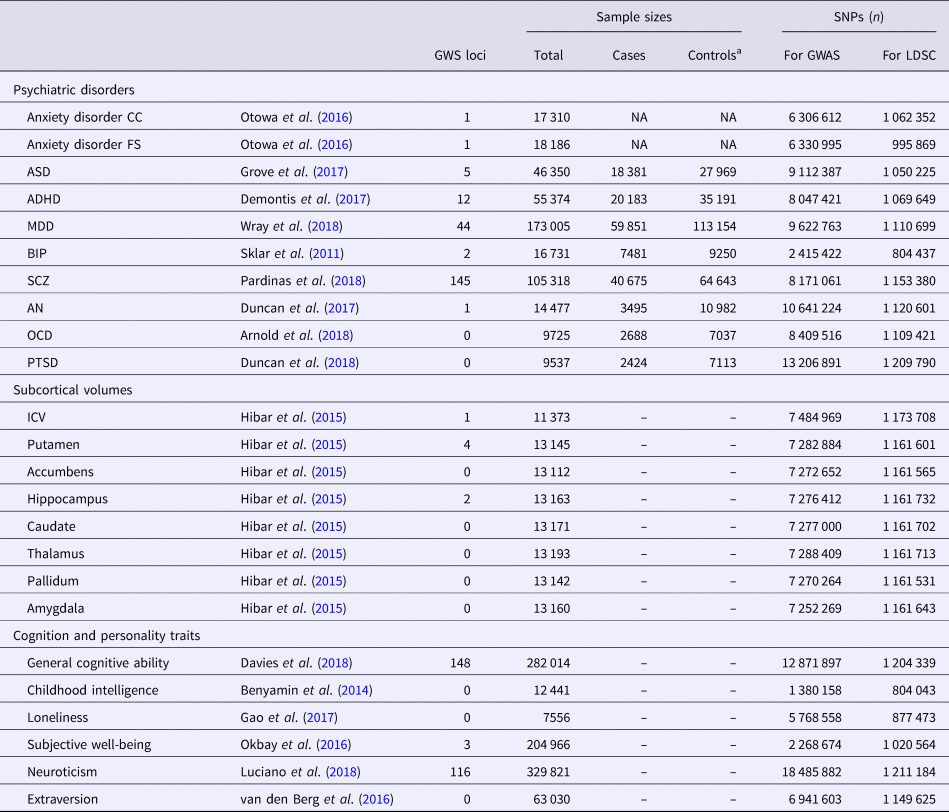
To calculate genetic correlations attributable to genome-wide single-nucleotide polymorphisms [SNPs (polygenicity; many small genetic effects)] between anxiety disorders and psychiatric and intermediate phenotypes, we extracted GWAS results for psychiatric and intermediate phenotypes (Table 1). GWAS summary statistics on eight psychiatric disorders from the PGC, the CLOZUK and the iPSYCH [ASD (iPSYCH-PGC GWAS-2017) (Grove et al., Reference Grove, Ripke, Als, Mattheisen, Walters, Won, Pallesen, Agerbo, Andreassen, Anney, Belliveau, Bettella, Buxbaum, Bybjerg-Grauholm, Bækved-Hansen, Cerrato, Chambert, Christensen, Churchhouse, Dellenvall, Demontis, De Rubeis, Devlin, Djurovic, Dumont, Goldstein, Hansen, Hauberg, Hollegaard, Hope, Howrigan, Huang, Hultman, Klei, Maller, Martin, Martin, Moran, Nyegaard, Nærland, Palmer, Palotie, Pedersen, Pedersen, Poterba, Poulsen, Pourcain, Qvist, Rehnström, Reichenberg, Reichert, Robinson, Roeder, Roussos, Saemundsen, Sandin, Satterstrom, Smith, Stefansson, Stefansson, Steinberg, Stevens, Sullivan, Turley, Walters, Xu, Geschwind, Nordentoft, Hougaard, Werge, Mors, Mortensen, Neale, Daly and Børglum2017), ADHD (ADHD2017) (Demontis et al., Reference Demontis, Walters, Martin, Mattheisen, Als, Agerbo, Belliveau, Bybjerg-Grauholm, Bækved-Hansen, Cerrato, Chambert, Churchhouse, Dumont, Eriksson, Gandal, Goldstein, Grove, Hansen, Hauberg, Hollegaard, Howrigan, Huang, Maller, Martin, Moran, Pallesen, Palmer, Pedersen, Pedersen, Poterba, Poulsen, Ripke, Robinson, Satterstrom, Stevens, Turley, Won, Andreassen, Burton, Boomsma, Cormand, Dalsgaard, Franke, Gelernter, Geschwind, Hakonarson, Haavik, Kranzler, Kuntsi, Langley, Lesch, Middeldorp, Reif, Rohde, Roussos, Schachar, Sklar, Sonuga-Barke, Sullivan, Thapar, Tung, Waldman, Nordentoft, Hougaard, Werge, Mors, Mortensen, Daly, Faraone, Børglum and Neale2017), MDD (MDD2) (Wray et al., Reference Wray, Ripke, Mattheisen, Trzaskowski, Byrne, Abdellaoui, Adams, Agerbo, Air, Andlauer, Bacanu, Baekvad-Hansen, Beekman, Bigdeli, Binder, Blackwood, Bryois, Buttenschon, Bybjerg-Grauholm, Cai, Castelao, Christensen, Clarke, Coleman, Colodro-Conde, Couvy-Duchesne, Craddock, Crawford, Crowley, Dashti, Davies, Deary, Degenhardt, Derks, Direk, Dolan, Dunn, Eley, Eriksson, Escott-Price, Kiadeh, Finucane, Forstner, Frank, Gaspar, Gill, Giusti-Rodriguez, Goes, Gordon, Grove, Hall, Hannon, Hansen, Hansen, Herms, Hickie, Hoffmann, Homuth, Horn, Hottenga, Hougaard, Hu, Hyde, Ising, Jansen, Jin, Jorgenson, Knowles, Kohane, Kraft, Kretzschmar, Krogh, Kutalik, Lane, Li, Li, Lind, Liu, Lu, MacIntyre, MacKinnon, Maier, Maier, Marchini, Mbarek, McGrath, McGuffin, Medland, Mehta, Middeldorp, Mihailov, Milaneschi, Milani, Mill, Mondimore, Montgomery, Mostafavi, Mullins, Nauck, Ng, Nivard, Nyholt, O'Reilly, Oskarsson, Owen, Painter, Pedersen, Pedersen, Peterson, Pettersson, Peyrot, Pistis, Posthuma, Purcell, Quiroz, Qvist, Rice, Riley, Rivera, Saeed Mirza, Saxena, Schoevers, Schulte, Shen, Shi, Shyn, Sigurdsson, Sinnamon, Smit, Smith, Stefansson, Steinberg, Stockmeier, Streit, Strohmaier, Tansey, Teismann, Teumer, Thompson, Thomson, Thorgeirsson, Tian, Traylor, Treutlein, Trubetskoy, Uitterlinden, Umbricht, Van der Auwera, van Hemert, Viktorin, Visscher, Wang, Webb, Weinsheimer, Wellmann, Willemsen, Witt, Wu, Xi, Yang, Zhang, Arolt, Baune, Berger, Boomsma, Cichon, Dannlowski, de Geus, DePaulo, Domenici, Domschke, Esko, Grabe, Hamilton, Hayward, Heath, Hinds, Kendler, Kloiber, Lewis, Li, Lucae, Madden, Magnusson, Martin, McIntosh, Metspalu, Mors, Mortensen, Muller-Myhsok, Nordentoft, Nothen, O'Donovan, Paciga, Pedersen, Penninx, Perlis, Porteous, Potash, Preisig, Rietschel, Schaefer, Schulze, Smoller, Stefansson, Tiemeier, Uher, Volzke, Weissman, Werge, Winslow, Lewis, Levinson, Breen, Borglum and Sullivan2018), BIP (Sklar et al., Reference Sklar, Ripke, Scott, Andreassen, Cichon, Craddock, Edenberg, Nurnberger, Rietschel, Blackwood, Corvin, Flickinger, Guan, Mattingsdal, McQuillen, Kwan, Wienker, Daly, Dudbridge, Holmans, Lin, Burmeister, Greenwood, Hamshere, Muglia, Smith, Zandi, Nievergelt, McKinney, Shilling, Schork, Bloss, Foroud, Koller, Gershon, Liu, Badner, Scheftner, Lawson, Nwulia, Hipolito, Coryell, Rice, Byerley, McMahon, Schulze, Berrettini, Lohoff, Potash, Mahon, McInnis, Zöllner, Zhang, Craig, Szelinger, Barrett, Breuer, Meier, Strohmaier, Witt, Tozzi, Farmer, McGuffin, Strauss, Xu, Kennedy, Vincent, Matthews, Day, Ferreira, O'Dushlaine, Perlis, Raychaudhuri, Ruderfer, Lee, Smoller, Li, Absher, Bunny, Barchas, Schatzberg, Jones, Meng, Thompson, Watson, Myers, Akil, Boehnke, Chambert, Moran, Scolnick, Djurovic, Melle, Morken, Gill, Morris, Quinn, Mühleisen, Degenhardt, Mattheisen, Schumacher, Maier, Steffans, Propping, Nöthen, Anjorin, Bass, Gurling, Kandaswamy, Lawrence, McGhee, McIntosh, McLean, Muir, Pickard, Breen, St Clair, Caesar, Gordon-Smith, Jones, Fraser, Green, Frozeva, Jones, Kirov, Moskvina, Nikolov, O'Donovan, Owen, Collier, Elkin, Williamson, Young, Ferrier, Stefansson, Stefansson, Porgeirsson, Steinberg, Gustafsson, Bergen, Nimgaonkar, Hultman, Landén, Lichtenstein, Sullivan, Schalling, Osby, Backlund, Frisén, Langstrom, Jamain, Leboyer, Etain, Bellivier, Petursson, Sigurđsson, Müller-Mysok, Lucae, Schwarz, Fullerton, Schofield, Martin, Montgomery, Lathrop, Óskarsson, Bauer, Wright, Mitchell, Hautzinger, Reif, Kelsoe and Purcell2011), SCZ (CLOZUK-PGC2) (Pardinas et al., Reference Pardinas, Holmans, Pocklington, Escott-Price, Ripke, Carrera, Legge, Bishop, Cameron, Hamshere, Han, Hubbard, Lynham, Mantripragada, Rees, MacCabe, McCarroll, Baune, Breen, Byrne, Dannlowski, Eley, Hayward, Martin, McIntosh, Plomin, Porteous, Wray, Caballero, Geschwind, Huckins, Ruderfer, Santiago, Sklar, Stahl, Won, Agerbo, Als, Andreassen, Baekvad-Hansen, Mortensen, Pedersen, Borglum, Bybjerg-Grauholm, Djurovic, Durmishi, Pedersen, Golimbet, Grove, Hougaard, Mattheisen, Molden, Mors, Nordentoft, Pejovic-Milovancevic, Sigurdsson, Silagadze, Hansen, Stefansson, Stefansson, Steinberg, Tosato, Werge, Collier, Rujescu, Kirov, Owen, O'Donovan and Walters2018), AN (Duncan et al., Reference Duncan, Yilmaz, Gaspar, Walters, Goldstein, Anttila, Bulik-Sullivan, Ripke, Thornton, Hinney, Daly, Sullivan, Zeggini, Breen and Bulik2017), OCD (Arnold et al., Reference Arnold, Askland, Barlassina, Bellodi, Bienvenu, Black, Bloch, Brentani, Burton, Camarena, Cappi, Cath, Cavallini, Conti, Cook, Coric, Cullen, Cusi, Davis, Delorme, Denys, Derks, Eapen, Edlund, Erdman, Falkai, Figee, Fyer, Geller, Goes, Grabe, Grados, Greenberg, Grünblatt, Guo, Hanna, Hemmings, Hounie, Jenicke, Keenan, Kennedy, Khramtsova, Konkashbaev, Knowles, Krasnow, Lange, Lanzagorta, Leboyer, Lennertz, Li, Liang, Lochne, Macciardi, Maher, Maier, Marconi, Mathews, Matthesien, McCracken, McLaughlin, Miguel, Moessner, Murphy, Neale, Nestadt, Nestadt, Nicolini, Nurmi, Osiecki, Pauls, Piacentini, Posthuma, Pulver, Qin, Rasmussen, Rauch, Richter, Riddle, Ripke, Ruhrmann, Sampaio, Samuels, Scharf, Shugart, Smit, Stein, Stewart, Turiel, Vallada, Veenstra-VanderWeele, Wagner, Walitza, Wang, Wendland, Vulink, Yu and Zai2018) and PTSD (Duncan et al., Reference Duncan, Ratanatharathorn, Aiello, Almli, Amstadter, Ashley-Koch, Baker, Beckham, Bierut, Bisson, Bradley, Chen, Dalvie, Farrer, Galea, Garrett, Gelernter, Guffanti, Hauser, Johnson, Kessler, Kimbrel, King, Koen, Kranzler, Logue, Maihofer, Martin, Miller, Morey, Nugent, Rice, Ripke, Roberts, Saccone, Smoller, Stein, Stein, Sumner, Uddin, Ursano, Wildman, Yehuda, Zhao, Daly, Liberzon, Ressler, Nievergelt and Koenen2018)] were available in a public database (https://www.med.unc.edu/pgc/results-and-downloads). GWAS summary statistics regarding the volumes of seven subcortical brain regions (the nucleus accumbens, amygdala, caudate nucleus, hippocampus, pallidum, putamen and thalamus) and the ICV were calculated by the ENIGMA Consortium in an analysis known as ENIGMA2 (Hibar et al., Reference Hibar, Stein, Renteria, Arias-Vasquez, Desrivieres, Jahanshad, Toro, Wittfeld, Abramovic, Andersson, Aribisala, Armstrong, Bernard, Bohlken, Boks, Bralten, Brown, Chakravarty, Chen, Ching, Cuellar-Partida, den Braber, Giddaluru, Goldman, Grimm, Guadalupe, Hass, Woldehawariat, Holmes, Hoogman, Janowitz, Jia, Kim, Klein, Kraemer, Lee, Olde Loohuis, Luciano, Macare, Mather, Mattheisen, Milaneschi, Nho, Papmeyer, Ramasamy, Risacher, Roiz-Santianez, Rose, Salami, Samann, Schmaal, Schork, Shin, Strike, Teumer, van Donkelaar, van Eijk, Walters, Westlye, Whelan, Winkler, Zwiers, Alhusaini, Athanasiu, Ehrlich, Hakobjan, Hartberg, Haukvik, Heister, Hoehn, Kasperaviciute, Liewald, Lopez, Makkinje, Matarin, Naber, McKay, Needham, Nugent, Putz, Royle, Shen, Sprooten, Trabzuni, van der Marel, van Hulzen, Walton, Wolf, Almasy, Ames, Arepalli, Assareh, Bastin, Brodaty, Bulayeva, Carless, Cichon, Corvin, Curran, Czisch, de Zubicaray, Dillman, Duggirala, Dyer, Erk, Fedko, Ferrucci, Foroud, Fox, Fukunaga, Gibbs, Goring, Green, Guelfi, Hansell, Hartman, Hegenscheid, Heinz, Hernandez, Heslenfeld, Hoekstra, Holsboer, Homuth, Hottenga, Ikeda, Jack, Jenkinson, Johnson, Kanai, Keil, Kent, Kochunov, Kwok, Lawrie, Liu, Longo, McMahon, Meisenzahl, Melle, Mohnke, Montgomery, Mostert, Muhleisen, Nalls, Nichols, Nilsson, Nothen, Ohi, Olvera, Perez-Iglesias, Pike, Potkin, Reinvang, Reppermund, Rietschel, Romanczuk-Seiferth, Rosen, Rujescu, Schnell, Schofield, Smith, Steen, Sussmann, Thalamuthu, Toga, Traynor, Troncoso, Turner, Valdes Hernandez, van't Ent, van der Brug, van der Wee, van Tol, Veltman, Wassink, Westman, Zielke, Zonderman, Ashbrook, Hager, Lu, McMahon, Morris, Williams, Brunner, Buckner, Buitelaar, Cahn, Calhoun, Cavalleri, Crespo-Facorro, Dale, Davies, Delanty, Depondt, Djurovic, Drevets, Espeseth, Gollub, Ho, Hoffmann, Hosten, Kahn, Le Hellard, Meyer-Lindenberg, Muller-Myhsok, Nauck, Nyberg, Pandolfo, Penninx, Roffman, Sisodiya, Smoller, van Bokhoven, van Haren, Volzke, Walter, Weiner, Wen, White, Agartz, Andreassen, Blangero, Boomsma, Brouwer, Cannon, Cookson, de Geus, Deary, Donohoe, Fernandez, Fisher, Francks, Glahn, Grabe, Gruber, Hardy, Hashimoto, Hulshoff Pol, Jonsson, Kloszewska, Lovestone, Mattay, Mecocci, McDonald, McIntosh, Ophoff, Paus, Pausova, Ryten, Sachdev, Saykin, Simmons, Singleton, Soininen, Wardlaw, Weale, Weinberger, Adams, Launer, Seiler, Schmidt, Chauhan, Satizabal, Becker, Yanek, van der Lee, Ebling, Fischl, Longstreth, Greve, Schmidt, Nyquist, Vinke, van Duijn, Xue, Mazoyer, Bis, Gudnason, Seshadri, Ikram, Martin, Wright, Schumann, Franke, Thompson and Medland2015) and made available in a public database (http://enigma.ini.usc.edu/research/download-enigma-gwas-results/). GWAS summary statistics regarding cognition in childhood (Benyamin et al., Reference Benyamin, Pourcain, Davis, Davies, Hansell, Brion, Kirkpatrick, Cents, Franic, Miller, Haworth, Meaburn, Price, Evans, Timpson, Kemp, Ring, McArdle, Medland, Yang, Harris, Liewald, Scheet, Xiao, Hudziak, de Geus, Jaddoe, Starr, Verhulst, Pennell, Tiemeier, Iacono, Palmer, Montgomery, Martin, Boomsma, Posthuma, McGue, Wright, Davey Smith, Deary, Plomin and Visscher2014) from the Childhood Intelligence Consortium (CHIC) and general cognitive ability (Davies et al., Reference Davies, Lam, Harris, Trampush, Luciano, Hill, Hagenaars, Ritchie, Marioni, Fawns-Ritchie, Liewald, Okely, Ahola-Olli, Barnes, Bertram, Bis, Burdick, Christoforou, DeRosse, Djurovic, Espeseth, Giakoumaki, Giddaluru, Gustavson, Hayward, Hofer, Ikram, Karlsson, Knowles, Lahti, Leber, Li, Mather, Melle, Morris, Oldmeadow, Palviainen, Payton, Pazoki, Petrovic, Reynolds, Sargurupremraj, Scholz, Smith, Smith, Terzikhan, Thalamuthu, Trompet, van der Lee, Ware, Windham, Wright, Yang, Yu, Ames, Amin, Amouyel, Andreassen, Armstrong, Assareh, Attia, Attix, Avramopoulos, Bennett, Bohmer, Boyle, Brodaty, Campbell, Cannon, Cirulli, Congdon, Conley, Corley, Cox, Dale, Dehghan, Dick, Dickinson, Eriksson, Evangelou, Faul, Ford, Freimer, Gao, Giegling, Gillespie, Gordon, Gottesman, Griswold, Gudnason, Harris, Hartmann, Hatzimanolis, Heiss, Holliday, Joshi, Kahonen, Kardia, Karlsson, Kleineidam, Knopman, Kochan, Konte, Kwok, Le Hellard, Lee, Lehtimaki, Li, Liu, Koini, London, Longstreth, Lopez, Loukola, Luck, Lundervold, Lundquist, Lyytikainen, Martin, Montgomery, Murray, Need, Noordam, Nyberg, Ollier, Papenberg, Pattie, Polasek, Poldrack, Psaty, Reppermund, Riedel-Heller, Rose, Rotter, Roussos, Rovio, Saba, Sabb, Sachdev, Satizabal, Schmid, Scott, Scult, Simino, Slagboom, Smyrnis, Soumare, Stefanis, Stott, Straub, Sundet, Taylor, Taylor, Tzoulaki, Tzourio, Uitterlinden, Vitart, Voineskos, Kaprio, Wagner, Wagner, Weinhold, Wen, Widen, Yang, Zhao, Adams, Arking, Bilder, Bitsios, Boerwinkle, Chiba-Falek, Corvin, De Jager, Debette, Donohoe, Elliott, Fitzpatrick, Gill, Glahn, Hagg, Hansell, Hariri, Ikram, Jukema, Vuoksimaa, Keller, Kremen, Launer, Lindenberger, Palotie, Pedersen, Pendleton, Porteous, Raikkonen, Raitakari, Ramirez, Reinvang, Rudan, Dan, Schmidt, Schmidt, Schofield, Schofield, Starr, Steen, Trollor, Turner, Van Duijn, Villringer, Weinberger, Weir, Wilson, Malhotra, McIntosh, Gale, Seshadri, Mosley, Bressler, Lencz and Deary2018) from the CHARGE Consortium, COGENT and the UK Biobank were available in public databases (https://www.thessgac.org/data and http://www.ccace.ed.ac.uk/node/335). GWAS summary statistics on four personality traits [subjective well-being (Okbay et al., Reference Okbay, Baselmans, De Neve, Turley, Nivard, Fontana, Meddens, Linner, Rietveld, Derringer, Gratten, Lee, Liu, de Vlaming, Ahluwalia, Buchwald, Cavadino, Frazier-Wood, Furlotte, Garfield, Geisel, Gonzalez, Haitjema, Karlsson, van der Laan, Ladwig, Lahti, van der Lee, Lind, Liu, Matteson, Mihailov, Miller, Minica, Nolte, Mook-Kanamori, van der Most, Oldmeadow, Qian, Raitakari, Rawal, Realo, Rueedi, Schmidt, Smith, Stergiakouli, Tanaka, Taylor, Thorleifsson, Wedenoja, Wellmann, Westra, Willems, Zhao, Amin, Bakshi, Bergmann, Bjornsdottir, Boyle, Cherney, Cox, Davies, Davis, Ding, Direk, Eibich, Emeny, Fatemifar, Faul, Ferrucci, Forstner, Gieger, Gupta, Harris, Harris, Holliday, Hottenga, De Jager, Kaakinen, Kajantie, Karhunen, Kolcic, Kumari, Launer, Franke, Li-Gao, Liewald, Koini, Loukola, Marques-Vidal, Montgomery, Mosing, Paternoster, Pattie, Petrovic, Pulkki-Raback, Quaye, Raikkonen, Rudan, Scott, Smith, Sutin, Trzaskowski, Vinkhuyzen, Yu, Zabaneh, Attia, Bennett, Berger, Bertram, Boomsma, Snieder, Chang, Cucca, Deary, van Duijn, Eriksson, Bultmann, de Geus, Groenen, Gudnason, Hansen, Hartman, Haworth, Hayward, Heath, Hinds, Hypponen, Iacono, Jarvelin, Jockel, Kaprio, Kardia, Keltikangas-Jarvinen, Kraft, Kubzansky, Lehtimaki, Magnusson, Martin, McGue, Metspalu, Mills, de Mutsert, Oldehinkel, Pasterkamp, Pedersen, Plomin, Polasek, Power, Rich, Rosendaal, den Ruijter, Schlessinger, Schmidt, Svento, Schmidt, Alizadeh, Sorensen, Spector, Starr, Stefansson, Steptoe, Terracciano, Thorsteinsdottir, Thurik, Timpson, Tiemeier, Uitterlinden, Vollenweider, Wagner, Weir, Yang, Conley, Smith, Hofman, Johannesson, Laibson, Medland, Meyer, Pickrell, Esko, Krueger, Beauchamp, Koellinger, Benjamin, Bartels and Cesarini2016), loneliness (Gao et al., Reference Gao, Davis, Hart, Sanchez-Roige, Han, Cacioppo and Palmer2017), neuroticism (Luciano et al., Reference Luciano, Hagenaars, Davies, Hill, Clarke, Shirali, Harris, Marioni, Liewald, Fawns-Ritchie, Adams, Howard, Lewis, Gale, McIntosh and Deary2018) and extraversion (van den Berg et al., Reference van den Berg, de Moor, Verweij, Krueger, Luciano, Arias Vasquez, Matteson, Derringer, Esko, Amin, Gordon, Hansell, Hart, Seppala, Huffman, Konte, Lahti, Lee, Miller, Nutile, Tanaka, Teumer, Viktorin, Wedenoja, Abdellaoui, Abecasis, Adkins, Agrawal, Allik, Appel, Bigdeli, Busonero, Campbell, Costa, Smith, Davies, de Wit, Ding, Engelhardt, Eriksson, Fedko, Ferrucci, Franke, Giegling, Grucza, Hartmann, Heath, Heinonen, Henders, Homuth, Hottenga, Iacono, Janzing, Jokela, Karlsson, Kemp, Kirkpatrick, Latvala, Lehtimaki, Liewald, Madden, Magri, Magnusson, Marten, Maschio, Mbarek, Medland, Mihailov, Milaneschi, Montgomery, Nauck, Nivard, Ouwens, Palotie, Pettersson, Polasek, Qian, Pulkki-Raback, Raitakari, Realo, Rose, Ruggiero, Schmidt, Slutske, Sorice, Starr, St Pourcain, Sutin, Timpson, Trochet, Vermeulen, Vuoksimaa, Widen, Wouda, Wright, Zgaga, Porteous, Minelli, Palmer, Rujescu, Ciullo, Hayward, Rudan, Metspalu, Kaprio, Deary, Raikkonen, Wilson, Keltikangas-Jarvinen, Bierut, Hettema, Grabe, Penninx, van Duijn, Evans, Schlessinger, Pedersen, Terracciano, McGue, Martin and Boomsma2016)] from the Social Science Genetic Association Consortium, the Health and Retirement Study, the Centre for Cognitive Ageing and Cognitive Epidemiology at the University of Edinburgh (CCACE) and the Genetics of Personality Consortium (GPC) were available in public databases (https://www.thessgac.org/data, https://www.med.unc.edu/pgc/results-and-downloads, http://www.ccace.ed.ac.uk/node/335 and http://www.tweelingenregister.org/GPC/, respectively). Informed consent was obtained from all participants and/or their families in each study cohort. This study was performed in compliance with the World Medical Association's Declaration of Helsinki and was approved by the Research Ethical Committee of Kanazawa Medical University.
Demographic information for each GWAS

GWS, genome-wide significant; CC, case–control; FS, factor score; LDSC, linkage disequilibrium score regression; ASD, autism spectrum disorder; ADHD, attention-deficit/hyperactivity disorder; MDD, major depressive disorder; BIP, bipolar disorder; SCZ, schizophrenia; AN, anorexia nervosa; OCD, obsessive-compulsive disorder; PTSD, posttraumatic stress disorder; ICV, intracranial volume.
a Controls or pseudocontrols from trio samples.
Linkage disequilibrium score regression (LDSC) analysis
LDSC analysis can estimate the genetic SNP correlations (r g) from GWASs and is a powerful tool for investigating the genetic architecture of common traits and diseases (Bulik-Sullivan et al., Reference Bulik-Sullivan, Loh, Finucane, Ripke, Yang, Patterson, Daly, Price and Neale2015). Regression weights (LD scores, ‘eur_w_ld_chr/’ files https://github.com/bulik/ldsc) were precomputed using the European-ancestry samples of the 1000 Genomes Project. To restrict the analysis to well-imputed SNPs, we filtered the imputed and directly genotyped SNPs in each GWAS to SNPs that overlapped with a HapMap3 SNP panel. Only results for markers with an imputation INFO score >0.90 and minor allele frequency >0.01 were included in the analysis. Insertion–deletion polymorphisms, structural variants, strand-ambiguous SNPs and SNPs with extremely large effect sizes were removed. The distribution of β values among SNPs in GWASs is normally expected to be centered on the null value of 0. If a phenotype with large variance is used, the recommended approach is to compute z-scores (https://github.com/bulik/ldsc/issues/43). Because median β values among SNPs in GWASs for the putamen and ICV were high (should be close to 0), these β values were converted to z-scores. For each GWAS, an LD regression was carried out by regressing the GWAS test statistics (χ2) against the LD scores of the SNPs. Using LDSC, we calculated the genetic correlation between the two consortium samples. The significance level for statistical tests was set at p < 0.05. A conservative Bonferroni-corrected p value threshold of p < 2.38 × 10⁻³ (=0.05/21) was used to avoid type-I error.
Results
Genetic correlation between anxiety disorders based on case–control and factor score models
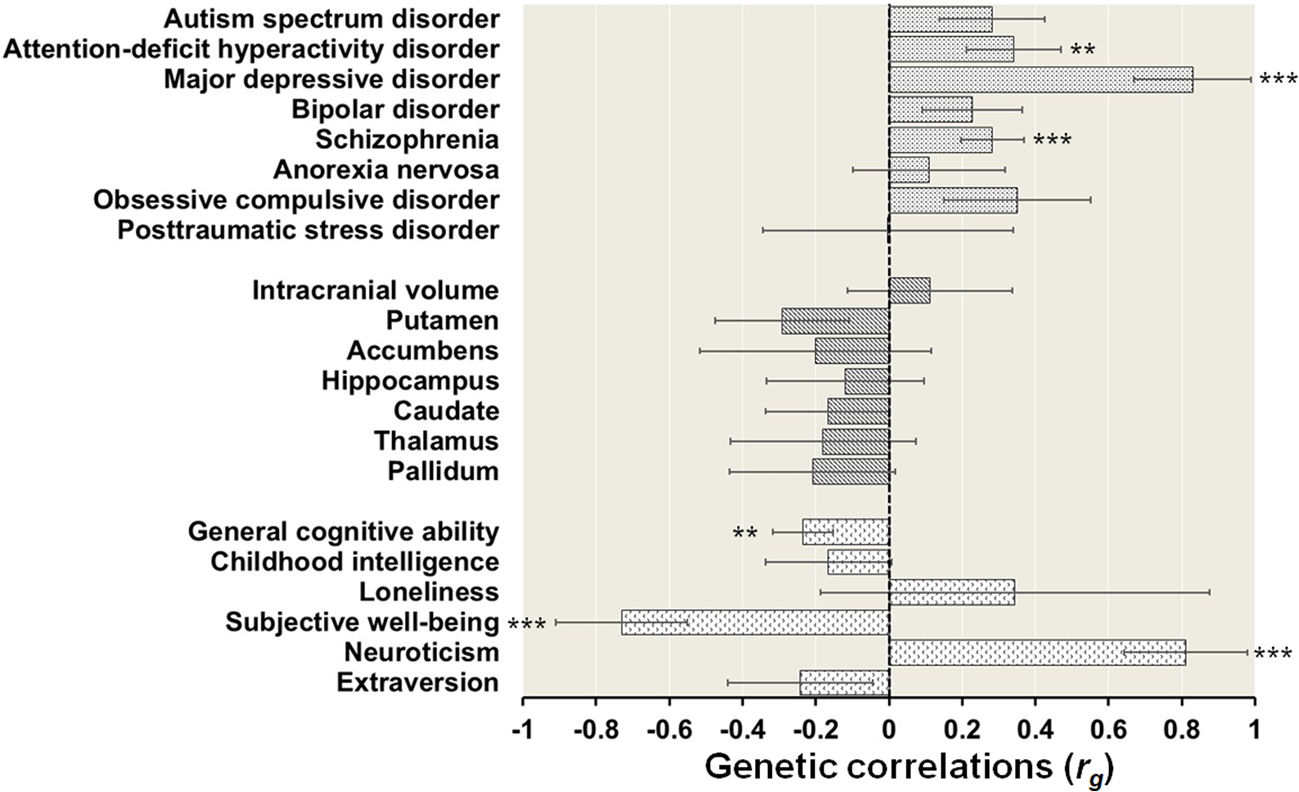
First, the genetic correlation between anxiety disorders based on the case–control and factor score models was examined. No significant correlation between anxiety disorders based on the case–control and factor score models (r g ± standard error = 0.35 ± 0.26, p = 0.18) was observed. Therefore, we investigated the shared genetic etiology between psychiatric and related intermediate phenotypes and anxiety disorders based on the case–control (Fig. 1) and factor score (Fig. 2) models.
Genetic correlations (r g) of anxiety disorders with psychiatric and intermediate phenotypes based on the case–control model. Error bars indicate the standard error (s.e.) of r g. *p < 0.05, **p < 0.01, ***p < 2.38 × 10⁻³ (=0.05/21). A positive r g indicates that a phenotype is genetically correlated with an elevated risk of anxiety disorders based on the case–control model, whereas a negative r g indicates that the phenotype is correlated with a reduced risk of anxiety disorders.

Genetic correlations (r g) of anxiety disorders with psychiatric and intermediate phenotypes based on the factor score model. Error bars indicate the standard error (s.e.) of r g. *p < 0.05, **p < 0.01, ***p < 2.38 × 10⁻³. A positive r g indicates that a phenotype is genetically correlated with an elevated risk of anxiety disorders based on the factor score model, whereas a negative r g indicates that the phenotype is correlated with a reduced risk of anxiety disorders.

Genetic correlations between anxiety disorders and psychiatric disorders
Of the eight psychiatric disorders examined, MDD had a highly significant positive correlation with anxiety disorders based on both models (Fig. 1, case–control, 0.83 ± 0.16, p = 1.97 × 10⁻⁷; Fig. 2, factor score, 0.61 ± 0.20, p = 2.10 × 10⁻³). SCZ was significantly positively correlated with anxiety disorders based on the case–control (0.28 ± 0.09, p = 1.10 × 10⁻³) but not the factor score model (0.15 ± 0.09, p = 0.06). ADHD had a nominally and positively correlation with anxiety disorders based on the case–control model (0.34 ± 0.13, p = 8.60 × 10⁻³) but not the factor score model (0.26 ± 0.14, p = 0.07). There were no other significant genetic correlations between psychiatric disorders such as OCD and PTSD and anxiety disorders based on the case–control or factor score model (p > 0.05).
Genetic correlations between anxiety disorders and brain region volumes
Next, we investigated the genetic correlations of the subcortical volumes and the ICV with anxiety disorders based on the case–control (Fig. 1) and factor score (Fig. 2) models. Because the h 2 of the amygdala volume was low and the mean χ2 for SNPs from GWAS for the amygdala was insufficient, we could not estimate the genetic correlations with amygdala volume. Of the remaining seven volumetric phenotypes, putamen volume was marginally and negatively correlated with risk of anxiety disorders based on the factor score model (Fig. 2, −0.50 ± 0.18, p = 5.00 × 10⁻³) but not the case–control model (−0.29 ± 0.18, p = 0.11). There were no other significant genetic correlations between anxiety disorders and brain region volumes (p > 0.05).
Genetic correlations between anxiety disorders and cognitive and personality traits
We investigated the genetic correlations of two cognitive and four personality traits with anxiety disorders based on the case–control (Fig. 1) and factor score (Fig. 2) models. We detected highly significant positive correlations between neuroticism and risk for anxiety disorders based on both models (case–control, 0.81 ± 0.17, p = 1.30 × 10⁻⁶; factor score, 0.56 ± 0.13, p = 1.20 × 10⁻⁵). Subjective well-being was significantly negatively correlated with anxiety disorders based on the case–control model (−0.73 ± 0.18, p = 4.89 × 10⁻⁵), and there was a nominal negative correlation based on the factor score model (−0.40 ± 0.14, p = 3.30 × 10⁻³). General cognitive ability had a nominal negative correlation with anxiety disorders based on the case–control model (−0.23 ± 0.08, p = 4.70 × 10⁻³) but not the factor score model (−0.15 ± 0.09, p = 0.08). There were no other significant genetic correlations between anxiety disorders and cognitive or personality traits (p > 0.05).
Discussion
To our knowledge, this investigation is the first comprehensive study to examine the genetic correlations of anxiety disorders with common psychiatric phenotypes (ASD, ADHD, MDD, BIP, SCZ, AN, OCD and PTSD) and their intermediate phenotypes (brain region volumes, cognitive functions and personality traits) using LDSC analysis. The anxiety disorders were assessed by two phenotypic models: (i) categorical case–control comparisons based on having any diagnosis of anxiety disorders v. supernormal controls and (ii) quantitative phenotypic factor scores derived from a multivariate analysis combining information across the clinical phenotypes (Otowa et al., Reference Otowa, Hek, Lee, Byrne, Mirza, Nivard, Bigdeli, Aggen, Adkins, Wolen, Fanous, Keller, Castelao, Kutalik, Van der Auwera, Homuth, Nauck, Teumer, Milaneschi, Hottenga, Direk, Hofman, Uitterlinden, Mulder, Henders, Medland, Gordon, Heath, Madden, Pergadia, van der Most, Nolte, van Oort, Hartman, Oldehinkel, Preisig, Grabe, Middeldorp, Penninx, Boomsma, Martin, Montgomery, Maher, van den Oord, Wray, Tiemeier and Hettema2016). We revealed strong overlaps between the genetic variants associated with anxiety disorders and MDD, SCZ, subjective well-being and neuroticism and weak genetic overlaps between anxiety disorders and ADHD, putamen volume and general cognitive ability. The effect sizes of these genetic overlaps (r g) based on the case–control model were larger than those based on the factor score model.
Strong genetic overlaps were observed between anxiety disorders and both MDD and neuroticism based on both the case–control and factor score models despite the removal of subjects who reported pure mood disorders from all samples (Otowa et al., Reference Otowa, Hek, Lee, Byrne, Mirza, Nivard, Bigdeli, Aggen, Adkins, Wolen, Fanous, Keller, Castelao, Kutalik, Van der Auwera, Homuth, Nauck, Teumer, Milaneschi, Hottenga, Direk, Hofman, Uitterlinden, Mulder, Henders, Medland, Gordon, Heath, Madden, Pergadia, van der Most, Nolte, van Oort, Hartman, Oldehinkel, Preisig, Grabe, Middeldorp, Penninx, Boomsma, Martin, Montgomery, Maher, van den Oord, Wray, Tiemeier and Hettema2016). Although these correlations have been indicated in previous studies (Okbay et al., Reference Okbay, Baselmans, De Neve, Turley, Nivard, Fontana, Meddens, Linner, Rietveld, Derringer, Gratten, Lee, Liu, de Vlaming, Ahluwalia, Buchwald, Cavadino, Frazier-Wood, Furlotte, Garfield, Geisel, Gonzalez, Haitjema, Karlsson, van der Laan, Ladwig, Lahti, van der Lee, Lind, Liu, Matteson, Mihailov, Miller, Minica, Nolte, Mook-Kanamori, van der Most, Oldmeadow, Qian, Raitakari, Rawal, Realo, Rueedi, Schmidt, Smith, Stergiakouli, Tanaka, Taylor, Thorleifsson, Wedenoja, Wellmann, Westra, Willems, Zhao, Amin, Bakshi, Bergmann, Bjornsdottir, Boyle, Cherney, Cox, Davies, Davis, Ding, Direk, Eibich, Emeny, Fatemifar, Faul, Ferrucci, Forstner, Gieger, Gupta, Harris, Harris, Holliday, Hottenga, De Jager, Kaakinen, Kajantie, Karhunen, Kolcic, Kumari, Launer, Franke, Li-Gao, Liewald, Koini, Loukola, Marques-Vidal, Montgomery, Mosing, Paternoster, Pattie, Petrovic, Pulkki-Raback, Quaye, Raikkonen, Rudan, Scott, Smith, Sutin, Trzaskowski, Vinkhuyzen, Yu, Zabaneh, Attia, Bennett, Berger, Bertram, Boomsma, Snieder, Chang, Cucca, Deary, van Duijn, Eriksson, Bultmann, de Geus, Groenen, Gudnason, Hansen, Hartman, Haworth, Hayward, Heath, Hinds, Hypponen, Iacono, Jarvelin, Jockel, Kaprio, Kardia, Keltikangas-Jarvinen, Kraft, Kubzansky, Lehtimaki, Magnusson, Martin, McGue, Metspalu, Mills, de Mutsert, Oldehinkel, Pasterkamp, Pedersen, Plomin, Polasek, Power, Rich, Rosendaal, den Ruijter, Schlessinger, Schmidt, Svento, Schmidt, Alizadeh, Sorensen, Spector, Starr, Stefansson, Steptoe, Terracciano, Thorsteinsdottir, Thurik, Timpson, Tiemeier, Uitterlinden, Vollenweider, Wagner, Weir, Yang, Conley, Smith, Hofman, Johannesson, Laibson, Medland, Meyer, Pickrell, Esko, Krueger, Beauchamp, Koellinger, Benjamin, Bartels and Cesarini2016; Otowa et al., Reference Otowa, Hek, Lee, Byrne, Mirza, Nivard, Bigdeli, Aggen, Adkins, Wolen, Fanous, Keller, Castelao, Kutalik, Van der Auwera, Homuth, Nauck, Teumer, Milaneschi, Hottenga, Direk, Hofman, Uitterlinden, Mulder, Henders, Medland, Gordon, Heath, Madden, Pergadia, van der Most, Nolte, van Oort, Hartman, Oldehinkel, Preisig, Grabe, Middeldorp, Penninx, Boomsma, Martin, Montgomery, Maher, van den Oord, Wray, Tiemeier and Hettema2016; Wray et al., Reference Wray, Ripke, Mattheisen, Trzaskowski, Byrne, Abdellaoui, Adams, Agerbo, Air, Andlauer, Bacanu, Baekvad-Hansen, Beekman, Bigdeli, Binder, Blackwood, Bryois, Buttenschon, Bybjerg-Grauholm, Cai, Castelao, Christensen, Clarke, Coleman, Colodro-Conde, Couvy-Duchesne, Craddock, Crawford, Crowley, Dashti, Davies, Deary, Degenhardt, Derks, Direk, Dolan, Dunn, Eley, Eriksson, Escott-Price, Kiadeh, Finucane, Forstner, Frank, Gaspar, Gill, Giusti-Rodriguez, Goes, Gordon, Grove, Hall, Hannon, Hansen, Hansen, Herms, Hickie, Hoffmann, Homuth, Horn, Hottenga, Hougaard, Hu, Hyde, Ising, Jansen, Jin, Jorgenson, Knowles, Kohane, Kraft, Kretzschmar, Krogh, Kutalik, Lane, Li, Li, Lind, Liu, Lu, MacIntyre, MacKinnon, Maier, Maier, Marchini, Mbarek, McGrath, McGuffin, Medland, Mehta, Middeldorp, Mihailov, Milaneschi, Milani, Mill, Mondimore, Montgomery, Mostafavi, Mullins, Nauck, Ng, Nivard, Nyholt, O'Reilly, Oskarsson, Owen, Painter, Pedersen, Pedersen, Peterson, Pettersson, Peyrot, Pistis, Posthuma, Purcell, Quiroz, Qvist, Rice, Riley, Rivera, Saeed Mirza, Saxena, Schoevers, Schulte, Shen, Shi, Shyn, Sigurdsson, Sinnamon, Smit, Smith, Stefansson, Steinberg, Stockmeier, Streit, Strohmaier, Tansey, Teismann, Teumer, Thompson, Thomson, Thorgeirsson, Tian, Traylor, Treutlein, Trubetskoy, Uitterlinden, Umbricht, Van der Auwera, van Hemert, Viktorin, Visscher, Wang, Webb, Weinsheimer, Wellmann, Willemsen, Witt, Wu, Xi, Yang, Zhang, Arolt, Baune, Berger, Boomsma, Cichon, Dannlowski, de Geus, DePaulo, Domenici, Domschke, Esko, Grabe, Hamilton, Hayward, Heath, Hinds, Kendler, Kloiber, Lewis, Li, Lucae, Madden, Magnusson, Martin, McIntosh, Metspalu, Mors, Mortensen, Muller-Myhsok, Nordentoft, Nothen, O'Donovan, Paciga, Pedersen, Penninx, Perlis, Porteous, Potash, Preisig, Rietschel, Schaefer, Schulze, Smoller, Stefansson, Tiemeier, Uher, Volzke, Weissman, Werge, Winslow, Lewis, Levinson, Breen, Borglum and Sullivan2018), the anxiety disorder phenotype was evaluated only on the basis of the case–control model in these studies. The heritability of susceptibility to anxiety disorders and MDD is estimated at approximately 40% (Sullivan et al., Reference Sullivan, Neale and Kendler2000; Hettema et al., Reference Hettema, Neale and Kendler2001). Anxiety disorders are frequently comorbid with MDD, and 50–60% of patients with MDD display a lifetime history of one or more anxiety disorders (Kaufman and Charney, Reference Kaufman and Charney2000; Kessler et al., Reference Kessler, Berglund, Demler, Jin, Koretz, Merikangas, Rush, Walters and Wang2003). However, twin and family studies indicate that anxiety disorders and MDD are distinct disorders and not alternative phases of one disorder (Middeldorp et al., Reference Middeldorp, Cath, Van Dyck and Boomsma2005). The comorbidity of these conditions can be explained by a partly shared genetic etiology, which also influences neuroticism and subjective well-being in the context of both disorders (Kendler et al., Reference Kendler, Gardner, Gatz and Pedersen2007; Mosing et al., Reference Mosing, Gordon, Medland, Statham, Nelson, Heath, Martin and Wray2009). This comorbidity may be caused by dysfunction of the brain regions involved in fear, anxiety and depressed mood. The cooccurrence of both depression and an anxiety disorder, as opposed to only one disorder, is associated with increased symptom severity and suicide risk (Kaufman and Charney, Reference Kaufman and Charney2000). The treatment of comorbid anxiety disorders and depression necessitates specific psychosocial adjustments, such as cognitive-behavioral therapy, compared with the treatment of either condition alone (Coplan et al., Reference Coplan, Aaronson, Panthangi and Kim2015). Although selective serotonin reuptake inhibitors and serotonin–norepinephrine reuptake inhibitors are the first-line pharmacological treatments for these disorders, some patients with comorbidity are treatment resistant. A combination of psychosocial and pharmacological treatments is required for treatment-resistant comorbidity.
Here, we detected a genetic correlation between anxiety disorders and SCZ for the first time. The prevalence of comorbid anxiety disorders in patients with SCZ ranges between 30% and 62% (Temmingh and Stein, Reference Temmingh and Stein2015; Howells et al., Reference Howells, Kingdon and Baldwin2017). Common comorbid anxiety disorders in patients with SCZ include social phobia/SAD, GAD, PD, agoraphobia and specific phobia (Achim et al., Reference Achim, Maziade, Raymond, Olivier, Merette and Roy2011). The prevalence of comorbid anxiety disorders in SCZ is 14.9% for social phobia/SAD, 10.9% for GAD, 9.8% for PD, 5.4% for agoraphobia and 7.9% for specific phobia (Achim et al., Reference Achim, Maziade, Raymond, Olivier, Merette and Roy2011). Diagnoses of anxiety disorders in patients with SCZ are allowed in the DSM-IV or 5 if the anxiety symptoms are ‘not better accounted for’ or ‘not restricted to’ SCZ symptoms (Achim et al., Reference Achim, Maziade, Raymond, Olivier, Merette and Roy2011). Therefore, anxiety symptoms in patients with SCZ may be underestimated and undertreated. Anxiety symptoms in SCZ are related to impairments in daily functioning, quality of life and self-esteem; symptom exacerbation or relapse; increased distress and elevated suicide risk (Buonocore et al., Reference Buonocore, Bosia, Bechi, Spangaro, Cavedoni, Cocchi, Bianchi, Guglielmino, Mastromatteo and Cavallaro2017). Pharmacological and psychosocial treatments targeting anxiety symptoms may be useful to improve daily functioning and quality of life in patients with SCZ.
The diagnostic category of anxiety disorders encompassed OCD and PTSD in the criteria in the DSM-IV, while OCD and PTSD are included in independent categories in the DSM-5 criteria (Kupfer, Reference Kupfer2015). Anxiety disorders are frequently comorbid with OCD and/or PTSD (Craske and Stein, Reference Craske and Stein2016), but there are important differences in diagnostic validations and treatment approaches across anxiety disorders and these disorders (Tambs et al., Reference Tambs, Czajkowsky, Roysamb, Neale, Reichborn-Kjennerud, Aggen, Harris, Orstavik and Kendler2009; Monzani et al., Reference Monzani, Rijsdijk, Harris and Mataix-Cols2014; Marras et al., Reference Marras, Fineberg and Pallanti2016; Maron et al., Reference Maron, Lan and Nutt2018). We did not detect significant genetic correlations between anxiety disorders and OCD or PTSD. The differences in sample sizes among GWASs for anxiety disorders, OCD and PTSD may make it impossible to simply compare correlations across phenotypes, while our findings might support the revision of the diagnostic classification.
The risk of anxiety disorders based on the case–control model was genetically correlated with poor general cognitive function, with an effect size (r g) of −0.23. Although the risk of anxiety disorders based on the case–control model tended to be associated with reduced subcortical brain region volumes, we could not detect significant genetic correlations between anxiety disorders and these regional volumes based on the case–control model (Fig. 1). The r g values of approximately −0.20 between anxiety disorders and subcortical brain region volumes were similar to the r g of −0.23 between anxiety disorders and general cognitive function. This discrepancy is likely due to the sample sizes of the GWASs (Table 1). The sample size for general cognitive function (Davies et al., Reference Davies, Lam, Harris, Trampush, Luciano, Hill, Hagenaars, Ritchie, Marioni, Fawns-Ritchie, Liewald, Okely, Ahola-Olli, Barnes, Bertram, Bis, Burdick, Christoforou, DeRosse, Djurovic, Espeseth, Giakoumaki, Giddaluru, Gustavson, Hayward, Hofer, Ikram, Karlsson, Knowles, Lahti, Leber, Li, Mather, Melle, Morris, Oldmeadow, Palviainen, Payton, Pazoki, Petrovic, Reynolds, Sargurupremraj, Scholz, Smith, Smith, Terzikhan, Thalamuthu, Trompet, van der Lee, Ware, Windham, Wright, Yang, Yu, Ames, Amin, Amouyel, Andreassen, Armstrong, Assareh, Attia, Attix, Avramopoulos, Bennett, Bohmer, Boyle, Brodaty, Campbell, Cannon, Cirulli, Congdon, Conley, Corley, Cox, Dale, Dehghan, Dick, Dickinson, Eriksson, Evangelou, Faul, Ford, Freimer, Gao, Giegling, Gillespie, Gordon, Gottesman, Griswold, Gudnason, Harris, Hartmann, Hatzimanolis, Heiss, Holliday, Joshi, Kahonen, Kardia, Karlsson, Kleineidam, Knopman, Kochan, Konte, Kwok, Le Hellard, Lee, Lehtimaki, Li, Liu, Koini, London, Longstreth, Lopez, Loukola, Luck, Lundervold, Lundquist, Lyytikainen, Martin, Montgomery, Murray, Need, Noordam, Nyberg, Ollier, Papenberg, Pattie, Polasek, Poldrack, Psaty, Reppermund, Riedel-Heller, Rose, Rotter, Roussos, Rovio, Saba, Sabb, Sachdev, Satizabal, Schmid, Scott, Scult, Simino, Slagboom, Smyrnis, Soumare, Stefanis, Stott, Straub, Sundet, Taylor, Taylor, Tzoulaki, Tzourio, Uitterlinden, Vitart, Voineskos, Kaprio, Wagner, Wagner, Weinhold, Wen, Widen, Yang, Zhao, Adams, Arking, Bilder, Bitsios, Boerwinkle, Chiba-Falek, Corvin, De Jager, Debette, Donohoe, Elliott, Fitzpatrick, Gill, Glahn, Hagg, Hansell, Hariri, Ikram, Jukema, Vuoksimaa, Keller, Kremen, Launer, Lindenberger, Palotie, Pedersen, Pendleton, Porteous, Raikkonen, Raitakari, Ramirez, Reinvang, Rudan, Dan, Schmidt, Schmidt, Schofield, Schofield, Starr, Steen, Trollor, Turner, Van Duijn, Villringer, Weinberger, Weir, Wilson, Malhotra, McIntosh, Gale, Seshadri, Mosley, Bressler, Lencz and Deary2018) was over 20 times larger than that in the GWASs for subcortical brain volumes (Hibar et al., Reference Hibar, Stein, Renteria, Arias-Vasquez, Desrivieres, Jahanshad, Toro, Wittfeld, Abramovic, Andersson, Aribisala, Armstrong, Bernard, Bohlken, Boks, Bralten, Brown, Chakravarty, Chen, Ching, Cuellar-Partida, den Braber, Giddaluru, Goldman, Grimm, Guadalupe, Hass, Woldehawariat, Holmes, Hoogman, Janowitz, Jia, Kim, Klein, Kraemer, Lee, Olde Loohuis, Luciano, Macare, Mather, Mattheisen, Milaneschi, Nho, Papmeyer, Ramasamy, Risacher, Roiz-Santianez, Rose, Salami, Samann, Schmaal, Schork, Shin, Strike, Teumer, van Donkelaar, van Eijk, Walters, Westlye, Whelan, Winkler, Zwiers, Alhusaini, Athanasiu, Ehrlich, Hakobjan, Hartberg, Haukvik, Heister, Hoehn, Kasperaviciute, Liewald, Lopez, Makkinje, Matarin, Naber, McKay, Needham, Nugent, Putz, Royle, Shen, Sprooten, Trabzuni, van der Marel, van Hulzen, Walton, Wolf, Almasy, Ames, Arepalli, Assareh, Bastin, Brodaty, Bulayeva, Carless, Cichon, Corvin, Curran, Czisch, de Zubicaray, Dillman, Duggirala, Dyer, Erk, Fedko, Ferrucci, Foroud, Fox, Fukunaga, Gibbs, Goring, Green, Guelfi, Hansell, Hartman, Hegenscheid, Heinz, Hernandez, Heslenfeld, Hoekstra, Holsboer, Homuth, Hottenga, Ikeda, Jack, Jenkinson, Johnson, Kanai, Keil, Kent, Kochunov, Kwok, Lawrie, Liu, Longo, McMahon, Meisenzahl, Melle, Mohnke, Montgomery, Mostert, Muhleisen, Nalls, Nichols, Nilsson, Nothen, Ohi, Olvera, Perez-Iglesias, Pike, Potkin, Reinvang, Reppermund, Rietschel, Romanczuk-Seiferth, Rosen, Rujescu, Schnell, Schofield, Smith, Steen, Sussmann, Thalamuthu, Toga, Traynor, Troncoso, Turner, Valdes Hernandez, van't Ent, van der Brug, van der Wee, van Tol, Veltman, Wassink, Westman, Zielke, Zonderman, Ashbrook, Hager, Lu, McMahon, Morris, Williams, Brunner, Buckner, Buitelaar, Cahn, Calhoun, Cavalleri, Crespo-Facorro, Dale, Davies, Delanty, Depondt, Djurovic, Drevets, Espeseth, Gollub, Ho, Hoffmann, Hosten, Kahn, Le Hellard, Meyer-Lindenberg, Muller-Myhsok, Nauck, Nyberg, Pandolfo, Penninx, Roffman, Sisodiya, Smoller, van Bokhoven, van Haren, Volzke, Walter, Weiner, Wen, White, Agartz, Andreassen, Blangero, Boomsma, Brouwer, Cannon, Cookson, de Geus, Deary, Donohoe, Fernandez, Fisher, Francks, Glahn, Grabe, Gruber, Hardy, Hashimoto, Hulshoff Pol, Jonsson, Kloszewska, Lovestone, Mattay, Mecocci, McDonald, McIntosh, Ophoff, Paus, Pausova, Ryten, Sachdev, Saykin, Simmons, Singleton, Soininen, Wardlaw, Weale, Weinberger, Adams, Launer, Seiler, Schmidt, Chauhan, Satizabal, Becker, Yanek, van der Lee, Ebling, Fischl, Longstreth, Greve, Schmidt, Nyquist, Vinke, van Duijn, Xue, Mazoyer, Bis, Gudnason, Seshadri, Ikram, Martin, Wright, Schumann, Franke, Thompson and Medland2015). Because the power of the LDSC analysis depends on the sample sizes of the input GWASs, further studies using larger sample sizes, e.g. with data from ENIGMA3 (Grasby et al., Reference Grasby, Jahanshad, Painter, Colodro-Conde, Bralten, Hibar, Lind, Pizzagalli, Ching, McMahon, Shatokhina, Zsembik, Agartz, Alhusaini, Almeida, Alnæs, Amlien, Andersson, Ard, Armstrong, Ashley-Koch, Bernard, Brouwer, Buimer, Bülow, Bürger, Cannon, Chakravarty, Chen, Cheung, Couvy-Duchesne, Dale, Dalvie, de Araujo, de Zubicaray, de Zwarte, den Braber, Doan, Dohm, Ehrlich, Engelbrecht, Erk, Fan, Fedko, Foley, Ford, Fukunaga, Garrett, Ge, Giddaluru, Goldman, Groenewold, Grotegerd, Gurholt, Gutman, Hansell, Harris, Harrison, Haswell, Hauser, Heslenfeld, Hoehn, Holleran, Hoogman, Hottenga, Ikeda, Janowitz, Jansen, Jia, Jockwitz, Kanai, Karama, Kasperaviciute, Kaufmann, Kelly, Kikuchi, Klein, Knapp, Knodt, Krämer, Lancaster, Lee, Lett, Lewis, Lopes-Cendes, Luciano, Macciardi, Marquand, Mathias, Melzer, Milaneschi, Mirza-Schreiber, Moreira, Mühleisen, Müller-Myhsok, Najt, Nakahara, Nho, Olde Loohuis, Papadopoulos Orfanos, Pearson, Pitcher, Pütz, Ragothaman, Rashid, Redlich, Reinbold, Repple, Richard, Riedel, Risacher, Rocha, Roth Mota, Salminen, Saremi, Saykin, Schlag, Schmaal, Schofield, Secolin, Shapland, Shen, Shin, Shumskaya, Sønderby, Sprooten, Strike, Tansey, Teumer, Thalamuthu, Thomopoulos, Tordesillas-Gutiérrez, Turner, Uhlmann, Vallerga, van der Meer, van Donkelaar, van Eijk, van Erp, van Haren, Van Rooij, van Tol, Veldink, Verhoef, Walton, Wang, Wardlaw, Wen, Westlye, Whelan, Witt, Wittfeld, Wolf, Wolfers, Yasuda, Zaremba, Zhang, Zhu, Zwiers, Artiges, Assareh, Ayesa-Arriola, Belger, Brandt, Brown, Cichon, Curran, Davies, Degenhardt, Dietsche, Djurovic, Doherty, Espiritu, Garijo, Gil, Gowland, Green, Häusler, Heindel, Ho, Hoffmann, Holsboer, Homuth, Hosten, Jack, Jang, Jansen, Kolskår, Koops, Krug, Lim, Luykx, Mathalon, Mather, Mattay, Matthews, Mayoral Van Son, McEwen, Melle, Morris, Mueller, Nauck, Nordvik, Nöthen, O'Leary, Opel, Paillère Martinot, Pike, Preda, Quinlan, Ratnakar, Reppermund, Steen, Torres, Veltman, Voyvodic, Whelan, White, Yamamori, Adams, Bis, Debette, Decarli, Fornage, Gudnason, Hofer, Ikram, Launer, Longstreth, Lopez, Mazoyer, Mosley, Roshchupkin, Satizabal, Schmidt, Seshadri, Yang, Alvim, Ames, Anderson, Andreassen, Arias-Vasquez, Bastin, Baune, Blangero, Boomsma, Brodaty, Brunner, Buckner, Buitelaar, Bustillo, Cahn, Calhoun, Caseras, Caspers, Cavalleri, Cendes, Corvin, Crespo-Facorro, Dalrymple-Alford, Dannlowski, de Geus, Deary, Delanty, Depondt, Desrivières, Donohoe, Espeseth, Fernández, Fisher, Flor, Forstner, Francks, Franke, Glahn, Gollub, Grabe, Gruber, Håberg, Hariri, Hartman, Hashimoto, Heinz, Hillegers, Hoekstra, Holmes, Hong, Hopkins, Hulshoff Pol, Jernigan, Jönsson, Kahn, Kennedy, Kircher, Kochunov, Kwok, Le Hellard, Martin, Martinot, McDonald, McMahon, Meyer-Lindenberg, Morey, Nyberg, Oosterlaan, Ophoff, Paus, Pausova, Penninx, Polderman, Posthuma, Rietschel, Roffman, Rowland, Sachdev, Sämann, Schumann, Sim, Sisodiya, Smoller, Sommer, St Pourcain, Stein, Toga, Trollor, Van der Wee, van't Ent, Völzke, Walter, Weber, Weinberger, Wright, Zhou, Stein, Thompson and Medland2018), are required.
The putamen is interconnected with many other structures and plays a role in the perception of contempt and disgust, many types of learning and regulation of movement (Zeki and Romaya, Reference Zeki and Romaya2008). Results from imaging studies have suggested involvement of the putamen in anxiety disorders (Yoo et al., Reference Yoo, Kim, Kim, Sung, Sim, Lee, Song, Kee and Lyoo2005; Del Casale et al., Reference Del Casale, Serata, Rapinesi, Kotzalidis, Angeletti, Tatarelli, Ferracuti and Girardi2013; Liao et al., Reference Liao, Yang, Zhang, He, Su and Li2014), although the sample sizes were relatively small. Structural deficits of the putamen are observed in patients with PD and are positively correlated with clinical symptoms (Yoo et al., Reference Yoo, Kim, Kim, Sung, Sim, Lee, Song, Kee and Lyoo2005), while increased putamen volumes are observed in patients with GAD (Liao et al., Reference Liao, Yang, Zhang, He, Su and Li2014) compared with healthy subjects. Furthermore, medication-naïve patients with first-episode MDD and comorbid PD had smaller putamen volumes than healthy subjects (Lai, Reference Lai2014). In contrast, no significant structural difference in the putamen was reported between MDD patients and healthy subjects (Schmaal et al., Reference Schmaal, Veltman, van Erp, Samann, Frodl, Jahanshad, Loehrer, Tiemeier, Hofman, Niessen, Vernooij, Ikram, Wittfeld, Grabe, Block, Hegenscheid, Volzke, Hoehn, Czisch, Lagopoulos, Hatton, Hickie, Goya-Maldonado, Kramer, Gruber, Couvy-Duchesne, Renteria, Strike, Mills, de Zubicaray, McMahon, Medland, Martin, Gillespie, Wright, Hall, MacQueen, Frey, Carballedo, van Velzen, van Tol, van der Wee, Veer, Walter, Schnell, Schramm, Normann, Schoepf, Konrad, Zurowski, Nickson, McIntosh, Papmeyer, Whalley, Sussmann, Godlewska, Cowen, Fischer, Rose, Penninx, Thompson and Hibar2016). Therefore, reduced putamen volumes might represent the structural pathophysiology of MDD with anxiety disorders, particularly PD.
Compared with the factor score model (Fig. 2), the case–control model showed increased genetic correlations between anxiety disorders and other psychiatric disorders as well as their intermediate phenotypes (Fig. 1). The case–control model is a simple approach that compares cases defined as having ‘any anxiety disorder’ with supernormal controls. In the case–control model, subsyndromal subjects intermediate between cases and supernormal controls are excluded. In contrast, the factor score model estimates quantitative factor scores to define a single continuous dimension of susceptibility using multivariate modeling of the covariation among the anxiety disorders for each subject. The case–control model categorizes phenotypes as meeting or not meeting criteria, but disease status for anxiety disorders can also be interpreted as a continuous dimension of susceptibility. Quantitative trait approaches, assuming a continuous distribution of susceptibility, would fit psychiatric disorders. Compared with categorical phenotypes, the concept of quantitative traits, in principle, increases the statistical power to detect genetic variants with small effects. In practice, there is a high degree of concordance in the genome-wide association signals between the case–control and factor score models (Otowa et al., Reference Otowa, Hek, Lee, Byrne, Mirza, Nivard, Bigdeli, Aggen, Adkins, Wolen, Fanous, Keller, Castelao, Kutalik, Van der Auwera, Homuth, Nauck, Teumer, Milaneschi, Hottenga, Direk, Hofman, Uitterlinden, Mulder, Henders, Medland, Gordon, Heath, Madden, Pergadia, van der Most, Nolte, van Oort, Hartman, Oldehinkel, Preisig, Grabe, Middeldorp, Penninx, Boomsma, Martin, Montgomery, Maher, van den Oord, Wray, Tiemeier and Hettema2016). However, in this study, the case–control model displayed increased effect sizes and reduced variation among psychiatric and intermediate phenotypes compared with the factor score model. If we compare categorical phenotypes and quantitative traits in the same group, the quantitative trait will have higher statistical power than the categorical phenotype. As the subjects with subthreshold anxiety disorders (score = 1) were excluded in the case–control model but included in the factor score model in this study, the study samples were somewhat different between the models, and simply comparing effect sizes between the models might not be appropriate. However, our findings may be partly explained the increased homogeneity of the case–control model, which used a supernormal control group and excluded subjects with subthreshold anxiety disorders (score = 1).
We could not detect a significant genetic correlation between the case–control and factor score models (r g = 0.35, p = 0.18). In the previous study (Otowa et al., Reference Otowa, Hek, Lee, Byrne, Mirza, Nivard, Bigdeli, Aggen, Adkins, Wolen, Fanous, Keller, Castelao, Kutalik, Van der Auwera, Homuth, Nauck, Teumer, Milaneschi, Hottenga, Direk, Hofman, Uitterlinden, Mulder, Henders, Medland, Gordon, Heath, Madden, Pergadia, van der Most, Nolte, van Oort, Hartman, Oldehinkel, Preisig, Grabe, Middeldorp, Penninx, Boomsma, Martin, Montgomery, Maher, van den Oord, Wray, Tiemeier and Hettema2016), SNPs that were strongly associated (p < 0.05) in the case–control model had very high concordance (98.2%) with those that were strongly associated in the factor score model, while nominally associated SNPs in the case–control model (p ⩾ 0.50) had relatively low concordance (59.6%) with those in the factor score model. The concordance of overall SNPs between the models was 70.9%. These results indicate that SNPs strongly associated with anxiety disorders were largely shared between models, but weakly associated SNPs differed between models at the genome-wide level, yielding no significant genetic correlation between the two models.
There are some limitations to the interpretations of our findings. As depicted in Figs 1 and 2, many of the correlations appear different from zero but are not statistically significant, particularly the case–control anxiety estimates for OCD, BIP and loneliness. The main weakness of this study is the status of the existing data. Sample sizes vary greatly between phenotypes, ranging from approximately 3000 cases for AN, OCD, and PTSD to an order of magnitude greater for many others (Table 1). The only exception to that relative weakness is the ENIGMA data, since its sample sizes were quite uniform across subcortical regions. Since power roughly varies as n 2, even large correlations might not be significantly detectable in smaller samples. Therefore, comparing correlations across phenotypes should be carefully interpreted for heterogeneous data.
In this study, we comprehensively investigated genetic correlations between anxiety disorders and psychiatric and related intermediate phenotypes. Consistent with previous genetic epidemiological studies, we confirmed that genetic vulnerability to anxiety disorders is correlated with vulnerability to several psychiatric disorders such as MDD, SCZ and ADHD; the volumes of specific subcortical brain regions; cognitive function and personality traits such as neuroticism and subjective well-being. Our data support the concept that the genetic etiology of anxiety disorders is independent from those of OCD and PTSD. We suggest that the comorbidity of anxiety disorders is partly explained by common genetic components. Further study is warranted to understand the shared biological mechanisms underlying anxiety disorders and related phenotypes.
Author ORCIDs
Kazutaka Ohi, 0000-0001-9577-9640
Acknowledgements
We would like to thank all the individuals who participated in this study.
Conflict of interest
None.