Introduction
The indications for paediatric tracheostomy have changed in recent decades, with fewer children requiring short-term tracheostomy to treat acute infective upper airway obstruction.Reference Arcand and Granger1 Now, most cases comprise children with chronic problems necessitating long-term tracheostomy use, who are frequently discharged home with their tracheostomy, to be cared for by parents or carers with the support of community health care workers.
The Leeds Metropolitan Borough is the third largest UK city, with a population of 770 000. The Leeds Teaching Hospitals NHS Trust is a tertiary paediatric referral centre receiving ENT, neurosurgery, cardiothoracic and intensive care referrals from throughout Yorkshire. Many children requiring tracheostomy are hospitalised for extended periods, creating considerable financial costs for the health service. In addition, prolonged hospitalisation burdens families both financially and psychologically.
In view of this, we investigated the post-operative course of children undergoing tracheostomy, highlighting the reasons for prolonged in-patient stay once medically fit, and any impediments to timely discharge.
Materials and methods
We conducted a 10-year (2000 to 2010), retrospective, cross-sectional study reviewing all children under the age of 16 years who had undergone tracheostomy insertion performed by either the otolaryngology or paediatric surgical team in the Leeds Teaching Hospitals NHS Trust. Children were identified using the operating theatre database, on which all procedures were recorded. The medical and nursing notes were obtained and reviewed.
Data collected included patient demographics, indication for tracheostomy, length of hospital stay (particularly once the child was considered medically fit for discharge), reasons for prolonged hospitalisation and destination on discharge. Where multiple factors delayed discharge, the issue causing the longest delay was recorded. Data were analysed anonymously and consideration was given to confidentiality.
Results and analysis
Of the 109 children identified, 101 sets of notes were available for review.
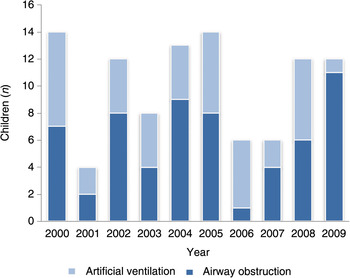
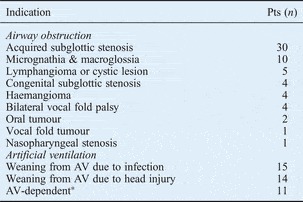
Indications for tracheostomy were initially divided into two broad groups: facilitation of artificial ventilation and relief of upper airway obstruction. Upper airway obstruction accounted for 60.4 per cent of cases while ventilatory support accounted for 39.6 per cent. Further subdivision of obstructive indications found subglottic stenosis to be the most common (34 children, 33.7 per cent); the majority of these cases were acquired (30 children, 29.7 per cent) while 4 (4.0 per cent) were congenital. Twenty-nine children (28.7 per cent) had tracheostomies to support weaning from assisted ventilation. Eleven children (10.9 per cent) were ventilator-dependent due to congenital myopathy or hypoventilation syndromes. Macroglossia and micrognathia accounted for 9.9 per cent of tracheostomies (10 children). A variety of less common indications accounted for the remaining 17 children (16.8 per cent) (Table I). There were no identified trends suggesting changes in the indication for tracheostomy over the 10-year study period (Figure 1).
Tracheostomy indications over time.

Indications for tracheostomy

*Due to myopathy or hypoventilation. Pts = patients; AV = artificial ventilation
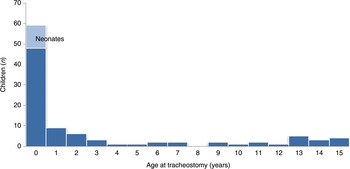
The mean age at tracheostomy insertion was 39.6 months, with the youngest child having surgery within 24 hours of birth. The majority of tracheostomies (59, 58.4 per cent) were performed on children under 1 year of age; 11 children (10.9 per cent) were less than 1 month old at tracheostomy, and 40 (39.6 per cent) were less than 6 months old (Figure 2).
Age at tracheostomy.

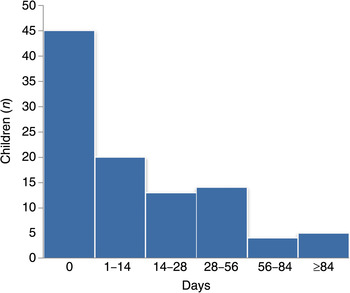
The total length of hospital stay ranged from 8 to 680 days (mean 115, median 77). The mean hospital stay following tracheostomy was 84 days (median 48, range 1–603). The mean additional in-patient stay once the child was considered medically fit for discharge was 19 days (median 5, range 0–265). Although 45 children (44.6 per cent) did not spend any further time in hospital once medically fit, 20 (19.8 per cent) spent up to 2 weeks, 13 (12.9 per cent) spent between 2 weeks and 1 month, and 23 (22.8 per cent) spent over 1 month; the maximum stay was 265 days (Figure 3). In 24 cases (23.8 per cent), children were transferred to regional hospitals; in 16 cases this happened before the child was medically fit for discharge. The length of time spent in regional hospitals once medically fit was not available from our data; therefore, some of these latter 16 children may also have experienced delayed discharge once medically fit.
Days spent in hospital after the child was considered medically fit for discharge.

Factors related to delayed discharge
Children whose discharge was delayed on non-medical grounds were divided into five categories: discharge delay of up to 13 days, delay of 14 to 27 days, delay of 28 to 55 days, delay of 56 to 83 days, and delay of 84 days or more.
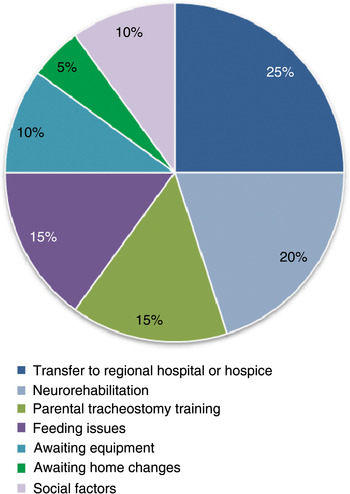
For the 20 children (19.8 per cent) delayed for up to 13 days once fit for discharge, various logistical factors were identified, as shown in Figure 4.
Factors delaying discharge for 1 to 13 days.

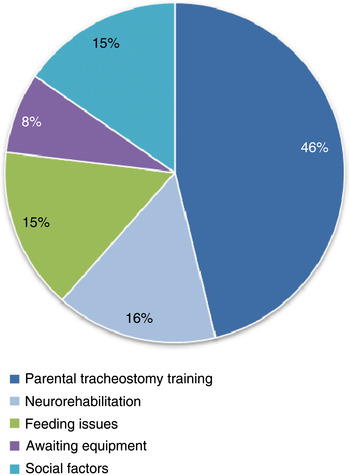
Thirteen children (12.9 per cent) were delayed for 14 to 27 days. Factors involved in these discharge delays are shown in Figure 5.
Factors delaying discharge for 14 to 27 days.

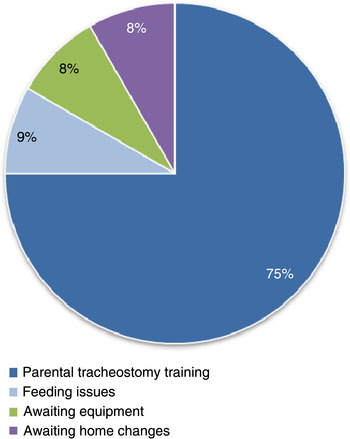
Fourteen children (13.9 per cent) were delayed for 28 to 55 days, as illustrated in Figure 6.
Factors delaying discharge for 28 to 55 days.

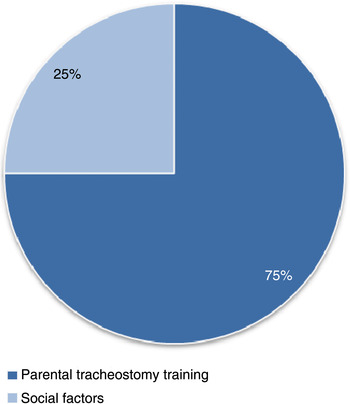
Four children (4.0 per cent) were delayed for 56 to 83 days, as illustrated in Figure 7.
Factors delaying discharge for 56 to 83 days.

Five children (5.0 per cent) were kept in hospital for more than 84 days after they were fit for discharge. Multiple factors accounted for these delays, including awaiting changes to housing (three cases), social problems (three cases) and tracheostomy training (one case).
Of the 56 children whose discharge was delayed despite them being medically fit, the majority (22 children, 39.3 per cent) were delayed due to the time taken to obtain parental competency in tracheostomy management. Other factors included awaiting equipment, awaiting changes to the home or re-housing, and additional social problems. The external social factors identified included parental substance abuse, single parenting, concerns about parenting ability, and the parents' first language not being English. Eighteen families did not speak English as a first language, in some cases necessitating regular use of interpreters. Five children were placed in foster care whilst in hospital; all had delayed discharge.
Discussion
In this study, over half of all children undergoing tracheostomy spent additional time in hospital once medically fit for discharge. A significant number (23, 22.8 per cent) spent over a month hospitalised due to non-medical factors, with a maximum stay of 265 days. In 24 cases (23.8 per cent), children were transferred to regional hospitals; therefore, we could not assess whether their discharge was further delayed beyond the time spent at the Leeds Teaching Hospitals NHS Trust.
Delays were related to a variety of factors, including equipment provision, arranging adequate housing, and time taken obtaining parental competency in tracheostomy management. A number of social and external factors were also identified, including parental substance abuse, single parenting, concerns about parenting ability, and English not being the family's first language.
Of the two broad indications for paediatric tracheostomy, the management of upper airway obstruction (60.4 per cent) was the most common, with the majority of these cases related to subglottic stenosis. Wetmore and colleagues reported facilitation of prolonged artificial ventilation as the most frequent indication for paediatric tracheostomy in their patients (53 per cent); however, it should be noted that their data represent indications for tracheostomy undertaken more than 10 years earlier.Reference Wetmore, Marsh, Thompson and Tom2, Reference Wetmore, Handler and Potsic3
None of the children in our study had a tracheostomy to treat acute upper airway obstruction secondary to infection; this reflects a trend towards short-term endotracheal intubation, better anaesthetic skills, and a lower incidence of epiglottitis following introduction of the Haemophilus influenzae type B (‘HIB’) vaccination. Similar findings have been reported in many recent studies.Reference Arcand and Granger1–Reference Zenk, Fyrmpas, Zimmermann, Koch, Constantindis and Iro5
Although indications for tracheostomy have changed over recent decades, we did not find any significant change over the 10-year period reviewed. The number of children having tracheostomies for subglottic stenosis changed little over the 10-year study period. This may reflect increasing survival of premature neonates who have been intubated, combined with better techniques of paediatric airway management.
The majority of tracheostomies (58.4 per cent) were performed in children under one year of age, in keeping with recent trends towards the use of tracheostomy in younger children.Reference Arcand and Granger1 Similarly, Wetmore et al. found that 67 per cent of children were less than one year of age at the time of tracheostomy, while Duncan et al. reported that 75 per cent of children with tracheostomies were under the age of one year.Reference Wetmore, Marsh, Thompson and Tom2, Reference Duncan, Howell, deLorimier, Adzick and Harrison6 This may be related both to greater survival of children with congenital abnormalities, and to premature infants requiring prolonged intubation.
Paediatric tracheostomies have significant implications for both child and family. In order for the tracheostomised child to be discharged home, many obstacles must be overcome. A variety of equipment is required, including spare tracheostomy tubes, ties, two suction machines, and in some cases nebulisers or oxygen. In our study, less than 10 per cent of discharges were delayed due to equipment provision problems. In contrast, Edwards et al. found that the most common obstacle to the discharge of 39 children requiring ventilation via tracheostomy was problems with funding for staff and equipment.Reference Edwards, O'Toole and Wallis7 This difference in findings may reflect the smaller number of home-ventilated patients in our cohort.
The provision of appropriate housing may also delay discharge. Local guidelines for the Leeds Teaching Hospitals NHS Trust state that children cannot be discharged to a high-rise flat or apartment as this may cause access difficulties in an emergency. Also, essential utilities (water, electricity etc) cannot be provided via payment meters, and must be guaranteed not to be disconnected even if payments are not met. The longer delays observed in the current study were often due to families requiring re-housing or establishing home ventilation. Edwards et al. found that a third of children being discharged dependent on ventilation via a tracheostomy did not have suitable housing; in our cohort, a smaller percentage of children were ventilator-dependent.Reference Edwards, O'Toole and Wallis7 The early involvement of a designated social worker for each child is essential in order to ensure that changes to the home environment (or re-housing) are implemented as quickly as possible. Adequate support must be available within the community, including nursing support, links to the ambulance service and respite care. Community nurses should become involved at an early stage, in order to meet the child in hospital and to arrange for continuity of equipment provision after discharge. Discharge planning meetings involving all parties are useful to highlight potential issues and expedite the discharge process.
Finally, parents must be competent to manage the tracheostomy, including tube changing, appropriate suctioning, and coping with potential emergencies such as tube obstruction or dislodgement. They must also be trained and assessed in basic paediatric life support. The American Thoracic Society consensus statement emphasises that, because a complication in a child with a tracheostomy represents a potentially life-threatening event, the preparation and education of home caregivers must be thorough and comprehensive.8 In our study, time taken to achieve parental tracheostomy competency caused the majority of discharge delays. This varied significantly across the cohort; frequently, additional social factors slowed training or meant parents were unable to obtain the required skills. Despite the stresses of managing a child with a tracheostomy day to day, Hopkins et al. found that the majority of carers managed well with practical aspects of care; in contrast, they were most concerned about the child's physical and emotional health.Reference Hopkins, Whetstone, Foster, Blaney and Morrison9
Concerns about parenting ability or unsafe home environments, including parental substance misuse, resulted in five children (5.0 per cent) being placed in foster care whilst in hospital. Assessment by social services and nursing staff takes time, and if the child is placed in care then further time is needed to train foster carers in tracheostomy management. Similarly, Edwards et al. reported that 2 out of 39 children (5.1 per cent) who required ventilation via a tracheostomy were placed in foster care during discharge planning.Reference Edwards, O'Toole and Wallis7 Again, early involvement of designated social workers is essential to ensure children have appropriate care if parents are unable to provide this.
Single parenting makes caring for a child with a tracheostomy much more challenging. The American Thoracic Society consensus states that two adults who will be consistent caregivers should be trained to care for the child at home.8 This may not be feasible in single parent households, and becomes more difficult if there are other siblings to care for. In these cases, it is particularly important that adequate respite and outreach support services are involved. Hopkins et al. found that home nursing and respite care were not felt to be adequate by families caring for children with tracheostomies, with many families receiving no additional support at home; although this data relates to children in the London area, it is likely that support is of a similar level nationwide.Reference Hopkins, Whetstone, Foster, Blaney and Morrison9 Spentzas et al. also commented on a number of social factors, including single parenting, which they felt may interfere with caregiver training prior to discharge.Reference Spentzas, Auth, Hess, Minarik, Storgion and Stidham10
In our cohort, a number of parents separated whilst the child was in hospital. Having a child in hospital long-term can be stressful on relationships, particularly if there are other siblings to care for and long distances to travel. Parental separation can delay discharge whilst appropriate care arrangements are agreed. Our observation of parental separation is supported by anecdotal evidence from the charity Aid for Children with Tracheostomies, which reports high numbers of partners leaving the home, unable to cope with the stress of caring for a child with a tracheostomy.Reference Hopkins, Whetstone, Foster, Blaney and Morrison9
Even with both parents present, having a child with a tracheostomy places additional responsibility on families and frequently affects parental employment and family dynamics. Children with tracheostomies should only be cared for by appropriately trained individuals; therefore, families can no longer leave children with nannies or friends or in regular child care. Hopkins et al. found that annual household income was reduced in households with a tracheostomised child, with more than half of participants reporting a total annual income of less than £15 000, in comparison to a mean annual income in the same area of £21 000.Reference Hopkins, Whetstone, Foster, Blaney and Morrison9 This compounds the issue that children with tracheostomies are more frequently from lower-earning families.Reference Saurel-Cubizolles, Zeitlin, Lelong, Papiernik, Di Renzo and Breart11
Eighteen families (17.82 per cent) in our study did not speak English as a first language. In some cases, this delayed tracheostomy training due to the need for interpreters. Even once a parent is confident in managing their child's tracheostomy, they must still be able to communicate effectively with the emergency services if needed. Similarly, Graf et al. reported that 10 per cent of discharges of tracheostomised children were impeded by language barriers.Reference Graf, Montagnino, Hueckel and McPherson12
• Paediatric tracheostomy can cause prolonged hospitalisation and financial burdens for both family and health service
• Delayed discharge is often due to social and external factors
• This would be reduced by early involvement of care organisations and good integration of medical, social and outreach services
• Dedicated paediatric tracheostomy nurse specialists co-ordinating discharge may reduce in-patient stay
Edwards et al. reported that significant family or social reasons were obstacles to discharge in 15 per cent of their 39 children.Reference Edwards, O'Toole and Wallis7 Graf et al. commented on factors impeding discharge in 70 children receiving tracheostomies; they found that 89 per cent of families had at least one impediment to discharge, with social factors being the most common cause for delay (20 per cent).Reference Graf, Montagnino, Hueckel and McPherson12 They reported a mean total hospital stay of 46 days; this relatively low number was attributed to an intensive, structured and anticipatory education programme. However, it should be noted that health care provision in the US and UK is difficult to compare; Medicaid provide newly tracheostomised children with nursing care for 24 hours a day for the first 72 hours, reduced over time to 40 hours per week. This compares with no designated nursing provision in the UK.Reference Graf, Montagnino, Hueckel and McPherson12
At the Leeds Teaching Hospitals NHS Trust, parental training in tracheostomy management is currently provided by several paediatric nurses, and includes basic life support and emergency tube changes. Parents initially observe tracheostomy care, then perform it themselves. Prior to discharge, parents are observed for a full 24 hours caring for their child independently, to ensure competence. Tearl and Hertzog assessed satisfaction with their training programme provided to families of children with tracheostomies requiring home ventilation; they found that having one designated trainer, as opposed to multiple trainers, produced greater satisfaction in the quality of training amongst both families and hospital staff.Reference Tearl and Hertzog13
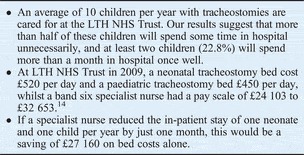
In view of the findings from this study, we believe that the provision of a dedicated paediatric tracheostomy nurse specialist, who is allocated specific time to co-ordinate medical, social and outreach services in addition to providing intensive daily training and assessment of parental competencies, may help to reduce unnecessary time spent in hospital by children with tracheostomies. We believe such a position would also be cost-effective; this is supported by the 2009 cost analysis shown in Table II.
2009 cost analysis for provision of dedicated paediatric tracheostomy nurse specialist

LTH = Leeds Teaching Hospital
Conclusion
The biopsychosocial consequences of paediatric tracheostomy significantly affect both child and family. These can lead to prolonged hospitalisation and consequentially to direct and indirect financial burdens on both the family and the health service. In many cases, delayed discharge is due to social and external factors. Early involvement of social care organisations and good integration of medical, social and outreach services would help reduce unnecessary hospitalisation. We recommend the use of dedicated paediatric tracheostomy nurse specialists to co-ordinate the discharge of neonates and children with tracheostomies, in order to facilitate this process and to reduce in-patient stay.