Introduction
Intrauterine growth restriction (IUGR) arises from maternal, fetal and/or placental factors that prevent the fetus from achieving its genetic potential for growth.Reference Ergaz, Avgil and Ornoy 1 , Reference Robinson, Moore, Owens and McMillen 2 In developed countries IUGR, which is most commonly caused by placental insufficiency, affects 6–12% of births.Reference Henriksen and Clausen 3 , Reference Kramer 4 Placental insufficiency progressively restricts transfer of nutrients and oxygen to the developing fetus, reducing growth particularly in late gestation.Reference Gagnon 5 , Reference Sankaran and Kyle 6 In human studies, low birth weight or small size at birth for gestational age (SGA) are often used as surrogate markers of IUGR.Reference Clayton, Cianfarani and Czernichow 7 There is conflicting evidence from human cohorts that voluntary levels and intensity of physical activity are altered in low birth weight compared with normal birth weight adolescents and adults.Reference Andersen, Angquist and Gamborg 8 – Reference Ridgway, Brage and Sharp 12 In human cohorts, increased physical activity throughout life, and in childhood or adolescence is associated with decreased risk of developing metabolic disease in adult life.Reference Bassuk and Manson 13 – Reference Fernandes and Zanesco 16 Decreased physical activity after IUGR may, therefore, contribute to the increased risk of metabolic disease in this population.Reference Whincup, Kaye and Owen 17 – Reference Forsén, Eriksson and Tuomilehto 19
A meta-analysis categorizing adolescents and adults as active or inactive by self-report showed an inverse U-shaped relationship between birth weight and levels of leisure time physical activity (LTPA).Reference Andersen, Angquist and Gamborg 8 Other studies confirm these findings with low and high birth weight individuals self-reporting lower levels of LTPA compared with those born of average birth weight.Reference Andersen, Angquist and Gamborg 8 , Reference Kajantie, Strang-Karlsson and Hovi 10 , Reference Salonen, Kajantie and Osmond 11 In contrast, LTPA measured objectively through accelerometer data during adolescence was either not relatedReference Ridgway, Brage and Sharp 12 or positively relatedReference Hildebrand, Kolle and Hansen 9 to birth weight. Similarly, reduced birth weight due to maternal famine exposure in mid- or late-gestation did not significantly alter self-reported physical activity.Reference Lussana, Painter and Ocke 20 Variable gender differences in physical activity have also been reported in humans, with LTPA either not differing between genders in adolescents and adultsReference Andersen, Angquist and Gamborg 8 , Reference Ridgway, Brage and Sharp 12 or females being more sedentary than males in adolescence.Reference Hildebrand, Kolle and Hansen 9 In addition to the variable effects of birth weight and sex, it is difficult to infer causality from human studies due to confounding by environmental factors that affect growth before birth and activity during postnatal life. For example, the risk of an SGA birth increases with lower socio-economic statusReference Raisanen, Gissler and Sankilampi 21 , Reference Hayward, Malcoe and Cleathero 22 and socio-economic status is positively correlated with levels of physical activity in both adolescents and adults.Reference Boone-Heinonen, Diez Roux and Kiefe 23 , Reference Stalsberg and Pedersen 24 Animal models of IUGR where progeny are delivered at term may be useful in separating out these effects of prenatal and postnatal environment on postnatal voluntary physical activity, while evaluating outcomes in both sexes is important given evidence for sex-specific effects of prenatal exposures.
Data from animal studies support the concept that prenatal exposure to maternal undernutrition may program voluntary physical activity. In rats, IUGR induced by maternal food restriction to 30% of ad libitum intakes decreased the activity of male and female progeny within a test arena over a recording period of 15 min, measured during the peri-pubertal period at 35 days of age and in adulthood at 14 months of age.Reference Vickers, Breier, McCarthy and Gluckman 25 Similarly, young adult (60 days old) IUGR male rat progeny of dams whose food intake was restricted by 50% from day 10 of pregnancy and throughout lactation, ran a shorter total distance over 7 days when provided with continuous running wheel access compared with control progeny from dams with ad libitum access to feed.Reference Cunha Fda, Dalle Molle and Portella 26 Interestingly, female progeny from food-restricted dams ran more than female progeny from control dams in the same experiment.Reference Cunha Fda, Dalle Molle and Portella 26 In a separate study, locomotor activity measured over half an hour during daylight hours in adult rats at 91 days of age was reduced in male progeny when mothers were protein-restricted during early pregnancy but not mid- or late-pregnancy.Reference Bellinger, Sculley and Langley-Evans 27 In female progeny, activity was reduced by maternal protein restriction regardless of whether restriction was imposed during early-, mid- or late-pregnancy.Reference Bellinger, Sculley and Langley-Evans 27 This provides further evidence that effects of some perinatal exposures on later activity may be sex-specific, and reinforces the need to include progeny of both sexes when evaluating impact. Also consistent with the hypothesis that prenatal exposures program physical activity, periconceptional maternal undernutrition in sheep decreased the distance walked voluntarily by adult male and female progeny over a period of 48 h in a paddock environment.Reference Donovan, Hernandez and Matthews 28 Interestingly, in this cohort comprising twin and singleton progeny, litter size did not affect activity in adulthood.Reference Donovan, Hernandez and Matthews 28 Maternal undernutrition of sheep throughout early-mid gestation did not alter physical activity of progeny, but this may reflect the fact that in this study the progeny were barn-housed and, therefore, had restricted opportunity for activity, compared with paddock-housed sheep.Reference Williams, Kurlak and Perkins 29 These studies do not, however, evaluate effects of IUGR on activity, as periconceptional maternal undernutrition does not reduce size at birth in sheep,Reference Todd, Oliver, Jaquiery, Bloomfield and Harding 30 whereas early-mid gestation nutrient restriction actually increased birth weight of progeny.Reference Gopalakrishnan, Gardner and Dandrea 31 Each are also likely to affect fetal growth at different times than occurs in IUGR, where restricted placental function restricts fetal growth mostly in late gestation.Reference Sankaran and Kyle 6 As yet, effects of restricted placental growth and/or function on spontaneous ambulatory activity have not been reported, nor has the effect of IUGR or restricted placental function on progeny physical activity been assessed in a free-ranging environment.
Restricted placental growth and function [placental restriction (PR)] resulting in IUGR can be induced experimentally in sheep by surgical removal of the majority of placental attachment sites from the non-pregnant endometrium before mating.Reference Alexander 32 , Reference Robinson, Kingston, Jones and Thorburn 33 This induces similar fetal and postnatal consequences as seen in human IUGR, by decreasing placental blood flow and oxygen and nutrient supply to the fetus.Reference Owens, Falconer and Robinson 34 – Reference Owens, Falconer and Robinson 37 In previous studies, average birth weight in PR lambs at term was reduced by 20–31%.Reference Gatford, Clarke and De Blasio 38 – Reference De Blasio, Gatford, Harland, Robinson and Owens 40 Postnatally, these lambs experience catch-up growthReference De Blasio, Gatford, Robinson and Owens 41 , Reference De Blasio, Gatford, McMillen, Robinson and Owens 42 and develop insulin resistance in early postnatal life,Reference De Blasio, Gatford, Harland, Robinson and Owens 40 while males but not females have impaired insulin action which persists to adulthood.Reference Gatford, Mohammad and Harland 43 We, therefore, utilized this experimental paradigm to test the hypothesis that restriction of placental growth and small size at birth would reduce levels of spontaneous ambulatory activity in adolescent and young adult sheep in a free-ranging environment, and that effects would be greater in female than male progeny.
Methods
Animal cohort
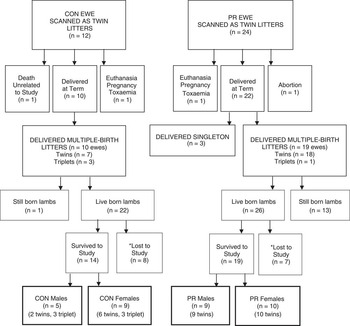
Placental growth of Merino×Border Leicester ewes was restricted by surgical removal of all but four visible endometrial placental attachment sites (caruncles) from each uterine horn, at least 10 weeks before timed mating of PR and unoperated control (CON) ewes.Reference Alexander 32 , Reference Robinson, Kingston, Jones and Thorburn 33 Because surgery and recovery occur before pregnancy in this model such that the fetus is not exposed to maternal surgery in PR pregnancies, and initial studies in this model established that sham surgery did not reduce size at birth,Reference Alexander 32 we did not perform sham surgery on CON ewes in the present study. Pregnancy was confirmed by ultrasound at 48–55 days after mating. Only ewes scanned as pregnant with twins (12 CON, 24 PR ewes) were selected for the study, due to limited availability of singleton control pregnancies. Ewes were housed indoors from day 110 of gestation until their spontaneously born lambs were weaned at 97.0±0.4 days of age. Throughout late gestation and lactation ewes were fed 1 kg Rumevite pellets daily (10.6 MJ metabolizable energy/kg dry matter; 12.3% crude protein; Ridley AgriProducts, St Arnaud, VIC, Australia), with ad libitum access to lucerne chaff and water. Gestational ages, lamb weights and litter sizes were recorded at birth. Only lambs born from litters with two or three lambs were included in the present study; not all litter sizes from ultrasound corresponded to litter size at delivery (Fig. 1). A total of 23 CON lambs (one stillborn and 22 liveborn) from 10 CON ewes and 39 PR lambs (26 liveborn and 13 stillborn) from 19 PR ewes were delivered between 12 and 27 July 2014 (Fig. 1). Due to deaths of some non-viable lambs and removal of triplet siblings, surviving lambs included in the spontaneous activity study [five CON males (two twins, three triplets), nine CON females (six twins, three triplets), nine PR males (nine twins) and 10 PR females (10 twins)] were reared as twins or singletons during lactation. The litter size during lactation (number of lambs suckling the ewe) was, therefore, included in statistical models to account for neonatal nutritional environment.
Animal cohort. *Lost to study: eight control (CON) and seven placental-restricted (PR) lambs were lost to study due to removal of triplet siblings to control for litter size (n=3 CON lambs, n=1 PR lambs), maternal removal from the study for health reasons (n=3 CON lambs, n=6 PR lambs) or lamb birth defects (n=2 CON lambs from 1 pregnancy).

Lambs were weighed daily until 30 days after birth, when catch-up growth usually occurs in PR lambs, based on our previous study in mixed singletons and twinsReference De Blasio, Gatford, Robinson and Owens 41 and then weekly until weaning. Absolute and fractional growth rates from birth to 30 days postnatal age were calculated by linear regression.Reference De Blasio, Gatford, McMillen, Robinson and Owens 42 After weaning, progeny were housed in adjacent paddocks in same-sex groups at the Roseworthy Campus of the University of Adelaide and group fed daily at a rate of 0.5 kg Rumevite pellets per sheep, with ad libitum access to oaten hay, seasonal pasture and water, and were weighed at monthly intervals.
Spontaneous ambulatory activity
Spontaneous ambulatory activity studies were performed under natural light and temperature conditions in the paddocks where animals were held throughout the study. Animals remained in their same-sex groups, each with access to paddocks of the same size (~0.25 ha) and shape, throughout both series of activity studies. Each animal was studied as an adolescent (204±1 days of age, during summer in January–February 2015) and as a young adult (294±1 days of age, during autumn in May 2015). Two recordings of 18 h duration were taken on each animal at each age. At each age, five to six animals were randomly allocated to each study day, with one recording of each animal completed before the second block of recordings, and different randomized orders used in each block to allow correction for day effects. All studies were completed within a 16-day period at each age. Garmin Forerunner 910XT GPS devices (Garmin Limited, Lenexa, KS, USA) were attached to a collar placed on individual sheep at 1800 h, and removed at 1200 h on the following day. Recording duration was determined by battery life and timed to capture periods of peak and changing activity seen in the evening and morning in free-ranging sheep.Reference Morton, Rudiger and Wood 45 Data were uploaded to the Garmin website using Garmin Connect software (v 15.7.4.1, Garmin Ltd), and distance in 5-s intervals was downloaded for subsequent data cleaning (to remove satellite artifacts). Distance traveled was used as the measure of spontaneous ambulatory activity and was summed for each 10 min period between 1800 and 1200 h the following day for each animal for the analysis of activity patterns. Average distance traveled per hour was calculated for the whole recording period, during daylight hours (before sunset and after sunrise), during night hours (between sunset and sunrise), and for hourly blocks from 2 h before sunrise to 2 h after sunrise. Average distance traveled per hour was also summed for hourly blocks from 1 h before to 2 h after sunset in adolescent animals only, when the recordings consistently started over an hour before sunset; pre-sunset data was not available in adults due to season. Average times of sunrise and sunset were 0642 and 2015 h, respectively, during adolescence in summer, and 0656 and 1725 h, respectively, during adulthood in autumn. Half-hourly temperature data for the Roseworthy Campus weather recording station throughout each recording period were downloaded from the Australian Government Bureau of Meteorology server (http://www.bom.gov.au/climate/dwo/IDCJDW5062.latest.shtml).
Statistical analysis
Size at birth and gestational age at birth were analyzed by mixed models ANOVA, for effects of treatment (CON compared with PR) and lamb sex as main factors, and including the dam as a random factor to correct for maternal effects. Neonatal growth rates were analyzed by mixed models ANOVA, including treatment, lamb sex and lactation litter size (one or two lambs suckling the ewe) as main factors, and including the dam as a random factor to correct for maternal effects. Effects of treatment and sex on proportions of lambs born alive were analyzed by χ2 test. Repeated measures of lamb body weights from birth to 30 days of age (during catch-up growth), from 30 days of age until weaning, and from weaning until the end of the study were analyzed by mixed models ANOVA, for effects treatment, lamb sex and lactation litter size as main factors, age as a within-animal factor and including the dam as a random factor in each model to correct for maternal effects. At each age, distances traveled per hour during the whole recording period, and during daylight and night hours of the recording period, were analyzed using a repeated-measures ANOVA, including treatment, sex, lactation litter size and recording block (first or second replicate) as main factors, dam and recording date as random factors, recording block as a within-animal factor and maximum temperature during the sampling period as a covariate. Spline analysis of behavioral patterns was conducted using 10-min interval data across the recording period, with 7037 distance records included. These were analyzed using a linear mixed model with a cubic spline that had 18 knot points, which fits a very flexible polynomial regression as previously detailed.Reference Verbyla, Cullis, Kenward and Welham 46 Fixed effects included treatment, sex, recording block, maximum temperature, time×treatment (linear treatment effect) and time×sex (linear sex effect). Random effects included dam, lamb, spline (time)×treatment (test for treatment differences in activity patterns), spline (time)×sex and factor (time) to allow for non-smooth departures in activity due to things like human disturbances. Pairwise comparisons between male and female activity at specific times based on predictions of activity every half-hour were analyzed by t-test. Associations between total, daylight and night activity as adolescents and adults and birth weight were assessed by Pearson’s correlation. Excluding lambs born in triplet litters limited between-sex comparisons and did not change effects of treatment on size at birth, neonatal growth or activity totals (Supplementary Table 1); data reported below, therefore, includes progeny born to twin and triplet litters. All analyses were performed using IBM SPSS v 22 (SPSS, Chicago, IL, USA), and data are presented as estimated means±s.e.m. unless otherwise stated.
Results
Size at birth and perinatal survival
In the subset of liveborn lambs, PR lambs were 26% lighter at birth than CON lambs (CON: 4.28±0.79 kg; PR: 3.17±1.29 kg; P<0.001), and birth weight did not differ between males and females (P>0.5). Stillborn lambs were 44% lighter than liveborn lambs (liveborn: 3.98±0.98 kg; stillborn: 2.22±1.10 kg; P<0.001). Gestational age was lower in PR lambs compared with CON lambs (CON: 146.0±2.6 days; PR: 143.5±2.0 days; P<0.001), although the majority were still within the term range, based on our previous observations of gestation length at spontaneous delivery in a larger cohort of CON pregnancies in this strain of sheep (mean: 147.0±0.3 days; range 143–150 days). Overall, PR lambs were less likely to be born alive than CON lambs (CON: 22 of 23 born alive; PR: 26 of 39 born alive; P=0.008).
In the lambs that survived and were included in spontaneous ambulatory activity studies, birth weight did not differ between treatments or sexes overall (Table 1), or in twin-born progeny only (Supplementary Table 1). Within CON lambs included in spontaneous ambulatory activity studies, birth weights did not differ between those born in twin and triplet litters (CON twin: 4.64±0.24 kg; CON triplet: 4.36±0.26 kg; P>0.1), and birth weights of triplets all fell within the range of birth weights observed in twins (CON twin: 3.5–5.7 kg; CON triplet: 3.6–5.2 kg). For ewes that had at least one lamb survived to be included in the spontaneous activity study, gestational age did not differ between CON and PR lambs (CON: 145.5±2.7 days; PR: 143.9±1.6 days; P>0.1).
Birth weight and neonatal growth

PR, placentally restricted.
Neonatal growth rates from birth to 30 days of age were calculated by linear regression for lambs included in spontaneous physical activity measures only. Treatment×sex interaction is indicated by T×S. Data are actual means±s.e.m.
Postnatal growth
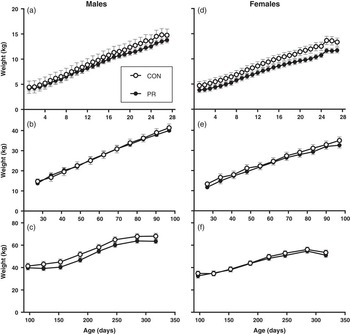
In the 1st month of life, absolute growth rate (Table 1) did not differ between CON and PR lambs (P>0.9), was higher in males than females (P=0.012) and fractional growth rate (Table 1) did not differ between treatments (P>0.1) or sexes (P>0.1). Similar effects were observed in twin-born progeny analyzed separately (Supplementary Table 1). Absolute and fractional growth rates from birth to day 30 did not differ between lactation litter sizes (each P>0.3). Body weight during the 1st month of life (Fig. 2a and 2d) increased with age (P<0.001), tended to be higher in CON than PR overall (P=0.054), and was higher in males than females (P=0.005). Lambs reared as singletons due to perinatal death of a sibling were heavier overall (P=0.001) and grew faster (lactation litter size×age interaction P<0.001) than lambs reared as twins. From the end of the neonatal period until weaning at 14 weeks of age (Fig. 2b and 2e), body weight increased with age (P<0.001), did not differ between treatments (P>0.4) or lactation litter sizes (P>0.1), and was higher in males than females (P=0.040). Similarly, body weight after weaning (Fig. 2c and 2f) increased with age (P<0.001), did not differ between treatments (P>0.5) or lactation litter sizes (P>0.6), and was higher in males than females (P=0.001).
Effects of placental restriction (PR) on postnatal weight in male (a–c) and female (d–f) sheep. Body weight of control (CON) (white circles) and PR (black circles) are shown daily from birth to day 27 (a, d), weekly from day 27 to weaning (b, e), and monthly from weaning to day 320 (c, f). Data are estimated means±s.e.m.

Spontaneous ambulatory activity in adolescence
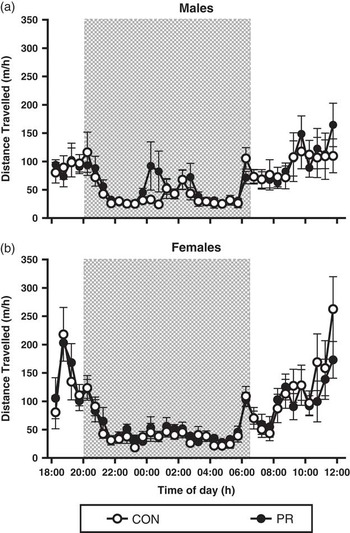
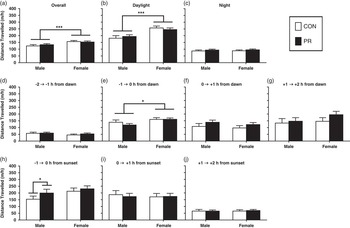
In adolescent sheep, the distance traveled over each 30-min interval changed throughout the recording period, following a typical diurnal pattern of greater activity during daylight than night times (Fig. 3a and 3b). Over the total 18-h recording period distance traveled per hour did not differ between treatments (P>0.1, Fig. 4a), females traveled 17% further than males (P<0.001, Fig. 4a), and distance traveled did not differ between recording blocks, lactation litter sizes or with maximum temperature (P>0.1, data not shown). During daylight, distance traveled per hour did not differ between treatments (P>0.1, Fig. 4b), females traveled 25% further than males (P<0.001, Fig. 4b), and distance traveled did not differ between recording blocks, lactation litter sizes or with maximum temperature (P=0.09, data not shown). During night, distance traveled per hour did not differ between CON and PR progeny (P=0.082, Fig. 4c), or sexes (each P>0.1, Fig. 4c), tended to be greater during the first recording block than during the second recording block (P=0.063, data not shown), and did not differ between lactation litter sizes or vary with maximum temperature (P>0.1, data not shown). Similar treatment and sex effects were observed in analyses restricted to twin-born progeny (Supplementary Table 1).
Activity patterns in male (a) and female (b) adolescent sheep at 204±1 days of age. Distance traveled in control (CON) (white circles) and placental restriction (PR) (black circles) progeny are shown as actual means±s.e.m., averaged for 30-min blocks between 1800 and 1200 h. Time from sunset to sunrise (night) is shaded gray.

Effects of treatment and sex on average distance traveled during specific periods in adolescent sheep at 204±1 days of age. Average distance traveled per hour was calculated across the entire recording period (a), during daylight (b) and night (c), and in blocks of time relative to sunrise: −2 to −1 (d), −1 to 0 (e), 0 to +1 (f), +1 to +2 (g) h from sunrise, and in blocks of time relative to sunset: −1 to 0 (h), 0 to +1 (i), +1 to +2 (j) h from sunset in control (CON) (white bars) and placental-restricted (PR) (black bars) adolescent sheep. Data are estimated as means±s.e.m. *P<0.05, ***P<0.001.

Analysis of hourly ambulatory activity during the peak activity period 2 h before and after sunriseReference Morton, Rudiger and Wood 45 , Reference Tobler, Jaggi, Arendt and Ravault 47 , Reference Zumwalt 48 showed no treatment differences in distance traveled in any hour (each P>0.1, Fig. 4d–4g). In the hour leading up to sunrise (Fig. 4e), distance traveled by females was greater than males (P=0.012), with a similar trend for the preceding hour (P=0.099, Fig. 4d), and no sex differences in activity in the 2 h after sunrise (Fig. 4f and 4g, each P>0.1). In the hour leading up to sunset (Fig. 4h), effects of treatment on distance traveled differed between sexes (treatment×sex interaction, P=0.043). Distance traveled in the hour leading up to sunset was higher in PR than CON males (P=0.025, Fig. 4h) and did not differ between treatments in females (P>0.1, Fig. 4h). During the remaining hourly blocks, from sunset to 1 h after sunset and from 1 to 2 h after sunset, distance traveled did not differ between treatments or sexes (each P>0.1, Fig. 4i and 4j).
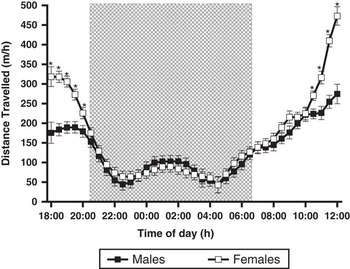
Spline analysis of activity in adolescents showed treatment differences in linear activity pattern (P<0.001) but no sex effects on the linear trend (P>0.05), and no effects of temperature (P>0.05). There were relatively large differences between sexes in the non-linear trends, and we therefore performed pairwise comparison of predicted activity at specific times (Fig. 5). Female activity was greater than that of males during periods of peak activity (each P<0.05).
Predicted activity patterns for male (closed squares) and female (open squares) adolescent sheep at 204±1 days of age. Distance traveled per hour was predicted by spline analysis, utilizing 18 spline points, and estimated means±s.e.m. are shown for males (black squares) and females (white squares) across the 18-h recording period. Differences in estimated means between male and females are indicated: *P<0.05.

Spontaneous ambulatory activity in adulthood
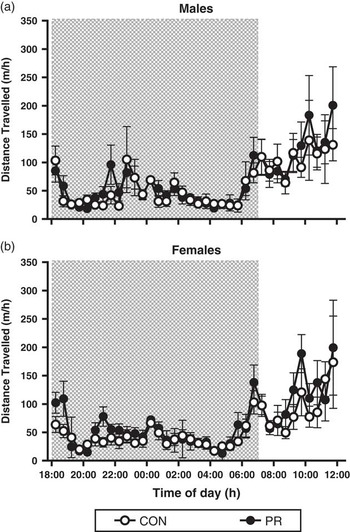
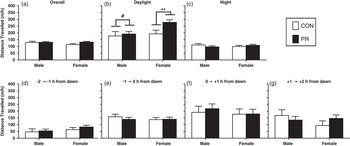
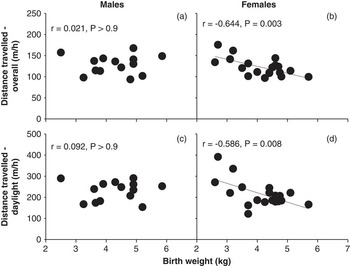
In adult sheep, similar to the pattern observed in adolescents, the distance traveled over each 30-min interval changed throughout the recording period, following a typical diurnal pattern of greater activity during daylight than night times (Fig. 6a and 6b). Over the total 18 h recording period, distance traveled per hour did not differ between treatments (P>0.1, Fig. 7a), sexes (P>0.1, Fig. 7a) or lactation litter sizes (P>0.1, data not shown), was higher during the first recording block than during the second recording block (P<0.001, data not shown) and was positively correlated with maximum temperature (P<0.001, data not shown). In analyses restricted to twin-born progeny only, although sex differences were observed, treatment similarly did not affect distance traveled per hour (Supplementary Table 1). During daylight, distance traveled by PR progeny tended to be greater than CON overall (P=0.092, Fig. 7b), females traveled 8% further than males overall (P=0.016, Fig. 7b), distance traveled was greater during the first recording block compared with the second recording block (P=0.025, data not shown), lambs raised as twins during lactation traveled 18% further than lambs raised as singletons (P=0.039, data not shown) and distance traveled did not correlate with maximum temperature (P>0.1, data not shown). Outcomes differed between sexes, such that in males distance during daylight tended to be higher in PR than CON progeny (+8%, P=0.053, Fig. 7b), was higher during recording block one than block two (P<0.001, data not shown), did not differ between lactation litter sizes (P>0.1, data not shown) and distance did not correlate with maximum temperature (P>0.1, data not shown). In females, distance traveled during daylight was 29% higher in PR than CON progeny (P=0.020, Fig. 7b), was not different between recording blocks (P>0.1, data not shown), lambs raised as singletons during lactation tended to be less active than lambs raised as twins (P=0.09, data not shown) and distance traveled did not correlate with maximum temperature (P>0.1, data not shown). During the night, there were no differences in distance traveled between treatments (P>0.1, Fig. 7c), sexes (P>0.1, Fig. 7c) or lactation litter sizes (P>0.1, data not shown). Distance traveled during the first recording block was higher than during the second recording block (P=0.02, data not shown) and tended to be positively correlated with maximum temperature (P=0.064, data not shown). In adults, average distance traveled across the total recording period correlated negatively with birth weight in females (Fig. 8b) (r=−0.644, P=0.003, n=19) but not in males (Fig. 8a) (r=0.021, P>0.1, n=14). Similarly, daylight activity correlated negatively with birth weight in females (Fig. 8d) (r=−0.586, P=0.008, n=19) but not in males (Fig. 8c) (r=0.092, P>0.9, n=14). Night activity did not correlate with birth weight in either sex (data not shown).
Activity patterns in male (a) and female (b) adult sheep at 294±1 days of age. Distance traveled in control (CON) (white circles) and placental-restricted (PR) (black circles) progeny are shown as actual means±s.e.m., averaged for 30-min blocks between 1800 and 1200 h. Time from sunset to sunrise (night) is shaded gray.

Effects of treatment and sex on average distance traveled during specific periods in adult sheep at 294±1 days of age. Average distance traveled per hour was calculated across the entire recording period (a), during daylight (b), night (c) and in blocks of time relative to sunrise: −2 to −1 (d), −1 to 0 (e), 0 to +1 (f), +1 to +2 (g) h from sunrise in control (CON) (white bars) and placental-restricted (PR) (black bars) young adult sheep. Data are estimated as means±s.e.m. # P=0.053, **P<0.01.

Adult ambulatory activity correlates negatively with birth weight in females (b) but not males (a). Average distance traveled per hour across the entire recording period (a, b) or during daylight (c, d) as adults, correlated negatively with birth weight in females (b, d) but not in males (a, c).

Hourly activity during the periods from 2 h before to 2 h after sunrise (Fig. 7d–7g), did not differ between treatments or sexes (each P>0.1). Spline analysis of activity in adults (data not shown) found no treatment differences in linear activity pattern (P>0.05), and a negative effect of maximum temperature (P<0.001). Although the linear trend differed between sexes (P<0.05), predicted activity did not differ between sexes at any time point (P>0.05, data not shown).
Discussion
In this study, we report for the first time the effects of placental insufficiency and variable size at birth in an animal model on spontaneous levels of physical activity in later life, specifically ambulatory activity in a free-ranging environment. Contrary to our hypothesis, in the present cohort of progeny from multi-fetal pregnancies, PR increased spontaneous ambulatory activity in adult female sheep during daylight hours, with a similar trend in males, and low birth weight was similarly associated with greater spontaneous ambulatory activity overall as well as during daylight in females. PR did not affect spontaneous ambulatory activity in adolescent sheep. Consistent with previous findings, spontaneous ambulatory activity levels were higher in females than males, particularly as adolescents. This suggests that decreased spontaneous ambulatory activity in adolescence and adulthood is not a primary driver in the postnatal development of metabolic disease after restricted placental function.
In the present study of sheep from multi-fetal litters, both PR and low birth weight female adult progeny were more active than CON and higher birth weight females during daylight, with similar diurnal activity patterns in both sexes. In males, although PR also tended to have greater adult daylight activity than CON, this effect was much smaller in magnitude and activity was not correlated with birth weight. This result is consistent with the sex-specific effects of experimental IUGR in a rodent study, in which dams were subjected to 50% global food restriction from day 10 of gestation until weaning, which increased activity in female but not male progeny.Reference Cunha Fda, Dalle Molle and Portella 26 Sex-specific effects of PR and associations with birth weight may reflect sex-specific fetal adaptations to adverse environments, similar to patterns observed in maternal asthma in humans where growth is reduced in females but not males.Reference Clifton 49 Whether PR or IUGR have sex-specific effects on fetal growth trajectories in these animal models is not yet known. Due to limited numbers of progeny, it was not possible to subdivide groups according to gestation litter size, although we included only progeny from multi-fetal litters in the present study. All surviving CON triplets had birth weights within the range of birth weights seen in CON twins, suggesting a similar degree of restriction. Litter size during lactation had very limited effects on activity in the present study, consistent with findings in a previous study including twins and singletons, where activity did not differ between singleton and twin litter size groups.Reference Donovan, Hernandez and Matthews 28 Furthermore, when we analyzed activity outcomes only for lambs born in twin litters (Supplementary Table 1), effects of treatment were similar to those reported in overall analyses including twins and triplets.
The mechanisms underlying this greater activity in low birth weight and PR adult females compared with CON and high birth weight females have not yet been identified. One brain region which is an important driver of spontaneous physical activity is the dorsal medial habenula.Reference Hsu, Wang and Wang 50 In mice, genetic elimination of neuronal development in this region reduced motivation-based locomotor activity, such as voluntary wheel running, with no abnormalities in gait and balance and the same physiological capacity for exercise as seen in control progeny.Reference Hsu, Wang and Wang 50 Induced activation of neurons in this region in normally developed mice increased voluntary locomotor activity,Reference Hsu, Wang and Wang 50 further confirming the importance of this region as a driver of spontaneous physical activity. Effects of PR or IUGR on this region, or on biological messengers implicated in modifying voluntary activity including dopamine, noradrenaline and serotoninReference Rowland 51 , Reference Thorburn and Proietto 52 are yet to be investigated. Confounding postnatal factors such as body weight, which is negatively correlated with physical activity,Reference DiPietro 53 can potentially affect activity. However, in the present study, when adolescent and adult spontaneous activity measures were taken, body weight did not differ between treatments, and is therefore unlikely to have contributed to the greater levels of activity observed in PR and low birth weight adult female progeny. Similarly, although a systematic review in humans reported variable and generally negative effects of psychological stress on physical activity,Reference Stults-Kolehmainen and Sinha 54 because the sheep in the present study were habituated to human contact by regular handling as lambs and frequent weight measures from birth throughout the study, stress is unlikely to have affected activity. A possible mechanism that might contribute to effects of PR and IUGR on postnatal activity is appetite. Movement in adult sheep is predominately driven by grazing, and sheep increase grazing time when hungry.Reference Allden and McDWhittaker 55 Feeding frequency, an indicator of appetite, is increased in PR compared with CON lambs during catch-up growth; effects of litter size were not reported in that study.Reference De Blasio, Gatford, Robinson and Owens 41 The increased ambulatory activity in PR and low birth weight adult females might, therefore, suggest hyperphagia in adult life, which has been reported in adult IUGR rat progeny whose mothers were globally food restricted to 30% of the intake of ad libitum-fed animals during gestation.Reference Vickers, Breier, Cutfield, Hofman and Gluckman 56 Effects of PR on adult appetite have not as yet been reported, although the similar body weights between PR and CON sheep in the present study suggests that PR might affect grazing behavior via altered food-type preference rather than increased drive for total nutrient intake. Interestingly, adult human data suggest that positive feedback occurs between spontaneous physical activity and hyperphagia, such that hyperphagia stimulates the desire for increased spontaneous activity which in turn stimulates hyperphagia, due to an inherent desire to maintain homeostatic body weight.Reference Thorburn and Proietto 52 This suggests that increased ambulatory activity in our adult female PR and low birth weight females might reflect increased appetite or altered food preference.
Activity patterns across the recording period were sexually dimorphic, with greater activity in females than males overall and in daylight in adolescent sheep, and also during daylight in adults. Our results are consistent with the greater physical activity in females than males reported in mice,Reference Thorburn and Proietto 52 ratsReference Vickers, Breier, McCarthy and Gluckman 25 , Reference Bellinger, Sculley and Langley-Evans 27 and sheep.Reference Donovan, Hernandez and Matthews 28 Estrogen is a positive driver of activity and possibly underlies these sex differences in activity, as in female mice ovariectomy reduces voluntary activity to levels similar to males, and 17β-estradiol treatment in ovariectomized mice increases activity.Reference Ainslie, Morris and Wittert 57 Interestingly, despite variable sex differences in activity in humans, where activity is either similar between genders,Reference Andersen, Angquist and Gamborg 8 , Reference Ridgway, Brage and Sharp 12 or greater in males than females,Reference Hildebrand, Kolle and Hansen 9 estrogen also appears to be a positive driver of activity in humans, with loss of ovarian function in women during menopause correlating with a marked fall in physical activity.Reference Poehlman and Tchernof 58 Our sheep were likely post-puberty during measures of SAA, particularly at 43 weeks of age, given the ad libitum nutrition and because Merino ewes enter puberty at an average age of 31 weeks (23–43 weeks old).Reference Nieto, Ferguson and Macleay 59 In order to minimize the likely impact and confounding by stress, we did not collect blood or track cycles in our cohort, and it was, therefore, not possible to match the ewes for estrus cycle. Interactions between PR and estrus cycle stage, and whether effects of PR change further with aging beyond young adulthood, are yet to be investigated. Further characterization of sex effects on voluntary activity and understanding of underlying mechanisms including pathways for estrogen responses are required.
This is the first study showing the effect of surgical pre-mating removal of placental attachments sites, which restricts placental growth and function,Reference Alexander 32 , Reference Robinson, Kingston, Jones and Thorburn 33 on spontaneous physical activity, where all progeny shared a common post-weaning environment, maternal age and similar genetic background. Additional strengths of the study were inclusion of both sexes, and that as all ewes delivered within 4 days of average term, this model is not confounded by prematurity, which is associated with reduced physical activity in adolescent and adult humans.Reference Dahan-Oliel, Mazer and Majnemer 60 Effects of PR on activity may, however, have been diluted by the flocking behavior that occurs in this herd species, where groups of sheep tend to move together,Reference Winfield, Syme and Pearson 61 making it even more significant that differences were observed between groups. Dilution of group differences in activity was seen in studies of circadian patterns of activity in transgenic Huntington’s disease (HD) sheep. HD sheep have relatively mild behavioral changes when kept in a mixed flock including individuals of normal genotype, but circadian abnormalities were far more evident in sheep living in flocks comprising only HD sheep.Reference Morton, Rudiger and Wood 45 Therefore, dilution of treatment effects on activity and/or activity patterns may potentially have occurred in the present study and should be kept in mind when interpreting the magnitude of difference that was observed. An additional limitation in interpreting the results of the present study is that, unlike previous studies in CON and PR sheep,Reference Wooldridge, Bischof and Meeusen 39 – Reference De Blasio, Gatford, Robinson and Owens 41 PR lambs within the cohort of animals that survived to be included in the spontaneous physical activity study were not lighter at birth and did not experience accelerated growth rates in early life compared with CON lambs. In part, we suspect this reflects restriction of fetal growth in all lambs, including CON lambs, within the present cohort, as a consequence of studying outcomes in offspring of multi-fetal pregnancies. Use of multiple-birth litters was chosen on the basis of ultrasound results in order to achieve similar litter sizes between treatments, due to insufficient availability of CON singleton pregnancies, but nutrient supply in late gestation is restricted in twins compared with that of singletons.Reference van der Linden, Sciascia, Sales and McCoard 62 This may have reduced the magnitude of effects of PR on size at birth compared with these previous studies, as likely all progeny were subject to a degree of growth restriction in utero. Growth curves of twins and singletons diverge in fetal sheep by approximately day 100 of gestation.Reference Rattray, Garrett, East and Hinman 63 Reduction of litter size by death of one fetus of twin litters in early gestation (day 42 after mating) does not fully normalize birth weight,Reference Hancock, Oliver, McLean, Jaquiery and Bloomfield 64 possibly because the number of placental attachments to the endometrium is already fixed with adhesion occurring by day 16 of development,Reference Spencer and Hansen 65 and hence before reduction in litter size. The surgical reduction in numbers of placental attachment sites before pregnancy in PR ewes may thus mirror some of the effects of multi-fetal litter size in ovine pregnancy, as both reduce the numbers of placental attachments and cotyledons formed. Whether triplets suffer additional growth restriction compared with twins is less clear, with similar fetal and placental weights reported in twin and triplet ovine fetuses in late gestation.Reference Vonnahme, Evoniuk and Johnson 66 In the overall cohort of liveborn lambs, PR were 26% lighter than CON. The lack of birth weight difference in lambs included in the spontaneous ambulatory activity studies (seen also when analysis was restricted to twin-born animals), therefore also reflects poorer survival of PR lambs, particularly the more restricted animals, including twins. An additional limitation of the study design is that, due to perinatal deaths and removal of some non-viable lambs, our study included lambs gestated in multi-fetal litters but that were raised as singletons or twins during lactation, which may have added variation in neonatal nutrition. We found, however, that lactation litter size had little effect on activity measures in adolescents or adults, consistent with reports in another cohort including lambs gestated and raised as singletons and twins.Reference Donovan, Hernandez and Matthews 28 In human cohorts exposed to severe maternal malnutrition at different times before, during and after pregnancy, maternal exposures in early pregnancy induced adverse changes in progeny health without changes in birth weight,Reference Roseboom, Painter, van Abeelen, Veenendaal and de Rooij 67 although self-reported activity was not affected by in utero famine exposure.Reference Lussana, Painter and Ocke 20 Similarly, periconceptional maternal undernutrition in sheep decreased activity in adult progeny without altering birth weight.Reference Donovan, Hernandez and Matthews 28 Our findings of PR effects even in the absence of differences in birth weight in females are thus consistent with the concept that periconceptual and gestational insults can affect postnatal outcomes without changes in birth weight.
IUGR is associated with increased burden of metabolic disease risk in later life, and understanding the determinants of this association may help to identify potential preventative interventions. In the present study, spontaneous ambulatory activity during adolescence and adulthood was not reduced by PR or associated with low birth weight in progeny of multi-fetal pregnancies. This may suggest that decreased physical activity does not explain the increased risk of metabolic disease after IUGR, if similar findings hold true in singleton cohorts not subjected to a level of restriction in controls as well as the PR group. In fact, contrary to the hypothesis, in the present study, PR females were more active than CON females, particularly as adults. Further studies are needed to explain why the effects of PR that we observed were sex-specific, to determine whether similar effects of PR are seen in comparisons within singleton cohorts and to identify the mechanisms underlying this greater spontaneous ambulatory activity after IUGR in adult female sheep from multi-fetal pregnancies.
Acknowledgments
The authors thank the staff of Laboratory Animal Services of the University of Adelaide for their excellent animal care throughout this project. Preliminary data from this study were presented at the Annual Meeting of the South Australian branch of the Australian Society of Medical Research Conference, Adelaide, Australia in June 2015 and at the Endocrine Society of Australia Conference, Adelaide, Australia in August 2015.
Financial Support
The study was supported by the 2014 Underworks Millennium Type 2 award from the Diabetes Australia Research Trust. A.L.W. is supported by an Australian Postgraduate Award from the Australian Government and a Healthy Development Adelaide scholarship.
Conflicts of Interest
None.
Ethical standards
All procedures were approved by the University of Adelaide Animal Ethics Committee (approval M-2013-231B) and conducted in accordance with Australian guidelines. 44
Supplementary Material
To view supplementary material for this article, please visit http://dx.doi./org/10.1017/S2040174416000283