Thomas Hastings (1784–1872), together with his contemporary and sometime collaborator Lowell Mason, was one of the best-known compilers and composers of reform psalmody in the United States during the nineteenth century.Footnote 1 In large part, Hastings's fame rests on his prolific production of tune books and compositions: he is generally credited with about thirty-five collections of music (some in multiple editions) as compiler or co-compiler, and it has been estimated that he wrote approximately 1,000 pieces of music, both sacred and secular.Footnote 2 Hastings is further remembered for his Dissertation on Musical Taste (1822), the first important philosophical treatise on music by an American, and for his editorship of two newspapers, the Western Recorder, and The Musical Magazine.Footnote 3
Hastings's concern for taste in music, particularly as it related to sacred music, primarily had a three-fold emphasis: (1) the music should be “correct” (or “scientific”) by adhering to the melodic, rhythmic, and harmonic practices of earlier European psalmody and Old World art music composers of the eighteenth and early nineteenth centuries; (2) it should avoid secular connotations; and (3) it should be expressive of the text to which it was set. Furthermore, the music should be simple enough for American choirs and congregations to perform adequately.
A result of this reasoning is that Hastings, Mason, and their followers are often censured by later critics for their rejection of two particular types of music, the work of eighteenth-century American psalmodists and the nineteenth-century folk hymn tradition, in favor of what the commentators consider to be bland arrangements or imitations of European music. For example, Irving Lowens lamented that “the crude but eloquent American product [eighteenth-century psalmody] had been supplanted by second-rate English importations and insipid ‘arrangements’ from the classic masters,” while George Pullen Jackson castigated what he called the “Better Music boys” for their rejection of shape-note notation, and by extension the folk hymns that came with it.Footnote 4
There is certainly justification for such criticism, but it is also true that Hastings and Mason made the changes they did with the full support of the singing and tune book-buying public. American tastes in music (as well as in other areas) were changing as the country became more urbanized and cosmopolitan, especially in the Northeast. Certainly, Hastings and Mason had a great deal to do with shaping that taste—the former through his writings (especially the Dissertation on Musical Taste) and both through their tune books, compositions, and teaching—but they also reflected the time in which they lived. Their compositions and publications seem to have met with ready acceptance and apparently filled a need on the part of American singers and churchgoers; otherwise their multitudinous collections would have failed instead of passing through edition after edition. That some of the hymn tunes they wrote and adapted have continued in use into the twenty-first century also indicates that congregations and hymnal committees over the years found features of their music relevant and attractive.
It should be noted, however, that while the bulk of their tune books was devoted to European music, that of their reform-minded contemporaries, and their own compositions, both Hastings and Mason made a place in their publications for examples of earlier American psalmody and American folk hymns, although these idioms broke almost every one of the strictures they placed upon sacred music. The purpose of the present article is to trace and analyze the appearance of these song styles in the tune books of one of these compilers, Thomas Hastings.
Hastings has been chosen as the focus of this article for several reasons, including his priority in the publication of tune books;Footnote 5 his many utterances critical of early American psalmody, shape-note notation, and folk hymnody; and the fact that his collections seem to have included both a surprisingly large number and a greater variety of pieces in these genres than Mason's. It should be noted that Hastings lived during a transitional time in American sacred music practice, when the independent singing school teacher (whether itinerant or local) was giving way to the teacher who worked through institutions such as the New York Academy of Sacred Music (Hastings himself used both approaches), and at a time when denominations were beginning to publish tune books or hymnals that included musical notation.Footnote 6 Furthermore, Hastings's tune books were sometimes compiled in association with another editor; for example, Hastings worked with William B. Bradbury on six collections. Thus, it is possible that there might have been a variety of reasons for a tune to be included in one of his collections: personal preference, instructions from a denominational body, insistence of another compiler, desire to include well-known tunes to help sell the book, need for non-copyrighted material to fill up the requisite number of pages, etc. On the other hand, Hastings was highly regarded by musicians generally and was most often the senior compiler of a tune book. What we know of his rather uncompromising personality suggests that in most cases he would likely stick to his principles or at least not give up any objections he might have had without a bitter struggle. It seems unlikely that pieces such as those mentioned above would have been included without at least his tacit approval.
Early American Tunes
Hastings's general attitude toward earlier American psalmody is evident from comments he made in an article titled “Musical Authors and Publications of the United States” from the July 1835 issue of The Musical Magazine. In discussing William Billings, he wrote that the earlier composer “had some genius, but very little learning,” and that “His first publication [The New-England Psalm-Singer, 1770] . . . was ridiculous in the extreme.” Hastings gave credit to Billings's AMHERST (“a decent tune”), BROOKFIELD (“deservedly popular”), EASTER ANTHEM (“some interesting traits”), and JORDAN, but the last-named was damned with faint praise: although it “had claims somewhat beyond mediocrity,” Hastings wondered “if indeed the melody was ever invented by” Billings. On the whole, Hastings thought that “Billings's efforts . . . are not to be lightly spoken of. He did what he could; and who, with his opportunities, would have effected more?”Footnote 7
After some affirming observations about Andrew Law, whose “abundant labors in pursuance of this object [cultivation and refinement], should be remembered with lasting gratitude” despite his adoption of shape-note notation, Hastings lumped together “some fifty or a hundred composers, most of them too inconsiderable for special notice.” He did single out “Benham, Bronson [Brownson], Gillet, Swan, Shumway, French, Morgan, Little, and Smith,” although not for positive features: Jacob French “made up a collection of mangled specimens of music,” Justin Morgan was “a name of more notoriety,” and William Little and William Smith “are names which must stand in musical history” for hindering “the progress of taste” through their introduction of “dunce notes” in The Easy Instructor (Reference Swan1801).Footnote 8
More favorable remarks were made about “Reed” (Daniel Read; “some traits of genius”) and Amos Bull (“a great improvement upon the fuguing style”). Hans Gram, Samuel Holyoke, Oliver Holden, Elias Mann, Jacob Kimball, “Gardiner,” and [Solomon] Chandler all received kudos, though they were muted by such comments as “less illiterate than the generality of contemporaneous specimens” (Holden) and “somewhat above mediocrity” (Mann). Hastings asserted that there had been “a gradual improvement in the character of our musical publications” during “the last twenty-five years,” that is, since about 1810, which is generally held to mark the end of the early period of American psalmody.Footnote 9
Despite his mostly negative view of the earlier American repertory, Hastings could not afford to ignore this music completely. Some of the works in this category were very popular with contemporary congregations, church choirs, and/or singing schools, and sales of his own books would probably be affected if they were omitted entirely.Footnote 10 This fact, plus his grudging acceptance of some of the pieces as being at least tolerable, means that Hastings found occasion to include tunes of this type in a number of collections.
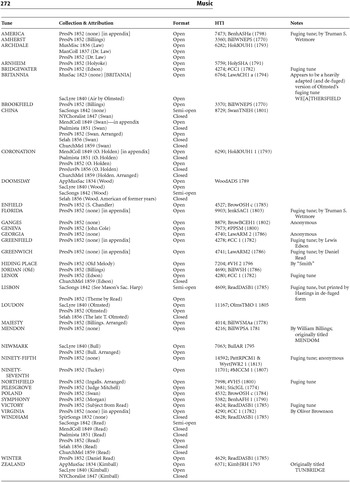
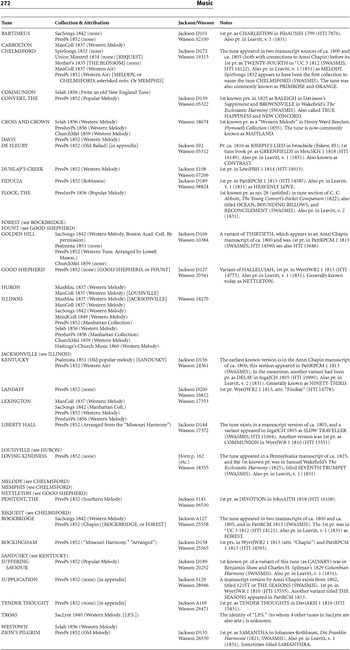
Thirty-six tunes either written by or containing attributions to one of the Yankee tunesmiths have been found in fourteen Hastings collections, for a total of sixty-five individual publications.Footnote 11 This information is summarized in three tables. Table 1 lists the tunes in alphabetical order by the names under which they appeared in Hastings's books, followed by the collection(s) in which they occurred, the attribution Hastings gave them, and the format of the original (open score, closed score, or semi-open score).Footnote 12 The identification of the piece in the Hymn Tune Index (HTI) is given together with the first published source as noted by HTI, followed by miscellaneous items of clarification or interest.Footnote 13
Early American tunes in Hastings's tune books.

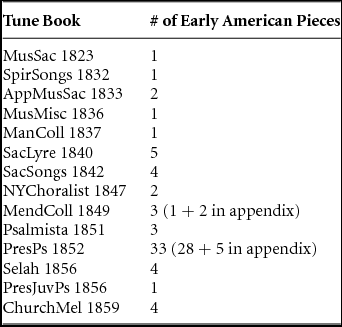
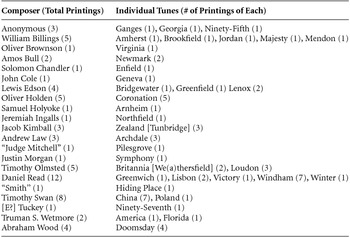
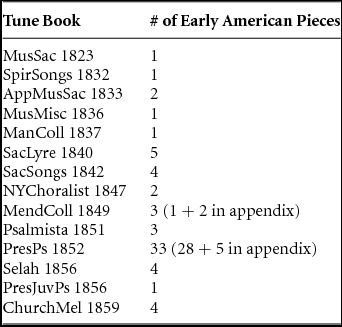
Table 2 inventories Hastings's tune books in chronological order and gives the number of early American tunes in each.Footnote 14 Table 3 gives the name of the composer (where known), the total number of printings of his tunes, and the number of times each tune appeared in a Hastings collection.
Hastings tune books containing early American tunes.
Early American composers represented in Hastings's tune books.

An examination of table 1 reveals that the early American pieces Hastings included were exclusively metrical tunes (no anthems). Many of the works were among the most popular productions of the Yankee tunesmiths: fourteen (slightly over 38%) of them are found in Richard Crawford's tabulation of the “core repertory” of American psalmody published through 1810.Footnote 15 Other tunes initially published too late to make it into the core repertory became very popular with compilers in the early nineteenth century; among them were CHINA and NORTHFIELD. These facts support the suggestion that Hastings often included tunes because of their popularity, not because of any special affection he might have had for them.
Another noteworthy aspect of Hastings's selection is the presence of a relatively large number of fuging tunes. Nine pieces—25% of the tunes—fall into this category.Footnote 16 These “miserable fugues of New-England,” as Hastings once called them,Footnote 17 broke many of his strictures about sacred music: in his view, their typically lively rhythms were not devotional in character, the overlapping texts obscured the words, and the music was full of harmonic ineptitudes. Nevertheless, he evidently felt that he could not do without them. It should be noted, however, that except for LENOX, none of these pieces was printed more than once, and some of them were given in “de-fuged” form.
Table 2 shows several interesting features of Hastings's use of the early American tunes. First, it was some seven or eight years after the compilation of his first tune book before he found a place for a piece by one of his Northeastern predecessors. His initial foray into tune book compiling, Musica Sacra, was published in 1815 or 1816, but it was apparently not until the fourth edition of the book in 1823 that Hastings included a work by one of the Yankee tunesmiths, a heavily adapted version of Timothy Olmsted's WETHERSFIELD that Hastings called BRITANNIA. It was then nearly a decade before he issued another such piece, Daniel Read's WINDHAM (in his and Lowell Mason's Spiritual Songs, 1832). Over the next twenty years, he typically published between one and four such items in his collections, with a quartet of tune books including at least three each: The Sacred Lyre (1840), Sacred Songs (1842), The Mendelssohn Collection (1849), and Psalmista (1851).
Table two demonstrates a distinct exception to this trend of including only a handful of Yankee tunesmith pieces: The Presbyterian Psalmodist of 1852 contained thirty-three such items, over half of the total publications, despite the fact that it was not significantly larger than some of Hastings's other tune books.Footnote 18 The reason for the large representation in this particular tune book is quite evident: Hastings was not completely free in the choice of repertory for the volume. The collection was compiled at the request of a denominational body, which appointed a committee to prepare it. In addition to securing the services of Hastings—who was himself a Presbyterian—as editor, the committee received “large correspondence throughout our Church” about the project, and one of its aims was “To insert some tunes which appeared to be favorites in some considerable sections” because it was “making provision for the edification of a large community of various tastes.” The compilers indicated their desire “to insert only music of such character as might elevate and improve the standard of taste throughout the Church,” but they “did not feel at liberty to discard such tunes as, after all, might be approved by a better judgment than our own, especially such as were endeared by long and hallowed association, and would be extensively and painfully missed from the collection.”Footnote 19
This fact probably explains the inclusion of some tunes about which Hastings had previously made disparaging remarks. An example is GANGES. One of Hastings's pet peeves was the contrafacting of melodies that had strong associations with secular texts into hymn tunes. On several occasions he specifically condemned the use of GANGES (which he usually called INDIAN PHILOSOPHER) as a hymn tune. For instance, in a review of N. and S. S. Jocelyn's Zion's Harp (New Haven, 1824) in the Western Recorder (17 May 1825), Hastings complained that “we know of no greater musical incongruities than such as ‘Zion's Harp’ presents us in ‘The Indian Philosopher,’ ‘The Young Man's Wish,’ and ‘Anna's Lyre,’ set to sacred words for the purpose of religious worship. To say nothing of their original secular character; they are our vulgar acquaintances, in the mouth of every old-fashioned singer of love-ditties, and altogether beneath the dignity of church music.”Footnote 20 Despite his strenuous disapproval of this and some other tunes, however, Hastings undoubtedly had to include them at the desire of the hymnal committee. It is easy to imagine his distaste at having to do so.
Table 3 reveals that the early American composer Hastings drew upon most often was Daniel Read, although most of the printings were accounted for by a single tune, WINDHAM. Much the same is true of the tunes by Timothy Swan, whose CHINA equaled the number achieved by WINDHAM. All five printings for Oliver Holden were of a single tune, CORONATION, which was the only one of these pieces to become part of the standard repertory of American congregational song throughout the nineteenth and twentieth centuries, and well into the twenty-first century. The works by other composers received only scattered circulation in Hastings's books.
One feature of Hastings's printings of these tunes not shown by the tables is the specific versions of the pieces included. In some instances, the settings found in Hastings's tune books differed very little from the original publications of the pieces. That is especially true of AMERICA, FLORIDA, GREENFIELD, GREENWICH, and VIRGINIA, all of which show only minor variations from their initial printings in the eighteenth or early nineteenth centuries.Footnote 21 The identity of these Hastings publications with their original settings does not mean, of course, that the compiler necessarily borrowed them directly from the collections in which they first appeared; more than likely they were taken from intervening tune books.
Interestingly, all five of the tunes named in the preceding paragraph are not only found in the same Hastings collection, The Presbyterian Psalmodist of 1852, but in the same section of that collection, the appendix. A note at the beginning of the appendix gives the reason for their close adherence to the originals:
A few tunes embraced in the [Presbyterian Church in the United States General] Assembly's list were found so imperfect in their structure, that any efforts towards appropriate correction would have destroyed their identity. These tunes the editor has thought fit to throw together at the close of the volume, without the slightest revision.Footnote 22
In other words, Hastings considered the pieces so far removed from “correctness” that he despaired of “improving” them without mangling them beyond recognition, in which case, of course, they would not have been the tunes as people knew them and would not have satisfied the group that had commissioned the book.
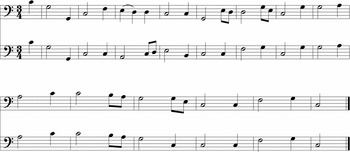
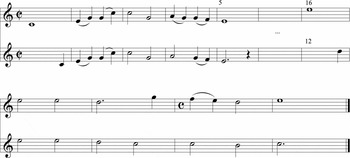
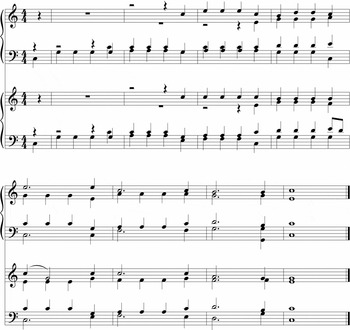
Hastings's use of an appendix for older, “incorrect” tune settings was unique in his practice. More commonly, the tunes appeared in the body of the book, and the compiler maintained the melodies intact—or very nearly so—but revised or rewrote the other parts. For example, the melody of CHINA appears in Hastings's Sacred Songs (Reference Hastings1842) just as it was initially published by Timothy Swan in his New England Harmony (Reference Swan1801) except for the simplification of a decorated passage in the penultimate measure and the elimination of a choosing note in the last measure (the tune is also transposed down a step). The first four notes of the bass part in Hastings are identical to those by Swan, but thereafter the part begins to emphasize chord roots (especially the primary chords) until the beginning of the third phrase, when it returns to the original setting and continues that way to the end, except for a slight revision at the beginning of phrase four (Example 1). The treble and counter parts appear to have been completely rewritten.Footnote 23 When Hastings printed CHINA in his and William B. Bradbury's The New York Choralist (1847), he made a few alterations in the version from Sacred Songs and included the following note: “Extensively sung in former times, at funerals. The original harmony was, of course, inadmissible.” This setting was then repeated in The Mendelssohn Collection (1849), The Presbyterian Psalmodist (1852), Selah (1856), and Church Melodies (1859).
Bass parts of CHINA from Timothy Swan's New England Harmony (1801, top), and Thomas Hastings's Sacred Songs (1842). The Swan setting has been transposed down a step and the note values halved to facilitate comparison. The last measure, originally a dotted whole note, has been made to conform to modern notation conventions.

Because of the popularity of tunes such as CHINA and the consequently large number of printings they received, plus the lack of bibliographical control over nineteenth-century tune books after 1820, it is often uncertain whether or not Hastings was directly responsible for the revisions in this and the other early American tunes he reprinted. He might have simply taken the setting for Sacred Songs from an earlier collection or perhaps borrowed someone else's revised version and made further changes in it. However, the likelihood is that the alterations were made by Hastings himself.Footnote 24 It is almost certain that Hastings—rather than Bradbury—was the source of the changes that occurred between Sacred Songs and The Mendelssohn Collection, since the version used in The Mendelssohn Collection continued to appear in Hastings's later tune books while Bradbury adopted a different setting.Footnote 25
In some of Hastings's printings of these tunes, not only the harmonizing parts but also the melodies were changed. Several rhythmic and pitch alterations occur in the melody of Hastings's single known publication of Samuel Holyoke's ARNHEIM, apparently in an effort to simplify it (Example 2). On the other hand, the bass part in Hastings (which relies somewhat on Holyoke's setting) is slightly more active than the one found in the original composer's Harmonia Americana.
Opening and conclusion of the tenor (melody) parts of ARNHEIM from Samuel Holyoke's Harmonia Americana (1791, top), and Thomas Hastings, The Presbyterian Psalmodist (1852). The Holyoke version has been transposed down a step to facilitate comparison.

Of particular interest is Hastings's approach to the fuging tunes other than those in the appendix to The Presbyterian Psalmodist, which, as noted above, were reprinted more or less in their original forms. Given the imitation prevalent in these pieces, it might be assumed that they would be more difficult to alter than a plain psalm or hymn tune such as CHINA or ARNHEIM. However, Hastings often made extensive changes in them, both in the homophonic and imitative sections. For example, in the opening homophonic section of Lewis Edson's LENOX, apart from rhythmic alterations at the ends of some phrases, the tenor of Hastings's version is identical to the 1782 original published in Simeon Jocelin and Amos Doolittle's The Chorister's Companion. The first, second, and fourth phrases of the bass are also the same as Edson's, while the third has been rewritten, and the treble and counter parts are completely new. More remarkable are the changes in the fuging section. The parts still enter in the same order (bass, tenor, treble, counter), and the entries of the first two begin with the same sequence of pitches as in the original. However, by the end of the second measure the bass moves to new material, the treble entrance shows little relationship to the part Edson wrote, and only the first four notes of the counter are identical to The Chorister's Companion (Example 3). Indeed, only the tenor remains largely untouched.Footnote 26
Fuging sections of Lewis Edson, LENOX, in Simeon Jocelin and Amos Dootlittle, The Chorister's Companion (1782, top), and Thomas Hastings, The Presbyterian Psalmodist (1852). The Hastings setting has been transposed up a step to facilitate comparison.

Even more radical are the changes found in LISBON, in which the fuging section was eliminated altogether by simply reharmonizing the tenor melody in homophonic fashion. This procedure was not original with Hastings, since the version he used in Sacred Songs was a slight adaptation of the one in Lowell Mason and Timothy B. Mason's Sacred Harp (Reference Mason and Mason1835), as the older compiler acknowledged.Footnote 27 Mason changed the meter from the “third mood of common time” (2/2) to 3/2, modified the rhythm, and rewrote the last phrase of the melody, all features that Hastings also adopted. Essentially, Daniel Read's fuging tune was turned into a plain hymn tune, a procedure that was to become common with other fuging tunes in hymnals of the later nineteenth century.Footnote 28 That Hastings probably knew something like the original form of the piece is evident from his notation in The Presbyterian Psalmodist that only the “Theme” was “by Read.”
Apart from including earlier American works in order to help sell his books, and except for the pieces in the appendix to The Presbyterian Psalmodist, Hastings seems to have republished these tunes to bring them into line with contemporary ideals of reform psalmody. His reworking of the pieces particularly involved the simplification of melodies and harmonies, and on occasion the alteration of rhythmic patterns as well. That most of the fuging tunes retained their imitative structure—even if heavily adapted—suggests that the arranger was not necessarily ready to do away with the form entirely, in spite of his often critical remarks about it.
Folk Hymns
The publication history of folk hymns began and flourished at approximately the same time that Hastings started his publishing career. The first large collection of folk hymn tunes, Jeremiah Ingalls's The Christian Harmony, was issued in 1805, followed by John Wyeth's Repository of Sacred Music, Part Second and Robert Patterson's Patterson's Church Music (both 1813), and the first southern folk-hymn volume, Ananias Davisson's Kentucky Harmony (Reference Davisson1816). Thomas Hastings's first tune book, Musica Sacra, was published about the same time as Davisson's volume.
One reason Hastings was unenthusiastic about folk hymnody had little to do with the music itself, but with the shape-note notation in which it typically appeared. The Wyeth and Patterson books mentioned above were the first to link folk hymns with shape-notes, a practice followed in many subsequent volumes that emphasized folk hymnody.Footnote 29 Folk hymns do not require shape-notes and shape-note notation can be and has been used with other kinds of music; the notation has no direct effect on the essence of the music or vice versa. In early nineteenth-century practice, however, folk hymns tended to be published in collections that used shape-note notation, so an informal association between them became common.
Hastings's attitude toward shape-notes—which he called “lozenge shaped characters” or “patent notes”—was made obvious in an article he wrote for the January 1837 issue of The Musical Magazine.Footnote 30 Hastings gave five reasons “which lie within the compass of common observation” for his dislike of the notation: (1) its inconvenience for music copyists, (2) its value only for novices and its inutility for instrumentalists, (3) the fact that it was tried “centuries ago” and found wanting,Footnote 31 (4) the universal acceptance of round-note notation by “all the civilized nations,” and (5) the tendency of those who use shape-notes to have “bad intonation.”
Another problem that Hastings had with folk hymnody was the fact that many of the tunes were based on secular antecedents. Hastings's view was that music used for the purposes of devotion should not call to mind secular associations, and he railed against the use of such melodies as “‘Drink to me, only,’ ‘Auld Lang Syne,’ ‘Lovely Nancy,’ ‘Nancy Dawson,’ or even ‘Yankee Doodle,’” which were “tainted . . . with the vilest associations” and should not be contrafacted by substituting religious texts for the originals.Footnote 32 Folk hymns that were not direct contrafacta of secular songs were also off-limits because they often centonized phrases from secular melodies, and the whole genre was ultimately traceable to balladry, drinking songs, love ditties, and the like.Footnote 33 Nevertheless, as was the case with early New England psalmody, despite his dislike for the notation in which folk hymnody was usually clothed and the associations it often had, Hastings could not completely ignore songs of this genre in his collections.
The folk hymns in Hastings's tune books were usually printed without specific attributions, but were often identified by generic labels such as “Western melody” (or “air” or “tune”), “Popular Melody,” and the like. The compiler seldom listed a printed source from which he took a tune of this sort (there are a few exceptions),Footnote 34 and in fact, some pieces that have these labels are manifestly not American folk hymns,Footnote 35 while others—as will be seen below—are of doubtful authenticity. Generally speaking, a published piece is described by modern scholars as a folk hymn when it appears in a nineteenth-century song book designed for a rural constituency (often in shape-notes), is anonymous or attributed to a local composer or arranger, is modal in orientation, contains a gapped scale, and demonstrates either centonization or contrafactum; obviously, not every one of these features will be found in every folk hymn, but often three or four will be present in a single tune. While most of the pieces Hastings designated “Western melodies” demonstrate at least some of these characteristics, a few do not, suggesting that these exceptions might have been mislabeled, that he simply did not know what else to call them, or that he employed this term to attract Western buyers for his books. On the other hand, the fact that Hastings gave them this designation must have some significance, since he often left pieces unattributed or used a pseudonym to disguise his personal contributions.
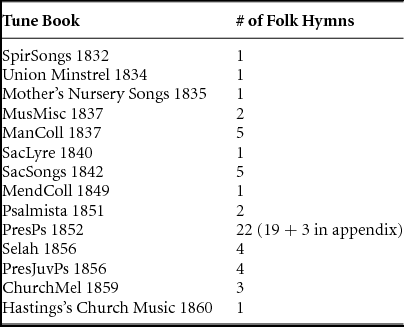
Table 4 lists the pieces in Hastings's tune books that are labeled as “Western melodies” or given a similar designation—except for those that obviously do not have a basis in American folk hymn tradition, but including those that are doubtful—or are known from other sources to be of folk origin. The table also points out the Hastings tune book(s) in which the pieces appeared; any attributions linked with them; an identification of the work by George Pullen Jackson, Dorothy D. Horn, and/or D. DeWitt Wasson; early sources for the tune (HTI where applicable); and miscellaneous information.Footnote 36 Table 5 shows the number of folk hymns that appeared in each of Hastings's collections that contained such items.
“Western melodies” in Hastings's tune books.

Hastings tune books containing “Western melodies.”
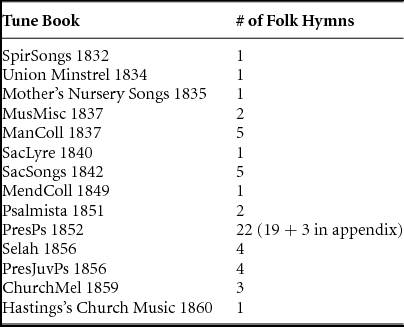
Table four reveals that Hastings printed at least twenty-nine tunes that are credited to or give some indication of being from the folk tradition, while table five shows that these songs appeared in fourteen separate tune books, with a total of fifty-three printings, numbers that are somewhat smaller than those for the early American composers (36, 13, and 66, respectively). Not surprisingly, The Presbyterian Psalmodist was again the collection that contained the largest number of items being analyzed, accounting for over 60% of the total publications of “Western melodies.”
The folk hymns Hastings used included several that were among those most commonly found in the shape-note and revival tune books that specialized in such pieces, including BARTIMEUS, CHELMSFORD, DE FLEURY, DUNLAP'S CREEK, KENTUCKY, LIBERTY HALL, ROCKBRIDGE, ROCKINGHAM, SUPPLICATION, TENDER THOUGHT, and THE PENITENT.Footnote 37 On the other hand, some popular folk hymns seem to be missing entirely from Hastings's works: HOLY MANNA, IDUMEA, KEDRON, NEW ORLEANS, SALVATION, and STAR IN THE EAST, to name only a few.Footnote 38
One noteworthy feature of Hastings's printings of melodies from the folk tradition is that no fewer than eleven of them (over 37%) are in common with Joshua Leavitt's The Christian Lyre, a collection of which Hastings was thoroughly critical.Footnote 39 Perhaps that is not unexpected, since the compiler of The Christian Lyre was quite purposeful in collecting the most popular tunes for his book, but it is surprising that Hastings probably took several of the tunes directly from Leavitt, including GOOD SHEPHERD, LOVING KINDNESS, SUFFERING SAVIOR, and ZION'S PILGRIM.Footnote 40
If Hastings found the harmonizations used by the Yankee tunesmiths to be inadequate, he undoubtedly considered those of the folk hymns in shape-note and revival tune books to be even more outrageous. The open and parallel fourths and fifths, strong harmonic clashes, and lack of functional harmony that typically characterized this music were the antithesis of the reform style he was trying to promote, and it is little wonder that he generally provided new arrangements of the tunes.
As samples of the changes Hastings made in some of these pieces we may examine two of the tunes for which he gave a specific source, LIBERTY HALL and ROCKINGHAM, both said to be arrangements from The Missouri Harmony. He probably relied upon the 1850 edition of The Missouri Harmony, which was “revised, enlarged, and corrected” by Charles Warren only two years before the New York compiler included the tunes in The Presbyterian Psalmodist. Footnote 41 Such, at least, seems to be the implication from the fact that Hastings apparently paraphrased portions of the counter parts of both pieces from this edition in his own settings, and in LIBERTY HALL he also duplicated some of the accidentals from Warren not found in the 1835 edition of The Missouri Harmony.Footnote 42 The most immediately apparent difference between the printings of LIBERTY HALL in The Missouri Harmony and The Presbyterian Psalmodist is that the former gives the tune in 3/2 meter while the latter revises it to 2/2. Warren included thirds in most of the chords; Hastings made sure that every chord was filled in, and also had the bass move principally by chord roots, eliminating the second inversion V chords found a couple of times in Warren. Apart from the tenor and a few places in the counter, the vocal lines in The Presbyterian Psalmodist show only a superficial resemblance to those from The Missouri Harmony.
The changes made in ROCKINGHAM are similar. The time signature for ROCKINGHAM is given in The Presbyterian Psalmodist as 2/2, but this was evidently a misprint, since the tune is actually in 3/2, as it was in The Missouri Harmony. A few decorative notes are omitted from the melody and—as with LIBERTY HALL—the individual voice parts and harmonies of The Presbyterian Psalmodist bear little relationship to those of The Missouri Harmony, although the opening notes of the counter in phrases one and three could be seen as paraphrases of the ones in Warren. Thus, in contrast to Hastings's procedure of sometimes keeping at least a portion of the original voice parts of the Yankee tunesmith pieces, in the folk hymn settings he appears to have relied almost exclusively upon the melody, largely ignoring the harmonies he found.
Hastings also copied the work of his contemporary, Lowell Mason, for the harmonization of at least one folk hymn, GOLDEN HILL, and he gave credit where credit was due, noting in Sacred Songs (1842) that the arrangement was from the “Bost. Acad. Coll. By permission” and in The Presbyterian Psalmodist (1852) that the tune was “Arranged by Lowell Mason.”Footnote 43 The version in Sacred Songs (1842) was identical to Mason's, except for two notes in the counter. This arrangement was repeated in Psalmista 1851 and—with a couple of minor changes—in The Presbyterian Psalmodist; one of these alterations, the use of a c’ instead of an f’ in the counter on the first beat of measure one, brings the setting more into line with Mason's original usage, while the other (the addition of an eighth note a’ in the treble, pickup to m. 10) does not. Hastings then returned to the version from Sacred Songs for Church Melodies (1859).
As with the Yankee tunesmith pieces discussed earlier, folk hymns were usually a distinct minority in Hastings's tune books, were frequently subjected to alteration or reharmonization, and were perhaps included more out of obligation than personal choice. Nevertheless, the fact that Hastings found a place for pieces of this ilk at all hints that his views of such music were not entirely negative, so long as they were divested of their shape-note garb, were not too obviously “secular” in origin, and were arranged as he considered appropriate.
“Western Melodies” of Questionable Origin
Several of the “Western melodies” call for further comment, particularly those that have not been located in earlier collections of folk hymns or about which there is uncertainty regarding their basis in oral tradition. Nikos Pappas has suggested that, beginning in the 1830s, there was a trend among the “scientific” musicians to include “western tunes or tunes written by composers in the west” as a way of “marketing to western consumers.” This development coincided “with the compilers of these tunebooks’ tours of western cities beginning in the late 1830s too, following the publication of [Timothy B. and Lowell] Mason's Sacred Harp in 1835.” Pappas further notes that these compilers “were not scholars,” often crediting tunes to incorrect people, regions, and sources, and that some of the pieces might be parodies or imitations of earlier tunes or newly written in the hope that they would replace a previous item with the same name.Footnote 44 Thus some of the unlocated “Western melodies” in Hastings's collections may actually have been composed by the compiler, their attributions might simply have been mistaken, or they were previously-published tunes so extensively reworked that their origins have been disguised.
For example, CARROLTON may be a heavily adapted version of Daniel Read's CHARLESTOWN, a fuging-tune that initially appeared in the composer's The American Singing Book (1785),Footnote 45 DAVIS is perhaps a parody of the folk hymn tune by the same name, HURON/LOUISVILLE shows some similarity to Lowell Mason's OAKHAM, and LEXINGTON appears to have been written in imitation of Mason's MISSIONARY HYMN.Footnote 46 Except for DAVIS, none of these tunes gives much evidence of being from the folk heritage, nor do TROAS (a fuging tune) or WESTOWN show oral tradition characteristics. Although said to be “From an old New England Tune,” known published variants of COMMUNION are found exclusively in the South, West, and Middle Atlantic states.Footnote 47 Despite their designation as “Western melodies,” these tunes show few of the characteristics of authentic folk hymns. Two tunes, CROSS AND CROWN and ILLINOIS/JACKSONVILLE, require more extensive treatment of their possible origins.
CROSS AND CROWN
Many hymnological sources credit CROSS AND CROWN to George N. Allen and his Oberlin Social & Sabbath School Hymn Book (1846), but this book was a words-only volume.Footnote 48 Hastings almost certainly borrowed the tune from Henry Ward Beecher's Plymouth Collection of Hymns and Tunes (1855), where it was labeled a “Western Melody.” Beecher was pastor of Brooklyn's Plymouth [Congregational] Church when Hastings was living and working in New York City, and the composer was undoubtedly acquainted with the well-known preacher and probably also with the two musical editors of the hymnal, Charles Beecher and John Zundel. Hastings printed the tune with different words in his two 1856 collections, slightly simplified the melody, and used a somewhat varied harmonization. Nonetheless, his setting demonstrates significant similarities with the Plymouth Collection that are surely not accidental.Footnote 49
Neither George Pullen Jackson nor Dorothy D. Horn mentioned CROSS AND CROWN in their studies of folk hymnody, but the melody does contain some hallmarks of folk tradition, including the use of a hexatonic scale and the fact that the second half of the tune is a variant of the first half (with a few notes transposed up an octave). CROSS AND CROWN continues to appear in United States hymnals in the early twenty-first century, usually under the title MAITLAND.Footnote 50
ILLINOIS/JACKSONVILLE
As seen in table four, the “Western melody” Hastings printed most often was ILLINOIS, which he also called JACKSONVILLE in one of its first publications. The fact that he published this tune nearly twice as often as any other “Western melody” causes it to stand out among these pieces. The tune was picked up (apparently from Hastings) by a number of later compilers, including J. B. Aikin in The Christian Minstrel (Reference Aikin1846). Some late-nineteenth and early-twentieth century congregational collections, including The Methodist Hymnal of the Methodist Episcopal and Methodist Episcopal South Churches (1905), credited the tune to “Jonathan Spilman.” The companion to this hymnal identified “Rev. Jonathan Spilman” as “A native of England; composer of vocal music” born in 1835.Footnote 51 However, that is certainly an error, since Hastings published the tune in 1837.
It seems more likely that the person named was Rev. Jonathan Edwards (J. E.) Spilman (1812–1896), a native of Kentucky and the composer of the tune SWEET AFTON (for Robert Burns's text “Flow gently, sweet Afton”). SWEET AFTON appears to have been written about the time Hastings first published ILLINOIS, lending credence to the idea that Spilman might have composed the latter tune.Footnote 52 The tune names ILLINOIS and JACKSONVILLE also provide circumstantial evidence for some sort of connection between this tune and Jonathan Spilman, since he graduated from Illinois College in Jacksonville, Illinois, in 1835, two years before Hastings's initial publications of the piece. One of Spilman's older brothers was Charles H. Spilman, who is probably to be identified as the co-compiler (with Benjamin Shaw) of the shape-note tune book Columbian Harmony (1829), suggesting potential involvement by J. E. Spilman with the music of the folk hymn tradition.Footnote 53 However, no contemporary or near-contemporary evidence has been discovered that links Spilman definitively with ILLINOIS/JACKSONVILLE.
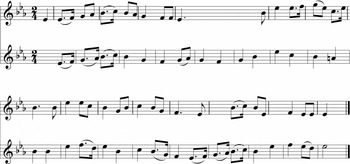
Although no direct antecedent of ILLINOIS has been found in the southern and western folk hymn collections, it does show some similarity to the tune BETHEL as printed in volume two of Joshua Leavitt's The Christian Lyre (1831).Footnote 54 The most obvious likenesses between the melodies of ILLINOIS and BETHEL are the identical openings in the first phrase (minus the pickup note and with one rhythmic difference), similar outlines at the ending of the second and beginning of the third phrases, the cadence on the dominant note in the second phrase, and the correspondence between the endings of the third phrases. Hastings's last phrase is clearly a repetition of his first phrase with an altered ending to achieve a greater climax (Example 4). Certainly, if BETHEL indeed served as the prototype for ILLINOIS, it has been subjected to heavy adaptation. Had the compiler been someone who normally worked in the folk tradition, it might be suspected that ILLINOIS was a transcription of an oral variant of BETHEL, but Hastings was (and is) not known for such activity, so it seems doubtful that he would have been responsible for making such an adaptation.
Comparison of the tenors (melodies) of BETHEL from Joshua Leavitt, The Christian Lyre (1831, top), and JACKSONVILLE (=ILLINOIS), from Thomas Hastings, The Musical Miscellany (1837). The note values of BETHEL have been halved, the time signature changed from common time to 2/4, and the piece transposed up a step to facilitate comparison.

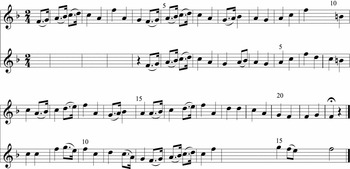
Comparison of the tenors (melodies) of FOSTER from Lowell Mason, The Choir (1832, top), and JACKSONVILLE (=ILLINOIS), from Thomas Hastings, The Musical Miscellany (1837, bottom). In The Choir, the first note of m. 11 is a half note. The note values of JACKSONVILLE have been halved and the piece transposed up a step to facilitate comparison.

However, another possibility for the origin of the melody presents itself, because ILLINOIS/JACKSONVILLE also shows remarkable similarities to the middle section of Lowell Mason's FOSTER, published by the Massachusetts composer as early as 1832 in The Choir (ex. 5).Footnote 55 Both pieces set texts containing eight-syllable phrases (although Mason's also has a six-syllable verse after each pair of eight-syllable lines), and both make extensive use of dotted rhythms as well as quarter-note movement. Hastings's first two phrases are virtually identical to the second and third phrases in Mason, while the remaining phrases are generally similar in outline and rhythmic motion. In place of Mason's fifth phrase (mm.15–19)—which keeps only two notes of the opening phrase intact—Hastings rounds out the form by harking back to the beginning of the melody. Mason's tune—which sets a longer text—then continues with an additional phrase.
There seem to be two potential explanations for the similarities between ILLINOIS/JACKSONVILLE and FOSTER. One is that Hastings encountered FOSTER in a collection by Mason and deliberately copied the tune, altering it to disguise its origin, and labeling it a “Western melody” to cloud its identification further. The other is that Hastings half remembered the tune from having sung (and/or seen) it before but did not remember exactly where that was, wrote it down to the best of his recollection, and—not knowing what else to do—called it a “Western melody.” Against the first suggestion is the fact that—apart from the dishonesty involved—it is difficult to believe that singers (and Mason himself) would not have recognized the similar natures of the tunes.Footnote 56 The second seems plausible except that—as noted above—Hastings was not normally given to transcriptions from oral tradition. Identifying which of the three (or other) possibilities for the origin of ILLINOIS/JACKSONVILLE is correct—composition by J. E. Spilman, a version of the folk hymn BETHEL, or a reworking of Lowell Mason's FOSTER—will have to await additional information.
Although the pieces discussed above cannot be traced directly to the folk tradition, it should be noted that Hastings had little reason to give purposely misleading attributions for them. The majority of the works he characterized as “Western melodies” were genuine folk hymns, and when he wished to hide his own compositional involvement in a tune he generally used a pseudonym such as “Carameni” or simply left off an attribution altogether. The best explanations for “false” identifications of pieces as “Western melodies” would seem to be that: (1) they resulted from an attempt to help sell the book in the West—although the collections contained so relatively few pieces of this sort that it is difficult to see how that could have been of much help; (2) Hastings wrote down from memory some melodies he only partially recalled and, not remembering their origins, identified them by a generic credit;Footnote 57 (3) he wrote pieces in direct imitation of works by others and disguised the fact with a blanket attribution; or (4) each of these approaches was operative at different times. Further light will need to be shed on the background of some of these pieces before their origins can be conclusively identified.
Conclusion
In his writings in the Western Recorder, The Musical Magazine, and elsewhere, Thomas Hastings rendered harsh judgments on the music of both the Yankee tunesmiths and the contemporary folk hymn tradition. His concerns were partly spiritual and partly musical, his principal desires being that the music allow the sacred texts to be heard distinctly, be garbed in what he deemed to be an acceptable musical language (which for him meant that the tunes had no overtly secular connotation), be easy to sing, and employ standard (European) harmonic practice.
Nevertheless, as reformers in every age have discovered, Hastings could not completely escape the pervasive influence of pieces in these “objectionable” styles. In some instances, he needed to include them to help sell his own books, in others he was probably given little choice in the matter, and in still others he probably recognized some value in the originals if “properly” adapted. The music of the Yankee tunesmiths and of American folk hymns may largely have remained unwelcome intruders in his collections, but he could not and did not ignore them. By incorporating such items into his tune books, Hastings undoubtedly hoped that people would purchase the volume, discover the “better” music it contained, and eventually turn away from the “unworthy” material.
Being the dogmatist he was, Hastings could not leave the items he borrowed untouched but sought to “improve” them by adjusting their harmonies and sometimes even their melodies, often with a heavy editorial hand. He also appears either to have significantly adapted some tunes or composed new pieces he hoped would replace the older ones, and perhaps even to have rearranged melodies written or published by his well-known contemporary, Lowell Mason, or others, clothing them with innocuous attributions that, purposefully or not, disguised their origins.
Although Hastings's arrangements were not “authentic” in that they generally departed considerably from the original melodic and harmonic settings, and while his specific arrangements have largely been discarded, this was the format in which these tunes became familiar to generations of churchgoers (especially in urban areas) during the second half of the nineteenth century and well beyond. In that sense, at least, Hastings and his contemporary reformers were partly responsible for passing down the heritage of early American psalmody and American folk hymnody to future singers, a distinction they themselves might be surprised to discover—and would perhaps have regretted.
Appendix: Table Appendix: Table Abbreviations
Full citations are given in the References list below.
Tune Books
-
AppMusSac=Appendix to Musica Sacra
-
ChurchMel=Church Melodies
-
Leavitt=Joshua Leavitt, The Christian Lyre
-
ManColl=The Manhattan Collection
-
MendColl=The Mendelssohn Collection
-
Mother's=The Mother's Nursery Songs
-
MusMisc=The Musical Miscellany
-
MusSacra=Musica Sacra
-
NYChoralist=The New York Choralist
-
PresJuvPs=The Presbyterian Juvenile Psalmodist
-
PresPs=The Presbyterian Psalmodist
-
SacLyre=The Sacred Lyre
-
SacSongs=Sacred Songs
-
SpirSongs=Spiritual Songs
Secondary Sources
-
Eskew=Eskew, Harry Lee. “Shape-Note Hymnody in the Shenandoah Valley.”
-
Horn=Horn, Dorothy D. Sing to Me of Heaven.
-
HTI=Temperley, Nicholas, assisted by Charles G. Manns, and Joseph Herl. The Hymn Tune Index.
-
Jackson A=Jackson, George Pullen. Another Sheaf of White Spirituals.
-
Jackson D=Jackson, George Pullen. Down-East Spirituals and Others. 2nd ed.
-
Jackson S=Jackson, George Pullen. Spiritual Folk-Songs of Early America. 2nd ed.
-
SWASMIS=Pappas, Nikos. “Southern and Western American Sacred Music.”
-
Wasson=Wasson, D. DeWitt. Hymntune Index.