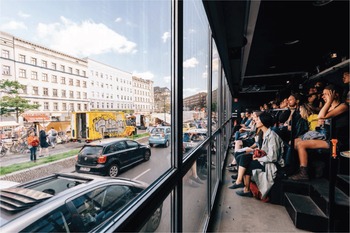
We boarded a converted truck near Frankfurt’s Mousonturm Theatre and sat in three rows on risers arranged lengthwise and facing one side of the vehicle. Seat belts fastened, we spent the next two hours floating through the city, alternately viewing urban streetscapes through the large side window panes and video projections on a screen that periodically descended to cover these windows. This setup was reminiscent of earlier Rimini Protokoll projects that used a truck-turned-auditorium, notably their 2006 production Cargo Sofia (see Brady Reference Brady2007:163). Our trip took us to the center of Frankfurt via its surrounding suburbs and back again, with an occasional stop to experience short performative interludes out on the street while we remained seated on the truck. At times the driver’s cabin, with a professional truck operator (Rudi Bühne) and a child (Arun Tönsmann in Frankfurt) in the passenger seat, was connected live into the makeshift auditorium by video link and projected onto the screen. The project, Do’s and Don’ts by the German theatre collective Rimini Protokoll, invited us to pay close attention to the city’s everyday goings-on — its pedestrians, shop fronts, and cars — and focus our gaze on the quotidian and the near at hand. At the same time, we were encouraged to absorb messages about “the system of urban organization” from the mouths of three quasi-performers: Rudi the truck driver, the young child, and an older teenager (Rimini Protokoll Reference Protokoll2019).
Rimini Protokoll’s experiments with genre, structure, and authorship of theatrical performances are well documented (see for example Dreysse and Malzacher Reference Dreysse and Malzacher2007). Their work can be seen as the culmination of a trend, originating in the 1960s, to reject separating art from experiential reality and rescue the everyday and here and now from neglect and relegation to a sphere beyond the arts. Henri Lefebvre’s method of rhythmanalysis applied to Do’s and Don’ts, with its key theme of contemporary city life — “everywhere where there is interaction between a place, a time and an expenditure of energy, there is rhythm” ([1992] 2013:25) — reveals how everyday and lived experience foregrounds the significance of spaces, rhythms and practices. In five “Acts” (mirroring the structure of the work itself ), I explore the treatment of space, time, and rhythm in Do’s and Don’ts: urban theatre and spectatorship, the city, dressage, capitalism, and choreographies of resistance. A precedent in 1960s choreography, Lucinda Childs’s Street Dance elucidates these themes and locates them in their historical lineage.
Lefebvrian rhythmanalysis is recognized in fields such as urban studies, sociology, tourism, and geography, yet it has not featured prominently in studies of performance or dance. This seems an odd omission given that choreographies of the body, of urbanism, dance, and theatre converge in terms of their rhythmicity. The study of rhythm, of course, has a tradition well beyond Lefebvre, ranging from writings by Henri Bergson and Marcel Mauss to Rudolf von Laban’s innovations in dance, and 21st-century musical and dance analyses, but only a few of these have inspired key insights into the relevance of rhythms in the formulation and structure of society. Footnote 1 Lefebvre’s work, with which rhythmanalysis is now primarily associated, is predominantly invested in questions of how political, bureaucratic, and commercial (i.e., capitalist) powers imprint rhythm on everyday practices and bodily movements. In this respect, it differs from most applications of rhythm in choreography and movement studies, where performers typically either respond to musical rhythms such as in Dalcroze’s eurhythmics, or alternatively, follow their natural breathing (Doris Humphrey being an apt example).
Rhythmanalysis also diverges from such choreographic approaches in that it does not consider performance from an internalized stance, that is, the viewpoint of an active participant or performer. Rather, it advocates that the “researchers” — in this case, the audience members — remain at one remove from the object of research and the setting under observation, rather than being immersed or directly involved in it. Rhythmanalysis is thus spectator-oriented, viewing a cityscape from an elevated vantage point such as a window, balcony, or terrace. In Do’s and Don’ts, spectators look through the truck’s added side-panel windows to engage with elements of their urban environment. I was particularly struck by the correspondence between the configuration of Do’s and Don’ts and “Seen from the Window”: a chapter in Rhythmanalysis where the narrator relates his observations of a large intersection of Paris as viewed through the window of his apartment.
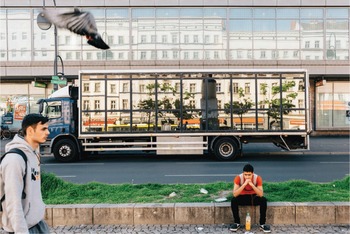
Rimini Protokoll, Do’s and Don’ts (Berlin 2018). By Aljoscha Begrich, Helgard Haug, and Jörg Karrenbauer. View of the outside of the truck with one-way window panes. (Photo © André Wunstorf)

Lefebvre’s rhythmanalysis focuses on both the biological and social rhythms of everyday life, particularly in urban settings, and their effects on the bodies and movements of a city’s inhabitants. His theory distinguishes various kinds of rhythm. At its most basic, he pits two different forms against one another: linear rhythms, which are impressed on us through “social practice, therefore from human activity: the monotony of actions and of movements, imposed structures,” and which essentially denote repetition and routine; and cyclical rhythms, which originate “in the cosmic, in nature: days, nights, seasons, the waves and tides of the sea, monthly cycles, etc.” ([1992] 2013:18). The body in rhythmanalysis is critical to apprehending rhythm, as the rhythmanalyst “learns rhythm from [the body], in order consequently to appreciate external rhythms” (29). Natural and biological rhythms, such as one’s heartbeat or hunger, are contrasted with social rhythms, the “processes imposed by the socio-economic organization of production, consumption, circulation and habitat” (82) — that is, the cultural backdrop that defines our lives. Both natural and social rhythms converge on the body, as does the rhythmic triad of time, space, and energy mentioned above. In exploring how lived experience is appropriated by modern life’s functionalism and its linear and social rhythms, Lefebvre’s theory is intimately tied to a social critique of urbanism, and identifies points of resistance and agency within quotidian existence: “What counts is not just what the social forces do to our everyday life, but what we do with these forces through our ways of ‘living’ them” (1968:349). Footnote 2 Following Lefebvre’s lead, then, we should commit ourselves to interrogate the reciprocities between prevailing sociopolitical and economic conditions, corporeal choreographies and city spaces; and consider how, in everyday life and through the power of performance, we can challenge hegemonic social forces and explore the transformative possibilities of urban environments.
Prologue
Lucinda Childs’s postmodern dance work Street Dance was produced in 1964, 55 years before Do’s and Don’ts, and partakes in the same trend of dissolving barriers between art and life. It shares in the observation of an actual cityscape through a window and it raises, in the context of its time, key issues about the framing of the urban environment, spectatorship, and the connections between cities, rhythms, and performance. Childs placed her audience in fellow choreographer Judith Dunn’s loft in New York City, several floors up, where they were soon directed to the window by a voice from a tape recorder. Footnote 3 Two performers dressed in everyday clothes appeared on the street below — one of them Childs herself. They carried out simple pedestrian movements (crossing the street, looking down, standing, talking) and occasionally pointed out details that were precisely synched with the information heard on the tape. The urban environment was captured by means of simple descriptions conveyed at precise intervals, which also served as prompts for the performers who moved toward the objects or gestured to features as they were announced. Footnote 4
The taped commentary enunciated, in fairly matter-of-fact terms, what could be seen in the street below; detailing for instance shops, window displays, and architectural structures. Marcia B. Siegel remarks in her analysis that Street Dance focused attention on the “neglected minutiae of everyday life” (2007:112). It appeared to contain no “dance” in the strict sense of extra-daily movement recognizable as dance. Indeed, little has been recorded in the way of movement description, leading me to conclude that this simply did not matter very much. Neither did the performance attempt to transform the locality; instead, it guided the audience to really see the city, prompting observations of normally overlooked everyday urban objects and actions. As Sally Banes put it: “The performers acted as markers, not altering the environment, but facilitating the spectator’s discovery of it” (1977:136). Some of the instructions led Childs and her coperformer to spotlight details of the urban landscape that were difficult to perceive from a distance without calling attention to them (such as shop window displays and lettering on building facades); at other times they blended into the background and left the spectators to observe for themselves the patterns and microgestures of the street. Thus, the piece drew the audience’s focus to the “infra-ordinary”: “the things that are not usually noted down, that are unremarkable, that are unimportant: what happens when nothing is happening, except time, people, cars and clouds” (Perec [Reference Perec1975] 1982:12).
Paying attention to the quotidian often brings with it a transformation of awareness, and Street Dance seemed designed to disrupt ordinary habits of viewing. The bird’s eye perspective was channeled towards a restricted slice of the city street. In the case of the 1965 version in Robert Rauschenberg’s studio in Manhattan, according to Childs’s score this was “the area between the Bon Vivant Delicacies Store and Surplus Materials of Norbert and Hausknect” (Childs Reference Childs1973:52). The tape directed the viewers to the studio windows, but according to Childs they were not able to see everything happening on the street below. Instead, they had to rely heavily on the audio recording and hence, to some extent, their imaginations:
The result was that the spectator was called upon to envision, in an imagined sort of way, information that in fact existed beyond the range of actual perception, so that a kind of cross-reference of perception tended to take place in which one mode of perceiving had to reconcile itself with the other to rule out the built-in discrepancy that the situation created. (1975:33)
As a viewing experience, Street Dance was in fact two-tiered. Its 1964 presentation was as part of a choreographic workshop executed by two performers, one of them Childs, now regarded worldwide as a pathfinding choreographer. Most of the audience in the loft were themselves also dance practitioners with full knowledge that an artistic work was in progress. However, for the innocent passersby who happened to chance on the performance in the street, it was not recognizable as such. Childs describes one of these chance encounters: “Some of the activities that happened were not planned; for instance, a pedestrian asked me a question, so I stopped what I was doing to answer him. But I liked that, the fact the dance could fit into the self-contained setting where everybody, including me, was going about their business” (1978:63). The anonymous performers blended into the urban goings-on, thus subverting the distinction between art and the everyday.
Resistance to dominant modes of production and reception was rife in the artistic and intellectual circles of the time. There were echoes of the reappropriation of urban space by the Situationists International, founded in 1957, who — under Lefebvre’s influence — staged a series of interventions against capitalist consumer culture, such as the dérive, which involved drifting aimlessly through the city. In the dance world, such resistance is most famously encapsulated in Yvonne Rainer’s so-called “no” manifesto: Footnote 5 “NO to spectacle no to virtuosity no to transformations and magic and make-believe no to the glamour and transcendency of the star image […]” (Rainer Reference Rainer1965:178). Yvonne Rainer’s renunciation of spectacle and glamour may be seen as a dance-world equivalent of the Situationists’ sociopolitical aims, notably their resistance to consumerism and marketing. Footnote 6 This is reflected in Street Dance too, with its abandonment of virtuosity, costume, and character, and the adoption of uneventful actions — performers pointing out objects and talking to each other. According to Rainer’s own recollections of Childs’s piece, the performers’ backs were turned to the audience throughout (in Lambert-Beatty Reference Lambert-Beatty2008:39). Attention was thus directed away from them and towards the urban environment within which their bodies moved, in stark contrast to the voyeuristic consumption of, for example, a ballet dancer’s fully frontal poses.
In the process, Street Dance extended the definition of dance by rendering objects and activities on the street into elements of performance; requiring viewers to explore, like the rhythmanalyst, the connections between urbanism and art. Steve Paxton’s observations of the work capture this point:
Nothing changed, except my attitude. People on the street continued to walk. But now I doubted them. Were they “real”? Of course they were?! … A distant siren went ooooh. The whole city joined the duet Childs made. This was the moment I had been looking for. (2003:207)
Or as Siegel puts it, “the dance consisted of the city itself, as reconfigured by the viewer” (2007:113). Paxton’s and Siegel’s comments that the whole city partook in the dance position the viewers’ experience as one of Einfühlung (empathy), defined as a subject’s identification with an object. As Dee Reynolds insightfully notes with reference to German philosophers Ludwig Klages and Theodor Lipps, when empathizing we may experience an inanimate object as a living being “by projecting subjective dynamism onto it” (Reynolds Reference Reynolds2007:34). Our psychological powers permit us to transfer rhythms and forces onto it, thus creating fusions between the object and our inner (observing) selves.
Yet despite its everyday setting and subject matter, Street Dance was heavily scripted and the performers’ actions were carefully timed with the use of a stopwatch. Rhythms create a link between the experience of Street Dance — which while entirely pedestrian, is heavily rhythmical — and our wider experience of urban spaces. The temporal score for the 1965 version, which Sally Banes has made available to us, shows how the piece was divided into precise intervals of minutes and seconds, at which different objects or locations in the urban space were identified in a rhythmic manner. The middle of the score, for example, reads as follows:
Following this preordained outline, the digit “8” — referring to a house number on Broadway — was pointed out by a dancer at 2:54, “1” at 2:55, and “6” at 2:56. The intervals between the performative events were usually of 1, 5, 10, or 20 seconds, and often grouped in small clusters of the same length, generating an overall rhythmic structure comprising composite repetitive blocks.
Cities are highly polyrhythmic spaces: an attribute echoed in the Street Dance’s complex time structure in which various temporalities are enmeshed. Spectators accustomed to the dynamic energies of metropolitan life would have been attuned to its diverse rhythms (some regular, others less so), which Childs’s performers assimilated to direct their actions. In so doing, she departs from previous rhythmic approaches such as Klages’s notion of a holistic and “indivisible totality” (see Reynolds Reference Reynolds2007:35) exemplified by constantly rolling sea waves; the cyclical exhale or inhale of breathing; and even the strictly repetitive rhythms of machinery, represented in some European modern dance works such as Gertrud Bodenwieser’s 1924 Demon Machine.
In fragmenting rhythms via their systematic ordering into blocks, Street Dance surreptitiously captures the culturally fragmented experience of urban life with its complex and often subtle changes of tempo. The polyrhythmic structure engendered by Childs’s rapidly changing sequence of actions reflects the hectic but wonderfully intricate rhythms that characterize the metropolis, yet which frequently go unrecognized by its inhabitants. In its intricate rhythmicity, Street Dance also gestures towards later performative engagements with urban environments whose changed production, consumption, and marketing patterns — as well as increasingly sophisticated regulatory frameworks — arguably require even more intricate, multilayered, and pluralized approaches for their artistic representation. Rimini Protokoll’s Do’s and Don’ts is a case in point.
Act 1
Urban Theatre’s Everyday in Do’s and Don’ts
In early 2019, 55 years after Street Dance, our two-hour journey began in the Künstlerhaus Mousonturm foyer. As all of us in the audience arrived, we picked up our tickets and lolled about, waiting to be collected and taken to the truck. From the program notes, we learned that:
The city represents a massive laboratory to observe everyday human behavior, and this lab has rules. There are Do’s and Don’ts. What is permitted and what had we better not do? What is being asked of me and which freedoms do I have? What am I not even allowed to think? What would it be like to live without rules? And what rules will we need in the future? On this journey, we will scrutinize the system of our urban organization: laws, rules, norms, rituals, spoken and unspoken arrangements, visible and invisible codes. (Rimini Protokoll Reference Protokoll2019)
The observation of “everyday human behavior” in the urban “laboratory” (a controlled space for experiments) marks a shift, not dissimilar to that witnessed in Street Dance, from the usual theatrical experience of watching performers portraying characters. Instead, the viewer as rhythmanalyst becomes an ethnographer applying observational methods to study the quotidian and uncover real people’s behavior in a social setting.
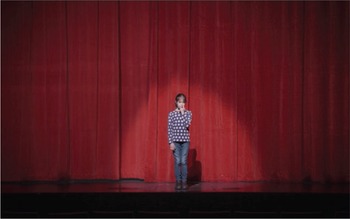
Rimini Protokoll, Do’s and Don’ts (Berlin 2018). By Aljoscha Begrich, Helgard Haug, and Jörg Karrenbauer. Dido Antonia Aquilanti pictured on a stage before a red theatre curtain. (Excerpt from the video documentation by Jay Lee, videostill © Mischa Leinkauf 2021)

Eventually, we were asked to board the truck and I chose a seat in the top row of three and fastened my seatbelt. Before setting off, a screen was lowered and we were presented with the “Prologue,” a recording in which a conventional theatre space was projected along the inside length of the vehicle. In the video of the Berlin performance, Footnote 7 a girl named Dido (the same role as Arun in Frankfurt), perhaps 10 or 11 years of age and dressed in blue jeans and a purple sweater, slips through the curtains and comes to stand near-motionless downstage, her legs tightly together and arms by her sides. Her body language — with a limited range of movement, front-on and self-contained — sets the tone for the work.
The girl introduces us to the protocols and rules of theatre: the “do’s and don’ts” of the stage and auditorium. For instance, one is not supposed to whistle onstage, as “this brings bad luck,” an injunction we are told dates back to the time of gas lamps. Also, one is not allowed to eat, or to wear a hat. However, when her role demands it, a performer is allowed to do anything: insult the audience, lie to them, be naked, urinate or defecate onstage, thus overthrowing all the conventions that apply in everyday life. The light then fades, signaling the beginning of the “show” proper, which coincides with the vehicle leaving the theatre’s precinct and the beginning of the ride.
Works by Rimini Protokoll, as Christopher Balme writes, are “predicated on the fundamental idea of situating performance in the real world and thereby problematizing the borders between reality and fiction” (2014:188). This, I argue, is importantly achieved through the presentation of a novel relationship between time and space. The on-screen theatrical proscenium arch frames the truck journey as if it was a conventional performance. Moreover, the work is subdivided into a prologue, five acts, and an epilogue, indicated by titles on the screen at the beginning of each section, suggesting that the “massive laboratory to observe everyday human behavior” (Rimini Protokoll Reference Protokoll2019) in the real world resembles or is the equivalent of a theatrical role-play. This superimposes the traditional rhythm of a theatrical work onto the macro structure of the journey. Rhythms also permeate the organization of material into smaller sections and units (see Jordan Reference Jordan1993:1) with a mix of recordings, street viewings, and live scenes with performers. During the journey we are occasionally left uncertain of whether the projections inside the truck are live or recorded, confusing the senses, and disorienting the spectators’ conception of time by blurring the internal rhythms of the performance with the external rhythms of the city itself.
Yet unlike Childs’s work, which involved professional performers, Do’s and Don’ts elides boundaries between reality and theatre by using “ordinary,” nonprofessional people with little or no prior stage experience, who simply play themselves. This “threatens to unhinge the work’s status as a play” ( Jackson Reference Jackson2011:170), as their speech eschews the rhythmic structures of the trained thespian’s voice, and they lack the bodily comportment or sense of rhythm instilled in professional dancers by their intensive training. Rudi the truck driver has a strong Ruhrgebiet dialect and there are several awkward silences in the young girl’s monologue. Yet as Daniel Wetzel from Rimini Protokoll explains:
We call them “experts” — there is all that writing about “amateurs” in our work, but for us they are experts: on the one hand because they know something we’re interested in, or because they embody a certain part of society, a certain profession, or a certain competence, which has molded them, which informs their thinking and even the way they look. (in Boenisch Reference Boenisch2008:110–11)
In Rudi’s case, his expertise involves operating a large vehicle and the many technical skills required to do so: engaging the clutch, pulling the handbrake, hand-eye coordination to avoid traffic obstacles, as well as his knowledge of traffic rules.
The work does make one more concrete allusion to theatrical convention in the form of a Berlin school choir (which Dido refers to as her choir), whose prerecorded interludes, which are interspersed throughout the work, give a commentary on different scenes and aspects of urban space and regulations. At times their voices provide a background, typically in the form of rhythmic chants, while at others we see some of the children on screen arranged in geometrical patterns (invariably rows of three) singing lines mostly in unison, a 21st-century Greek chorus: a homogenous group of performers who occasionally comment on the dramatic action.
Act 2
The City
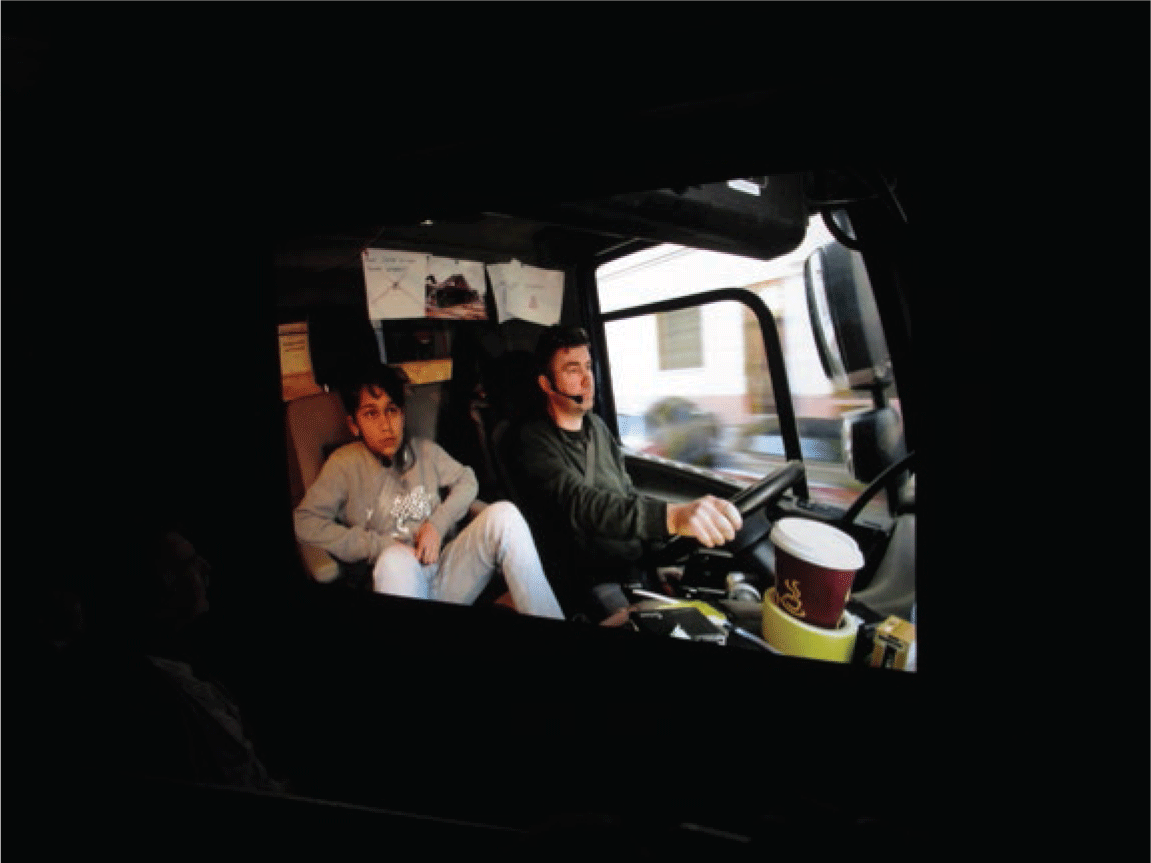
As the on-screen auditorium darkens, our journey’s first segment, entitled “Street Life,” commences. Projected in real time into the cargo space where we sit, we encounter Rudi the driver sitting next to Dido. The pair engage in conversation about the rules applying to trucks, such as the type of license needed to operate the vehicle we are sitting in. The screen then lifts and we see the city streets passing by. We soon notice the spatial and temporal regulation of the urban environment (particularly the traffic) that was mentioned in the program notes, and register its associated rhythms. We see cars in the right-hand lane wait patiently before red traffic lights, while those traveling straight on move in a seamless stream, with punctuated regularity as the lights change from red to amber, and two seconds later to green. Similar alternating cycles of signals, changes of motion and speed, queuing processes, and rhythmic repetition feature throughout much of the work. As we cross through a residential area, trees pass by the truck’s windowpane at regular one- or two-second intervals. Pedestrians wait for green lights before crossing the street — their bodies disciplined to act according to rules — while others smoke or talk in front of shops, gesticulating and chatting to one another. These scenes create “interactions of various repetitive and different rhythms” (Lefebvre [1992] 2013:40) that enliven the street.
Rimini Protokoll, Do’s and Don’ts (Frankfurt 2019). By Aljoscha Begrich, Helgard Haug, and Jörg Karrenbauer. From left: Arun Tönsmann and Rudolf (Rudi) Bühne in the driver’s cabin. (Photo © Alexandra Kolb)

As our journey proceeds, we pass through the areas of the city that serve different functions: quieter residential zones with neatly arranged houses, the lively center with its main square, fringes of parks and other uninhabited quarters, and finally suburbia. Such zoning, as Lefebvre critically remarks, rationalizes space and propagates segregation and separation, for instance between “ghettos” of leisure and those reserved for specific social groups, such as university campuses (1996:144). Our experience of the fragmentation of urban space is echoed and fortified through the visual dramaturgy. The alternation between live street scenes and recordings, heralded by the raising and lowering of our blind to the outside world, gives rhythm to our journey and punctuates our perceptions to highlight certain parts of the city while shielding others from view.
The imposition of traffic codes and the zoning of habitats were historically triggered by the collective chaos of urban space. In the 18th century, cities struggled to cope with a population explosion, leading to congestion of horse-drawn carriages, unsanitary conditions, and muddy, often flooded streets with gutters carrying away human waste (White Reference White2009). Introducing street lighting (in Paris and London from the early 19th century), paving roads, broadening streets to counter traffic congestion, and removing other hazards helped remedy the situation by stabilizing urban territories. This essentially marked the beginning of modern city planning, turning cities into more predictable and controllable spaces:
Space was homogenised and desynchronised of different activities, to produce predictable landscapes where every activity had its special place, e.g., streets were reserved for transport, residential areas for housing, squares for retail and public activities, and children were supposed to play at playgrounds. (Kärrholm Reference Kärrholm2009:424)
This new spatial configuration also “resulted in, and was combined with, new predictable timescapes” (424): a synchronization of temporal rhythms that had significant impacts on the human body. Examples include regular school timetables and working hours, fixed breaks and mealtimes, commuter rush hours, and preset bus and train schedules with peak and off-peak variations. These timescapes were designed to change the city from a state of arrhythmia — an injurious discordance between rhythms (associated in corporeal terms with illness and suffering) — to one of eurhythmia, the smooth and harmonious combination of rhythms we experience when in good health and as “normal (which is to say normed!) everydayness” (Lefebvre [Reference Lefebvre, Elden and Moore1992] 2013:25).
This increasingly linear (in Lefebvre’s sense) approach to time reflected a broader rationalization of life under capitalism, with the imposed rhythms often furthering the interests and logic of exchange-value production and economic growth. Footnote 8 These imposed rhythms superimposed “themselves on the multiple natural rhythms of the body” (18–19), such as respiration and heartbeat. Act 3 of Do’s and Don’ts entitled “Who Rules?” highlights the possible endpoint of such urban rationalization processes, as we are presented with the organization of a “Future City” around technology-based smart solutions. Futuristic computer animations of the metropolis are projected on screen with motorways full of driverless cars bumper-to-bumper in time-lapse, fingerprint recognition and facial ID devices, and fridges with integrated computer screens. Such a vision would likely have filled Lefebvre with horror, as he feared life experience being appropriated by increasingly abstract forces, to the point where the city “no longer lived” and was “no longer understood practically” (1996:148).
Yet glimpses of a less-regulated side to the city can also be gleaned from exposure to the alternative rhythms of its underbelly. In the work’s second act, entitled “Sending-off,” the truck halts at a square — in the recorded Berlin version the notorious Hermannplatz, reputedly one of the city’s least attractive public spaces. Footnote 9 On screen the children’s choir sings high-pitched repetitious words and syllables of unvarying accent and duration (such as “Ich - Ich - Ich”) at short regular intervals, accompanied by synthesized sounds that quickly become monotonous. The screen then lifts to reveal a variety of market huts, stalls, vans, and cycles scattered around in disorderly fashion, set against the backdrop of a large busy street, houses, and a few trees.
Rimini Protokoll, Do’s and Don’ts (Berlin 2018). By Aljoscha Begrich, Helgard Haug, and Jörg Karrenbauer. View of Hermannplatz Berlin from the inside of the truck; Dido Antonia Aquilanti on the grassed area to the left. (Photo © André Wunstorf)

The corporeal actions that present themselves on the square are set against the regularity of the choir’s accompaniment. Merchants sell goods and customers are bunched around stands with inexpensive clothes. A woman perched on a stone wall and a wheelchair user clad in a beanie hat and jeans — strangely slumped forward as if unconscious — are juxtaposed with the contrasting movements of people walking past and groups hovering excitedly around the stalls, as everyone exudes subtly differing degrees of motion or stillness with little synchronicity. The square is clearly a polyrhythmic space in which various rhythms interact. Members of the choir in turn criticize the square for being “loud and ugly,” “messy,” and “unruly,” and complain about dog turds, cigarette butts, scattered rubbish, unpleasant smells from fish and kebab stands, and homeless people in the same breath. Dido alights from the stationary truck and walks onto a grassed traffic island, coming to stand almost motionless with her legs tightly together and arms crossed below her chest as in the earlier theatre scene, to deliver a short monologue. She points out that the square is surveilled and policed according to the rules of a KBO (high-crime zone); its association with theft, drug-trafficking, and even murder grants police officers powers of intervention, including the right to ascertain someone’s identity and frisk-search them without a warrant.
By expressing fear of homeless people and marauding drunks, Dido and the choir condemn, or so it seems, the misconduct of the socially marginalized. In contrast to Childs’s work, which appears to celebrate the inhabitants’ “right to the city” (see Lefebvre Reference Lefebvre1968), the young choristers prioritize urban safeguarding and good order (which traditionally includes bans on graffiti, begging, and street sleeping) over the rights of the individual to occupy and use public space. Their view chimes with conservative ideological perspectives on city planning, such as R.C. Ellickson’s (1996), which regard strict social control and law enforcement as a precondition for shared use. Others, however, view such mechanisms as curtailments of liberty, and advocate actions that produce “antagonistic effects” (Lefebvre [1992] 2013:48) in the face of attempts at social control.
Act 3
Dressage, Control, and the Body
The regulating social rhythms that urban forces dictate have a significant effect on bodily comportment. In applying the concept of dressage, Lefebvre uses an analogy of the “breaking-in” of horses to comply with the patterns of behavior expected by their trainers:
To enter into a society, group or nationality is to accept values (that are taught), to learn a trade by following the right channels, but also to bend oneself (to be bent) to its ways. Which means to say: dressage. Humans break themselves in like animals. They learn to hold themselves. Dressage can go a long way: as far as breathing, movements, sex. It bases itself on repetition. (Lefebvre [1992] 2013:48)
Practices learned through repetition are imposed on individuals from an early age through rhythmic regimes of training. Temporal and spatial arrangements of people in everyday contexts are produced through various (for example, parental or political) forms of control and become routine and habitual.
The urban dressage to which we are exposed on our journey is immediately apparent. Little children are trained, through regular teaching, to look right and left before crossing roads and to respond to signals. Consequently, (older) people’s bodies have learned to obey the particularly strict traffic rules of German cities: we see pedestrians stop at red lights and walk when they change to green. They have acquired the technique to navigate the pavements in orderly, efficient, and methodical rhythmic patterns; neither too slowly nor too hastily, and mostly in straight lines. Dressage, as Lefebvre writes, “determines the majority of rhythms. In the street, people can turn left or right, but their walk, the rhythm of their walking, their movements [gestes] do not change for all that” ([1992] 2013:49). In the residential areas we traverse, we do not see anyone walking in circuitous curves, skipping along the road, or stopping without reason: they, and others, would consider such behaviors inappropriate for adults.
Other scenes in Do’s and Don’ts underscore the dressage that underpins daily life’s socially acceptable conduct. Some families, as the chorister children tell us off camera, operate point systems with marks awarded or subtracted for good or bad behavior, for instance for (not) tidying their room or (not) helping in the household. Introduced in childhood, the concept finds reverberations in later life. Rudi mentions, for example, the penalty points doled out for contravening traffic codes. The corporeal techniques people learn over time become internalized through reiteration, including both formal and informal rules of comportment in public places (the latter, mentioned in one scene, include not staring directly into another person’s eyes). People thus comply with them “to avoid guilt feelings” (Ellickson Reference Ellickson1996:1194), even if there is no external penalty or disadvantage for failing to do so. Dressage, in Lefebvre’s words, “puts into place an automatism of repetitions” ([1992] 2013:49). Footnote 10
Yet formal regulatory mechanisms and sanctions also ensure public compliance, should internalized codes prove inadequate. At the Konstablerwache square in Frankfurt, Rudi and Arun point out the closed-circuit (CCTV) security cameras that have become iconic implements of mass disciplinary surveillance, believed to promote “smarter” cities (predominantly through the prevention of crime). Video analysis, a digital tool that recognizes a person’s facial features and enables the authorities to follow their every step once captured by a camera, is featured in the filmed Berlin version. There is also mention of the Gefangenensammelstelle (or GESA for short), which we drive past: a building where people are taken after an arrest, often for “civil disobedience,” Footnote 11 when regular prison cells are unavailable to accommodate them.
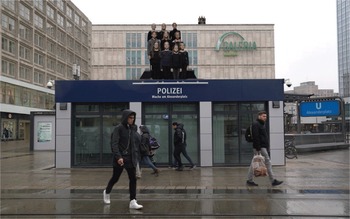
Such tools and institutions regulate street behavior by bringing individuals’ bodies into sync. Like the regularization of bodily comportment and expression through dressage, observation is designed to exert control and exemplifies the state’s overarching concern with surveillance, security, and order (corroborating Lefebvre’s critical stance towards urban planning and design). In another poignant scene, we are exposed to a series of short camera shots showing small groups of choristers — nine per group, arranged in lines of three, superimposed against the roofs of various local authority buildings such as the railway and police stations. Standing almost motionless and facing us front on, they sing in unison (to a piano accompaniment) repetitive melodic snatches of the words “Trust is good — control is better/Vertrauen ist gut — Kontrolle ist besser” in both English and German. This eventually segues into each group intoning the single word “control,” at different pitches, before the camera cuts to the next. Their locations are exactly where we might expect to find CCTV cameras, rendering them “objects-turned-human” (or vice versa); while the camerawork having them look down on us makes them appear both omniscient and powerful.
These frequent allusions to surveillance reminded me of the power of choreography, manifested by our own positioning inside the truck, whose huge glass panels allowed us to see outside but not be seen by those on the streets. This had distinct overtones of the panopticon: the prison designed by Jeremy Bentham (and discussed in Foucault’s Discipline and Punish [(1975) 1979:214–22]) that allowed the guards to observe inmates without their knowledge. The passersby whom we were able to survey were oblivious to us as we watched. Our status thus largely seemed to be that of voyeurs: able to observe everyday actions without the agents’ awareness. This said, I recall that while we were parked momentarily on Konstablerwache in Frankfurt, several passersby noticed that the vehicle strangely seemed to contain an audience, and moved back and forth around the truck to gain a better view and ascertain our presence. This produced a lot of laughter and waving on our side, and (eventually) theirs. It was also, I felt, an apt illustration of the cracks and fissures that can undermine total surveillance.
Rimini Protokoll, Do’s and Don’ts (Berlin 2018). By Aljoscha Begrich, Helgard Haug, and Jörg Karrenbauer. Police station at Alexanderplatz with choristers superimposed on the roof. (Excerpt from the video documentation by Jay Lee; videostill © Mischa Leinkauf 2021)

Act 4
Capitalism and the Shopping Mall
When we first encountered Rudi, he informed us that our mobile auditorium was a former refrigerator truck that had once carried pig halves. By comparing us to fresh meat ready for consumption, Rudi’s comment introduced the dominant rhythms of the market economy. From my place on the top row, I could observe the kinesis of the spectators’ torsos, which visibly swayed from right to left and back again, just as the pig halves likely had once swung from side to side in time with the vehicle’s movements. And just as the pig halves had hung suspended in an orderly fashion from the ceiling, we were obliged to wear seat belts and sit in three neat and tightly arranged rows, enacting legal and social imperatives.
Yet not all was in order. Already feeling distraught due to the death of an aunt and harboring an illness, I experienced nausea on the truck due to the extreme heat of the top row, even though it was February. Footnote 12 I thus became acutely aware of my body’s malfunctions, in line with Lefebvre’s observation that “it is only in suffering that a particular rhythm breaks apart, modified by illness” ([1992] 2013:37). While longing for fresh air to be pumped into the cargo space (which happened at regular but infrequent intervals) I pondered the fact that rhythm is, after all, not merely cultural but primarily biological. These sensations, which produced an acute sense of arrhythmia in my body, seemed in ironic contrast to the truck’s original function of keeping pork refrigerated.
Rimini Protokoll, Do’s and Don’ts (Frankfurt 2019). By Aljoscha Begrich, Helgard Haug, and Jörg Karrenbauer. Shopping mall scene projected on the screen. (Photo © Alexandra Kolb)

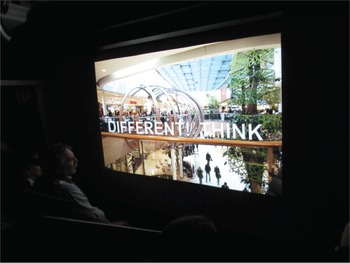
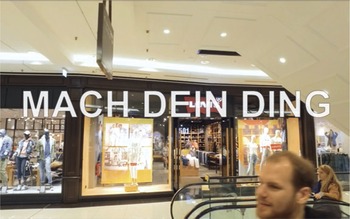
The linearity of rhythms became most pronounced in a poignant scene towards the end of Do’s and Don’ts, which captures the insidious and markedly iterative snappiness of many forms of advertising. The screen is lowered and the audience sees a video of the Kurfürstendamm, a major shopping street in Berlin — with its range of shops including Shoes Leiser, United Colors of Benetton, Mango, Adidas, Esprit, as well as the famous German department store Kaufhaus des Westens — as if driving past them in real time. The image then shifts to the interior of a large indoor shopping mall; I distinctly remember the transition being smooth enough to trick us into wondering whether our vehicle had actually entered such a space. Our virtual journey through retail precincts is accompanied at first by recorded acoustic, unmelodic, and rather unpleasant recurring beats, followed by cuts showing the children’s choir singing advertising slogans in repetitive staccato rhythms, alternating between the full chorus and short interjected solos and duets. The slogans are synchronously overlayed on the screen in large white capital letters: “JUST DO IT!–JUST DO IT! THINK DIFFERENT”; or “JUST DO IT–JUST DO IT–JUST DO IT. I’M LOVING IT!”; or “YOU ARE FREE, I AM SO FREE!” (“Just do it” is of course the Nike catchphrase, while “Think different” is an Apple tagline).
The on-screen intrusion of the advertising slogans and repeated intonations of the children’s choir lend contrapuntal rhythm to the gliding motion as we ride along the mall; the pronounced accents and stresses of the former belying the latter’s smoothness. The slogans themselves, alternately in English and German, have similar short rhythmic structures, usually containing one or two stressed syllabi: “Break the rules” and “Mach dein Ding” (Do your thing), for instance, can be notated as/x/(stresses on the first and last syllable). Others begin with an unstressed syllable followed by a stress, such as “Just do it!” and “Think different!”: in notation x/x. The slogans’ regularly alternating rhythmic patterns make them catchy and easy to remember; indeed, it has been recognized in linguistics that:
The appellative force of rhythm is widely employed in marketing, public speaking and motivational discourse. In its iconic capacity, rhythm reinforces the message, makes it recognizable and memorable, it brings order into utterance thus making it more harmonious. A more or less distinct rhythm is present in the majority of successful slogans. (Smirnova Reference Smirnova2016:127)
Psychologically, motivational slogans about freedom, agency, and individualism are designed to instill a feeling of power. Visually the products, presented in glassed-in shops or window displays, bestow a quasi-theatrical effect: an “advertising show” as Schivelbusch puts it ([1988] 1995:146). Spatially and temporally, shopping experiences in malls are carefully choreographed. In contrast to the outdoor market, which is devoid of choreographed routes, the mall induces customers to enter each floor at one end and exit at the other, obliging them to traverse its entire length in a straight line to maximize their purchases and consequently the company’s profit. The customers’ movements are forced to oscillate between rhythmic routines of action (crossing the mall) and contemplation (gazing at the window displays).
In stark contrast to the proclaimed freedom and endless possibilities promised in the slogans, the scene evokes the dominant form of repetition derived from the dictates of production. Emphasizing the linearity of capitalism’s rhythms through the chanting of unremittingly monotonous phrases to a facile musical accompaniment, the rhythm reflects the predictability, tedium, and banality of the neoliberal service economy centered on the consumer. What is more, the body language of the children choristers is at odds both with the spectacular concepts evoked by the corporate mottos and the brightly lit, colorful window displays. As we pass along the mall — observing people moving through the walkways — the choir is singled out by its relative stasis. A mixed-gender group, they stand facing the camera in three rows, mirroring the spectators’ own three-tiered seating arrangement and thus perhaps inviting us to reflect on ourselves. The singers at first remain completely still and (while repeatedly intoning “Just do it!”) sway slightly in unison from side to side, their arms hanging beside their bodies. Set against a black backdrop, they are clad in gloomy, dark clothes: black or navy jeans, long-sleeved sweaters and jumpers that leave only their faces, necks, and hands uncovered, standing out like small dots of lights in a sea of darkness. They present the image of a dull homogenous mass, an impression further promoted by their facial expressions. The camera focuses on a nerdy-looking boy in spectacles (think Harry Potter) who, while declaring “Discover the possibilities. Do something different,” looks as if he is having an endlessly tedious day.
Rimini Protokoll, Do’s and Don’ts (Berlin 2018). By Aljoscha Begrich, Helgard Haug, and Jörg Karrenbauer. Shopping mall scene with superimposed advertising slogan. (Excerpt from the video documentation by Jay Lee; videostill © Mischa Leinkauf 2021)

Boredom in contemporary society is an experience Lefebvre frequently, if unsystematically, alludes to throughout his writings. The modern phenomenon of “unrelenting boredom” is a result of “stultifying routine, the banalization of culture and the colonization of subjectivity by the spectacle,” as Michael Gardiner writes in an essay on “Henri Lefebvre and the ‘Sociology of Boredom’” (2012:39). Reverberating Georg Simmel’s observation that city dwellers are bombarded with internal and external stimuli associated with capitalism, eradicating personal identity and leading to mass anonymity ([1903] 1969:48), Lefebvre reflects on the endless distractions and activities of the market economy as “homogenous,” “tedious,” “uniform and monotonous” ([1992] 2013:82, 83). These shallow entertainments significantly compromise the quality of everyday life and the formation of meaningful individual identities. Accordingly, commodity time is quantitative and controlled, abstract, dreary, and predictable.
In the shopping mall scene, the bright, artificial lighting relegates natural cyclical rhythms such as day and night and the seasons to the outside world, controlling an unvarying climate. The continual sameness induced by rationalization echoes in the affective experience of repetitive musical beats and the restricted, subdued nature of the chorus movements and their homogenous, bland-colored clothes; they seem to embody a denial of fathomable lived experience. Thus boredom, as Gardiner writes with reference to Lefebvre, allows us to understand “wider anxieties, socio-cultural changes and subjective crises” (2012:37). Yet if boredom is a historically contingent condition, it follows that “it can be at least partly superseded, especially if we realize that boredom itself might occasionally harbour flashes of subversive insight and the seeds of transformational praxis” (38). The same observation applies more generally to the urban everyday.
Act 5
Resistant Choreography, or the Exception to the Rule
Homeless people present poignant examples of a transgressive corporeality that resists manifold attempts to manage the urban environment. We see several of them on the streets of Berlin. Rudi’s insistence that “everyone is the architect of their own fortune” suggests they are responsible for their own life choices, and may be seen to embrace the neoliberal ideal of rugged individualism. But whether by misfortune or choice, those outside of society’s mainstream defy dominant behavioral norms, and their presence on the street — and consequently in the artwork — provokes reflections about the interaction between bodies, place, and time, as highlighted in Nicholas Blomley’s intriguing article on “How to Turn a Beggar into a Bus Stop” (2007). Blomley argues that the regulation of urban life, notably through traffic codes, redirects an issue of rights (the urban poor’s right to shelter) to an argument about people’s activity and use of space. In democracies, individuals’ civil rights typically include free access to public spaces and they cannot be discriminated against on grounds of social status. Yet this has led, Blomley claims, to an adjustment in many countries’ laws and other social-control mechanisms that seeks to criminalize bodily actions in space instead. Specifically, local authorities can justify removing people for loitering or being immobile (sitting and lying in doorways) on the basis that they are obstructing the smooth flow of pedestrian traffic, presenting a safety hazard on streets, and thwarting their main function as transportation corridors. According to Blomley’s analysis, the homeless are thus seen as static objects in a similar way to mailboxes, café tables, and vegetable stands.
A lack of motion, of course, spawns its own alternative rhythms. The immobility of the homeless is the flip-side of the tyranny of societal dressage and capitalist norms, with their imposition of normative and socially acceptable behaviors on everyday life. Vagrants often occupy city locations designed for other purposes; for instance, sitting in front of shops where convention would demand an upright standing or walking posture. What’s more, they disturb the rhythms of passersby who have to skirt around them or stop to give them money, turning a (permissible and invited) contemplation of shop-window exhibits into a (often clandestine) gaze at these alternative human “displays.” Temporally, homeless people contravene the regularities of capitalism: the pursuit of efficiency and productivity that imposes strict rhythms on individual bodies. They typically eschew the usual distinctions between work- and leisure-time, are not bound by productivity requirements, and disrupt expected patterns of free-market exchange — for example when they attract voluntary donations, scavenge for discarded items, or commit minor acts of pilfering. They might thus be branded as outcasts of the capitalist system; as Phil Jones and Saskia Warren remark, with reference to Lefebvre, “bodies outside these rhythms can be considered abject. The regulation of time can thus be seen as marking any attempt to resist capitalism as abject” (2016:287).
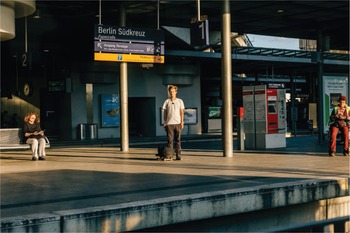
Rimini Protokoll, Do’s and Don’ts (Berlin 2018). By Aljoscha Begrich, Helgard Haug, and Jörg Karrenbauer. Jasper Penz stands on the platform at the Berlin Südkreuz Station. (Photo © André Wunstorf)

As I argued in my Act 2 section above, the segregation of public space was designed to combat the chaos that had reigned on city streets in bygone eras. Restrictions on beggars, street entertainers, and vendors, who are given strict instructions about where they can ply their trades, fulfill a similar function. But these regulations are liable to be judged in different ways depending on one’s political standpoint. Blomley suggests they are motivated by authoritarianism or a “police-power mentality” (2007:1703). Others defend them in the interest of capitalist forces, asserting that the presence of beggars leads to an “exodus […] of street users” and negatively influences consumer behavior (see Ellickson Reference Ellickson1996:1175). Yet others cite a deep-rooted (albeit contested) Western belief in freedom: Kärrholm articulates this view by pointing out that “[t]here is a long-standing association in liberal thought between mobility, individualism and liberty” (2009:1707). The equation of freedom with mobility, which we also observe in advertising slogans, can be traced back to Hobbes who defined liberty as the “absence of […] external impediments to motion” ([1651] 1968:261). Following this logic, those who block walkways by sitting or standing on them are not only viewed as impediments to consumers or through traffic, but as attacking the very core of our liberal understanding of freedom. Hence, by removing obstacles on the street (human or otherwise) we ensure this worldview remains intact.
The theme of motionlessness or stillness is explored in Do’s and Don’ts. In one scene, Dido’s socially critical older brother Jasper, who is perhaps 17 years of age, joins us on our journey as the girl is required to return home by the Youth Protection Act. He will later out himself as a left-wing opponent of the capitalist system, which he associates with control, authoritarianism, and a predilection for rules and order. We see the teenager standing motionless on a platform, broad-legged and in semi-profile, his gaze fixed to the left into space. In the recorded Berlin version, this takes place at Südkreuz station behind two train tracks, while in Frankfurt a tram station was used for the equivalent scene. At first, we do not notice the boy, who blends into the backdrop of everyday activity as did the performers in Street Dance. Yet the dialogue between him and his sister, who is still on the truck, gives his presence away. Jasper explains that by standing there completely still, he is seeking to undermine the rule that we must always have a reason to be somewhere (as opposed to loitering without purpose). Not doing anything, he argues, can be a disruptive act.
In a scene towards the end of the piece, the motif of stillness as resistance to dominant norms of mobility surfaces again, when Jasper encourages the driver to stop in the middle of a large, busy junction, temporarily halting traffic and creating a long queue of stationary cars. In Frankfurt, this caused a memorable and hilarious moment when a frustrated and aggressive Mercedes motorist drove, at intervals, closer and closer to the side of our truck until his hood almost bumped it. As the scene took place after nightfall, we saw his headlights flashing and heard his horn being used wildly and repetitively, reminding us that many people have internalized their right to mobility as an element of freedom, and react harshly against those who threaten that right.
These sustained moments of inactivity could be seen to offer, in Lefebvre’s words, “a new usage of the body, of time and space, of sociability” (1988:86–87) that presents a utopian alternative to the status quo. By using a nonnormative gestural language and choosing to do nothing, Jasper refuses the role that society has identified for him and confirms his own agency; by stopping traffic (however momentarily) he rejects the functionality and rationality of the prescribed uses of space. The act of standing in public places has been deployed elsewhere as a form of protest, both in the political context of demonstrations and indeed in the work of certain choreographers. In the US civil rights movement, as Susan Foster convincingly argues, it was used as a “stoic, non-compliant non-action” (2003:399) by African Americans to undermine discriminatory segregation laws. In Turkey, meanwhile, it served as a “legal form of resistance” (Foellmer Reference Foellmer2016:58; see Mee Reference Mee2014) against a police ban on demonstrations in a square in Istanbul. André Lepecki considers various politically charged deployments of motionlessness in dance or by dancers, for instance in Jérôme Bel’s The Last Performance (1995) and by Yoshiko Chuma, who in 1992 stood at St. Mark’s church in New York “saying that the state of the world was such that she didn’t feel like dancing” (Lepecki Reference Lepecki, de Belder and Tachelet2001:43). Such intentional acts of stillness, in Lepecki’s words, trouble the “dusty folds of agitation in the name of progress” (44).
Stillness is an alternative form of temporality, which challenges the routine rhythmicities of capitalist forces with their constant succession of (supposedly) novel activities. It injects moments of disturbance and disobedience into an otherwise over-regulated world. Of course, being still also changes our corporeal rhythms. As all dancers know, and choreographer Steve Paxton has explicitly observed, total stillness does not exist even in the act of standing, which actually entails “quite a lot of minute movement” (in Zimmer Reference Zimmer1977:11). Lefebvre reflects similarly that for the observant rhythmanalyst, “apparent immobility […] contains one thousand and one movements” ([1992] 2013:26). By being still, we draw attention to the distinction between our body’s conscious and directed movements (external rhythms) and its internal physiological ones such as breathing and tiny gestures we cannot control, like the blinking of our eyes. This also means that our alignment to dominant social rhythms is never complete, as our natural bodily processes cannot be fully suppressed or annexed by hegemonic forces.
Epilogue
As I stepped off the truck at the end of our two-hour journey, I felt physically and mentally exhausted, having listened to almost nonstop commentary with little fresh air to breathe. Our spectatorship experience could hardly be described as straightforward. Its ambivalence was manifest, on one hand, by the fact that we were encouraged to engage in an enhanced form of voyeurism compared to conventional theatre: our observation of urban spaces through the truck’s windows was unbeknownst to most of the “performers” in the outside world, with the exception of the Rimini Protokoll actors. We thus participated in the very activity of surveillance explored in multiple sections of the work. On the other hand, we were ourselves subject to control mechanisms inside the truck; pressed into narrow seats with belts — as ersatz pig halves — and what I suspected in hindsight might have been an intentionally limited airflow. Footnote 13 We journeyed at a time when attempts by organized gangs to funnel migrants from the Middle East across European borders, locking them in air-tight refrigerator lorries, and in some cases suffocating their “cargo” through sheer carelessness (see for example Withnall Reference Withnall2015) was still in vivid memory. They too are lurid illustrations of lived rhythms falling victim and ultimately succumbing to profiteering powers.
Despite its parallels with Do’s and Don’ts in engaging with the urban everyday, Street Dance conveyed a more utopian and optimistic vision of the city in performance. Its witty yet matter-of-fact taped commentary, listing the objects and architectural details in view while the performers interacted with them, profiled the urban everyday environment as a site worthy of discovery and rhythmized it in a playful fashion. Non-theatre spaces, the minutiae of everyday life, quotidian movements, novel forms of spectatorship, and a conception of performance expanded to include passersby and the city itself are sharply delineated from (and indeed opposed to) what Lucinda Childs’s contemporaries saw as near-ubiquitous notions of spectacle and virtuosity.
Despite Do’s and Don’ts’ explicit analogy between theatre and the city, the piece places less emphasis on the pleasurable adventure of urban discovery than on the abstract rules and forces exerted on individuals. This is not to overlook certain playful elements; for instance towards the end of our journey, after nightfall, we were asked to use our mobile phones as torches to wave at passersby who could perceive the moving lights despite the one-way glass. Yet rhythm is predominantly presented not as a totality, a ludic enterprise, or corporeal function, but rather as a succession of external impositions on bodies both outside and inside the truck. What we lose in the process is our capacity to experience the city through empathy: bombarded by a mix of live and prerecorded commentaries, we are urged to reflect cognitively on the regulations and norms engendered by city-planners, police, governments, and capitalist institutions alike. Footnote 14
Avenues for freedom, accordingly, are to be found elsewhere. As I argued in my Act 5 section, it is possible to reject the social imperatives imposed on everyday life at the level of the body, but such transformative praxis requires conscious awareness of our subjection to dressage and other control mechanisms in the first place. Jasper, in particular, embodies this refusal. Stasis — understood as the reduction of rhythmic movements down to the body’s basic corporeal functions — is shown as the most effective tool of resistance to what Lefebvre calls social rhythms, including the trivializing effects of the endless (and mindless) string of activities proffered by untrammeled consumerism. A compelling case is made for reclaiming stillness as a subversive act of nonengagement, undermining the conception of freedom as motion that is at the heart of much liberal thought. Or to put it differently: the politically dissident potential of everyday performance is thus no longer spawned in doing, but in not-doing.