INTRODUCTION
Flagellates of the family Trichomonadidae, order Trichomonadida, are amitochondriate, microaerophilic protozoa that mostly live as parasites in the intestine or in the urogenital tract of humans and animals (Brugerolle and Müller, Reference Brugerolle, Müller, Leadbeater and Green2000). In birds, two trichomonad species, Trichomonas gallinae and Tetratrichomonas gallinarum, are most commonly found.
Trichomonas gallinae, present in lesions of the upper digestive tract of pigeons, was firstly reported by Rivolta (Reference Rivolta1878), who named it Cercomonas gallinae. Because some flagellates were also found in a pigeon liver in connection with caseous hepatitis the pathogen was also called Cercomonas hepaticum. Later on, Stabler (Reference Stabler1938) introduced the name Trichomonas gallinae for trichomonads that colonize the crop of pigeons. Trichomonas gallinae is the only trichomonad species with a non-ambiguous, proven pathogenic potential for birds (Bondurant and Honigberg, Reference Bondurant, Honigberg and Kreier1994).
Tetratrichomonas gallinarum was originally reported by Martin and Robertson (Reference Martin and Robertson1911) as Trichomonas gallinarum, while the actual name Tetratrichomonas gallinarum was established following a taxonomic scheme applied by Honigberg (Reference Honigberg1963). Tetratrichomonas gallinarum is commonly found in the large intestine of gallinaceous and anseriform birds (McDougald, Reference McDougald, Saif, Fadly, Glisson, McDougald, Nolan and Swayne2008).
In the past, any flagellates present in the upper part of the digestive tract anterior to the gizzard and in the tissue of the head, thorax or abdomen of a bird were considered to be T. gallinae (Stabler, Reference Stabler1954). In comparison, T. gallinarum is most often found in the lower part of the intestinal tract, principally the caeca. Additionally, different species of trichomonads were also classified on the basis of the hosts they infected (Levine, Reference Levine1985). Recently, the introduction of molecular methods and the development of clonal cultures have proved to be useful in more accurate identification and classification of these protozoa.
MORPHOLOGY
Representatives of the order Trichomonadida are unicellular organisms with a single nucleus. These flagellates are characterized by the presence of a single karyomastigont, five to six flagella, undulating membrane of lamelliform-type and the B-type costa (Cepicka et al. Reference Cepicka, Hampl and Kulda2010). Trichomonads lack classic mitochondria as sites of oxidative fermentation, but instead possess specialized organelles named hydrogenosomes (Müller, Reference Müller1993). These energy-generating organelles use a fermentative pathway for pyruvate metabolism and not the Krebs cycle as classical mitochondria.
Trichomonads exist at the trophozoite stage in vitro under favourable incubation conditions and move with the help of flagella (Stabler, Reference Stabler1954). Much has been learned about the morphology of T. gallinae and T. gallinarum by light microscopy, even though several investigations reported contradicting sizes of trophozoites (Stabler, Reference Stabler1941, Reference Stabler1954; McDowell, Reference McDowell1953; Abraham and Honigberg, Reference Abraham and Honigberg1964; Theodorides and Olson, Reference Theodorides and Olson1965; Honigberg, Reference Honigberg and Kreier1978; Bondurant and Honigberg, Reference Bondurant, Honigberg and Kreier1994). These variations in size could be attributed to the inherent constitution of these flagellates based upon physicochemical changes in their growth environment, or due to distortions caused by the various fixatives used during preparation (Theodorides and Olson, Reference Theodorides and Olson1965).
In general, the morphological variations among T. gallinae and T. gallinarum are mainly represented by the presence or absence of a protruding flagellum behind the posterior end of the body. Trichomonas gallinae trophozoites vary in shape reaching from ovoidal to pyriform with a size of about 7–11 μm. They are provided with four free anterior flagellae and a fifth recurrent one, which does not become free at the posterior pole as it extends for only two-thirds of the body length (Tasca and De Carli, Reference Tasca and De Carli2003; Mehlhorn et al. Reference Mehlhorn, Al-Quraishy, Amin and Michael2009). The nucleus is ovoid with a size of 2·5–3 μm. The axostyle consists of a row of microtubules running from the region of the apical basal bodies to the posterior end of the cell. Flagellated stages contain food vacuoles, hydrogenosomes, a costa-like structure, and glycogen granules beside lacunes of endoplasmic reticulum. In addition, spherical, non-flagellated and cyst-like stages occur. In general, the trophozoites of T. gallinarum reflect a similar constitution as T. gallinae but they appear mostly pear-shaped and range in size from 6 to 15 μm which was described to be roughly the same size as red blood cells (Clark et al. Reference Clark, De Gussem and Barnes2003). They also have four free anterior flagella and a fifth recurrent one, which becomes free at the posterior pole in contrast to that of T. gallinae. The anterior flagella were found to be approximately 8–13 μm in length (Bondurant and Honigberg, Reference Bondurant, Honigberg and Kreier1994). Another clearly visible difference to T. gallinae is the occurrence of a sphere of lacunes of the endoplasmic reticulum surrounding the nucleus with its typical perinuclear membranes in a regular distance. Furthermore, food vacuoles appear very large (Mehlhorn et al. Reference Mehlhorn, Al-Quraishy, Amin and Michael2009).
EPIDEMIOLOGY AND TRANSMISSION
Trichomonas gallinae
The parasite T. gallinae is of veterinary and economic importance, as it causes avian trichomonosis, a disease with important medical and commercial implications. Avian trichomonosis has been reported from several continents and is considered a major disease of numerous avian species, especially columbiformes and falconiformes (Stabler, Reference Stabler1954). In pigeons, the disease is also called canker. The rock pigeon (Columba livia) is the primary host of T. gallinae and has been considered responsible for the worldwide distribution of this protozoal infection (Stabler, Reference Stabler1954; Harmon et al. Reference Harmon, Clark, Hawbecker and Stafford1987). Similarly, other species within the Columbidae, like doves (e.g. Streptopelia decaocto) and feral or wood pigeons (e.g. Columba palumbus) are important hosts as well (Bondurant and Honigberg, Reference Bondurant, Honigberg and Kreier1994).
Raptors, like hawks, eagles and falcons, are also susceptible to infection by T. gallinae (Krone et al. Reference Krone, Altenkamp and Kenntner2005) and may develop trichomonosis which is also termed ‘frounce’ in these birds (McDougald, Reference McDougald, Saif, Fadly, Glisson, McDougald, Nolan and Swayne2008). Work and Hale (Reference Work and Hale1996) reported severe trichomonosis-induced mortality in owls. A very detailed listing of bird species from the orders Columbiformes, Falconiformes and Strigiformes was published recently by Forrester and Foster (Reference Forrester, Foster, Atkinson, Thomas and Hunter2008).
Since 2005 avian trichomonosis has been recognized as an emerging infectious disease of wild finches in the UK (Robinson et al. Reference Robinson, Lawson, Toms, Peck, Kirkwood, Chantrey, Clatworthy, Evans, Hughes, Hutchinson, John, Pennycott, Perkins, Rowley, Simpson, Tyler and Cunningham2010), which further spread as a consequence of bird migration (Lawson et al. Reference Lawson, Robinson, Neimanis, Handeland, Isomursu, Agren, Hamnes, Tyler, Chantrey, Hughes, Pennycott, Simpson, John, Peck, Toms, Bennett, Kirkwood and Cunningham2011b ). Later on, several outbreaks were recorded in Southern Fennoscandia, Northern Germany, Eastern Canada, the British Isles, France and Slovenia (Peters et al. Reference Peters, Kilwinski, Reckling and Henning2009; Forzan et al. Reference Forzan, Vanderstichel, Melekhovets and McBurney2010; Neimanis et al. Reference Neimanis, Handeland, Isomursu, Agren, Mattsson, Hamnes, Bergsjo and Hirvela-Koski2010; Gourlay et al. Reference Gourlay, Decors, Jouet, Treilles, Lemberger, Faure, Moinet, Chi, Tyler, Cunningham and Lawson2011; Lawson et al. Reference Lawson, Robinson, Colvile, Peck, Chantrey, Pennycott, Simpson, Toms and Cunningham2012; Zadravec et al. Reference Zadravec, Marhold, Slavec, Rojs and Racnik2012; Lehikoinen et al. Reference Lehikoinen, Lehikoinen, Valkama, Väisänen and Isomursu2013), including Passeriformes like Lonchura oryzivora, Taeniopygia guttata, canaries and psittacines. Park (Reference Park2011) documented the infection by T. gallinae in several novel species including lorikeets, corvids and a cuckoo species, plus its distinctive presentation in southern boobook owls (Ninox boobook). Trichomonosis, characterized by morbidity and mortality was also reported in free-ranging house finches (Carpodacus mexicanus), mockingbirds (Mimus polyglottos) and corvids (scrub jay: Aphelocoma californica; crow: Corvus brachyrhynchos; raven: Corvus corax) in northern California (Anderson et al. Reference Anderson, Grahn, Van Hoosear and Bondurant2009). In comparison to the species of birds mentioned before only a few natural occurrences of trichomonosis have been reported in gallinaceous birds like turkeys (Hawn, Reference Hawn1937) and chickens (Levine and Brandly, Reference Levine and Brandly1939).
Avian trichomonosis has been reported from almost every major land mass, indicating a worldwide prevalence of the parasite (Forrester and Foster, Reference Forrester, Foster, Atkinson, Thomas and Hunter2008). In addition to the worldwide distribution, especially in Columbidae, reports of prevalence vary greatly, ranging from 5·6% (Schulz et al. Reference Schulz, Bermudez and Millspaugh2005) in Mourning Doves (Zenaida macroura) to 34·2% in wintering woodpigeons (C. palumbus) (Villanua et al. Reference Villanua, Hofle, Perez-Rodriguez and Gortazar2006) and up to 95% in White-winged Doves (Zenaida asiatica) (Conti and Forrester, Reference Conti and Forrester1981).
The threatening role for endangered species has been reported several times, supported by the ability of the parasite to infect numerous avian species (Höfle et al. Reference Höfle, Gortazar, Ortíz, Knispel and Kaleta2004; Bunbury et al. Reference Bunbury, Jones, Greenwood and Bell2007; Hegemann et al. Reference Hegemann, Hegemann and Krone2007). This seems to be particularly important for birds of prey that nest near urban areas. Due to the loss of habitat their traditional prey is mainly replaced by urban pigeons. A noticeable variation was found in the prevalence of the parasite in Cooper's hawk (Accipiter cooperi) in Arizona (Boal et al. Reference Boal, Mannan and Hudelson1998). The infection rate in nestlings of couples breeding far from urban areas was only 9%, in comparison to 85% in birds from urban areas. According to the authors, this was due to the increased consumption of urban columbiformes. This observation was further corroborated by Estes and Mannan (Reference Estes and Mannan2003), who determined that 57% of the urban Cooper's hawks’ diet consisted of columbiformes compared with 4% in rural areas. The same was observed in goshawk nestlings (Accipiter gentilis) close to urban areas in Europe, with 100% prevalence in Poland (Wieliczko et al. Reference Wieliczko, Piasecki, Dorrestein, Adamski and Mazurkiewcz2003) and 65% in Germany (Krone et al. Reference Krone, Altenkamp and Kenntner2005). On the Iberian Peninsula, studies about the prevalence of T. gallinae focused on Bonelli's eagle (Hieraaetus fasciatus), a vulnerable species, whose population on the Peninsula accounts for 75–93% of the total European population (Real and Manosa, Reference Real and Manosa1997). In 1993, trichomonosis was one of the most important single nestling mortality factors for Bonelli's eagle, accounting for 22% of total chick mortality. In southern Portugal T. gallinae was demonstrated in 50% of the Bonelli's eagle chicks analysed by Höfle et al. (Reference Höfle, Blanco, Palma, Melo, Redig, Cooper and Remple2000). In northeast Spain, Real et al. (Reference Real, Manosa and Munoz2000) found the parasite present in 36% of the raptors. In all cases, a high percentage of pigeons were observed in the eagle's diet. A remarkable difference in the prevalence of trichomonosis in captive and wild birds was recorded in Saudi Arabia by Bailey et al. (Reference Bailey, Samour, Bailey, Remple, Remple, Lumeij, Remple, Redig, Lierz and Cooper2000), who detected a prevalence of 35% in wild pigeons and 68% in captive birds. However, this trend was not so pronounced in Australia, where the prevalence of trichomonosis was almost equal between captive pigeons (49%) and wild birds (46%) (McKeon et al. Reference McKeon, Dunsmore and Raidal1997). Altogether, in numerous reports avian trichomonosis could be linked to the bird species and the way birds are kept or the biology of a certain bird species.
Great variations could be noticed between studies focusing on the prevalence depending on the parameters (season, age or bird species) applied in the investigations. The occurrence of avian trichomonosis among pigeon nestlings has been reported throughout the year, but marked seasonal fluctuations were also recorded. No clear seasonal link could be established as outbreaks in pigeons and doves occur throughout the whole year (Gerhold et al. Reference Gerhold, Tate, Gibbs, Mead, Allison and Fischer2007a ; Begum et al. Reference Begum, Mamun, Rahman and Bari2008). In comparison, seasonal patterns of disease occurrence appear to be prominent in finches where trichomonosis has recently emerged (Neimanis et al. Reference Neimanis, Handeland, Isomursu, Agren, Mattsson, Hamnes, Bergsjo and Hirvela-Koski2010; Robinson et al. Reference Robinson, Lawson, Toms, Peck, Kirkwood, Chantrey, Clatworthy, Evans, Hughes, Hutchinson, John, Pennycott, Perkins, Rowley, Simpson, Tyler and Cunningham2010; Lawson et al. Reference Lawson, Robinson, Neimanis, Handeland, Isomursu, Agren, Hamnes, Tyler, Chantrey, Hughes, Pennycott, Simpson, John, Peck, Toms, Bennett, Kirkwood and Cunningham2011b ). In the UK, finch mortalities begin in July, with peaks reached in late summer and early autumn. Climatic factors were initially thought to have played a role in the emergence of the disease in the UK (Anonymous, Reference Anonymous2006), but this hypothesis was all but neglected due to the inconsistency between weather events and trichomonosis outbreaks. Despite reports suggesting the seasonality of the disease, climatological data have not been assessed to determine the potential role of weather conditions on the emergence of trichomonosis in a particular region. However, more recently, dry weather and low rainfall have been suggested as factors involved in the emergence of the disease in finches in the UK (Simpson and Molenaar, Reference Simpson and Molenaar2006). In agreement with this, the prevalence of T. gallinae infection in doves in Mauritius was found to be higher at sites and times of warmer temperatures and lower rainfall (Bunbury et al. Reference Bunbury, Jones, Greenwood and Bell2007).
Due to the extreme fragility of T. gallinae trophozoites, it was long believed that the parasite was unable to survive outside the host “for more than the briefest periods” (Stabler, Reference Stabler1954). Furthermore, an intermediate host (live vector) is unknown among these protozoa (Stabler, Reference Stabler1954; McDougald, Reference McDougald, Saif, Fadly, Glisson, McDougald, Nolan and Swayne2008). In view of this, the flagellate displays only a low tenacity in an ambient environment and dies quickly outside the host. It is generally believed that water and bird feed are sources for the transmission of the parasite. Trichomonas gallinae survives only for a short period in tap water (Bondurant and Honigberg, Reference Bondurant, Honigberg and Kreier1994) and at least 8 hours in carcasses (Erwin et al. Reference Erwin, Kloss, Lyles, Felderhoff, Fedynich, Henke and Roberson2000). Moreover, T. gallinae could survive outside the host for up to 120 h under certain laboratory conditions (Amin et al. Reference Amin, Neubauer, Liebhart, Grabensteiner and Hess2010).
However, a direct contact seems most efficient to establish an infection and the best example for this is the transmission of parasites via the crop milk from infected parent birds to the nestlings during first feeding (Stabler, Reference Stabler1954). In adult pigeons, the infection can occur during courtship while raptors can be infected from prey animals carrying the parasite. The infection of turkeys and chickens happens mainly via drinking water contaminated by pigeons (Bondurant and Honigberg, Reference Bondurant, Honigberg and Kreier1994). Conclusively, a wet environment seems to be generally required by trichomonad flagellates to persist in their motile form, so persistent drying of buildings and housing facilities following washing will enhance the control of a trichomonad infection.
Trichomonas gallinae is unable to form true cysts, even though cyst-like stages (pseudocysts) were reported (Tasca and De Carli, Reference Tasca and De Carli2003; Mehlhorn et al. Reference Mehlhorn, Al-Quraishy, Amin and Michael2009). These pseudocysts may provide another route of transmission and an environmentally resistant stage during unfavourable conditions. Consequently, pseudocysts apparently enhance transmission and extend survival time outside the host.
Tetratrichomonas gallinarum
Tetratrichomonas gallinarum is a flagellate commonly inhabiting the intestinal tract of different poultry species including chickens, turkeys, guinea fowl, quails, ducks and geese (Levine, Reference Levine1985; Friedhoff et al. Reference Friedhoff, Kuhnigk and Muller1991; Bondurant and Honigberg, Reference Bondurant, Honigberg and Kreier1994). In older literature, the incidence of T. gallinarum in chickens was about 60% in Pennsylvania (McDowell, Reference McDowell1953) and 43% in Russia (Bondarenko, Reference Bondarenko1964). An influence of the weather on the prevalence of T. gallinarum infections was reported by Weinzirl (Reference Weinzirl1917) who found an increase during warmer periods, whereas Leibovitz (Reference Leibovitz1973) mentioned a peak of infection in autumn. Anyhow, prevalence data might be influenced by the different detection methods including variations of the media used for isolation and propagation as outlined below (subheading: cultivation of trichomonads).
The flagellate can be transmitted via consumption of contaminated food. Infected birds excrete live parasites as soon as 2 days post infection, as proven recently by experimental infection of chickens and turkeys with an axenic clonal culture of T. gallinarum (Amin et al. Reference Amin, Liebhart, Weissenbock and Hess2011). In addition to trophozoites, pseudocysts of T. gallinarum are reported in vivo and in vitro which might protect the parasite during fecal oral transmission (Friedhoff et al. Reference Friedhoff, Kuhnigk and Muller1991; Mehlhorn et al. Reference Mehlhorn, Al-Quraishy, Amin and Michael2009).
PATHOGENICITY
Trichomonas gallinae
Pindak et al. (Reference Pindak, Gardner and Pindak de Mora1986) noticed the deficiency of an easy procedure by which the pathogenicity of the organism can be determined, a statement still valid today. The assignment of trichomonad isolates as pathogenic or non-pathogenic is mainly based on the severity of the symptoms induced in the host from which the particular strain is isolated.
The preferred site for T. gallinae is the upper digestive tract including the mouth, pharynx, oesophagus and crop, with the parasite rarely found posterior to the proventriculus (Cauthen, Reference Cauthen1936). Consequently, the excretion of the protozoa via droppings is very limited. Moreover, the flagellate is able to enter the head sinuses and invade the brain and eye regions and can be detected in tears (Bondurant and Honigberg, Reference Bondurant, Honigberg and Kreier1994). Jaquette (Reference Jaquette1950) demonstrated that T. gallinae reached the abdominal viscera presumably via the blood, but not via the gut and the bile duct. Moreover, systemic trichomonosis involving the liver, lung, heart, pancreas, air sacs and pericardium has been documented (Stabler and Engley, Reference Stabler and Engley1946). The severity of pathologic lesions of T. gallinae in the upper digestive tract varies from a mild inflammation of the mucosa to caseous areas that block the oesophageal lumen (Stabler, Reference Stabler1954). Narcisi et al. (Reference Narcisi, Sevoian and Honigberg1991) reported that a virulent strain of T. gallinae was able to create diphtheritic membranes of wet canker, associated with fibrinous lesions in internal organs such as the liver, lungs and peritoneum, resulting in high mortality. The authors also described that vascular congestion of the tongue, liver and lung was detected already 4 days post infection (dpi). Moreover, necrosis of the epithelial cells and submucosa of the oropharyngeal regions was observed on the 5th and 6th dpi. Trichomonads were only found attached to the epithelium of this localization. Additionally, purulent exudates containing mainly heterophils were noticed after one week in the oropharynx, crop and the lungs. Histopathological changes associated with T. gallinae infection in the liver were characterized by a vascular congestion with perivascular cuffing, observed as early as 4 dpi. Fatty degeneration of the hepatocytes at 7 dpi was found before complete necrosis of the hepatic cells in the presence of trichomonads occurred. Furthermore, degenerative lesions were detected in the kidneys and genitalia of the infected pigeons. Additionally, the caseous masses may appear in intestinal and gizzard surfaces, substernal membranes and pericardium (Stabler, Reference Stabler1954). The myocardium also may become caseous as an extension from the pericardium. Trichomonas gallinae strains of moderate virulence are often associated with caseous abscesses in the upper digestive tract and oropharyngeal region, whereas no visible lesions are produced by avirulent strains of T. gallinae (Cole and Friend, Reference Cole, Friend, Friend and Franson1999). Stabler (Reference Stabler1948) reported that 80–90% of adult pigeons were infected without showing any clinical signs of the disease. The author assumed in a later report that most of these birds became immunized as a result of exposure to an avirulent strain of the parasite, enabling them to act as a constant source of infection for their progenies (Stabler, Reference Stabler1954).
It seems that the severity of the disease depends on the susceptibility of the infected birds together with the pathogenic potential of the incriminated strain and the stage of infection (Cooper and Petty, Reference Cooper and Petty1988; Cole and Friend, Reference Cole, Friend, Friend and Franson1999). It was also thought that variations in virulence are related to the antigenic composition of the parasite (Stepkowski and Honigberg, Reference Stepkowski and Honigberg1972; Dwyer, Reference Dwyer1974). Even though genetic data indicate a certain variation between isolates, no correlation with virulence was established (Gerhold et al. Reference Gerhold, Yabsley, Smith, Ostergaard, Mannan, Cann and Fischer2008; Anderson et al. Reference Anderson, Grahn, Van Hoosear and Bondurant2009; Grabensteiner et al. Reference Grabensteiner, Bilic, Kolbe and Hess2010; Ecco et al. Reference Ecco, Preis, Vilela, Luppi, Malta, Beckstead, Stimmelmayer and Gerhold2012; Stimmelmayr et al. Reference Stimmelmayr, Stefani, Thrall, Landers, Revan, Miller, Beckstead and Gerhold2012; Chi et al. Reference Chi, Lawson, Durrant, Beckmann, Alrefaei, Kirkbride, Bell, Cunningham and Tyler2013).
Early studies indicated that the virulence of in vitro grown T. gallinae could be determined by producing lesions in mice at the site of subcutaneous inoculations (Honigberg, Reference Honigberg1961; Frost and Honigberg, Reference Frost and Honigberg1962). The use of haemolytic activity was demonstrated as unsuitable for determining the virulence of T. gallinae (Gerhold et al. Reference Gerhold, Yabsley and Fischer2007b ) contrary to reports about the virulence of Trichomonas vaginalis (Krieger et al. Reference Krieger, Poisson and Rein1983). Double-stranded RNA (dsRNA) virus particles, detected in T. vaginalis, were assumed to be a virulence factor by Wang et al. (Reference Wang, Wand and Alderete1987). However, these particles were not detected by transmission electron microscope and dsRNA segments were not visualized in agarose gel electrophoresis of extracted RNA from 12 T. gallinae isolates recovered from wild birds (Gerhold et al. Reference Gerhold, Allison, Sellers, Linnemann, Chang and Alderete2009).
Only a few studies investigated the behaviour of the parasite in cell cultures. Honigberg et al. (Reference Honigberg, Becker, Livingston and McLure1964) examined the effect of a virulent (Jones’ Barn) and an avirulent (Lahore) strain of T. gallinae on trypsin-dispersed chick liver cell cultures. The authors showed that there were significant differences in the behaviour of the two strains, while the effect of a cell-free filtrate obtained from an actively growing virulent trichomonad strain on liver cell cultures was relatively small. Kulda (Reference Kulda1967) demonstrated abnormal changes in a monkey kidney cell line caused by trichomonads but ultrafiltrates obtained from cultures with high protozoal numbers had no effect on this cell line. Recently, we were able to demonstrate that genetically different T. gallinae isolates caused diverse magnitude of cytopathic effects on LMH and QT35 monolayers (Amin et al. Reference Amin, Bilic, Berger and Hess2012a ). In contrast to other studies, which were focused on the direct interaction of T. gallinae with cell cultures, we demonstrated that the destruction of monolayers was the consequence of both direct and indirect interaction of the parasite with the cells. Consequently, it seems that tissue cultures are a practical and sophisticated approach to study the pathogenicity of different axenic T. gallinae isolates.
Little information is available about the mechanism by which T. gallinae causes pathological changes in its hosts. In comparison, it could be shown that glycosidase, neuraminidase and certain peptidases are present in extracts of related trichomonads (North, Reference North1982; Lockwood et al. Reference Lockwood, North and Coombs1984; Provenzano and Alderete, Reference Provenzano and Alderete1995; Thomford et al. Reference Thomford, Talbot, Ikeda and Corbeil1996). Until recently, the role of secreted products by T. gallinae in growth media and their function in host-pathogen interaction have not been clarified. Amin et al. (Reference Amin, Nobauer, Patzl, Berger, Hess and Bilic2012b ) identified proteolytic proteins secreted by T. gallinae, which contributed to the detachment of a cell monolayer as mentioned above. In that study, it was shown that the addition of specific peptidase inhibitors such as TLCK and E-64 to the cell-free filtrate partially inhibited the destruction of the monolayer. This result implies the presence of peptidases in the filtrate and their involvement in the cytopathogenic effect. The application of multiple molecular techniques led to the identification of four different Clan CA, family C1, cathepsin L-like cysteine peptidases in the pool of proteins secreted by T. gallinae.
Tetratrichomonas gallinarum
Tetratrichomonas gallinarum frequently occurs in mixed infections with other protozoa, especially Histomonas meleagridis and Blastocystis spp., due to its presence in the large intestine (Tyzzer, Reference Tyzzer1920). Various studies investigated the pathogenicity of T. gallinarum either in naturally infected chickens and turkeys or via experimental infection, with contradicting outcomes (Allen, Reference Allen1941; Goedbloed and Bool, Reference Goedbloed and Bool1962; Kemp and Reid, Reference Kemp and Reid1965; Lee, Reference Lee1972; Patton and Patton, Reference Patton and Patton1996; Norton, Reference Norton1997; Richter et al. Reference Richter, Schulze, Kammerling, Mostegl and Weissenbock2010; Amin et al. Reference Amin, Liebhart, Weissenbock and Hess2011). However, it needs to be mentioned that these investigations could have been significantly influenced by some other concurrent infections due to limited characterization of samples obtained from naturally infected birds. Very often those samples are contaminated with bacteria or other protozoan parasites, mainly H. meleagridis. Accordingly, the pathogenicity of T. gallinarum in poultry has been discussed controversially which is elaborated in detail below, and the pathogenic effect of T. gallinarum alone as a primary pathogen remains in dispute.
Allen (Reference Allen1941) reported T. gallinarum-induced lesions in the caecum and liver of domestic fowls and turkeys and that the parasite may be a possible causative agent of enterohepatitis. This suggestion disagreed with the findings of Tyzzer (Reference Tyzzer1920, Reference Tyzzer1934), who already proved that H. meleagridis was the true aetiologic agent of such an infection. The pathogenic potential of T. gallinarum was demonstrated by Lee (Reference Lee1972) following cloacal infection of 3–6-week-old chickens with the caecal content of naturally infected broilers harbouring T. gallinarum. Although the infected chickens appeared healthy, a loss of microvilli and reduction of glycocalyx with complete loss of the polysaccharide matrix was noticed. Yellow, frothy liquid caecal content as well as small raised papulae on the mucosal surface of the caeca were observed in both chickens and turkeys experimentally infected with an emulsion containing T. gallinarum and bacteria (Norton, Reference Norton1997). Additionally, severe necrotic enteritis of the duodenum and the jejunum of turkeys were reported in that study. A pathogenic potential of T. gallinarum in ducks was noticed by Crespo et al. (Reference Crespo, Walker, Nordhausen, Sawyer and Manalac2001) characterized by a decrease in egg production and an increase of mortality of female ducks. Interestingly, the male ducks from the same naturally infected flock remained clinically normal. Another recent study also reported the pathogenic potential of T. gallinarum in ducks suffering from acute typhlohepatitis (Richter et al. Reference Richter, Schulze, Kammerling, Mostegl and Weissenbock2010). In wild birds, three reports connected T. gallinarum with pathological changes. Patton and Patton (Reference Patton and Patton1996) reported T. gallinarum as the likely trichomonad found in the brain of a mockingbird (M. polyglottos) suffering from encephalitis. As none of the molecular methods were used to characterize samples from the diseased bird it cannot be excluded that T. gallinae was responsible for the infection. Two recent reports of tetratrichomonosis in a Waldrapp ibis (Geronticus eremita) (Laing et al. Reference Laing, Weber, Yabsley, Shock, Grosset, Petritz, Barr, Reilly and Lowenstine2013) and an American white pelican (Pelecanus erythrorhynchos) (Burns et al. Reference Burns, Braun, Armien and Rideout2013), described necrotizing hepatitis or hepatitis/splenitis in the affected birds. Both reports applied molecular methods for identification of protozoan parasite present in the samples, eliminating the possible confusion with T. gallinae.
In contrast to this, a collection of other reports could not demonstrate a pathogenic potential of T. gallinarum. Goedbloed and Bool (Reference Goedbloed and Bool1962) were unable to produce any clinical signs or histopathological changes in turkeys following rectal inoculation with a T. gallinarum culture. Kemp and Reid (Reference Kemp and Reid1965) reported that chickens and turkeys infected with a certain strain of T. gallinarum obtained from naturally infected birds showed no mortality, gross lesions, or even decrease in body weight. Furthermore, in vitro studies failed to demonstrate the pathogenic potential of T. gallinarum. Kulda (Reference Kulda1967) demonstrated that the parasite was able to grow in a monkey kidney cell culture without producing any cytopathogenic effect. In another study, a subcutaneous mouse assay did not reflect any pathological changes following injection with different strains of T. gallinarum (Kulda et al. Reference Kulda, Suchankova and Svoboda1974). Recently, it has been proven that genetically different T. gallinarum clones and their cell-free filtrate had no destructive effect on cell cultures (permanent chicken liver (LMH) and a permanent quail fibroblast (QT35) cell line) (Amin et al. Reference Amin, Bilic, Berger and Hess2012a ). One of the investigated clones used in these studies was also used to infect turkeys and specified pathogen-free chickens without producing any clinical signs, macroscopic or microscopic lesions (Amin et al. Reference Amin, Liebhart, Weissenbock and Hess2011). Even though being non-pathogenic T. gallinarum was transmitted rapidly between infected birds and a latent infection was established.
DIAGNOSTIC OPTIONS
Clinical signs and post-mortem investigations
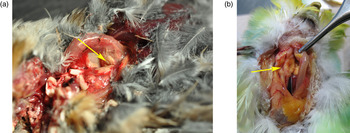
Clinical signs associated with avian trichomonosis are loss of appetite, vomiting, ruffled feathers, diarrhoea, dysphagia, dyspnoea, weight loss, increased thirst, inability to stand or to maintain balance and a pendulous crop (Narcisi et al. Reference Narcisi, Sevoian and Honigberg1991). A greenish fluid or whitish fibrinous material may be accumulating in the mouth and crop as demonstrated in Fig. 1. These materials may also exude from the beak of the infected bird (Stabler, Reference Stabler1947). Death may occur within 3 weeks of infection.
Caseous lesions that can block the lumen of the oesophagus in (a) Budgerigar (Melopsittacus undulatus) and (b) Hawfinch (Coccothraustes, Coccothraustes) that died due to trichomonosis.

Post-mortem investigations could play an important role in the diagnosis of trichomonads, especially T. gallinae due to the pathognomonic lesions characterized by the presence of yellowish soft caseus material in the oropharynx of infected birds. However, T. gallinae infections may be confused with some other pathological conditions that result in similar lesions. For example, infections with avian poxviruses, fungi (Candidida sp., Aspergillus sp.) and nematodes (Capillaria sp.), as well as the presence of sialoliths (salivary stones), a non-specific pharyngeo-esophagitis or Vitamin A deficiency could result in similar oral lesions (Levine, Reference Levine1985). Confusions with pigeon herpesvirus, avian paramyxovirus or fowl adenovirus were demonstrated when trichomonads affect the internal organs, and bacterial infections of the navel might be confused with navel canker caused by T. gallinae (Vogel, Reference Vogel, Heider and Monreal1992). Additionally, trichomonosis could be confused with other infectious diseases that are characterized by granuloma formation such as tuberculosis, mycoplasmosis, salmonellosis and coligranuloma (Friedhoff, Reference Friedhoff1982). In general, trichomonosis should be a differential diagnosis for birds showing regurgitation or upper gastrointestinal abscesses (Park, Reference Park2011). Apart from this, infected birds can also remain asymptomatic due to the infection with avirulent strains of trichomonads or due to a lower susceptibility as seen in older birds. Therefore, diagnosis is established by microscopic examination of samples from infected birds with definite identification of its nucleic acids.
MICROSCOPICAL EXAMINATIONS
Wet mount preparation
Diagnosing trichomonads depends traditionally on direct microscopic observation of motile protozoa via wet mount preparation (i.e. immediate examination of glass slides). Sample material can be obtained via swabbing the cloacae in case of T. gallinarum (Allen, Reference Allen1941) or the oral cavity for T. gallinae (Honigberg, Reference Honigberg and Kreier1978). Trichomonads appear as elongated, oval shapes, which move briskly. The wet mount sample smeared on a glass slide can be stained with Giemsa as demonstrated for T. gallinae (Borji et al. Reference Borji, Razmi, Movassaghi, Moghaddas and Azad2011). However, the sensitivity to detect trichomonads in wet mount preparations is low, especially if the number of parasites in the host is marginal. In this case, inoculation of swabs into a suitable growth medium and their incubation at optimal temperature was shown to be helpful to enrich the number of trichomonads.
Cultivation of trichomonads
Growth medium for the detection of trichomonads has been shown to be more sensitive than wet mount preparations, considering that several investigators reported superior results when both methods were applied (Fouts and Kraus, Reference Fouts and Kraus1980; Cooper and Petty, Reference Cooper and Petty1988; Bunbury et al. Reference Bunbury, Bell, Jones, Greenwood and Hunter2005). Cultivation has been the gold standard for detection of trichomonads as it is easy to interpret and gives valid results, even in poorly infected birds. Trichomonas gallinae grows in a variety of media (Forrester and Foster, Reference Forrester, Foster, Atkinson, Thomas and Hunter2008). Several investigations used InPouch™ TF Kits (BioMed Diagnostics, White City, OR, USA), a commercial product originally developed to culture Tritrichomonas foetus from cattle, which was shown to be very convenient and effective for use in the field (Schulz et al. Reference Schulz, Bermudez and Millspaugh2005; Bunbury et al. Reference Bunbury, Jones, Greenwood and Bell2007; Gerhold et al. Reference Gerhold, Yabsley and Fischer2007b ). Development of a technique to establish clonal cultures of trichomonads raised the standard of cultivation (Hess et al. Reference Hess, Kolbe, Grabensteiner and Prosl2006). Such well-defined cultures were shown to be very useful for detailed characterization of protozoa (Amin et al. Reference Amin, Neubauer, Liebhart, Grabensteiner and Hess2010; Grabensteiner et al. Reference Grabensteiner, Bilic, Kolbe and Hess2010) and they are indispensible for pathogenicity studies (Amin et al. Reference Amin, Liebhart, Weissenbock and Hess2011). However, due to the complexity of the technique, application of clonal cultures in daily routine is still inconvenient.
Minimal nutritional requirements are essential to obtain good growth results of protozoa in vitro. The nutritional requirements and energy metabolism of trichomonads differ from those of the majority of eukaryotic cells. Trichomonad flagellates depend mainly on pre-formed metabolites as nutrients which indicates the absence of essential biosynthetic pathways (Müller, Reference Müller1990). Undoubtedly, there are various factors which may influence the growth behaviour of flagellates in vitro. These issues were fruitfully investigated in the first half of the last century and are reviewed by Stabler (Reference Stabler1954), focusing on media supplements that boost T. gallinae growth. Higher cell counts of well-defined protozoal cultures are obtained in monoxenic cultures in comparison to axenic ones (Tasca and De Carli, Reference Tasca and De Carli2001). In this context it was noticed that clonal cultures of trichomonads grown in Medium 199 develop high populations in the presence of bacteria (Hess et al. Reference Hess, Kolbe, Grabensteiner and Prosl2006). Different media and techniques have been described to obtain axenic cultures, but most of them are rather laborious and time consuming (Diamond, Reference Diamond1957; Kulda et al. Reference Kulda, Suchankova and Svoboda1974). Using different media a standard procedure for axenization of T. gallinarum and T. gallinae was established recently (Amin et al. Reference Amin, Neubauer, Liebhart, Grabensteiner and Hess2010). Under axenic conditions T. gallinarum and T. gallinae grew in modified T. vaginalis (TV) – and Hollander fluid (HF) medium, respectively. The incubation temperature was shown to influence the growth rate of trichomonads (Theodorides, Reference Theodorides1964; Amin et al. Reference Amin, Neubauer, Liebhart, Grabensteiner and Hess2010). Axenically, the most favourable temperature for T. gallinarum was 40 °C with higher cell yields than those observed following incubation at 37 °C. In contrast, the number of live cells recorded for T. gallinae was higher at 37 °C in comparison to 40 °C of incubation (De Carli et al. Reference De Carli, da Silva, Wendorff and Rott1996; De Carli and Tasca, Reference De Carli and Tasca2002; Tasca and De Carli, Reference Tasca and De Carli2003; Amin et al. Reference Amin, Neubauer, Liebhart, Grabensteiner and Hess2010). These findings might reflect the clinical environment of both parasites, either in the pharynx or the caeca of birds. Virulence of T. gallinae was also reported to be influenced by the incubation temperature and the cultivation method (Stabler et al. Reference Stabler, Honigberg and King1964). Consequently, in order to maintain the virulence and high number of protozoal cells after the axenization process, it is essential to keep a certain optimal temperature for incubation of trichomonad cells.
Until recently, there were no data available about aerobic and anaerobic growth conditions of T. gallinarum and T. gallinae following axenization. In this context it needs to be considered that trichomonads are amitochondrial anaerobic protozoa, which gain the required energy by utilizing exogenous and endogenous carbohydrates under both aerobic and anaerobic conditions (Donald and Miklos, Reference Donald and Miklos1973). Recently, Amin et al. (Reference Amin, Neubauer, Liebhart, Grabensteiner and Hess2010) revealed that T. gallinarum and T. gallinae were able to multiply under both aerobic and anaerobic conditions in an axenic environment. Interestingly, the growth of these trichomonads under anaerobic and aerobic conditions was very similar and the addition of antibiotics to the axenic cultures of T. gallinarum and T. gallinae had no adverse effect on the growth. However, adding of antibiotics to the culture medium might lead to in vitro attenuation which was speculated as a consequence of direct interaction of the protozoal nucleic acid with antibiotics (Kirk, Reference Kirk1962; Stabler et al. Reference Stabler, Honigberg and King1964). Therefore, antibiotics should only be used until axenic cultures are established in order to minimize any influence of drugs on the virulence in consecutive studies (Bondurant and Honigberg, Reference Bondurant, Honigberg and Kreier1994).
Several studies showed that prolonged axenic cultivation of virulent T. gallinae strains caused a loss in pathogenicity (Goldman and Honigberg, Reference Goldman and Honigberg1968; Amin et al. Reference Amin, Bilic, Berger and Hess2012a , Reference Amin, Nobauer, Patzl, Berger, Hess and Bilic b ). In that respect, it is important to use cultures with low passages if aspects of virulence are investigated. In general, virulent strains of trichomonads grow faster in vitro than avirulent ones (Bondurant and Honigberg, Reference Bondurant, Honigberg and Kreier1994).
Cell cultures were reported as a sensitive tool to differentiate between strains of different pathogenicity (Honigberg et al. Reference Honigberg, Becker, Livingston and McLure1964). Recently, it has been proven that both LMH and QT35 cells were able to support and enhance the growth of T. gallinarum, an effect even more pronounced for T. gallinae (Amin et al. Reference Amin, Bilic, Berger and Hess2012a ). Obviously, some components of the cells are considered to be necessary nutrients for the protozoa. In agreement with this media from uninfected cells or the media itself did not appear to possess soluble growth factors for trichomonads as mentioned before for T. vaginalis (Peterson and Alderete, Reference Peterson and Alderete1984; Karen et al. Reference Karen, Meysick and Garber1990). In this context, it was demonstrated that the adherence between the parasite and the cells in the culture is helpful for the protozoa to ascertain the delivery of nutrient substances. Additionally, it was confirmed that cell culture matrix as well as special growth media could be used for in vitro cultivation of T. gallinae after axenization (Amin et al. Reference Amin, Neubauer, Liebhart, Grabensteiner and Hess2010, Reference Amin, Bilic, Berger and Hess2012a ).
Staining of trichomonads
In most of the protocols applying staining methods for trichomonads, smears are prepared from cultures. The smears are fixed on slides and treated with different staining methods, such as Giemsa, silver, iron–hematoxylin, Malachite green or methylene blue, Papanicolaou, acridine orange or other stains (Borchardt and Smith, Reference Borchardt and Smith1991; Kaufman et al. Reference Kaufman, Faro and Brown2004). Gram-stained smears were already described by Cree (Reference Cree1968). However, these methods are not of use in routine clinical settings because they are laborious, expensive and dilute the original samples. Furthermore, they might result in false negative result if direct smears are made from birds harbouring only low numbers of parasites (Kaufman et al. Reference Kaufman, Faro and Brown2004). In tissues, the use of haematoxylin and eosin (HE) and Periodic-acid Schiff (PAS) stains was proven to be limited for identification of the flagellates, especially in organs that contained only a few protozoal cells (Amin et al. Reference Amin, Liebhart, Weissenbock and Hess2011).
Detection of trichomonad's nucleic acid
The presence of trichomonads, respectively parasite's DNA, can be detected in oral fluids, in tissue taken from the crop, pharynx or from faeces by polymerase chain reaction (PCR). A variety of primers have been described, most of them targeting ITS1-5.8S rRNA-ITS2 and 18S rRNA regions (Felleisen, Reference Felleisen1997; Delgado-Viscogliosi et al. Reference Delgado-Viscogliosi, Viscogliosi, Gerbod, Kulda, Sogin and Edgcomb2000; Gerbod et al. Reference Gerbod, Sanders, Moriya, Noel, Takasu, Fast, Delgado-Viscogliosi, Ohkuma, Kudo, Capron, Palmer, Keeling and Viscogliosi2004; Cepicka et al. Reference Cepicka, Kutisova, Tachezy, Kulda and Flegr2005; Grabensteiner and Hess, Reference Grabensteiner and Hess2006; Lawson et al. Reference Lawson, Cunningham, Chantrey, Hughes, John, Bunbury, Bell and Tyler2011a ; Malik et al. Reference Malik, Brochu, Bilic, Yuan, Hess, Logsdon and Carlton2011; Noda et al. Reference Noda, Mantini, Meloni, Inoue, Kitade, Viscogliosi and Ohkuma2012). The majority of primers were originally designed to detect all trichomonads, as they were developed for phylogenetic analysis and not for diagnostics. Exceptional to this are primers targeting either the 18S rRNA (Grabensteiner and Hess, Reference Grabensteiner and Hess2006) or the Fe-hydrogenase (Lawson et al. Reference Lawson, Cunningham, Chantrey, Hughes, John, Bunbury, Bell and Tyler2011a ). The 18S rRNA primers developed to detect T. gallinae and T. gallinarum, were succesfully applied in a field study reporting a prevalence of up to 31·8% of trichomonads in German poultry flocks (Hauck et al. Reference Hauck, Balczulat and Hafez2010). The Fe-hydrogenase primers were designed to specifically amplify the Fe-hydrogenase gene of T. gallinae, which was used to support the classification of strains. Recently, this application demonstrated the potential for detecting fine-scale variations amongst T. gallinae strains (Chi et al. Reference Chi, Lawson, Durrant, Beckmann, Alrefaei, Kirkbride, Bell, Cunningham and Tyler2013).
Moreover, in situ hybridization (ISH) for definitive demonstration of the protozoan nucleic acid in paraffin-embedded tissues was applied (Liebhart et al. Reference Liebhart, Weissenbock and Hess2006). Overall, ISH was found to be more sensitive than histochemical staining (such as PAS and HE), especially in tissues showing marginal occurrence of the parasite. The protozoa were clearly detected as dark blue labelled cells following ISH (Amin et al. Reference Amin, Liebhart, Weissenbock and Hess2011). Intact trichomonad cells could be demonstrated in different organs and their location within the tissue could be determined. Moreover, ISH provides the opportunity to correlate the histological changes with the presence of the protozoon, offering the option to investigate the virulence of trichomonads on a cellular level.
Antibody based technique
ELISA has only been used under experimental conditions to detect antibodies against T. gallinarum and T. gallinae in poultry (Amin et al. Reference Amin, Liebhart, Weissenbock and Hess2011). It remains to be determined whether such a technique can be used to obtain a more detailed picture about the presence of trichomonads in poultry. Moreover, it would be interesting to employ serology for screening potential carrier birds because birds that survived an infection with T. gallinae are considered to act as a latent carrier for the parasite over years. Therefore, it is conceivable that these carrier birds might contribute to the persistent spread of the parasite.
GENETIC ANALYSIS OF TRICHOMONADS
Trichomonas gallinae
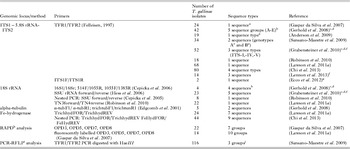
Based on clinical signs the degree of pathogenicity of T. gallinae isolates may vary as mentioned above. To determine the genetic polymorphism among T. gallinae isolates in different bird species, several studies were performed but none focused explicitly on distinguishing pathogenic from non-pathogenic strains (Gaspar da Silva et al. Reference Gaspar da Silva, Barton, Bunbury, Lunness, Bell and Tyler2007; Gerhold et al. Reference Gerhold, Yabsley, Smith, Ostergaard, Mannan, Cann and Fischer2008; Anderson et al. Reference Anderson, Grahn, Van Hoosear and Bondurant2009; Sansano-Maestre et al. Reference Sansano-Maestre, Garijo-Toledo and Gomez-Munoz2009; Grabensteiner et al. Reference Grabensteiner, Bilic, Kolbe and Hess2010; Lawson et al. Reference Lawson, Cunningham, Chantrey, Hughes, John, Bunbury, Bell and Tyler2011a ; Ecco et al. Reference Ecco, Preis, Vilela, Luppi, Malta, Beckstead, Stimmelmayer and Gerhold2012; Stimmelmayr et al. Reference Stimmelmayr, Stefani, Thrall, Landers, Revan, Miller, Beckstead and Gerhold2012; Chi et al. Reference Chi, Lawson, Durrant, Beckmann, Alrefaei, Kirkbride, Bell, Cunningham and Tyler2013; Lennon et al. Reference Lennon, Dunn, Stockdale, Goodman, Morris and Hamer2013). Most of the studies analysed the ITS1-5.8S rRNA-ITS2 region and/or 18S rRNA sequences, with exception of two studies, which additionally used either α-tubulin (Gerhold et al. Reference Gerhold, Yabsley, Smith, Ostergaard, Mannan, Cann and Fischer2008) or Fe-hydrogenase gene sequences (Lawson et al. Reference Lawson, Cunningham, Chantrey, Hughes, John, Bunbury, Bell and Tyler2011a ) (Table 1). Some studies observed only minor or no sequence variations between T. gallinae isolates, even though they analysed different bird species from various geographic regions including pink pigeons (Columba mayeri) and Madagascar turtle-doves (Streptopelia picturata) from the island of Mauritius (Gaspar da Silva et al. Reference Gaspar da Silva, Barton, Bunbury, Lunness, Bell and Tyler2007), domestic pigeons and birds of prey from the east part of the Iberian Peninsula, Spain (Sansano-Maestre et al. Reference Sansano-Maestre, Garijo-Toledo and Gomez-Munoz2009) or different passerines, columbids and raptors from the UK (Lawson et al. Reference Lawson, Cunningham, Chantrey, Hughes, John, Bunbury, Bell and Tyler2011a ; Chi et al. Reference Chi, Lawson, Durrant, Beckmann, Alrefaei, Kirkbride, Bell, Cunningham and Tyler2013). Furthermore, the ITS1-5.8S rRNA-ITS2 sequences reported in these studies were identical to either one or to both previously reported isolates: T. gallinae strain G7 (GenBank Accession No.AY349182) (Kleina et al. Reference Kleina, Bettim-Bandinelli, Bonatto, Benchimol and Bogo2004) and T. gallinae strain TG (GenBank Accession No U86616) described by Felleisen (Reference Felleisen1997). In order to further investigate the degree of variation among such isolates some studies applied methods like random amplified polymorphic DNA analysis (RAPD) or PCR restriction fragment length polymorphism analysis (PCR-RFLP) (Table 1) (Gaspar da Silva et al. Reference Gaspar da Silva, Barton, Bunbury, Lunness, Bell and Tyler2007; Sansano-Maestre et al. Reference Sansano-Maestre, Garijo-Toledo and Gomez-Munoz2009; Lawson et al. Reference Lawson, Cunningham, Chantrey, Hughes, John, Bunbury, Bell and Tyler2011a ). However, these methods just confirmed the data obtained by sequence analysis of the ITS1-5.8S rRNA-ITS2 locus. Interestingly, Sansano-Maestre et al. (Reference Sansano-Maestre, Garijo-Toledo and Gomez-Munoz2009) reported a prevalence of T. gallinae isolates with identical sequence to T. gallinae strain TG (U86614) in columbiformes, whereas isolates with identical sequence to T. gallinae strain G7 (AY349182) were more often found in raptors and all birds that displayed macroscopic lesions. A study analysing T. gallinae isolates causing massive mortality of British passerines demonstrated the presence of a single strain in all deceased birds (Lawson et al. Reference Lawson, Cunningham, Chantrey, Hughes, John, Bunbury, Bell and Tyler2011a ). This strain was shown to possess the ITS1-5.8S rRNA-ITS2 sequence identical to a T. gallinae G7 strain (AY349182) (Robinson et al. Reference Robinson, Lawson, Toms, Peck, Kirkwood, Chantrey, Clatworthy, Evans, Hughes, Hutchinson, John, Pennycott, Perkins, Rowley, Simpson, Tyler and Cunningham2010). Just recently, studies of Chi et al. (Reference Chi, Lawson, Durrant, Beckmann, Alrefaei, Kirkbride, Bell, Cunningham and Tyler2013) and Ganas (pers. communication) demonstrated that by additionally analysing the Fe-hydrogenase locus finer-scale genetic variations could be detected in isolates displaying identical ITS1-5.8S rRNA-ITS2 sequence, arguing for detailed analysis of different loci.
Molecular typing of Trichomonas gallinae isolates

a Sequence is identical to AY349182 (T. gallinae G7).
b Sequence groups C to E have identical sequence, but their length varies.
c The study also reports Trichomonas spp. sequences.
d The study additionally reports Trichomonas spp. sequences closely related to Trichomonas vaginalis.
e Sequence is identical to U86614 (T. gallinae TG).
f The study additionally reports Trichomonas spp. sequence that closely related to Trichomonas tenax.
g The study additionally reports Simplicimonas spp.- and T. vaginalis-like sequences.
h RAPD analysis = random amplified polymorphic DNA analysis.
i PCR-RFLP analysis = PCR restriction fragment length polymorphism analysis.
j One group was interpreted as mix of other two, i.e. that affected birds were infected with both genotypes.
New light was shed by several studies (Gerhold et al. Reference Gerhold, Yabsley, Smith, Ostergaard, Mannan, Cann and Fischer2008; Anderson et al. Reference Anderson, Grahn, Van Hoosear and Bondurant2009; Grabensteiner et al. Reference Grabensteiner, Bilic, Kolbe and Hess2010; Ecco et al. Reference Ecco, Preis, Vilela, Luppi, Malta, Beckstead, Stimmelmayer and Gerhold2012; Stimmelmayr et al. Reference Stimmelmayr, Stefani, Thrall, Landers, Revan, Miller, Beckstead and Gerhold2012) reporting greater genetic diversity among T. gallinae isolates. Two studies (Gerhold et al. Reference Gerhold, Yabsley, Smith, Ostergaard, Mannan, Cann and Fischer2008; Grabensteiner et al. Reference Grabensteiner, Bilic, Kolbe and Hess2010) reported many different sequence groups/types, but used different nomenclature in labelling of these groups. Additional confusion is given by the fact that some sequence groups (assigned as C to E) reported by Gerhold et al. (Reference Gerhold, Yabsley, Smith, Ostergaard, Mannan, Cann and Fischer2008) have identical sequence but differ slightly in their length.
The study of Anderson et al. (Reference Anderson, Grahn, Van Hoosear and Bondurant2009) described a new flagellate isolated from M. polyglottos (EU290650) which was genetically distinct from all previously sequenced trichomonads and resembled more the sequences from tetratrichomonads. Three other studies (Gerhold et al. Reference Gerhold, Yabsley, Smith, Ostergaard, Mannan, Cann and Fischer2008; Grabensteiner et al. Reference Grabensteiner, Bilic, Kolbe and Hess2010; Ecco et al. Reference Ecco, Preis, Vilela, Luppi, Malta, Beckstead, Stimmelmayer and Gerhold2012), showed that some isolates were more related to the human parasite T. vaginalis than to other isolates of T. gallinae. Furthermore, in different studies flagellates were detected and defined as Trichomonas-like parabasalids as they did not group to any defined strain from the genus Trichomonas (Gerhold et al. Reference Gerhold, Yabsley, Smith, Ostergaard, Mannan, Cann and Fischer2008; Grabensteiner et al. Reference Grabensteiner, Bilic, Kolbe and Hess2010; Stimmelmayr et al. Reference Stimmelmayr, Stefani, Thrall, Landers, Revan, Miller, Beckstead and Gerhold2012). Grabensteiner et al. (Reference Grabensteiner, Bilic, Kolbe and Hess2010) and recently Lennon et al. (Reference Lennon, Dunn, Stockdale, Goodman, Morris and Hamer2013) identified an isolate that showed the highest relationship to the human parasite Trichomonas tenax. Both studies also showed a closer relationship of T. tenax to T. gallinae than to the human parasite T. vaginalis, an observation already reported by Kleina et al. (Reference Kleina, Bettim-Bandinelli, Bonatto, Benchimol and Bogo2004). It remains speculative whether the close relationship between T. gallinae and T. tenax emerges from the fact that both are implicated in the infections of the upper digestive tract. In contrast to all studies, Grabensteiner et al. (Reference Grabensteiner, Bilic, Kolbe and Hess2010) employed clonal cultures of isolated trichomonads and by doing this it was possible to demonstrate the co-existence of diverse strains within a single bird.
Tetratrichomonas gallinarum
Genetic analysis of T. gallinarum isolates demonstrated a complexity that goes beyond the usual intraspecific polymorphism generally seen in trichomonad genera of Trichomonas, Tritrichomonas and Tetratrichomonas (Cepicka et al. Reference Cepicka, Kutisova, Tachezy, Kulda and Flegr2005). In their study, Cepicka et al (Reference Cepicka, Kutisova, Tachezy, Kulda and Flegr2005) applied two methods: sequence analysis of 18S rRNA and ITS1-5.8S rRNA-ITS2 and random amplified polymorphic DNA (RAPD) analysis, for analysing isolates obtained from different bird species and humans. The authors report the separation of T. gallinarum isolates into five groups (A–E) and 11 subgroups (A1, A2, B1, B2, B3, C1, C2, C3, D1, D2 and E), that, according to the extensive polymorphism, might represent at least three different species: groups A-C, D and E. Hence, these results could be considered as an explanation for controversies on pathogenicity of T. gallinarum observed in different reports, even though our initial studies with genetically different isolates did not point in this direction (Amin et al. Reference Amin, Bilic, Berger and Hess2012a ). Finally, as phylogenetic analysis revealed a close relationship of some human with avian T. gallinarum isolates a zoonotic potential of these parasites should be considered.
TREATMENT OF AVIAN TRICHOMONOSIS
The first specific chemotherapeutic agents against trichomonads were tested and approved more than 50 years ago. Some drug compounds have been administered either in drinking water or applied topically to the bird's mouth and throat. A certain degree of success has been achieved by using compounds such as acriflavine, weak hydrochloric acid and copper sulphate (Rosenwald, Reference Rosenwald1944; Jaquette, Reference Jaquette1948). Effective antibiotic therapy was reported once in the case of avian trichomonosis, despite the fact that this is not a typical procedure for treatment (Hamilton and Stabler, Reference Hamilton and Stabler1953). Furthermore, after several treatments of a diseased gyrfalcon with broad-spectrum antibiotics (Aureomycin) numerous sites of active infection with Aspergillus fumigatus, in addition to canker, were noticed. It was suggested that the antibiotics may cause activation of latent fungal infections and possibly latent trichomonosis. Therefore, applying certain antibiotics to treat trichomonosis might even be unfavourable.
Various nitroimidazoles, including metronidazole, dimetridazole, ronidazole and carnidazole have been considered the standard treatment for avian as well as for human trichomonosis (Franssen and Lumeij, Reference Franssen and Lumeij1992; Kulda, Reference Kulda1999). However, even after successful treatment captive pigeons can often carry the parasite for a long time. In order to prevent economic losses nitroimidazole drugs are routinely administered to racing pigeons in subtherapeutic doses. This prolonged exposure to nitroimidazole creates the environment for developing resistance to these compounds, as shown for related trichomonads, T. vaginalis and T. foetus (Kulda et al. Reference Kulda, Cerkasov, Demes and Cerkasovova1984, Reference Kulda, Tachezy and Cerkasovova1993). Indeed, in the past, several investigations reported the resistance to nitroimidazole derivates of T. gallinae isolates from pigeons (Lumeij and Zwijnenberg, Reference Lumeij and Zwijnenberg1990; Franssen and Lumeij, Reference Franssen and Lumeij1992; Munoz et al. Reference Munoz, Castella and Gutierrez1998). A recent study with different T. gallinae clonal cultures obtained from budgerigars and racing pigeons reported significantly different minimal lethal concentrations (MLCs) against four 5-nitroimidazoles (Zimre-Grabensteiner et al. Reference Zimre-Grabensteiner, Arshad, Amin and Hess2011). Variations in sensitivities of two genetically different isolates obtained from the same bird were reported, indicating a correlation between in vitro results and genetic relationship (Grabensteiner et al. Reference Grabensteiner, Bilic, Kolbe and Hess2010; Zimre-Grabensteiner et al. Reference Zimre-Grabensteiner, Arshad, Amin and Hess2011). Correlation between in vitro and in vivo resistance of one Trichomonas strain could be demonstrated, underlining the benefit of in vitro tests to investigate treatment failures.
In wild birds, treatment is much more problematic and generally not considered an option due to the way of application (Cole and Friend, Reference Cole, Friend, Friend and Franson1999). In the case of medicated food supplied on bird feeders, medication is based on an estimated food intake of a normal bird per day. However, as birds might not feed only on a single feeder the uptake of a drug could be suboptimal which might lead to resistance development of target T. gallinae strains (Munoz et al. Reference Munoz, Castella and Gutierrez1998). Apart from the potential of developing resistant T. gallinae strains, implementation of medicated feed could cause harmful effects in non-target bird species. Reece et al. (Reference Reece, Barr, Forsyth and Scott1985) already demonstrated that dimetridazole can be toxic to birds. Indeed, the incidence of population decline of non-target birds was documented for Red-legged Partridges (Alectoris rufa), whose population of chicks and adults decreased in the area where T. gallinae outbreak in woodpigeons (C. palumbus) was treated with dimetridazole via game bird feeders (Höfle et al. Reference Höfle, Gortazar, Ortíz, Knispel and Kaleta2004). In contrast to this, metronidazole derivates, dimetridazole and ronidazole, were used to treat trichomonosis with limited success in one subpopulation of wild pink pigeons (C. mayeri) (Swinnerton et al. Reference Swinnerton, Greenwood, Chapman and Jones2005).
Conclusively, future measurements to prevent T. gallinae outbreaks in wild as well as in captive birds should concentrate on actions to reduce sources of infection as already outlined by Forrester and Foster (Reference Forrester, Foster, Atkinson, Thomas and Hunter2008). The major aim would be to prevent attracting birds to feeding places if not necessary. In any case such places should fulfil minimum requirements with regard to sanitary conditions, like changing of food regularly and disinfection of food places.
CONCLUSIONS AND PERSPECTIVES
Amongst the trichomonadidae the flagellate T. gallinae is the most important parasite in birds due to its worldwide distribution and pathogenicity, mainly in Columbiformes, Falconiformes and Strigiformes whereas other trichomonads are of limited significance. With the appearance of more severe cases in wild birds in recent years the disease has gained further attention. Epidemiological studies with detailed molecular characterization of the parasites will be of high importance in future studies in order to track more precisely individual strains or clones of T. gallinae. This will also shed new light on a possible zoonotic character of trichomonads in general originating from birds. The genetic heterogeneity of isolates causing avian trichomonosis indicates that even though in the past all infections were solely attributed to T. gallinae they might have been caused by species more closely related to T. vaginalis or T. tenax. These observations signify a necessity to implement standardized molecular methods in routine diagnostics. Recent data strengthen the requirement for implementing several genomic loci in typing T. gallinae isolates. Ultimately, new developments should concentrate on determining loci that would give strain variation data as well the information on strain's pathogenicity.
A panel of in vitro and in vivo studies should be applied in future studies to characterize the biology of isolates, including drug sensitivity and host response. Easier systems and models need to be developed in order to gain more principal data about virulence factors and host-pathogen interactions. New technologies such as genomics and proteomics should be applied to resolve genome structures and protein profiles of avian trichomonads. Elucidating the pathogenesis and virulence factors of these parasites will enforce the development of new protection strategies, which is needed considering data about resistance of flagellates against actual treatments. However, the fact that trichomonosis is restricted to certain bird species with its limited economic market may pose a certain hindrance for new developments.