Procurement has an important role in healthcare decision making, with a deep and wide impact. Significant healthcare expenditures flow through procurement offices. Medical technologies alone are estimated to contribute 3–4 percent of healthcare expenditures (Reference Graves1), and may account for as much as 31 percent of total hospital costs per case in the United States (Reference Montgomery2), or approximately 13 percent of total hospital spending in Canada (Reference Arshoff, Henshall and Juzwishin3). Yet, how healthcare systems buy things affects more than budgets. It also affects which technologies will be made available to patients, and which suppliers and business practices will prove successful, with implications for patient outcomes and innovation opportunities (Reference Kastanioti, Kontodimopoulos and Stasinopoulos4;Reference Meehan, Menzies and Michaelides5).
The significance of procurement's role has encouraged increased scrutiny, with growing calls for “evidence-based” and “value-based” approaches and for greater collaboration with health technology assessment (HTA) (Reference Arshoff, Henshall and Juzwishin3;Reference Meehan, Menzies and Michaelides5–Reference Trippoli, Caccese and Marinai10). Yet, procurement's decision-making approach is not well understood by HTA practitioners and other proponents of evidence-based decision making.
Procurement practices in publicly funded health systems have been deeply influenced by regulatory requirements and cost reduction pressures in recent decades. Requirements for open competitive buying processes in the public sector in countries such as Canada and across Europe (Reference Arrowsmith, Linarelli and Wallace11;Reference Lian and Laing12) necessitate the use of highly formalized processes, with publicly posted tender documents that pre-specify evaluative criteria and rubrics for needed products, which are then applied in the assessment of submitted bids leading to contracts with the winning supplier(s) (Reference Sorenson and Kanavos7;Reference Lian and Laing12;13).
Policy pressure to reduce costs means that these competitive buying processes are increasingly pursued through pooled procurement strategies and managed by group purchasing organizations (GPOs) rather than individual healthcare delivery organizations or units (Reference Arshoff, Henshall and Juzwishin3;Reference Sorenson and Kanavos7;Reference Nollet and Beaulieu14). In turn, such developments have altered the role of clinicians, who traditionally played a central role in the selection of supplies, especially for “physician preference items” in sub-specialty areas such as orthopedics or cardiology (Reference Montgomery2;Reference Robinson8). Sometimes-conflicted arrangements between suppliers and clinicians have been challenged, and financial benefits, termed “value-adds,” whereby vendors support clinical training or research as part of a contract for goods, have been minimized or formalized (Reference Leather, Gardner and Green15).
These developments have led to growing complaints. Procurement processes have been criticized as overly technical, rigid, and price focused, failing to adequately assess benefits or economic value, and limiting the adoption of unanticipated products or innovations that offer additional benefits, whether clinical and economic (e.g., system-wide clinical benefits or cost reductions), or environmental and social (e.g., to reduce carbon emissions or avoid child labor and modern slavery) (Reference Graves1;Reference Arshoff, Henshall and Juzwishin3;Reference Meehan, Menzies and Michaelides5;Reference Sorenson and Kanavos7;Reference Poder9). As well, the pooling of procurement for large parts of a country or over long periods of time among a small number of suppliers has been criticized as “all or nothing purchasing,” creating challenges for the reliability of supply as well as costs over time (Reference Graves1;Reference Meehan, Menzies and Michaelides5) and exacerbating the difficulties faced by small- and medium-size enterprises (SMEs) in bidding for public sector contracts (Reference Karjalainen and Kemppainen16). Finally, there is concern that clinicians have become too detached from formalized purchasing processes, such that their product needs are insufficiently addressed (Reference Sorenson and Kanavos7;Reference Garfield and Zack17;Reference Lingg, Merida-Herrera and Wyss18).
Such complaints have been particularly acute for medical technologies. This arises because of pressures associated with high cost, high technology products for which physicians have preferences, and which constitute a large and rising proportion of hospital supply costs (Reference Montgomery2;Reference Sorenson and Kanavos7;Reference Robinson8). Cost pressures can also lead to lowest price procurement for many “low” technology products, such as consumables (e.g., medical gauze, sterile gloves, surgical instruments), with implications for product quality and the social and environmental conditions of production. Interest arises also due to the influence of procurement on medical device innovation, and the role of SMEs in device development (Reference Sorenson and Kanavos7).
Thus, we sought to analyze how procurement organizations assess the value of medical technologies: how products are solicited and evaluated, who is buying, and how buying practices structure opportunities for suppliers. We focused on Canada, where the provinces that administer the country's publicly-funded health systems require or encourage hospitals and health authorities to use GPOs, even as federal and provincial task forces and think tanks increasingly call for attention to innovation and “value-based” procurement (Reference Arshoff, Henshall and Juzwishin3;Reference Poder9).
Methods
We conducted a review of tender documents to solicit medical technologies for patient care in Canada, focusing on the request for proposal (RFP) tender type, where price is not expected to be determinative and factors such as product quality, service and company reputation are taken into account (Reference Bröchner, Camén and Eriksson19). We drew on templates and toolkits developed by Canada's healthcare procurement professional association to inform data collection and analysis (13).
We identified RFPs from tenders posted on six major tender portals that capture the majority of Canadian bidding activity: two privately run sites (Biddingo, Merx) and four provincially run sites: Ontario Tender's Portal, BC Bid, Alberta Purchasing Connection and Quebec's Le système électronique d'appel d'offres (SEAO).
We used bidding sites' own classification schemes to screen RFPs for medical technologies, specifically medical equipment (durable technologies such as imaging devices, ultrasound units, ventilators, interventional cardiology devices) and medical supplies (nondurable and consumable supplies such as sutures, tubing, tongue depressors). We included only tenders from healthcare delivery organizations or their buying agents, and excluded RFPs exclusively focused on research or services. We aimed to collect 100 RFPs, to create a large and informative dataset (25 from Quebec in French; 75 from the rest of Canada in English). We reviewed the bidding sites at regular intervals between January and December 2015, and collected a convenience sample of eligible RFPs as they were posted.
We collected and reviewed tender documentation, focusing data extraction on relevant sections and discussions. To address questions about how products were solicited and evaluated, we collected information on evaluation criteria and rubrics. In Canada, RFPs typically outline three sets of requirements that suppliers wishing to sell their products should meet, which are each to be evaluated separately (13). The first requirements are mandatory, usually structured as simple pass/fail judgments regarding the bid's eligibility for further review. We focused on the next two sets of substantive requirements, which are usually separated into two “envelopes”: technical and quality-relevant criteria in envelope 1 and financial criteria in envelope 2. We identified all evaluation criteria and also searched for mention of expectations related to environmental or social sustainability. Finally, we collected scoring information, such as weight placed on each criterion and approach taken to aggregate these scores.
To gain information about buyers, we collected information on the name and type of organization that issued the RFP, including individual healthcare delivery organizations and GPOs (single province or national); as a secondary analysis, we applied the GPO/ non-GPO distinction to cost-relevant variables. To address questions about who was being bought from, we collected information about the terms and conditions under which a contract would ultimately be signed with successful bidder(s), that is, how many companies would be expected to supply the needed products, and the length and potential for extensions of these contracts.
Finally, to gain insight into the prevalence of RFPs relative to other tender types in medical technology purchasing, we conducted a census of tenders posted on the same six bidding sites over a period of 10 weeks in summer 2015. We used established product categories to filter results and reviewed tender titles and posting organization name to limit the results to medical equipment and supplies for healthcare provision (as for the RFP review). We only collected data posted on the bidding sites (i.e., tendering organization, type of tender) rather than tender documentation and thus only included tenders where tender type was identifiable on the bidding site.
Findings
The RFP review identified ninety-seven eligible RFPs and the census of tenders identified 226 eligible tenders (Table 1).
Cross-Country Distribution of RFPs and Tenders

*The number of Quebec RFPs was pre-determined.
GPO, group purchasing organization; PEI, Prince Edward Island; RFP, request for proposal.
Who is Buying
Among RFPs, GPOs were the majority buyers (n = 54; 55.7 percent), although individual healthcare delivery organizations were frequent buyers (n = 43; 44.3 percent). Similarly, in the census of tenders, GPOs were the majority buyer (n = 120; 53.1 percent), with individual healthcare delivery organizations as frequent buyers (n = 106; 46.9 percent).
How Are They Buying
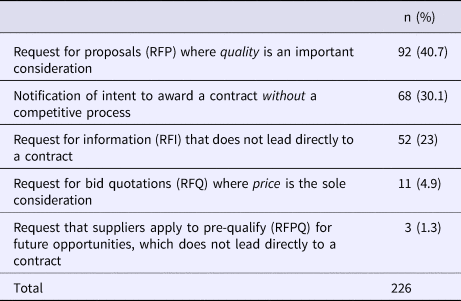
According to the census of tenders, RFPs were the most common tender type (n = 92; 40.7 percent), and Request for bid Quotations (RFQ), where price is the only consideration, were rare (n = 11; 4.9 percent) (Table 2).
Tender Types

RFP Evaluation Criteria
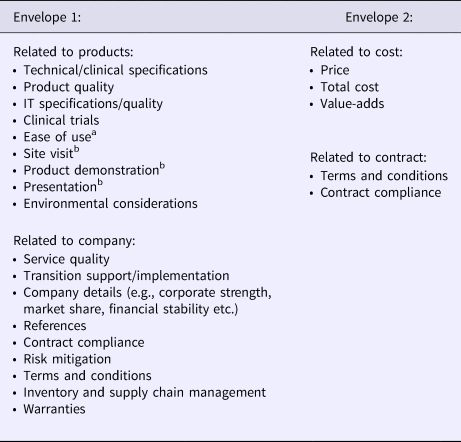
All RFPs used a “two envelope” structure, with detailed evaluation criteria for each envelope (Table 3).
Examples of Envelope 1 and Envelope 2 Criteria

a Ease of use is a common envelope 1 criteria for Quebec RFPs, but rarely seen in English RFPs.
bThese criteria allow assessment of product quality but may also allow assessment of vendor quality.
In envelope 1, criteria were of two types, relating to the (i) product being sold and (ii) vendor selling the product. Product-relevant criteria, such as technical or clinical specifications or quality (e.g., product size, material type, strength, or durability), were to be detailed in written form. As well, RFPs often included criteria that allowed product quality to be assessed by viewing or handling the product, termed clinical trials, site visits, or product demonstrations. Vendor-relevant criteria included documented evidence of vendor experience and qualifications; ability to meet technical, functional, and delivery requirements; and service levels and quality assurance.
Environmental considerations, such as requests for the supplier to disclose environmental impact or re-usability of any products supplied, were mentioned in a small majority of RFPs (n = 54; 55.7 percent); of these, half (27/54, 50 percent) included environmental considerations as evaluated criteria. Social policy considerations were frequently (n = 66; 68 percent) mentioned in RFPs, seeking assurances that the supplier would comply with jurisdiction-specific occupational health and safety legislation, or with legislation related to human rights, citizenship, and multiculturalism, accessibility for persons with disabilities or would provide employment insurance; these were never included as evaluated criteria.
Envelope 2 contained financial criteria of two types, relating to (i) the contract to be signed for delivery of goods, such as supplier compliance with pre-specified contract terms or conditions, and (ii) costs. “Total cost” was commonly referenced (n = 83) but inconsistently used. Where a weighted criterion (i.e., not including Quebec RFPs, which used a K-factor strategy, detailed below), “total cost” was the most commonly referenced cost criterion (n = 53/72; 73.6 percent). A further fifteen RFPs (20.8 percent) explicitly weighted price, two weighted envelope 1 at 100 percent, and two did not specify whether price or total cost comprised the cost criterion. GPOs weighted total costs (70 percent) to a comparable extent as non-GPOs (81.8 percent).
Definitions of total cost were limited and did not extend across the lifecycle or include cost savings or other benefits. Total cost was defined vaguely (e.g., “Pricing should consist of the total cost for the duration of the contract”) or explained through lists of each type of cost to include. Such lists included some of the following: (i) potentially hidden up-front costs, such as custom duties, taxes or delivery costs; (ii) transition costs, such as costs of installation, conversion, implementation and training; or (iii) use costs, such as accessories, consumables and service (pre- and post-warranty) or maintenance.
Finally, in a minority of RFPs (n = 33; 34 percent), “value-adds” were included as an evaluated cost component; 51.8 percent of GPOs included evaluated value-adds, while only 11.6 percent of non-GPOs did so. In a further eight RFPs, they were accepted but not scored and in three they were expressly disallowed. Among the thirty-three RFPs that scored them, multiple value-adds were typically requested, with the most common related to clinical training or education (n = 28; 84.8 percent) and the next most common for research funding (n = 23; 69.7 percent); nine tenders (27.3 percent) used value-adds to solicit innovative or enhanced product or service solutions (seven GPOs; two non-GPOs).
RFP Evaluation Rubrics
We identified three main approaches to scoring bids. The most common, in forty-seven RFPs (48.5 percent), was a simple summative rubric. A total score of 100 (or variant) was specified, with set percentages allocated to envelope 1 and envelope 2. Among these forty-seven RFPs, the mean weight assigned to envelope 1 was 64.1 percent (SD 11.99; range 15–87.5).
A second strategy varied slightly from the first by requiring a mandatory minimum score for one or both envelopes, followed by an overall summative score. Minimum scores were specified in twenty-two (22.7 percent) RFPs, of which twelve required minimum scores for the envelope 1 criteria, nine required minimum scores for both envelopes and one required minimum scores for envelope 2. In these twenty-two RFPs, the mean weight assigned to envelope 1 was 62.9 percent (SD 7.89; range 45–80). Among the buyers using either of these two strategies (n = 69), GPOs used the simple summative rubric more (74.5 percent) than non-GPOs (54.5 percent).
The third strategy was specific to Quebec, where public procurement law permits the use of a quality adjustment mechanism termed the “K-factor” (K = 15, 20, or 30), which selects the lowest cost bid as the winning supplier, where this cost has been adjusted for quality (Reference Karjalainen and Kemppainen16). The quality rating (envelope 1) encompasses a minimum of three criteria, each of which must achieve a minimum “acceptable level of performance,” set at 70 percent. The formula for calculating adjusted price also requires a minimum of 70 percent for the final quality rating:
 $$\hbox{Adjusted price} = \hbox{Bid price/Quality adjustment factor}$$
 $$\hbox{Quality adjustment factor} = 1 + {\rm K}^{\ast} ( \hbox{Final quality rating} - 70 )/30$$
Of the twenty-five Quebec RFPs reviewed, twenty-four indicated their intent to use a K-factor, although only twenty-two listed the specific K-factor. Of these twenty-two, the K-factor was most often 30.0 percent (fifteen cases); in four cases, the K-factor was 15 percent and in three cases it was 20 percent. GPOs used the 20 percent K-factor, while non-GPOs used the 15 or 30 percent K-factors.
Four RFPs did not align with any of these methods. Of these, two placed the full weight on envelope 1 criteria and did not allocate a score to envelope 2, but specified that the total cost of ownership would be assessed and, if deemed unreasonably high, the supplier might be disqualified or would have a value adjustment applied (GPO). As well, one RFP set a minimum score for the quality criteria then selected the lowest cost bid (non-GPO), and one RFP provided insufficient information to identify the evaluation strategy (non-GPO).
Who Are They Buying from
RFP Contract Terms
Most RFPs (n = 77; 79.4 percent) specified the expected length of the contract to be negotiated with the successful supplier(s). The base length of the contracts ranged from 1 to 10 years (mean, 3.93 years; SD 1.71). Most commonly, the base length was 3 (thirty-three RFPs) or 5 years (twenty-six RFPs).
Most RFPs that specified a contract length also specified renewal options, ranging from 1 to 8 years, generally on an annual basis. The average maximum renewal time was 2.14 years (SD 1.21). Most commonly, the maximum extension length was 2 (forty-eight RFPs) or 3 years (ten RFPs).
Most RFPs (n = 95; 97.9 percent) indicated the buyer's intention to award to single or multiple suppliers, although the majority of these (n = 54; 56.9 percent) were to be awarded to either single or multiple suppliers at the buyer's discretion. Where specified (n = 41), most (n = 36; 87.8 percent) were to be awarded to a single supplier, while only a small minority (n = 5; 12.2 percent) were to be awarded to multiple suppliers.
Discussion
Through a review of tender documents to solicit products for patient care in Canada, we provide a comprehensive overview of the way in which procurement judges the value of medical technologies, including how products are solicited and evaluated, who buys them and how contract terms structure opportunities for vendors. Our findings reflect international developments in health system procurement, including regulatory requirements for the public sector that oblige open competitive tendering (e.g., EU Public Procurement Directives), as well as cost control expectations that have encouraged the growth of pooled procurement practices and the rise of GPOs (Reference Arshoff, Henshall and Juzwishin3–Reference Meehan, Menzies and Michaelides5;Reference Sorenson and Kanavos7;Reference Arrowsmith, Linarelli and Wallace11;Reference Lian and Laing12;Reference Nollet and Beaulieu14). In our dataset, a small majority of tenders were managed by GPOs, with their emphasis on cost reduction through pooling purchases across multiple hospitals and health authorities, although there was also a sizeable role for individual healthcare organizations in soliciting products to address specific needs.
This study provides insight into how procurement's decision-making process navigates clinical requirements, cost reduction expectations and innovation opportunities.(Reference Montgomery2;Reference Sorenson and Kanavos7;Reference Robinson8;Reference Lingg, Merida-Herrera and Wyss18). Perhaps unexpectedly, our results suggest that this is not an approach dominated by price. The RFP tender type, which aims to account for quality factors beyond price (Reference Thokala, Devlin and Marsh20), was most common, and tenders that solicit bids solely on the basis of price were rare. As well, among RFPs, quality criteria were weighted more heavily than financial criteria, with minimum standards for quality common in evaluative rubrics, including where “lowest cost” was the determining factor.
Furthermore, while GPOs have a clear role in pooling purchases and reducing costs, the RFPs they issued were not notable for an emphasis on price. Differences between GPO and non-GPO RFPs were apparent for some cost-relevant variables but not for others: GPOs emphasized the simple summative rubric rather than a rubric with minimum scores but weighted “total cost” as much as non-GPOs. As well, other differences, such as the greater use by GPOs of explicit value-adds, including those incenting innovation in service delivery, may have more to do with their greater professional capacity to standardize and coordinate practice than their evaluative judgment (Reference Meehan, Menzies and Michaelides5).
Notwithstanding buyer type, there were elements of the decision-making approach that are consistent with criticism raised in North American and European contexts alike (Reference Graves1;Reference Arshoff, Henshall and Juzwishin3;Reference Meehan, Menzies and Michaelides5;Reference Sorenson and Kanavos7;Reference Trippoli, Caccese and Marinai10). In particular, although there was a clear emphasis on total costs as the key financial criterion, definitions of total cost were minimalist, excluding many costs that accrue across the life cycle of a product and any costs (or savings) that accrue where products offer different benefits, and which may occur across different budget lines within healthcare organizations or across different health system sectors.
Procurement's decision-making process aims to solicit specific types of products, and only rarely to create opportunities for innovative or unanticipated product offerings. While we identified a small number of tenders that used value-adds to encourage innovation or proposed an evaluative rubric that placed full weight on quality, the dominant approach was designed for acquisition of the familiar, in line with specific clinical and organizational requirements. Evaluation criteria, collected together so that users and related experts may assess them, anticipate highly technical variation among products, related to materials, compatibility with existing information technology or physical infrastructure, ease of use and technical performance. Criteria also account for vendor characteristics, such as service quality, transition support, inventory management, and the company's financial stability. Whether these criteria adequately reflect clinical needs is unknown, but the process does reflect regularized relations between clinicians and vendors, particularly by GPOs (Reference Montgomery2;Reference Robinson8), with only a third including traditional types of value-adds related to clinical education or research.
Finally, our study provides some insight into how buying processes might affect who is being bought from (Reference Meehan, Menzies and Michaelides5;Reference Sorenson and Kanavos7). Most contract terms, with their emphasis on limited numbers of suppliers and long contracts, suggest an emphasis on large suppliers, as is also apparent in the emphasis among evaluated criteria on issues such as corporate strength, market share and financial stability. Ironically, while these evaluated criteria indicate consideration of some important risks to the security of the healthcare supply chain, the preponderance of “all or nothing” contract terms may work to reduce supply reliability in the long term, even as it reduces opportunities for smaller suppliers to be successful (Reference Graves1;Reference Meehan, Menzies and Michaelides5;Reference Karjalainen and Kemppainen16).
Procurement's evaluative approach is only partially comparable to the applied policy analytic methodologies used in HTA and healthcare priority setting. The approach appears, in some respects, to be less developed, with reliance on clinical judgments of quality rather than strength or quality of evidence and a narrow interpretation of costs. On the other hand, there are areas of emerging similarity; for example, procurement's approach to structuring the decision problem and weighing and aggregating scores is akin to the multi-criteria decision analytic approaches that are receiving increased attention in healthcare decision-making, including in HTA (Reference Thokala, Devlin and Marsh20;Reference Marsh, Ijzerman and Thokala21). As well, procurement's approach attends to issues that hold increased interest for HTA practitioners, such as implementation-relevant considerations (e.g., transition support or costs) (Reference Lehoux and Williams-Jones22) and environmental impacts (Reference Marsh, Ganz and Hsu23).
While HTA and procurement may, in theory, have complementary roles in “managing the introduction and diffusion of MDs [medical devices] in an effort to find an appropriate balance between patient access to innovation and cost containment,” (Reference Callea, Armeni and Marsilio6) this is not necessarily true in practice. Differences between procurement and HTA reflect the specific decision-making tasks that each institution routinely faces. Procurement's role is typically expansive and authoritative: to acquire the supplies and equipment healthcare facilities need to function on a daily basis, while addressing clinical needs for quality and policy expectations for cost control and regulatory compliance. HTA, by contrast, often has a more reduced role, informing coverage decisions for a subset of novel, often-expensive technologies. Thus, while there may be lessons for procurement from HTA, there may also be lessons for HTA from procurement, especially if HTA aims to go beyond its “addiction to adoption,” (Reference Bryan, Mitton and Donaldson24) and inform the routine management and optimization of health technologies.
Limitations
This study faces several limitations. First, our search identified tender activity, not quantity or volume of products sought, which cannot readily be identified or aggregated from tender documentation. Second, the dataset may not be representative of the population of relevant tenders across the country; we generated a convenience sample, relied on six main tender portals, used bidding sites' own classification schemes to screen for eligible tenders, and the timing of our searches may not be reflective of year-round activity. Finally, while medical technologies differ considerably, it proved infeasible to clearly differentiate tenders by technology type, as bidding sites used varied technology classification schemes; not all such schemes identified purchasing-relevant distinctions, and such distinctions were confounded by the inclusion of multiple technology types within single tenders (e.g., Cardiac Perfusion Equipment and Consumables). Finally, our review emphasized evaluation structure, criteria, and rubric, and attended to a limited set of contract terms and conditions; as contract terms and conditions are relevant to supplier opportunities and may specify expectations for social and environmental practices, future research to explore contract terms is warranted.
In conclusion, procurement brings a distinctive approach to the evaluation of medical technologies, with consequences for cost, quality and innovation. Growing scrutiny has encouraged criticism, with calls for increased involvement of HTA and experiments in collaborative working (Reference Poder9;Reference Lingg, Merida-Herrera and Wyss18). More research is needed to understand how these two important institutions for healthcare decision making can work together most productively. Yet greater understanding of how procurement approaches the decision-making task is a critical first step in developing strategies for coordination. Furthermore, while the HTA toolkit may be instructive for procurement, collaborative effort may also identify ways in which lesson-learning can proceed in the opposite direction.
Acknowledgements
We thank Raphael Rivière for his assistance in the review of Quebec RFPs, Nicole Simms for her careful review of the dataset, and procurement colleagues for advising on the sampling frame for this review.
Financial support
The research was funded by an investigator-initiated research grant held by FAM from the Canadian Institutes of Health Research (CIHR) - MOP 133514. The funder had no role in study design, data collection or analysis, or in the decision to submit for publication.
Conflicts of Interest
The authors have nothing to disclose.